by Tom Gurney
Tom Gurney BSc (Hons) is an art history expert with over 20 years experience
Published on June 19, 2020 / Updated on October 12, 2026
Email: tomgurney1@gmail.com / Phone: +44 7429 011000
Sunrise on the Matterhorn by Albert Bierstadt
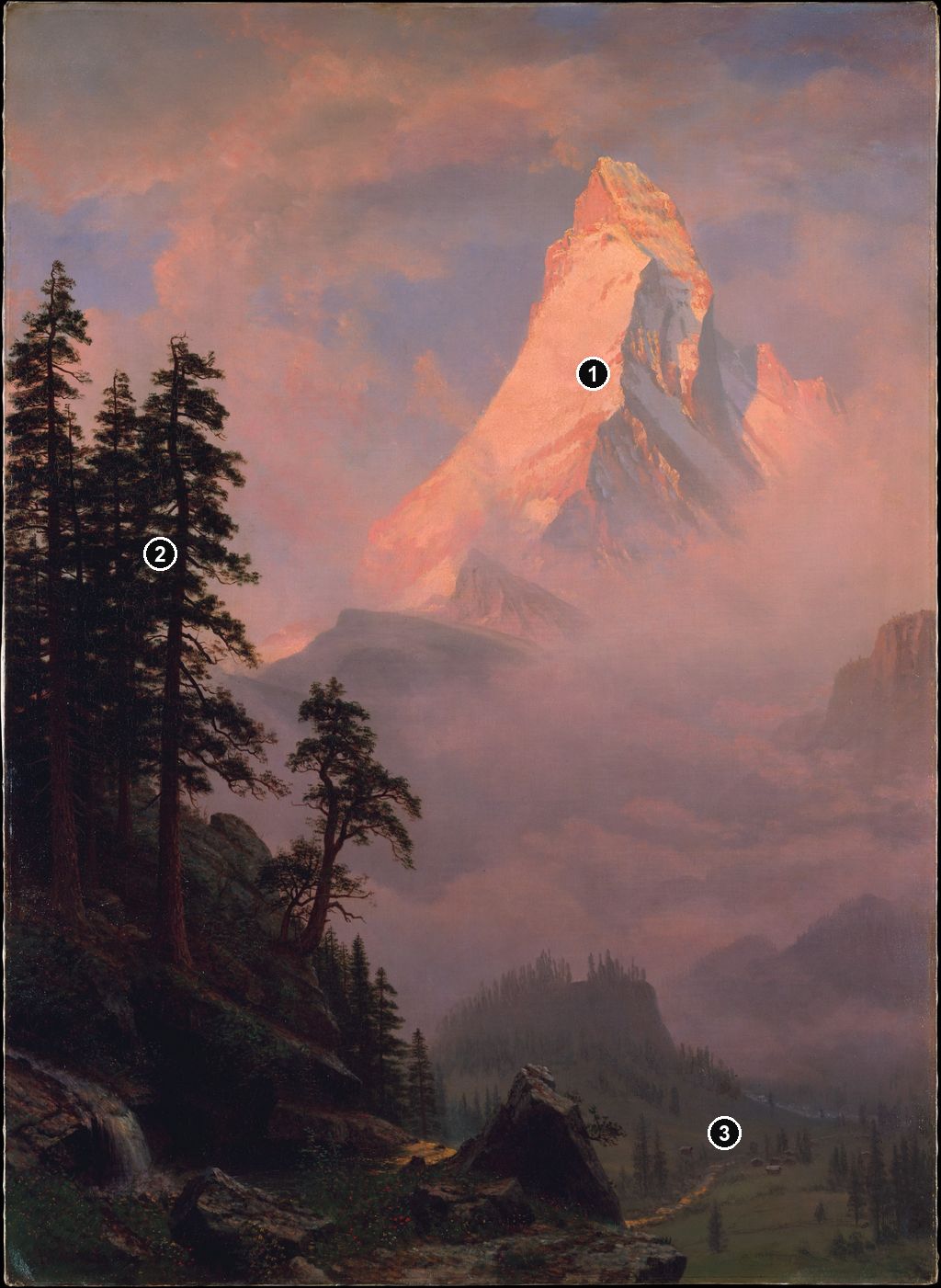
Morning reaches the summit long before it reaches the valley. In Albert Bierstadt’s Sunrise on the Matterhorn, a great pink face of rock and snow rises above cloud, while the evergreen trees, boulders and buildings below remain in shadow. The peak seems almost suspended in the sky. Only after following the intervening ridges down into the valley does its immense height become fully apparent.
The Metropolitan Museum of Art dates this oil on canvas to after 1875, leaving its precise year open. Measuring 148.6 × 108.3 cm, it entered the museum as Mrs. Karl W. Koeniger’s gift in 1966, accession 66.114. [1]
At a Glance
Annotated Details from Sunrise on the Matterhorn
Use the numbered details to explore how Bierstadt builds this scene from light, scale and overlapping forms. Image: The Metropolitan Museum of Art, Gift of Mrs. Karl W. Koeniger, 1966. Image source.
Details from SUNRISE ON THE MATTERHORN
Compare these enlarged passages with their positions in the full painting.
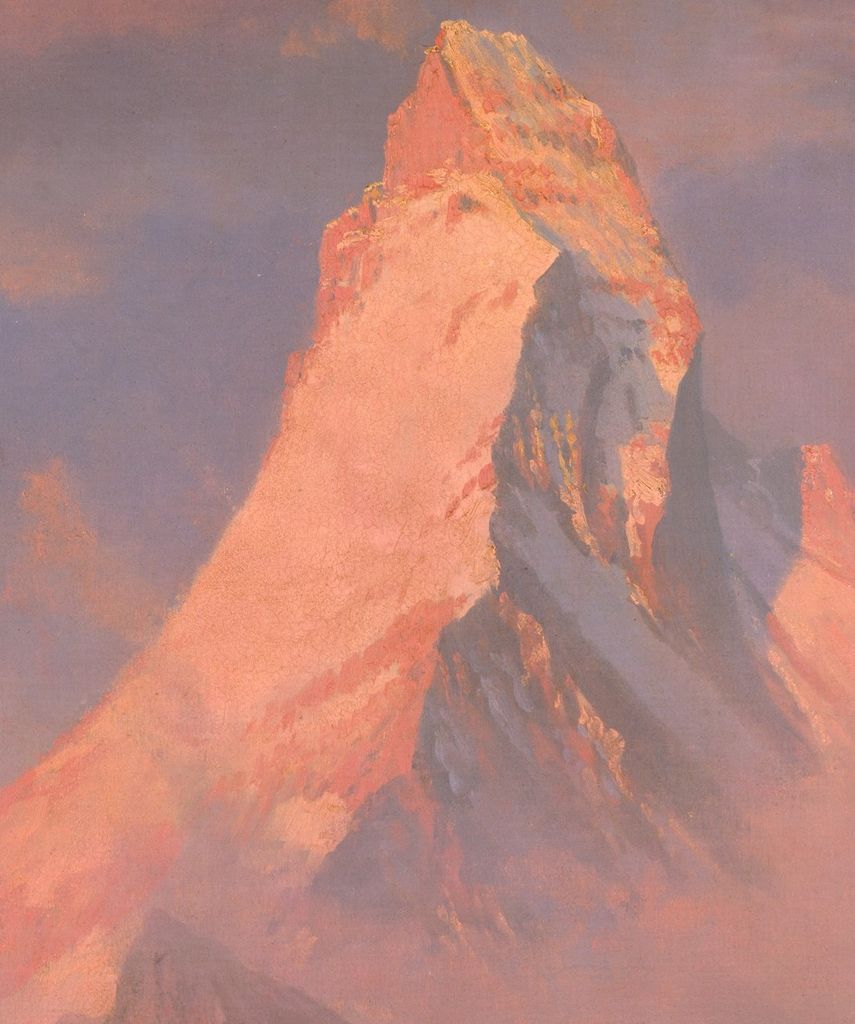
Sunlight on the summit
Compare the warmly lit peak with its darker neighbouring surfaces. A concentrated passage of colour makes the summit the focus of the view.
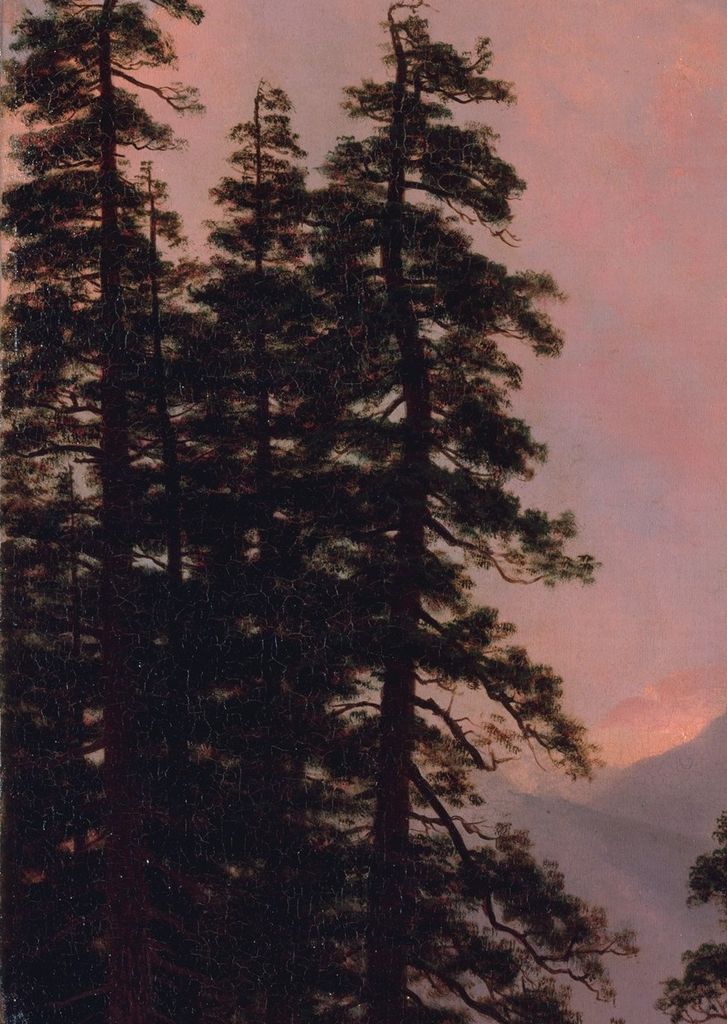
Dark trees against the distance
Follow the branching silhouettes against the lighter mountain. Their crisp edges place the trees close to the viewer.
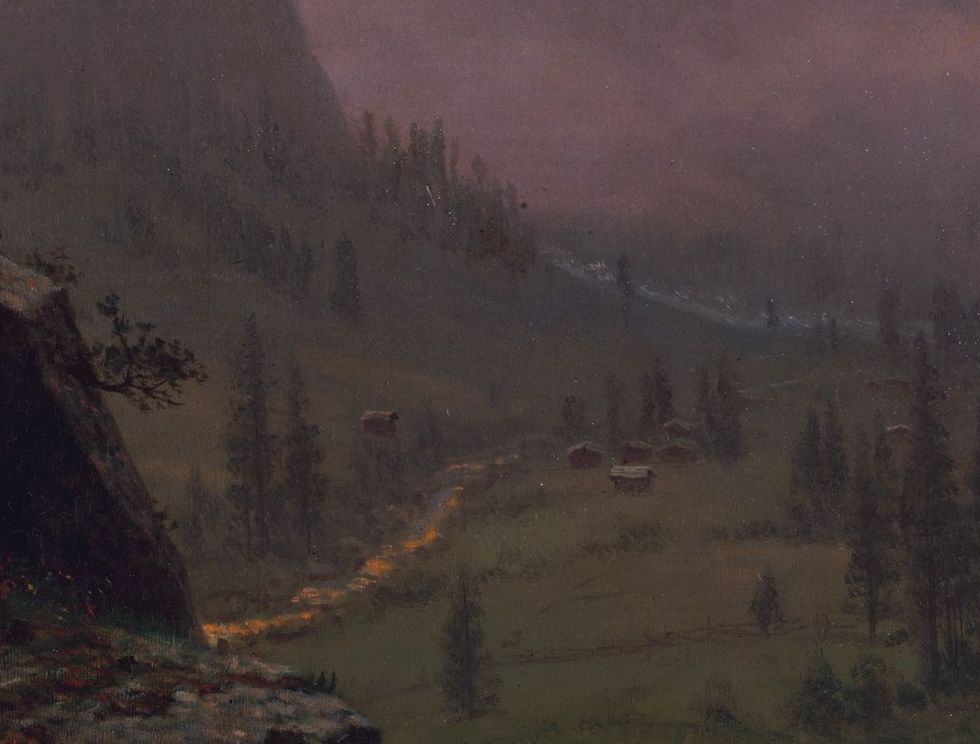
Cattle in the lower valley
Find the small cattle in the valley. Their scale draws attention to the great distance between the inhabited ground and the high summit.
Where this painting sits in Bierstadt’s career
Dates refer to the paintings, rather than to the journeys behind them. Approximate dates and ranges retain the qualifications in the collection records.
Lake Lucerne
1858Mountain Brook
1863Sunrise on the Matterhorn
After 1875Street in Nassau
c. 1877–1880The Last of the Buffalo
1888–1889The Golden Gate
1900Contents
How light builds the mountain
The principal summit stands to the right of centre, leaving room for the dark trees to rise along the left edge. Its illuminated face is broad and surprisingly simple when seen from a distance: a warm triangular expanse against a cooler, clouded sky. Along its right side, a deep blue-grey recess cuts through the pink, making the mountain turn sharply away from the light. Small warm marks catch edges within this shadow. The peak has both a clear silhouette and an intricate inner structure.
The surrounding clouds carry quieter versions of the same colours. Rose and salmon pass through the grey-violet sky, and a glowing veil partially conceals the lower slopes. The summit is the brightest concentration of a colour already spread through the atmosphere. Its light therefore belongs to the whole scene, even while setting the mountain apart.
There is no visible sun. Sunrise becomes legible through the unequal distribution of illumination: the upper mountain burns with warmth, while the nearer wooded slope remains dark. The contrast gives the scene a sense of time. It is possible to imagine the light moving lower, reaching the places that still wait beneath it. Bierstadt holds the landscape at the moment when the difference between summit and valley is strongest.
The clouds also complicate our sense of distance. Near the top, rock edges are sharply readable. Farther down, mountain, mist and sky begin to merge. A low ridge crosses beneath the peak, hiding its connection to the ground. This interruption makes the summit appear more remote than a continuous outline would. Height is expressed through separation as much as through the mountain’s pointed form.
Looking from the wooded slope
The foreground offers a quite different kind of looking. Tall conifers occupy the left side, their broken branches interrupting the sky. Below them are green undergrowth, scattered reddish flowers and irregular rocks. A small cascade drops over a ledge near the lower left corner. Close to the centre of the foreground, a pointed boulder repeats the summit’s shape on a much smaller scale. These details give the viewer somewhere to stand before looking out across the valley.
The trees are crucial measures of space. Their trunks and individual branches are clear nearby; on the projecting ridge farther down, the forest becomes a fine fringe of vertical marks. Beyond it, wooded slopes dissolve into haze. The successive changes in definition help distinguish a deep landscape from a flat arrangement of dark and light shapes.
A winding ochre line leads away from the foreground through the green valley. Small roofed buildings appear towards the lower right, diminished by distance. Their presence gives the land a human scale without competing with the mountain. The valley is habitable, but its houses occupy only a tiny part of the picture. The eye can move between the everyday space below and a summit far beyond it.
The view is elevated enough to look down over the nearest valley, yet the Matterhorn still demands an upward gaze. That double movement is the painting’s central spatial experience. The viewer stands above some of the landscape and beneath its overwhelming dominant feature. The Met describes this relationship as a juxtaposition between a distant, cloud-surrounded peak and a low rocky foreground. [1] The painting makes that distance tangible through trees, ridges, buildings and the long interval of mist.
From this wooded slope, the eye makes an ascent through the picture: past the trees, across the cloud-filled interval and up the bright rock face. The foreground gives the act of looking a position, although a precise observation site cannot be established from the view alone.
Swiss studies and a later canvas
Bierstadt made Swiss oil studies and pencil sketches with fellow American artists in summer 1856, and the Met records further sketching visits between 1867 and 1897. His engagement with the landscape extended across decades; the record does not associate this canvas with a particular visit. [1]
The earlier Lake Lucerne makes the study-to-studio process clearer. Nancy Anderson’s catalogue records that its 1858 panorama grew from the 1856 Swiss studies, and that the canvas underwent changes to mountain profiles and the position of its church. She also notes that Bierstadt’s companions watched Alexandre Calame sketching near Brunnen. [2] Such evidence belongs to the earlier work; individual studies for Sunrise on the Matterhorn have not been established here.
The comparison nevertheless helps us look at the later canvas as a constructed view. The nearest rocks are substantial enough to seem within reach, while mist interrupts the passage to the mountain. A small, tree-fringed ridge holds the lower centre, giving the eye a stopping place beneath the summit. Observation supplies the kinds of detail that make this world convincing; the intervals between them make its height compelling.
The Alps and the American mountain paintings
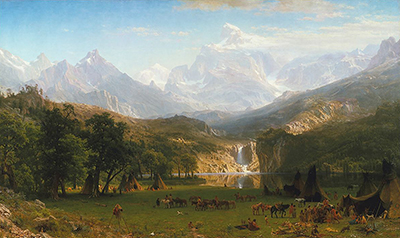
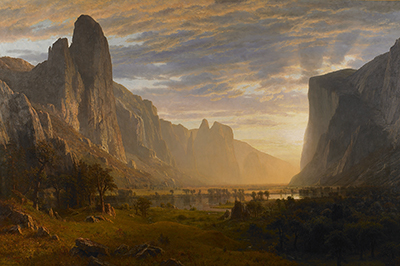
Anderson connects Lake Lucerne with the later The Rocky Mountains, Lander’s Peak and Looking Down Yosemite Valley, California, tracing how foregrounds, middle-distance water, mountain backgrounds and lighting could be adapted across subjects. [2] The Alpine landscapes belong within the development of Bierstadt’s American mountain painting as well as within his European travels.
The later Matterhorn painting keeps Alpine scenery active within that wider career. Its upright canvas concentrates the drama in one principal peak. It draws attention upwards, from the tangible wooded ground to the almost isolated summit. The valley supplies depth and scale; the mountain commands the upper space.
Katia Botta offers a useful comparison in her Italian-language study of representations of the Matterhorn. In section 4, she places Bierstadt’s painting beside Calame’s Le Mont Cervin, vu du Lac Noir (1840) and Federico Ashton’s Monte Cervino dal Riffelsee (1876). She interprets all three through the sublime, emphasising the mountain’s upward thrust, the vertical organisation of the picture and the resulting sensation of vertigo. This is a comparison of pictorial effects, rather than evidence that Bierstadt copied either work. [3]
That reading helps describe the tension visible here. The pink light and softly coloured clouds invite lingering attention, but the steep rock face and the space beneath it resist easy imaginative access. Beauty and daunting scale coexist. Even the nearest trees contribute: their sharp, dark outlines provide familiar forms against which the distant summit becomes extraordinary.
Studying the shape of the Matterhorn
The mountain’s apparent steepness had already prompted a searching discussion in John Ruskin’s Modern Painters. In volume IV, first published in 1856, he distinguished the impression of near-vertical cliffs from their measurable form. He examined the Matterhorn from different positions, including the Riffelhorn, and used a daguerreotype to check whether enthusiasm had distorted his drawing. In the chapter on precipices, an overwhelming visual impression becomes a reason for more careful observation. [4]
That distinction sharpens our attention to Bierstadt’s peak. The broad illuminated face is tilted into space; a darker recess turns its right edge away from us. Snow and pale rock marks interrupt the pink surface, while the flank descending to the right spreads the mountain’s mass beyond its pointed summit. Following these forms makes the peak less like a simple triangle. We can register its complexity while still feeling the force of its upward thrust.
Ruskin’s method also makes the viewpoint matter. A mountain’s outline changes as the observer moves. Bierstadt gives us a sustained experience from one pictured position, where trees secure the near edge and atmosphere opens a long interval beneath the summit. That arrangement offers a coherent spatial experience while leaving the observer’s precise station unestablished.
The Guild of St George preserves Ruskin’s 1849 The Matterhorn from the Moat of the Riffelhorn, one of the studies made for Modern Painters. Its account stresses his use of several angles and distances to understand the mountain’s structure. [5] Looking at this study alongside Bierstadt’s canvas brings two ways of organising attention into focus. Ruskin’s brown and pale surfaces spread across the snowfields, with bands of exposed rock leading towards the central peak. The nearer ground continues into the mountain’s lower mass. In Bierstadt’s painting, trees and inhabited green land occupy the lower space, while a luminous haze loosens their connection with the summit.
The difference lies partly in the work each image asks the eye to perform. Ruskin’s study encourages us to trace structures across the surface and relate the peak to its supporting slopes. Bierstadt keeps directing us between sharply present foreground forms and a distant height revealed through changing light. His canvas lets the mountain appear both physically massive and briefly transformed by the morning atmosphere.
A landscape of visitors as well as summits
The shaded buildings below the peak belong to a mountain world that nineteenth-century visitors increasingly entered. In his study of Zermatt guestbooks, Jérémie Magnin examines surviving records from the Monte Rosa and Riffelhaus hotels in the 1850s and 1860s. They accommodated climbers and travellers seeking mountain views. The books recorded names, occupations and itineraries, while longer entries described climbs, weather and the work of guides. Magnin reads Alpine Club signatures as claims to status, but also finds evidence of dependence on fellow climbers, local guides and hotelkeepers. The first ascent of the Matterhorn in 1865 belongs to this visiting culture. [6]
Those records give substance to the human world around an apparently solitary summit. Looking at a mountain, staying near it and attempting to climb it involved different activities and relationships. The guestbooks describe that regional culture; they do not identify a hotel or particular visit behind Bierstadt’s canvas. In the painting itself, the buildings remain small enough to be overlooked. Yet once noticed, they give the valley another meaning: its quiet green spaces can be occupied, worked and travelled through.
Bierstadt places that accessible world beneath a peak whose brilliant light arrives much earlier. The narrow canvas gives the buildings and trees enough presence to establish familiar distances, then stretches the eye across haze towards a height that exceeds them. Following the ochre line through the valley brings us back to the lower ground. Looking upwards again restores the summit’s isolation. The painting’s scale depends on that repeated movement between places we can imagine inhabiting and a mountain we must contemplate across the intervening air.
Watch: Albert Bierstadt
Five perspectives on his paintings and their historical setting.
American Landscape Painting: Albert Bierstadt and the American Land
A Museum of Fine Arts, Boston presentation on American Landscape Painting: Albert Bierstadt and the American Land.
Explore Bierstadt’s artworks
Discussion
How does the contrast between the illuminated peak and shaded valley establish the mountain’s height?
Reader Insights
Follow the pink summit into its blue-grey recesses. Which colour or edge most strongly makes the mountain turn in space?
Compare the pointed foreground boulder with the distant peak. How do these echoes connect the wooded slope to the mountain?
Compare Ruskin’s Matterhorn study with Bierstadt’s painting. How do exposed rock, snow, trees and haze guide your attention differently?
Join the Conversation
Share a specific observation, documented connection or comparison from Sunrise on the Matterhorn.
References
- The Metropolitan Museum of Art, “Sunrise on the Matterhorn,” collection record 10158, accession 66.114. Introductory interpretation and “Artwork Details”: dating, medium, dimensions, gift, Swiss studies and later visits. View source text
- Nancy Anderson, “Albert Bierstadt” and “Lake Lucerne,” in American Paintings of the Nineteenth Century, Part I, National Gallery of Art, 1996, printed pp. 31–38. Especially p. 33, technical notes and the 1856 Swiss journey; p. 34, field studies and studio composition; pp. 36–38, Calame and the relationship to the western landscapes. Travel testimony and earlier documentary material are discussed through Anderson’s catalogue account. View source text
- Katia Botta, “Il Cervino. Mediazioni di una Gestalt montana,” Aesthetica Preprint 127, September–December 2024, §4, printed p. 205 and note 7. Italian-language article; comparison of Bierstadt, Calame and Ashton. DOI: 10.7413/0393-85221487. View source text
- John Ruskin, Modern Painters, vol. IV, Part V, “Of Mountain Beauty” (first published 1856), chapter XVI, “Resulting Forms: Third, Precipices,” §§6–12. National Library Association edition, transcribed by Project Gutenberg, ebook 31623. View source text
- The Guild of St George, “The Matterhorn from the Moat of the Riffelhorn,” in “Highlights of the Ruskin Collection.” Object account and image of John Ruskin’s 1849 study. View source text
- Jérémie Magnin, “Nineteenth-Century Culture of Visitors’ Books: Zermatt and the Golden Age of British Mountaineering,” KGS Forum 33 (2019), printed pp. 54–57, especially pp. 54 and 56. Swiss Federal Office for Civil Protection. Hotel records discussed through Magnin’s published research. View source text