by Tom Gurney
Tom Gurney BSc (Hons) is an art history expert with over 20 years experience
Published on June 19, 2020 / Updated on October 12, 2026
Email: tomgurney1@gmail.com / Phone: +44 7429 011000
Beached Ship by Albert Bierstadt
A vessel leans beside dark rocks, its rigging tangled against a sunset sky. Waves lift across the foreground, while smaller sailing boats remain distant shapes along the horizon. In Beached Ship, Albert Bierstadt places the heaviest object in the scene close to shore and gives the open sea a contrasting band of light.
Sotheby’s catalogued this composition in its 2007 American paintings sale, lot 169, as an oil on canvas signed and dated 1859 at the lower left, measuring 43.2 × 59.7 cm.[1] The auction image matches the ship, shore and distant vessels in the reproduction shown here. The entry documents the work’s history through that sale; it does not establish its present owner or an exact coastal location.
At a Glance
Where this painting sits in Bierstadt’s career
Dates refer to the paintings, rather than to the journeys behind them. Approximate dates and ranges retain the qualifications in the collection records.
Lake Lucerne
1858Beached Ship
1859Mountain Brook
1863Street in Nassau
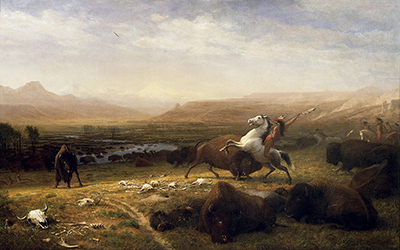
c. 1877–1880The Last of the Buffalo
1888–1889The Golden Gate
1900Contents
The painting's documented history
The auction entry lists a 1980 exhibition at Hirschl & Adler Galleries in New York and an earlier Sotheby's sale on 13 February 1982. It records the 2007 seller's acquisition at that sale.[1] This gives the picture a documented modern history, without supplying a nineteenth-century commission or an account of the scene's origin.
Sotheby's 2007 condition note describes lining and craquelure.[1] That historical auction assessment does not establish when the treatment occurred or the canvas's present condition. The published reproduction remains useful for following the arrangement of ship, sea and sky, while leaving those material questions separate.
A marine subject from New Bedford's artistic community
The National Park Service places Bierstadt's upbringing and early drawing teaching in New Bedford. After studying in Düsseldorf, he returned in 1857 and organised an art exhibition in the city in 1858. The following year brought his first western expedition.[2] Beached Ship therefore belongs to a year associated with his western travels, but its coastal subject shows that those travels did not exhaust his interests.
The local artistic community included painters specialising in maritime subjects. In her 2016 account of William Bradford, Whaling Museum curator Christina Connett records Bradford's friendship with Bierstadt and the inclusion of his New Bedford Harbor at Sunset in Bierstadt's 1858 exhibition. She also describes Bradford's work with Albert van Beest and their place in the region's marine tradition.[3]
These connections help situate the painting among artists for whom ships, coasts and light were familiar subjects. They do not identify this shore as New Bedford, establish that Bierstadt witnessed a wreck, or make Bradford the source of the composition. The distinction allows the picture to be considered within a documented artistic community while retaining its own uncertain narrative.
Near danger and distant light
The tilted ship occupies the left half, close to a steep group of rocks. Its hull remains largely dark, with a warmer patch catching light on the right. Above it, masts, spars and lines cross at irregular angles. A few pieces of sail remain visible among them. The complicated upper structure makes the broad hull seem heavier by comparison.
The water cuts across this weight with a sequence of moving crests. Pale foam catches the sunset and briefly outlines each wave. One rises beside the rocks, another lifts at the right, and smaller broken lines pass through the foreground. There is no single continuous path into the picture: the dark troughs and bright crests repeatedly interrupt it.
A small boat lies low in the nearest water, its projecting oar or spar crossing a patch of foam. It contributes to the sense of disruption without supplying a clearly visible rescue story. The reproduction does not allow us to identify its occupants or purpose.
Farther away, the arrangement becomes simpler. A vessel with two pale sails sits near the centre-right; other sails grow less distinct towards the edge. Their small scale and comparatively upright shapes differ from the close ship’s tilt. The straight horizon gives a stable line to a scene whose foreground is unsettled.
Most of the light belongs to the sky. Yellow spreads above the horizon, with a pale opening at the right and red-orange clouds higher up. A shaft of sunlight breaks through at the right, away from the principal vessel. That glow makes the ship’s dark outline emphatic. The painting’s drama comes from the relationship between the disturbed near water and the luminous space beyond it.
An early marine subject
The Haggin Museum’s account of Bierstadt’s seascapes notes his harbour subjects of the 1850s and 1860s. It places the more extensive Farallon Island wave studies in 1872, followed by Bahamian seascapes after his first visit in 1877.[4] Beached Ship belongs earlier in that sequence, showing that marine subjects were part of his work before the familiar later breaking waves.
Its sea already has a strong role in organising the composition. The repeated wave crests carry light across the lower half, and their dark troughs increase the vessel's apparent weight. This is a different emphasis from a picture centred on the shape and transparency of one enormous breaker. Here, the ship remains the most conspicuous close object, and the moving water continually changes how much of it can be seen.
Newport Rocks: another coast in 1859
Bierstadt's Newport Rocks offers a useful comparison from the same year. The McMullen Museum of Art identifies that work as oil on panel and dates it to 1859. Jeffery Howe's accompanying account discusses the contrast between turbulent foreground water and a luminous, calmer distance, placing the coastal subject within Newport's attraction to artists and patrons.[5]
In its reproduction, pale green swells and white foam spread around the foreground rocks. A brilliant horizontal strip marks the distant water, where small sailing ships appear. Beached Ship uses a related contrast of near turbulence and distant light, but the vessel gives that contrast a more immediate human consequence. Its damaged forms occupy the place where Newport Rocks offers a direct study of waves and shore.
The comparison shows the value of looking beyond Bierstadt's mountain pictures when considering his early work. Two coastal paintings can share an interest in recession and light while differing in the kind of attention they invite. Their common date does not establish a sequence of making or place them on the same stretch of coast.
Bradford's wreck and the boundary of identification
William Bradford's Shipwreck off Nantucket, dated about 1860–1861 by the Metropolitan Museum of Art, depicts a documented event. The museum records the grounding of the whaling ship Nantucket at Nashawena Island on 8 August 1859 and Bradford's visit the next day. Its account links the heavy seas and tilting ship to his work with van Beest.[6]
Bradford's picture makes the slanting deck and the activity of surrounding small craft prominent. The vessel is large and brightly exposed beneath a cool, broken sky. Bierstadt places much of his nearer ship in shadow, allowing the warm sky and the distant sails to remain strong competing attractions. The two paintings demonstrate different ways of joining a damaged vessel to moving water.
The Met's identification belongs to Bradford's painting. Nothing in the consulted record for Beached Ship identifies it with the Nantucket disaster. Keeping the works distinct is essential: a similar date and a shared maritime setting offer grounds for comparison, but do not establish that they tell the same story.
Looking forward to the Ancon
Compare it with Wreck of the Ancon in Loring Bay, Alaska of 1889. The later picture sets a listing vessel within relatively still grey water; here the waves and sunset keep the near scene active. Both make the ship’s imbalance easy to read, but the surrounding conditions give that imbalance a different force.
Watch: Albert Bierstadt
Five perspectives on his paintings and their historical setting.
American Landscape Painting: Albert Bierstadt and the American Land
A Museum of Fine Arts, Boston presentation on American Landscape Painting: Albert Bierstadt and the American Land.
Explore Bierstadt’s artworks
Discussion
How does the ship’s tilted position affect the contrast between the near shore and distant light?
Reader Insights
Follow the heavy hull into the tangled lines above it. Which forms make the vessel feel most vulnerable?
Compare the stranded vessel with the small sailing boats along the horizon. How does their separation shape the scene’s sense of danger?
Compare the damaged vessel here with the waves and rocks in Bierstadt’s Newport Rocks, also dated 1859. How does the presence of a ship change the effect of foreground turbulence and distant light?
Join the Conversation
Share a specific observation, documented connection or comparison from Beached Ship.
References
- Sotheby’s. Albert Bierstadt, Beached Ship, American Paintings, Drawings and Sculpture, New York, 28 November 2007, lot 169. Description, provenance, exhibition and historical condition note; matching image. Captured catalogue entry. View source text
- National Park Service. “Albert Bierstadt,” New Bedford Whaling National Historical Park. Early teaching, Düsseldorf study, 1857 return, 1858 exhibition and 1859 western travel. View source text
- Christina Connett. “Inner Light: The World of William Bradford,” New Bedford Whaling Museum Bulletin, Summer 2016, pp. 8–9. Bradford's artistic connections, friendship with Bierstadt and inclusion in the 1858 exhibition. View source text
- Haggin Museum. After a Norther, Bahamas. Collection entry, early harbour subjects, the May 1872 Farallon visit and later Bahamian work; chronology belongs to Bierstadt's wider marine production. View source text
- Jeffery Howe; McMullen Museum of Art. Newport Rocks, 1859, 2021.17, Carolyn A. and Peter S. Lynch Collection. Object details and coastal interpretation; reproduction inspected for comparison. View source text
- Metropolitan Museum of Art. William Bradford, Shipwreck off Nantucket (Wreck off Nantucket after a Storm), c. 1860–1861, 1971.192. Object details, documented grounding, Bradford's visit and van Beest context; reproduction inspected. View source text