by Tom Gurney
Tom Gurney BSc (Hons) is an art history expert with over 20 years experience
Page created on September 3, 2026 / Page updated on September 13, 2026
Email: tomgurney1@gmail.com / Phone: +44 7429 011000
How Sacred Images and Objects Work within Belief, Ritual and Community
Religious art is made in relation to sacred belief and practice. It may support worship, meditation, teaching, ritual presence, pilgrimage, commemoration or private devotion. A work can narrate scripture, embody a deity, preserve sacred words, mark a holy place or organise a community's attention.
There is no single religious style. Some traditions make figural images central; others give special importance to calligraphy, geometry, architecture, sound or guarded objects. Meaning depends not only on what an artwork depicts, but on what people did with it, where it stood and how its materials were understood.[1]
At a Glance
- Core ideareligious art is made in relation to sacred belief, practice, teaching or communal identity.
- Function mattersdevotion, ritual, scripture, architecture and public display create different kinds of object.
- Image is not requiredwriting, pattern, material, sound-bearing objects and architecture can carry sacred purpose.
- Museum cautiondisplay cases can separate objects from touch, movement, offering and restricted access.
- Explore nextcompare mythological art and iconography and symbols .
Contents
What makes art religious?
Subject is one clue, not the whole definition. A scene from scripture may be religious art, but so may a manuscript page without figures or an object whose sacred power depended on wrapping, chanting and ritual use. An artwork now isolated in a museum may originally have been touched, carried, opened, veiled, illuminated or approached in prayer.
Function distinguishes religious art from adjacent categories. History Painting can include biblical narrative as elevated composition; religious art asks how an image operates within belief and devotion. Mythological Art discusses the inherited genre term and the remaking of consequential stories. Neither category determines whether a community regards a subject as sacred or true. Painting Genres provides the wider map.
Religious identity can also change. An object may move from temple, church, home or ceremonial setting to collection and museum. That shift offers new access while removing actions, sounds and relationships that once completed its meaning.
Eight religious artworks and their different functions
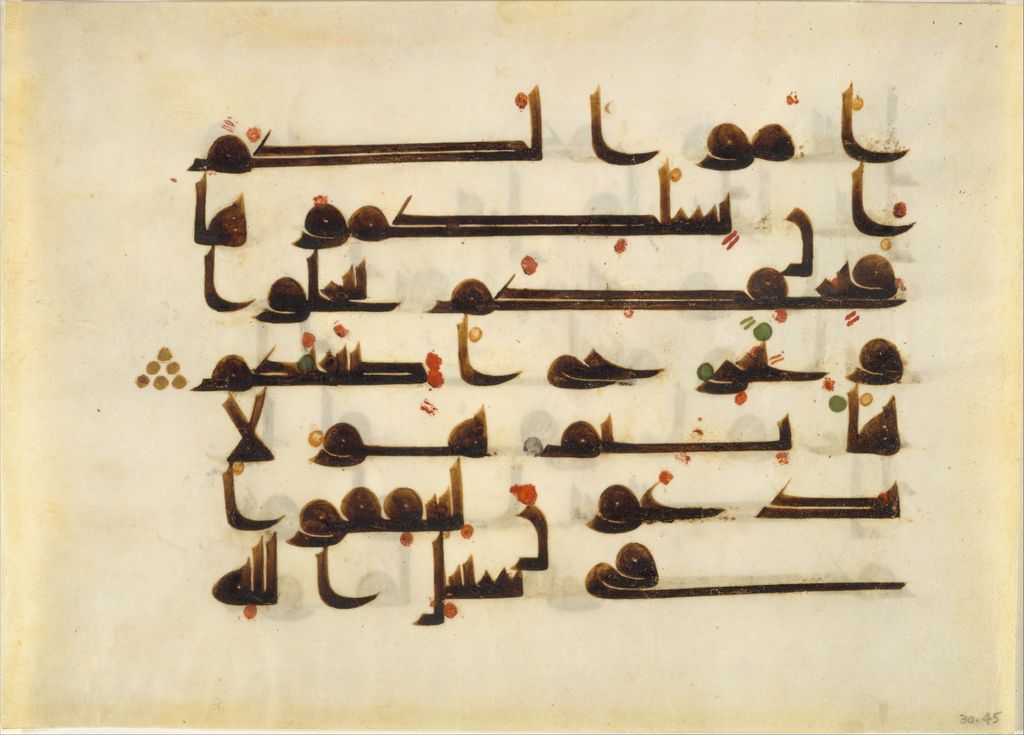
Sacred text — Folio from a Qur'an Manuscript
A parchment folio probably made in Syria in the late ninth or early tenth century carries Qur'anic text in black ink, with gold and coloured marks.[2] Horizontally extended letters respond to the rectangular page; a broad-nibbed reed pen gives the script its measured weight.
The page demonstrates that religious art need not picture a sacred figure. The written revelation is itself the focus. Line, interval, material and recitation belong together, and aesthetic attention cannot be separated from the text's religious status. Treating the folio merely as “decoration” would miss its primary purpose.
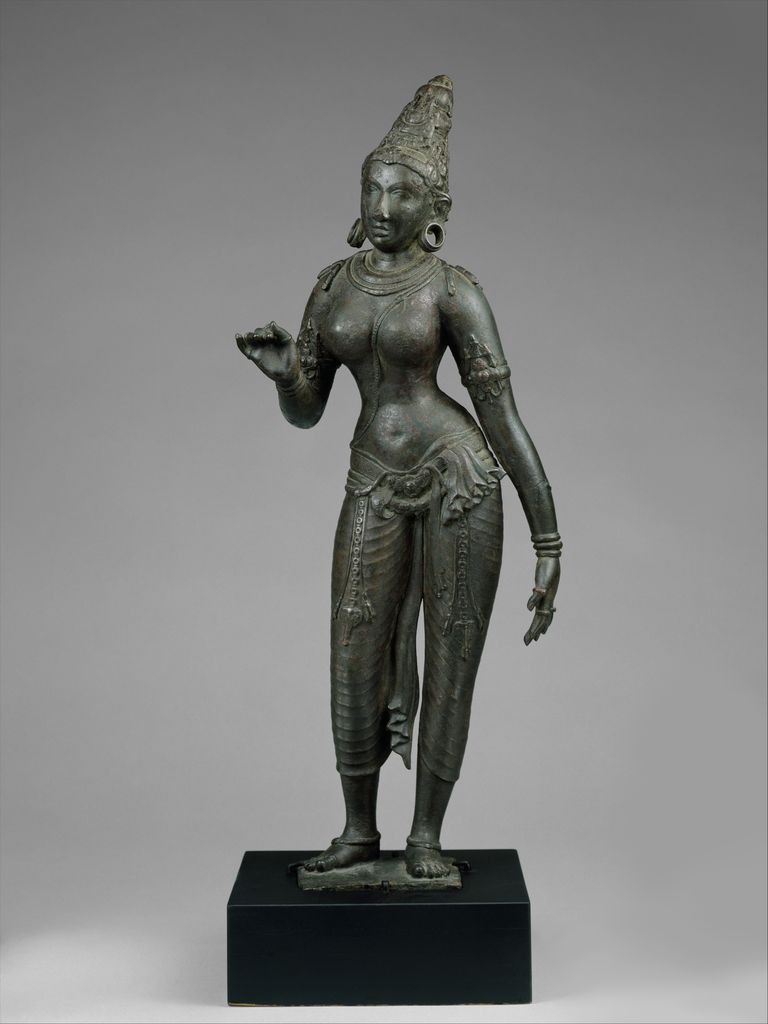
Divine presence — Standing Parvati
The Chola-period copper-alloy Standing Parvati, made in Tamil Nadu around the first quarter of the tenth century, presents the Hindu goddess with an upright, rhythmic stance and tall headdress.[3] Parvati is the consort of Shiva and mother of Ganesha.
South Asian sacred images were created as focuses for worship and meditation as well as expressions of philosophical ideas.[1] A sculpture of a deity is not simply a portrait in the Western sense. Consecration, offering, procession and darshan—the reciprocal act of seeing and being seen by the divine—can make presence and encounter fundamental to its life.
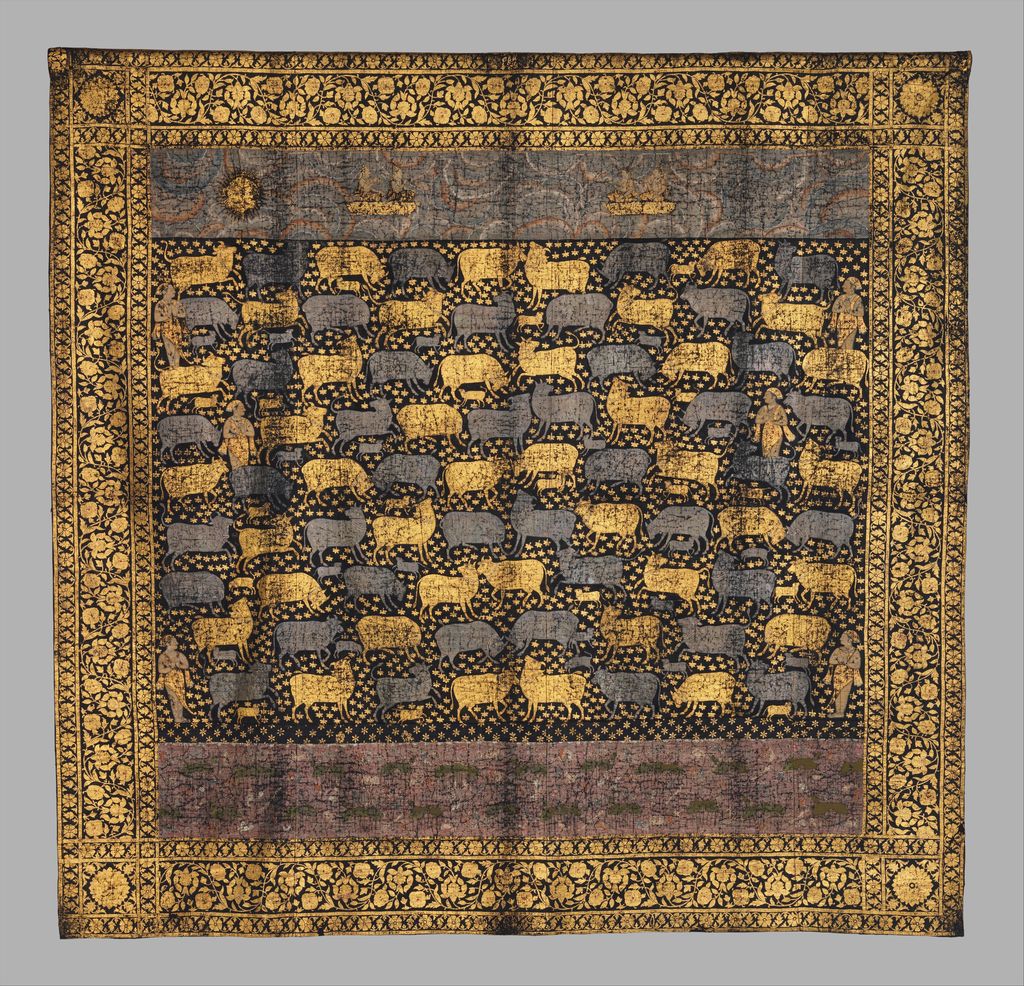
Temple setting — Pichhwai for the Festival of Cows
This large late-eighteenth-century Pichhwai for the Festival of Cows was made in the Deccan for a community devoted to Shri Nathji.[4] Painted cloths of this kind hung behind a temple's principal image. Cows and calves fill an indigo ground amid gold, silver and flowers, celebrating Krishna's elevation from tender of calves to cowherd.
The textile is both image and environment. Its scale and placement transformed the shrine for a festival. Seen behind glass today, it remains visually abundant, but the museum encounter differs from the seasonal, communal and devotional setting for which it was created.
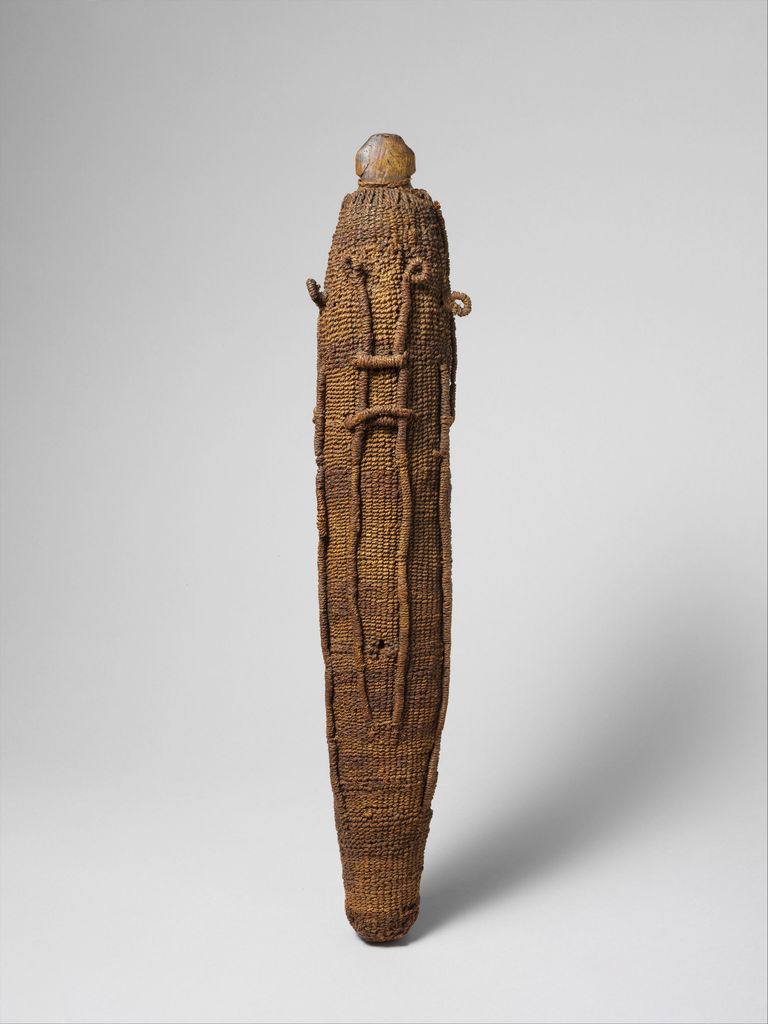
Binding words and body — To'o
An eighteenth-century Mā'ohi to'o from Tahiti is formed from wood, coconut fibre and feathers.[5] Loops of cord refer to facial and bodily features. According to the Met's account, binding the image with a fibre “skin” accompanied chants; the material was understood to catch spoken words and encourage a deity to inhabit the object temporarily.
Its abstraction is not absence. Body, material, voice and sacred presence are joined through practice. Looking at the complete object while ignoring the actions that animated it would impose a museum idea of sculpture on a ritual image with a different ontology.
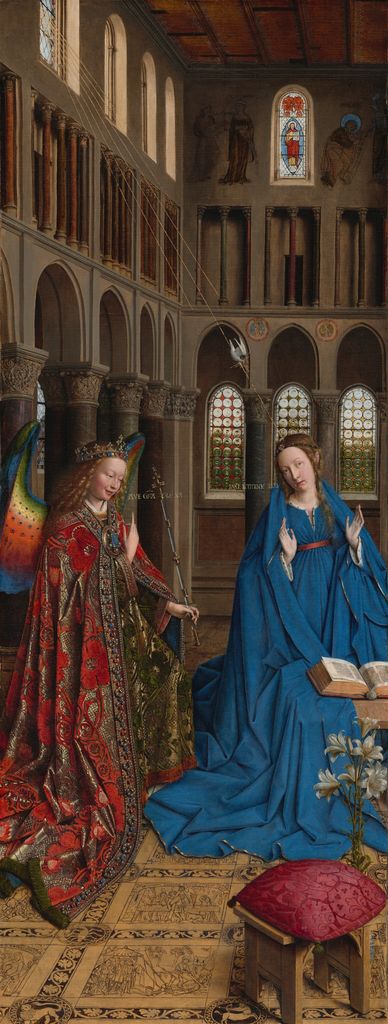
Scripture in architecture — The Annunciation
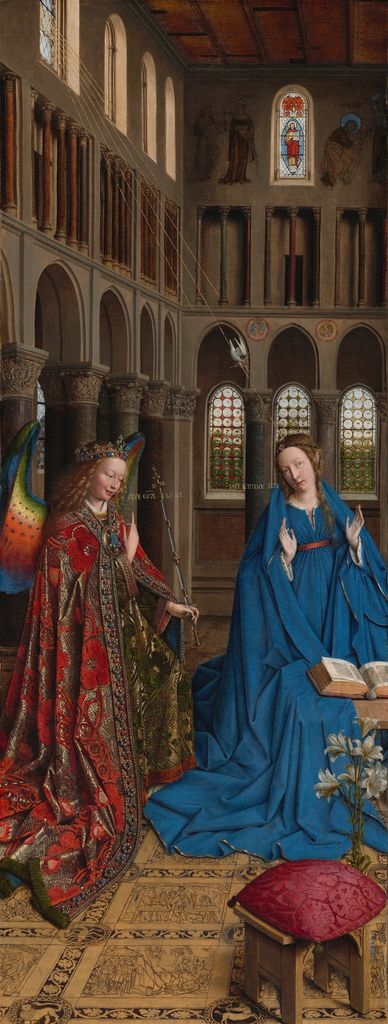
Jan van Eyck's The Annunciation, around 1434–36, sets Gabriel's greeting to Mary inside a richly articulated church.[6] Inscriptions, patterned floor tiles, rays of light and architectural differences gather multiple layers of Christian meaning into the encounter.
The panel's detail rewards close devotion as well as narrative reading. The church is not a neutral backdrop; it connects Mary, sacred history and an institution imagined across time. Its current museum presentation preserves the image but not necessarily the larger structure or devotional rhythm to which a panel could once belong.
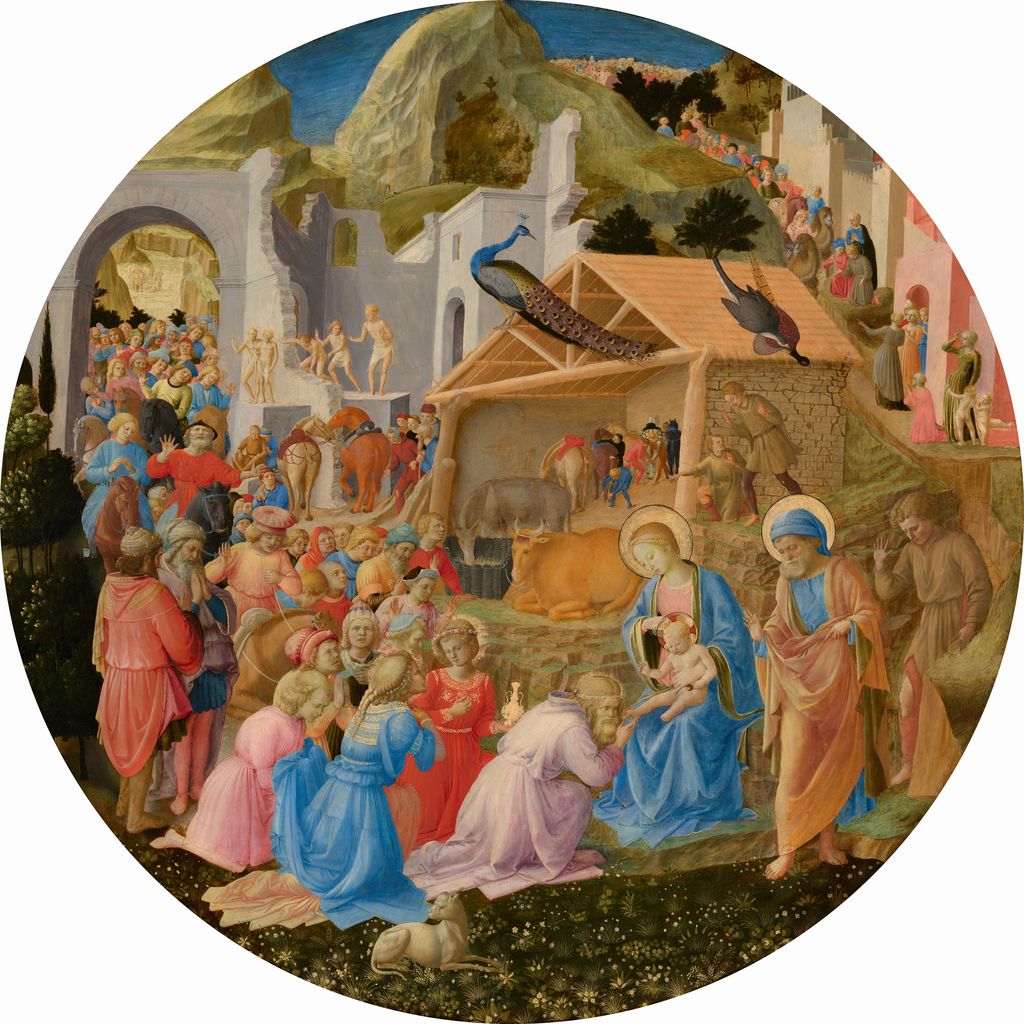
Communal procession — The Adoration of the Magi
Fra Angelico and Fra Filippo Lippi's circular Adoration of the Magi, painted around 1440–60, gathers Mary and the Christ Child, kneeling visitors, animals, attendants, ruins and distant landscape.[7] The procession curves around the tondo, allowing different ages, costumes and responses to converge on one sacred centre.
The subject joins biblical narrative to ideas of homage and universal witness. The painting's richness also reflects patronage: rare clothing, animals and an expansive company make devotion socially and materially visible.
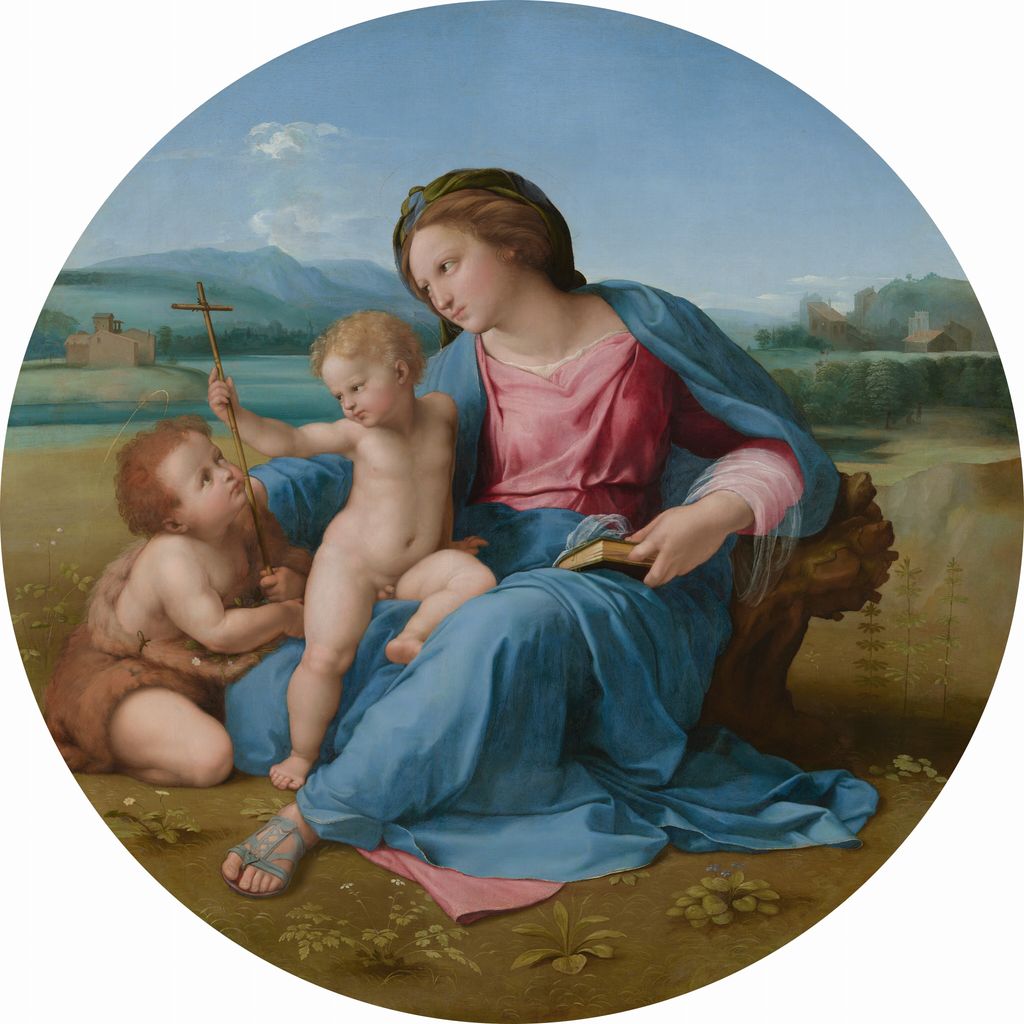
Intimacy and foreknowledge — The Alba Madonna
Raphael's Alba Madonna (around 1510) groups Mary, the Christ Child and young John the Baptist within a circular landscape.[8] Their bodies create an interlocking, low pyramid. The children attend to a reed cross, introducing Christ's future Passion into a tender meeting.
The tondo format concentrates relation. Gesture, gaze and touch turn doctrine into an intimate exchange without eliminating foreknowledge of suffering. Religious art often works through this compression of different times: childhood can contain a future sacrifice, and meditation moves between affection and prophecy.
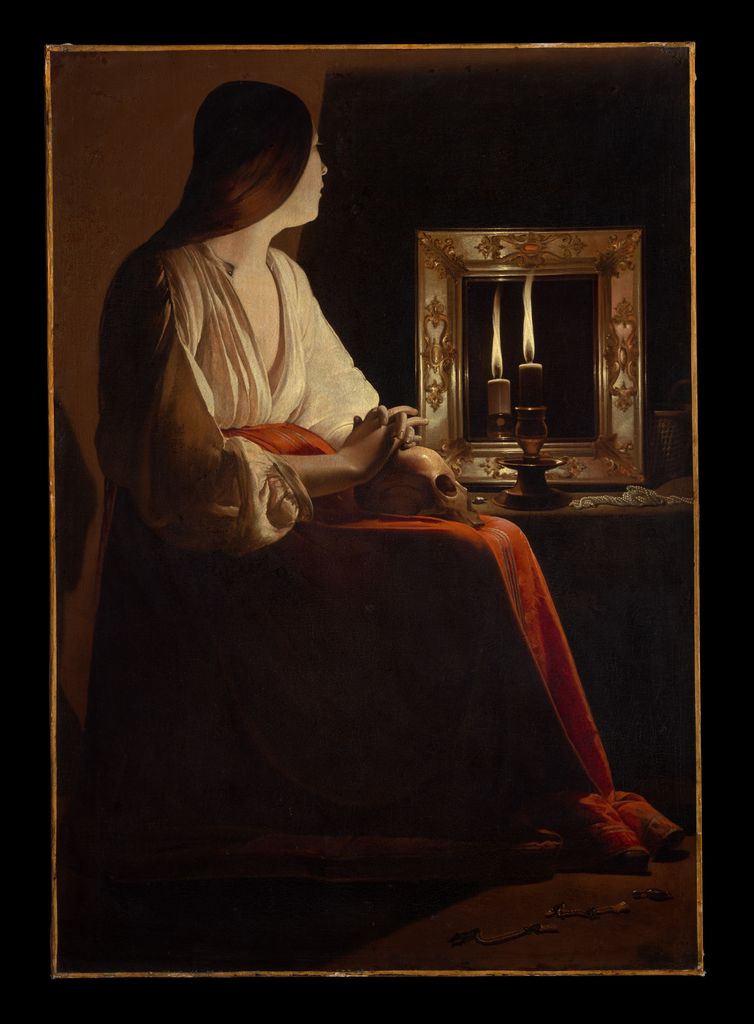
Private penitence — The Penitent Magdalen
Georges de La Tour's The Penitent Magdalen, around 1640, shows Mary Magdalene seated beside a candlelit mirror with a skull on her lap.[9] Flame illuminates her profile and hands while most of the room remains dark.
The stillness differs from public narrative. Skull, mirror and fading light direct thought toward mortality, repentance and spiritual attention. The painting creates an inward devotional space in which looking slows to match contemplation.
Image, word and the limits of a single definition
Religions differ over what may be represented, how images should be treated and where sacred authority resides. Qur'anic manuscript art can make the revealed word visually powerful without illustrating God. Hindu sacred images can support embodied encounter. A Mā'ohi ritual image may depend on binding and recitation. Christian paintings can narrate scripture or focus prayer through saints and holy figures.
These are not interchangeable solutions to one artistic problem. Each must be described through its own concepts and historical evidence. Comparison is useful when it clarifies difference: all eight examples organise attention, but they do so through distinct relationships among material, presence, text and community.
Iconoclasm and reform also belong to the history of religious art. Images have been rejected, destroyed, concealed or altered when communities disputed their authority. Survival in a museum is therefore not a complete record of what was once made or valued.
Sacred objects before museums
Many European religious paintings were built into functional ensembles. An altarpiece stood on or behind an altar and formed a focus of devotion; it might combine static holy figures with narrative scenes.[10] Diptychs and triptychs could close for protection and range from private devotional objects to major church furnishings.[11]
Gold, scale and placement responded to real spaces. Candlelight activated reflective surfaces; processions approached images; doors opened on feast days. NGA teaching material stresses that Italian sacred panels now displayed as museum pictures were made for churches, private chapels and homes.[12]
Other traditions likewise exceed the isolated art object. A manuscript belongs to reading and recitation, a temple hanging to seasonal installation, and a ritual image to actions that may no longer occur. Labels and photographs provide evidence, but they cannot fully restore use.
Patronage, access and power
Religious art may express shared belief while also recording institutional wealth and authority. Clergy, rulers, merchants, confraternities and families commissioned works, selected subjects and sometimes appeared as donors. Precious material could honour the sacred, display generosity and assert social position at once.
Access was structured. Some objects were public, others revealed only at certain times, handled by designated people or kept within restricted spaces. Museum display can make them continuously visible, changing a regulated encounter into an individual viewing experience.
Collection history also matters, especially for objects removed through colonial power, excavation, sale or religious upheaval. Responsible looking asks how a work left its original community, what documentation survives and whether present display acknowledges continuing relationships.
Reproduction changes access again. A digital image can reveal detail and reach distant readers, but it standardises scale, illumination and viewpoint. The photograph should never be confused with the complete encounter: parchment, metal, fibre, textile and painted panel each answer touch, movement and space differently.
How to look at religious art
Begin with the tradition and object name used by its makers or community when known. Identify material, format and original setting before interpreting symbols. Ask whether the work was read, carried, opened, dressed, illuminated, offered to or seen from a distance.
Then follow attention. Text, gesture, scale, light and repetition may guide worshippers differently from museum viewers. Distinguish documented meaning from visual inference, and avoid assuming that a familiar symbol works identically across cultures.
Finally, consider change. What has been separated from the object—frame, shrine, sound, movement or community? How did patronage and power shape visibility? Religious art is not simply art with a holy subject. It is art whose form, use and reception participate in relationships people understand as sacred.
Watch: Religious Art through Formal Analysis
Choose a museum-led whole-work analysis, a close reading, or a foundations overview for considering religious art.
Introducing Formal Analysis: Landscape
Follow how subject, space, colour and composition work together across a complete artwork.
Watch on YouTubeFrequently Asked Questions
Religious art is made in relation to sacred belief, practice, teaching, ritual or communal identity.
No. Text, pattern, architecture, ritual objects and materials can have sacred functions without representing a figure.
The labels can overlap, but original function, community, living belief and historical reception should guide the distinction.
Museums may separate sacred objects from touch, movement, offering, sound, restricted access and the spaces for which they were made.
Identify the tradition and object function, use culturally appropriate sources, observe access restrictions and avoid reducing sacred meaning to a universal symbol list.
Discussion
Which object on this page changes most when you restore its original ritual, architectural or communal setting?
Reader Insights
A folio, sculpture, cloth and altarpiece organise sacred encounter differently.
Movement, touch, recitation, offering and placement can be essential.
Use the relevant community’s terms and acknowledge restricted or living practices.
Join the Conversation
Share one precise observation or a useful museum example below.
References
- Functions of South Asian Art — The Metropolitan Museum of Art
- Folio from a Qur'an Manuscript — The Metropolitan Museum of Art
- Standing Parvati — The Metropolitan Museum of Art
- Pichhwai for the Festival of Cows — The Metropolitan Museum of Art
- To'o (Ritual Image) — The Metropolitan Museum of Art
- The Annunciation — National Gallery of Art
- The Adoration of the Magi — National Gallery of Art
- The Alba Madonna — National Gallery of Art
- The Penitent Magdalen — The Metropolitan Museum of Art
- Altarpieces — National Gallery, London
- Diptychs — National Gallery, London
- An Eye for Art — National Gallery of Art