by Tom Gurney
Tom Gurney BSc (Hons) is an art history expert with over 20 years experience
Page created on September 3, 2026 / Page updated on September 13, 2026
Email: tomgurney1@gmail.com / Phone: +44 7429 011000
Reading Sea, Ship, Weather and Maritime Work Together
Marine art makes the sea, coast, ships or maritime activity structurally central. Its subjects range from precise portraits of vessels and naval encounters to fishing, ports, storms, beaches and leisure. The category is often called marine painting or maritime art; seascape usually places particular emphasis on water, weather and horizon.
A picture does not become marine art simply because a strip of water appears in the distance. Water, vessel or coastal life must organise the image's space and meaning. Artists have used that structure to represent commerce, national power, labour, travel, recreation and the sea's resistance to human control.[1]
At a Glance
- Core ideamarine art makes the sea, coast, ships or maritime activity structurally central.
- Look beyond seascapelabour, trade, travel, warfare and empire often determine the subject.
- Ships have rolesa vessel can be a portrait-like subject, a working tool or a political sign.
- Weather is activewind, wave, visibility and light organise risk, motion and scale.
- Explore nextcompare landscape art and history painting .
Contents
What counts as marine art?
Marine art can show open ocean without land, a crowded harbour, a river carrying ships, or a beach shaped by tides. Some works describe rigging and hulls with technical precision; others dissolve ship and sea into atmosphere. Prints, drawings and watercolours belong beside oil paintings because maritime imagery circulated through many media.
The boundaries with nearby categories remain useful rather than absolute. A coast can belong to Landscape Art in the broad sense, but a vessel, surf or maritime livelihood may make the marine identity stronger. A naval battle can also be History Painting when public narrative and heroic action dominate. Genre Painting overlaps when daily labour or leisure in a boat is the main event.
Marine art is therefore identified by emphasis. Ask what would be lost if the water, weather or ship were removed. If the work's spatial tension and human stakes collapse, the maritime setting is not incidental.
Six marine artworks and what they reveal
Wave, boats and distance — The Great Wave
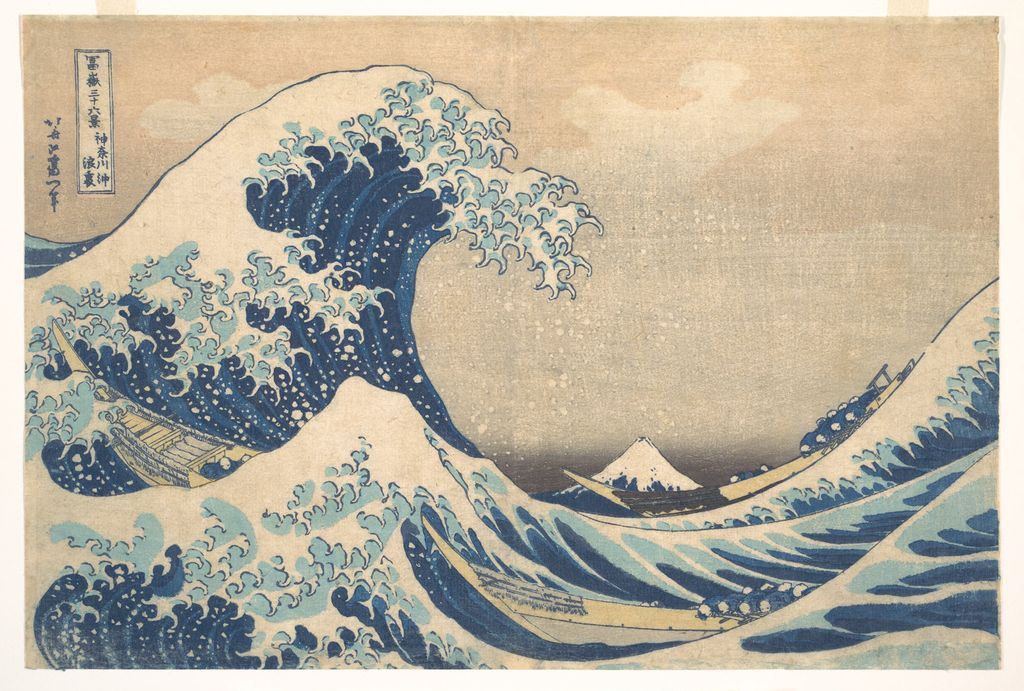
Katsushika Hokusai's Under the Wave off Kanagawa, widely known as The Great Wave, was published around 1830–32 as part of Thirty-six Views of Mount Fuji.[2] Three fast boats cut through a trough while a curling wave rises above them; Fuji sits small and steady on the horizon.
The print makes scale unstable. Foam resembles grasping fingers, yet the wave is also a precisely patterned form. The boats establish human risk, while the repeated cone of the wave and mountain binds near violence to remote permanence. Its blue, drawn from imported Prussian-blue pigment, also reminds us that marine images and their materials travelled through trade.
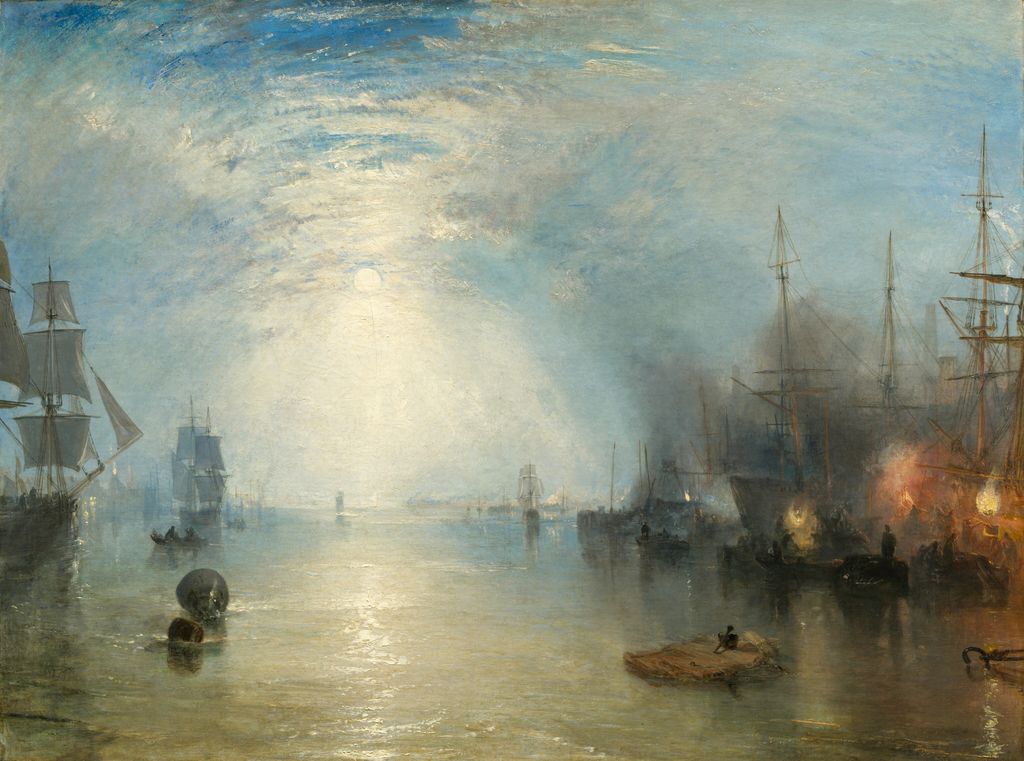
Harbour labour — Keelmen Heaving in Coals by Moonlight
J. M. W. Turner's Keelmen Heaving in Coals by Moonlight (1835) shows workers transferring coal among vessels on the River Tyne.[3] Cool moonlight spreads across water as orange fires puncture the smoke at right. Ships emerge and disappear within luminous haze.
The scene joins beauty to industrial labour. The workers are tiny, but their fires and boats animate the harbour. Turner does not separate atmospheric spectacle from the energy economy transforming Britain: coal, water transport and nocturnal work occupy the same radiant field.
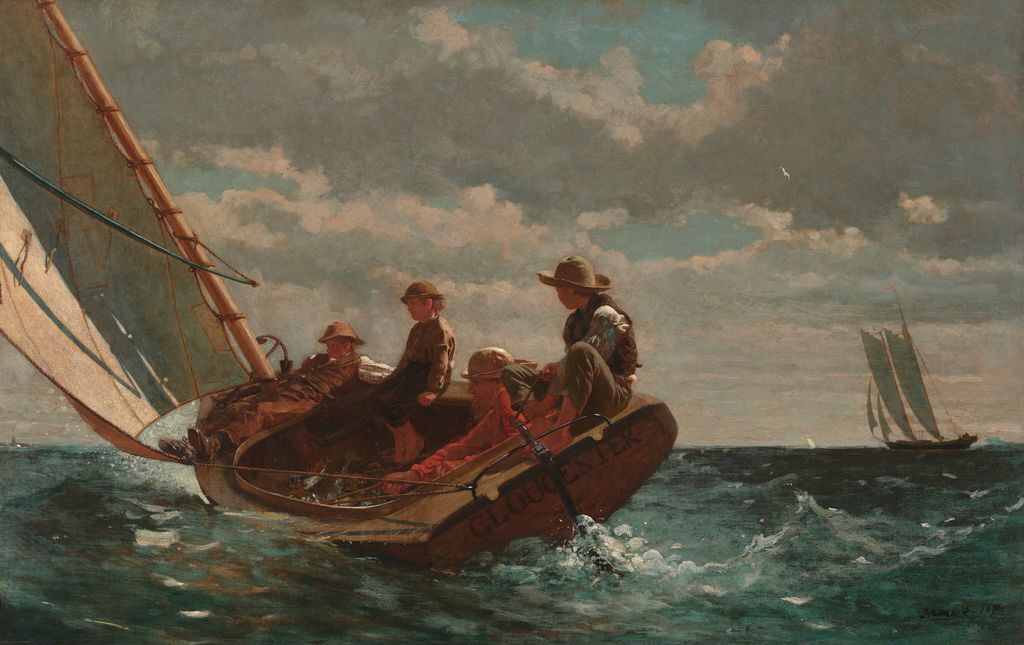
Shared control — Breezing Up (A Fair Wind)
Winslow Homer's Breezing Up, painted between 1873 and 1876, places a man and three boys in a small sailboat beneath a cropped sail.[4] The hull tilts through choppy water while a distant vessel balances the open horizon.
The title suggests favourable weather, yet the composition depends on practiced coordination. Rope, tiller, bodies, wind and wave form one system. The image can evoke recreation and optimism, but its maritime ease is learned rather than effortless.
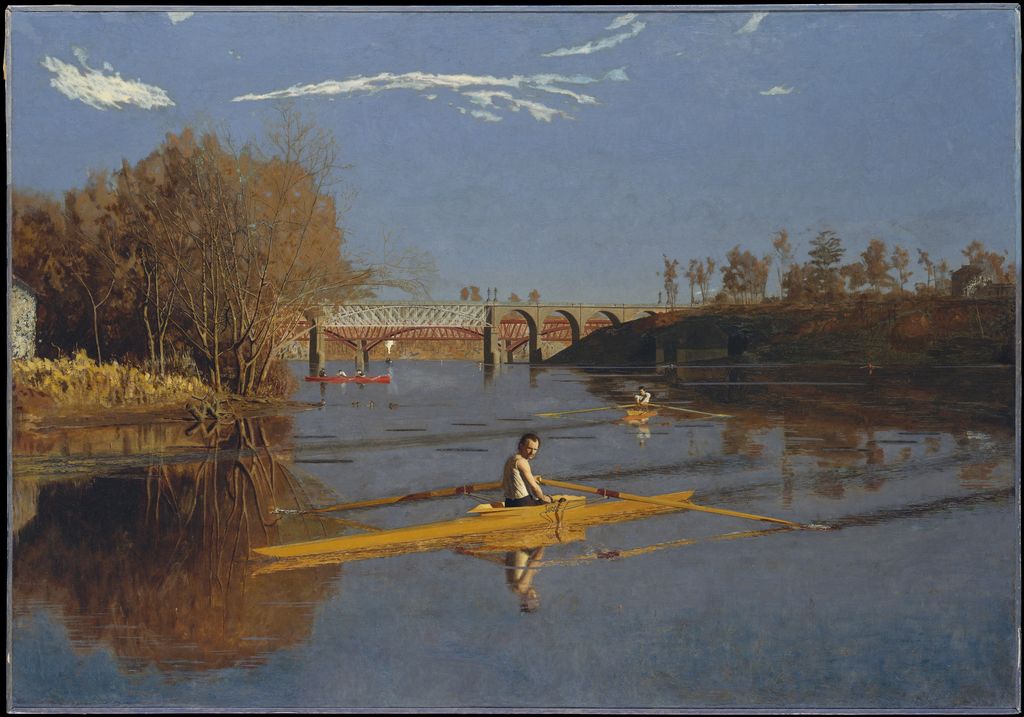
River movement — The Champion Single Sculls
Thomas Eakins's The Champion Single Sculls (1871) follows rower Max Schmitt on Philadelphia's Schuylkill River.[5] Oars, wake, bridges and banks lead back through measured space. Eakins also places himself in a second shell, making observation part of the scene.
Marine art need not concern ocean danger. Rivers create working and recreational cultures of their own. Here repeated strokes and receding bridges turn athletic movement into a study of modern place, bodily technique and controlled water.
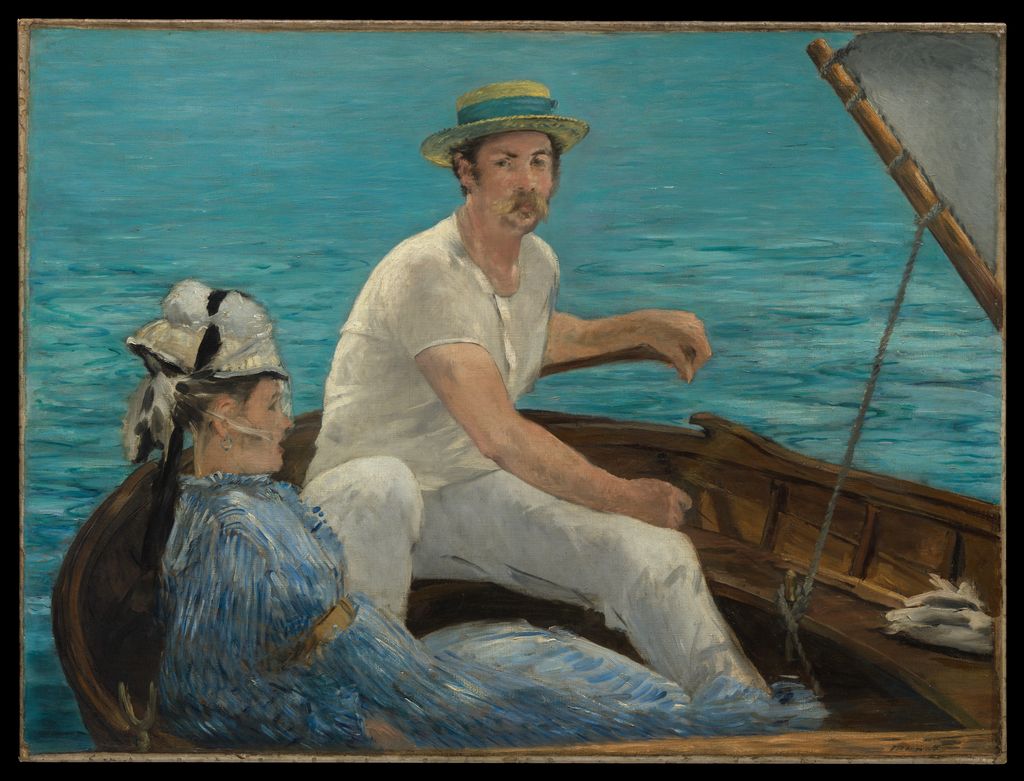
Modern leisure — Boating
Édouard Manet's Boating (1874) brings a seated woman and a man steering into abrupt proximity.[6] A large pale sail cuts across the upper left while blue water fills almost everything behind them. The cropping makes the boat feel close and the surrounding space strangely flat.
The subject is relaxed, but the composition is bold. Leisure on the Seine becomes an experiment in broad colour, compressed depth and partial view. The boat is both setting and geometric frame.
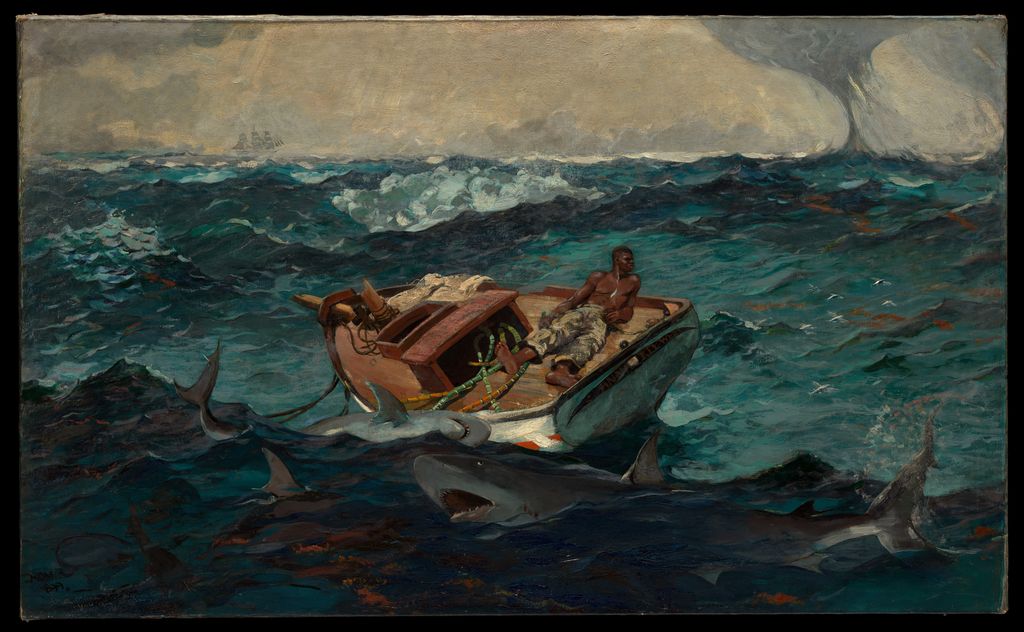
Atlantic danger — The Gulf Stream
In The Gulf Stream, begun in 1899 and reworked by 1906, Homer isolates a Black man on a damaged boat amid sharks, high water and a distant waterspout.[7] Sugarcane lies across the deck while a ship appears near the horizon. The man's outward gaze does not disclose whether he sees it.
The painting culminates Homer's sustained engagement with conflict between people and the sea, but its geography carries more than universal danger. The Gulf Stream links the Caribbean, the United States, Europe and Africa; current Met interpretation places the image amid empire and political upheaval as well as epic survival.[7] The protagonist's composure and uncertain future resist an easy rescue story.
Dutch marine painting and maritime power
Marine painting became a major speciality in the seventeenth-century Dutch Republic. Commerce, fishing and naval conflict made ships central to public life. Artists described coastal waters, harbours, calms and storms for patrons who could recognise vessel types and political associations.
Willem van de Velde the Elder made precise ship drawings and recorded fleets; Willem van de Velde the Younger developed atmospheric paintings of vessels at sea. Ludolf Backhuysen became another leading marine painter in the later century. His drawing A Ship at Sea shows a cargo vessel shortening sail beneath a low horizon, a study that could support a larger composition.[8]
Accuracy did not make these works neutral documents. A flagship's scale, a calm sea or a threatening cloud could project command, prosperity or vulnerability. NGA research on an Amsterdam Harbor Scene connects depicted ships to the First Anglo-Dutch War and to the international movement of vessels, artists and commissions.[9]
Weather, work and the sublime
The sea offers few stable landmarks. Artists organise it through horizons, wave rhythms, reflected light and the lean of a mast. Weather can be the picture's true protagonist, shifting visibility and scale even when no storm is shown.
In eighteenth- and nineteenth-century art, the sublime made overwhelming nature a major aesthetic problem. Turner could move from identifiable harbour labour to light that nearly consumes solid forms. By about 1890, Homer increasingly concentrated on the sea's force and drama, although human histories still shaped what that force meant.[10]
Marine labour complicates the romance of open water. Fishing, coal transport, rowing and sail handling depend on specialised knowledge. Tiny figures should not be mistaken for unimportant ones: their actions reveal the economic and physical systems that connect shore to sea.
Ships as portraits, tools and political signs
A ship can function almost like a portrait sitter. Distinctive rigging, flags and hulls identify a vessel, while its position establishes status or action. Commissioners might value technical recognition, commemorate a voyage or assert naval power.
Yet vessels are also tools. Their design responds to cargo, water and weather; ropes and sails record work. Reading a marine image therefore means looking beyond “a boat” to its scale, function and crew. Is it a warship, ferry, fishing craft, rowing shell or leisure sailboat?
Flags and naval formations can make political claims, but open water can undermine certainty. Storm, fog and distance remind viewers that maritime power remains contingent on conditions no state controls completely.
How marine art travelled
Maritime imagery moved along the same routes it represented. Dutch artists worked for foreign patrons, prints carried ship designs across borders, and port cities gathered objects and visual knowledge from far away. Hokusai's wave emerged within Japanese print publishing yet used a synthetic blue transmitted through international exchange. European and American artists later collected Japanese prints and learned from their cropping and pattern.
This circulation does not collapse distinct traditions into one story. It shows why marine art is inherently connected: oceans can divide places, but ships, images and materials also cross them.
How to read marine art
Start with the horizon and viewpoint. Are you safely on shore, level with a deck or almost inside the waves? Then identify the craft and activity. Count who is working, who is travelling and who controls the vessel.
Follow the weather through clouds, sails, smoke, reflections and wave direction. Compare the scale of people, ships and water. Notice whether technical detail promises mastery or atmospheric effects make structures uncertain.
Finally, ask what the sea connects. A harbour can reveal labour and commerce; a naval scene can construct national memory; a leisure boat can mark class and modern mobility. Marine art is at its strongest when water is not generic scenery but an active medium through which people work, move, imagine power and confront limits.
Watch: Marine Art through Formal Analysis
Choose a museum-led whole-work analysis, a close reading, or a foundations overview for considering marine art.
Introducing Formal Analysis: Landscape
Follow how subject, space, colour and composition work together across a complete artwork.
Watch on YouTubeFrequently Asked Questions
Marine art centres the sea, coast, ships or maritime activity as the work’s organising subject.
Seascape is an important form, but marine art also includes ports, naval actions, ship portraits, fishing and maritime labour.
Their type, rig, condition and activity can identify work, trade, conflict, technology or political power.
Wind, wave, light and visibility control movement, danger, distance and the viewer’s relation to the sea.
Identify the water, vessel, weather and activity, then connect visual evidence to maritime history and the work’s intended audience.
Discussion
Which marine work on this page makes weather, labour or political power more important than the vessel itself?
Reader Insights
Type, rig and scale can narrow the activity and date.
Wave direction, wake, reflection and horizon organise movement.
Trade, labour, empire and danger are rarely neutral background.
Join the Conversation
Share one precise observation or a useful museum example below.
References
- Seascapes — National Gallery of Art
- Under the Wave off Kanagawa — The Metropolitan Museum of Art
- Keelmen Heaving in Coals by Moonlight — National Gallery of Art
- Breezing Up (A Fair Wind) — National Gallery of Art
- The Champion Single Sculls — The Metropolitan Museum of Art
- Boating — The Metropolitan Museum of Art
- The Gulf Stream — The Metropolitan Museum of Art
- A Ship at Sea — The Metropolitan Museum of Art
- Amsterdam Harbor Scene — National Gallery of Art
- Winslow Homer (1836–1910) — The Metropolitan Museum of Art