by Tom Gurney
Tom Gurney BSc (Hons) is an art history expert with over 20 years experience
Page created on September 3, 2026 / Page updated on September 13, 2026
Email: tomgurney1@gmail.com / Phone: +44 7429 011000
When Ordinary Life Becomes the Main Event
Genre painting depicts people engaged in ordinary life: working, eating, playing, shopping, resting, learning or meeting one another. The name can be confusing because “genre” also means any category of subject, such as landscape or portraiture. In the narrower art-historical sense, however, a genre painting is a scene of everyday life rather than a portrait of a named sitter or a grand religious, mythological or historical event.[1]
The category became especially prominent in the seventeenth-century Netherlands, where specialists pictured both rural and urban society. Later artists carried everyday-life subjects into changing streets, workplaces and leisure spaces. Such paintings can feel immediate, but they are never neutral snapshots. Artists select characters, objects and gestures, then organise them for humour, sympathy, beauty, criticism or uncertainty.
At a Glance
- Core ideagenre painting centres scenes of everyday life rather than named heroes or elevated public narratives.
- Typical settingshomes, streets, schools, workplaces, markets, taverns and leisure spaces.
- Not neutral evidenceselection, staging, convention and audience shape every apparent slice of life.
- Not all unnamed figuresthe activity and social setting must organise the work, not merely appear within another genre.
- Explore nextcompare history painting and the wider painting genre guide .
Contents
What counts as genre painting?
A genre scene usually centres an activity rather than an individual's identity. A woman pours milk, children play a game, dancers rehearse or travellers wait. The figures may have been modelled from real people, yet the image presents them as participants in a recognisable social situation. A portrait, by contrast, primarily preserves and constructs the identity of a particular sitter.
The boundary can remain porous. An interior may contain carefully rendered still-life objects; an outdoor scene may also be a landscape; a modern crowd can approach social history. Subject and purpose matter more than a rigid checklist. Painting Genres sets out the wider family, while History Painting explains the elevated narrative category against which everyday-life subjects were often ranked.
The term itself was applied retrospectively. Artists and viewers did not always use today's categories, and the broad word “genres” names a system that once placed history painting above portraiture, landscape, still life and scenes of everyday life.[2] Genre painting is therefore both a useful description and a reminder that classifications are historical constructions.
Six genre paintings and the worlds they construct
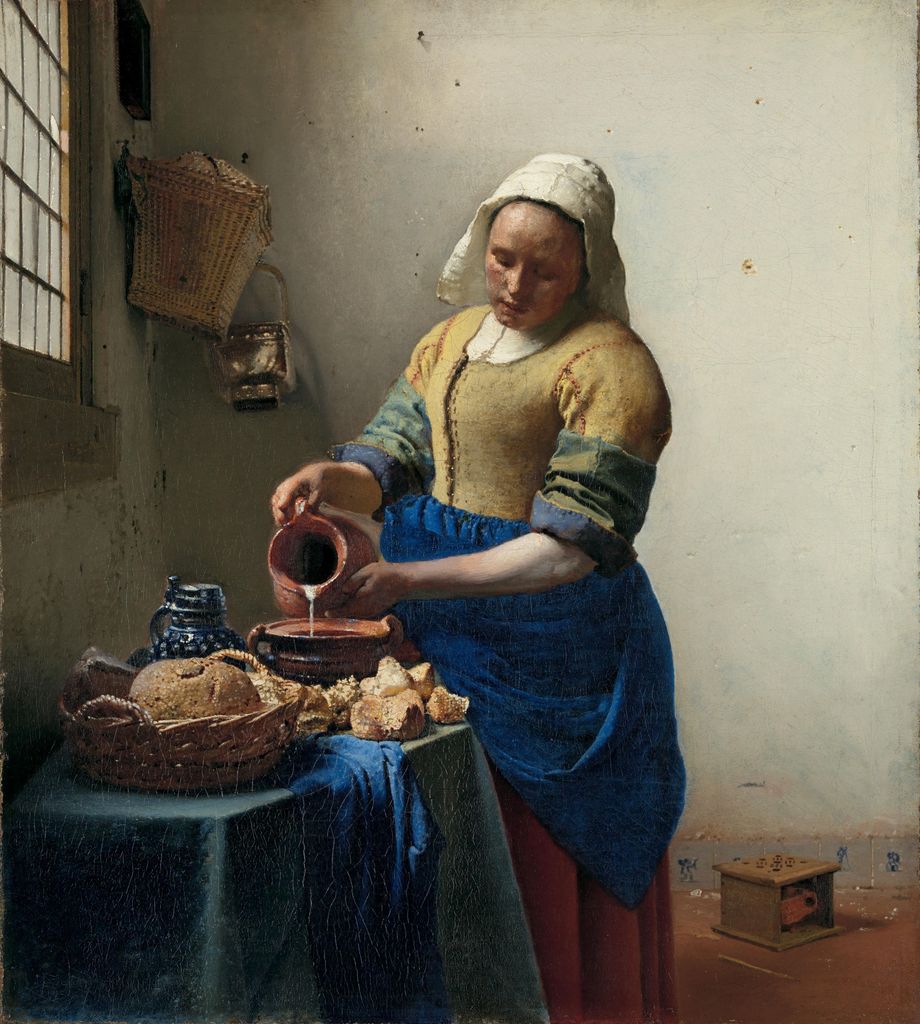
Domestic work — The Milkmaid
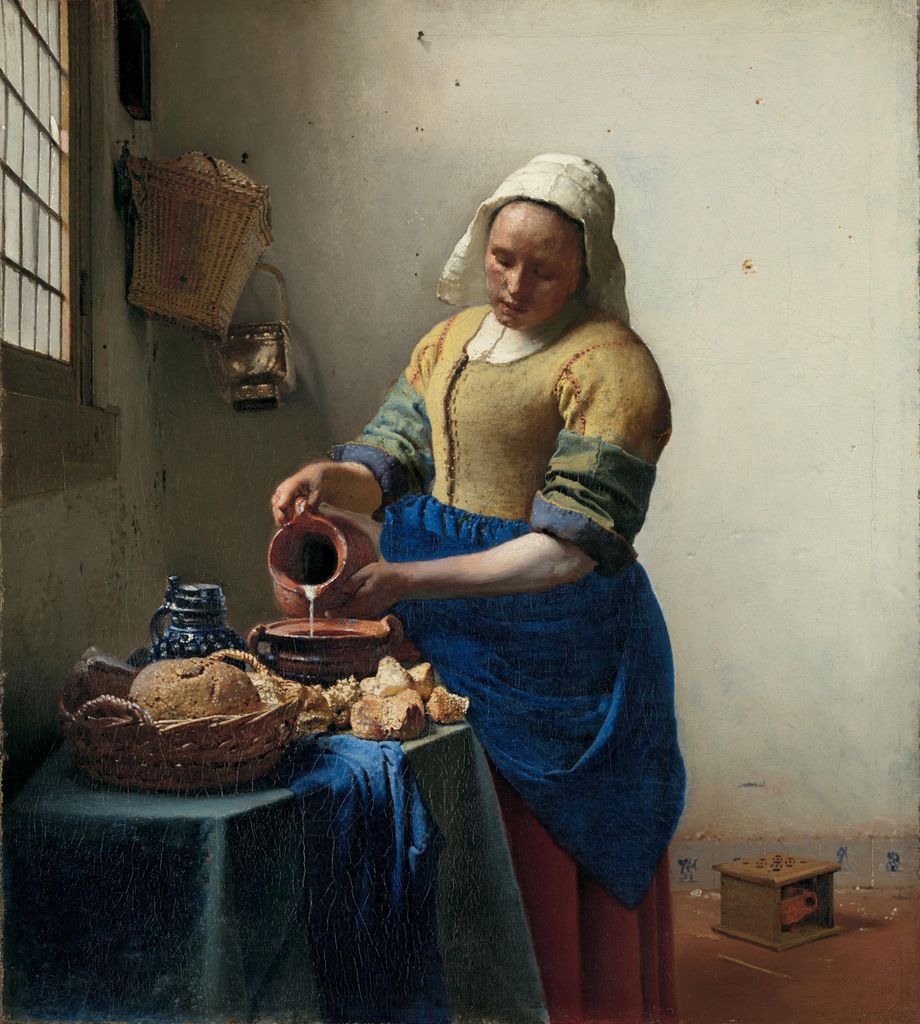
Johannes Vermeer's The Milkmaid, painted around 1660, shows a woman steadily pouring milk beside bread and earthenware.[3] Light crosses the room, catches the stream and gives ordinary surfaces unusual weight. The action is modest, but the composition is exact: the standing figure forms a stable centre while the broad wall slows the scene.
Vermeer became renowned for intimate genre scenes of daily life in Delft, though that reputation grew long after his death.[4] The quiet should not be mistaken for simple transcription. Costume, props, light and viewpoint shape how viewers imagine labour, attention and domestic space.
Quiet play — The House of Cards
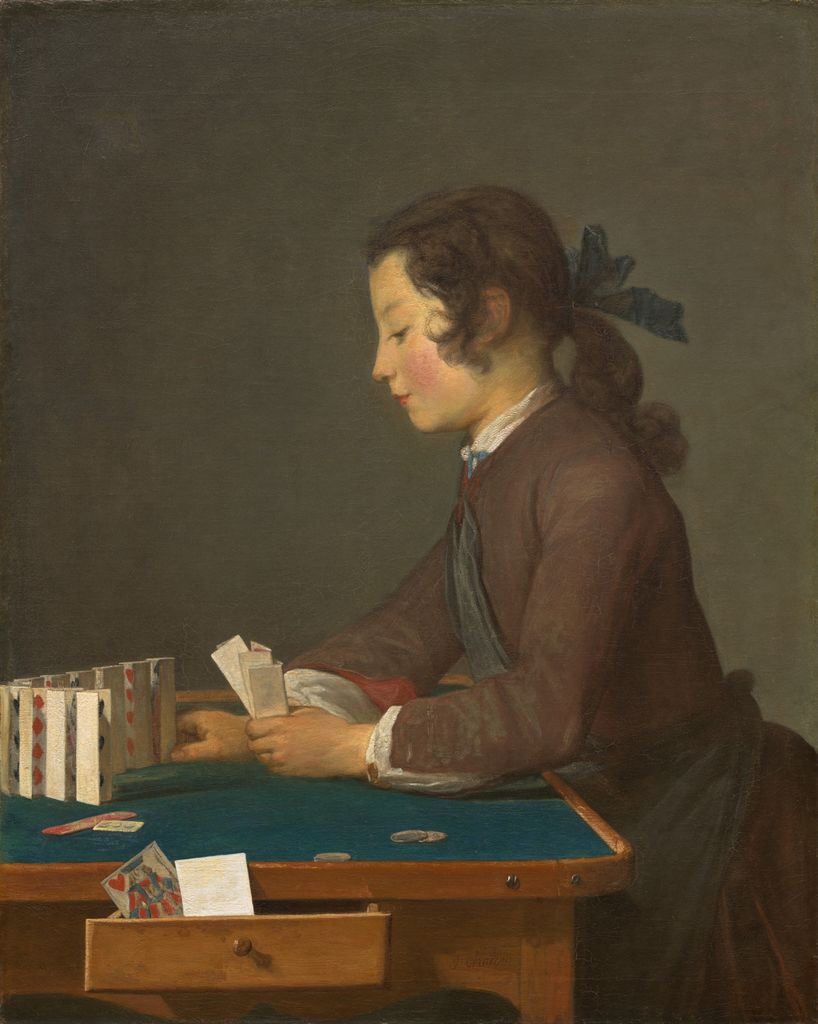
Jean Siméon Chardin's The House of Cards, probably painted in 1737, concentrates on a young person building a fragile structure at a table.[5] The absorbed figure and the precarious cards create a small narrative: balance may hold or collapse. Chardin makes attention itself the event.
This is a useful test of the category's scale. Nothing public or heroic occurs, yet anticipation gives the scene dramatic life. The painting also resists a single moral. The cards can suggest patience and skill, idle amusement, or the instability of human plans. Genre painting often leaves such possibilities available rather than announcing one lesson.
Training and modern labour — The Dance Class
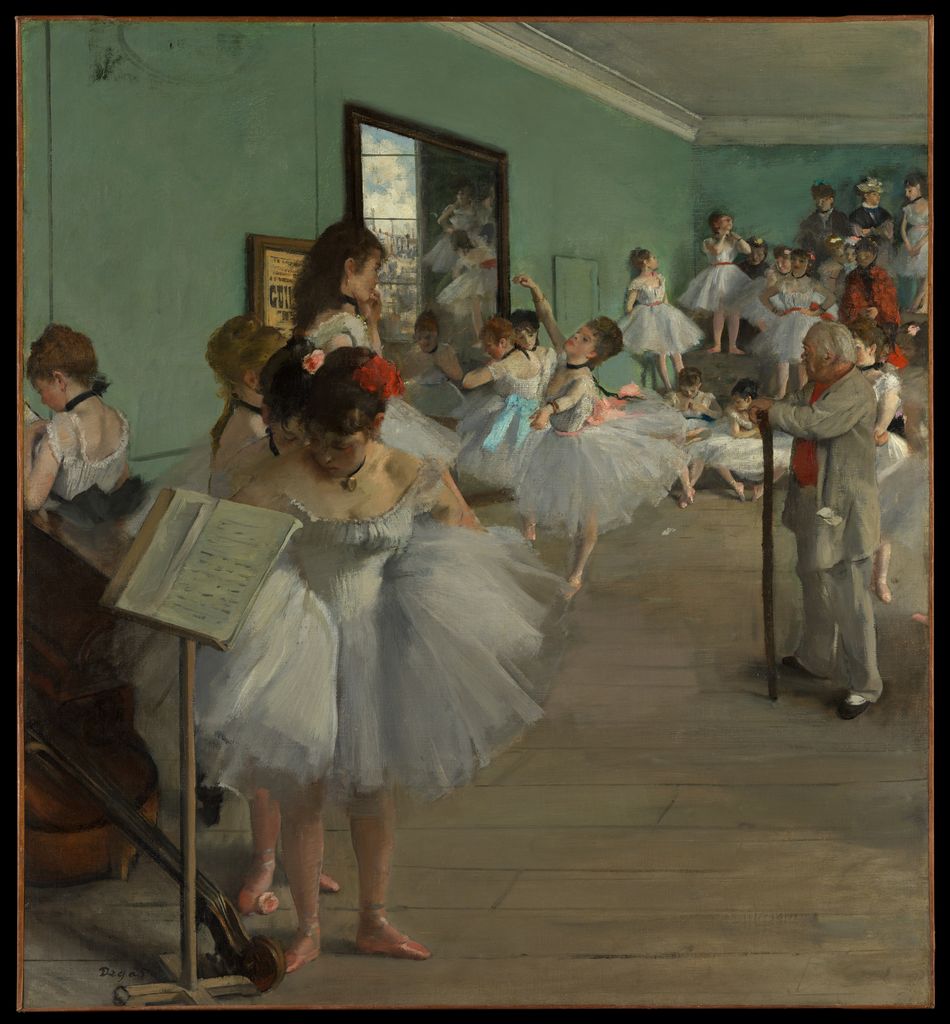
Edgar Degas's The Dance Class (1874) turns rehearsal into a complex social environment.[6] Dancers stretch, adjust costumes, wait and watch while the ballet master occupies the room's working centre. The angled floor and scattered poses produce the impression of a moment encountered in passing.
That apparent spontaneity is rigorously composed. Degas repeatedly studied dancers and rearranged poses across drawings and paintings. The result concerns labour as much as spectacle: repetition, fatigue, discipline and observation precede performance. By choosing the rehearsal room instead of the stage, he converts the machinery of modern entertainment into an everyday subject.
Childhood outdoors — Snap the Whip
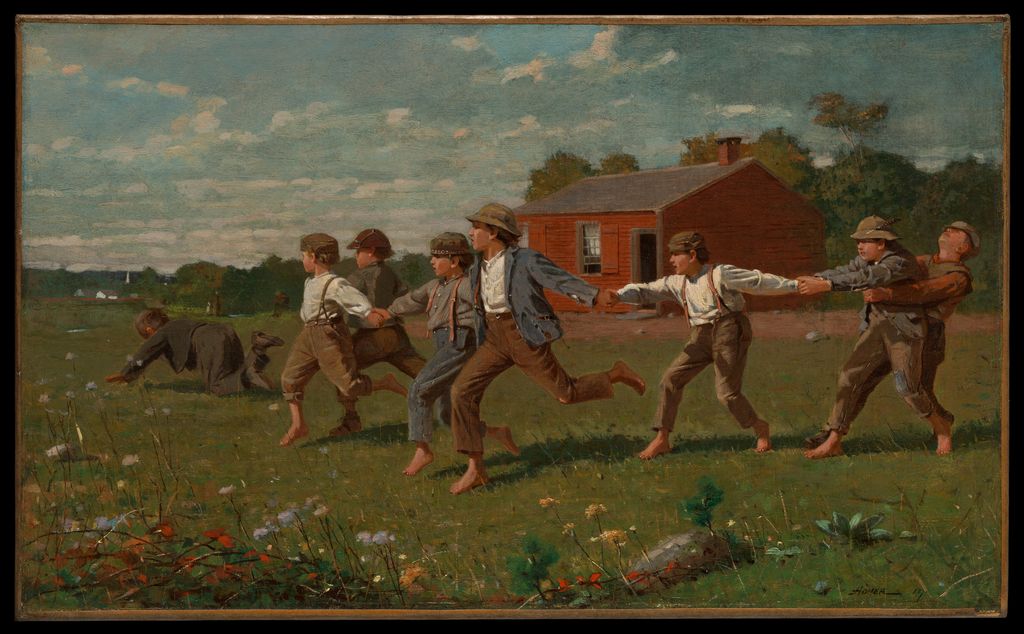
Winslow Homer's Snap the Whip (1872) shows a line of boys running across grass as their chain begins to break.[7] The school building fixes the rural setting while linked hands and leaning bodies make the game readable. A familiar activity becomes an image of physical energy, coordination and separation.
American painters of everyday life increasingly addressed public change, national identity and a widening range of communities during the nineteenth century.[8] Homer's scene may evoke freedom and shared play, but its historical setting also invites questions about education, rural memory and the kinds of childhood a post-Civil War audience wished to see.
Modern leisure — A Sunday on La Grande Jatte
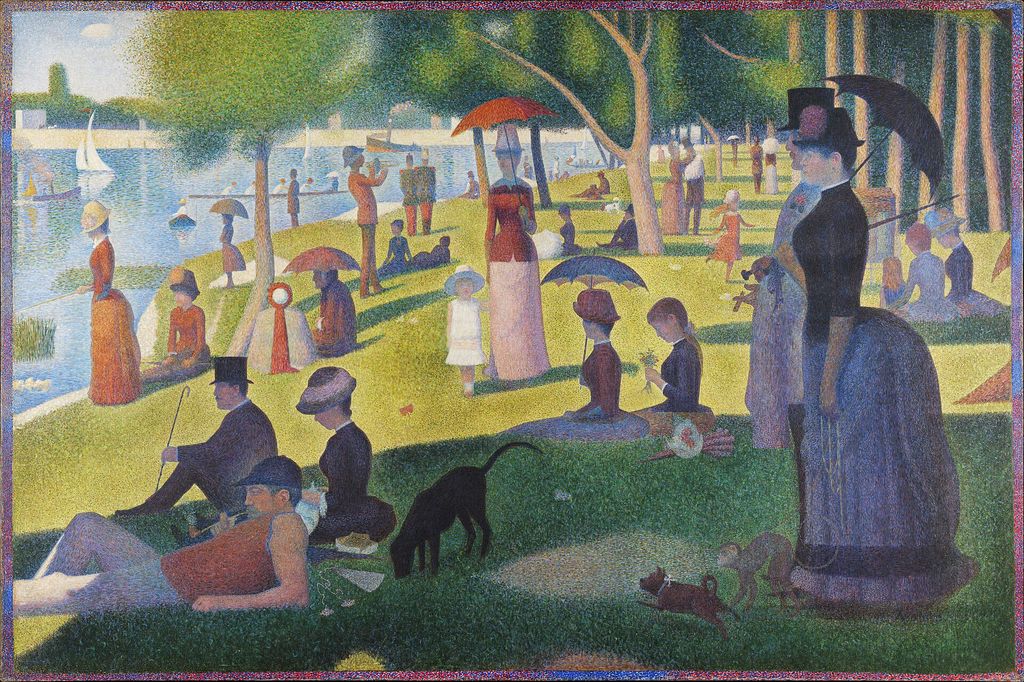
Georges Seurat's A Sunday on La Grande Jatte—1884, made in 1884–86, assembles Parisians along the Seine.[9] Walking, fishing and resting are everyday leisure activities, yet the figures appear unusually still. Repeated verticals, profiles and carefully placed colour make the park feel ordered and slightly estranged.
The painting expands genre beyond a close interior. Social types occupy the same public space without necessarily interacting. Clothing, posture, distance and placement carry information about class and conduct. The scene looks collective, but its measured intervals can make modern urban life seem detached.
Urban ambiguity — The Railway
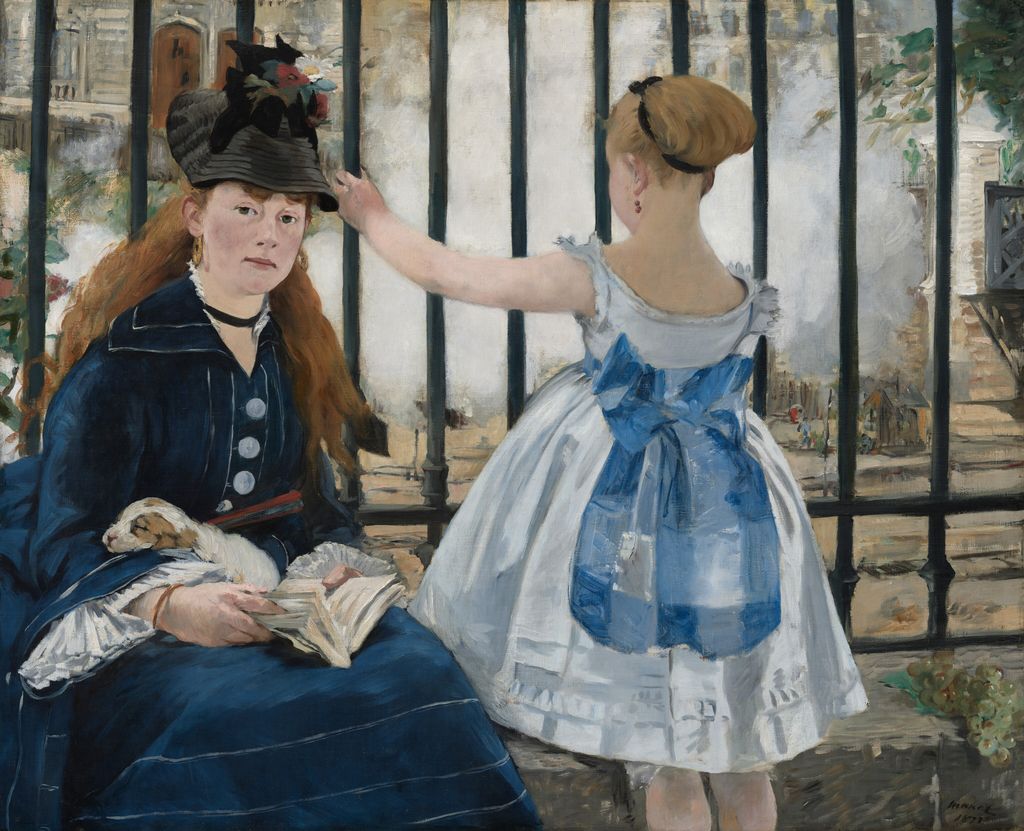
Édouard Manet's The Railway (1873) places a seated woman and a standing child beside the iron fence of Paris's Gare Saint-Lazare.[10] The woman looks outward while the child faces the tracks, hidden by steam. A sleeping dog, an open book and a bunch of grapes offer clues without resolving what the figures are doing or how they are related.
Instead of a complete story, Manet supplies a fragment. The barrier divides viewers from the railway, and the two figures attend to different worlds. The modern city appears through interruption, looking and partial access. This kind of ambiguity became central to later scenes of everyday life.
Dutch genre painting and its audiences
Seventeenth-century Dutch painters developed a remarkable range of household interiors, taverns, markets, guardrooms, village festivals and street encounters. Artists such as Gerard ter Borch, Pieter de Hooch, Gabriel Metsu, Jan Steen and Vermeer sometimes worked with similar motifs while distinguishing themselves through surfaces, light, humour and narrative tone.[11]
Jan Steen's The Feast of Saint Nicholas fills a household with gifts, tears, teasing and competing reactions. The setting is recognisable, but its abundance is carefully staged. Comic disorder could entertain while encouraging viewers to judge behaviour. Other interiors offer quieter puzzles through letters, musical instruments, wine glasses or exchanged glances.
These details should not be treated as a code in which every object has one fixed meaning. An object can be useful, fashionable, humorous and symbolic at once. Nor do polished rooms describe every Dutch household. Paintings were made for markets and patrons; they selected particular kinds of life and often transformed them through familiar conventions.
Everyday life beyond the Dutch interior
Genre painting existed before and beyond the Dutch Republic. Pieter Bruegel the Elder's The Harvesters (1565), for example, joins seasonal work, eating and rest within a wide landscape. The picture demonstrates how categories can overlap: it is both a landscape and a densely observed account of rural activity.
In eighteenth-century France, Chardin made domestic routines and absorbed figures carry sustained pictorial gravity. Nineteenth-century artists then used cafés, theatres, boulevards, railways, schools and parks to address modern experience. In the United States, scenes of daily life ranged from family interiors to labour, childhood, rural memory and social conflict. Expanding exhibitions and art markets encouraged new subjects, while many narratives remained deliberately subtle or open-ended.[8]
The academic hierarchy had classified everyday subjects as low because they supposedly demanded less invention than elevated narrative.[2] Genre painters repeatedly disproved that assumption. A glance across a room or a pause in a game can require intricate control of viewpoint, gesture, timing and implication.
Genre painting is not a photograph of society
Everyday subject matter creates a powerful sense of access. Viewers may feel they have entered a seventeenth-century kitchen or a nineteenth-century rehearsal. Yet paintings are selective evidence. Costumes and furnishings can reveal material culture, but the scene may idealise comfort, caricature poverty, conceal labour or arrange social roles for a buyer's expectations.
Titles add another complication. Some familiar titles were assigned or standardised after a work was made, and they can narrow an image that originally remained ambiguous. Historical interpretation therefore compares the painting with collection records, contemporary objects, related works and the conditions in which it circulated.
The question is not whether a genre scene is “realistic” in a simple sense. A more useful question is what kind of reality it constructs—and for whom.
How to read a genre painting
Begin with the activity. Identify what has just happened, what is happening now and what might happen next. Then follow gazes and gestures. A turned back, an interrupted task or an exchanged look can organise the entire scene.
Inspect the setting without assuming every object is a symbol. Which tools, foods, furnishings or clothes establish work, wealth, season or place? Notice who occupies the centre and who remains at the edge. Ask whether the viewpoint makes you a guest, customer, passer-by or unseen observer.
Finally, test the scene against its audience and category. Does humour invite judgment? Does beauty soften hard labour? Does a seemingly private moment depend on public ideas about class, gender or respectability? Genre painting rewards close looking because ordinary actions are rarely empty. Its finest examples make daily life visually compelling while preserving the uncertainty of other people's worlds.
Watch: Genre Painting through Formal Analysis
Choose a museum-led whole-work analysis, a close reading, or a foundations overview for considering genre painting.
Introducing Formal Analysis: Landscape
Follow how subject, space, colour and composition work together across a complete artwork.
Watch on YouTubeFrequently Asked Questions
Genre painting depicts scenes of everyday life, with ordinary activities and social settings as its organising subject.
The specialised term developed for pictures of everyday life, even though genre in a broader sense means any recurring category of subject.
It may look observational, but artists select, arrange, idealise, satirise or moralise; it should not be treated as an unfiltered social record.
Genre painting usually centres ordinary life, while history painting constructs consequential narratives from history, scripture, mythology or literature.
Identify the activity, setting, figures and audience, then compare visual evidence with the work’s historical context and intended function.
Discussion
Which scene on this page most strongly reveals the artist’s selection or staging rather than functioning as a neutral record?
Reader Insights
Begin with what the figures are doing and where.
Pose, viewpoint, gesture and props turn observation into construction.
Audience and market can explain humour, sympathy, moral pressure or social distance.
Join the Conversation
Share one precise observation or a useful museum example below.
References
- Genres — National Gallery, London
- The Genres — National Gallery, London
- The Milkmaid — Rijksmuseum
- Johannes Vermeer — Rijksmuseum
- The House of Cards — National Gallery of Art
- The Dance Class — The Metropolitan Museum of Art
- Snap the Whip — The Metropolitan Museum of Art
- American Scenes of Everyday Life, 1840–1910 — The Metropolitan Museum of Art
- A Sunday on La Grande Jatte—1884 — Art Institute of Chicago
- The Railway — National Gallery of Art
- Vermeer and the Masters of Genre Painting — National Gallery of Art