by Tom Gurney
Tom Gurney BSc (Hons) is an art history expert with over 20 years experience
Page created on September 3, 2026 / Page updated on September 13, 2026
Email: tomgurney1@gmail.com / Phone: +44 7429 011000
How Arranged Things Become Experiments in Attention, Matter and Time
Still life art makes inanimate things its primary subject. Fruit, flowers, food, vessels, books, tools, fabrics and collected curiosities may be arranged on a table, shelf or forest floor. Because the actors do not move, the artist controls nearly every relationship: what is present, what is cut off, which surface catches light and which object appears about to fall.
That control makes arrangement inseparable from interpretation.
At a Glance
- Core ideastill life makes inanimate or gathered things the primary subject.
- Look forselection, arrangement, surface, scale, viewpoint and relationships among objects.
- Meanings are contextualflowers, food, vessels and books do not carry one fixed symbolic code.
- Matter changesripeness, reflection, breakage and decay can make time visible.
- Explore nextcompare vanitas , flower symbolism and the wider genre guide .
Contents
The English term follows the Dutch stilleven, which became current around 1650. Still life flourished as an independent speciality in the seventeenth-century Netherlands, although artists elsewhere developed related traditions.[1] It has never been only a record of possessions. Arranged things can test perception, display skill, advertise abundance, warn about time or turn an ordinary mug into a study of colour and form.
What makes an artwork a still life?
The defining feature is focus. Inanimate objects carry the main visual and expressive work. A bowl of fruit in the corner of a portrait is a still-life element; a painting that makes the bowl, fruit and surrounding space its central event is a still life.
Common families include flower pieces, breakfast and banquet tables, game pieces, kitchen scenes, collections of shells or instruments, and vanitas arrangements that evoke mortality. The category also embraces austere studies of a few things and modern works in which objects become a means to rethink space. Natural specimens may appear—dead game, insects or cut plants—while living human figures generally shift the work toward another genre.
Still life overlaps with Painting Genres more broadly and with Genre Painting when household objects establish an everyday setting. The difference lies in emphasis: genre painting centres human activity, while still life asks objects and their arrangement to command attention.
Six still lifes and their different purposes
Luxury and interruption — Still Life with Oysters, a Silver Tazza, and Glassware
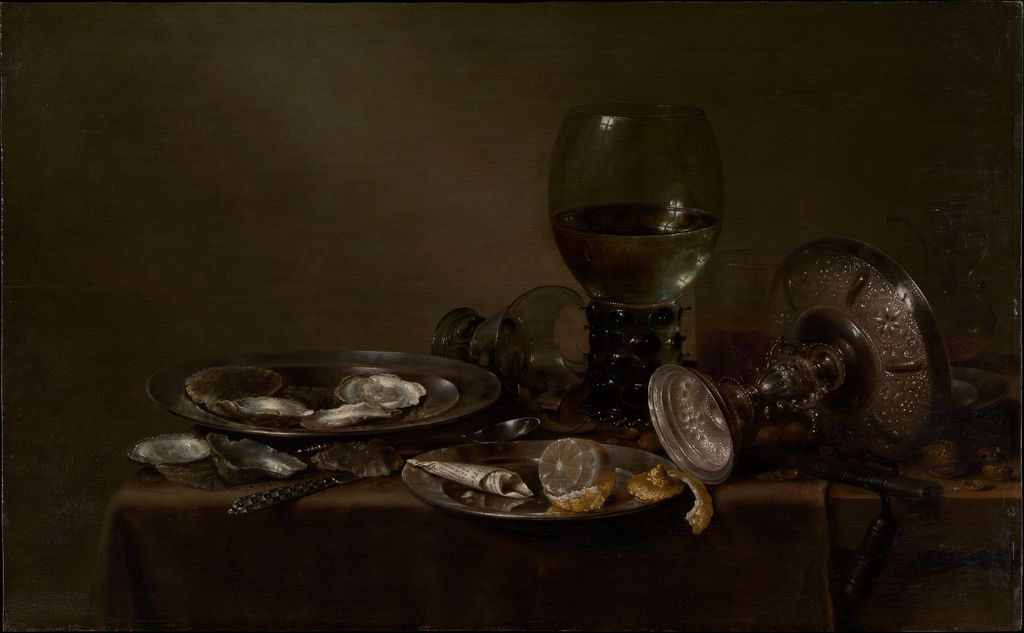
Willem Claesz Heda's 1635 still life assembles oysters, a peeled lemon, silver, glass and rumpled cloth across a table.[2] Reflections move between muted greys and warm browns. The tipped vessels and partly eaten food make the meal appear recently interrupted.
This carefully controlled disorder belongs to a Dutch tradition of banquet and breakfast pieces. Imported fruit, fine metalwork and fragile glass could signal prosperity and global commerce, while broken, emptied or perishable things recalled how quickly pleasure passes. Those readings need not cancel the painting's visual delight. Attraction and warning can coexist.
The forest floor — Still Life with Poppy, Insects, and Reptiles
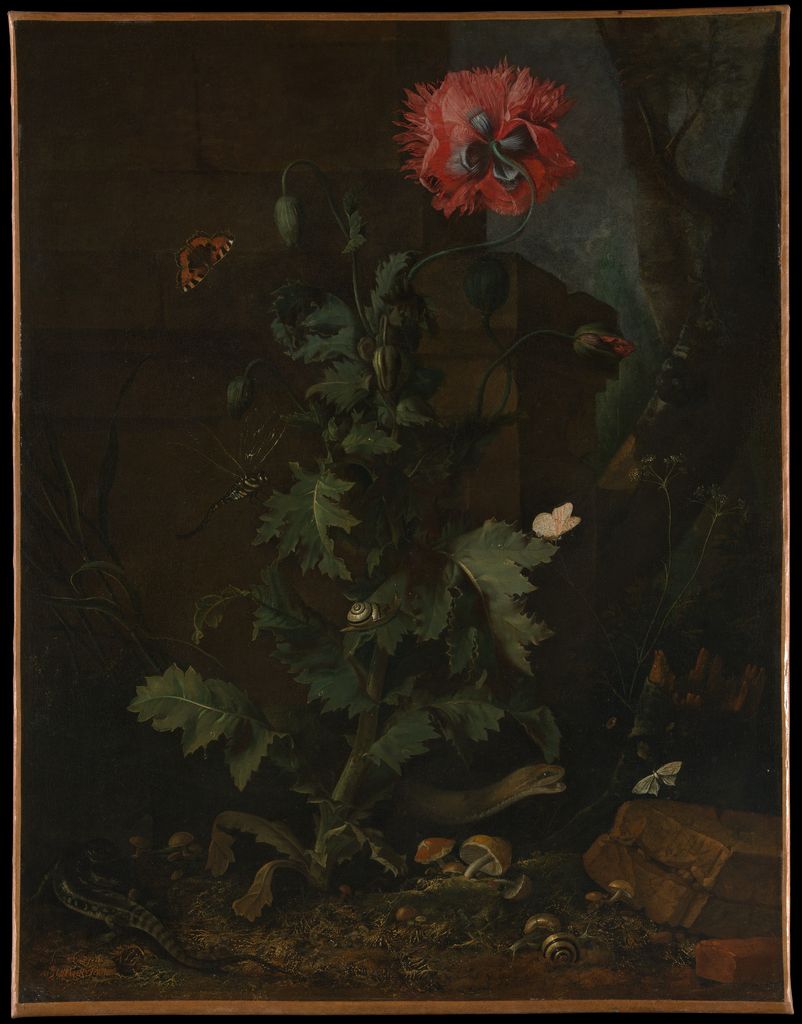
Otto Marseus van Schrieck's Still Life with Poppy, Insects, and Reptiles, made around 1670, replaces the tabletop with a dark, damp habitat.[3] A red flower rises among leaves, fungi, butterflies, a dragonfly, snails and reptiles. Scale and proximity make the small creatures unusually imposing.
Marseus specialised in such forest-floor scenes. The work connects artistic display with close study of nature, yet it is not a scientific diagram. Plants and animals are combined into an invented encounter governed by contrast, concealment and surprise.
Ordinary weight — Still Life with a White Mug
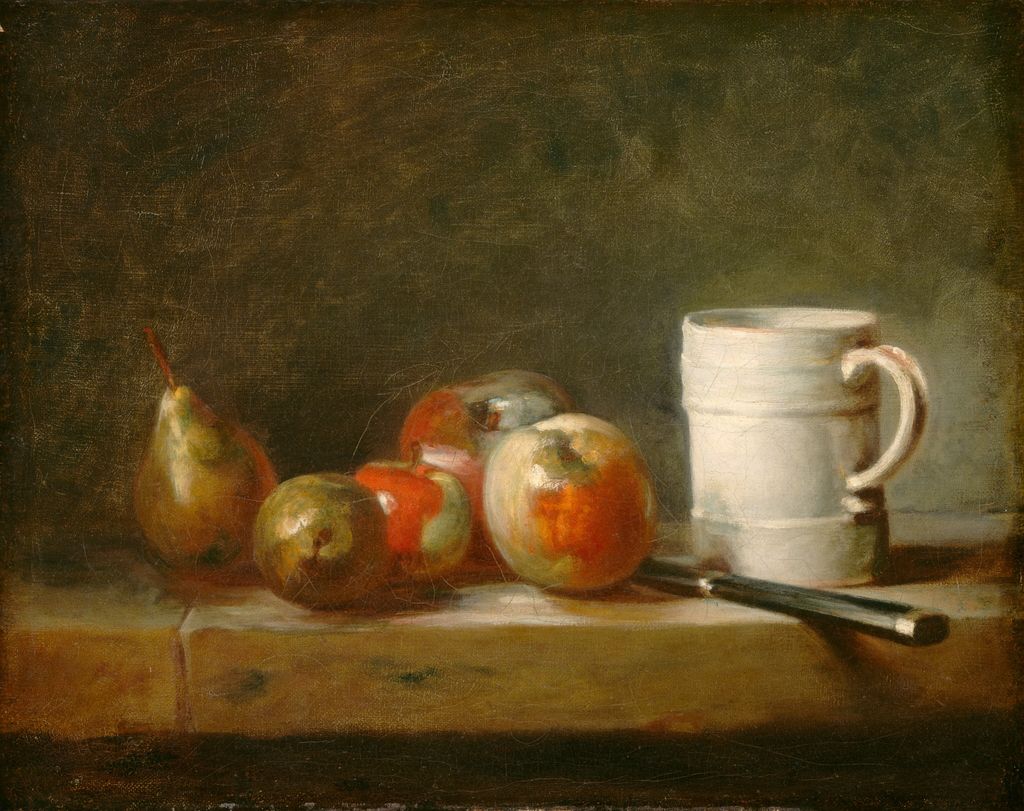
Jean Siméon Chardin's Still Life with a White Mug, around 1764, reduces the cast to apples, pears, a knife and a plain ceramic vessel.[4] The mug's pale body, the fruit's rounded colour and the knife's diagonal edge occupy a shallow, quiet space.
Compared with a luxury table, the objects are modest. Chardin makes their differences in weight, texture and reflectivity sufficient. The painting demonstrates that still life does not require elaborate symbolism or abundance: sustained looking can give familiar things dignity without turning them into characters.
Constructed seeing — Still Life with Apples and Pears
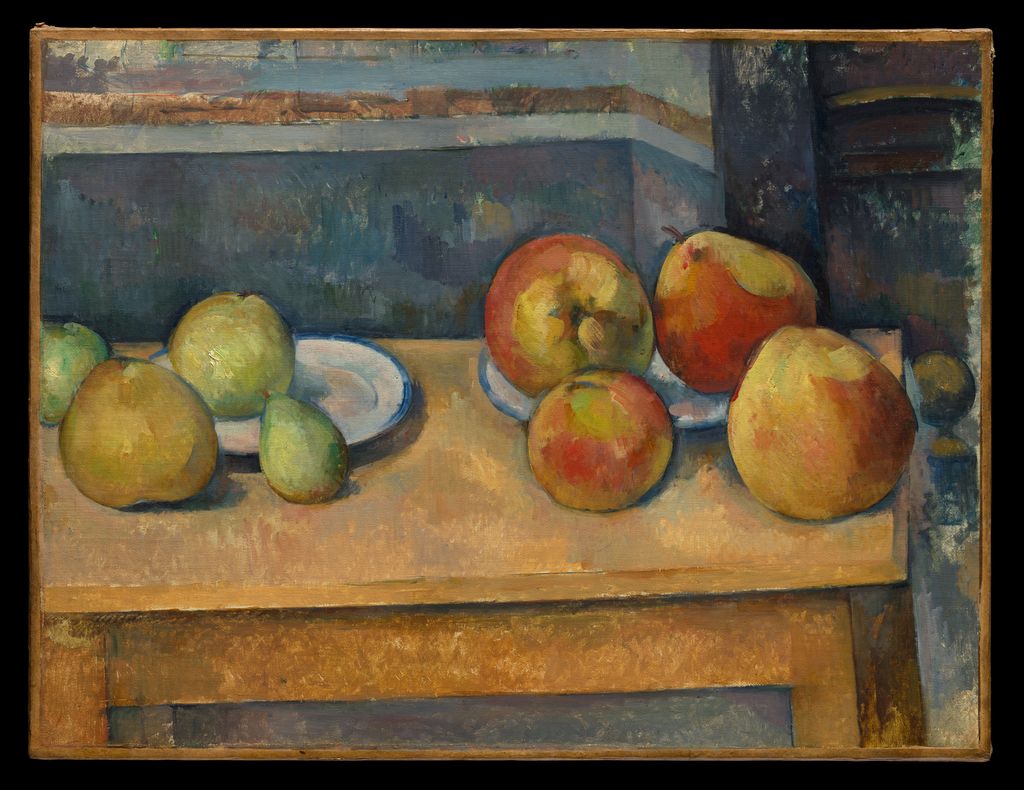
Paul Cézanne's Still Life with Apples and Pears, about 1891–92, spreads fruit, plates and folded cloth across a table whose angles do not settle into one consistent viewpoint.[5] The objects feel solid, yet the space around them tilts and compresses.
Cézanne's approach gave relationships among shapes and colours priority over seamless classical perspective.[6] The still life became an ideal laboratory because the objects could be moved and repainted. Rather than hide construction, the picture lets viewers feel the adjustments through which seeing becomes painting.
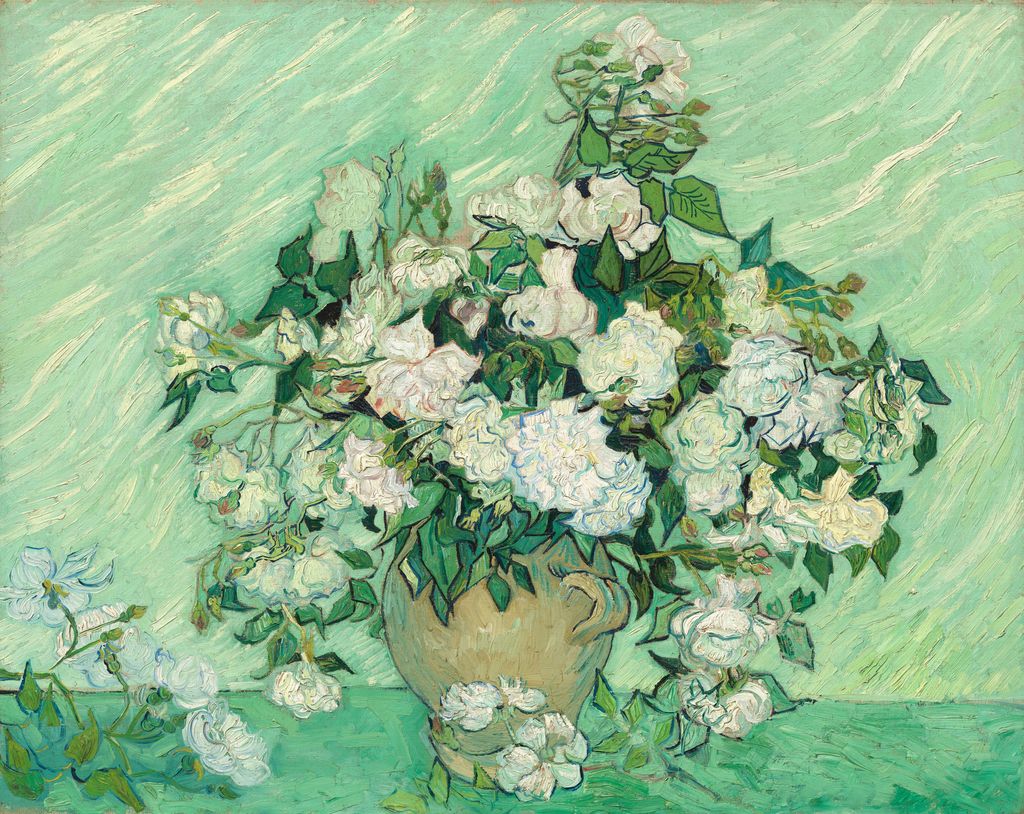
Flowers as colour — Roses
Vincent van Gogh painted Roses in 1890, near the end of his stay at the asylum in Saint-Rémy.[7] Pale blossoms crowd outward from a vase against a green field. Much of the original pink has faded, but the overlapping curves and directional brushwork still animate the bouquet.
Cut flowers traditionally evoke beauty and transience, although no single moral exhausts the image. Here colour, touch and growth matter as much as identification. The painting turns a conventional bouquet into a field of active marks.
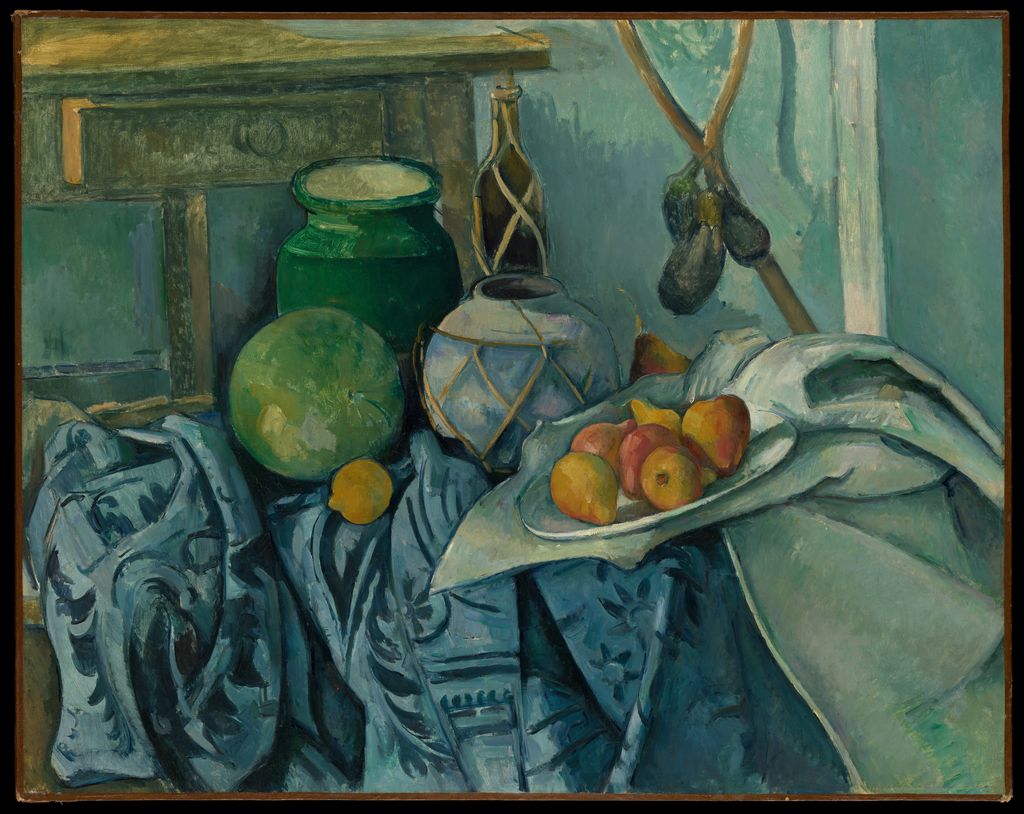
Unstable space — Still Life with a Ginger Jar and Eggplants
In Still Life with a Ginger Jar and Eggplants (1893–94), Cézanne places fruit, patterned cloth, vessels and dark vegetables within a space that seems to rise toward the viewer.[8] Edges align and then diverge; fabric both supports and interrupts the objects.
This is not carelessness. Multiple adjustments make the arrangement feel observed over time rather than captured from one frozen point. That spatial problem would become important to later artists, including Cubists who treated tabletop objects, letters, printed paper and simulated surfaces as material for radical reconstruction.[9]
From detail to independent genre
Objects carried meaning long before still life became an independent category. Flowers, books, vessels and food appeared within religious and secular paintings, where they could establish setting, status or devotion. During the early seventeenth century, specialised still-life production expanded in Dutch and Flemish cities amid urbanisation, collecting, trade and increased attention to domestic possessions.[10]
Painters developed recognisable subgenres. Flower pictures might combine species that did not bloom at the same time, producing an ideal bouquet rather than one observed at a single sitting. Meal pieces ranged from modest breakfasts to lavish pronk displays of imported fruit, porcelain and silver. Hunting trophies projected aristocratic privilege; shells and scientific instruments aligned ownership with curiosity.
The category's lower academic rank reflected a hierarchy that valued narrative and the human figure above things.[11] Yet still life demanded formidable control of material difference. Metal, citrus peel, glass, fur and cloth had to remain distinct while sharing one light and one pictorial world.
Vanitas, abundance and the danger of fixed symbols
A vanitas still life explicitly reflects on mortality and the limits of worldly achievement. Skulls, extinguished candles, watches, wilting flowers or broken objects can point toward death and passing time. Jacques de Gheyn II's Vanitas Still Life (1603) makes that warning unusually direct.[10]
Other pictures are less certain. A peeled lemon may suggest luxury, sensory pleasure, bitterness or simply offer the painter a spiralling form. A flower can be a botanical rarity, a sign of transience and an occasion for colour. Meaning emerges from combinations, historical context and intended audience; it should not be decoded from a universal symbol dictionary.
Abundance itself can be double-edged. Paintings display what patrons valued while exposing perishability and excess. Their beauty may intensify rather than resolve that tension.
Still life and modern art
Still life remained productive because its controlled setup permitted experiment. Francisco de Zurbarán's A Cup of Water and a Rose reduces things to a disciplined interval of light, dark and silence.[12] Chardin found gravity in ordinary household objects. Cézanne made repeated arrangements test how colour constructs form and space.
Cubist artists then dismantled the stable tabletop. Georges Braque's Still Life (Glass and Cigarette Pack) combines drawn and pasted materials, confusing represented surfaces with the actual surface of the work.[9] Later artists would assemble found objects, photograph commodities or use domestic things to address consumption, identity and memory. The genre survives not because its subjects stay still, but because objects change meaning as they move between use, ownership and representation.
How to read a still life
First inventory what is actually visible. Distinguish materials, condition and placement before assigning meaning. Is food untouched or partly consumed? Are flowers fresh, fading or impossibly combined? Do expensive and ordinary objects share the same space?
Next trace the arrangement. Follow diagonals, overlaps and gaps; note what projects beyond an edge or reflects something outside the frame. Ask where the light begins and which textures demand slow looking. An apparently casual table is usually highly constructed.
Then consider time. Ripeness, decay, an extinguished flame or an unfinished meal can make absence palpable. Finally, relate the objects to their historical world: trade, collecting, household labour, scientific interest or mass consumption. A persuasive reading holds material pleasure and cultural meaning together. Still life teaches that things are never merely background; placed under attention, they become evidence of how people see and value the world.
Watch: Still Life Art through Formal Analysis
Choose a museum-led whole-work analysis, a close reading, or a foundations overview for considering still life art.
Introducing Formal Analysis: Landscape
Follow how subject, space, colour and composition work together across a complete artwork.
Watch on YouTubeFrequently Asked Questions
Still life art makes inanimate or gathered objects—such as fruit, flowers, vessels, food or books—its primary subject.
No. Meaning depends on the work’s place, date, genre, material relationships and supporting historical evidence.
Still life is the broad genre; vanitas is a historically specific still-life tradition concerned with transience and worldly attachment.
Their colour, surface, seasonal availability, value and physical change make them rich subjects for observation and interpretation.
Identify the objects and their conditions, trace arrangement and viewpoint, notice material effects, then test symbolic claims against reliable context.
Discussion
Which still life on this page makes physical change or instability most important to the experience of its objects?
Reader Insights
Name objects, materials and visible conditions before interpreting.
Overlap, edge, tilt and spacing reveal how the artist constructed attention.
Use object records and historical context rather than fixed dictionaries.
Join the Conversation
Share one precise observation or a useful museum example below.
References
- Still Lives — National Gallery, London
- Still Life with Oysters, a Silver Tazza, and Glassware — The Metropolitan Museum of Art
- Still Life with Poppy, Insects, and Reptiles — The Metropolitan Museum of Art
- Still Life with a White Mug — National Gallery of Art
- Still Life with Apples and Pears — The Metropolitan Museum of Art
- Paul Cézanne — The Metropolitan Museum of Art
- Roses — National Gallery of Art
- Still Life with a Ginger Jar and Eggplants — The Metropolitan Museum of Art
- Cubism and the Trompe l'Oeil Tradition — The Metropolitan Museum of Art
- Still-Life Painting in Northern Europe, 1600–1800 — The Metropolitan Museum of Art
- The Genres — National Gallery, London
- A Cup of Water and a Rose — National Gallery, London