by Tom Gurney
Tom Gurney BSc (Hons) is an art history expert with over 20 years experience
Page created on September 3, 2026 / Page updated on September 13, 2026
Email: tomgurney1@gmail.com / Phone: +44 7429 011000
How Visual Traditions Retell Stories of Gods, Heroes and Transformation
Mythological art gives visual form to culturally significant stories about gods, heroes, origins, transformations and the supernatural. In European art history, the label usually refers to subjects from ancient Greek and Roman literature. Artists repeatedly returned to Ovid, Homer and other classical sources, reshaping their narratives for palaces, civic spaces, private collectors and modern audiences.[1]
The term needs care. “Myth” in academic usage can describe a culture's foundational narrative without declaring it false. Some stories represented in museums belong to living religious traditions, and the line between mythological and religious art depends on context and community. This guide explains a historical art category; it does not rank beliefs.
At a Glance
- Core ideamythological art depends on culturally significant narratives involving gods, heroes, origins or transformation.
- Traditions are pluralGreek and Roman mythology are only part of a much wider field.
- Images retellartists select moments, combine sources and adapt stories for new audiences.
- Context firstobject type, place, date, patronage and living traditions constrain interpretation.
- Explore nextcompare religious art , history painting and iconography .
Contents
What makes art mythological?
A mythological artwork normally depends on a recognisable narrative, deity or supernatural figure. Attributes help identify characters: a thunderbolt, lyre, trident, winged sandals or particular animal. The setting may be a celestial realm, an ideal landscape or an otherwise ordinary world interrupted by transformation.
Knowledge of the source changes what viewers see, but artists rarely illustrate texts mechanically. They choose one instant, combine episodes, alter costumes and emphasise themes relevant to their own period. Patronage matters. A scene of Venus might celebrate marriage, sensuality or dynastic fertility; Hercules could model strength; Phaeton could warn against reckless rule.
Mythological subjects often overlap with History Painting because European academies placed learned classical narrative within that elevated category.[2] They differ in scope: mythological art also includes decorative images, isolated deities, objects and modern reinterpretations that do not operate as grand academic narrative. Painting Genres locates both within a wider taxonomy.
Five mythological artworks across cultures and purposes
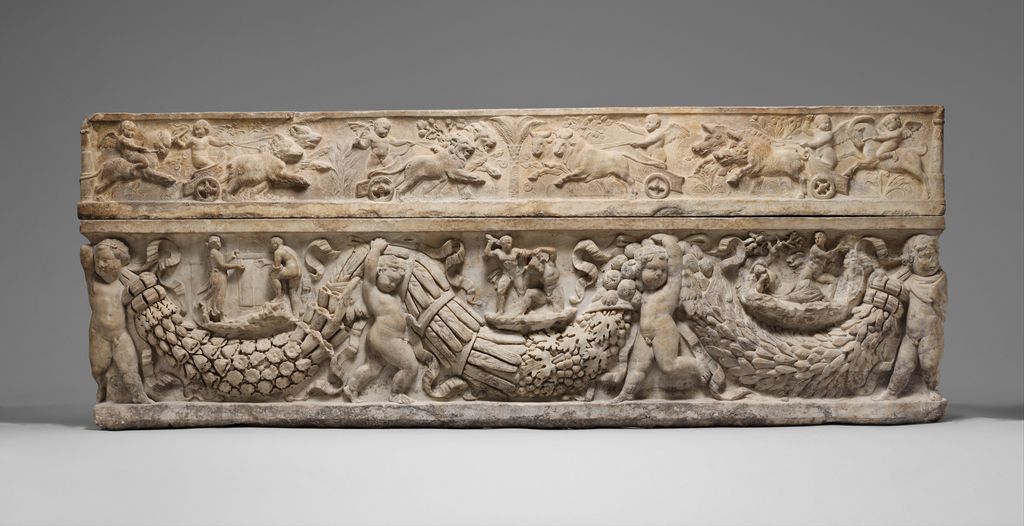
Myth on a funerary object — Sarcophagus with Theseus and Ariadne
A Roman marble sarcophagus made around 130–150 CE combines hanging garlands with episodes from the story of Theseus and Ariadne.[3] The long object distributes narrative across relief fields instead of offering a single framed instant. Myth accompanies a container made for the dead.
Such an object demonstrates that mythological art is not limited to easel painting. Story, ritual use and sculpted form work together. Ariadne's abandonment and later association with Dionysus could evoke loss, transformation and a passage beyond ordinary life without forming one simple funerary code.
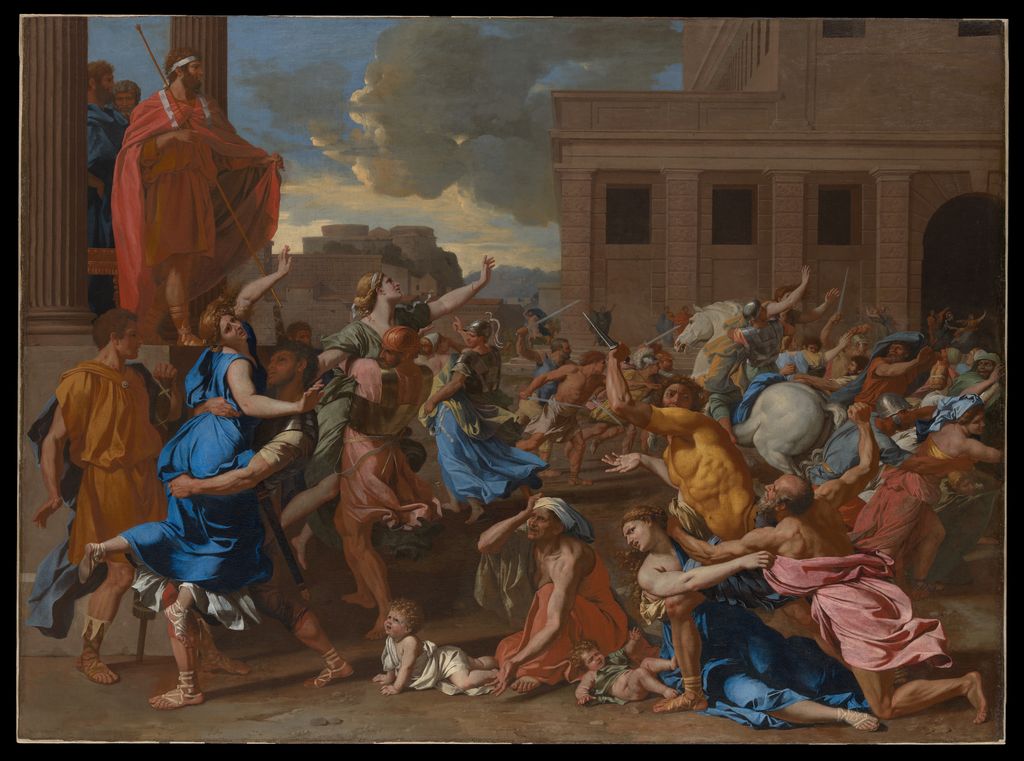
Foundation legend — The Abduction of the Sabine Women
Nicolas Poussin's The Abduction of the Sabine Women, probably 1633–34, stages a violent episode from Rome's legendary origins.[4] Romulus gives a signal at left, and opposed bodies surge across an architectural square. Gesture and grouping make command, resistance and panic legible.
The work sits between myth, legend and history. That uncertainty is revealing: stories of origin can claim political authority even when they are not documentary accounts. Modern viewers must also confront the violence against women that older civic narratives often converted into a tale of collective foundation.
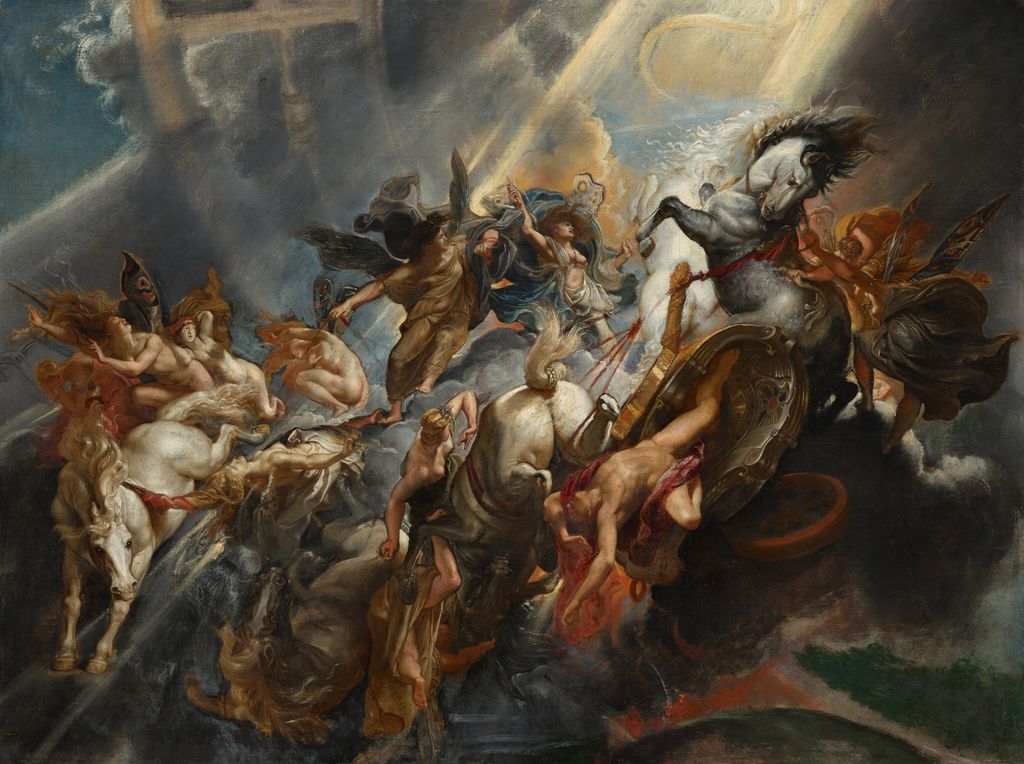
Cosmic failure — The Fall of Phaeton
Peter Paul Rubens's The Fall of Phaeton, painted around 1604–05 and later reworked, captures the instant Jupiter's thunderbolt destroys the uncontrolled sun chariot.[5] Horses, bodies and the signs of the seasons tumble through a fractured sky. The canvas transforms Ovid's sequence into simultaneous catastrophe.
Phaeton's desire to prove himself by driving his father's chariot had consequences for the entire world. Early modern interpreters could treat the story as a warning about pride, failed moderation or immature rulers.[5] Rubens preserves those possibilities while exploiting the subject's physical drama.
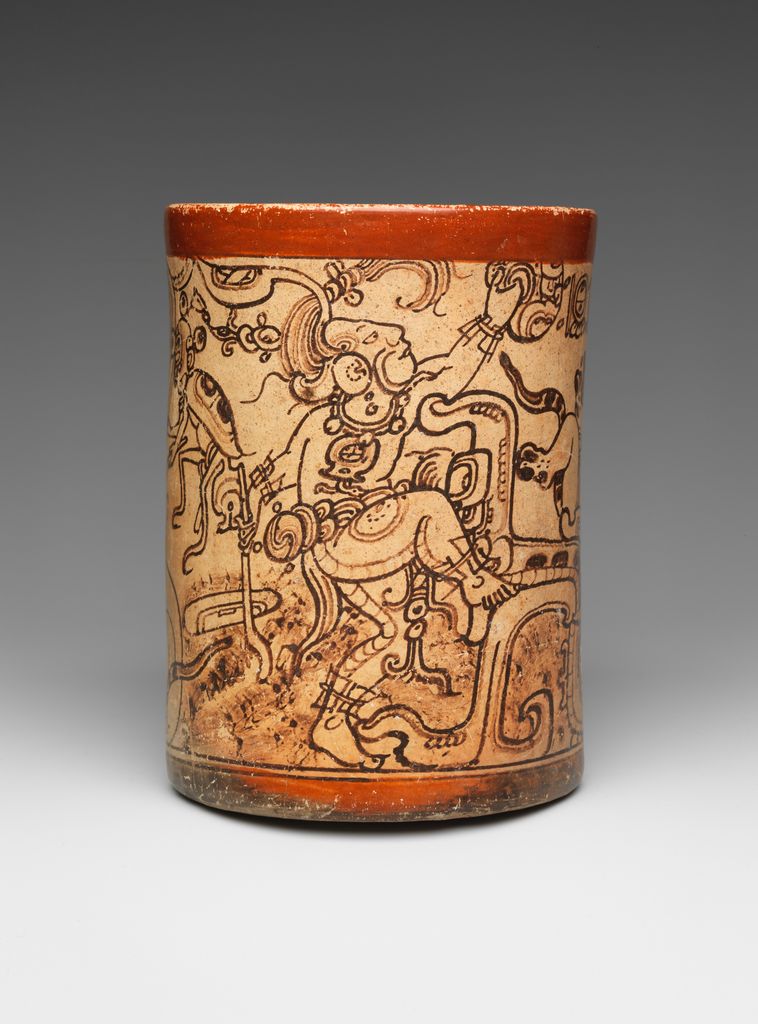
Rain, death and renewal — Vessel with Mythological Scene
A Classic Maya drinking vessel, painted by the artist known as the Metropolitan Painter between 600 and 800 CE, wraps a complex supernatural scene around its curved surface.[6] The rain god Chahk encounters an animate mountain, a baby jaguar and a death being. The narrative connects rain, decomposition and renewed life.
The cup's form matters: viewers handle or turn an object whose image cannot be seen all at once. Hieroglyphic text and figures belong to a courtly, ritual and agricultural world. Museum interpretation continues to develop, so uncertainty about particular beings should be preserved rather than filled with familiar Greco-Roman comparisons.
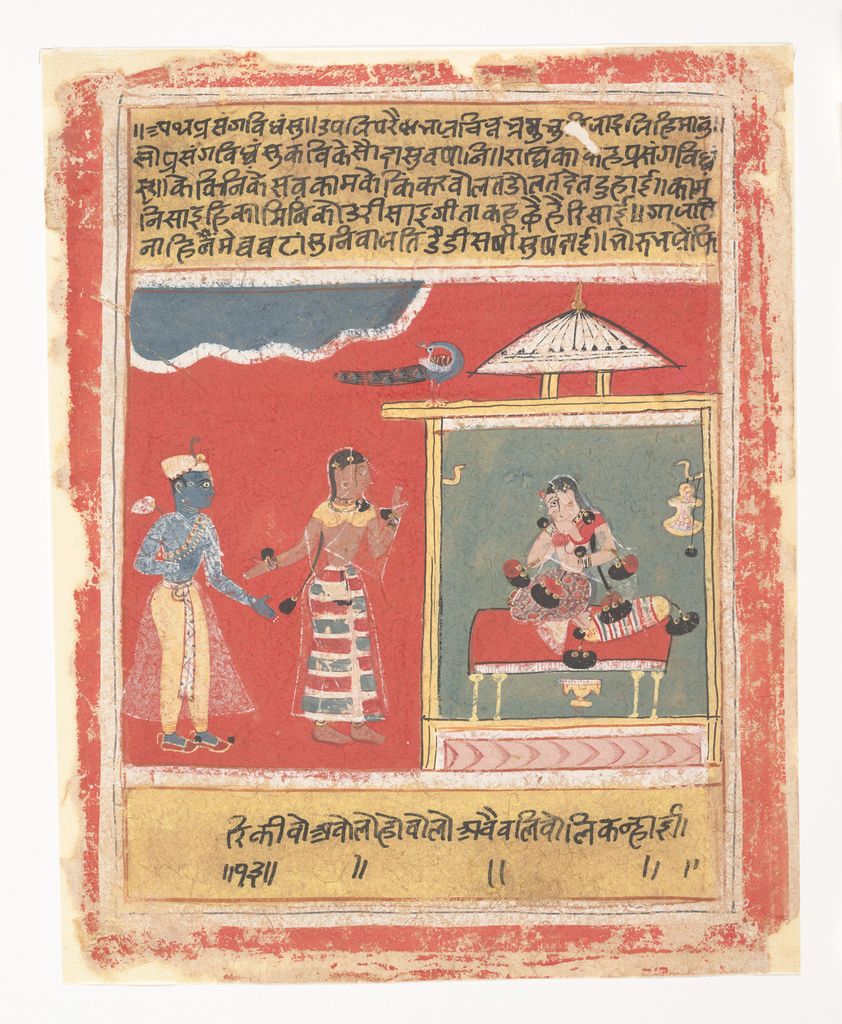
Poetry and devotion — Radha's Friend Pleads with Her to Receive Krishna
A Malwa folio dated 1634 illustrates a scene from the Rasikapriya, a poetic text that classifies lovers and their emotional states.[7] Radha's companion mediates between her and Krishna across vivid fields of architecture and landscape. Flat colour and separated zones make emotional distance spatial.
Krishna stories have literary and mythic dimensions, but Krishna is also worshipped within living Hindu traditions. Calling this image mythological cannot erase its devotional meanings or reduce sacred figures to fictional characters. The example instead shows how poetry, theology, courtly painting and lived belief can meet in one work.
Classical sources and Renaissance reinvention
Greek and Roman myths survived through texts, objects and later retellings. Renaissance patrons and artists encountered them alongside revived antiquity, humanist learning and contemporary political ambitions. The nude bodies and transformations of myth offered subjects different from Christian commissions while still carrying moral, dynastic or philosophical claims.
Sandro Botticelli's The Birth of Venus presents the goddess arriving at shore in an invented poetic synthesis rather than illustrating one passage exactly. Titian's Diana and Actaeon belonged to a six-painting series commissioned for Philip of Spain and drew largely on Ovid's Metamorphoses.[8] The startled encounter sets Actaeon's fatal transformation in motion.
These works were made for particular viewers. Learning and luxury could become part of their appeal, while erotic display was often authorised through an ancient name. Asking who commissioned the image and where it was seen is therefore as important as identifying the story.
How artists change a myth
Adaptation is central to mythological art. Artists select a before, climax or aftermath; they may make a secondary character central, alter emotional tone or quote an earlier composition. Rubens's Venus and Adonis, for example, takes its story from Ovid while deliberately engaging Titian's treatment of the lovers' leave-taking.[9]
Changes reveal new priorities. A warning can become a spectacle; a heroic deed can be questioned from the viewpoint of its victim; a familiar deity can enter a modern setting. Materials change meaning too. A narrative wrapped around a cup unfolds differently from one spread across a palace wall.
Myths can also legitimise power. Rulers and patrons align themselves with gods, heroes or founding ancestors. Allegorical flexibility lets an old story comment on a new marriage, war or political crisis without representing it directly.
Why transformation appears so often
Transformation gives artists a visual problem that narrative alone cannot solve. Ovid's characters become trees, animals, stone or stars; divine beings change scale or identity; journeys link earthly and supernatural spaces. A painter or sculptor must decide whether to show the change beginning, completed, or suspended between states.
That choice affects sympathy. Showing Daphne's fingers becoming leaves can concentrate attention on fear and escape, while a triumphant god may shift attention toward pursuit and possession. Showing Actaeon before his transformation makes viewers anticipate punishment; showing him as a stag changes how human recognition survives inside an animal body.
Cycles of death and renewal also organise stories beyond the classical Mediterranean. On the Maya vessel, rain, decomposition and birth are interdependent rather than simply opposed. Comparison can illuminate a shared visual challenge, but it should not imply that differently situated beings or cosmologies mean the same thing.
Mythological versus religious art
The distinction is historical, not a measure of truth. In much European museum classification, Greco-Roman narratives are called mythology while Christian subjects are called religious art. That division reflects the history of institutions as much as the inherent nature of images.
An ancient image of a deity could have been devotional, civic or funerary before later viewers classified it as art. Likewise, Hindu, Maya and other traditions cannot be understood simply by mapping them onto European categories. Religious Art in the broad sense concerns worship, scripture, devotion and sacred use; this page focuses on visual narration and transformation under the inherited genre term.
Context should guide language. Identify the culture, source, maker if known, original function and current interpretation. Where knowledge is incomplete, say so.
How to read mythological art
First identify the characters through attributes, inscriptions and relationships. Then find the chosen moment. What happened before, and what consequence does the image ask you to anticipate?
Compare the work with its source without treating deviation as error. An alteration may serve patronage, politics, format or emotional clarity. Look at who acts and who bears the result. Origin stories and heroic victories often contain violence that older interpretations normalised.
Finally, reconstruct use. Was the object handled, worn, displayed in a palace, placed with the dead or viewed in worship? Mythological art is not a warehouse of timeless plots. It is the continuing remaking of consequential stories in specific materials, places and communities.
Watch: Mythological Art through Formal Analysis
Choose a museum-led whole-work analysis, a close reading, or a foundations overview for considering mythological art.
Introducing Formal Analysis: Landscape
Follow how subject, space, colour and composition work together across a complete artwork.
Watch on YouTubeFrequently Asked Questions
Mythological art gives visual form to culturally significant stories about gods, heroes, origins and transformations.
No. Many cultures have distinct narrative and visual traditions, which should be identified on their own terms.
The categories can overlap; the work’s original community, function and relationship to living belief matter more than a modern label alone.
They select moments and adapt bodies, settings and meanings for new patrons, politics, media and audiences.
Identify the tradition and source, name the represented moment, examine changes made by the artist, and consult culturally appropriate scholarship.
Discussion
Which work on this page most clearly reshapes an inherited story for a new object, audience or cultural setting?
Reader Insights
Do not treat mythology as a single universal sourcebook.
Attributes, gestures and companions identify the chosen moment.
Ask what changed between source, object and audience.
Join the Conversation
Share one precise observation or a useful museum example below.
References
- The Inquiring Eye: Classical Mythology in European Art — National Gallery of Art
- History Paintings — National Gallery, London
- Marble Sarcophagus with Garlands and the Myth of Theseus and Ariadne — The Metropolitan Museum of Art
- The Abduction of the Sabine Women — The Metropolitan Museum of Art
- The Fall of Phaeton — National Gallery of Art
- Vessel with Mythological Scene — The Metropolitan Museum of Art
- Radha's Friend Pleads with Her to Receive Krishna — The Metropolitan Museum of Art
- Diana and Actaeon — National Gallery, London
- Venus and Adonis — The Metropolitan Museum of Art