 by
Tom Gurney
Tom Gurney BSc (Hons) is an art history expert with over 20 years experience
Email:
tomgurney1@gmail.com
/ Phone:
+44 7429 011000
Eastman Johnson Biography: Introduction
Eastman Johnson’s career carried him from portrait drawing in Maine and Boston to European studios, the streets of Washington, the Lake Superior region and the harvest fields of Nantucket. Across those settings, he developed a sustained interest in how people occupy rooms, attend to one another and conduct the activities of daily life.
He was born on 29 July 1824 in Lovell, Maine, and died in New York on 5 April 1906. His best-known paintings belong to the decades around the Civil War, but they form only part of a working life that also included early drawings, family portraits, public commissions and participation in New York’s art institutions. [1] [2] [3]
At a Glance
- Name Eastman Johnson, also recorded as Jonathan Eastman Johnson
- Born 29 July 1824, Lovell, Maine
- Died 5 April 1906, New York
- Nationality American
- Principal fields Genre painting, portraiture and drawing
- European training Düsseldorf, The Hague and Paris, 1849–55
- Wife Elizabeth Buckley, married 1869
- Daughter Ethel Eastman Johnson
Eastman Johnson in context
Bars show approximate historical periods. c. means circa (about).
American genre painting
c. 1830–1880 [30]The genre-painting range marks a period of nineteenth-century prominence; the genre continued beyond it. Other subjects and practices are retained in Notes and sources.
Notes and sources
American genre painting. Everyday actions with public meanings. Johnson’s American subjects join observed rooms and activities to questions of community and national life. The wider American Realism page offers related reading. [1]
Portraiture. A practice continuing across his career. Early portrait drawings, major family groups and later public commissions belong to a continuous practice. [1]
Civil War subjects. Escape, injury, reading and care. Military journeys supplied material for pictures whose action often centres on individuals and families. This is a subject grouping, rather than a formal movement. [1]
Each bar runs from the person’s birth to their death.
Henry Wadsworth Longfellow
1807–1882 · Birth–death [31]Thomas Couture
1815–1879 · Birth–death [32]Emanuel Leutze
1816–1868 · Birth–death [33]Sanford Robinson Gifford
1823–1880 · Birth–death [34]Eastman Johnson
1824–1906 · Birth–death [35]Notes and sources
Henry Wadsworth Longfellow. Crayon commissions from 1846. The poet commissioned likenesses of sisters and friends, connecting Johnson with a literary household. [4]
Thomas Couture. Paris study, 1855. Study in Couture’s Paris studio followed the artist’s years in Düsseldorf and The Hague. [1]
Emanuel Leutze. Düsseldorf training, 1849–51. Work in Leutze’s studio formed part of Johnson’s extended European education. [1]
Sanford Robinson Gifford. Friendship and an 1880 portrait. The two artists were friends and neighbours in the Tenth Street Studio Building. The Met considers the portrait possibly posthumous. [5]
Eastman Johnson. Follow selected objects through his career while keeping studies and versions distinct. [1]
Kitchen at Mount Vernon
1857; Charles Butt canvasNegro Life at the South
1859; New York Historical originalA Ride for Liberty—The Fugitive Slaves
About 1862; Brooklyn versionSugaring Off
About 1864–65; unfinished RISD canvasThe Wounded Drummer Boy (San Diego study)
About 1864–71; study, not the finished canvasThe Early Scholar
About 1865; NGA studyFiddling His Way
1866; Chrysler canvasThe Letter Home
1867; Minneapolis drawingThe Boyhood of Lincoln
1868; Michigan canvasThe Brown Family
1869; NGA versionThe Hatch Family
1870–71The Girl I Left Behind Me
About 1872The Toilet
1873Husking Bee, Island of Nantucket
1876; Chicago canvasThe New Bonnet
1876The Cranberry Harvest, Island of Nantucket
1880; Timken canvasNotes and sources
Kitchen at Mount Vernon. A large hearth and worn architecture surround a small family group. [6]
Negro Life at the South. A Washington yard brings everyday encounters into the contested setting of slavery. [7]
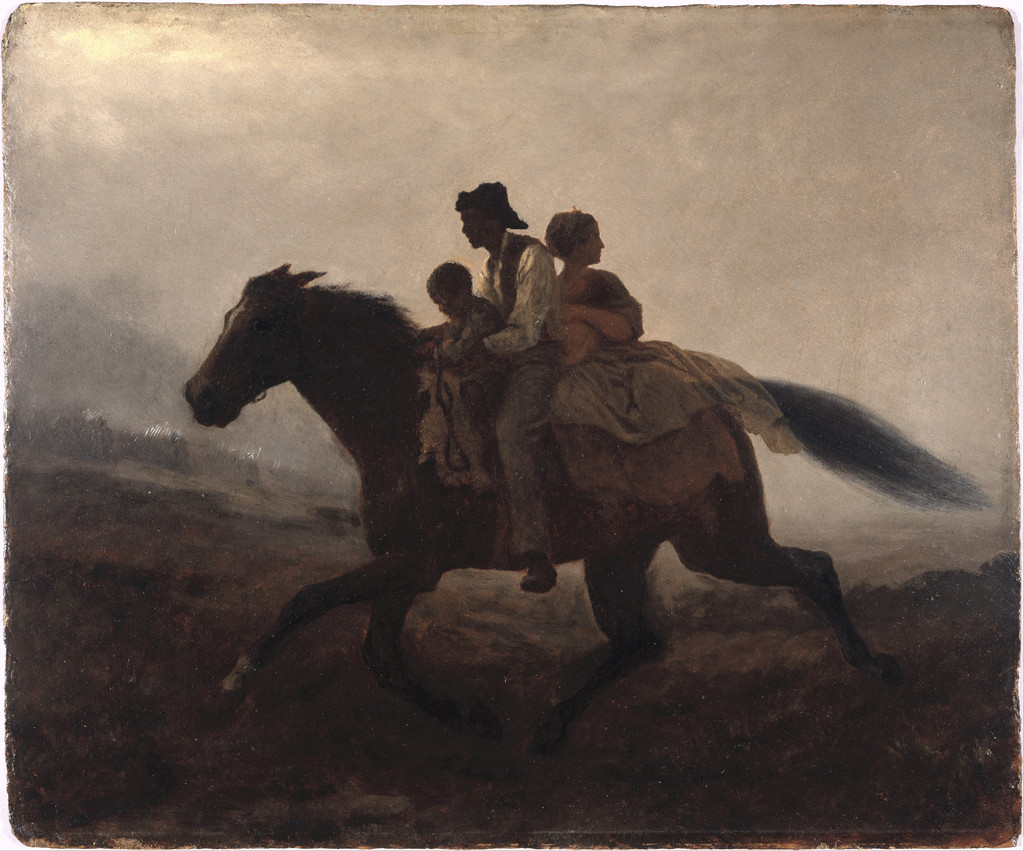
A Ride for Liberty—The Fugitive Slaves. A family’s movement towards freedom carries the whole composition. [8]
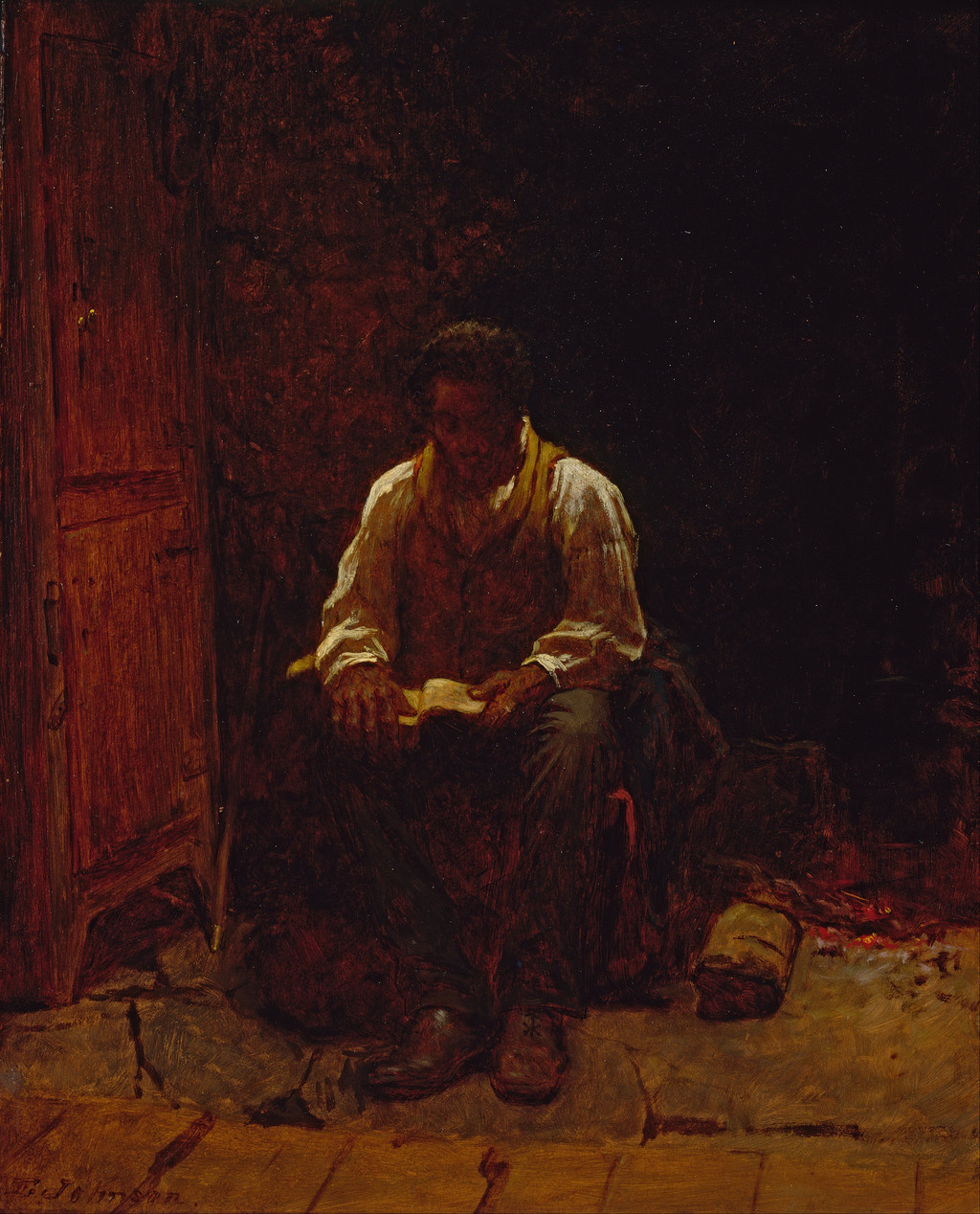
The Lord Is My Shepherd. A lowered head and open book concentrate attention within a dark room. [9]
Sugaring Off. Unfinished passages reveal the preparation of an ambitious gathering around maple-sugar production. [10]
The Wounded Drummer Boy (San Diego study). Soldier and drummer form a single upright group; this study has its own object history. [11]
The Early Scholar. A child’s position beside a stove turns the need for warmth into the centre of a schoolroom. [12]
Fiddling His Way. A Black musician’s playing gathers the attention of a household. [13]
The Letter Home. A wounded man and a woman writing connect spoken words with an absent home. [14]
The Boyhood of Lincoln. Firelight makes an imagined scene of Lincoln reading into an image of aspiration. [15]
The Brown Family. A child’s reaching arm connects three generations within an elaborate interior. [16]
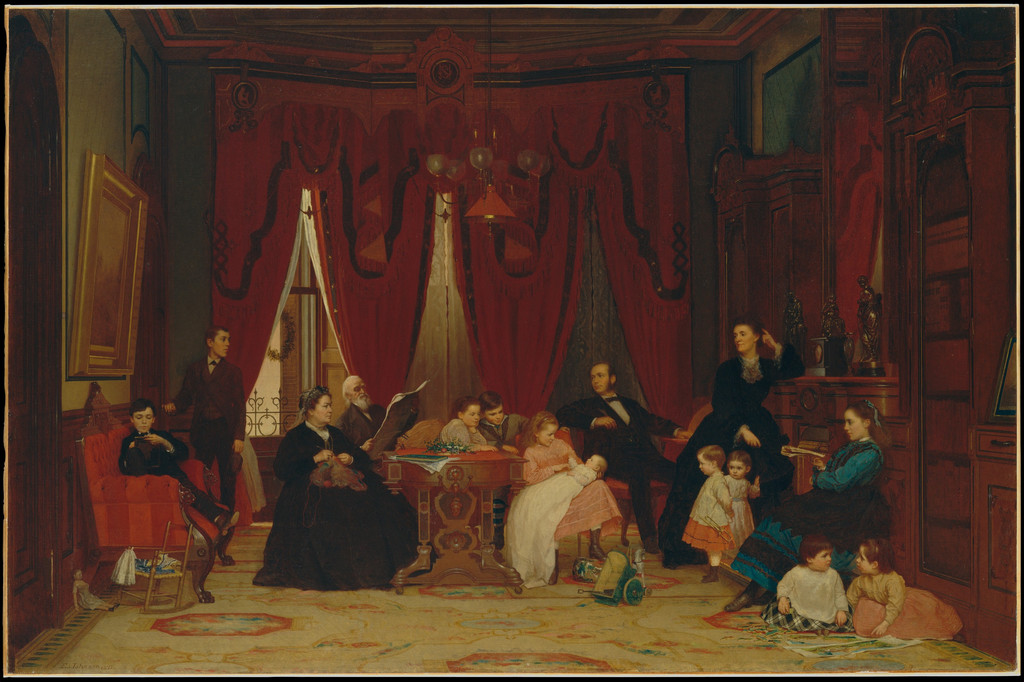
The Hatch Family. Fifteen figures inhabit a library through a carefully distributed set of activities. [17]
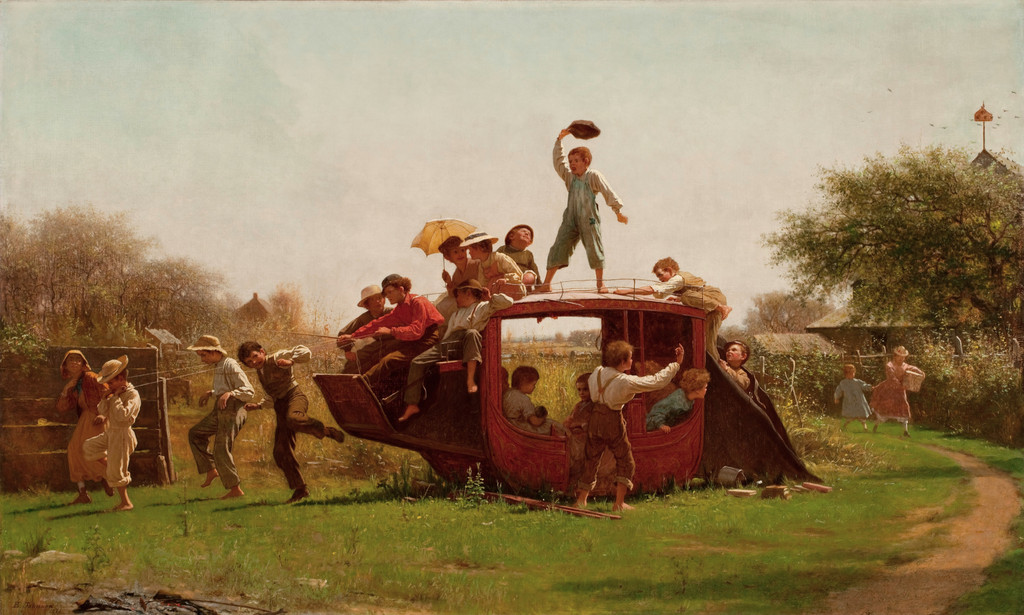
The Old Stagecoach. Children give a broken vehicle a new purpose through play. [18]
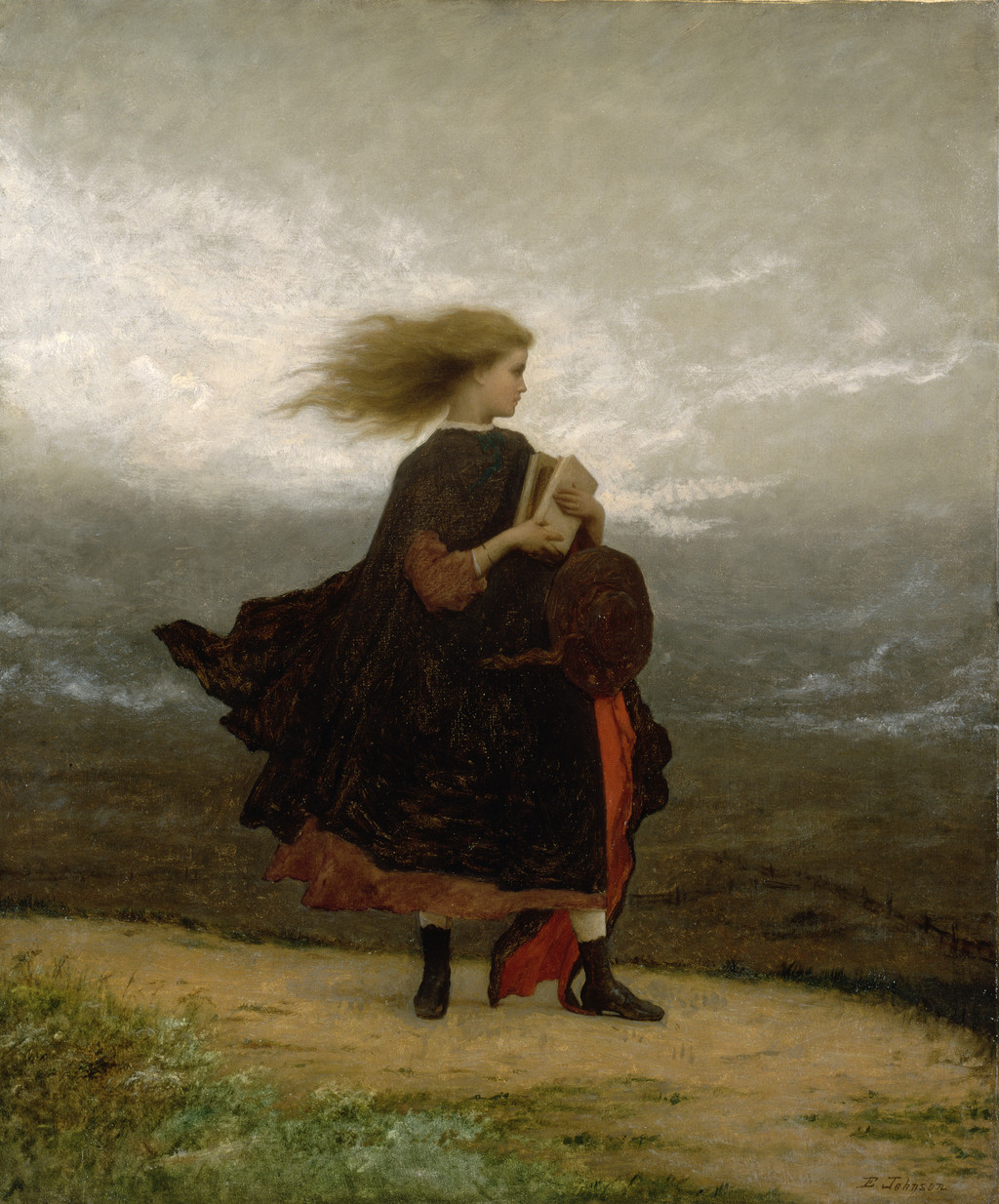
The Girl I Left Behind Me. A still figure, books and wind-driven clothing hold competing directions of attention. [19]
The Toilet. The mirror returns a face while the figure’s back occupies the foreground. [20]
Husking Bee, Island of Nantucket. A line of people and pale husks joins harvest work to a social gathering. [21]
The New Bonnet. A bonnet, a glass and a fire give three figures different occupations within one room. [22]
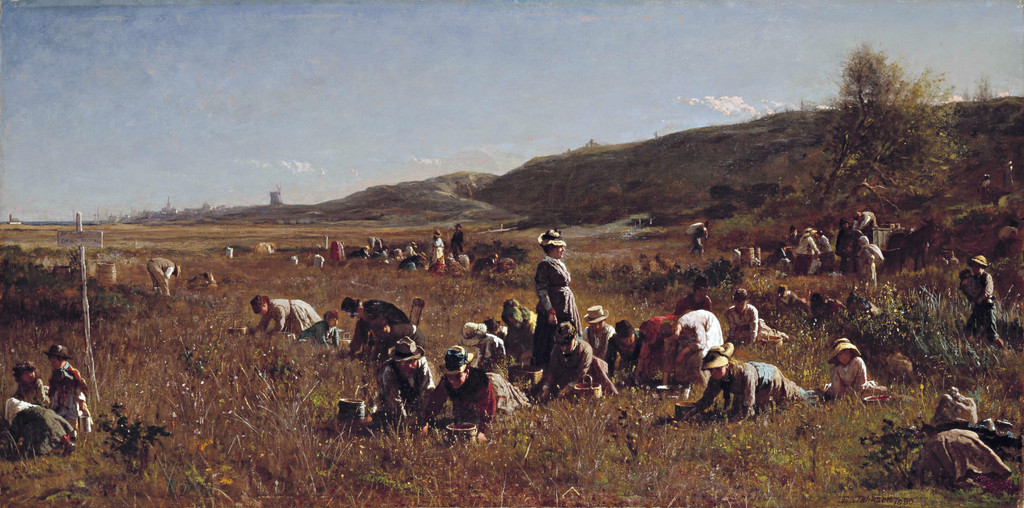
The Cranberry Harvest, Island of Nantucket. Repeated working figures spread across a panoramic field beneath an expansive sky. [23]
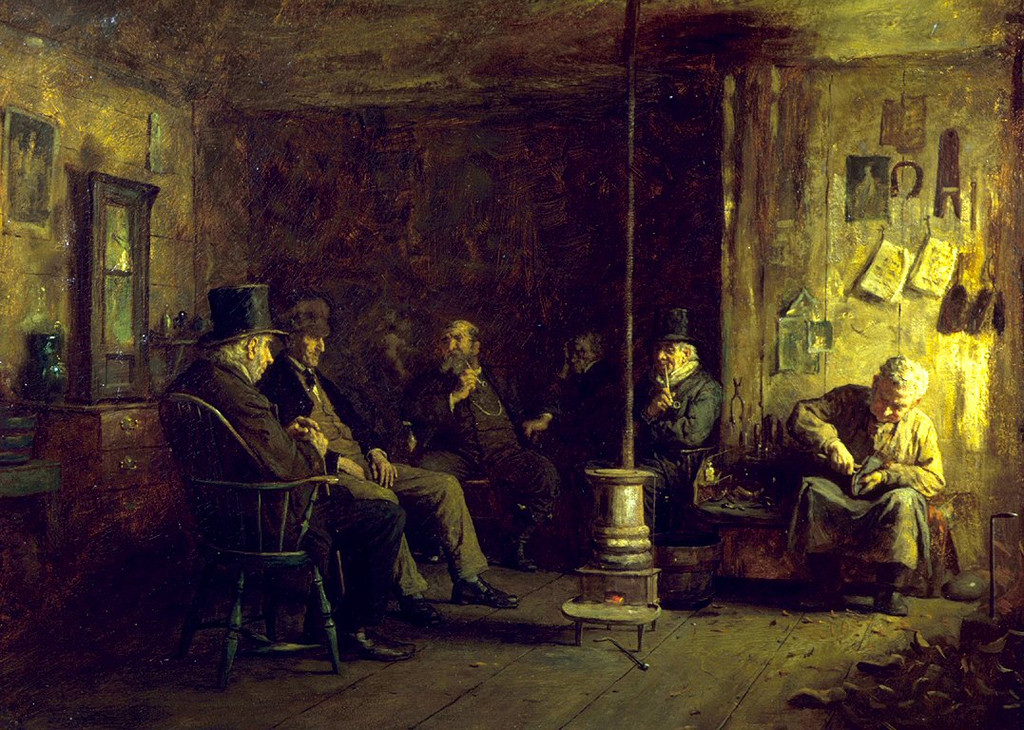
The Nantucket School of Philosophy. A shoemaker’s shop becomes a place for work, company and conversation. [24]
Contents
- Maine and the beginning of a profession
- Washington and the Longfellow commissions
- Düsseldorf and Emanuel Leutze
- The Hague and Paris
- Returning to Washington
- Lake Superior in 1856 and 1857
- New York and the 1859 breakthrough
- The Civil War and its aftermath
- Marriage, a family and Nantucket
- Portraits and institutions
Maine and the beginning of a profession
Johnson grew up in Fryeburg and Augusta after his birth in Lovell. His father, Philip Carrigan Johnson, worked in Maine politics and government. That family environment later helped connect the young artist with the public figures whose likenesses could provide work and establish a reputation. [2] [3]
Around 1840, he spent time in a Boston lithography shop, designing material for books and music. He returned to Maine in 1842 and developed a portrait practice in pencil, charcoal and related drawing media. The early work depended on a skill that could be offered directly to relatives, acquaintances and people within his father’s circle. [2]
These beginnings are important because Johnson’s later reputation as a painter can obscure how fully drawing functioned as a profession. He was producing likenesses before the extended European training that developed his handling of oils. A sitter’s face, a sheet of paper and access to patrons were already the basis of an artistic livelihood.
Four stages of Eastman Johnson’s career
These periods group related developments; painting, travel and local work overlap across their boundaries.
From professional likenesses to painting abroad
Portrait drawing supplied early employment in Maine, Washington and Boston. Johnson’s European years included Leutze’s studio in Düsseldorf, study in The Hague and work with Couture in Paris. [1]
People, places and contested national life
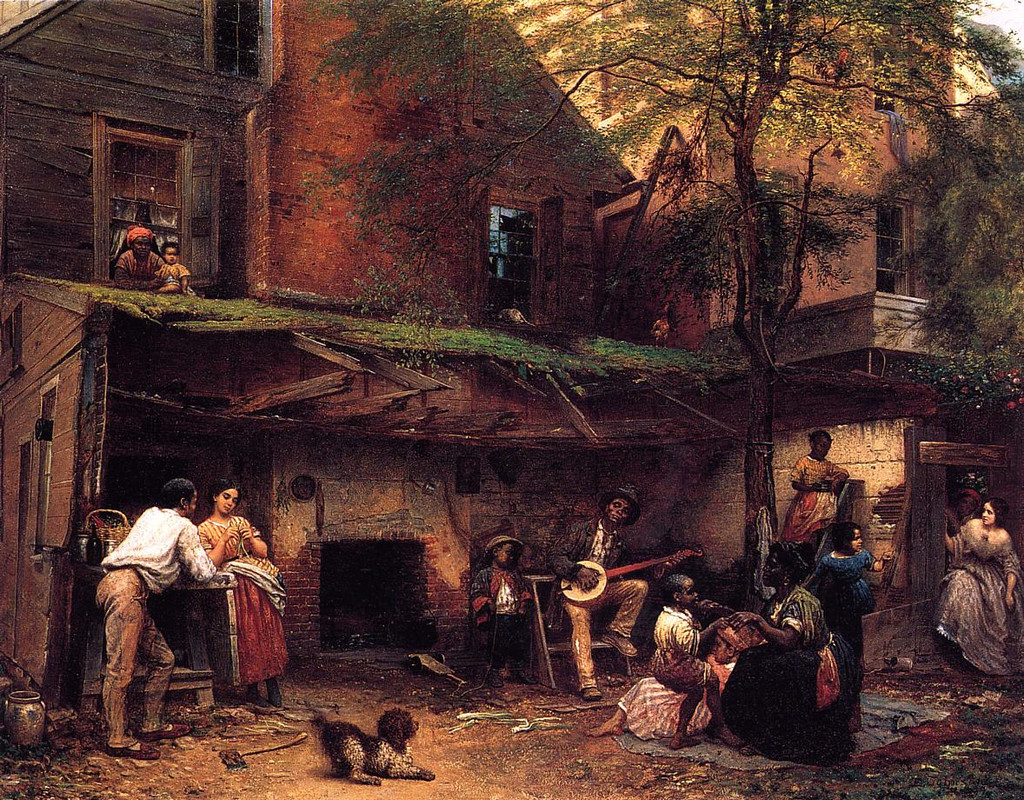
Work around Lake Superior and in Washington preceded the New York success of Negro Life at the South. During the Civil War, Johnson developed subjects of escape, military experience and life away from the battlefield. [1]
Portrait groups alongside harvest gatherings
Marriage and family life accompanied a sustained engagement with Nantucket. Family portraits and scenes of harvest, play and company developed alongside one another, culminating in the broad Timken cranberry canvas. [1]
Public commissions with a continuing interest in genre
Portrait commissions increasingly occupied Johnson’s later career. The Nantucket School of Philosophy, painted in 1887, nevertheless shows that everyday gatherings remained part of his work. His activity continued into the early twentieth century. [1]
Washington and the Longfellow commissions
Johnson moved to Washington in the mid-1840s and drew prominent national figures. Museum biographies describe access to a congressional committee room as a working space, probably assisted by his father’s connections. Portraits of political and social figures linked his developing practice with the capital’s public life. [2] [3]
Boston supplied another network. Beginning in September 1846, Henry Wadsworth Longfellow commissioned crayon portraits of his sisters and friends. The National Park Service identifies ten in the Longfellow House collection and records a double portrait of the poet’s sons in 1848. The commissions gave Johnson sustained work within a literary household. [4]
The contrast between the two cities helps explain the range of his early subjects. In Washington, a likeness could belong to a gallery of public figures; in Boston, it could preserve a family member or friend within a personal collection. Both settings depended on relationships through which one successful portrait might lead to another.
Johnson’s drawings retain this early achievement as an important part of his career. Their modelling through light and shadow would remain relevant when he moved more fully into painting.
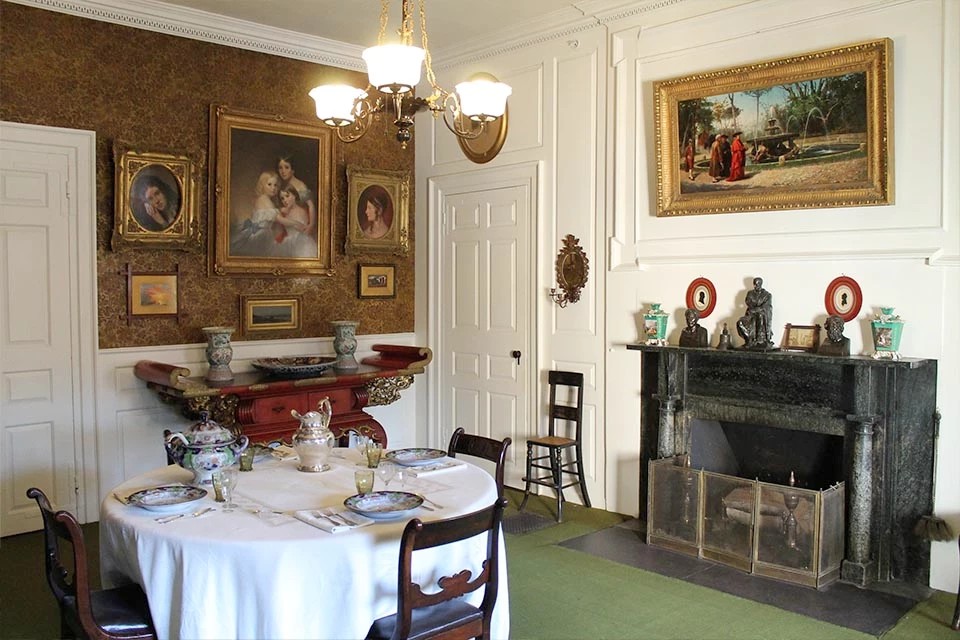
Dining room at Longfellow House–Washington’s Headquarters National Historic Site, 2018. The room reflects Alice Longfellow’s later arrangement; Johnson’s over-door drawings are outside this photograph, and the central family painting is not attributed to him. NPS Photo / Kate Hanson Plass. Public domain.
Image source
.
Public domain
.
Düsseldorf and Emanuel Leutze
In 1849 Johnson travelled to Europe for sustained study. Düsseldorf offered academic training and a community of American artists. His time in Emanuel Leutze ’s studio gave him a closer engagement with oil painting and the construction of ambitious compositions. [1] [2]
The Met biography records his work on a small copy of Leutze’s Washington Crossing the Delaware for an engraver. That association places Johnson beside the making and reproduction of a major history painting, even though his own later reputation would depend strongly on more intimate subjects. The copy’s present location is not established here from the older account. [2]
Leutze’s studio also belonged to an international artistic environment. Training abroad did not simply prepare Johnson to import one finished style. It gave him access to different methods and examples that he would later adapt to people and places in the United States.
The Hague and Paris
Johnson left Düsseldorf in 1851 and settled in The Hague after travel that included London. His extended Dutch stay allowed close study of seventeenth-century painting, particularly the treatment of figures within illuminated interiors. He also obtained portrait work there, making the period one of employment as well as education. [1] [3]
The Dutch example offered a way to give ordinary rooms and actions substantial pictorial weight. Selective light could organise a face, a table or a hearth without relying on the grandeur of the subject. That resource would remain visible in Johnson’s later American interiors.
In 1855 he went to Paris to study with Thomas Couture. The stay added another approach to tonal preparation and paint handling to the experience already acquired in Germany and the Netherlands. News of his mother’s death brought him back to the United States later that year. [1] [2]
The six-year span abroad was unusually substantial within his generation’s early training. Its importance lies in the range of encounters, rather than a claim that one teacher explains every subsequent work. Johnson’s technique developed through these experiences and through the demands of individual pictures.
Returning to Washington
His family’s Washington home supplied a base after his return. The city was both a place of political power and a society in which enslaved and free Black residents lived and worked alongside white households. John Davis’s study of Johnson’s Washington years places the artist within that complicated urban environment. [25]
His father married Mary Washington James in 1857. Davis documents her ownership of enslaved people in 1850 and the presence of free Black servants in the Johnson household in 1860. Those records should not be turned into certainty about who lived there in every intervening year or who later posed for the paintings.
Johnson also visited Mount Vernon with Louis Rémy Mignot in 1857. The deteriorating estate provided material for architectural and domestic scenes, including the first version of Kitchen at Mount Vernon . His attention was shifting towards the relationships between people, inhabited spaces and historically charged places. [2] [25]
Lake Superior in 1856 and 1857
Family connections took Johnson to Superior, Wisconsin, in 1856 and again in 1857. His work there brought him into contact with Ojibwe people and encampments around Lake Superior. The catalogue records the role of local guide Stephen Bunga in the 1857 trip. [26]
The journey combined artistic interests with the opportunities and pressures of a growing settlement economy. The region was Ojibwe territory, and Johnson’s interest in picturesque subjects existed alongside land speculation. It should not be described as the discovery of an uninhabited frontier.
The drawings and paintings include Ojibwe Youth , dated 4 October 1857, now in the St. Louis County Historical Society collection. That precise date anchors one work without resolving every date in the larger group. The catalogue also records that the sitter’s gender is unknown, despite conflicting older captions. [26]
These works belong both to Johnson’s development and to the later history of representations of Ojibwe life. Their observed details can be valuable while their titles, identities and the circumstances of their making still require examination.
New York and the 1859 breakthrough
After further work in Cincinnati, Johnson established himself in New York in 1858. The following spring he exhibited Negro Life at the South at the National Academy of Design. The complex Washington yard scene attracted substantial attention and helped establish him as a painter of American everyday life. [1] [2]
He became an Associate of the Academy in 1859 and a full Academician the next year. The professional recognition mattered alongside the picture’s popularity: it connected his growing audience with an established institution through which paintings could be exhibited and reputations maintained. [1]
The work’s reception also exposed the risks of representation. It was read through opposed attitudes towards slavery and quickly became known by the misleading title Old Kentucky Home . Davis’s reconstruction returns it to Washington rather than treating its fame as proof that viewers understood its setting or politics in the same way. [25]
Watch: Eastman Johnson
Choose a film to explore the artist’s work, its interpretation and its wider setting.
Director's Choice - The Girl I Left Behind Me by Eastman Johnson
The Smithsonian American Art Museum looks at Johnson’s The Girl I Left Behind Me.
Watch on YouTubeThe Civil War and its aftermath
During the war, Johnson followed Union troops and developed subjects associated with military experience, escape, injury and care. His catalogue biography records those journeys alongside domestic scenes of the home front. He did not need to restrict the conflict to a large battlefield panorama to make it consequential in his art. [1]
A Ride for Liberty represents a family seeking freedom on a single horse. The Lord Is My Shepherd makes reading the centre of a quiet interior. Their different scales of action offer distinct ways into the period’s questions about agency, learning and freedom.
Some subjects developed across a long interval. The Wounded Drummer Boy reached its finished canvas in 1871, while The Letter Home belongs to his postwar treatment of wartime care. The dates of finished works, studies and reported experiences need to remain separate rather than being gathered into one supposedly direct battlefield record.
At the same time, Johnson worked on maple-sugar subjects in Maine. Sugaring Off shows how rural activity could provide material for a substantial composition even during the years in which war transformed the country around it. The strands of his career overlapped rather than replacing one another neatly. [1]
Marriage, a family and Nantucket
Johnson married Elizabeth Buckley of Troy, New York, in 1869. Their daughter Ethel was born in 1870. Regular summers on Nantucket began around the same time, and the island supplied a durable setting for work, family life and subjects drawn from its residents. [1] [27]
He developed a home and studio there while continuing his New York career. In 1872 he moved his Manhattan studio to his renovated home at 65 West 55th Street. The two settings allowed a professional life that joined metropolitan patrons with sustained observation and study on the island. [2] [27]
Nantucket subjects included children, women outdoors, harvest gatherings and older sea captains. The Old Stagecoach combined local child models with an abandoned vehicle studied elsewhere. Husking Bee and The Cranberry Harvest made communal labour the basis of broad compositions.
The island’s appearance in these pictures should not turn them into an unselected record of local life. Studio construction, repeated studies and the expectations of collectors all helped determine what became a painting. Their sense of informal sociability depended on considered arrangements.
Eastman Johnson, The Cranberry Harvest, Island of Nantucket, 1880. Oil on canvas, 69.5 × 138.4 cm. Putnam Foundation, Timken Museum of Art, 1972:002. Public domain faithful reproduction.
Image source
.
Public domain
.
Portraits and institutions
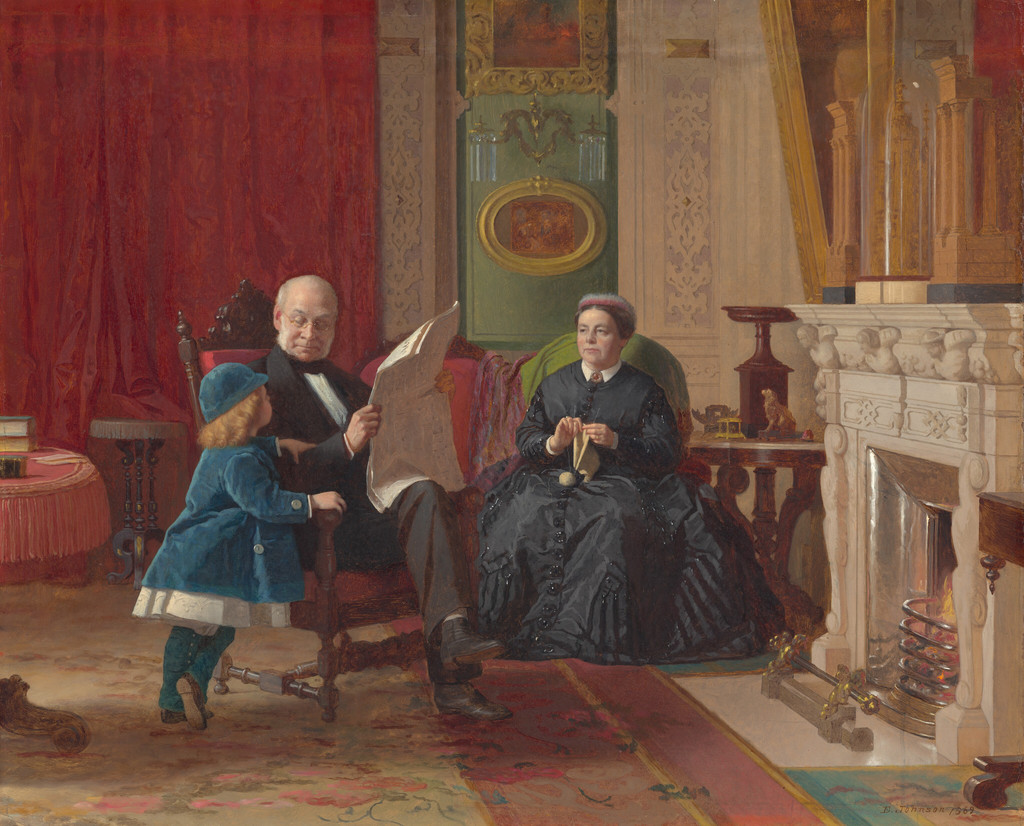
Portrait commissions continued throughout these decades. The Brown Family and The Hatch Family place named sitters within substantial domestic environments before the later concentration on individual public portraits. They demonstrate the continuity of a practice begun with drawings in the 1840s.
In the 1880s and later, Johnson devoted more of his work to prominent sitters. The catalogue biography names business leaders, actors and presidents among his subjects. The photographs published with Edgar French’s 1906 retrospective show an artist working at the scale of large formal likenesses, including Benjamin Harrison’s portrait. Their publication date should not be mistaken for an exact date of the photographed sessions. [1] [28]
Professional organisations formed another part of the career. Johnson belonged to the Century Association and Union League Club and was a founding trustee of the Metropolitan Museum of Art. His participation connected artists, patrons, exhibitions and collecting institutions within a developing New York art world. [1]
The transition towards more portraits did not happen at a single boundary after which every other interest vanished. The Nantucket School of Philosophy dates from 1887, while earlier family groups already belonged to portraiture. Changes in emphasis are clearer than a simple two-part career.
Eastman Johnson, The Brown Family, 1869. Oil on paper on canvas, 59 × 72.4 cm. National Gallery of Art, Gift of David Edward Finley and Margaret Eustis Finley, 1978.72.1. Public domain. This is the smaller Washington version.
Image source
.
Public domain
.
Final years and a changing reputation
Johnson continued exhibiting and receiving portrait commissions into his later years. Museum biographies also record return trips to Europe, making his first period abroad one part of a longer international career. A wholly isolated, exclusively local image of the painter would miss those connections. [2]
He died at his New York home on 5 April 1906, aged eighty-one. Later that year, French’s article presented his portrait practice as a record reaching across several generations of American public life. The retrospective admiration is evidence of a contemporary view of his achievement, rather than an impartial final judgement. [2] [27] [28]
Subsequent scholarship and museum catalogues have reconsidered the work through its materials, patrons and representations of race, family and national identity. His place among American artists and within the broader context of American Realism depends on that combination of visual observation and the social settings in which pictures were made and seen.
The main Eastman Johnson page provides routes through the paintings, while the separate portraits , drawings and technique pages follow practices that recur across this chronology. The life is most revealing when those strands remain connected: a changing set of places and commissions, held together by sustained attention to people and their surroundings.
Artworks directory
Browse twenty-one selected objects discussed in these articles, including the Gifford portrait and the Prang print after Johnson. Dates identify individual objects, including the San Diego Drummer Boy study. Use All media to include the chromolithograph.
| Name | Date | Medium |
|---|---|---|
| Kitchen at Mount Vernon | 1857; Charles Butt canvas | Oil on canvas |
| Negro Life at the South | 1859; New York Historical original | Oil on linen |
| A Ride for Liberty—The Fugitive Slaves | About 1862; Brooklyn version | Oil on paperboard |
| The Lord Is My Shepherd | 1863 | Oil on fiberboard |
| Sugaring Off | About 1864–65; unfinished RISD canvas | Oil on canvas |
| The Wounded Drummer Boy (San Diego study) | About 1864–71; study, not the finished canvas | Oil on board |
| The Early Scholar | About 1865; NGA study | Oil on academy board on canvas |
| Fiddling His Way | 1866; Chrysler canvas | Oil on canvas |
| The Letter Home | 1867; Minneapolis drawing | Charcoal and graphite on paper |
| The Boyhood of Lincoln | 1868; Michigan canvas | Oil on canvas |
| The boyhood of Lincoln—An evening in the log hut (Prang after Johnson) | About 1868; separate reproductive print | Chromolithograph, W. Harring / L. Prang & Co., after Johnson |
| The Brown Family | 1869; NGA version | Oil on paper on canvas |
| The Hatch Family | 1870–71 | Oil on canvas |
| The Old Stagecoach | 1871 | Oil on canvas |
| The Girl I Left Behind Me | About 1872 | Oil on canvas |
| The Toilet | 1873 | Oil on paper board |
| Husking Bee, Island of Nantucket | 1876; Chicago canvas | Oil on canvas |
| The New Bonnet | 1876 | Oil on academy board |
| Sanford Robinson Gifford | 1880; possibly posthumous | Oil on academy board |
| The Cranberry Harvest, Island of Nantucket | 1880; Timken canvas | Oil on canvas |
| The Nantucket School of Philosophy | 1887 | Oil on panel |
Frequently Asked Questions
His first extended European period, 1849–55, included Düsseldorf, Leutze’s studio, The Hague and Couture’s studio in Paris. [1]
He died on 5 April 1906, before his birthday on 29 July, so he was eighty-one. The older Met biography’s age of eighty-two is inconsistent with its own dates. [2]
Discussion
Look again at the images and ideas explored in Eastman Johnson Biography. These editorial prompts invite your observations.
Reader Insights
Which part of Johnson’s European study helps you understand a particular American interior? Connect the chronology with visible choices.
How does the continuity of portrait drawing and painting change your understanding of his later commissions?
Compare the Washington and Nantucket settings. Which social encounters become possible in each environment?
Join the Conversation
Share a detail, comparison or question about Eastman Johnson Biography below.
References
- Patricia Hills and Abigael MacGibeny , About Eastman Johnson, Eastman Johnson Catalogue Raisonné. Career, European training, marriage, Nantucket, portrait commissions and institutions. View source
- Natalie Spassky and others , American Paintings in The Metropolitan Museum of Art, Volume II, 1985, pp. 220–222. Chronological biography, Leutze, Dutch study, New York and later career. The stated death age is corrected using the dates; incidental unsupported details are not adopted. View source
- John Davis , Eastman Johnson biography, in American Paintings of the Nineteenth Century, Part I, National Gallery of Art, 1996, p. 372. Maine, early portrait practice, European study and professional setting. View source
- National Park Service , Longfellow House Fine Art Collection. September 1846 commissions and the 1848 double portrait. View source
- Sanford Robinson Gifford,1880,88.16, current object record and API. View source
- Washington’s Kitchen at Mount Vernon,1857,Hills6.0.4. View source
- Negro Life at the South,1859,S-225. View source
- A Ride for Liberty–The Fugitive Slaves, Brooklyn version, Hills 10.0.11r. View source
- The Lord Is My Shepherd, 1863, 1979.5.13. View source
- Sugaring Off, ca.1864–1865, 45.050. View source
- Wounded Drummer Boy, San Diego study, Hills 10.0.18. View source
- The Early Scholar,c.1865,1963.10.157: current object record. View source
- Fiddling His Way,1866,89.60. View source
- The Letter Home,1867,74.17; current collection data. View source
- Boyhood of Lincoln,1868,1895.90. View source
- The Brown Family, 1869, 1978.72.1. View source
- The Hatch Family, 1870–71, 26.97. View source
- The Old Stagecoach, 1871, L1888.22. View source
- The Girl I Left Behind Me, c.1872, 1986.79. View source
- The Toilet, 1873, 2015.19.85. View source
- Husking Bee, Island of Nantucket, 1876, 1922.444: current public API. View source
- The New Bonnet,1876,25.110.11,currentobjectrecordandAPI. View source
- The Cranberry Harvest, Island of Nantucket, 1880, 1972:002. View source
- The Nantucket School of Philosophy,1887,37.311. View source
- John Davis , Eastman Johnson’s Negro Life at the South and Urban Slavery in Washington, D.C., The Art Bulletin 80, no. 1, 1998, pp. 67–92. Washington household, urban setting and the 1859 picture’s reception. View source
- Hills and MacGibeny , Ojibwe Youth, 4 October 1857, Hills no. 38.4.1. Lake Superior visits, Stephen Bunga, dated drawing and identity limits; original letter not separately consulted. View source
- Eastman Johnson Catalogue Raisonné , Chronology. Selected family, studio and death dates, checked against the biographies. Unrelated erroneous dates elsewhere in the chronology are not repeated. View source
- Edgar French , An American Portrait Painter of Three Historical Epochs, The World’s Work 13, no. 2, December 1906, pp. 8307–8323. Retrospective portrait account and photographs; historical anecdotes are treated selectively. View source
- Splash image source.
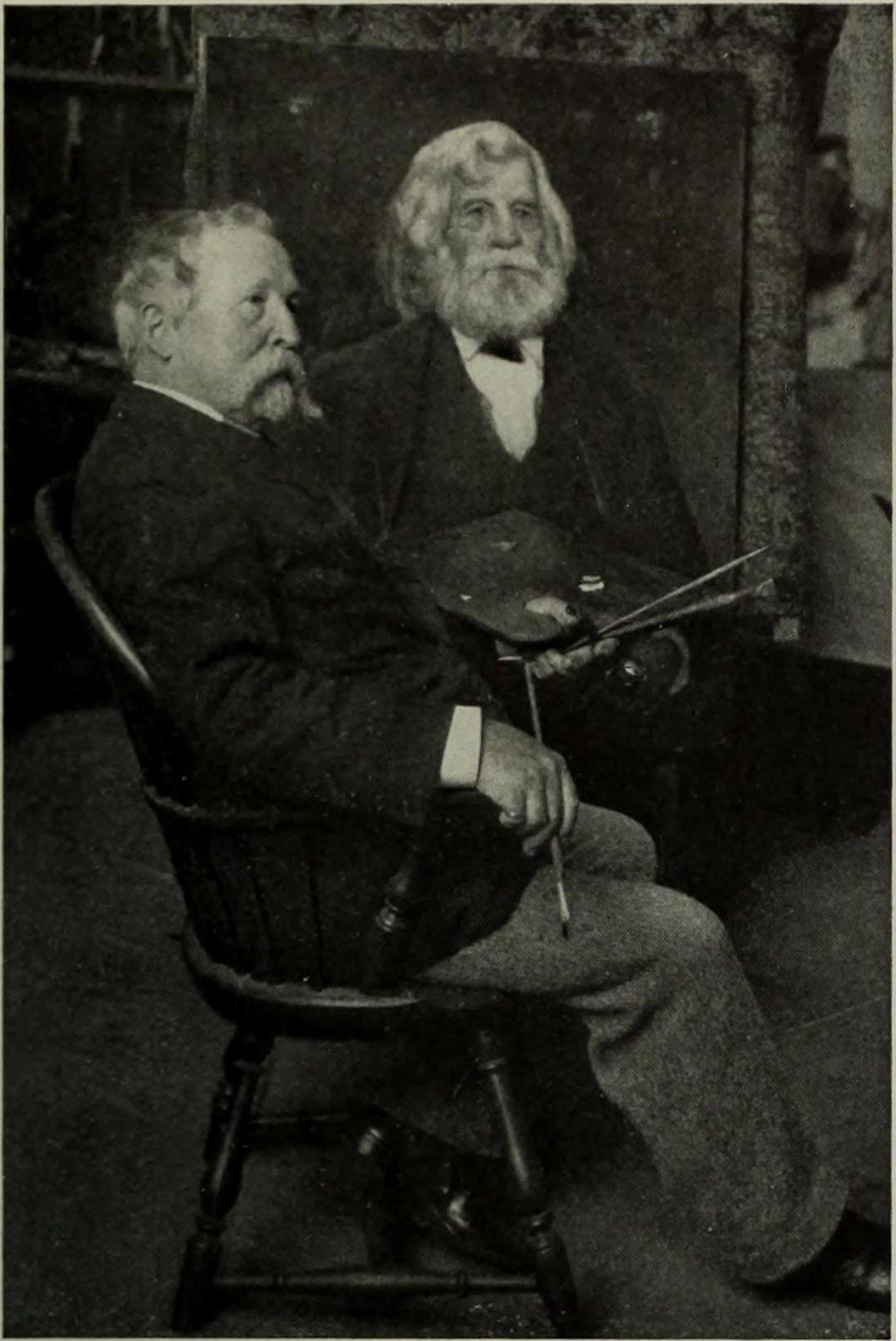
Eastman Johnson seated beside his painted portrait of Parke Godwin. Photograph published in The World’s Work, December 1906, p. 8321. The second face is part of the painting; the exact photograph date and photographer are not established. The World’s Work; Robarts Library, University of Toronto; Internet Archive. Public domain. Public domain .
View source - George Michael Cohen, A Regional Study of American Genre Painting from 1830–1880 (Boston University, 1962). This is a period of nineteenth-century prominence, not an end date for the genre. View source
- US National Park Service, Henry Wadsworth Longfellow: 1807–1882. Artist life dates. View source
- National Gallery, London, Thomas Couture: 1815–1879. Artist life dates. View source
- Smithsonian American Art Museum, Emanuel Leutze: 1816–1868. Artist life dates. View source
- US National Park Service, Sanford Robinson Gifford: 1823–1880. Artist life dates. View source
- New Britain Museum of American Art, Eastman Johnson: 1824–1906. Artist life dates. View source