 by
Tom Gurney
Tom Gurney BSc (Hons) is an art history expert with over 20 years experience
Email:
tomgurney1@gmail.com
/ Phone:
+44 7429 011000
Husking Bee, Island of Nantucket by Eastman Johnson: Introduction
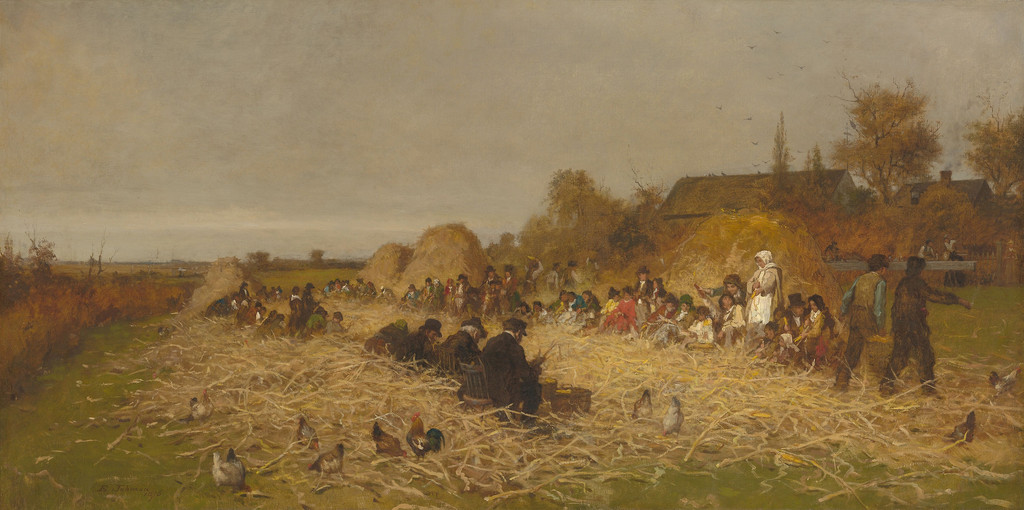
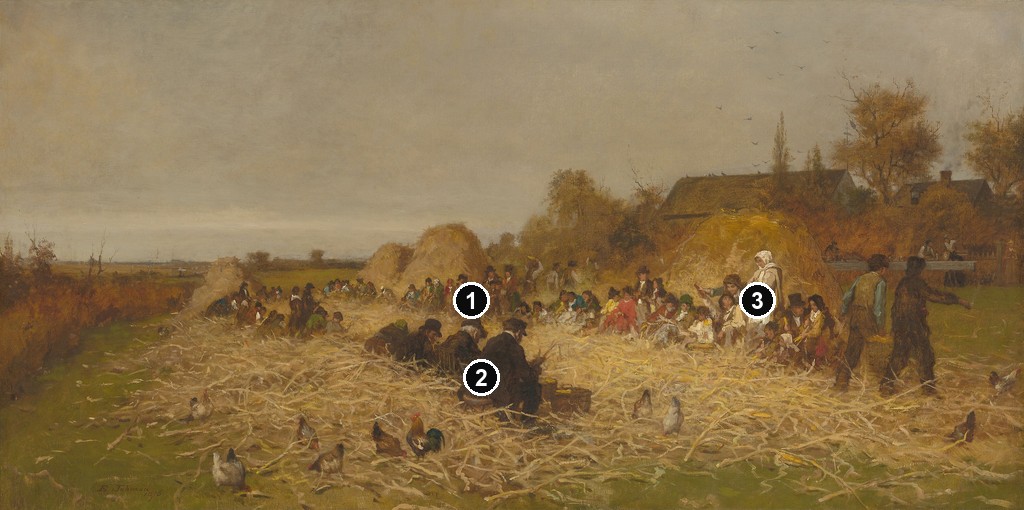
In Eastman Johnson’s Husking Bee, Island of Nantucket , a harvest task becomes a landscape filled with company. Two rows of people recede through a field covered in pale corn husks. Older men sit in chairs near the foreground, children join the gathering, and chickens pick their way across the discarded material.
The finished painting is dated 1876 and belongs to the Art Institute of Chicago. Its long format allows Johnson to connect many small exchanges without making one person the sole protagonist. Made in the year of the United States centennial, it offered a rural subject that could carry ideas of continuity, cooperation and national memory. [1]
At a Glance
- Artist Eastman Johnson
- Title Husking Bee, Island of Nantucket
- Date 1876
- Medium Oil on canvas
- Dimensions 69.6 × 138.2 cm
- Collection Art Institute of Chicago
- Accession 1922.444
- Credit Gift of Honoré and Potter Palmer
The Chicago painting is distinct from the related oil study in the Metropolitan Museum of Art. [1] [2]
This work across Eastman Johnson’s career
The Girl I Left Behind Me
About 1872The Toilet
1873Husking Bee, Island of Nantucket (current article)
1876; Chicago canvasThe New Bonnet
1876The Cranberry Harvest, Island of Nantucket
1880; Timken canvasNotes and sources
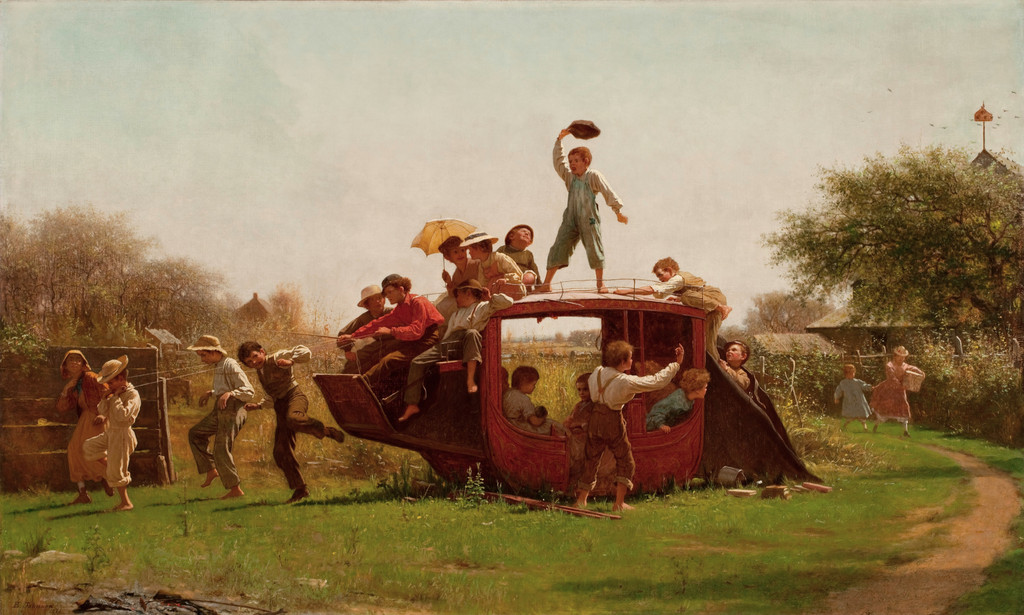
The Old Stagecoach. Children give a broken vehicle a new purpose through play. [3]
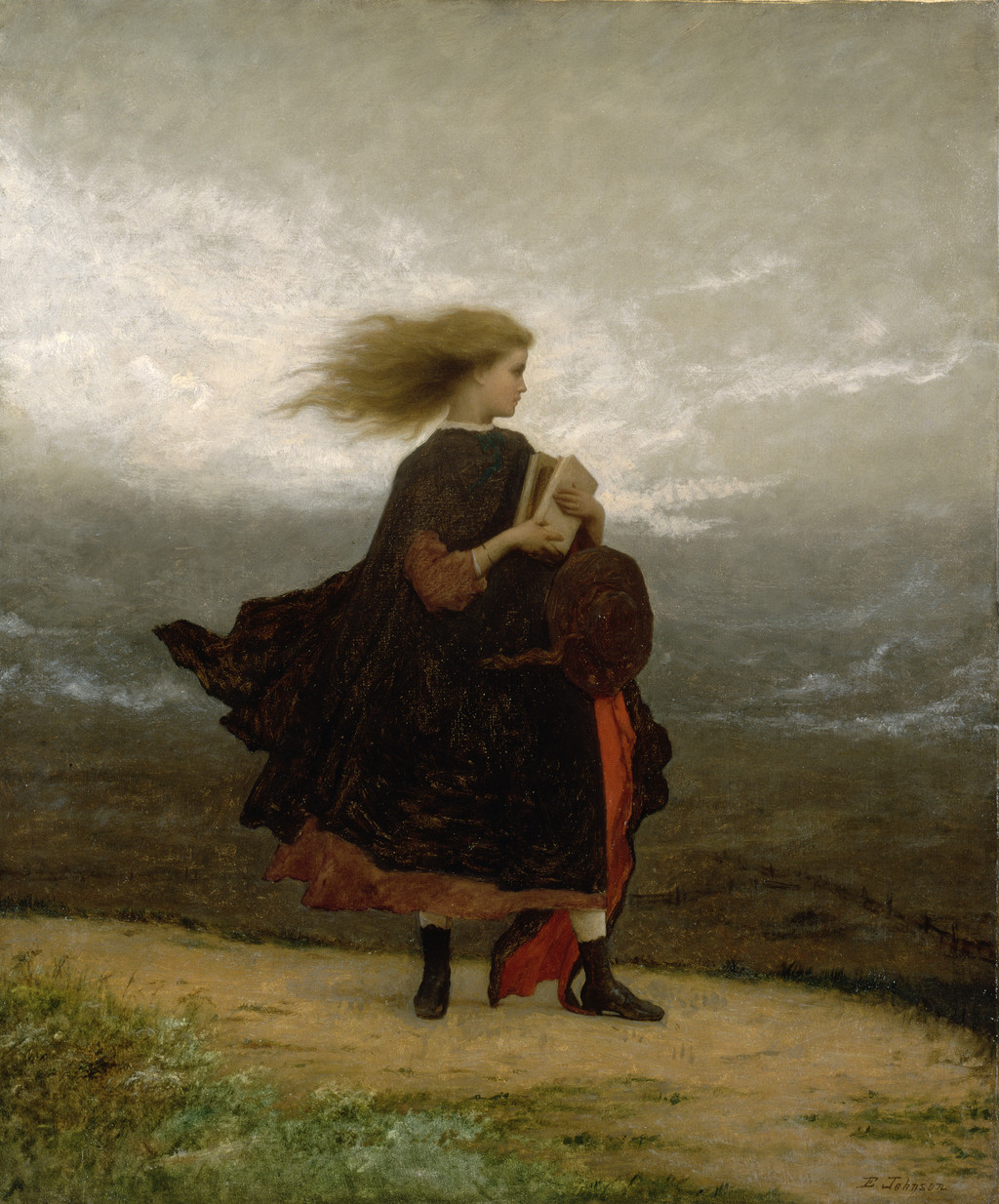
The Girl I Left Behind Me. A still figure, books and wind-driven clothing hold competing directions of attention. [4]
The Toilet. The mirror returns a face while the figure’s back occupies the foreground. [5]
Husking Bee, Island of Nantucket (current article). A line of people and pale husks joins harvest work to a social gathering. [6]
The New Bonnet. A bonnet, a glass and a fire give three figures different occupations within one room. [7]
The Cranberry Harvest, Island of Nantucket. Repeated working figures spread across a panoramic field beneath an expansive sky. [8]
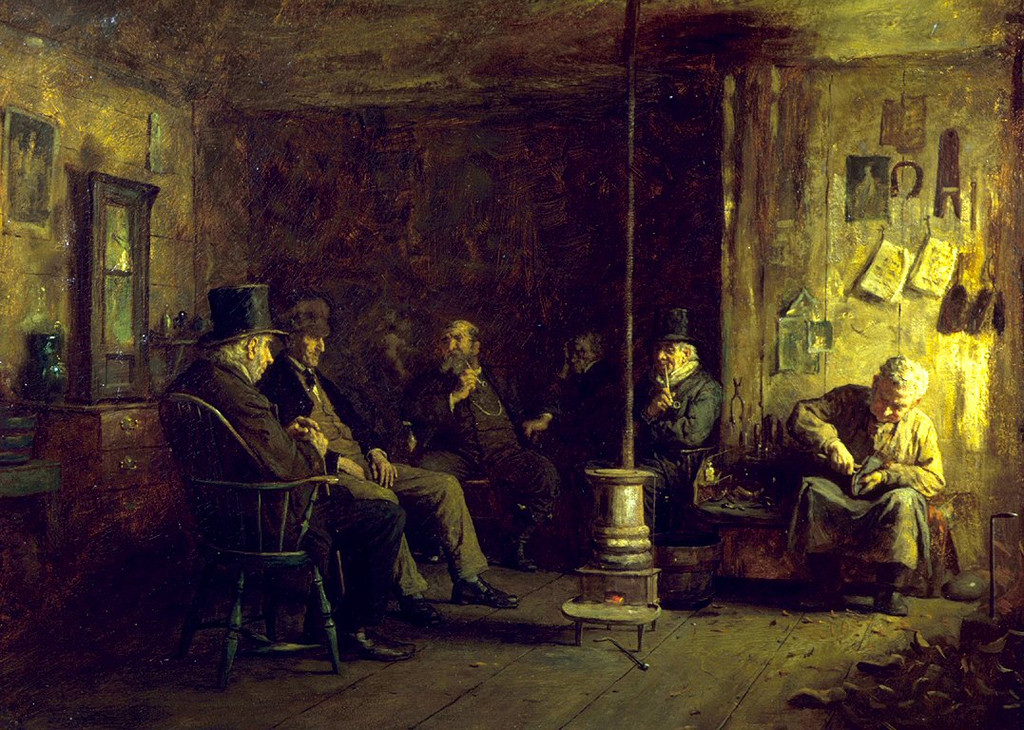
The Nantucket School of Philosophy. A shoemaker’s shop becomes a place for work, company and conversation. [9]
Contents
- What is a husking bee?
- A diagonal made out of people
- Buildings, sky and autumn colour
- The red ear and a small social story
- Studies and a changing format
- Weather remembered after the event
- Cooperation and the centennial
- Exhibitions and collectors
- Annotated details
What is a husking bee?
A husking bee brings people together to remove the outer coverings from harvested corn. The practical work can also provide an occasion for conversation, flirtation and shared recreation. Johnson represents the task through gathered people, baskets, ears of corn and the accumulating husks spread across the field. [1]
The title therefore names both an activity and a social event. The scene is not simply a view of crops or a portrait of a single worker. Its subject is the way people occupy a place together while performing a repeated task, with different bodies finding different positions within the gathering.
That combination gives the painting several scales of interest. A distant viewer can recognise a large communal pattern. Closer looking discovers particular hats, turned heads, raised hands and small exchanges between neighbours. Johnson makes the work comprehensible without requiring every person to be identified.
Annotated Details from Husking Bee, Island of Nantucket
The numbered points identify visible features discussed in this article. Return from each detail to the whole composition. Eastman Johnson, Husking Bee, Island of Nantucket, 1876. Oil on canvas, 69.6 × 138.2 cm. Art Institute of Chicago, 1922.444. CC0. Image source. CC0 / Public domain. Numbers added to a separate overview; detail images are native crops. No recolouring, retouching, reconstruction or enlargement.
Details from HUSKING BEE, ISLAND OF NANTUCKET
Compare the cropped details with the complete images above. Notice how their colours, shapes and positions contribute to the larger compositions.
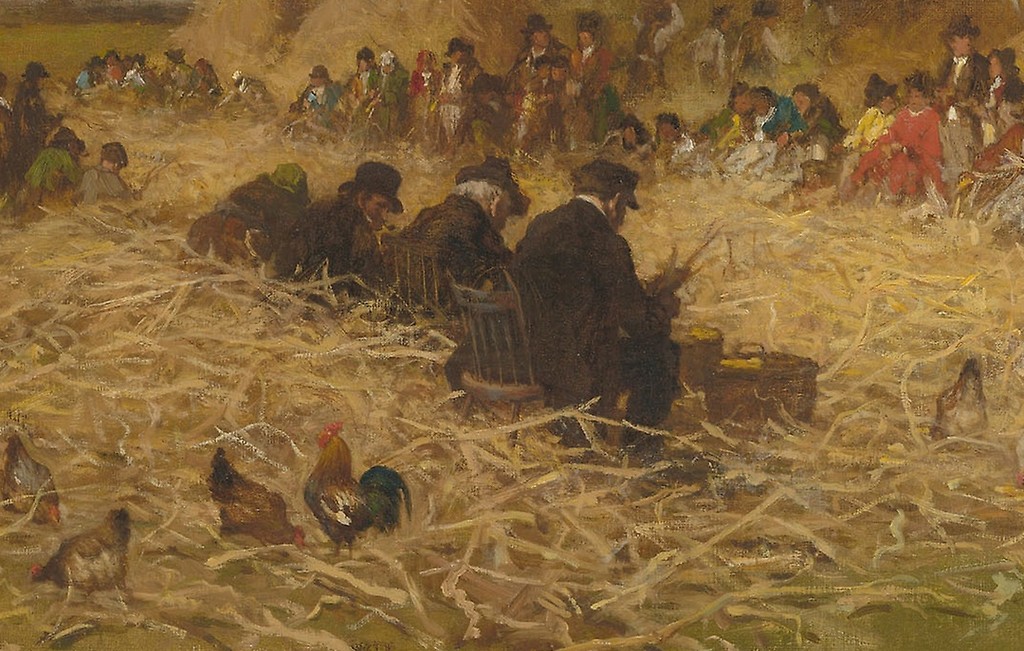
The diagonal gathering
Two lines of people recede across the field between pale husks. Repeated heads and bodies establish a shared task while leaving small differences of posture and activity visible.
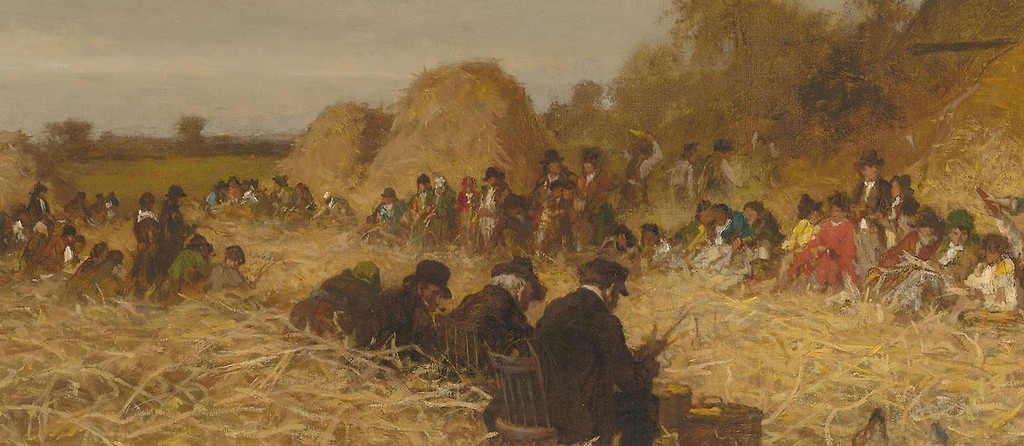
Seated men in the foreground
Dark coats and chair backs make a substantial foreground group. Their upright and bent shapes interrupt the lighter surface of scattered husks and lead towards the more distant workers.
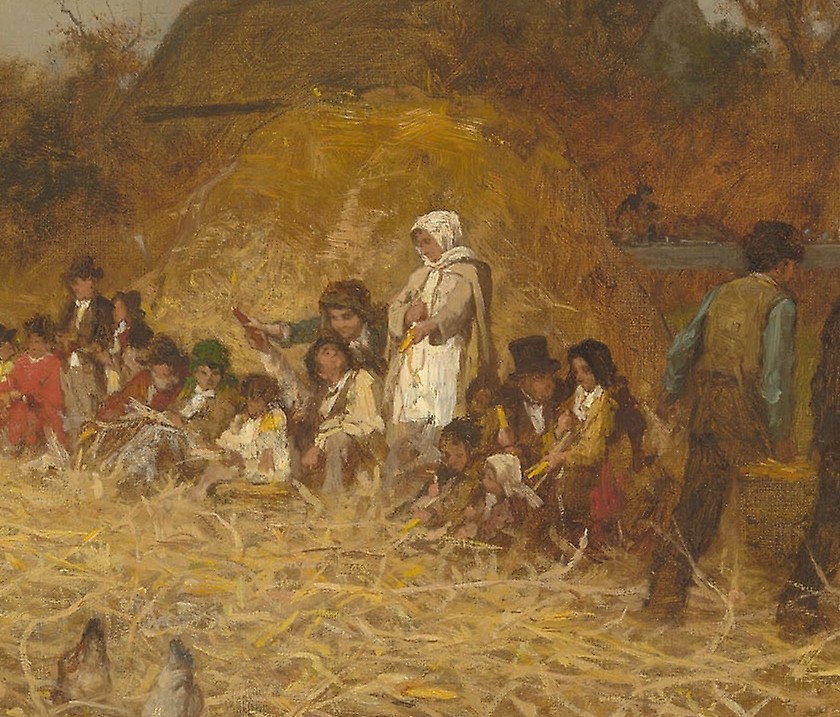
A standing woman among seated workers
A pale standing figure rises beside people sitting on the ground. The contrast of height, clothing and gesture gives this part of the harvest gathering its own small centre.
A diagonal made out of people
The most striking compositional device is the pair of seated rows. Beginning near the foreground, the workers diminish in size towards the left distance. Their bodies create a strong diagonal through an otherwise horizontal view, providing a route into the field without relying on a road or river.
The pale husks strengthen that route. Their tangled forms spread across the ground, joining one seated group to another and separating the working area from the greener edges of the field. The surface is busy with marks, but the overall direction remains clear because the figures and harvest material share a broad movement into depth.
The nearer workers offer different silhouettes. Several older men occupy chairs, their dark coats and hats forming a conspicuous cluster against the light ground. Elsewhere, figures sit lower among the husks. The contrast introduces differences of age and bodily accommodation within the same communal activity.
Near the right-hand group, a pale-clad standing woman lifts an arm above the seated line. Her vertical figure interrupts the repeated low poses and helps keep the long composition from becoming monotonous. Farther right, standing figures and the farm boundary give the gathering an edge without completely closing it.
Chickens provide a smaller foreground movement. Their bodies and coloured plumage punctuate the carpet of husks, creating incidents that do not compete with the main human arrangement. They help make the field appear occupied at several levels: gathering people, useful materials and animals pursuing their own activity.
Buildings, sky and autumn colour
Behind the workers, hay or harvest stacks, trees and farm buildings establish a rural setting. Their larger masses counter the small repeated figures. The dark roofline and warmer vegetation also give the nearer group a background against which hats, dresses and faces can become visible.
The sky occupies a substantial part of the canvas, but its restrained tone keeps it connected with the muted field. Johnson does not need a spectacular sunset to make the harvest atmospheric. Warm ochres, browns and scattered notes of stronger colour carry the season through the whole image.
The breadth of the landscape matters as much as its individual objects. People and ground are interwoven: the husks surround bodies, chairs interrupt the surface, and the rows seem to grow out of the field’s organisation. The painting can be read as a figure composition and as a landscape without requiring either category to dominate.
The red ear and a small social story
The Art Institute’s interpretation identifies a woman discovering a red ear of corn. It relates the incident to a folk custom permitting the finder to kiss someone of her choice. This brings a possible courtship story into the larger work gathering. [1]
The detail is best understood at that scale. It adds an intelligible social possibility rather than supplying a complete narrative for every person. The museum’s explanation of the custom does not establish the names of a particular couple or prove that Johnson recorded one actual kiss.
The incident also changes the balance between work and leisure. The harvest task creates the conditions for company, and company gives the repeated labour a recreational dimension. The painting’s conviviality emerges from the coexistence of those activities rather than from the absence of work.
Studies and a changing format
The Met holds Corn Husking at Nantucket , accession 07.68, an oil study related to the Chicago painting. Natalie Spassky’s catalogue entry dates it tentatively to about 1875 and discusses other drawings and studies through which Johnson developed the arrangement. The work illustrated here remains the finished Chicago canvas of 1876. [2]
One smaller, elongated study was dated 28 October 1875. According to the catalogue, comparison among the studies and final work reveals changes in the composition’s proportions. The established figure arrangement could be carried into a format with more room above and below, altering how people and landscape relate. [2]
Spassky describes the final painting as more defined than the Met study while retaining a sense of lively handling. The distinction is useful: a finished work can preserve apparent freshness through a sustained process of development. Visible ease does not mean the whole gathering was resolved in one uninterrupted session. [2]
The studio’s role is documented in another way by the photograph published in Edgar French’s 1906 account. Harvest pictures and studies appear among the works retained around Johnson’s workspace; the Met catalogue identifies both its study and another harvest sketch in that view. Their survival in the studio connects this public image with an ongoing working collection. [10] [2]
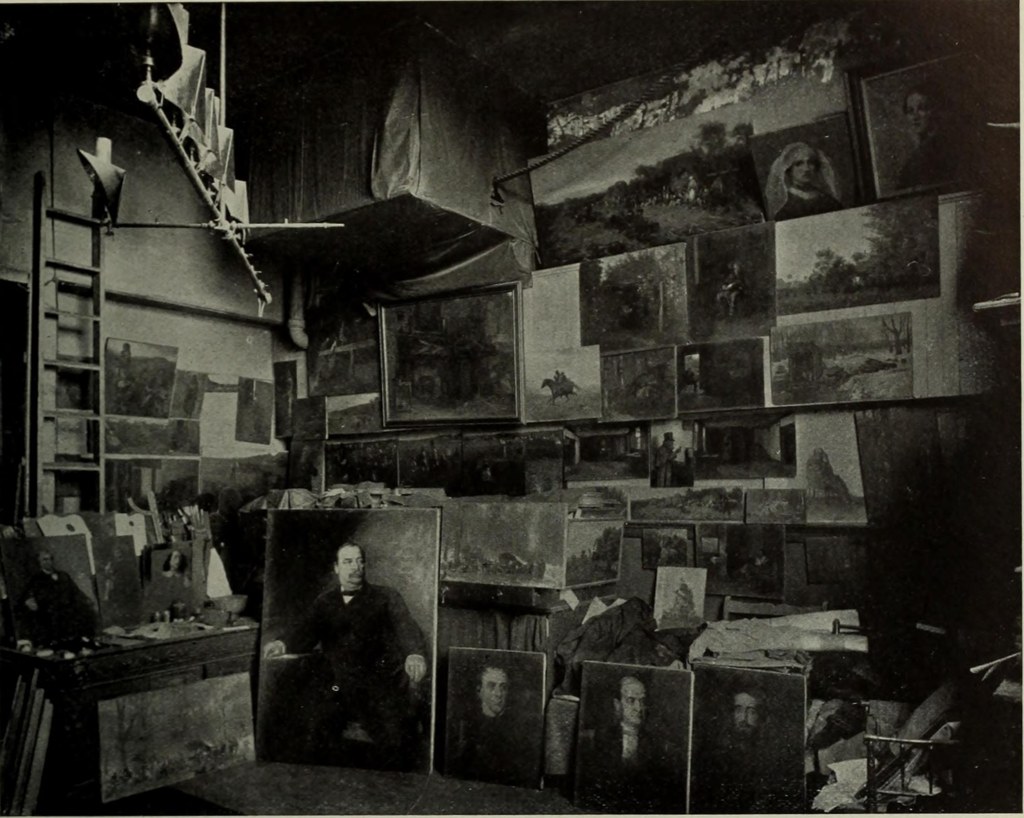
Eastman Johnson’s studio, photograph published in The World’s Work, December 1906, p. 8317. The Met catalogue identifies harvest studies in this view. Exact photograph date and photographer are not established. The World’s Work; Robarts Library, University of Toronto; Internet Archive. Public domain.
Image source
.
Public domain
.
Watch: Eastman Johnson
Choose a film to explore the artist’s work, its interpretation and its wider setting.
Director's Choice - The Girl I Left Behind Me by Eastman Johnson
The Smithsonian American Art Museum looks at Johnson’s The Girl I Left Behind Me.
Watch on YouTubeWeather remembered after the event
Elizabeth Johnson’s 1913 letter, cited by Spassky, recalled a late-November day with dark skies and wind when the artist encountered the subject. She also remembered older sea captains taking chairs because prolonged crouching was difficult for them. It is a vivid retrospective explanation of differences visible within the gathering. [2]
The catalogue also reproduces a 1907 sale description that presents a warmer early-autumn atmosphere. These accounts concern the related study and its remembered setting, and they do not agree in every atmospheric detail. The painting need not be forced into one exact weather report to remain convincing as an autumn scene. [2]
The widow’s recollection connects some of the same captains with The Nantucket School of Philosophy . The comparison helps reveal continuity in Johnson’s interest in older island men, while leaving the precise identity of each harvest figure open. A familiar social world could supply several different compositions. [2]
Cooperation and the centennial
The Art Institute frames Husking Bee in relation to the centennial’s interest in the national past. A seasonal rural gathering could offer urban viewers an appealing image of customary cooperation during a period of rapid industrial and social change. The museum’s interpretation explains why such a subject could seem timely in 1876. [1]
The painting’s apparent harmony should nevertheless remain a pictorial proposition. A gathering can be selected, organised and made representative through art. The presence of several ages and both working and social exchanges does not establish that the scene objectively describes every group or economic relationship on Nantucket.
The comparison with The Cranberry Harvest is particularly useful. There, people are distributed across a bog in smaller clusters, with picking repeated through many different postures. Here, the paired rows provide a much more visible collective structure. The two paintings make community legible through different patterns of labour.
An earlier comparison, Sugaring Off , shows Johnson organising another gathering around rural production. Its unfinished margins expose decisions that a completed harvest canvas ordinarily conceals. Together, these works reveal the sustained effort behind an image of apparently natural cooperation.
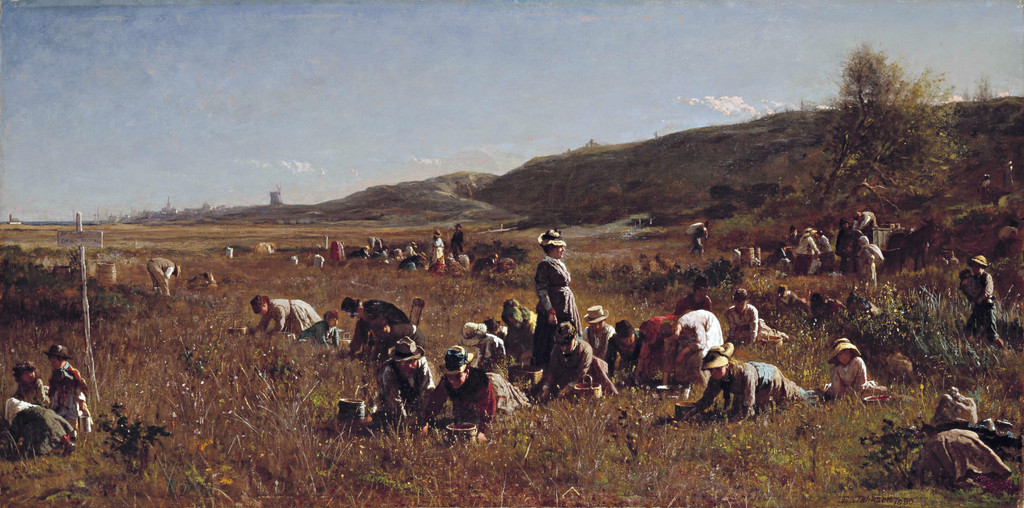
Eastman Johnson, The Cranberry Harvest, Island of Nantucket, 1880. Oil on canvas, 69.5 × 138.4 cm. Putnam Foundation, Timken Museum of Art, 1972:002. Public domain faithful reproduction.
Image source
.
Public domain
.
Exhibitions and collectors
The Chicago record places Husking Bee at the National Academy of Design and Philadelphia’s Centennial Exhibition in 1876, followed by the Paris Exposition Universelle in 1878. Its rural subject therefore travelled through major national and international displays rather than remaining an exclusively local image. [1]
Photographer and artist Napoleon Sarony owned it by 1878 and lent it to the Paris exhibition. Potter and Bertha Palmer acquired it in 1889; it later descended to their sons, Honoré and Potter Palmer II, who gave it to the Art Institute in 1922. The history links the painted Nantucket gathering with collectors in New York and Chicago. [1]
Its present dimensions follow the Art Institute’s current record, rather than the discrepant measurement printed for the Chicago work in the older Met catalogue. Keeping that distinction clear also prevents the study’s material data from migrating into the finished painting’s description. The two works reward comparison precisely because their identities and histories remain separate.
Artworks directory
Browse twenty-one selected objects discussed in these articles, including the Gifford portrait and the Prang print after Johnson. Dates identify individual objects, including the San Diego Drummer Boy study. Use All media to include the chromolithograph.
| Name | Date | Medium |
|---|---|---|
| Kitchen at Mount Vernon | 1857; Charles Butt canvas | Oil on canvas |
| Negro Life at the South | 1859; New York Historical original | Oil on linen |
| A Ride for Liberty—The Fugitive Slaves | About 1862; Brooklyn version | Oil on paperboard |
| The Lord Is My Shepherd | 1863 | Oil on fiberboard |
| Sugaring Off | About 1864–65; unfinished RISD canvas | Oil on canvas |
| The Wounded Drummer Boy (San Diego study) | About 1864–71; study, not the finished canvas | Oil on board |
| The Early Scholar | About 1865; NGA study | Oil on academy board on canvas |
| Fiddling His Way | 1866; Chrysler canvas | Oil on canvas |
| The Letter Home | 1867; Minneapolis drawing | Charcoal and graphite on paper |
| The Boyhood of Lincoln | 1868; Michigan canvas | Oil on canvas |
| The boyhood of Lincoln—An evening in the log hut (Prang after Johnson) | About 1868; separate reproductive print | Chromolithograph, W. Harring / L. Prang & Co., after Johnson |
| The Brown Family | 1869; NGA version | Oil on paper on canvas |
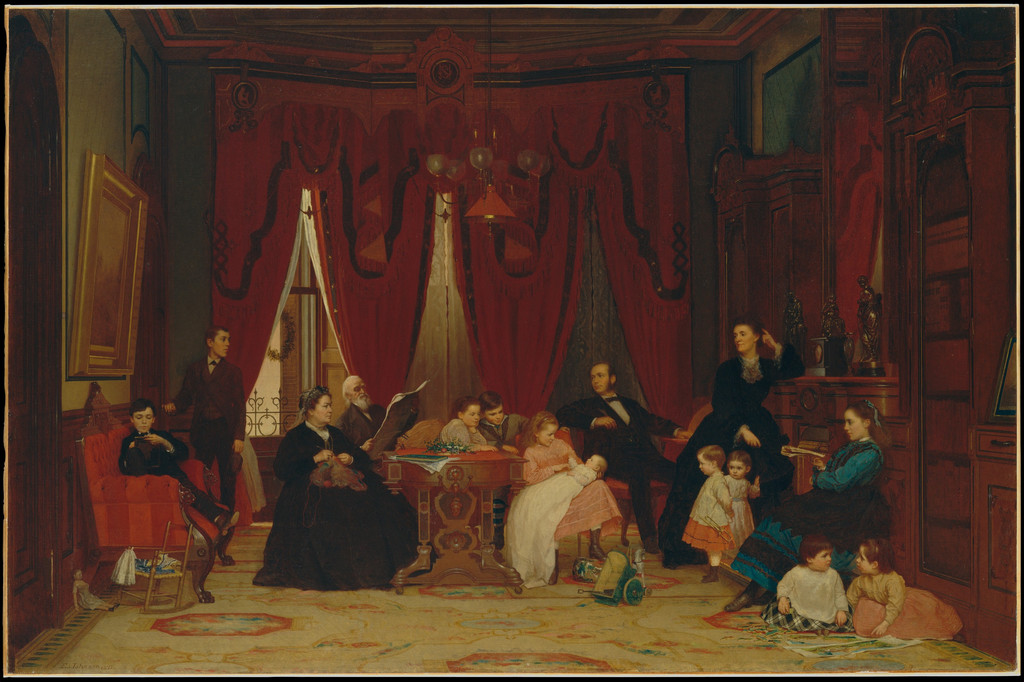
| The Hatch Family | 1870–71 | Oil on canvas |
| The Old Stagecoach | 1871 | Oil on canvas |
| The Girl I Left Behind Me | About 1872 | Oil on canvas |
| The Toilet | 1873 | Oil on paper board |
| Husking Bee, Island of Nantucket | 1876; Chicago canvas | Oil on canvas |
| The New Bonnet | 1876 | Oil on academy board |
| Sanford Robinson Gifford | 1880; possibly posthumous | Oil on academy board |
| The Cranberry Harvest, Island of Nantucket | 1880; Timken canvas | Oil on canvas |
| The Nantucket School of Philosophy | 1887 | Oil on panel |
Frequently Asked Questions
The finished 1876 painting belongs to the Art Institute of Chicago, accession 1922.444, with the credit Gift of Honoré and Potter Palmer. [1]
The museum connects it with a folk custom allowing its finder to kiss a person of her choice. That interpretation supplies a small courtship episode within the larger gathering. [1]
No. The Met holds a related oil study, 07.68. Its approximate date, support, dimensions and ownership should remain distinct from the Chicago canvas. [2]
Discussion
Look again at the images and ideas explored in Husking Bee, Island of Nantucket by Eastman Johnson. These editorial prompts invite your observations.
Reader Insights
Trace the receding rows. How does repetition create depth while preserving differences among participants?
What do the seated older figures and foreground chickens add to the main activity?
Compare the studio photograph with the finished harvest. What does retained preparatory work suggest about the making of rural scenes?
Join the Conversation
Share a detail, comparison or question about Husking Bee, Island of Nantucket by Eastman Johnson below.
References
- Art Institute of Chicago. Husking Bee , Island of Nantucket, 1876, 1922.444. Current object data, interpretation, provenance and exhibition history. API description licensed CC BY 4.0; article interpretation is independently written and attributed to the museum. View source 1 · View source 2
- Natalie Spassky. “Corn Husking at Nantucket.” In American Paintings in The Metropolitan Museum of Art , Volume II, 1985, pp. 227–229. Related studies, reported family letter, critical response and studio photograph identifications. Current Chicago measurements take precedence over the older discrepant entry. View source
- The Old Stagecoach, 1871, L1888.22. View source
- The Girl I Left Behind Me, c.1872, 1986.79. View source
- The Toilet, 1873, 2015.19.85. View source
- Husking Bee, Island of Nantucket, 1876, 1922.444: current public API. View source
- The New Bonnet,1876,25.110.11,currentobjectrecordandAPI. View source
- The Cranberry Harvest, Island of Nantucket, 1880, 1972:002. View source
- The Nantucket School of Philosophy,1887,37.311. View source
- Edgar French. “An American Portrait Painter of Three Historical Epochs.” The World’s Work , volume 13, December 1906, pp. 8307–8323; studio photograph p. 8317. Publication date does not establish the photograph’s exact date. View source
- Splash image source.
Eastman Johnson, Husking Bee, Island of Nantucket, 1876. Oil on canvas, 69.6 × 138.2 cm. Art Institute of Chicago, Gift of Honoré and Potter Palmer, 1922.444. CC0. CC0 / Public domain .
View source