 by
Tom Gurney
Tom Gurney BSc (Hons) is an art history expert with over 20 years experience
Email:
tomgurney1@gmail.com
/ Phone:
+44 7429 011000
The Letter Home by Eastman Johnson: Introduction
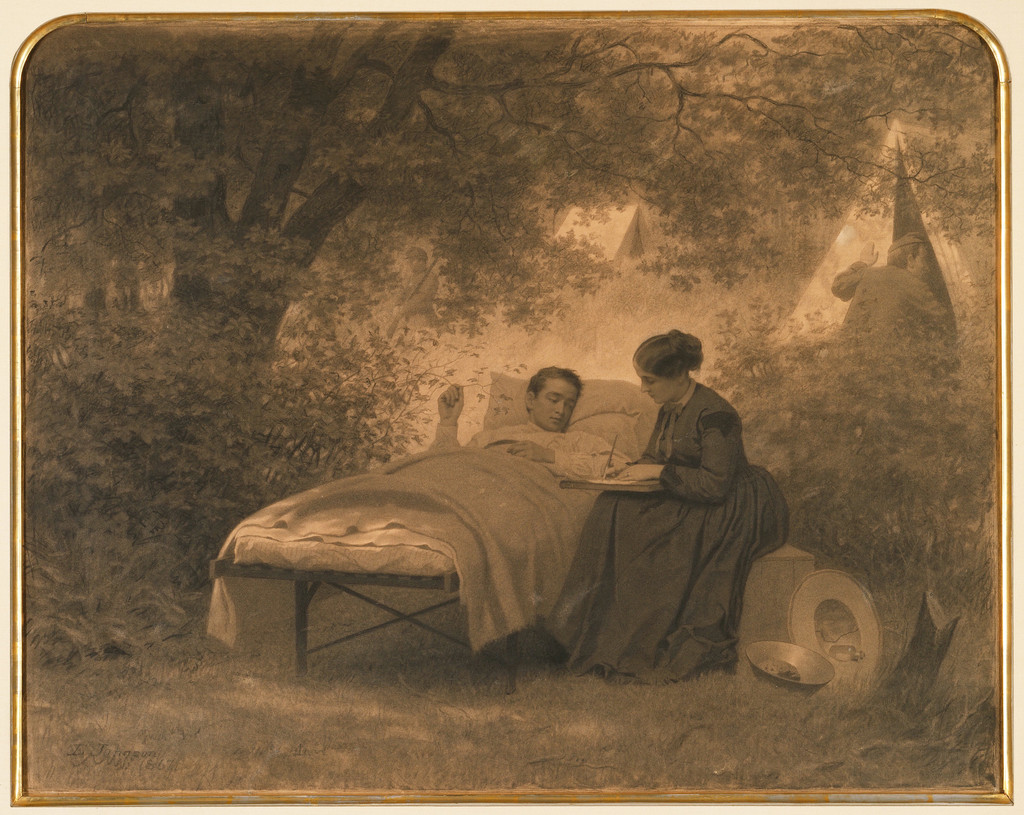
In Eastman Johnson’s The Letter Home , a soldier rests on a camp bed while a woman writes beside him. His raised hand suggests the words being spoken; her lowered hand gives them a material form. The image makes a small act of communication carry the distance between a military hospital and an unseen home.
The work illustrated here is the large charcoal and graphite drawing dated 1867 in the Minneapolis Institute of Art. It is related to an oil painting in Boston and is also catalogued as The Field Hospital . Keeping those objects and titles distinct reveals a richer history than treating every reproduction as the same painting. [1] [2]
At a Glance
- Artist Eastman Johnson
- Current museum title The Letter Home
- Alternate catalogue title The Field Hospital
- Date 1867
- Medium Charcoal and graphite on paper
- Image dimensions 60.96 × 76.2 cm
- Sheet dimensions 68.74 × 87.63 cm
- Collection Minneapolis Institute of Art
- Accession 74.17
- Credit The Julia B. Bigelow Fund
The museum records separate measurements for the drawn image and the larger sheet. [1]
This work across Eastman Johnson’s career
The Wounded Drummer Boy (San Diego study)
About 1864–71; study, not the finished canvasThe Early Scholar
About 1865; NGA studyFiddling His Way
1866; Chrysler canvasThe Letter Home (current article)
1867; Minneapolis drawingThe Boyhood of Lincoln
1868; Michigan canvasThe Brown Family
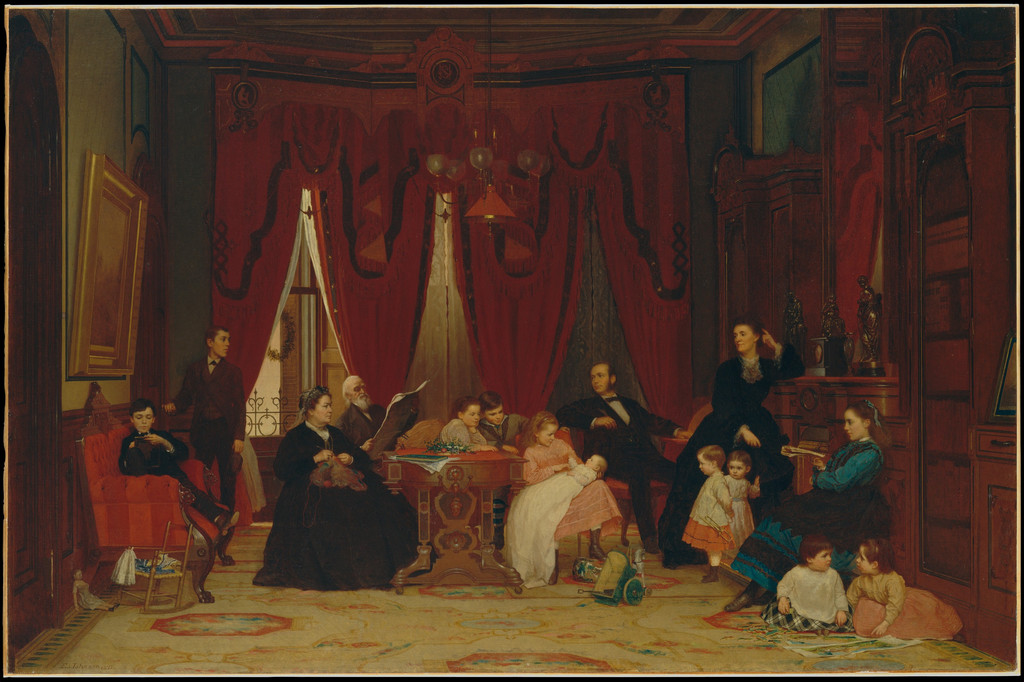
1869; NGA versionThe Hatch Family
1870–71Notes and sources
The Wounded Drummer Boy (San Diego study). Soldier and drummer form a single upright group; this study has its own object history. [3]
The Early Scholar. A child’s position beside a stove turns the need for warmth into the centre of a schoolroom. [4]
Fiddling His Way. A Black musician’s playing gathers the attention of a household. [5]
The Letter Home (current article). A wounded man and a woman writing connect spoken words with an absent home. [1]
The Boyhood of Lincoln. Firelight makes an imagined scene of Lincoln reading into an image of aspiration. [6]
The Brown Family. A child’s reaching arm connects three generations within an elaborate interior. [7]
The Hatch Family. Fifteen figures inhabit a library through a carefully distributed set of activities. [8]
Contents
- Two people connected by a letter
- A quiet foreground within a military camp
- Who posed for the nurse?
- The Letter Home or The Field Hospital?
- The Boston painting and public reception
- Drawing, reproduction and ownership
- Annotated details
Two people connected by a letter
The bed extends diagonally from the left foreground towards the seated woman. Its crossed supports and the blanket’s long sweep establish a substantial object beneath the soldier’s reclining body. His head rests near the nurse’s shoulder level, bringing their faces into a close relationship without making either turn towards the viewer.
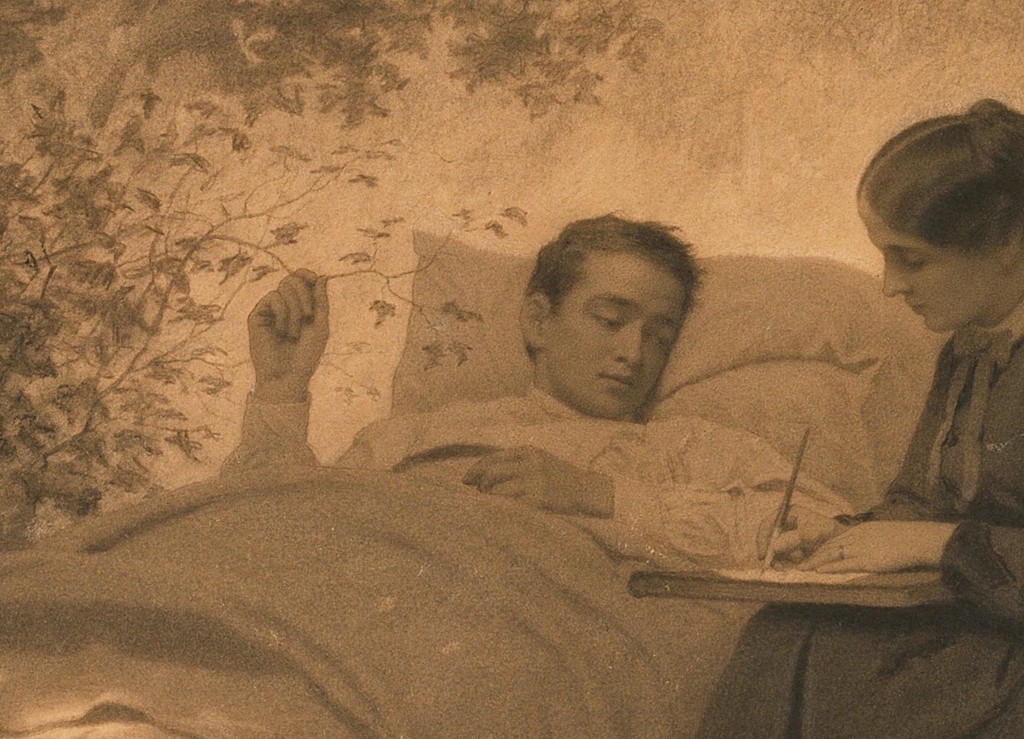
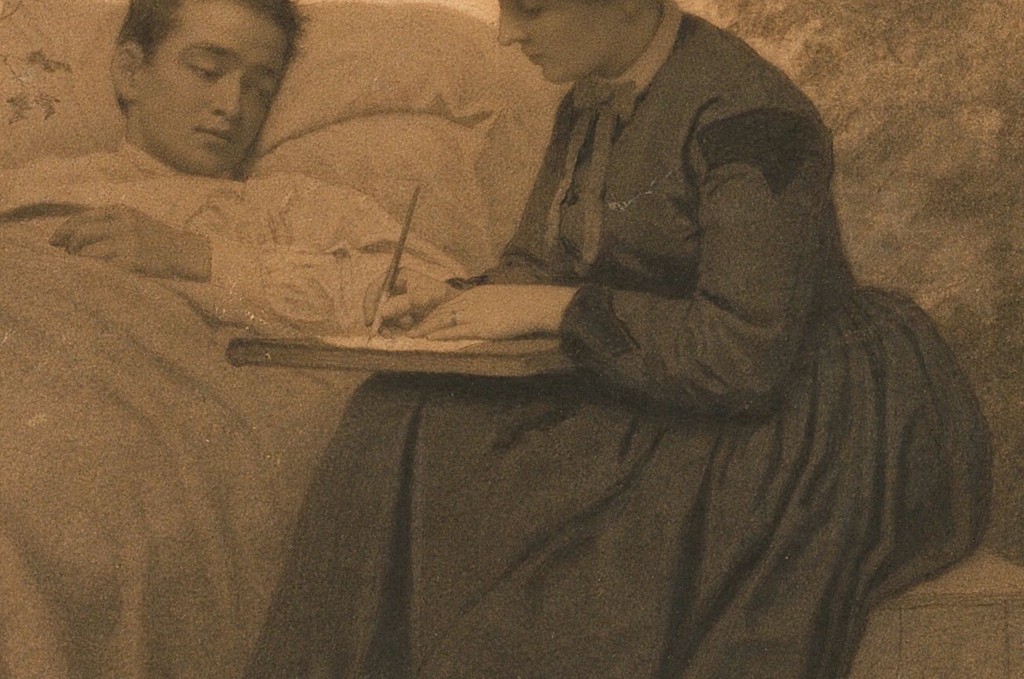
The soldier’s raised forearm introduces a second, smaller movement. It rises out of the blanket beside his head, while the nurse’s writing hand descends towards the paper on her lap. These gestures give the scene a quiet rhythm: speaking, listening and recording. The activity requires attention from both figures even though only one holds the writing instrument.
Johnson does not show the letter’s recipient. Home exists through the purpose of the task and the title, rather than a second scene inserted into the image. The reader is invited to imagine the next stage of the letter’s journey without being given its contents. A specific painted sentence would narrow that possibility; the visible exchange remains the picture’s centre.
The writing also makes care broader than medical treatment. The woman’s assistance allows the reclining man to maintain a relationship beyond the camp. That is a reading grounded in their depicted activity, rather than evidence that the drawing records a particular surviving letter or a named patient.
Annotated Details from The Letter Home
The numbered points identify visible features discussed in this article. Return from each detail to the whole composition. Eastman Johnson, The Letter Home, 1867. Charcoal and graphite on paper; image 60.96 × 76.2 cm, sheet 68.74 × 87.63 cm. Minneapolis Institute of Art, The Julia B. Bigelow Fund, 74.17. Public domain. Image source. Public domain. Numbers added to a separate overview; detail images are native crops. No recolouring, retouching, reconstruction or enlargement.
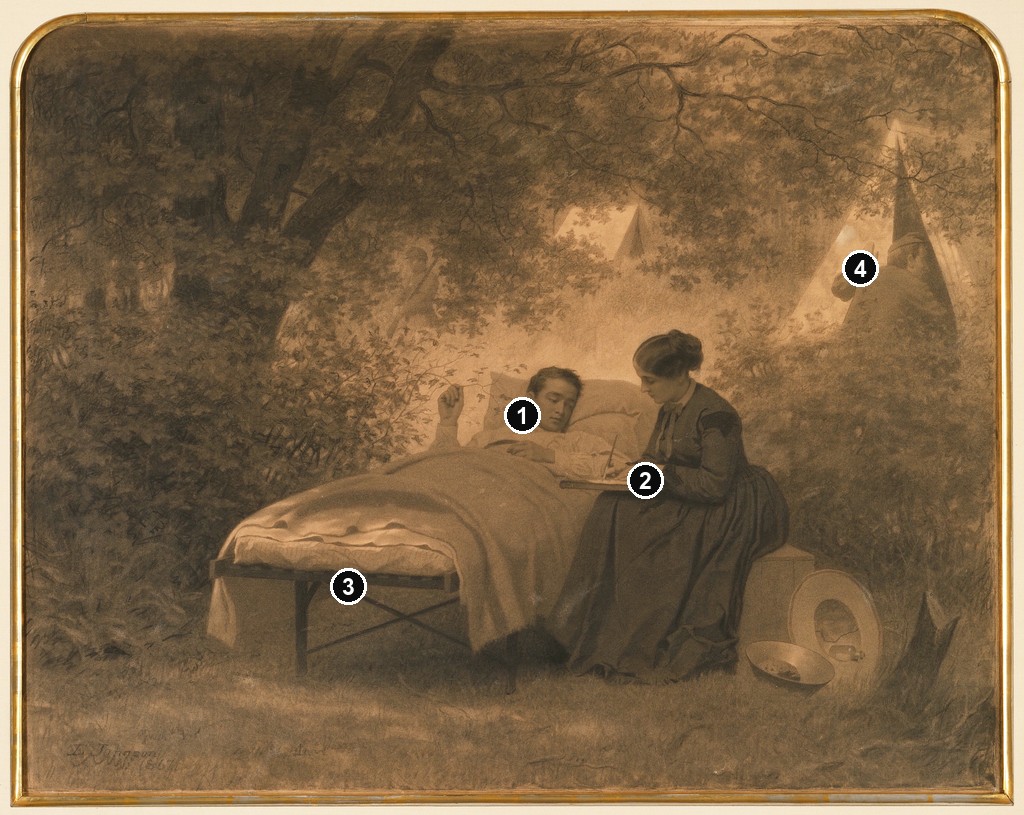
Details from THE LETTER HOME
Compare the cropped details with the complete images above. Notice how their colours, shapes and positions contribute to the larger compositions.
A raised hand and reclining head
The soldier raises one hand while resting against his pillow. The gesture gives a visible direction to the words being spoken towards the woman beside the bed.
The writing hand and page
The woman lowers her attention to the page and holds a pen against it. Her hand turns the exchange into a physical act of writing between two people.
Blanket and camp-bed structure
The blanket’s broad folds lead towards the bed’s wooden supports. These shapes give the reclining body weight and a place within the temporary camp setting.
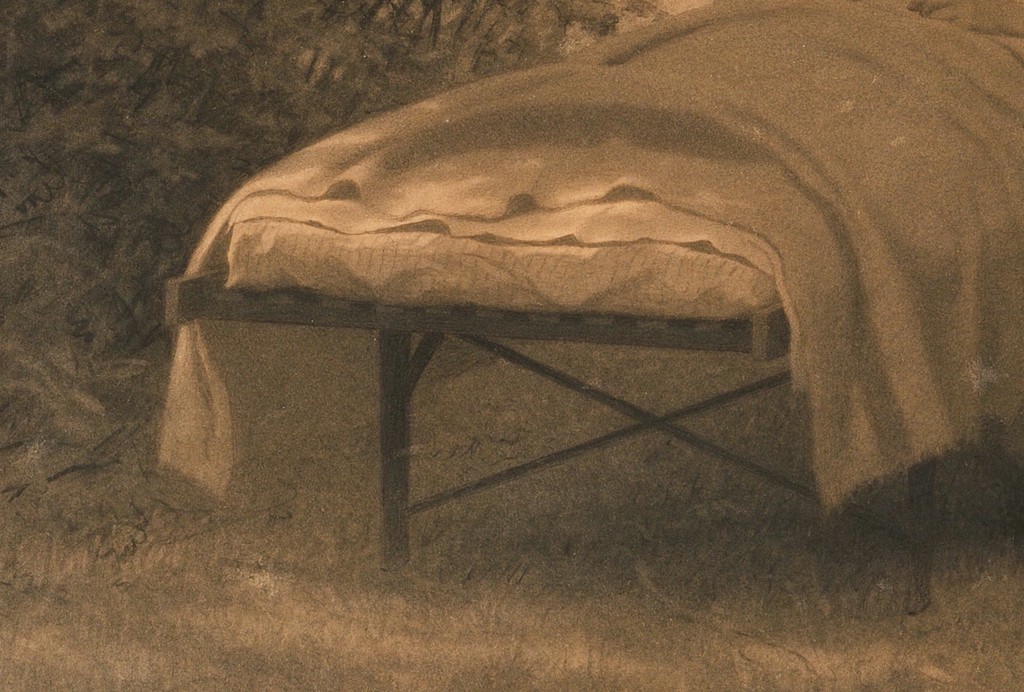
A quieter camp beyond the foreground
A tent and a smaller figure remain visible beyond the principal pair. Their lighter, less emphatic forms establish the military setting while leaving the letter-writing encounter dominant.
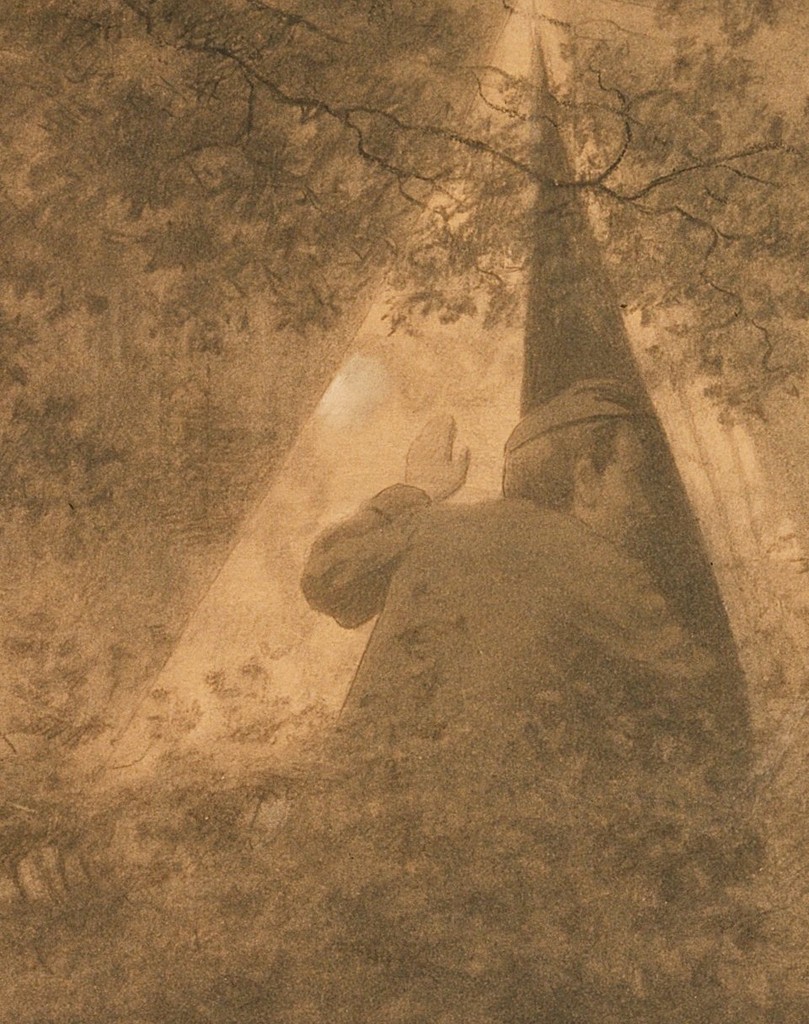
A quiet foreground within a military camp
Trees and foliage form a sheltered enclosure around the figures. Farther back, pale tents and a standing figure establish the wider camp. The foreground encounter therefore remains connected with a military environment even though Johnson gives most of the image to a bed, a nurse and a soldier.
The light is organised around the patient’s head, pillow and bedding. Those pale passages emerge from the darker vegetation and the woman’s dress. Her skirt creates a strong mass at the right, anchoring the more softly modelled reclining figure. The difference in tone makes the pair easy to find before we begin examining their hands.
A basin and another vessel occupy the lower-right corner beside the seated woman. Along with the camp bed and covering, these objects give the scene a practical setting. They are close enough to appear available for use, rather than arranged as a distant catalogue of military equipment.
The drawing’s warm paper and broad dark passages create an atmosphere quite different from an outline illustration. Johnson models volume through changes of tone, allowing the trees to remain dense and the faces more delicate. The current museum record identifies charcoal and graphite; the image should not be described as an oil painting simply because its pictorial effect is extensive. [1]
Who posed for the nurse?
The catalogue raisonné reproduces a letter written by Elizabeth Johnson to Mary Blatchford on 27 October 1909. In that retrospective account, the artist’s widow identifies his sister Harriet, Mrs. Joseph May, as the woman who sat for the nurse. The letter supplies a model’s identity through a family recollection made decades after the work’s creation. [2]
That information does not identify the soldier or establish that the scene reproduces an actual hospital encounter involving Harriet. A model could provide a figure’s appearance within a composed narrative. The distinction lets us acknowledge the family connection while leaving the particular event and patient unnamed.
The letter also helps explain why the work has accumulated titles. Elizabeth referred to the hospital subject and suggested a Gettysburg title, but her wording was uncertain. The correspondence is evidence for the history of remembering and naming the work; it does not securely locate the depicted event at Gettysburg. [2]
The Letter Home or The Field Hospital?
Mia’s current title directs attention towards the communication. The Field Hospital , used by the catalogue raisonné, places the same action within an institution of wartime care. An early published title for the drawing, The Nurse , foregrounded the woman instead. Each name changes the reader’s first emphasis without altering the figures on the sheet. [1] [2]
The catalogue argues that the drawing probably shared the title of the related painting, exhibited as The Field Hospital in 1868. That is a reconstruction supported by the relationship between the works, rather than a newly discovered original label attached to this drawing. The museum’s present title remains appropriate for the main caption. [2]
Mia also records an original wooden frame bearing Sanitary Commission medals. That is part of the object’s history and its association with organised wartime service. The reproduction shown here includes a narrow inner border, but does not show the complete outer frame and medals. [1]
Watch: Eastman Johnson
Choose a film to explore the artist’s work, its interpretation and its wider setting.
Director's Choice - The Girl I Left Behind Me by Eastman Johnson
The Smithsonian American Art Museum looks at Johnson’s The Girl I Left Behind Me.
Watch on YouTubeThe Boston painting and public reception
The related Field Hospital in the Museum of Fine Arts, Boston, is an oil painting on paperboard, also dated 1867. Its dimensions are 58.4 × 69.8 cm, and its accession number is 48.434. The catalogue records a Sanitary Commission inscription on a packing case within that painted composition. These details belong to the Boston object, not automatically to the Minneapolis sheet. [9]
The painting appeared at the National Academy of Design in 1868. A New York Times review, transcribed in the catalogue, praised the subject’s tenderness and the avoidance of a gruesome spectacle. The account makes clear that the act of taking down a wounded soldier’s letter was intelligible to contemporary viewers. [9]
Patricia Hills places the hospital subject within Johnson’s postwar representation of women’s Civil War service. That context helps explain why an apparently private exchange could have public significance. The work gives nursing and communication a place within the war’s imagery alongside more conspicuous actions of combat. [10]
Drawing, reproduction and ownership
The museum calls the drawing a study for the painting. Both are dated 1867, but that description alone does not establish a complete sequence of making or every change between the objects. Johnson’s drawings could serve preparation while also offering substantial, independently rewarding images. [1]
With an image about sixty-one centimetres high, this is a substantial sheet rather than a pocket-sized notation. Its rounded upper corners, carefully sustained tonal setting and developed foreground invite prolonged looking. The separate image and sheet measurements also matter: the drawn composition does not occupy every part of the paper recorded by the museum. [1]
The catalogue traces this sheet through Louis Prang’s ownership by 1875 and the Blatchford family, followed by later owners and a 1974 purchase for Mia. It also lists a related 1870 print, Our Women Warriors . That print has its own reproductive history; it should not be substituted for the drawing without an exact caption. [2]
Compared with The Wounded Drummer Boy , the hospital scene gives vulnerability a different tempo. The drummer’s story turns bodily injury towards continued action, whereas the letter depends on stillness and assistance. Johnson could make wartime service visible through both a dramatic ascent and a patient exchange beside a bed.
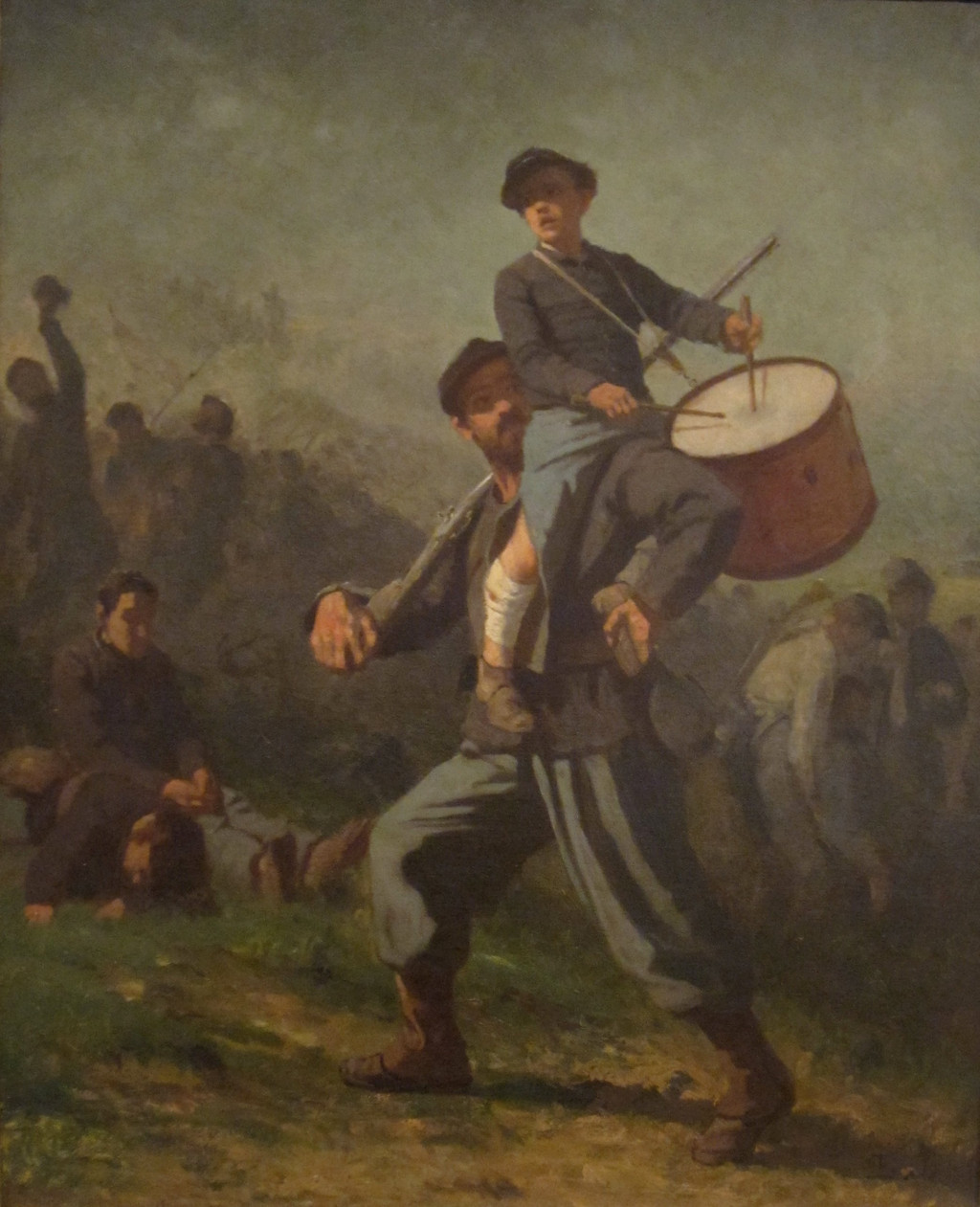
Eastman Johnson, study for The Wounded Drummer Boy, about 1864–71. Oil on board, 66.7 × 54.9 cm. San Diego Museum of Art, 1940.79. Photograph: Wmpearl, CC0. This is a study, distinct from the finished 1871 canvas.
Image source
.
CC0 / Public domain
.
Artworks directory
Browse twenty-one selected objects discussed in these articles, including the Gifford portrait and the Prang print after Johnson. Dates identify individual objects, including the San Diego Drummer Boy study. Use All media to include the chromolithograph.
| Name | Date | Medium |
|---|---|---|
| Kitchen at Mount Vernon | 1857; Charles Butt canvas | Oil on canvas |
| Negro Life at the South | 1859; New York Historical original | Oil on linen |
| A Ride for Liberty—The Fugitive Slaves | About 1862; Brooklyn version | Oil on paperboard |
| The Lord Is My Shepherd | 1863 | Oil on fiberboard |
| Sugaring Off | About 1864–65; unfinished RISD canvas | Oil on canvas |
| The Wounded Drummer Boy (San Diego study) | About 1864–71; study, not the finished canvas | Oil on board |
| The Early Scholar | About 1865; NGA study | Oil on academy board on canvas |
| Fiddling His Way | 1866; Chrysler canvas | Oil on canvas |
| The Letter Home | 1867; Minneapolis drawing | Charcoal and graphite on paper |
| The Boyhood of Lincoln | 1868; Michigan canvas | Oil on canvas |
| The boyhood of Lincoln—An evening in the log hut (Prang after Johnson) | About 1868; separate reproductive print | Chromolithograph, W. Harring / L. Prang & Co., after Johnson |
| The Brown Family | 1869; NGA version | Oil on paper on canvas |
| The Hatch Family | 1870–71 | Oil on canvas |
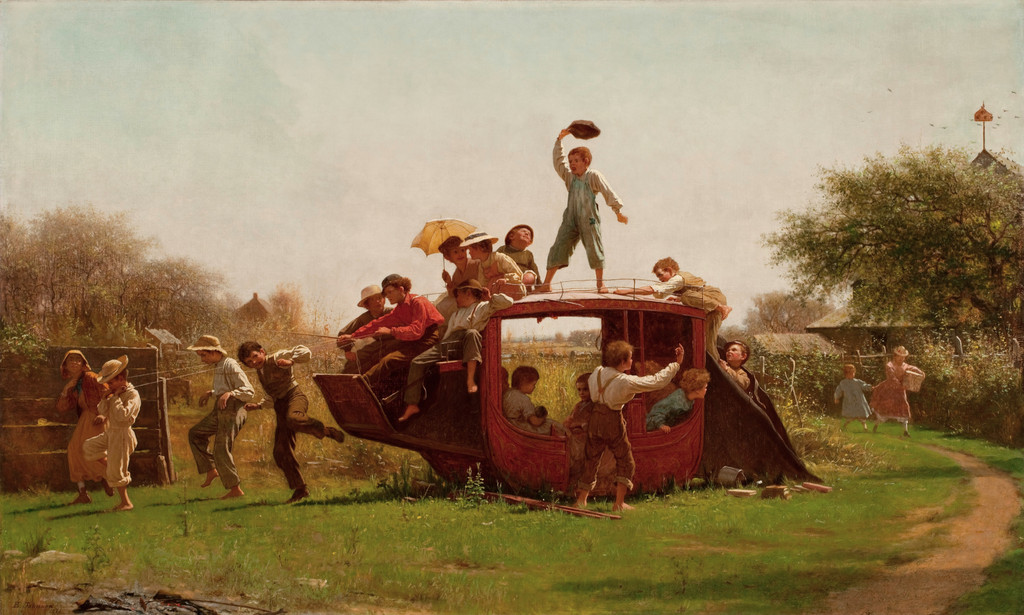
| The Old Stagecoach | 1871 | Oil on canvas |
| The Girl I Left Behind Me | About 1872 | Oil on canvas |
| The Toilet | 1873 | Oil on paper board |
| Husking Bee, Island of Nantucket | 1876; Chicago canvas | Oil on canvas |
| The New Bonnet | 1876 | Oil on academy board |
| Sanford Robinson Gifford | 1880; possibly posthumous | Oil on academy board |
| The Cranberry Harvest, Island of Nantucket | 1880; Timken canvas | Oil on canvas |
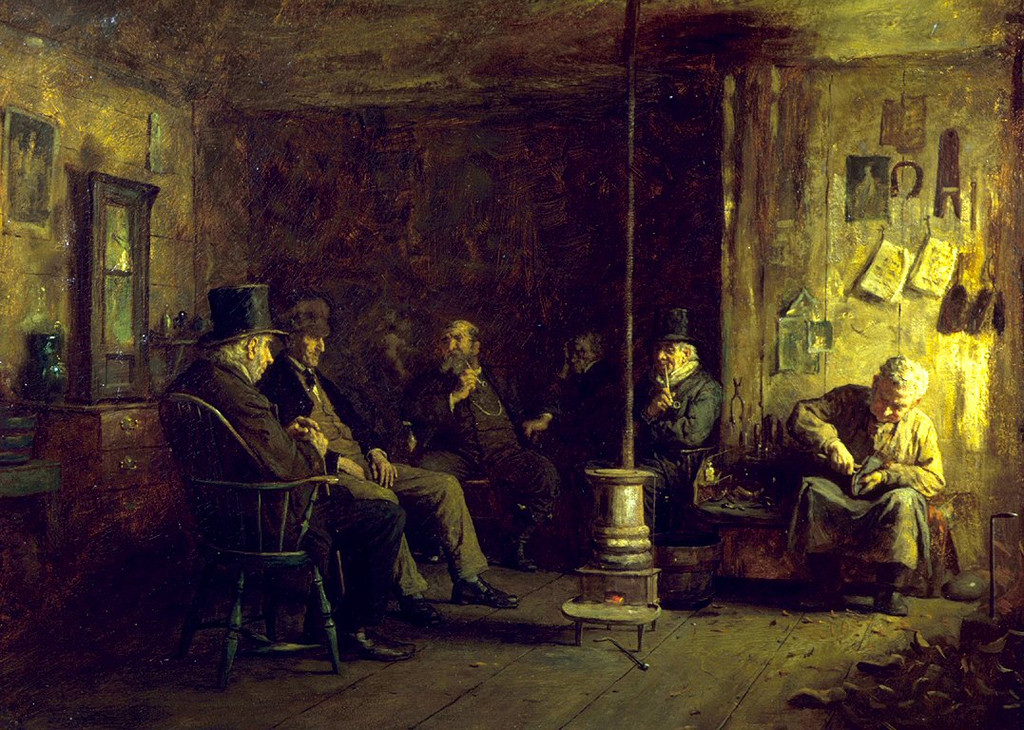
| The Nantucket School of Philosophy | 1887 | Oil on panel |
Frequently Asked Questions
Elizabeth Johnson’s 1909 letter, transcribed in the catalogue, identifies the artist’s sister Harriet May as the model. It does not establish a named historical patient or a particular event involving her. [2]
The artist’s widow suggested a Gettysburg title retrospectively, with uncertainty. That recollection is insufficient to establish the precise hospital or battlefield represented. [2]
Discussion
Look again at the images and ideas explored in The Letter Home by Eastman Johnson. These editorial prompts invite your observations.
Reader Insights
How do the bed and writer create a relationship between physical vulnerability and communication?
Compare the sharper foreground with the distant figure. How does drawing establish their different importance?
What changes when you distinguish the sheet, the Boston painting and later titles rather than treating them as one object?
Join the Conversation
Share a detail, comparison or question about The Letter Home by Eastman Johnson below.
References
- Minneapolis Institute of Art. The Letter Home , 1867, 74.17. Current object data, medium, dimensions, title and frame description. View source
- Patricia Hills and Abigael MacGibeny. The Field Hospital , drawing, 1867, Hills no. 40.0.10. Eastman Johnson Catalogue Raisonné. Title history, Elizabeth Johnson’s 1909 letter, provenance and related print. View source
- Wounded Drummer Boy, San Diego study, Hills 10.0.18. View source
- The Early Scholar,c.1865,1963.10.157: current object record. View source
- Fiddling His Way,1866,89.60. View source
- Boyhood of Lincoln,1868,1895.90. View source
- The Brown Family, 1869, 1978.72.1. View source
- The Hatch Family, 1870–71, 26.97. View source
- Patricia Hills and Abigael MacGibeny. The Field Hospital , painting, 1867, Hills no. 10.0.23. Eastman Johnson Catalogue Raisonné. Boston object, inscription, exhibition and transcribed 1868 review. View source
- Patricia Hills. Painting Race: Eastman Johnson’s Pictures of Slaves , Ex-Slaves, and Freedmen, in Eastman Johnson: Painting America , 1999, p. 148. Consulted passage on the hospital subject and women’s wartime service; the separate 1986 hospital study was not directly consulted. View source
- Splash image source.
Eastman Johnson, The Letter Home, 1867. Charcoal and graphite on paper; image 60.96 × 76.2 cm, sheet 68.74 × 87.63 cm. Minneapolis Institute of Art, The Julia B. Bigelow Fund, 74.17. Public domain. Public domain .
View source