 by
Tom Gurney
Tom Gurney BSc (Hons) is an art history expert with over 20 years experience
Email:
tomgurney1@gmail.com
/ Phone:
+44 7429 011000
The Wounded Drummer Boy by Eastman Johnson: Introduction
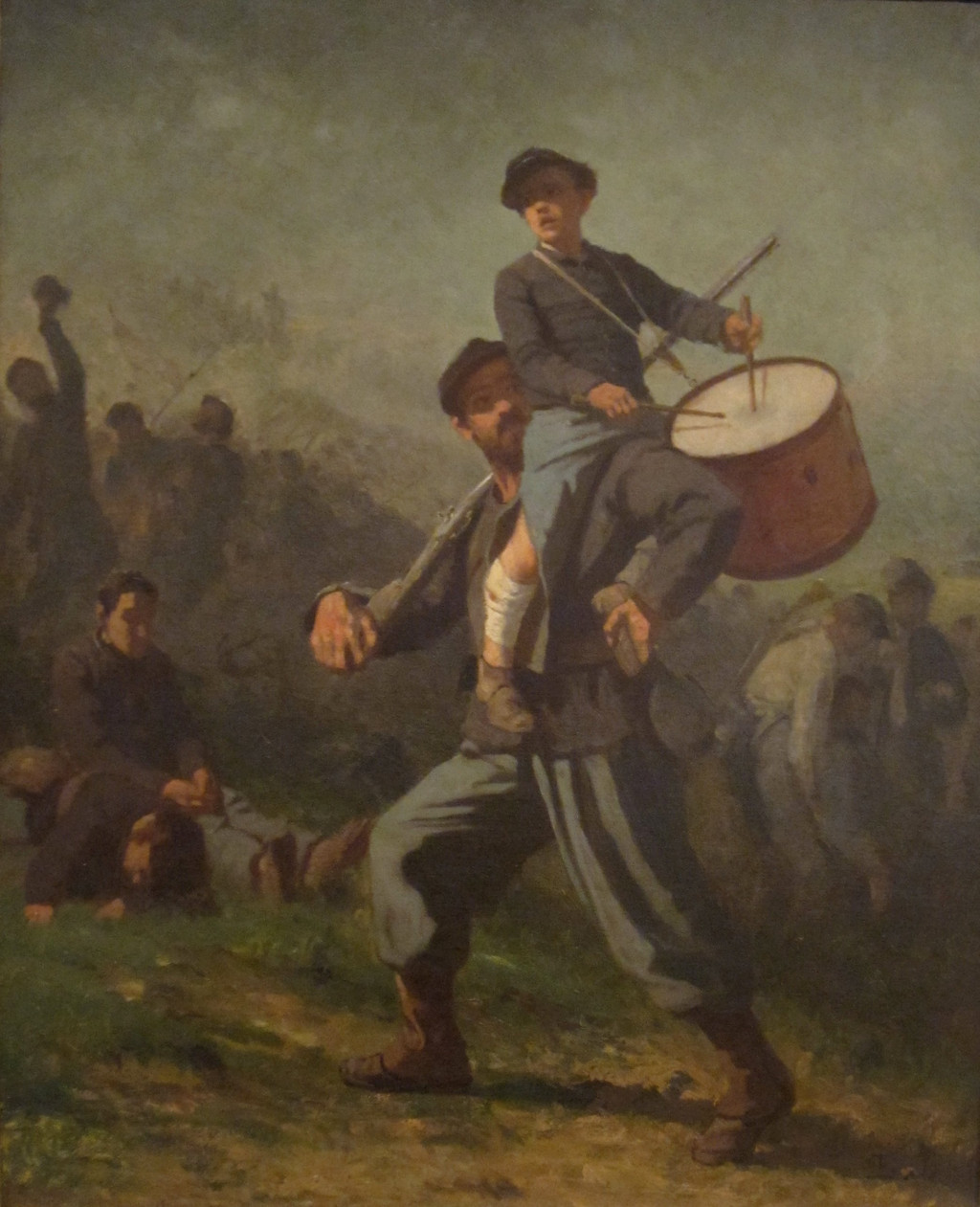
A soldier strides across a smoky battlefield with a boy on his shoulders. The boy continues to hold his drumsticks above the drum, turning the act of being carried into an act of participation. Eastman Johnson makes the two figures into a single towering group: one supplies the strength to move, the other the sound that urges movement onwards.
The finished Wounded Drummer Boy is a canvas dated 1871, exhibited at the National Academy of Design in 1872. The main illustration here shows a separate study in the San Diego Museum of Art, dated approximately 1864–71. Distinguishing the study from the finished painting helps explain a subject Johnson developed across several objects and over several years. [1] [2]
At a Glance
- Artist Eastman Johnson
- Finished painting The Wounded Drummer Boy, an incident of the late war
- Finished painting date 1871
- Finished painting medium and size Oil on canvas, 121.9 × 99.1 cm
- Finished painting location Private collection, New York, as recorded by the catalogue raisonné in 2021
- Illustrated object San Diego Museum of Art study, c. 1864–71
- Study medium and size Oil on board, 66.7 × 54.9 cm
- Study accession 1940.79
The San Diego study and the finished canvas have separate collection histories. The study’s accession number begins with 1940, while the catalogue records its gift in March 1941. [1] [2]
This work across Eastman Johnson’s career
A Ride for Liberty—The Fugitive Slaves
About 1862; Brooklyn versionSugaring Off
About 1864–65; unfinished RISD canvasThe Wounded Drummer Boy (San Diego study) (current article)
About 1864–71; study, not the finished canvasThe Early Scholar
About 1865; NGA studyFiddling His Way
1866; Chrysler canvasThe Letter Home
1867; Minneapolis drawingNotes and sources
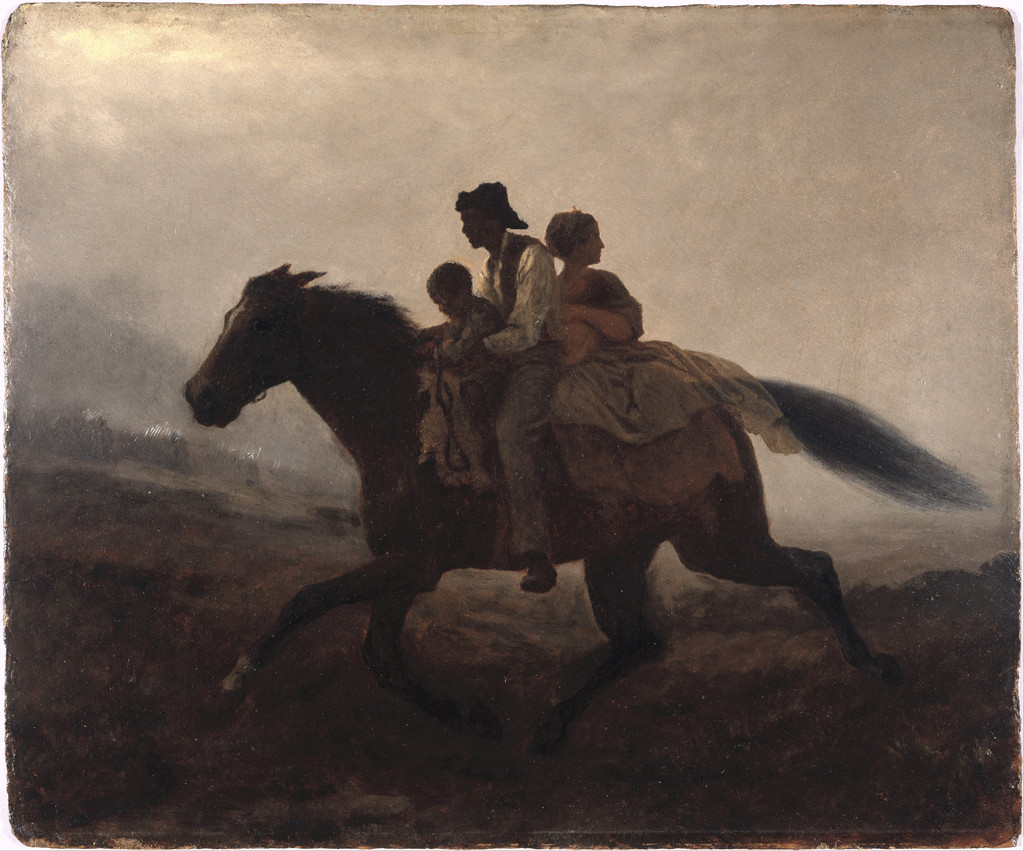
A Ride for Liberty—The Fugitive Slaves. A family’s movement towards freedom carries the whole composition. [3]
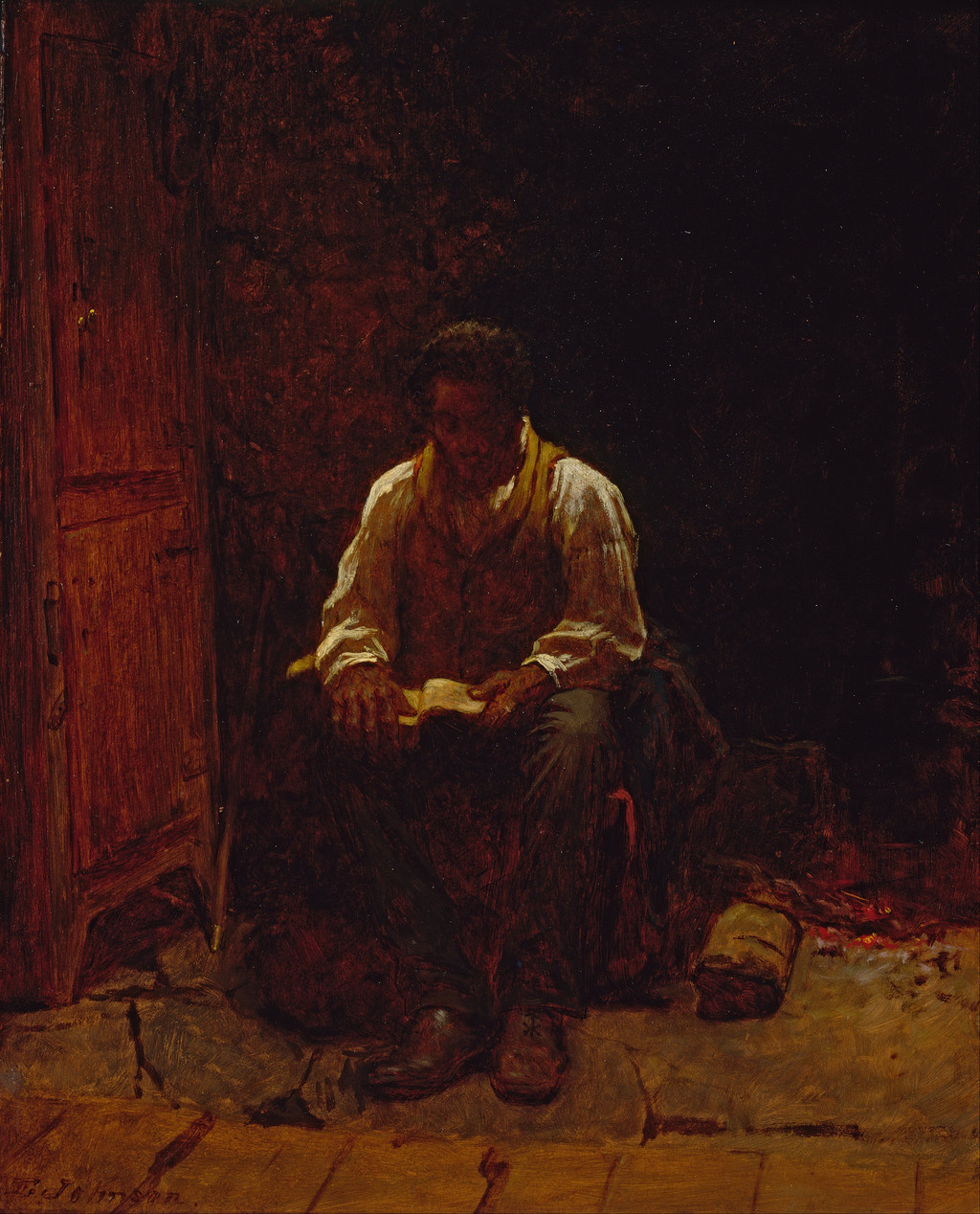
The Lord Is My Shepherd. A lowered head and open book concentrate attention within a dark room. [4]
Sugaring Off. Unfinished passages reveal the preparation of an ambitious gathering around maple-sugar production. [5]
The Wounded Drummer Boy (San Diego study) (current article). Soldier and drummer form a single upright group; this study has its own object history. [2]
The Early Scholar. A child’s position beside a stove turns the need for warmth into the centre of a schoolroom. [6]
Fiddling His Way. A Black musician’s playing gathers the attention of a household. [7]
The Letter Home. A wounded man and a woman writing connect spoken words with an absent home. [8]
Contents
- Two bodies carrying the action
- The story attached to the image
- A subject developed across the war and its aftermath
- Three museum studies and a finished canvas
- Heroism and the wounded child
- Exhibition and remembrance
Two bodies carrying the action
In the San Diego study, the soldier’s long step establishes the direction and effort of the scene. His boots occupy the foreground, while the boy rises above his head. The pair fill much of the tall composition, bringing the viewer close to an action that the surrounding battlefield can only partly explain.
The soldier is not simply a pedestal. His broad stride, bent arm and turned head make the physical work of carrying another person apparent. The boy depends on that support, yet the drum gives him a continuing role of his own. Johnson links vulnerability and usefulness within the same group.
The drum projects to the right, balancing the boy’s body and interrupting the vertical stack of figures. Its pale circular surface catches the eye against the muted air. The sticks remain poised above it, making the instrument an active part of the narrative rather than a discarded sign of military service.
The surrounding men are lower, smaller or less clearly defined. At the left, a seated figure brings injury and exhaustion into the foreground. More distant bodies recede into smoke. Their reduced clarity gives the central pair exceptional visibility, as though their determination has become the one action the viewer can follow through the confusion.
A weapon rises behind the drummer, keeping the scene connected to combat even as the drum and carrying gesture dominate. The painting’s appeal depends on this combination: the pair seem exposed to danger, but their joined movement offers a coherent response to it.
The story attached to the image
The 1872 National Academy exhibition catalogue supplied an explanatory anecdote. As transcribed in the catalogue raisonné, it described a drummer disabled by a shot in the leg, asking to be carried so that he could continue drumming. A soldier took him on his shoulders after the wound was bound. The text gave viewers a compact sequence of injury, request, assistance and renewed effort. [1]
That sequence changes the meaning of the carrying gesture. Without the story, a viewer might initially read the pair as an evacuation from battle. The continuing performance instead makes the movement part of the fight. Assistance enables the child to resume the duty through which the story defines his courage.
The Brooklyn Museum’s account, preserved in the catalogue entry for its separate study, associates the subject with an incident reportedly occurring at Antietam in 1862. The word reportedly matters. The evidence consulted here does not establish an independently identified boy, a named carrier or a verified eyewitness episode observed by Johnson. [9]
The painting can therefore be considered as a carefully developed representation of a circulating wartime story. Its effectiveness does not depend on treating every detail as battlefield documentation. Johnson’s choices of scale, pose and emphasis are themselves central to how the story becomes persuasive.
A subject developed across the war and its aftermath
A letter from Johnson to the sculptor E. D. Palmer, dated 4 January 1864 and transcribed in the catalogue, says that he had not yet begun painting the drummer subject and was enlarging the drawing. The original letter was not separately consulted for this account. Its published wording nevertheless places the idea in development well before the finished canvas’s 1871 date. [1]
The interval between the wartime project and its postwar completion is significant. A scene that could encourage support during the conflict could later commemorate sacrifice and perseverance. The Brooklyn interpretation explicitly connects the composition’s appeal to Northern audiences both during and after the war. [9]
There is no need to imagine that Johnson worked on the picture continuously throughout that interval. The surviving studies and the letter establish development, but not an uninterrupted schedule. Their approximate dates preserve the uncertainty about exactly when each painted version took its present form.
Watch: Eastman Johnson
Choose a film to explore the artist’s work, its interpretation and its wider setting.
Director's Choice - The Girl I Left Behind Me by Eastman Johnson
The Smithsonian American Art Museum looks at Johnson’s The Girl I Left Behind Me.
Watch on YouTubeThree museum studies and a finished canvas
The illustrated San Diego work is oil on board, measuring 66.7 × 54.9 cm. The catalogue traces it through Johnson’s 1907 estate sale, Hubbard ownership and a later gift from Mrs. Herbert S. Darlington. It provides access to the composition through an object with its own history, rather than serving as a substitute identity for the larger canvas. [2]
Brooklyn’s study is smaller: 54.5 × 42.5 cm, painted on laminated paperboard. A soldier sketch appears on its reverse. The museum purchased it in 1959 through the Dick S. Ramsay Fund, accession 59.9. Neither its support nor that reverse drawing should be transferred to the San Diego work. [9]
A further study belongs to the Frick institution in Pittsburgh, accession 1989.1. The catalogue describes oil on paperboard measuring 66 × 55.9 cm. This is the Pittsburgh collection, distinct from the Frick Collection in New York. Its size is close to the San Diego study’s, making the collection and accession particularly useful identifiers. [10]
The finished canvas is larger, at 121.9 × 99.1 cm, and carries Johnson’s signature and the date 1871. Its confirmed National Academy appearance followed in 1872, under the expanded title The Wounded Drummer Boy, an incident of the late war . Painting and exhibition dates describe different events; neither requires correcting the other. [1]
Heroism and the wounded child
The image’s emotional force raises a difficult question. The boy is injured and dependent on an adult, yet his determination invites admiration. The narrative directs attention towards continued service at precisely the moment when his need for protection is most apparent.
Patricia Hills’s interpretation, reproduced in the finished painting’s catalogue entry, argues that the subject’s sentimental appeal can soften a viewer’s concern for the hardships of war and the child’s condition. Her reading makes the emotional success of the picture part of its problem: pathos may help convert suffering into an uplifting story. [1]
Looking again at the central pair allows both responses. The soldier’s assistance is tender and practical, while the drum insists that the boy continue contributing. The image joins care to military purpose without resolving the tension between them. The less emphatic casualties around the pair make that tension harder to dismiss.
The Letter Home offers another relationship between injury and assistance. There, communication and bedside attention slow the action into an intimate exchange. The drummer scene transforms support into conspicuous movement. Comparing the two makes the different demands placed on a wounded person easier to see.
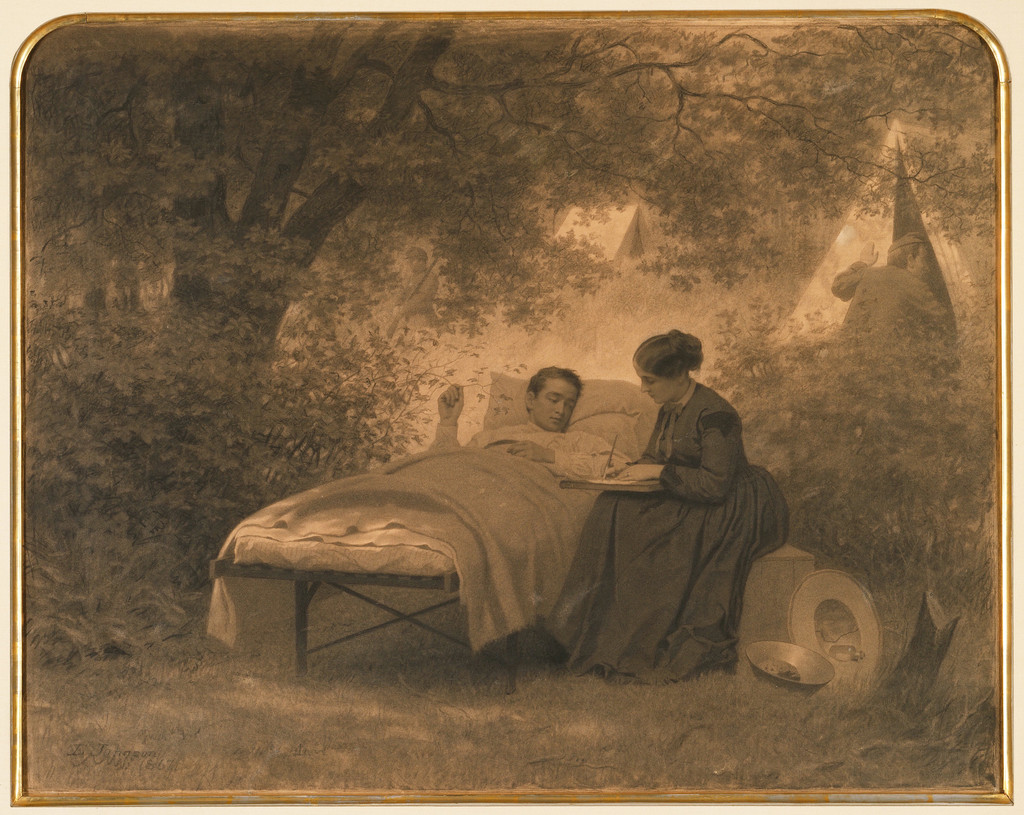
Eastman Johnson, The Letter Home, 1867. Charcoal and graphite on paper; image 60.96 × 76.2 cm, sheet 68.74 × 87.63 cm. Minneapolis Institute of Art, The Julia B. Bigelow Fund, 74.17. Public domain.
Image source
.
Public domain
.
Exhibition and remembrance
The Union League Club of New York acquired the finished painting in 1872 and retained it until at least 1972, according to the catalogue. It appeared in the club’s nineteenth-century exhibitions and was lent by the club to the 1972 Johnson retrospective. The catalogue recorded a private New York collection by 2021; that record does not establish present public display. [1]
The club ownership and repeated exhibition gave the picture a life beyond its original anecdote. Viewers encountered it as an enduring image of Union courage after the battlefield had become a subject of remembrance. Its chronology spans an artist’s wartime idea, a postwar finished painting and successive settings in which the story was retold.
Placed beside The Boyhood of Lincoln , the drummer shows another way Johnson made childhood carry national meaning. The reader’s effort is private and quiet; the drummer’s is public and endangered. Each composition turns a young person’s concentrated action into an example offered to adult viewers.
Artworks directory
Browse twenty-one selected objects discussed in these articles, including the Gifford portrait and the Prang print after Johnson. Dates identify individual objects, including the San Diego Drummer Boy study. Use All media to include the chromolithograph.
| Name | Date | Medium |
|---|---|---|
| Kitchen at Mount Vernon | 1857; Charles Butt canvas | Oil on canvas |
| Negro Life at the South | 1859; New York Historical original | Oil on linen |
| A Ride for Liberty—The Fugitive Slaves | About 1862; Brooklyn version | Oil on paperboard |
| The Lord Is My Shepherd | 1863 | Oil on fiberboard |
| Sugaring Off | About 1864–65; unfinished RISD canvas | Oil on canvas |
| The Wounded Drummer Boy (San Diego study) | About 1864–71; study, not the finished canvas | Oil on board |
| The Early Scholar | About 1865; NGA study | Oil on academy board on canvas |
| Fiddling His Way | 1866; Chrysler canvas | Oil on canvas |
| The Letter Home | 1867; Minneapolis drawing | Charcoal and graphite on paper |
| The Boyhood of Lincoln | 1868; Michigan canvas | Oil on canvas |
| The boyhood of Lincoln—An evening in the log hut (Prang after Johnson) | About 1868; separate reproductive print | Chromolithograph, W. Harring / L. Prang & Co., after Johnson |
| The Brown Family | 1869; NGA version | Oil on paper on canvas |
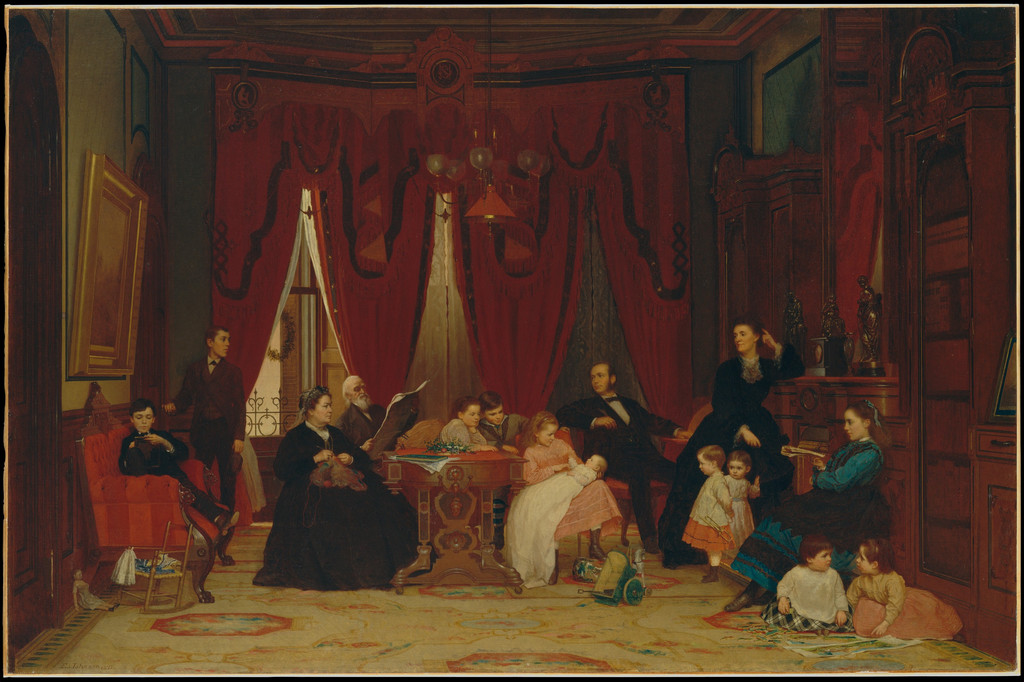
| The Hatch Family | 1870–71 | Oil on canvas |
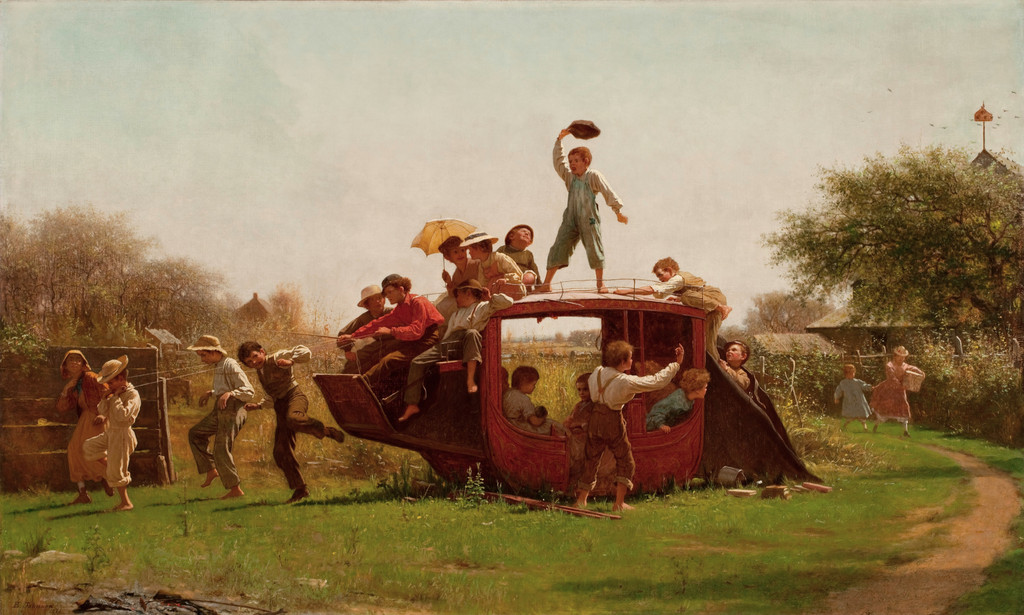
| The Old Stagecoach | 1871 | Oil on canvas |
| The Girl I Left Behind Me | About 1872 | Oil on canvas |
| The Toilet | 1873 | Oil on paper board |
| Husking Bee, Island of Nantucket | 1876; Chicago canvas | Oil on canvas |
| The New Bonnet | 1876 | Oil on academy board |
| Sanford Robinson Gifford | 1880; possibly posthumous | Oil on academy board |
| The Cranberry Harvest, Island of Nantucket | 1880; Timken canvas | Oil on canvas |
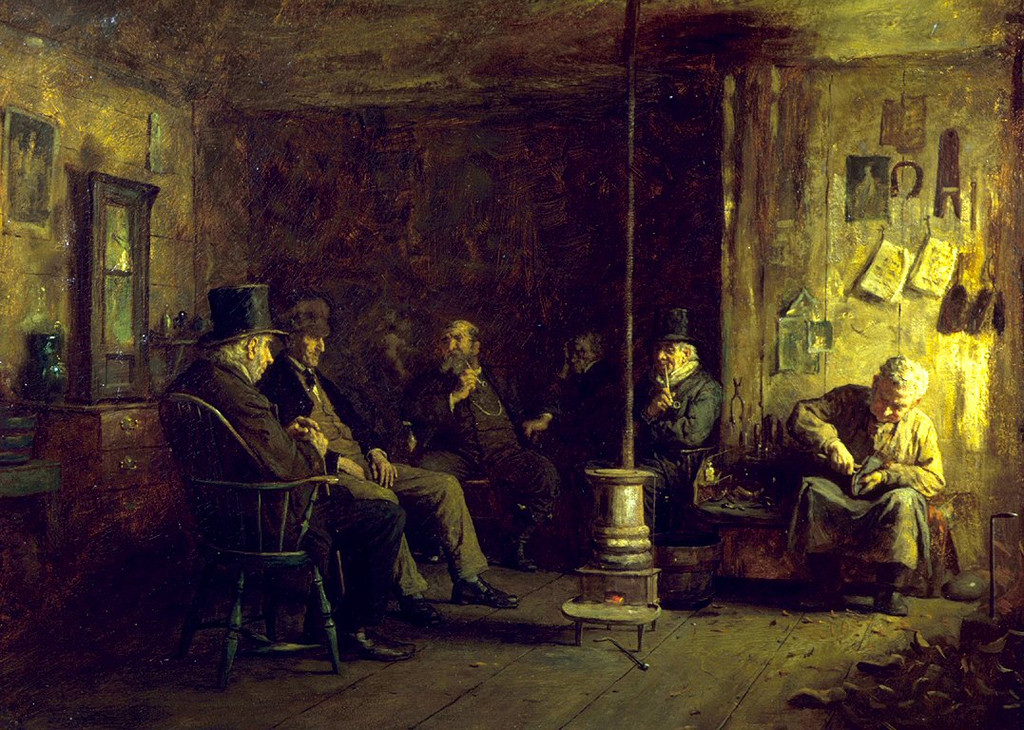
| The Nantucket School of Philosophy | 1887 | Oil on panel |
Frequently Asked Questions
The main image shows the San Diego Museum of Art’s study, c. 1864–71, oil on board, accession 1940.79. It is not the larger finished canvas of 1871. [2]
It is signed and dated 1871. Its confirmed National Academy of Design exhibition took place in 1872. [1]
The subject has been associated with a reported Antietam incident. The consulted sources do not establish that Johnson directly witnessed the depicted episode or identify the participants securely. [9]
The catalogue raisonné recorded a private New York collection in 2021, following earlier Union League Club ownership. Its present display status is not established here. [1]
Discussion
Look again at the images and ideas explored in The Wounded Drummer Boy by Eastman Johnson. These editorial prompts invite your observations.
Reader Insights
How do the soldier’s stride and the boy’s drum combine into one conspicuous action?
Does the carrying gesture suggest care, continued duty or both? Identify the details that support your response.
Compare this San Diego study with the recorded finished canvas. What must remain attached to each object’s own history?
Join the Conversation
Share a detail, comparison or question about The Wounded Drummer Boy by Eastman Johnson below.
References
- Patricia Hills and Abigael MacGibeny , The Wounded Drummer Boy, an incident of the late war, 1871, Hills no. 10.0.21, Eastman Johnson Catalogue Raisonné. Finished canvas, transcribed 1864 letter and 1872 exhibition anecdote, Hills’s interpretation, ownership and exhibitions. Original archival documents were not separately consulted. View source
- Hills and MacGibeny , Wounded Drummer Boy, c. 1864–71, Hills no. 10.0.18. San Diego study, accession 1940.79, sale description and provenance. View source
- A Ride for Liberty–The Fugitive Slaves, Brooklyn version, Hills 10.0.11r. View source
- The Lord Is My Shepherd, 1863, 1979.5.13. View source
- Sugaring Off, ca.1864–1865, 45.050. View source
- The Early Scholar,c.1865,1963.10.157: current object record. View source
- Fiddling His Way,1866,89.60. View source
- The Letter Home,1867,74.17; current collection data. View source
- Hills and MacGibeny , Study for The Wounded Drummer Boy, c. 1864–71, Hills no. 10.0.17r. Brooklyn study, quoted museum account, reverse sketch and collection history. View source
- Hills and MacGibeny , The Wounded Drummer Boy, c. 1864–71, Hills no. 10.0.19. Frick Pittsburgh study, materials, dimensions and ownership. View source
- Splash image source.
Eastman Johnson, study for The Wounded Drummer Boy, c. 1864–71. Oil on board, 66.7 × 54.9 cm. San Diego Museum of Art, Gift of Mrs. Herbert S. Darlington, 1940.79. Photograph by Wmpearl via Wikimedia Commons, CC0. CC0 / Public domain .
View source