 by
Tom Gurney
Tom Gurney BSc (Hons) is an art history expert with over 20 years experience
Email:
tomgurney1@gmail.com
/ Phone:
+44 7429 011000
Eastman Johnson’s Technique: Drawing, Paint and Working Methods: Introduction
Eastman Johnson built convincing figures and interiors through relationships of light and dark. A face could emerge from a large mass of shadow; a sleeve, a book or the edge of a hearth could supply the small light passage that organised the scene. His skill lay partly in deciding how much description each part of a picture needed.
That effect came from varied materials and procedures. Drawings, oil studies, large exhibition paintings and commissioned portraits did not all follow one formula. The catalogue raisonné’s technical survey and museum examinations offer useful evidence, provided their general observations remain distinct from findings about a particular object. [1]
At a Glance
- Core approach Relationships of light and shadow [1]
- Drawing Charcoal, blending and pale accents; exact media vary [1]
- Paint supports Canvas, paper and prepared boards [1]
- Examples The Early Scholar , The Brown Family and The New Bonnet
Contents
- Drawing through light and dark
- Preparation and the middle tones
- What unfinished work reveals
- Paper, canvas and different kinds of board
- Underdrawing and the transfer of a figure
- Revisions within the Brown Family
- Large groups and economical paint
- Signatures and the material history of a work
- Annotated details
Drawing through light and dark
Johnson’s early portrait practice depended on drawing. Patricia Hills describes his use of charcoal, blending with a stump and brighter accents in white chalk or opaque watercolour. Her account emphasises how small marks combine into larger tonal masses, making a face feel solid without giving every feature the same sharp outline. [1]
The important relationship is between a middle tone, the darker passages within it and the limited highlights above it. A deep eye socket may lose detail while a cheek catches light. The result can remain recognisably individual even when parts of the face are deliberately less explicit.
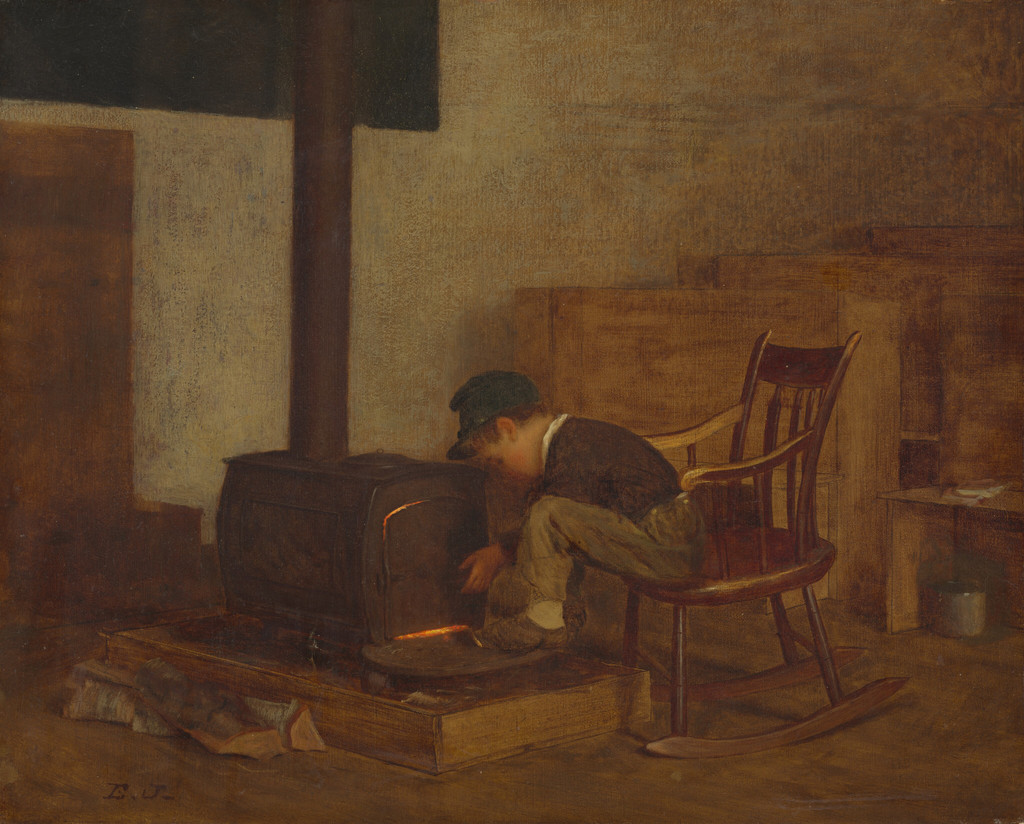
This way of seeing carries into the paintings. In The Early Scholar , the child and schoolroom are held together by a restricted range of tones. The brightest passages do not cover the entire surface; their force depends on the darker surroundings.
The method does not mean that all drawings contain the same ingredients. A record identifying charcoal and white crayon belongs to that particular sheet, while another may specify pencil or graphite. The visible brightness of a mark is not enough to identify its material without an object record or examination.
Annotated Details from Eastman Johnson’s Technique: Drawing, Paint and Working Methods
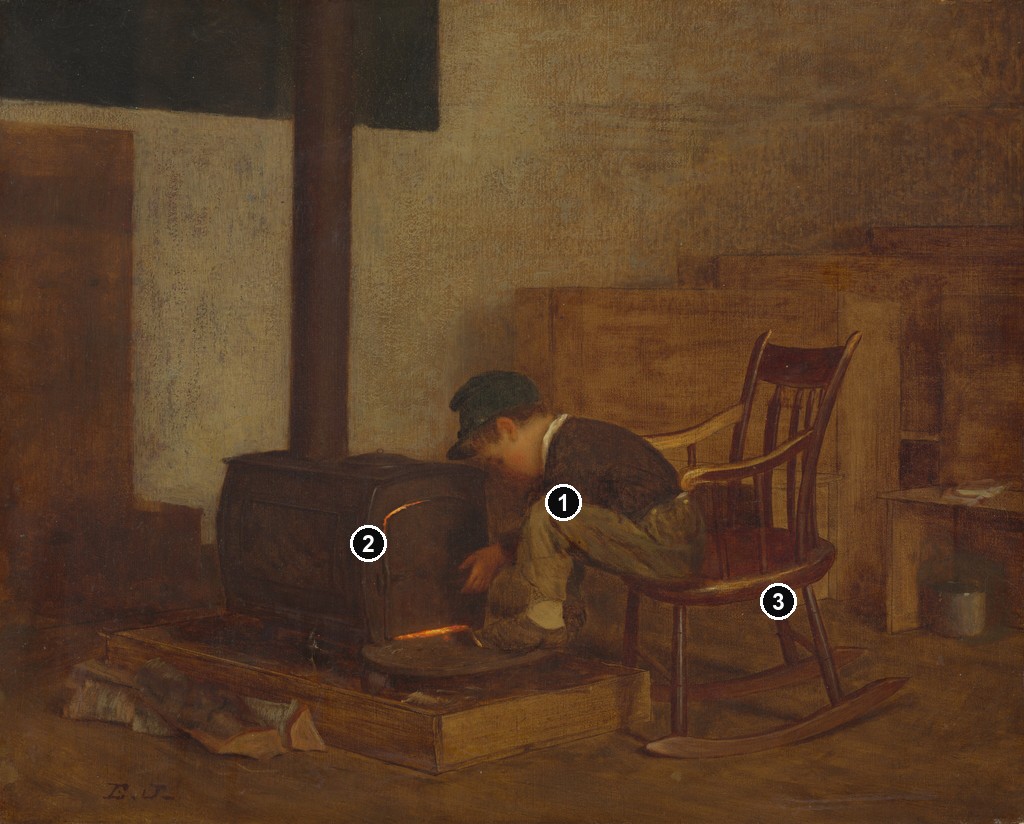
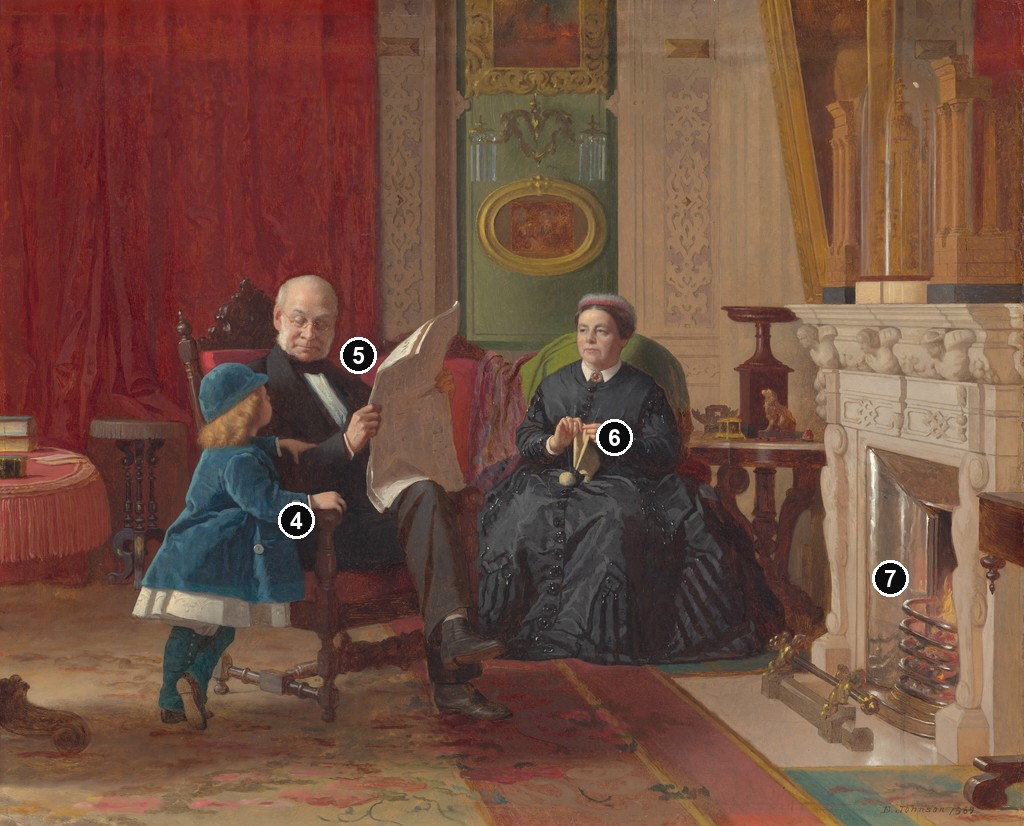
The numbered points identify visible features discussed in this article. Return from each detail to the whole composition. The captions keep each work’s identity, date and medium separate.
The Early Scholar NGA Study
Eastman Johnson, The Early Scholar, about 1865. Oil on academy board on canvas, 43.2 × 53.7 cm. National Gallery of Art, Washington, Chester Dale Collection, 1963.10.157. Public domain. Image source. Public domain. Numbers added to a separate overview; detail images are native crops. No recolouring, retouching, reconstruction or enlargement.
The Brown Family NGA Version
Eastman Johnson, The Brown Family, 1869. Oil on paper on canvas, 59 × 72.4 cm. National Gallery of Art, Gift of David Edward Finley and Margaret Eustis Finley, 1978.72.1. Public domain. This is the smaller Washington version. Image source. Public domain. Numbers added to a separate overview; detail images are native crops. No recolouring, retouching, reconstruction or enlargement.
Details from EASTMAN JOHNSON’S TECHNIQUE: DRAWING, PAINT AND WORKING METHODS
Compare the cropped details with the complete images above. Notice how their colours, shapes and positions contribute to the larger compositions.
The Early Scholar NGA Study
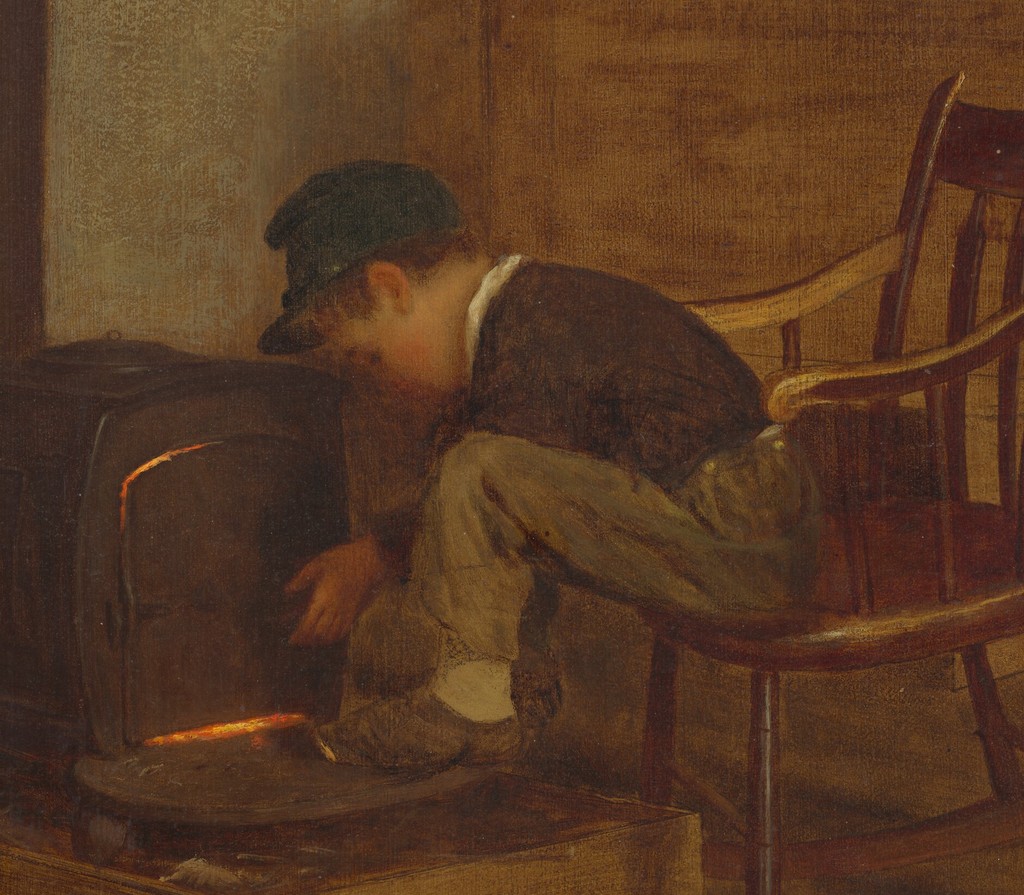
A body leaning towards warmth
The boy bends forward in the rocking chair, drawing his hands and feet towards the stove. His lowered head joins the curve of his back, making warmth the scene’s immediate concern.
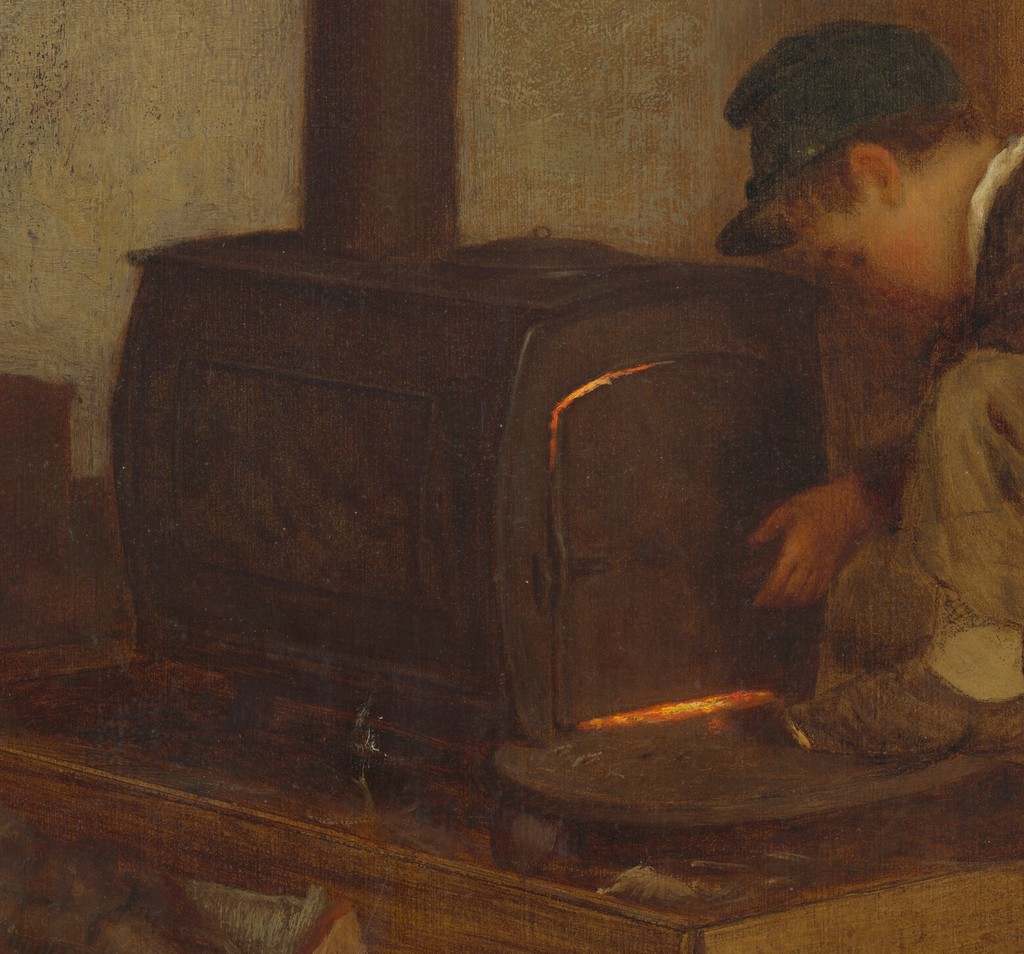
The stove and its small orange light
A narrow orange opening marks the stove within the otherwise brown room. Its small bright passages connect the dark iron box with the boy’s outstretched hands and feet.
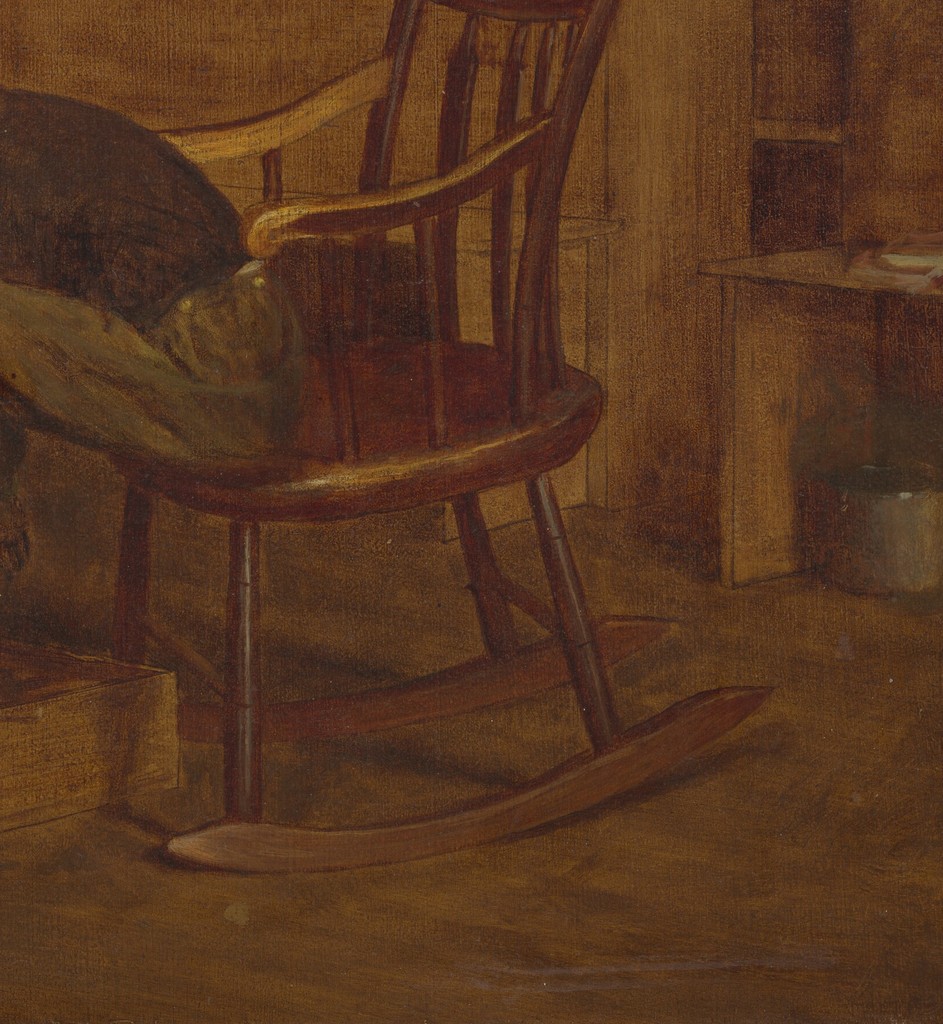
Chair, platform and surrounding room
The curved rocker and raised platform give the figure a firm position in the room. Their overlapping horizontal and curved edges contrast with the upright stove pipe and the wall behind.
The Brown Family NGA Version
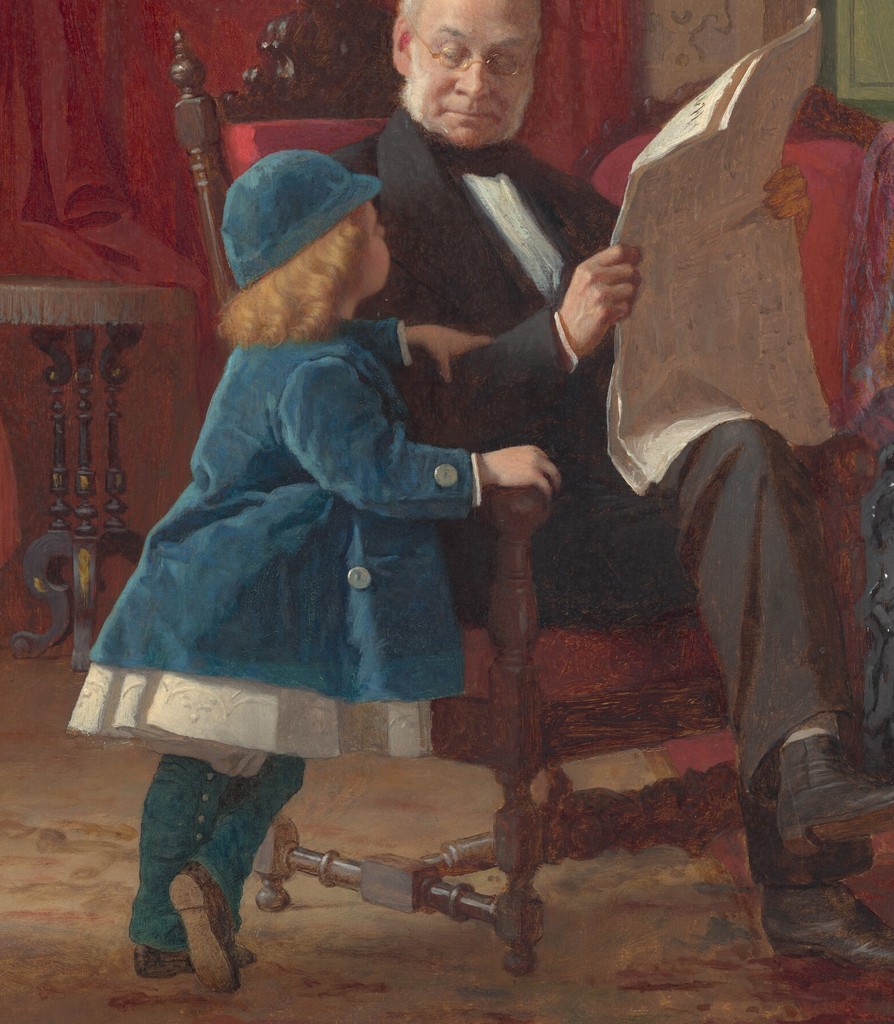
The child’s reaching arm
The child’s blue clothing stands out against the red furnishings. One hand reaches towards the seated man’s arm, creating a connection that interrupts his attention to the newspaper.
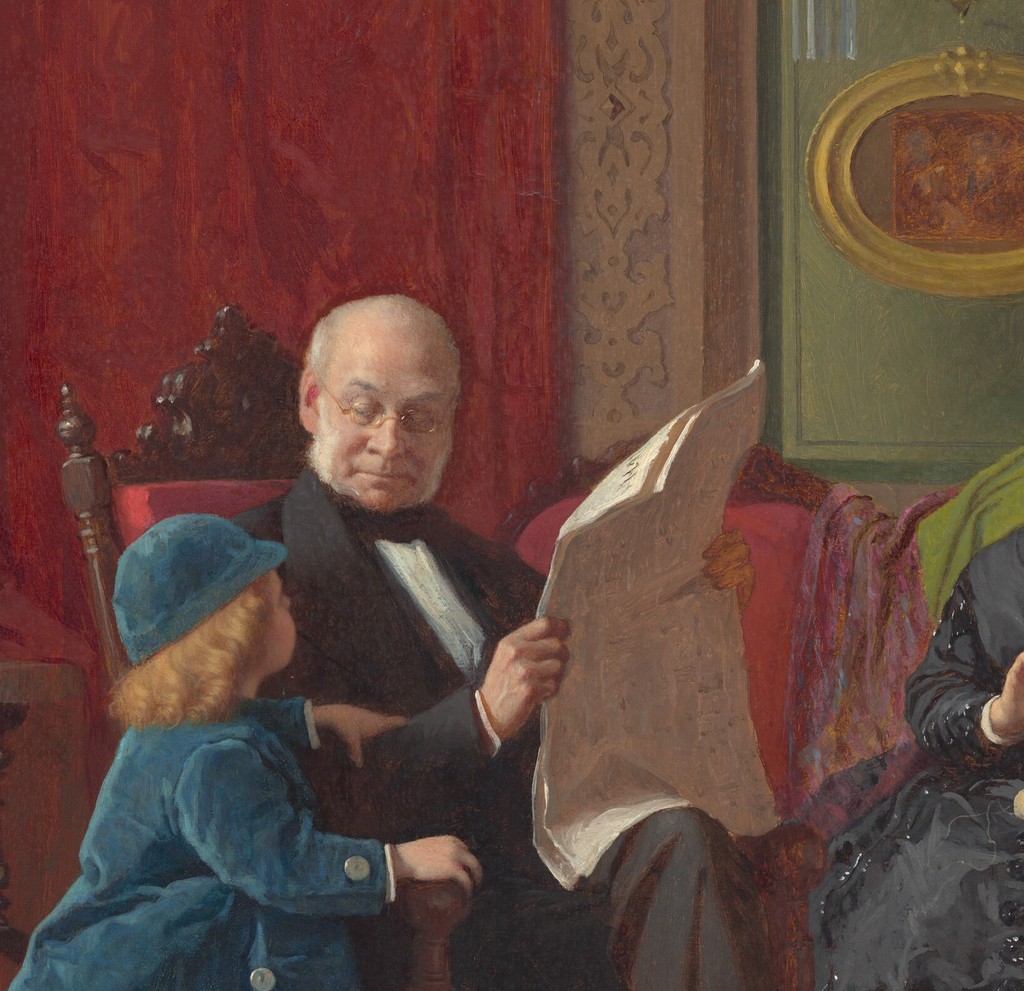
A face above the newspaper
The newspaper rises diagonally beside the older man’s head. His glasses, dark coat and pale shirt bring a recognisable likeness into the larger arrangement of furniture and family activity.
Knitting and a separate direction of attention
The woman holds her knitting in front of her dark dress while looking across the room. Her hands and gaze give her a distinct occupation within the three-person group.
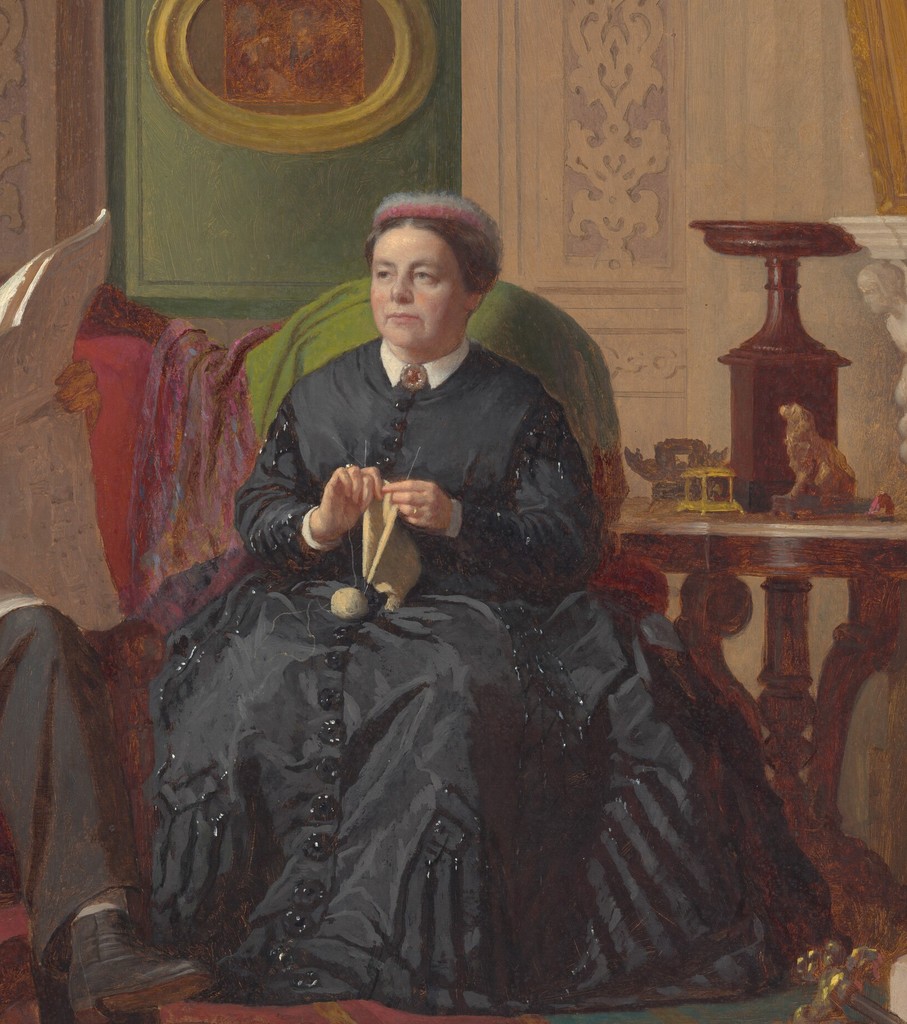
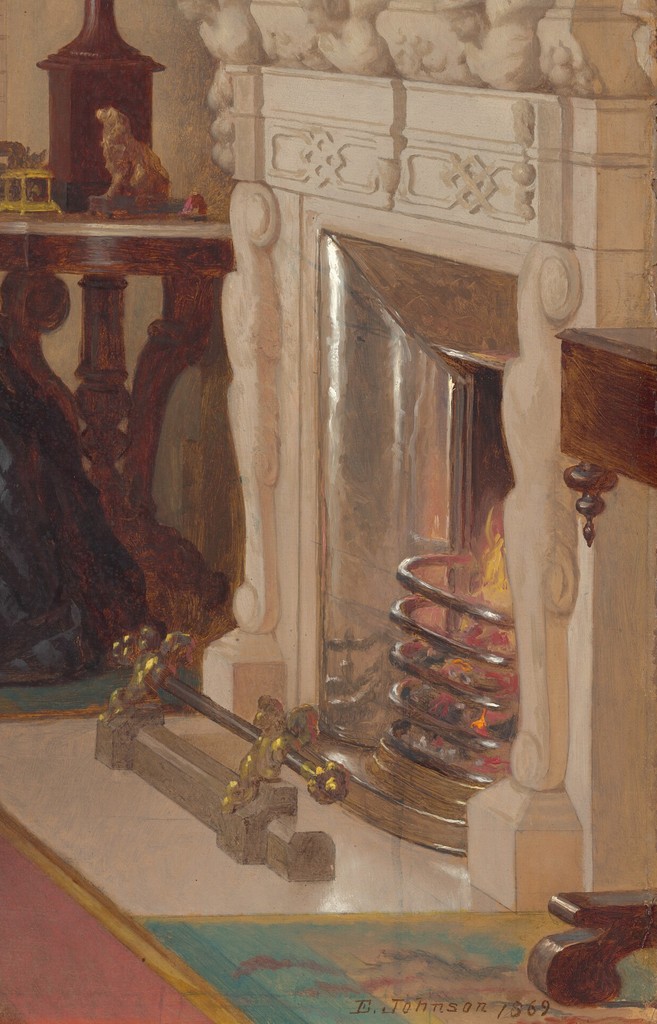
The fireplace as a second bright centre
The pale mantel and fire occupy a substantial area beside the figures. Carved details, the grate and the floor surround make the room’s furnishings active parts of the composition.
Preparation and the middle tones
Hills connects Johnson’s approach to his European study, especially his time with Thomas Couture. Her account describes brownish preparation contributing to the middle tones, with darker and lighter paint establishing the extremes. She also discusses scumbled passages, in which partly opaque paint allows an underlying layer to remain active. [1]
Such layering changes the role of the surface beneath the final touches. A dark passage need not be built from a thick, completely covering coat. An exposed or partly exposed lower tone can do important work, making the finished image depend on what is left visible as well as what is added.
The National Gallery’s technical account of its Early Scholar makes that process more specific. It records a thin buff ground, a transparent brown layer and extensive underdrawing, probably in pencil. Darker applications deepen the shadows, while lighter, more opaque passages appear to have followed. These findings concern the Gallery’s own version, rather than every painting of the subject. [2]
The distinction between general practice and exact examination is useful. The survey explains a recurring way of working; the technical entry tells us what was observed in one support and paint structure. Neither requires turning a warm brown reproduction into a list of identified pigments.
What unfinished work reveals
Sugaring Off offers unusually direct access to preparation because large areas remain unresolved. The RISD Museum’s discussion by Maureen C. O’Brien relates its tonal groundwork, trial figures and varying degrees of finish to Couture’s teaching. The margins and transitions let a viewer see decisions that a more uniformly completed surface could conceal. [3]
Looking at the whole canvas is essential. A relatively developed group and a more tentative passage belong to the same large arrangement. Their differences show Johnson testing how people, activity and open space could work together, rather than simply moving in a neat line from the left side of the canvas to the right.
The painting does not establish why he left it unfinished. Nor does it authorise a modern reconstruction of the missing decisions. Its value as evidence lies in the surviving contrasts between stages of work, including the places where no final resolution is available.
It also complicates the idea that a study is necessarily a small first thought and a large canvas a wholly settled result. Scale, intended use and degree of finish can vary independently. Johnson’s surviving work is more informative when those qualities are recorded separately.
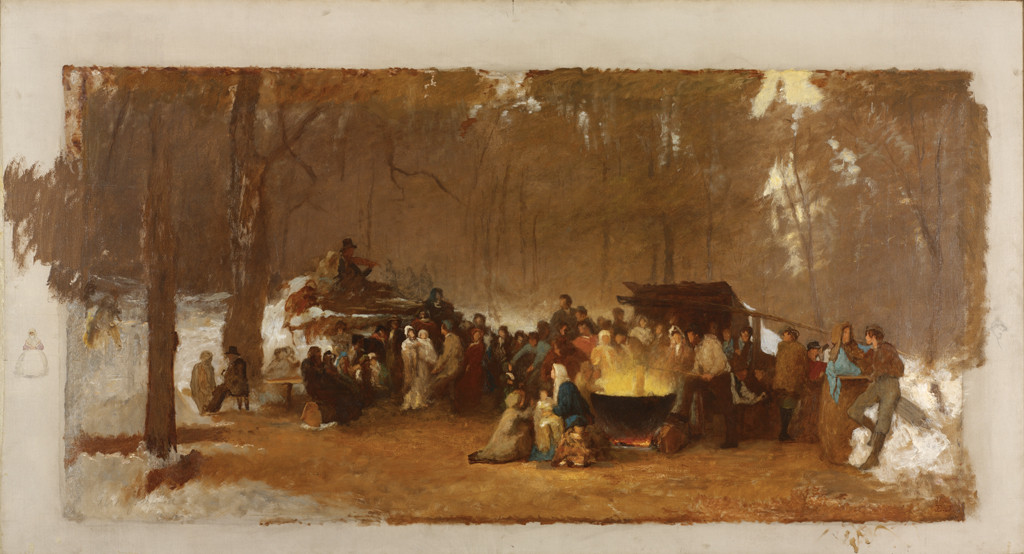
Eastman Johnson, Sugaring Off, about 1864–65. Oil on canvas, 134 × 245.1 cm. RISD Museum, Museum Works of Art Fund, 45.050. Unfinished. CC0.
Image source
.
CC0 / Public domain
.
Paper, canvas and different kinds of board
Johnson used a range of supports. The National Gallery’s Early Scholar is described as a thin cardboard support mounted to fabric. Its Brown Family is painted on paper that has also been lined to fabric. These are different material structures from a painting executed directly on an ordinary stretched canvas. [2] [4]
The Brown Family examination records a narrow strip of paper, about four centimetres wide, joined at the top. The catalogue considers it probably part of the original intention. This is a physical alteration to the support’s extent, but it should not be explained as a confidently recovered change of subject without further evidence. [4]
Terms such as academy board, paperboard, fiberboard and panel should likewise follow individual records. Hills notes that prepared composition boards could provide convenient supports for oil studies. Her statement that she had not found actual wood among the examples she examined describes the limits of that survey. It does not overrule the Walters Art Museum’s description of The Nantucket School of Philosophy as oil on panel. [1] [5]
The support matters because it can affect texture, size and later treatment. It does not determine the picture’s status by itself. A work on paper can be highly developed, and a large canvas can preserve an unsettled composition.
Underdrawing and the transfer of a figure
The Met’s 1985 catalogue discusses Girl with Glass , a drawing dated 22 September 1875, in relation to the central figure in The New Bonnet . It reports infrared evidence and a close correspondence between the drawn and painted forms, drawing on Sheldon Keck’s earlier investigation of Johnson’s procedure. [6]
The account helps explain why different parts of the finished painting can have different kinds of definition. The central figure’s carefully maintained contours contrast with freer passages elsewhere. A transferred or closely followed drawing could preserve a form while subsequent handling varied around it.
That is evidence for a particular relationship, not a universal mechanism proved for every Johnson painting. Hills’s broader survey treats transfer procedures as an area requiring further research. A visible graphite-like edge can suggest a question without answering every part of it. [1]
Nor is mechanical assistance incompatible with observation. A drawing can record an initial encounter, and a transfer can help the painter reposition that observed form within a more elaborate design. The finished effect may look informal while depending on preparatory precision.
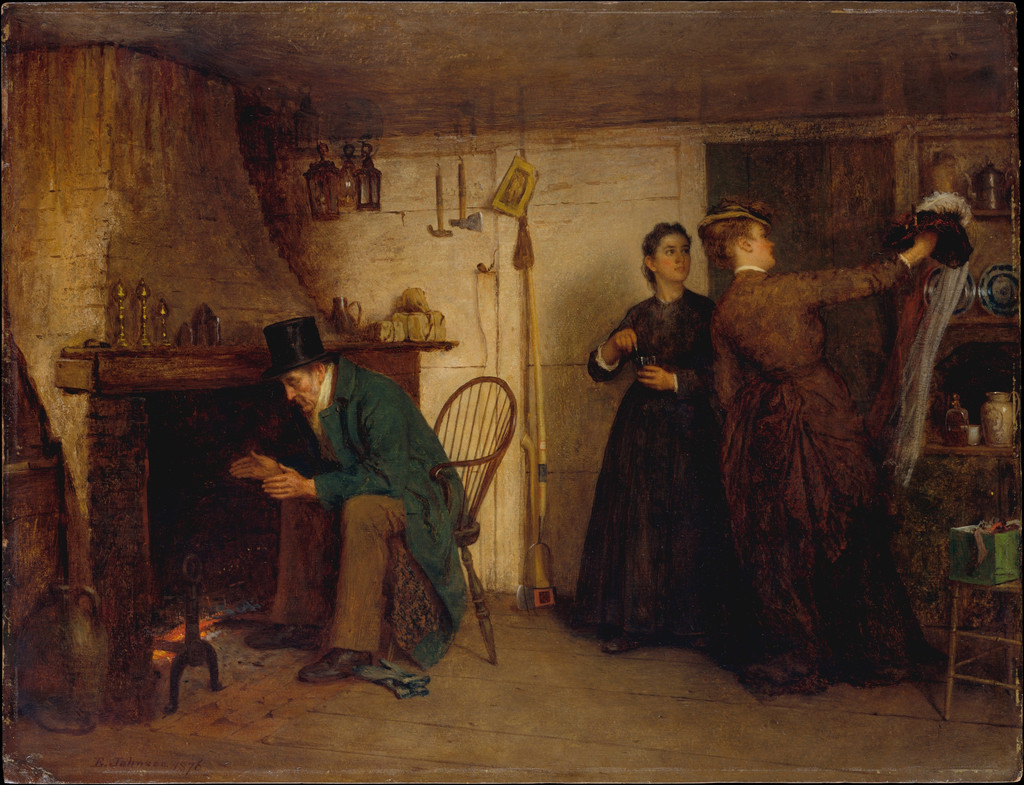
Eastman Johnson, The New Bonnet, 1876. Oil on academy board, 52.7 × 68.6 cm. The Metropolitan Museum of Art, Bequest of Collis P. Huntington, 1900, 25.110.11. Public domain.
Image source
.
Public domain
.
Watch: Eastman Johnson
Choose a film to explore the artist’s work, its interpretation and its wider setting.
Director's Choice - The Girl I Left Behind Me by Eastman Johnson
The Smithsonian American Art Museum looks at Johnson’s The Girl I Left Behind Me.
Watch on YouTubeRevisions within the Brown Family
The National Gallery’s examination of The Brown Family records extensive underdrawing, including perspective lines and decorative details in the room. Infrared reflectography and X-radiography revealed small adjustments to the man and child. The apparently stable domestic gathering therefore includes evidence of revision beneath its surface. [4]
The paint was generally applied thinly, with greater finish in the figures than in the surroundings. Limited thicker touches occur in the flames and highlights on metal. This distribution helps explain how a richly furnished room can remain subordinate to the relationships between the people.
The same entry documents varnish removal and restoration in 1978, before the Gallery acquired the work. Those observations belong to a dated treatment history. They should not be presented as a report of the painting’s condition today or transferred to the larger Brown family portrait in San Francisco. [4]
Technical evidence thus adds another chronology to the picture. There is the scene represented, the sequence of Johnson’s decisions and the later history of the physical object. Keeping those chronologies distinct prevents a repair from being mistaken for an original brushstroke or a revised pose from becoming an invented family event.
Large groups and economical paint
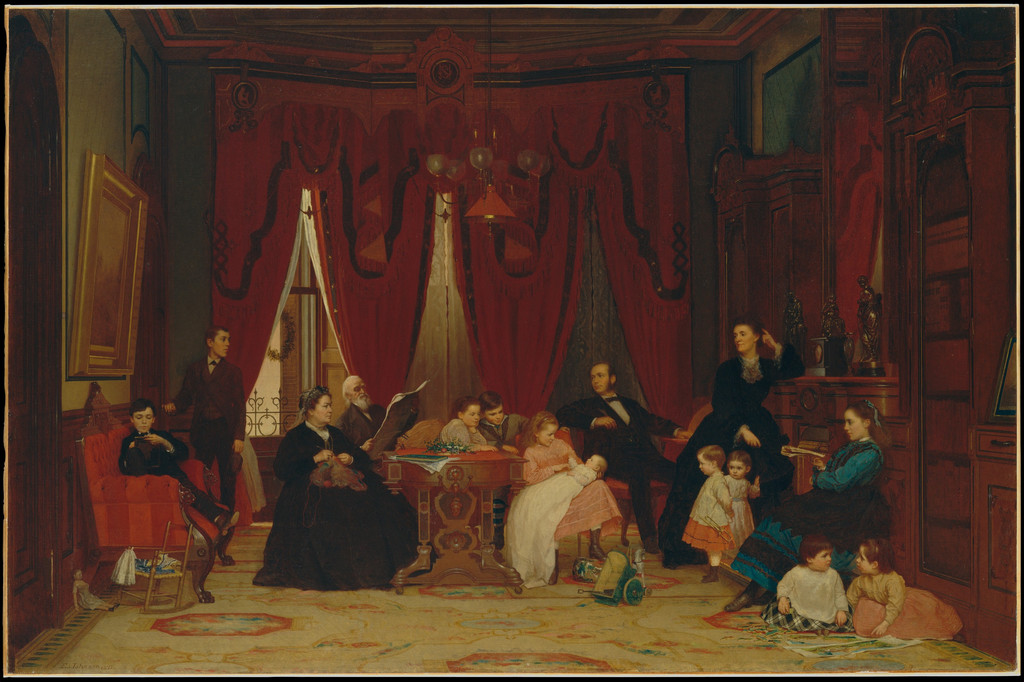
The Met catalogue describes thin paint in The Hatch Family and records a Dechaux supplier’s stamp. The large, crowded portrait could therefore depend on relatively economical handling rather than uniformly heavy paint. A supplier’s mark provides evidence about a prepared support, not a complete list of colours or a recipe used in every passage. [7]
Johnson’s oil sketch of Joseph Wesley Harper, Jr. provides another comparison. The National Gallery catalogue describes pronounced underdrawing, thin background paint and more substantial touches in the face. It distinguishes this sketch from the finished portrait at Columbia, whose greater resolution should not be assigned to the study. [8]
These examples show how economy and specificity can coexist. A face may receive a concentrated set of touches while a coat or wall is established with a broader passage. The relative difference directs attention; it does not automatically indicate carelessness in the less finished area.
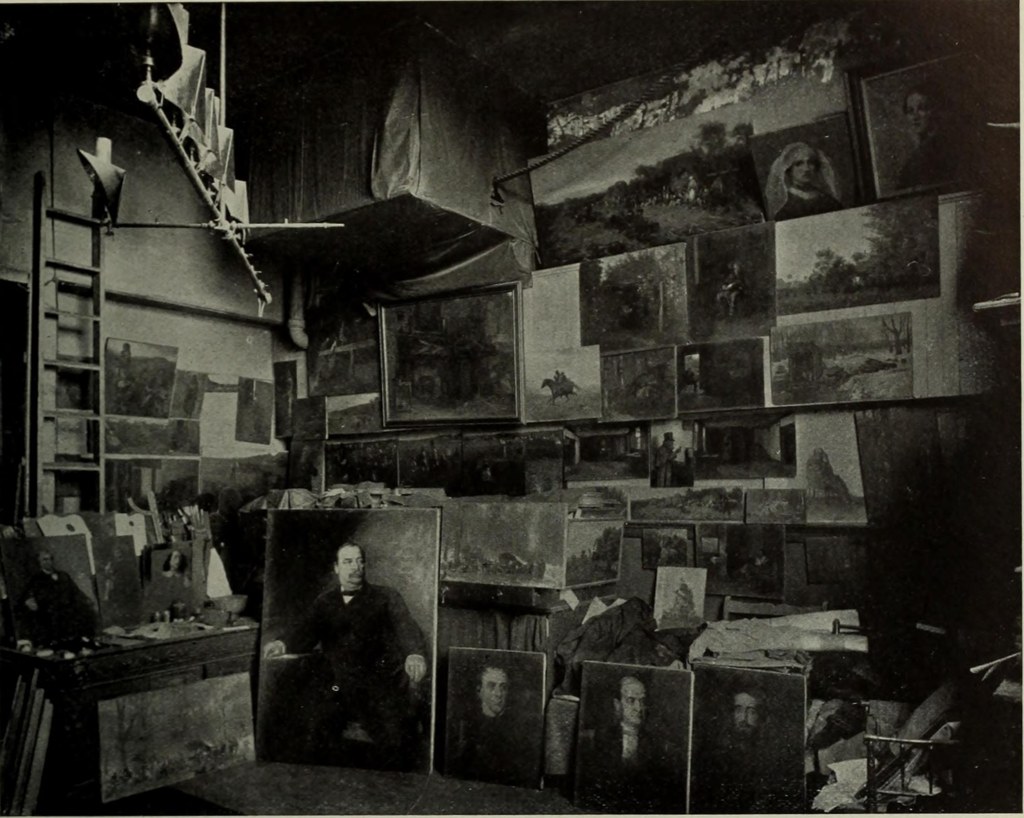
Eastman Johnson’s studio, photograph published in The World’s Work, December 1906, p. 8317. The Met catalogue identifies harvest studies in this view. Exact photograph date and photographer are not established. The World’s Work; Robarts Library, University of Toronto; Internet Archive. Public domain.
Image source
.
Public domain
.
Signatures and the material history of a work
An inscription is part of a painting’s evidence, but its appearance can have a history. The catalogue account of the 1857 Kitchen at Mount Vernon reports correspondence about returning the work to Johnson for re-signing in 1895, together with later difficulty seeing the inscription in ordinary light. The original letters and conservation report are mediated through that account. [9]
The example warns against treating a reproduction of a signature as a self-sufficient account of authorship or date. A faint mark may reflect material changes, treatment or an inscription’s own history. Those questions require examination of the exact object and its documentation.
For understanding Johnson’s art, the more productive comparison is between the evidence of making and the effect of looking. Preparatory lines, thin tones, transferred forms and later revisions can produce a scene that feels immediate. His convincing informality was often the result of sustained decisions about where to define, where to suggest and where to leave a darker passage active.
Artworks directory
Browse twenty-one selected objects discussed in these articles, including the Gifford portrait and the Prang print after Johnson. Dates identify individual objects, including the San Diego Drummer Boy study. Use All media to include the chromolithograph.
| Name | Date | Medium |
|---|---|---|
| Kitchen at Mount Vernon | 1857; Charles Butt canvas | Oil on canvas |
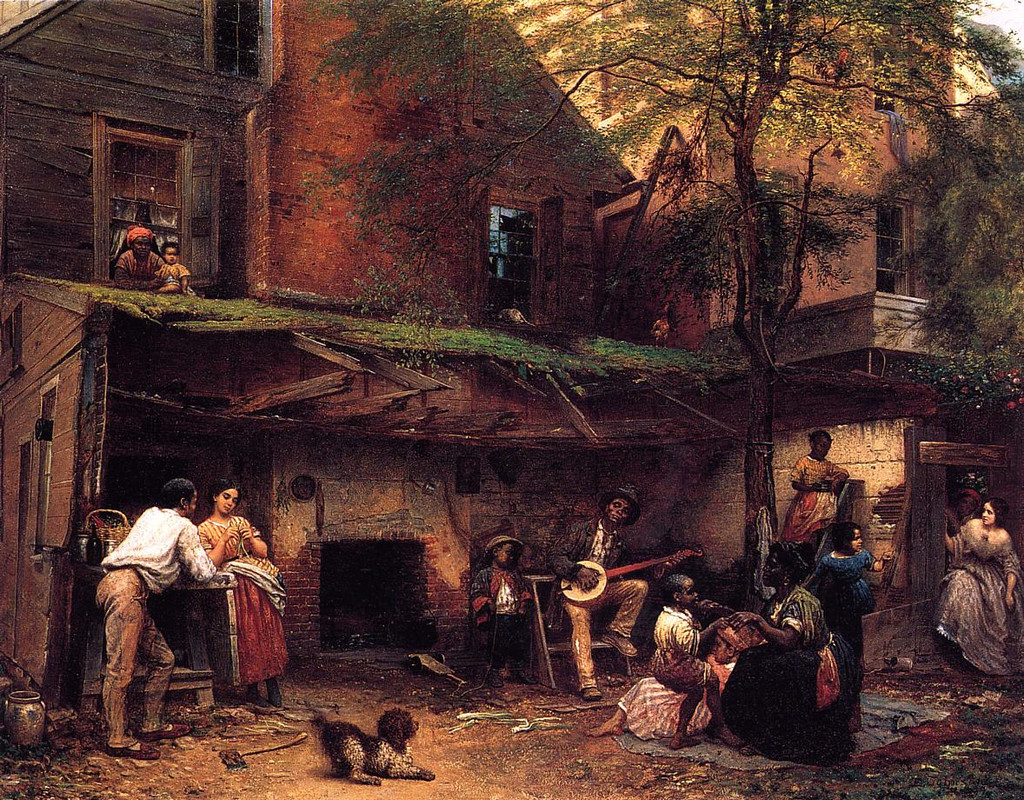
| Negro Life at the South | 1859; New York Historical original | Oil on linen |
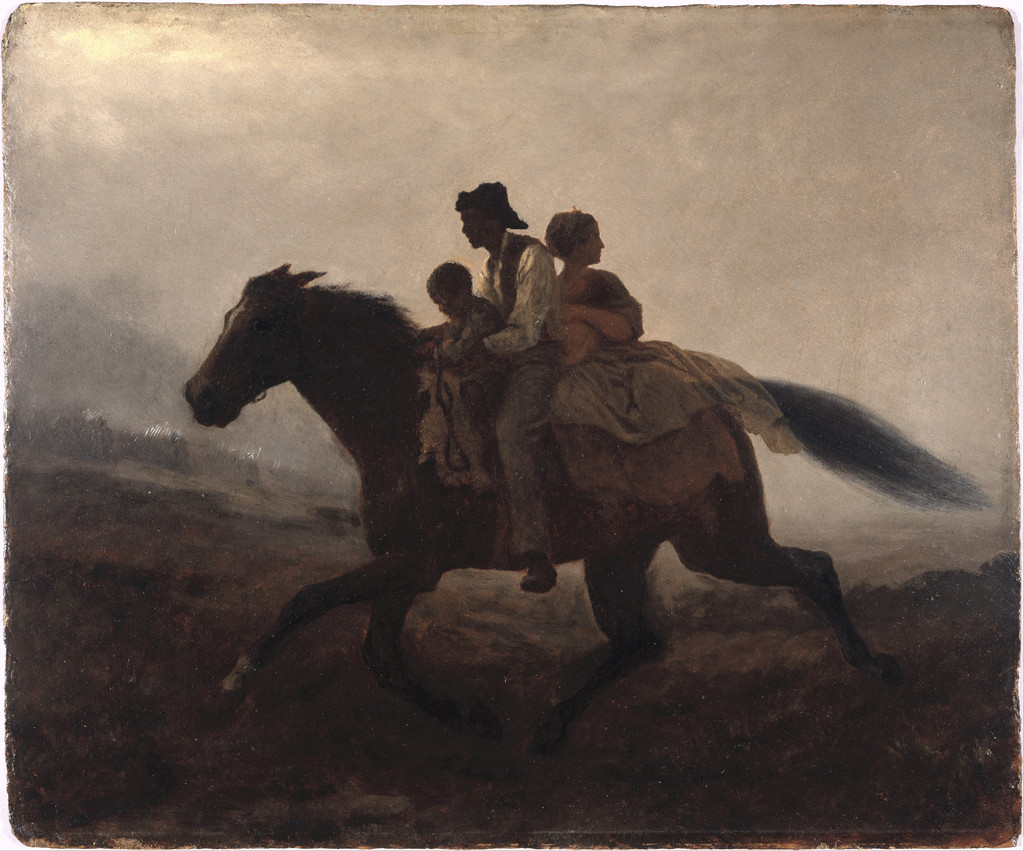
| A Ride for Liberty—The Fugitive Slaves | About 1862; Brooklyn version | Oil on paperboard |
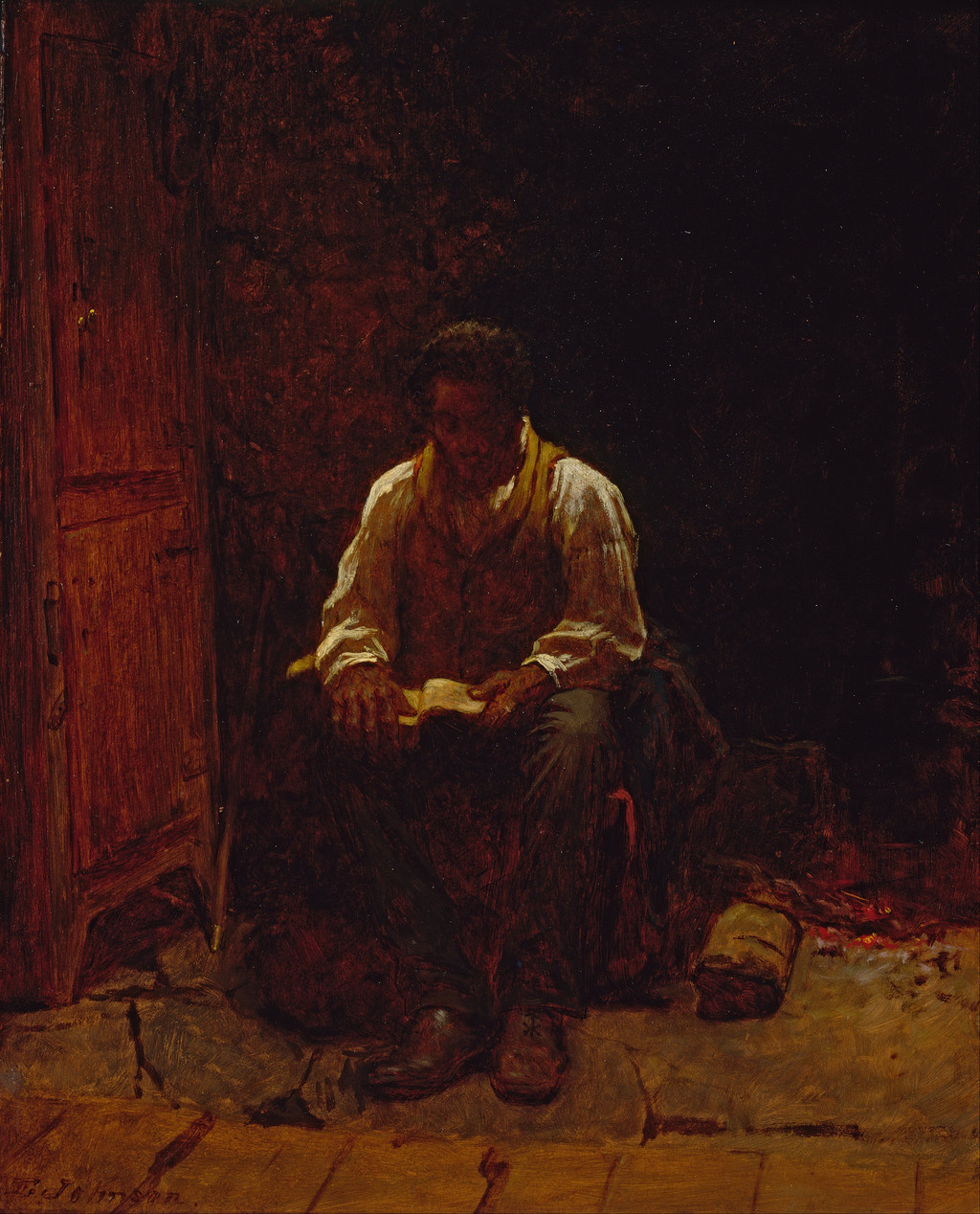
| The Lord Is My Shepherd | 1863 | Oil on fiberboard |
| Sugaring Off | About 1864–65; unfinished RISD canvas | Oil on canvas |
| The Wounded Drummer Boy (San Diego study) | About 1864–71; study, not the finished canvas | Oil on board |
| The Early Scholar | About 1865; NGA study | Oil on academy board on canvas |
| Fiddling His Way | 1866; Chrysler canvas | Oil on canvas |
| The Letter Home | 1867; Minneapolis drawing | Charcoal and graphite on paper |
| The Boyhood of Lincoln | 1868; Michigan canvas | Oil on canvas |
| The boyhood of Lincoln—An evening in the log hut (Prang after Johnson) | About 1868; separate reproductive print | Chromolithograph, W. Harring / L. Prang & Co., after Johnson |
| The Brown Family | 1869; NGA version | Oil on paper on canvas |
| The Hatch Family | 1870–71 | Oil on canvas |
| The Old Stagecoach | 1871 | Oil on canvas |
| The Girl I Left Behind Me | About 1872 | Oil on canvas |
| The Toilet | 1873 | Oil on paper board |
| Husking Bee, Island of Nantucket | 1876; Chicago canvas | Oil on canvas |
| The New Bonnet | 1876 | Oil on academy board |
| Sanford Robinson Gifford | 1880; possibly posthumous | Oil on academy board |
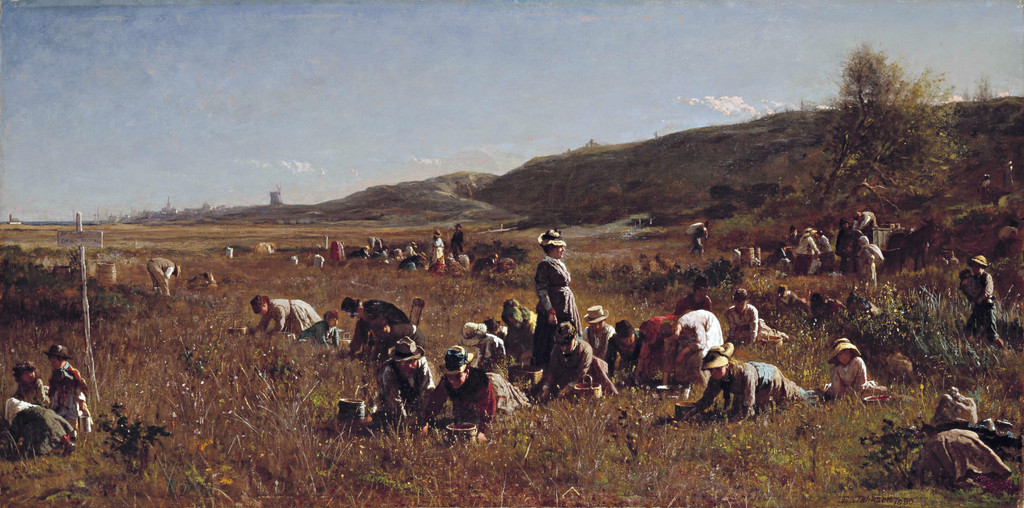
| The Cranberry Harvest, Island of Nantucket | 1880; Timken canvas | Oil on canvas |
| The Nantucket School of Philosophy | 1887 | Oil on panel |
Frequently Asked Questions
Yes. The relationship between Girl with Glass and The New Bonnet is a particularly useful documented example. Broader claims about one transfer method used everywhere remain less secure. [6]
Colour reproductions support looking at the composition, but they do not identify exact pigments or a universal palette. Dated technical examinations provide a different kind of evidence.
Discussion
Look again at the images and ideas explored in Eastman Johnson’s Technique: Drawing, Paint and Working Methods. These editorial prompts invite your observations.
Reader Insights
Where does a lower tone remain active within a finished-looking passage? Distinguish what you see from technical examination findings.
What changes when you compare a reported underdrawing with the visible finished figure in The New Bonnet?
How do the unfinished margins of Sugaring Off change your idea of an apparently spontaneous gathering?
Join the Conversation
Share a detail, comparison or question about Eastman Johnson’s Technique: Drawing, Paint and Working Methods below.
References
- Patricia Hills , Technical Information on Johnson’s Practices, Eastman Johnson Catalogue Raisonné. General drawing, tonal preparation, supports and transfer discussion; uncertainties retained. View source
- National Gallery of Art , American Paintings of the Nineteenth Century, Part I, pp. 373–376. The Gallery’s Early Scholar and its technical notes. View source
- Maureen C. O’Brien , New Ways to Paint: Sugaring Off, RISD Museum, 2014. Unfinished composition, preparation and Couture-related method. View source
- National Gallery of Art , American Paintings of the Nineteenth Century, Part I, pp. 376–382. The Brown Family, paper join, imaging, handling and 1978 treatment. View source
- Walters Art Museum , The Nantucket School of Philosophy, 37.311. Object-specific oil-on-panel description. View source
- Natalie Spassky and others , American Paintings in The Metropolitan Museum of Art, Volume II, 1985, pp. 229–232. New Bonnet entry, preparatory drawing and reported infrared evidence; Keck’s original study was not separately consulted. View source
- Spassky and others , American Paintings in The Metropolitan Museum of Art, Volume II, pp. 223–225. Hatch Family technical and supplier information. View source
- National Gallery of Art , American Paintings of the Nineteenth Century, Part I, pp. 382–384. Joseph Wesley Harper, Jr. sketch and comparison with the finished portrait. View source
- Patricia Hills and Abigael MacGibeny , Washington’s Kitchen at Mount Vernon, 1857, Hills no. 6.0.4. Mediated re-signing and examination history. View source
- Splash image source.
Eastman Johnson, The Early Scholar, about 1865. Oil on academy board on canvas, 43.2 × 53.7 cm. National Gallery of Art, Washington, Chester Dale Collection, 1963.10.157. Public domain. Public domain .
View source