 by
Tom Gurney
Tom Gurney BSc (Hons) is an art history expert with over 20 years experience
Email:
tomgurney1@gmail.com
/ Phone:
+44 7429 011000
The Nantucket School of Philosophy by Eastman Johnson: Introduction
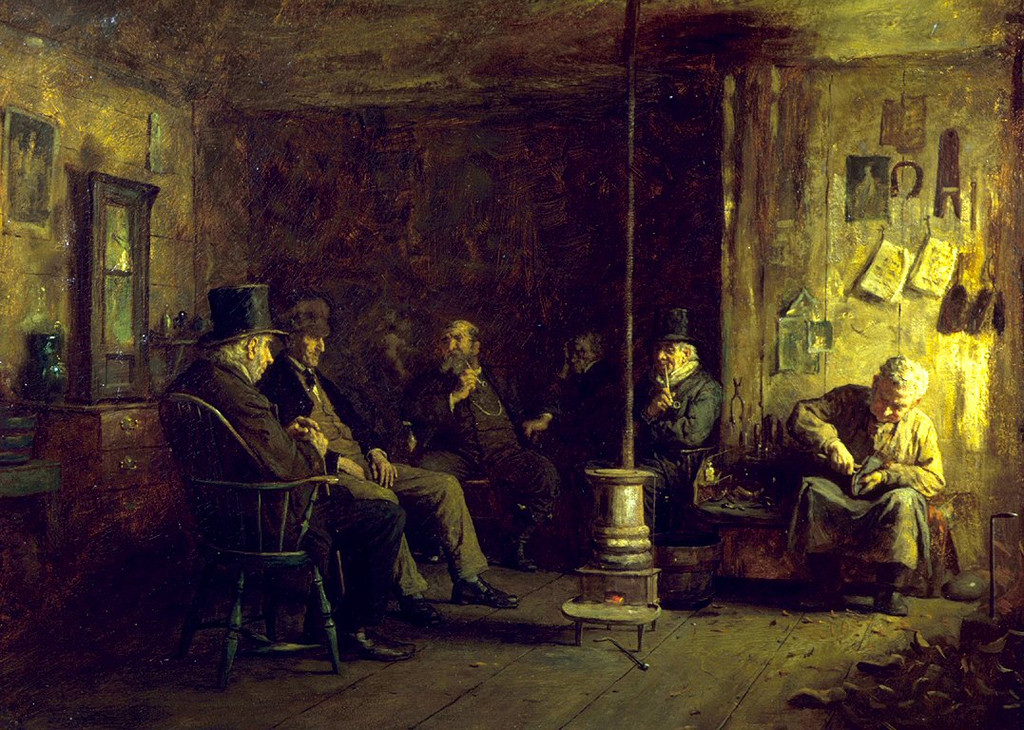
Eastman Johnson’s The Nantucket School of Philosophy gives an ordinary room an unusually grand title. Elderly men gather around a stove in a shoemaker’s shop. Some appear to talk or listen; the man at the right continues working with his hands. The scene makes conversation part of a place where useful work still takes place.
The Walters Art Museum dates the painting to 1887 and identifies several of its participants through names reportedly supplied by Johnson two years later. It belongs to his long engagement with Nantucket people and interiors, bringing individual faces into a shared setting rather than arranging them as a formal group portrait. [1]
At a Glance
- Artist Eastman Johnson
- Title The Nantucket School of Philosophy
- Date 1887
- Medium Oil on panel, following the Walters record
- Dimensions 59 × 80.5 cm
- Collection Walters Art Museum, Baltimore
- Accession 37.311
- Credit Acquired by Henry Walters, 1924
The painting is signed and dated at the lower right. [1]
This work across Eastman Johnson’s career
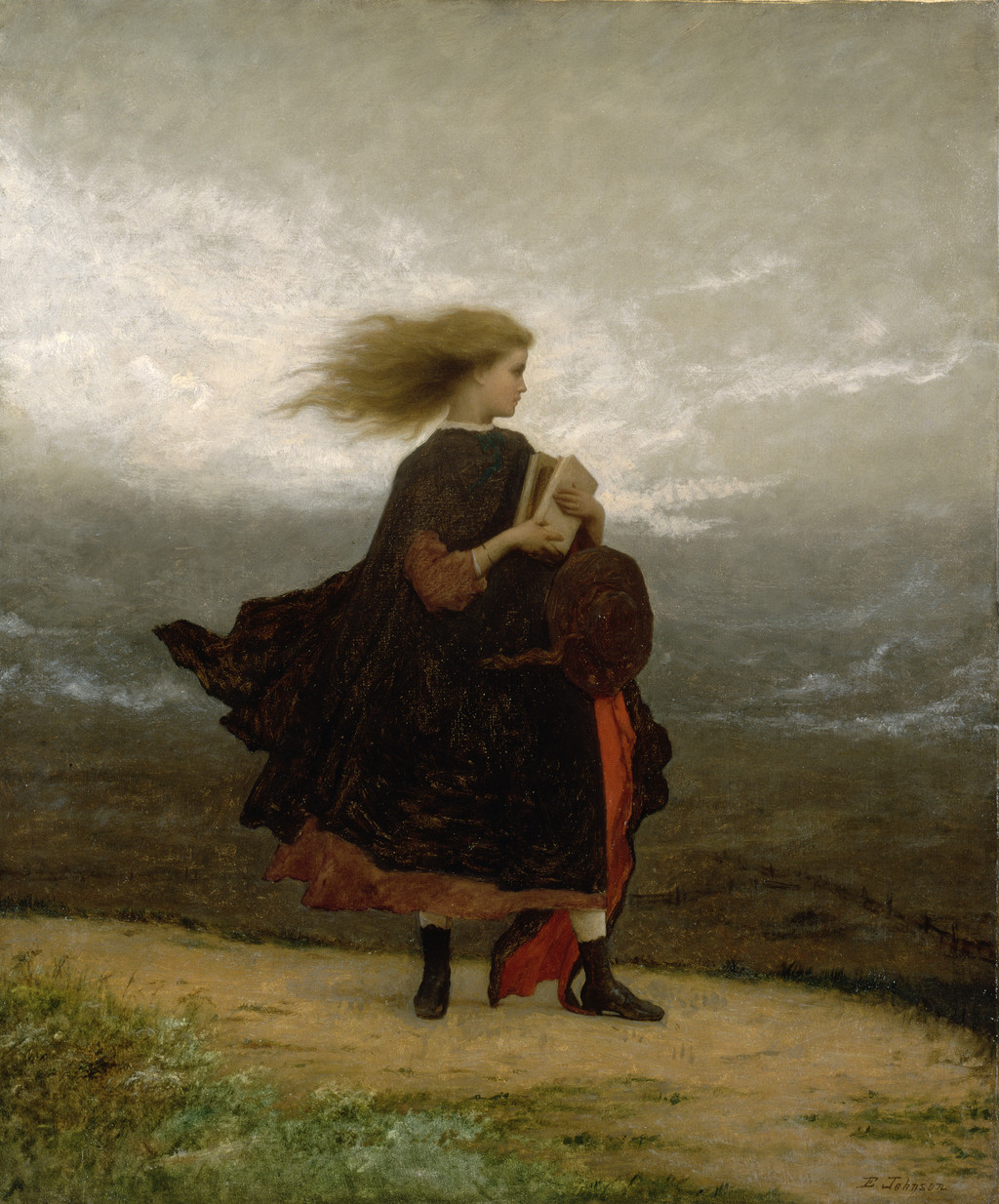
The Girl I Left Behind Me
About 1872The Toilet
1873Husking Bee, Island of Nantucket
1876; Chicago canvasThe New Bonnet
1876The Cranberry Harvest, Island of Nantucket
1880; Timken canvasNotes and sources
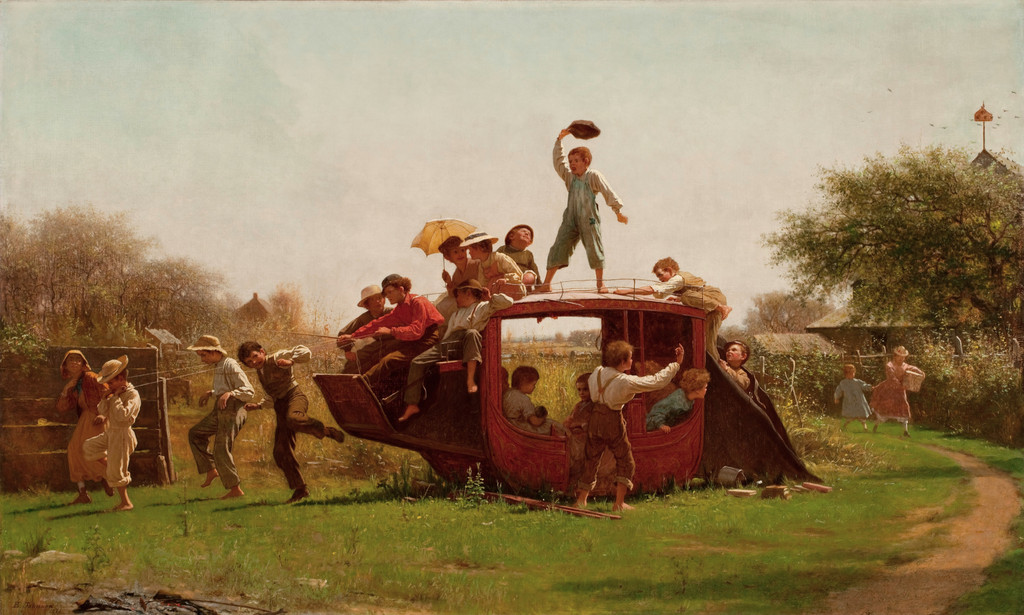
The Old Stagecoach. Children give a broken vehicle a new purpose through play. [2]
The Girl I Left Behind Me. A still figure, books and wind-driven clothing hold competing directions of attention. [3]
The Toilet. The mirror returns a face while the figure’s back occupies the foreground. [4]
Husking Bee, Island of Nantucket. A line of people and pale husks joins harvest work to a social gathering. [5]
The New Bonnet. A bonnet, a glass and a fire give three figures different occupations within one room. [6]
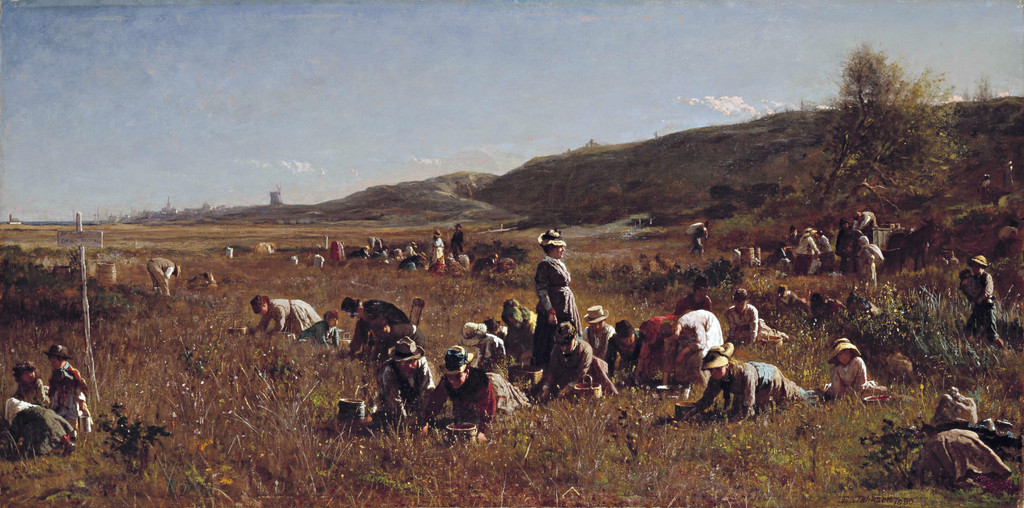
The Cranberry Harvest, Island of Nantucket. Repeated working figures spread across a panoramic field beneath an expansive sky. [7]
The Nantucket School of Philosophy (current article). A shoemaker’s shop becomes a place for work, company and conversation. [1]
Contents
- What kind of school is this?
- The stove as a social centre
- The shoemaker’s work continues
- Faces, names and island memory
- A late genre picture and a related study
- Light, materials and the museum record
- From private ownership to Baltimore
What kind of school is this?
There is no classroom or lecturer’s desk. The gathering is organised around a stove, chairs and a workbench. Calling it a school of philosophy elevates the men’s conversation without turning the room into a scholarly institution. Experience, memory and the exchange of opinions become possible forms of knowledge within an everyday setting.
The title also introduces humour. The men are not shown demonstrating a unified argument, and the shoemaker’s attention is divided between company and his task. The picture allows an ordinary social gathering to acquire intellectual dignity while retaining its practical surroundings. Its effect depends on the gap between the ambitious name and the modest place.
The museum describes the men as retired captains reminiscing about the past. That account gives the gathering a particular island identity, although it does not provide a transcript of their conversation. The painting leaves the content of their talk outside the frame, making its duration and social setting more important than an identifiable spoken sentence. [1]
The stove as a social centre
The stove stands close to the middle of the foreground. Its cylindrical body and tall pipe give the room a strong vertical axis. A tiny warm opening near the base introduces a concentrated point of colour, while the pale metal catches light more broadly. Several figures sit around this shared source of heat.
The pipe divides the interior without completely separating its occupants. To the left, seated bodies overlap in a darker cluster; to the right, the shoemaker receives stronger light. Our eye can move around the stove from one group to the other, following the places where faces, hands and clothing emerge from shadow.
The chairs contribute different poses. The leftmost foreground man sits sideways to us with one hand supporting his head. Another figure extends his legs into the room. Near the pipe, a man holds a pipe of his own close to his mouth. These varied positions make the gathering feel sustained rather than assembled for a single ceremonial instant.
Johnson leaves much of the central background dark. That darkness gathers the company into one room while allowing particular heads and gestures to remain distinct. The figures do not need equal brightness to have a place in the conversation. Some are conspicuous; others emerge only after the viewer has spent time looking.
The shoemaker’s work continues
At the far right, the working man bends over the object in his hands. Light falls across his face, sleeve and lap, making his activity easier to see than several of the neighbouring figures. The pose gives the composition an active endpoint: the movement of looking across the room arrives at a task still in progress.
Tools and pieces of equipment hang on the wall behind him. Papers, small framed objects and other attachments interrupt the plaster. Their presence establishes the shop as an accumulated working environment, rather than an empty room borrowed for an encounter. The foreground floor likewise contains objects and irregular marks that resist a polished domestic presentation.
The workbench is low and crowded. It occupies the space between the shoemaker and the stove, joining his task to the room’s central gathering. He does not have to withdraw into another space to continue working, and the others do not appear obliged to adopt his occupation. Talk and manual activity coexist without becoming identical.
That relationship distinguishes this painting from a straightforward image of retirement. The museum identifies the shoemaker as Captain Haggerty: maritime experience and a present practical role can belong to the same person. The combination gives the title’s philosophy a bodily setting in hands, tools, warmth and the habits of company. [1]
Faces, names and island memory
The Walters account reports that Johnson identified Captain Moore as the talker and Captain Ray as the man at the left leaning on his hand. It also records that the other captains had died by the time of that later identification. The information brings a poignant historical distance into a scene that can initially appear simply convivial. [1]
Those names should not be stretched into a complete key to every shadowed face. The important connection is between a social group known to the artist and the process through which that group was remembered. The picture preserves a particular arrangement of company while its participants’ lives continued beyond the moment of representation.
A related recollection connects these older island men with Johnson’s harvest scenes. Natalie Spassky’s Met catalogue entry on Corn Husking at Nantucket cites a 1913 letter from Elizabeth Johnson, who recalled that some of the same captains appeared in The Nantucket School of Philosophy . It is a retrospective family account, rather than a modern identification of every figure. [8]
The connection makes Husking Bee a useful comparison. One picture places people within a communal outdoor activity; the other gathers older men inside around heat and conversation. The recurrence of participants links different kinds of island sociability without making either composition a complete record of Nantucket life.
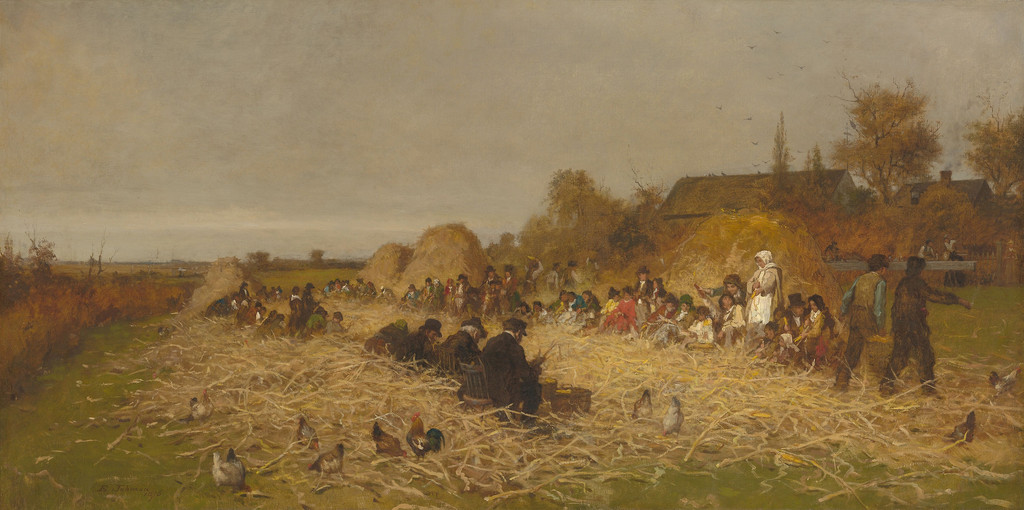
Eastman Johnson, Husking Bee, Island of Nantucket, 1876. Oil on canvas, 69.6 × 138.2 cm. Art Institute of Chicago, 1922.444. CC0.
Image source
.
CC0 / Public domain
.
Watch: Eastman Johnson
Choose a film to explore the artist’s work, its interpretation and its wider setting.
Director's Choice - The Girl I Left Behind Me by Eastman Johnson
The Smithsonian American Art Museum looks at Johnson’s The Girl I Left Behind Me.
Watch on YouTubeA late genre picture and a related study
The Walters describes the 1887 work as Johnson’s last dated painting of everyday life. That formulation is more precise than treating it as proof that he never again considered a genre subject. Portraiture increasingly occupied his later career, but the boundary between portrait and everyday scene remains porous in a room filled with recognisable individuals. [1]
The Milwaukee Art Museum’s 2017 guide interprets the subject through memory and melancholy. Its illustration, however, is the museum’s study, M1949.3, rather than the Walters painting. The distinction is necessary when comparing images: a related study can illuminate the development or interpretation of a subject without sharing the final object’s dimensions, support or ownership. [9]
The late date also changes how one might approach the title. These men’s talk belongs to a remembered community, but the painting itself was made through the selective work of an experienced artist. The details that make the gathering convincing—unequal light, different poses, tools and worn boards—have been organised into a coherent pictorial encounter.
Light, materials and the museum record
The contrast between bright right-hand wall and darker company gives the scene a tonal structure. Yellow-green and brown passages extend across walls, floor and clothing, with stronger accents around the stove and illuminated faces. The light allows everyday objects to share the picture’s attention with the men rather than serving merely as an anonymous background.
Patricia Hills’s technical account discusses the importance of Dutch painting and tonal organisation to Johnson’s interiors. It offers a useful context for this arrangement of dark masses and selected lights. It does not establish a laboratory analysis of the pigments or preparation in this exact painting. [10]
The Walters calls the support a panel. Hills’s general observation that she had not found actual wood panels among the Johnson works she examined should not silently replace that object-specific museum description. Nor does the brief public conservation list, which records treatments in 1944 and 1988, establish a particular wood species or a detailed sequence of restoration. [1] [10]
From private ownership to Baltimore
The museum traces the painting through Edward D. Adams and Knoedler before Henry Walters acquired it in 1924. It entered the museum through his 1931 bequest. The record flags conflicting days for the 1924 sale, so the year supplies a more secure marker than an unqualified exact date. [1]
Alongside The New Bonnet , this interior shows how differently Johnson could organise attention within a Nantucket room. There, a displayed accessory links three separate activities. Here, the stove holds a larger company together while one man’s work continues at the edge. In both, social meaning grows through the arrangement of bodies and familiar objects.
Artworks directory
Browse twenty-one selected objects discussed in these articles, including the Gifford portrait and the Prang print after Johnson. Dates identify individual objects, including the San Diego Drummer Boy study. Use All media to include the chromolithograph.
| Name | Date | Medium |
|---|---|---|
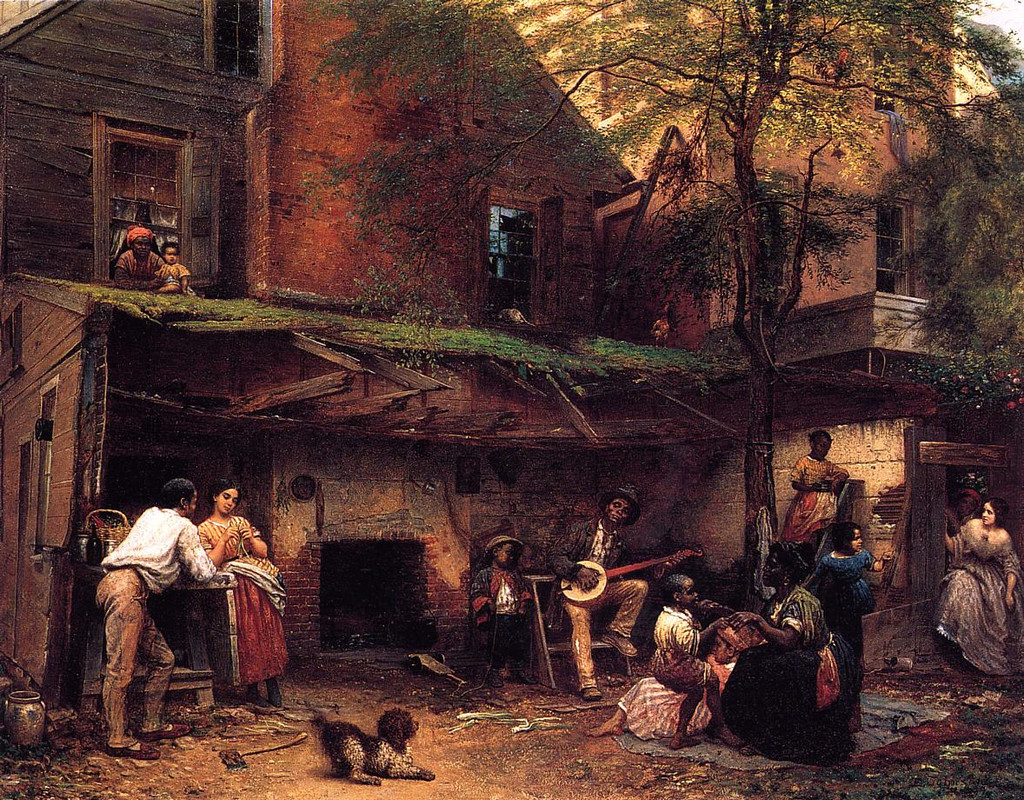
| Kitchen at Mount Vernon | 1857; Charles Butt canvas | Oil on canvas |
| Negro Life at the South | 1859; New York Historical original | Oil on linen |
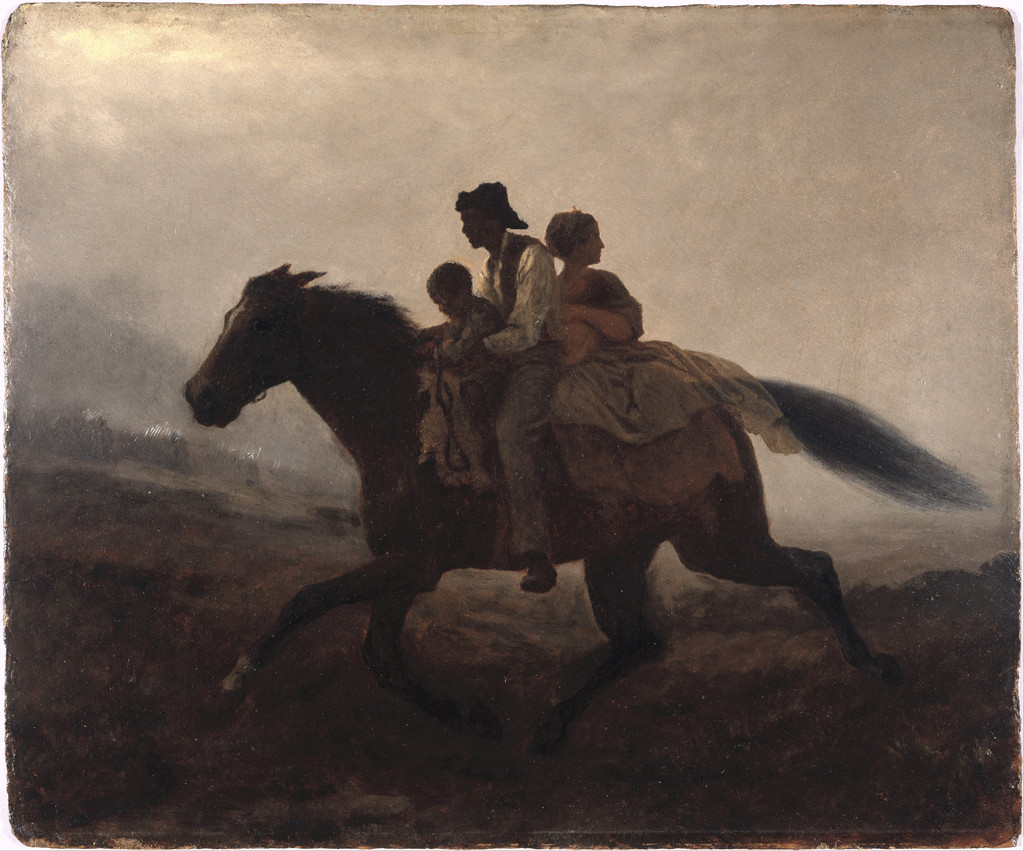
| A Ride for Liberty—The Fugitive Slaves | About 1862; Brooklyn version | Oil on paperboard |
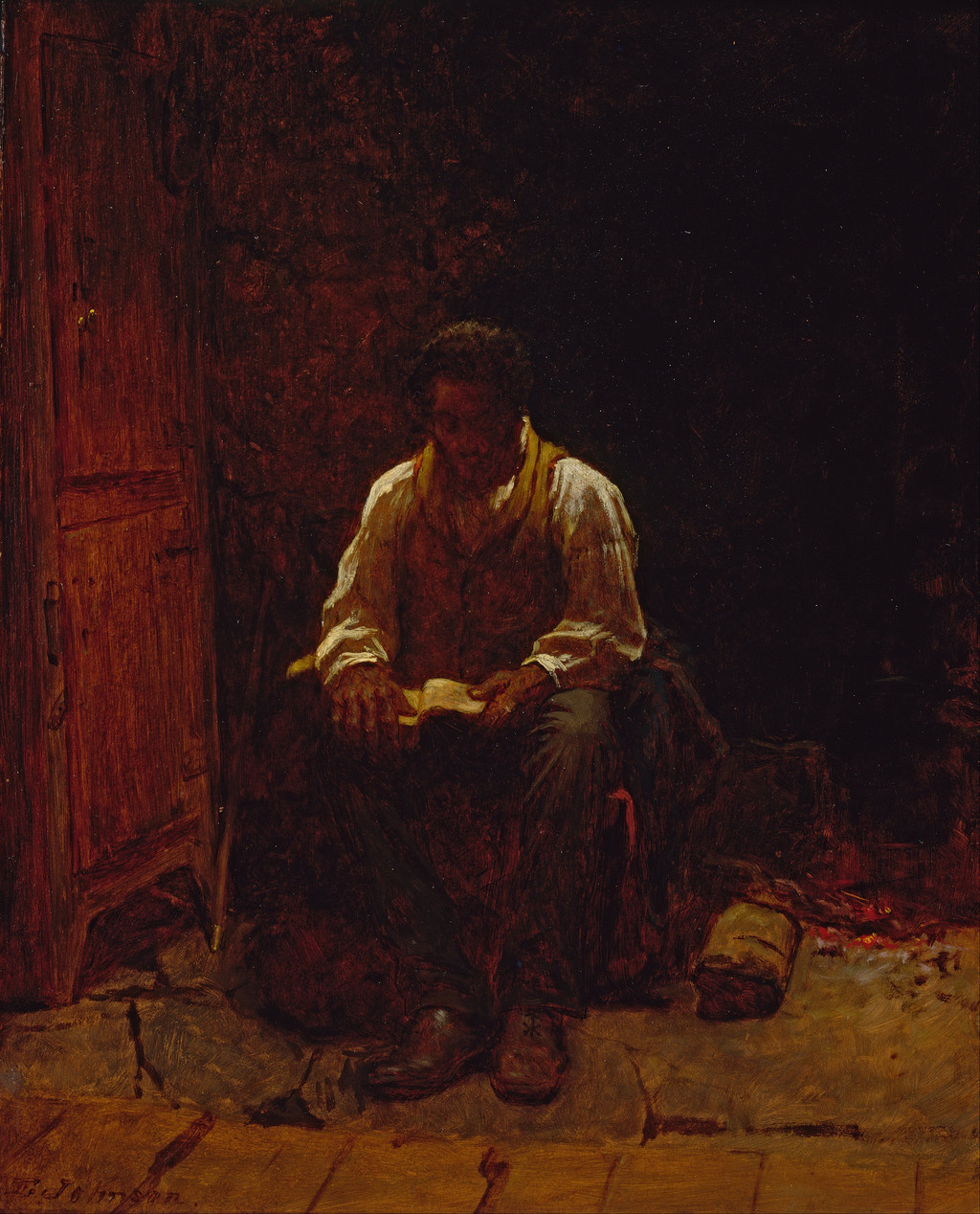
| The Lord Is My Shepherd | 1863 | Oil on fiberboard |
| Sugaring Off | About 1864–65; unfinished RISD canvas | Oil on canvas |
| The Wounded Drummer Boy (San Diego study) | About 1864–71; study, not the finished canvas | Oil on board |
| The Early Scholar | About 1865; NGA study | Oil on academy board on canvas |
| Fiddling His Way | 1866; Chrysler canvas | Oil on canvas |
| The Letter Home | 1867; Minneapolis drawing | Charcoal and graphite on paper |
| The Boyhood of Lincoln | 1868; Michigan canvas | Oil on canvas |
| The boyhood of Lincoln—An evening in the log hut (Prang after Johnson) | About 1868; separate reproductive print | Chromolithograph, W. Harring / L. Prang & Co., after Johnson |
| The Brown Family | 1869; NGA version | Oil on paper on canvas |
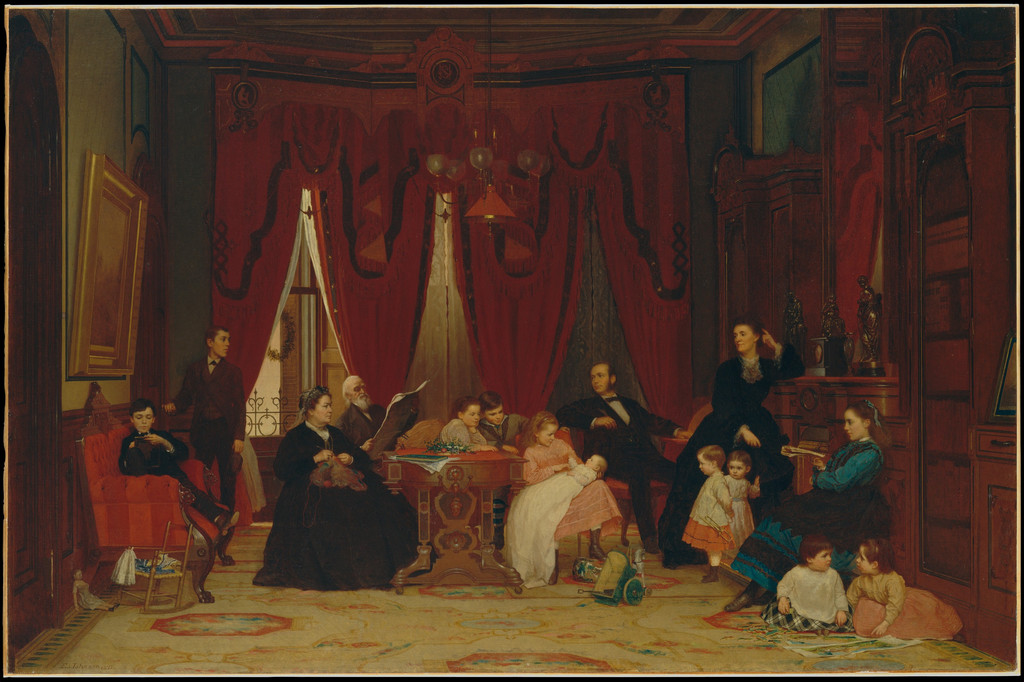
| The Hatch Family | 1870–71 | Oil on canvas |
| The Old Stagecoach | 1871 | Oil on canvas |
| The Girl I Left Behind Me | About 1872 | Oil on canvas |
| The Toilet | 1873 | Oil on paper board |
| Husking Bee, Island of Nantucket | 1876; Chicago canvas | Oil on canvas |
| The New Bonnet | 1876 | Oil on academy board |
| Sanford Robinson Gifford | 1880; possibly posthumous | Oil on academy board |
| The Cranberry Harvest, Island of Nantucket | 1880; Timken canvas | Oil on canvas |
| The Nantucket School of Philosophy | 1887 | Oil on panel |
Frequently Asked Questions
The scene takes place in a cobbler’s shop. The title gives the elderly men’s conversation the humorous dignity of philosophical study. The museum describes them as reminiscing captains. [1]
The Walters reports Johnson’s later identification of Captain Haggerty, the shoemaker; Captain Moore, the talker; and Captain Ray, leaning on his hand at the left. It does not provide a complete secure identification of every visible face. [1]
Discussion
Look again at the images and ideas explored in The Nantucket School of Philosophy by Eastman Johnson. These editorial prompts invite your observations.
Reader Insights
How does the stove help connect people with different poses and occupations?
Which gestures make conversation visible without supplying its words?
How do the recorded names change the scene, and which aspects remain interpretation rather than biography?
Join the Conversation
Share a detail, comparison or question about The Nantucket School of Philosophy by Eastman Johnson below.
References
- Walters Art Museum. The Nantucket School of Philosophy , 1887, 37.311. Current object record, reported artist identifications, provenance, measurements and conservation listing. View source
- The Old Stagecoach, 1871, L1888.22. View source
- The Girl I Left Behind Me, c.1872, 1986.79. View source
- The Toilet, 1873, 2015.19.85. View source
- Husking Bee, Island of Nantucket, 1876, 1922.444: current public API. View source
- The New Bonnet,1876,25.110.11,currentobjectrecordandAPI. View source
- The Cranberry Harvest, Island of Nantucket, 1880, 1972:002. View source
- Natalie Spassky. “Corn Husking at Nantucket.” In American Paintings in The Metropolitan Museum of Art , Volume II, 1985, pp. 227–229, especially p. 228. Cites Elizabeth Johnson’s 1913 recollection about recurring sea-captain models; original letter not directly consulted. View source
- Milwaukee Art Museum. Eastman Johnson and a Nation Divided , 2017 gallery guide. Interpretation through memory and melancholy; figure 5 is study M1949.3. View source
- Patricia Hills. Technical Information on Johnson’s Practices. Eastman Johnson Catalogue Raisonné. General technical context and limits of support observations. View source
- Splash image source.
Eastman Johnson, The Nantucket School of Philosophy, 1887. Oil on panel, 59 × 80.5 cm. The Walters Art Museum, Acquired by Henry Walters, 1924, 37.311. Public domain; institutional reproduction via Wikimedia Commons. Public domain .
View source