 by
Tom Gurney
Tom Gurney BSc (Hons) is an art history expert with over 20 years experience
Email:
tomgurney1@gmail.com
/ Phone:
+44 7429 011000
Negro Life at the South by Eastman Johnson: Introduction
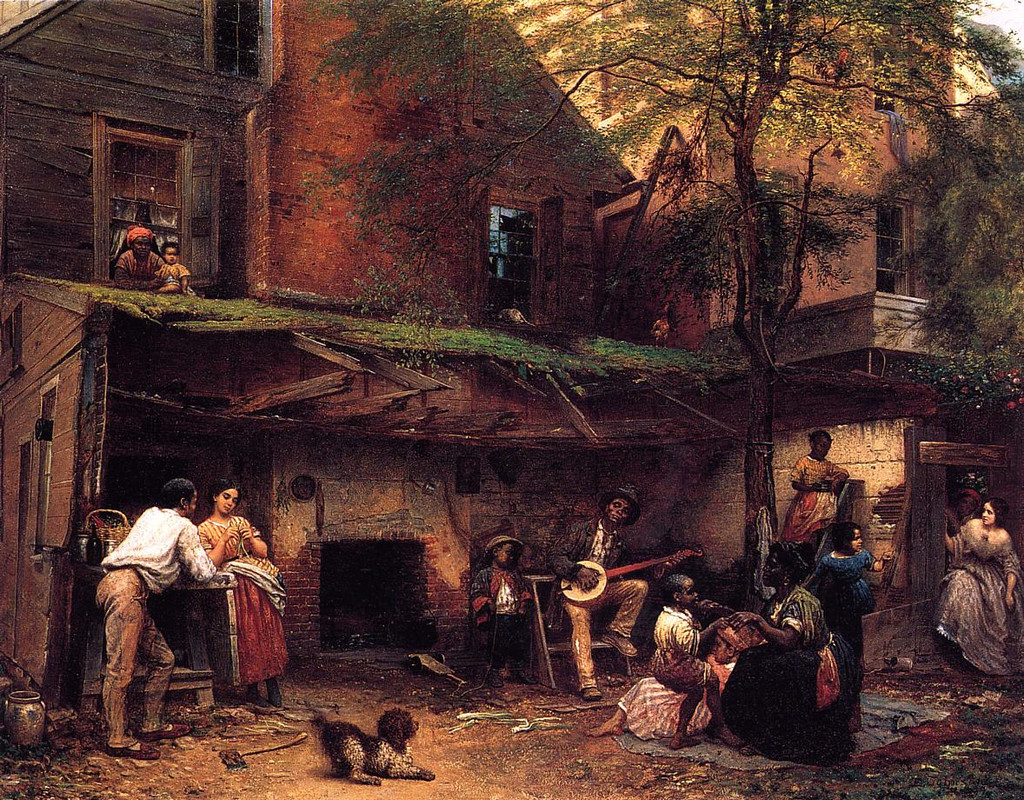
A banjo player sits beneath a damaged building, surrounded by people talking, caring for children and listening to music. At the right, a white woman steps through a doorway into the yard. The scene appears full of small, familiar incidents, but their setting makes them part of a much larger argument about slavery, domestic life and the nation.
Eastman Johnson exhibited Negro Life at the South in 1859. The painting helped establish his reputation as a painter of American everyday life and soon became widely known as Old Kentucky Home . That alternative title is geographically misleading: the yard belongs to Washington, D.C., rather than a Kentucky plantation. The original is held at The New York Historical as part of the Robert L. Stuart Collection. [1] [2] [3]
The historical title is retained here to identify the work and discuss its reception. In the article’s own account, the people represented are described as Black adults and children, without treating the title as their identity or assuming that they all shared the same legal status.
At a Glance
- Artist Eastman Johnson
- Title Negro Life at the South
- Familiar alternative title Old Kentucky Home
- Date 1859
- Medium Oil on linen
- Dimensions 94 × 116.8 cm, following the current museum record
- Collection The New York Historical, Robert L. Stuart Collection
- Accession S-225
- Credit The Robert L. Stuart Collection, the gift of his widow Mrs. Mary Stuart
The catalogue raisonné gives slightly smaller measurements. The current owning-museum dimensions above identify the illustrated original; the later variation in Atlanta is a separate painting. [1] [2] [4]
This work across Eastman Johnson’s career
Kitchen at Mount Vernon
1857; Charles Butt canvasNegro Life at the South (current article)
1859; New York Historical originalA Ride for Liberty—The Fugitive Slaves
About 1862; Brooklyn versionSugaring Off
About 1864–65; unfinished RISD canvasThe Wounded Drummer Boy (San Diego study)
About 1864–71; study, not the finished canvasThe Early Scholar
About 1865; NGA studyNotes and sources
Kitchen at Mount Vernon. A large hearth and worn architecture surround a small family group. [5]
Negro Life at the South (current article). A Washington yard brings everyday encounters into the contested setting of slavery. [1]
A Ride for Liberty—The Fugitive Slaves. A family’s movement towards freedom carries the whole composition. [6]
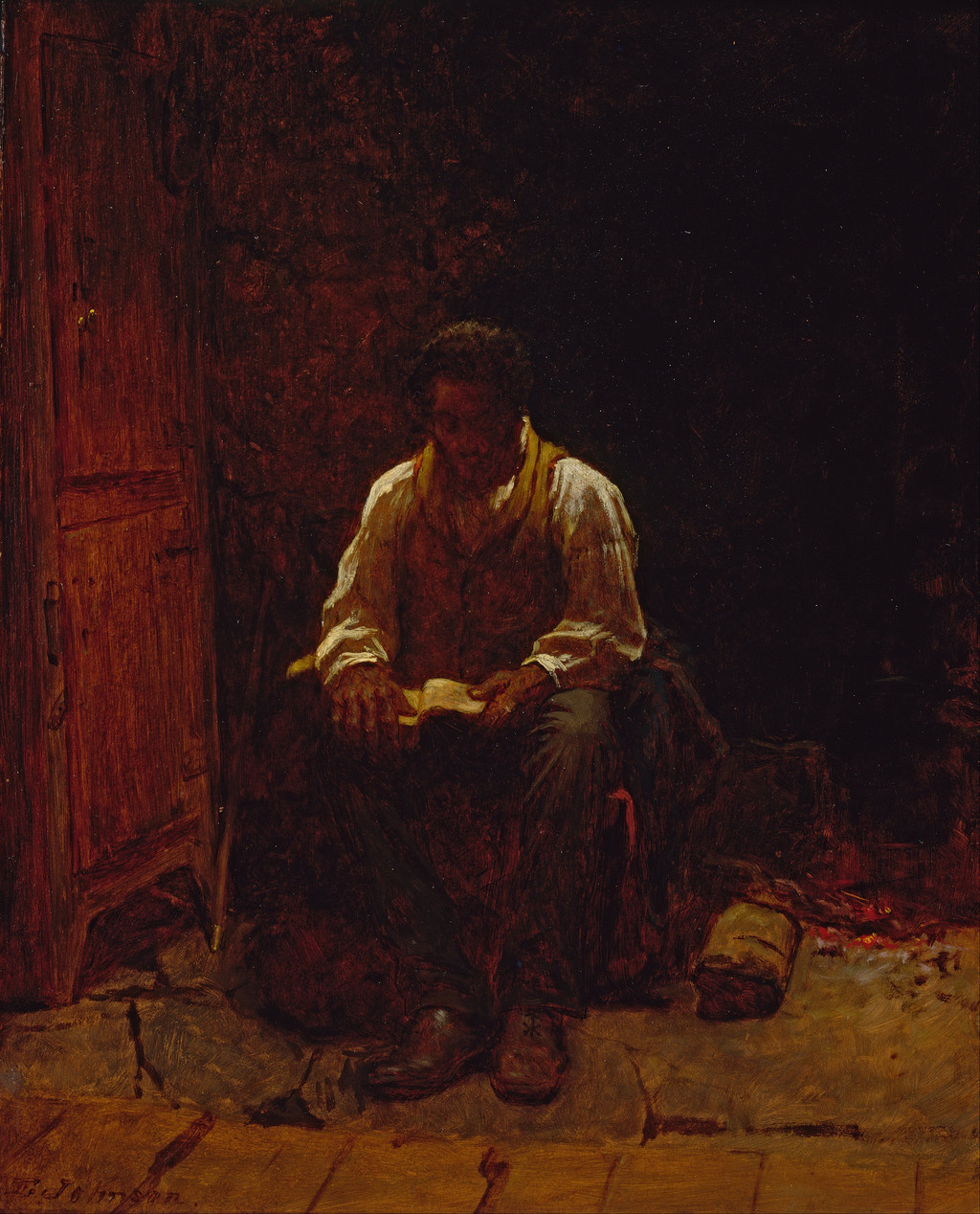
The Lord Is My Shepherd. A lowered head and open book concentrate attention within a dark room. [7]
Sugaring Off. Unfinished passages reveal the preparation of an ambitious gathering around maple-sugar production. [8]
The Wounded Drummer Boy (San Diego study). Soldier and drummer form a single upright group; this study has its own object history. [9]
The Early Scholar. A child’s position beside a stove turns the need for warmth into the centre of a schoolroom. [10]
Contents
- Looking across the yard
- A building that shapes the encounter
- The Washington setting
- Urban slavery and the problem of identification
- Before emancipation in the capital
- What the figures reveal, and what they withhold
- The 1859 exhibition and divided responses
- Why Old Kentucky Home is misleading
- How the war changed the act of looking
- Collectors and the economy around the picture
Looking across the yard
Johnson fills the canvas with an irregular building and the space around it. The architecture dominates the upper half: broken surfaces, windows, a mossy roof, brickwork and timber extend across the scene. The people occupy its lower shelter and openings, making the structure appear inhabited at several levels.
At the left, a man leans towards a woman near a chair and a small work surface. Their closeness creates a conversation separate from the musical group. The woman’s hands remain occupied, so the encounter combines attention to another person with the ordinary activity of the yard.
Near the centre, the banjo’s pale circular body stands out against the player’s darker clothing and the shadowed wall. Its long neck reaches towards the figures at the right, linking the central musician with the larger group. A child beside him looks towards the playing, giving the performance an immediate audience.
The right-hand group is more densely packed. An adult supports a small child, another figure sits nearby, and a girl stands with her back partly towards the viewer. Their overlapping bodies create relationships of care, observation and response without arranging everyone into a formal family portrait.
Above the courtyard, a woman and child appear at an open window. They occupy another level of the same building, bringing its upper storey into the social life below. A small cat in a separate opening and the dog in the foreground add further directions of attention and movement.
The dog is especially conspicuous against the brighter ground. Its position gives the foreground an incident of its own, while its orientation directs attention back towards the people. Small animals, scattered objects and gestures encourage the viewer to move slowly through an apparently spontaneous gathering.
Yet the scene is highly organised. The couple, musician, children and arriving woman form a sequence across the width. Their differences keep the eye moving, while the enclosing architecture holds them within one space. Johnson makes many activities legible without giving every person equal emphasis.
A building that shapes the encounter
The damaged structure contributes more than atmosphere. Gaps in plaster reveal brick; uneven timbers support a roof that seems to have accumulated vegetation. Openings lead into dark rooms, and a tree rises through the crowded space. The building’s condition is inseparable from the way the people can occupy it.
The low roof also acts as a boundary within the composition. It separates the upper window from the figures below while keeping both visible. A viewer can look across several levels of domestic activity that might ordinarily remain concealed behind a street-facing façade.
The better-kept building beyond introduces another comparison. Its cleaner wall and more regular windows contrast with the weathered surfaces in the yard. This difference helped contemporary critics turn architecture into a social argument: the condition of a dwelling could be read alongside the circumstances of the people living there. [2]
The doorway at the right makes that separation active. The arriving woman crosses a threshold between spaces with different appearances and social associations. Her entrance asks the viewer to consider who belongs within the yard, who is visiting it and how the gathering changes when someone looks in from outside.
The picture does not provide answers through a complete cast list. The entrance is visible; the exact relationship between every person is not. Its force comes partly from making the act of crossing into this space noticeable without explaining it away.
The Washington setting
Art historian John Davis’s study restores the painting to the specific environment of the nation’s capital. He connects the yard with the neighbourhood of Johnson’s family home at 266 F Street, between Thirteenth and Fourteenth Streets. A nineteenth-century account by Johnson’s friend John Coyle identified the dilapidated neighbouring structure as the basis for the painting. [3]
Davis compares that account with Albert Boschke’s 1857 map of Washington, examining square 253, bounded by F, G, Thirteenth and Fourteenth Streets. His reconstruction relates the family’s brick house, the neighbouring frame building and the sheltered interior yard. The correspondence is a scholarly reconstruction from maps and records, rather than a new survey of the site. [3]
The Library of Congress holds Boschke’s map as a separate historical object. It records buildings and urban divisions that help establish the kind of city Davis is discussing. The map’s existence should not be confused with a modern illustration already labelled with the painting’s figures or a precisely verified viewpoint. [11]
This geography changes the subject. The people are not placed in an undefined rural South, safely distant from national political institutions. Their yard belongs within Washington, close to the streets where legislators, officials, artists and household workers lived. The capital’s public identity and the conditions of its less visible interiors occupy the same city.
It also changes the significance of the surrounding walls. The yard is a space set back from ordinary street traffic, and Johnson’s composition makes it available to sustained looking. Davis interprets that exposure as central to the work’s relation to the political controversy over slavery in Washington. The building is both a place people inhabit and a way of deciding what a public audience can see. [3]
Urban slavery and the problem of identification
The Washington setting makes urban slavery essential to the painting’s context. The city contained both enslaved and free Black residents, whose lives and work brought them into close contact with white households. A courtyard gathering cannot be divided confidently into legal categories by clothing, complexion or position alone. [3]
The people’s apparent ease is equally insufficient as evidence. Music, conversation and care for a child could occur within lives constrained by enslavement. An interval of leisure does not establish that an institution was benign, and the absence of a depicted punishment is not evidence of freedom from coercion.
Conversely, identifying the larger subject as slavery does not recover each model’s status. A painter could arrange people observed in one setting, use different models or combine studies within a constructed scene. The image’s detailed appearance is not a census return or a complete record of one household.
Davis’s discussion of Johnson’s family demonstrates the need for such distinctions. Mary Washington James, who married Johnson’s father in 1857, had owned three enslaved people at the time of the 1850 census. The 1860 Johnson household included two free Black servants. Those records do not prove who was present in 1857 or identify the people painted in 1859. [3]
It would therefore be misleading to turn the entire gathering into Johnson’s own household or to name the figures from nearby census entries. The documents establish a complex social environment. They do not provide a reliable key linking each body on the canvas with an individual name and biography.
Before emancipation in the capital
The painting’s date places it before the District of Columbia’s wartime emancipation. The National Archives identifies 16 April 1862 as the date Lincoln signed the act ending slavery in the District, months before the Emancipation Proclamation. Johnson’s 1859 audience was therefore looking at a subject that remained part of the capital’s present, rather than an institution already abolished there. [12]
That sequence matters when interpreting the yard’s apparent calm. A later viewer knows the war and emancipation lie ahead; a viewer in 1859 could not know the outcome with the same certainty. Reading the damaged building as a prophecy of slavery’s inevitable end gives the scene a retrospective order that its first audience did not possess.
The National Park Service’s account of D.C. emancipation also emphasises Black Washingtonians’ own actions. Alongside congressional legislation, it describes escape attempts and later petitions by people asserting their freedom. Those histories remind us that the constrained activities visible in Johnson’s yard cannot stand for the full range of action taken by people living under slavery. [13]
The distinction is useful for looking rather than simply supplying a date after the painting. Johnson selected a particular gathering at a particular apparent interval in the day. The lives around such a gathering included work, negotiation, movement and resistance that the canvas could not encompass. A scene of domestic interaction is one representation of those lives, not their complete measure.
What the figures reveal, and what they withhold
Johnson gives the adults and children distinct poses rather than making them identical signs of a condition. The musician’s extended instrument, the couple’s closeness and the woman supporting a child each occupy a different part of the scene. These distinctions give viewers several points of human contact.
At the same time, the scene draws on familiar nineteenth-century conventions of musical entertainment and domestic anecdote. Patricia Hills asks readers to examine those conventions alongside the more individual rendering of the figures and the interruption produced by the white woman’s entrance. Recognition and stereotype can coexist within the same image. [2] [14]
That coexistence helps explain why the picture can remain uncomfortable. A viewer may respond to the warmth of an encounter while recognising the inherited expectations through which it was made legible. The pleasure of looking does not automatically settle the political meaning of what is shown.
The lighter complexion of one woman and the arrangement of doorways have also prompted interpretations concerning sexual relations and racial hierarchy. Such readings belong to the painting’s scholarship, but the visible forms do not establish parentage, a sexual encounter or a named relationship. Davis discusses these possibilities without making them the only route into the work. [3]
Likewise, a cat, ladder or dark opening should not be treated as a fixed symbol whose meaning can be decoded with certainty. Their roles in the picture are first spatial and visual. More elaborate readings require argument and attribution, rather than the assumption that every small object carries one universally agreed message.
The 1859 exhibition and divided responses
The painting appeared at the National Academy of Design in New York in the spring of 1859, catalogued as Negro Life at the South . Its success was an important step in Johnson’s emergence as a painter of American subjects. The catalogue raisonné connects that reception with his election as an Associate Academician. [2]
Contemporary responses were far from uniform. The New-York Daily Tribune review, transcribed in the catalogue and discussed by Davis, considered the damaged housing and contrasts between residents as evidence against slavery. The same review also described the music, courtship and children through paternalistic assumptions about happiness and simplicity. [2] [3]
That combination matters. Even a critic prepared to see an indictment could use the racial stereotypes of the period to explain the people. An apparently sympathetic response was not necessarily free from the assumptions that helped sustain unequal relationships.
Other writers emphasised the picture’s charm, artistic skill or power to awaken sympathy while withholding the prestige accorded to grand historical subjects. The Crayon response reproduced by the catalogue praised its observation and popularity but placed limits on its status as elevated art. Such distinctions reveal how subject matter, race and artistic hierarchy were judged together. [2]
The scene could therefore support opposed positions without having no meaning of its own. Some viewers saw damaged housing as an indictment; others treated leisure and family affection as reassurance. The details remained before them, but their selection and interpretation differed.
Watch: Eastman Johnson
Choose a film to explore the artist’s work, its interpretation and its wider setting.
Director's Choice - The Girl I Left Behind Me by Eastman Johnson
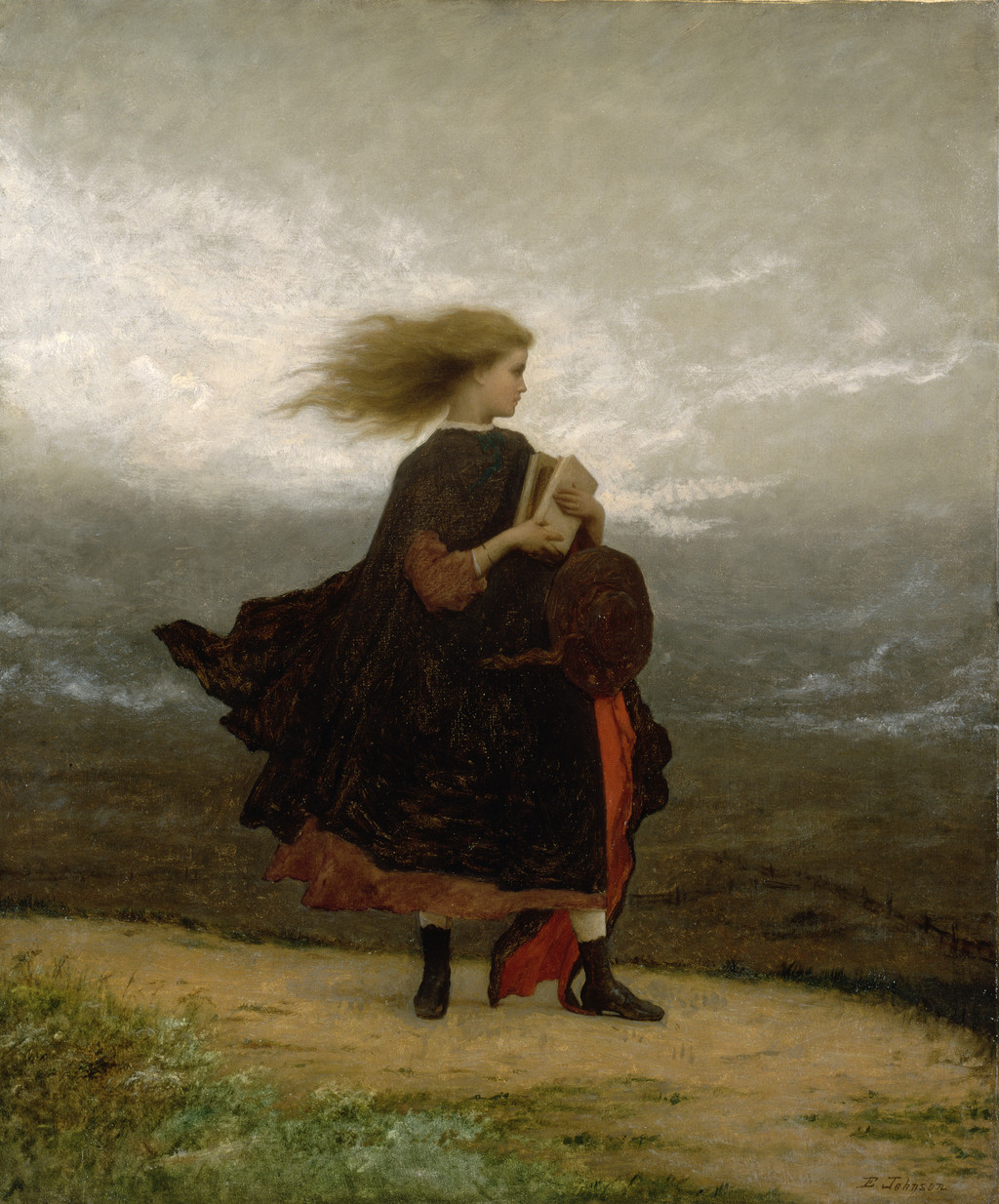
The Smithsonian American Art Museum looks at Johnson’s The Girl I Left Behind Me.
Watch on YouTubeWhy Old Kentucky Home is misleading
The alternative title associates the painting with Stephen Foster’s sentimental song and with a generalised plantation setting. Davis shows that this association began early: an August 1859 notice already called the picture The Old Kentucky Home . The title did not first emerge years later at the Paris exposition. [3]
That early appearance changes the account of the work’s reception. The displacement from a specific Washington yard to an imagined Kentucky home began almost immediately, rather than being only a distant misunderstanding. Audiences could recognise a familiar song-world more readily than the political geography of the capital.
The title also invites nostalgia. The word home gathers the figures into an apparently coherent domestic community, while Kentucky supplies an agricultural region the painting itself does not establish. It can make an enclosed urban yard feel like a surviving image of plantation life.
Returning to the visible architecture helps resist that substitution. The cramped relationships between neighbouring buildings, the multiple openings and the better-kept structure beyond belong to an urban arrangement. They are not incidental scenery around an interchangeable story of the rural South.
Later exhibition titles continued to shift the location and emphasis. The catalogue records a French Kentucky title at the 1867 Exposition Universelle and The Old Kentucky Home at Philadelphia’s 1876 Centennial. These titles are evidence of how the image circulated, rather than evidence that its original setting was Kentucky. [2]
How the war changed the act of looking
The work continued to circulate after its initial exhibition. Its courtyard remained materially the same painted arrangement, but audiences encountered it through a war that had transformed the political meaning of slavery. A picture made before the conflict could become an image through which survivors imagined the world that preceded it.
Davis examines an 1867 response that treated the damaged quarters as a sign of slavery’s approaching collapse while also recalling supposedly pleasant aspects of the old order. He argues that such a reading made violent political change appear almost like a natural process of decay. The account reveals the critic’s retrospective work upon the image, rather than a prophecy securely placed there by Johnson. [3]
Other antislavery viewers found the reassuring domestic emphasis inadequate. Davis cites Ednah Dow Cheney’s criticism of the complacency invited by pleasant scenes of enslaved people’s leisure. Her objection demonstrates that disagreement did not simply divide slavery’s defenders from its opponents: people opposed to the institution could also dispute whether sympathetic genre painting confronted it effectively. [3]
This makes a single balance sheet of favourable and hostile reactions insufficient. The same person could admire the painting’s observation and question its social effects. A critic might recognise human feeling but reject the ease with which an audience could turn that feeling into nostalgia.
The scene’s continuing appeal belongs within that history. Repeated familiarity can make a painting seem easier to understand, especially when a comforting alternative title accompanies it. Restoring the Washington site and the range of responses makes its apparent familiarity less secure and its historical questions more precise.
Collectors and the economy around the picture
The catalogue records John Frederick Kensett as an early owner in 1859, followed by William P. Wright and Robert Leighton Stuart. These named collectors place the painting within a New York market far removed from the courtyard it depicts. Its audience included people who could purchase and exhibit an image of Black domestic life as a prestigious possession. [2]
Davis examines Wright’s cotton interests and Stuart’s sugar-refining wealth, connecting the picture’s collecting history with Northern economic dependence on enslaved labour. He argues that a nostalgic interpretation could be attractive within that environment. The business connections are historical evidence; a precise private motive for buying this particular painting remains an interpretation. [3]
The distinction prevents another simplification. Ownership does not automatically tell us everything a collector thought, but neither is it irrelevant to a painting’s public life. A work can be displayed, loaned and discussed within networks whose wealth is connected to the social order it represents.
The dates of the Stuart acquisition and later institutional transfer differ between the catalogue raisonné and Davis’s article. The secure outline is the Wright-to-Stuart ownership and the painting’s place in the Stuart collection; the disputed exact years should not be silently combined into a new chronology. The current museum credit identifies the gift of Mary Stuart. [1] [2] [3]
Reproductions and the Atlanta variation
The painting’s reputation extended beyond people who saw the original. Davis discusses early photographic reproductions and the role of print circulation in making the composition familiar. A reproduced image and a memorable alternative title could reinforce each other, allowing the work to enter conversations in which its actual Washington site was no longer remembered. [3]
The High Museum of Art owns a smaller variation, accession 1997.187, dated about 1876 in its current record. It is oil on canvas and measures 18¼ × 24⅛ inches. That painting should not be substituted for the 1859 linen original in a caption or collection listing. [15]
The High connects its variation with the production of a colour lithograph. The catalogue raisonné offers the print-model purpose more cautiously and gives the broader date c. 1859–76, noting the possibility of another model. The differing levels of certainty should remain visible rather than being flattened into an unquestioned sequence. [4] [15]
The variation demonstrates the composition’s continued usefulness, but its existence cannot resolve every uncertainty about the original’s earliest exhibitions. The catalogue questions whether one painting could have appeared in overlapping New York and Boston shows in 1859. A possible listing should not become a firm itinerary simply because several versions are known.
Light, detail and the limits of a reproduction
The original’s broad arrangement remains clear in the supplied image. Sunlight crosses the yard and catches clothing, faces and the instrument, while the dark interiors retain depth. The damaged building offers a dense pattern of surfaces against which small gestures become legible.
That detailed effect can tempt a viewer to treat every element as documentary fact. Yet a carefully painted room is still an arrangement selected and constructed by an artist. The composition can be grounded in a real place while combining, emphasising or withholding parts of what Johnson observed.
No scientific analysis of the original was consulted that would support identifying exact pigments, a complete sequence of revisions or a particular treatment from this reproduction. Its warm, textured appearance is adequate for looking at the whole scene, but it does not justify fine enlarged claims about surface condition.
The most useful close looking here remains relational: where the roof divides the picture, how figures cluster, what the doorway interrupts and how one building’s condition contrasts with another. Those relationships connect visual form with the historical questions the painting raises.
Looking alongside other Johnson works
Kitchen at Mount Vernon offers an earlier interior in which people and damaged architecture share the scene. The later Washington painting expands that relationship across a yard, with more figures and a threshold that brings an outsider into the gathering. The comparison shows how architecture can organise a social encounter rather than merely furnish a background.
Fiddling His Way concentrates the musical encounter within a New England household after the Civil War. The musician’s place at the edge of the group raises questions about welcome, service and equality. Here, music forms one centre among several within a setting whose legal and social circumstances are different.
In A Ride for Liberty , the represented family acts to escape. The movement and urgency contrast with this enclosed yard, but neither composition supplies a complete biography of its figures. Together, they make it possible to compare different ways Johnson represented agency, family ties and the pursuit or restriction of freedom.
The Washington painting’s importance lies partly in its resistance to a single comfortable account. Its incidents can be appealing, its architecture picturesque and its people recognisably absorbed in ordinary life. Those pleasures exist within a subject that cannot be made innocent by changing its title to a remembered home elsewhere.
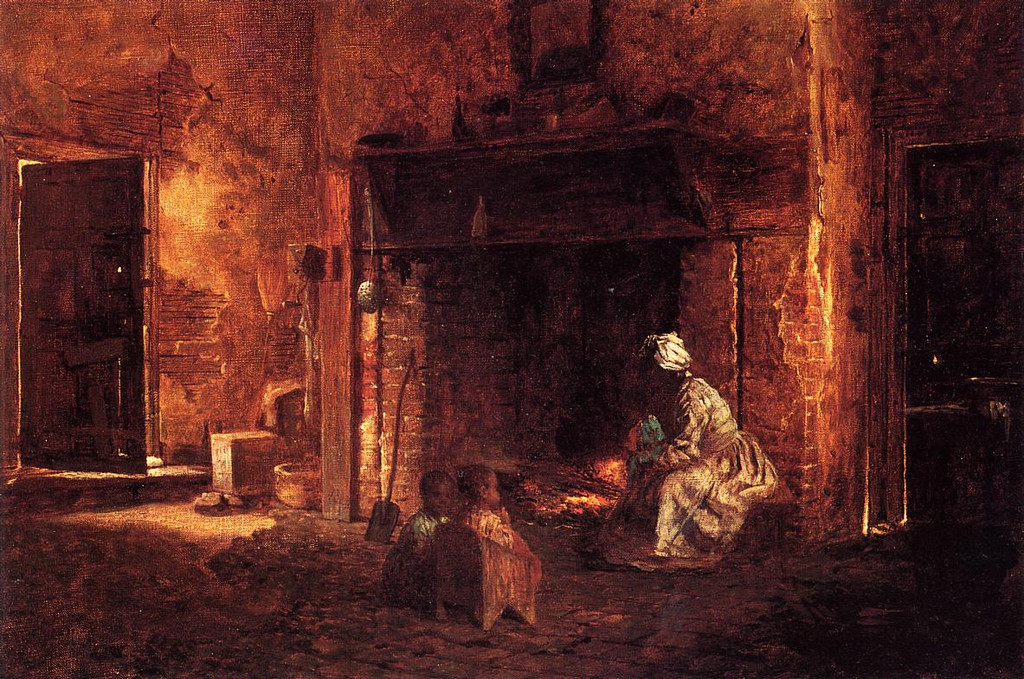
Eastman Johnson, Kitchen at Mount Vernon, 1857. Oil on canvas, 35.6 × 53.3 cm. Charles Butt collection, Texas, as recorded by the Eastman Johnson Catalogue Raisonné, Hills 6.0.4. Public domain faithful reproduction via WikiArt. This is distinct from Mount Vernon’s 1864 board version.
Image source
.
Public domain
.
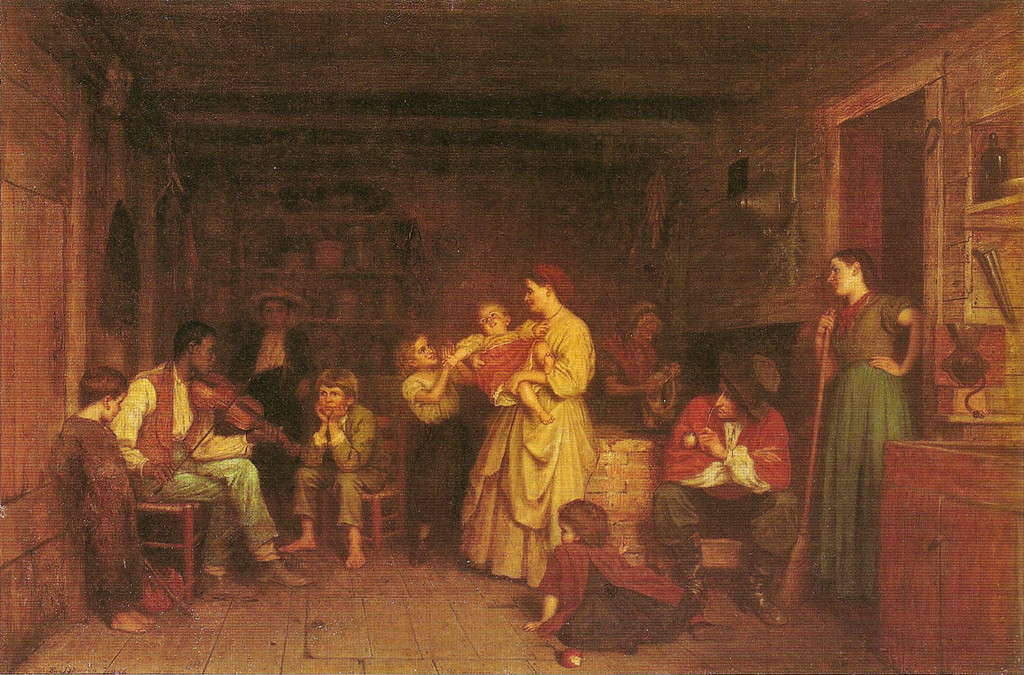
Eastman Johnson, Fiddling His Way, 1866. Oil on canvas, 61.6 × 92.7 cm. Chrysler Museum of Art, Bequest of Walter P. Chrysler, Jr., 89.60. Public domain faithful reproduction.
Image source
.
Public domain
.
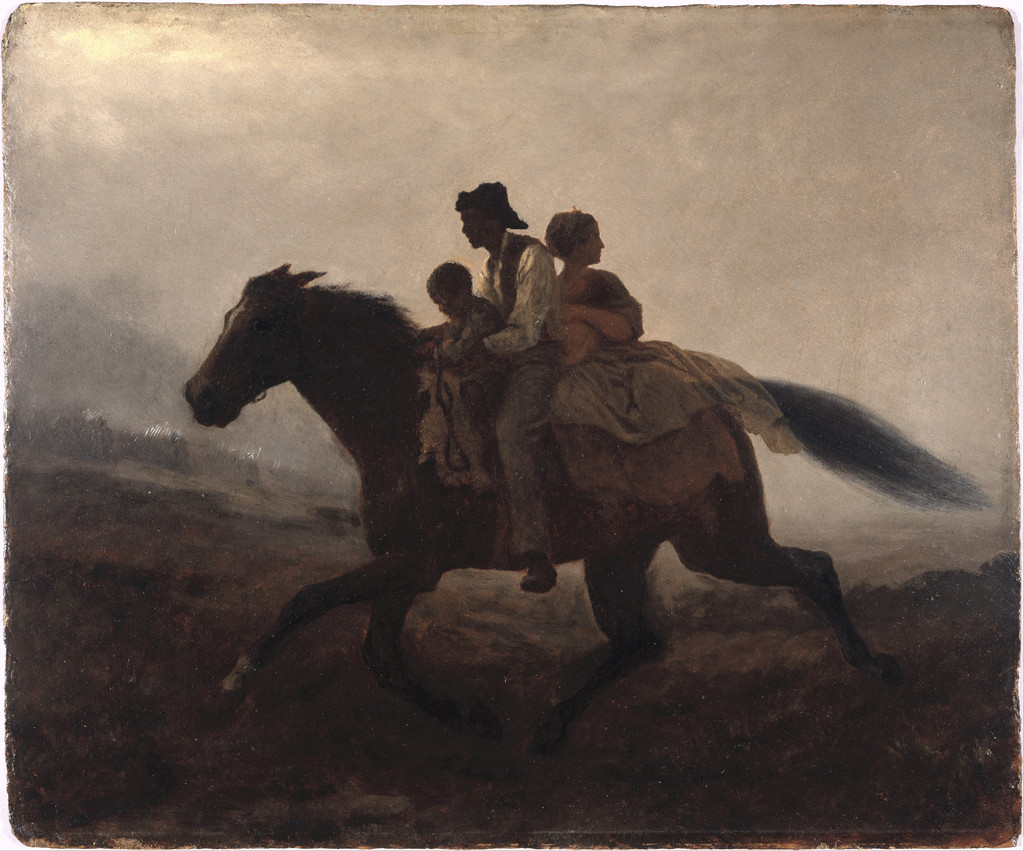
Eastman Johnson, A Ride for Liberty—The Fugitive Slaves, about 1862. Oil on paperboard, 55.2 × 66.7 cm. Brooklyn Museum, Gift of Gwendolyn O. L. Conkling, 40.59a–b. Public domain faithful reproduction. The recorded eyewitness inscription belongs to the separate Virginia version.
Image source
.
Public domain
.
Artworks directory
Browse twenty-one selected objects discussed in these articles, including the Gifford portrait and the Prang print after Johnson. Dates identify individual objects, including the San Diego Drummer Boy study. Use All media to include the chromolithograph.
| Name | Date | Medium |
|---|---|---|
| Kitchen at Mount Vernon | 1857; Charles Butt canvas | Oil on canvas |
| Negro Life at the South | 1859; New York Historical original | Oil on linen |
| A Ride for Liberty—The Fugitive Slaves | About 1862; Brooklyn version | Oil on paperboard |
| The Lord Is My Shepherd | 1863 | Oil on fiberboard |
| Sugaring Off | About 1864–65; unfinished RISD canvas | Oil on canvas |
| The Wounded Drummer Boy (San Diego study) | About 1864–71; study, not the finished canvas | Oil on board |
| The Early Scholar | About 1865; NGA study | Oil on academy board on canvas |
| Fiddling His Way | 1866; Chrysler canvas | Oil on canvas |
| The Letter Home | 1867; Minneapolis drawing | Charcoal and graphite on paper |
| The Boyhood of Lincoln | 1868; Michigan canvas | Oil on canvas |
| The boyhood of Lincoln—An evening in the log hut (Prang after Johnson) | About 1868; separate reproductive print | Chromolithograph, W. Harring / L. Prang & Co., after Johnson |
| The Brown Family | 1869; NGA version | Oil on paper on canvas |
| The Hatch Family | 1870–71 | Oil on canvas |
| The Old Stagecoach | 1871 | Oil on canvas |
| The Girl I Left Behind Me | About 1872 | Oil on canvas |
| The Toilet | 1873 | Oil on paper board |
| Husking Bee, Island of Nantucket | 1876; Chicago canvas | Oil on canvas |
| The New Bonnet | 1876 | Oil on academy board |
| Sanford Robinson Gifford | 1880; possibly posthumous | Oil on academy board |
| The Cranberry Harvest, Island of Nantucket | 1880; Timken canvas | Oil on canvas |
| The Nantucket School of Philosophy | 1887 | Oil on panel |
Frequently Asked Questions
Its setting is Washington, D.C. The familiar Old Kentucky Home title associates the painting with a sentimental song and a generalised Southern setting, rather than identifying its actual location. [3]
Davis documents its use in August 1859. It was already circulating soon after the painting’s New York debut, rather than originating at the 1867 Paris exposition. [3]
The work concerns life within a society shaped by slavery, but the consulted records do not establish every figure’s legal status or name. Washington had both enslaved and free Black residents. [3]
Discussion
Look again at the images and ideas explored in Negro Life at the South by Eastman Johnson. These editorial prompts invite your observations.
Reader Insights
Follow the thresholds and windows. How does the building determine which people and activities become visible?
How does knowing the Washington setting change your response to the familiar Old Kentucky Home title?
Choose a detail that could support different contemporary readings. What makes those interpretations possible, and where are their limits?
Join the Conversation
Share a detail, comparison or question about Negro Life at the South by Eastman Johnson below.
References
- The New York Historical , Negro Life at the South, 1859, S-225. Current object fields, dimensions, credit and description consulted through returned museum text. View source
- Patricia Hills and Abigael MacGibeny , Negro Life at the South, 1859, Hills no. 8.0.2, Eastman Johnson Catalogue Raisonné. Original object, contemporary responses, provenance, exhibitions and title variants. Period reviews quoted there were not separately consulted. View source
- John Davis , Eastman Johnson’s Negro Life at the South and Urban Slavery in Washington, D.C., The Art Bulletin 80, no. 1, 1998, pp. 67–92. Washington site, household records, urban slavery, critical reception, early title and collectors. His archival reconstruction is attributed; original census, correspondence and sale records were not newly examined. View source
- Hills and MacGibeny , Negro Life at the South, Hills no. 8.0.3. Separate High Museum variation, broader date and qualified print-model hypothesis. View source
- Washington’s Kitchen at Mount Vernon,1857,Hills6.0.4. View source
- A Ride for Liberty–The Fugitive Slaves, Brooklyn version, Hills 10.0.11r. View source
- The Lord Is My Shepherd, 1863, 1979.5.13. View source
- Sugaring Off, ca.1864–1865, 45.050. View source
- Wounded Drummer Boy, San Diego study, Hills 10.0.18. View source
- The Early Scholar,c.1865,1963.10.157: current object record. View source
- Library of Congress , Albert Boschke, Map of Washington City, 1857, 83694274. Historical map record; Davis’s labelled reconstruction remains his scholarly interpretation, not part of the original cartography. View source
- National Archives , The District of Columbia Emancipation Act. Date and scope of the act signed on 16 April 1862, National Archives Identifier 299814. View source
- National Park Service , Emancipation in Washington, D.C. Institutional account of resistance, legislation and petitions for freedom; these later records do not identify Johnson’s models. View source
- Patricia Hills , Painting Race: Eastman Johnson’s Pictures of Slaves, Ex-Slaves, and Freedmen, in Eastman Johnson: Painting America, 1999, pp. 121–122, 125–130. Representation and contemporary responses; only these accepted early sections are invoked here. View source
- High Museum of Art , Negro Life at the South, about 1876, 1997.187. Current date, dimensions and museum interpretation of the variation’s relation to print production. View source
- Splash image source.
Eastman Johnson, Negro Life at the South, also known as Old Kentucky Home, 1859. Oil on linen, 94 × 116.8 cm. The New York Historical, The Robert L. Stuart Collection, the gift of his widow Mrs. Mary Stuart, S-225. Public domain faithful reproduction via WikiArt. The depicted yard is in Washington, D.C. Public domain .
View source