 by
Tom Gurney
Tom Gurney BSc (Hons) is an art history expert with over 20 years experience
Email:
tomgurney1@gmail.com
/ Phone:
+44 7429 011000
The Toilet by Eastman Johnson: Introduction
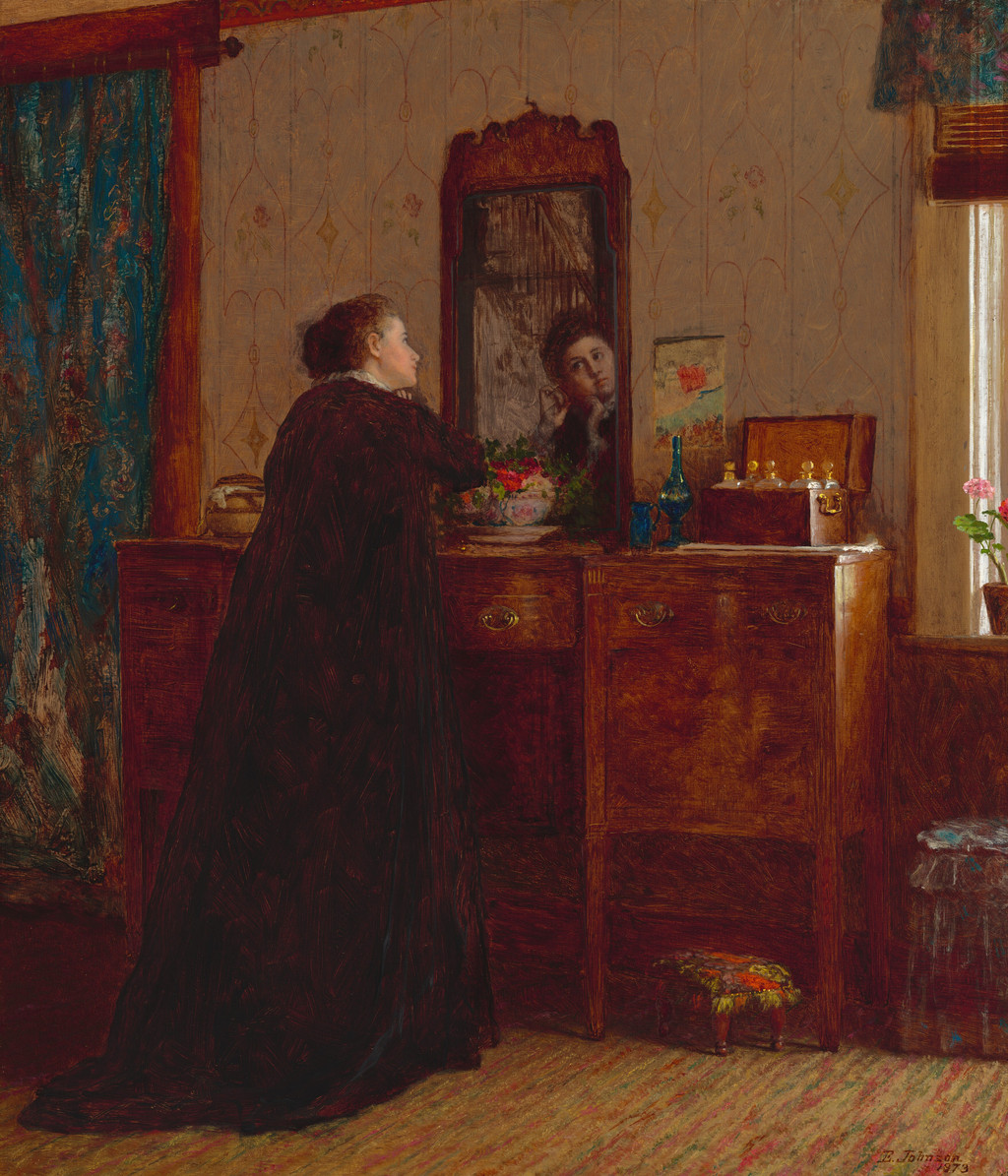
Eastman Johnson’s The Toilet shows a woman adjusting an earring before a mirror. Her back occupies much of the foreground, but the reflection returns her face to us. Between those two views stands a substantial wooden sideboard, crowded with flowers, bottles and the small objects of daily use.
Painted in 1873, the picture makes dressing part of a richly furnished domestic interior. Its title uses toilet in the older sense of personal preparation and grooming. The National Gallery of Art now holds the work as part of the Corcoran Collection, identifying its medium as oil on paper board. [1]
At a Glance
- Artist Eastman Johnson
- Title The Toilet
- Date 1873
- Medium Oil on paper board
- Dimensions 66.5 × 56.2 cm
- Collection National Gallery of Art, Washington
- Accession 2015.19.85
- Credit Corcoran Collection; gift of Captain A. S. Hickey, USN (Ret.), in memory of his wife, Caryl Crawford Hickey, 1957
These measurements describe the painted support, rather than the much larger framed object. [1]
This work across Eastman Johnson’s career
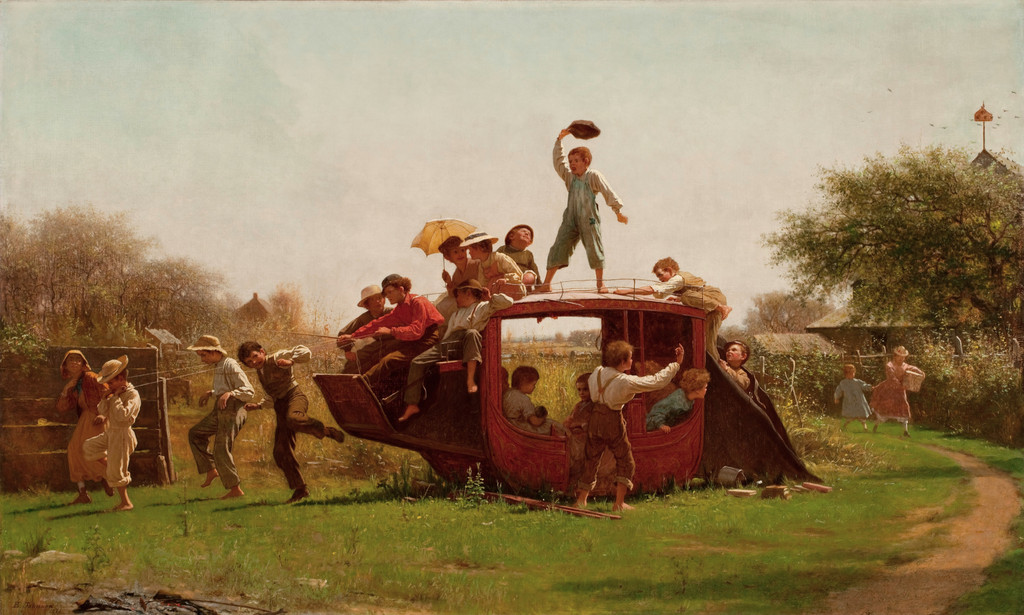
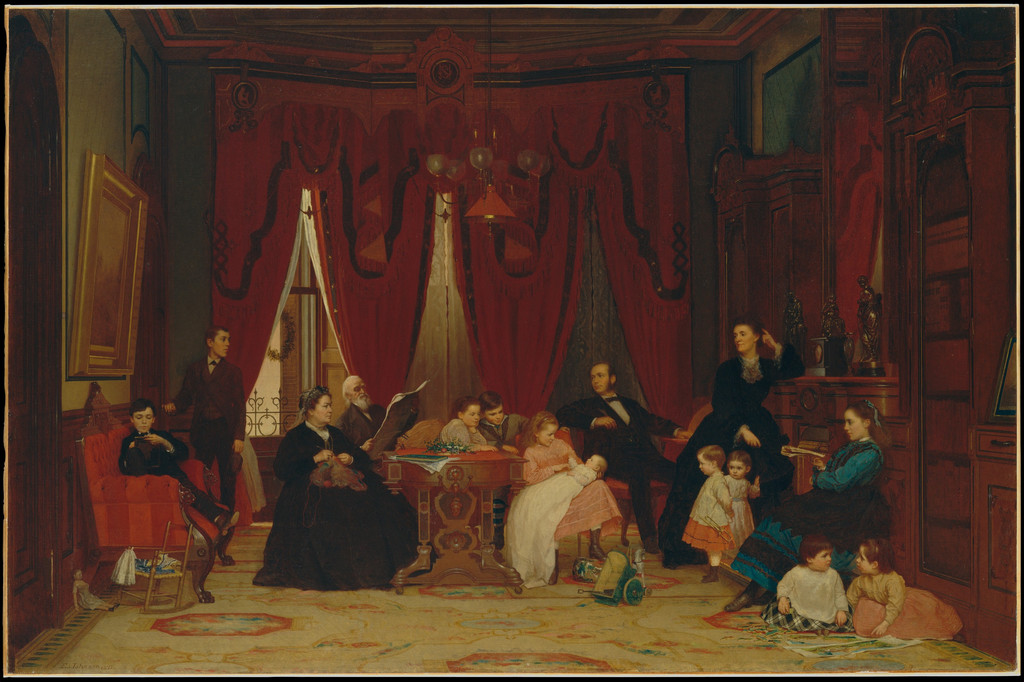
The Hatch Family
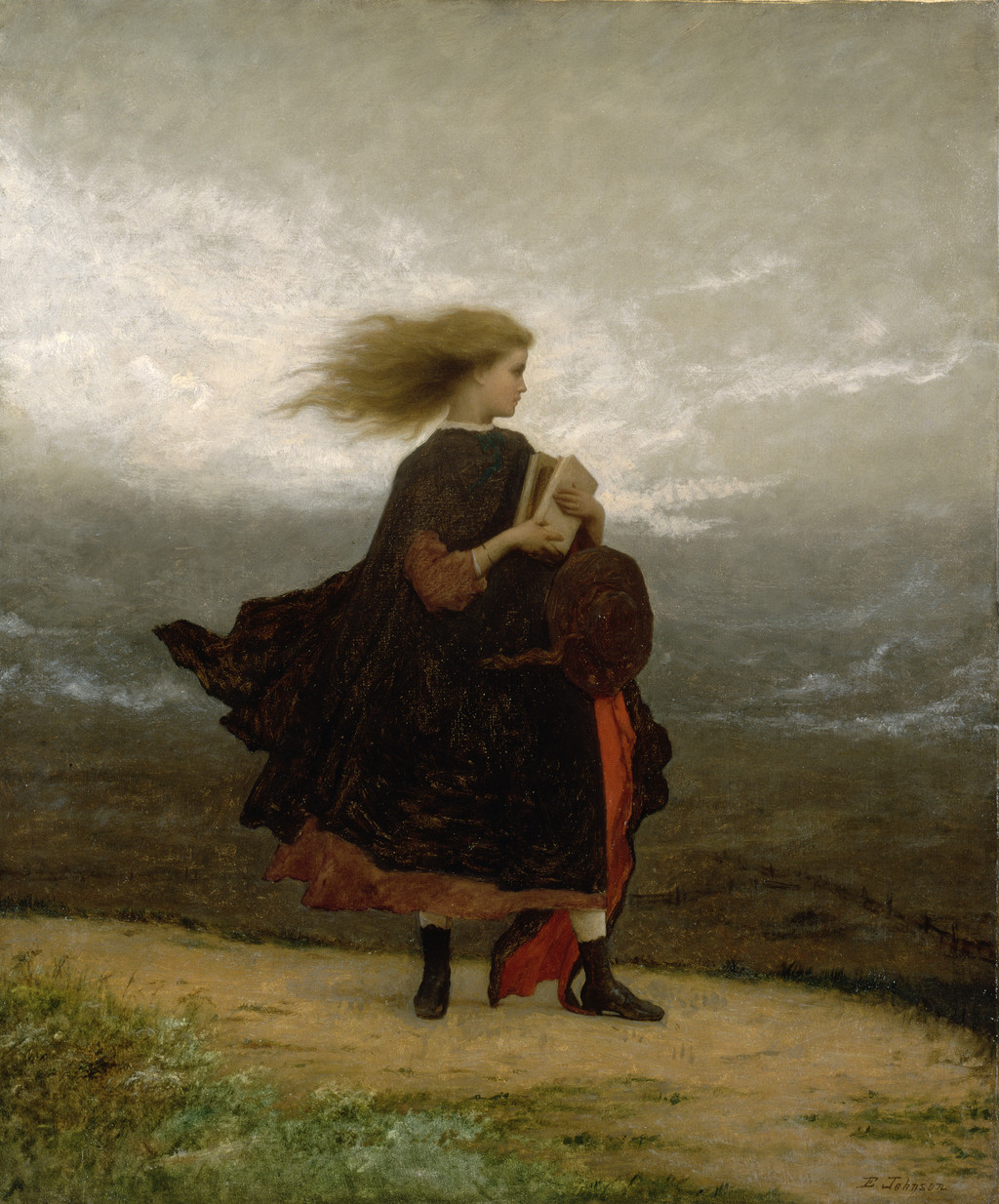
1870–71The Girl I Left Behind Me
About 1872Husking Bee, Island of Nantucket
1876; Chicago canvasThe New Bonnet
1876The Cranberry Harvest, Island of Nantucket
1880; Timken canvasNotes and sources
The Hatch Family. Fifteen figures inhabit a library through a carefully distributed set of activities. [2]
The Old Stagecoach. Children give a broken vehicle a new purpose through play. [3]
The Girl I Left Behind Me. A still figure, books and wind-driven clothing hold competing directions of attention. [4]
The Toilet (current article). The mirror returns a face while the figure’s back occupies the foreground. [1]
Husking Bee, Island of Nantucket. A line of people and pale husks joins harvest work to a social gathering. [5]
The New Bonnet. A bonnet, a glass and a fire give three figures different occupations within one room. [6]
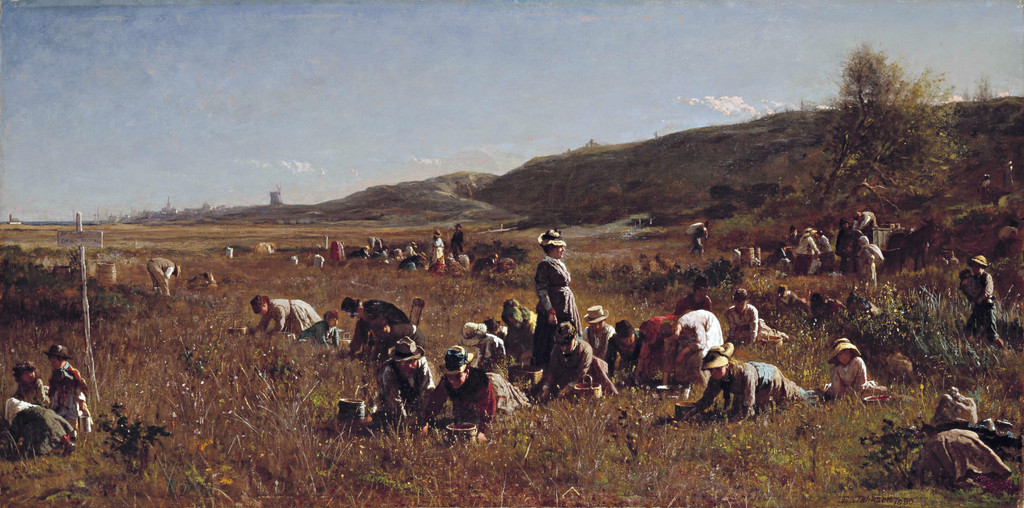
The Cranberry Harvest, Island of Nantucket. Repeated working figures spread across a panoramic field beneath an expansive sky. [7]
Contents
- A figure seen from behind and in reflection
- Why a sideboard matters
- Curtains, wallpaper and small household details
- Intimacy and the limits of biography
- Brushwork and the room’s immediacy
- The 1875 exhibition and later titles
- Annotated details
A figure seen from behind and in reflection
The woman stands close to the sideboard, leaning slightly towards the mirror. Her dark gown spreads across the lower-left half of the picture and reaches the floor in a broad, irregular shape. Above it, the light edge of her collar and her turned profile help distinguish the head from the patterned wall.
The reflection provides a different view of the same activity. Her face appears near the mirror’s right edge, with her hands lifted towards the ear. Our attention moves between the profile outside the glass and the more frontal reflected face. Johnson makes a small act of dressing visible through two complementary viewpoints.
The mirror is unusually important to the space. It shows more than the woman: a staircase appears behind her reflection, suggesting an area of the house beyond the room we directly face. The picture can therefore feel enclosed while retaining evidence of connected domestic spaces. Laura Groves Napolitano’s Corcoran catalogue essay uses that reflected staircase to locate the scene downstairs. [8]
At the same time, the mirror does not function as an open doorway. Its carved frame keeps the reflected scene within a second, smaller rectangle. We see the woman through an object that belongs to the room, and that object introduces its own surface, edges and limitations. The act of looking remains part of the represented household activity.
Annotated Details from The Toilet
The numbered points identify visible features discussed in this article. Return from each detail to the whole composition. Eastman Johnson, The Toilet, 1873. Oil on paper board, 66.5 × 56.2 cm. National Gallery of Art, Corcoran Collection (Gift of Captain A. S. Hickey, USN [Ret.], in memory of his wife, Caryl Crawford Hickey, 1957), 2015.19.85. Public domain. Image source. Public domain. Numbers added to a separate overview; detail images are native crops. No recolouring, retouching, reconstruction or enlargement.
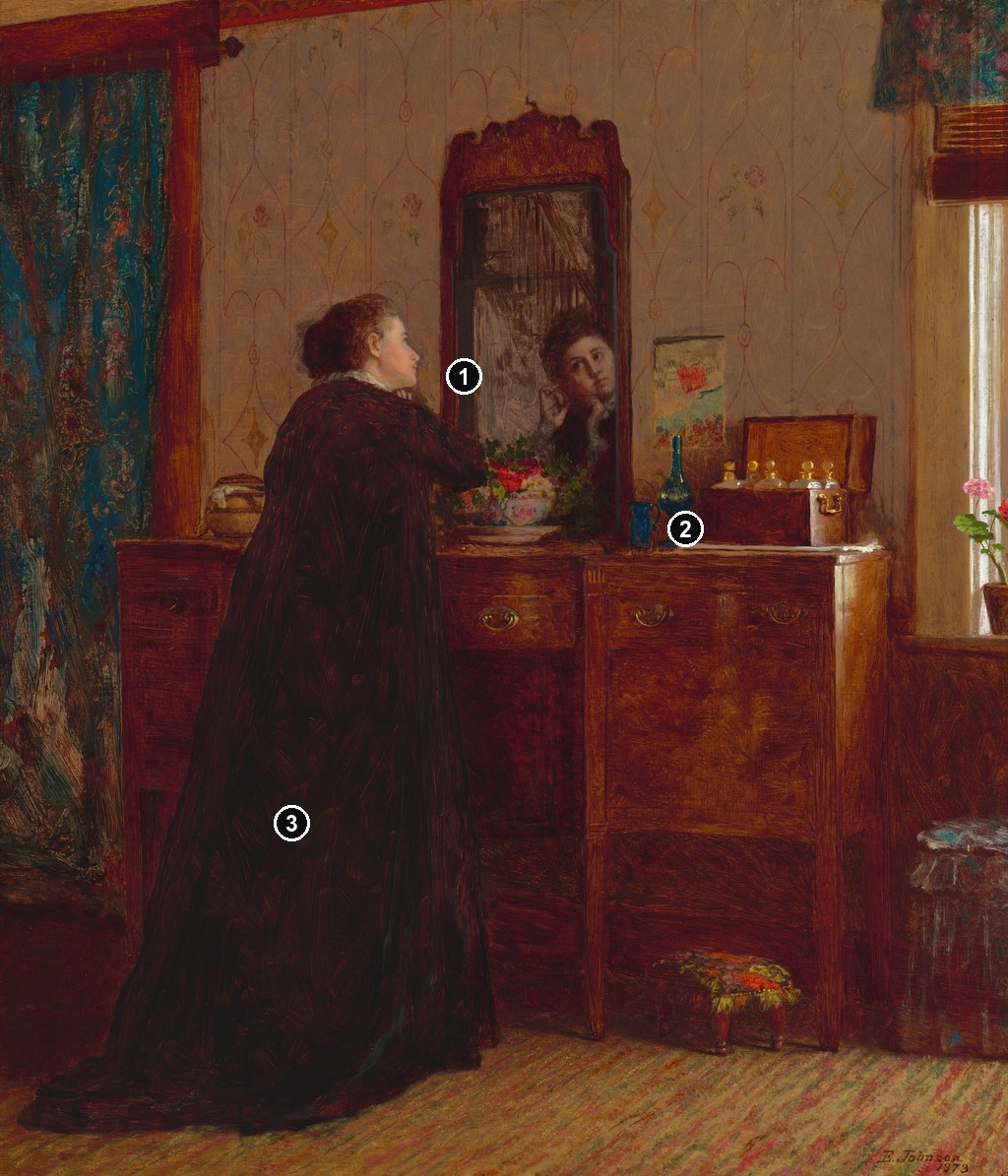
Details from THE TOILET
Compare the cropped details with the complete images above. Notice how their colours, shapes and positions contribute to the larger compositions.
A face in profile and in reflection
The woman turns towards the mirror, which returns a different view of her face and raised hand. The two views make the dressing action readable despite the back facing the viewer.
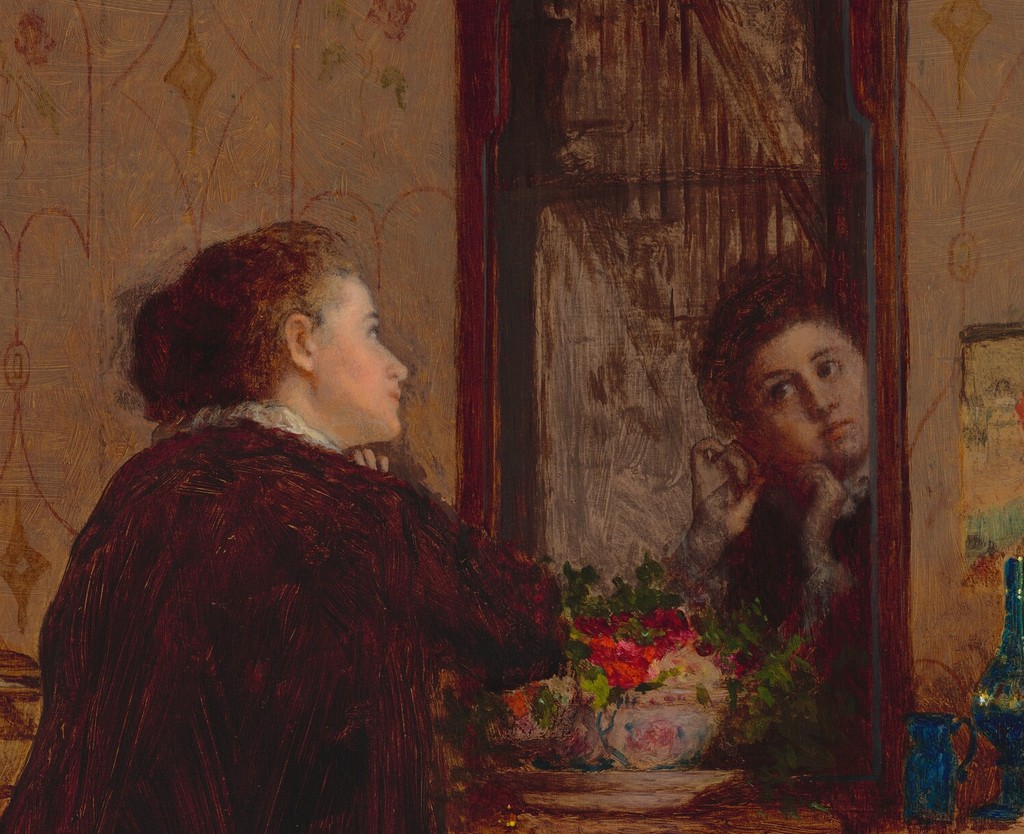
Flowers and vessels across the sideboard
Flowers, blue vessels and an open box of small bottles spread across the polished sideboard. Their separate shapes and highlights interrupt the large dark mass of the furniture.
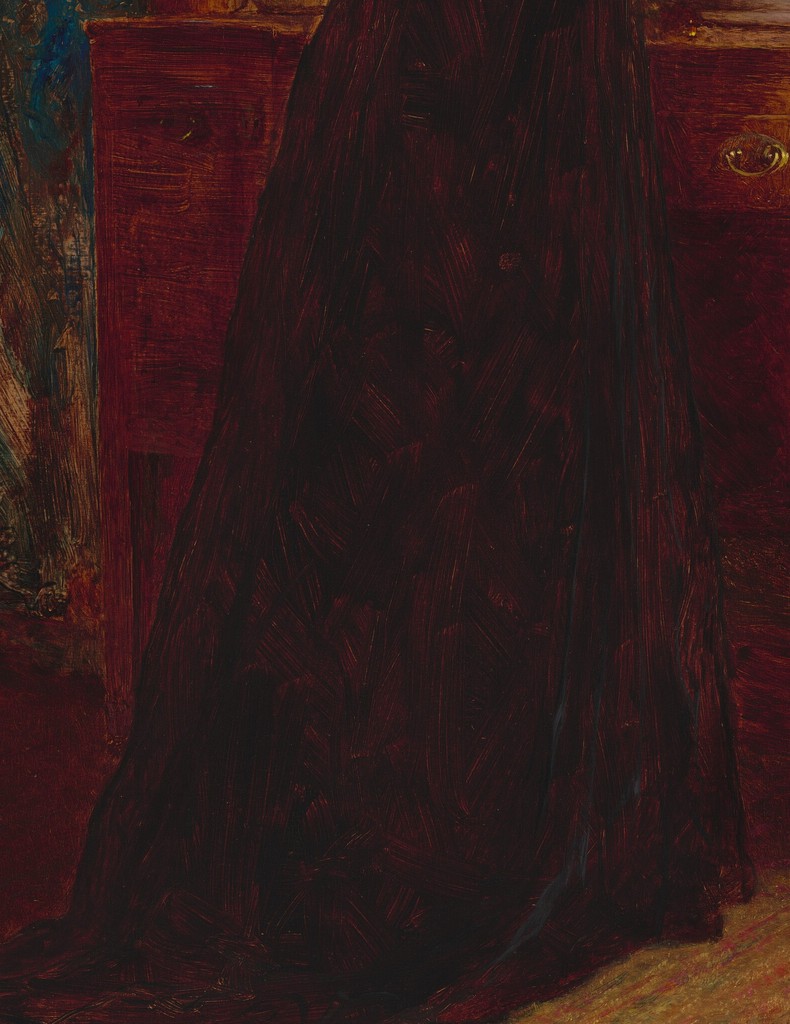
A dark gown against the furnished room
Long passages of dark fabric lead down towards the floor. The gown’s large shape contrasts with patterned curtains, cabinet edges and the smaller objects surrounding the figure.
Why a sideboard matters
The sideboard occupies almost as much attention as the figure. Its polished front, drawers, handles and curved lower edges create a large horizontal structure beneath the mirror. The woman’s dark clothing overlaps its left side, while the exposed right half allows the wood’s warm colour to become conspicuous.
Napolitano identifies the sideboard as a Federal-period furnishing and the mirror as an older, colonial-period object. Those historical forms coexist with later decorative choices in the room. The interior is therefore not a single frozen period setting: older furniture has continued into a household with other tastes and uses. [8]
The objects on its top make that adaptation visible. An open case holds bottles at the right; blue glass stands near the mirror; flowers occupy a central bowl; a basket rests towards the left. The woman uses the surface during her dressing, bringing personal preparation into a space associated with storing and presenting household goods.
The catalogue connects the sideboard with hospitality and with a nostalgic idea of an earlier domestic world. In this picture, however, its use has shifted towards a private routine. That interpretation gains force from the conjunction of the dressing figure, the bottle case and the familiar piece of furniture, rather than from the sideboard acting as an isolated symbol. [8]
The room’s exact location is not established by a surviving floor plan presented here. Napolitano’s suggestion of a dining room follows from the sideboard and the reflected staircase. It is a useful explanation of the painted evidence, while leaving room for the ways a furnished domestic space could support several activities. [8]
Curtains, wallpaper and small household details
The left side is closed by a heavy blue patterned curtain. Its folds provide a deep vertical border against the woman’s gown and the warmer timber. At the right, a window admits light beneath a partially lowered blind. These two edges give the room different kinds of boundary: thick fabric on one side, a controlled glimpse of daylight on the other.
The wall between them is busy with repeating curves and small motifs. Its pattern changes the scale of looking. From farther away, the woman and sideboard dominate; closer attention discovers the decorative field behind them, the mirror’s crest and the little picture fastened beside the glass.
Napolitano identifies that small picture as a child’s sketch and connects it with the familial atmosphere of the room. Its informal placement is a useful contrast with the substantial framed mirror. The room contains both an imposing furnishing and a more casual trace of household life. [8]
Near the floor, a small upholstered stool occupies the gap beneath the sideboard. Another low furnishing sits at the right edge. These details complicate what might otherwise be a simple frontal arrangement. The different heights of stool, sideboard top, figure and mirror establish an interior scaled around bodies and their everyday movements.
Watch: Eastman Johnson
Choose a film to explore the artist’s work, its interpretation and its wider setting.
Director's Choice - The Girl I Left Behind Me by Eastman Johnson
The Smithsonian American Art Museum looks at Johnson’s The Girl I Left Behind Me.
Watch on YouTubeIntimacy and the limits of biography
The painting belongs to a period in which Johnson repeatedly explored domestic interiors. Napolitano places it near his establishment of a New York house and home studio for his family in 1872. That context helps explain the availability and importance of household subjects without identifying this woman as his wife, Elizabeth. [8]
The pose also raises a question about the viewer’s position. The woman faces her own reflection while we look at her from behind. She is absorbed in a routine that does not require an audience. The picture’s intimacy grows from that arrangement, even though Johnson has carefully composed what the spectator is allowed to see.
Napolitano relates the subject to the traditional image of Venus at her toilet and to nineteenth-century ideas about private family life. Those connections offer ways of interpreting the scene’s inwardness and sensuality. They do not supply a verified relationship between the woman and an imagined spectator, or prove that the painting records a particular private encounter. [8]
The distinction is valuable when comparing Johnson’s other interiors. The New Bonnet distributes attention among three people and an object being displayed. The Brown Family connects several generations through an occupied room. The Toilet lets one person’s routine organise the space, with the mirror supplying the second view.
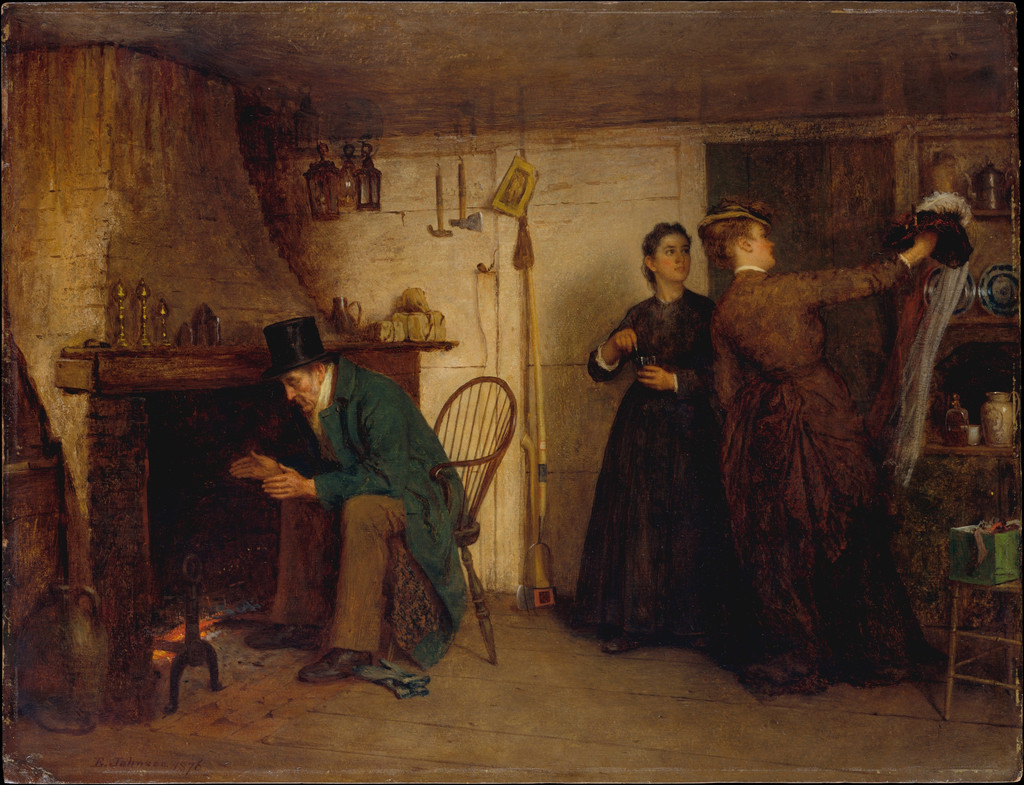
Eastman Johnson, The New Bonnet, 1876. Oil on academy board, 52.7 × 68.6 cm. The Metropolitan Museum of Art, Bequest of Collis P. Huntington, 1900, 25.110.11. Public domain.
Image source
.
Public domain
.
Brushwork and the room’s immediacy
Close looking reveals a surface that is less uniformly polished than the furnishings might initially suggest. Strokes move along the gown, across the sideboard and through the floor covering. The wood is established through differences of tone and direction, while bright touches distinguish handles, glass and flowers.
Napolitano associates this freer handling with the scene’s informality. The description is especially useful because the picture combines carefully arranged objects with a surface that retains visible movement. A viewer can recognise the furniture and simultaneously remain aware of the marks through which Johnson has made it. [8]
The catalogue raisonné’s general technical account describes Johnson’s use of tonal preparation and varied drawing procedures. It provides context for this balance of organised masses and selective definition, but it is not an infrared examination of The Toilet . The exact object’s paperboard support and the visible handling are firmer grounds for discussion than an assumed recipe for every passage. [9]
The 1875 exhibition and later titles
Johnson showed the picture at the National Academy of Design in 1875. According to Napolitano’s account of the reviews, Henry James particularly admired the sideboard, while Susan Noble Carter discussed the figure’s graceful pose and reflected face. The two responses demonstrate how furniture and bodily arrangement could share critical attention. [8]
The NGA also records a probable earlier appearance at the Century Association in January 1874 as Lady Before a Mirror . Later exhibitions used The Earring , while the work was purchased for the Corcoran in October 1957 under the title Woman in an Interior . These names emphasise different parts of the same composition rather than identifying separate paintings. [1]
The painting passed through the Sloan, Guilford and Stewart ownership histories before reaching the Corcoran through Childs Gallery. It entered the National Gallery in 2015 with the Corcoran Collection. Its current accession, 2015.19.85, should therefore be distinguished from the older Corcoran number found in earlier publications. [1]
Artworks directory
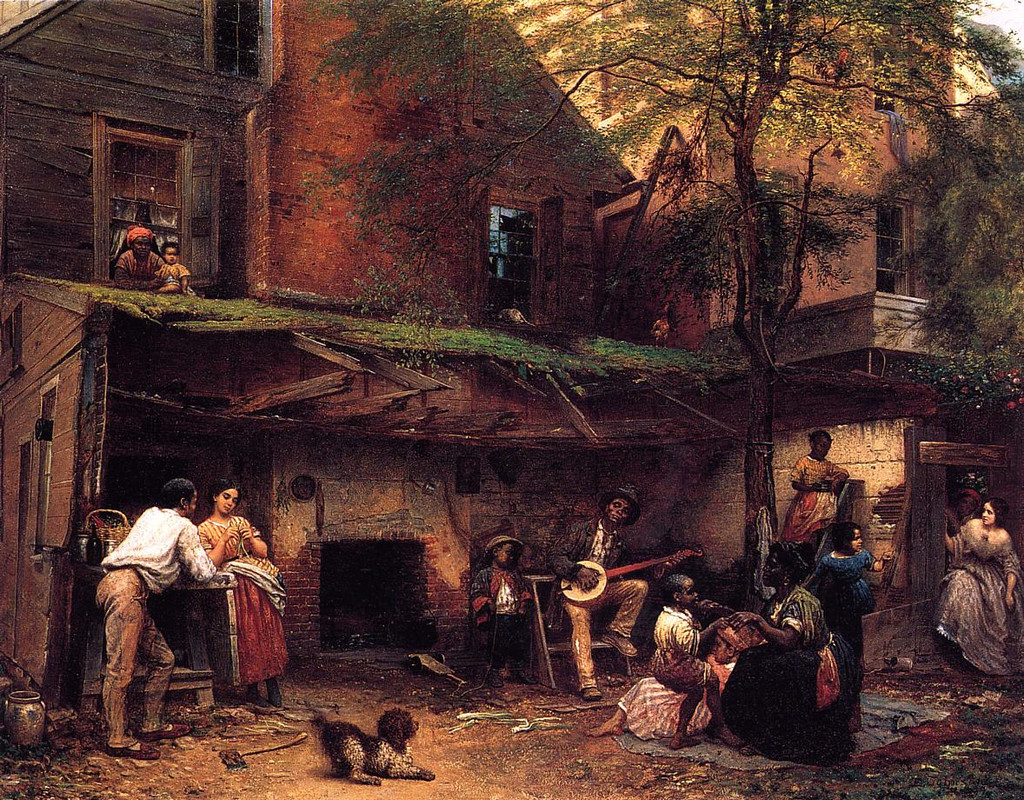
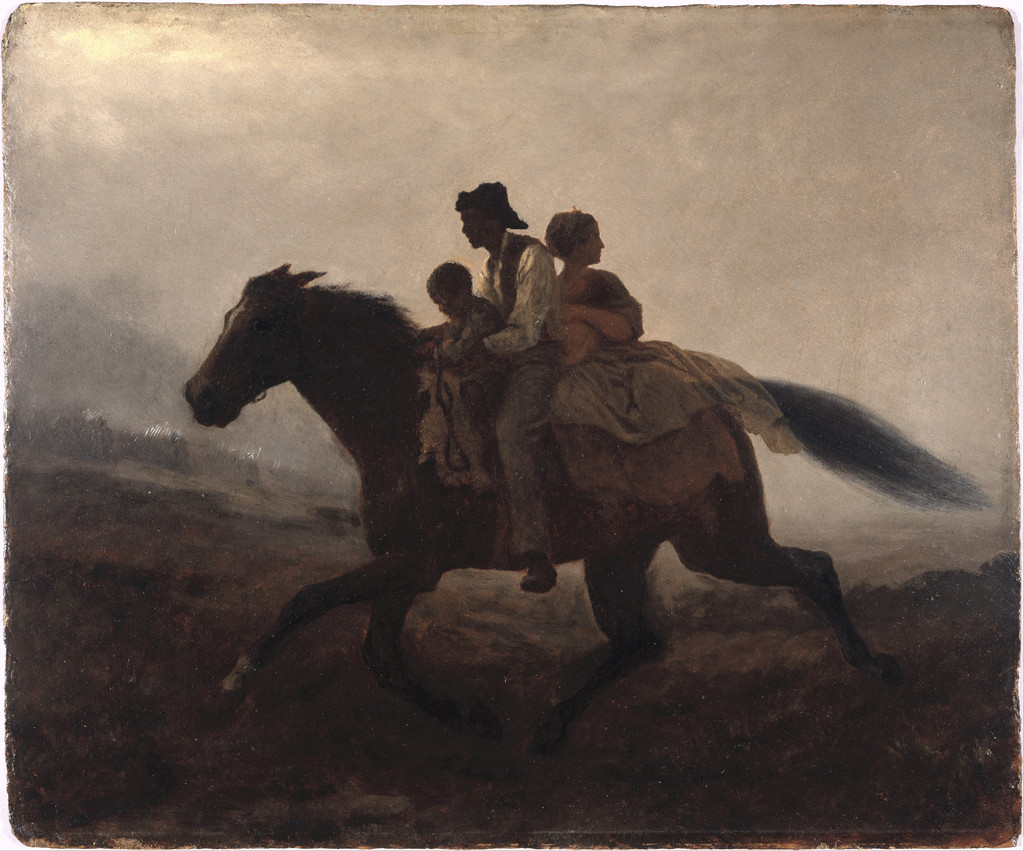
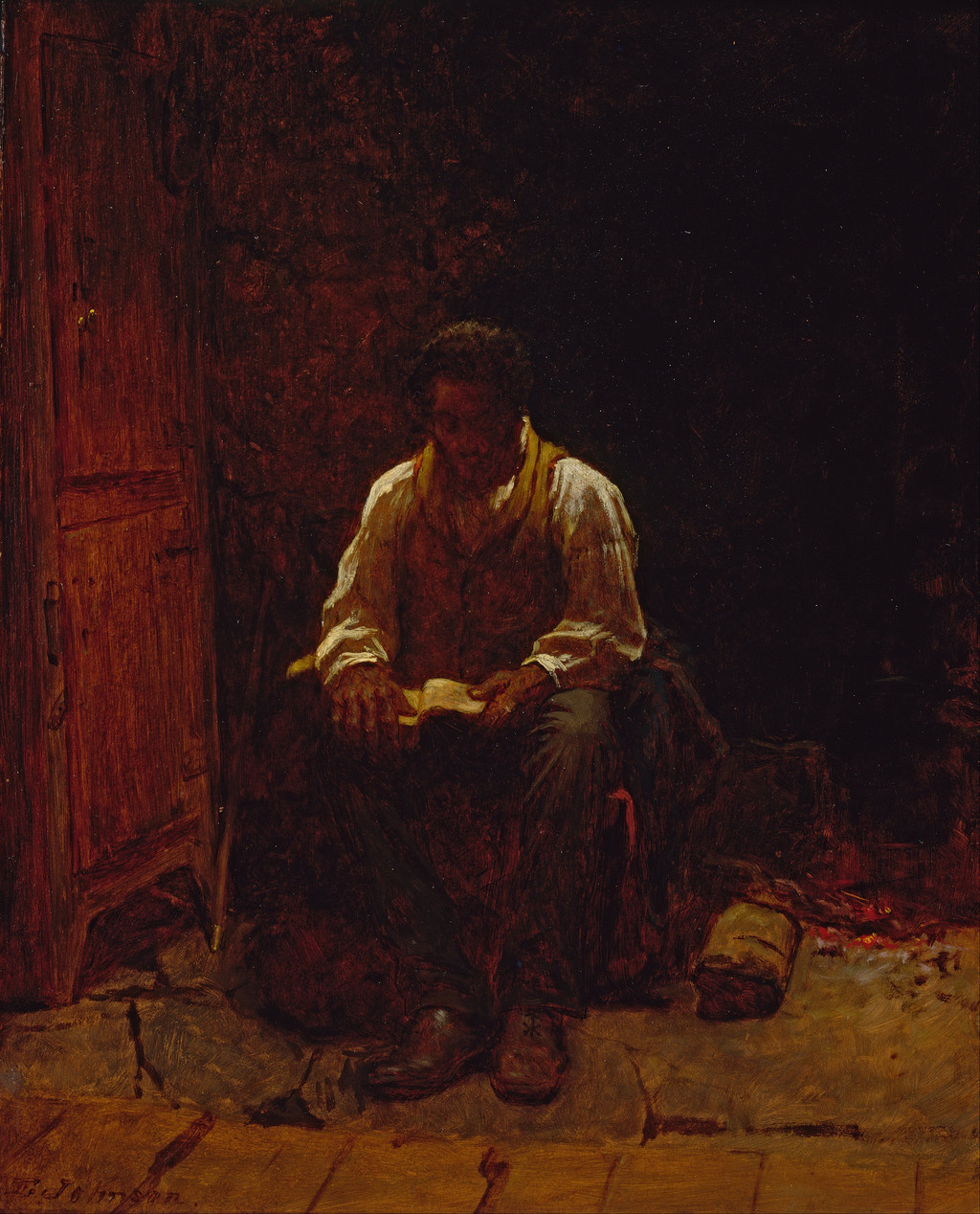
Browse twenty-one selected objects discussed in these articles, including the Gifford portrait and the Prang print after Johnson. Dates identify individual objects, including the San Diego Drummer Boy study. Use All media to include the chromolithograph.
| Name | Date | Medium |
|---|---|---|
| Kitchen at Mount Vernon | 1857; Charles Butt canvas | Oil on canvas |
| Negro Life at the South | 1859; New York Historical original | Oil on linen |
| A Ride for Liberty—The Fugitive Slaves | About 1862; Brooklyn version | Oil on paperboard |
| The Lord Is My Shepherd | 1863 | Oil on fiberboard |
| Sugaring Off | About 1864–65; unfinished RISD canvas | Oil on canvas |
| The Wounded Drummer Boy (San Diego study) | About 1864–71; study, not the finished canvas | Oil on board |
| The Early Scholar | About 1865; NGA study | Oil on academy board on canvas |
| Fiddling His Way | 1866; Chrysler canvas | Oil on canvas |
| The Letter Home | 1867; Minneapolis drawing | Charcoal and graphite on paper |
| The Boyhood of Lincoln | 1868; Michigan canvas | Oil on canvas |
| The boyhood of Lincoln—An evening in the log hut (Prang after Johnson) | About 1868; separate reproductive print | Chromolithograph, W. Harring / L. Prang & Co., after Johnson |
| The Brown Family | 1869; NGA version | Oil on paper on canvas |
| The Hatch Family | 1870–71 | Oil on canvas |
| The Old Stagecoach | 1871 | Oil on canvas |
| The Girl I Left Behind Me | About 1872 | Oil on canvas |
| The Toilet | 1873 | Oil on paper board |
| Husking Bee, Island of Nantucket | 1876; Chicago canvas | Oil on canvas |
| The New Bonnet | 1876 | Oil on academy board |
| Sanford Robinson Gifford | 1880; possibly posthumous | Oil on academy board |
| The Cranberry Harvest, Island of Nantucket | 1880; Timken canvas | Oil on canvas |
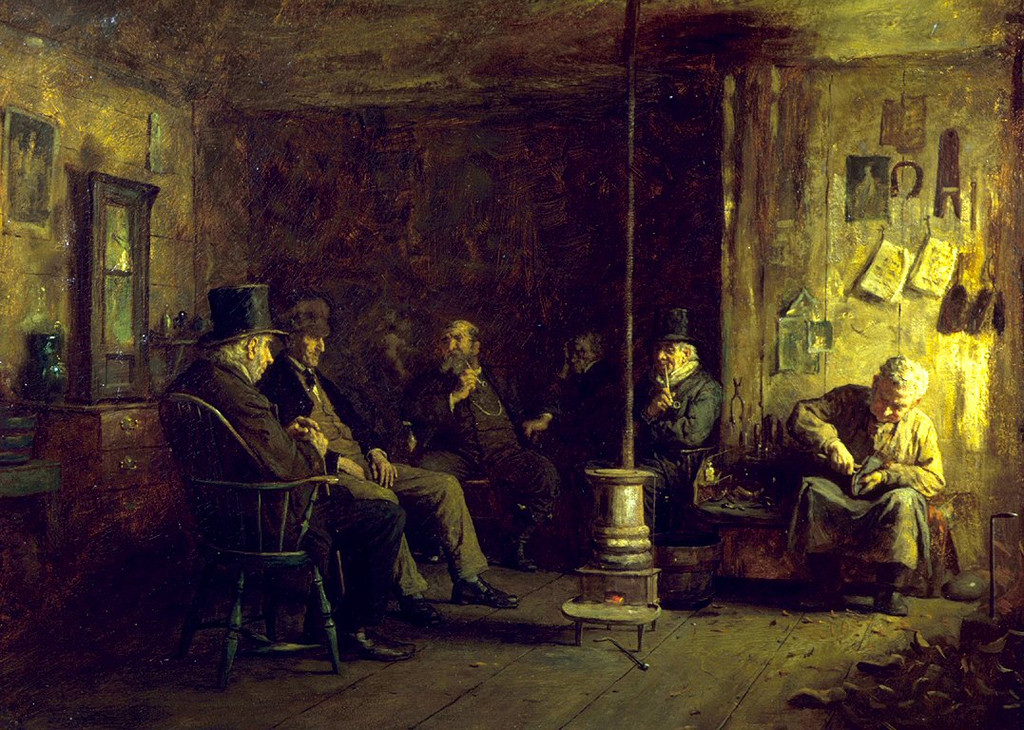
| The Nantucket School of Philosophy | 1887 | Oil on panel |
Frequently Asked Questions
The consulted museum and catalogue evidence does not securely identify her. Johnson’s family surroundings are relevant context, but do not establish the sitter’s name. [8]
It belongs to the National Gallery of Art in Washington, as part of the Corcoran Collection, accession 2015.19.85. [1]
Discussion
Look again at the images and ideas explored in The Toilet by Eastman Johnson. These editorial prompts invite your observations.
Reader Insights
How does the mirror change the relationship between the figure’s turned back and the viewer?
Follow the sideboard, curtain and reflected stair. How do objects connect this room with spaces beyond it?
Which details encourage a biographical reading, and why do they stop short of identifying the sitter securely?
Join the Conversation
Share a detail, comparison or question about The Toilet by Eastman Johnson below.
References
- National Gallery of Art. The Toilet , 1873, 2015.19.85. Current object record, provenance, exhibition history, inscriptions and public-domain image. View source
- The Hatch Family, 1870–71, 26.97. View source
- The Old Stagecoach, 1871, L1888.22. View source
- The Girl I Left Behind Me, c.1872, 1986.79. View source
- Husking Bee, Island of Nantucket, 1876, 1922.444: current public API. View source
- The New Bonnet,1876,25.110.11,currentobjectrecordandAPI. View source
- The Cranberry Harvest, Island of Nantucket, 1880, 1972:002. View source
- Laura Groves Napolitano. “The Toilet.” In Corcoran Gallery of Art: American Paintings to 1945 , edited by Sarah Cash, 2011, pp. 136–137; notes p. 267. Furnishings, domestic interpretation, reflected staircase, family context and transcribed critical responses. View source
- Patricia Hills and Abigael MacGibeny. Technical Information on Johnson’s Practices. Eastman Johnson Catalogue Raisonné. General working methods; not an object-specific scientific report on this painting. View source
- Splash image source.
Eastman Johnson, The Toilet, 1873. Oil on paper board, 66.5 × 56.2 cm. National Gallery of Art, Corcoran Collection (Gift of Captain A. S. Hickey, USN [Ret.], in memory of his wife, Caryl Crawford Hickey, 1957), 2015.19.85. Public domain. Public domain .
View source