 by
Tom Gurney
Tom Gurney BSc (Hons) is an art history expert with over 20 years experience
Email:
tomgurney1@gmail.com
/ Phone:
+44 7429 011000
The New Bonnet by Eastman Johnson: Introduction
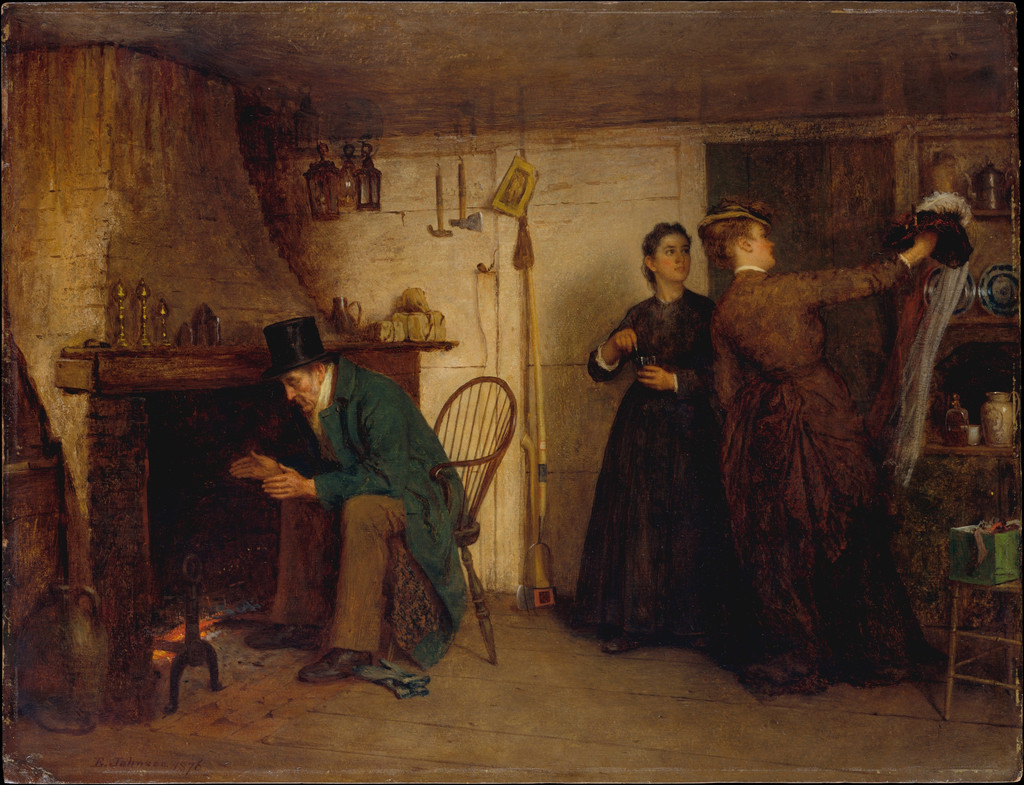
Eastman Johnson’s The New Bonnet brings three people together without giving them the same occupation. An elderly man bends towards a fire. One woman holds a glass while turning towards another, who displays a bonnet beside her head. The small room contains several kinds of attention: warmth, hospitality and the pleasure of looking at something new.
Painted in 1876, the picture belongs to Johnson’s Nantucket interiors. Its dense furnishings and carefully connected gestures make a modest domestic incident unusually absorbing. The Metropolitan Museum of Art identifies its support as academy board, rather than canvas, and records it as part of the Huntington bequest. [1]
At a Glance
- Artist Eastman Johnson
- Title The New Bonnet
- Date 1876
- Medium Oil on academy board
- Dimensions 52.7 × 68.6 cm
- Collection Metropolitan Museum of Art, New York
- Accession 25.110.11
- Credit Bequest of Collis P. Huntington, 1900
The physical details follow the Met’s current object record. [1]
This work across Eastman Johnson’s career
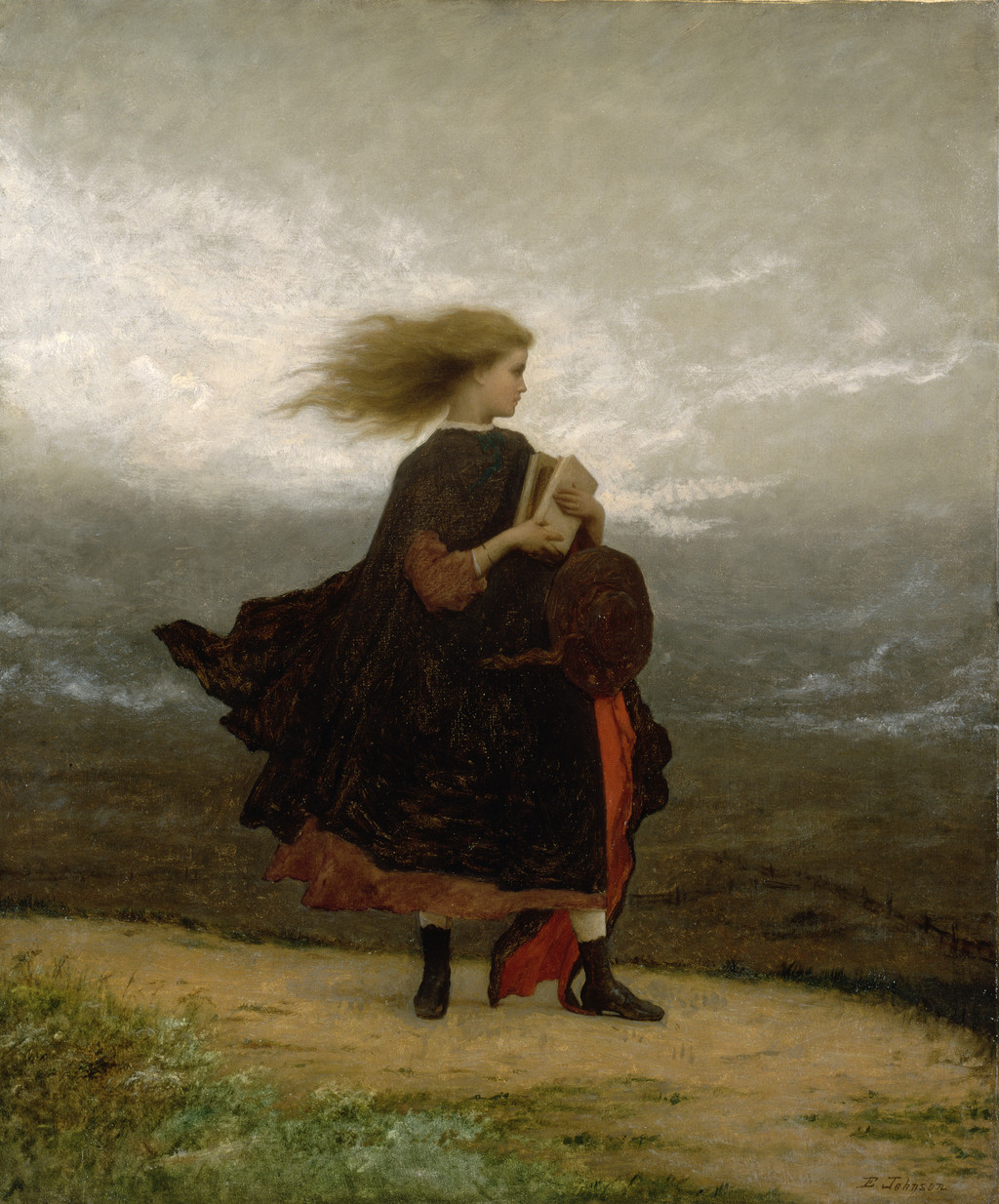
The Girl I Left Behind Me
About 1872The Toilet
1873Husking Bee, Island of Nantucket
1876; Chicago canvasThe Cranberry Harvest, Island of Nantucket
1880; Timken canvasNotes and sources
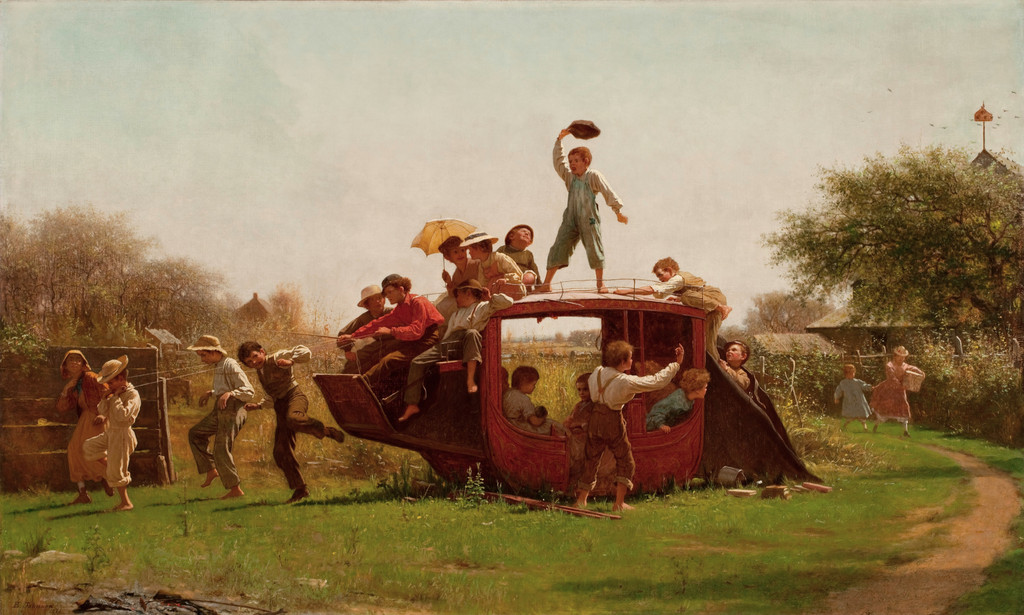
The Old Stagecoach. Children give a broken vehicle a new purpose through play. [2]
The Girl I Left Behind Me. A still figure, books and wind-driven clothing hold competing directions of attention. [3]
The Toilet. The mirror returns a face while the figure’s back occupies the foreground. [4]
Husking Bee, Island of Nantucket. A line of people and pale husks joins harvest work to a social gathering. [5]
The New Bonnet (current article). A bonnet, a glass and a fire give three figures different occupations within one room. [1]
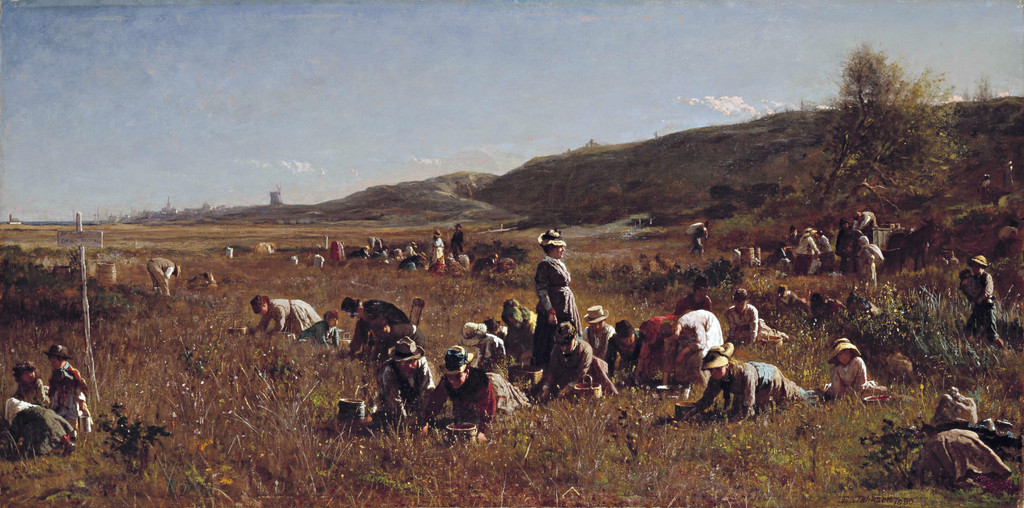
The Cranberry Harvest, Island of Nantucket. Repeated working figures spread across a panoramic field beneath an expansive sky. [6]
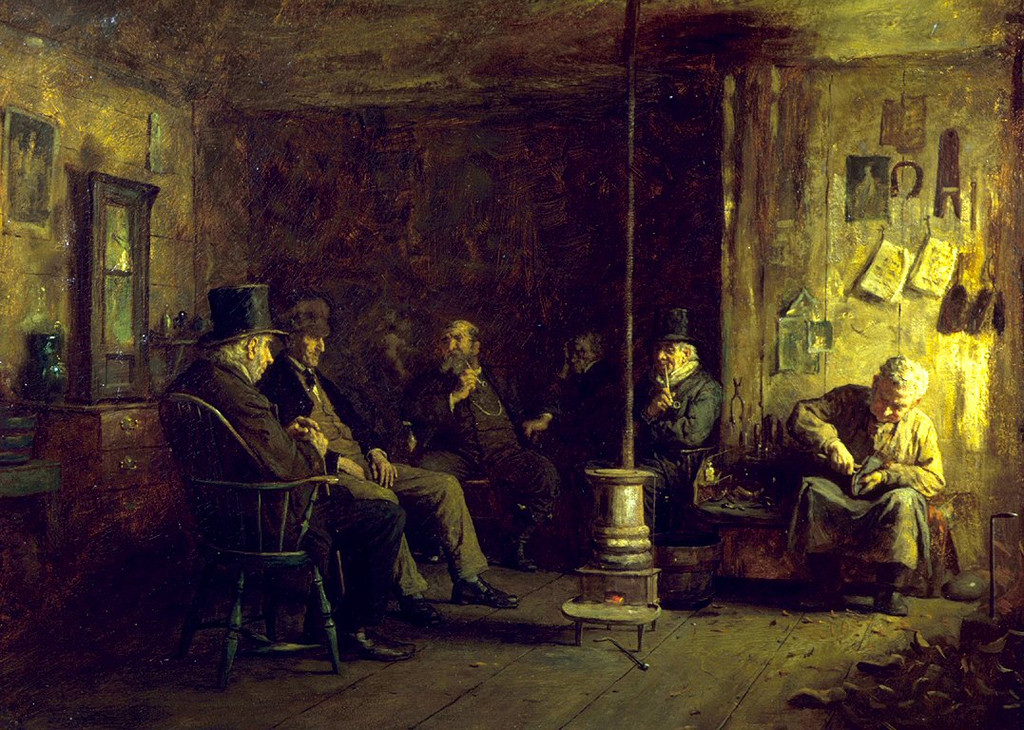
The Nantucket School of Philosophy. A shoemaker’s shop becomes a place for work, company and conversation. [7]
Contents
- Three figures, several directions of attention
- The bonnet within an older room
- Fashion without an exaggerated moral
- A drawing beneath the painted scene
- Two pictures at the 1876 exhibition
- Huntington ownership and the Met
- Annotated details
Three figures, several directions of attention
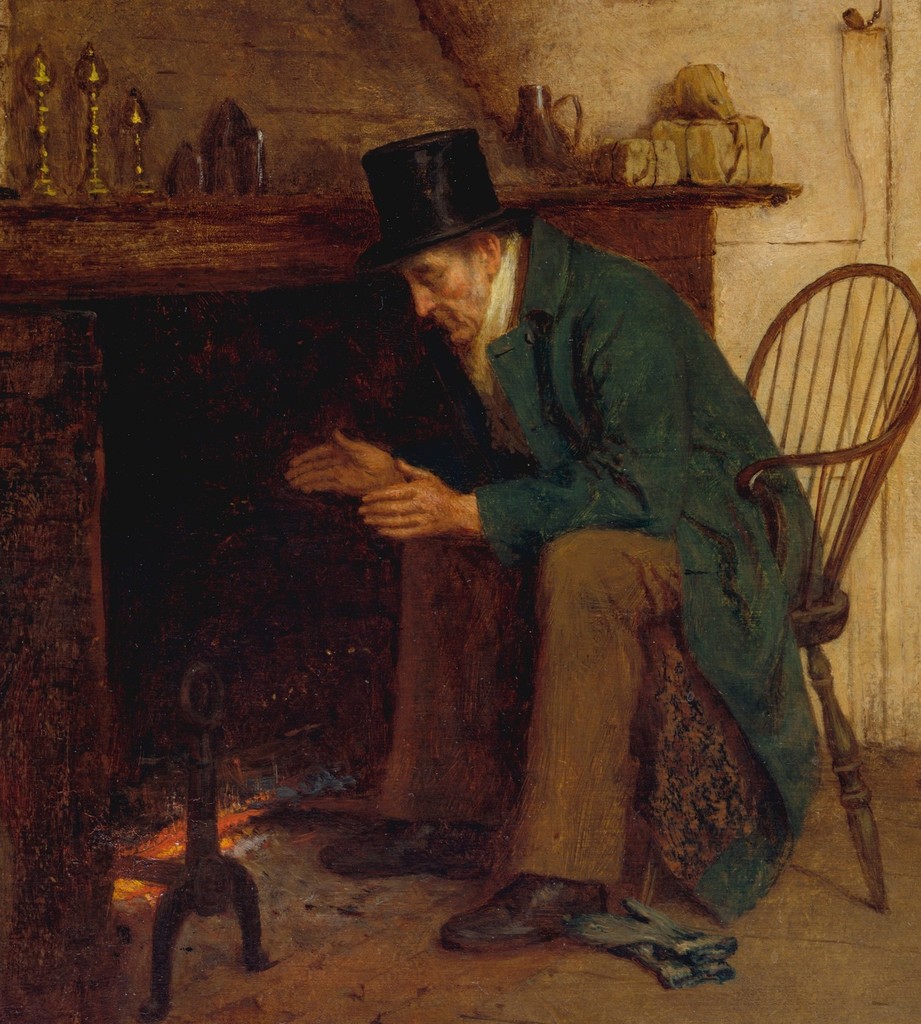
The man occupies the left half of the picture. His top hat, heavy coat and forward lean give him a compact outline against the hearth. His hands approach the fire, while his face remains largely lowered. The chair supports his body but does not make him look settled into conversation: his immediate relationship is with the heat.
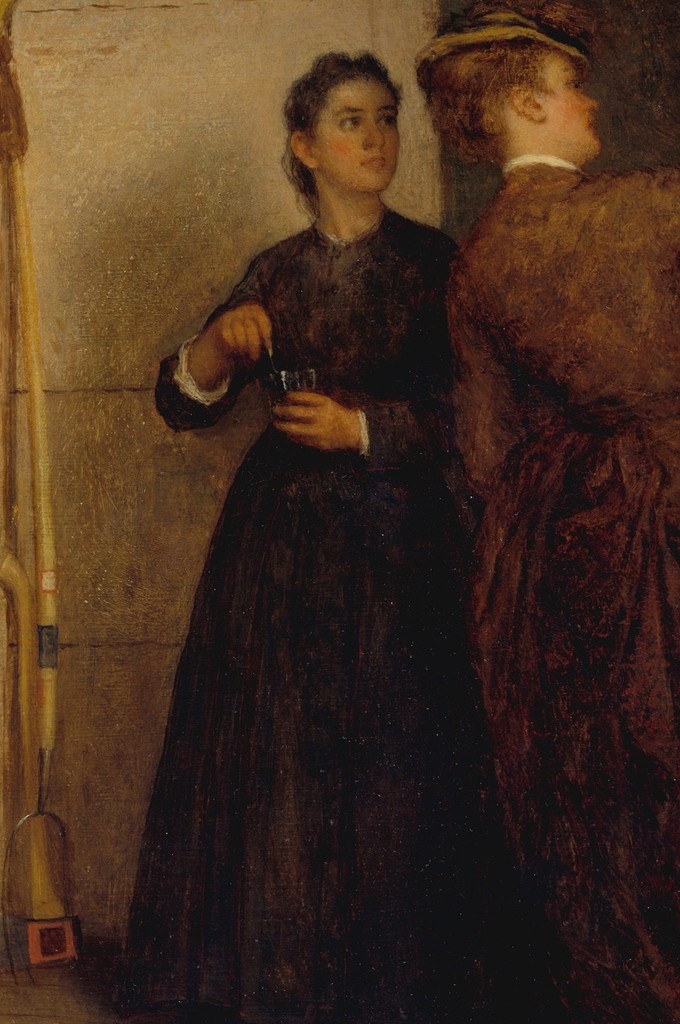
The women introduce a different movement. The figure near the centre holds a small glass and turns her head towards the right. Her body belongs to the space beside the fireplace, but her glance connects her with the bonnet. She therefore links activities that could otherwise become separate incidents on opposite sides of the room.
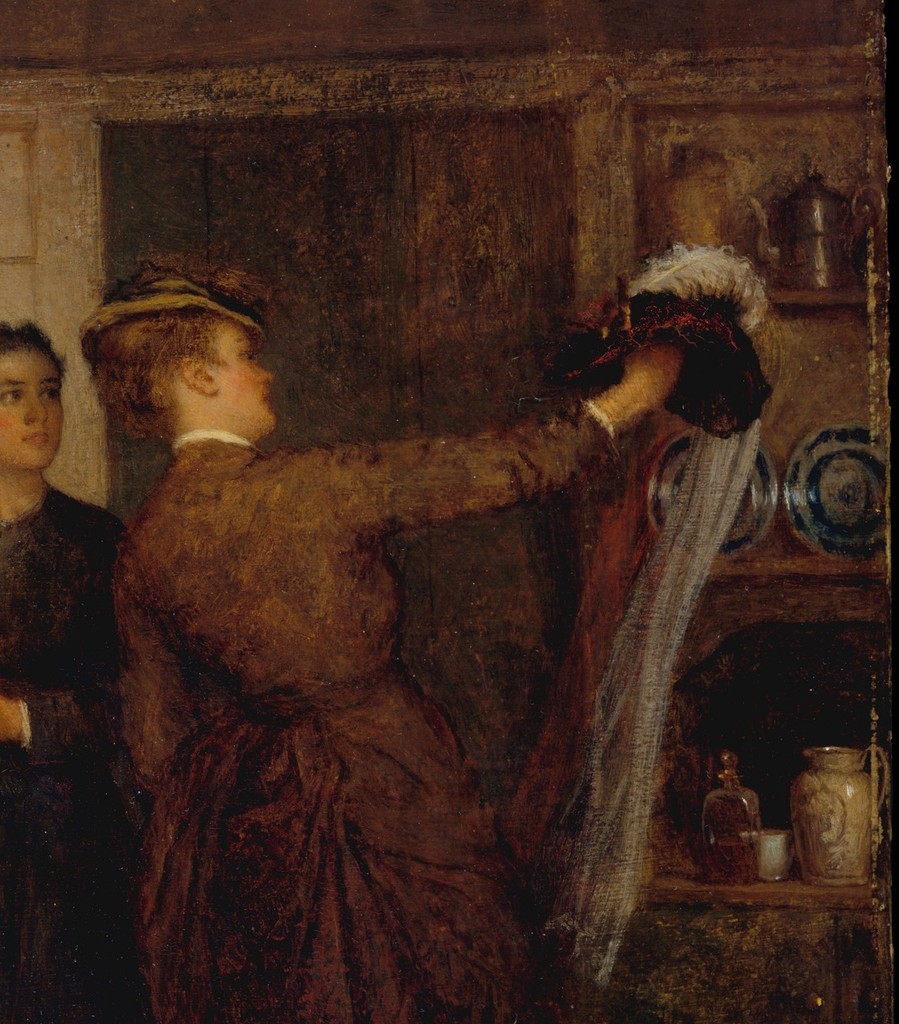
The right-hand woman raises the new object towards the light. Her lifted arm and headwear provide an upward emphasis against the man’s downward bend. Johnson does not need an exaggerated expression to make the display intelligible. The relation between hands, head and watching companion supplies the action.
Natalie Spassky’s Met catalogue entry treats this central woman as the composition’s pivot. The turn of her head redirects our attention, while the angled mantel and curving chimney reinforce the connection. What first appears to be an informal gathering depends on a carefully arranged route through the figures. [8]
Annotated Details from The New Bonnet
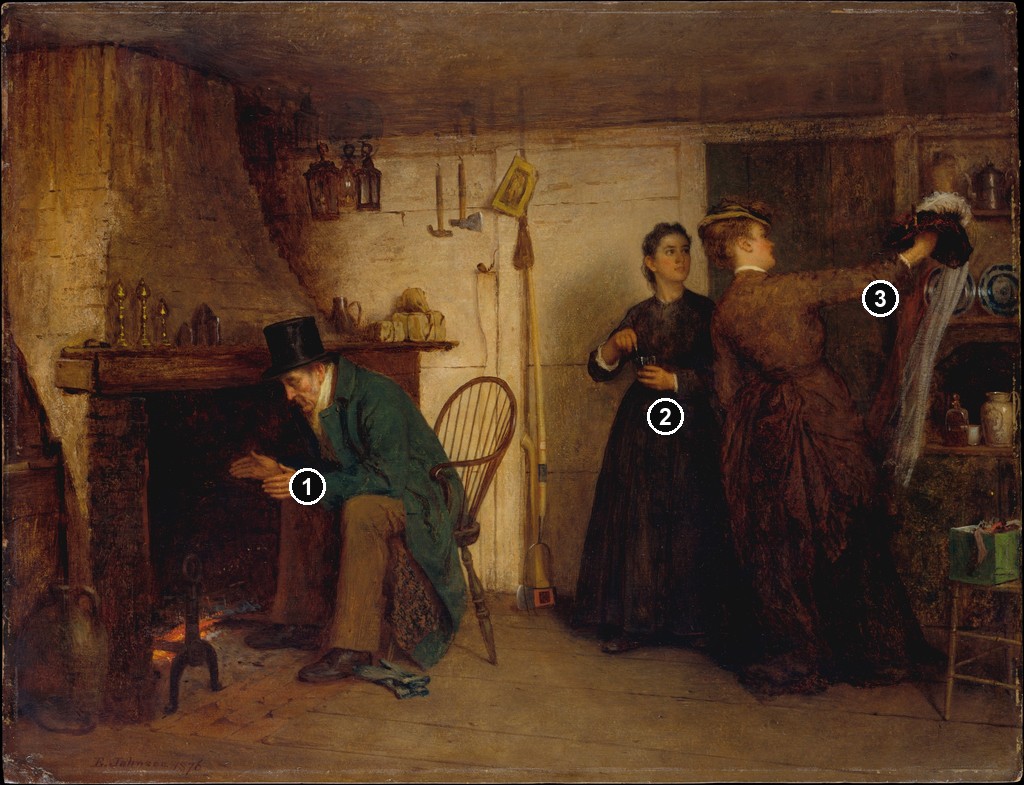
The numbered points identify visible features discussed in this article. Return from each detail to the whole composition. Eastman Johnson, The New Bonnet, 1876. Oil on academy board, 52.7 × 68.6 cm. The Metropolitan Museum of Art, Bequest of Collis P. Huntington, 1900, 25.110.11. Public domain. Image source. Public domain. Numbers added to a separate overview; detail images are native crops. No recolouring, retouching, reconstruction or enlargement.
Details from THE NEW BONNET
Compare the cropped details with the complete images above. Notice how their colours, shapes and positions contribute to the larger compositions.
A man attending to the fire
The seated man bends towards the hearth with his hands extended. His body and the chair give this side of the room a low, inward movement.
The woman holding a glass
A glass and raised hand occupy the dark central figure. Her gaze turns towards the neighbouring woman, connecting an otherwise separate activity with the display of the bonnet.
Bonnet and extended arm
The woman at the right extends her arm to display the bonnet beside her head. The raised object and pale hanging fabric create another direction of attention within the small interior.
The bonnet within an older room
The bonnet is small compared with the fireplace and furniture. Its importance comes from the people looking at it and the title that singles it out. Following the title into the picture draws attention to the difference between a new personal accessory and the room’s accumulated household equipment.
Johnson gives that equipment a substantial presence. Lanterns and tools hang overhead; candlesticks stand near the hearth; the broad fireplace and Windsor chair establish a familiar domestic setting. The catalogue notes that several such furnishings recur in his Nantucket interiors. They belong to a pictorial vocabulary that could be rearranged around different encounters. [9] [8]
The objects are also compositional devices. The chair’s curved back repeats the movement around the seated man, while the small stool and hatbox near the lower edge bring the scene close to the viewer. Because these foreground objects are partly cut by the picture’s boundary, the room seems to continue beyond the rectangle.
The colour holds the crowded setting together. Warm browns extend across the timber, plaster and women’s clothing, while the man’s blue-green coat forms a cooler mass at the left. Small lights pick out faces, hands and the bonnet’s pale edging. The accessory attracts attention through its position and the surrounding gestures as much as through colour, keeping it connected to the room’s other activities.
Spassky connects that cropping with more adventurous compositional habits in contemporary French painting. The comparison concerns the way a picture is organised, rather than identifying a particular French work that Johnson copied. The everyday subject and apparently old-fashioned room can coexist with a less conventional arrangement of space. [8]
Fashion without an exaggerated moral
The women’s interest in the bonnet makes fashion part of ordinary household life. It is tempting to turn the contrast with the older man into a complete story about youth and age, vanity and usefulness, or changing island customs. The picture does not settle those possibilities. The man’s warming hands and the women’s shared looking remain more specific than a fixed moral.
An earlier American painting by Francis William Edmonds also bears the title The New Bonnet . Spassky suggests that Johnson would have known it and distinguishes its more emphatic storytelling from his quieter treatment. That provides a useful comparison within genre painting, although it does not document a direct act of copying. [8]
Johnson’s scene rewards attention because each figure can remain differently occupied. The central woman’s glass is particularly useful in this respect. It connects her to the man while her head turns towards the bonnet. An older museum description calls the drink a toddy; its precise ingredients cannot be established from the small painted vessel alone. [9]
Watch: Eastman Johnson
Choose a film to explore the artist’s work, its interpretation and its wider setting.
Director's Choice - The Girl I Left Behind Me by Eastman Johnson
The Smithsonian American Art Museum looks at Johnson’s The Girl I Left Behind Me.
Watch on YouTubeA drawing beneath the painted scene
The Met catalogue identifies Girl with Glass , a drawing dated 22 September 1875, as a preparatory study for the central figure. Johnson preserved the figure’s pose closely when developing the painting. The study gives a documentary basis for discussing preparation, beyond the impression that the encounter happened spontaneously. [8]
The same catalogue reports infrared examination of the three figures. It describes strong contour drawing around the central woman, evidence of mechanical transfer in at least the man’s face and hands, and freer drawing beneath the woman displaying the bonnet. These findings suggest that Johnson could combine different procedures within a single composition. [8]
This is a published technical account, not a process visible in full through the ordinary colour reproduction. Spassky’s 1985 entry draws on earlier infrared work, including Sheldon Keck’s study. Its value here is the object-specific evidence it supplies: the carefully prepared central figure did not require every other figure to be constructed in exactly the same way. [8]
The distinction also prevents a misleading equation between quiet subject matter and effortless execution. Johnson’s apparently casual room contains decisions about pose, transfer, contour and finish. The technique page places these findings alongside the more exposed preparation in his studies.
Two pictures at the 1876 exhibition
Johnson exhibited The New Bonnet at the National Academy of Design in 1876. The same exhibition included Husking Bee, Island of Nantucket , whose outdoor gathering and broader handling offered a strong contrast with this closely furnished interior. [9] [8]
The response was mixed. As reported in the Met catalogue, one critic objected to the elaborate manner, another praised the precision but found the colour restrained, and the New York Times admired the small composition. These differences matter more than a single verdict of success or failure: reviewers were judging the relation between subject, drawing, surface and colour. [8]
The comparison with Husking Bee also shows why Johnson’s style should not be reduced to one uniform finish. An island interior, a panoramic harvest and a charcoal figure study could call for different kinds of description. The coexistence of those approaches was visible to his contemporaries.
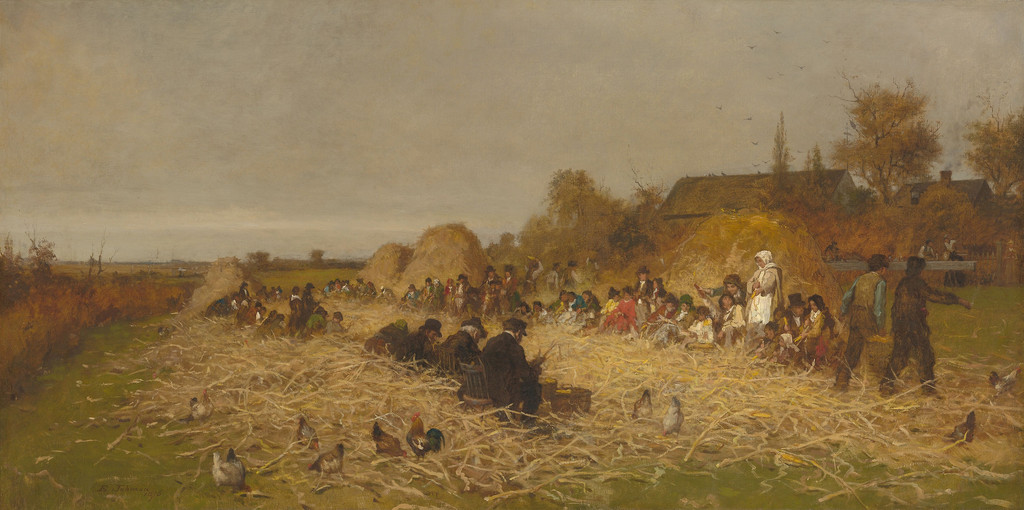
Eastman Johnson, Husking Bee, Island of Nantucket, 1876. Oil on canvas, 69.6 × 138.2 cm. Art Institute of Chicago, 1922.444. CC0.
Image source
.
CC0 / Public domain
.
Huntington ownership and the Met
Collis P. Huntington owned the painting by 1880. His 1900 bequest to the Met was subject to successive life interests for his wife and her son, Archer M. Huntington. The latter interest was relinquished in 1925. The museum’s accession number therefore should not be mistaken for the date of the original bequest. [9] [8]
For another view of activity within a Nantucket room, The Nantucket School of Philosophy makes work and conversation share the same space. The Toilet narrows attention to one woman and her reflection. Together, these interiors show how Johnson could build a social encounter from small adjustments of posture, objects and looking.
Artworks directory
Browse twenty-one selected objects discussed in these articles, including the Gifford portrait and the Prang print after Johnson. Dates identify individual objects, including the San Diego Drummer Boy study. Use All media to include the chromolithograph.
| Name | Date | Medium |
|---|---|---|
| Kitchen at Mount Vernon | 1857; Charles Butt canvas | Oil on canvas |
| Negro Life at the South | 1859; New York Historical original | Oil on linen |
| A Ride for Liberty—The Fugitive Slaves | About 1862; Brooklyn version | Oil on paperboard |
| The Lord Is My Shepherd | 1863 | Oil on fiberboard |
| Sugaring Off | About 1864–65; unfinished RISD canvas | Oil on canvas |
| The Wounded Drummer Boy (San Diego study) | About 1864–71; study, not the finished canvas | Oil on board |
| The Early Scholar | About 1865; NGA study | Oil on academy board on canvas |
| Fiddling His Way | 1866; Chrysler canvas | Oil on canvas |
| The Letter Home | 1867; Minneapolis drawing | Charcoal and graphite on paper |
| The Boyhood of Lincoln | 1868; Michigan canvas | Oil on canvas |
| The boyhood of Lincoln—An evening in the log hut (Prang after Johnson) | About 1868; separate reproductive print | Chromolithograph, W. Harring / L. Prang & Co., after Johnson |
| The Brown Family | 1869; NGA version | Oil on paper on canvas |
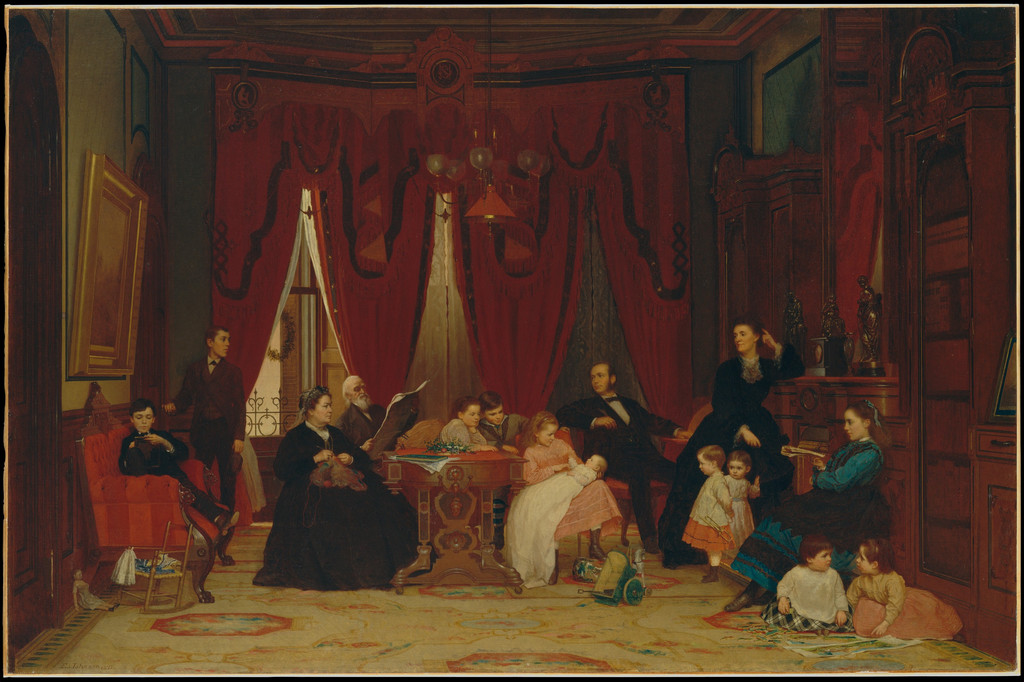
| The Hatch Family | 1870–71 | Oil on canvas |
| The Old Stagecoach | 1871 | Oil on canvas |
| The Girl I Left Behind Me | About 1872 | Oil on canvas |
| The Toilet | 1873 | Oil on paper board |
| Husking Bee, Island of Nantucket | 1876; Chicago canvas | Oil on canvas |
| The New Bonnet | 1876 | Oil on academy board |
| Sanford Robinson Gifford | 1880; possibly posthumous | Oil on academy board |
| The Cranberry Harvest, Island of Nantucket | 1880; Timken canvas | Oil on canvas |
| The Nantucket School of Philosophy | 1887 | Oil on panel |
Frequently Asked Questions
It belongs to the Metropolitan Museum of Art in New York, accession 25.110.11. Its credit is the Bequest of Collis P. Huntington, 1900. [1]
The Met identifies the support as academy board. Generic references to canvas in older interpretive prose should not replace that object-specific description. [1]
Spassky’s published account describes different underdrawing procedures among the figures, including strong contours, transferred passages and freer drawing. Those findings are attributed to the historical examination rather than claimed as a new analysis. [8]
Discussion
Look again at the images and ideas explored in The New Bonnet by Eastman Johnson. These editorial prompts invite your observations.
Reader Insights
Follow the different gazes. How does shared attention gather the three figures without making them act alike?
How does the older room affect your reading of the fashionable bonnet?
What does the reported drawing-to-painting relationship explain about the central figure’s contours?
Join the Conversation
Share a detail, comparison or question about The New Bonnet by Eastman Johnson below.
References
- Metropolitan Museum of Art. The New Bonnet , 1876, 25.110.11. Current object record and public-domain image. View source
- The Old Stagecoach, 1871, L1888.22. View source
- The Girl I Left Behind Me, c.1872, 1986.79. View source
- The Toilet, 1873, 2015.19.85. View source
- Husking Bee, Island of Nantucket, 1876, 1922.444: current public API. View source
- The Cranberry Harvest, Island of Nantucket, 1880, 1972:002. View source
- The Nantucket School of Philosophy,1887,37.311. View source
- Natalie Spassky. “The New Bonnet.” In American Paintings in The Metropolitan Museum of Art , Volume II, 1985, pp. 229–232. Composition, preparatory drawing, reported infrared evidence and reception. View source
- Patricia Hills and Abigael MacGibeny. The New Bonnet , 1876, Hills no. 26.1.14. Eastman Johnson Catalogue Raisonné. Object, provenance, exhibition history and earlier museum description. View source
- Splash image source.
Eastman Johnson, The New Bonnet, 1876. Oil on academy board, 52.7 × 68.6 cm. The Metropolitan Museum of Art, Bequest of Collis P. Huntington, 1900, 25.110.11. Public domain. Public domain .
View source