 by
Tom Gurney
Tom Gurney BSc (Hons) is an art history expert with over 20 years experience
Email:
tomgurney1@gmail.com
/ Phone:
+44 7429 011000
Kitchen at Mount Vernon by Eastman Johnson: Introduction
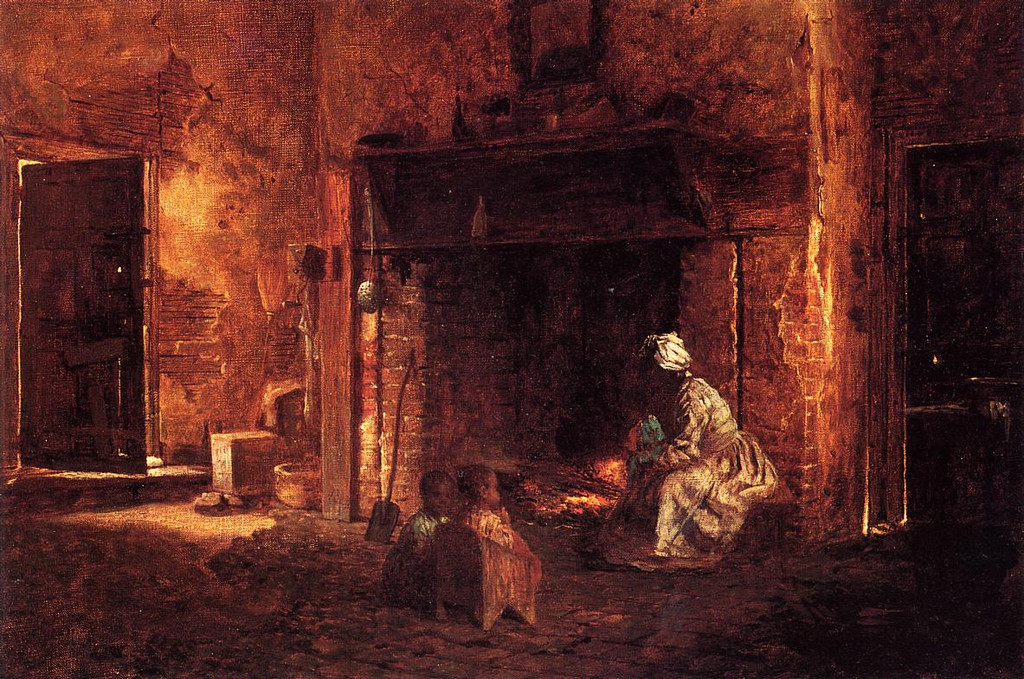
The hearth is much larger than the people gathered beside it. Its dark opening occupies the centre of Eastman Johnson’s Kitchen at Mount Vernon , while a woman holding a baby sits to the right and two children sit nearer the foreground. Broken plaster and exposed lath make the room’s worn condition as noticeable as its domestic use.
The canvas illustrated here dates from 1857 and is recorded in the Charles Butt collection in Texas. Mount Vernon owns a separate version painted on board in 1864. The familiar kitchen title also needs qualification: the catalogue raisonné, following the Mount Vernon Ladies’ Association, identifies the represented room as the Servant’s Hall. [1] [2]
At a Glance
- Artist Eastman Johnson
- Title Kitchen at Mount Vernon, also catalogued as Washington’s Kitchen at Mount Vernon
- Illustrated version 1857
- Medium Oil on canvas
- Dimensions 35.6 × 53.3 cm
- Collection Charles Butt collection, Texas, as recorded by the catalogue raisonné
- Catalogue number Hills 6.0.4
- Related version Mount Vernon Ladies’ Association, 1864, oil on board, M-1001
The Mount Vernon board measures 31.8 × 52.1 cm according to the catalogue raisonné. The owning museum’s larger, three-dimensional measurements include its frame and should not be substituted for the painted support. [2] [3]
This work across Eastman Johnson’s career
Kitchen at Mount Vernon (current article)
1857; Charles Butt canvasNegro Life at the South
1859; New York Historical originalA Ride for Liberty—The Fugitive Slaves
About 1862; Brooklyn versionSugaring Off
About 1864–65; unfinished RISD canvasThe Wounded Drummer Boy (San Diego study)
About 1864–71; study, not the finished canvasThe Early Scholar
About 1865; NGA studyNotes and sources
Kitchen at Mount Vernon (current article). A large hearth and worn architecture surround a small family group. [1]
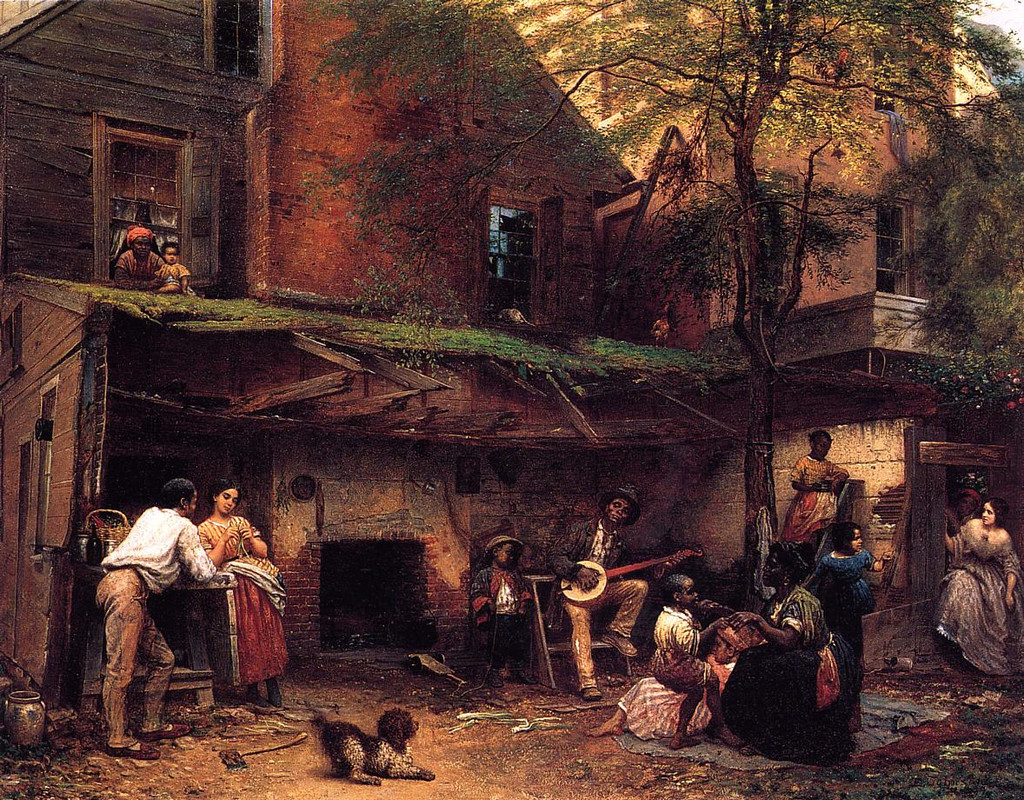
Negro Life at the South. A Washington yard brings everyday encounters into the contested setting of slavery. [4]
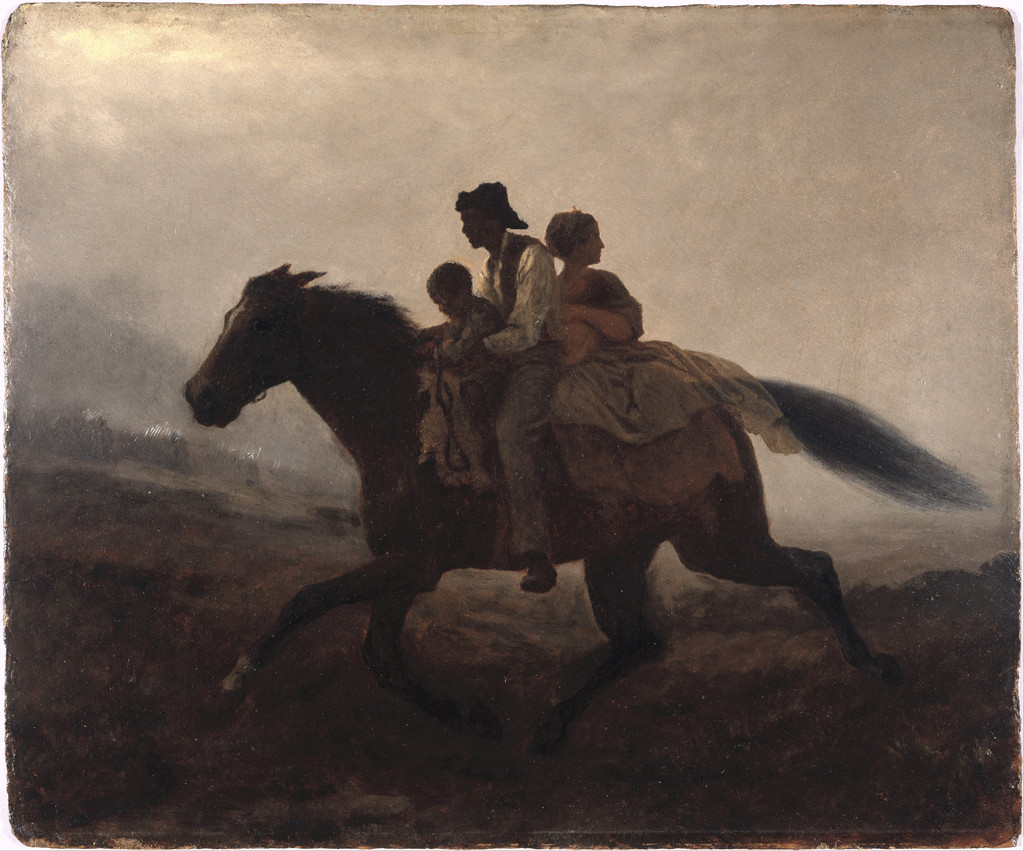
A Ride for Liberty—The Fugitive Slaves. A family’s movement towards freedom carries the whole composition. [5]
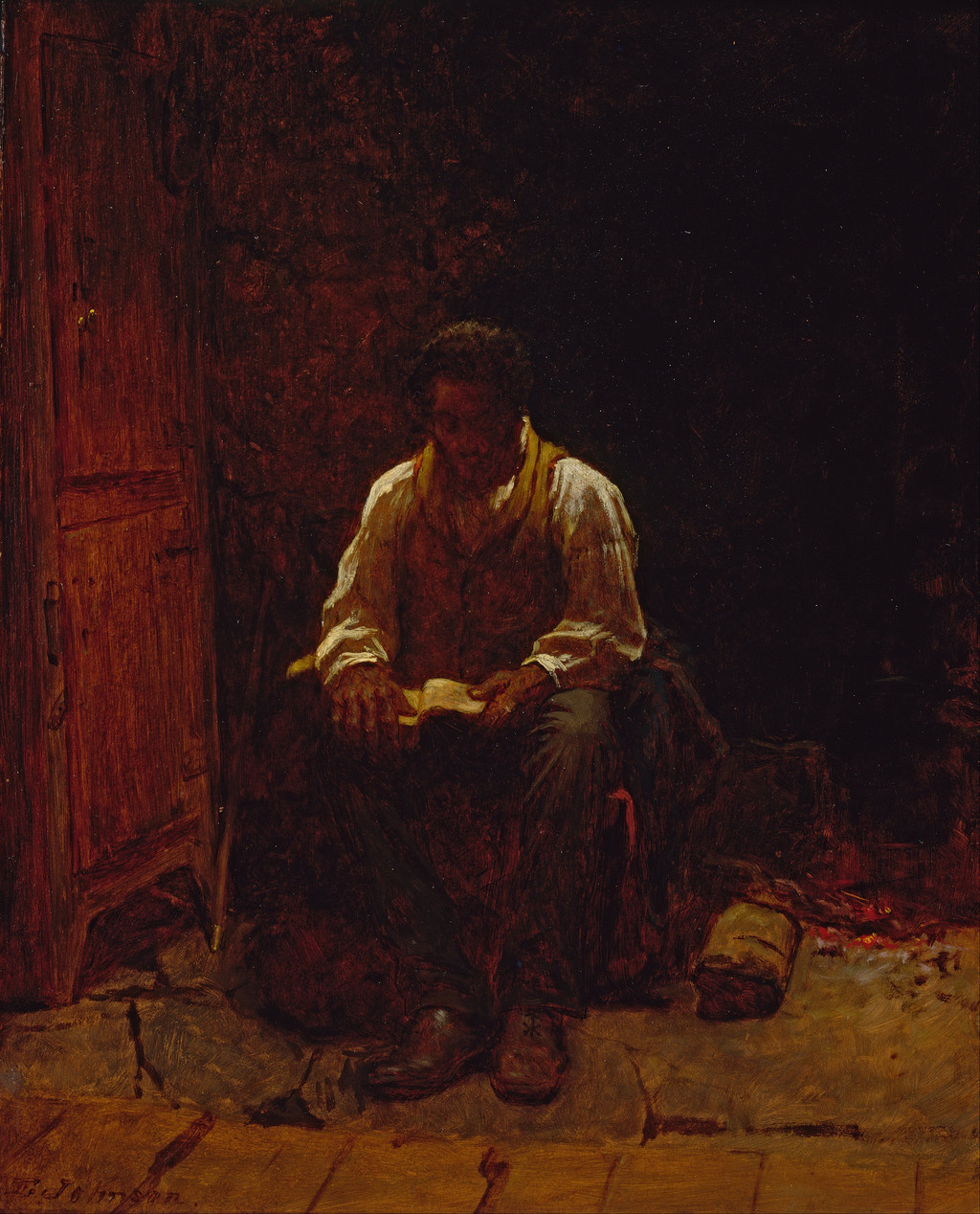
The Lord Is My Shepherd. A lowered head and open book concentrate attention within a dark room. [6]
Sugaring Off. Unfinished passages reveal the preparation of an ambitious gathering around maple-sugar production. [7]
The Wounded Drummer Boy (San Diego study). Soldier and drummer form a single upright group; this study has its own object history. [8]
The Early Scholar. A child’s position beside a stove turns the need for warmth into the centre of a schoolroom. [9]
Contents
- Doors, firelight and a family group
- The room behind the title
- Mount Vernon in the 1850s
- Domesticity and the limits of resemblance
- European painting and an American interior
- The later Mount Vernon version
- Exhibition, signature and ownership
Doors, firelight and a family group
Two doors flank the great chimney. Light enters at the left and catches the floor and wall, while the opening at the right leads into a darker space. Between them, the hearth holds its own smaller source of illumination. Johnson gives the viewer several ways into the room without making its entire interior equally clear.
The woman sits close to the fire with the infant on her lap. Her pale head covering and lighter dress emerge from the surrounding shadow, but her face remains less emphatic. The children nearer the foreground form another small grouping. One turns towards the viewer, introducing a contact across the picture’s surface that differs from the woman’s inward attention.
The furniture is plain, and everyday implements stand or hang around the hearth. The scale of these objects gives the domestic activity a physical setting: people have to sit, tend a fire, store things and move through doors within this room. The worn fabric of the building remains present around every such action.
The fireplace also acts as a compositional weight. Its broad black opening holds the middle of the painting, while the brighter figures sit below and beside it. The people are neither isolated against an empty background nor given the grandeur of formal portraiture. Their relationships unfold within architecture that seems to have a longer, difficult history of its own.
The room behind the title
The identification as the Servant’s Hall prevents the inherited title from becoming a substitute for architectural history. It does not require pretending that the painting lacks a cooking hearth or domestic equipment. A room’s name, its fitted features and its use at different moments are related questions, but they are not interchangeable. [1] [2]
The word Washington in several historical titles introduces another potential misunderstanding. Johnson did not depict a gathering observed during George Washington’s life. He visited the estate in the nineteenth century, and the painting belongs to that later encounter with the place. Its figures should not be assigned names from Washington’s household without supporting evidence.
The Mount Vernon museum identifies the woman in its 1864 version as enslaved and describes three children around her. That interpretation keeps the estate’s history of enslavement within view, rather than allowing the domestic setting to become an unqualified image of rustic comfort. It concerns a distinct painting, although the related composition makes it important to the subject as a whole. [3]
Mount Vernon in the 1850s
The catalogue places Johnson’s first visit to the estate in the summer of 1857, with the painter Louis Mignot, followed by another visit the next summer. It describes a site that had fallen into disrepair and a growing preservation effort by the Mount Vernon Ladies’ Association. Johnson’s damaged interior belongs within that encounter between a deteriorating place and renewed attention to Washington’s memory. [1]
The visible damage is unusually insistent. Areas of plaster have fallen away, exposing horizontal lath; rough brickwork interrupts the walls around the hearth. These surfaces make time and neglect visible without a written explanation. The grand historical association of the estate meets an interior whose condition offers little outward splendour.
That meeting gives the scene more than one possible emphasis. Viewers can attend to the national site in need of preservation, or to the people living within its deteriorated spaces. The painting holds both before us. Restoring the reputation or fabric of a famous estate does not automatically tell the histories of everyone who worked there.
Mount Vernon’s label for its version describes a romantic and melancholy mood produced by the dilapidation and dramatic light. That is a useful account of the picture’s emotional appeal, provided atmosphere does not obscure the conditions of enslavement also acknowledged by the museum. [3]
Domesticity and the limits of resemblance
The catalogue raisonné reproduces Patricia Hills’s comparison of the woman and children with Harriet Beecher Stowe’s description of the household in Uncle Tom’s Cabin . The parallel concerns a domestic grouping, including an adult caring for a baby and children nearby. It is a literary comparison, rather than proof that Johnson copied a particular passage or intended the painted figures to represent Stowe’s characters. [1]
The comparison raises a broader question about how a family interior was made legible to nineteenth-century audiences. A hearth, a mother and children could invite sympathy through familiar domestic forms. Yet familiarity can also encourage a viewer to overlook the legal and material circumstances that distinguish one household from another.
Johnson’s room resists complete reassurance. The figures have a shared domestic space, but the building around them is damaged, and the deep shadows withhold much of their individual appearance. We can recognise acts of care without claiming access to their thoughts or treating the painting as a complete description of life on the estate.
John Davis places Johnson’s earlier interior studies within the development that preceded the more elaborate Negro Life at the South of 1859. That later painting expands the relationships between people and architecture into a larger urban setting. The comparison helps trace Johnson’s recurring interest in inhabited spaces without assigning every interior the same political meaning. [10]
Watch: Eastman Johnson
Choose a film to explore the artist’s work, its interpretation and its wider setting.
Director's Choice - The Girl I Left Behind Me by Eastman Johnson
The Smithsonian American Art Museum looks at Johnson’s The Girl I Left Behind Me.
Watch on YouTubeEuropean painting and an American interior
Hills also relates the subject to the older pictorial tradition of people inhabiting ruined monuments, exemplified by the French painter Hubert Robert. Johnson’s setting gives that relationship a different historical charge: the damaged building is part of a famous American estate, and its inhabitants are connected with enslavement rather than an imagined ancient world. [11]
The comparison helps explain why the room’s architecture commands so much attention. A viewer can take pleasure in the varied surfaces, shafts of light and shadowed recesses, even while recognising deprivation in the place represented. The same feature may provide pictorial interest and evidence of neglect.
In her catalogue discussion of the 1857 canvas, Hills connects Johnson’s handling of illuminated interiors with Dutch seventeenth-century painting. The comparison concerns an approach to light and inhabited space, rather than a demonstrated copy of one particular picture. It places the small canvas within Johnson’s response to European art after his return to an American subject. [1]
The people prevent the interior from becoming an empty architectural study. The child’s outward look and the woman’s care for the baby give the room a present human use. Their grouping makes the estate something more immediate than an admired relic, even though the picture cannot tell their complete histories.
The later Mount Vernon version
George Washington Riggs and his wife Janet Sheddon Riggs commissioned the version now owned by Mount Vernon in 1864. Janet Riggs served as the association’s Vice Regent for Washington, D.C. The commission connects the subject directly with people involved in the estate’s preservation. [3]
The later work is painted on artist’s board and signed with a date ending in 64. Annie Burr Jennings, Vice Regent for Connecticut, gave it to the Mount Vernon Ladies’ Association in 1937. Its history therefore differs from that of the earlier canvas, even though both paintings carry closely related titles and show the familiar hearth and family arrangement. [2] [3]
The existence of a commissioned version seven years after the illustrated painting shows that the subject retained value beyond Johnson’s initial visit. The worn room could function as an image worth collecting and preserving in its own right. It carried both the estate’s famous association and a view of people largely absent from more ceremonial representations of Washington.
Exhibition, signature and ownership
The 1857 canvas appeared at the National Academy of Design in 1860 as Washington’s Kitchen at Mount Vernon . Its later provenance includes Samuel Latham Mitchill Barlow, Thomas B. Clarke and L. B. Doud. The catalogue records its purchase for the Charles Butt collection at the November 2019 Christie’s sale. [1]
The signature has a complicated history. The catalogue reports correspondence from 1895 concerning its faintness and a return to Johnson for re-signing. It also reports later examination under ultraviolet light and treatment after which the inscription remained difficult to see in ordinary light. Those accounts should not be turned into a fresh technical diagnosis from the reproduction. [1]
The painting’s strongest effects remain accessible without resolving every material question. Light crosses broken surfaces, the hearth gathers a small group, and one child looks out from the room. Johnson gives a famous place an intimate human scale while leaving its larger history present in the worn walls around the figures.
Artworks directory
Browse twenty-one selected objects discussed in these articles, including the Gifford portrait and the Prang print after Johnson. Dates identify individual objects, including the San Diego Drummer Boy study. Use All media to include the chromolithograph.
| Name | Date | Medium |
|---|---|---|
| Kitchen at Mount Vernon | 1857; Charles Butt canvas | Oil on canvas |
| Negro Life at the South | 1859; New York Historical original | Oil on linen |
| A Ride for Liberty—The Fugitive Slaves | About 1862; Brooklyn version | Oil on paperboard |
| The Lord Is My Shepherd | 1863 | Oil on fiberboard |
| Sugaring Off | About 1864–65; unfinished RISD canvas | Oil on canvas |
| The Wounded Drummer Boy (San Diego study) | About 1864–71; study, not the finished canvas | Oil on board |
| The Early Scholar | About 1865; NGA study | Oil on academy board on canvas |
| Fiddling His Way | 1866; Chrysler canvas | Oil on canvas |
| The Letter Home | 1867; Minneapolis drawing | Charcoal and graphite on paper |
| The Boyhood of Lincoln | 1868; Michigan canvas | Oil on canvas |
| The boyhood of Lincoln—An evening in the log hut (Prang after Johnson) | About 1868; separate reproductive print | Chromolithograph, W. Harring / L. Prang & Co., after Johnson |
| The Brown Family | 1869; NGA version | Oil on paper on canvas |
| The Hatch Family | 1870–71 | Oil on canvas |
| The Old Stagecoach | 1871 | Oil on canvas |
| The Girl I Left Behind Me | About 1872 | Oil on canvas |
| The Toilet | 1873 | Oil on paper board |
| Husking Bee, Island of Nantucket | 1876; Chicago canvas | Oil on canvas |
| The New Bonnet | 1876 | Oil on academy board |
| Sanford Robinson Gifford | 1880; possibly posthumous | Oil on academy board |
| The Cranberry Harvest, Island of Nantucket | 1880; Timken canvas | Oil on canvas |
| The Nantucket School of Philosophy | 1887 | Oil on panel |
Frequently Asked Questions
Discussion
Look again at the images and ideas explored in Kitchen at Mount Vernon by Eastman Johnson. These editorial prompts invite your observations.
Reader Insights
How do the large hearth and flanking doors give the small family group its position in the room?
What changes when the familiar kitchen title is considered alongside the Servant’s Hall identification?
Compare the damaged surfaces with the acts of care. How can picturesque appeal and difficult history occupy the same image?
Join the Conversation
Share a detail, comparison or question about Kitchen at Mount Vernon by Eastman Johnson below.
References
- Patricia Hills and Abigael MacGibeny , Washington’s Kitchen at Mount Vernon, 1857, Hills no. 6.0.4, Eastman Johnson Catalogue Raisonné. Illustrated canvas, visits, room identification, provenance, exhibitions and mediated signature/treatment history. Original correspondence and conservation report were not separately consulted. View source
- Hills and MacGibeny , Mt. Vernon Kitchen, 1864, Hills no. 6.0.7. Separate Mount Vernon board, support dimensions and collection history. View source
- Mount Vernon Ladies’ Association , Kitchen at Mount Vernon, 1864, M-1001. Owning museum’s label, commission, gift, support, framed dimensions and description of its version. View source
- Negro Life at the South,1859,S-225. View source
- A Ride for Liberty–The Fugitive Slaves, Brooklyn version, Hills 10.0.11r. View source
- The Lord Is My Shepherd, 1863, 1979.5.13. View source
- Sugaring Off, ca.1864–1865, 45.050. View source
- Wounded Drummer Boy, San Diego study, Hills 10.0.18. View source
- The Early Scholar,c.1865,1963.10.157: current object record. View source
- John Davis , Eastman Johnson’s Negro Life at the South and Urban Slavery in Washington, D.C., The Art Bulletin 80, no. 1, 1998, pp. 67–92. Earlier interior studies and the development of the 1859 composition. View source
- Patricia Hills , Painting Race: Eastman Johnson’s Pictures of Slaves, Ex-Slaves, and Freedmen, in Eastman Johnson: Painting America, 1999, pp. 122, 125. Early interiors and the comparison with people inhabiting ruins; no claim of direct consultation of the historical estate records. View source
- Splash image source.
Eastman Johnson, Kitchen at Mount Vernon, 1857. Oil on canvas, 35.6 × 53.3 cm. Charles Butt collection, Texas, as recorded by the Eastman Johnson Catalogue Raisonné, Hills 6.0.4. Public domain faithful reproduction via WikiArt. This is distinct from Mount Vernon’s 1864 board version. Public domain .
View source