 by
Tom Gurney
Tom Gurney BSc (Hons) is an art history expert with over 20 years experience
Email:
tomgurney1@gmail.com
/ Phone:
+44 7429 011000
The Hatch Family by Eastman Johnson: Introduction
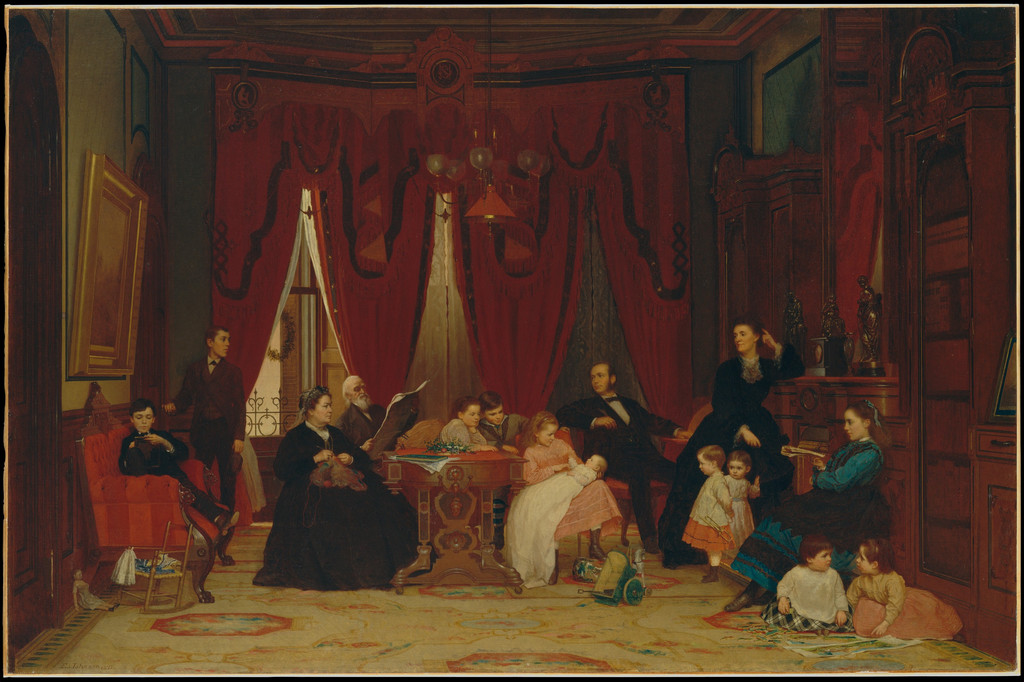
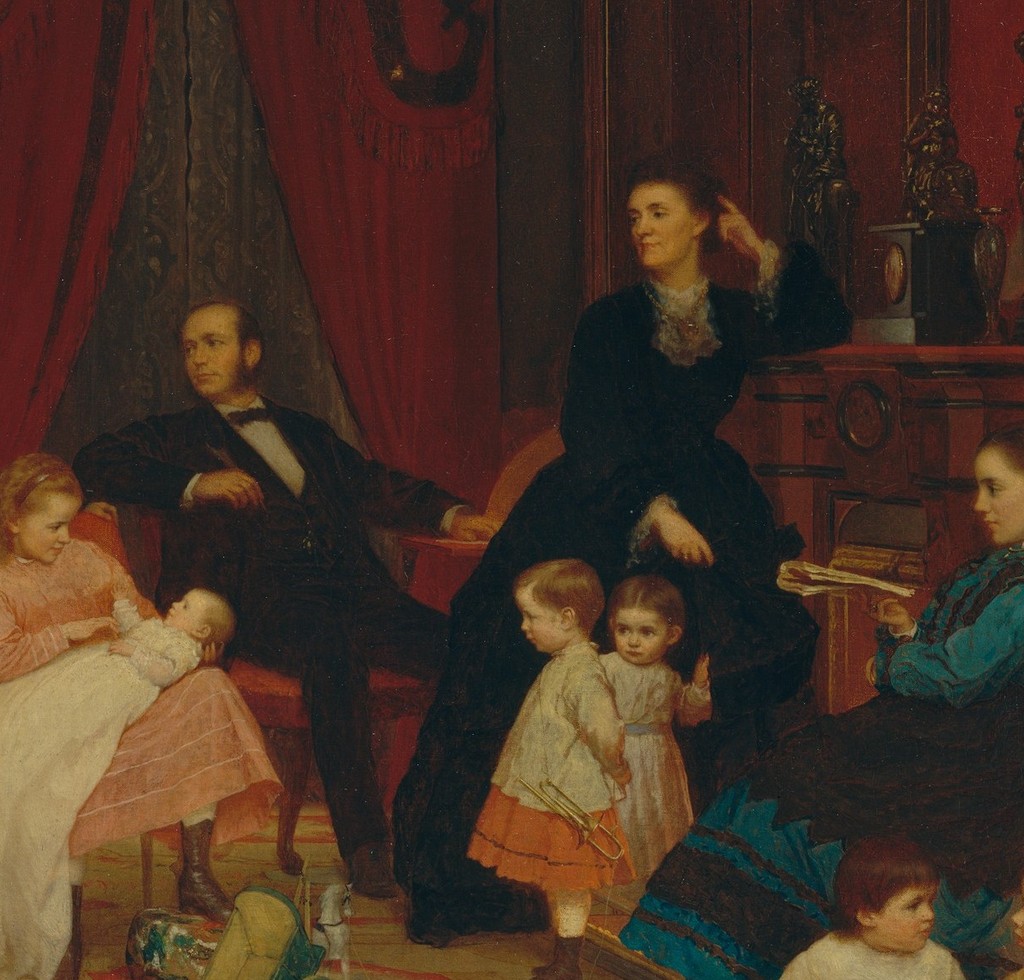
Eastman Johnson’s The Hatch Family fills a New York library with three generations. Children gather around a small table, a newspaper rises above the central company, and two younger figures sit together on the carpet. At the right, the parents preside over the room without requiring everyone else to face them—or us.
The portrait was commissioned by Wall Street broker and collector Alfrederick Hatch and painted in 1870–71. Its fifteen figures make it an ambitious exercise in group portraiture, but the furnishings are almost equally insistent. Family likeness, domestic activity and material prosperity share the same large canvas. [1] [2]
At a Glance
- Artist Eastman Johnson
- Title The Hatch Family
- Date 1870–71
- Medium Oil on canvas
- Dimensions 121.9 × 186.4 cm
- Sitters Alfrederick and Theodosia Hatch, eleven children and two grandparents
- Collection Metropolitan Museum of Art, New York
- Accession 26.97
- Credit Gift of Frederic H. Hatch, 1926
The date range follows the current Met record; the painting itself is signed and dated 1871. [1] [2]
This work across Eastman Johnson’s career
The Letter Home
1867; Minneapolis drawingThe Boyhood of Lincoln
1868; Michigan canvasThe Brown Family
1869; NGA versionThe Girl I Left Behind Me
About 1872The Toilet
1873Notes and sources
The Letter Home. A wounded man and a woman writing connect spoken words with an absent home. [3]
The Boyhood of Lincoln. Firelight makes an imagined scene of Lincoln reading into an image of aspiration. [4]
The Brown Family. A child’s reaching arm connects three generations within an elaborate interior. [5]
The Hatch Family (current article). Fifteen figures inhabit a library through a carefully distributed set of activities. [1]
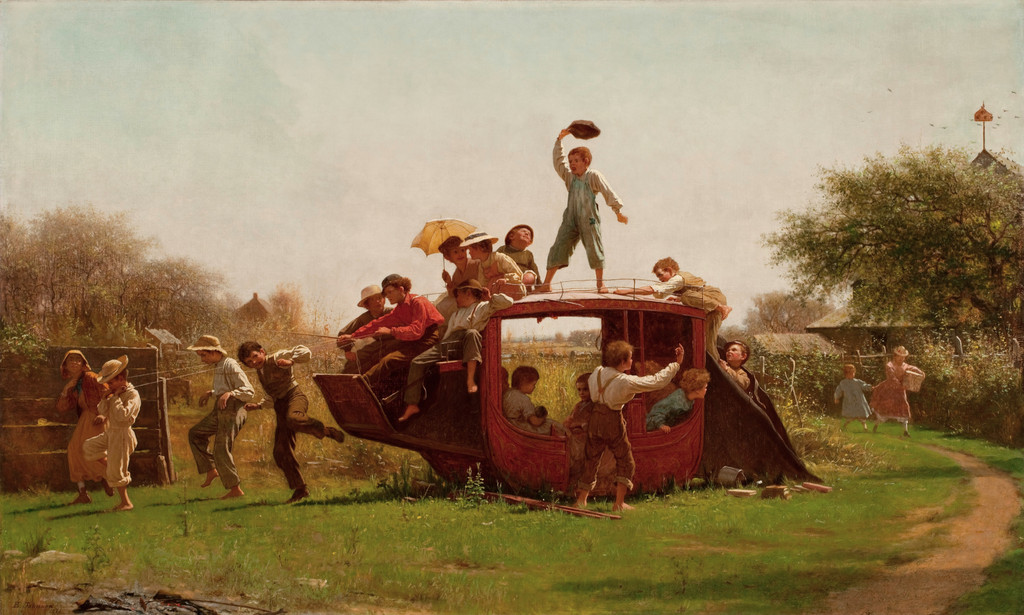
The Old Stagecoach. Children give a broken vehicle a new purpose through play. [6]
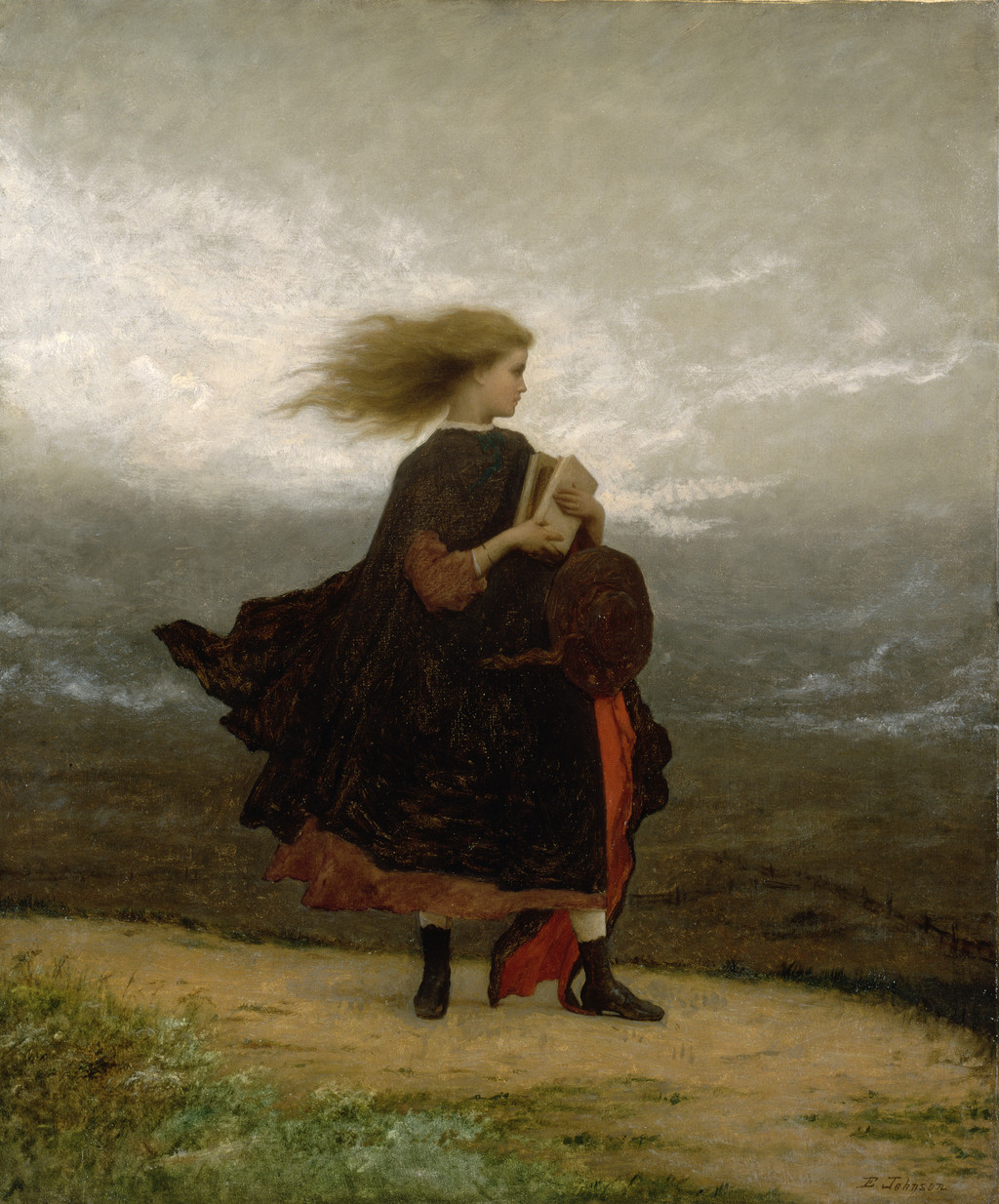
The Girl I Left Behind Me. A still figure, books and wind-driven clothing hold competing directions of attention. [7]
The Toilet. The mirror returns a face while the figure’s back occupies the foreground. [8]
Contents
- Fifteen people without a formal row
- Parents, grandparents and children
- A commission for a collector
- A new baby and a changing picture
- An elaborate room from carpet to ceiling
- Finish, drawing and preparatory studies
- Family memory and the museum
- Annotated details
Fifteen people without a formal row
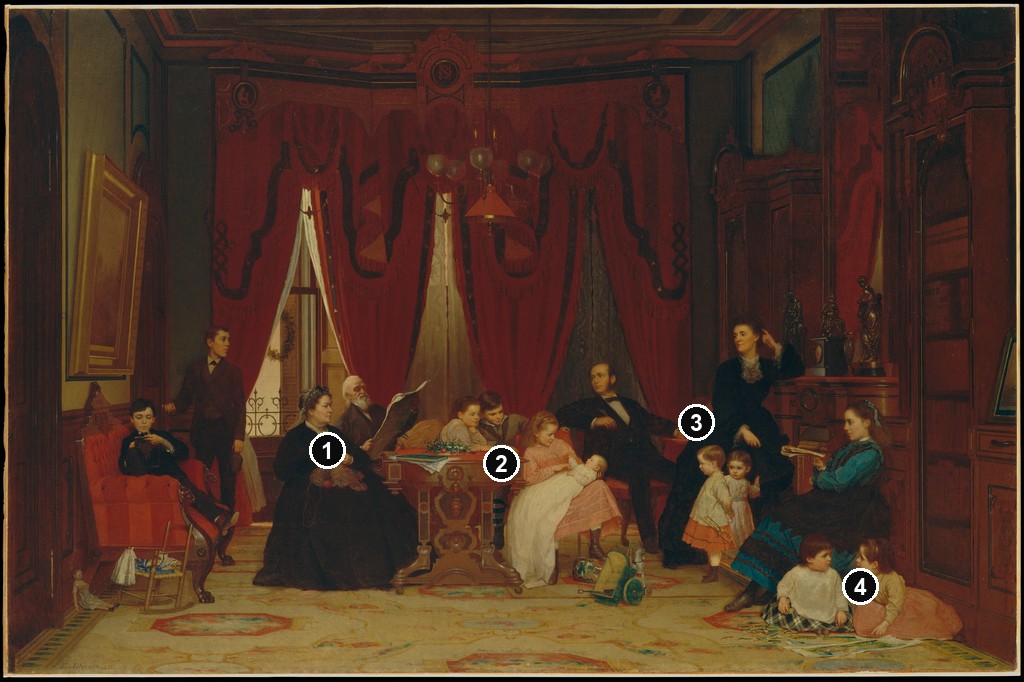
Johnson distributes the family through several smaller groups. Two boys occupy the far left, one standing and another seated. Nearer the centre, an older woman knits while an elderly man reads a newspaper behind her. Children lean together across the small table and continue the grouping towards the mother and seated father at the right.
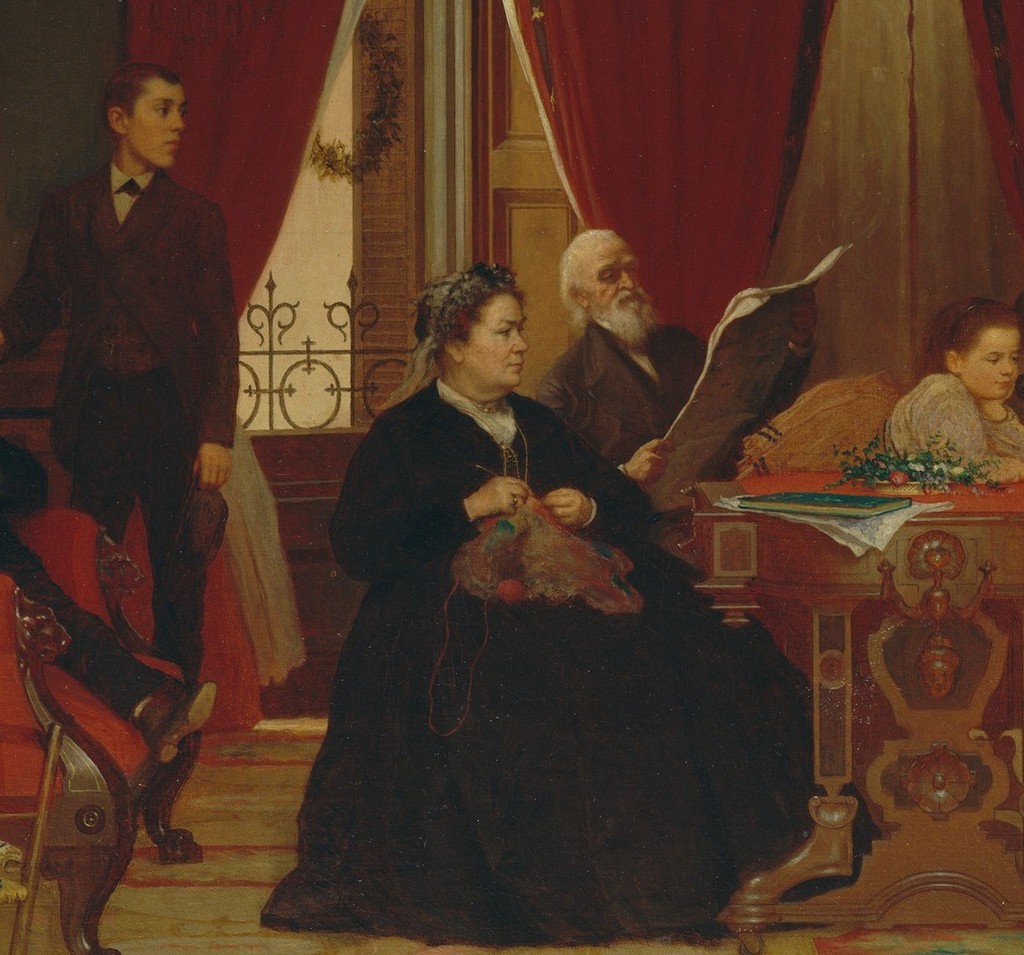
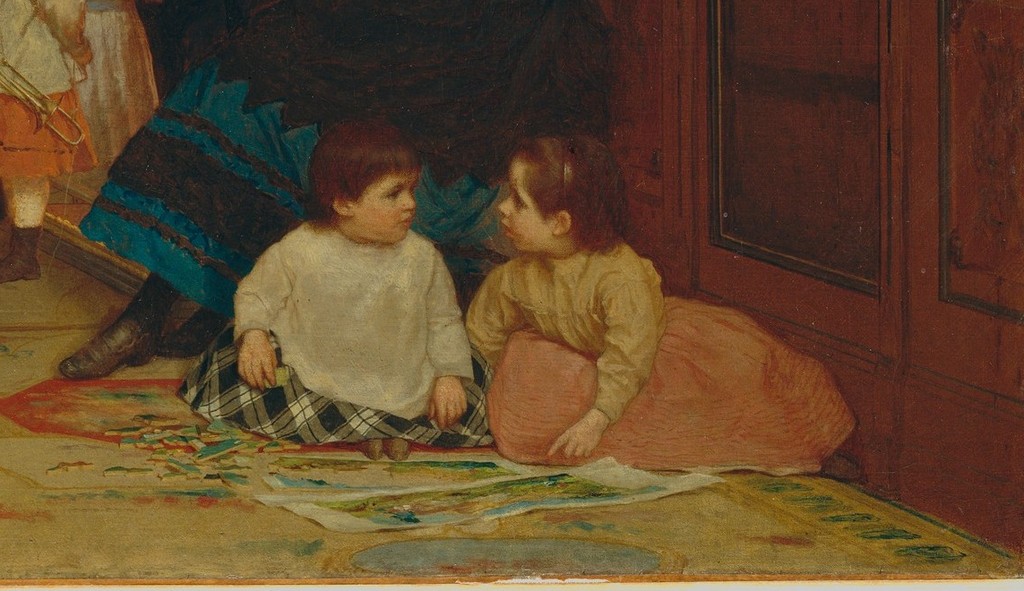
The youngest figures occupy lower levels. A girl holds a baby near the middle; two small children stand close to their mother; another pair sit on the floor at the right. Their changing heights prevent the figures from becoming a continuous horizontal band of heads. The arrangement gives the room a succession of overlapping centres.
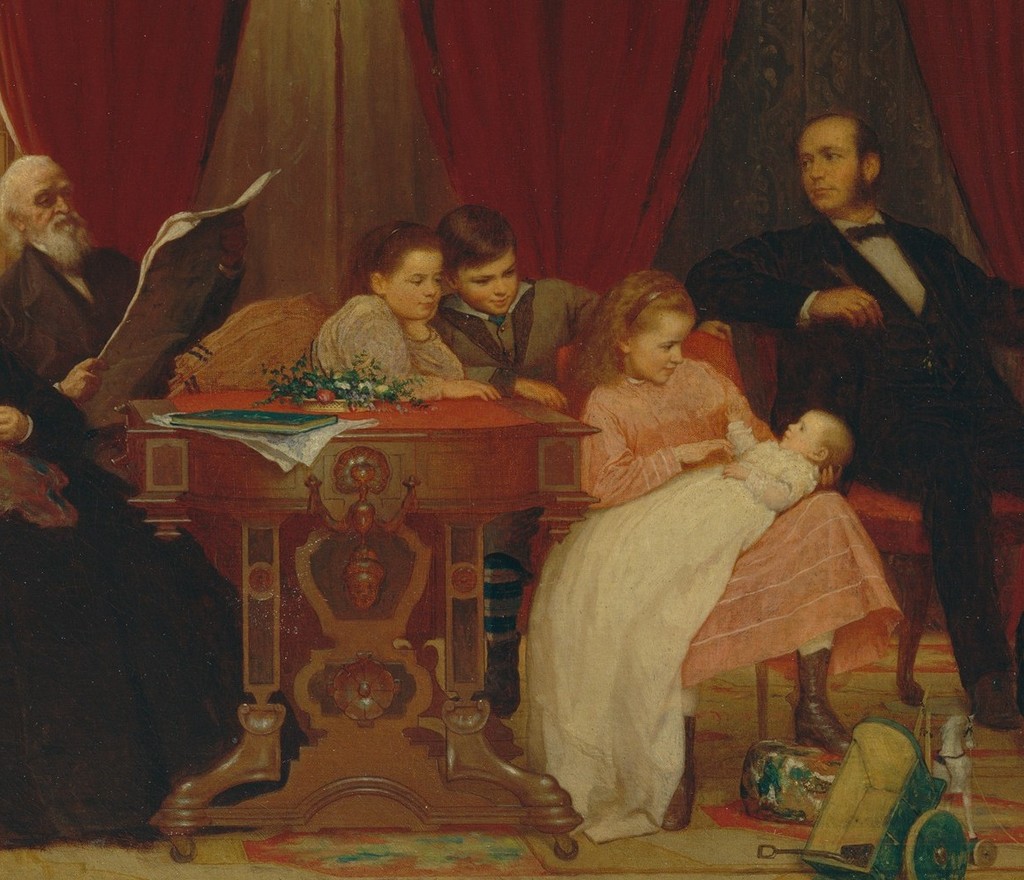
Attention likewise moves in several directions. Some children look towards one another or the objects before them. The father turns into the gathering from his desk, while the mother stands beside the fireplace. Their presence gives the composition a parental framework without suppressing the separate relationships within it.
The central table is especially useful. It brings children together around an object while creating a low, elaborate mass between the older generation and the group at the right. Its legs, carved details and projecting top help organise the floor space. Johnson uses furniture to gather people as well as to display the household’s possessions.
The result resembles a family encounter more than an official assembly. Yet its apparent ease depends on choices about overlap, spacing and pose. Fifteen distinct likenesses have to remain readable within one coherent interior, with enough variation to suggest ongoing life rather than a line of people waiting their turn.
Annotated Details from The Hatch Family
The numbered points identify visible features discussed in this article. Return from each detail to the whole composition. Eastman Johnson, The Hatch Family, 1870–71. Oil on canvas, 121.9 × 186.4 cm. The Metropolitan Museum of Art, Gift of Frederic H. Hatch, 1926, 26.97. Public domain. Image source. Public domain. Numbers added to a separate overview; detail images are native crops. No recolouring, retouching, reconstruction or enlargement.
Details from THE HATCH FAMILY
Compare the cropped details with the complete images above. Notice how their colours, shapes and positions contribute to the larger compositions.
Reading and needlework at the left
An older man raises a newspaper beside a woman occupied with work in her lap. Their different activities place two individual likenesses within the same part of the library.
Children around the central table
Children lean over the small table while another supports the baby nearby. Furniture, overlapping bodies and differing heights connect several figures without arranging them in a single row.
The parents within the right-hand group
The seated man and standing woman anchor the right side of the room. Younger children gather below them, joining the adults to the surrounding family activity.
Two children on the carpet
The youngest foreground pair turn towards one another on the carpet. Their low position brings the family group close to the viewer and extends the arrangement beyond the principal chairs.
Parents, grandparents and children
Alfrederick Hatch sits at the right, and his wife, Theodosia Ruggles Hatch, stands nearby at the mantel. The knitting woman is her mother, Mrs. John Gould Ruggles; the elderly newspaper reader is Hatch’s father, Dr. Horace Hatch. The remaining eleven figures are the couple’s children. The Met catalogue gives these identifications through information supplied by the donor in 1926. [2]
The mixture of generations makes the portrait more than a record of parents and offspring. It presents a household connected both backwards and forwards in time. The grandparents occupy recognisable activities rather than appearing as a separate commemorative group, while the children have different ages, postures and relationships to the room.
Reading and knitting are particularly effective ways of making that continuity visible. They establish familiar occupations around which the younger figures can gather. Johnson had already combined a knitting grandmother, newspaper-reading grandfather and child in The Brown Family . John Davis’s NGA catalogue entry discusses that earlier picture within the same broader practice of intergenerational family portraiture. [9]
The resemblance does not make the two commissions interchangeable. The Brown group is concentrated around a boy’s contact with his grandfather. Here, the family spreads across a much wider network of activities. A reader can follow several encounters without discovering one gesture that explains everyone else.
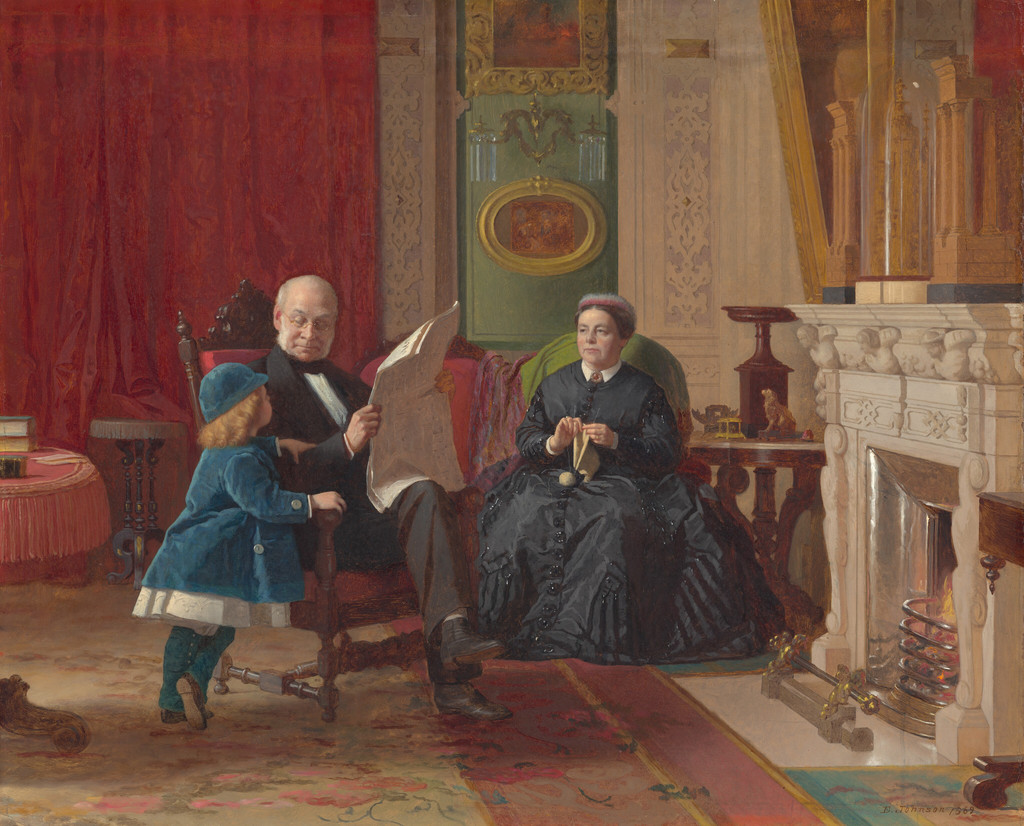
Eastman Johnson, The Brown Family, 1869. Oil on paper on canvas, 59 × 72.4 cm. National Gallery of Art, Gift of David Edward Finley and Margaret Eustis Finley, 1978.72.1. Public domain. This is the smaller Washington version.
Image source
.
Public domain
.
A commission for a collector
Hatch was a partner in the brokerage firm Fisk and Hatch and an enthusiastic buyer of paintings. The portrait places his family in the library of their home on Park Avenue at 37th Street. His later presidency of the New York Stock Exchange, in 1883–84, should not be projected backwards into the circumstances of the 1870–71 commission. [1] [2]
The library brings collecting into the portrait’s structure. Pictures hang above and beside the sitters, furnishings receive careful description, and the room’s decorative system extends from carpet to ceiling. The family is represented through a setting in which objects and taste are continually visible.
The current Met interpretation describes the painting as a presentation of generational wealth. That reading is supported by the scale of the group, the luxurious interior and the continuity between age groups. It also draws attention to the social specificity of the scene: these are the domestic comforts of an affluent household after the Civil War, not a neutral sample of American family life. [1]
A new baby and a changing picture
Frederic Hatch later recalled that the portrait took about a year and a half. According to his account, a new baby arrived shortly before completion, requiring Johnson to adjust the composition. The earlier youngest child was represented standing in short dresses near her mother, while the newest arrival occupied the place of the baby. [2]
Another family recollection connects the birth of Emily Nichols Hatch in August 1871 with a promise of an additional thousand dollars for her inclusion. The Met catalogue reports the story as part of the family’s memory of the commission. It is useful evidence of how the picture’s making was remembered, rather than a surviving invoice that independently fixes the entire price. [2]
The distinction matters because a second, less secure anecdote has sometimes supplied a total of ten thousand dollars. Johnson’s nephew recalled that figure for a family portrait but could not remember the work’s name. The catalogue suggests The Hatch Family as a possibility; the amount should therefore not be presented as its certain documented fee. [2]
The more secure point is that the commission developed over time while the family itself changed. The finished arrangement gives the impression of a single gathering, but its history contains different stages of observation, preparation and revision. The baby story helps make that temporal difference intelligible.
Watch: Eastman Johnson
Choose a film to explore the artist’s work, its interpretation and its wider setting.
Director's Choice - The Girl I Left Behind Me by Eastman Johnson
The Smithsonian American Art Museum looks at Johnson’s The Girl I Left Behind Me.
Watch on YouTubeAn elaborate room from carpet to ceiling
The room rises high above the figures. Heavy red hangings, carved timber, a chandelier and framed pictures fill the upper field, while the patterned carpet occupies much of the foreground. Johnson has given the family an architectural envelope that remains conspicuous even when the viewer concentrates on the people.
The curtains create several strong vertical divisions. Openings between them introduce narrower areas of light and make the room’s rear boundary more complicated than a flat wall. The wreath at a window suggests a Christmas setting in the Met’s interpretation, although the comforts and activities represented are not restricted to that season. [1]
The carpet does a different kind of work. Its broad patterns connect figures who sit at different distances, while toys and small possessions interrupt the surface near the children. The room can therefore appear both coordinated and occupied. Its order is a framework for activity, rather than evidence that nothing is ever moved.
Spassky relates the décor to Renaissance and Italianate revival taste and to the kind of fashionable interior associated with the New York furnishing firm of Léon Marcotte. That is a stylistic context for the ensemble; it does not prove that every chair, curtain or decorative object was individually made by Marcotte. [2]
The abundance of detail also changes the pace of looking. From a distance, the red room and light carpet establish large areas around the family. At closer range, a viewer can move between carved furniture, small toys, patterned fabrics and faces. The setting supplies many routes through the group, making the portrait reward more than an initial count of its sitters.
Finish, drawing and preparatory studies
The Met catalogue connects the painting with the tradition of English conversation pieces and Dutch domestic interiors. Both offer useful precedents for representing recognisable people through relationships and activities within a room. Johnson’s group combines that informal appearance with the demands of a substantial commissioned likeness. [2]
Its precise description does not mean that all the paint is thick. Spassky reports thin layers through which drawing remains visible in places, relating the method to Johnson’s training with Thomas Couture. The historical entry also records an Edward Dechaux canvas-preparation stamp noted before lining. These are specific material observations, not a complete identification of the paints used throughout. [2]
Preparatory studies survive in different media for individual family members. Their existence helps explain how a large group could be assembled from sustained work on particular heads and figures. It also connects this elaborate canvas with Johnson’s continuing practice as a draughtsman, explored on the drawings page . [2]
Family memory and the museum
The painting passed from Alfrederick Hatch to his son Frederic, who gave it to the Met in 1926. The donor also supplied identifications and recollections that became important to its later interpretation. The object and the family’s account of it entered museum history together, although their different kinds of evidence should remain distinguishable. [2]
Within Johnson’s portrait career , The Hatch Family demonstrates the scope of group portraiture well before his later concentration on individual commissions. Its achievement lies in making people, possessions and relationships coexist across a complicated space. The family’s impressive room remains a display of wealth, but the varied acts of looking, reading, knitting and playing prevent it from becoming an empty showroom.
Artworks directory
Browse twenty-one selected objects discussed in these articles, including the Gifford portrait and the Prang print after Johnson. Dates identify individual objects, including the San Diego Drummer Boy study. Use All media to include the chromolithograph.
| Name | Date | Medium |
|---|---|---|
| Kitchen at Mount Vernon | 1857; Charles Butt canvas | Oil on canvas |
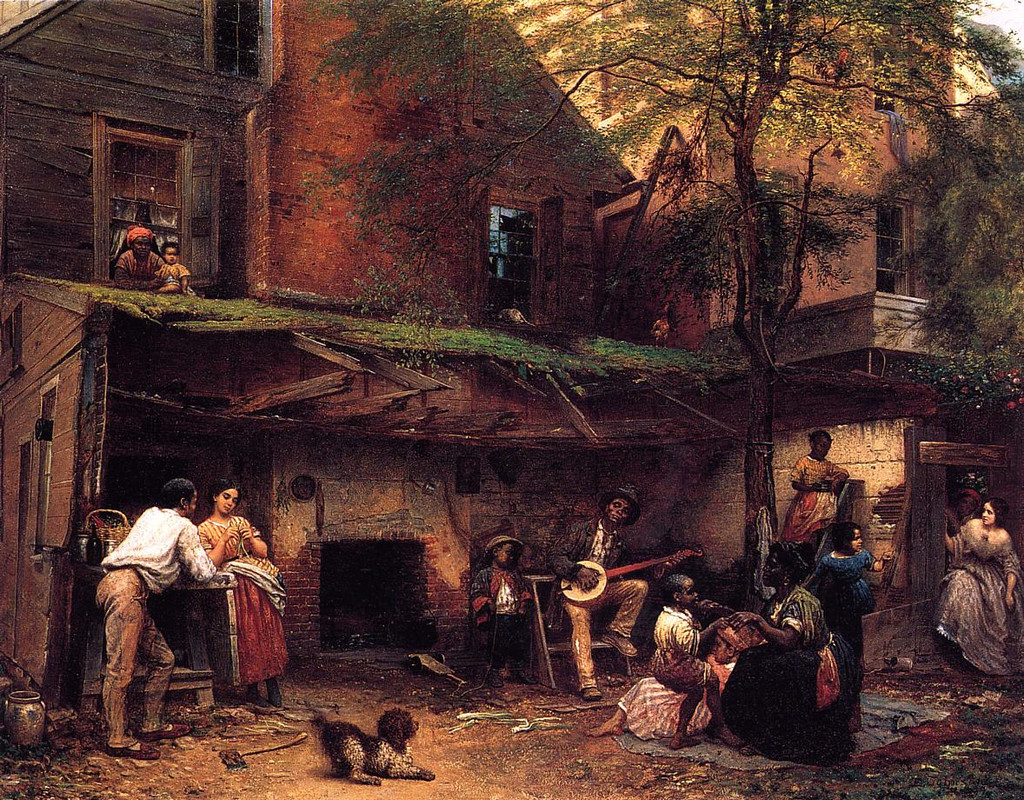
| Negro Life at the South | 1859; New York Historical original | Oil on linen |
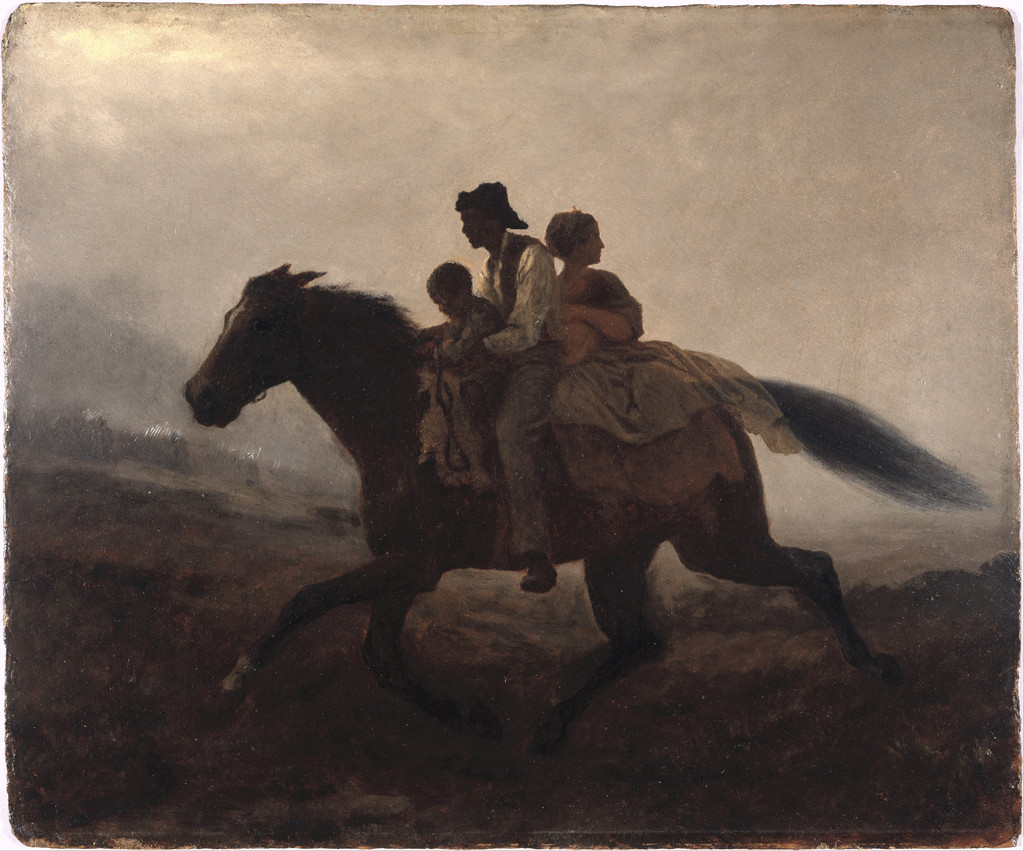
| A Ride for Liberty—The Fugitive Slaves | About 1862; Brooklyn version | Oil on paperboard |
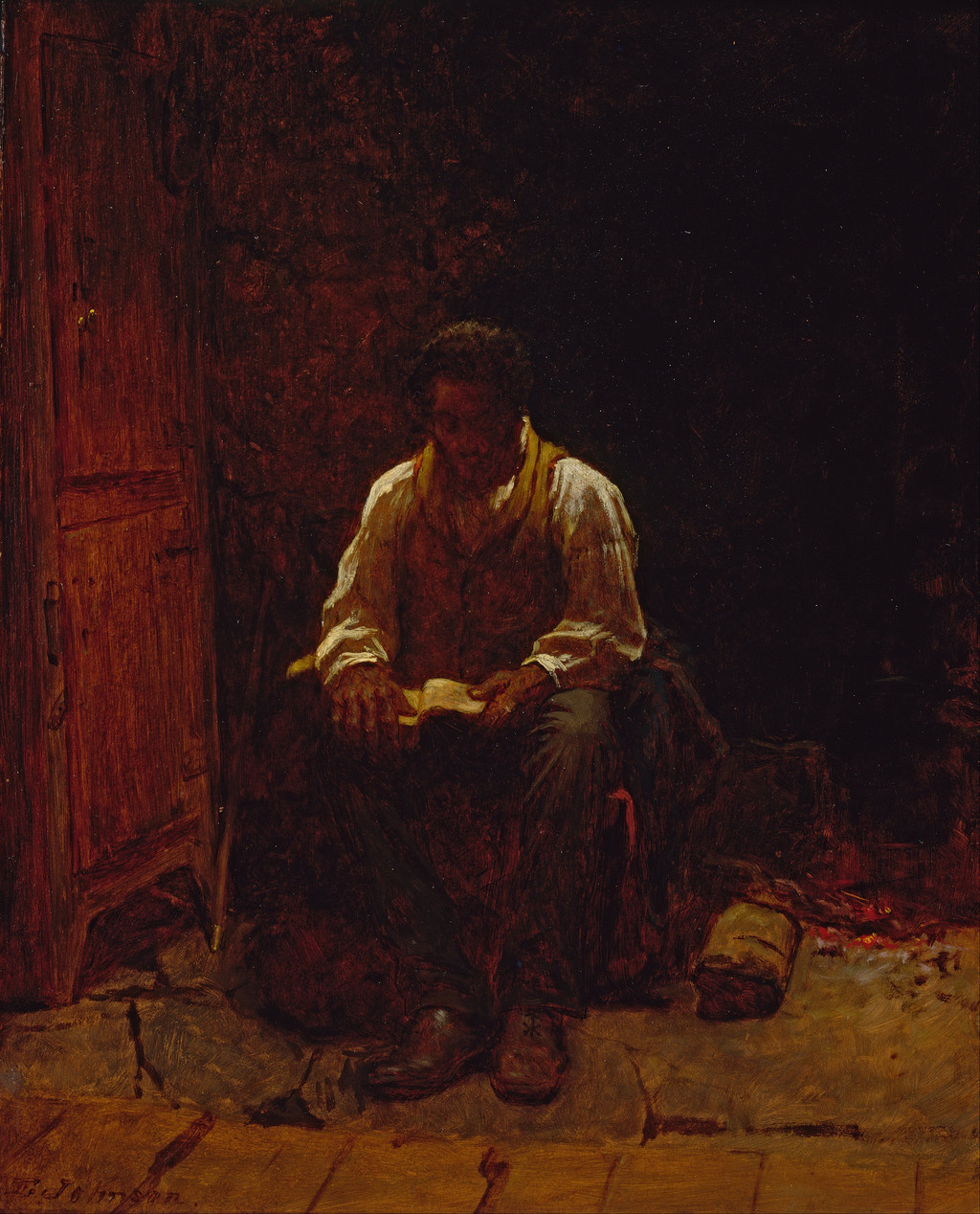
| The Lord Is My Shepherd | 1863 | Oil on fiberboard |
| Sugaring Off | About 1864–65; unfinished RISD canvas | Oil on canvas |
| The Wounded Drummer Boy (San Diego study) | About 1864–71; study, not the finished canvas | Oil on board |
| The Early Scholar | About 1865; NGA study | Oil on academy board on canvas |
| Fiddling His Way | 1866; Chrysler canvas | Oil on canvas |
| The Letter Home | 1867; Minneapolis drawing | Charcoal and graphite on paper |
| The Boyhood of Lincoln | 1868; Michigan canvas | Oil on canvas |
| The boyhood of Lincoln—An evening in the log hut (Prang after Johnson) | About 1868; separate reproductive print | Chromolithograph, W. Harring / L. Prang & Co., after Johnson |
| The Brown Family | 1869; NGA version | Oil on paper on canvas |
| The Hatch Family | 1870–71 | Oil on canvas |
| The Old Stagecoach | 1871 | Oil on canvas |
| The Girl I Left Behind Me | About 1872 | Oil on canvas |
| The Toilet | 1873 | Oil on paper board |
| Husking Bee, Island of Nantucket | 1876; Chicago canvas | Oil on canvas |
| The New Bonnet | 1876 | Oil on academy board |
| Sanford Robinson Gifford | 1880; possibly posthumous | Oil on academy board |
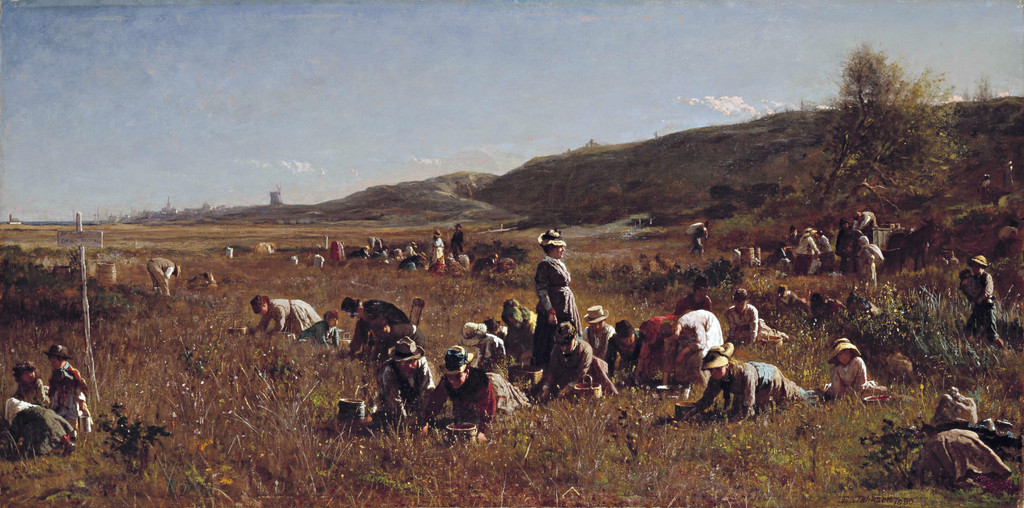
| The Cranberry Harvest, Island of Nantucket | 1880; Timken canvas | Oil on canvas |
| The Nantucket School of Philosophy | 1887 | Oil on panel |
Frequently Asked Questions
The catalogue identifies fifteen: Alfrederick and Theodosia Hatch, their eleven children, and two grandparents. The information derives from the donor’s documentation. [2]
Family recollections reported by the Met describe an adjustment after a new arrival in 1871. The story is retrospective and should be distinguished from a detailed contemporary sitting record. [2]
That total is not securely established for this particular picture. The nephew who recalled it for a family group could not remember the painting’s name. [2]
Discussion
Look again at the images and ideas explored in The Hatch Family by Eastman Johnson. These editorial prompts invite your observations.
Reader Insights
How does Johnson give fifteen figures distinct activities while holding the group within one room?
Follow the furniture into depth. Which objects act as boundaries or connections between generations?
How does the retrospective account of the baby’s addition affect your understanding of the portrait as a constructed record?
Join the Conversation
Share a detail, comparison or question about The Hatch Family by Eastman Johnson below.
References
- Metropolitan Museum of Art. The Hatch Family , 1870–71, 26.97. Current object record, commission, setting, interpretation and public-domain image. View source
- Natalie Spassky. “The Hatch Family.” In American Paintings in The Metropolitan Museum of Art , Volume II, 1985, pp. 223–225. Sitters, family recollections, furnishings, preparatory studies, material account and provenance. View source
- The Letter Home,1867,74.17; current collection data. View source
- Boyhood of Lincoln,1868,1895.90. View source
- The Brown Family, 1869, 1978.72.1. View source
- The Old Stagecoach, 1871, L1888.22. View source
- The Girl I Left Behind Me, c.1872, 1986.79. View source
- The Toilet, 1873, 2015.19.85. View source
- John Davis. “The Brown Family.” In American Paintings of the Nineteenth Century , Part I, National Gallery of Art, 1996, pp. 376–382. Intergenerational conversation pieces and comparison with Johnson’s family groups. View source
- Splash image source.
Eastman Johnson, The Hatch Family, 1870–71. Oil on canvas, 121.9 × 186.4 cm. The Metropolitan Museum of Art, Gift of Frederic H. Hatch, 1926, 26.97. Public domain. Public domain .
View source