 by
Tom Gurney
Tom Gurney BSc (Hons) is an art history expert with over 20 years experience
Email:
tomgurney1@gmail.com
/ Phone:
+44 7429 011000
Eastman Johnson’s Portraits: Introduction
Portraiture runs through Eastman Johnson’s career, from early crayon drawings to substantial family groups and later commissions from public figures. It gave him opportunities to study a single face, arrange relationships within a furnished room and negotiate the expectations of a patron. The familiar scenes of everyday life developed alongside this continuing practice.
His portraits also connect different parts of nineteenth-century American society. Literary households, artists’ studios, financial families and civic institutions all appear within their histories. Looking across those settings makes the work more varied than a simple succession of formal heads. [1]
Selected Eastman Johnson portraits
At a Glance
- Early commissions Longfellow’s circle, from 1846 [2]
- Family groups The Brown Family and The Hatch Family [3] [4]
- Artist portrait Sanford Robinson Gifford, 1880 [5]
- Later subjects Business leaders, cultural figures and presidents [1]
Contents
- Early likenesses and literary patrons
- The Brown family and the room around a likeness
- Fifteen figures in The Hatch Family
- Gifford: a portrait within an artists’ community
- Public commissions and the studio photograph
- A sketch and a commissioned finish
- Likeness, patronage and ordinary action
- Annotated details
Early likenesses and literary patrons
The Longfellow commissions provide an early, well-documented example. Beginning in September 1846, Henry Wadsworth Longfellow commissioned crayon portraits of his sisters and close friends. The National Park Service identifies ten in the house collection and records Johnson’s double portrait of the poet’s sons in 1848. [2]
These works made drawing an independent professional activity. A likeness could preserve the appearance of a relative or friend and become part of the household’s account of itself. A group of portraits also recorded a network: the artist’s sitters belonged to relationships that continued beyond the individual sitting.
The attention to light and shadow that characterises Johnson’s drawings remained important in oil. A face could be specific without every edge becoming equally sharp. The reader can follow those material connections on the drawings and technique pages.
Annotated Details from Eastman Johnson’s Portraits
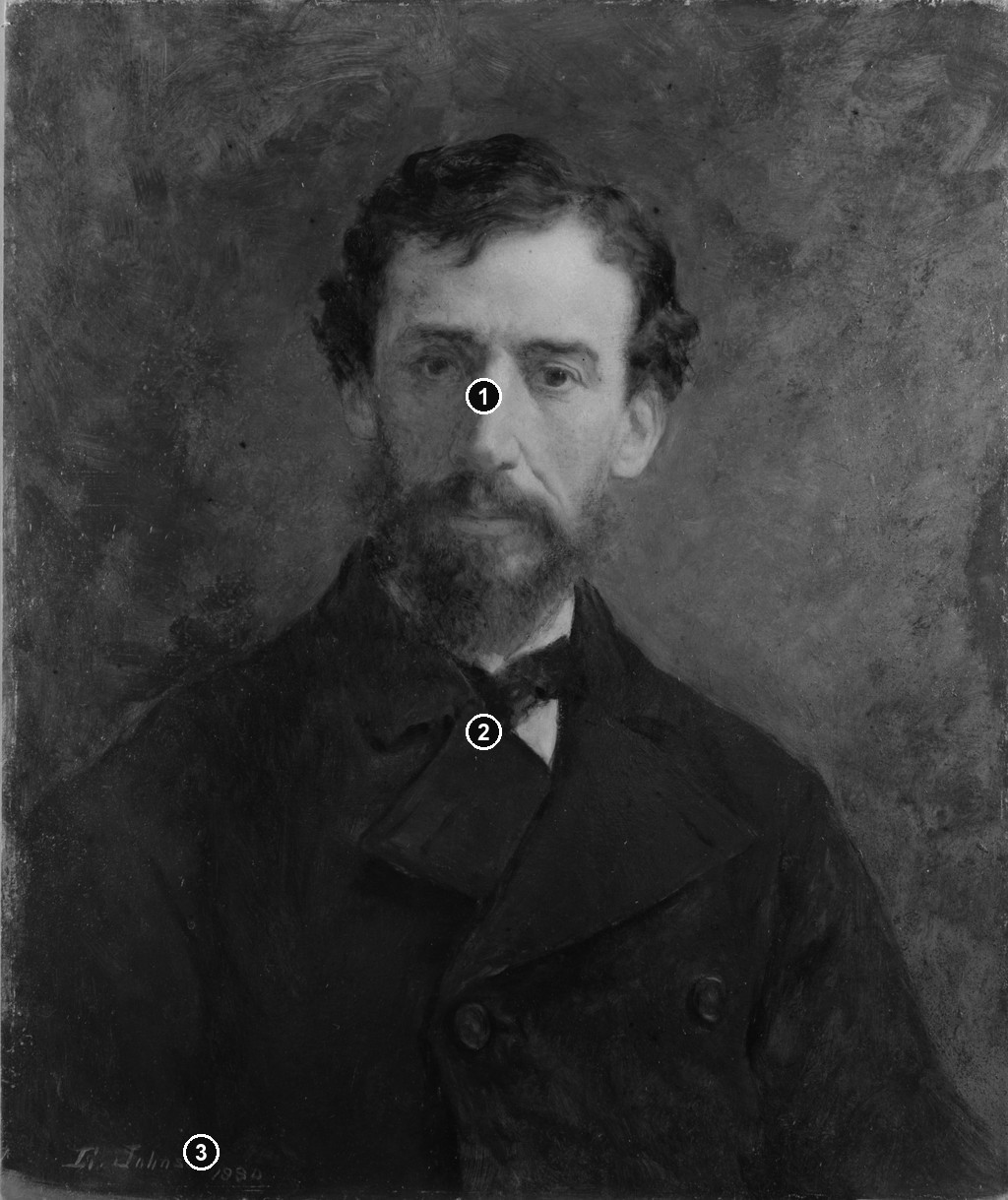
The numbered points identify visible features discussed in this article. Return from each detail to the whole composition. Eastman Johnson, Sanford Robinson Gifford, 1880. Oil on academy board, 67.9 × 56.2 cm. The Metropolitan Museum of Art, Gift of Richard Butler, 1888, 88.16. Monochrome museum reproduction; the original painting’s colours cannot be read from this image. Public domain. Image source. Public domain. Numbers added to a separate overview; detail images are native crops. No recolouring, retouching, reconstruction or enlargement.
Details from EASTMAN JOHNSON’S PORTRAITS
Compare the cropped details with the complete images above. Notice how their colours, shapes and positions contribute to the larger compositions.
The lit face and turned head
Light separates the forehead, nose and cheek from the darker hair and beard. This monochrome reproduction supports reading those tonal relationships while leaving the painting’s original colours undetermined.
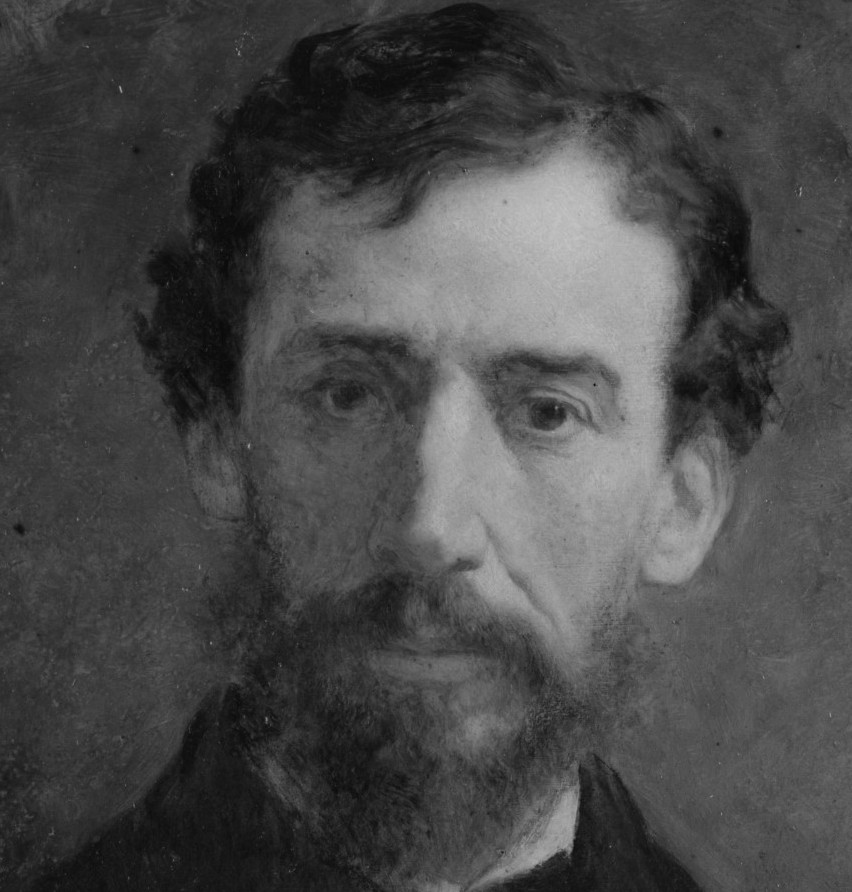
Collar, beard and dark coat
The pale collar interrupts the dark shapes of beard and clothing. Broad lapels extend the bust downwards while keeping the head as the principal light area.
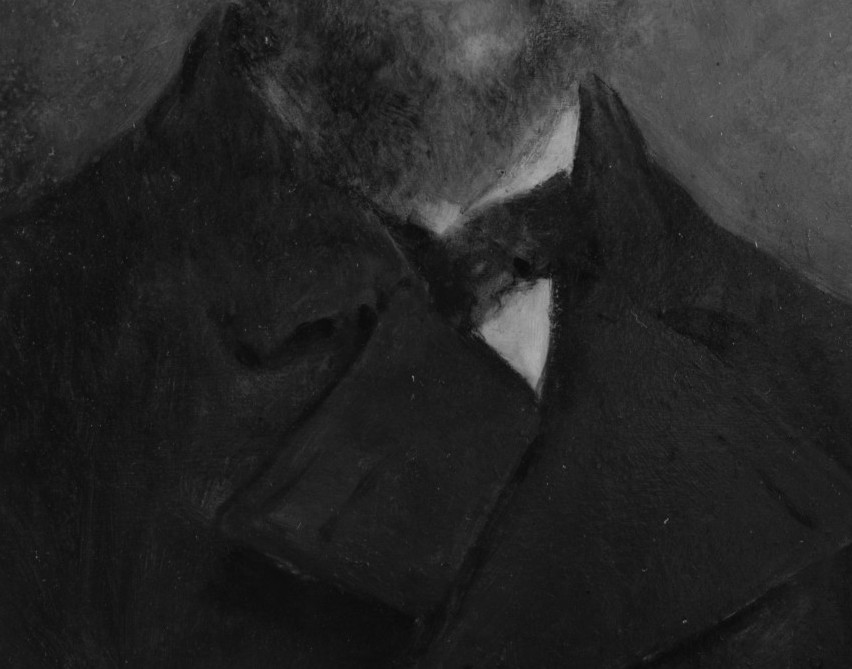
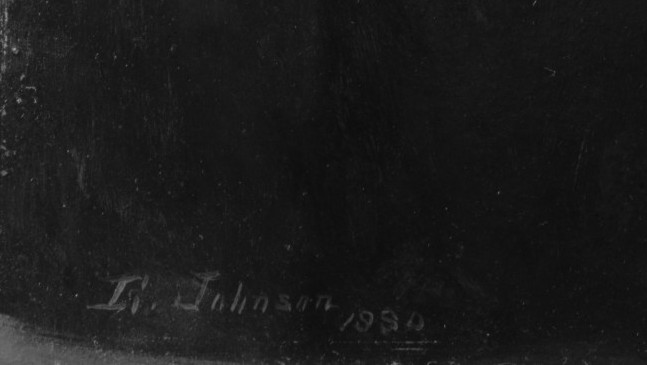
The lower-left signature and date
The signature and 1880 date sit low against the dark clothing. They form part of the visible painted record; the date alone does not establish whether the sitter posed from life.
The Brown family and the room around a likeness
The Brown Family brings individual likeness into a more extensive domestic setting. The National Gallery’s 1869 version shows James and Eliza Brown with their grandson William Adams Brown. Paper mounted to canvas carries a carefully developed room as well as the three figures. [3]
The room gives relationships visible form. Furniture, carpet, pictures and the hearth surround a small group whose attention is unevenly distributed. The child’s connection with the seated man is especially prominent, while the woman occupies another position within the encounter. The composition makes a family relationship readable without presenting everyone as though posed in a single line.
Domestic possessions do more than fill empty space. They establish comfort, taste and the kind of environment in which the family wished to be represented. Yet a painting of a richly appointed room does not give a complete account of the sitters’ private lives, and expression alone cannot supply the thoughts they held during a sitting.
The National Gallery work must remain distinct from the larger Brown family canvas in San Francisco. Contemporary criticism discussed the larger version’s display of furnishings; its entire reception should not be transferred to the smaller Washington painting. The relationship between the versions is part of the subject’s history, rather than a reason to merge them. [3]
The smaller work also complicates a straightforward study-and-final sequence. Its degree of finish is substantial, even though its paper support might suggest preparation. The catalogue considers several explanations without establishing one conclusively. Support, size and finish therefore need to be recorded before assigning it a precise role.
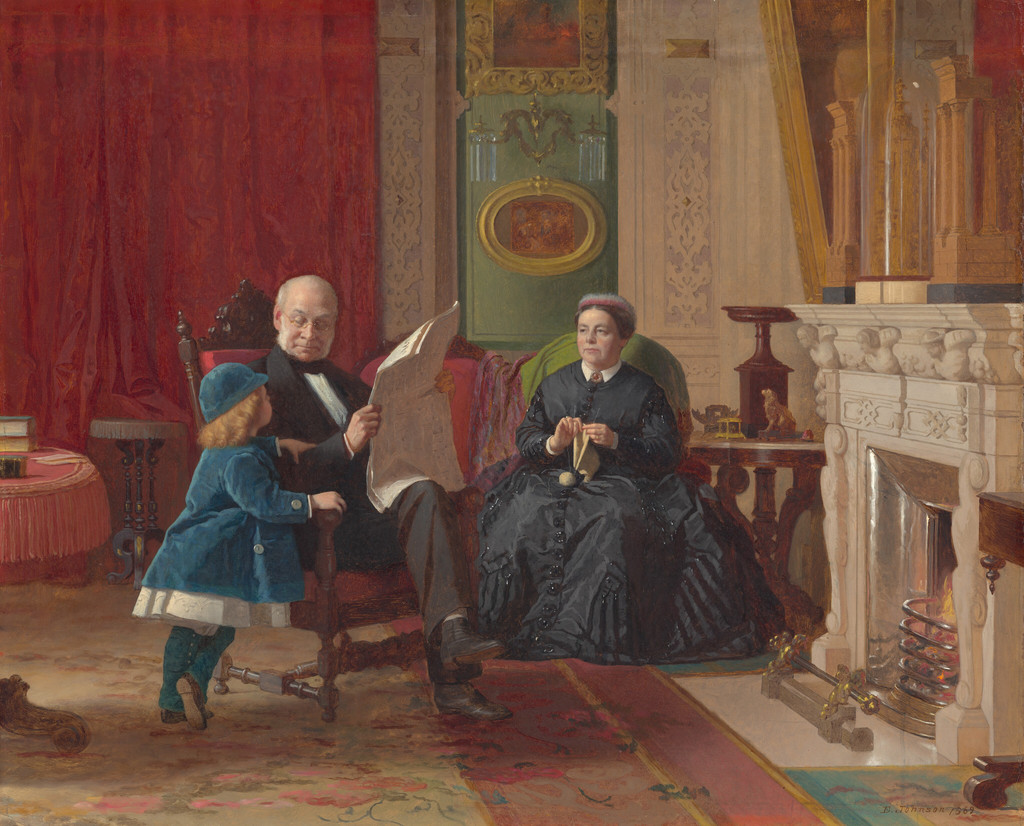
Eastman Johnson, The Brown Family, 1869. Oil on paper on canvas, 59 × 72.4 cm. National Gallery of Art, Gift of David Edward Finley and Margaret Eustis Finley, 1978.72.1. Public domain. This is the smaller Washington version.
Image source
.
Public domain
.
Fifteen figures in The Hatch Family
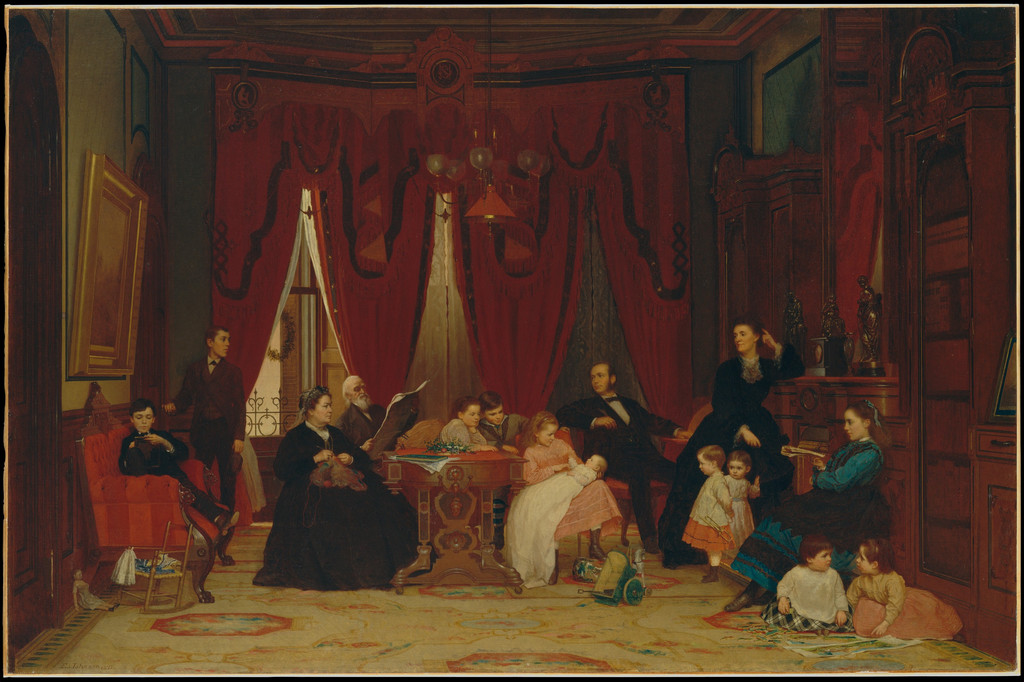
The Hatch Family , painted in 1870–71, expands the challenge to three generations and fifteen people. The Met catalogue identifies Alfrederick Smith Hatch, his wife Theodosia, two older relatives and their eleven children within the library of the family’s New York home. [4]
Johnson makes the room feel full without giving every figure the same task. Some read or attend to work; others look towards another person or occupy an edge of the group. The separate activities help the family appear to inhabit its environment, even while the arrangement has been carefully constructed.
The library’s depth is essential. Figures stand and sit at several distances, with the central furniture providing a framework for their distribution. Overlapping bodies and lines of sight keep the eye moving through a room that has to function as both setting and portrait structure.
The object is also a record assembled over time. The catalogue reproduces the donor’s later account of a baby’s addition and Johnson’s high opinion of the work. Those recollections help explain the picture’s family history, but they are retrospective testimony rather than a surviving schedule of every sitting or an invoice for each alteration. [4]
The scale and early date of the commission make it an important part of Johnson’s portrait career before the period when public likenesses increasingly occupied his time. A major family project was already central to his work while he was developing Nantucket subjects.
Gifford: a portrait within an artists’ community
The Met’s Sanford Robinson Gifford is dated 1880, the year of the landscape painter’s death. Johnson and Gifford were friends and neighbours in the Tenth Street Studio Building. The museum considers the portrait possibly posthumous, so its date alone does not establish a final sitting from life. [5]
The portrait is oil on academy board, 67.9 × 56.2 cm, accession 88.16. Richard Butler gave it to the Met in 1888 after it had belonged to Gifford’s widow. The museum relates the picture to professional friendships and patronage within its own early history. [5]
The available illustration is monochrome. It supports looking at the arrangement of head, clothing, light and shadow, but it cannot establish the original colours. That distinction is particularly important in a portrait whose effect depends on differences across the face.
Its history also shows how the meaning of a likeness can change. A portrait made within friendship may later become a memorial object and then part of a museum collection. These settings add associations without allowing us to diagnose the sitter’s emotional life from his expression.
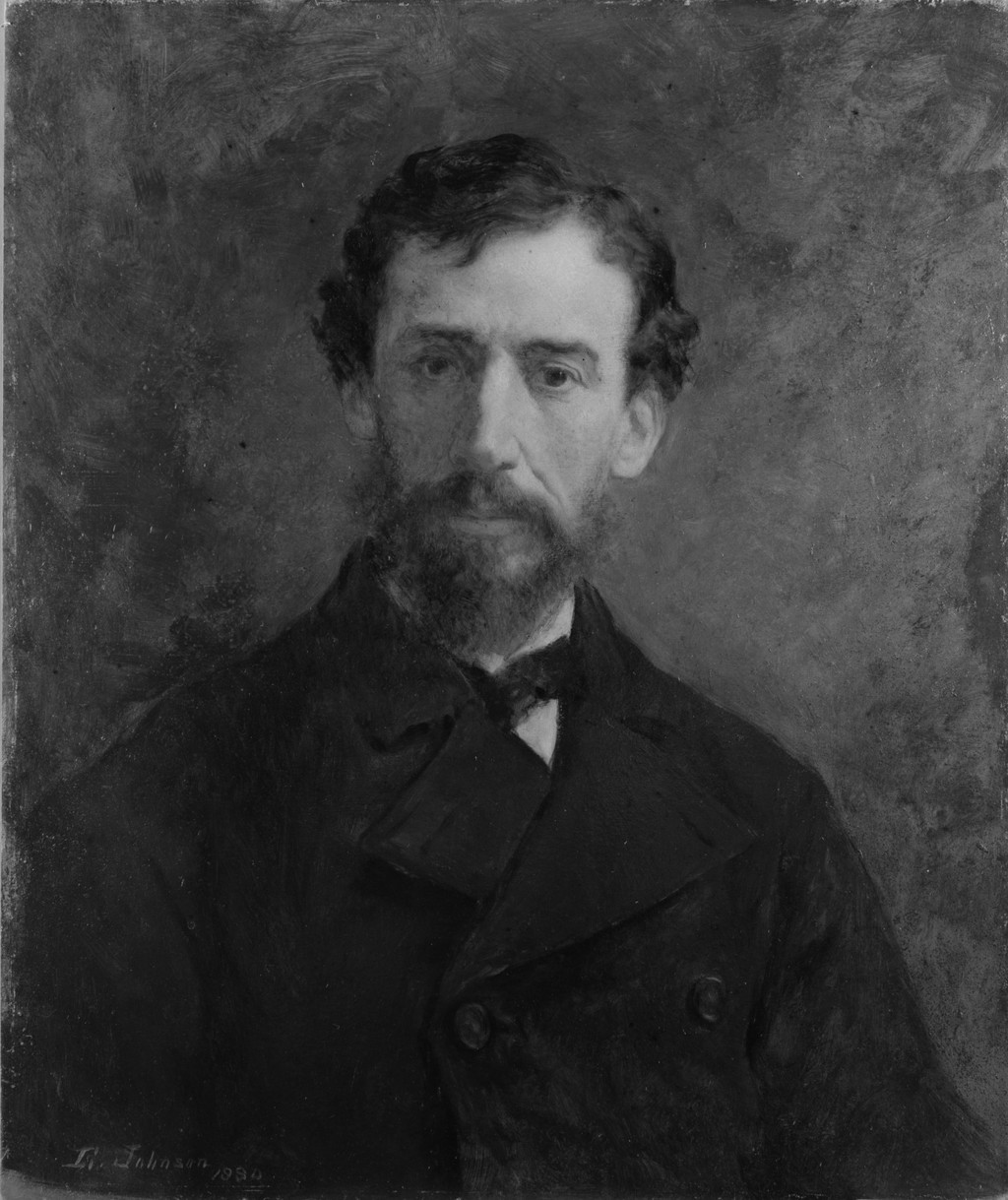
Eastman Johnson, Sanford Robinson Gifford, 1880. Oil on academy board, 67.9 × 56.2 cm. The Metropolitan Museum of Art, Gift of Richard Butler, 1888, 88.16. Monochrome museum reproduction; the original painting’s colours cannot be read from this image. Public domain.
Image source
.
Public domain
.
Watch: Eastman Johnson
Choose a film to explore the artist’s work, its interpretation and its wider setting.
Director's Choice - The Girl I Left Behind Me by Eastman Johnson
The Smithsonian American Art Museum looks at Johnson’s The Girl I Left Behind Me.
Watch on YouTubePublic commissions and the studio photograph
Johnson’s later portrait subjects included business leaders, cultural figures and presidents. The catalogue biography records work from life with Chester Arthur, Grover Cleveland and Benjamin Harrison. Such commissions belonged to an established practice, supported by social relationships and an ability to produce a recognisable, publicly usable likeness. [1]
A photograph published in The World’s Work in December 1906 shows Johnson standing before a large portrait of Harrison. The canvas dominates the working space, while the painter faces it with his palette and brushes. The image records the relation between artist, equipment and painted figure; it does not show Harrison physically standing beside him. [6]
Another photograph in the same article shows Johnson seated beside his portrait of Parke Godwin. The second face belongs to the painting. Keeping that distinction clear prevents a documentary image of the studio from being misread as a photograph of two living men sitting together.
The photographs were published in 1906, but their exact exposure dates are not established by that publication year. Their value here lies in the visible working arrangements and the way the article presented Johnson’s portrait practice. They do not document the date of every brushstroke or a complete session with the represented subject. [6]
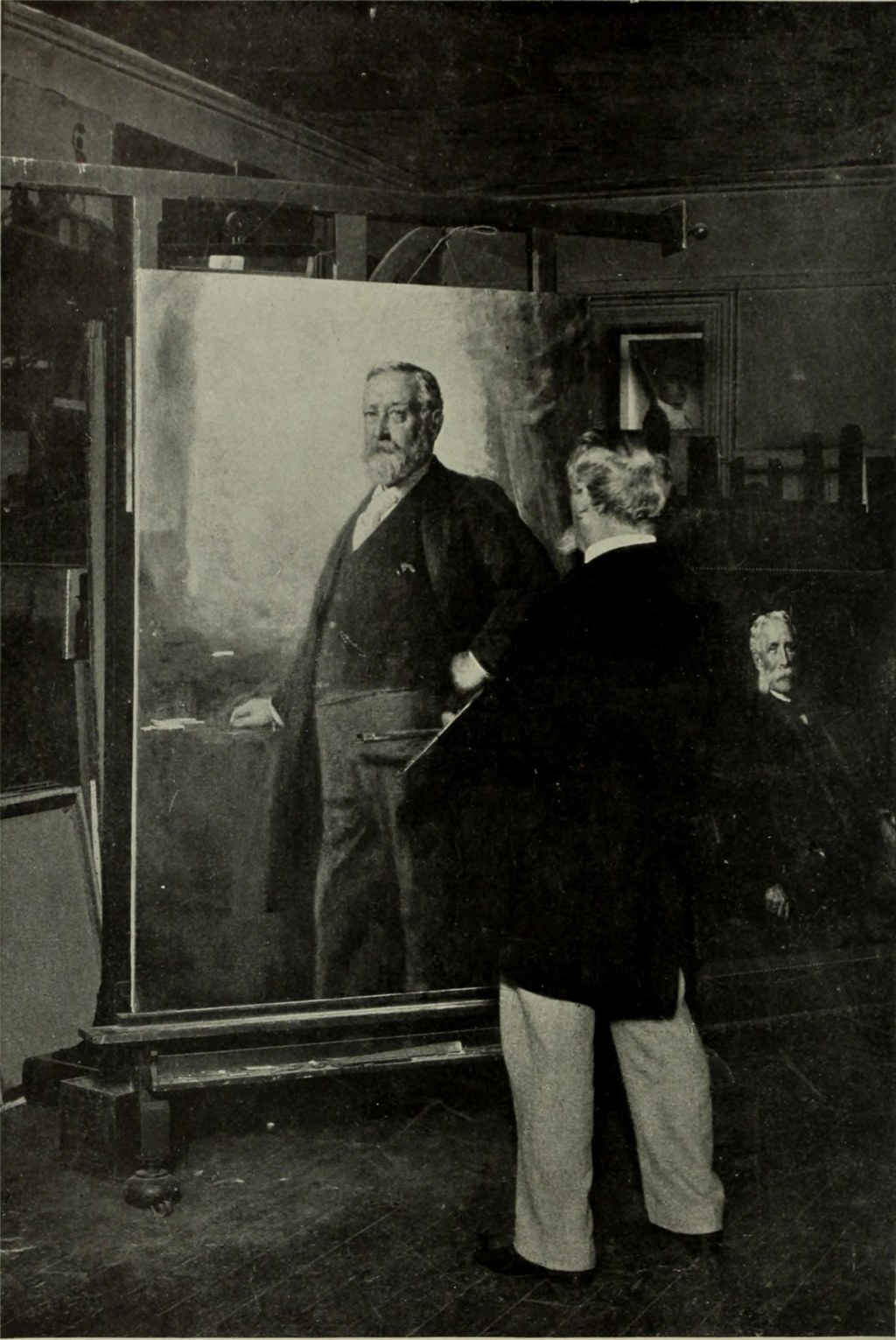
Eastman Johnson at his portrait of Benjamin Harrison. Photograph published in The World’s Work, December 1906, plate between pp. 8321 and 8323. Harrison appears in the painting; this is not a photograph of him standing beside Johnson. Exact photograph date and photographer are not established. The World’s Work; Robarts Library, University of Toronto; Internet Archive. Public domain.
Image source
.
Public domain
.
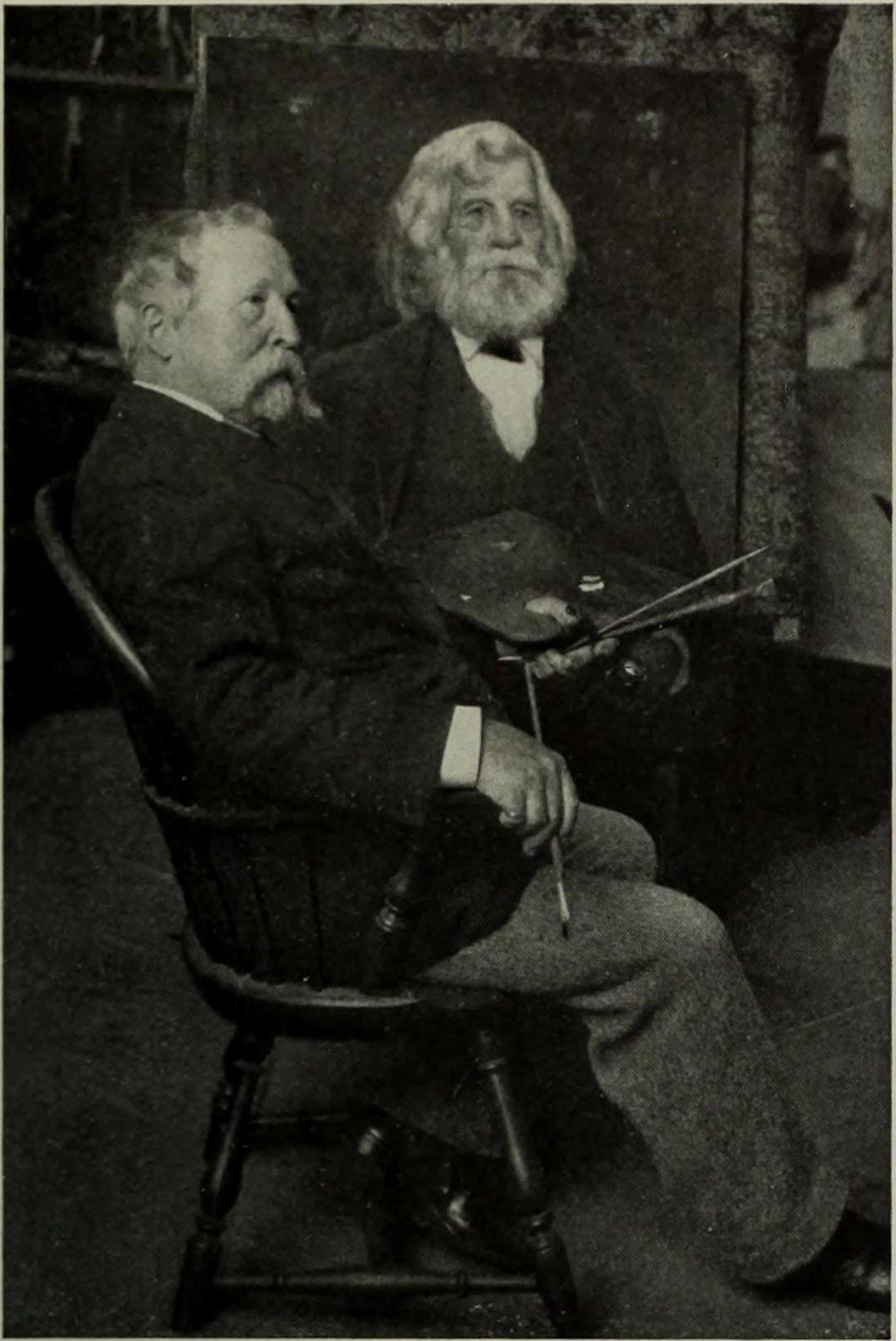
Eastman Johnson seated beside his painted portrait of Parke Godwin. Photograph published in The World’s Work, December 1906, p. 8321. The second face is part of the painting; the exact photograph date and photographer are not established. The World’s Work; Robarts Library, University of Toronto; Internet Archive. Public domain.
Image source
.
Public domain
.
A sketch and a commissioned finish
Johnson’s oil sketch of Joseph Wesley Harper, Jr., about 1885, offers another distinction. The National Gallery catalogue identifies it as a work retained by the artist in relation to a more finished likeness at Columbia. The sketch has its own support history, underdrawing and relatively thin, textured handling. [7]
The comparison is useful because the word portrait describes both works without making their purposes identical. One can preserve an economical encounter with the sitter’s appearance; the other can meet the demands of a completed commission. Differences in finish need not be explained as differences in the sitter’s character.
The catalogue also places opposing assessments of Johnson’s later portraiture beside one another. Some twentieth-century criticism found it formulaic, while earlier admirers valued its characterisation. These judgements are part of the work’s reception, rather than proof that a growing number of commissions amounted to an artistic decline. [7]
Likeness, patronage and ordinary action
The family groups help explain the continuing relationship between portraits and Johnson’s everyday scenes. A represented person can read, hold a child or attend to another figure, making a portrait resemble an observed interval of domestic life. The specific identities and commission history still distinguish it from a scene whose people remain unnamed.
Likewise, a formal public portrait can depend on the same attention to selective light that organises a schoolroom or hearth interior. The difference lies partly in what the picture is asked to preserve: an individual’s appearance and position, a family’s relationships or an event carried by anonymous figures.
Johnson’s portraits reward looking through both the face and the surrounding record. The image offers a visible person or group; a commission, letter, donor’s account or museum history helps establish what can responsibly be said about it. The most convincing account allows those kinds of evidence to work together without making either do the other’s job.
Artworks directory
Browse twenty-one selected objects discussed in these articles, including the Gifford portrait and the Prang print after Johnson. Dates identify individual objects, including the San Diego Drummer Boy study. Use All media to include the chromolithograph.
| Name | Date | Medium |
|---|---|---|
| Kitchen at Mount Vernon | 1857; Charles Butt canvas | Oil on canvas |
| Negro Life at the South | 1859; New York Historical original | Oil on linen |
| A Ride for Liberty—The Fugitive Slaves | About 1862; Brooklyn version | Oil on paperboard |
| The Lord Is My Shepherd | 1863 | Oil on fiberboard |
| Sugaring Off | About 1864–65; unfinished RISD canvas | Oil on canvas |
| The Wounded Drummer Boy (San Diego study) | About 1864–71; study, not the finished canvas | Oil on board |
| The Early Scholar | About 1865; NGA study | Oil on academy board on canvas |
| Fiddling His Way | 1866; Chrysler canvas | Oil on canvas |
| The Letter Home | 1867; Minneapolis drawing | Charcoal and graphite on paper |
| The Boyhood of Lincoln | 1868; Michigan canvas | Oil on canvas |
| The boyhood of Lincoln—An evening in the log hut (Prang after Johnson) | About 1868; separate reproductive print | Chromolithograph, W. Harring / L. Prang & Co., after Johnson |
| The Brown Family | 1869; NGA version | Oil on paper on canvas |
| The Hatch Family | 1870–71 | Oil on canvas |
| The Old Stagecoach | 1871 | Oil on canvas |
| The Girl I Left Behind Me | About 1872 | Oil on canvas |
| The Toilet | 1873 | Oil on paper board |
| Husking Bee, Island of Nantucket | 1876; Chicago canvas | Oil on canvas |
| The New Bonnet | 1876 | Oil on academy board |
| Sanford Robinson Gifford | 1880; possibly posthumous | Oil on academy board |
| The Cranberry Harvest, Island of Nantucket | 1880; Timken canvas | Oil on canvas |
| The Nantucket School of Philosophy | 1887 | Oil on panel |
Frequently Asked Questions
The Met catalogue identifies fifteen figures across three generations, including the couple, two older relatives and eleven children. [4]
The Met dates it 1880 and considers it possibly posthumous. That uncertainty should remain part of its account. [5]
Discussion
Look again at the images and ideas explored in Eastman Johnson’s Portraits. These editorial prompts invite your observations.
Reader Insights
Compare the Brown and Hatch groups. How does each room help establish relationships among the people?
What can the monochrome Gifford reproduction show clearly, and what would require access to the painting’s colour?
Look at the studio photographs. How do scale and equipment shape the relationship between artist and painted likeness?
Join the Conversation
Share a detail, comparison or question about Eastman Johnson’s Portraits below.
References
- Patricia Hills and Abigael MacGibeny , About Eastman Johnson, Eastman Johnson Catalogue Raisonné. Continuous portrait practice, late commissions and presidential sitters. View source
- National Park Service , Longfellow House Fine Art Collection. Early crayon commissions and the 1848 double portrait. View source
- National Gallery of Art , American Paintings of the Nineteenth Century, Part I, pp. 376–382. Brown family identities, versions, technique and qualified reception history. View source
- Natalie Spassky and others , American Paintings in The Metropolitan Museum of Art, Volume II, 1985, pp. 223–225. Hatch family identification, domestic setting and retrospective testimony. View source
- The Metropolitan Museum of Art , Sanford Robinson Gifford, 1880, 88.16. Object information, friendship, possible posthumous execution and Richard Butler’s gift. View source
- Edgar French , An American Portrait Painter of Three Historical Epochs, The World’s Work 13, no. 2, December 1906, pp. 8307–8323. Retrospective article and documentary studio photographs; publication and exposure dates distinguished. View source
- National Gallery of Art , American Paintings of the Nineteenth Century, Part I, pp. 382–384. Joseph Wesley Harper, Jr. sketch, finished Columbia likeness and critical reception. View source
- Splash image source.
Eastman Johnson, The Hatch Family, 1870–71. Oil on canvas, 121.9 × 186.4 cm. The Metropolitan Museum of Art, Gift of Frederic H. Hatch, 1926, 26.97. Public domain. Public domain .
View source