 by
Tom Gurney
Tom Gurney BSc (Hons) is an art history expert with over 20 years experience
Email:
tomgurney1@gmail.com
/ Phone:
+44 7429 011000
The Girl I Left Behind Me by Eastman Johnson: Introduction
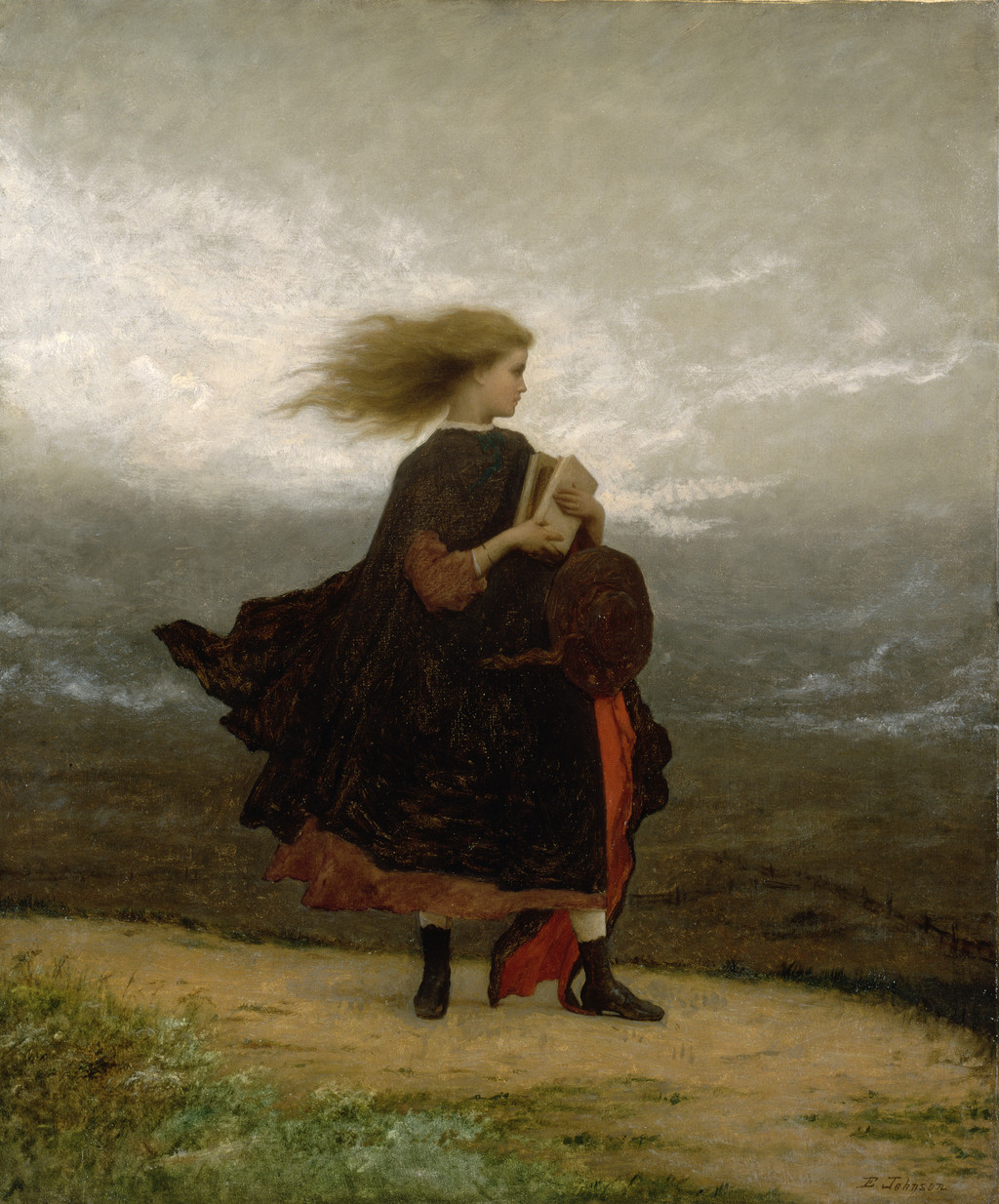
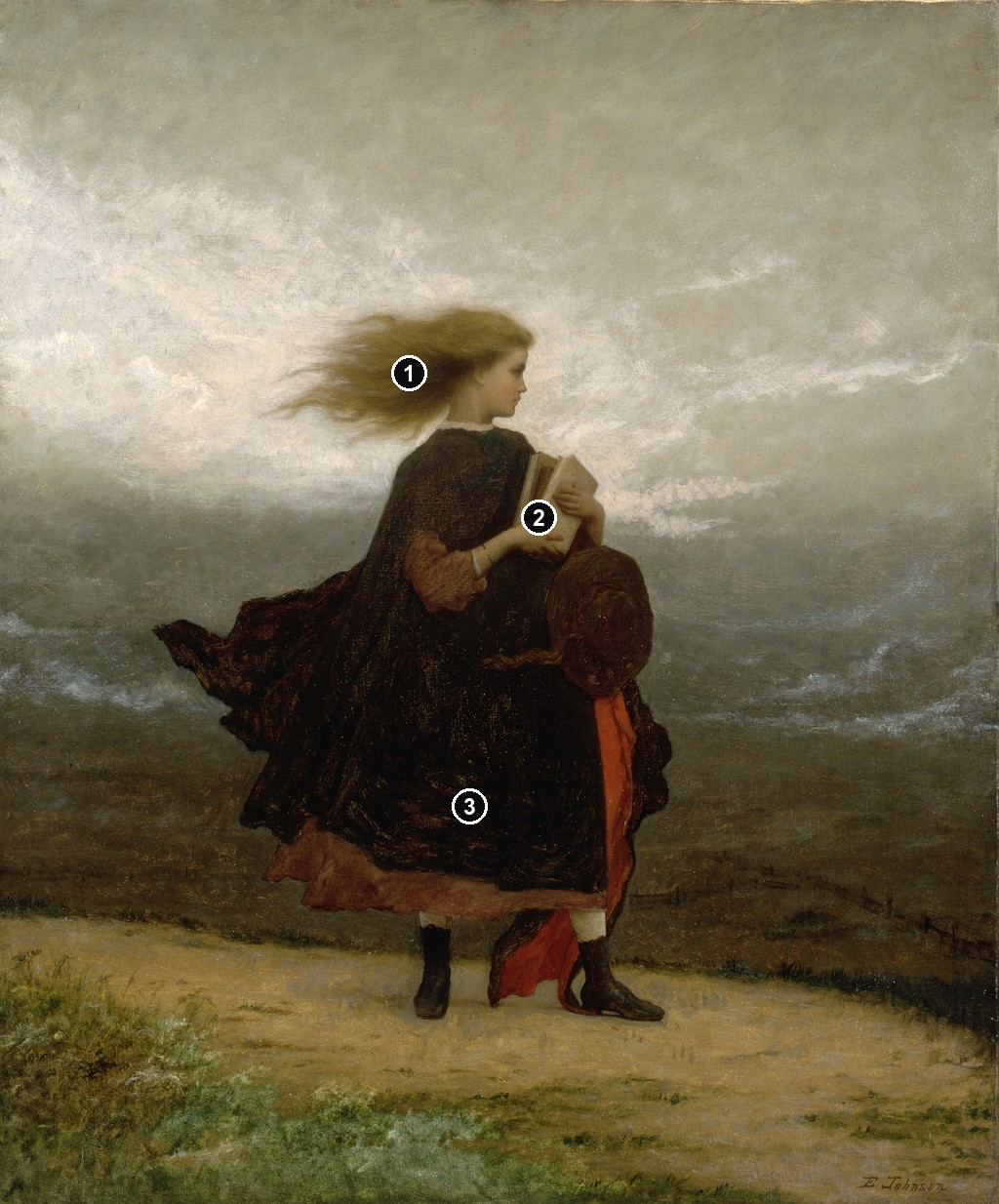
A young figure stands against an enormous sky, her hair blowing to the left while she looks steadily to the right. Books are pressed to her chest, and a broad hat rests against the dark sweep of her clothing. Eastman Johnson makes the weather move around a person who remains strikingly still.
The Girl I Left Behind Me belongs to the Smithsonian American Art Museum, which dates it about 1872. The title invokes a song associated with the Civil War, allowing the solitary figure to suggest absence and uncertainty beyond the immediate landscape. The painting was made after the war; its historical associations should not be mistaken for a wartime date. [1]
At a Glance
- Artist Eastman Johnson
- Title The Girl I Left Behind Me
- Date About 1872
- Medium Oil on canvas
- Dimensions 106.7 × 88.7 cm
- Collection Smithsonian American Art Museum
- Accession 1986.79
- Credit Museum purchase made possible in part by Mrs. Alexander Hamilton Rice in memory of her husband and by Ralph Cross Johnson
The catalogue raisonné gives the broader date c. 1872–75. Its documented exhibition appearances include Chicago in 1875 and Brooklyn in 1876. [2]
This work across Eastman Johnson’s career
The Brown Family
1869; NGA versionThe Hatch Family
1870–71The Toilet
1873Husking Bee, Island of Nantucket
1876; Chicago canvasThe New Bonnet
1876Notes and sources
The Brown Family. A child’s reaching arm connects three generations within an elaborate interior. [3]
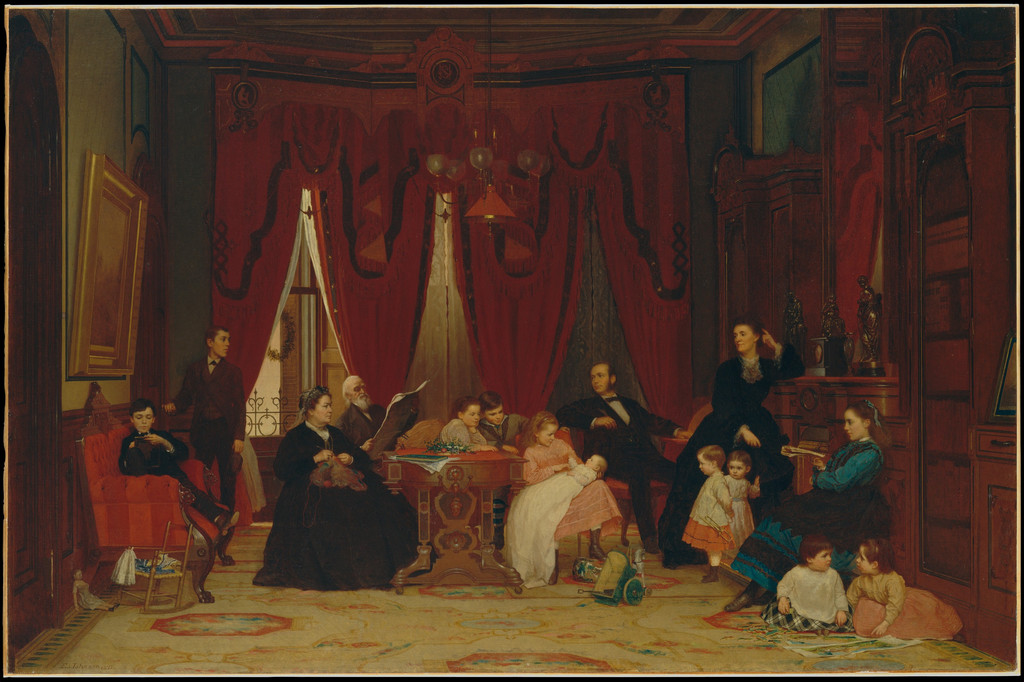
The Hatch Family. Fifteen figures inhabit a library through a carefully distributed set of activities. [4]
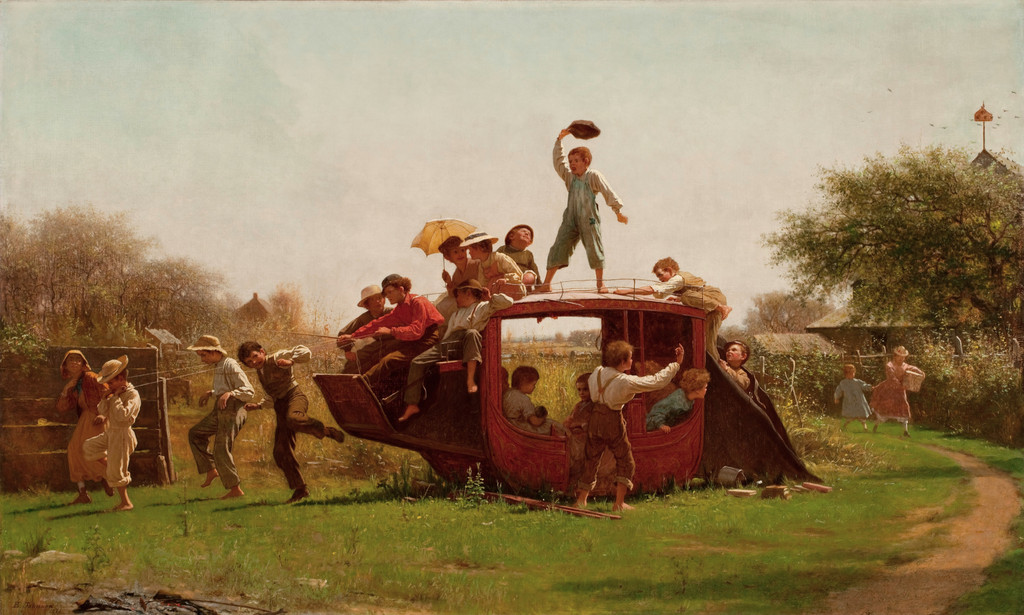
The Old Stagecoach. Children give a broken vehicle a new purpose through play. [5]
The Girl I Left Behind Me (current article). A still figure, books and wind-driven clothing hold competing directions of attention. [1]
The Toilet. The mirror returns a face while the figure’s back occupies the foreground. [6]
Husking Bee, Island of Nantucket. A line of people and pale husks joins harvest work to a social gathering. [7]
The New Bonnet. A bonnet, a glass and a fire give three figures different occupations within one room. [8]
Contents
- A still figure in moving air
- Sky, path and distance
- The song behind the title
- The ring and a possible national reading
- A schoolgirl in the estate-sale description
- Dating, exhibitions and the Smithsonian
- Looking alongside Johnson’s other figures
- Annotated details
A still figure in moving air
The composition depends on opposing directions. Hair and loose fabric stream towards the left, while the head turns into the space at the right. The figure’s stance gives her weight on the sandy ground, but the weather appears to pull at everything that can move independently of her body.
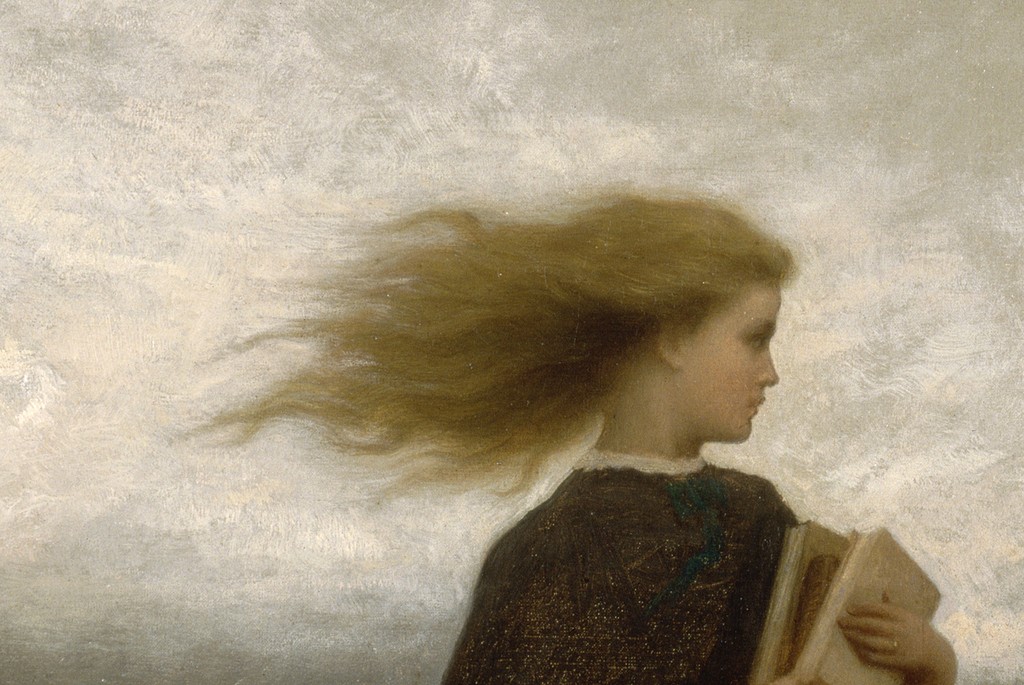
Johnson gives that contrast particular clarity by placing the head against pale sky. The profile needs little surrounding detail to become readable. The hair extends away from it in a broad, windblown mass, so the direction of the air is visible before the viewer examines the rest of the landscape.
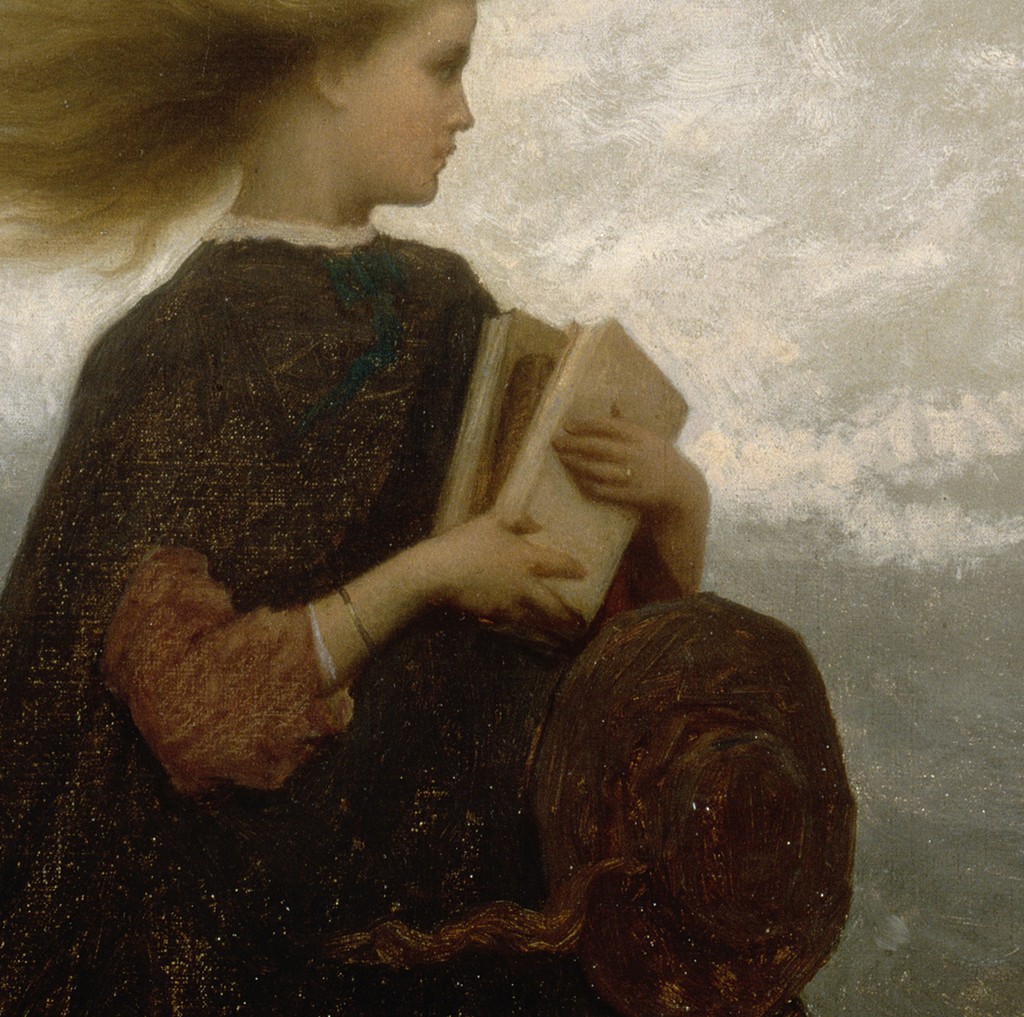
The books form a more compact shape. Held close between the hands and the chest, they appear protected within the figure’s posture. Their pale surfaces stand out from the outer garment, giving the otherwise dark central mass another point of concentration besides the face.
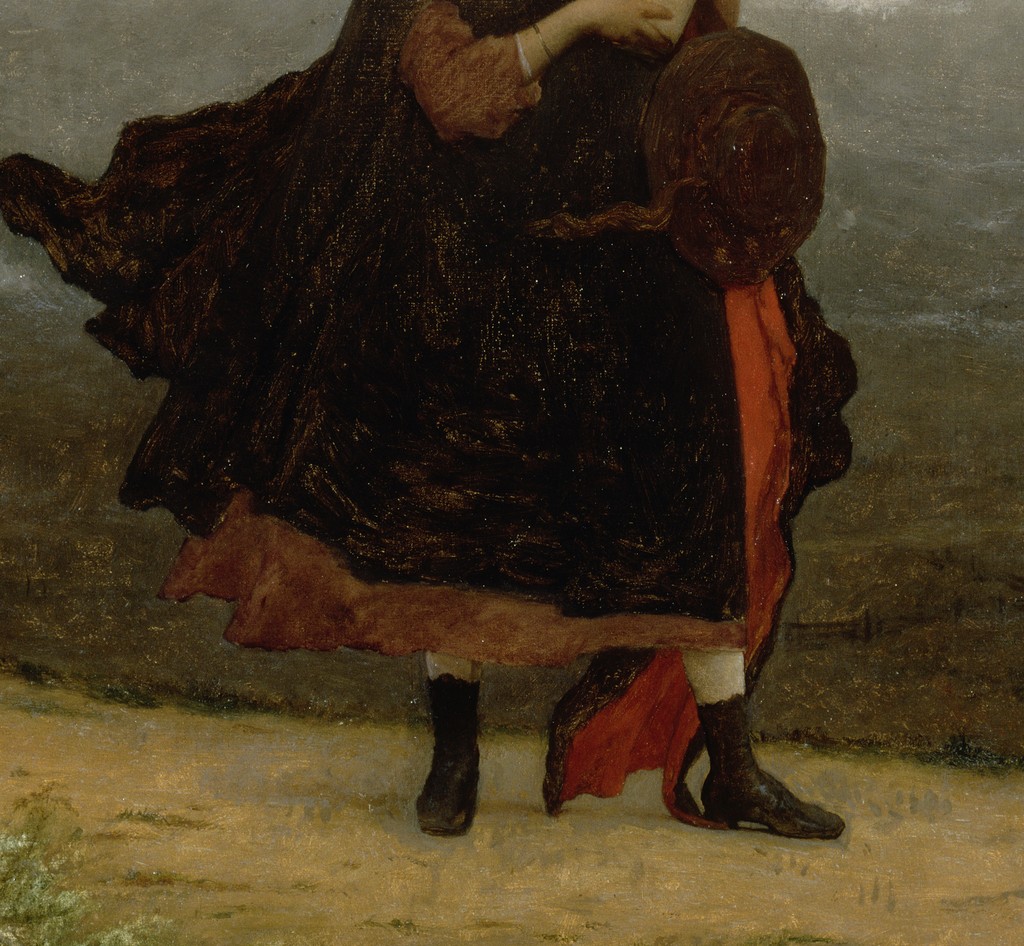
The hat introduces a rounded shape lower down. It rests against the clothing instead of shielding the head, leaving the hair fully exposed. The red fabric visible below and within the darker garment supplies a stronger colour accent, carrying the eye through the figure towards the ground.
These details give the person a material presence without resolving her story. She has books, outdoor clothing and a hat, and she occupies a particular piece of exposed ground. The objects let us imagine a journey or an interrupted errand, but the image offers no complete itinerary.
Annotated Details from The Girl I Left Behind Me
The numbered points identify visible features discussed in this article. Return from each detail to the whole composition. Eastman Johnson, The Girl I Left Behind Me, about 1872. Oil on canvas, 106.7 × 88.7 cm. Smithsonian American Art Museum, Museum purchase made possible in part by Mrs. Alexander Hamilton Rice in memory of her husband and by Ralph Cross Johnson, 1986.79. Public domain. Image source. Public domain. Numbers added to a separate overview; detail images are native crops. No recolouring, retouching, reconstruction or enlargement.
Details from THE GIRL I LEFT BEHIND ME
Compare the cropped details with the complete images above. Notice how their colours, shapes and positions contribute to the larger compositions.
Hair moving against a steady profile
The hair streams to the left while the face looks to the right. The pale profile remains clear against the unsettled sky, setting a steady gaze within moving air.
Books held close to the body
Both hands secure the books against the chest. Their pale edges and the brighter sleeves make a compact centre within the figure’s darker clothing.
Hat, moving skirt and planted feet
The broad hat rests against a sweep of dark fabric, with red lining showing below. The clothing moves across the figure while the boots retain a firm position on the path.
Sky, path and distance
The sky occupies much of the canvas above the figure. Its alternating pale and darker passages create an unsettled atmosphere, while the low horizon prevents distant buildings or people from competing with her. Johnson gives the landscape breadth but withholds a clear destination.
The sandy foreground path provides the most stable area of light below. Grass borders it, and a fence recedes across the lower distance at the right. These small divisions establish depth without opening the composition into a straightforward view of where the figure has come from or where she will go next.
The Smithsonian’s interpretation treats the promontory and uncertain path as part of the subject’s ambiguity. The figure may have to turn back or seek another way forward. This is an interpretive reading of her position within the landscape, not a documented account of an actual walk. [1]
The difference between her clear silhouette and the less definite distance strengthens that reading. We can locate the person more confidently than we can determine the place beyond her. The weather becomes a condition of looking as well as a feature of the scene: it makes the wider world harder to read.
The song behind the title
The museum connects Johnson’s title with an Irish ballad popular among both Union and Confederate troops. The catalogue raisonné also identifies the song association and links a Library of Congress song sheet published in 1862. [1] [2]
The title changes the viewer’s position in relation to the figure. Its first-person wording introduces an absent speaker: someone has gone away and remembers the person left behind. The painting supplies the person who remains, while the name supplies a relationship that cannot be seen directly.
That absent voice is especially effective in a composition containing only one figure. No departing soldier or waiting companion appears to fix the story. Instead, the viewer has to connect the title’s remembered relationship with the body before the sky. Absence becomes part of the painting through language rather than through an illustrated farewell.
The shared use of the song by opposing armies also resists a simple identification of the woman with one documented military household. Its emotional premise could travel between different listeners. The painting’s title opens a wartime association without establishing the sitter’s loyalties or the name of the person supposedly missing.
The ring and a possible national reading
The Smithsonian’s label interprets a ring as a sign of commitment and asks whether the suggested union concerns a marriage or the nation. It also connects the divided landscape and obscuring atmosphere with uncertainty. The museum presents a field of possible meanings rather than a recovered letter from Johnson explaining a fixed allegory. [1]
The distinction between a clue and a biography is important. A ring may help a viewer construct a marital reading, but it does not prove that the model was a wife awaiting a soldier. Still less does it establish widowhood, a death or a particular episode of bereavement.
A national interpretation similarly depends on more than simply recognising the war-associated title. The figure’s exposed position, divided surroundings and unsettled outlook can support a reading of uncertainty after conflict. They do not tell us that every painted object represents a specific state, political event or programme of reconstruction.
The picture gains some of its strength from withholding that final explanation. The figure looks outward while holding her books close, combining attention to a distant world with the preservation of something immediately her own. The action is simple enough to remain visible when a proposed symbolic reading becomes less certain.
Watch: Eastman Johnson
Choose a film to explore the artist’s work, its interpretation and its wider setting.
Director's Choice - The Girl I Left Behind Me by Eastman Johnson
The Smithsonian American Art Museum looks at Johnson’s The Girl I Left Behind Me.
Watch on YouTubeA schoolgirl in the estate-sale description
Johnson’s 1907 estate-sale catalogue offered another way to understand the figure. As transcribed in the catalogue raisonné, it described a schoolgirl carrying two large books, apparently travelling to recite lessons, who stops on a sandy path above the sea. The qualifying language belongs to a later catalogue writer, not to an identified account by the model. [2]
This account gives the books a practical role and the figure a possible daily activity. It is useful because it shows that the painting could be described through an ordinary errand as well as through the song’s story of separation. The two readings need not cancel each other, but neither should be elevated into a fully documented event.
The description also makes the passage of time in interpretation apparent. A museum label, a sale catalogue and a modern viewer may emphasise different features of the same canvas. Their accounts belong to its history of reception; they are not interchangeable statements of Johnson’s intention.
Dating, exhibitions and the Smithsonian
The museum’s approximate date of 1872 sits within the catalogue raisonné’s broader 1872–75 range. The painting is signed but the consulted object record does not give a painted year beside the signature. The recorded 1875 Chicago appearance establishes that the work was circulating by then, without settling its precise completion date. [1] [2]
It was shown at the Chicago Interstate Industrial Exposition in 1875 and at the Brooklyn Art Association in 1876 under its familiar title. These appearances matter because the name’s musical association belongs to the work’s nineteenth-century reception, rather than being a wholly modern invention applied to an unidentified girl. [2]
The catalogue later records it in Johnson’s estate and in the 1907 sale, number 144. Its subsequent documented history includes an auction appearance in 1980 and the dealer James Maroney before the Smithsonian’s purchase in 1986. The museum’s current credit names the funds that helped make that acquisition possible. [1] [2]
Looking alongside Johnson’s other figures
The books invite comparison with The Boyhood of Lincoln , although the actions differ. Lincoln’s imagined younger self is absorbed in reading by a fire; this figure carries books while looking into an exposed landscape. In one painting, attention settles on the page. In the other, the books remain held while attention moves elsewhere.
The Wounded Drummer Boy offers a more public kind of resolve, defined by action within a military story. The girl’s stillness leaves her relation to the remembered conflict less explicit. Her gaze and windblown clothing make waiting visible without showing what will end it.
The combination gives the painting its distinctive balance. Weather, title and distance suggest a larger story, but Johnson keeps the immediate figure clear. Her presence is firmer than the narrative we can construct around her, and the unresolved space beyond her continues to hold the eye.
Artworks directory
Browse twenty-one selected objects discussed in these articles, including the Gifford portrait and the Prang print after Johnson. Dates identify individual objects, including the San Diego Drummer Boy study. Use All media to include the chromolithograph.
| Name | Date | Medium |
|---|---|---|
| Kitchen at Mount Vernon | 1857; Charles Butt canvas | Oil on canvas |
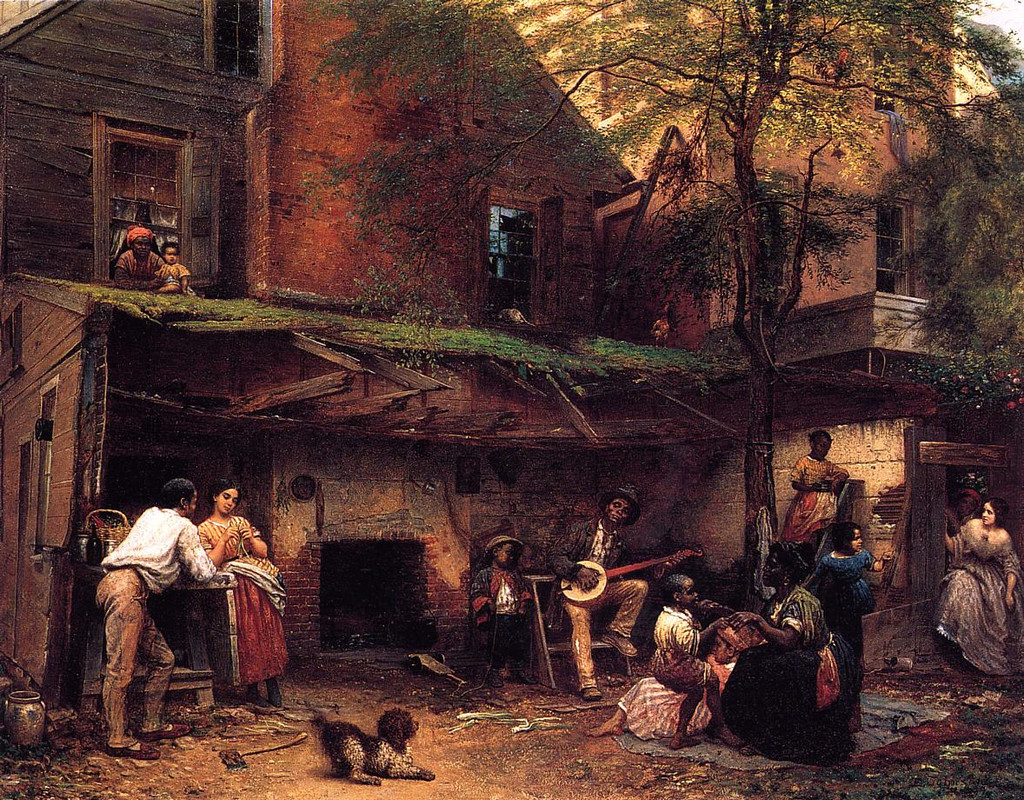
| Negro Life at the South | 1859; New York Historical original | Oil on linen |
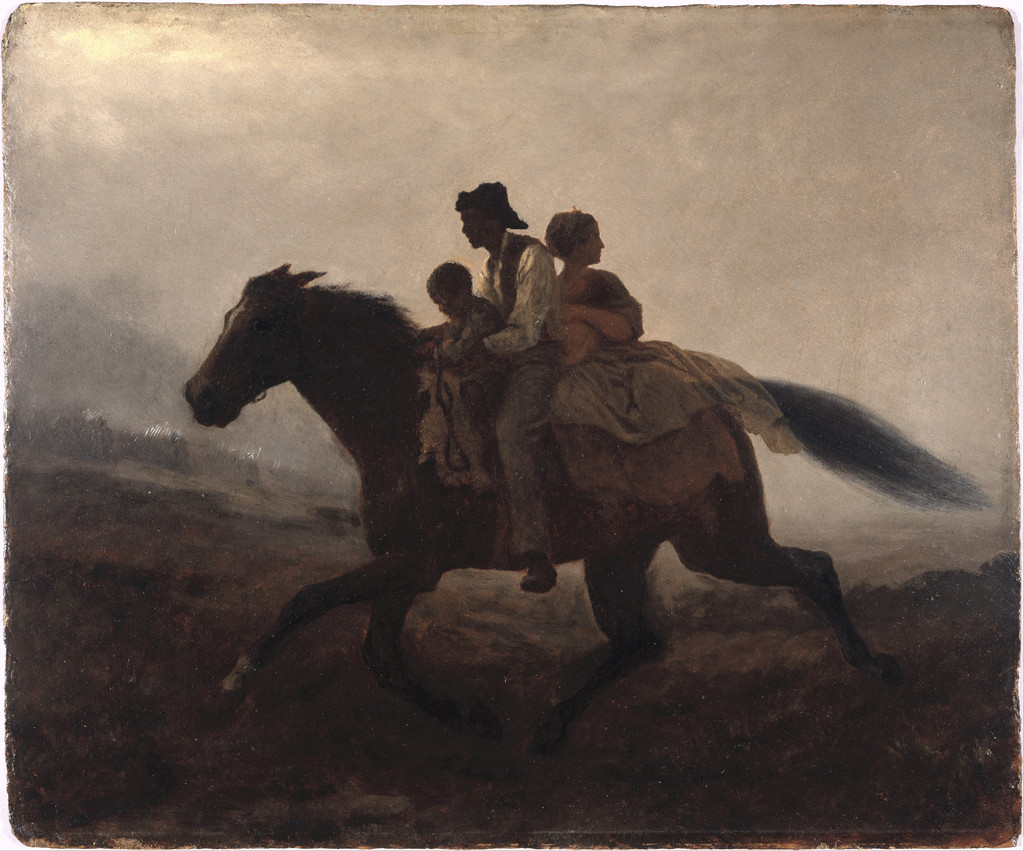
| A Ride for Liberty—The Fugitive Slaves | About 1862; Brooklyn version | Oil on paperboard |
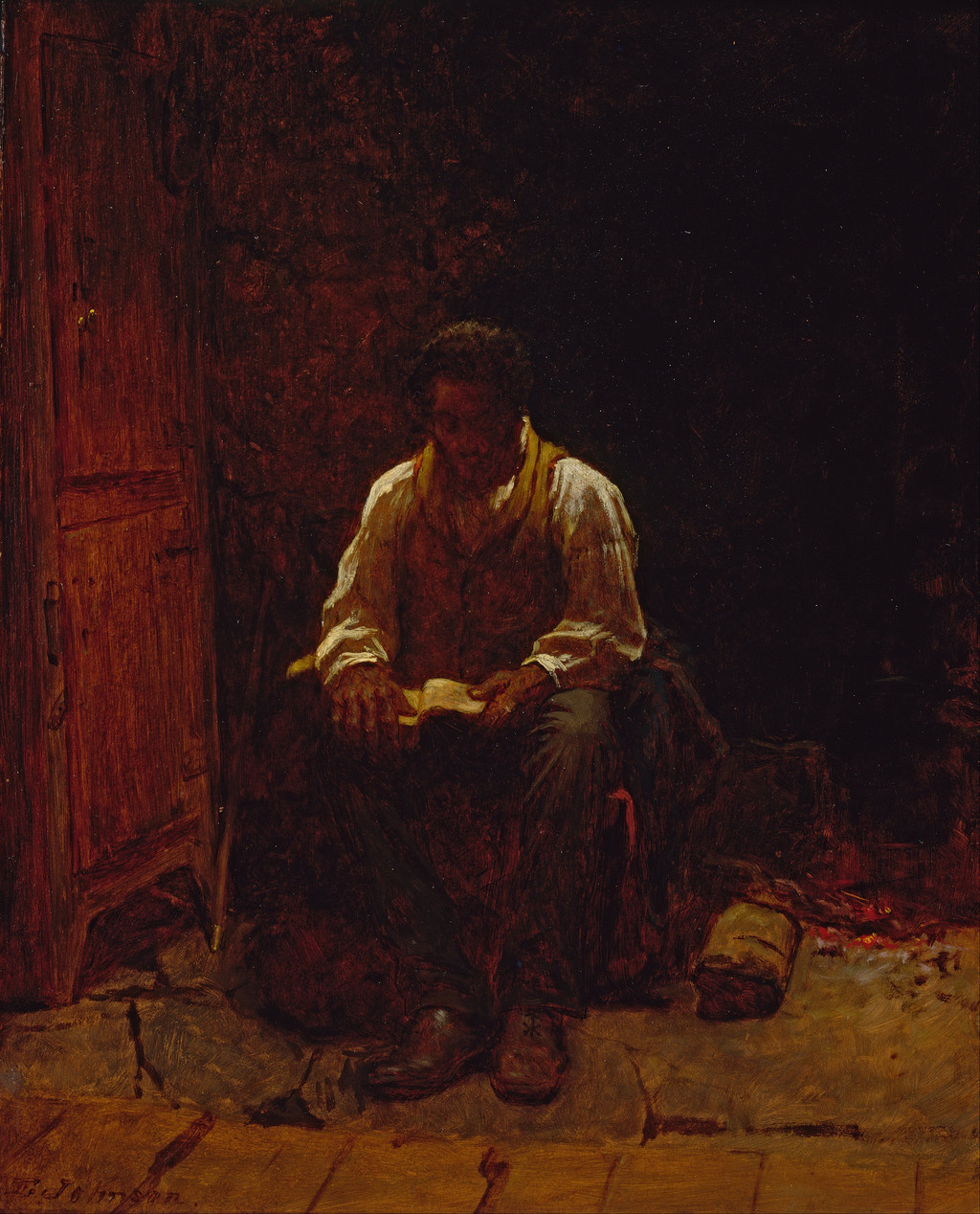
| The Lord Is My Shepherd | 1863 | Oil on fiberboard |
| Sugaring Off | About 1864–65; unfinished RISD canvas | Oil on canvas |
| The Wounded Drummer Boy (San Diego study) | About 1864–71; study, not the finished canvas | Oil on board |
| The Early Scholar | About 1865; NGA study | Oil on academy board on canvas |
| Fiddling His Way | 1866; Chrysler canvas | Oil on canvas |
| The Letter Home | 1867; Minneapolis drawing | Charcoal and graphite on paper |
| The Boyhood of Lincoln | 1868; Michigan canvas | Oil on canvas |
| The boyhood of Lincoln—An evening in the log hut (Prang after Johnson) | About 1868; separate reproductive print | Chromolithograph, W. Harring / L. Prang & Co., after Johnson |
| The Brown Family | 1869; NGA version | Oil on paper on canvas |
| The Hatch Family | 1870–71 | Oil on canvas |
| The Old Stagecoach | 1871 | Oil on canvas |
| The Girl I Left Behind Me | About 1872 | Oil on canvas |
| The Toilet | 1873 | Oil on paper board |
| Husking Bee, Island of Nantucket | 1876; Chicago canvas | Oil on canvas |
| The New Bonnet | 1876 | Oil on academy board |
| Sanford Robinson Gifford | 1880; possibly posthumous | Oil on academy board |
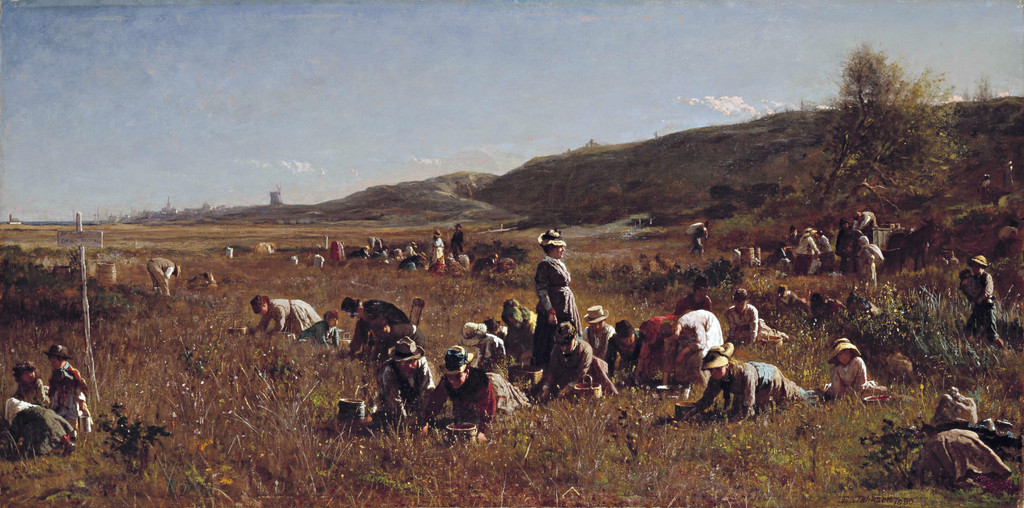
| The Cranberry Harvest, Island of Nantucket | 1880; Timken canvas | Oil on canvas |
| The Nantucket School of Philosophy | 1887 | Oil on panel |
Frequently Asked Questions
It belongs to the Smithsonian American Art Museum, accession 1986.79. The museum dates it about 1872. [1]
Widowhood is not established by the consulted evidence. The museum explores a marital and national interpretation of the ring and song-associated title, but those clues do not identify the sitter’s biography. [1]
The accepted approximate date is after the war. The song title supplies a wartime association; it does not date the canvas to the conflict itself. [1]
The 1907 sale description interpreted her as a schoolgirl carrying lessons. That later account is one reading of the visible objects, not proof of a named sitter’s daily routine. [2]
Discussion
Look again at the images and ideas explored in The Girl I Left Behind Me by Eastman Johnson. These editorial prompts invite your observations.
Reader Insights
How do the opposed directions of hair and gaze make the figure seem steady within moving weather?
Consider the books, hat and ring separately. Which observations support interpretation, and which claims would need documentation?
How does the title introduce an absent person without showing a farewell or a departing soldier?
Join the Conversation
Share a detail, comparison or question about The Girl I Left Behind Me by Eastman Johnson below.
References
- Smithsonian American Art Museum , The Girl I Left Behind Me, 1986.79. Object information, credit, gallery and 2012 exhibition interpretations; marital and national readings remain attributed. View source
- Patricia Hills and Abigael MacGibeny , The Girl I Left Behind Me, c. 1872–75, Hills no. 10.0.25, Eastman Johnson Catalogue Raisonné. Broader date, early exhibitions, song connection, mediated 1907 sale description and later provenance. The original song sheet and sale catalogue were not separately consulted. View source
- The Brown Family, 1869, 1978.72.1. View source
- The Hatch Family, 1870–71, 26.97. View source
- The Old Stagecoach, 1871, L1888.22. View source
- The Toilet, 1873, 2015.19.85. View source
- Husking Bee, Island of Nantucket, 1876, 1922.444: current public API. View source
- The New Bonnet,1876,25.110.11,currentobjectrecordandAPI. View source
- Splash image source.
Eastman Johnson, The Girl I Left Behind Me, about 1872. Oil on canvas, 106.7 × 88.7 cm. Smithsonian American Art Museum, Museum purchase made possible in part by Mrs. Alexander Hamilton Rice in memory of her husband and by Ralph Cross Johnson, 1986.79. Public domain. Public domain .
View source