 by
Tom Gurney
Tom Gurney BSc (Hons) is an art history expert with over 20 years experience
Email:
tomgurney1@gmail.com
/ Phone:
+44 7429 011000
The Boyhood of Lincoln by Eastman Johnson: Introduction
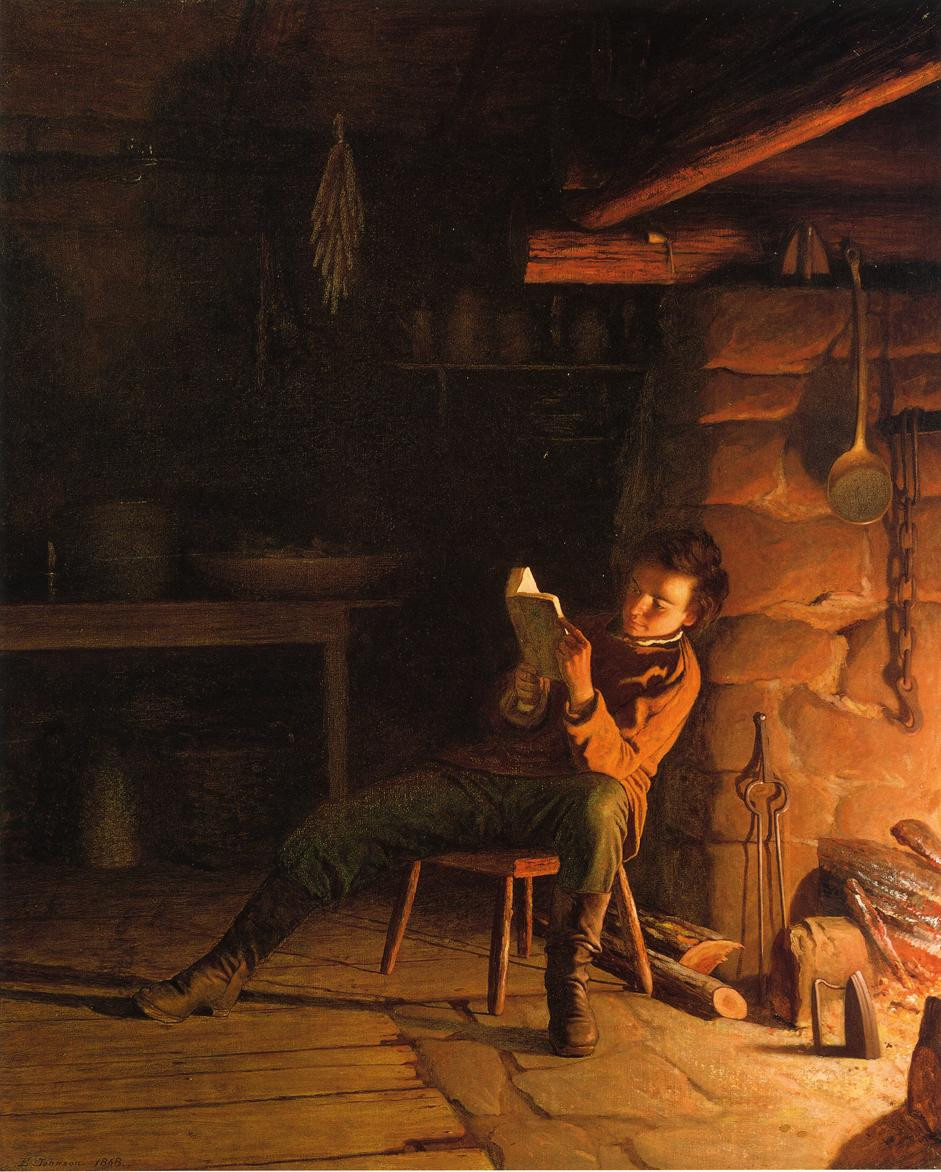
A boy sits beside a fire, holding a book close enough to catch its light. His long leg reaches across the floor, while his upper body turns towards the pages. Nothing in the room announces a president. Eastman Johnson makes that later identity depend on what the child is doing: reading with an absorption that seems to exclude everything around him.
Painted in 1868, The Boyhood of Lincoln belongs to the University of Michigan Museum of Art. It is an imaginative reconstruction of Abraham Lincoln’s youth, made after his death, rather than a childhood likeness observed from life. Its quiet domestic setting gives a national story the appearance of an ordinary evening. [1] [2]
At a Glance
- Artist Eastman Johnson
- Title The Boyhood of Lincoln
- Date 1868
- Medium Oil on canvas
- Dimensions 117.95 × 94.62 cm
- Collection University of Michigan Museum of Art
- Accession 1895.90
- Credit Bequest of Henry C. Lewis
The measurements above follow the museum’s current record. A smaller board version and a separately catalogued oil painting associated with the Prang print belong to the subject’s wider history. [1] [3] [4]
This work across Eastman Johnson’s career
The Early Scholar
About 1865; NGA studyFiddling His Way
1866; Chrysler canvasThe Letter Home
1867; Minneapolis drawingThe Boyhood of Lincoln (current article)
1868; Michigan canvasThe Brown Family
1869; NGA versionThe Hatch Family
1870–71Notes and sources
The Early Scholar. A child’s position beside a stove turns the need for warmth into the centre of a schoolroom. [5]
Fiddling His Way. A Black musician’s playing gathers the attention of a household. [6]
The Letter Home. A wounded man and a woman writing connect spoken words with an absent home. [7]
The Boyhood of Lincoln (current article). Firelight makes an imagined scene of Lincoln reading into an image of aspiration. [1]
The Brown Family. A child’s reaching arm connects three generations within an elaborate interior. [8]
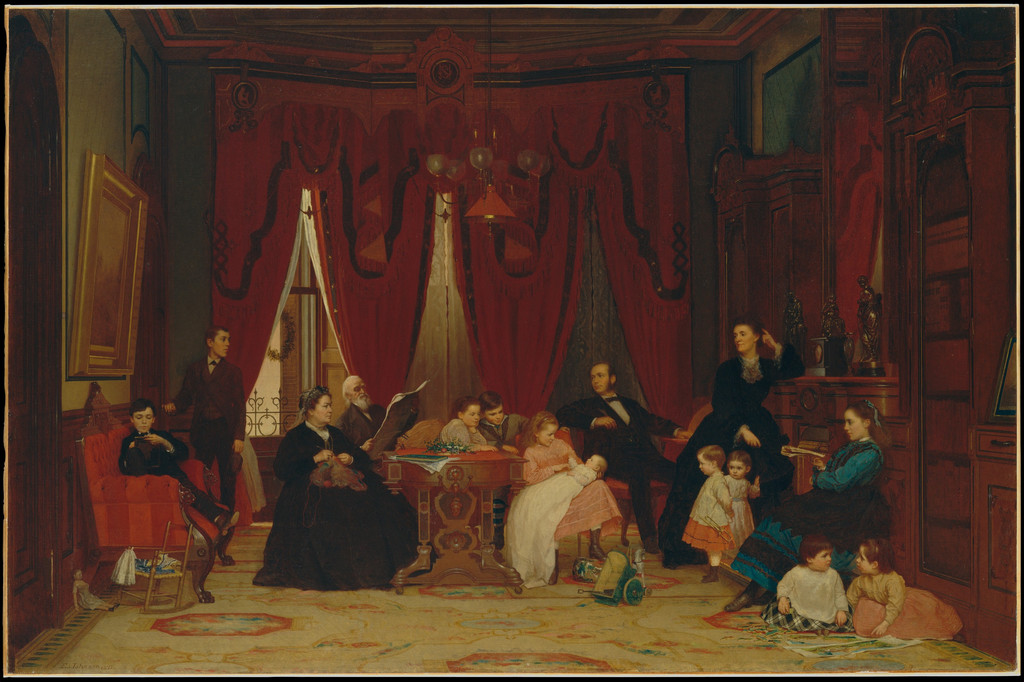
The Hatch Family. Fifteen figures inhabit a library through a carefully distributed set of activities. [9]
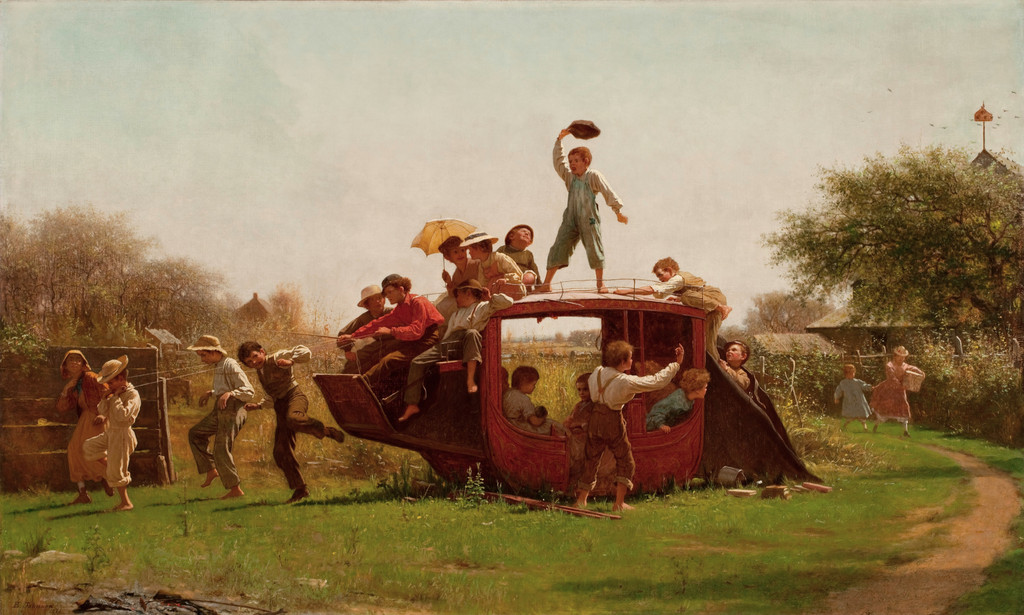
The Old Stagecoach. Children give a broken vehicle a new purpose through play. [10]
Contents
- Reading by the hearth
- An imagined childhood after the Civil War
- A picture intended to inspire other readers
- The Michigan canvas and the Prang print
- The smaller Kalamazoo painting
- Collecting and the painting’s appearance
- Annotated details
Reading by the hearth
Johnson places the boy low in the tall composition. Much of the upper room lies in darkness, with beams, hanging plants and domestic equipment emerging gradually from the shadows. The figure occupies only part of this space, yet the concentration of light around his face and book makes him its clear centre.
His pose combines relaxation and effort. One boot rests near the hearth, and the other extends far to the left. The chair is small and plain. These spread limbs could suggest a child taking his ease, but the hands and inclined head bring attention back to the demanding activity of reading.
The book stands between the face and the viewer. We see the reader’s concentration more clearly than we see what he reads. Its particular title cannot be established from the reproduction, and the scene does not need one to communicate its idea. Learning appears as a repeated act of attention, carried out with the light and furniture available.
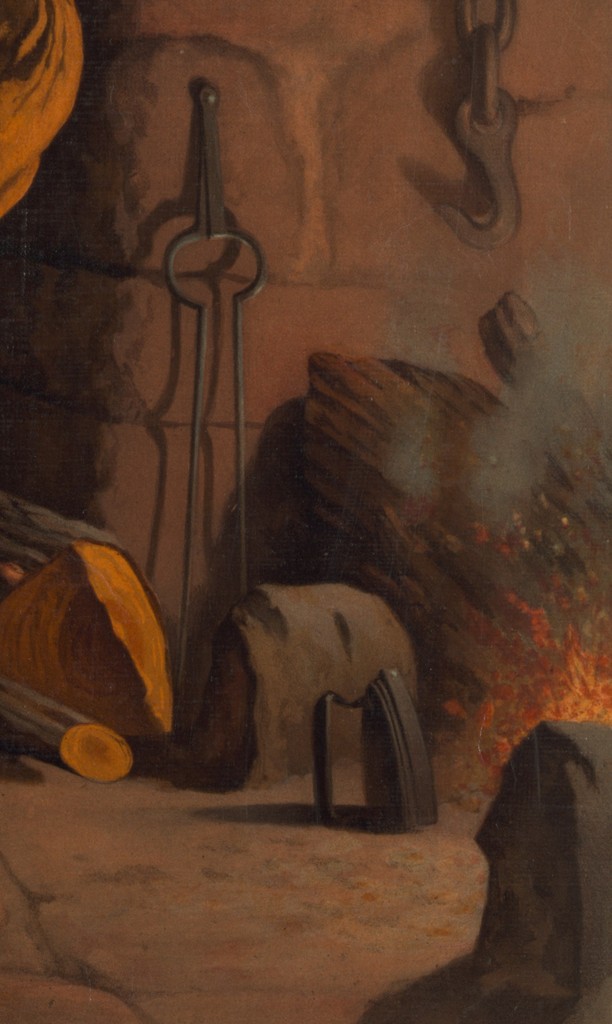
The fire does several kinds of work. It warms the room, illuminates the pages and sends an orange glow over the boy’s clothes and the stonework. Logs and iron implements occupy the hearth beside him. This is a working domestic space, where intellectual effort happens among the materials of everyday maintenance.
Johnson also gives the light a compositional boundary. The bright masonry at the right meets a much darker room at the left. The boy sits across that division, with his face turned towards the source that makes reading possible. The contrast makes his small action visible without introducing another person to explain or supervise it.
Annotated Details from The Boyhood of Lincoln
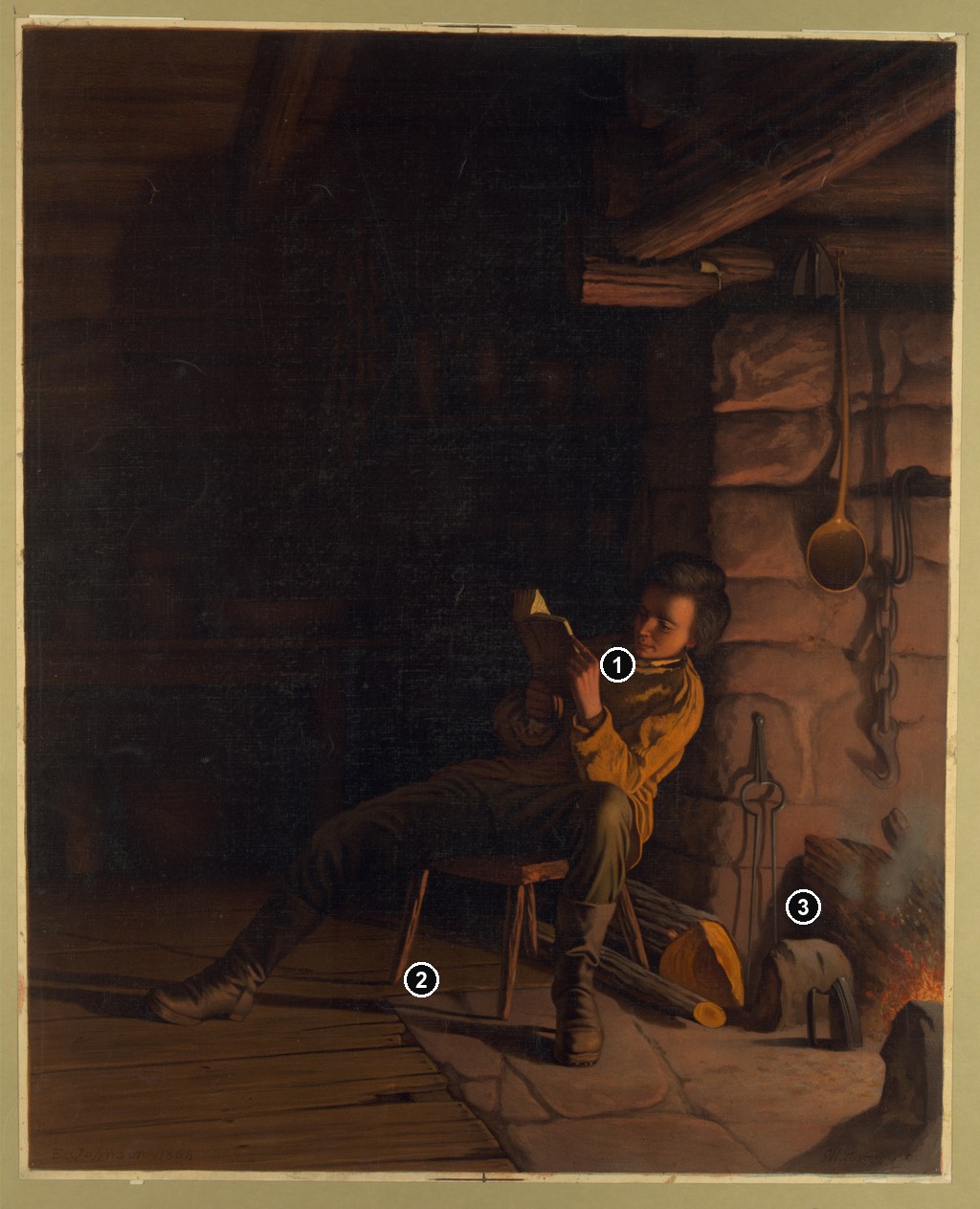
The numbered points identify visible features discussed in this article. Return from each detail to the whole composition. W. Harring after Eastman Johnson, The Boyhood of Lincoln—An Evening in the Log Hut, c. 1868. Chromolithograph published by L. Prang & Co., 54.3 × 43.6 cm. Library of Congress, 99405503, LC-DIG-ppmsca-18446. Reproductive print, distinct from the Michigan canvas. No known restrictions on publication. Image source. Public domain. Numbers added to a separate overview; detail images are native crops. No recolouring, retouching, reconstruction or enlargement.
Details from THE BOYHOOD OF LINCOLN
Compare the cropped details with the complete images above. Notice how their colours, shapes and positions contribute to the larger compositions.
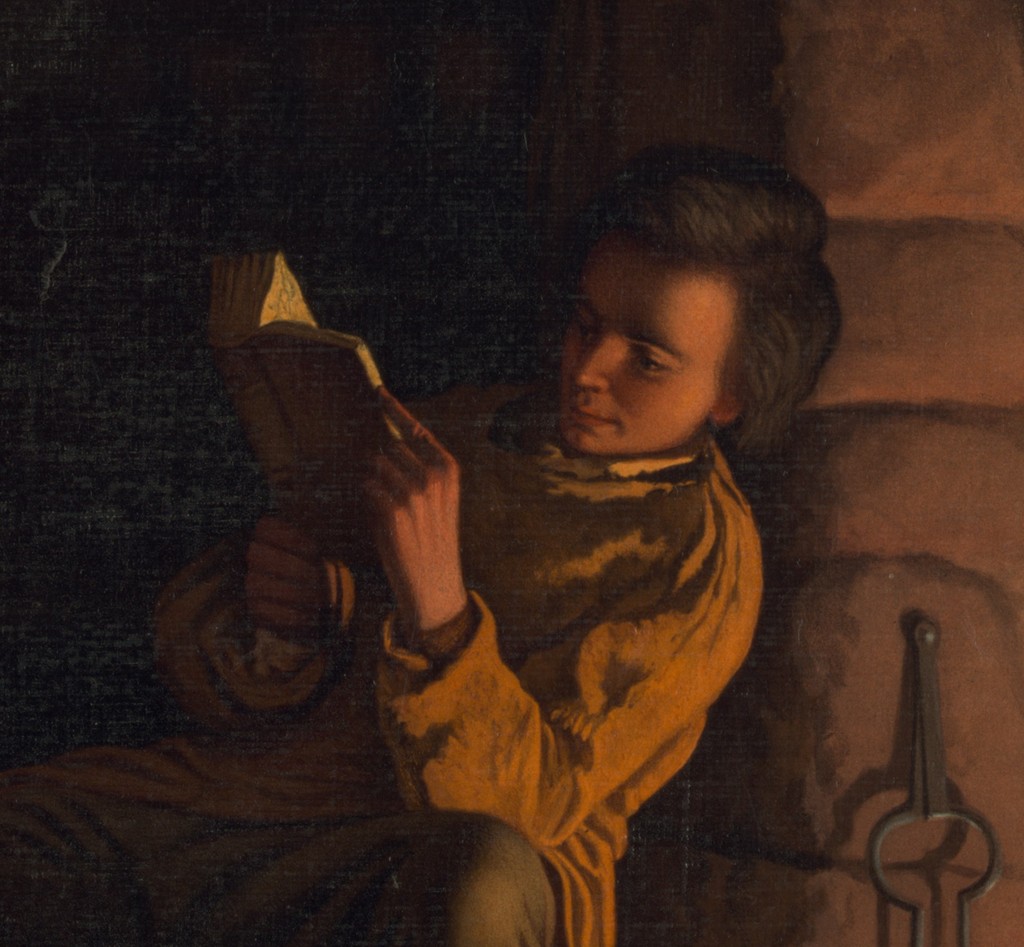
The face and raised book in the print
The raised book brings the boy’s hands close to his face. Warm printed tones pick out the reader against the much darker interior of this separate reproductive image.
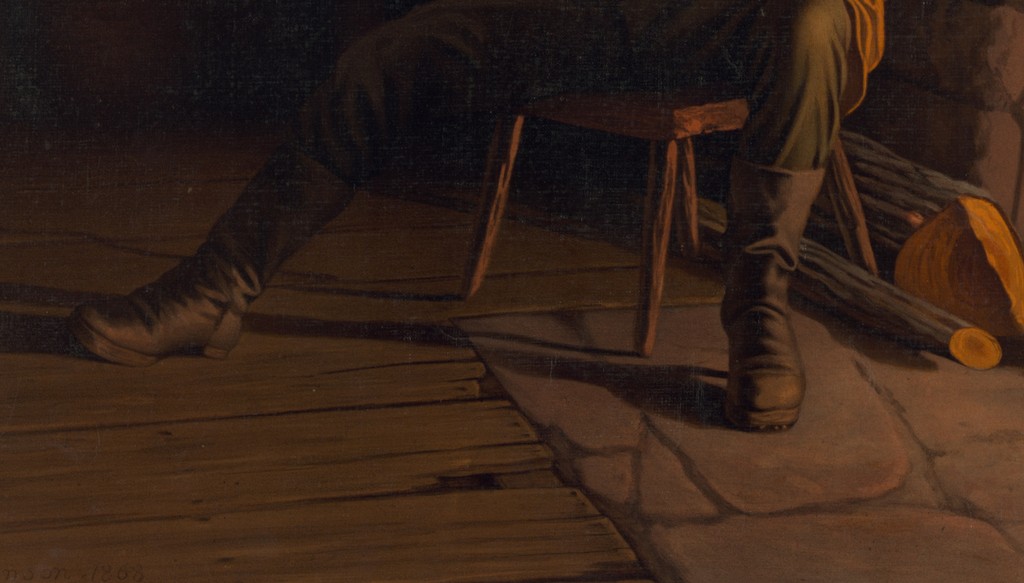
Legs, chair and uneven floor
The long legs and small chair spread across the lower part of the cabin. Their arrangement gives the youthful reader an informal posture within the printed scene.
Fire, logs and hanging implements
The glowing fire and nearby logs occupy the lower-right corner, with implements rising beside the reader. These details belong to the Prang print after Johnson and should be compared with the separate Michigan canvas.
An imagined childhood after the Civil War
The painting’s date matters. The adult Lincoln had already become a figure of national mourning and remembrance when Johnson returned to his youth. Patricia Hills places The Boy Lincoln within the postwar images that sustained the murdered president’s mythic stature. Her interpretation identifies the public meaning that a seemingly private reading scene could carry. [11]
The choice of childhood gives that remembrance a particular form. Instead of presidential dress, public ceremony or a battlefield, Johnson offers an interior and a book. The future leader is imagined before office, fame or military command. Viewers who knew the end of his story could read the beginning as an explanation of character.
That structure is persuasive because the child seems unaware of his audience. He does not turn to display intelligence or invite admiration. His absorption allows the viewer to discover an exemplary quality within an apparently unposed moment. The composition supplies the moral significance while the boy continues to read.
The catalogue raisonné describes Johnson’s Lincoln subject as both a historical person and an exemplary American youth, associated with determination and hard work. That formulation helps explain why the image could appeal beyond people seeking a portrait of the president. It offered a model of self-education that could be transferred into another household. [2]
Such an image selects and simplifies. An isolated, industrious reader cannot account for every relationship, institution or opportunity involved in a life. The painting gives us a memorable visual account of individual application; it does not establish that application alone explains Lincoln’s career, or that Johnson reconstructed a particular documented evening.
A picture intended to inspire other readers
An 1869 newspaper notice, transcribed in the catalogue raisonné’s entry for the Prang-related painting, makes the exemplary reading explicit. It recommended the image for a household in which boys would have to make their own way. The notice is evidence of how the subject was promoted and understood, rather than proof of what every contemporary viewer thought. [3]
The domestic destination is especially appropriate. A picture of a boy learning at home could hang in another home as an encouragement to reading. Its audience could compare the represented child’s modest surroundings with the circumstances of children looking at the image. The historical subject thus became a practical lesson through display and repetition.
The same account records a chromolithograph offered for fifteen dollars. That detail connects the composition’s moral appeal with a commercial means of distribution. The printed image allowed the subject to circulate beyond the single owner of an oil painting, while keeping the recognisable arrangement of reader, book and hearth. [3]
Watch: Eastman Johnson
Choose a film to explore the artist’s work, its interpretation and its wider setting.
Director's Choice - The Girl I Left Behind Me by Eastman Johnson
The Smithsonian American Art Museum looks at Johnson’s The Girl I Left Behind Me.
Watch on YouTubeThe Michigan canvas and the Prang print
The print requires a separate identification. The Library of Congress holds The Boyhood of Lincoln—An Evening in the Log Hut , a chromolithograph by W. Harring after Johnson, published by L. Prang & Co. around 1868. Its catalogue gives dimensions of 54.3 × 43.6 cm. Those are the print’s measurements, not the size of the Michigan canvas. [12]
The two illustrations share the familiar subject, but the print is not a photograph of the museum painting. The catalogue raisonné identifies a distinct, currently unlocated oil painting of 1868 as the composition used for Prang’s chromolithograph. That work has its own ownership history, beginning with Prang, and its own entry. [3]
The Michigan canvas’s possible association with Prang is less secure. Its catalogue entry marks both that ownership and a proposed 1870 sale appearance as uncertain. It also reproduces an 1870 newspaper distinction between a Johnson original in Prang’s collection and the painting used for the chromolithograph. The evidence makes a simple one-painting account misleading. [2]
Comparing the canvas reproduction and the Library of Congress print is therefore a comparison between related objects. The placement and treatment of the figure, firewood and surrounding shadows deserve attention, but differences in photographic colour cannot by themselves establish differences in Johnson’s original pigments. Each image also has a separate material history: paint on canvas in one case, a printed sheet in the other.
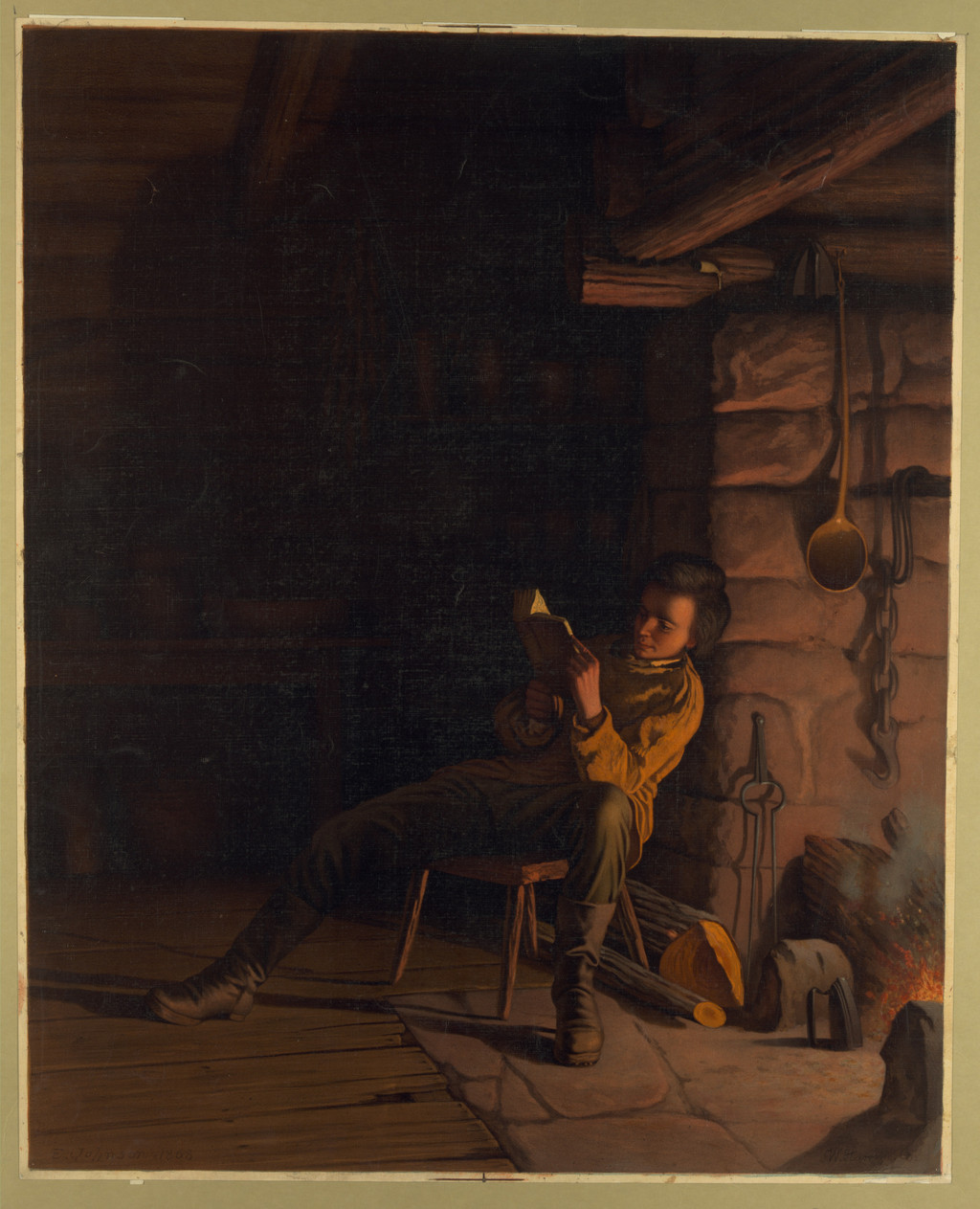
W. Harring after Eastman Johnson, The Boyhood of Lincoln—An Evening in the Log Hut, c. 1868. Chromolithograph published by L. Prang & Co., 54.3 × 43.6 cm. Library of Congress, 99405503, LC-DIG-ppmsca-18446. Reproductive print, distinct from the Michigan canvas. No known restrictions on publication.
Image source
.
Public domain
.
The smaller Kalamazoo painting
Another version belongs to the Kalamazoo Institute of Arts, accession 2009.109. Dated 1867, it is oil on board and measures 68.6 × 54.9 cm. Its reverse carries a small Sugaring Off scene dated approximately 1861–65. The double-sided object brings two apparently distant Johnson subjects onto a single support. [4]
The earlier date helps establish that Johnson developed the reading subject before the Michigan canvas’s signed year. It does not, by itself, settle every step between the board, the canvas and the print model. The catalogue gives possible early exhibition and sale connections for more than one version, so those appearances cannot confidently be assigned to a single object.
This version history also changes how we understand the finished-looking scene. Johnson was working through a composition capable of variation and circulation, rather than simply recording an event once. The child’s apparent solitude conceals a larger network of studies, paintings, publishers, collectors and viewers.
Collecting and the painting’s appearance
The catalogue records Henry Clay Lewis as the owner of the Michigan canvas by 1875. His bequest brought it into the museum’s collection in 1895. Later exhibitions included the 1972 Johnson retrospective and the travelling American ABC: Childhood in 19th Century America exhibition of 2006–07. These settings placed the work within both the artist’s career and a broader history of representations of children. [1] [2]
Its dark appearance has also attracted comment. Examination notes published in the catalogue raisonné suggest that bitumen may have contributed to darkening in the upper left. That is a qualified historical opinion, not a chemical finding established by the consulted record. A reproduction cannot tell us how every shadow looked in 1868. [2]
The visible composition nevertheless makes a clear distinction between the largely shadowed room and the concentrated light around the reader. In The Early Scholar , Johnson similarly gives sustained attention a pictorial presence. [13] The Lincoln subject adds a known future to that act of learning: viewers recognise the adult identity that the child himself cannot yet possess.
The comparison with The Wounded Drummer Boy brings out a different use of childhood. One child’s effort takes place in domestic quiet, the other’s amid battle. Both images allow a young figure to carry ideas of resolve larger than the immediate action. Their national significance comes from the stories built around those actions, as well as from Johnson’s handling of bodies, objects and light.
Artworks directory
Browse twenty-one selected objects discussed in these articles, including the Gifford portrait and the Prang print after Johnson. Dates identify individual objects, including the San Diego Drummer Boy study. Use All media to include the chromolithograph.
| Name | Date | Medium |
|---|---|---|
| Kitchen at Mount Vernon | 1857; Charles Butt canvas | Oil on canvas |
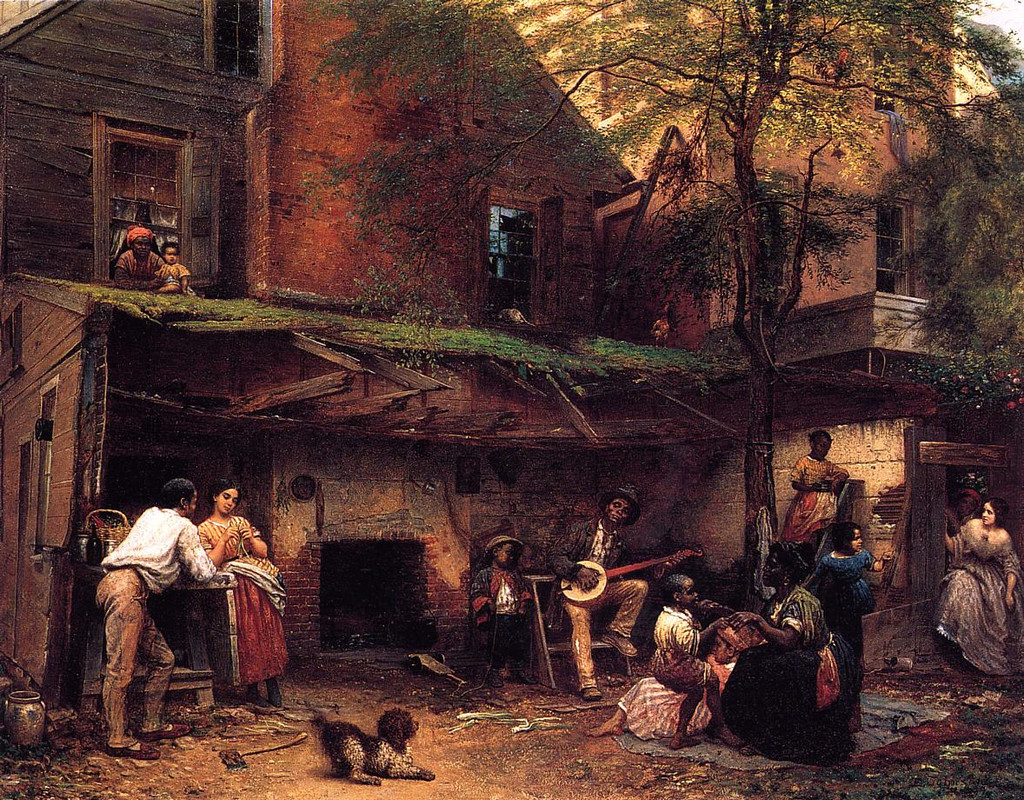
| Negro Life at the South | 1859; New York Historical original | Oil on linen |
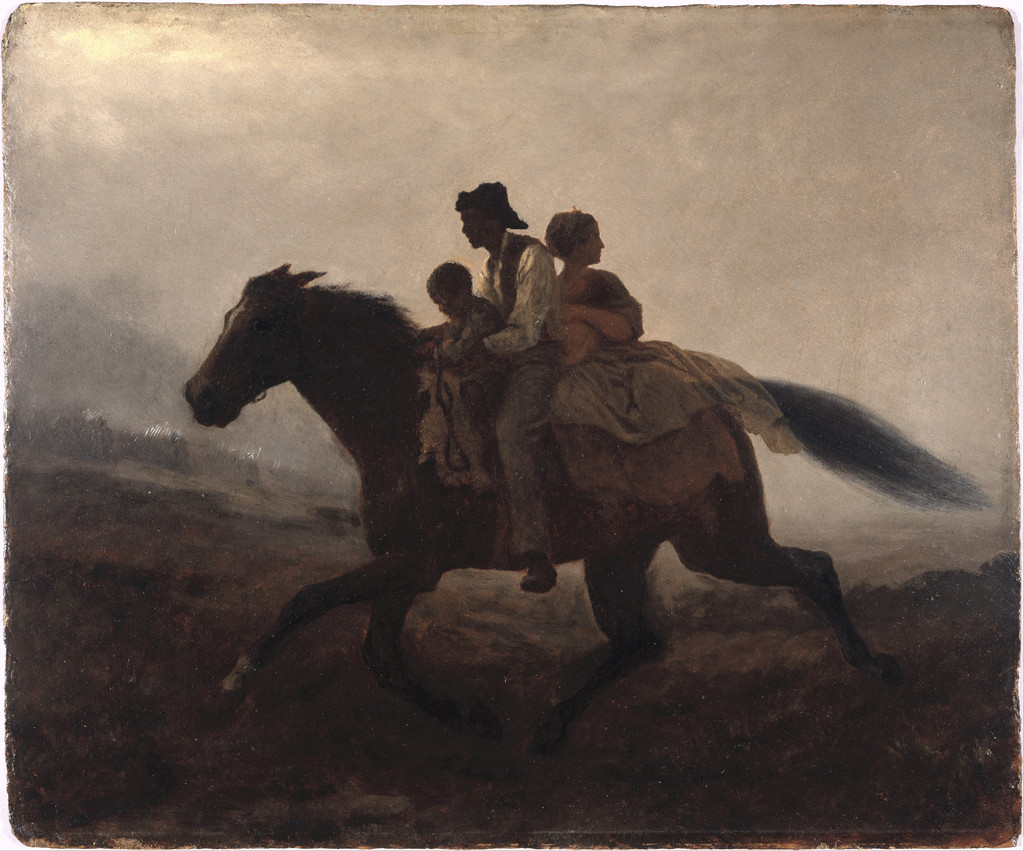
| A Ride for Liberty—The Fugitive Slaves | About 1862; Brooklyn version | Oil on paperboard |
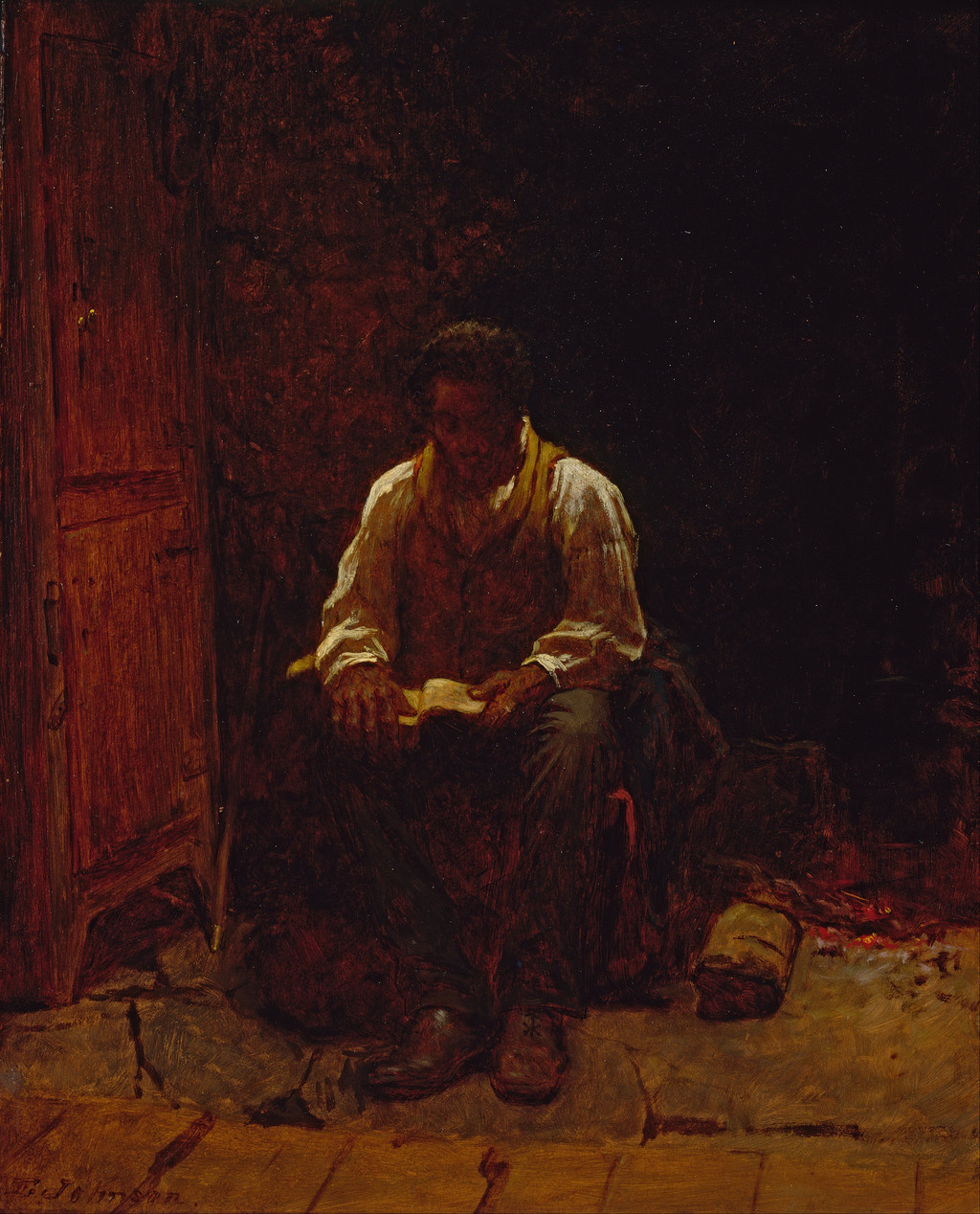
| The Lord Is My Shepherd | 1863 | Oil on fiberboard |
| Sugaring Off | About 1864–65; unfinished RISD canvas | Oil on canvas |
| The Wounded Drummer Boy (San Diego study) | About 1864–71; study, not the finished canvas | Oil on board |
| The Early Scholar | About 1865; NGA study | Oil on academy board on canvas |
| Fiddling His Way | 1866; Chrysler canvas | Oil on canvas |
| The Letter Home | 1867; Minneapolis drawing | Charcoal and graphite on paper |
| The Boyhood of Lincoln | 1868; Michigan canvas | Oil on canvas |
| The boyhood of Lincoln—An evening in the log hut (Prang after Johnson) | About 1868; separate reproductive print | Chromolithograph, W. Harring / L. Prang & Co., after Johnson |
| The Brown Family | 1869; NGA version | Oil on paper on canvas |
| The Hatch Family | 1870–71 | Oil on canvas |
| The Old Stagecoach | 1871 | Oil on canvas |
| The Girl I Left Behind Me | About 1872 | Oil on canvas |
| The Toilet | 1873 | Oil on paper board |
| Husking Bee, Island of Nantucket | 1876; Chicago canvas | Oil on canvas |
| The New Bonnet | 1876 | Oil on academy board |
| Sanford Robinson Gifford | 1880; possibly posthumous | Oil on academy board |
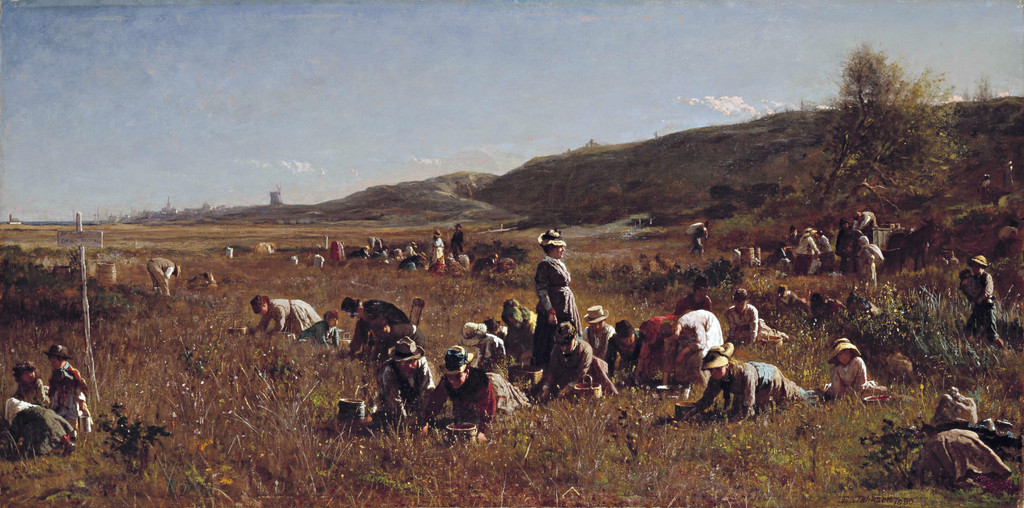
| The Cranberry Harvest, Island of Nantucket | 1880; Timken canvas | Oil on canvas |
| The Nantucket School of Philosophy | 1887 | Oil on panel |
Frequently Asked Questions
The illustrated 1868 oil painting is in the University of Michigan Museum of Art, accession 1895.90, Bequest of Henry C. Lewis. [1]
It reconstructs Lincoln’s childhood after his death. It is not a life portrait of the young Lincoln or evidence of one precisely documented evening. [2]
The particular title is not established by the evidence used here. The composition makes the activity of reading more legible than the book’s text.
Discussion
Look again at the images and ideas explored in The Boyhood of Lincoln by Eastman Johnson. These editorial prompts invite your observations.
Reader Insights
How does the hearth make reading possible while also organising the composition?
Compare the Michigan canvas with the Prang print. Which differences belong to the objects, and which may reflect reproduction?
How does knowledge of Lincoln’s later life change an otherwise ordinary scene of a child reading?
Join the Conversation
Share a detail, comparison or question about The Boyhood of Lincoln by Eastman Johnson below.
References
- University of Michigan Museum of Art , Boyhood of Lincoln, 1895.90. Current object information. View source
- Patricia Hills and Abigael MacGibeny , Boyhood of Lincoln, 1868, Hills no. 27.0.14, Eastman Johnson Catalogue Raisonné. Object, interpretation, provenance, exhibition history and historical examination notes; original archival sources cited there were not separately consulted. View source
- Hills and MacGibeny , The Boyhood of Abraham Lincoln, 1868, Hills no. 27.0.11. Separate print-model painting, transcribed newspaper reception and related chromolithograph. View source
- Hills and MacGibeny , Boyhood of Lincoln, 1867, Hills no. 27.0.10r. Kalamazoo board version, reverse, provenance and uncertain early exhibition identifications. View source
- The Early Scholar,c.1865,1963.10.157: current object record. View source
- Fiddling His Way,1866,89.60. View source
- The Letter Home,1867,74.17; current collection data. View source
- The Brown Family, 1869, 1978.72.1. View source
- The Hatch Family, 1870–71, 26.97. View source
- The Old Stagecoach, 1871, L1888.22. View source
- Patricia Hills , Painting Race: Eastman Johnson’s Pictures of Slaves, Ex-Slaves, and Freedmen, in Eastman Johnson: Painting America, 1999, p. 148. Postwar exhibition context and the interpretation of The Boy Lincoln. View source
- Library of Congress , The Boyhood of Lincoln—An Evening in the Log Hut, 99405503. Chromolithograph by W. Harring after Johnson, published by L. Prang & Co., c. 1868. View source
- National Gallery of Art , American Paintings of the Nineteenth Century, Part I, pp. 373–376. The Early Scholar entry and related versions. View source
- Splash image source.
Eastman Johnson, The Boyhood of Lincoln, 1868. Oil on canvas, 117.95 × 94.62 cm. University of Michigan Museum of Art, Bequest of Henry C. Lewis, 1895.90. Public domain faithful reproduction via WikiArt. Public domain .
View source