 by
Tom Gurney
Tom Gurney BSc (Hons) is an art history expert with over 20 years experience
Email:
tomgurney1@gmail.com
/ Phone:
+44 7429 011000
Sugaring Off by Eastman Johnson: Introduction
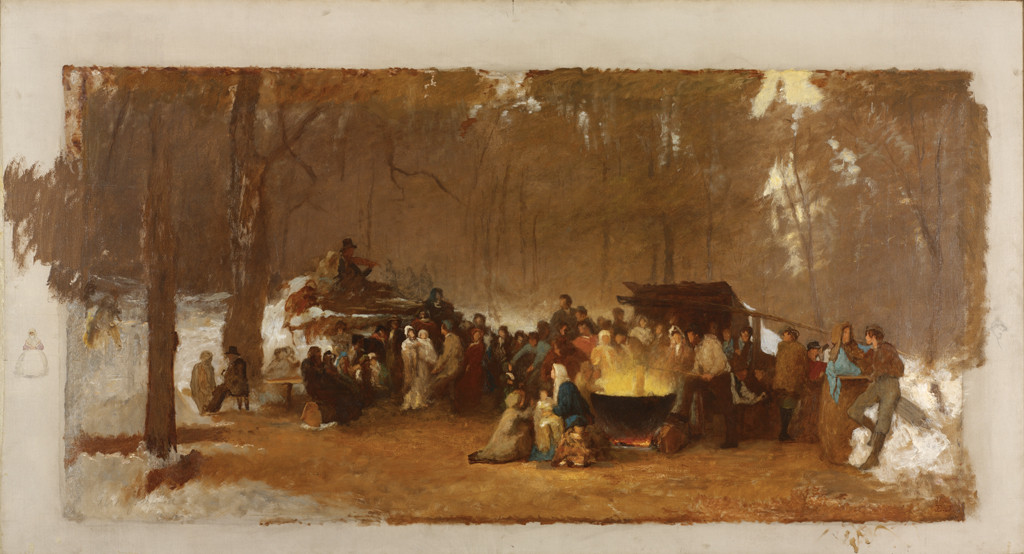
Eastman Johnson’s Sugaring Off gathers a community around the production of maple sugar. A large boiling vessel and its fire occupy the centre-right, while people cluster, talk and move through a wooded camp. The subject is everyday rural work, but the canvas gives it the breadth of a much grander public scene.
The painting in the RISD Museum is unfinished. Its exposed margins contain small figure experiments, and the main composition alternates between broadly established masses and more developed patches of colour. Those differences make the work especially revealing: we can look at the gathering and at the process through which Johnson was constructing it. [1] [2]
At a Glance
- Artist Eastman Johnson
- Title Sugaring Off
- Date About 1864–65
- Medium Oil on canvas
- Dimensions 134 × 245.1 cm
- Collection RISD Museum, Providence
- Accession 45.050
- Credit Museum Works of Art Fund
- State Unfinished
The current RISD object record supplies the date and measurements. A broader date range sometimes used for the series should not replace this particular canvas’s museum dating. [1]
This work across Eastman Johnson’s career
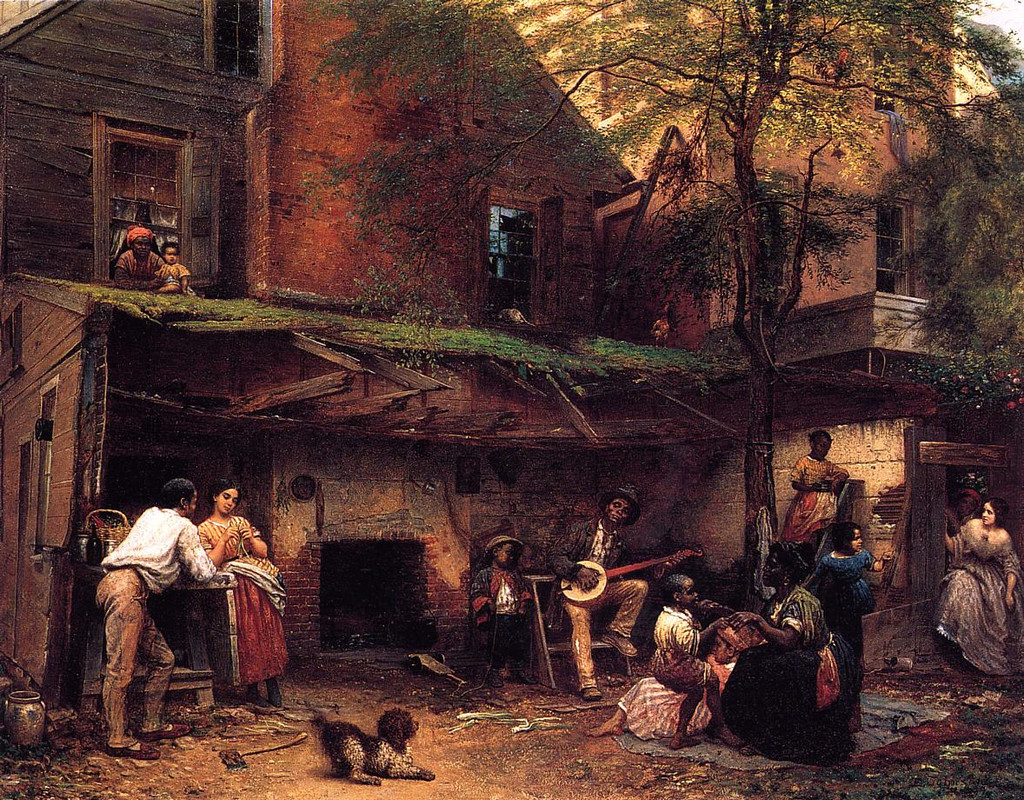
Negro Life at the South
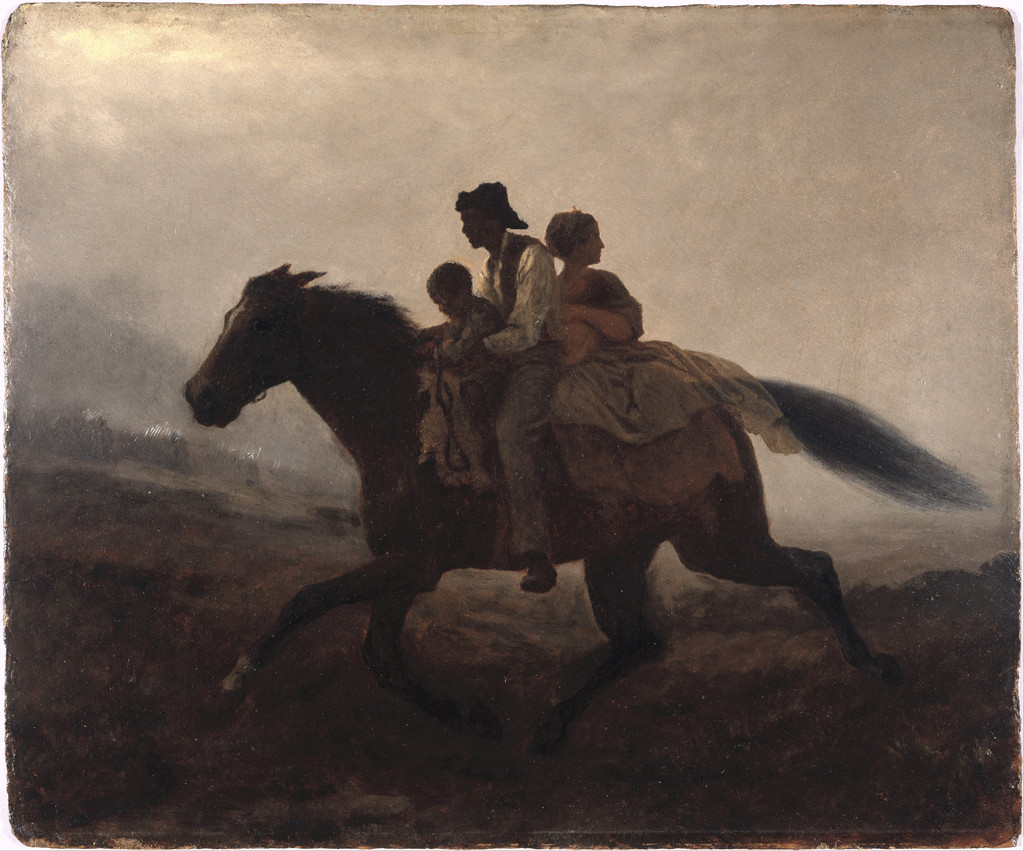
1859; New York Historical originalA Ride for Liberty—The Fugitive Slaves
About 1862; Brooklyn versionSugaring Off (current article)
About 1864–65; unfinished RISD canvasThe Wounded Drummer Boy (San Diego study)
About 1864–71; study, not the finished canvasThe Early Scholar
About 1865; NGA studyFiddling His Way
1866; Chrysler canvasNotes and sources
Negro Life at the South. A Washington yard brings everyday encounters into the contested setting of slavery. [3]
A Ride for Liberty—The Fugitive Slaves. A family’s movement towards freedom carries the whole composition. [4]
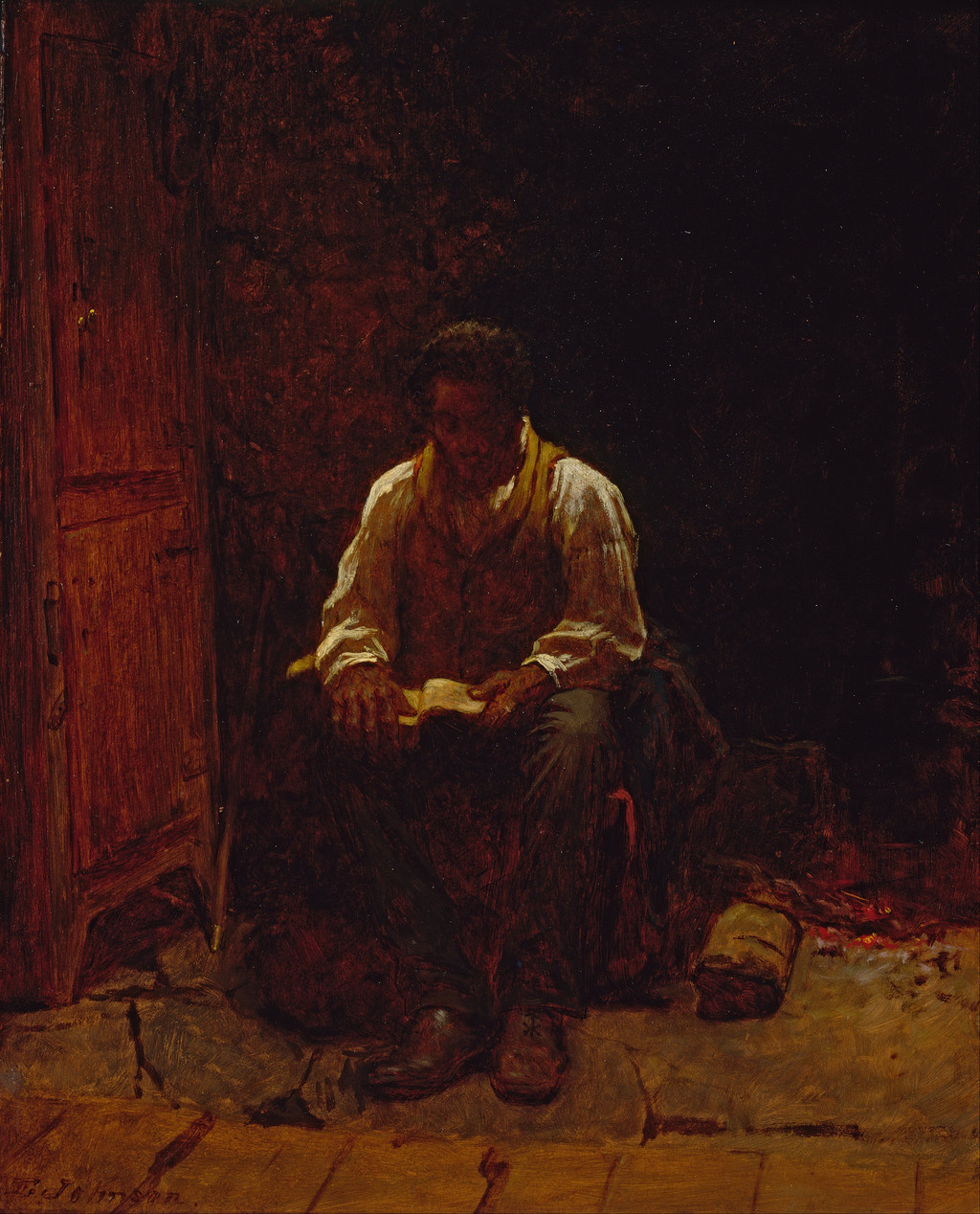
The Lord Is My Shepherd. A lowered head and open book concentrate attention within a dark room. [5]
Sugaring Off (current article). Unfinished passages reveal the preparation of an ambitious gathering around maple-sugar production. [1]
The Wounded Drummer Boy (San Diego study). Soldier and drummer form a single upright group; this study has its own object history. [6]
The Early Scholar. A child’s position beside a stove turns the need for warmth into the centre of a schoolroom. [7]
Fiddling His Way. A Black musician’s playing gathers the attention of a household. [8]
Contents
- A spring activity in Maine
- Reading the camp from left to right
- Work, music and company
- Brown preparation and selected colour
- The experiments at the margins
- Ambition without a known final outcome
- The Sap Gatherers
- Maple sugar and historical interpretation
A spring activity in Maine
Johnson began a series of maple-sugar subjects in the early 1860s, working around Fryeburg in his home state of Maine. The catalogue describes spring visits to observe the gathering of sap and its reduction at temporary camps. The large RISD canvas belongs to that sustained investigation of a seasonal industry and its social occasions. [2] [9]
The process gives the picture an understandable practical centre. Sap must be collected and boiled down, so vessels, fuel, shelters and people can become parts of the same working arrangement. Johnson’s composition extends that activity into a gathering in which children, musicians and sociable groups also have a place.
Spring is important to the subject’s identity. Maple-sap gathering should not be confused with an autumn harvest merely because Johnson later painted corn husking and cranberry picking. The different seasonal tasks offered him different settings, objects and ways of arranging a community. [9]
Reading the camp from left to right
At the left, a large tree trunk establishes the nearest vertical boundary within the painted scene. Behind it, the more lightly indicated woodland recedes into a brown atmosphere. A raised musician and a rough structure or pile of timber help gather the figures into a denser group towards the middle.
The central company occupies several levels. Some figures stand, others sit or bend, and smaller bodies appear nearer the ground. Their varied heights prevent the gathering from becoming a simple procession. Johnson uses groups within the group, allowing a viewer to discover exchanges that do not all depend on the same action.
The boiling vessel is the most conspicuous practical object. Its dark bowl sits above a bright fire, with pale vapour rising into the figures behind. The contrast of black, orange and lighter paint creates a strong focus within the canvas’s predominantly brown field. Heat becomes visible through differences of colour and tone.
At the right, figures occupy the area beside a rough shelter and a stronger vertical form. A seated man, a standing woman in brighter colour and other nearby bodies create a second cluster. Their positions extend the scene beyond the vessel, making the camp seem like a place in which several activities can continue at once.
The trees provide a larger framework above these incidents. Some trunks and branches are barely articulated, yet they are sufficient to establish enclosure and distance. The figures do not need a fully finished woodland to appear gathered beneath it. The image demonstrates how much pictorial information can be carried by selective marks.
Work, music and company
The gathering’s character comes from the conjunction of production and recreation. The vessel, fire and rough structures establish labour, while music and smaller social exchanges extend the event beyond a technical demonstration. The image asks us to look at the people assembled around a process, rather than only at the process itself.
The large format makes that distinction especially clear. At nearly two and a half metres wide, the canvas could give rural figures an imposing collective presence. Curator Maureen C. O’Brien relates its scale to the ambition of history painting, even though its subject is a New England community event. [1] [2]
The result can feel theatrical without requiring the scene to be dismissed as inauthentic. Bodies have been selected and positioned to make gestures readable across a broad space. Observed activities become material for an organised composition, with enough variety to suggest that life continues beyond its most prominent incident.
Brown preparation and selected colour
O’Brien’s essay connects the exposed working method with Johnson’s training under Thomas Couture. Broad brown preparation establishes a tonal field, while stronger lights and touches of colour bring particular figures forward. The image remains coherent before all its passages have received equivalent finish. [2]
This is visible in the contrast between the loosely described trees and the brighter costumes near the boiling vessel. A face, sleeve or skirt can emerge through a relatively small change against the brown background. The shared preparation helps join separate figures even when their individual features remain incomplete.
Hills’s general technical account likewise describes Johnson’s use of underpainting as part of the middle tone of an interior or figure composition. That context helps explain the economy of the process. It does not identify a complete pigment mixture or prove that every brown passage here was produced through an identical procedure. [10]
The unfinished state therefore reveals a relationship between overall organisation and local detail. Johnson could establish the crowd, woodland and principal light effects before resolving every person. The viewer can follow that hierarchy without needing to imagine a single inevitable finished appearance.
The experiments at the margins
Around the central painted area, pale exposed canvas contains isolated sketches and figures. Some are drawn lightly; others receive small touches of paint. These marks belong to the object’s working history rather than to a separate decorative border. O’Brien interprets them as trials of poses and character within the developing composition. [2]
The margins are valuable because they keep alternatives visible. A figure can be considered away from the crowd, where the arrangement of an arm, skirt or body can be tested without immediately deciding its final relationship to every other person. The large composition and its smaller experiments occupy the same physical surface.
The contrast also changes how we understand the main group. Its more legible passages are stages within an ongoing construction, rather than proof that Johnson had already settled everything else. Some bodies appear firmly placed; others remain closer to indications of a possible position.
RISD records red initials and a pencil inscription identifying the work as unfinished. The marks reinforce the distinction between the substantial image that survives and a fully completed exhibition picture. Preserving the exposed edges in reproduction allows that material character to remain part of the reading. [1]
Watch: Eastman Johnson
Choose a film to explore the artist’s work, its interpretation and its wider setting.
Director's Choice - The Girl I Left Behind Me by Eastman Johnson
The Smithsonian American Art Museum looks at Johnson’s The Girl I Left Behind Me.
Watch on YouTubeAmbition without a known final outcome
According to O’Brien, Johnson did not exhibit this large canvas publicly during his lifetime. Her account places it within a studio economy in which prospective patrons could view works in progress and consider commissions. That offers a context for its ambition without supplying a complete record of every visitor or response. [2]
The painting’s survival as an unfinished object does not by itself explain why work stopped. A projected composition might change, remain without a buyer or lose priority among other projects. The consulted evidence does not justify turning one such possibility into the definite story of this canvas.
Its present interest nevertheless does not depend entirely on a missing completion. The visible process makes the work a substantial account of composition in progress. The boiling vessel, grouped figures and woodland already establish a convincing encounter, while the margins show some of the decisions through which it was being achieved.
The Sap Gatherers
Johnson returned to maple-sugar subjects beyond the early-1860s campaign. The Sap Gatherers , dated about 1873 in the catalogue raisonné, is a much smaller work in oil on paper mounted on board, measuring 34.6 × 42.2 cm. Its present whereabouts are recorded as unknown. It should not be mistaken for the RISD canvas or automatically treated as an early study for it. [9]
The catalogue reproduces a 1907 sale description of two boys gathering sap. One pours from a birch-bark container into a barrel on a sled, while the other drinks from a similar vessel. The episode concentrates on collection within the woods, in contrast to the large canvas’s gathering around boiling and social activity. [9]
The smaller picture also has an unusual collaborative history. A diary entry by Jervis McEntee, transcribed in the catalogue, recalls spending a day in Johnson’s studio painting on its foreground. The entry is dated 22 April 1873 but refers back to a Thursday; the date of writing should not silently become the exact day of the work. [9]
The recollection makes the studio a place of artistic exchange as well as individual preparation. It does not establish how every passage was divided between the painters, or make McEntee a co-author of the earlier RISD composition. Its particular value lies in documenting assistance on a specific later picture. [9]
Maple sugar and historical interpretation
The catalogue’s thematic account relays Brian Allen’s argument that maple sugar could acquire patriotic and antislavery associations as an alternative to plantation-produced cane sugar. That interpretation supplies a wider context for the subject during the Civil War years. It is not an explicit statement by Johnson explaining the political meaning of this exact canvas. [9]
The distinction matters because a rural gathering can carry several kinds of appeal. Viewers might attend to customary work, regional identity, social continuity, lively figures or painting technique. Those possibilities do not have to be reduced to one message before the picture becomes historically interesting.
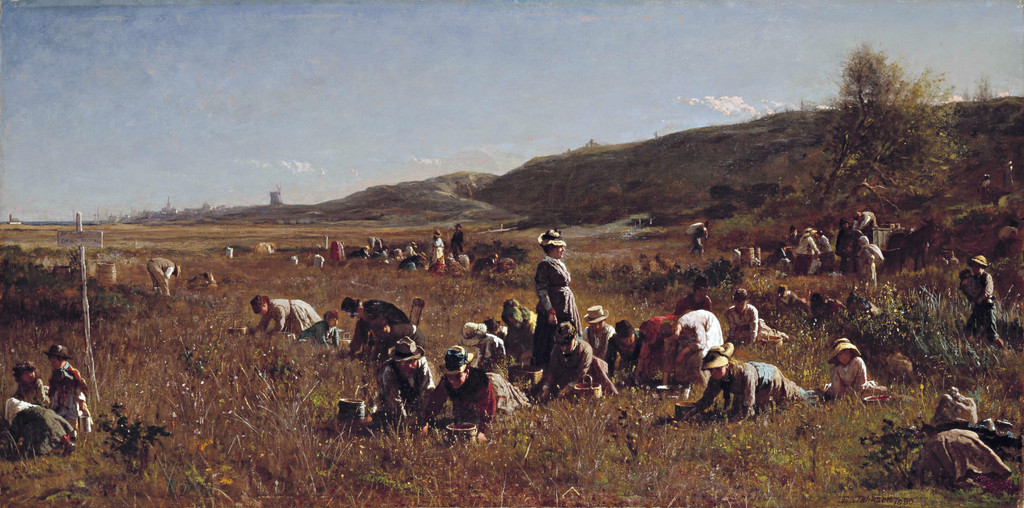
The later Husking Bee and The Cranberry Harvest show Johnson resolving other large communal scenes. Their clearer finished surfaces offer a useful contrast with this exposed process. Across the works, repeated tasks create patterns through which many individuals can occupy a single expansive image.
For readers interested in Johnson’s technique , Sugaring Off is particularly instructive because preparation remains visible alongside developed passages. The painting invites close looking at what has been established, what is still tentative and how a broad tonal framework can support a crowded scene.
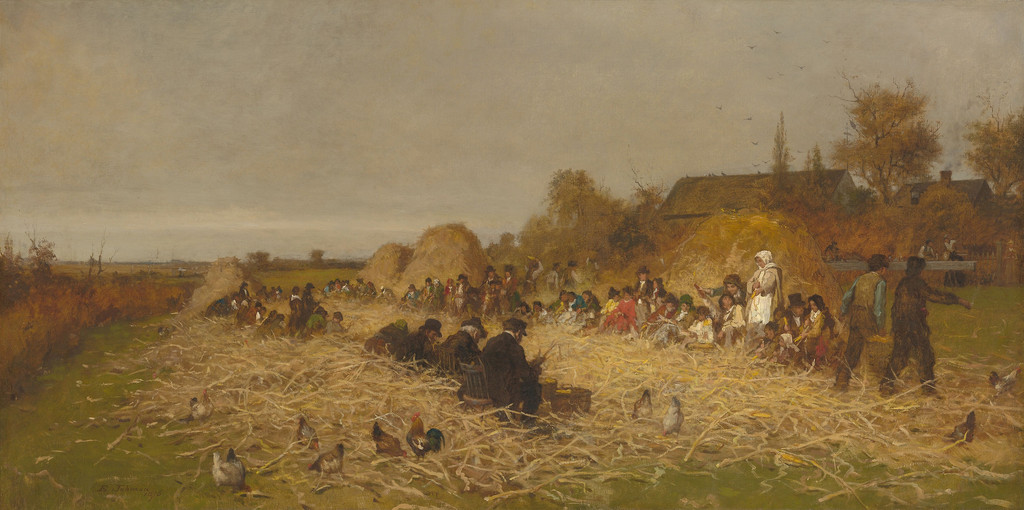
Eastman Johnson, Husking Bee, Island of Nantucket, 1876. Oil on canvas, 69.6 × 138.2 cm. Art Institute of Chicago, 1922.444. CC0.
Image source
.
CC0 / Public domain
.
Artworks directory
Browse twenty-one selected objects discussed in these articles, including the Gifford portrait and the Prang print after Johnson. Dates identify individual objects, including the San Diego Drummer Boy study. Use All media to include the chromolithograph.
| Name | Date | Medium |
|---|---|---|
| Kitchen at Mount Vernon | 1857; Charles Butt canvas | Oil on canvas |
| Negro Life at the South | 1859; New York Historical original | Oil on linen |
| A Ride for Liberty—The Fugitive Slaves | About 1862; Brooklyn version | Oil on paperboard |
| The Lord Is My Shepherd | 1863 | Oil on fiberboard |
| Sugaring Off | About 1864–65; unfinished RISD canvas | Oil on canvas |
| The Wounded Drummer Boy (San Diego study) | About 1864–71; study, not the finished canvas | Oil on board |
| The Early Scholar | About 1865; NGA study | Oil on academy board on canvas |
| Fiddling His Way | 1866; Chrysler canvas | Oil on canvas |
| The Letter Home | 1867; Minneapolis drawing | Charcoal and graphite on paper |
| The Boyhood of Lincoln | 1868; Michigan canvas | Oil on canvas |
| The boyhood of Lincoln—An evening in the log hut (Prang after Johnson) | About 1868; separate reproductive print | Chromolithograph, W. Harring / L. Prang & Co., after Johnson |
| The Brown Family | 1869; NGA version | Oil on paper on canvas |
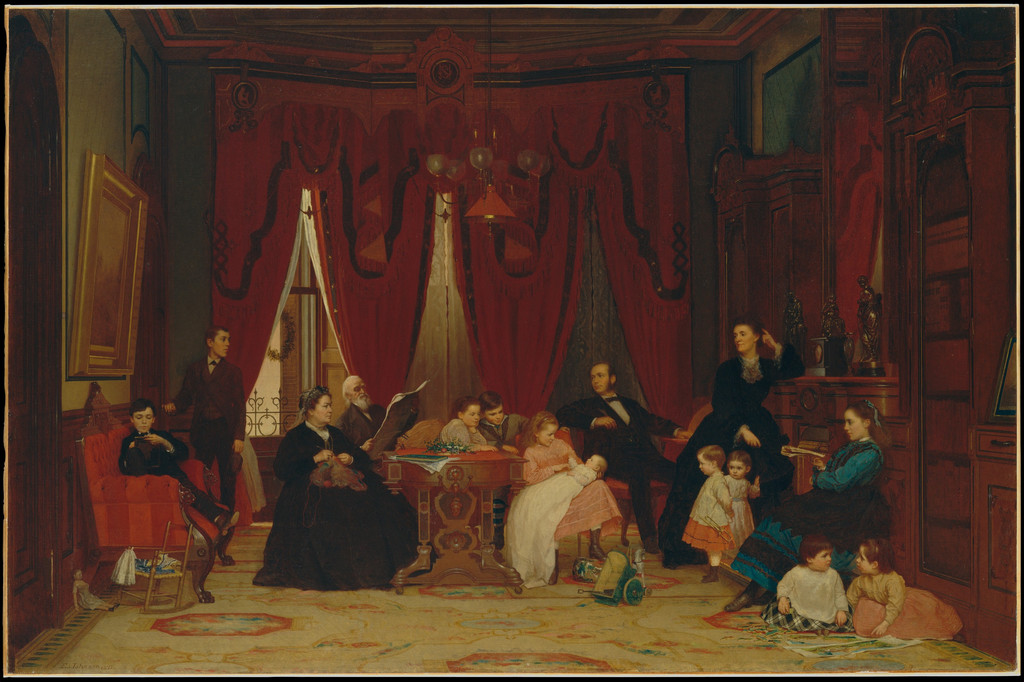
| The Hatch Family | 1870–71 | Oil on canvas |
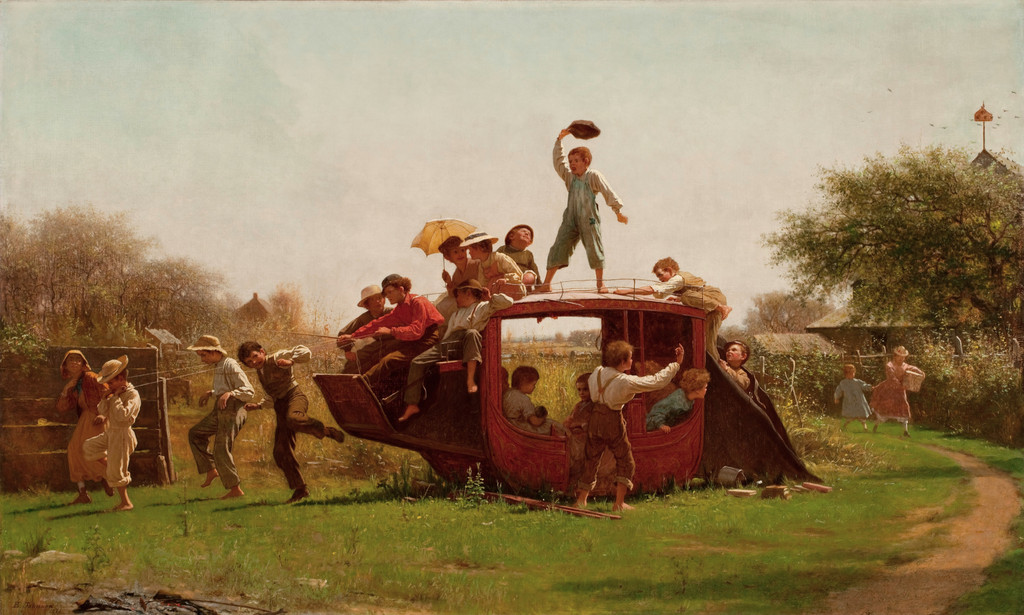
| The Old Stagecoach | 1871 | Oil on canvas |
| The Girl I Left Behind Me | About 1872 | Oil on canvas |
| The Toilet | 1873 | Oil on paper board |
| Husking Bee, Island of Nantucket | 1876; Chicago canvas | Oil on canvas |
| The New Bonnet | 1876 | Oil on academy board |
| Sanford Robinson Gifford | 1880; possibly posthumous | Oil on academy board |
| The Cranberry Harvest, Island of Nantucket | 1880; Timken canvas | Oil on canvas |
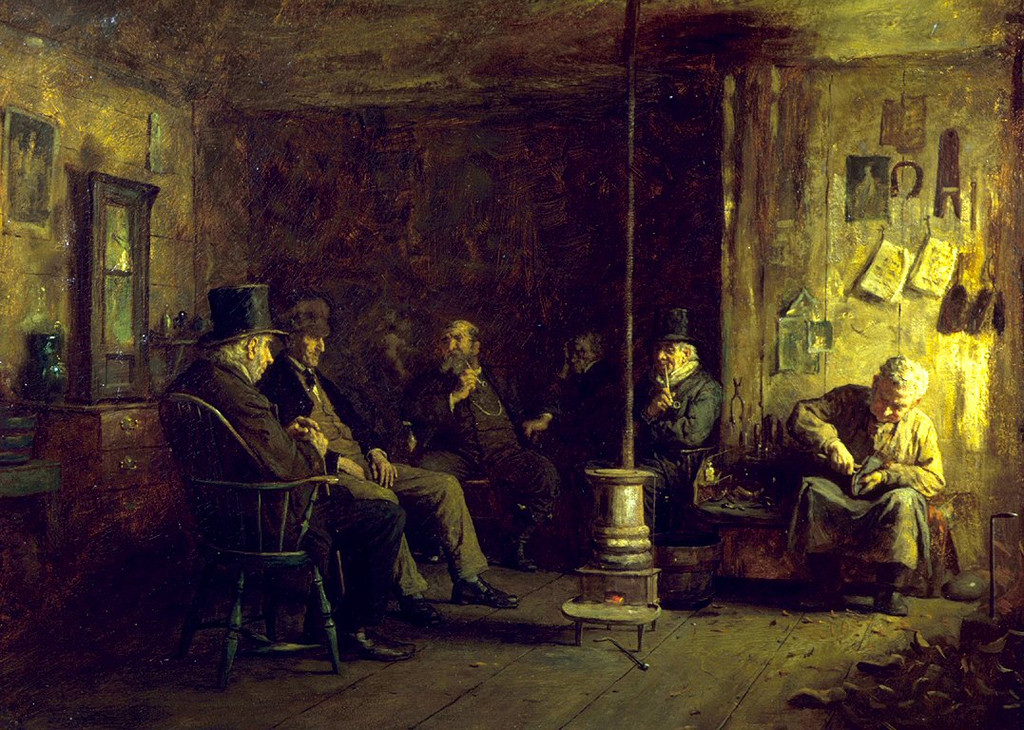
| The Nantucket School of Philosophy | 1887 | Oil on panel |
Frequently Asked Questions
The documented catalogue account concerns the foreground of the distinct, smaller Sap Gatherers , dated about 1873. It should not be transferred to the earlier RISD canvas. [9]
Discussion
Look again at the images and ideas explored in Sugaring Off by Eastman Johnson. These editorial prompts invite your observations.
Reader Insights
Where do the exposed margins make a compositional decision visible before it becomes fully resolved?
How do work, music and waiting coexist within the camp rather than forming a single repeated action?
Compare the large unfinished canvas with the recorded Sap Gatherers. Why is their distinction important to the collaboration account?
Join the Conversation
Share a detail, comparison or question about Sugaring Off by Eastman Johnson below.
References
- RISD Museum. Sugaring Off , about 1864–65, 45.050. Current date, measurements, inscriptions, credit and CC0 image status. Older exhibition labels contain seasonal and veteran-identification claims not adopted here. View source
- Maureen C. O’Brien. New Ways to Paint: Sugaring Off , RISD Museum, 24 January 2014. Scale, working method, Couture, exposed margins and lifetime exhibition status. View source
- Negro Life at the South,1859,S-225. View source
- A Ride for Liberty–The Fugitive Slaves, Brooklyn version, Hills 10.0.11r. View source
- The Lord Is My Shepherd, 1863, 1979.5.13. View source
- Wounded Drummer Boy, San Diego study, Hills 10.0.18. View source
- The Early Scholar,c.1865,1963.10.157: current object record. View source
- Fiddling His Way,1866,89.60. View source
- Patricia Hills and Abigael MacGibeny. The Sap Gatherers , about 1873, Hills no. 13.6.11. Eastman Johnson Catalogue Raisonné. Maple-sugar series context, separate object, transcribed McEntee diary, sale description and provenance. Allen’s interpretation is consulted through this account; original diary not directly read. View source
- Patricia Hills. Technical Information on Johnson’s Practices. Eastman Johnson Catalogue Raisonné. General tonal preparation and working methods , not a laboratory report on this canvas. View source
- Splash image source.
Eastman Johnson, Sugaring Off, about 1864–65. Oil on canvas, 134 × 245.1 cm. RISD Museum, Museum Works of Art Fund, 45.050. Unfinished. CC0. CC0 / Public domain .
View source