 by
Tom Gurney
Tom Gurney BSc (Hons) is an art history expert with over 20 years experience
Email:
tomgurney1@gmail.com
/ Phone:
+44 7429 011000
The Cranberry Harvest, Island of Nantucket by Eastman Johnson: Introduction
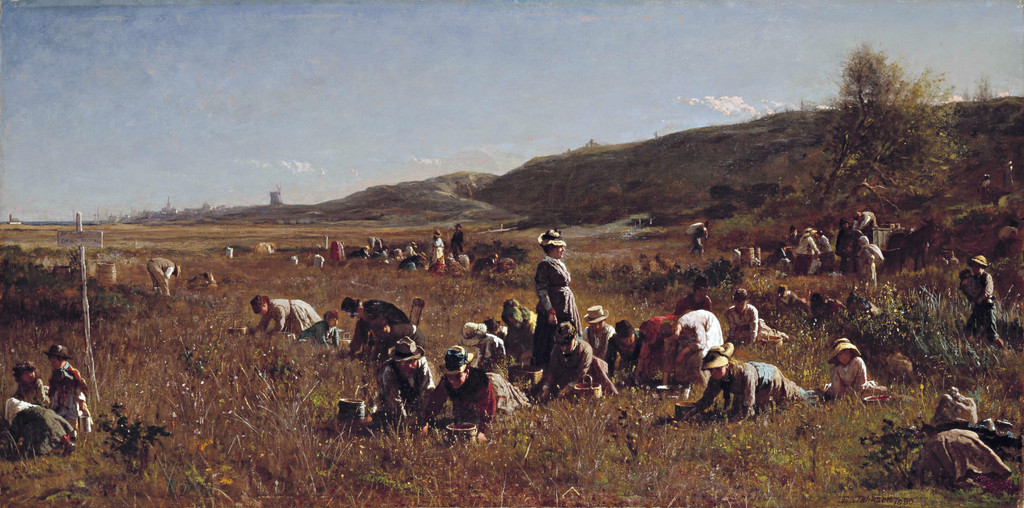
Eastman Johnson’s The Cranberry Harvest, Island of Nantucket spreads a seasonal gathering across a broad field beneath an expansive sky. Most figures bend or kneel among the plants. A standing woman near the centre interrupts their low silhouettes, while buckets, children, carts and distant workers connect separate actions into a larger scene.
The painting was completed in 1880 and is now in the Timken Museum of Art’s Putnam Foundation collection. It brings together Johnson’s interest in rural labour, individual gestures and the construction of a landscape filled with people. Its history also includes studies, major exhibitions, private ownership abroad and the removal of a figure added by a later hand. [1] [2]
At a Glance
- Artist Eastman Johnson
- Title The Cranberry Harvest, Island of Nantucket
- Date 1880
- Medium Oil on canvas
- Dimensions 69.5 × 138.4 cm
- Collection Putnam Foundation, Timken Museum of Art, San Diego
- Accession 1972:002
- Signature and date Lower right
The dimensions follow the Timken’s current object record, which differs from the measurement given in the catalogue raisonné. [1] [2]
This work across Eastman Johnson’s career
The Girl I Left Behind Me
About 1872The Toilet
1873Husking Bee, Island of Nantucket
1876; Chicago canvasThe New Bonnet
1876The Cranberry Harvest, Island of Nantucket (current article)
1880; Timken canvasNotes and sources
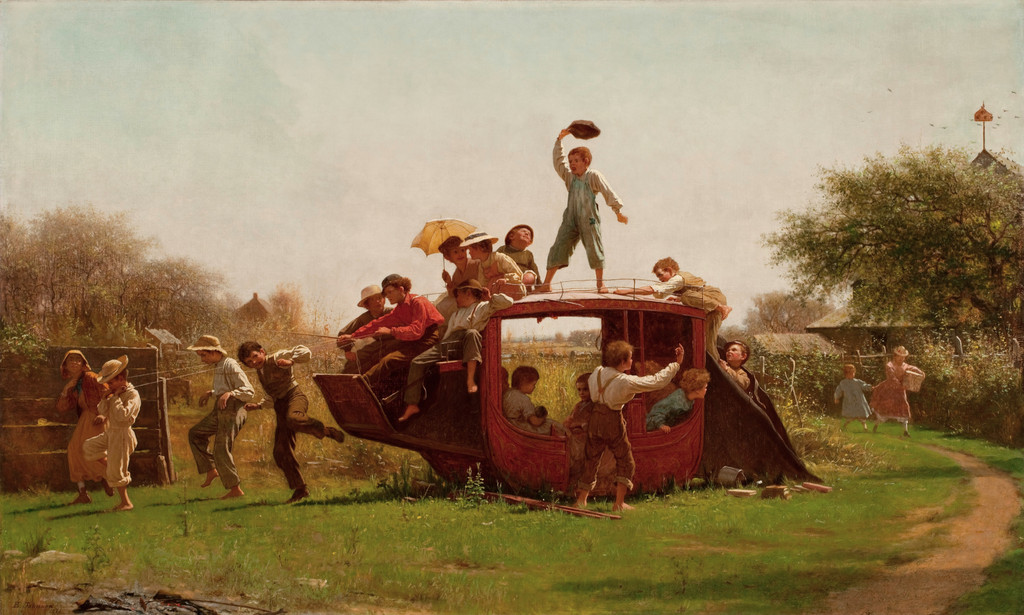
The Old Stagecoach. Children give a broken vehicle a new purpose through play. [3]
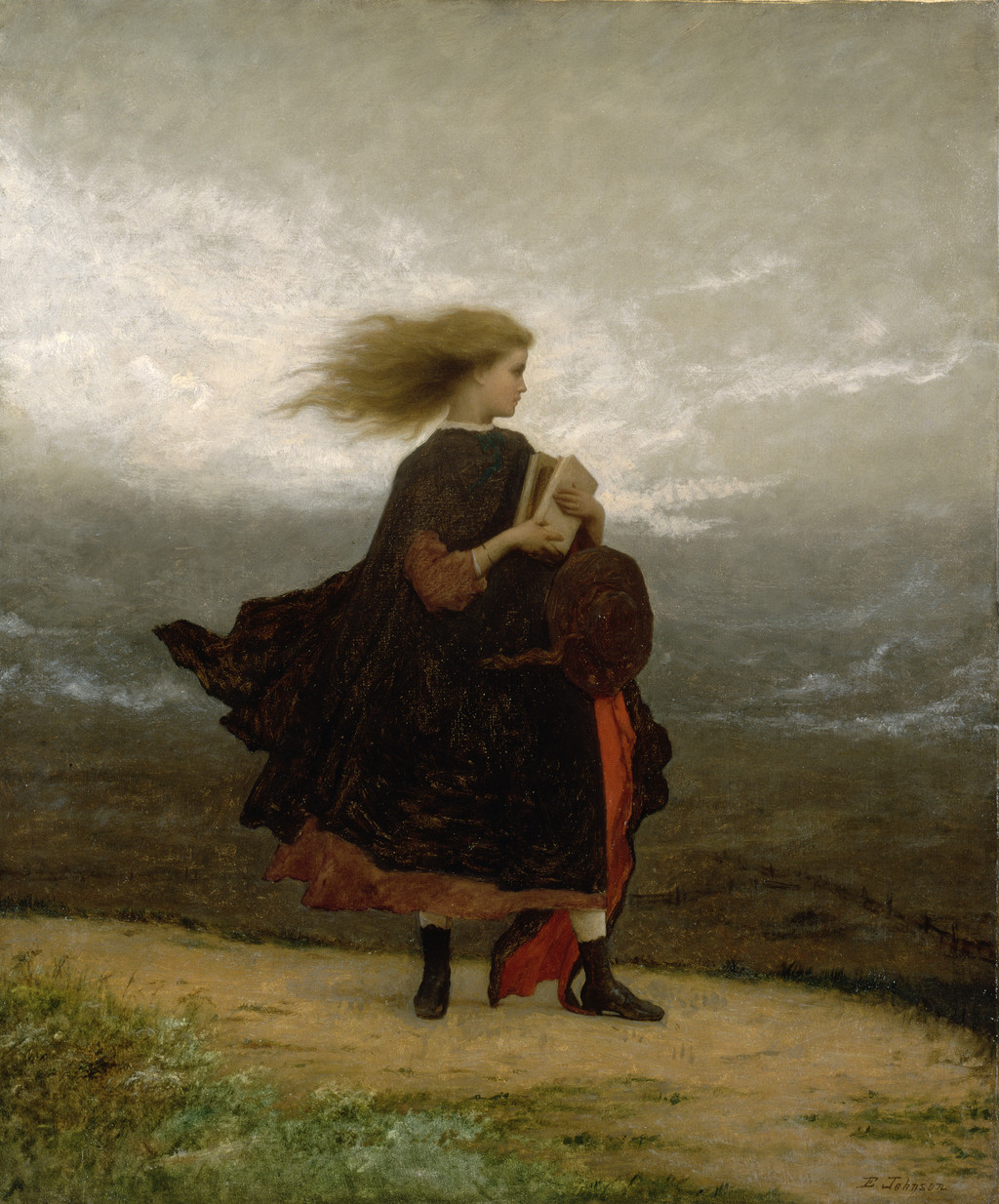
The Girl I Left Behind Me. A still figure, books and wind-driven clothing hold competing directions of attention. [4]
The Toilet. The mirror returns a face while the figure’s back occupies the foreground. [5]
Husking Bee, Island of Nantucket. A line of people and pale husks joins harvest work to a social gathering. [6]
The New Bonnet. A bonnet, a glass and a fire give three figures different occupations within one room. [7]
The Cranberry Harvest, Island of Nantucket (current article). Repeated working figures spread across a panoramic field beneath an expansive sky. [1]
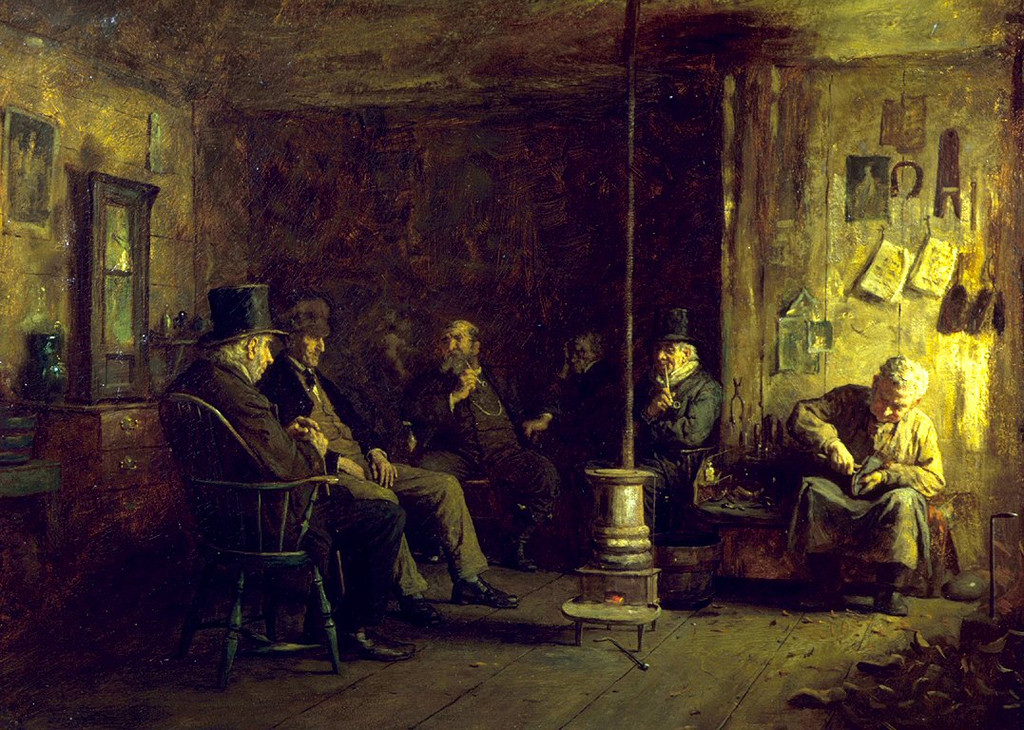
The Nantucket School of Philosophy. A shoemaker’s shop becomes a place for work, company and conversation. [8]
Contents
- Nantucket and a sustained harvest subject
- The width of the picture
- The standing woman and an approaching child
- Bodies organised around a repeated task
- A landscape with distant settlement and boundaries
- Light and the movement of colour
- Related studies and a closer view of picking
- Community without a complete social inventory
- The figure added by another hand
- Annotated details
Nantucket and a sustained harvest subject
Johnson began spending substantial periods on Nantucket in 1870, following his marriage to Elizabeth Buckley the previous year. The island supplied subjects ranging from children’s play and women outdoors to older captains gathered in interiors. The cranberry harvest became one of his most sustained investigations of work within a rural community. [2]
The catalogue describes a series of at least eighteen studies associated with the subject. That breadth matters: the finished panorama was part of an extended process of observing figures, considering groups and developing the relationship between activity and place. It should not be treated as the sole surviving record of a subject Johnson encountered once. [2]
The harvest offered several things that could interest a figure painter. It brought people outdoors, required repeated bodily movements and distributed work across an open area. Containers and vehicles could connect individual pickers to the gathering as a whole. Children’s presence introduced further differences of scale and attention within the same landscape.
The panorama transforms those possibilities into a legible composition. The viewer can recognise a large seasonal activity before identifying what any one person is doing. At closer range, the gathering becomes less uniform, with pauses, exchanges and different postures interrupting the general pattern.
Annotated Details from The Cranberry Harvest, Island of Nantucket
The numbered points identify visible features discussed in this article. Return from each detail to the whole composition. Eastman Johnson, The Cranberry Harvest, Island of Nantucket, 1880. Oil on canvas, 69.5 × 138.4 cm. Putnam Foundation, Timken Museum of Art, 1972:002. Public domain faithful reproduction. Image source. Public domain. Numbers added to a separate overview; detail images are native crops. No recolouring, retouching, reconstruction or enlargement.
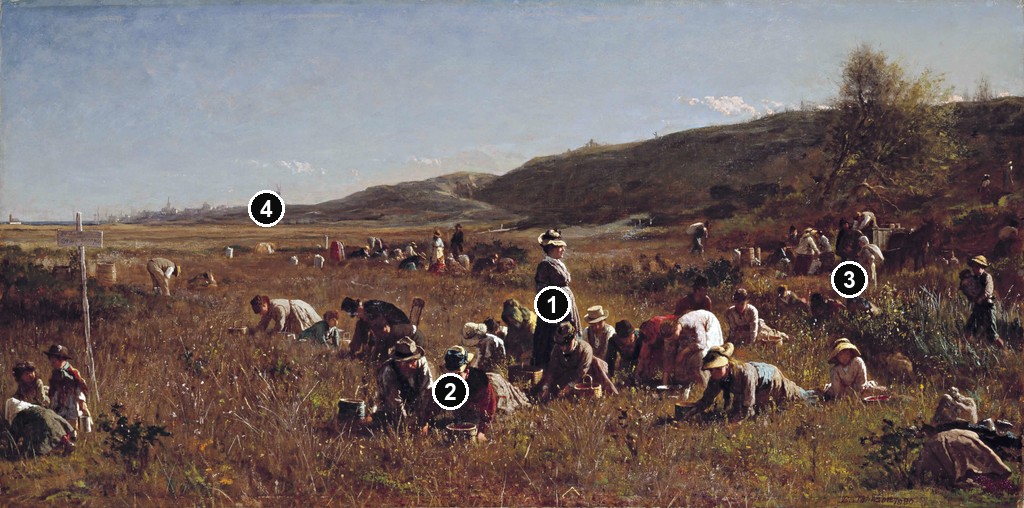
Details from THE CRANBERRY HARVEST, ISLAND OF NANTUCKET
Compare the cropped details with the complete images above. Notice how their colours, shapes and positions contribute to the larger compositions.
The standing woman and nearby child
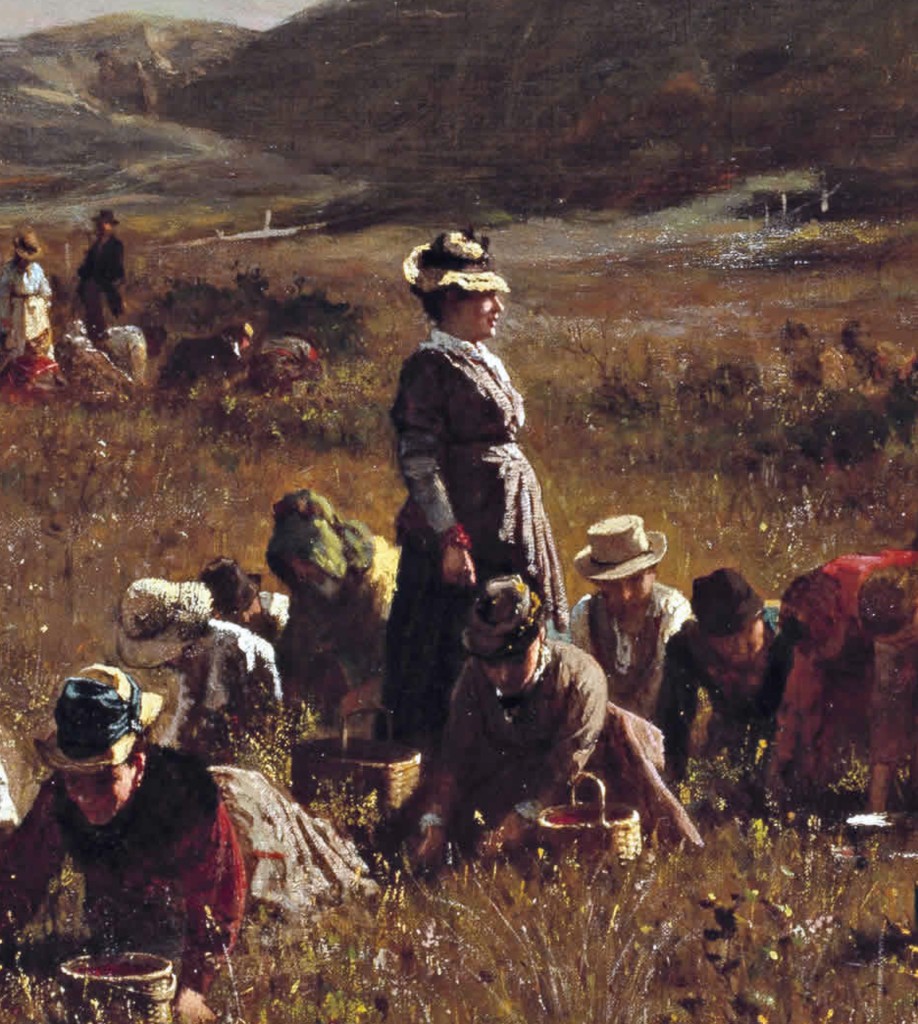
The standing woman rises above the repeated bent and kneeling bodies. A smaller figure nearby gives the upright form a connection with the surrounding activity rather than isolating it as a single protagonist.
Hands, baskets and repeated picking
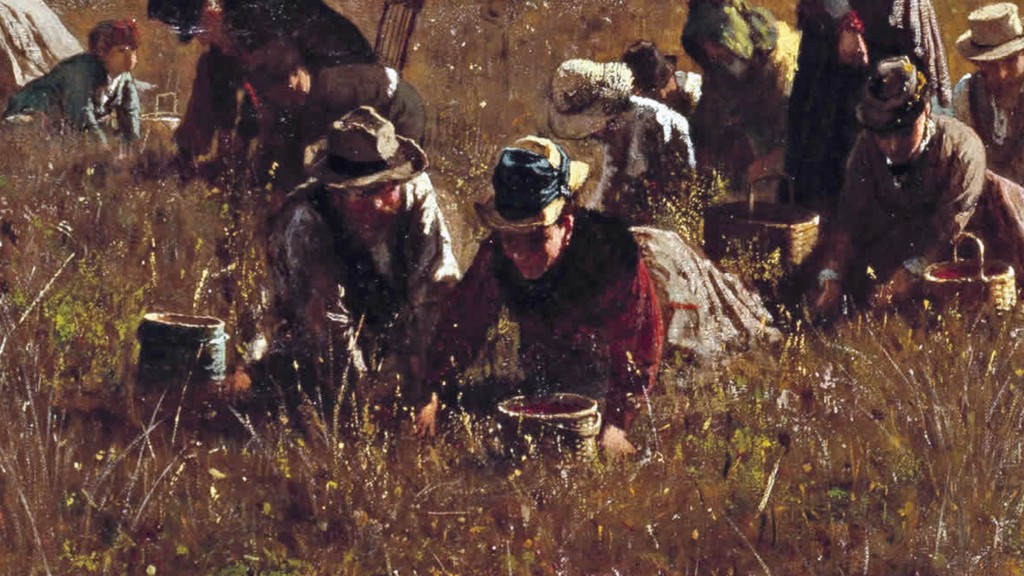
Foreground figures bend towards the low plants and containers. Hats, sleeves and baskets form a series of separate light and dark shapes across the working group.
Work continuing towards the right
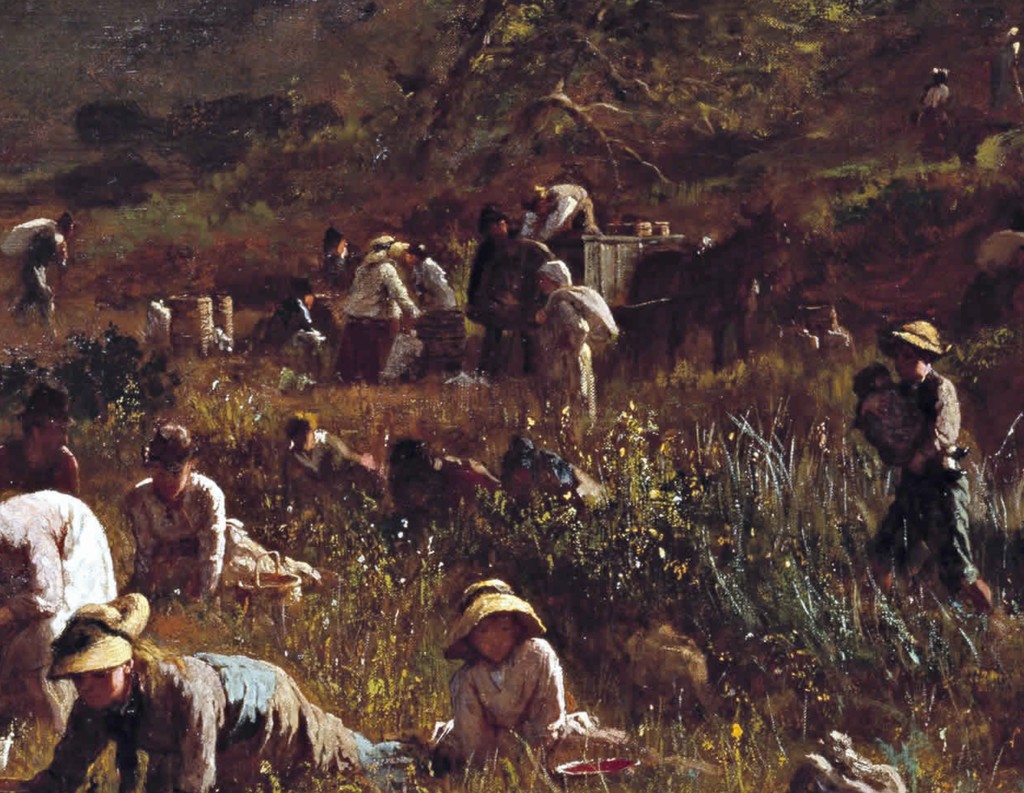
More figures and a cart extend the gathering towards the bank. Their changing sizes and positions carry activity away from the foreground without closing the field around one group.
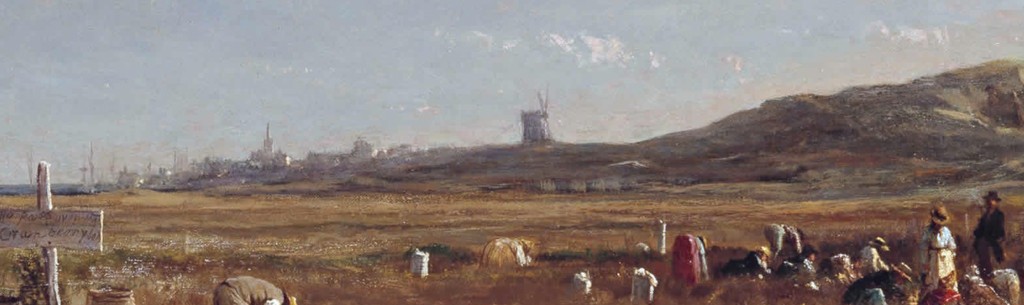
Settlement along the distant horizon
A windmill and buildings mark the far edge of the open field. Their small scale makes the worked landscape extend towards an inhabited distance beneath the broad sky.
The width of the picture
The canvas is nearly twice as wide as it is high. That proportion encourages the eye to travel along the field rather than settle immediately on a single central episode. Groups spread towards both sides, and the figures’ different distances establish a substantial landscape beyond the foreground.
The sky gives the scene room to breathe. Its blue and pale cloud forms occupy much of the upper field, balancing the density of plants, containers and bodies below. The workers remain important without turning the landscape into a thin strip behind a frieze of figures.
The broad hillside at the right introduces another large shape. Its darker slope rises above the gathering and then descends towards the more distant terrain at the left. A viewer can follow that movement away from the nearer workers, across open ground and towards the settlement on the horizon.
These large divisions make a crowded subject manageable. Sky, bank and worked field establish a framework in which small gestures can remain readable. Johnson does not give every worker equal prominence; some become clear incidents, while others contribute to the sense of repeated activity farther away.
The standing woman and an approaching child
The standing woman near the centre is the most conspicuous interruption of the picking posture. Her dark dress and pale hat form a strong upright against the lower bodies around her. She gives the broad horizontal design a vertical focus without standing precisely at its mathematical centre.
The Timken’s interpretation draws attention to her connection with a boy carrying an infant towards her. That exchange introduces a small narrative within the work gathering. The woman’s pause can connect attention to other people with the practical activity taking place around her. [1]
The figures’ relationship should not be expanded into a complete undocumented family story. The image and museum account establish the approach and the exchange of attention, but do not identify the people or supply their conversation. The usefulness of the incident is that it makes the gathering feel socially responsive.
The standing figure also changes how the neighbouring bodies are seen. Kneeling women, seated children and a figure bending close to the ground become more noticeable through contrast with her height. Johnson can vary the rhythm of work by allowing one participant to stop while others continue.
The episode is therefore both narrative and structural. It gives the reader a point of human connection and gives the composition a stable landmark. From there, the eye can return to the foreground pickers or move towards the carts and clustered activity at the right.
Bodies organised around a repeated task
The nearer pickers occupy a range of postures. Some bend from the waist, others kneel, and some sit low enough for their hats and shoulders to become the most visible parts of the body. The plants partly conceal hands and lower limbs, making the activity legible through concentrated bodily directions rather than a sequence of fully exposed actions.
The differences are important. A repeated task could produce an image of interchangeable workers, but Johnson varies the intervals, colours and orientations. Several figures turn sideways; others face into the field. Some work close together, while a few are separated by a small expanse of vegetation.
Buckets punctuate those intervals. Their upright sides and darker openings provide more geometric shapes within the irregular grass. A container can mark the small territory around one picker while also implying the accumulation of produce through the group’s repeated labour.
Children introduce a different scale. Near the lower edges, smaller bodies accompany adults without simply duplicating their postures. Their presence makes the harvest a setting for shared time as well as a sequence of practical operations. The exact responsibilities and relationships of the depicted children remain unidentified.
At the right, carts and animals extend the working system beyond picking. They suggest movement and collection around a scene otherwise dominated by low, local gestures. The contrast between kneeling figures and larger transport equipment helps the viewer understand the harvest as several connected activities.
A landscape with distant settlement and boundaries
The near field is dense with grasses, flowers and low plants. Colour and small strokes create an uneven surface rather than a diagram of each botanical form. That treatment matters because the workers have to appear within the field, partly obscured by it, rather than pasted onto a uniformly empty ground.
Farther left, the settlement and a conspicuous windmill establish a horizon of habitation beyond the harvest. The Timken emphasises Johnson’s attention to the distant Nantucket view and its landmarks. The painting connects the immediate activity with a place that extends beyond the workers’ field. [1]
A posted notice stands in the left-hand area. It introduces a small indication of boundaries within a landscape that can initially look open and unrestricted. Historical transcriptions of its wording differ, so the visible presence of the notice is more secure here than an exact quotation of its lettering. [2]
The hillside and vegetation create boundaries of another kind. They divide the broad landscape into passages of light, shadow and distance. The gathering is expansive, but it is not spread evenly through an undifferentiated space. People and equipment occupy selected areas within a varied terrain.
The result is a landscape with human use at its centre. Its interest does not depend on separating beautiful scenery from the work taking place within it. The dry plants, paths, distant buildings and gathering of pickers contribute to the same sense of an inhabited island.
Light and the movement of colour
The Timken describes the scene through late-afternoon light and an evocative handling of the landscape. The light gives particular hats, sleeves and faces stronger emphasis, while other figures merge into the darker vegetation. The overall effect remains broad enough to connect people who are physically separated. [1]
Small passages of red, yellow, blue and pale fabric move through the lower field. They do not all correspond to equally prominent people. A bright sleeve or hat can catch the eye briefly and then redirect it towards another group, creating a rhythm across the panorama.
The sky’s cooler colour counterbalances those warmer notes. The field and bank remain relatively dark in places, which allows scattered highlights to register strongly. The picture’s brightness therefore comes partly from contrasts within a restrained overall structure, rather than every passage being equally light.
Hills’s historical examination notes describe thin passages, free touches of colour and pencil lines visible in places. Those observations support a discussion of economical handling within the finished painting. Descriptive colour names in the notes should not be mistaken for laboratory identification of particular pigments. [2]
The combination of broad design and selective definition helps explain why the gathering can seem both crowded and spacious. Enough is specified to distinguish the principal actions, while other forms remain more suggestive. A viewer moves between recognition of individuals and awareness of the field as a whole.
Watch: Eastman Johnson
Choose a film to explore the artist’s work, its interpretation and its wider setting.
Director's Choice - The Girl I Left Behind Me by Eastman Johnson
The Smithsonian American Art Museum looks at Johnson’s The Girl I Left Behind Me.
Watch on YouTubeRelated studies and a closer view of picking
Crystal Bridges Museum holds Cranberry Pickers, Nantucket , dated about 1879. Its object account places it within Johnson’s exploration of the harvest and gives another institutional point of access to the series. It is a separate canvas, not an alternative title for the Timken panorama. [9]
The relationship between a study and a final picture should be considered carefully. Different harvest images can isolate a figure, concentrate a small group or test a wider setting. A catalogue’s association with the series does not by itself establish the exact order of every sketch or prove that each was made directly before the 1880 painting.
The existence of those related works nevertheless changes the reading of the panorama. Its individual gestures belong to a repeated artistic investigation, not merely to one spontaneous encounter. The gathering can look natural because Johnson had considered the forms through which bending, carrying, pausing and looking could be made intelligible.
The Timken notes that the central exchange suggests observation of an actual scene. That impression is worth distinguishing from a documented claim that the entire finished composition reproduces one moment exactly. Observation and pictorial construction can contribute to the same convincing effect. [1]
Community without a complete social inventory
The picture’s distribution of adults, children and equipment makes the harvest appear communal. Different activities can be joined through a shared seasonal task, and the standing woman’s pause allows care or conversation to enter the broader pattern of work.
Such an image can also offer an appealing continuity with customary rural life. It gives viewers a landscape in which useful labour and human association remain visually connected. The broad sky and varied figures make that connection expansive rather than confined to a single household.
The image does not, however, establish the workers’ wages, ownership arrangements or every social relationship on the island. Those questions require other evidence. The painting’s particular achievement is to make a selected gathering convincing and consequential, rather than to supply a complete economic survey.
Comparison with The Old Stagecoach helps keep that selectivity visible. Children in a sunny rural setting can carry ideas about community while also taking different roles within a constructed scene. Johnson’s apparently familiar subjects reward questions about arrangement as well as recognition.
The figure added by another hand
The painting’s appearance has changed during its history. The catalogue reports that a figure was added beside the standing woman while the canvas was abroad. Hills saw the addition in 1970 and later described it as the work of another hand. According to her account, it was removed between 1970 and 1972. [2]
The addition matters because the central area depends on the spacing among bodies and the direction of their attention. Inserting another person could alter the balance between the standing woman, the approaching figures and the surrounding pickers. A change to a comparatively small area can affect how the larger gathering is read.
The consulted sources do not establish a precise restoration date or identify the person who made the addition. The catalogue’s 2021 remark leaves the removal’s relationship to the Timken purchase uncertain, while Hills’s later examination notes give the broader 1970–72 interval. That range is the appropriate level of precision. [2]
The current reproduction shows the composition without that added figure. It should not be used to create an imagined reconstruction of the earlier altered state. The historical account is valuable as evidence of how a painting can acquire and lose passages during circulation, distinct from the artist’s original working revisions.
Richard ownership and early exhibitions
The catalogue records Auguste Richard as the painting’s owner from 1880 and documents loans associated with him into the end of the century. The work appeared at the National Academy of Design in 1880, followed by Met loan exhibitions and the United States National Museum in the early 1880s. [2]
Its exhibition at the 1893 World’s Columbian Exposition in Chicago brought the Nantucket subject into another major international display. The panorama’s place within that circuit is a reminder that rural imagery was made for audiences and collectors whose lives could be far removed from the depicted harvest. [1] [2]
The later provenance includes a Scottish private collection over two generations and London dealer Bernard Bivall in 1969. By 1970 the painting was with Peter Tillou and Vose Galleries. The Putnam Foundation acquired it on 18 March 1972, bringing it into the collection now associated with the Timken. [2]
A gap in widely published ownership history does not necessarily mean a picture was physically lost. The documented sequence is more useful than a dramatic rediscovery story: the canvas moved through private collections and dealers before renewed museum attention made it more publicly accessible.
A renewed museum life
The 1972 Johnson retrospective and later exhibitions placed the panorama within broader accounts of nineteenth-century American painting. A focused Timken exhibition in 1990–91 gave the work and its related studies particular attention. These later settings helped shift the picture from a familiar harvest image towards an object with a complex artistic and material history. [1] [2]
The contrast with Husking Bee remains especially instructive. In that 1876 canvas, paired rows visibly organise the communal task. In the cranberry field, people are dispersed among plants and across irregular ground, so community emerges through overlapping small groups rather than one clear line. [6]
Sugaring Off offers another comparison through its unfinished surface. Its exposed trials make the process of assembling a large gathering unusually visible. The completed cranberry panorama conceals more of that preparation, but its studies and historical examination notes reveal the sustained choices behind the impression of outdoor life.
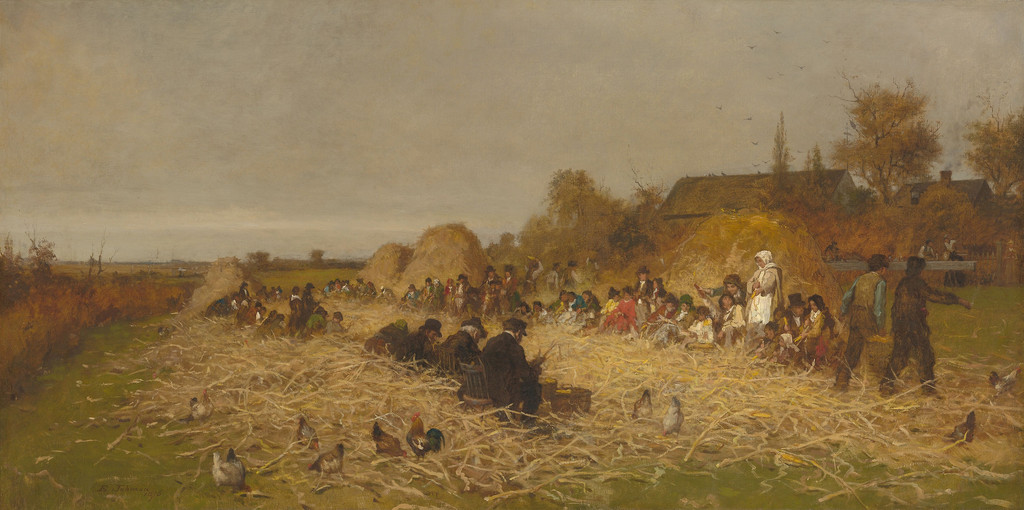
Eastman Johnson, Husking Bee, Island of Nantucket, 1876. Oil on canvas, 69.6 × 138.2 cm. Art Institute of Chicago, 1922.444. CC0.
Image source
.
CC0 / Public domain
.
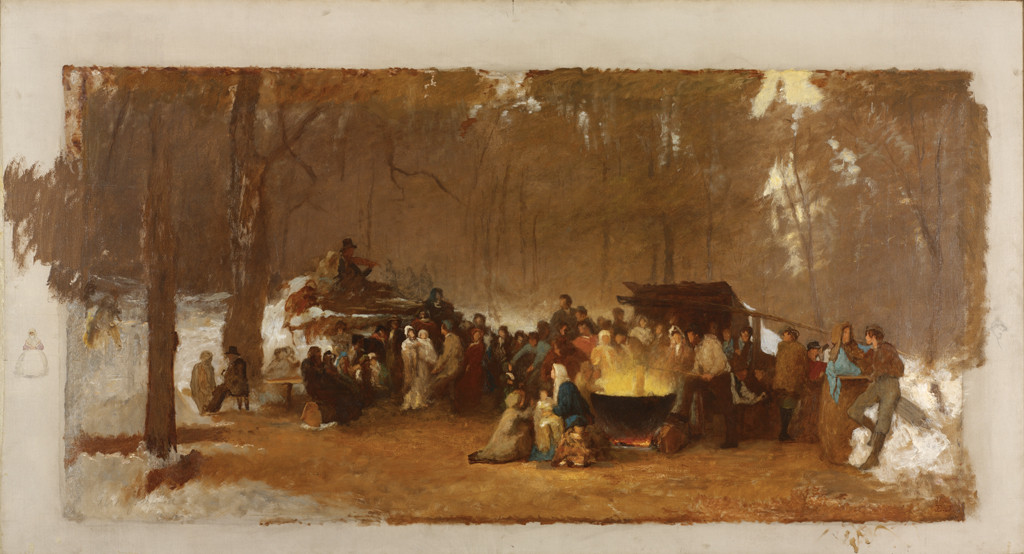
Eastman Johnson, Sugaring Off, about 1864–65. Oil on canvas, 134 × 245.1 cm. RISD Museum, Museum Works of Art Fund, 45.050. Unfinished. CC0.
Image source
.
CC0 / Public domain
.
Artworks directory
Browse twenty-one selected objects discussed in these articles, including the Gifford portrait and the Prang print after Johnson. Dates identify individual objects, including the San Diego Drummer Boy study. Use All media to include the chromolithograph.
| Name | Date | Medium |
|---|---|---|
| Kitchen at Mount Vernon | 1857; Charles Butt canvas | Oil on canvas |
| Negro Life at the South | 1859; New York Historical original | Oil on linen |
| A Ride for Liberty—The Fugitive Slaves | About 1862; Brooklyn version | Oil on paperboard |
| The Lord Is My Shepherd | 1863 | Oil on fiberboard |
| Sugaring Off | About 1864–65; unfinished RISD canvas | Oil on canvas |
| The Wounded Drummer Boy (San Diego study) | About 1864–71; study, not the finished canvas | Oil on board |
| The Early Scholar | About 1865; NGA study | Oil on academy board on canvas |
| Fiddling His Way | 1866; Chrysler canvas | Oil on canvas |
| The Letter Home | 1867; Minneapolis drawing | Charcoal and graphite on paper |
| The Boyhood of Lincoln | 1868; Michigan canvas | Oil on canvas |
| The boyhood of Lincoln—An evening in the log hut (Prang after Johnson) | About 1868; separate reproductive print | Chromolithograph, W. Harring / L. Prang & Co., after Johnson |
| The Brown Family | 1869; NGA version | Oil on paper on canvas |
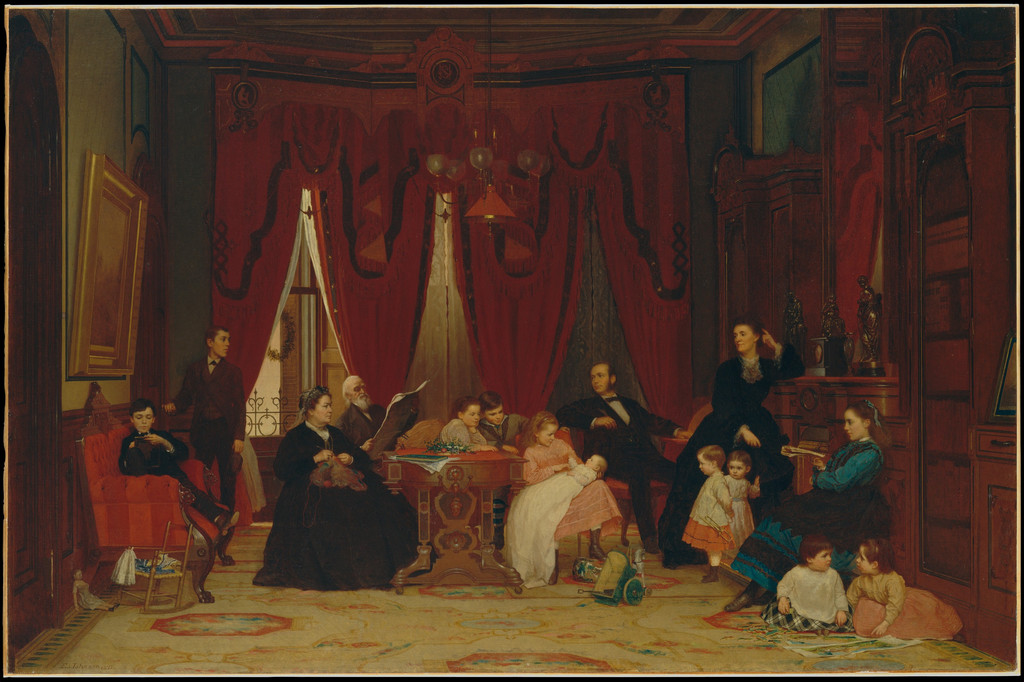
| The Hatch Family | 1870–71 | Oil on canvas |
| The Old Stagecoach | 1871 | Oil on canvas |
| The Girl I Left Behind Me | About 1872 | Oil on canvas |
| The Toilet | 1873 | Oil on paper board |
| Husking Bee, Island of Nantucket | 1876; Chicago canvas | Oil on canvas |
| The New Bonnet | 1876 | Oil on academy board |
| Sanford Robinson Gifford | 1880; possibly posthumous | Oil on academy board |
| The Cranberry Harvest, Island of Nantucket | 1880; Timken canvas | Oil on canvas |
| The Nantucket School of Philosophy | 1887 | Oil on panel |
Frequently Asked Questions
The 1880 canvas belongs to the Putnam Foundation collection at the Timken Museum of Art in San Diego, accession 1972:002. [1]
The consulted records do not identify her by name. The Timken points to her exchange with a boy carrying an infant, an important small narrative within the panorama. [1]
Yes, according to Hills’s catalogue account. A figure attributed to a later hand was visible in 1970 and removed between 1970 and 1972. The precise treatment date is not established here. [2]
Discussion
Look again at the images and ideas explored in The Cranberry Harvest, Island of Nantucket by Eastman Johnson. These editorial prompts invite your observations.
Reader Insights
Follow the standing woman, approaching child and distant groups. How does the wide format connect separate actions?
Compare the workers with the distant boundaries. How does the landscape organise the activity without explaining every relationship?
What does the painting’s alteration history change about your confidence in treating a reproduction as a single unchanging image?
Join the Conversation
Share a detail, comparison or question about The Cranberry Harvest, Island of Nantucket by Eastman Johnson below.
References
- Timken Museum of Art. The Cranberry Harvest , Island of Nantucket, 1880, 1972:002. Current object facts, landscape and figure interpretation, provenance and exhibition history. View source
- Patricia Hills and Abigael MacGibeny. The Cranberry Harvest , Island of Nantucket, 1880, Hills no. 26.4.11. Eastman Johnson Catalogue Raisonné. Series context, ownership, exhibitions and Hills’s historical examination notes, including the later-hand figure and its removal. Original dealer and treatment documentation not directly consulted. View source
- The Old Stagecoach, 1871, L1888.22. View source
- The Girl I Left Behind Me, c.1872, 1986.79. View source
- The Toilet, 1873, 2015.19.85. View source
- Art Institute of Chicago. Husking Bee , Island of Nantucket, 1876, 1922.444. Exact comparison-object data; the two harvest compositions remain distinct. View source
- The New Bonnet,1876,25.110.11,currentobjectrecordandAPI. View source
- The Nantucket School of Philosophy,1887,37.311. View source
- Crystal Bridges Museum of American Art. Cranberry Pickers , Nantucket, about 1879, 2010.68. Separate related work and harvest-series context. Displayed three-dimensional measurements are not used as painted-canvas dimensions. View source
- Splash image source.
Eastman Johnson, The Cranberry Harvest, Island of Nantucket, 1880. Oil on canvas, 69.5 × 138.4 cm. Putnam Foundation, Timken Museum of Art, 1972:002. Public domain faithful reproduction. Public domain .
View source