 by
Tom Gurney
Tom Gurney BSc (Hons) is an art history expert with over 20 years experience
Email:
tomgurney1@gmail.com
/ Phone:
+44 7429 011000
Fiddling His Way by Eastman Johnson: Introduction
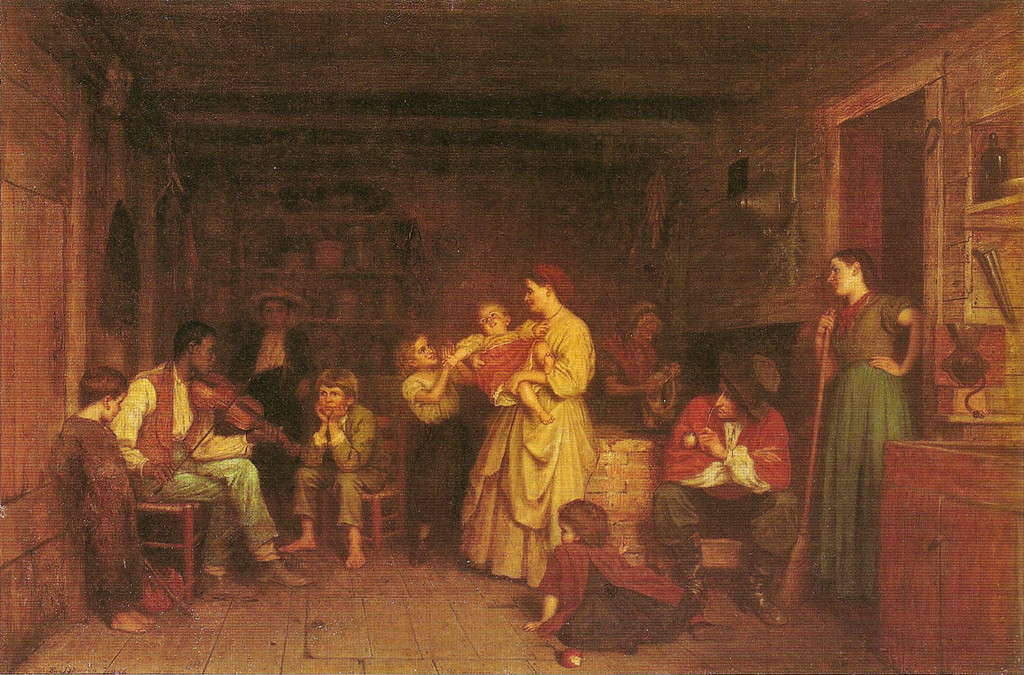
The musician sits at the far left, but his playing reaches across the room. Children watch from nearby, a woman holds a baby near the centre, and other members of the household gather around the hearth. In Eastman Johnson’s Fiddling His Way , an apparently informal visit becomes a carefully arranged encounter between a performer and his audience.
The illustrated painting is the Chrysler Museum of Art’s canvas of 1866, which shows a Black fiddler in a New England interior. A separate version in the Terra Foundation collection has a white musician. Their shared title makes the distinction easy to overlook, even though it changes the social relationships through which the scene is understood. [1] [2]
At a Glance
- Artist Eastman Johnson
- Title Fiddling His Way
- Date 1866
- Medium Oil on canvas
- Dimensions 61.6 × 92.7 cm
- Collection Chrysler Museum of Art
- Accession 89.60
- Credit Bequest of Walter P. Chrysler, Jr.
The Terra Foundation’s related work, c. 1866, is oil on artist’s board, 53 × 63.2 cm, accession 1999.8. It is a different object from the Chrysler canvas. [1] [2]
This work across Eastman Johnson’s career
Sugaring Off
About 1864–65; unfinished RISD canvasThe Wounded Drummer Boy (San Diego study)
About 1864–71; study, not the finished canvasThe Early Scholar
About 1865; NGA studyFiddling His Way (current article)
1866; Chrysler canvasThe Letter Home
1867; Minneapolis drawingThe Boyhood of Lincoln
1868; Michigan canvasThe Brown Family
1869; NGA versionNotes and sources
Sugaring Off. Unfinished passages reveal the preparation of an ambitious gathering around maple-sugar production. [3]
The Wounded Drummer Boy (San Diego study). Soldier and drummer form a single upright group; this study has its own object history. [4]
The Early Scholar. A child’s position beside a stove turns the need for warmth into the centre of a schoolroom. [5]
Fiddling His Way (current article). A Black musician’s playing gathers the attention of a household. [1]
The Letter Home. A wounded man and a woman writing connect spoken words with an absent home. [6]
The Boyhood of Lincoln. Firelight makes an imagined scene of Lincoln reading into an image of aspiration. [7]
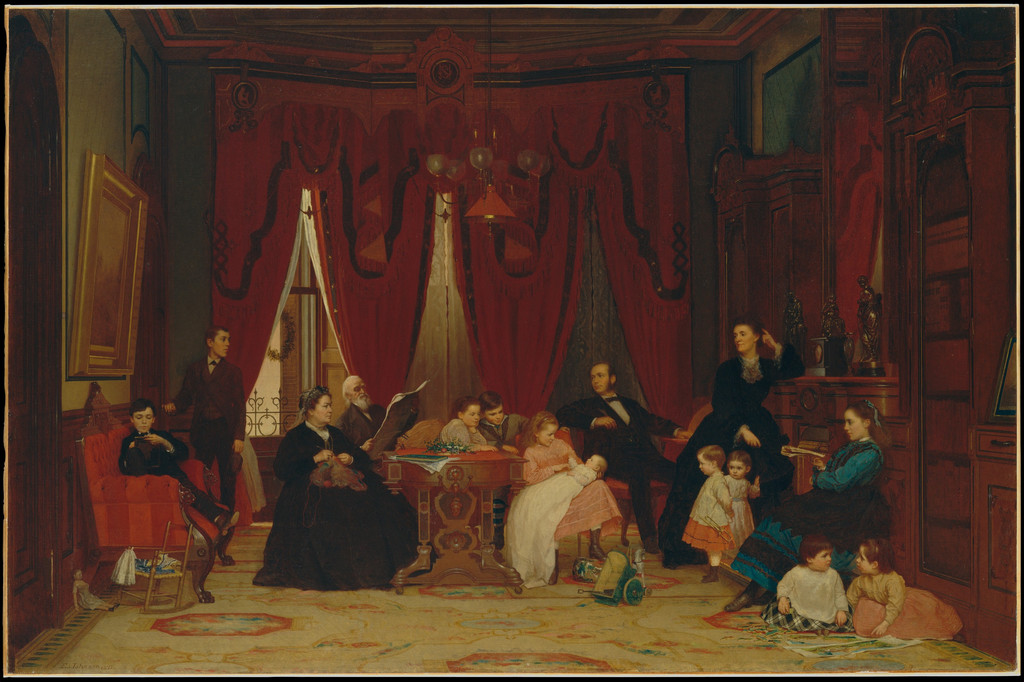
The Brown Family. A child’s reaching arm connects three generations within an elaborate interior. [8]
Contents
- A room gathered around music
- Light, furniture and the performer’s position
- The title and the aftermath of emancipation
- A studio account before the signed date
- The other Fiddling His Way
- A performer and a painter
- Exhibitions, titles and collecting
- Music among Johnson’s other subjects
A room gathered around music
Johnson gives the fiddler a position close to the left edge. His bow and the instrument extend into the room, directing attention towards the listeners. The seated body stays near the boundary, while the activity crosses it. Music is invisible, but the arrangement of people gives it a visible reach.
Several children make that reach particularly clear. The boy seated near the musician holds his face between his hands, with his elbows supported above his knees. Another small figure stands close to the left foreground. Their proximity makes the performance feel intimate: this is a room in which the audience can sit only a few feet from the player.
Near the centre, a woman stands with a baby in her arms. Her light clothing and the infant’s position attract attention away from the darker musician. A nearby child turns upwards towards the pair. Johnson gives this part of the group a separate exchange of glances, so the room contains more than a single, uniformly attentive audience.
At the right, another woman stands near the hearth with a hand at her hip. A seated figure bends over an object held in their lap below her. The different levels continue across the painting: musician and seated children, standing mother and infant, standing woman, seated adult and a child low on the floor. The figures create a varied rhythm within the broad horizontal format.
That variation keeps the gathering from becoming a formal line of listeners. Some bodies turn towards the player, others towards a child or another adult. Their overlapping attention makes the scene feel inhabited, while the repeated inward gestures hold the people together.
Light, furniture and the performer’s position
The floorboards lead into the group, offering an open foreground before the more crowded room. A barrel, seats, door and hearth help locate the people within an ordinary domestic interior. These objects are useful because they establish positions and distances without requiring a grand architectural setting.
Light picks out the musician’s clothing and the central mother and baby, but leaves other faces less emphatic. The room is legible through these pools of illumination rather than through equal clarity everywhere. Johnson can suggest a substantial household while allowing different figures to emerge at different speeds as the viewer looks.
The fiddler’s position matters beyond its usefulness to the composition. He is indispensable to the event but occupies its edge. The household has the larger share of the room; his contribution organises the gathering without placing him at its spatial centre.
That arrangement does not make the scene simply hostile or welcoming. The children’s closeness suggests interest, and the shared activity makes an encounter possible. Yet the painting provides no account of payment, duration of the visit or the musician’s standing once he stops playing. Its warmth cannot answer all the social questions raised by its title.
The title and the aftermath of emancipation
Fiddling His Way links music to making a living. The possessive title presents the player as someone finding a route through the world by means of a skill. The Chrysler interpretation connects the work with the opportunities and economic challenges facing Black Americans after the Civil War. That context belongs to the subject’s meaning without identifying the painted man’s individual biography. [1]
The phrase also gives the apparent leisure of the room an unequal structure. The family can listen while the musician performs. His activity might be entertainment for them and work for him. The picture does not show a transaction clearly enough to establish a wage, a contract or an exact employment relationship.
Patricia Hills reads the subject against Reconstruction debates about self-support and the limited opportunities offered to freed people. She connects the player’s marginal position with a welcome dependent on musical service, rather than unrestricted social equality. This is an interpretation of the scene within its historical setting, not proof that the unidentified fiddler lacked land or had personally experienced enslavement. [9]
Keeping those levels separate makes the painting more revealing. We can consider what the arrangement offered a contemporary audience while acknowledging how little it tells us about the model. The performer’s visible skill and the family’s interest are features of the image; his life outside the room remains unrecorded here.
A studio account before the signed date
Hills reproduces a February 1865 account of a visit to Johnson’s studio. The writer mentioned a New England interior in which a Black musician played while a family listened. The notice places a closely related composition in development before the Chrysler canvas’s signed date of 1866. The original newspaper was not separately consulted for this article. [9]
The account is useful partly because it describes an unfinished project through a visitor’s interests. It gives brief attention to the musical gathering alongside other Johnson subjects. A contemporary studio notice is evidence of what a writer saw and chose to mention; it is not a complete explanation by the painter of every figure and its significance.
Nor does the earlier notice establish the identities of the people who posed. A convincing household can be made from models and compositional decisions. The picture’s domestic coherence should not be mistaken for a surviving family photograph or a complete account of a particular performance.
Watch: Eastman Johnson
Choose a film to explore the artist’s work, its interpretation and its wider setting.
Director's Choice - The Girl I Left Behind Me by Eastman Johnson
The Smithsonian American Art Museum looks at Johnson’s The Girl I Left Behind Me.
Watch on YouTubeThe other Fiddling His Way
The Terra Foundation version also places a musician within a rustic family interior. Its performer is white, and its smaller artist’s-board support gives it a separate material identity. The object is dated approximately 1866 and entered the collection through the Daniel J. Terra Art Acquisition Endowment Fund. [2]
The comparison demonstrates that the general framework could accommodate a different social encounter. A fiddler, an audience and a modest room remain recognisable components, but a change in the musician alters what viewers may bring to the relationships between them. A shared compositional idea does not guarantee a shared meaning.
Hills discusses the second version through a description in Johnson’s 1907 estate-sale catalogue. The account presents an older, itinerant musician and a farmer’s family. Its presence in the estate provides a later point in that version’s history; it does not, on its own, establish a secure sequence of Johnson’s decisions or why he made the two works. [9]
It would therefore be too simple to describe one painting as a correction of the other. The available evidence supports comparison more firmly than it supports a complete narrative of revision. Each work asks the viewer to consider who belongs within the family circle and on what terms a visitor enters it.
A performer and a painter
The Chrysler’s label draws an analogy between the fiddler and Johnson himself: both are artists whose skill deserves recognition. It reads the musical gathering as an appeal to respect the talents and humanity of Black citizens. That affirmative interpretation sits alongside Hills’s more questioning account of the musician’s position within the room. [1]
The comparison makes the audience an active part of the subject. A performance needs people willing to listen, just as a painting needs viewers and patrons. Johnson gives the musician visible attention from the household; the museum’s reading asks a viewer to consider the judgement that attention implies.
It also allows a distinction between recognising talent and establishing equality. A listener may admire a particular performance without accepting a performer on equal terms elsewhere. The painting provides an occasion to think about that gap, while leaving the musician’s larger circumstances outside its frame.
Exhibitions, titles and collecting
The canvas appeared at the National Academy of Design in 1866 and travelled to the Paris Exposition Universelle in 1867 as Le Joueur de Violon , or The Violin Player . It was shown at Philadelphia’s 1876 Centennial as The Wandering Fiddler . A modest interior could therefore represent American painting in major public exhibitions, far beyond the household it depicted. [10]
Those titles place different emphasis on the encounter. The Violin Player names an occupation or activity, while The Wandering Fiddler gives the performer an itinerant identity. Neither title changes the people or objects on the canvas. Their differences show how exhibition and collecting can supply another layer of narrative around a painted scene.
The museum traces ownership through Robert Leighton Stuart, John Taylor Johnston and the Garrett family. After later collectors and dealers, Walter P. Chrysler, Jr. acquired it in 1974; his bequest brought it into the museum in 1989. This collecting history connects the nineteenth-century exhibition picture with the institution through which many viewers encounter it today. [1]
Music among Johnson’s other subjects
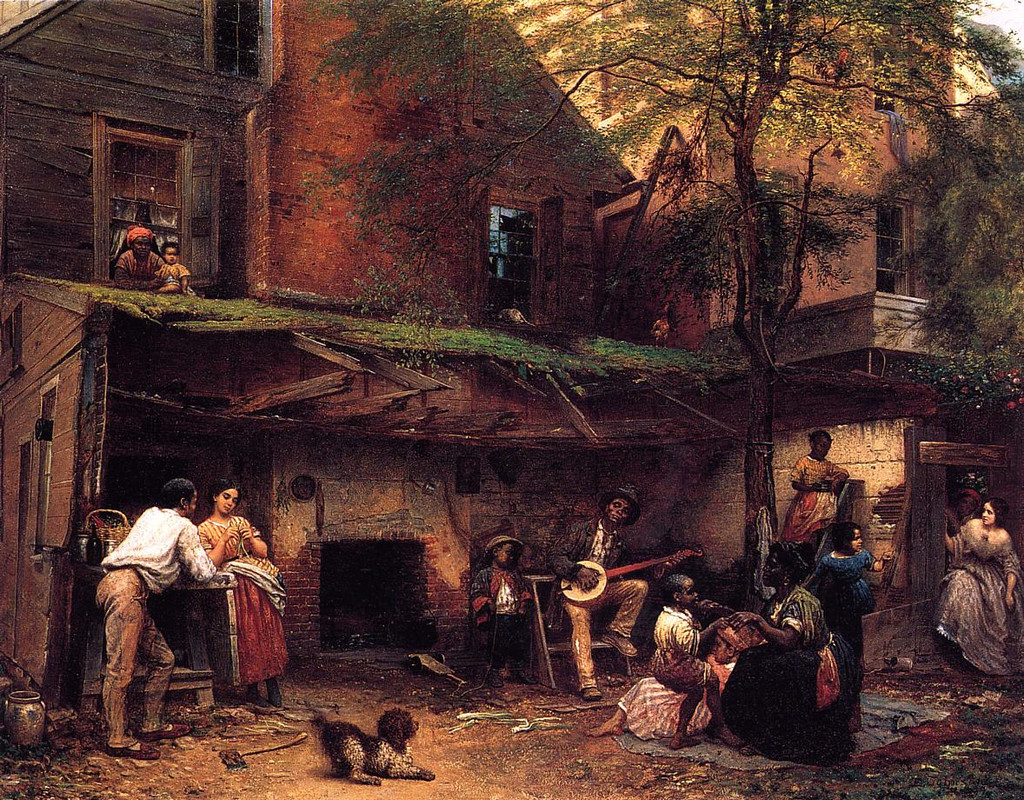
In Negro Life at the South , music is one activity within a more extensive arrangement of people, buildings and encounters. Fiddling His Way concentrates attention on a single performer and the audience his skill draws together. The narrower room makes the relationship between participation and position especially visible.
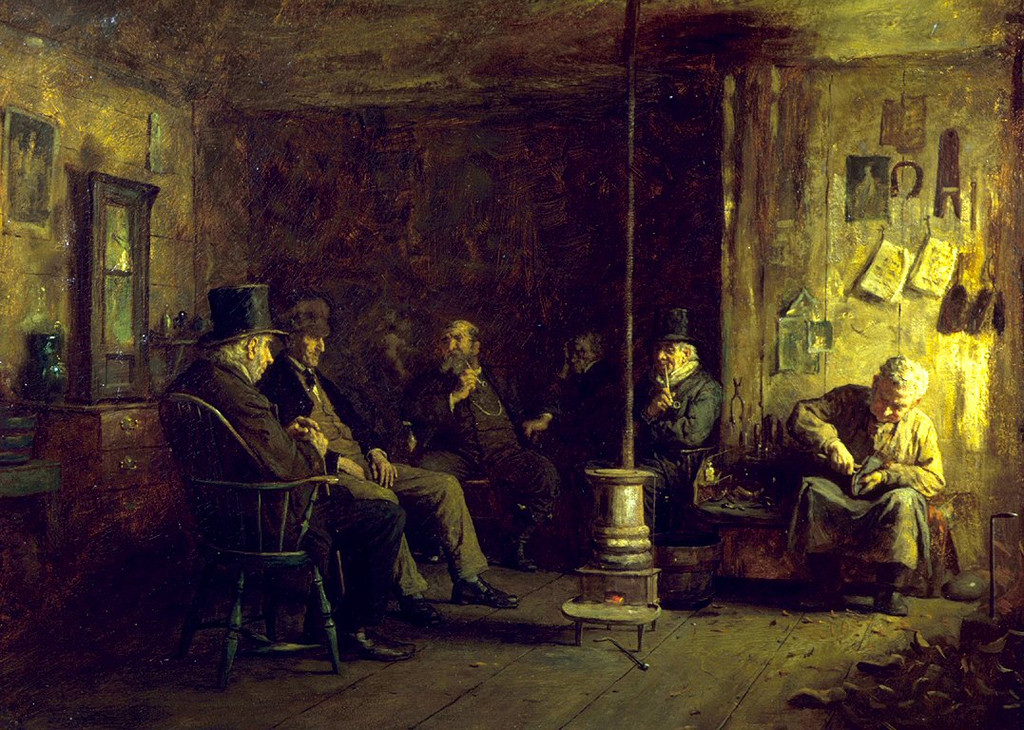
The comparison with The Nantucket School of Philosophy shifts attention from playing to conversation. Both paintings create a social gathering through unevenly distributed bodies and gestures. Neither needs every participant to perform the same action at the same moment.
The Chrysler picture’s lasting interest lies in that unevenness. The musician is needed and watched, close to the children yet outside the household’s central grouping. Johnson gives the scene enough warmth to invite a first reading of companionship, and enough structure to make a second look more questioning.
Artworks directory
Browse twenty-one selected objects discussed in these articles, including the Gifford portrait and the Prang print after Johnson. Dates identify individual objects, including the San Diego Drummer Boy study. Use All media to include the chromolithograph.
| Name | Date | Medium |
|---|---|---|
| Kitchen at Mount Vernon | 1857; Charles Butt canvas | Oil on canvas |
| Negro Life at the South | 1859; New York Historical original | Oil on linen |
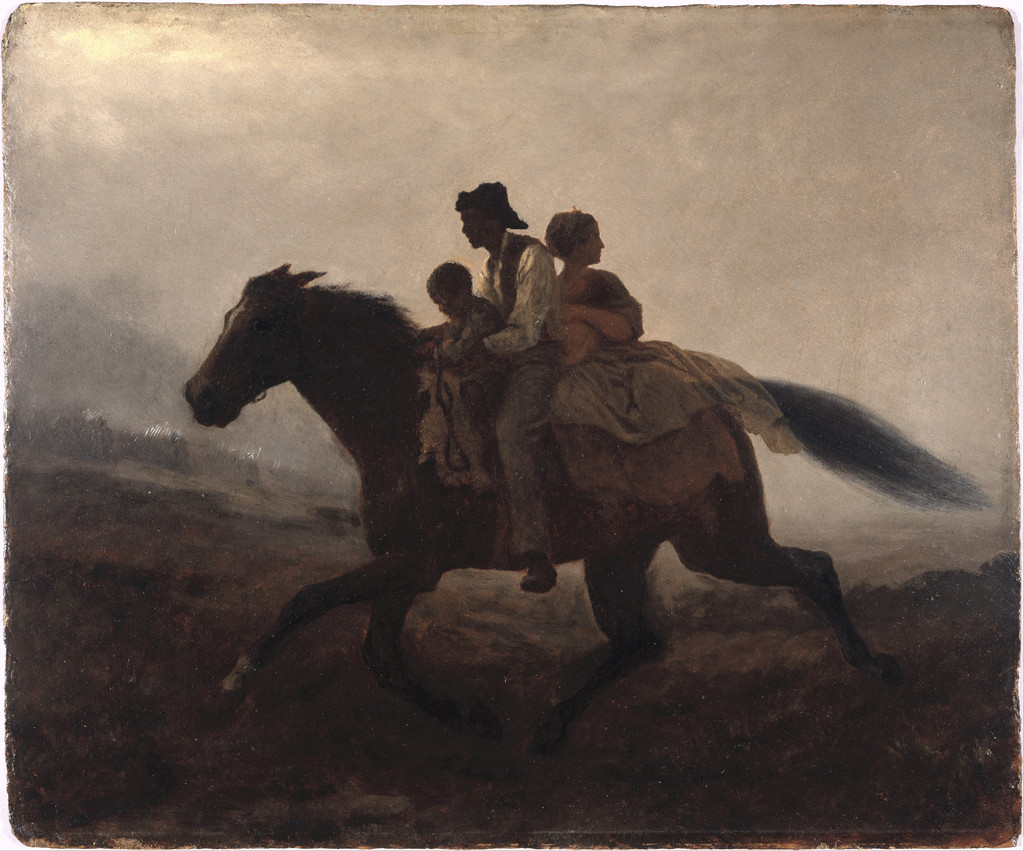
| A Ride for Liberty—The Fugitive Slaves | About 1862; Brooklyn version | Oil on paperboard |
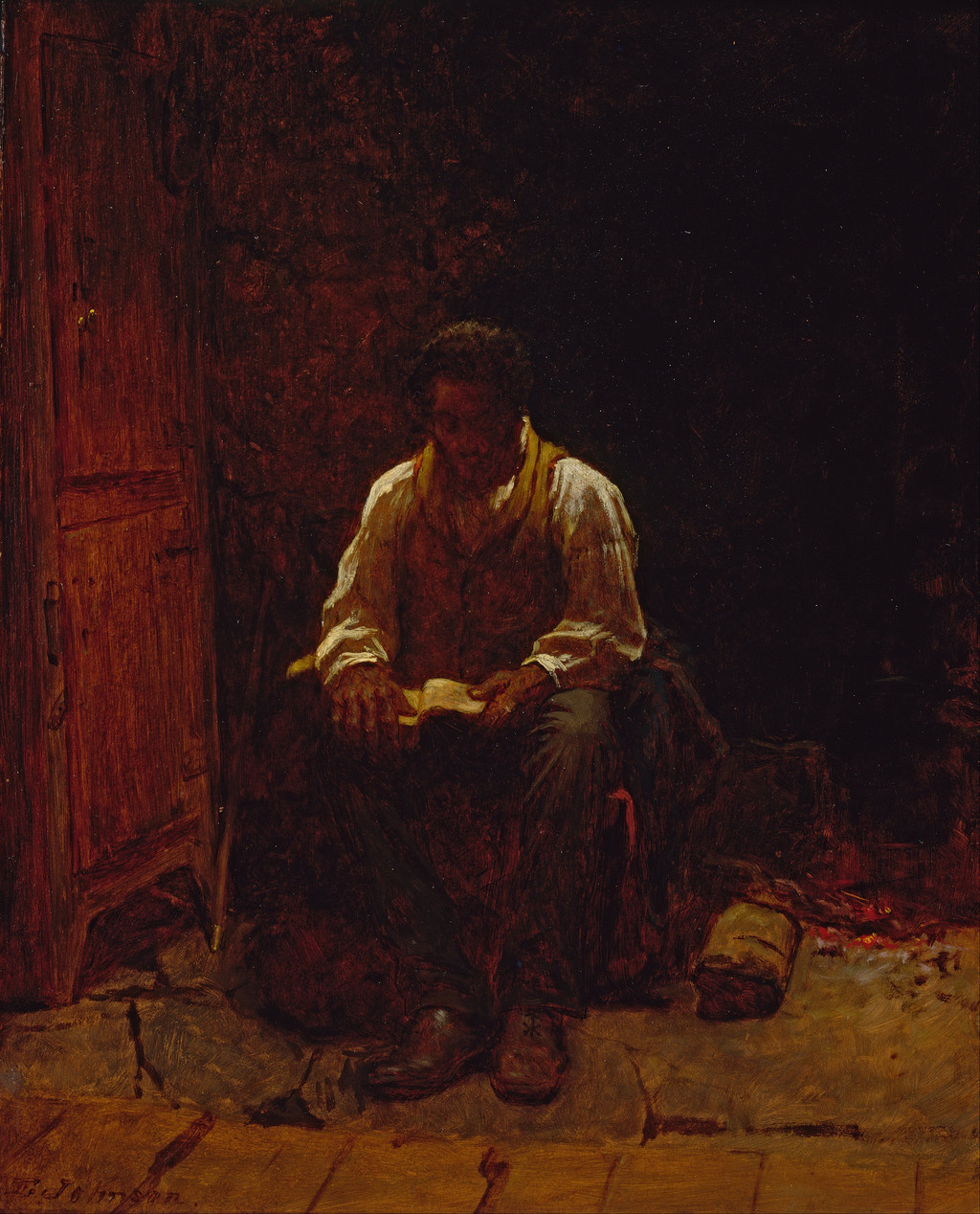
| The Lord Is My Shepherd | 1863 | Oil on fiberboard |
| Sugaring Off | About 1864–65; unfinished RISD canvas | Oil on canvas |
| The Wounded Drummer Boy (San Diego study) | About 1864–71; study, not the finished canvas | Oil on board |
| The Early Scholar | About 1865; NGA study | Oil on academy board on canvas |
| Fiddling His Way | 1866; Chrysler canvas | Oil on canvas |
| The Letter Home | 1867; Minneapolis drawing | Charcoal and graphite on paper |
| The Boyhood of Lincoln | 1868; Michigan canvas | Oil on canvas |
| The boyhood of Lincoln—An evening in the log hut (Prang after Johnson) | About 1868; separate reproductive print | Chromolithograph, W. Harring / L. Prang & Co., after Johnson |
| The Brown Family | 1869; NGA version | Oil on paper on canvas |
| The Hatch Family | 1870–71 | Oil on canvas |
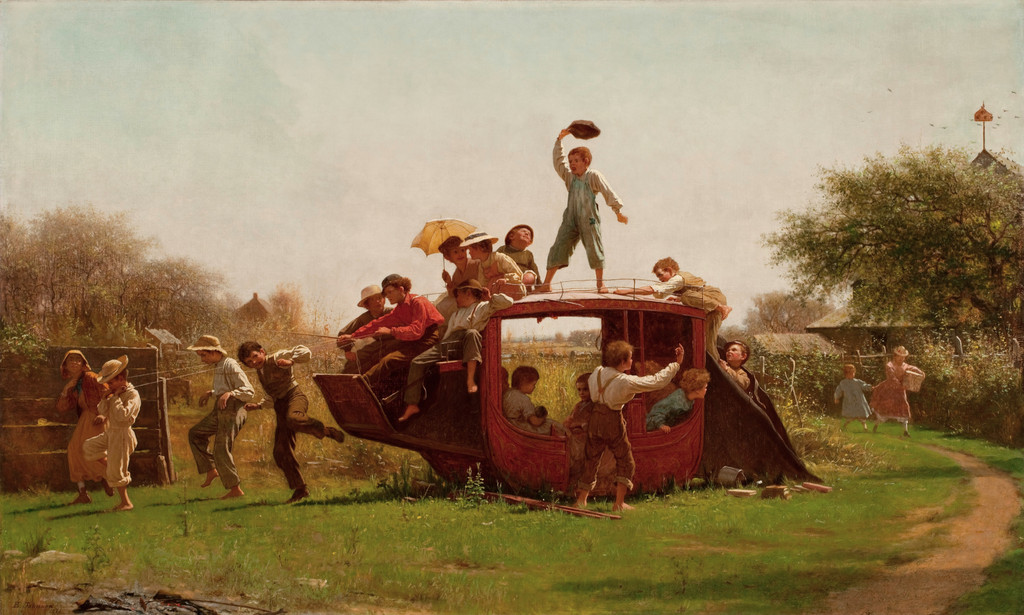
| The Old Stagecoach | 1871 | Oil on canvas |
| The Girl I Left Behind Me | About 1872 | Oil on canvas |
| The Toilet | 1873 | Oil on paper board |
| Husking Bee, Island of Nantucket | 1876; Chicago canvas | Oil on canvas |
| The New Bonnet | 1876 | Oil on academy board |
| Sanford Robinson Gifford | 1880; possibly posthumous | Oil on academy board |
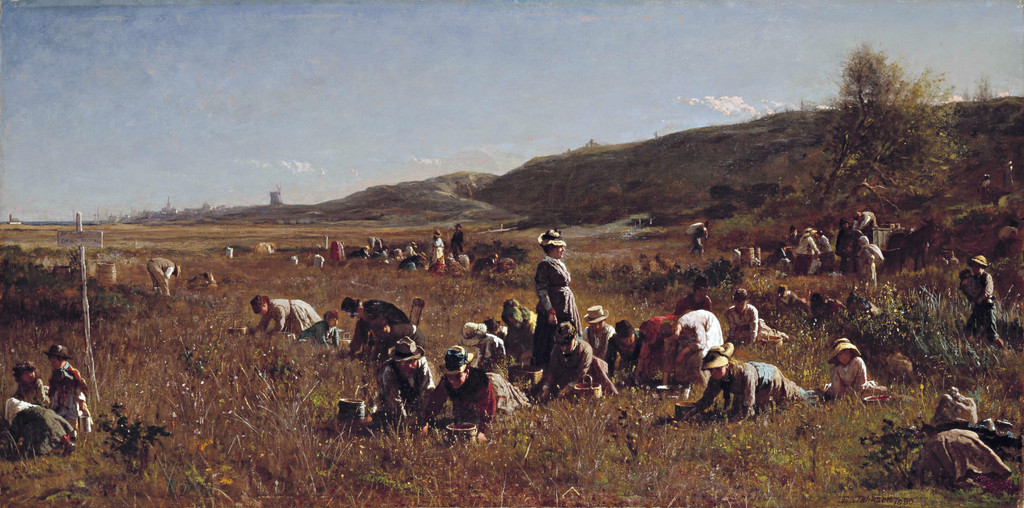
| The Cranberry Harvest, Island of Nantucket | 1880; Timken canvas | Oil on canvas |
| The Nantucket School of Philosophy | 1887 | Oil on panel |
Frequently Asked Questions
It is in the Chrysler Museum of Art, accession 89.60, Bequest of Walter P. Chrysler, Jr. It is the 1866 oil on canvas illustrated here. [1]
His individual history is not established here. Scholarship connects the painting with Reconstruction and economic self-support, but that interpretation cannot supply an undocumented biography. [9]
Discussion
Look again at the images and ideas explored in Fiddling His Way by Eastman Johnson. These editorial prompts invite your observations.
Reader Insights
How can a musician be central to the event while remaining at the edge of the painted group?
Which responses among the listeners suggest interest, distraction or another activity? Describe what is visible.
Compare the Black and white fiddler versions through their records. What changes can be discussed without inventing a revision sequence?
Join the Conversation
Share a detail, comparison or question about Fiddling His Way by Eastman Johnson below.
References
- Chrysler Museum of Art , Fiddling His Way, 89.60. Current object fields, museum interpretation, provenance and exhibition information consulted through returned museum text. View source
- Terra Foundation for American Art , Fiddling His Way, 1999.8. Object fields and opening interpretive paragraph; the full essay was not consulted. View source
- Sugaring Off, ca.1864–1865, 45.050. View source
- Wounded Drummer Boy, San Diego study, Hills 10.0.18. View source
- The Early Scholar,c.1865,1963.10.157: current object record. View source
- The Letter Home,1867,74.17; current collection data. View source
- Boyhood of Lincoln,1868,1895.90. View source
- The Brown Family, 1869, 1978.72.1. View source
- Patricia Hills , Painting Race: Eastman Johnson’s Pictures of Slaves, Ex-Slaves, and Freedmen, in Eastman Johnson: Painting America, 1999, pp. 148, 150–151. Musical integration, social position and mediated studio and estate-sale accounts; original periodical and sale catalogue not separately consulted. View source
- Patricia Hills and Abigael MacGibeny , Fiddling His Way, 1866, Hills no. 11.0.1, Eastman Johnson Catalogue Raisonné. Object, exhibition history and historical titles. The entry’s apparent placement of a post-Paris section within the 1866 exhibition is not repeated, and quoted review details belonging to another painting are not transferred to this work. View source
- Splash image source.
Eastman Johnson, Fiddling His Way, 1866. Oil on canvas, 61.6 × 92.7 cm. Chrysler Museum of Art, Bequest of Walter P. Chrysler, Jr., 89.60. Public domain faithful reproduction. Public domain .
View source