 by
Tom Gurney
Tom Gurney BSc (Hons) is an art history expert with over 20 years experience
Email:
tomgurney1@gmail.com
/ Phone:
+44 7429 011000
A Ride for Liberty by Eastman Johnson: Introduction
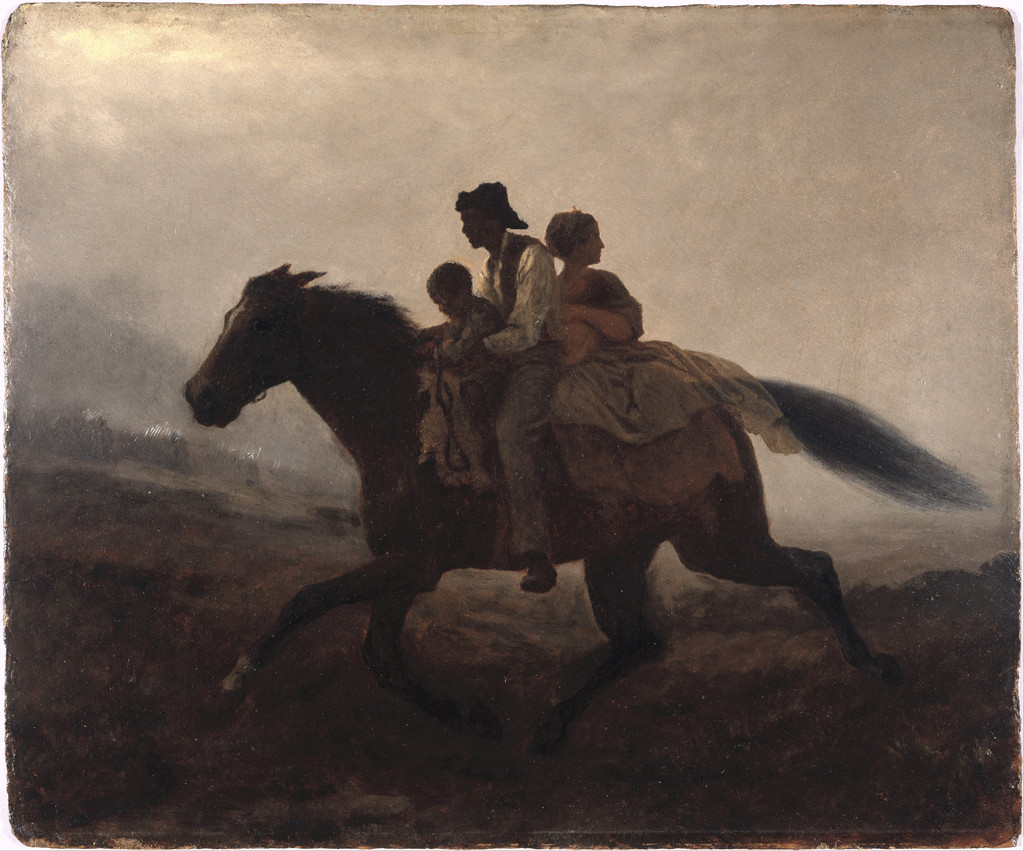
A horse carries a family across a dark foreground, its legs extended and its tail streaming behind. The man faces the direction of travel, a child sits before him, and the woman turns to look back while holding an infant. Eastman Johnson makes escape visible through a group whose bodies share one urgent movement but whose attention points in different directions.
A Ride for Liberty—The Fugitive Slaves exists in three recorded painted versions. The main illustration here is the Brooklyn Museum’s work on paperboard, dated about 1862. Its subject is a Black family seeking freedom during the Civil War. The well-known inscription in which Johnson claimed to have witnessed such an incident belongs to a separate version now in Virginia, rather than to the Brooklyn picture. [1] [2]
At a Glance
- Artist Eastman Johnson
- Title A Ride for Liberty—The Fugitive Slaves
- Date About 1862
- Medium Oil on paperboard
- Dimensions 55.2 × 66.7 cm
- Collection Brooklyn Museum
- Accession 40.59a–b
- Credit Gift of Gwendolyn O. L. Conkling
- Reverse Scythe Sharpening, about 1863–64
The Virginia Museum of Fine Arts version, 85.644, is oil on board, 55.2 × 66.4 cm. A smaller third painting is currently unlocated in the catalogue raisonné. [1] [2] [3]
This work across Eastman Johnson’s career
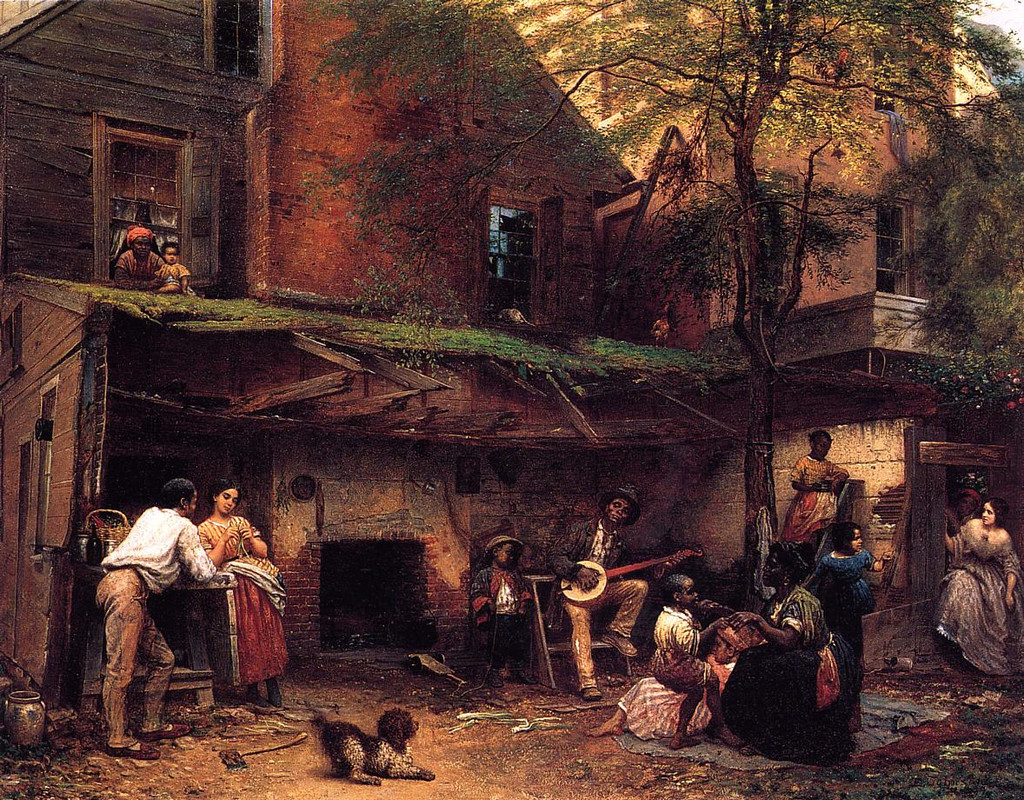
Kitchen at Mount Vernon
1857; Charles Butt canvasNegro Life at the South
1859; New York Historical originalA Ride for Liberty—The Fugitive Slaves (current article)
About 1862; Brooklyn versionSugaring Off
About 1864–65; unfinished RISD canvasThe Wounded Drummer Boy (San Diego study)
About 1864–71; study, not the finished canvasThe Early Scholar
About 1865; NGA studyNotes and sources
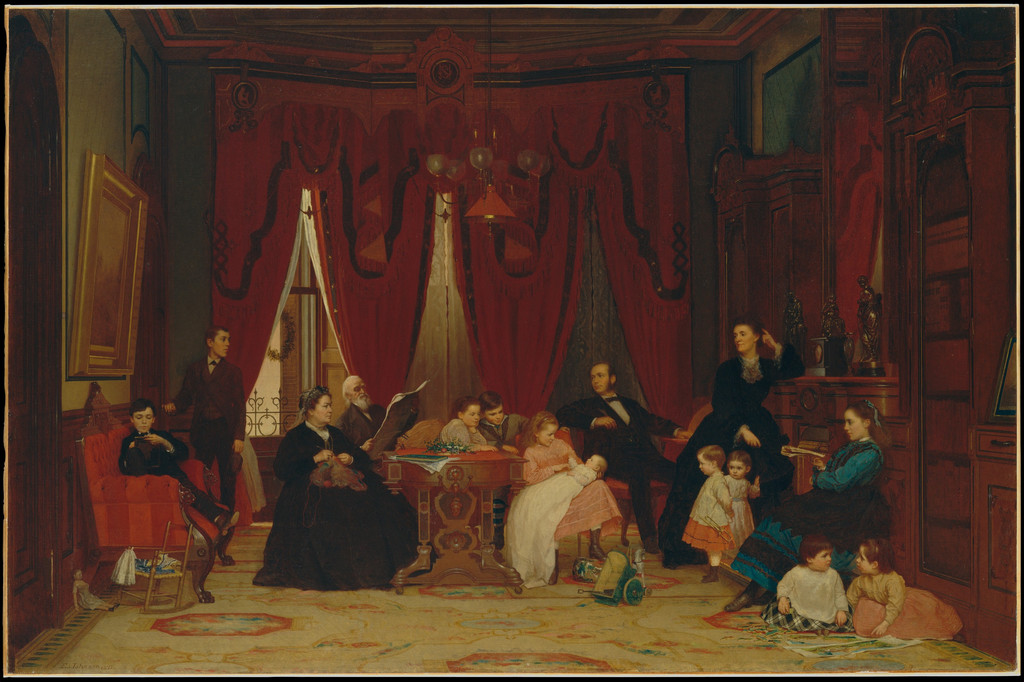
Kitchen at Mount Vernon. A large hearth and worn architecture surround a small family group. [4]
Negro Life at the South. A Washington yard brings everyday encounters into the contested setting of slavery. [5]
A Ride for Liberty—The Fugitive Slaves (current article). A family’s movement towards freedom carries the whole composition. [1]
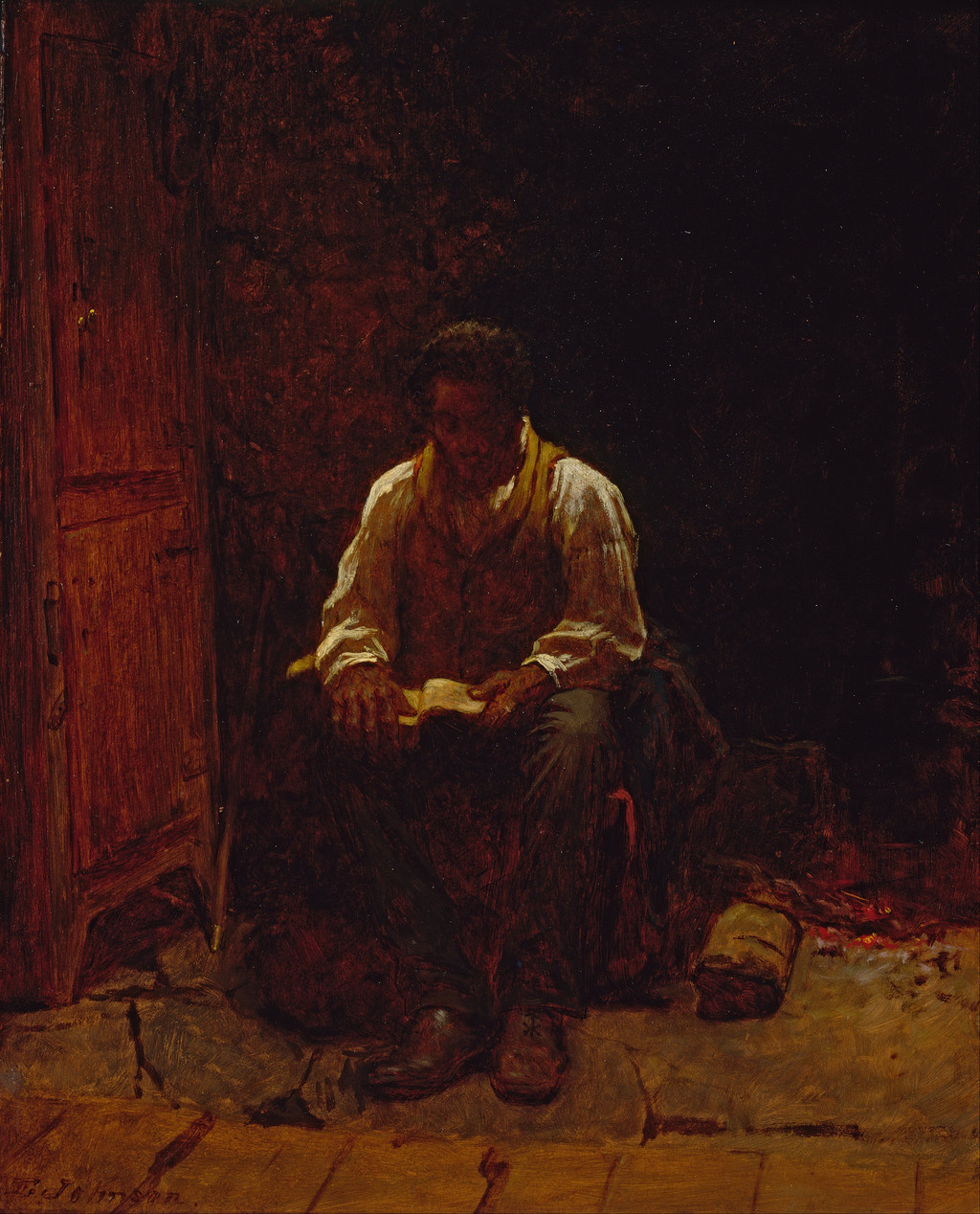
The Lord Is My Shepherd. A lowered head and open book concentrate attention within a dark room. [6]
Sugaring Off. Unfinished passages reveal the preparation of an ambitious gathering around maple-sugar production. [7]
The Wounded Drummer Boy (San Diego study). Soldier and drummer form a single upright group; this study has its own object history. [8]
The Early Scholar. A child’s position beside a stove turns the need for warmth into the centre of a schoolroom. [9]
Contents
- One movement, different directions of attention
- The pale sky and dark ground
- Escape as an action undertaken by the family
- Johnson’s claim to have witnessed the incident
- Three paintings with separate histories
- A small support with a forceful design
- Family ownership and public recognition
- Movement, freedom and other Johnson journeys
- Annotated details
One movement, different directions of attention
The Brooklyn picture establishes its direction immediately. The horse’s head points left, and its dark body stretches across the lower half of the composition. The tail and the woman’s clothing extend towards the right, making the air seem to register the animal’s speed.
The riders do not merely repeat that horizontal movement. The man sits upright enough for his head to form the group’s highest point. His pale shirt helps separate his torso from the darker bodies around it, while his profile and the child before him turn towards the route ahead.
The woman’s backward look breaks the shared direction. Her body travels with the others, but her face turns towards the space they are leaving. The gesture gives the scene a danger that need not be represented by a visible pursuer. Looking back is enough to make the viewer consider what might follow.
The infant is held close, within the compact mass of the riders. The older child occupies a more exposed place before the man. Together, the children make the escape a problem of care as well as speed: everyone must remain together on a single animal.
Johnson keeps the family tightly grouped. Faces, hands and clothing overlap, with few large gaps between the bodies. This compression makes the riders seem mutually dependent without requiring a separate scene of rescue or assistance. The horse carries their combined weight, and their arrangement becomes the central fact of the image.
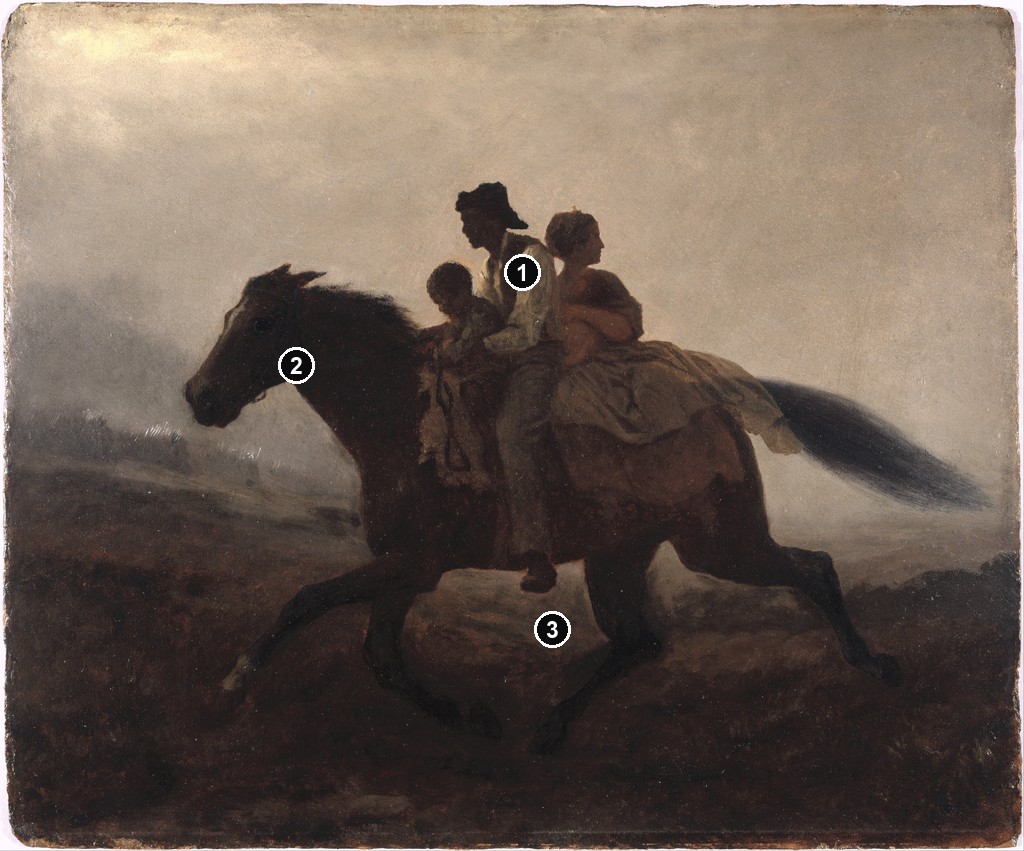
Annotated Details from A Ride for Liberty
The numbered points identify visible features discussed in this article. Return from each detail to the whole composition. Eastman Johnson, A Ride for Liberty—The Fugitive Slaves, about 1862. Oil on paperboard, 55.2 × 66.7 cm. Brooklyn Museum, 40.59a–b. Public domain. This Brooklyn version is distinct from the inscribed Virginia Museum version. Image source. Public domain. Numbers added to a separate overview; detail images are native crops. No recolouring, retouching, reconstruction or enlargement.
Details from A RIDE FOR LIBERTY
Compare the cropped details with the complete images above. Notice how their colours, shapes and positions contribute to the larger compositions.
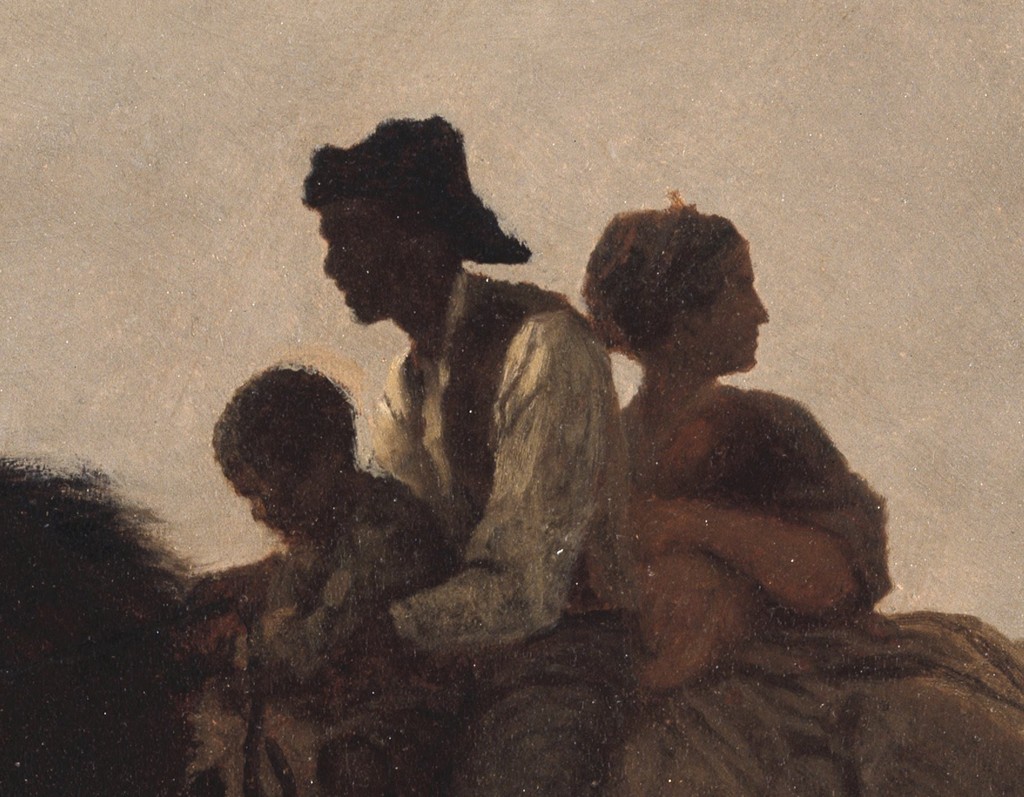
Different directions within the family
The man and the child in front face the direction of travel while the woman turns back. Their heads form a compact group above the horse, giving escape both forward movement and watchfulness.
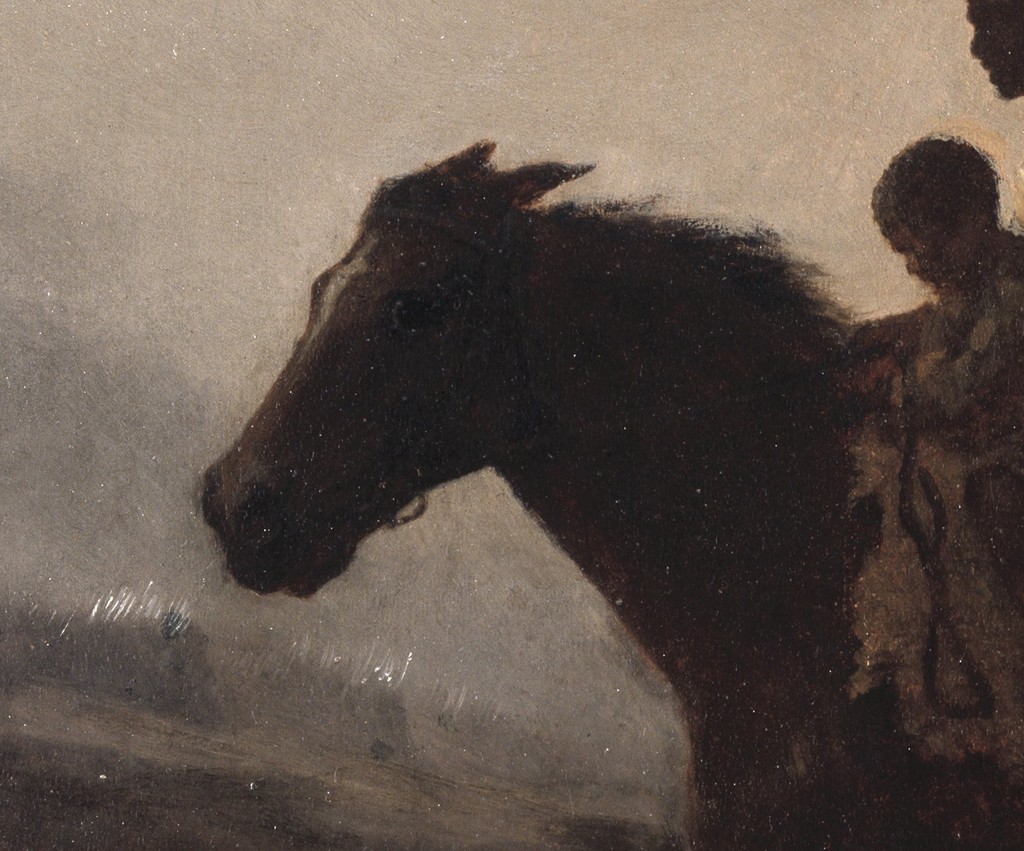
The horse’s forward-reaching head
The horse’s dark head projects into the paler landscape. Its angle and the line of the neck carry the movement towards the left before the viewer follows the rest of the body.
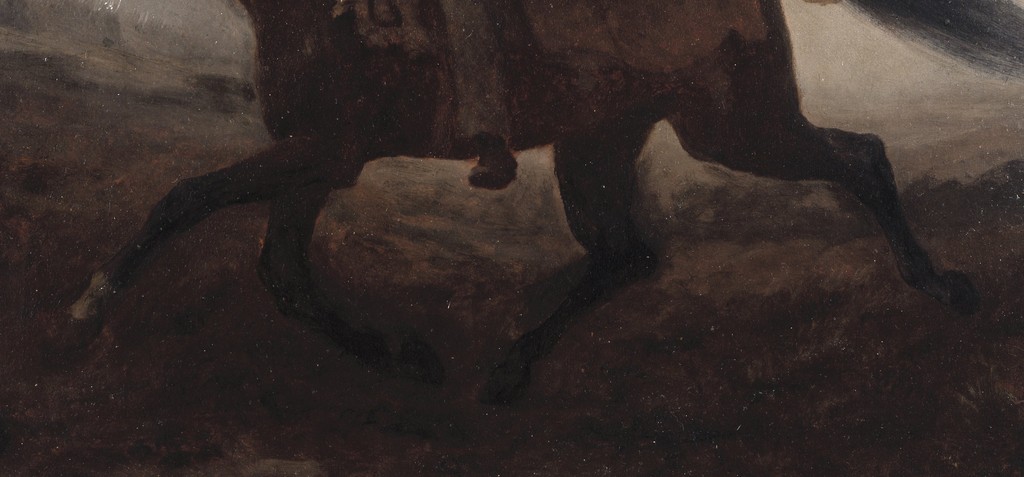
Extended legs across dark ground
The stretched legs spread the action across the lower half of the picture. Dark ground and broad shadow hold the moving group together beneath the much lighter sky.
The pale sky and dark ground
Much of the upper composition is occupied by a subdued sky. Its broad, relatively open area makes the dark outlines of heads, horse and clothing unusually legible. Johnson supplies little architectural detail that might interrupt the movement or identify an exact road.
The foreground is darker and less clearly defined. Hooves and ground meet within rough passages of brown, while the horse’s body remains the most substantial shape. The picture gives the viewer enough land to understand travel, but not a fully mapped route from one identifiable place to another.
Hills reads the dim light as dawn and identifies distant glints with Union bayonets. In her account, the represented family is moving towards Union lines. Those small indications belong to the scholar’s interpretation of the scene; the painting does not show an arrival or establish what happened to the people afterwards. [10]
The restricted setting intensifies the action. There is no welcoming household, broad crowd or destination placed prominently before the riders. The viewer remains with the crossing itself, looking at a moment whose outcome lies beyond the composition.
Escape as an action undertaken by the family
The subject differs from an emancipation scene organised around a benefactor. No white rescuer occupies the foreground or directs the family’s movement. The man, woman and children fill the picture through their own flight, while the larger military circumstances remain distant.
Hills makes that agency central to her interpretation. She contrasts the family’s escape with Johnson’s The Freedom Ring , a manumission subject in which a young girl’s release depended on white benefactors. In A Ride for Liberty , the people represented act to obtain their own freedom. The contrast concerns how the paintings organise a story, not proof of the unnamed riders’ complete biography. [10]
The children matter to that organisation. They make the scene more than the flight of an isolated adult and show freedom pursued through a group that must protect its most vulnerable members. The woman’s attention to the space behind and the man’s attention to the route ahead distribute the demands of the journey across the family.
Calling this agency does not remove the danger. The horse’s speed, the backward glance and the lack of a visible endpoint all keep uncertainty present. The painting gives the family a decisive action without claiming that action alone could control every condition around them.
Johnson’s claim to have witnessed the incident
The Virginia version carries an inscription, recorded in the catalogue raisonné, in which Johnson described the subject as an incident he saw near Centreville during McClellan’s advance towards Manassas. Its account places the sighting in March 1862. This is evidence of the artist’s claim, not an independently recovered identification of the family. [2]
The recorded day needs care. The Virginia entry transcribes March 2 followed by a dash, while the Brooklyn entry reproduces scholarship with a bracketed possible additional digit. The inscription should not be silently regularised into a certainty greater than the transcriptions support. Its broader relation to the 1862 campaign is clearer than a fully resolved reading of every mark. [1] [2]
Hills connects the inscription with a Civil War culture of eyewitness reporting. Illustrated newspapers often stressed that their artists had seen the events represented. Johnson’s written claim similarly asked an audience to understand the scene as grounded in experience, giving urgency and authority to the painted action. [10]
An eyewitness claim and a finished image nevertheless answer different questions. Johnson may have wanted the subject understood as truthful, but he still chose its format, scale, lighting and arrangement. The clear silhouette and coordinated gestures belong to the work of making a picture, whether or not the initial encounter occurred exactly as later described.
Neither inscription nor catalogue supplies names, a complete route or an account of a successful arrival. The record supports discussing escape and the artist’s asserted observation while keeping those further details unresolved. The people should not be assigned a documented life story merely because the picture’s title is familiar.
Watch: Eastman Johnson
Choose a film to explore the artist’s work, its interpretation and its wider setting.
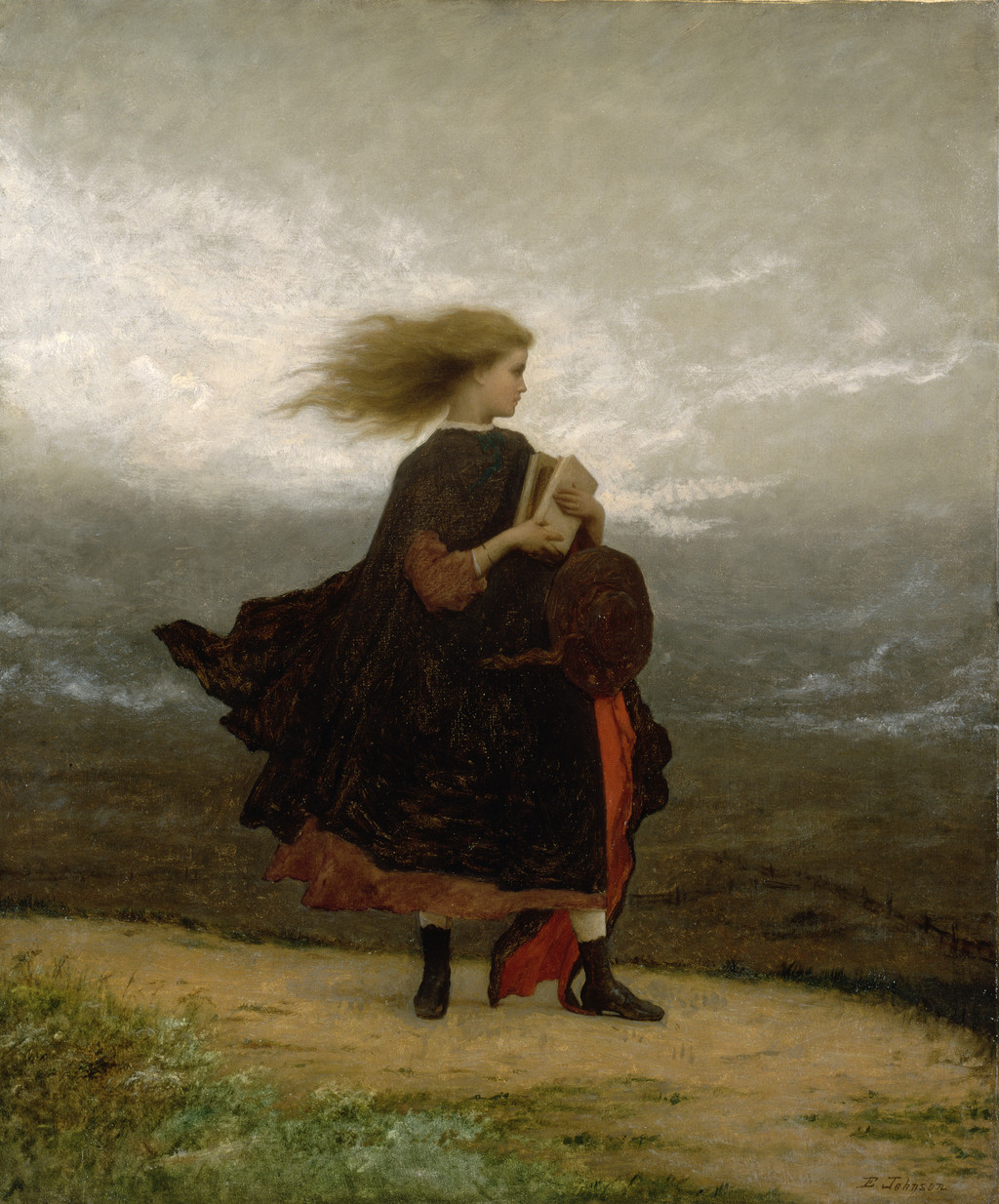
Director's Choice - The Girl I Left Behind Me by Eastman Johnson
The Smithsonian American Art Museum looks at Johnson’s The Girl I Left Behind Me.
Watch on YouTubeThree paintings with separate histories
Brooklyn’s painting is oil on paperboard. Its reverse contains Scythe Sharpening , dated approximately 1863–64 in the catalogue. The second composition makes the support a physical object with two painted sides; it does not put the Virginia inscription on the reverse of this version. [1]
The Virginia Museum of Fine Arts painting is recorded as oil on board and belongs to the Paul Mellon Collection, accession 85.644. Its catalogue history includes Johnson’s 1907 estate sale, number 123, and a chain through Louis Ettlinger and his daughter before the later Mellon ownership. The museum received it in 1985. [2]
The third version is smaller, at 41.9 × 53.3 cm, and painted on academy board. The catalogue records auction appearances in 1940 and 1943 and an exhibition at John Levy Galleries in 1942, but gives its present whereabouts as unknown. A surviving historical photograph provides evidence of the work without establishing where the painting can now be seen. [3]
The three supports and measurements should remain attached to their own objects. Older scholarship sometimes calls the inscribed version a canvas, but the current catalogue identifies it as board. Repeating the historical wording without qualification would introduce a material distinction the accepted object records do not support.
The versions establish that Johnson returned to the composition. They do not by themselves provide a secure order for every brushstroke or prove that one should be dismissed as merely a copy of another. Each painting has its own marks, ownership and documentary record.
A small support with a forceful design
The Brooklyn object is modest in size, but the horse and riders occupy it with considerable force. The horse nearly spans the width, while the man’s head rises well into the sky. Johnson gives the action room to read without surrounding it with a large amount of descriptive landscape.
Its handling remains broader than a detailed historical panorama. Larger areas of tone hold the animal and clothing together, while smaller light passages articulate a sleeve, face or hand. These contrasts support the narrative at the scale of the whole picture; they do not require every feature to be sharply described.
The supplied reproduction retains the irregular outer edges of the painted support. Those edges belong to the surviving object, not to an imagined painted frame. Preserving them helps distinguish the material work from a later image cropped tightly into a perfectly regular rectangle.
The painting’s apparent immediacy should also be distinguished from a proven outdoor working method. Neither speed in the represented horse nor broad handling establishes that Johnson painted the entire picture while watching the event. The evidence supports the composition and the artist’s claim about its subject, without documenting a single uninterrupted painting session.
Family ownership and public recognition
The Brooklyn version passed through Johnson’s estate and descendants before Gwendolyn O. L. Conkling gave it to the museum in 1940. The catalogue records an appearance in the Brooklyn Johnson exhibition of 1939–40, followed by later exhibitions including Romantic Painting in America in 1943 and Johnson’s 1972 retrospective. [1]
That history is different from proof of a wartime public reception. The 1907 memorial-exhibition identification is only possible, and the consulted record does not establish that this version was publicly exhibited during the Civil War. Its later prominence should not be projected backwards into a documented contemporary audience that the evidence has not supplied.
Movement, freedom and other Johnson journeys
Milwaukee’s 2017 exhibition guide compares the freedom associated with this urgent journey and the play around The Old Stagecoach . In the later painting, children create an imagined ride around a vehicle that cannot move. The comparison places questions of mobility and unequal roles within two very different scenes. [11]
The contrast is especially useful at the level of objects. A single horse makes actual movement possible here; the abandoned coach gives the children a framework for make-believe. Ropes, seats and passenger positions distribute roles in the game, while the horse in A Ride for Liberty binds the riders into one precarious means of escape.
The Wounded Drummer Boy offers another carried group in motion. There, a soldier’s strength enables a child to continue a military performance. Here, the family’s coordinated flight places civilian freedom at the centre. Johnson makes bodies supporting and protecting one another carry much of the meaning in both compositions.
The image remains powerful because it stops before an answer. The horse moves, the riders hold together, and the woman looks back. The pursuit of freedom is visible as an action in progress, with the people’s future still beyond the edge of the painting.
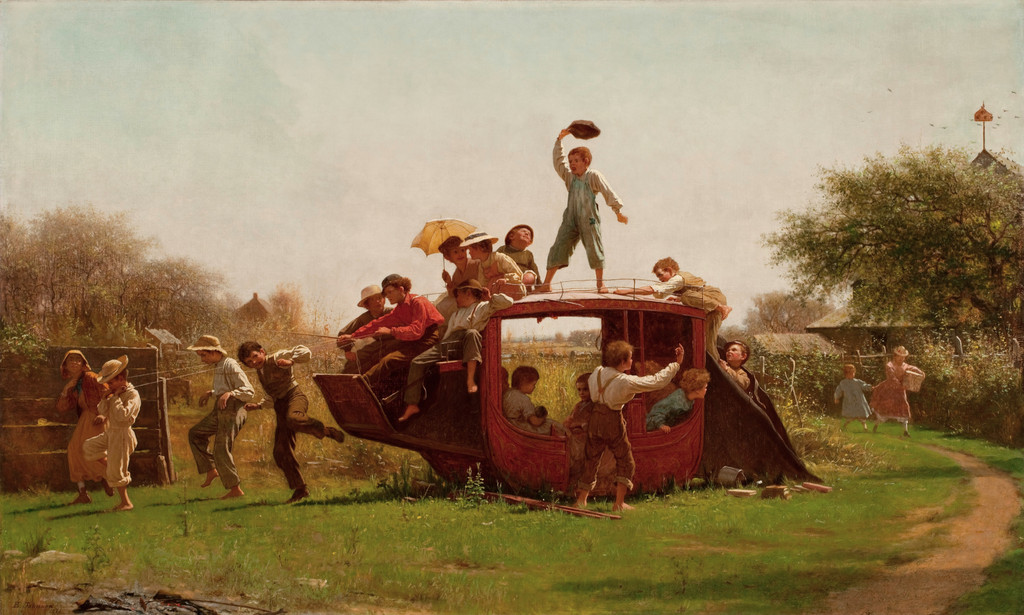
Eastman Johnson, The Old Stagecoach, 1871. Oil on canvas, 92.08 × 152.72 cm. Layton Art Collection, Milwaukee Art Museum, Gift of Frederick Layton, L1888.22. Public domain faithful reproduction.
Image source
.
Public domain
.
Artworks directory
Browse twenty-one selected objects discussed in these articles, including the Gifford portrait and the Prang print after Johnson. Dates identify individual objects, including the San Diego Drummer Boy study. Use All media to include the chromolithograph.
| Name | Date | Medium |
|---|---|---|
| Kitchen at Mount Vernon | 1857; Charles Butt canvas | Oil on canvas |
| Negro Life at the South | 1859; New York Historical original | Oil on linen |
| A Ride for Liberty—The Fugitive Slaves | About 1862; Brooklyn version | Oil on paperboard |
| The Lord Is My Shepherd | 1863 | Oil on fiberboard |
| Sugaring Off | About 1864–65; unfinished RISD canvas | Oil on canvas |
| The Wounded Drummer Boy (San Diego study) | About 1864–71; study, not the finished canvas | Oil on board |
| The Early Scholar | About 1865; NGA study | Oil on academy board on canvas |
| Fiddling His Way | 1866; Chrysler canvas | Oil on canvas |
| The Letter Home | 1867; Minneapolis drawing | Charcoal and graphite on paper |
| The Boyhood of Lincoln | 1868; Michigan canvas | Oil on canvas |
| The boyhood of Lincoln—An evening in the log hut (Prang after Johnson) | About 1868; separate reproductive print | Chromolithograph, W. Harring / L. Prang & Co., after Johnson |
| The Brown Family | 1869; NGA version | Oil on paper on canvas |
| The Hatch Family | 1870–71 | Oil on canvas |
| The Old Stagecoach | 1871 | Oil on canvas |
| The Girl I Left Behind Me | About 1872 | Oil on canvas |
| The Toilet | 1873 | Oil on paper board |
| Husking Bee, Island of Nantucket | 1876; Chicago canvas | Oil on canvas |
| The New Bonnet | 1876 | Oil on academy board |
| Sanford Robinson Gifford | 1880; possibly posthumous | Oil on academy board |
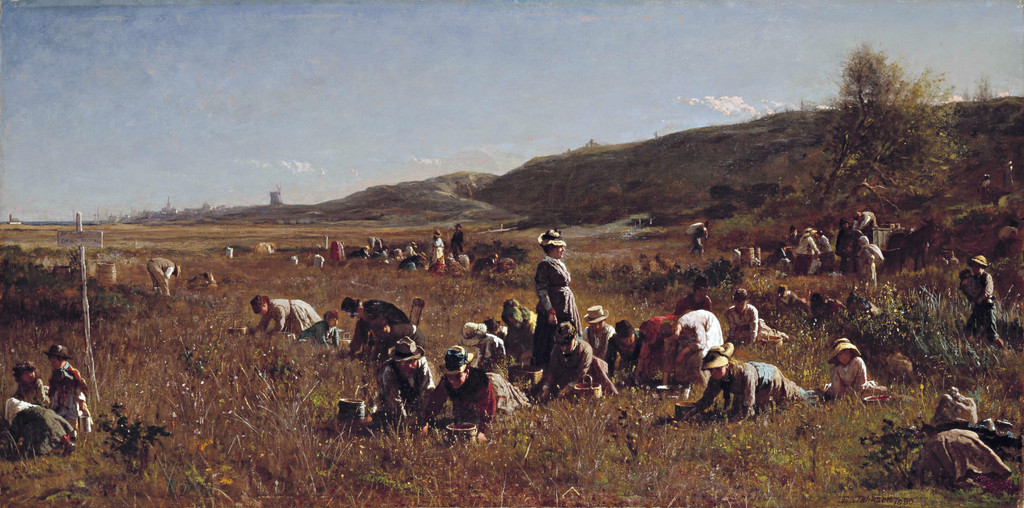
| The Cranberry Harvest, Island of Nantucket | 1880; Timken canvas | Oil on canvas |
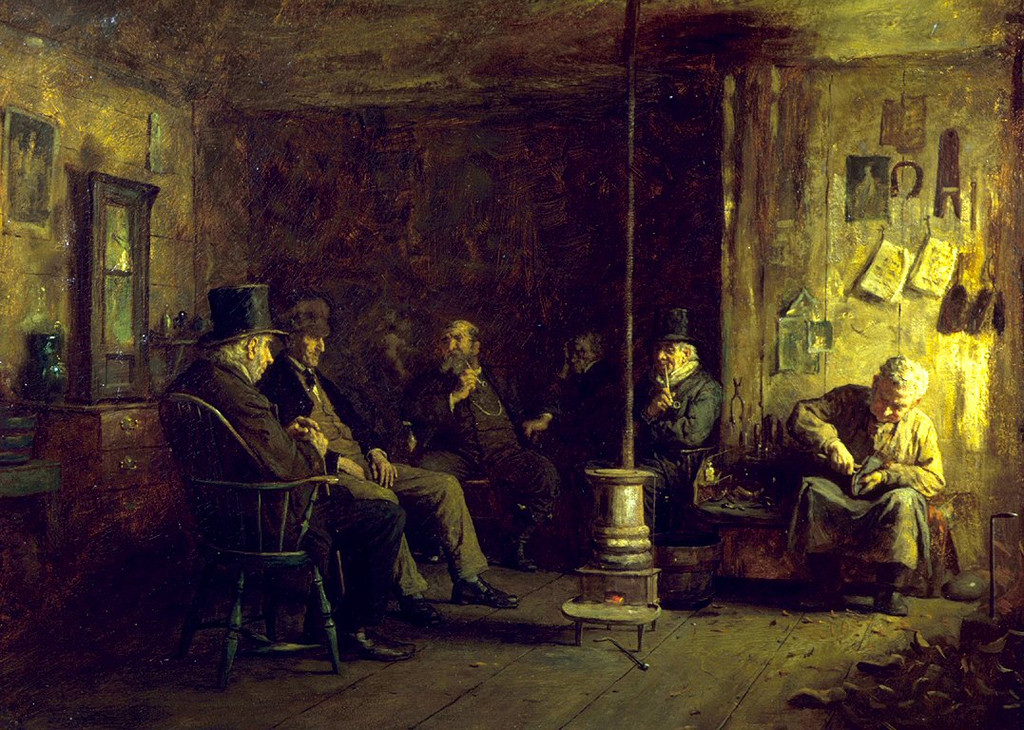
| The Nantucket School of Philosophy | 1887 | Oil on panel |
Frequently Asked Questions
The Brooklyn Museum’s paperboard painting, about 1862, accession 40.59a–b, Gift of Gwendolyn O. L. Conkling. Its reverse is Scythe Sharpening. [1]
It is recorded on the separate Virginia Museum of Fine Arts version, 85.644. The Brooklyn reverse should not be described as carrying that inscription. [2]
Discussion
Look again at the images and ideas explored in A Ride for Liberty by Eastman Johnson. These editorial prompts invite your observations.
Reader Insights
Compare the directions of the man’s and woman’s attention. How do they give the same journey different demands?
What does the landscape show about escape, and what does it leave unresolved about the family’s destination?
Compare the horse with the abandoned stagecoach. How does each object distribute movement and dependence?
Join the Conversation
Share a detail, comparison or question about A Ride for Liberty by Eastman Johnson below.
References
- Patricia Hills and Abigael MacGibeny , A Ride for Liberty—The Fugitive Slaves, c. 1862, Hills no. 10.0.11r, Eastman Johnson Catalogue Raisonné. Brooklyn object, reverse, family provenance, exhibitions and mediated eyewitness account. View source
- Hills and MacGibeny , A Ride for Liberty—The Fugitive Slaves—1862, Hills no. 10.0.10. Virginia version, support, recorded inscription, 1907 sale account and provenance. The original reverse inscription was not directly inspected for this article. View source
- Hills and MacGibeny , Fugitive Slaves, c. 1862, Hills no. 10.0.9. Smaller unlocated academy-board version and twentieth-century records. View source
- Washington’s Kitchen at Mount Vernon,1857,Hills6.0.4. View source
- Negro Life at the South,1859,S-225. View source
- The Lord Is My Shepherd, 1863, 1979.5.13. View source
- Sugaring Off, ca.1864–1865, 45.050. View source
- Wounded Drummer Boy, San Diego study, Hills 10.0.18. View source
- The Early Scholar,c.1865,1963.10.157: current object record. View source
- Patricia Hills , Painting Race: Eastman Johnson’s Pictures of Slaves, Ex-Slaves, and Freedmen, in Eastman Johnson: Painting America, 1999, p. 136. Eyewitness-reporting context, interpretation of movement towards Union lines and self-directed escape; historical canvas description superseded by current board identification. View source
- Milwaukee Art Museum , Eastman Johnson and a Nation Divided, 2017 exhibition guide. Curatorial comparison of mobility and agency in A Ride for Liberty and The Old Stagecoach. View source
- Splash image source.
Eastman Johnson, A Ride for Liberty—The Fugitive Slaves, about 1862. Oil on paperboard, 55.2 × 66.7 cm. Brooklyn Museum, Gift of Gwendolyn O. L. Conkling, 40.59a–b. Public domain faithful reproduction. The recorded eyewitness inscription belongs to the separate Virginia version. Public domain .
View source