


 by
Tom Gurney
Tom Gurney BSc (Hons) is an art history expert with over 20 years experience
Email:
tomgurney1@gmail.com
/ Phone:
+44 7429 011000
Conrad Wise Chapman: Paintings and Life: Introduction
Conrad Wise Chapman painted landscapes in which people had already left their mark. A fort could contain broken masonry, tents and men preparing for another day. A Mexican valley could hold small settlements, cultivated fields and figures travelling along a road. The setting gave his pictures breadth, while those details made it a place of work and habitation.
Born in Washington, D.C., in 1842, Chapman grew up in Europe and learned painting within his father’s artistic household. His service in the Confederate army brought him to Charleston, where he recorded the harbor defenses. After the war, Mexico became an enduring subject, alongside European views and repeated journeys between countries. He died in Hampton, Virginia, in 1910. [1]
His career connects several histories of nineteenth-century art: family training in Rome, the commissioned representation of war and the work of foreign painters in Mexico. The paintings reward attention to both their expansive views and the smaller activities that occupy them.
Explore Chapman’s paintings
At a Glance
- Artist Conrad Wise Chapman, 1842–1910.
- Training His father, John Gadsby Chapman, and the artistic environment of Rome.
- Principal subjects Charleston defenses, military encampments, Mexican landscapes and European views.
- Important distinction Some Charleston pictures were painted by his father from Conrad’s studies.
- Start with Bombardment of Fort Moultrie, the Hunley painting and the Mexican landscapes.
Conrad Wise Chapman in context
Bars show approximate historical periods. c. means circa (about).
Realism is a broad historical context for related reading. Training, wartime subjects and Mexican views are retained in Notes and sources.
Notes and sources
Realism. Landscape, ordinary activity and the Civil War. The broader movement page supplies context for looking at American experience. Chapman’s inclusion here identifies a useful comparison, rather than documented membership in a formal school. [3]
Italian landscape training. Rome and the Campagna. Family training in Rome connected outdoor study with a practice of small landscape pictures. [2]
Civil War landscape. A commission within the Confederate defenses. The Charleston pictures record selected places, work and weapons from within a Confederate military assignment. [3]
Mexican landscape and travel art. First journey in 1865; repeated subjects later. Collection records distinguish inhabited landscapes and versions made at different points in his career. [4]
Each bar runs from the artist’s birth to their death.
John Gadsby Chapman
1808–1889 · Birth–death [29]John Linton Chapman
1839–1905 · Birth–death [30]Conrad Wise Chapman
1842–1910 · Birth–death [31]Notes and sources
John Gadsby Chapman. Father, teacher and collaborator. Conrad trained within his father’s artistic household. John Gadsby also painted specific pictures in the Charleston series. [1] [5]
John Linton Chapman. Brother and fellow artist. Both sons learned within the family’s Roman practice; their work and subjects require separate identification. [2]
Conrad Wise Chapman. Follow works from the early oil studies to later Mexican views. [1]
Alejandro Najera. A named 1894 commission. The reverse inscription names Najera as the recipient of this particular Valley of Mexico canvas. [6]
Camp No. 2, Terrenos Baldios
1860; setting unidentifiedBombardment of Fort Moultrie
1864; scene 16 November 1863The Flag of Sumter
1863–64; scene 20 October 1863Fort Sumter, Interior at Sunrise
1864; published scene dates differSubmarine Torpedo Boat H. L. Hunley
1864; scene 6 December 1863Torpedo Boat David at Charleston Dock
1864; scene 25 October 1863The Fifty-ninth Virginia Infantry—Wise’s Brigade
Probably 1867; scene September 1863Valley of Mexico paintings
Separate versions, 1866–1902Monterrey desde el cerro de Chipinque
1902; photographed in 2023Notes and sources
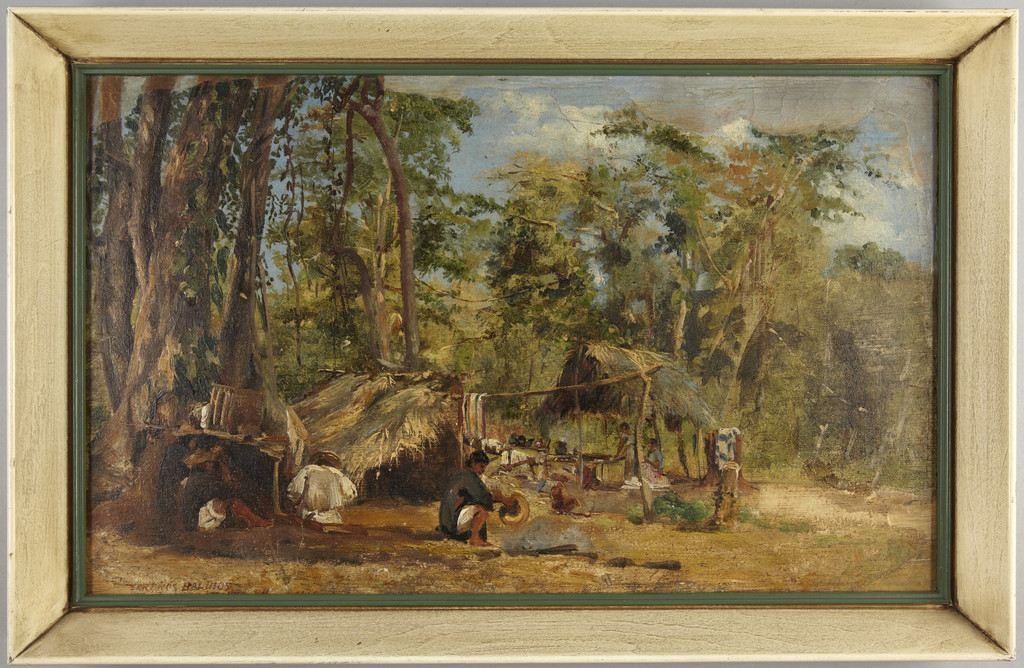
Camp No. 2, Terrenos Baldios. A framed oil study whose catalogue date does not identify it as a Mexican survey camp. [7]
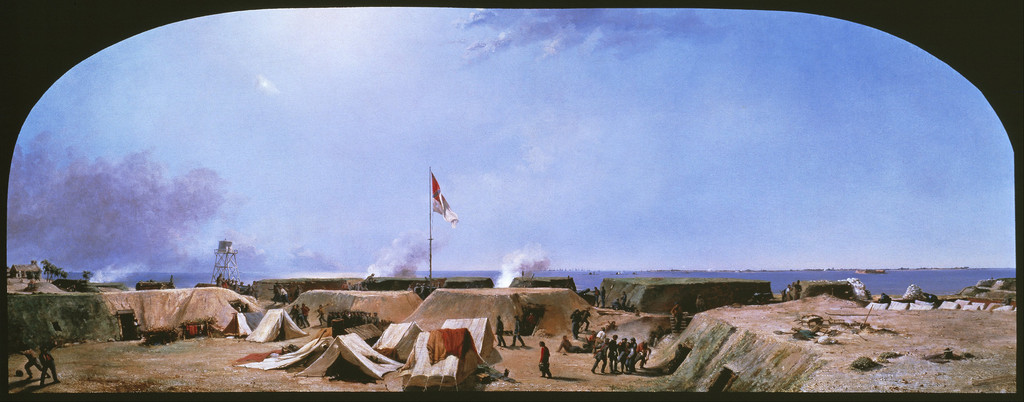
Bombardment of Fort Moultrie. The large Gibbes panorama opens the sandy fort interior to figures, tents and a broad sky. [8]
The Flag of Sumter. A flag and a solitary guard stand above the ruined wall in sunset light. [9]
Fort Sumter, Interior at Sunrise. Workers, water and broken ground occupy the surviving courtyard; the article explains the conflicting scene dates. [10]
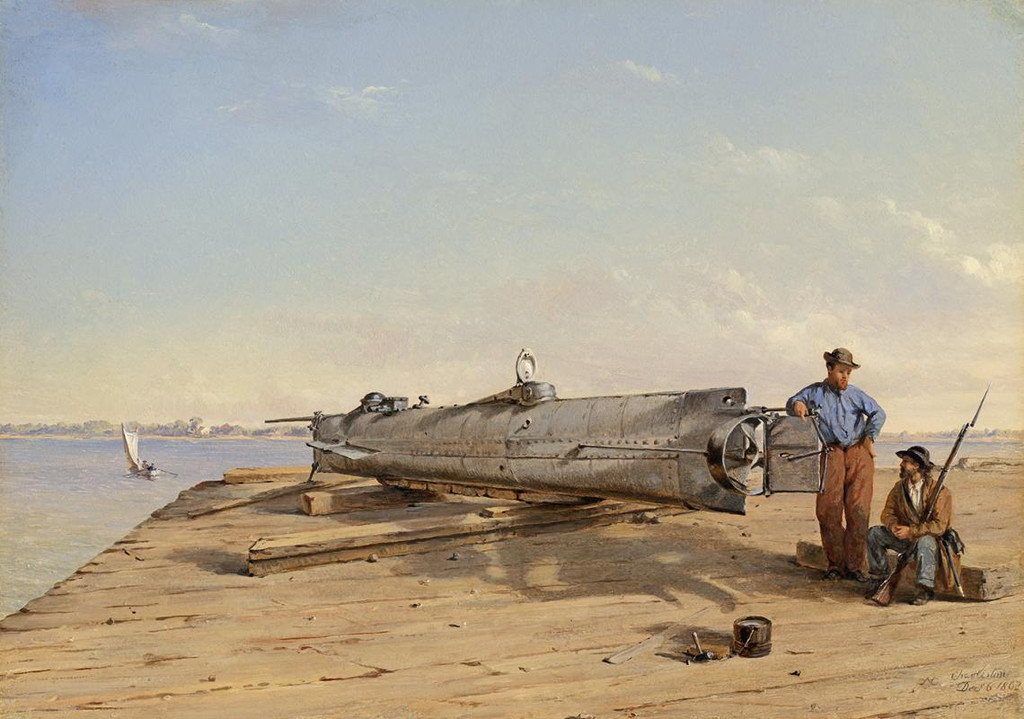
Submarine Torpedo Boat H. L. Hunley. The beached hull and two men establish the scale of the small submarine. [11]
Torpedo Boat David at Charleston Dock. A low vessel, dock and exposed fittings bring military technology into a working waterfront. [12]
The Fifty-ninth Virginia Infantry—Wise’s Brigade. A mounted figure, tents and a bridge organize a camp within a larger landscape. [13]
Valley of Mexico paintings. Compare individual studies and later versions. The date band groups several objects and does not indicate continuous work on one painting. [1] [14] [4] [6] [15]
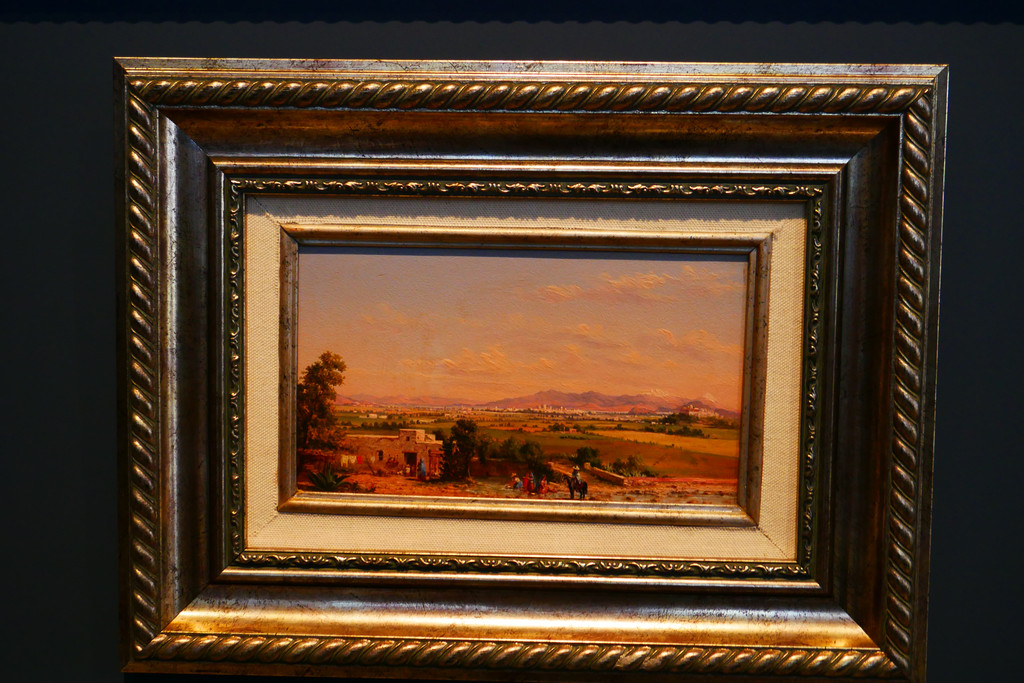
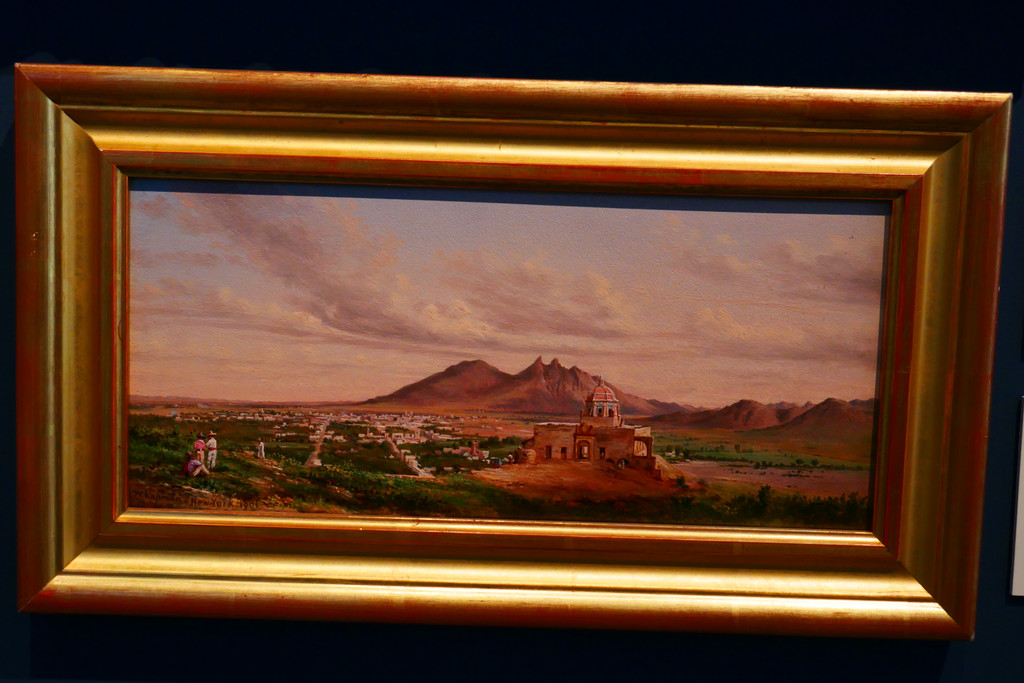
Monterrey desde el cerro de Chipinque. The photograph retains the frame and gallery setting of this later Monterrey painting. [16]
Chapman’s artistic connections
Family teaching and two very different commissions connect the Roman, Charleston and Mexican parts of his career.
- John Gadsby Chapman: Conrad learned within his father’s Roman household. The Charleston portfolio also includes paintings explicitly credited to John Gadsby, including Charleston Bay and City. [1] [5]
- John Linton Chapman: Conrad and his brother John Linton shared an artistic household. Their separate works make attribution within the family an essential part of understanding its output. [2]
- P. G. T. Beauregard: Beauregard oversaw the Charleston defenses when Chapman received his assignment to record fortifications. The commission shaped his choice of subjects and viewpoints. [17]
- Alejandro Najera: The inscription on the reverse of the 1894 Valley of Mexico canvas names Najera. This is one specific commission within a much larger group of related views. [6]
Contents
- Three places to begin
- Learning to paint in Rome
- A soldier assigned to make pictures
- The Charleston series and the Chapman family
- Work inside the defenses
- Light and the meaning of a viewpoint
- The date of a scene and the making of a painting
- Painting in Mexico
- Several versions of the Valley of Mexico
- Observation and the limits of detail
Three places to begin
Bombardment of Fort Moultrie gives the viewer a wide prospect from inside a fortified position. Tents and scattered groups occupy the sandy foreground; smoke and the distant fleet register an engagement beyond the walls. The Gibbes Museum dates the canvas to 1864 and identifies the represented event as 16 November 1863. Its broad format makes it a useful introduction to the relationship between a military subject and a landscape composition. [8]
The painting of H. L. Hunley works at a different scale. A submarine rests beside the water, with a standing man and an armed guard near its propeller. The vessel’s rivets, hatches and supports invite close looking, while the quiet shore gives little outward indication of the dangers associated with it. Chapman’s later recollection supplies a dramatic account, but it should be read alongside the painting’s date and the vessel’s history. [18]
The Valley of Mexico views open another part of his career. In the small 1870 canvas in the Cisneros collection, a camp and people at work occupy the foreground beneath a far-reaching landscape. The arrangement brings domestic activity and agricultural labor into the same field of vision. It offers a productive comparison with the inhabited military landscapes of Charleston. [4]
Four stages of Conrad Wise Chapman’s career
These periods group related developments; painting, travel and local work overlap across their boundaries.
Learning within an artistic household
Chapman began his career in 1855, after the family had settled in Rome. His father’s practice offered instruction within a community of artists and visitors. [1]
Service, field studies and paintings made later
Confederate service brought Chapman to the Charleston defenses. Sketches made during the siege supplied material for paintings completed after he obtained a furlough to Rome. [1]
A new body of landscape subjects
Chapman travelled to Mexico after the war and painted views of its inhabited landscapes. European travel and work followed, while Mexican subjects remained part of his practice. [1]
Returning to subjects and places
After returning to Mexico in 1883, Chapman made variations of earlier views and also coloured photographs. Richmond, later journeys and the final move to Hampton form the closing part of his life. [1]
Learning to paint in Rome
Chapman’s father, John Gadsby Chapman, was a painter and illustrator whose American career included The Baptism of Pocahontas for the Capitol. The family left the United States in 1848 and settled in Rome in 1850. There, small paintings of Italian subjects formed part of the elder artist’s response to a market that included visiting Americans. Conrad’s artistic education took shape within this working household. [1]
Family training could connect the observation of a landscape with the practical business of making pictures for others. A site supplied forms, distances and changing light; a studio allowed a painter to arrange that material, repeat a subject or adapt it to a different size. Those possibilities remained important when Conrad later worked from wartime studies and returned to Mexican views over many years.
Mary K. McGuigan’s discussion of the Chapman family includes Conrad’s Landscape at Frattocchie , dated 1861. Its long, narrow dimensions show that the panoramic format belonged to his early practice. The same discussion distinguishes his work from pictures by his brother John Linton and their father, a useful reminder that the household contained several individual careers. [2]
The Italian background therefore helps explain habits that recur across changing subjects. A low horizon could leave room for a large sky. Buildings and figures could establish scale without filling the view. The eye could move between an immediate patch of activity and terrain that continued far beyond it.
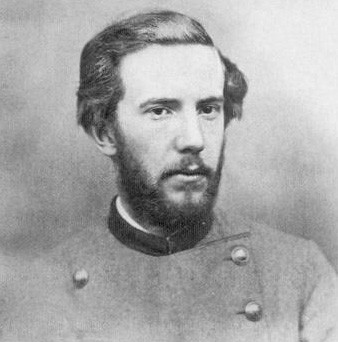
Conrad Wise Chapman in uniform, about 1865. The small historical photograph provides a likeness alongside the account of his training and military career. Conrad Wise Chapman, about 1865. Photographer unidentified. Virginia State Library and Archives, via Wikimedia Commons. Public domain US.
Image source
.
Public domain
. Resized only; whole supplied image retained, with no appearance changes.
A soldier assigned to make pictures
In 1861 Chapman returned to the United States and enlisted in a Kentucky Confederate regiment. He later served in Virginia and reached Charleston in 1863. The American Civil War Museum describes his assignment to sketch the harbor fortifications for the Ordnance Bureau, while General P. G. T. Beauregard oversaw the strengthening of the defenses. [3]
The commission shaped what he could see and what his pictures were expected to preserve. His position among the defenders gave him access to batteries, works under repair and military equipment. These were selected subjects within a Confederate undertaking, rather than a survey made from an independent position outside the conflict.
The museum’s account of the commission places Thomas Jordan and Josiah Gorgas within that administrative setting. Orders, access and intended use belong to the history of the pictures as much as their colors and brushwork. Knowing why a view was commissioned helps explain its concentration on the construction and maintenance of particular defenses. [17]
The Civil War paintings include intervals of waiting and repair as well as bombardment. A painter recording a gun position might also include tents, a boat, a sentry or people carrying materials. Such details give the military site a lived rhythm and make its ordinary routines visible.
The Charleston series and the Chapman family
The American Civil War Museum’s portfolio brings together 31 pictures associated with the Charleston commission. The sequence moves among different batteries, distant harbor views, damaged forts and experimental vessels. Seen together, the works build a geography through repeated crossings and changes of viewpoint. [19]
The sequence also records collaboration between father and son. The museum explicitly identifies John Gadsby Chapman as the painter of Charleston Bay and City . Conrad’s field material and his father’s finished picture have connected roles in that object’s history. A familiar association with Conrad’s wartime service should not erase the person who painted the surviving work. [5]
Moving through the series requires attention to the kind of image being offered. Quaker Battery , for example, was described by Conrad as an imagined scene illustrating the use of wooden dummy guns. Its convincing sand, palms and soldiers do not turn it into a record of one securely identified event. The distinction comes from the artist’s own retrospective description. [20]
These differences make the series richer than a uniform set of military illustrations. Some pictures depend on a particular location; another explains a practice through invention. Some connect Conrad’s observation to his own later painting, while others connect that observation to his father’s work. Each deserves its own attribution and account.
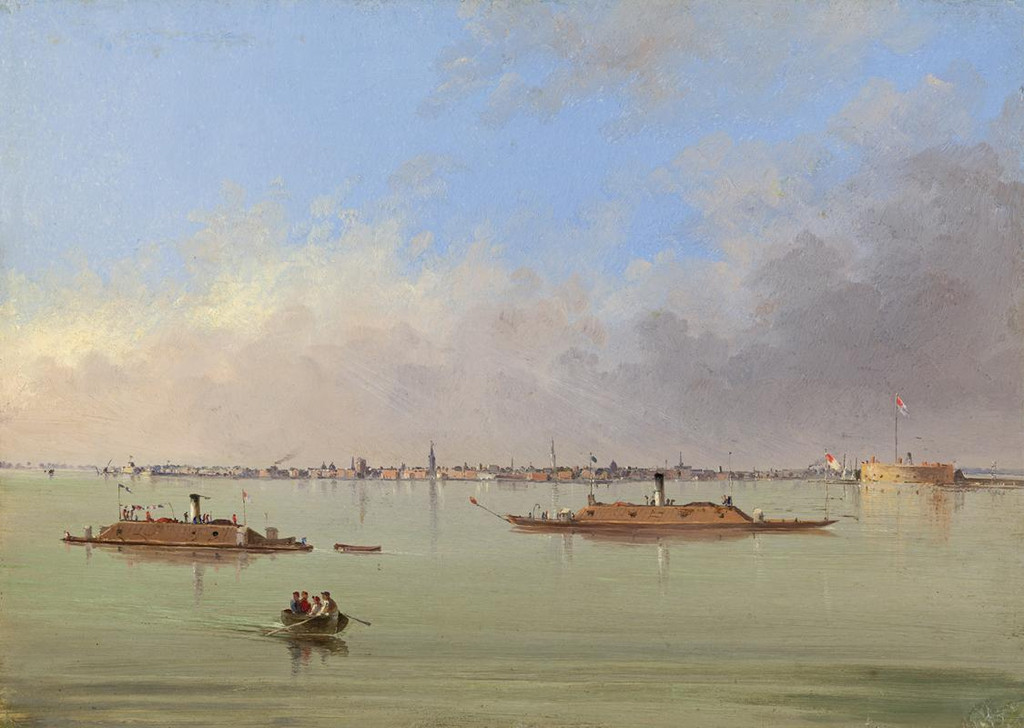
Charleston Bay and City, 1864. John Gadsby Chapman painted this view from Conrad’s studies; its harbor scene belongs to the shared Charleston series. John Gadsby Chapman, from studies by Conrad Wise Chapman, Charleston Bay and City, 1864. American Civil War Museum. Public-domain reproduction; exhibition photography credited to Alan Thompson.
Image source
.
Public domain
. Resized only; whole supplied image retained, with no appearance changes.
Work inside the defenses
Fort Sumter, Interior at Sunrise gives much of its foreground to damaged ground and standing water. People gather around a small fire below the broken walls. The sky is spacious and luminous, while the courtyard remains a difficult place to move through.
In his 1898 recollection, Chapman associated the fires with Black workers warming themselves before the day’s labor. He also described the continuing preparation of sandbags to repair the defenses. That account gives a specific connection between the visible groups and the work required to sustain the fort. [21]
The scene invites a viewer to notice who maintains the place as well as who guards it. The workers are small within the composition, but the fort’s continuing use depends on activity of this kind. Their scale within a broad landscape should not make their presence incidental to its history.
The painting does not supply a complete biography or legal status for every individual. Clothing and position alone cannot recover those lives. Looking carefully means keeping the people visible without turning a limited painted record into a certainty about each person represented.
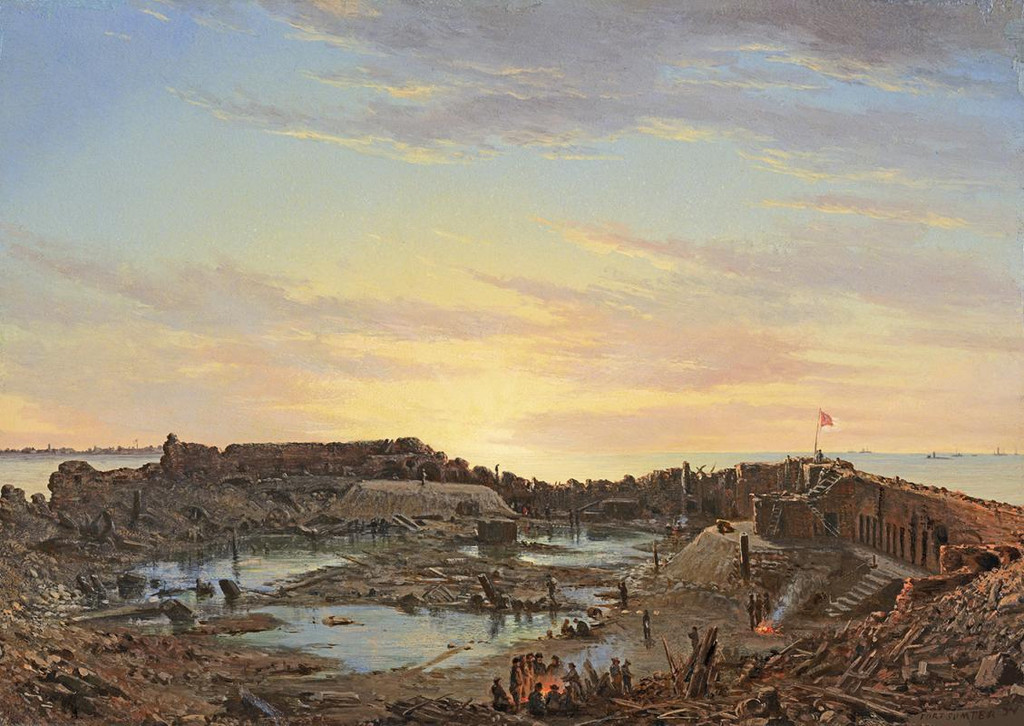
Fort Sumter, Interior at Sunrise. Workers gather around a fire in the foreground of the damaged, partly flooded courtyard. Conrad Wise Chapman. American Civil War Museum; exhibition photography credited to Alan Thompson. Public-domain faithful reproduction.
Image source
.
Public domain
. Resized only; whole supplied image retained, with no appearance changes.
Light and the meaning of a viewpoint
Chapman could give a similar setting sharply different effects through light. Interior at Sunrise spreads pale color across water and sky. Night Bombardment narrows visibility to a fort, a sailboat, flashes and a beam crossing the dark water. The Flag of Sumter lifts a large moving form above the red-brown ruin of a wall.
The physical arrangement matters before a symbolic interpretation begins. In the flag picture, the pole draws the eye upward while a ladder leads it back into the damaged structure. The flag occupies a conspicuous share of the sky; the sentry beneath it is much smaller. The distant ships give the open water a military presence. Chapman described the originating view as a sunset sketch. [22]
Curator Eleanor Harvey reads these Charleston pictures through their Confederate purpose and Chapman’s Italian formation. Her discussion connects the ruined Sumter interior with the remembered example of Rome’s ancient buildings. This is an interpretation of the picture’s emotional and historical associations, rather than a statement written into every visible stone. [10]
Comparing the pictures makes their choices of viewpoint particularly clear. A position inside a ruined courtyard brings a viewer among the effects of bombardment. A harbor prospect permits a more detached survey. The same landscape tradition could support both intimacy and distance.
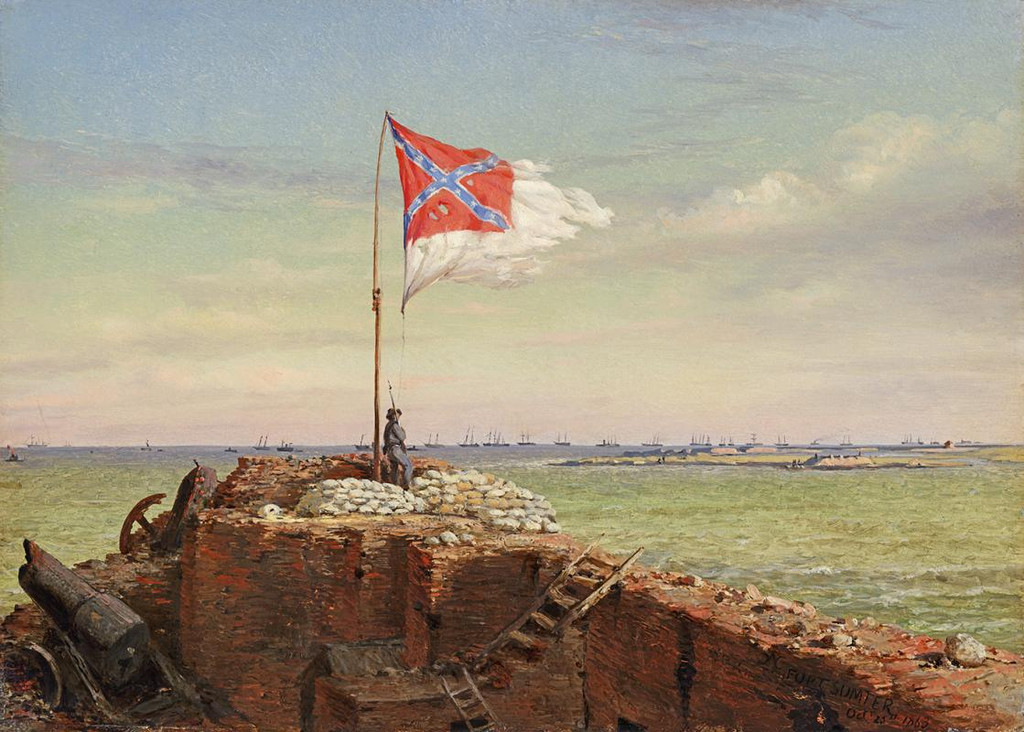
The Flag of Sumter. A sentry stands below the large flag, above broken walls and a ladder, with ships across the harbor. Conrad Wise Chapman. American Civil War Museum; exhibition photography credited to Alan Thompson. Public-domain faithful reproduction.
Image source
.
Public domain
. Resized only; whole supplied image retained, with no appearance changes.
The date of a scene and the making of a painting
Chapman’s titles and inscriptions often refer to a wartime place and day, while a finished painting could be made later. Bombardment of Fort Moultrie is a clear example: the Gibbes record gives 1864 as the creation date and November 1863 as the represented engagement. [8]
The Amon Carter Museum dates The Fifty-ninth Virginia Infantry—Wise’s Brigade to probably 1867. Its inscription recalls Diascund Bridge in September 1863. The scene’s tents, mounted figure and open foreground therefore belong to a picture whose relationship with military experience includes later reconstruction. [13]
That interval can be an active part of the art. A field study preserves selected information; a finished composition gives relationships among figures and setting a more sustained arrangement. Recollection adds another layer when the artist describes the picture decades afterward. These stages help explain why apparent immediacy and later making can coexist.
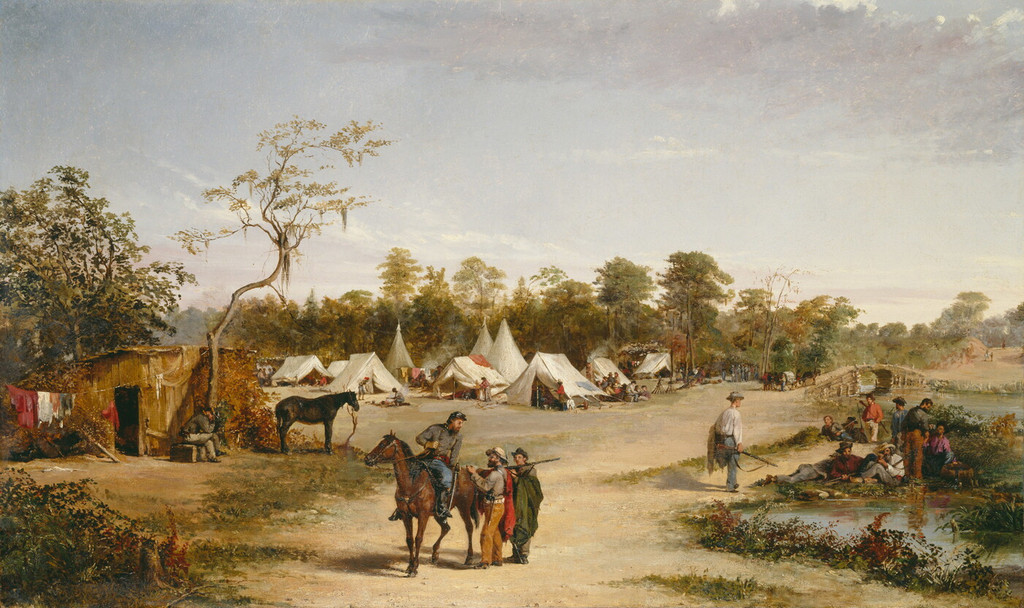
The Fifty-ninth Virginia Infantry—Wise’s Brigade, probably 1867. The inscription recalls Diascund Bridge in September 1863. Conrad Wise Chapman, The Fifty-ninth Virginia Infantry—Wise’s Brigade, probably 1867. Amon Carter Museum of American Art, Fort Worth, Texas, 2001.7. Public domain.
Image source
.
Public domain
. Resized only; whole supplied image retained, with no appearance changes.
Watch: Conrad Wise Chapman
Two Spanish-language museum films explore Chapman and his views of Mexico.
#ElSoumayaEnCasa | Conrad Wise Chapman
Museo Soumaya introduces Chapman and his work. This museum presentation is in Spanish.
Watch on YouTubePainting in Mexico
Chapman reached Monterrey in 1865, after the Confederate defeat. The Museo de Historia Mexicana’s Vista de Monterrey , dated that year, presents a long view of the settlement and its mountain setting. Its foreground activity connects the broad prospect with people, animals and transport. [23]
Mexico became a continuing source of subjects. The landscape around the capital offered extensive views in which distant mountains, cultivated ground and buildings could occupy different bands of space. Such settings also allowed figures and everyday tasks to remain legible within a large geographical whole.
An account derived from Ben Bassham’s Timken exhibition essay describes Chapman’s work for the English engineer W. R. Jolly. A commission associated with Jolly’s tile factory developed within a larger interest in the Valley of Mexico. Later versions returned to material gathered during the earlier Mexican journey. [6]
The industrial connection is revealing. A landscape commission might serve a patron’s interest in a particular enterprise while giving much of the picture to the surrounding terrain. Buildings could be both identifiable subjects and small elements within a much wider view. Patronage and landscape ambition met within the same composition.
The Museo Soumaya’s Paisaje mexicano , dated 1877, centers on Ajusco. Its commentary identifies figures repeated in other pictures and places Chapman’s work in relation to Mexican landscape painting and the observation of local customs. These connections widen the account of his art beyond the Charleston defenses. [24]
Luis Alvaz’s 2023 gallery photograph of Monterrey desde el cerro de Chipinque, 1902, by Conrad Wise Chapman. The frame and museum setting remain visible. Luis Alvaz, photograph of Monterrey desde el cerro de Chipinque (1902) by Conrad Wise Chapman, Museo Internacional del Barroco, 21 April 2023. CC BY-SA 4.0.
Image source
.
CC BY-SA 4.0; photograph by Luis Alvaz, 21 April 2023
. Photograph by Luis Alvaz (2023), CC BY-SA 4.0. Resized only; no crop or colour changes. This resized photograph remains CC BY-SA 4.0.
Several versions of the Valley of Mexico
The title Valley of Mexico covers distinct paintings. The Cisneros canvas of 1870 is a small work, measuring 13.34 by 20.32 centimeters. Its occupied foreground and broad distance operate within that intimate scale. [4]
The 1894 canvas formerly in the Timken Museum is a different object, with a long inscription recording its making for Alejandro Najera. Its dimensions, support and history belong to that version. They cannot be transferred to another picture because both show the same valley. [6]
A gallery photograph by Luis Alvaz records a framed México desde la hacienda de los Morales identified as 1896. Another photograph records Monterrey desde el cerro de Chipinque , dated 1902. The visible frames and gallery surroundings present these paintings as encountered objects, complementing the closer study offered by flat reproductions. [15] [16]
The Mexican landscapes article follows these settings and periods together. The separate Valley article compares the recurring subject across versions, keeping the small Cisneros picture, the later wide canvas and the photographed Hacienda view distinct.
Luis Alvaz’s 2023 gallery photograph of México desde la hacienda de los Morales, identified as 1896. This is a different object from the 1870 Cisneros and 1894 former Timken canvases. Luis Alvaz, photograph of México desde la hacienda de los Morales (1896) by Conrad Wise Chapman, Museo Internacional del Barroco, 21 April 2023. CC BY-SA 4.0.
Image source
.
CC BY-SA 4.0; photograph by Luis Alvaz, 21 April 2023
. Photograph by Luis Alvaz (2023), CC BY-SA 4.0. Resized only; no crop or colour changes. This resized photograph remains CC BY-SA 4.0.
Observation and the limits of detail
The appeal of a Chapman picture often begins with a particular detail: a chimney on a low vessel, the angle of a ladder or a group beside a fire. Those elements make looking rewarding even before the full history of the subject is known. They also encourage questions about what a painting can establish.
The 1998 archaeological assessment of Hunley treats Chapman’s image as an important record of the vessel’s general appearance while discussing discrepancies in particular features. Its comparison shows how a picture can be useful evidence without every detail becoming an exact technical specification. [25]
Torpedo Boat David offers another opportunity to compare a carefully depicted machine with its setting. The low hull, chimney and exposed plates occupy a dock full of timber, sheds and people. The picture locates the vessel within the labor of repair, giving the surrounding workplace a role in its meaning.
Submarine Torpedo Boat H. L. Hunley, 1864, representing a December 1863 shore scene. The hull and its visible fittings supplied material for later archaeological comparisons. Conrad Wise Chapman. American Civil War Museum; exhibition photography credited to Alan Thompson. Public-domain faithful reproduction.
Image source
.
Public domain
. Resized only; whole supplied image retained, with no appearance changes.
Later years and the survival of the work
Chapman’s later life involved further moves among Mexico, Europe and the United States. The Library of Virginia records his work coloring photographs as well as painting, his marriage to Laura Seagar and the couple’s eventual settlement in Hampton in 1909. He died there on 10 December 1910. His widow’s donation to the Virginia State Library later passed to the Valentine Museum in 1941. [1]
Different collections preserve different parts of the career. The Charleston pictures have a strong place within the history of the Civil War, while Mexican collection records bring landscape and local activity to the foreground. Placing those holdings alongside each other makes it easier to see the range of his practice.
Ben Bassham’s Conrad Wise Chapman: Artist and Soldier of the Confederacy , published in 1998, provides a substantial book-length study. Its combination of biography and artistic discussion offers a route beyond an introduction organized around a few familiar wartime pictures. [26]
Following the paintings
Begin with the large Moultrie panorama, then compare the flag and the Sumter interior. Follow the movement from open view to close detail in the two vessel pictures. The Mexican landscapes offer a further comparison, especially in the relationship between an occupied foreground and an expansive distance.
Chapman belongs within the wider history of American artists . The Civil War landscape and documentary traditions discussed under American Realism provide a useful context for his work, while his family training and Mexican subjects bring other settings into view.
Across those settings, the most useful questions remain specific. Where has the painter placed the viewer? What activity occupies the foreground? Which details establish distance, and which give people a presence within it? Attending to those choices makes the pictures legible as compositions and as particular views of a changing world.
Essential Conrad Wise Chapman works
Bombardment of Fort Moultrie
1864; scene 16 November 1863 · The large Gibbes panorama opens the sandy fort interior to figures, tents and a broad sky.
Submarine Torpedo Boat H. L. Hunley
1864; scene 6 December 1863 · The beached hull and two men establish the scale of the small submarine.
The Flag of Sumter
1863–64; scene 20 October 1863 · A flag and a solitary guard stand above the ruined wall in sunset light.
Fort Sumter, Interior at Sunrise
1864; published scene dates differ · Workers, water and broken ground occupy the surviving courtyard; the article explains the conflicting scene dates.
The Fifty-ninth Virginia Infantry—Wise’s Brigade
Probably 1867; scene September 1863 · A mounted figure, tents and a bridge organize a camp within a larger landscape.
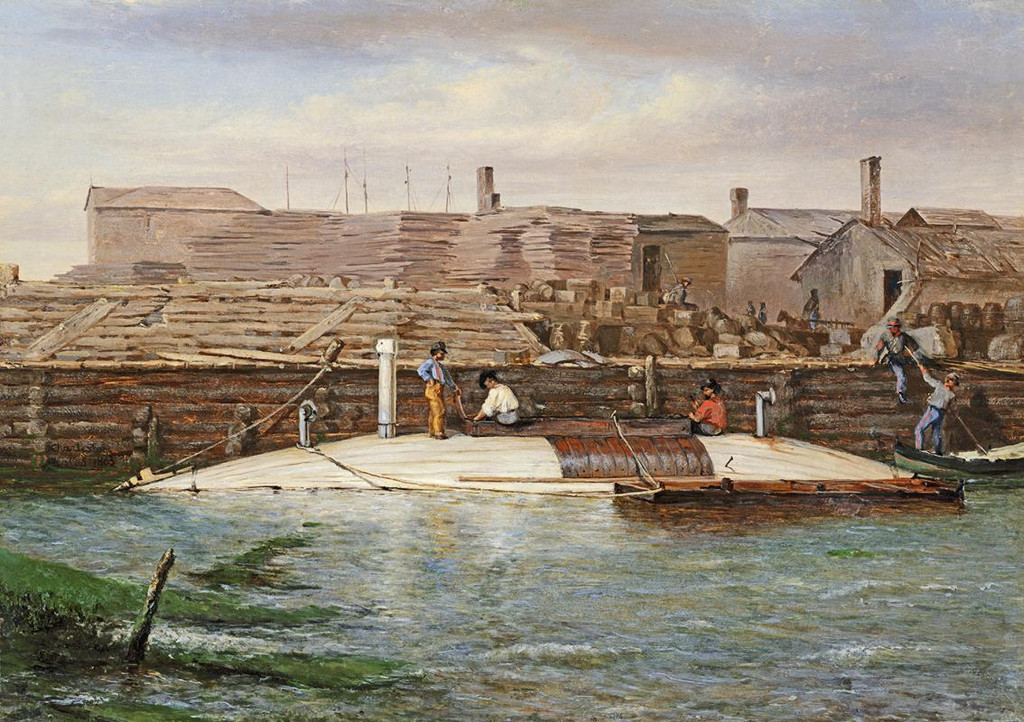
Torpedo Boat David at Charleston Dock
1864; scene 25 October 1863 · A low vessel, dock and exposed fittings bring military technology into a working waterfront.
Valley of Mexico paintings
1896; one of several Valley versions · Compare individual studies and later versions. The date band groups several objects and does not indicate continuous work on one painting.
Artworks directory
Browse 46 works identified in the consulted collection and catalogue records, including all 31 pictures in the father-and-son Charleston portfolio. Six entries explicitly credit John Gadsby Chapman. Approximate 1864–65 labels describe the series period; dates within its titles describe scenes and sometimes conflict with other catalogues. Other dates identify the separate objects or commissions. Links open our article where available, or the cited record. This is a research-based directory, not a catalogue raisonné.
| Name | Date | Medium |
|---|---|---|
| Battery Chevis, Mar. 4, 1864 | Series, c. 1864–65; scene date in title where given | Painting |
| Forts Sumter & Johnson, Mar. 15, 1864 | Series, c. 1864–65; scene date in title where given | Painting |
| Entrance to Fort Sumter — John Gadsby Chapman, from Conrad’s studies | Series, c. 1864–65; scene date in title where given | Painting |
| White Point Battery Charleston, Dec. 24, 1863 | Series, c. 1864–65; scene date in title where given | Painting |
| Quaker Battery (imagined scene) | Series, c. 1864–65; scene date in title where given | Painting |
| Fort Moultrie, Nov. 11, 1863 | Series, c. 1864–65; scene date in title where given | Painting |
| Battery on Long Island, Dec. 4, 1863 | Series, c. 1864–65; scene date in title where given | Painting |
| Church Flat Camp, Dec. 10, 1864 | Series, c. 1864–65; scene date in title where given | Painting |
| Fort Johnson, Oct. 10, 1863 | Series, c. 1864–65; scene date in title where given | Painting |
| Battery Halston — John Gadsby Chapman, from Conrad’s studies | Series, c. 1864–65; scene date in title where given | Painting |
| Charleston Bay and City — John Gadsby Chapman, from Conrad’s studies | Series, c. 1864–65; scene date in title where given | Painting |
| Battery Marion, Nov. 4, 1863 | Series, c. 1864–65; scene date in title where given | Painting |
| Battery Marshall, Sullivan's Island, Dec. 4, 1863 | Series, c. 1864–65; scene date in title where given | Painting |
| The Flag of Sumter, Oct. 20, 1863 | 1863–64; scene 20 October 1863 | Painting |
| Battery Beauregard, Nov. 22, 1863 — John Gadsby Chapman, from Conrad’s studies | Series, c. 1864–65; scene date in title where given | Painting |
| Fort Moultrie, Interior, Sep. 16, 1863 (portfolio index entry) | Series, c. 1864–65; scene date in title where given | Painting |
| Battery Bee, Dec. 3, 1863 | Series, c. 1864–65; scene date in title where given | Painting |
| Battery Wampler, Mar. 4, 1864 | Series, c. 1864–65; scene date in title where given | Painting |
| Submarine Torpedo Boat H.L. Hunley, Dec. 6, 1863 | 1864; scene 6 December 1863 | Painting |
| Battery Simkins, Feb. 25, 1864 | Series, c. 1864–65; scene date in title where given | Painting |
| Fort Sumter [Gun Gallery], Dec. 8, 1863 | Series, c. 1864–65; scene date in title where given | Painting |
| Fort Sumter, Interior, Sunrise, Dec. 9, 1864 | 1864; published scene dates differ | Painting |
| Torpedo Boat David at Charleston Dock, Oct. 25, 1863 | 1864; scene 25 October 1863 | Painting |
| Federal Battery on Morris Island, Feb. 12, 1864 | Series, c. 1864–65; scene date in title where given | Painting |
| Fort Sumter from Moultrie, Nov. 10, 1863 | Series, c. 1864–65; scene date in title where given | Painting |
| Battery Marshall from Long Island, Nov. 18, 1863 | Series, c. 1864–65; scene date in title where given | Painting |
| Evening Gun, Fort Sumter — John Gadsby Chapman, from Conrad’s studies | Series, c. 1864–65; scene date in title where given | Painting |
| Battery Haskel, Mar. 4, 1864 — John Gadsby Chapman, from Conrad’s studies | Series, c. 1864–65; scene date in title where given | Painting |
| Battery Rutledge, Dec. 3, 1864 | Series, c. 1864–65; scene date in title where given | Painting |
| Night Bombardment, Dec. 10, 1864 | Series, c. 1864–65; scene date in title where given | Painting |
| Battery Laurens Street Charleston, Feb. 7, 1864 | Series, c. 1864–65; scene date in title where given | Painting |
| Bombardment of Fort Moultrie (Gibbes panorama) | 1864; scene 16 November 1863 | Oil on canvas |
| The Fifty-ninth Virginia Infantry—Wise’s Brigade | Probably 1867; scene September 1863 | Oil on canvas |
| Camp No. 2, Terrenos Baldios | 1860; setting unidentified | Oil on wood panel |
| Frattocchie | 1861 | Oil painting |
| French Encampment at Monterrey | 1865; described in historical catalogue essay | Painting |
| Vista de Monterrey | 1865 | Oil on paper |
| Valley of Mexico (Jolly commission) | 1865/66 commission; catalogue dates vary | Painting |
| Valle de México (Cisneros version) | 1870 | Oil on canvas |
| Important Panoramic View of the Valley of Mexico, San Angel | Executed 1866; reverse inscribed 1865 | Oil on canvas laid down on board |
| Valle de México (Alejandro Najera commission) | 1894 | Oil on canvas |
| Paisaje mexicano (Ajusco) | 1877 | Oil on canvas |
| México desde la hacienda de los Morales | 1896; photographed in 2023 | Painting |
| Monterrey desde el cerro de Chipinque | 1902; photographed in 2023 | Painting |
| Valley of Mexico (Valentine version) | 1902 | Oil on wood |
| Picket Post | 1863 | Engraving |
Frequently Asked Questions
No. The series includes pictures painted by his father, John Gadsby Chapman, from Conrad’s studies. The museum specifically identifies the father as the painter of Charleston Bay and City. [5]
Discussion
Look again at the images and ideas explored in Conrad Wise Chapman: Paintings and Life. These editorial prompts invite your observations.
Reader Insights
Compare the Moultrie interior with the Mexican gallery views. How does each foreground establish the scale of the wider landscape?
How does knowing that the father painted Charleston Bay and City change your understanding of the series as a family undertaking?
Choose a work whose scene date differs from its creation date. What does that interval change about its apparent immediacy?
Join the Conversation
Share a detail, comparison or question about Conrad Wise Chapman: Paintings and Life below.
References
- Library of Virginia , Father and Son: The Works of John Gadsby Chapman and Conrad Wise Chapman, 1998–99 exhibition. Family, travel, later life and collection history. View source
- Mary K. McGuigan , Scenery Found, in American Latium, 2023, consulted pp. 160–163. Chapman family practice and Conrad’s Landscape at Frattocchie. View source
- American Civil War Museum , About the Artists, archived Chapman exhibition. Family training, Confederate service, assignment and return to Rome. View source
- Colección Patricia Phelps de Cisneros , Valle de México, 1870. Exact small canvas and inhabited landscape. View source
- American Civil War Museum , Charleston Bay and City, archived portfolio entry. Explicit attribution to John Gadsby Chapman. View source
- Christie’s , Valle de México, 1894, lot 4010480. Exact object and excerpts from Ben Bassham’s Timken exhibition essay, reproduced with the museum’s permission. View source
- Camp No. 2, Terrenos Baldios, y1970-114. View source
- Gibbes Museum of Art , Bombardment of Fort Moultrie, partner record on Google Arts & Culture. Creation in 1864, represented engagement and object details. View source
- The Civil War and American Art, 2013 exhibition press release. View source
- Eleanor Harvey , The Civil War and American Art: A Confederate View, Smithsonian American Art Museum, 2013. Interpretation of the Charleston pictures and their Roman associations. View source
- Rachel Lance, How Historical Research Helped Solve a Civil War Submarine Mystery, 18 September 2017. View source
- Conrad Wise Chapman - Torpedo Boat David at Charleston Dock, Oct. 25, 1863.jpg. View source
- Amon Carter Museum of American Art , The Fifty-ninth Virginia Infantry—Wise’s Brigade, 2001.7. Probably 1867 and the inscription recalling September 1863. View source
- Important Panoramic View of the Valley of Mexico, San Angel,2024lot38. View source
- Luis Alvaz , México desde la hacienda de los Morales, museum photograph, Wikimedia Commons. Photograph of the painting identified as 1896, made 21 April 2023; CC BY-SA 4.0. View source
- Luis Alvaz , Monterrey desde el cerro de Chipinque, museum photograph, Wikimedia Commons. Photograph of the 1902 picture, made 21 April 2023; CC BY-SA 4.0. View source
- American Civil War Museum , The Man Behind the Mission, archived exhibition. Administrative setting of the Charleston commission. View source
- American Civil War Museum , Submarine Torpedo Boat H. L. Hunley, archived portfolio entry. Work and the artist’s retrospective description. View source
- American Civil War Museum , complete archived Chapman portfolio index. The 31-picture sequence. View source
- American Civil War Museum , Quaker Battery, archived portfolio entry. Retrospective description of an imagined scene with dummy guns. View source
- American Civil War Museum , Fort Sumter, Interior, Sunrise, archived portfolio entry. Retrospective description of workers, fires and sandbag preparation. View source
- American Civil War Museum , The Flag of Sumter, archived portfolio entry. Sunset study and harbor setting. View source
- Museo de Historia Mexicana , 3 Museos, Vista de Monterrey. The 1865 oil on paper and its subject. View source
- Museo Soumaya , Paisaje mexicano, 1877, partner record on Google Arts & Culture. Ajusco, repeated figures and attributed interpretation. View source
- Larry E. Murphy , editor, H. L. Hunley Site Assessment, National Park Service and partner institutions, 1998, consulted historical and comparison passages, particularly pp. 73–74 and 80. The painting’s general usefulness and specific discrepancies; a historical assessment preceding recovery. View source
- Kent State University Press , Ben Bassham, Conrad Wise Chapman: Artist and Soldier of the Confederacy. Publisher description and bibliography, 1998, 348 pages. View source
- Splash image source.
Bombardment of Fort Moultrie presents tents, figures and sandy defenses beneath a broad sky. Painted in 1864; the represented engagement took place on 16 November 1863. Conrad Wise Chapman, Bombardment of Fort Moultrie, 1864. Gibbes Museum of Art, 1981.012. Museum purchase with funds provided by Winnie Edwards Murray Fund. Public domain. Public domain . Resized only; whole supplied image retained, with no appearance changes.
View source - Smarthistory, Realism period guide: c. 1830–1880. Broad international context, not a formal membership period. View source
- Smithsonian American Art Museum, John Gadsby Chapman: 1808–1889. Artist life dates. View source
- Smithsonian American Art Museum, John Linton Chapman: 1839–1905. Artist life dates. View source
- Smithsonian Libraries, Soldier Artist exhibition catalogue, Conrad Wise Chapman: 1842–1910. Artist life dates. View source