 by
Tom Gurney
Tom Gurney BSc (Hons) is an art history expert with over 20 years experience
Email:
tomgurney1@gmail.com
/ Phone:
+44 7429 011000
The Valley of Mexico Paintings: Introduction
Conrad Wise Chapman returned to the Valley of Mexico in different formats and years. A small occupied landscape, a narrow panoramic study and a later canvas made for a named patron belong to that recurring interest. Their related titles can make them seem interchangeable, but each has its own support, dimensions and recorded history.
The most useful comparison begins with those objects. The Cisneros collection’s canvas is dated 1870; the San Angel panorama has a catalogue execution date of 1866 and a reverse inscription dated 1865; the 1894 canvas associated with the Timken Museum names Alejandro Najera. A gallery photograph records another Hacienda de los Morales view identified as 1896. [1] [2] [3] [4]
At a Glance
- Artist Conrad Wise Chapman.
- Subject A recurring group of Valley of Mexico views.
- Selected dates 1866, 1870, 1894 and a photographed view identified as 1896.
- Important distinction Related titles do not imply one painting or one creation history.
- Records considered Cisneros collection, Sotheby’s, Christie’s and a museum photograph by Luis Alvaz.
- Working history Observation, studies, notes and memory contributed to later versions.
This work across Conrad Wise Chapman’s career
Camp No. 2, Terrenos Baldios
1860; setting unidentifiedThe Flag of Sumter
1863–64; scene 20 October 1863Bombardment of Fort Moultrie
1864; scene 16 November 1863Fort Sumter, Interior at Sunrise
1864; published scene dates differSubmarine Torpedo Boat H. L. Hunley
1864; scene 6 December 1863Torpedo Boat David at Charleston Dock
1864; scene 25 October 1863Valley of Mexico paintings (current article)
Separate versions, 1866–1902The Fifty-ninth Virginia Infantry—Wise’s Brigade
Probably 1867; scene September 1863Monterrey desde el cerro de Chipinque
1902; photographed in 2023Notes and sources
Camp No. 2, Terrenos Baldios. A framed oil study whose catalogue date does not identify it as a Mexican survey camp. [5]
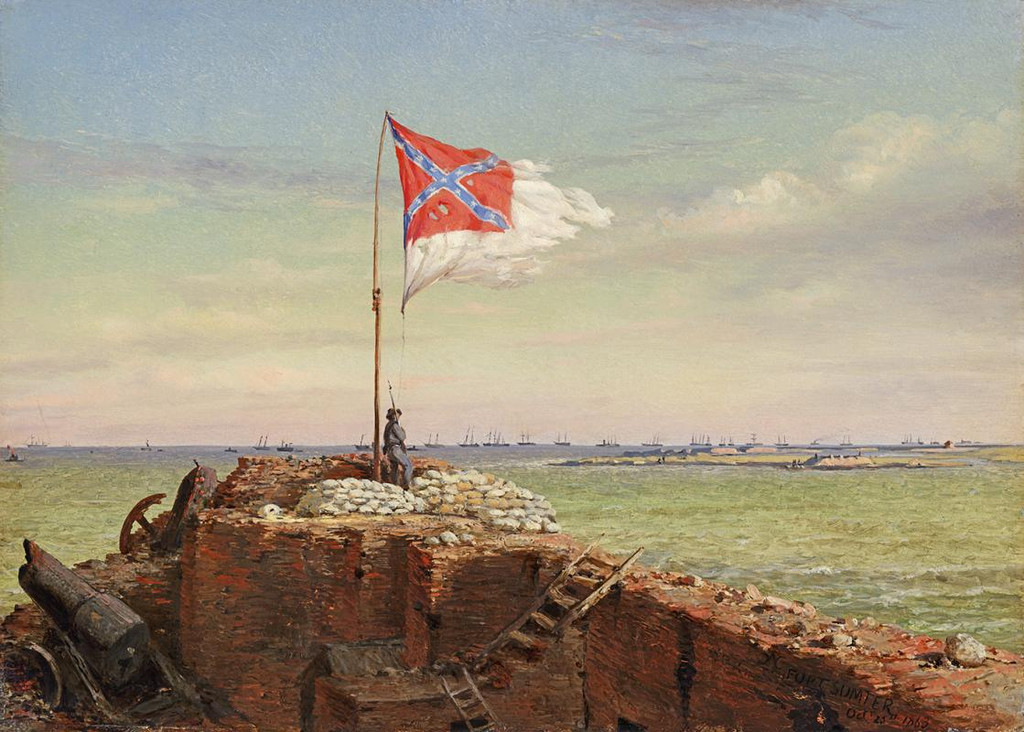
The Flag of Sumter. A flag and a solitary guard stand above the ruined wall in sunset light. [6]
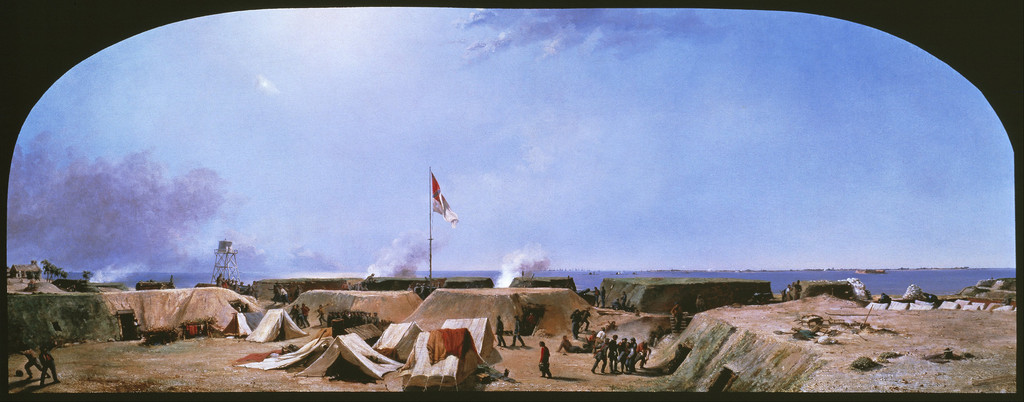
Bombardment of Fort Moultrie. The large Gibbes panorama opens the sandy fort interior to figures, tents and a broad sky. [7]
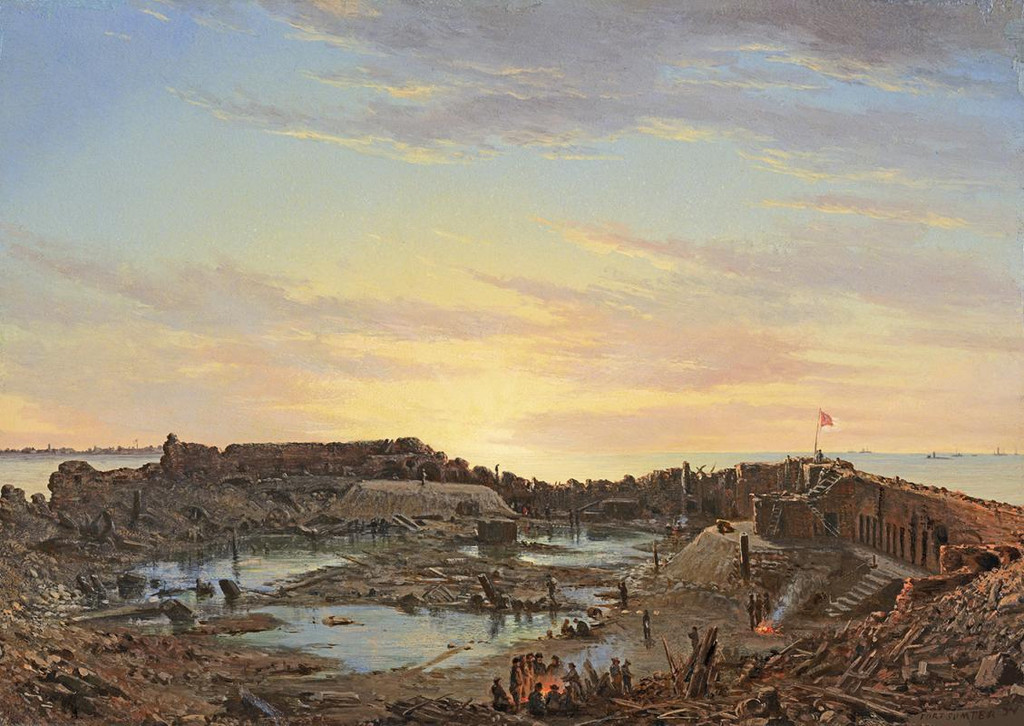
Fort Sumter, Interior at Sunrise. Workers, water and broken ground occupy the surviving courtyard; the article explains the conflicting scene dates. [8]
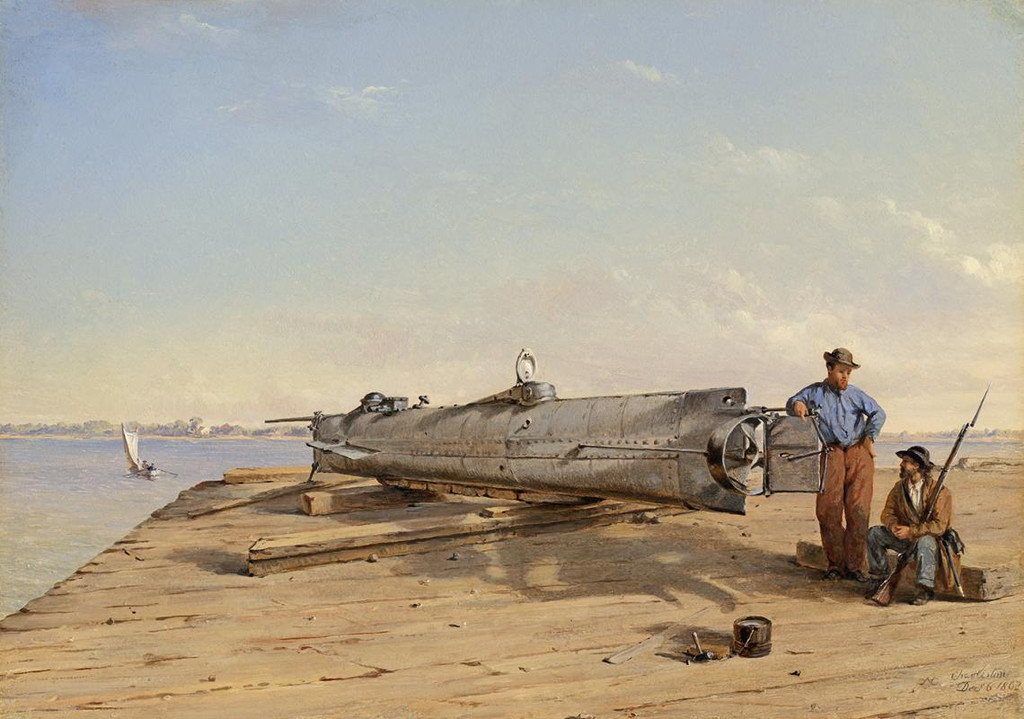
Submarine Torpedo Boat H. L. Hunley. The beached hull and two men establish the scale of the small submarine. [9]
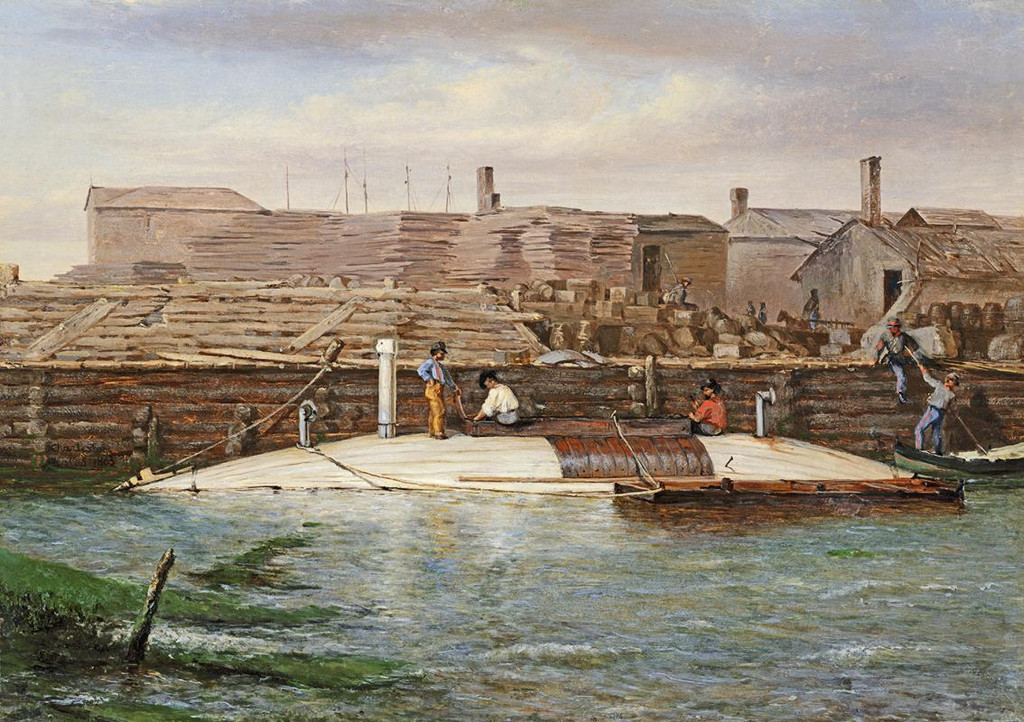
Torpedo Boat David at Charleston Dock. A low vessel, dock and exposed fittings bring military technology into a working waterfront. [10]
Valley of Mexico paintings (current article). Compare individual studies and later versions. The date band groups several objects and does not indicate continuous work on one painting. [11] [2] [1] [3] [4]
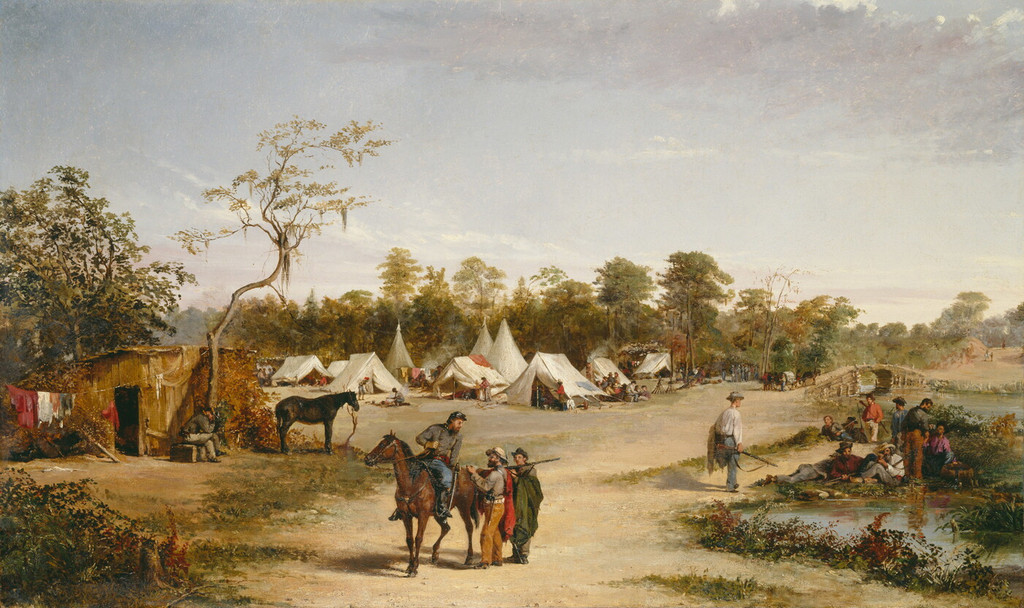
The Fifty-ninth Virginia Infantry—Wise’s Brigade. A mounted figure, tents and a bridge organize a camp within a larger landscape. [12]
Monterrey desde el cerro de Chipinque. The photograph retains the frame and gallery setting of this later Monterrey painting. [13]
Contents
- The small Cisneros canvas of 1870
- The long San Angel study
- The 1894 canvas made for Alejandro Najera
- A Hacienda de los Morales view in a gallery photograph
- Jolly and the earlier commission
- Observation, notes and memory
- Figures within a recurring landscape
- Scale and the occupied foreground
- Following the individual objects
The small Cisneros canvas of 1870
The Cisneros collection records its Valle de México as an oil on canvas measuring 13.34 by 20.32 centimeters. The 1870 date identifies a compact object whose represented landscape extends far beyond its small physical scale. [1]
The collection describes an occupied foreground: women and children rest or carry out domestic tasks near a camp, while men work farther to the right. Buildings, water, mountains and sky then establish successive distances. The view brings household activity and work on the land into the same prospect. [1]
That arrangement gives the figures more than a measuring role. They identify uses of the landscape and organize the viewer’s approach to its breadth. The eye begins among people before following the terrain outward. Within the small canvas, the transition from nearby activity to far-reaching distance becomes a central part of the subject.
The long San Angel study
The San Angel panorama has very different proportions. Sotheby’s records oil on canvas laid down on board, measuring 14.3 by 82.5 centimeters. The narrow format extends a prospect across a width many times its height, making lateral relationships particularly important. [2]
Its date also needs careful wording. The catalogue states that it was executed in San Angel in 1866, while transcribing a reverse inscription dated 1865. These are two pieces of recorded information about the same object. The inscription should remain distinguishable from the catalogue’s execution date rather than being silently substituted for it. [2]
The record gives a provenance including the Valentine Richmond History Center and a later private collection, followed by a Christie’s sale in 2005. It also records the work’s exhibition in the Timken’s 1996–97 Chapman show. These details help track this particular panorama through the literature, where a general Valley of Mexico title would provide less precise identification. [2]
The 1894 canvas made for Alejandro Najera
The 1894 Valle de México catalogued by Christie’s is an oil on canvas measuring 63.2 by 126 centimeters. Its reverse inscription names Alejandro Najera and identifies the view as being from the Hacienda de Los Olivares de los Padres. The signature and date also associate the finished work with Mexico in 1894. [3]
The named recipient makes this a specific commission within a recurring subject. It should remain separate from the earlier work connected with the English engineer W. R. Jolly. A painting can return to established material while being made for a new person and occasion.
The historical Christie’s record identifies the canvas as Timken Museum property, with Putnam Foundation provenance. It also records earlier exhibition history and inclusion in the Timken’s 1996–97 Chapman exhibition. The completed historical sale establishes another stage in the object’s history; it does not identify a present owner or display location. [3]
Its much larger dimensions change the kind of object under consideration. The small Cisneros view can be held within an intimate field of attention, while this canvas gives the repeated landscape a more extensive physical presence. A shared subject permits comparison, but the viewer’s relationship with size is substantially different.
A Hacienda de los Morales view in a gallery photograph
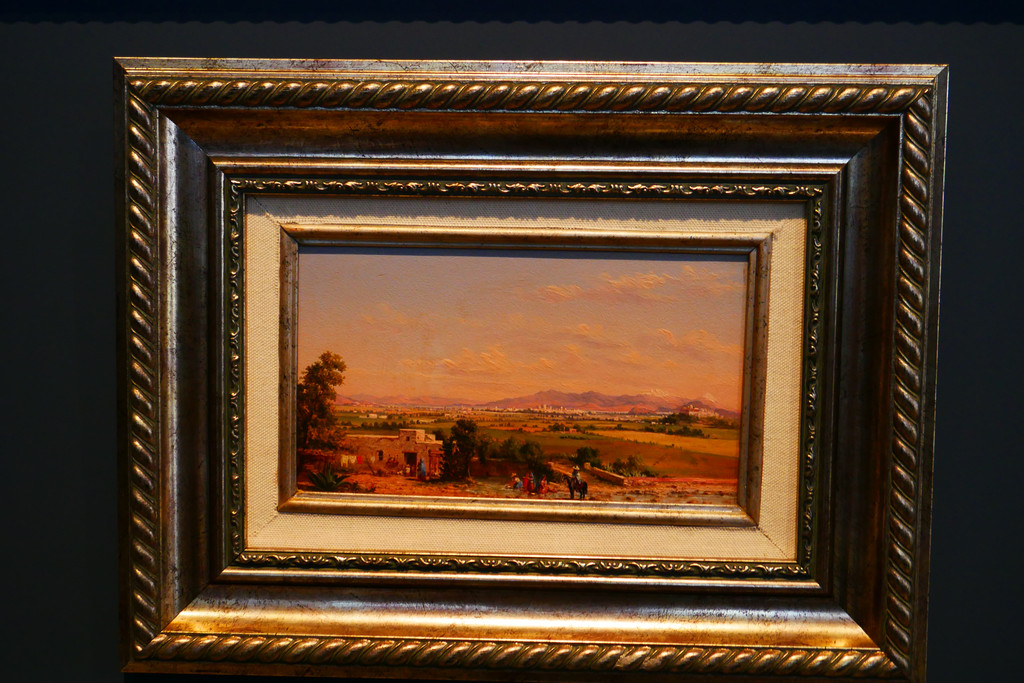
Luis Alvaz’s photograph, made on 21 April 2023 at the Museo Internacional del Barroco, identifies its depicted painting as México desde la hacienda de los Morales , 1896. The photograph preserves the complete elaborate frame and the dark gallery background around it. [4]
Within the framed view, a building and figures occupy the foreground, with a tree at the left and fields extending toward a distant settlement. The terrain opens into a broad low horizon backed by mountains. A horse and people near the lower part of the painting give the prospect an immediate human scale.
The frame is part of this photographic encounter. Its layered gilded surfaces surround the landscape and affect how its extent is perceived. The gallery lighting gives the photograph a warm appearance, while the arrangement of building, figures and distance remains legible within it.
The record names Hacienda de los Morales; the 1894 inscription names Los Olivares de los Padres. Those names belong to their respective identifications. They should not be collapsed into one location label merely because both works are associated with a Valley of Mexico subject.
Jolly and the earlier commission
The catalogue essay derived from Ben Bassham’s Timken study connects the recurring valley subject with Chapman’s early work for W. R. Jolly. After buying the Monterrey pictures, the engineer commissioned a view associated with his tile factory. That undertaking developed into a more extensive landscape project. [3]
The account describes studies incorporating the city, water, mountains and the factory as parts of a comprehensive prospect. The enterprise could be a relatively small element within the represented terrain while remaining important to the circumstances of the commission. A patron’s purpose and the picture’s visual emphasis need not operate at the same scale.
Later versions made use of earlier material. The relationship explains why the Jolly project remains relevant to the history of the 1894 canvas without making Najera and Jolly the same patron or the surviving paintings one object. A recurring subject can connect commissions while preserving their differences.
Watch: Conrad Wise Chapman
Two Spanish-language museum films explore Chapman and his views of Mexico.
#ElSoumayaEnCasa | Conrad Wise Chapman
Museo Soumaya introduces Chapman and his work. This museum presentation is in Spanish.
Watch on YouTubeObservation, notes and memory
The Cisneros commentary states that Chapman painted the valley both in front of the subject and from notes and memory. The distinction gives repeated views a working history. A later date can identify a finished painting whose material was partly gathered during an earlier encounter with the place. [1]
The Library of Virginia likewise describes Chapman returning to variations on his earlier Valley of Mexico views during his later career. Its account connects that practice with the continuing need to support himself and his wife through painting and photograph coloring. Repetition belonged within professional work across changing circumstances. [11]
The survival of a study or remembered arrangement creates possibilities for change. A painter can select different foreground details, alter the breadth of a format or give a group a different relation to the distance. The value of comparison lies in following what is retained and what becomes particular to the later object.
Figures within a recurring landscape
Chapman’s use of repeated figures also appears in the Museo Soumaya’s discussion of Paisaje mexicano , dated 1877 and centered on Ajusco. The museum identifies figures shared with other works in its collection, including a person beside a horse in a Valley of Mexico painting. [14]
That observation adds another level to the comparison of versions. Recurrence can involve a pose or small group as well as a mountain prospect. The placement of those forms determines how a viewer enters the larger landscape: a person standing, resting or attending to an animal supplies a different point of attention.
The repeated figure does not by itself establish the same represented individual across every picture. It reveals part of an artist’s usable material. Keeping the visual form distinct from an unsupported personal identity makes the comparison more precise.
Scale and the occupied foreground
Across these records, people and settlement remain important to the way the valley is presented. The small Cisneros canvas organizes domestic activity and field work beneath the distance. The photographed Hacienda view brings a building, figures and a horse close to the spectator before opening toward the city and mountains.
The differences of format affect how that movement can unfold. A long narrow study encourages a sweep across terrain; a larger canvas gives groups and distances more physical room; a small picture compresses an extensive prospect into a close view. Size is part of how the same broad subject becomes a different experience.
The Mexican landscapes article places these works beside Monterrey and Ajusco. Here, the comparison remains centered on the valley and its versions. Identifying support, dimensions, inscription and provenance gives the viewer a sound basis for considering the recurring arrangements of land, people and distance.
Following the individual objects
A useful starting point is the date attached to the exact record, followed by the support and size. The 1870 canvas, narrow San Angel work, 1894 commission and photographed 1896 view can then be followed through their own descriptions. An inscription may supply another date or a patron’s name without answering every question about the object’s later whereabouts.
The photographs and historical catalogues also have their own dates. Alvaz’s 2023 image records an encounter with the framed 1896 painting. The Timken and auction records preserve earlier stages of exhibition and ownership. Keeping those histories separate allows them to enrich the paintings rather than merge them into an invented single biography.
The recurring valley subject gives Chapman’s career continuity across different commissions and decades. The artist homepage connects that work with his training and wartime pictures, while the individual records keep the variety within the Mexican landscapes visible.
Artworks directory
Browse 46 works identified in the consulted collection and catalogue records, including all 31 pictures in the father-and-son Charleston portfolio. Six entries explicitly credit John Gadsby Chapman. Approximate 1864–65 labels describe the series period; dates within its titles describe scenes and sometimes conflict with other catalogues. Other dates identify the separate objects or commissions. Links open our article where available, or the cited record. This is a research-based directory, not a catalogue raisonné.
| Name | Date | Medium |
|---|---|---|
| Battery Chevis, Mar. 4, 1864 | Series, c. 1864–65; scene date in title where given | Painting |
| Forts Sumter & Johnson, Mar. 15, 1864 | Series, c. 1864–65; scene date in title where given | Painting |
| Entrance to Fort Sumter — John Gadsby Chapman, from Conrad’s studies | Series, c. 1864–65; scene date in title where given | Painting |
| White Point Battery Charleston, Dec. 24, 1863 | Series, c. 1864–65; scene date in title where given | Painting |
| Quaker Battery (imagined scene) | Series, c. 1864–65; scene date in title where given | Painting |
| Fort Moultrie, Nov. 11, 1863 | Series, c. 1864–65; scene date in title where given | Painting |
| Battery on Long Island, Dec. 4, 1863 | Series, c. 1864–65; scene date in title where given | Painting |
| Church Flat Camp, Dec. 10, 1864 | Series, c. 1864–65; scene date in title where given | Painting |
| Fort Johnson, Oct. 10, 1863 | Series, c. 1864–65; scene date in title where given | Painting |
| Battery Halston — John Gadsby Chapman, from Conrad’s studies | Series, c. 1864–65; scene date in title where given | Painting |
| Charleston Bay and City — John Gadsby Chapman, from Conrad’s studies | Series, c. 1864–65; scene date in title where given | Painting |
| Battery Marion, Nov. 4, 1863 | Series, c. 1864–65; scene date in title where given | Painting |
| Battery Marshall, Sullivan's Island, Dec. 4, 1863 | Series, c. 1864–65; scene date in title where given | Painting |
| The Flag of Sumter, Oct. 20, 1863 | 1863–64; scene 20 October 1863 | Painting |
| Battery Beauregard, Nov. 22, 1863 — John Gadsby Chapman, from Conrad’s studies | Series, c. 1864–65; scene date in title where given | Painting |
| Fort Moultrie, Interior, Sep. 16, 1863 (portfolio index entry) | Series, c. 1864–65; scene date in title where given | Painting |
| Battery Bee, Dec. 3, 1863 | Series, c. 1864–65; scene date in title where given | Painting |
| Battery Wampler, Mar. 4, 1864 | Series, c. 1864–65; scene date in title where given | Painting |
| Submarine Torpedo Boat H.L. Hunley, Dec. 6, 1863 | 1864; scene 6 December 1863 | Painting |
| Battery Simkins, Feb. 25, 1864 | Series, c. 1864–65; scene date in title where given | Painting |
| Fort Sumter [Gun Gallery], Dec. 8, 1863 | Series, c. 1864–65; scene date in title where given | Painting |
| Fort Sumter, Interior, Sunrise, Dec. 9, 1864 | 1864; published scene dates differ | Painting |
| Torpedo Boat David at Charleston Dock, Oct. 25, 1863 | 1864; scene 25 October 1863 | Painting |
| Federal Battery on Morris Island, Feb. 12, 1864 | Series, c. 1864–65; scene date in title where given | Painting |
| Fort Sumter from Moultrie, Nov. 10, 1863 | Series, c. 1864–65; scene date in title where given | Painting |
| Battery Marshall from Long Island, Nov. 18, 1863 | Series, c. 1864–65; scene date in title where given | Painting |
| Evening Gun, Fort Sumter — John Gadsby Chapman, from Conrad’s studies | Series, c. 1864–65; scene date in title where given | Painting |
| Battery Haskel, Mar. 4, 1864 — John Gadsby Chapman, from Conrad’s studies | Series, c. 1864–65; scene date in title where given | Painting |
| Battery Rutledge, Dec. 3, 1864 | Series, c. 1864–65; scene date in title where given | Painting |
| Night Bombardment, Dec. 10, 1864 | Series, c. 1864–65; scene date in title where given | Painting |
| Battery Laurens Street Charleston, Feb. 7, 1864 | Series, c. 1864–65; scene date in title where given | Painting |
| Bombardment of Fort Moultrie (Gibbes panorama) | 1864; scene 16 November 1863 | Oil on canvas |
| The Fifty-ninth Virginia Infantry—Wise’s Brigade | Probably 1867; scene September 1863 | Oil on canvas |
| Camp No. 2, Terrenos Baldios | 1860; setting unidentified | Oil on wood panel |
| Frattocchie | 1861 | Oil painting |
| French Encampment at Monterrey | 1865; described in historical catalogue essay | Painting |
| Vista de Monterrey | 1865 | Oil on paper |
| Valley of Mexico (Jolly commission) | 1865/66 commission; catalogue dates vary | Painting |
| Valle de México (Cisneros version) | 1870 | Oil on canvas |
| Important Panoramic View of the Valley of Mexico, San Angel | Executed 1866; reverse inscribed 1865 | Oil on canvas laid down on board |
| Valle de México (Alejandro Najera commission) | 1894 | Oil on canvas |
| Paisaje mexicano (Ajusco) | 1877 | Oil on canvas |
| México desde la hacienda de los Morales | 1896; photographed in 2023 | Painting |
| Monterrey desde el cerro de Chipinque | 1902; photographed in 2023 | Painting |
| Valley of Mexico (Valentine version) | 1902 | Oil on wood |
| Picket Post | 1863 | Engraving |
Frequently Asked Questions
Sotheby’s transcribes a reverse inscription dated 1865 but catalogues execution in 1866. Both are recorded distinctions about that object. [2]
Discussion
Look again at the images and ideas explored in The Valley of Mexico Paintings. These editorial prompts invite your observations.
Reader Insights
Compare the recorded dimensions. How might the small canvas and long panorama produce different experiences of an extensive view?
Which details in the gallery photograph show an encounter with a framed object rather than an unframed reproduction?
How do inscriptions and provenance help keep related Valley of Mexico titles attached to distinct paintings?
Join the Conversation
Share a detail, comparison or question about The Valley of Mexico Paintings below.
References
- Colección Patricia Phelps de Cisneros , Valle de México, 1870. Exact small canvas, occupied foreground and work from observation, notes and memory. View source
- Sotheby’s , Important Panoramic View of the Valley of Mexico, San Angel, 2024, lot 38. Canvas laid on board, dimensions, 1866 execution, 1865 reverse inscription, provenance and exhibition history. View source
- Christie’s , Valle de México, 1894, lot 4010480. Najera inscription, support, dimensions, historical Timken property and sale record, with permitted excerpts from Bassham’s exhibition essay. View source
- Luis Alvaz , México desde la hacienda de los Morales, museum photograph. The painting identified as 1896; photograph made 21 April 2023, CC BY-SA 4.0. View source
- Camp No. 2, Terrenos Baldios, y1970-114. View source
- The Civil War and American Art, 2013 exhibition press release. View source
- Bombardment of Fort Moultrie, Charleston Harbor, South Carolina. View source
- The Civil War and American Art: A Confederate View. View source
- Rachel Lance, How Historical Research Helped Solve a Civil War Submarine Mystery, 18 September 2017. View source
- Conrad Wise Chapman - Torpedo Boat David at Charleston Dock, Oct. 25, 1863.jpg. View source
- Library of Virginia , Father and Son, 1998–99 exhibition. Later Mexican practice, repeated views and livelihood. View source
- The Fifty-ninth Virginia Infantry—Wise’s Brigade,2001.7. View source
- Monterrey desde el cerro de Chipinque (1902), MIB photograph01. View source
- Museo Soumaya , Paisaje mexicano, 1877, partner catalogue. Repeated figures and a related Valley of Mexico subject in the collection. View source
- Splash image source.
Luis Alvaz’s 2023 gallery photograph of México desde la hacienda de los Morales, identified as 1896. This framed painting is one distinct object within Chapman’s recurring Valley of Mexico subjects. Luis Alvaz, photograph of México desde la hacienda de los Morales (1896) by Conrad Wise Chapman, Museo Internacional del Barroco, 21 April 2023. CC BY-SA 4.0. CC BY-SA 4.0; photograph by Luis Alvaz, 21 April 2023 . Photograph by Luis Alvaz (2023), CC BY-SA 4.0. Resized only; no crop or colour changes. This resized photograph remains CC BY-SA 4.0.
View source