 by
Tom Gurney
Tom Gurney BSc (Hons) is an art history expert with over 20 years experience
Email:
tomgurney1@gmail.com
/ Phone:
+44 7429 011000
Bombardment of Fort Moultrie: Introduction
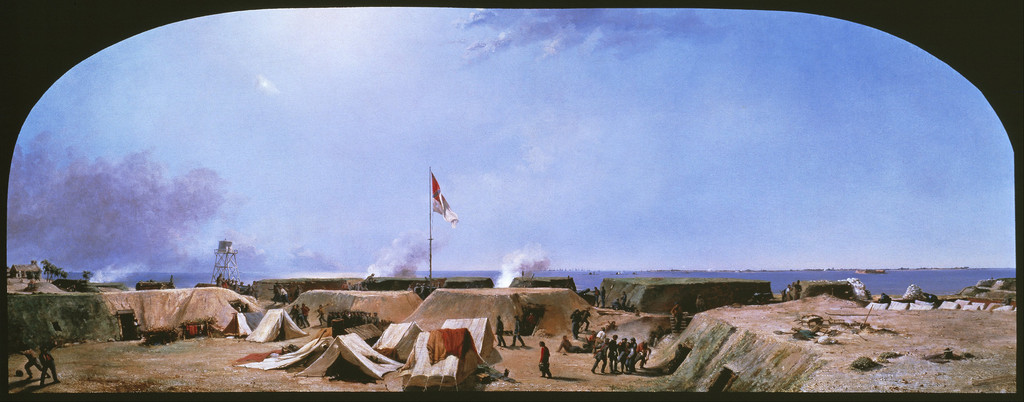
Conrad Wise Chapman’s Bombardment of Fort Moultrie places the viewer inside a broad, sandy defensive position. Tents, moving figures and large banks of earth fill the lower part of the canvas. Beyond them, smoke and small ships indicate the fighting across Charleston Harbor. An expansive blue sky gives the scene an openness that makes the busy ground below it particularly striking.
The Gibbes Museum of Art dates the painting to 1864, when Chapman completed it in Rome. Its subject is the engagement of 16 November 1863, during which the grounded Union monitor Lehigh came under Confederate fire. The canvas translates that event into a panorama of the fort and the people occupying it. [1]
The painting’s interest extends beyond the distant exchange of gunfire. Much of its visual force comes from the arrangement of shelters, tents and figures within the defensive works. The landscape is a place made and continually maintained for war.
At a Glance
- Artist Conrad Wise Chapman, 1842–1910.
- Title Bombardment of Fort Moultrie, Charleston Harbor, South Carolina.
- Created 1864, in Rome.
- Represented event 16 November 1863.
- Medium Oil on canvas.
- Dimensions 30⅞ by 75⅜ inches.
- Collection Gibbes Museum of Art, Charleston.
This work across Conrad Wise Chapman’s career
Camp No. 2, Terrenos Baldios
1860; setting unidentifiedThe Flag of Sumter
1863–64; scene 20 October 1863Bombardment of Fort Moultrie (current article)
1864; scene 16 November 1863Fort Sumter, Interior at Sunrise
1864; published scene dates differSubmarine Torpedo Boat H. L. Hunley
1864; scene 6 December 1863Torpedo Boat David at Charleston Dock
1864; scene 25 October 1863Valley of Mexico paintings
Separate versions, 1866–1902The Fifty-ninth Virginia Infantry—Wise’s Brigade
Probably 1867; scene September 1863Monterrey desde el cerro de Chipinque
1902; photographed in 2023Notes and sources
Camp No. 2, Terrenos Baldios. A framed oil study whose catalogue date does not identify it as a Mexican survey camp. [2]
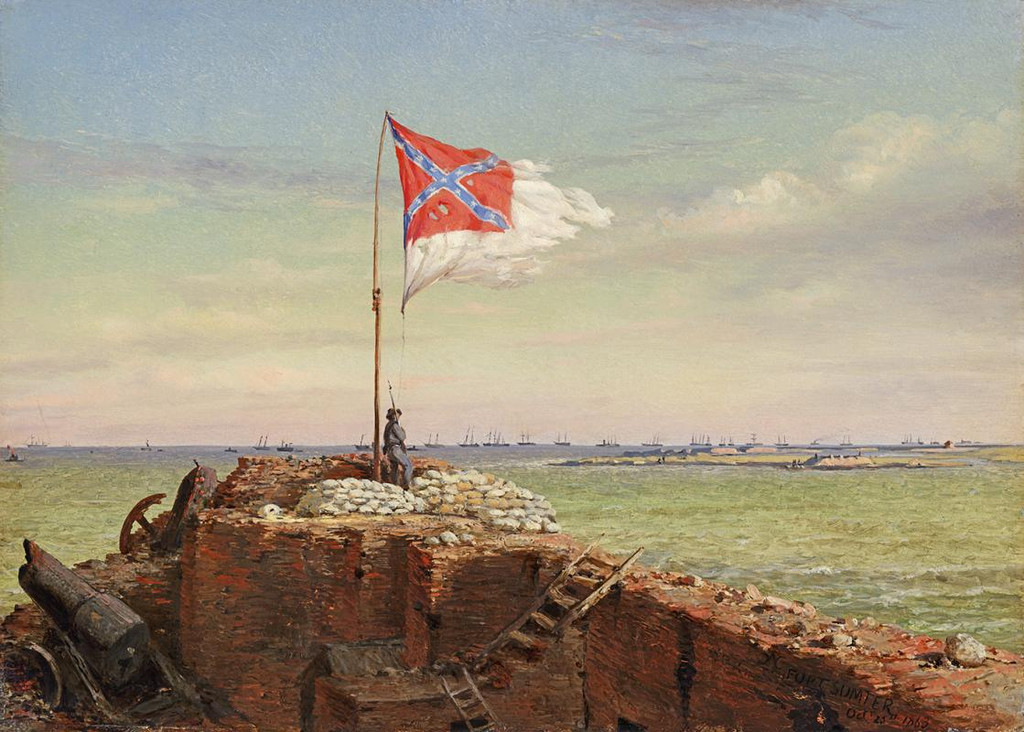
The Flag of Sumter. A flag and a solitary guard stand above the ruined wall in sunset light. [3]
Bombardment of Fort Moultrie (current article). The large Gibbes panorama opens the sandy fort interior to figures, tents and a broad sky. [1]
Fort Sumter, Interior at Sunrise. Workers, water and broken ground occupy the surviving courtyard; the article explains the conflicting scene dates. [4]
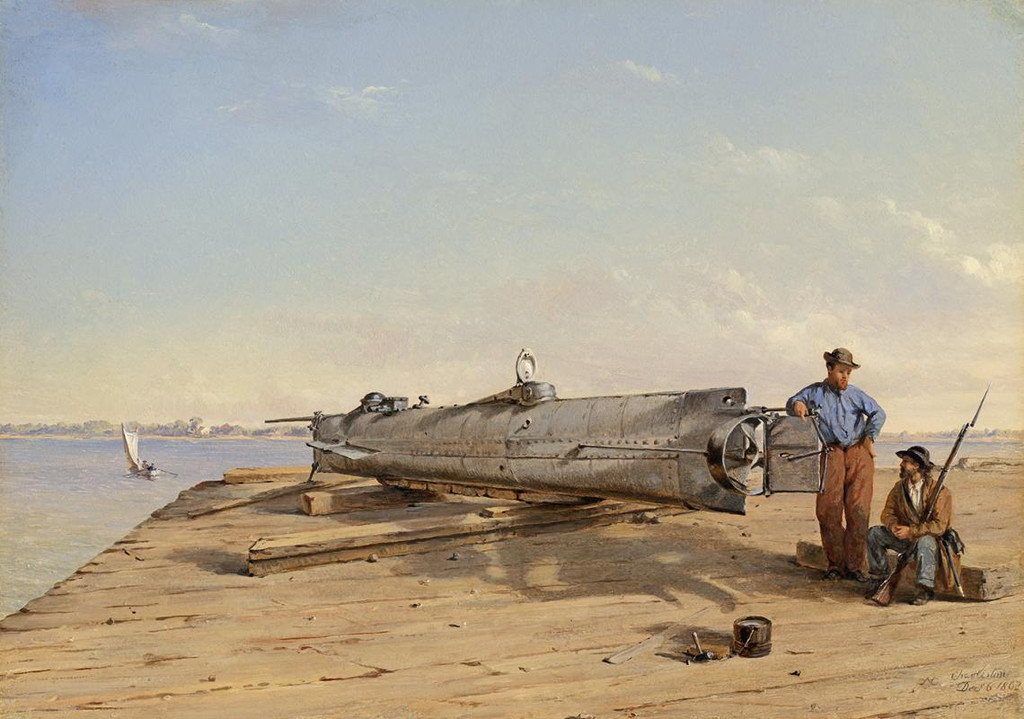
Submarine Torpedo Boat H. L. Hunley. The beached hull and two men establish the scale of the small submarine. [5]
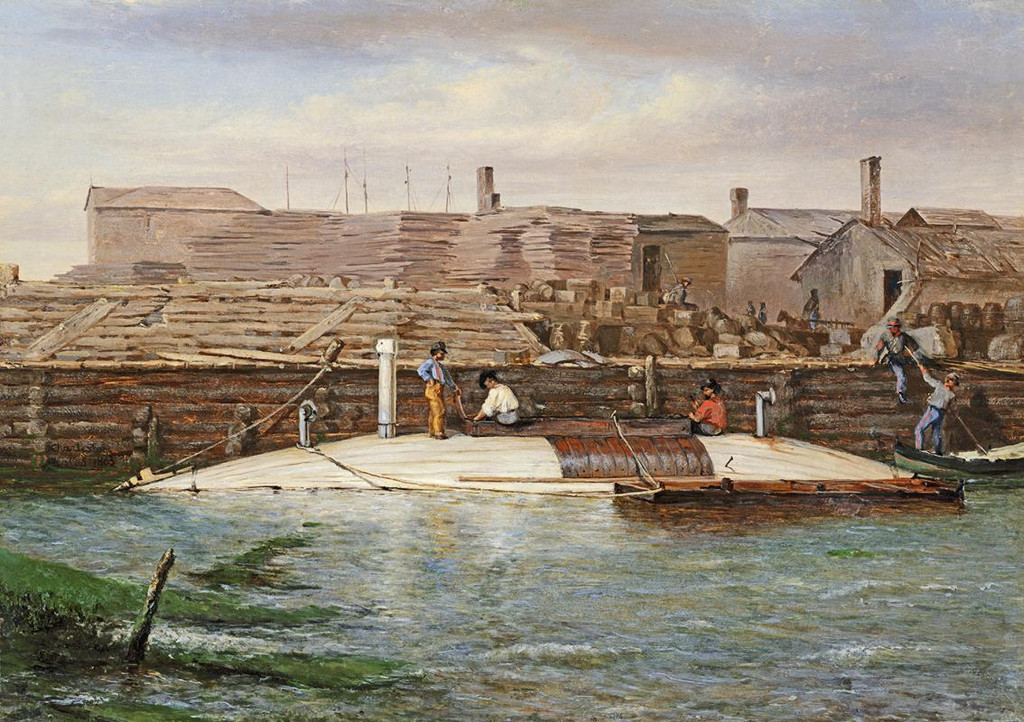
Torpedo Boat David at Charleston Dock. A low vessel, dock and exposed fittings bring military technology into a working waterfront. [6]
Valley of Mexico paintings. Compare individual studies and later versions. The date band groups several objects and does not indicate continuous work on one painting. [7] [8] [9] [10] [11]
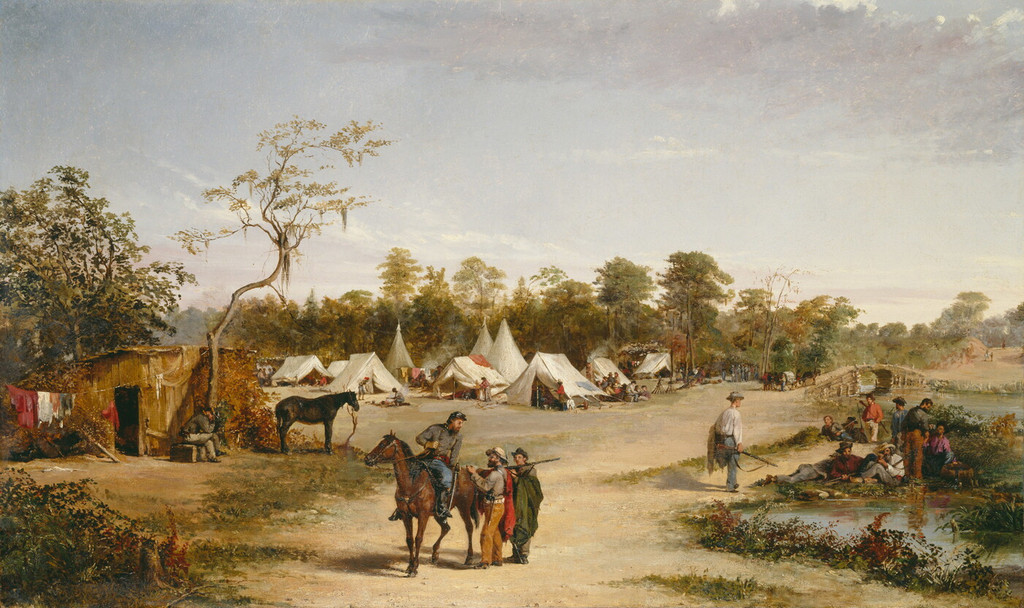
The Fifty-ninth Virginia Infantry—Wise’s Brigade. A mounted figure, tents and a bridge organize a camp within a larger landscape. [12]
Monterrey desde el cerro de Chipinque. The photograph retains the frame and gallery setting of this later Monterrey painting. [13]
Contents
- A view from within the fort
- The engagement of 16 November 1863
- Sand and the construction of a defensive landscape
- Tents and the rhythm of the interior
- Groups and individual actions
- The flag and the open sky
- A panoramic shape and a rounded upper edge
- The commission and its intended audience
- Studies and the later canvas
- Annotated details
A view from within the fort
The composition gives the spectator an elevated position from which much of the interior can be surveyed at once. The nearer ground spreads across the width of the picture, while the harbor appears as a much narrower band beyond the defenses. People become the principal means of judging the size of the spaces and structures.
Ben Bassham identifies the viewpoint with the north wall of Fort Moultrie. The ships appear from this position as small forms beyond the heavy earthworks. This is a view made from the defenders’ side, and its arrangement makes the fort’s own organization easier to examine than the vessels opposing it. [14]
The elevated prospect also allows the eye to move among separate activities. A viewer can follow the line of tents, pause at a group in the foreground and then look toward the smoke near the horizon. The picture does not require every figure to be read in a single sequence. Its width sustains several related centers of attention.
Annotated Details from Bombardment of Fort Moultrie
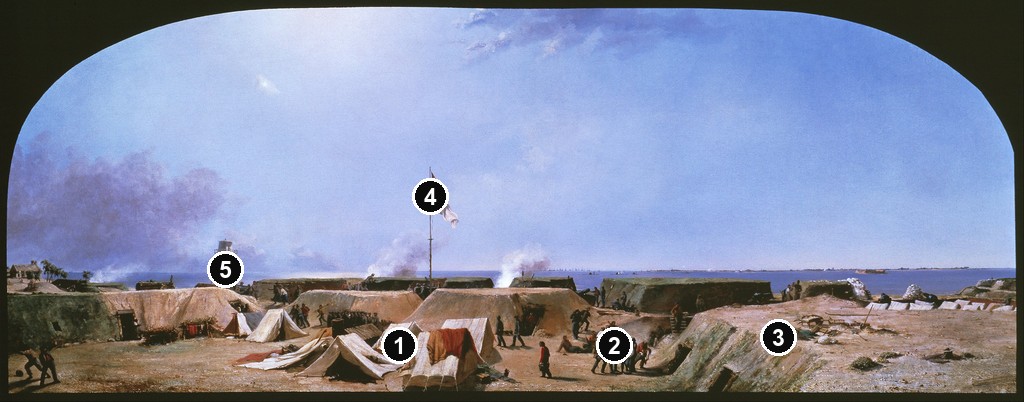
The numbered points identify visible features discussed in this article. Return from each detail to the whole composition. Bombardment of Fort Moultrie, painted in Rome in 1864. The composition represents the engagement of 16 November 1863. Conrad Wise Chapman, Bombardment of Fort Moultrie, 1864. Gibbes Museum of Art, 1981.012. Museum purchase with funds provided by Winnie Edwards Murray Fund. Public domain. Image source. Public domain. Numbers added to this separate overview; cropped details are shown below. No recolouring, retouching or reconstruction.
Details from BOMBARDMENT OF FORT MOULTRIE
Compare the cropped details with the complete images above. Notice how their colours, shapes and positions contribute to the larger compositions.
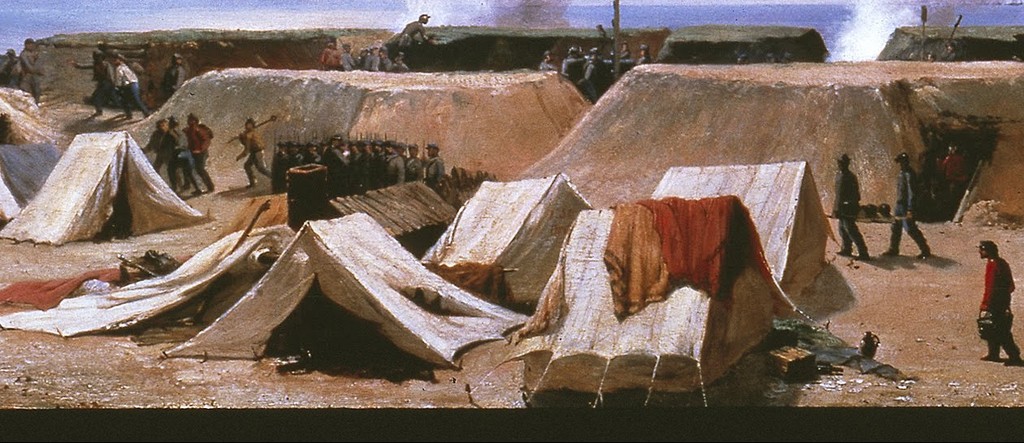
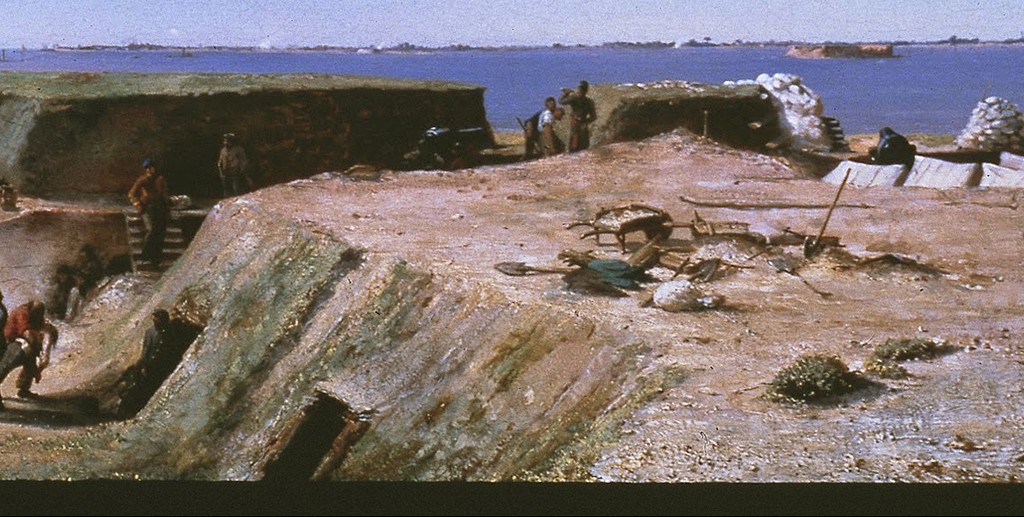
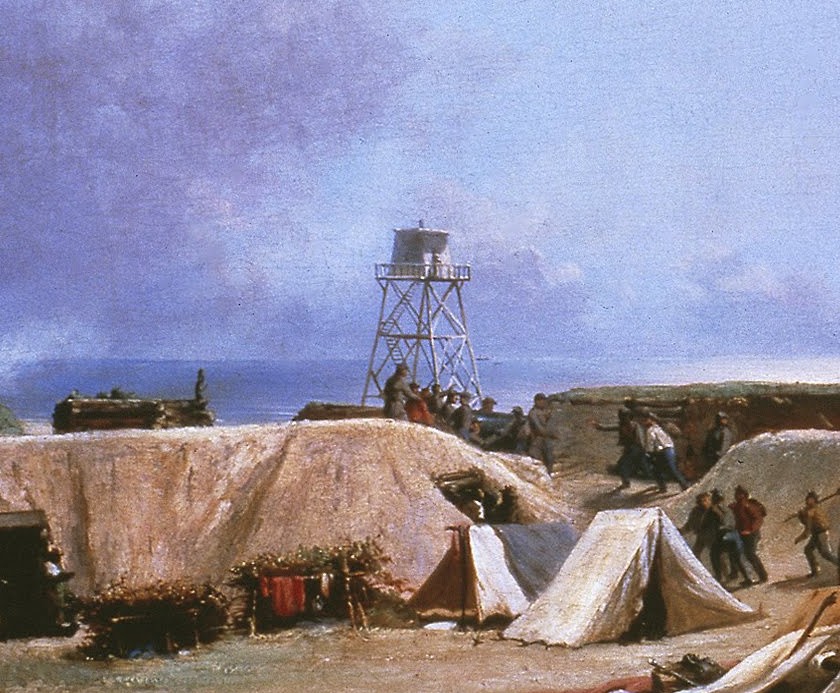
Tents within the earthworks
Pale tent cloth forms a sequence of triangles across the sandy interior. Red fabric and dark openings interrupt those bright shapes, bringing the near ground into focus.
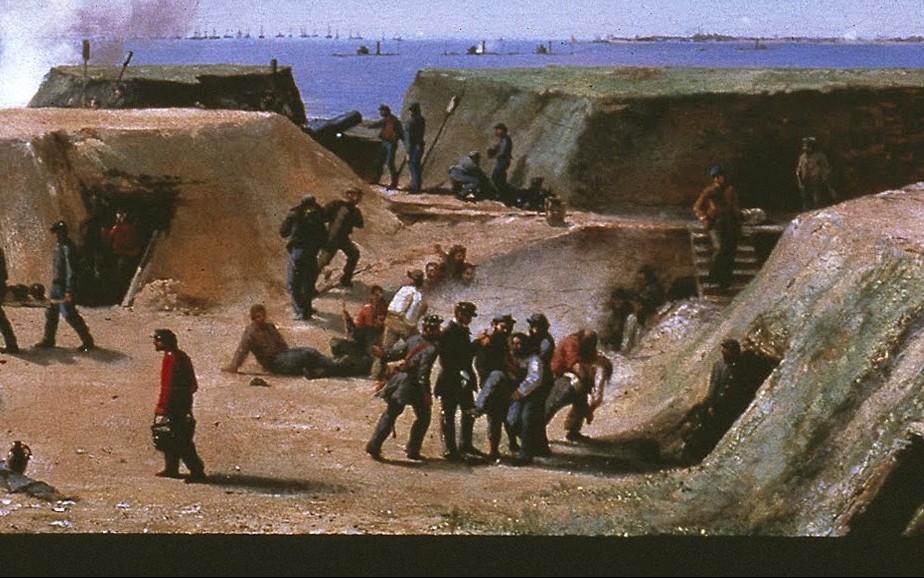
A group crossing the open ground
The clustered standing figures give scale to the enclosure. Their upright bodies and different directions of movement contrast with the low, broad earthworks.
Sand shaped into a defensive ramp
Sloping sand connects the immediate foreground with the raised defensive position. Its ridges catch the light and turn a military structure into a sequence of landscape forms.
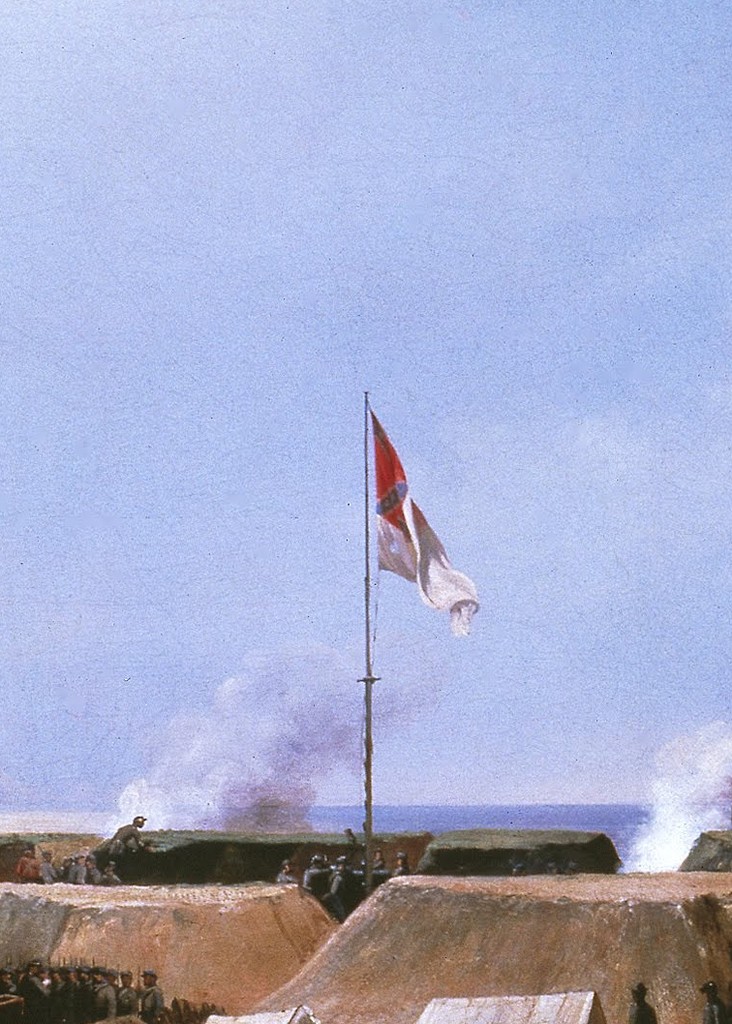
Flag above the horizon
The tall pole connects the working interior with the open sky. The flag’s pale lower cloth and red upper passages stand out above the low horizon.
Lookout tower and distant smoke
The narrow timber tower rises beside low earthworks. Smoke behind it interrupts the level water and horizon, while small figures help establish its size.
The engagement of 16 November 1863
The event began when Lehigh entered Charleston Harbor and became stuck on a sandbar as the tide fell. At daybreak, the stranded ship was visible to Fort Moultrie’s gunners. Other Union monitors came to help tow it free while exchanging fire with the Confederate positions. The Gibbes account identifies those vessels as the small ships visible beyond the fort’s bulwarks. [1]
That account gives the open water a precise historical setting. A casual first glance might make it seem like the quiet distance of a coastal landscape. Knowing the event encourages the viewer to inspect the tiny marks on the horizon and connect them with the smoke rising from the defensive line.
The contrast in scale is important. The ships occupy very little of the painted surface, yet their presence explains much of the activity within the fort. Chapman makes an engagement visible through its effects on an occupied place. A battle can be the subject of a picture even when the opposing forces are too distant for their crews to be distinguished.
Sand and the construction of a defensive landscape
Large banks divide the interior into connected but partly screened areas. Their sloping surfaces catch light differently from the darker openings and vertical faces beneath them. The combination gives the fort a varied texture: a place of piled material, cut passages, covered spaces and changing levels.
Bassham explains the earthworks as part of the strengthening directed by Beauregard and his engineer, David Bullock Harris. Sand and earth protected masonry and separated gun positions. A traverse, one of the substantial banks within the fort, shielded the spaces beside it from fire arriving at an angle. [14]
The structures are consequently more than a background for the figures. Their height and arrangement determine where people can stand, move and take shelter. Slopes create exposed surfaces; openings create darker areas into which figures can disappear. A viewer encounters the fort through the routes its construction permits.
This gives the painting a particular kind of landscape subject. The terrain has been reshaped for an immediate purpose. Its banks resemble masses of ground, yet their repeated forms and strategic arrangement reveal sustained human intervention. What appears from a distance as a sandy setting becomes, on closer inspection, a system of labor and protection.
Tents and the rhythm of the interior
The central tents introduce a more fragile kind of shelter. Their pale fabric catches the light, while darker folds and reddish pieces of material break up the group. The low, sloping shapes repeat some of the angles of the earthworks without sharing their mass.
Their placement gives the interior a domestic element. Canvas shelters occupy ground close to gun positions and protective banks, bringing the routines of living into the same space as the work of defense. The fort is presented as somewhere inhabited between episodes of firing, rather than a diagram containing only weapons and walls.
The tents also help organize the composition. They draw the eye into the lower center, where their bright surfaces stand out against earth tones. From there, a viewer can follow figures and passages toward the more distant defensive line. The movement is visual as well as practical: fabric, bodies and banks make a sequence of sizes across the ground.
The wide format leaves intervals around these objects. Those spaces matter because they allow a figure or a small group to remain legible. Chapman does not fill every part of the interior equally. The distribution of occupied and open ground makes the fort’s activity easier to follow.
Groups and individual actions
People appear in several kinds of formation. Some stand together in comparatively orderly groups; others cross open ground or gather around an immediate task. The variation prevents the interior from becoming a uniform field of interchangeable soldiers.
In the right foreground, a compact group directs attention toward someone being carried. The bodies incline toward a shared action, gathering the eye around a more immediate consequence of the engagement. Distant smoke establishes fighting on the horizon; this group gives the event a human scale close to the spectator.
Bassham associates the group with men wounded at the fort and compares the tenderness of the carrying action with a Deposition of Christ. The comparison is his interpretation of the arrangement. It offers a way to consider the group’s emotional weight without turning the painting into a documented religious program. [14]
The contrast with nearby upright figures makes the action more distinct. Some bodies maintain a vertical stance, while the carrying group bends and converges. The eye can register those differences before recovering the account of the shell that Bassham connects with the injuries.
The flag and the open sky
The flagpole rises conspicuously above the low defensive line. It occupies a different visual register from the broader masses of the fort: a narrow upright carrying fabric against the sky. Its position helps give the long composition an identifiable center without enclosing the view.
The flag’s Confederate identity connects the prospect with the commission’s political setting. Chapman served with the defenders, and his Charleston work developed within their effort to record the fortifications. The American Civil War Museum’s biography places that assignment alongside his military service and later completion of paintings in Rome. [15]
The size of the sky gives the pole room to stand out. Smoke interrupts the blue in several places, while cloud and haze soften the distant horizon. The fort’s materials and activities remain concentrated below. That division gives the painting breadth while retaining a clear connection between the quiet upper space and the violent activity that sends smoke into it.
A panoramic shape and a rounded upper edge
The image has rounded upper corners, with the painted sky meeting a curved boundary. Those corners soften the outline of the open sky, while the straight lower edge gives the sandy foreground a long base. The two boundaries frame the horizontal prospect in different ways.
The long format encourages a viewing movement from side to side. A tower and buildings at the left provide one group of vertical accents; the flag rises nearer the center; figures and layered defenses extend toward the right. These changes prevent the horizon from acting as an uninterrupted horizontal rule.
Within that broad arrangement, small repetitions create continuity. Pale tent fabric, patches of clothing and light on the sandy banks recur across the interior. Darker entrances and cast shadows punctuate those surfaces. The result holds together as a panorama while offering many smaller places at which to stop.
Watch: Conrad Wise Chapman
Two Spanish-language museum films explore Chapman and his views of Mexico.
#ElSoumayaEnCasa | Conrad Wise Chapman
Museo Soumaya introduces Chapman and his work. This museum presentation is in Spanish.
Watch on YouTubeThe commission and its intended audience
Chapman’s Charleston work began within a wider effort to record the Confederate defenses. The museum’s account places Beauregard, Thomas Jordan and Josiah Gorgas within the project’s administrative history. The large Moultrie canvas developed from that environment of military access and artistic work, while also serving a particular patron. [16]
Bassham identifies that patron as Charles K. Prioleau, a Charleston businessman based in Liverpool and involved in blockade running. He suggests that the painting offered Prioleau a memento of Charleston’s wartime resistance. The identification of the patron and the interpretation of his interest should remain distinct: the latter describes a likely purpose, rather than a recovered instruction specifying every element of the picture. [14]
The commission gives the painting an audience beyond the fort itself. A view made in connection with military experience could be carried into a private setting overseas. Its carefully distributed figures, brilliant sky and extensive prospect made an event into a substantial object for continued viewing.
Studies and the later canvas
Chapman had worked at the Charleston defenses before returning to Rome on furlough in March 1864. The museum describes the finished pictures as developing from the wartime sketches. That sequence joins observation in South Carolina with subsequent work in a studio far from the represented site. [15]
A study can preserve an arrangement, a group or a particular feature without determining every part of a finished canvas. The large painting brings its elements into a sustained composition: distant vessels, banks, tents, flag and figures have to remain related across the full width. The result’s apparent immediacy is compatible with a process involving selection and later arrangement.
Bassham also proposes a comparison with a bombardment painting attributed to John Ross Key, whom Chapman knew. He presents the possible relationship as a hypothesis. It can prompt consideration of a shared panoramic approach, but it does not establish that Chapman copied Key’s work or that a patron required him to do so. [14]
Why the painting is dated 1864
The Gibbes catalogue gives 1864 as the creation date. The inscription’s reference to Fort Moultrie on 16 November 1863 identifies the subject’s day. These dates answer different questions: when the engagement occurred and when the surviving canvas was made. [1]
Bassham discusses an earlier 1867 dating and cites a letter written by John Gadsby Chapman in May 1865. In that letter, the father described a large Moultrie bombardment picture already in England. Bassham’s argument for the earlier date depends on identifying that picture with the surviving canvas. The museum’s present 1864 catalogue date is consistent with that proposed chronology. [14]
The distinction helps a viewer understand the painting’s relationship with experience. The date attached to the event cannot by itself turn the finished canvas into an image completed during the firing. Its history includes the gathering of material and the later work required to make the large composition.
Labor and the maintenance of the defenses
The banks and shelters required continuing work. Bassham connects the construction and repair of the Charleston defenses with enslaved labor drawn from nearby plantations. That history belongs alongside the military functions of the structures: their protective mass depended on people moving and maintaining material. [14]
Chapman’s smaller pictures make such work explicit in different settings. His retrospective account of Fort Moultrie, November 11, 1863 describes Black workers gathering sand for repairs. The description of Battery Marshall, Sullivan’s Island refers to workers constructing breastworks under an overseer. These are separate paintings, with their own views and descriptions. [17] [18]
Those accounts make labor a necessary part of reading the large canvas’s setting. The monumental banks should be considered as constructed works, rather than anonymous features of the landscape. At the same time, a broad painted scene cannot establish the legal status or personal history of every small figure visible within it.
Fort Sumter, Interior at Sunrise offers another view of a fort sustained through repeated repair. Chapman associated its fire-side groups with workers warming themselves before preparing sandbags. The different composition brings the relationship between people, damaged ground and continuing maintenance into a closer interior view. [19]
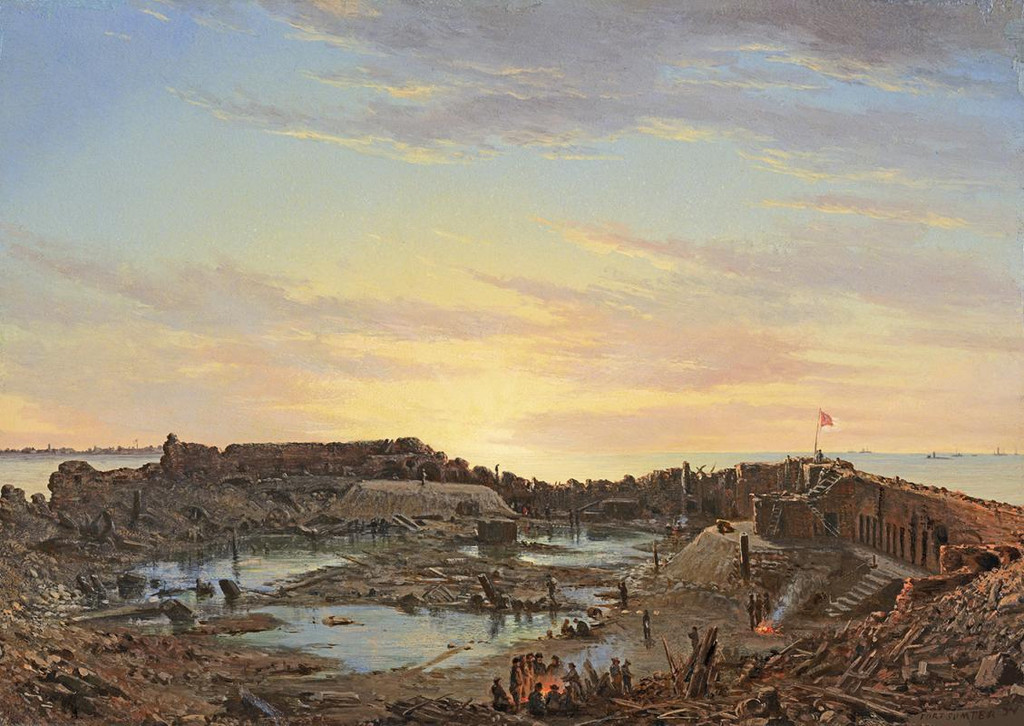
Fort Sumter, Interior at Sunrise. The smaller view brings workers, a fire and damaged ground into a different relationship from the expansive Moultrie panorama. Conrad Wise Chapman. American Civil War Museum; exhibition photography credited to Alan Thompson. Public-domain faithful reproduction.
Image source
.
Public domain
. Resized only; whole supplied image retained, with no appearance changes.
The Gibbes canvas and the wider Charleston series
The large Moultrie painting should be distinguished from the 31 small pictures in the American Civil War Museum’s archived portfolio. That sequence includes a separate Moultrie exterior and many other positions around the harbor. Its index provides a route through the sites and subjects associated with the commission. [20]
The suite includes paintings made by his father from Conrad’s studies. The museum explicitly attributes Charleston Bay and City to John Gadsby Chapman, keeping the finished picture’s authorship distinct from its connection with Conrad’s wartime observations. [21]
The differences in scale encourage different kinds of looking. A small panel can concentrate a particular position or incident within a compact scene. This canvas extends the interior across a panoramic field, giving the arrangement of separate groups a more sustained role. The full dimensions recorded by the Gibbes are 30⅞ by 75⅜ inches, in oil on canvas. [1]
The work also belongs in the wider discussion of Chapman’s Civil War paintings . Harvey’s account emphasizes both the artistic construction of the Charleston views and their Confederate associations. That combination keeps the painting’s beauty connected with the historical position from which it was made. [4]
Looking slowly across the tents, protective banks and moving figures reveals the canvas’s distinctive balance. The distant vessels explain the engagement, but the occupied interior gives the event its visible substance. Chapman’s panorama asks the viewer to examine a place whose forms, routines and dangers have been made by war.
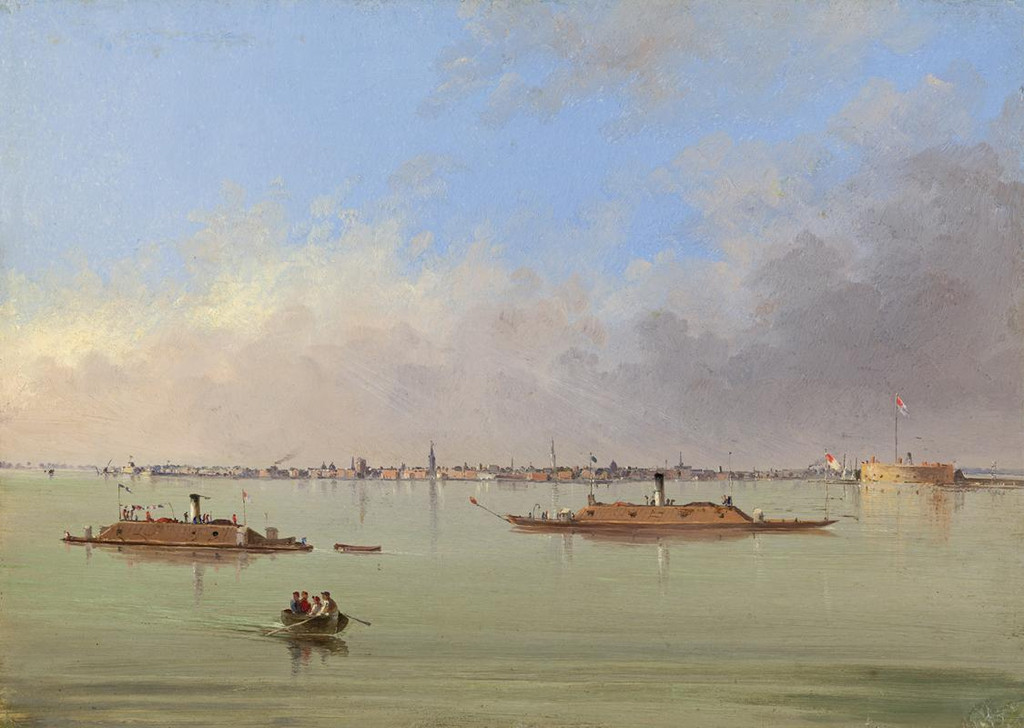
Charleston Bay and City, 1864, painted by John Gadsby Chapman from Conrad’s studies. A separate work in the shared Charleston suite. John Gadsby Chapman, from studies by Conrad Wise Chapman, Charleston Bay and City, 1864. American Civil War Museum. Public-domain reproduction; exhibition photography credited to Alan Thompson.
Image source
.
Public domain
. Resized only; whole supplied image retained, with no appearance changes.
Artworks directory
Browse 46 works identified in the consulted collection and catalogue records, including all 31 pictures in the father-and-son Charleston portfolio. Six entries explicitly credit John Gadsby Chapman. Approximate 1864–65 labels describe the series period; dates within its titles describe scenes and sometimes conflict with other catalogues. Other dates identify the separate objects or commissions. Links open our article where available, or the cited record. This is a research-based directory, not a catalogue raisonné.
| Name | Date | Medium |
|---|---|---|
| Battery Chevis, Mar. 4, 1864 | Series, c. 1864–65; scene date in title where given | Painting |
| Forts Sumter & Johnson, Mar. 15, 1864 | Series, c. 1864–65; scene date in title where given | Painting |
| Entrance to Fort Sumter — John Gadsby Chapman, from Conrad’s studies | Series, c. 1864–65; scene date in title where given | Painting |
| White Point Battery Charleston, Dec. 24, 1863 | Series, c. 1864–65; scene date in title where given | Painting |
| Quaker Battery (imagined scene) | Series, c. 1864–65; scene date in title where given | Painting |
| Fort Moultrie, Nov. 11, 1863 | Series, c. 1864–65; scene date in title where given | Painting |
| Battery on Long Island, Dec. 4, 1863 | Series, c. 1864–65; scene date in title where given | Painting |
| Church Flat Camp, Dec. 10, 1864 | Series, c. 1864–65; scene date in title where given | Painting |
| Fort Johnson, Oct. 10, 1863 | Series, c. 1864–65; scene date in title where given | Painting |
| Battery Halston — John Gadsby Chapman, from Conrad’s studies | Series, c. 1864–65; scene date in title where given | Painting |
| Charleston Bay and City — John Gadsby Chapman, from Conrad’s studies | Series, c. 1864–65; scene date in title where given | Painting |
| Battery Marion, Nov. 4, 1863 | Series, c. 1864–65; scene date in title where given | Painting |
| Battery Marshall, Sullivan's Island, Dec. 4, 1863 | Series, c. 1864–65; scene date in title where given | Painting |
| The Flag of Sumter, Oct. 20, 1863 | 1863–64; scene 20 October 1863 | Painting |
| Battery Beauregard, Nov. 22, 1863 — John Gadsby Chapman, from Conrad’s studies | Series, c. 1864–65; scene date in title where given | Painting |
| Fort Moultrie, Interior, Sep. 16, 1863 (portfolio index entry) | Series, c. 1864–65; scene date in title where given | Painting |
| Battery Bee, Dec. 3, 1863 | Series, c. 1864–65; scene date in title where given | Painting |
| Battery Wampler, Mar. 4, 1864 | Series, c. 1864–65; scene date in title where given | Painting |
| Submarine Torpedo Boat H.L. Hunley, Dec. 6, 1863 | 1864; scene 6 December 1863 | Painting |
| Battery Simkins, Feb. 25, 1864 | Series, c. 1864–65; scene date in title where given | Painting |
| Fort Sumter [Gun Gallery], Dec. 8, 1863 | Series, c. 1864–65; scene date in title where given | Painting |
| Fort Sumter, Interior, Sunrise, Dec. 9, 1864 | 1864; published scene dates differ | Painting |
| Torpedo Boat David at Charleston Dock, Oct. 25, 1863 | 1864; scene 25 October 1863 | Painting |
| Federal Battery on Morris Island, Feb. 12, 1864 | Series, c. 1864–65; scene date in title where given | Painting |
| Fort Sumter from Moultrie, Nov. 10, 1863 | Series, c. 1864–65; scene date in title where given | Painting |
| Battery Marshall from Long Island, Nov. 18, 1863 | Series, c. 1864–65; scene date in title where given | Painting |
| Evening Gun, Fort Sumter — John Gadsby Chapman, from Conrad’s studies | Series, c. 1864–65; scene date in title where given | Painting |
| Battery Haskel, Mar. 4, 1864 — John Gadsby Chapman, from Conrad’s studies | Series, c. 1864–65; scene date in title where given | Painting |
| Battery Rutledge, Dec. 3, 1864 | Series, c. 1864–65; scene date in title where given | Painting |
| Night Bombardment, Dec. 10, 1864 | Series, c. 1864–65; scene date in title where given | Painting |
| Battery Laurens Street Charleston, Feb. 7, 1864 | Series, c. 1864–65; scene date in title where given | Painting |
| Bombardment of Fort Moultrie (Gibbes panorama) | 1864; scene 16 November 1863 | Oil on canvas |
| The Fifty-ninth Virginia Infantry—Wise’s Brigade | Probably 1867; scene September 1863 | Oil on canvas |
| Camp No. 2, Terrenos Baldios | 1860; setting unidentified | Oil on wood panel |
| Frattocchie | 1861 | Oil painting |
| French Encampment at Monterrey | 1865; described in historical catalogue essay | Painting |
| Vista de Monterrey | 1865 | Oil on paper |
| Valley of Mexico (Jolly commission) | 1865/66 commission; catalogue dates vary | Painting |
| Valle de México (Cisneros version) | 1870 | Oil on canvas |
| Important Panoramic View of the Valley of Mexico, San Angel | Executed 1866; reverse inscribed 1865 | Oil on canvas laid down on board |
| Valle de México (Alejandro Najera commission) | 1894 | Oil on canvas |
| Paisaje mexicano (Ajusco) | 1877 | Oil on canvas |
| México desde la hacienda de los Morales | 1896; photographed in 2023 | Painting |
| Monterrey desde el cerro de Chipinque | 1902; photographed in 2023 | Painting |
| Valley of Mexico (Valentine version) | 1902 | Oil on wood |
| Picket Post | 1863 | Engraving |
Frequently Asked Questions
It represents the engagement of 16 November 1863, when the Union monitor Lehigh grounded in Charleston Harbor and other monitors came to help while Confederate batteries fired. [1]
The Gibbes Museum dates the canvas to 1864 and records that it was completed in Rome. The 1863 inscription refers to the represented engagement. [1]
It belongs to the Gibbes Museum of Art in Charleston, South Carolina. The museum credits its purchase to funds provided by the Winnie Edwards Murray Fund. [1]
Discussion
Look again at the images and ideas explored in Bombardment of Fort Moultrie. These editorial prompts invite your observations.
Reader Insights
Follow the tents, banks and openings. How do they direct movement through the fortified interior?
How does the carrying group change the human scale of an engagement whose ships remain tiny in the distance?
Compare the whole panorama with the small Sunrise panel. Which activities become most prominent in each view?
Join the Conversation
Share a detail, comparison or question about Bombardment of Fort Moultrie below.
References
- Gibbes Museum of Art , Bombardment of Fort Moultrie, Charleston Harbor, South Carolina, partner catalogue on Google Arts & Culture. Creation in 1864, represented engagement, dimensions, support, inscription and collection credit. View source
- Camp No. 2, Terrenos Baldios, y1970-114. View source
- The Civil War and American Art, 2013 exhibition press release. View source
- Eleanor Harvey , The Civil War and American Art: A Confederate View, Smithsonian American Art Museum, 2013. The Charleston pictures’ artistic construction and historical perspective. View source
- Rachel Lance, How Historical Research Helped Solve a Civil War Submarine Mystery, 18 September 2017. View source
- Conrad Wise Chapman - Torpedo Boat David at Charleston Dock, Oct. 25, 1863.jpg. View source
- Father and Son: The Works of John Gadsby Chapman and Conrad Wise Chapman. View source
- Important Panoramic View of the Valley of Mexico, San Angel,2024lot38. View source
- Valle de México (1870). View source
- Valle de México (1894), lot4010480. View source
- México desde la hacienda de los Morales (1896), MIB photograph01. View source
- The Fifty-ninth Virginia Infantry—Wise’s Brigade,2001.7. View source
- Monterrey desde el cerro de Chipinque (1902), MIB photograph01. View source
- Ben L. Bassham , The Bombardment of Fort Moultrie, November 16, 1863, South Carolina Historical Magazine 89, January 1988, pp. 13–23. The complete article, including the conditional dating argument in note 16, commission, defenses, labor and attributed visual comparisons. View source
- American Civil War Museum , About the Artists, archived Chapman exhibition. Military assignment, March 1864 furlough and work in Rome. View source
- American Civil War Museum , The Man Behind the Mission, archived exhibition. Administrative context of the fortification-recording project. View source
- American Civil War Museum , Fort Moultrie, November 11, 1863, archived portfolio entry. Retrospective account of gathering sand for repairs. View source
- American Civil War Museum , Battery Marshall, Sullivan’s Island, archived portfolio entry. Retrospective description of labor on the breastworks. View source
- American Civil War Museum , Fort Sumter, Interior at Sunrise, archived portfolio entry. Workers, fires and sandbag preparation. View source
- American Civil War Museum , complete archived Chapman portfolio index. The 31-picture series and separate Moultrie entries. View source
- American Civil War Museum , Charleston Bay and City, archived portfolio entry. John Gadsby Chapman’s authorship of the finished painting. View source
- Splash image source.
Bombardment of Fort Moultrie, painted in Rome in 1864. The composition represents the engagement of 16 November 1863. Conrad Wise Chapman, Bombardment of Fort Moultrie, 1864. Gibbes Museum of Art, 1981.012. Museum purchase with funds provided by Winnie Edwards Murray Fund. Public domain. Public domain . Resized only; whole supplied image retained, with no appearance changes.
View source