 by
Tom Gurney
Tom Gurney BSc (Hons) is an art history expert with over 20 years experience
Email:
tomgurney1@gmail.com
/ Phone:
+44 7429 011000
The Fifty-ninth Virginia Infantry—Wise’s Brigade: Introduction
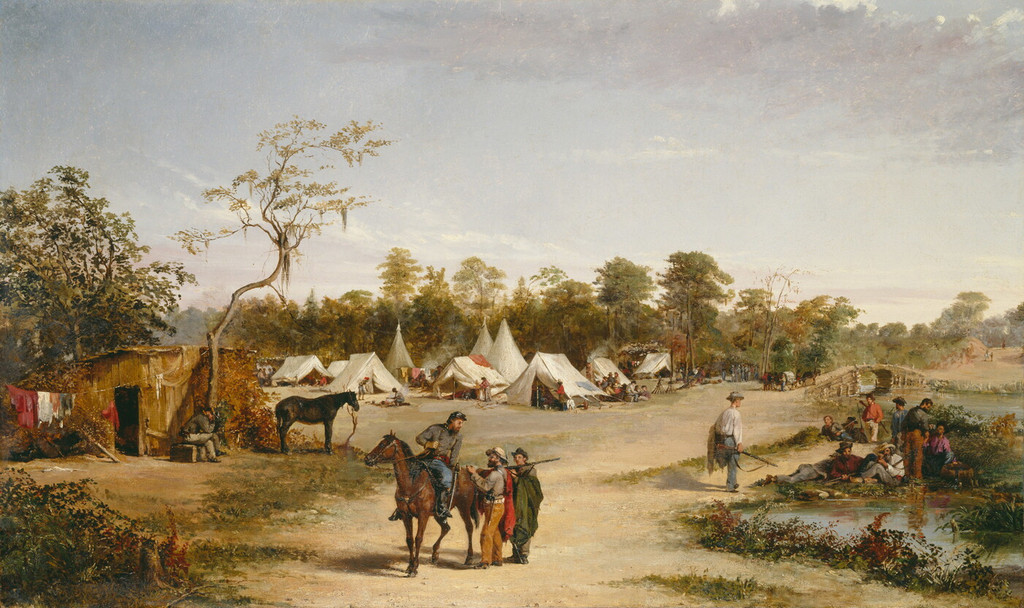
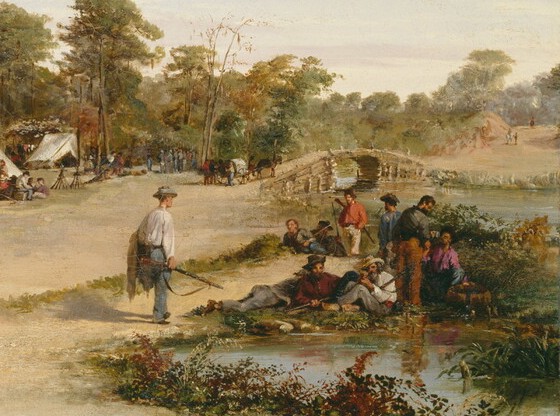
Conrad Wise Chapman’s The Fifty-ninth Virginia Infantry—Wise’s Brigade presents an encampment within an open landscape. A mounted man and two standing figures occupy the foreground, with tents, trees and a small building behind them. At the right, another group gathers beside water and the approach to a bridge.
The Amon Carter Museum dates the canvas to probably 1867. Its recorded inscription refers to Diascund Bridge in September 1863. The distinction places a wartime subject within a picture whose finished form belongs to a later act of painting and recollection. [1]
At a Glance
- Artist Conrad Wise Chapman.
- Title The Fifty-ninth Virginia Infantry—Wise’s Brigade.
- Date Probably 1867.
- Inscribed scene Diascund Bridge, September 1863.
- Medium Oil on canvas.
- Dimensions 20⅛ by 33⅞ inches.
- Collection Amon Carter Museum of American Art, Fort Worth, accession 2001.7.
This work across Conrad Wise Chapman’s career
Camp No. 2, Terrenos Baldios
1860; setting unidentifiedThe Flag of Sumter
1863–64; scene 20 October 1863Bombardment of Fort Moultrie
1864; scene 16 November 1863Fort Sumter, Interior at Sunrise
1864; published scene dates differSubmarine Torpedo Boat H. L. Hunley
1864; scene 6 December 1863Torpedo Boat David at Charleston Dock
1864; scene 25 October 1863Valley of Mexico paintings
Separate versions, 1866–1902The Fifty-ninth Virginia Infantry—Wise’s Brigade (current article)
Probably 1867; scene September 1863Monterrey desde el cerro de Chipinque
1902; photographed in 2023Notes and sources
Camp No. 2, Terrenos Baldios. A framed oil study whose catalogue date does not identify it as a Mexican survey camp. [2]
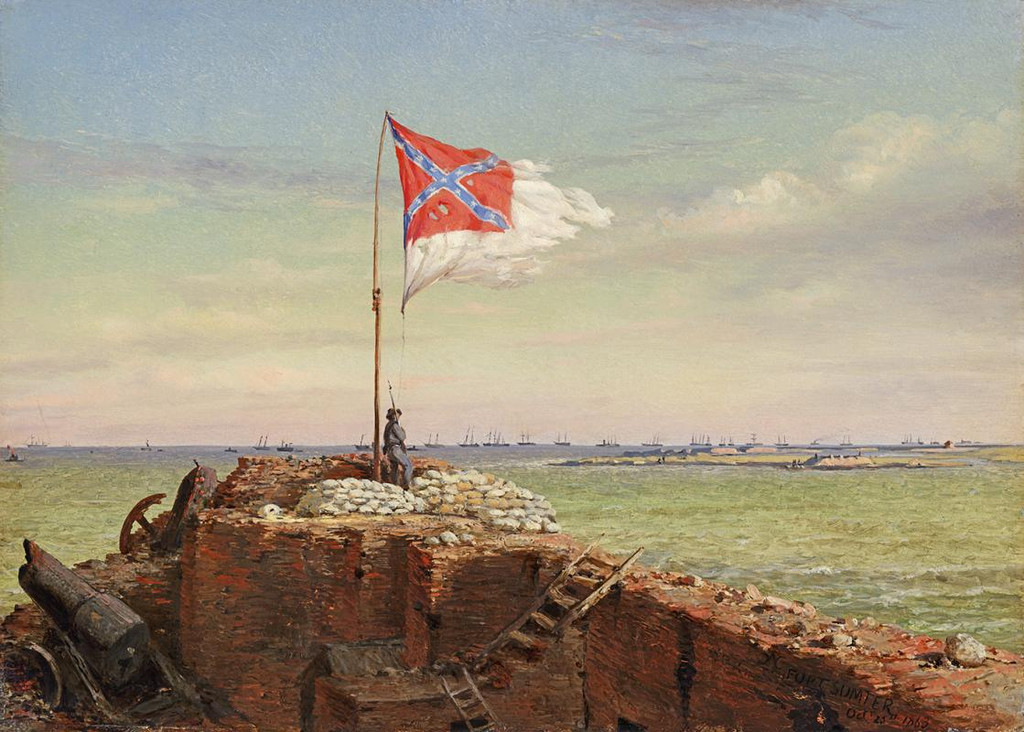
The Flag of Sumter. A flag and a solitary guard stand above the ruined wall in sunset light. [3]
Bombardment of Fort Moultrie. The large Gibbes panorama opens the sandy fort interior to figures, tents and a broad sky. [4]
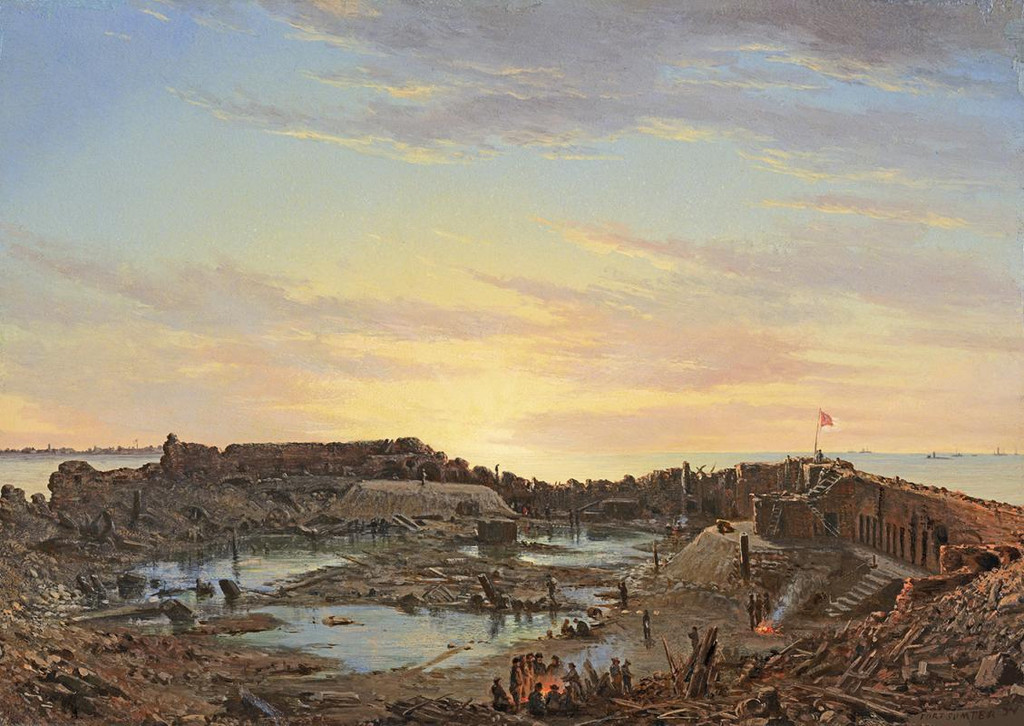
Fort Sumter, Interior at Sunrise. Workers, water and broken ground occupy the surviving courtyard; the article explains the conflicting scene dates. [5]
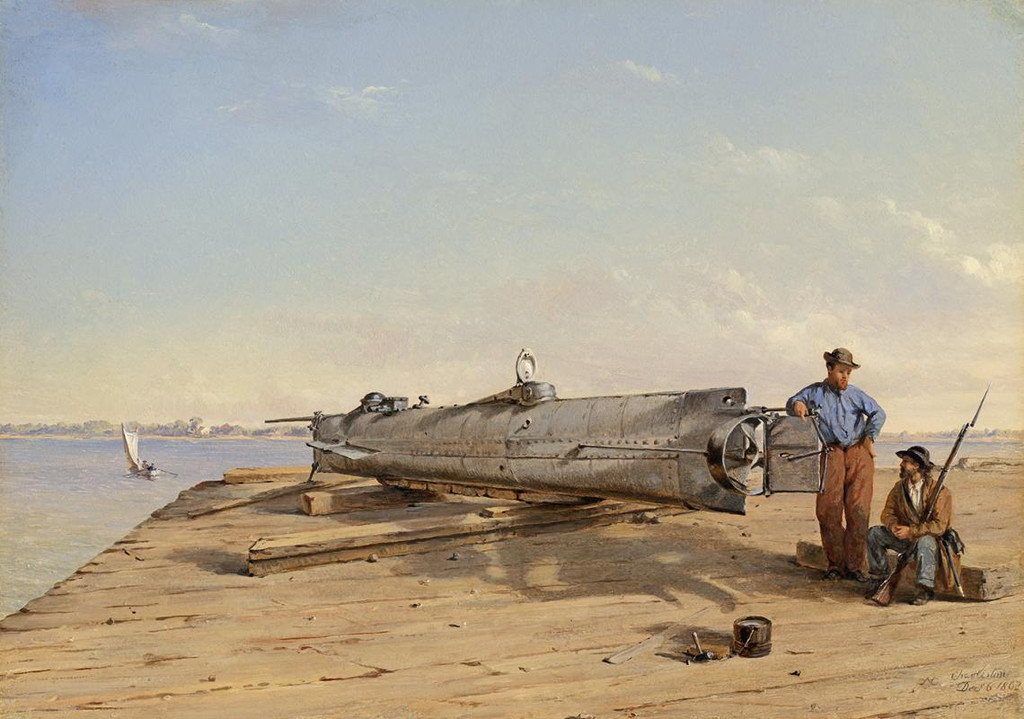
Submarine Torpedo Boat H. L. Hunley. The beached hull and two men establish the scale of the small submarine. [6]
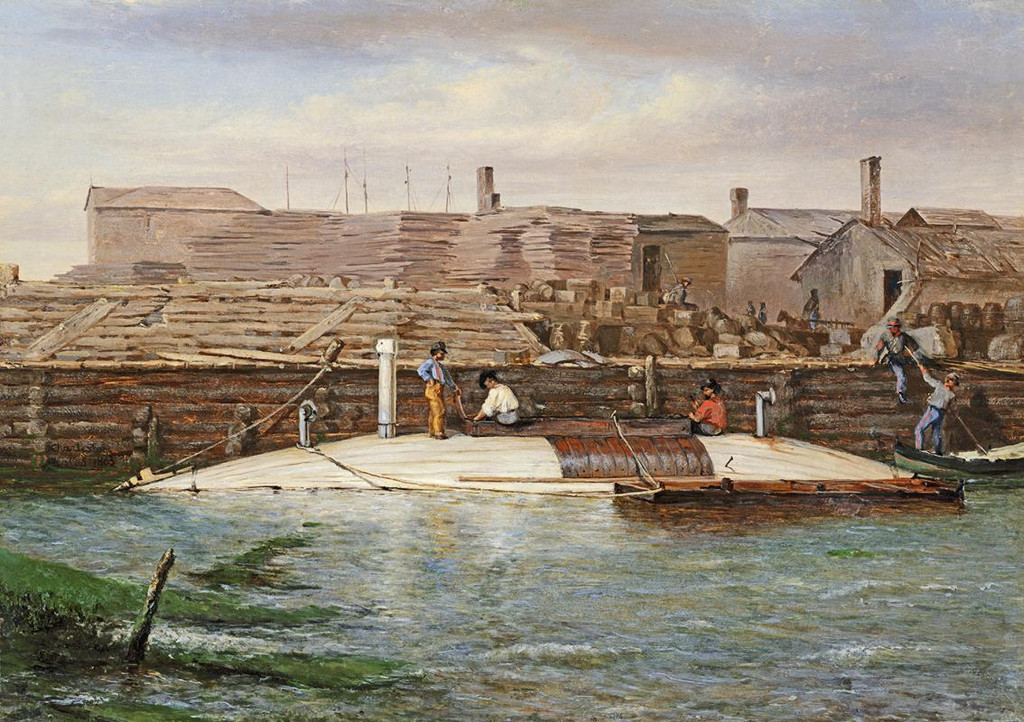
Torpedo Boat David at Charleston Dock. A low vessel, dock and exposed fittings bring military technology into a working waterfront. [7]
Valley of Mexico paintings. Compare individual studies and later versions. The date band groups several objects and does not indicate continuous work on one painting. [8] [9] [10] [11] [12]
The Fifty-ninth Virginia Infantry—Wise’s Brigade (current article). A mounted figure, tents and a bridge organize a camp within a larger landscape. [1]
Monterrey desde el cerro de Chipinque. The photograph retains the frame and gallery setting of this later Monterrey painting. [13]
Contents
- A camp within a broad view
- The mounted man and his companions
- Tents, a building and ordinary routines
- Water and the bridge
- Trees, light and depth
- September 1863 and probably 1867
- Wise and the family connection
- Beside the Charleston paintings
- Annotated details
A camp within a broad view
The composition gives the camp an extensive setting. Trees form a boundary behind the tents, and a large sky opens above them. The near ground remains sufficiently clear for the central figures and horse to stand out, while smaller activities continue toward the edges.
The arrangement lets a viewer recognize both a place of temporary habitation and the surrounding terrain. The camp does not fill every part of the landscape. Instead, tents, a building and groups of people establish different uses within an open area, connected by the light ground running between them.
The broad format encourages movement across the scene. The eye can begin with the mounted figure, continue through the bright tents and follow the view toward the water at the right. Those changes of scale make the foreground encounter one part of a larger occupied place.
Annotated Details from The Fifty-ninth Virginia Infantry—Wise’s Brigade
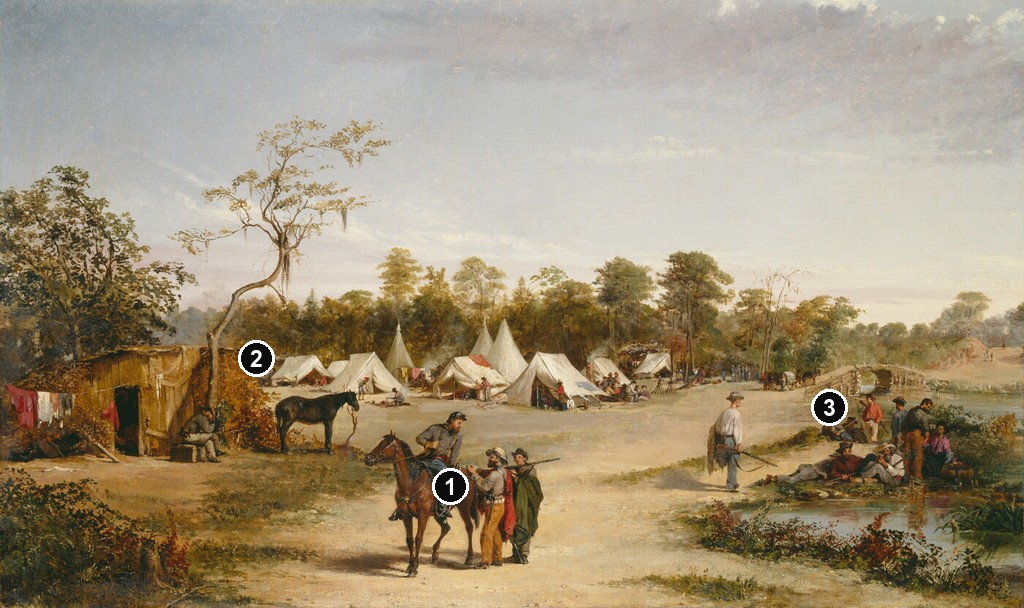
The numbered points identify visible features discussed in this article. Return from each detail to the whole composition. The Fifty-ninth Virginia Infantry—Wise’s Brigade, probably 1867. The recorded inscription names Diascund Bridge and September 1863. Conrad Wise Chapman, The Fifty-ninth Virginia Infantry—Wise’s Brigade, probably 1867. Amon Carter Museum of American Art, Fort Worth, Texas, 2001.7. Public domain. Image source. Public domain. Numbers added to this separate overview; cropped details are shown below. No recolouring, retouching or reconstruction.
Details from THE FIFTY-NINTH VIRGINIA INFANTRY—WISE’S BRIGADE
Compare the cropped details with the complete images above. Notice how their colours, shapes and positions contribute to the larger compositions.
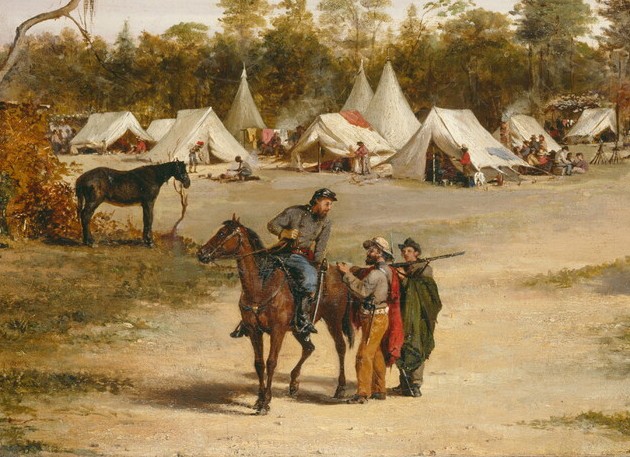
The mounted man and two companions
The horse and three men form the most prominent foreground group. Their overlapping bodies and angled heads suggest an exchange, without identifying the people represented.
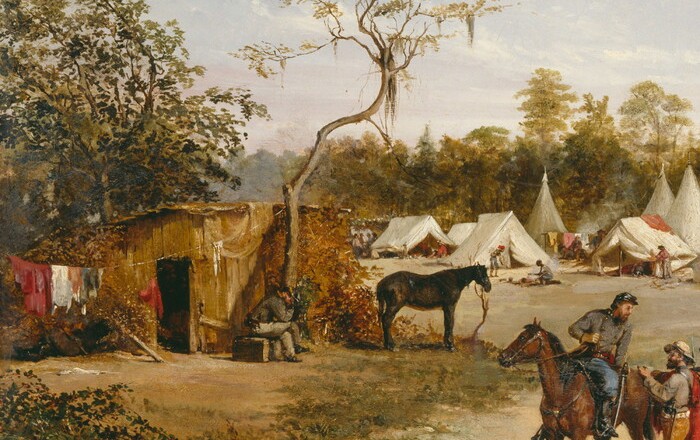
A camp made visible through ordinary activity
White tents, a timber building, hanging cloth and scattered figures give the camp a lived appearance. Light shapes lead from the near building into the trees.
Water, figures and a bridge
People gather beside the water, while the bridge extends the scene into the distance. The broad open ground connects this group to the tents farther left.
The mounted man and his companions
The foreground horse and three men create the clearest group. The rider inclines toward the men beside him, while their bodies form a compact cluster around the animal. Differences of posture suggest an exchange without supplying its exact words or purpose.
Color helps distinguish the figures. Lighter trousers, darker coats and red fabric punctuate the group, separating bodies that might otherwise merge into the horse and ground. The differences are useful compositional accents, rather than a basis for assigning a rank or personal identity to each man.
The horse’s position also gives the group a larger shape within the open foreground. Its dark body and legs stand against the lighter earth, gathering attention before the viewer moves into the camp behind. The people and animal provide a human scale from which the tents and trees can be judged.
Tents, a building and ordinary routines
The middle ground contains several kinds of tent, from low angular shelters to taller pointed forms. Their pale surfaces catch light against the darker trees, making the camp easy to follow across the picture. Openings and folds introduce smaller patches of shadow within the bright fabric.
At the left, a modest wooden building stands close to a tree, with clothing hanging nearby. A figure occupies its shaded edge, and another animal stands farther into the open ground. The placement gives this side of the composition a more enclosed character than the broad central area.
These details connect military occupation with ordinary routines of shelter, clothing and animal care. They make the camp readable as somewhere inhabited over time. A viewer can attend to its practical arrangements while the prominent foreground group continues to provide a clear center.
Water and the bridge
The right side introduces a different kind of gathering. Several men sit or stand near the water, with a solitary upright figure between them and the main foreground group. The change of posture creates a quieter rhythm along the edge.
Beyond them, the bridge carries the eye toward the farther part of the camp. Its repeated supports and low horizontal structure connect the water with a route through the landscape. The inscription’s reference to Diascund Bridge gives that element a historical association, while the picture incorporates it into the movement of the whole view. [1]
Water also changes the foreground’s texture. Reflections and irregular banks interrupt the light open ground, giving the resting group a distinct setting. The composition joins those different surfaces without requiring every activity to share the same degree of prominence.
Trees, light and depth
The tall, irregular tree toward the left rises above much of the camp. Its bending trunk and sparse upper branches break the broad sky, while denser foliage along the middle ground establishes a lower boundary. The two kinds of tree mass provide different measures of height and distance.
Pale tent fabric and light earth stand against that darker vegetation. The contrast gives the interior of the camp a degree of clarity, while the sky remains comparatively soft. The eye can move from the strongest foreground forms into smaller groups without encountering a single rigid division between near and far.
Warm browns and greens hold much of the setting together. Brighter clothing and the whiteness of the tents create particular stopping points within it. The painting’s openness depends on that balance between a continuous landscape and a number of distinct local accents.
Watch: Conrad Wise Chapman
Two Spanish-language museum films explore Chapman and his views of Mexico.
#ElSoumayaEnCasa | Conrad Wise Chapman
Museo Soumaya introduces Chapman and his work. This museum presentation is in Spanish.
Watch on YouTubeSeptember 1863 and probably 1867
The museum transcribes an inscription naming Diascund Bridge and September 1863, while giving probably 1867 as the painting’s date. The wartime month and the probable creation date answer separate questions. One locates the represented subject; the other identifies when the surviving canvas was likely made. [1]
The difference permits a more precise understanding of apparent immediacy. A picture can describe a military setting convincingly while its final arrangement develops later. The finished painting does not need to have been completed beside the tents for observations of camp life to contribute to its making.
Chapman’s biography includes both military service and continued artistic work. The American Civil War Museum records his enlistment, later Virginia service and Charleston assignment. That experience provides a wider setting for the camp subject, while the exact object retains its own recorded date and inscription. [14]
Wise and the family connection
Henry Alexander Wise was part of the Chapman family’s Virginia network. The Library of Virginia describes John Gadsby writing to his old friend on Conrad’s behalf during the war. The brigade name consequently connects the subject with relationships that also affected the artist’s military career. [8]
The connection does not identify the people in the foreground. The painting gives them roles within an arrangement of encounter, occupation and rest, while their individual biographies remain outside the recorded information about the object. A careful reading can retain the title’s military association without converting the group into a confidently named portrait gathering.
Beside the Charleston paintings
Bombardment of Fort Moultrie presents another large military landscape, dated 1864 by the Gibbes Museum. It concentrates on a fortified interior during an engagement, with protective banks and tents organizing the ground. The Carter camp offers a more open arrangement among trees, water and routes through the terrain. [4]
Harvey’s discussion of Chapman emphasizes the conjunction of artistic composition and the historical circumstances of his Confederate service. That approach is useful here too: the camp can be examined as an organized landscape while retaining the particular military world it represents. [5]
The wider Civil War paintings article follows those differences across separate objects. In this canvas, the mounted group, bright tents and people beside the water make the rhythms of occupation and ordinary activity especially visible.
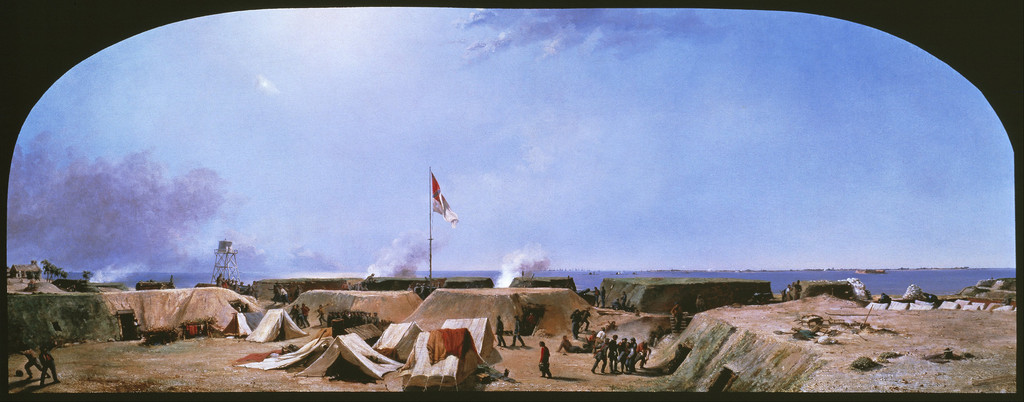
Bombardment of Fort Moultrie, 1864. A separate military panorama organizes tents and groups within a fortified interior. Conrad Wise Chapman, Bombardment of Fort Moultrie, 1864. Gibbes Museum of Art, 1981.012. Museum purchase with funds provided by Winnie Edwards Murray Fund. Public domain.
Image source
.
Public domain
. Resized only; whole supplied image retained, with no appearance changes.
Artworks directory
Browse 46 works identified in the consulted collection and catalogue records, including all 31 pictures in the father-and-son Charleston portfolio. Six entries explicitly credit John Gadsby Chapman. Approximate 1864–65 labels describe the series period; dates within its titles describe scenes and sometimes conflict with other catalogues. Other dates identify the separate objects or commissions. Links open our article where available, or the cited record. This is a research-based directory, not a catalogue raisonné.
| Name | Date | Medium |
|---|---|---|
| Battery Chevis, Mar. 4, 1864 | Series, c. 1864–65; scene date in title where given | Painting |
| Forts Sumter & Johnson, Mar. 15, 1864 | Series, c. 1864–65; scene date in title where given | Painting |
| Entrance to Fort Sumter — John Gadsby Chapman, from Conrad’s studies | Series, c. 1864–65; scene date in title where given | Painting |
| White Point Battery Charleston, Dec. 24, 1863 | Series, c. 1864–65; scene date in title where given | Painting |
| Quaker Battery (imagined scene) | Series, c. 1864–65; scene date in title where given | Painting |
| Fort Moultrie, Nov. 11, 1863 | Series, c. 1864–65; scene date in title where given | Painting |
| Battery on Long Island, Dec. 4, 1863 | Series, c. 1864–65; scene date in title where given | Painting |
| Church Flat Camp, Dec. 10, 1864 | Series, c. 1864–65; scene date in title where given | Painting |
| Fort Johnson, Oct. 10, 1863 | Series, c. 1864–65; scene date in title where given | Painting |
| Battery Halston — John Gadsby Chapman, from Conrad’s studies | Series, c. 1864–65; scene date in title where given | Painting |
| Charleston Bay and City — John Gadsby Chapman, from Conrad’s studies | Series, c. 1864–65; scene date in title where given | Painting |
| Battery Marion, Nov. 4, 1863 | Series, c. 1864–65; scene date in title where given | Painting |
| Battery Marshall, Sullivan's Island, Dec. 4, 1863 | Series, c. 1864–65; scene date in title where given | Painting |
| The Flag of Sumter, Oct. 20, 1863 | 1863–64; scene 20 October 1863 | Painting |
| Battery Beauregard, Nov. 22, 1863 — John Gadsby Chapman, from Conrad’s studies | Series, c. 1864–65; scene date in title where given | Painting |
| Fort Moultrie, Interior, Sep. 16, 1863 (portfolio index entry) | Series, c. 1864–65; scene date in title where given | Painting |
| Battery Bee, Dec. 3, 1863 | Series, c. 1864–65; scene date in title where given | Painting |
| Battery Wampler, Mar. 4, 1864 | Series, c. 1864–65; scene date in title where given | Painting |
| Submarine Torpedo Boat H.L. Hunley, Dec. 6, 1863 | 1864; scene 6 December 1863 | Painting |
| Battery Simkins, Feb. 25, 1864 | Series, c. 1864–65; scene date in title where given | Painting |
| Fort Sumter [Gun Gallery], Dec. 8, 1863 | Series, c. 1864–65; scene date in title where given | Painting |
| Fort Sumter, Interior, Sunrise, Dec. 9, 1864 | 1864; published scene dates differ | Painting |
| Torpedo Boat David at Charleston Dock, Oct. 25, 1863 | 1864; scene 25 October 1863 | Painting |
| Federal Battery on Morris Island, Feb. 12, 1864 | Series, c. 1864–65; scene date in title where given | Painting |
| Fort Sumter from Moultrie, Nov. 10, 1863 | Series, c. 1864–65; scene date in title where given | Painting |
| Battery Marshall from Long Island, Nov. 18, 1863 | Series, c. 1864–65; scene date in title where given | Painting |
| Evening Gun, Fort Sumter — John Gadsby Chapman, from Conrad’s studies | Series, c. 1864–65; scene date in title where given | Painting |
| Battery Haskel, Mar. 4, 1864 — John Gadsby Chapman, from Conrad’s studies | Series, c. 1864–65; scene date in title where given | Painting |
| Battery Rutledge, Dec. 3, 1864 | Series, c. 1864–65; scene date in title where given | Painting |
| Night Bombardment, Dec. 10, 1864 | Series, c. 1864–65; scene date in title where given | Painting |
| Battery Laurens Street Charleston, Feb. 7, 1864 | Series, c. 1864–65; scene date in title where given | Painting |
| Bombardment of Fort Moultrie (Gibbes panorama) | 1864; scene 16 November 1863 | Oil on canvas |
| The Fifty-ninth Virginia Infantry—Wise’s Brigade | Probably 1867; scene September 1863 | Oil on canvas |
| Camp No. 2, Terrenos Baldios | 1860; setting unidentified | Oil on wood panel |
| Frattocchie | 1861 | Oil painting |
| French Encampment at Monterrey | 1865; described in historical catalogue essay | Painting |
| Vista de Monterrey | 1865 | Oil on paper |
| Valley of Mexico (Jolly commission) | 1865/66 commission; catalogue dates vary | Painting |
| Valle de México (Cisneros version) | 1870 | Oil on canvas |
| Important Panoramic View of the Valley of Mexico, San Angel | Executed 1866; reverse inscribed 1865 | Oil on canvas laid down on board |
| Valle de México (Alejandro Najera commission) | 1894 | Oil on canvas |
| Paisaje mexicano (Ajusco) | 1877 | Oil on canvas |
| México desde la hacienda de los Morales | 1896; photographed in 2023 | Painting |
| Monterrey desde el cerro de Chipinque | 1902; photographed in 2023 | Painting |
| Valley of Mexico (Valentine version) | 1902 | Oil on wood |
| Picket Post | 1863 | Engraving |
Frequently Asked Questions
The inscription refers to that wartime month, but the Amon Carter Museum dates the canvas to probably 1867. [1]
The museum record provides the unit-associated title and inscription, rather than individual names for the depicted group. Their identities should not be inferred solely from position or clothing. [1]
The painting belongs to the Amon Carter Museum of American Art in Fort Worth, Texas, accession 2001.7. [1]
Discussion
Look again at the images and ideas explored in The Fifty-ninth Virginia Infantry—Wise’s Brigade. These editorial prompts invite your observations.
Reader Insights
How does the mounted group connect with the camp rather than becoming a separate portrait scene?
Follow the left building, bright tents and group beside the water. How do they establish different forms of occupation?
What changes when the September 1863 inscription is distinguished from the probable 1867 creation date?
Join the Conversation
Share a detail, comparison or question about The Fifty-ninth Virginia Infantry—Wise’s Brigade below.
References
- Amon Carter Museum of American Art , The Fifty-ninth Virginia Infantry—Wise’s Brigade, 2001.7. Probable 1867 date, September 1863 inscription, support, dimensions and credit. View source
- Camp No. 2, Terrenos Baldios, y1970-114. View source
- The Civil War and American Art, 2013 exhibition press release. View source
- Gibbes Museum of Art , Bombardment of Fort Moultrie, partner catalogue. Separate 1864 canvas and its fortified setting. View source
- Eleanor Harvey , The Civil War and American Art: A Confederate View, Smithsonian American Art Museum, 2013. The paintings’ artistic construction and Confederate circumstances. View source
- Rachel Lance, How Historical Research Helped Solve a Civil War Submarine Mystery, 18 September 2017. View source
- Conrad Wise Chapman - Torpedo Boat David at Charleston Dock, Oct. 25, 1863.jpg. View source
- Library of Virginia , Father and Son, 1998–99 exhibition. Family connection with Henry Alexander Wise and wartime intervention. View source
- Important Panoramic View of the Valley of Mexico, San Angel,2024lot38. View source
- Valle de México (1870). View source
- Valle de México (1894), lot4010480. View source
- México desde la hacienda de los Morales (1896), MIB photograph01. View source
- Monterrey desde el cerro de Chipinque (1902), MIB photograph01. View source
- American Civil War Museum , About the Artists, archived exhibition. Enlistment, Virginia service and the Charleston assignment. View source
- Splash image source.
The Fifty-ninth Virginia Infantry—Wise’s Brigade, probably 1867. The recorded inscription names Diascund Bridge and September 1863. Conrad Wise Chapman, The Fifty-ninth Virginia Infantry—Wise’s Brigade, probably 1867. Amon Carter Museum of American Art, Fort Worth, Texas, 2001.7. Public domain. Public domain . Resized only; whole supplied image retained, with no appearance changes.
View source