


 by
Tom Gurney
Tom Gurney BSc (Hons) is an art history expert with over 20 years experience
Email:
tomgurney1@gmail.com
/ Phone:
+44 7429 011000
Conrad Wise Chapman’s Civil War Paintings: Introduction
Conrad Wise Chapman’s Civil War pictures describe the occupied landscape of a siege. Guns and earthworks appear beside tents, boats, fires and groups carrying out ordinary tasks. The fighting may register through smoke in the distance, damage to a wall or the need to keep repairing a defensive position.
The Charleston commission grew from Chapman’s Confederate service. Stationed there in 1863, he was assigned to sketch the harbor defenses; finished paintings subsequently developed from the studies in Rome. His father, John Gadsby Chapman, painted some of those works. The pictures combine military access, field observation and later studio practice. [1]
Reading the series together reveals differences that can disappear when a single picture is used as a historical illustration. A distant prospect, a damaged interior and an imagined battery make different kinds of claim. The artist’s descriptions, written in 1898, add another layer of recollection to the surviving images.
Explore the Civil War paintings
At a Glance
- Principal setting Charleston Harbor and its defenses.
- Origin A Confederate commission to record fortifications during Chapman’s military service.
- Working process Wartime sketches followed by finished paintings, including work by his father.
- Important group The 31-picture portfolio held by the American Civil War Museum.
- Other major objects The larger Gibbes Fort Moultrie canvas and the Amon Carter camp painting.
- Reading approach Distinguish observation, studio reconstruction, imagined scenes and retrospective captions.
Contents
- A commission within the Confederate defenses
- The 31 pictures and their authorship
- Earthworks and the work of repair
- Inside Sumter at sunrise
- A flag above the ruined wall
- Bombardment after dark
- Distance and observation through a telescope
- Boats and the intervals between attacks
- Hunley and David
- Annotated details
A commission within the Confederate defenses
Chapman’s assignment belonged to the military organization around General P. G. T. Beauregard. The American Civil War Museum connects Thomas Jordan’s commissioning role with material intended for Josiah Gorgas at the Ordnance Bureau in Richmond. The pictures began within an administrative effort to record selected sites and preparations. [2]
That purpose helps explain the subjects. A battery’s position, the relation between neighboring works or a newly developed vessel could supply a reason for making a view. Access to the defenses gave the artist a perspective embedded in the Confederate undertaking. The series preserves that position as well as the places represented.
The commission did not eliminate artistic choice. Even a picture intended to show a military position needed a viewpoint, a distribution of light and an arrangement of its objects. Chapman’s ability to make those elements readable gives the works an interest extending beyond their use as illustrations of equipment or events.
Annotated Details from Conrad Wise Chapman’s Civil War Paintings
The numbered points identify visible features discussed in this article. Return from each detail to the whole composition. The captions keep each work’s identity, date and medium separate.
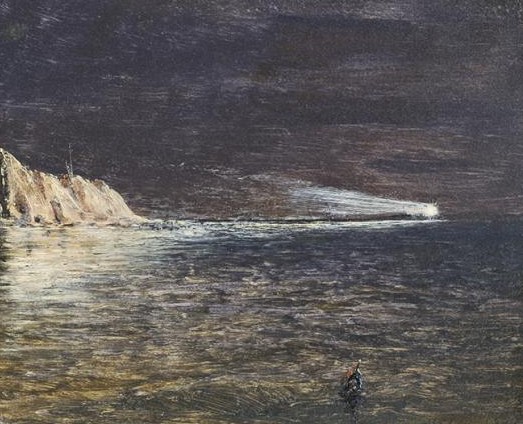
Night Bombardment
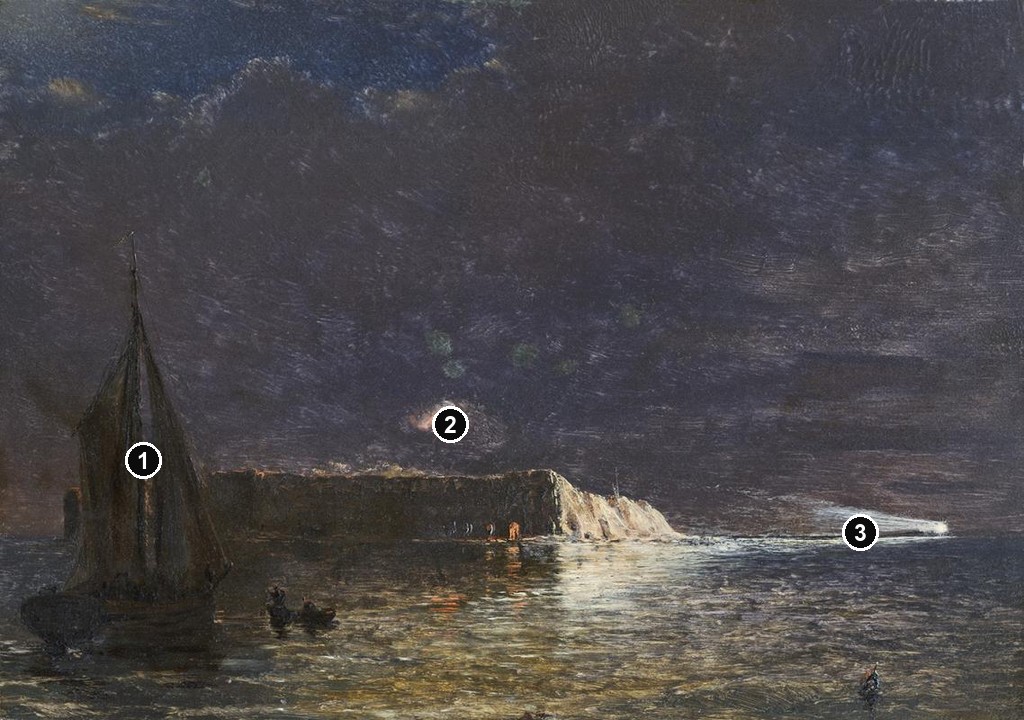
Night Bombardment. Artificial light, smoke, a sailboat and reflections organize the view after dark. Conrad Wise Chapman. American Civil War Museum; exhibition photography credited to Alan Thompson. Public-domain faithful reproduction. Image source. Public domain. Numbers added to this separate overview; cropped details are shown below. No recolouring, retouching or reconstruction.
Quaker Battery Imagined Scene
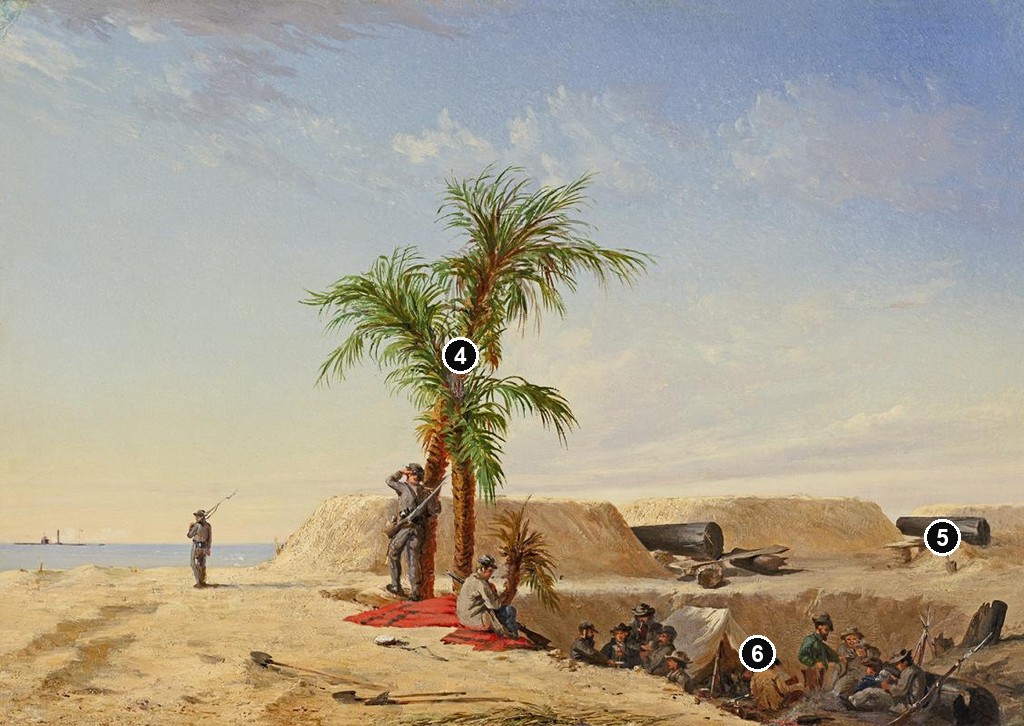
Quaker Battery, an imagined scene illustrating the use of wooden dummy guns. Soldiers occupy a sandy position beneath palms. Conrad Wise Chapman. American Civil War Museum; exhibition photography credited to Alan Thompson. Public-domain faithful reproduction. Image source. Public domain. Numbers added to this separate overview; cropped details are shown below. No recolouring, retouching or reconstruction.
Details from CONRAD WISE CHAPMAN’S CIVIL WAR PAINTINGS
Compare the cropped details with the complete images above. Notice how their colours, shapes and positions contribute to the larger compositions.
Night Bombardment
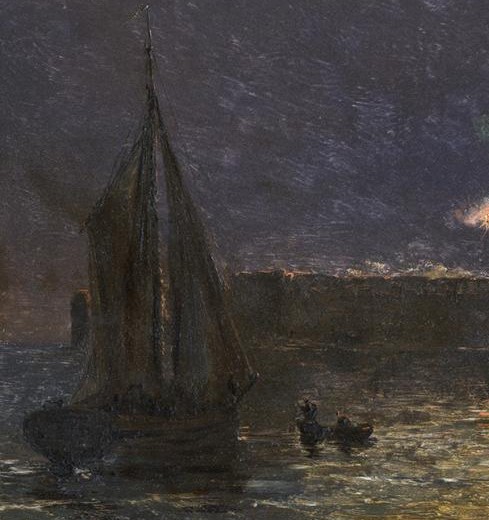
A dark sail close to the viewer
The large sailboat rises out of the dark foreground. Its mast and triangular sail establish a near position against the low fort beyond.
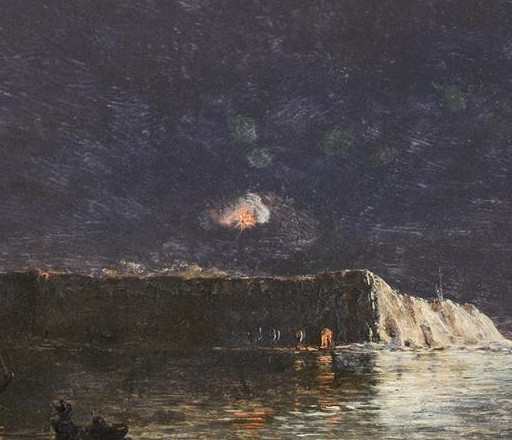
A small flare above the fort
A compact orange-white burst interrupts the dark sky. Its limited area makes the surrounding darkness active, rather than illuminating the whole scene evenly.
A beam crossing the water
A bright point at the right sends light across the water toward the fort. Reflections spread below the illuminated wall, connecting the distant structure with the foreground surface.
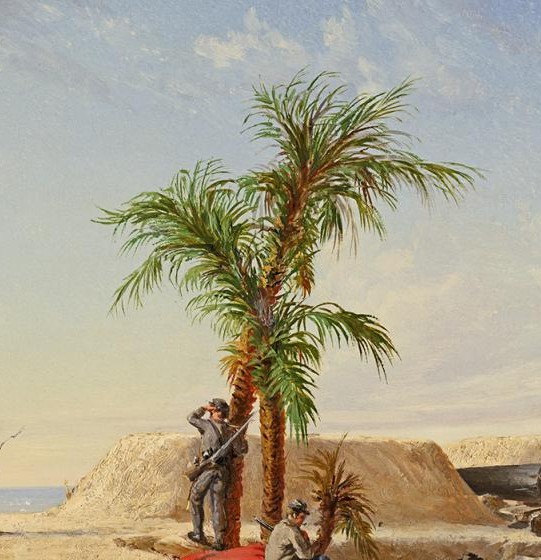
Quaker Battery Imagined Scene
Palms above the soldiers
Tall palms break the broad sky above a standing soldier and a seated companion. Their textured trunks and spreading leaves give the sandy position an especially distinctive outline.
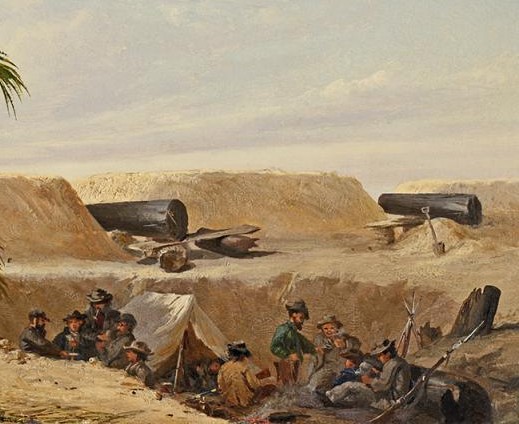
Dummy guns behind the sand
Dark horizontal forms project above and between the sandy defensive shapes. Chapman’s later description identifies this as an imagined illustration of wooden dummy guns, rather than a securely recorded battery.
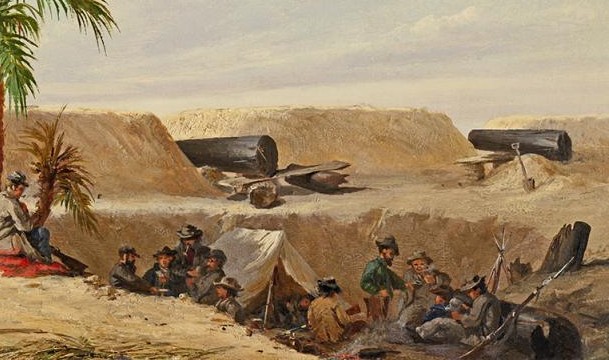
A camp within the sandy foreground
A small shelter, reclining figures and scattered equipment occupy the lower ground. Their relaxed poses make routine and waiting central to this invented scene.
The 31 pictures and their authorship
The museum’s archived portfolio lists 31 works, moving among forts, island batteries, harbor views and vessels. A sequence of separate prospects can make a complex geography intelligible: the viewer follows changes of position and direction instead of receiving one view that claims to contain the whole system. [3]
The group includes pictures painted by John Gadsby Chapman. Charleston Bay and City is explicitly attributed to the father in its individual museum description. Entrance to Fort Sumter is another work for which the entry identifies his role. Conrad’s field studies and military service remain part of the project’s history without making every finished picture his own painting. [4] [5]
This division of work connects the commission with the Chapman family’s artistic practice. A site studied by the son could become material for the father in Rome. Looking at the series as a shared undertaking permits both contributions to remain visible, while individual attributions keep the surviving objects distinct.
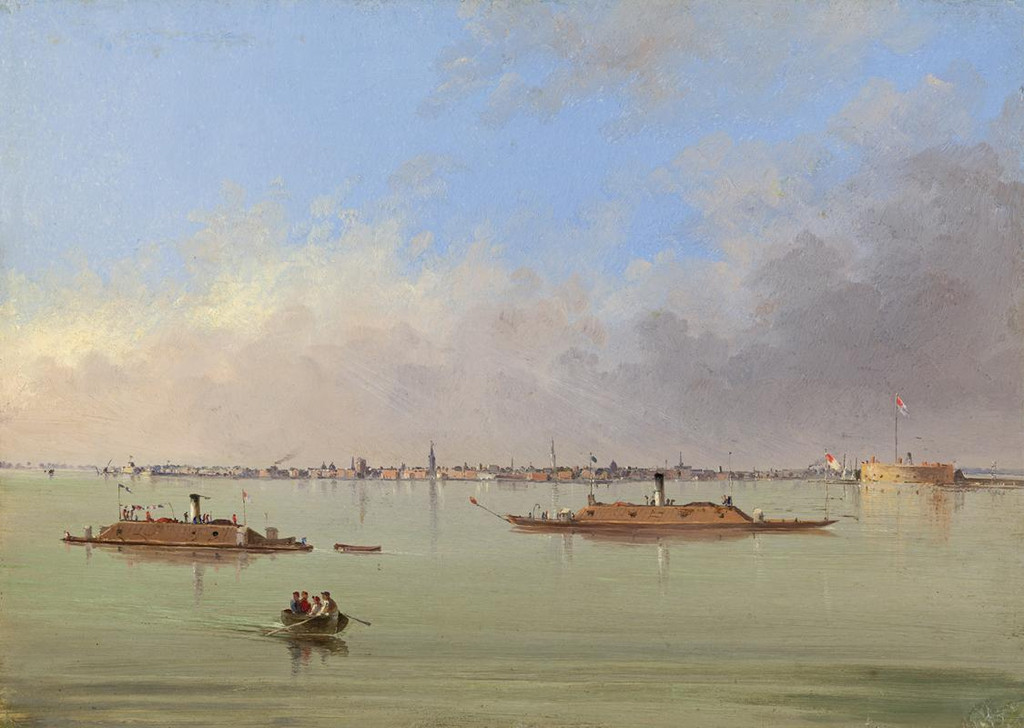
Charleston Bay and City, painted by John Gadsby Chapman from Conrad’s studies. A view within the shared Charleston undertaking. John Gadsby Chapman, from studies by Conrad Wise Chapman, Charleston Bay and City, 1864. American Civil War Museum. Public-domain reproduction; exhibition photography credited to Alan Thompson.
Image source
.
Public domain
. Resized only; whole supplied image retained, with no appearance changes.
Earthworks and the work of repair
The defenses appear as constructed places. Banks of sand, protected openings, passages and gun positions organize the space around the figures. These forms can seem almost like natural terrain in a broad view, yet their repeated slopes and strategic arrangement show sustained labor.
Chapman’s retrospective description of Fort Moultrie, November 11, 1863 identifies Black workers collecting sand to repair the fortifications. His account of Battery Marshall, Sullivan’s Island refers to breastwork construction under an overseer. Both descriptions make maintenance part of the subject, rather than an incidental activity happening beside the military works. [6] [7]
The people engaged in that work deserve attention alongside the armed figures. A fort’s continuing function depended on movement of material, repairs and preparation. The paintings do not recover every worker’s biography or legal status, but their presence changes how the structures themselves are understood.
Inside Sumter at sunrise
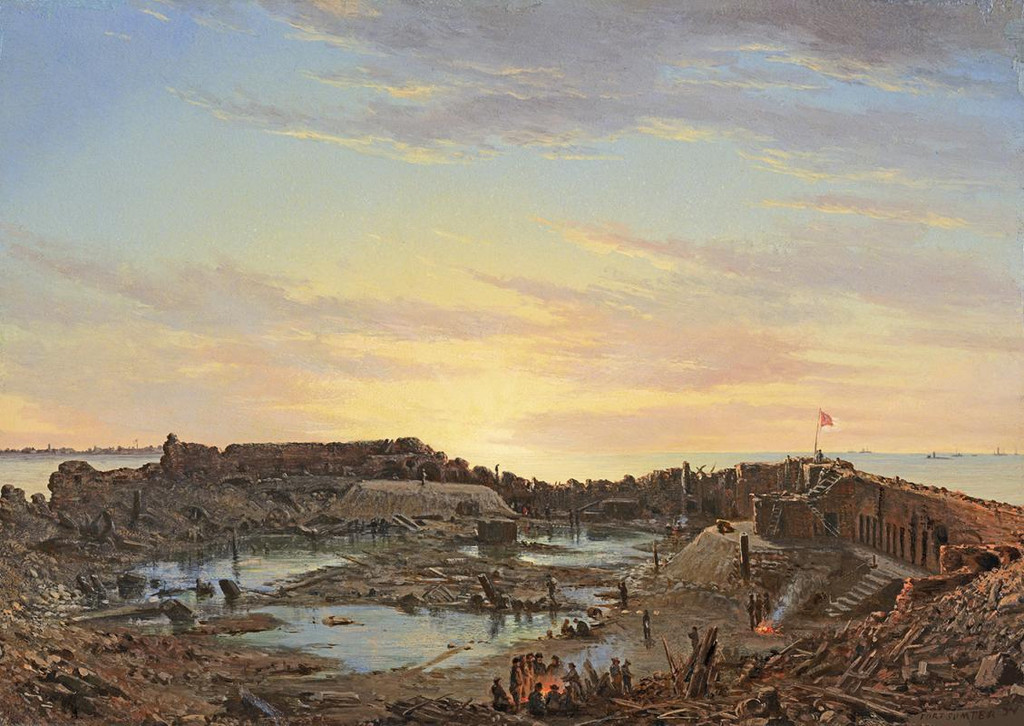
Fort Sumter, Interior at Sunrise concentrates on a damaged courtyard. Standing water catches light from the pale sky, and small groups occupy ground littered with debris. The surviving walls frame an interior in which military occupation continues despite substantial destruction.
Chapman associated the foreground fire with workers warming themselves before beginning the day’s tasks. He described the continuing preparation of sandbags for breaks in the defenses. The recollection connects a quiet moment with the labor required to keep the position usable. [8]
The composition also gives the viewer time to examine the place. The expansive sky and reflected light hold the eye before its movement reaches smaller figures and broken surfaces. Atmosphere and material damage operate together. The scene can be visually luminous while retaining the consequences of bombardment in its ground and walls.
A flag above the ruined wall
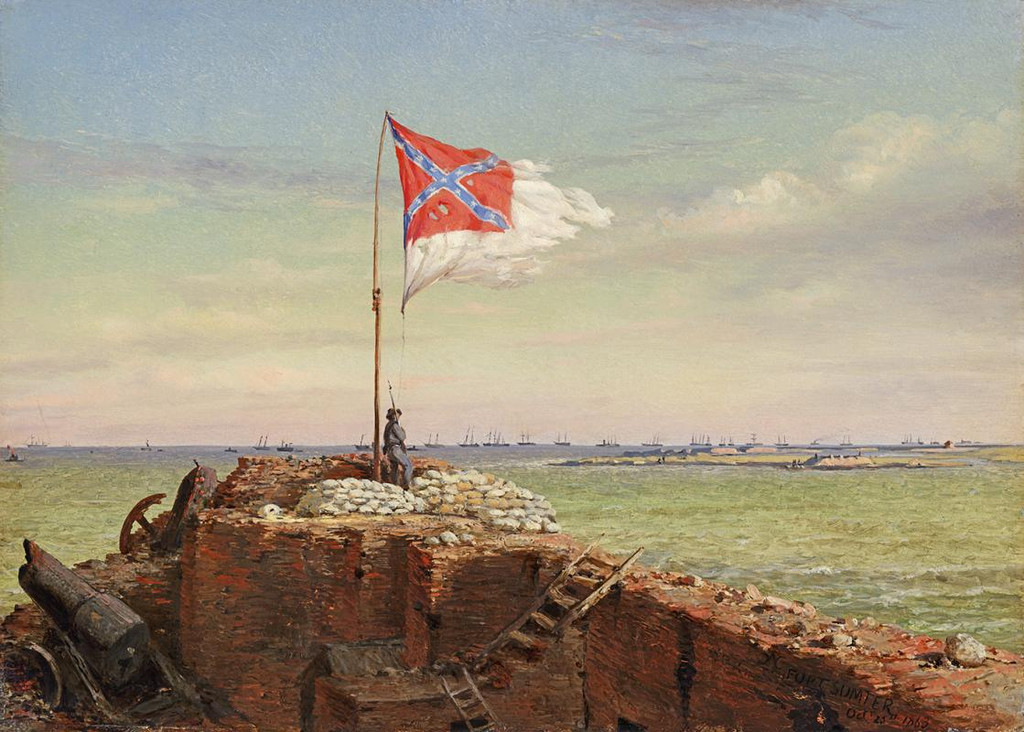
The Flag of Sumter brings one emblematic object close to the viewer. The large flag rises above a small guard, a ladder and damaged brickwork. Distant vessels remain visible across the open water, giving the flag’s position a military setting.
The artist described the originating view as a sunset sketch. Its light separates the red-brown wall from the softer sky and water, while the flag’s projecting shape gives the composition an active center. A single upright pole holds together a picture otherwise organized around low, broken forms. [9]
The Confederate banner was part of the political purpose of the position. Its prominence should be read within the commission and the fort’s occupation. A close study of color and shape can coexist with attention to the allegiance represented; formal description need not detach the image from the conflict that gave it meaning.
Bombardment after dark
Night Bombardment transforms the harbor through limited visibility. A dark sailboat occupies the left foreground. Across the water, a flash and smoke rise above the fort, while a bright beam enters from the right and catches the lower edges of the structure. Reflections make the water an active surface within the darkness.
Chapman’s short description identifies calcium light directed from Morris Island and a mail boat in the distance. The artificial beam therefore belongs to the military setting, as does the movement of a vessel through it. [10]
The change from sunrise to night gives the viewer a different relationship with the same harbor. At sunrise, ground and walls become progressively legible within a broad light. Here, separate illuminated areas interrupt the dark. What can be seen depends on the direction and reach of the beam, making visibility itself part of the scene’s tension.
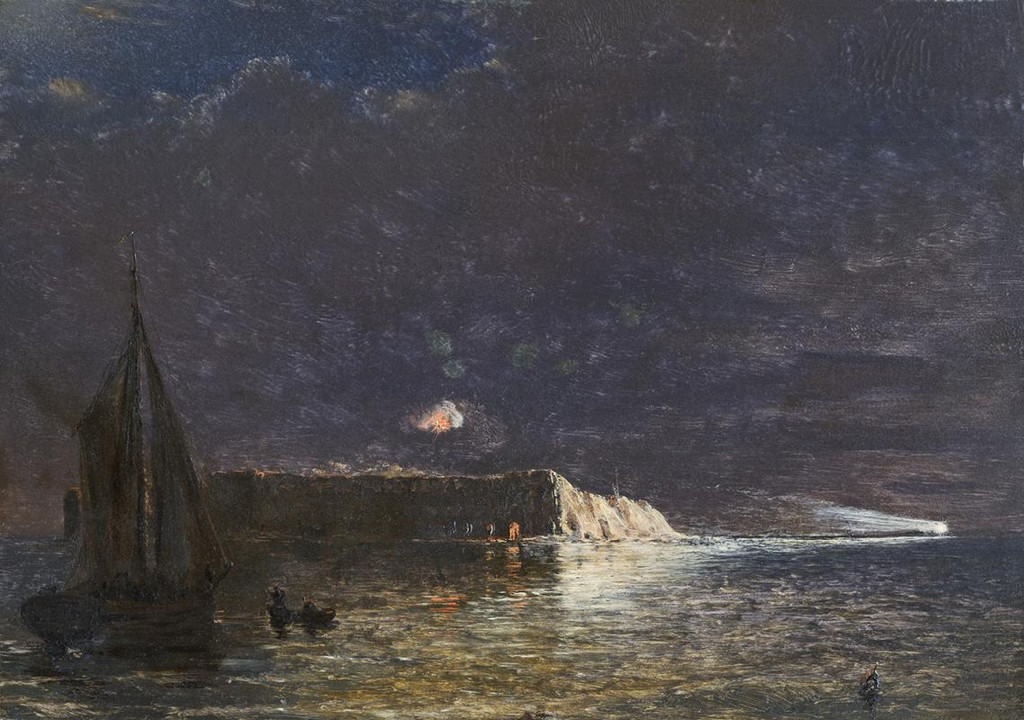
Night Bombardment. Artificial light, smoke, a sailboat and reflections organize the view after dark. Conrad Wise Chapman. American Civil War Museum; exhibition photography credited to Alan Thompson. Public-domain faithful reproduction.
Image source
.
Public domain
. Resized only; whole supplied image retained, with no appearance changes.
Distance and observation through a telescope
Not every subject was studied from close beside its guns. In the description of Federal Battery on Morris Island , Chapman recalled making the sketch through a telescope from the top of St. Michael’s Church in Charleston. The account identifies both the distant subject and the means by which he observed it. [11]
That distinction is useful when considering detail. A telescopic view depends on a particular line of sight and on the instrument’s ability to bring a distant area into focus. The resulting picture offers an observed prospect, but its apparent closeness should not be mistaken for the artist’s physical presence among the represented soldiers.
The recollection also shows the variety of access within the project. The artist could study one position from its interior, another across the water and another through optical assistance. Those different methods helped produce a series whose viewpoints are more varied than a single uniform survey.
Boats and the intervals between attacks
Small vessels connect the defensive positions in several descriptions. Forts Sumter and Johnson includes a mail boat moving between forts. Chapman’s recollection places that ordinary connection within repeated shelling, allowing communication and danger to occupy the same harbor. [12]
His description of Battery Marshall from Long Island emphasizes a boat preparing to leave, buildings used by troops and sentries. He remarked on the quietness of the represented place. This is a different Marshall view from the Sullivan’s Island picture with workers constructing breastworks. The similar names should not merge the objects or their activities. [13]
Such intervals are important to the series’ rhythm. Repeated waiting, transport and repair sustain the military landscape between episodes of firing. The pictures make a siege visible as an extended occupation of places, with practical routines continuing around the possibility of attack.
Watch: Conrad Wise Chapman
Two Spanish-language museum films explore Chapman and his views of Mexico.
#ElSoumayaEnCasa | Conrad Wise Chapman
Museo Soumaya introduces Chapman and his work. This museum presentation is in Spanish.
Watch on YouTubeHunley and David
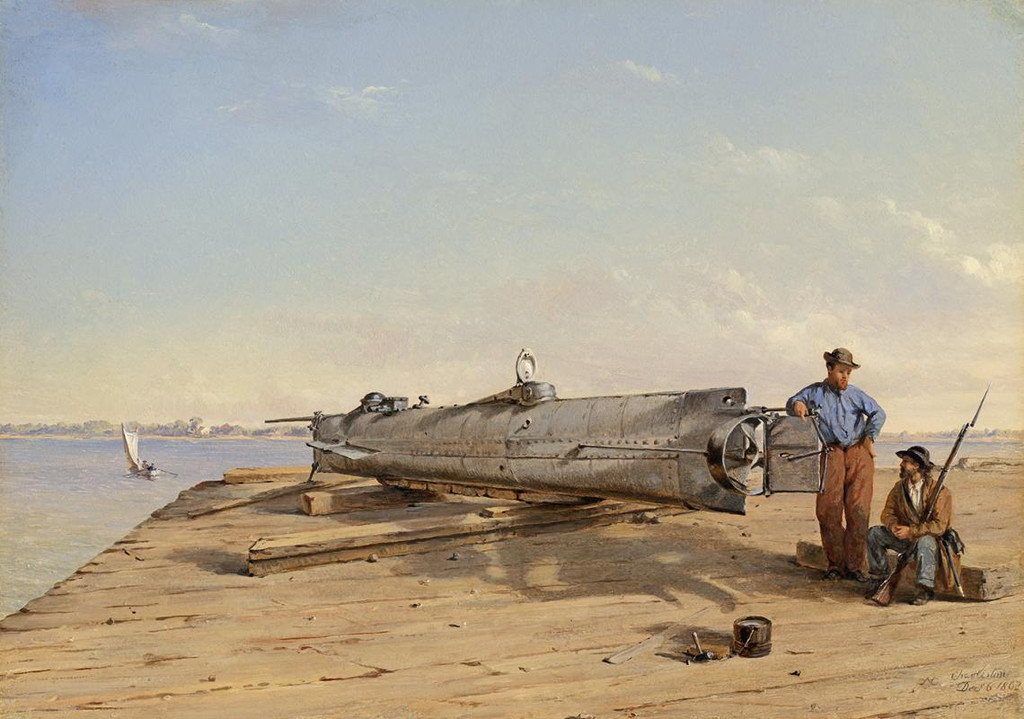
The two best-known vessel subjects require separate attention. H. L. Hunley rests out of the water on a shore, where its riveted hull, hatches and propeller can be examined beside two men. David appears low in the water at a dock, surrounded by sheds, stacked timber and people engaged around the vessel.
Chapman’s retrospective Hunley description gives an account of earlier crew losses and the boat’s disappearance. Its identification of the standing figure needs comparison with the chronology, rather than acceptance from the caption alone. The painting remains an important visual record without making every later recollection secure. [14]
The David description concerns repairs and new plates. It also includes a sweeping claim that this was the first torpedo boat ever constructed. That claim should not determine the picture’s historical interpretation. The visible workplace, hull and repair activity provide a more precise starting point for studying the object. [15]
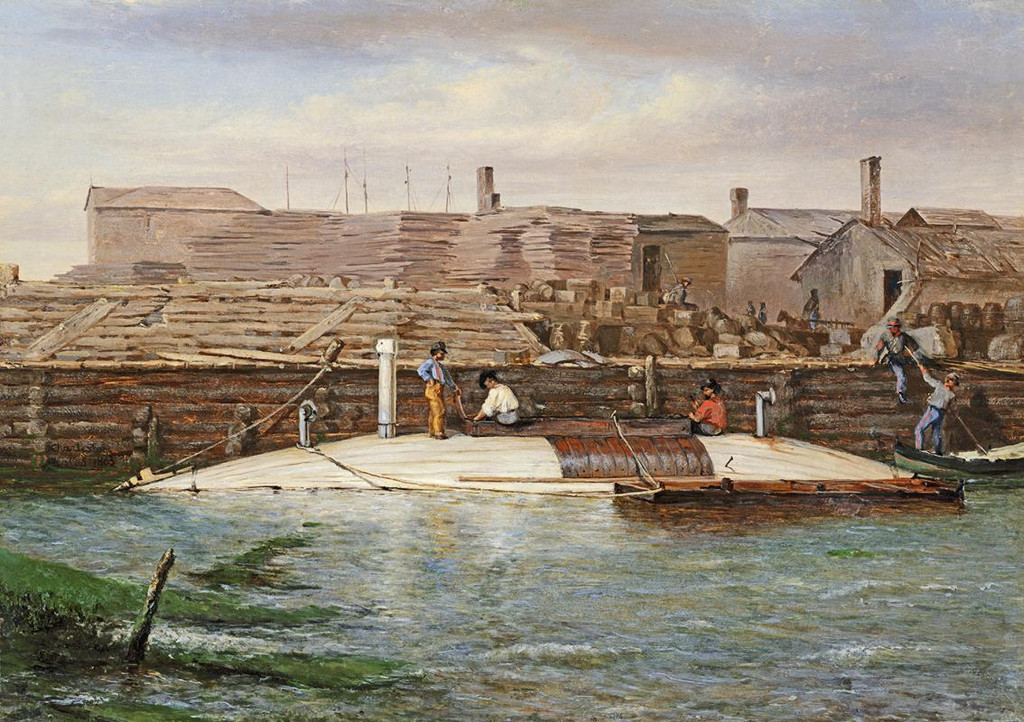
Torpedo Boat David at Charleston Dock. The low vessel appears within a busy setting of repairs, timber and sheds. Conrad Wise Chapman. American Civil War Museum; exhibition photography credited to Alan Thompson. Public-domain faithful reproduction.
Image source
.
Public domain
. Resized only; whole supplied image retained, with no appearance changes.
An imagined battery
Quaker Battery demonstrates a different relationship between painting and evidence. Soldiers occupy a sandy position beneath palms; dark dummy guns appear on the earthworks behind them. The place looks coherent and inhabited, but Chapman explicitly described it as an invented illustration of a practice. [16]
The wooden guns were intended to resemble real artillery from a distance. The painting, in turn, supplies a plausible setting in which that deception can be understood. It explains an idea through the arrangement of figures, shelter and military-looking objects, rather than documenting one securely identified incident.
This makes it particularly useful beside the other Charleston pictures. Convincing detail can establish the legibility of a scene without proving that the entire arrangement was witnessed. The artist’s own account helps distinguish what kind of historical use the picture can support.
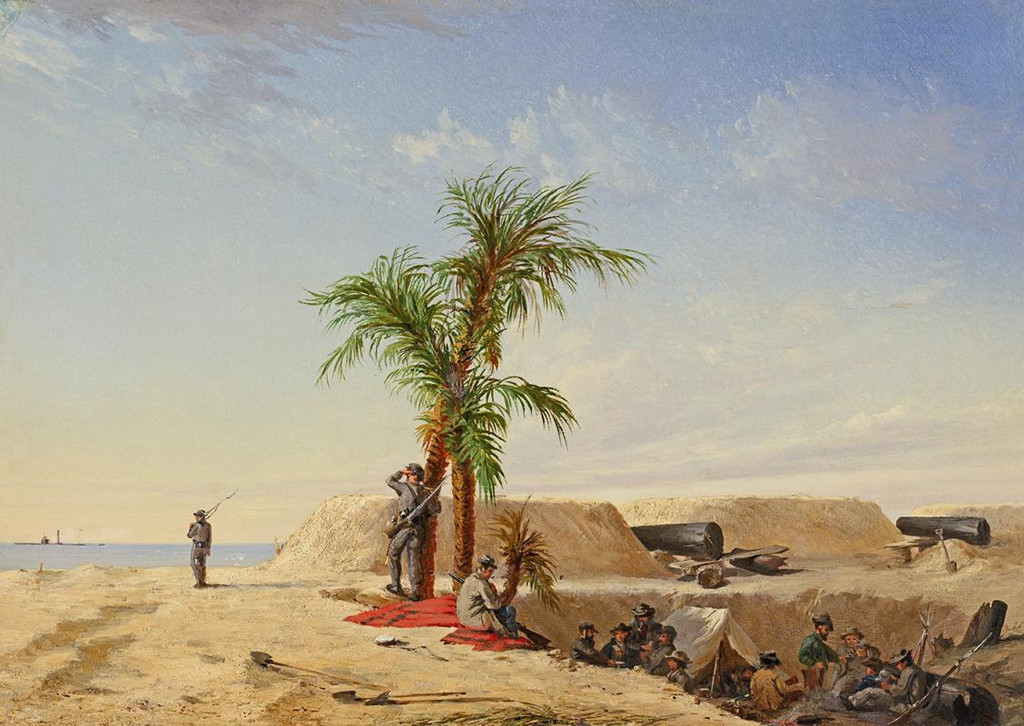
Quaker Battery, an imagined scene illustrating the use of wooden dummy guns. Soldiers occupy a sandy position beneath palms. Conrad Wise Chapman. American Civil War Museum; exhibition photography credited to Alan Thompson. Public-domain faithful reproduction.
Image source
.
Public domain
. Resized only; whole supplied image retained, with no appearance changes.
Larger canvases and later reconstruction
Bombardment of Fort Moultrie is a separate, much larger canvas at the Gibbes Museum. The museum dates it to 1864 and identifies the represented engagement as 16 November 1863. Its wide interior brings tents, protective banks and groups into a panoramic arrangement. [17]
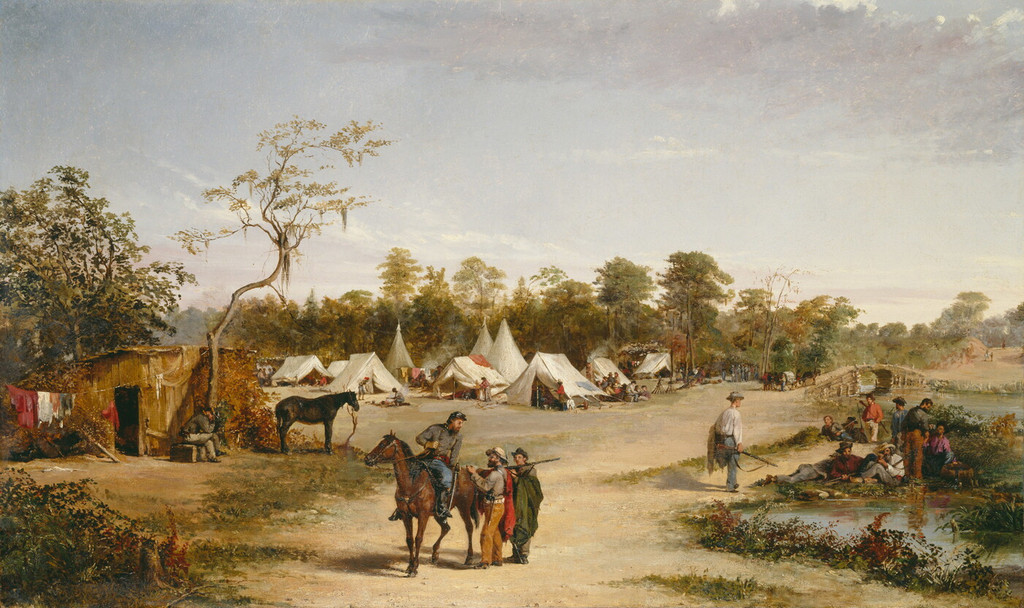
The Fifty-ninth Virginia Infantry painting at the Amon Carter Museum recalls a different military setting. Its inscription names Diascund Bridge in September 1863, while the museum dates the canvas to probably 1867. The camp scene therefore makes the interval between experience and finished picture especially clear. [18]
These objects extend the account beyond the small Charleston portfolio. Different supports, sizes and dates brought military material into different kinds of composition. They should be related through their subjects and working histories while remaining separate paintings with their own collection records.
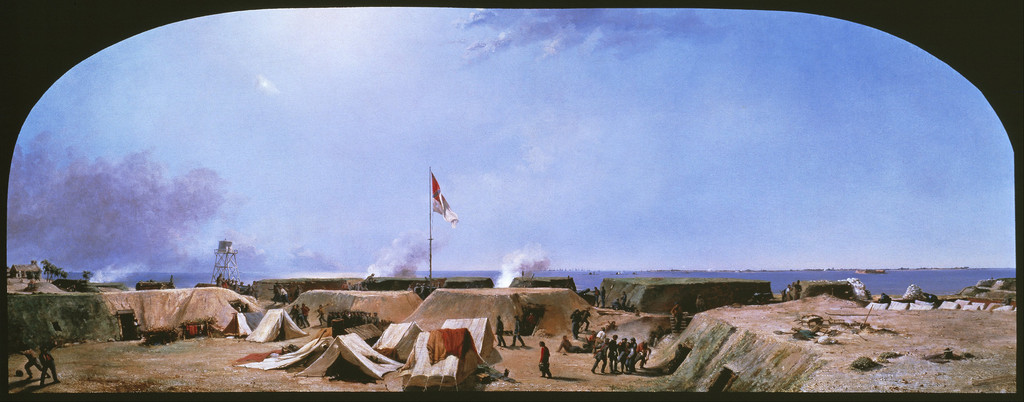
Bombardment of Fort Moultrie, 1864. The wide Gibbes canvas is separate from the small 31-picture portfolio. Conrad Wise Chapman, Bombardment of Fort Moultrie, 1864. Gibbes Museum of Art, 1981.012. Museum purchase with funds provided by Winnie Edwards Murray Fund. Public domain.
Image source
.
Public domain
. Resized only; whole supplied image retained, with no appearance changes.
Dates in titles and museum descriptions
A date attached to a picture can describe a scene, an originating study or the finished work. The distinction is particularly important in a series that developed from field material into paintings made elsewhere. A day in a title should be considered alongside the object’s recorded creation date, rather than standing in for the whole working history.
The wording of titles can also differ between institutions. The archived portfolio calls the Sumter sunrise scene December 9, 1864 , while Harvey’s Smithsonian discussion identifies it as December 9, 1863 . Both discuss the interior with workers and fires. The difference needs to remain visible when following the picture through the literature; it should not be resolved simply by copying one date into every account. [8] [19]
The short title Fort Sumter, Interior at Sunrise identifies the subject while allowing its dating to be discussed separately. An exact catalogue title is useful for locating a record, but the historical question of when a scene was observed still requires comparison with the artist’s movements and the finished painting’s making.
How to read the series together
Begin with viewpoint and scale. An interior brings the viewer among the effects of bombardment; a harbor prospect makes a network of positions legible; a close vessel picture encourages inspection of a particular machine. Then consider the work’s making, its attribution and the date attached to its scene.
Harvey’s Smithsonian discussion connects the Charleston pictures’ artistic construction with their Confederate purpose. Her reading keeps the circumstances of the commission alongside their formal accomplishment, including the resonance of ruined Sumter within Chapman’s Roman upbringing. [19]
The pictures belong in the wider history of American artists and the Civil War landscape and documentary traditions discussed under American Realism . Their most productive comparison begins with concrete choices: who is visible, where the spectator stands, which activities are selected and how later recollection changes the account of a painted view.
Artworks directory
Browse 46 works identified in the consulted collection and catalogue records, including all 31 pictures in the father-and-son Charleston portfolio. Six entries explicitly credit John Gadsby Chapman. Approximate 1864–65 labels describe the series period; dates within its titles describe scenes and sometimes conflict with other catalogues. Other dates identify the separate objects or commissions. Links open our article where available, or the cited record. This is a research-based directory, not a catalogue raisonné.
| Name | Date | Medium |
|---|---|---|
| Battery Chevis, Mar. 4, 1864 | Series, c. 1864–65; scene date in title where given | Painting |
| Forts Sumter & Johnson, Mar. 15, 1864 | Series, c. 1864–65; scene date in title where given | Painting |
| Entrance to Fort Sumter — John Gadsby Chapman, from Conrad’s studies | Series, c. 1864–65; scene date in title where given | Painting |
| White Point Battery Charleston, Dec. 24, 1863 | Series, c. 1864–65; scene date in title where given | Painting |
| Quaker Battery (imagined scene) | Series, c. 1864–65; scene date in title where given | Painting |
| Fort Moultrie, Nov. 11, 1863 | Series, c. 1864–65; scene date in title where given | Painting |
| Battery on Long Island, Dec. 4, 1863 | Series, c. 1864–65; scene date in title where given | Painting |
| Church Flat Camp, Dec. 10, 1864 | Series, c. 1864–65; scene date in title where given | Painting |
| Fort Johnson, Oct. 10, 1863 | Series, c. 1864–65; scene date in title where given | Painting |
| Battery Halston — John Gadsby Chapman, from Conrad’s studies | Series, c. 1864–65; scene date in title where given | Painting |
| Charleston Bay and City — John Gadsby Chapman, from Conrad’s studies | Series, c. 1864–65; scene date in title where given | Painting |
| Battery Marion, Nov. 4, 1863 | Series, c. 1864–65; scene date in title where given | Painting |
| Battery Marshall, Sullivan's Island, Dec. 4, 1863 | Series, c. 1864–65; scene date in title where given | Painting |
| The Flag of Sumter, Oct. 20, 1863 | 1863–64; scene 20 October 1863 | Painting |
| Battery Beauregard, Nov. 22, 1863 — John Gadsby Chapman, from Conrad’s studies | Series, c. 1864–65; scene date in title where given | Painting |
| Fort Moultrie, Interior, Sep. 16, 1863 (portfolio index entry) | Series, c. 1864–65; scene date in title where given | Painting |
| Battery Bee, Dec. 3, 1863 | Series, c. 1864–65; scene date in title where given | Painting |
| Battery Wampler, Mar. 4, 1864 | Series, c. 1864–65; scene date in title where given | Painting |
| Submarine Torpedo Boat H.L. Hunley, Dec. 6, 1863 | 1864; scene 6 December 1863 | Painting |
| Battery Simkins, Feb. 25, 1864 | Series, c. 1864–65; scene date in title where given | Painting |
| Fort Sumter [Gun Gallery], Dec. 8, 1863 | Series, c. 1864–65; scene date in title where given | Painting |
| Fort Sumter, Interior, Sunrise, Dec. 9, 1864 | 1864; published scene dates differ | Painting |
| Torpedo Boat David at Charleston Dock, Oct. 25, 1863 | 1864; scene 25 October 1863 | Painting |
| Federal Battery on Morris Island, Feb. 12, 1864 | Series, c. 1864–65; scene date in title where given | Painting |
| Fort Sumter from Moultrie, Nov. 10, 1863 | Series, c. 1864–65; scene date in title where given | Painting |
| Battery Marshall from Long Island, Nov. 18, 1863 | Series, c. 1864–65; scene date in title where given | Painting |
| Evening Gun, Fort Sumter — John Gadsby Chapman, from Conrad’s studies | Series, c. 1864–65; scene date in title where given | Painting |
| Battery Haskel, Mar. 4, 1864 — John Gadsby Chapman, from Conrad’s studies | Series, c. 1864–65; scene date in title where given | Painting |
| Battery Rutledge, Dec. 3, 1864 | Series, c. 1864–65; scene date in title where given | Painting |
| Night Bombardment, Dec. 10, 1864 | Series, c. 1864–65; scene date in title where given | Painting |
| Battery Laurens Street Charleston, Feb. 7, 1864 | Series, c. 1864–65; scene date in title where given | Painting |
| Bombardment of Fort Moultrie (Gibbes panorama) | 1864; scene 16 November 1863 | Oil on canvas |
| The Fifty-ninth Virginia Infantry—Wise’s Brigade | Probably 1867; scene September 1863 | Oil on canvas |
| Camp No. 2, Terrenos Baldios | 1860; setting unidentified | Oil on wood panel |
| Frattocchie | 1861 | Oil painting |
| French Encampment at Monterrey | 1865; described in historical catalogue essay | Painting |
| Vista de Monterrey | 1865 | Oil on paper |
| Valley of Mexico (Jolly commission) | 1865/66 commission; catalogue dates vary | Painting |
| Valle de México (Cisneros version) | 1870 | Oil on canvas |
| Important Panoramic View of the Valley of Mexico, San Angel | Executed 1866; reverse inscribed 1865 | Oil on canvas laid down on board |
| Valle de México (Alejandro Najera commission) | 1894 | Oil on canvas |
| Paisaje mexicano (Ajusco) | 1877 | Oil on canvas |
| México desde la hacienda de los Morales | 1896; photographed in 2023 | Painting |
| Monterrey desde el cerro de Chipinque | 1902; photographed in 2023 | Painting |
| Valley of Mexico (Valentine version) | 1902 | Oil on wood |
| Picket Post | 1863 | Engraving |
Frequently Asked Questions
Chapman called it an imagined scene explaining the use of wooden dummy guns. It should be read as an illustration of that practice. [16]
Discussion
Look again at the images and ideas explored in Conrad Wise Chapman’s Civil War Paintings. These editorial prompts invite your observations.
Reader Insights
Compare an interior, a harbor prospect and the reported telescopic view. How does access shape what each image can show?
What changes when the workers and repair tasks receive as much attention as guns, flags and military positions?
How does Quaker Battery help distinguish convincing depiction from a record of one observed event?
Join the Conversation
Share a detail, comparison or question about Conrad Wise Chapman’s Civil War Paintings below.
References
- American Civil War Museum , About the Artists, archived exhibition. Service, assignment and later painting in Rome. View source
- American Civil War Museum , The Man Behind the Mission, archived exhibition. Jordan, Gorgas and the commission’s administrative setting. View source
- American Civil War Museum , complete archived portfolio index. The 31-picture sequence. View source
- American Civil War Museum , Charleston Bay and City, archived entry. Father’s authorship of the finished work. View source
- American Civil War Museum , Entrance to Fort Sumter, archived entry. Father’s authorship and the sally-port scene. View source
- American Civil War Museum , Fort Moultrie, November 11, 1863, archived entry. Gathering sand for repairs. View source
- American Civil War Museum , Battery Marshall, Sullivan’s Island, archived entry. Breastworks and oversight. View source
- American Civil War Museum , Fort Sumter, Interior at Sunrise, archived entry. Workers, fires and sandbags. View source
- American Civil War Museum , The Flag of Sumter, archived entry. Sunset study and harbor setting. View source
- American Civil War Museum , Night Bombardment, archived entry. Calcium light and mail boat. View source
- American Civil War Museum , Federal Battery on Morris Island, archived entry. Retrospective account of telescopic observation from St. Michael’s Church. View source
- American Civil War Museum , Forts Sumter and Johnson, archived entry. Mail boat and repeated shelling. View source
- American Civil War Museum , Battery Marshall from Long Island, archived entry. Quiet interval, vessels and buildings. View source
- American Civil War Museum , Submarine Torpedo Boat H. L. Hunley, archived entry. Retrospective account, requiring comparison with vessel chronology. View source
- American Civil War Museum , Torpedo Boat David, archived entry. Repairs and the artist’s technological claim. View source
- American Civil War Museum , Quaker Battery, archived entry. Retrospective description of an imagined illustration. View source
- Gibbes Museum of Art , Bombardment of Fort Moultrie, partner catalogue. Separate large canvas, 1864, representing November 1863. View source
- Amon Carter Museum of American Art , The Fifty-ninth Virginia Infantry—Wise’s Brigade, 2001.7. Probably 1867 and the September 1863 inscription. View source
- Eleanor Harvey , The Civil War and American Art: A Confederate View, Smithsonian American Art Museum, 2013. Artistic construction, Confederate commission and Roman associations. View source
- Splash image source.
Fort Sumter, Interior at Sunrise. A damaged courtyard, standing water and workers near a fire give a close view of the occupied fort. Conrad Wise Chapman. American Civil War Museum; exhibition photography credited to Alan Thompson. Public-domain faithful reproduction. Public domain . Resized only; whole supplied image retained, with no appearance changes.
View source