 by
Tom Gurney
Tom Gurney BSc (Hons) is an art history expert with over 20 years experience
Email:
tomgurney1@gmail.com
/ Phone:
+44 7429 011000
Submarine Torpedo Boat H L Hunley: Introduction
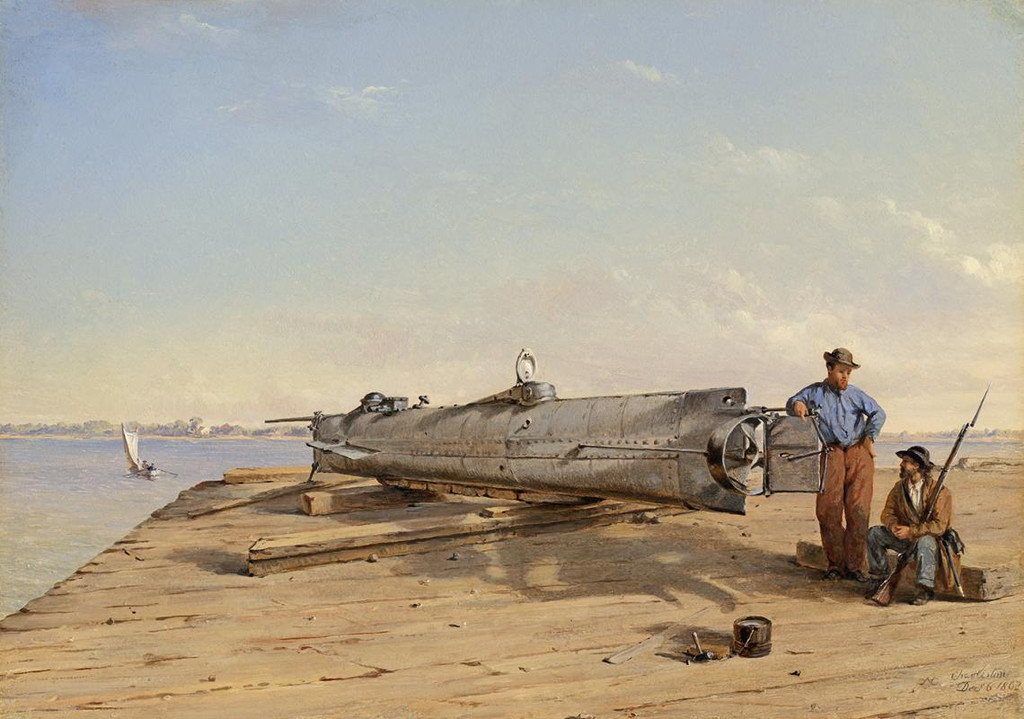
Conrad Wise Chapman’s painting of H. L. Hunley shows the submarine out of the water on a quiet shore. Its long, riveted hull stretches across the composition, with two men near the exposed propeller and small tools in the foreground. The stillness of the setting gives the vessel the appearance of an object available for inspection.
The picture represents a view dated 6 December 1863 and was painted in 1864. The American Civil War Museum’s catalogue number is 0985.14.00037a. Its carefully depicted exterior has made the painting valuable to later researchers, while Chapman’s retrospective description requires comparison with the vessel’s chronology. [1]
At a Glance
- Artist Conrad Wise Chapman.
- Created 1864.
- Represented view December 6, 1863.
- Medium Oil on board or panel.
- Dimensions Approximately 29.2 by 39.3 centimeters.
- Collection American Civil War Museum, 0985.14.00037a.
- Key distinction A detailed painting and a later recollection provide different kinds of evidence.
This work across Conrad Wise Chapman’s career
Camp No. 2, Terrenos Baldios
1860; setting unidentifiedThe Flag of Sumter
1863–64; scene 20 October 1863Bombardment of Fort Moultrie
1864; scene 16 November 1863Fort Sumter, Interior at Sunrise
1864; published scene dates differSubmarine Torpedo Boat H. L. Hunley (current article)
1864; scene 6 December 1863Torpedo Boat David at Charleston Dock
1864; scene 25 October 1863Valley of Mexico paintings
Separate versions, 1866–1902The Fifty-ninth Virginia Infantry—Wise’s Brigade
Probably 1867; scene September 1863Monterrey desde el cerro de Chipinque
1902; photographed in 2023Notes and sources
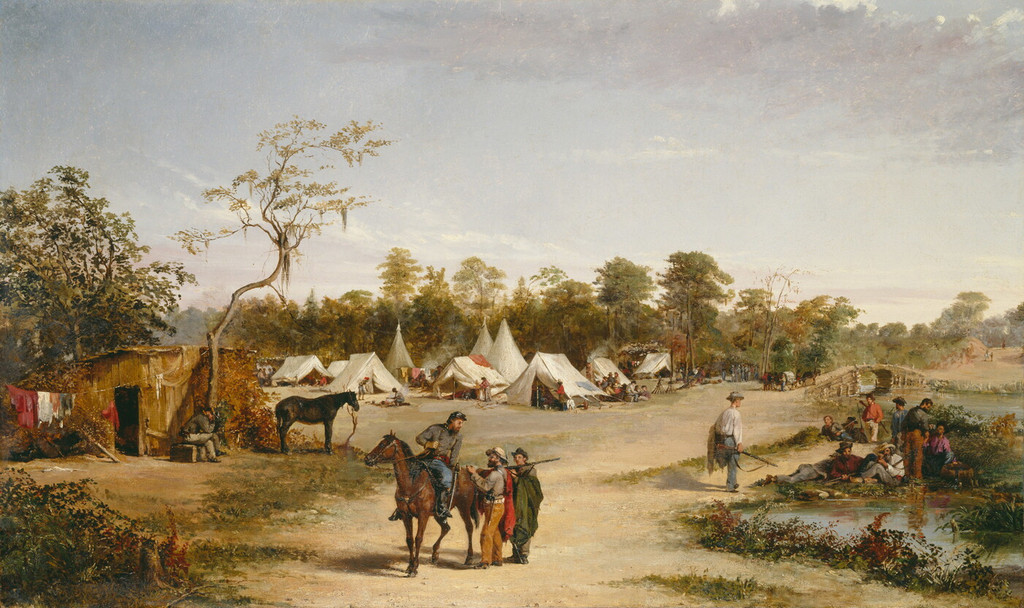
Camp No. 2, Terrenos Baldios. A framed oil study whose catalogue date does not identify it as a Mexican survey camp. [2]
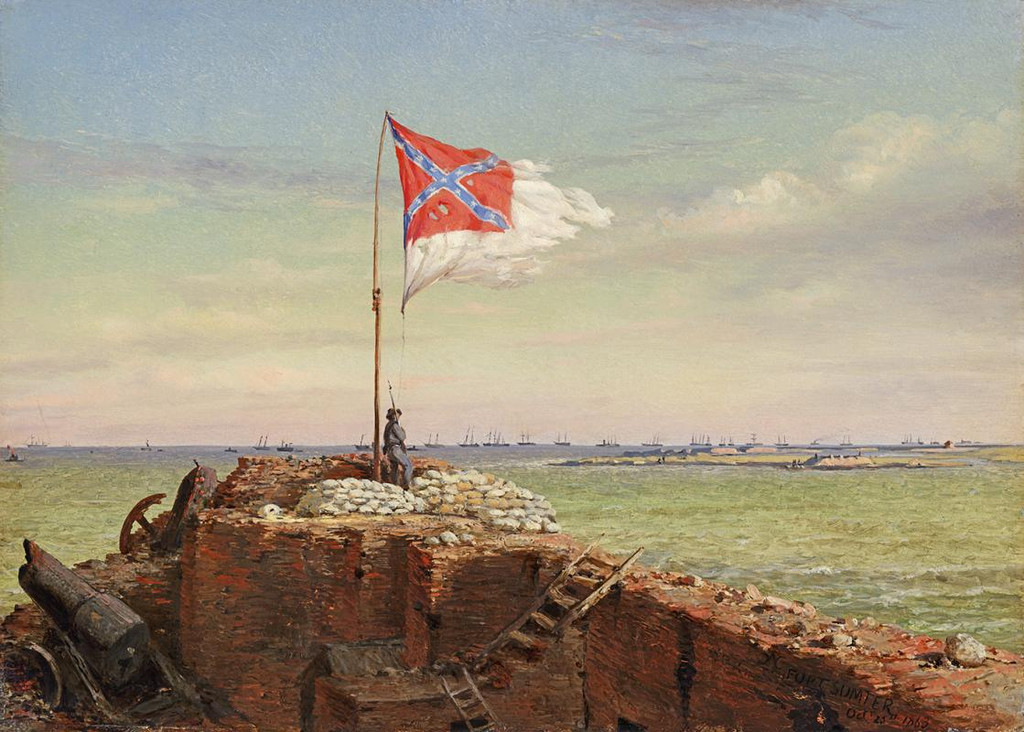
The Flag of Sumter. A flag and a solitary guard stand above the ruined wall in sunset light. [3]
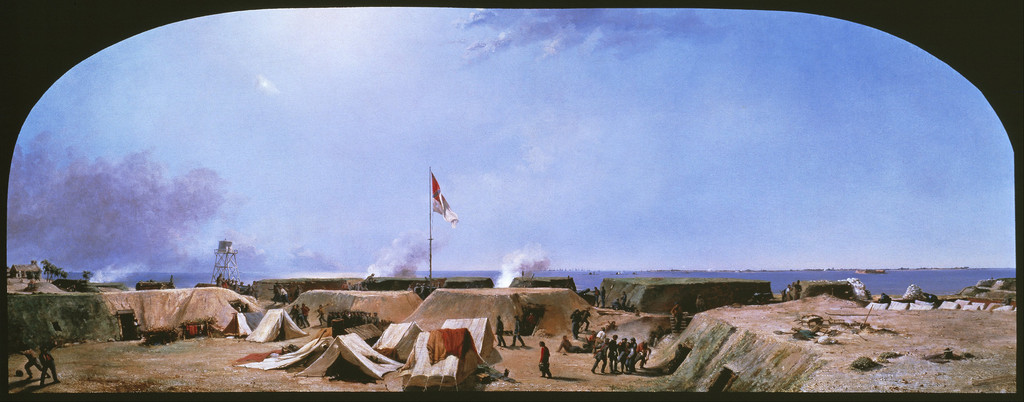
Bombardment of Fort Moultrie. The large Gibbes panorama opens the sandy fort interior to figures, tents and a broad sky. [4]
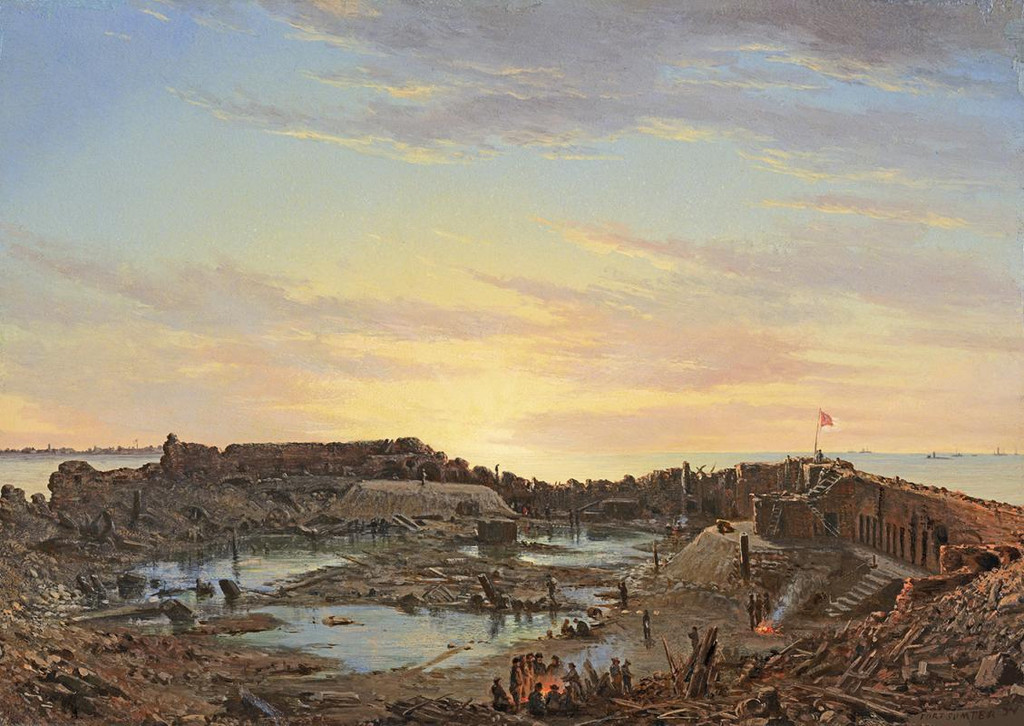
Fort Sumter, Interior at Sunrise. Workers, water and broken ground occupy the surviving courtyard; the article explains the conflicting scene dates. [5]
Submarine Torpedo Boat H. L. Hunley (current article). The beached hull and two men establish the scale of the small submarine. [1]
Torpedo Boat David at Charleston Dock. A low vessel, dock and exposed fittings bring military technology into a working waterfront. [6]
Valley of Mexico paintings. Compare individual studies and later versions. The date band groups several objects and does not indicate continuous work on one painting. [7] [8] [9] [10] [11]
The Fifty-ninth Virginia Infantry—Wise’s Brigade. A mounted figure, tents and a bridge organize a camp within a larger landscape. [12]
Monterrey desde el cerro de Chipinque. The photograph retains the frame and gallery setting of this later Monterrey painting. [13]
Contents
- The submarine on the shore
- Two figures and the scale of the machine
- A small panel and a long hull
- Tools on the ground
- The 1898 recollection
- Why the standing man cannot simply be named Hunley
- Sketch, scene and finished painting
- A picture compared with archaeological evidence
- The final mission and later recovery
- Annotated details
The submarine on the shore
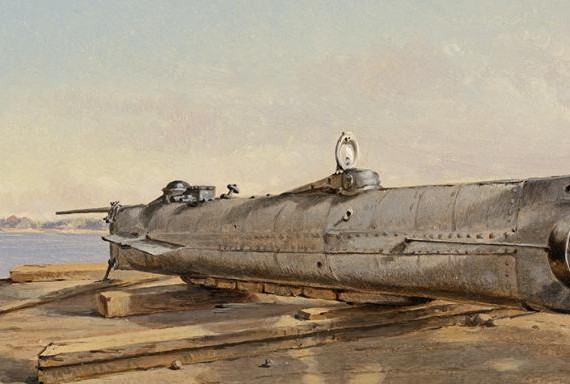
The vessel sits on supports above pale ground, with water extending behind it to the left. Its long horizontal form determines much of the picture’s organization. A raised hatch interrupts the upper contour near the center, while another appears farther toward the left.
Chapman has made the hull substantial through changes of tone and visible seams. Light catches parts of its curved surface, while darker passages define its underside and fittings. Rows of rivets and joined plates give the exterior a constructed character without requiring the viewer to see inside.
The shore also matters. It permits the whole side of the vessel to remain visible above the ground, unlike a view of the submarine in operation. The picture presents a machine between uses, where a spectator can look at its shape and external arrangements in relation to the people beside it.
Annotated Details from Submarine Torpedo Boat H L Hunley
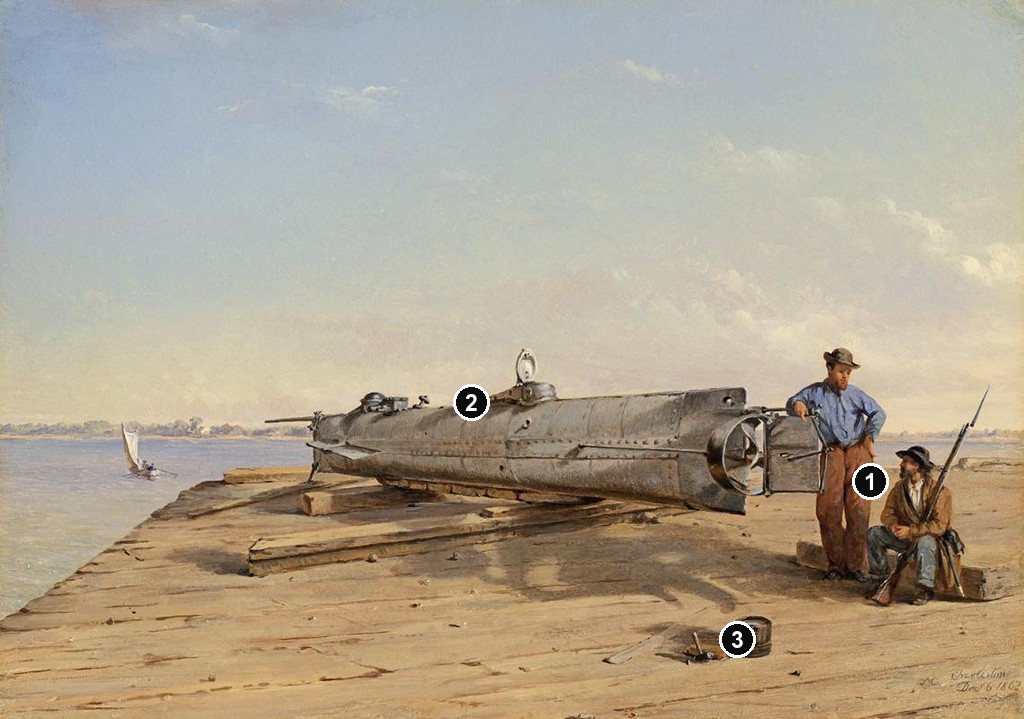
The numbered points identify visible features discussed in this article. Return from each detail to the whole composition. Submarine Torpedo Boat H. L. Hunley, painted in 1864 from a view titled December 6, 1863. The standing figure is not securely identified as Horace Hunley. Conrad Wise Chapman. American Civil War Museum; exhibition photography credited to Alan Thompson. Public-domain faithful reproduction. Image source. Public domain. Numbers added to this separate overview; cropped details are shown below. No recolouring, retouching or reconstruction.
Details from SUBMARINE TORPEDO BOAT H L HUNLEY
Compare the cropped details with the complete images above. Notice how their colours, shapes and positions contribute to the larger compositions.
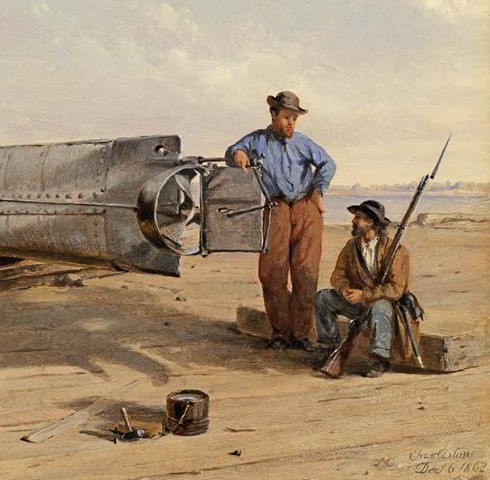
Two men beside the propeller
A standing man and seated armed guard give the hull a human scale. Their clear presence does not establish the standing man’s name; the article explains the problem with the later identification.
Raised openings along the hull
Two openings interrupt the vessel’s long upper edge. The pale raised hatch catches the light above the darker body, making the top of the small submarine easier to follow.
Supports and tools on the shore
Timber supports, scattered tools and a small pot connect the vessel with work on land. Their irregular arrangement contrasts with the continuous curve of the metal hull.
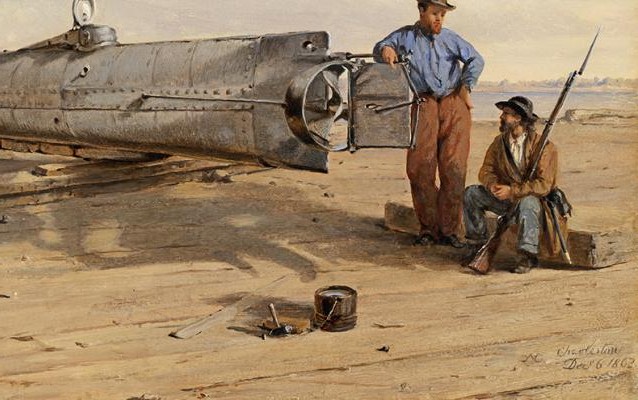
Two figures and the scale of the machine
A standing man rests one arm near the submarine’s stern, with a seated armed figure close to him. Their placement gives the large metal object a human scale. The long hull can be judged against the height of the standing body and the smaller seated posture.
The difference between their stances introduces a relaxed rhythm at the right of the picture. One figure extends upward, while the other gathers close to the ground. Their proximity gives this end of the vessel a social as well as a mechanical presence, balancing the emptier space along the shore to the left.
Neither figure is shown operating the submarine. Their presence makes a guarded or supervised interval legible, while the exposed propeller and supports encourage examination of the vessel as an object. The picture’s quiet appearance should be considered alongside the dangerous testing and operation recorded in its history.
A small panel and a long hull
The painting measures approximately 29.2 by 39.3 centimeters and is recorded as oil on panel. Its physical scale is modest, while the depicted submarine occupies much of the available width. The object record therefore helps explain the concentration of its design: the long hull and nearby figures have to remain legible within a relatively compact surface. [14]
The low shore leaves space around the machine rather than enclosing it within a crowded workshop. The light ground separates its darker underside from the foreground, and the pale sky permits the raised fittings to interrupt a simple background. Those choices make the exterior easier to follow as a continuous form, from the tapered left end to the exposed machinery beside the men.
Tools on the ground
A small dark container and tools occupy the near foreground, below the figures. These objects bring the scale of attention down from the whole vessel to things handled in working around it. They also give the relatively empty shore a more particular use.
The scattered items provide a different kind of detail from the hull’s repeated seams. Rivets establish the constructed surface of the machine; small objects near the men connect it with practical activity at human scale. Their presence makes the quiet interval feel occupied without requiring the painting to show every task or identify a particular repair. The viewer can consider the vessel as something built, tended and examined as well as operated.
The 1898 recollection
Chapman’s later description identifies the standing man as Hunley and the other as a sentry. It also tells a story of earlier crew losses, a word painted on the boat and a final departure from which it did not return. The account is dramatic, but it was written in 1898, decades after the represented view. [15]
That distance makes comparison essential. A later caption can preserve useful information about place and objects while mixing those details with recollection of events learned at other times. Its interpretation of a figure does not acquire certainty simply because the painting itself is visually specific.
The two men can therefore be described by their appearance and positions without assigning the standing figure a secure name. The distinction preserves what is visible while allowing the historical identification to remain a separate question.
Why the standing man cannot simply be named Hunley
The Friends of the Hunley dates Horace Hunley’s death to the submarine’s second fatal sinking, on 15 October 1863. That event preceded the December date attached to Chapman’s view. The chronology conflicts with the 1898 caption’s identification of him as a man present in the represented December scene. [16]
The same museum account records survivors of the first sinking on 29 August. Chapman’s later statement that the boat returned from both earlier occasions with everyone dead consequently compresses the history inaccurately. The first accident killed five members of the crew, while three survived. [16]
These discrepancies matter because the image is so often treated as a straightforward illustration of the submarine. A convincing hull and a confident later caption do not provide identical evidence. The painting can remain useful for the vessel’s appearance while the figure identification and summarized accident narrative are qualified.
Sketch, scene and finished painting
The oil painting belongs to Chapman’s Charleston project. The museum’s biography connects his military assignment with sketches made at the defenses and paintings subsequently developed in Rome. Its account locates studio work after the immediate activity of recording sites and equipment. [17]
The 1998 H. L. Hunley Site Assessment identifies a sketch made while the vessel was dry-docked on 2 December 1863 as the basis of the later painting associated with December 6. This is the assessment’s account of the relationship between study and picture, not a claim that the finished panel was completed on the shore. [18]
The title’s day, the study’s reported date, the painting’s 1864 creation and the 1898 description belong to different stages. Keeping them separate clarifies how an image based on wartime access became a finished work and then acquired a retrospective narrative.
Watch: Conrad Wise Chapman
Two Spanish-language museum films explore Chapman and his views of Mexico.
#ElSoumayaEnCasa | Conrad Wise Chapman
Museo Soumaya introduces Chapman and his work. This museum presentation is in Spanish.
Watch on YouTubeA picture compared with archaeological evidence
The 1998 assessment treats Chapman’s depiction as an important record of the submarine’s general form. It discusses features including hatches, the snorkel box and the hull, while considering discrepancies in the torpedo arrangement and a depicted cutwater. The evaluation is specifically that of a historical archaeological report preceding the vessel’s recovery. [18]
The comparison illustrates a productive use of painted evidence. A researcher can ask whether a feature is present, how it is positioned and whether another kind of record supports it. The answer may vary from one part of the image to another. General usefulness does not require every visible fitting to become an exact specification.
The painting’s viewpoint also establishes limits. It makes an exterior available for study, including parts easier to see while the vessel is ashore. It does not reveal the whole interior or demonstrate every mechanism’s operation. Those questions require evidence beyond the painted surface.
The final mission and later recovery
On 17 February 1864, Hunley attacked and sank the Union blockading ship USS Housatonic . The submarine and its crew were also lost. The National Park Service’s account places the subsequent recovery on 8 August 2000 and describes the move to the Warren Lasch Conservation Center for controlled excavation and conservation. [19]
The Friends of the Hunley’s timeline distinguishes the 1995 discovery from the 2000 raising. Those later events changed the kinds of evidence available to researchers. Before recovery, the vessel had to be approached through historical accounts, images and underwater investigation; the recovered object made further physical examination possible. [20]
That chronology also gives the 1998 assessment a defined place. Its comparisons record an important stage of research, rather than a final account of all subsequent findings. The painting’s historical role can be followed through those changes in access to the submarine itself.
The painting and explanations of the loss
In a 2017 Hagley article, engineer Rachel Lance described the archival and experimental work behind her interpretation that blast effects caused the crew’s deaths. Her account identifies the study of historical black powder as part of that research. This is a dated explanation advanced by a particular researcher. [1]
Chapman’s painting cannot by itself settle the cause of the loss. The quiet exterior on the shore represents an earlier interval, and its visible fittings supply only part of the information needed for that question. Its importance lies in the way it can be compared with other records and with the recovered vessel.
Keeping those roles distinct prevents a familiar image from being asked to prove more than it shows. It offers a view of the submarine’s appearance, a composition involving figures and machinery, and an object with its own making and later descriptions. Each role contributes something different.
Hunley beside David
Torpedo Boat David gives another vessel a different working setting. David appears low in the water at a dock, surrounded by timber, sheds and people. Chapman’s description associates it with repairs and new plates. [21]
The two pictures are particularly revealing in comparison. Hunley’s exposed hull is available for inspection against an open shore; David is embedded within a more crowded workplace. Human figures establish scale in both, while supports, plates and surrounding materials connect the machines with practical work.
The Civil War paintings article follows these subjects within the larger Charleston commission. Their documentary value is strongest when the visible details, later captions and independent chronology remain distinguishable throughout the reading.
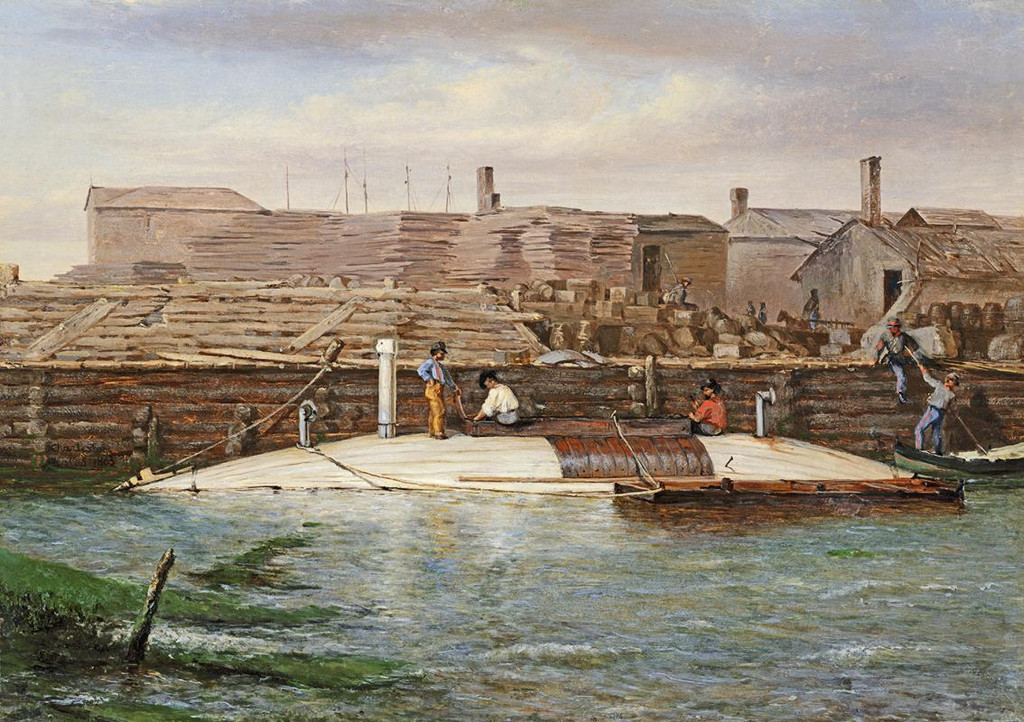
Torpedo Boat David at Charleston Dock. A separate vessel shown low in the water within a working dock. Conrad Wise Chapman. American Civil War Museum; exhibition photography credited to Alan Thompson. Public-domain faithful reproduction.
Image source
.
Public domain
. Resized only; whole supplied image retained, with no appearance changes.
Artworks directory
Browse 46 works identified in the consulted collection and catalogue records, including all 31 pictures in the father-and-son Charleston portfolio. Six entries explicitly credit John Gadsby Chapman. Approximate 1864–65 labels describe the series period; dates within its titles describe scenes and sometimes conflict with other catalogues. Other dates identify the separate objects or commissions. Links open our article where available, or the cited record. This is a research-based directory, not a catalogue raisonné.
| Name | Date | Medium |
|---|---|---|
| Battery Chevis, Mar. 4, 1864 | Series, c. 1864–65; scene date in title where given | Painting |
| Forts Sumter & Johnson, Mar. 15, 1864 | Series, c. 1864–65; scene date in title where given | Painting |
| Entrance to Fort Sumter — John Gadsby Chapman, from Conrad’s studies | Series, c. 1864–65; scene date in title where given | Painting |
| White Point Battery Charleston, Dec. 24, 1863 | Series, c. 1864–65; scene date in title where given | Painting |
| Quaker Battery (imagined scene) | Series, c. 1864–65; scene date in title where given | Painting |
| Fort Moultrie, Nov. 11, 1863 | Series, c. 1864–65; scene date in title where given | Painting |
| Battery on Long Island, Dec. 4, 1863 | Series, c. 1864–65; scene date in title where given | Painting |
| Church Flat Camp, Dec. 10, 1864 | Series, c. 1864–65; scene date in title where given | Painting |
| Fort Johnson, Oct. 10, 1863 | Series, c. 1864–65; scene date in title where given | Painting |
| Battery Halston — John Gadsby Chapman, from Conrad’s studies | Series, c. 1864–65; scene date in title where given | Painting |
| Charleston Bay and City — John Gadsby Chapman, from Conrad’s studies | Series, c. 1864–65; scene date in title where given | Painting |
| Battery Marion, Nov. 4, 1863 | Series, c. 1864–65; scene date in title where given | Painting |
| Battery Marshall, Sullivan's Island, Dec. 4, 1863 | Series, c. 1864–65; scene date in title where given | Painting |
| The Flag of Sumter, Oct. 20, 1863 | 1863–64; scene 20 October 1863 | Painting |
| Battery Beauregard, Nov. 22, 1863 — John Gadsby Chapman, from Conrad’s studies | Series, c. 1864–65; scene date in title where given | Painting |
| Fort Moultrie, Interior, Sep. 16, 1863 (portfolio index entry) | Series, c. 1864–65; scene date in title where given | Painting |
| Battery Bee, Dec. 3, 1863 | Series, c. 1864–65; scene date in title where given | Painting |
| Battery Wampler, Mar. 4, 1864 | Series, c. 1864–65; scene date in title where given | Painting |
| Submarine Torpedo Boat H.L. Hunley, Dec. 6, 1863 | 1864; scene 6 December 1863 | Painting |
| Battery Simkins, Feb. 25, 1864 | Series, c. 1864–65; scene date in title where given | Painting |
| Fort Sumter [Gun Gallery], Dec. 8, 1863 | Series, c. 1864–65; scene date in title where given | Painting |
| Fort Sumter, Interior, Sunrise, Dec. 9, 1864 | 1864; published scene dates differ | Painting |
| Torpedo Boat David at Charleston Dock, Oct. 25, 1863 | 1864; scene 25 October 1863 | Painting |
| Federal Battery on Morris Island, Feb. 12, 1864 | Series, c. 1864–65; scene date in title where given | Painting |
| Fort Sumter from Moultrie, Nov. 10, 1863 | Series, c. 1864–65; scene date in title where given | Painting |
| Battery Marshall from Long Island, Nov. 18, 1863 | Series, c. 1864–65; scene date in title where given | Painting |
| Evening Gun, Fort Sumter — John Gadsby Chapman, from Conrad’s studies | Series, c. 1864–65; scene date in title where given | Painting |
| Battery Haskel, Mar. 4, 1864 — John Gadsby Chapman, from Conrad’s studies | Series, c. 1864–65; scene date in title where given | Painting |
| Battery Rutledge, Dec. 3, 1864 | Series, c. 1864–65; scene date in title where given | Painting |
| Night Bombardment, Dec. 10, 1864 | Series, c. 1864–65; scene date in title where given | Painting |
| Battery Laurens Street Charleston, Feb. 7, 1864 | Series, c. 1864–65; scene date in title where given | Painting |
| Bombardment of Fort Moultrie (Gibbes panorama) | 1864; scene 16 November 1863 | Oil on canvas |
| The Fifty-ninth Virginia Infantry—Wise’s Brigade | Probably 1867; scene September 1863 | Oil on canvas |
| Camp No. 2, Terrenos Baldios | 1860; setting unidentified | Oil on wood panel |
| Frattocchie | 1861 | Oil painting |
| French Encampment at Monterrey | 1865; described in historical catalogue essay | Painting |
| Vista de Monterrey | 1865 | Oil on paper |
| Valley of Mexico (Jolly commission) | 1865/66 commission; catalogue dates vary | Painting |
| Valle de México (Cisneros version) | 1870 | Oil on canvas |
| Important Panoramic View of the Valley of Mexico, San Angel | Executed 1866; reverse inscribed 1865 | Oil on canvas laid down on board |
| Valle de México (Alejandro Najera commission) | 1894 | Oil on canvas |
| Paisaje mexicano (Ajusco) | 1877 | Oil on canvas |
| México desde la hacienda de los Morales | 1896; photographed in 2023 | Painting |
| Monterrey desde el cerro de Chipinque | 1902; photographed in 2023 | Painting |
| Valley of Mexico (Valentine version) | 1902 | Oil on wood |
| Picket Post | 1863 | Engraving |
Frequently Asked Questions
The oil painting dates to 1864. Its title identifies a view of December 6, 1863. [1]
It gives a detailed exterior view that can be compared with other descriptions and physical evidence. The 1998 assessment found it useful while discussing particular discrepancies. [18]
Discussion
Look again at the images and ideas explored in Submarine Torpedo Boat H L Hunley. These editorial prompts invite your observations.
Reader Insights
Which exterior features would be most useful to compare with archaeological evidence, and what can the painting not show?
How does the difference between the 1898 caption and the vessel chronology change your confidence in the figure identification?
Compare the open shore with David’s crowded dock. How does the setting affect your attention to each machine?
Join the Conversation
Share a detail, comparison or question about Submarine Torpedo Boat H L Hunley below.
References
- Rachel Lance , How Historical Research Helped Solve a Civil War Submarine Mystery, Hagley Museum and Library, 2017. Painting caption, 1864 creation, ACWM catalogue number and the author’s dated research account. View source
- Camp No. 2, Terrenos Baldios, y1970-114. View source
- The Civil War and American Art, 2013 exhibition press release. View source
- Bombardment of Fort Moultrie, Charleston Harbor, South Carolina. View source
- The Civil War and American Art: A Confederate View. View source
- Conrad Wise Chapman - Torpedo Boat David at Charleston Dock, Oct. 25, 1863.jpg. View source
- Father and Son: The Works of John Gadsby Chapman and Conrad Wise Chapman. View source
- Important Panoramic View of the Valley of Mexico, San Angel,2024lot38. View source
- Valle de México (1870). View source
- Valle de México (1894), lot4010480. View source
- México desde la hacienda de los Morales (1896), MIB photograph01. View source
- The Fifty-ninth Virginia Infantry—Wise’s Brigade,2001.7. View source
- Monterrey desde el cerro de Chipinque (1902), MIB photograph01. View source
- Wikimedia Commons , exact ACWM-derived Hunley file record. Object support, dimensions and collection. The file’s conflicting inscription transcription is not treated as an authenticated date reading. View source
- American Civil War Museum , Hunley, archived portfolio entry. The artist’s 1898 recollection and its figure identification. View source
- Friends of the Hunley , The H. L. Hunley’s Sinkings. August survivors and Horace Hunley’s death in October 1863. View source
- American Civil War Museum , About the Artists, archived exhibition. Assignment, sketches and later work in Rome. View source
- Larry E. Murphy , editor, H. L. Hunley Site Assessment, 1998, consulted historical and comparison passages, particularly pp. 73–74 and 80. Sketch chronology, the painting’s usefulness and specific discrepancies; an assessment preceding recovery. View source
- National Park Service , Save America’s Treasures Grant—H. L. Hunley Submarine, updated April 12, 2024. Housatonic attack, recovery and conservation setting. View source
- Friends of the Hunley , Timeline. Mission, discovery and raising dates. View source
- American Civil War Museum , Torpedo Boat David, archived entry. Repair activity and separate vessel subject. View source
- Splash image source.
Submarine Torpedo Boat H. L. Hunley, painted in 1864 from a view titled December 6, 1863. The standing figure is not securely identified as Horace Hunley. Conrad Wise Chapman. American Civil War Museum; exhibition photography credited to Alan Thompson. Public-domain faithful reproduction. Public domain . Resized only; whole supplied image retained, with no appearance changes.
View source