


 by
Tom Gurney
Tom Gurney BSc (Hons) is an art history expert with over 20 years experience
Email:
tomgurney1@gmail.com
/ Phone:
+44 7429 011000
George Caleb Bingham: Introduction
George Caleb Bingham (1811–1879) painted people making a life together: boatmen sharing a tune, neighbours weighing an argument, a crowd waiting to learn who had won an election. His most familiar pictures turn the rivers and small communities of nineteenth-century Missouri into carefully arranged scenes of work, leisure and public behaviour. He also spent much of his career painting individual portraits, earning a living through likenesses alongside the narrative subjects for which he is best known. [1] [2]
These paintings often seem immediately readable. A raised hand belongs to a speech or a dance; a tilted head signals attention; a relaxed body suggests a pause in work. Yet the relationships are less simple than the first impression. The same crowd can suggest confidence in public life and reveal its exclusions. A peaceful river can provide a setting for people whose livelihoods were changing. An apparently spontaneous group can have been assembled through separate drawings and deliberate revisions. [3] [4]
Bingham rewards looking at both levels. We can enjoy the dancer, the sunlight and the individuality of a face while asking how those details shape a picture of American society. His people have a striking physical presence, but the scenes are composed images, with choices about who occupies the centre, who looks out at us and who remains at the edge.
At a Glance
- Lived 1811–1879 [1]
- Principal setting Missouri and its rivers and communities [1]
- Subjects Portraits, river scenes, elections and historical drama [2]
- Working methods Figure studies, carefully arranged groups and reproductive prints [3]
George Caleb Bingham in context
Bars show approximate historical periods. c. means circa (about).
Hudson River School
c. 1825–1880 [25]American genre painting
c. 1830–1880 [26]The genre-painting range marks a period of nineteenth-century prominence; the genre continued beyond it. Other subjects and practices are retained in Notes and sources.
Notes and sources
Hudson River School. A parallel mid-century landscape community. New York landscape painters offered another approach to American subjects. Their school provides contemporary context rather than a membership label for Bingham. [6] [5]
American genre painting. Public audiences from about 1830. Scenes of daily life reached broader exhibition audiences. Bingham’s river groups belong within this field. [5] [3]
Each bar runs from the artist’s birth to their death.
William Sidney Mount
1807–1868 · Birth–death [27]George Caleb Bingham
1811–1879 · Birth–death [28]Emanuel Leutze
1816–1868 · Birth–death [29]Winslow Homer
1836–1910 · Birth–death [30]Notes and sources
William Sidney Mount. Cider Making, 1840–41. Mount’s rural subjects offer a contemporary comparison within American genre painting. This comparison does not imply personal contact. [5]
George Caleb Bingham. Missouri river scenes and political gatherings. Explore selected paintings across his career. [3] [4]
Emanuel Leutze. Düsseldorf, 1856. Leutze welcomed Bingham to Düsseldorf, where Bingham painted Jolly Flatboatmen in Port. [3]
Winslow Homer. The Veteran in a New Field, 1865. Homer offers a later example of everyday subjects bearing the weight of national experience. [5]
The Jolly Flatboatmen
1846; NGA canvasThe County Election
1851–52 original; 1852 replica illustratedCanvassing for a Vote
1852; signed canvasStump Speaking
1853–54The Verdict of the People
1854–55Order No. 11: Martial Law
1865–68; Cincinnati originalNotes and sources
Fur Traders Descending the Missouri. Dates identify the canvas discussed in the article. [7]
The Jolly Flatboatmen. Dates identify the canvas discussed in the article. [8]
Raftsmen Playing Cards. Dates identify the canvas discussed in the article. [9]
Mississippi Boatman. Dates identify the canvas discussed in the article. [10]
The County Election. The original is 124:1944; the illustrated 1852 replica is 44:2001. Their dimensions and acquisition histories differ. [11] [12]
Daniel Boone Escorting Settlers through the Cumberland Gap. Dates identify the canvas discussed in the article. [13]
Canvassing for a Vote. Dates identify the canvas discussed in the article. [14]
Stump Speaking. Dates identify the canvas discussed in the article. [15]
The Verdict of the People. Dates identify the canvas discussed in the article. [16]
Jolly Flatboatmen in Port. Dates identify the canvas discussed in the article. [17]
Order No. 11: Martial Law. Dates identify the canvas discussed in the article. [18]
Bingham’s artistic connections
Artists, a patron and a publishing institution helped his compositions develop and circulate.
- Emanuel Leutze: Leutze welcomed Bingham to Düsseldorf during his European residence. This contact places an American river subject within an international working environment. [3]
- Thomas Doney: Doney translated The Jolly Flatboatmen into a reproductive print. Surviving impressions distinguish the painted composition from its later form on paper. [19]
- James S. Rollins: Bingham discussed the progress, printing plans and finance of Stump Speaking in his letter to Rollins. The document joins artistic ambition to practical support. [20] [3]
- American Art-Union: The Art-Union purchased paintings and circulated prints to subscribers, helping Bingham’s river compositions reach audiences beyond the original canvases. [3]
Contents
- A career between Missouri and national audiences
- River pictures: stillness, labour and company
- Elections and the boundaries of citizenship
- Portraits and the making of historical drama
- Drawing, repetition and the museum view
- Where to begin with Bingham
A career between Missouri and national audiences
Born in Virginia in 1811, Bingham moved with his family to Missouri in 1819. His early development included an apprenticeship to cabinetmakers and the gradual establishment of a portrait practice. He learned through looking, making and encounters with other artists, rather than following one continuous course of academic training. Visits to eastern cities and a period in Washington broadened the professional world available to a painter working from Missouri. [1] [4]
The connection between a regional base and a wider audience became central to his career. The communities and river traffic around him supplied recognisable subjects, while institutions, dealers and exhibitions elsewhere helped determine how those subjects travelled. The American Art-Union in New York purchased his pictures and distributed reproductive prints, placing scenes associated with the West before viewers who might never encounter those places themselves. [4]
This exchange matters when considering the idea of Bingham as a painter of frontier life. He knew Missouri closely, but a painting intended for a distant public had to make its people and actions intelligible. Clothes, poses, expressions and the spacing between bodies helped turn an observed individual into a figure who could carry a story. Conrads’s account of his figure studies shows how much attention he gave to these distinctions. [4]
He was also a participant in the political life he represented. After a contested election in 1846, he won a seat in Missouri’s legislature in 1848. Later public service and the Civil War brought other demands and subjects. His pictures of citizenship consequently belong beside a complex personal political history, rather than an assumption that he watched public affairs from a comfortable distance. [4] [21]
European travel added another dimension. Bingham worked in Düsseldorf during the later 1850s, carrying American subjects into a different artistic environment. The detailed biography follows these journeys, changes of residence and public roles. Across them, portraiture remained a continuing profession, while the river and political pictures formed particularly concentrated bodies of work. [4]
Four stages of George Caleb Bingham’s career
These periods group related developments; painting, travel and local work overlap across their boundaries.
A profession established in Missouri
A Virginia childhood was followed by life in Missouri, an apprenticeship and portrait commissions. Travel east broadened Bingham’s professional opportunities before his best-known river paintings. [1]
Groups of people for a wider public
River scenes and election crowds became major subjects. The Art-Union and reproductive printmaking helped compositions travel beyond Missouri, while Bingham participated in electoral politics. [4]
American subjects painted abroad
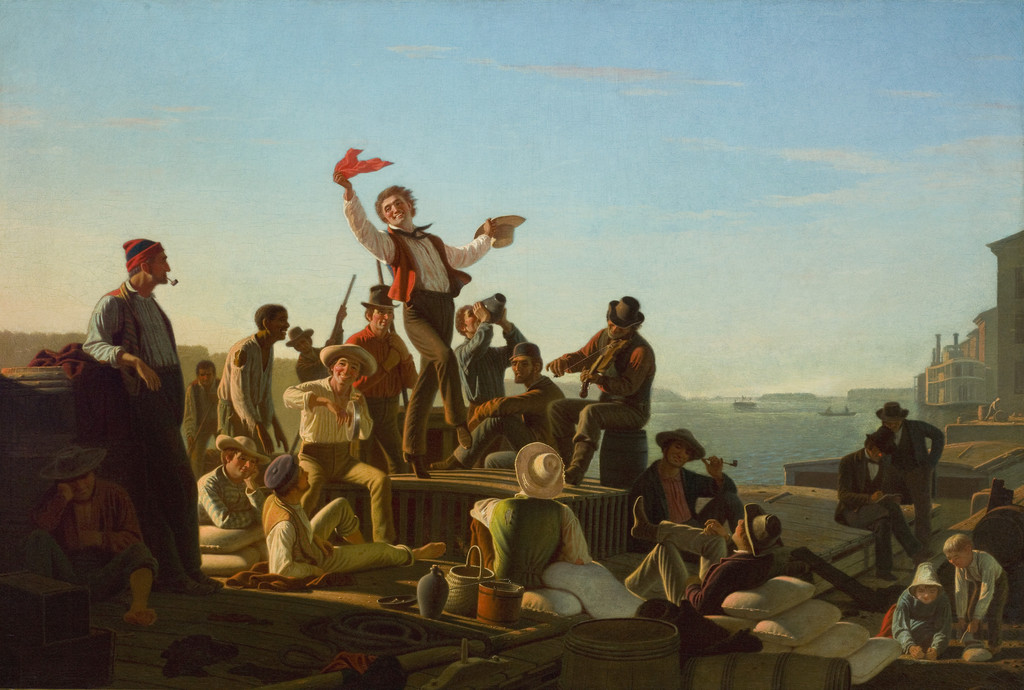
Bingham travelled to Europe in 1856 and worked in Düsseldorf, where he made Jolly Flatboatmen in Port. He returned to Missouri in 1859 and continued portraiture alongside public service. [3]
Public argument, portraits and teaching
Civil War service and the civilian removals ordered in 1863 supplied the background to Order No. 11. Portrait commissions, further public roles and teaching continued in his later life. [1]
River pictures: stillness, labour and company
Fur Traders Descending the Missouri , painted in 1845, places a long, low boat beneath a great expanse of pale sky. Two figures, a dark animal and their belongings occupy a narrow band near the bottom. Reflections repeat the boat’s forms, while a partly submerged branch interrupts the water in front. The apparent simplicity gives each small change in direction or expression unusual weight. [7]
The men’s presence keeps the image from becoming an empty landscape. One sits upright with a paddle; the younger figure leans across the bundled cargo. Both turn towards the viewer, creating a relationship across the surface of the river. Looking at their faces, we are also made aware of our own position outside the boat, observing people whose exchange with one another remains largely unexplained.
The work’s history complicates the familiar title. Its earlier title identified a French trader and a son of mixed ancestry, using racial language now recognised as offensive. The Art-Union changed it to the more general description by which the painting is known. That change affects what viewers are prompted to notice: an economic activity can move into the foreground while a specific relationship between people becomes less explicit. The Met’s account and Scott Manning Stevens’s Native perspective give this distinction particular importance. [7] [22]
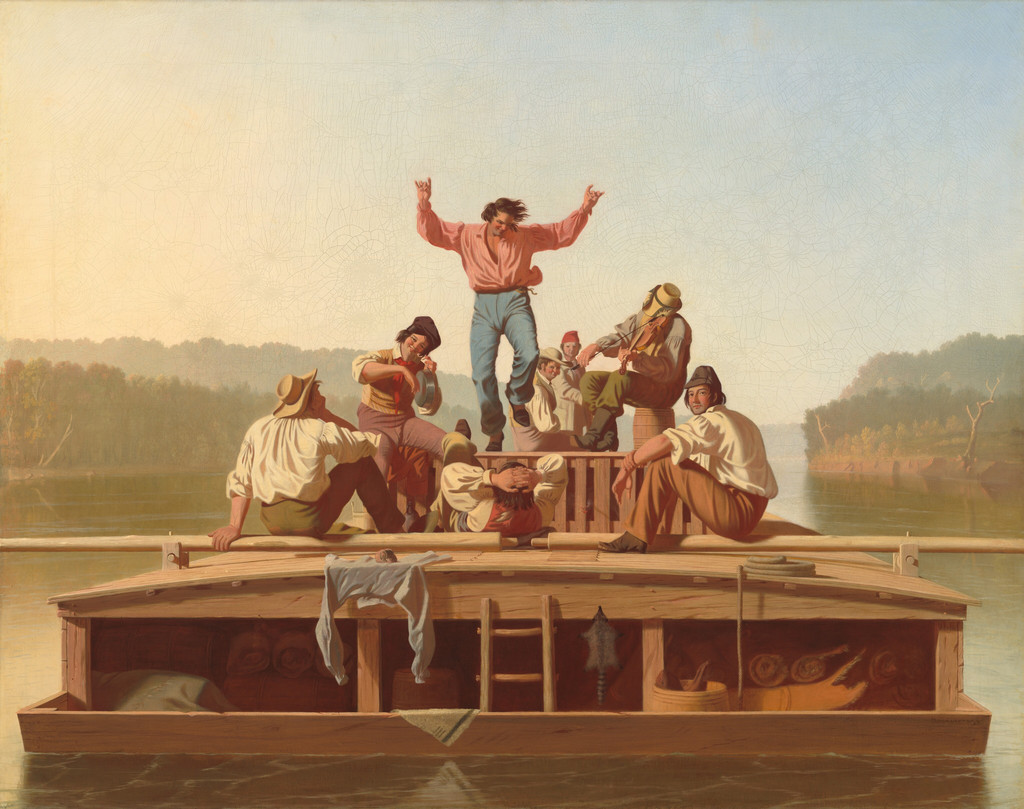
The Jolly Flatboatmen offers a different rhythm. In the 1846 painting, a dancer stands above a group of musicians and companions. His raised arms and lifted body break the quieter lines of the seated figures, yet the whole group remains firmly organised within the boat. The contrast between an animated centre and stable surrounding forms helps make the pleasure of the scene immediately visible. [8]
Elsewhere, Bingham brings attention closer to one body or a smaller exchange. Mississippi Boatman confronts us with an isolated working figure. Raftsmen Playing Cards concentrates on a group absorbed in a game and rest. The paintings vary the relation between looking out, watching another person and withdrawing from shared activity. The surviving drawings show that particular poses could return in another composition, with changes that altered their effect. [3]
The river pictures therefore offer more than a picturesque record of transport. They make different kinds of human company visible through the arrangement of bodies. The landscape gives those encounters room to unfold, but the painter’s choices hold our attention on the people within it.
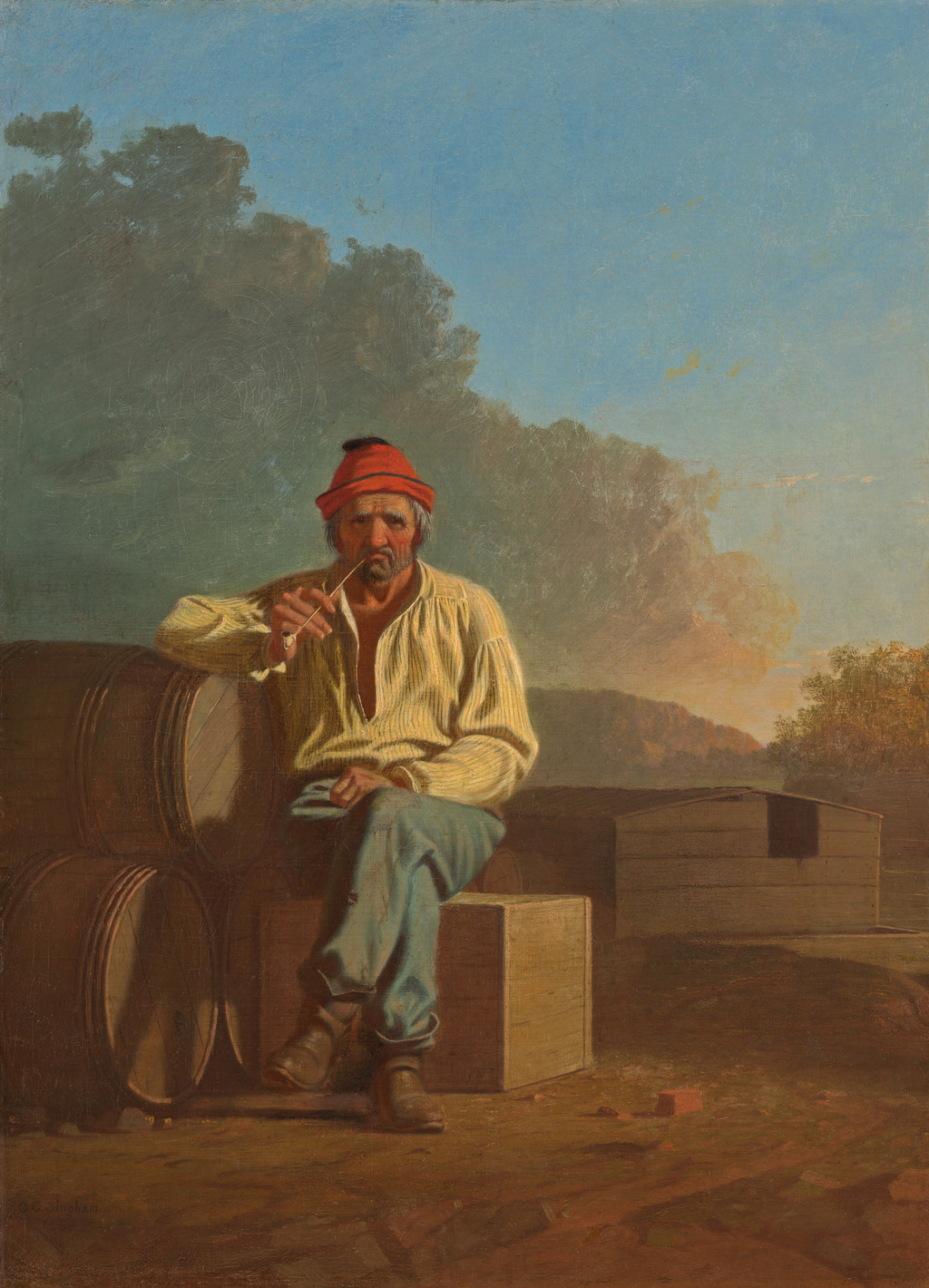
George Caleb Bingham, Mississippi Boatman, 1850. Oil on canvas. National Gallery of Art, Washington, 2004.66.1.
Image source
.
Public domain
.
Elections and the boundaries of citizenship
Bingham’s political paintings move from intimate persuasion to the behaviour of a crowd. In Canvassing for a Vote , a small group outside a tavern gives an argument a human scale. A politician’s gesture meets different degrees of attention. The arrangement encourages us to compare the listeners rather than imagine that a speech produces the same response in everyone. Conrads links the composition to an earlier painting and to studies in which Bingham revised the appearance of a potential voter. [4]
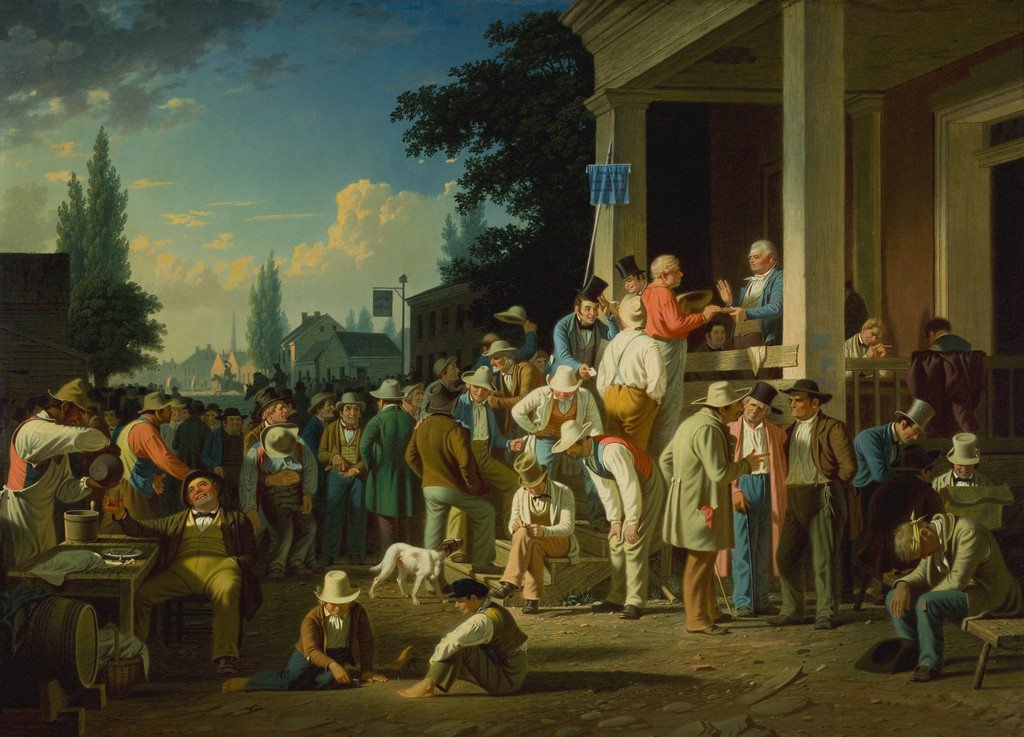
The County Election expands the encounter into a busy public occasion. People approach the polling place, offer party tickets, converse or become distracted. The museum identifies an Irish immigrant taking an oath and an older Revolutionary veteran descending the steps. Such details place people with different histories within the same political gathering, giving the general idea of an electorate a variety of ages, clothes and actions. [11]
The crowd also includes failures of attention and judgement. Politics appears within a social world in which drink, persuasion and personal advantage can affect conduct. The humour does not erase the seriousness of the subject. It makes ideal participation and imperfect behaviour visible together, asking viewers to move between their recognition of individual characters and their assessment of the whole occasion.
The other major election pictures change the moment being examined. Stump Speaking turns on an orator and the people listening to him. The Verdict of the People shows the public absorbing an election result. Read alongside the polling scene, they offer different stages of political life: making a case, casting a vote and reacting to an outcome. [4]
Their image of the public is also selective. The people entitled to vote were not the whole population. Women and Black Americans appear differently within these scenes, when they appear at all, and visibility within a painting must not be mistaken for equal access to political power. Those boundaries are part of the pictures’ historical meaning, alongside the liveliness of the crowds. [23]
Bingham’s own position requires similar care. He opposed the extension of slavery and supported the Union, but Stack’s research also discusses enslaved people recorded in his household in earlier censuses. His later commitments do not remove those earlier relationships. Keeping the complexity in view makes it possible to examine the paintings’ democratic ambitions without treating either the artist or the society he represented as free from contradiction. [21]
Watch: George Caleb Bingham
Choose a film to explore the artist’s work, its interpretation and its wider setting.
Navigating the West: George Caleb Bingham and the River at the Amon Carter Museum of American Art
The Amon Carter Museum introduces an exhibition devoted to Bingham’s river paintings.
Watch on YouTubePortraits and the making of historical drama
The narrative pictures can overshadow the portraits that sustained Bingham’s working life. A commissioned likeness had a different task from a crowd scene: it had to give one person a convincing and appropriate presence. The turn of a head, the handling of clothing and the space around a sitter acquire particular importance when the viewer is not being led through a larger action. His portraits reveal this continuing concern with individual appearance. [2] [4]
His late self-portrait brings the profession into the image. Bingham faces the viewer while holding a drawing book and pencil. The hands and implements show an activity through which the face wishes to be understood. Conrads places this likeness at about 1877, near the end of a career in which drawing had helped connect individual observation with ambitious compositions. [4]
Historical drama gave that compositional ambition another field. Daniel Boone Escorting Settlers through the Cumberland Gap presents an earlier migration through a solemn procession in a mountainous landscape. It belongs to Bingham’s mid-century imagining of American history, rather than to an eyewitness record of the journey. Its relationship between people and setting differs from a river painting: movement through the landscape becomes the action around which the group is organised. [13]
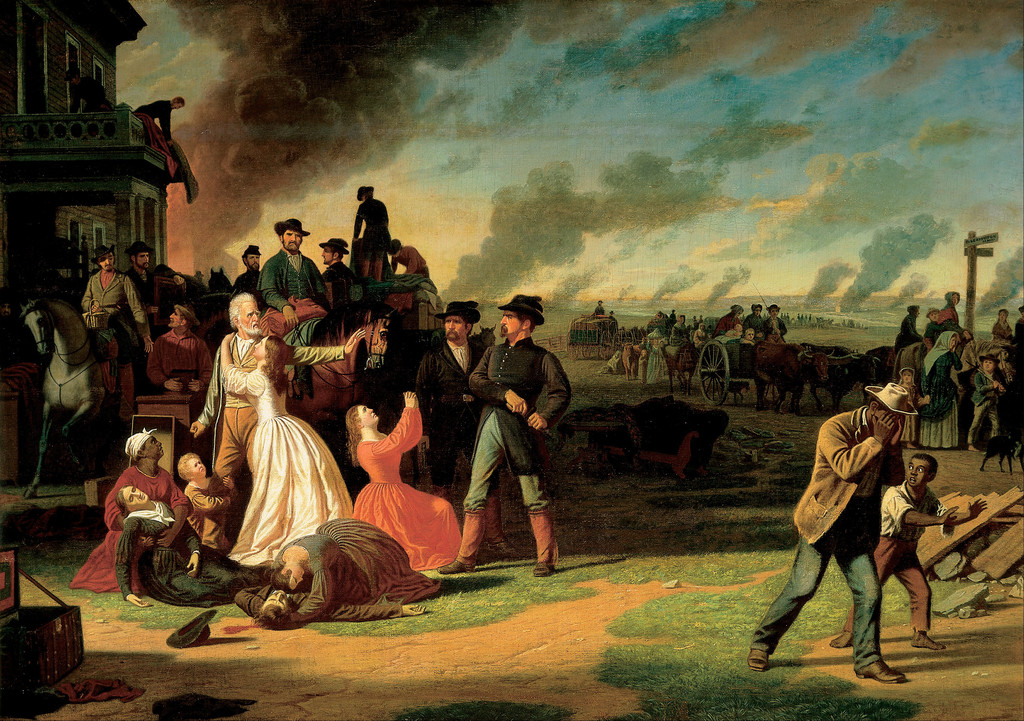
Order No. 11 , also called Martial Law , confronts a more recent and bitter subject. The Cincinnati original, dated 1865–1868, responds to the Civil War order that displaced civilians from parts of western Missouri. A threatened household occupies the foreground while wagons, departing people and smoke extend the consequences into the distance. The picture makes an accusation through an arranged scene of suffering. [21] [18]
Its later history shows why an artist’s argument and a painting’s reception need to be distinguished. Bingham defended the work publicly, while subsequent viewers connected it with different accounts of the war. Stack examines those changing readings and the role of Black figures within the composition. The painting’s force is inseparable from its position within a disputed history of violence, slavery and remembrance. [21]
George Caleb Bingham, Order No. 11 (Martial Law), 1865–1868. Oil on canvas. Cincinnati Art Museum, 1958.515. The Edwin and Virginia Irwin Memorial.
Image source
.
Public domain
.
Drawing, repetition and the museum view
The finished paintings reveal only part of Bingham’s labour. His surviving drawings preserve individual figures in pencil, ink and wash, often with careful attention to the shapes of clothing and the distribution of light across a body. These sheets allowed a pose to be considered separately from the setting into which it would eventually enter. A figure could then be repositioned, modified or used again. [3] [4]
That practice helps explain the balance of the river groups. The apparent ease of a seated musician or resting boatman does not mean the painter improvised the whole scene in front of a boat. The Navigating the West exhibition brought drawings and paintings together with infrared examination to investigate how compositions developed. Its findings included evidence of transfer, changes beneath the painted surface and the reuse of studies across different works. [3]
Repetition was a source of variation. A body familiar from one picture could acquire another mood when its face, neighbours or surroundings changed. Moving a figure closer to the viewer could strengthen its directness; placing the same pose within a group could make it part of a shared rhythm. The style and technique article follows these specific connections between a study and its painted uses.
Works on paper also extended the pictures’ reach. The Art-Union’s engraving of The Jolly Flatboatmen carried the composition far beyond the original painting’s immediate audience. Making a print required another set of choices: painted colour and brushwork had to become the marks and tonal relationships of a reproductive medium. A widely circulated image consequently had a material history alongside the unique canvas from which it derived. [8]
The drawings and prints article brings these two directions together. Some sheets helped the artist move towards a painting; reproductive works helped the image move outwards to viewers. Both are essential to understanding how a Missouri subject became familiar to a national public.
Museums now make it possible to reconnect objects that were dispersed through those different routes. An early drawing, a finished painting and an engraving may belong to different collections, yet considering them together restores the sequence of decisions around an image. It also discourages the assumption that the most familiar reproduction tells us everything about the object.
Where to begin with Bingham
Start with the difference between stillness and activity. In Fur Traders , an expanse of light and water gives two faces an unusual intensity. In The Jolly Flatboatmen , the dancer’s movement stands out because the surrounding group provides such a stable frame. In the election paintings, small exchanges divide a large crowd into moments of attention, persuasion, confidence and uncertainty.
Then consider who is looking at whom. A figure turning out of the picture draws us into a different relationship from someone absorbed in a game or speech. Bingham repeatedly uses those directions of attention to organise a social scene. They give the viewer ways into the painting while allowing its people to remain occupied with interests of their own.
Finally, follow the image beyond its first impression. The paintings selection distinguishes major subjects and versions, including the later Jolly Flatboatmen in Port . The biography, portraits and works on paper supply other views of the same career. Together, these objects show an artist shaping public pictures from close attention to individual people, and finding in their gestures a way to examine the society around him.
Essential George Caleb Bingham works
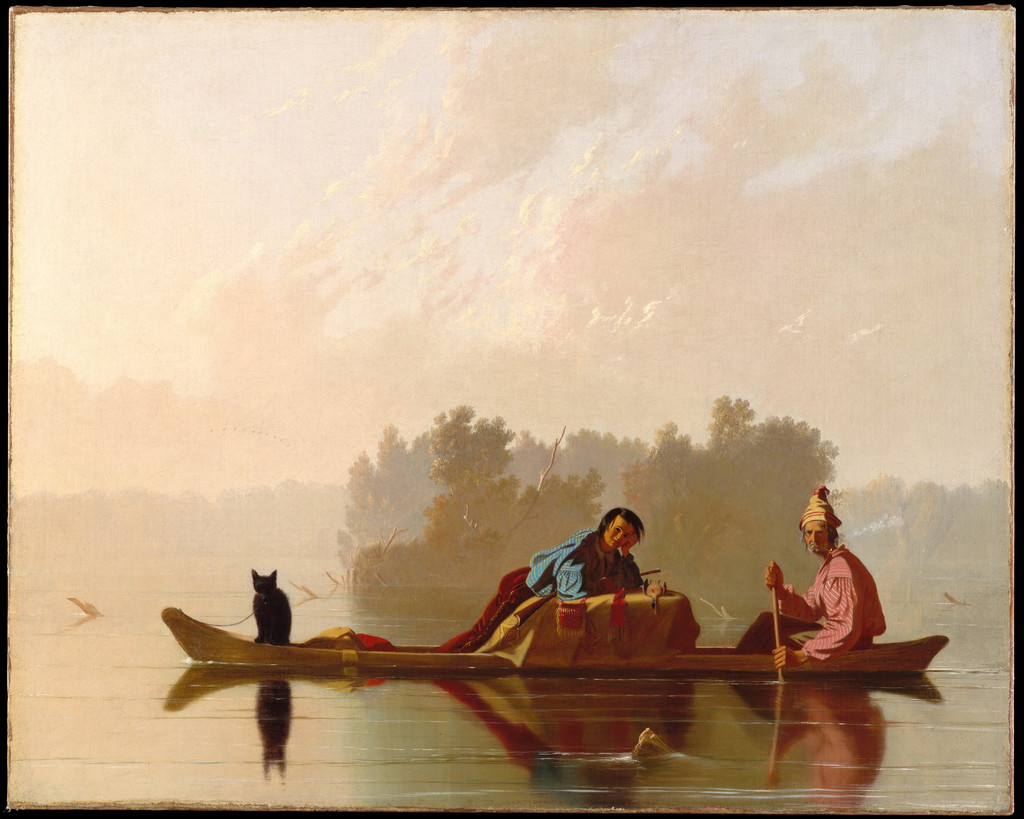
Fur Traders Descending the Missouri
1845 · A low boat and a wide river give an encounter unusual stillness.
The Jolly Flatboatmen
1846; NGA canvas · A dancer’s movement rises above a stable group of companions.
The County Election
1851–52 original; 1852 replica illustrated · A public poll assembles a crowd; the illustration is the distinct 1852 replica.
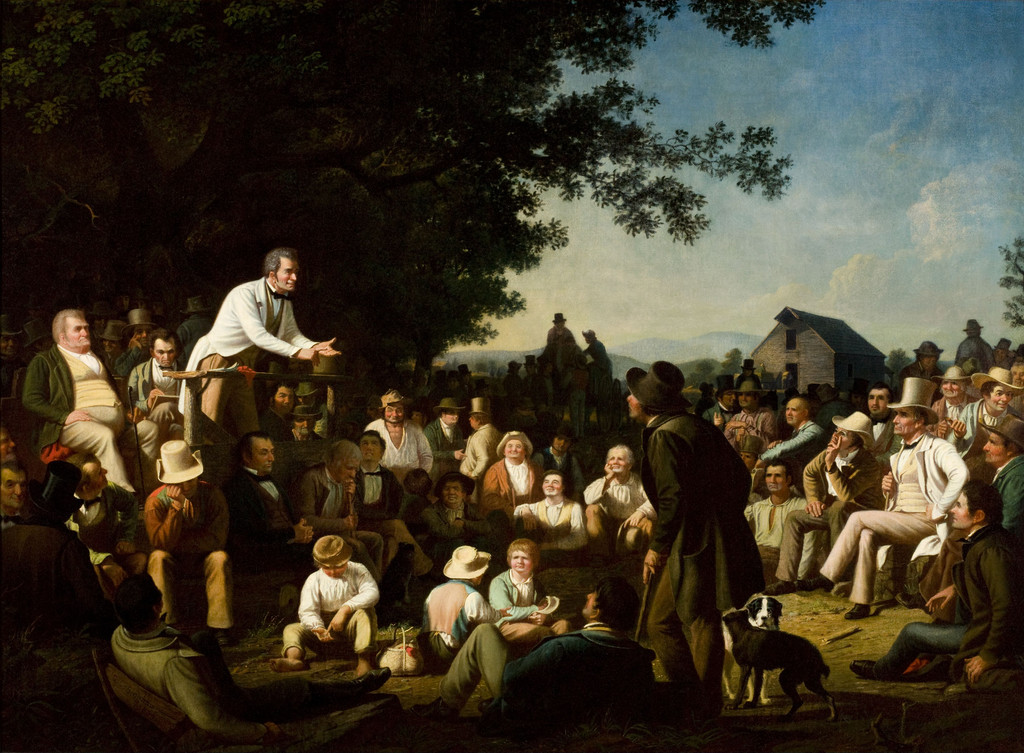
Stump Speaking
1853–54 · An orator’s gesture meets varied kinds of attention.
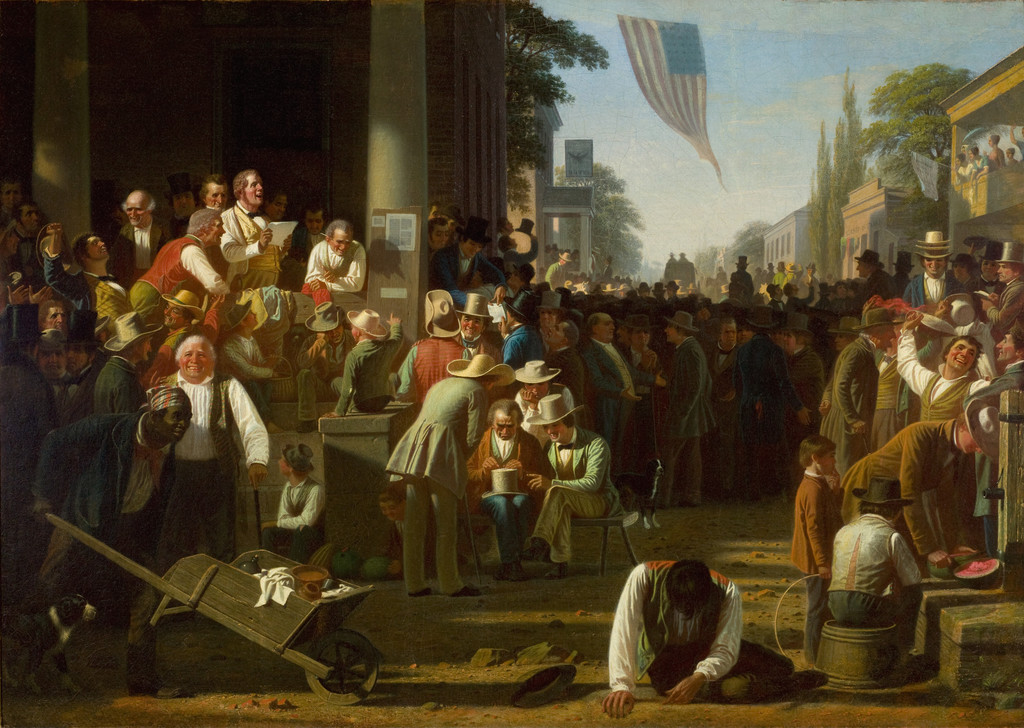
The Verdict of the People
1854–55 · A result becomes public through different reactions in a crowded street.
Order No. 11: Martial Law
1865–68; Cincinnati original · A displaced household gives a political accusation an emotional centre.
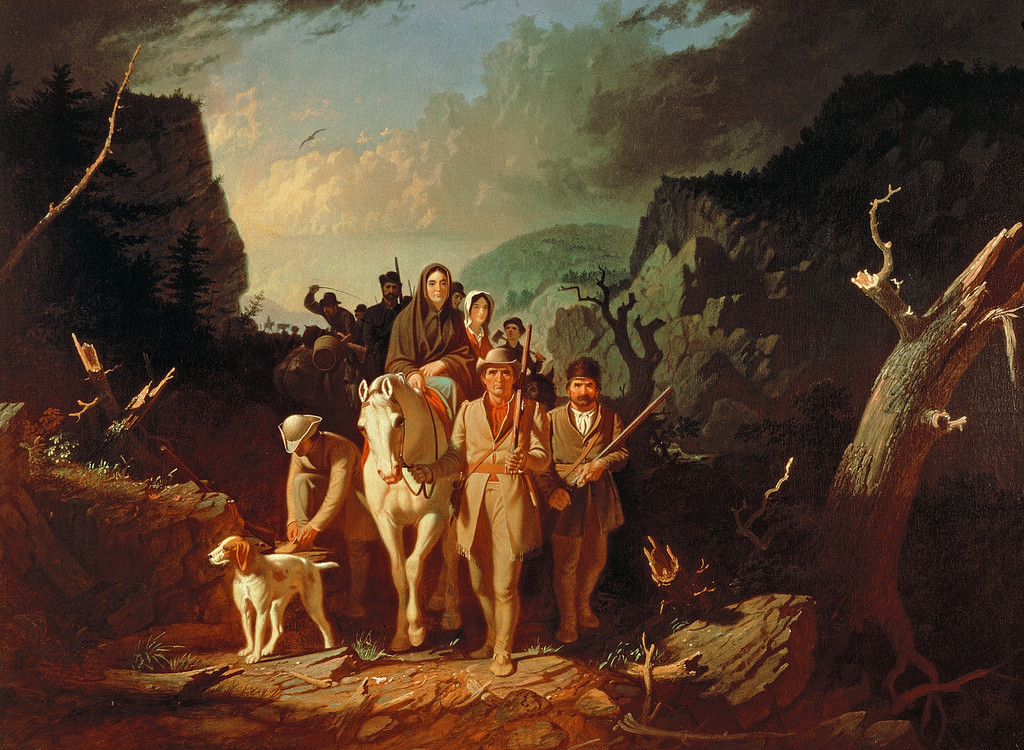
Daniel Boone Escorting Settlers through the Cumberland Gap
1851–52 · A procession enters a landscape arranged for historical drama.
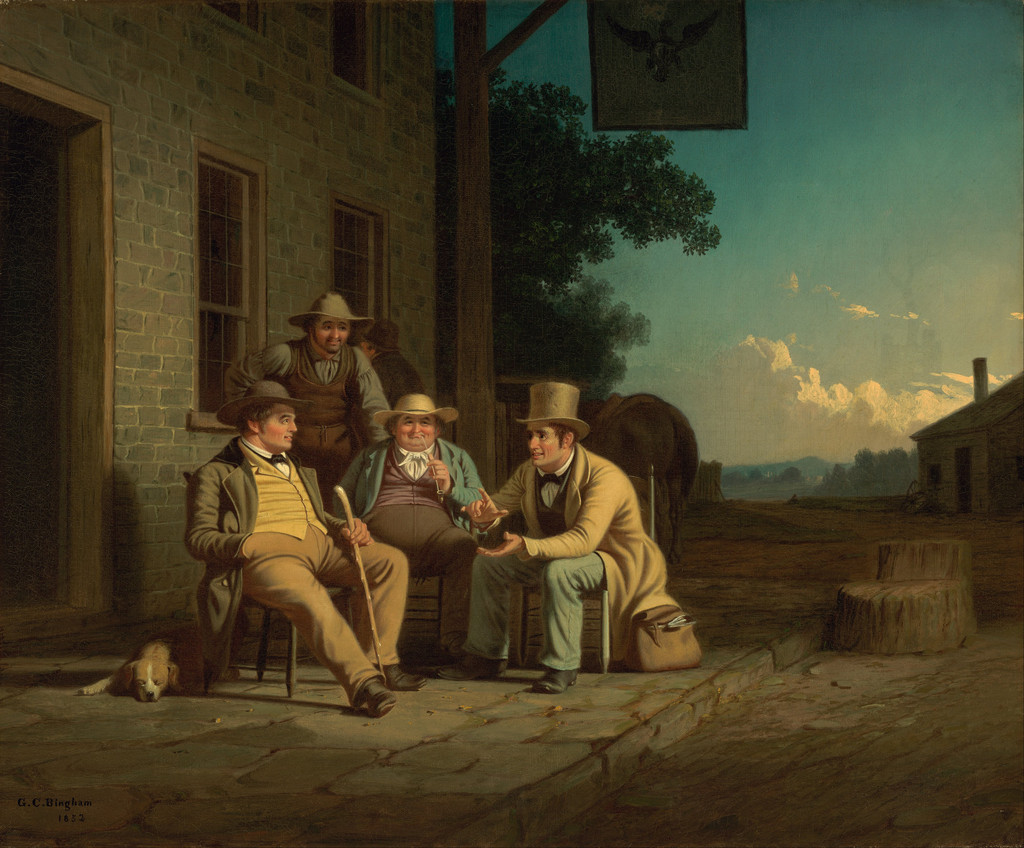
Canvassing for a Vote
1852; signed canvas · A small conversation makes persuasion a study of listening.
Artworks directory
A documented selection discussed across these articles, including separate canvases, figure studies and reproductive impressions. Dates identify the particular object or study; collection and title distinctions follow museum records and the 2015 exhibition checklist. This is not a catalogue raisonné. Prints are grouped with works on paper in the Drawing filter.
| Name | Date | Medium |
|---|---|---|
| Fur Traders Descending the Missouri | 1845 | Painting — oil on canvas |
| The Jolly Flatboatmen | 1846; NGA canvas | Painting — oil on canvas |
| The County Election (original) | 1851–52 | Painting — oil on canvas |
| Stump Speaking | 1853–54 | Painting — oil on canvas |
| The Verdict of the People | 1854–55 | Painting — oil on canvas |
| Order No. 11: Martial Law | 1865–68; Cincinnati original | Painting — oil on canvas |
| Daniel Boone Escorting Settlers through the Cumberland Gap | 1851–52 | Painting — oil on canvas |
| Canvassing for a Vote | 1852; signed canvas | Painting — oil on canvas |
| Raftsmen Playing Cards | 1847 | Painting — oil on canvas |
| Mississippi Boatman | 1850 | Painting — oil on canvas |
| Jolly Flatboatmen in Port | 1857 | Painting — oil on canvas |
| The County Election (replica illustrated here) | 1852 | Painting — oil on canvas |
| Martial Law or Order No. 11 (Missouri replica) | 1870 | Painting — oil on canvas |
| The Jolly Flatboatmen (Terra canvas) | 1877–78 | Painting — oil on canvas |
| John Quincy Adams (later version) | about 1850, after an 1844 original | Painting — oil on canvas |
| Country Politician | 1849 | Painting — oil on canvas |
| The Trappers’ Return | 1851 | Painting — oil on canvas |
| The Concealed Enemy | 1845 | Painting — oil on canvas |
| The Wood-boat | 1850 | Painting — oil on canvas mounted on board |
| Lighter Relieving a Steamboat Aground | 1847 | Painting — oil on canvas |
| Watching the Cargo | 1849 | Painting — oil on canvas |
| In a Quandary | 1851 | Painting — oil on canvas |
| Boatmen on the Missouri | 1846 | Painting — oil on canvas |
| Self-Portrait (Saint Louis) | 1834–35 | Painting — oil on canvas |
| Self-Portrait (Nelson-Atkins) | about 1877 | Painting — oil on canvas |
| Mrs. David Steele Lamme and Son William Wirt | 1837 | Painting — oil on canvas |
| Portrait of Leonidas Wetmore | 1839–40 | Painting — oil on canvas |
| Fur Trader (study for Fur Traders Descending the Missouri) | 1845 | Drawing — brush, ink and wash over pencil |
| Skillet-beater (study for The Jolly Flatboatmen) | 1846 | Drawing — brush, ink and wash over pencil |
| Young Wood-boatman (study for The Wood-boat) | 1850 | Drawing — brush, ink and wash over pencil |
| Thomas Doney after Bingham: The Jolly Flat Boat Men (Met impression) | 1847 | Print — mezzotint and engraving with etching |
| Thomas Doney after Bingham: The Jolly Flat Boat Men (coloured Carter impression) | 1847 | Print — intaglio with applied watercolour |
| The Verdict of the People (lithographic proof) | ca. 1858–59 | Print — lithographic proof |
| Gautier after Bingham: Stump Speaking | 1856 | Print — etching and aquatint |
| Claude Regnier after Bingham: In a Quandary, Mississippi Raftsmen Playing Cards | 1852 | Print — hand-coloured lithograph |
Frequently Asked Questions
The subjects drew on a world he knew, but surviving studies and technical examination show deliberate preparation, transfer and revision. The finished compositions should not be treated as spontaneous records of complete groups posed together on a river. [3]
No. The National Gallery of Art owns the 1846 painting. Bingham made the distinct Jolly Flatboatmen in Port in 1857 and returned to the subject in another painting now dated 1877–78. Prints after the earlier work are separate objects too. [3]
Discussion
Look again at the images and ideas explored in George Caleb Bingham. These editorial prompts invite your observations.
Reader Insights
Which gesture first draws your attention in Bingham’s crowded scenes?
How does a portrait change your understanding of the river paintings?
Compare a quiet river encounter with an election crowd: what holds each group together?
Join the Conversation
Share a detail, comparison or question about George Caleb Bingham below.
Explore the wider art history
Explore the wider history of American artists, with portraits, landscapes and changing approaches to modern art.
Explore American Realism for a wider context on Bingham’s representations of work, public life and social behaviour.
References
- State Historical Society of Missouri , “George Caleb Bingham,” Historic Missourians. View source
- John Caldwell and Oswaldo Rodriguez Roque , with Dale T. Johnson, American Paintings in the Metropolitan Museum of Art , volume I (1994), Bingham biography and entry, pp. 538–543. View source
- Metropolitan Museum of Art , Navigating the West: George Caleb Bingham and the River , exhibition labels, June 29, 2015. View source
- Margaret C. Conrads , “Bingham@200: A Bicentennial Celebration,” Antiques & Fine Art , Spring 2011, pp. 193–199. View source
- Carrie Rebora Barratt and H. Barbara Weinberg, Metropolitan Museum of Art, American Scenes of Everyday Life, 1840–1910, September 2009. View source
- Kevin J. Avery, Metropolitan Museum of Art, The Hudson River School, October 2004. View source
- Metropolitan Museum of Art , Fur Traders Descending the Missouri , 1845, 33.61. View source
- National Gallery of Art , The Jolly Flatboatmen , 1846, 2015.18.1. View source
- Saint Louis Art Museum, Raftsmen Playing Cards. View source
- National Gallery of Art, Mississippi Boatman. View source
- Saint Louis Art Museum , The County Election , 1851–52, 124:1944. View source
- Saint Louis Art Museum, The County Election, 1852 replica, 44:2001. View source
- Mildred Lane Kemper Art Museum , Daniel Boone Escorting Settlers through the Cumberland Gap , 1851–52, WU 2171; collection label, 2016. View source
- Nelson-Atkins Museum of Art, Canvassing for a Vote. View source
- Saint Louis Art Museum, Stump Speaking. View source
- Saint Louis Art Museum, The Verdict of the People. View source
- Saint Louis Art Museum, Jolly Flatboatmen in Port. View source
- Cincinnati Art Museum , Order No. 11 , 1865–1868, 1958.515. View source
- Metropolitan Museum of Art, Thomas Doney after Bingham, The Jolly Flat Boat Men, 1847, 42.119.68. View source
- George Caleb Bingham to James S. Rollins, 7 November 1853, transcription by C. B. Rollins, State Historical Society of Missouri. View source
- Joan Stack , “Toward an Emancipationist Interpretation of George Caleb Bingham’s General Order No. 11: The Reception History of the Painting and the Remembered Civil War in Missouri,” Missouri Historical Review 107, no. 4 (July 2013), pp. 203–221. View source
- Scott Manning Stevens , Bingham contribution to “Native Perspectives,” Metropolitan Museum of Art. View source
- Katie Steiner , “Electing To Laugh,” Metropolitan Museum of Art, November 4, 2009. View source
- Splash image source.
George Caleb Bingham, The Jolly Flatboatmen, 1846. Oil on canvas. National Gallery of Art, Washington, 2015.18.1. Public domain .
View source - Kevin J. Avery, “The Hudson River School”, Metropolitan Museum of Art (2004). Origins in 1825 and decline in the 1870s–1880s; c. 1825–1880 is an approximate comparative range. View source
- George Michael Cohen, A Regional Study of American Genre Painting from 1830–1880 (Boston University, 1962). This is a period of nineteenth-century prominence, not an end date for the genre. View source
- National Gallery of Art, William Sidney Mount: 1807–1868. Artist life dates. View source
- National Gallery of Art, George Caleb Bingham: 1811–1879. Artist life dates. View source
- Smithsonian American Art Museum, Emanuel Leutze: 1816–1868. Artist life dates. View source
- National Gallery of Art, American Masters catalogue, Winslow Homer: 1836–1910. Artist life dates. View source