 by
Tom Gurney
Tom Gurney BSc (Hons) is an art history expert with over 20 years experience
Email:
tomgurney1@gmail.com
/ Phone:
+44 7429 011000
The Jolly Flatboatmen: Introduction
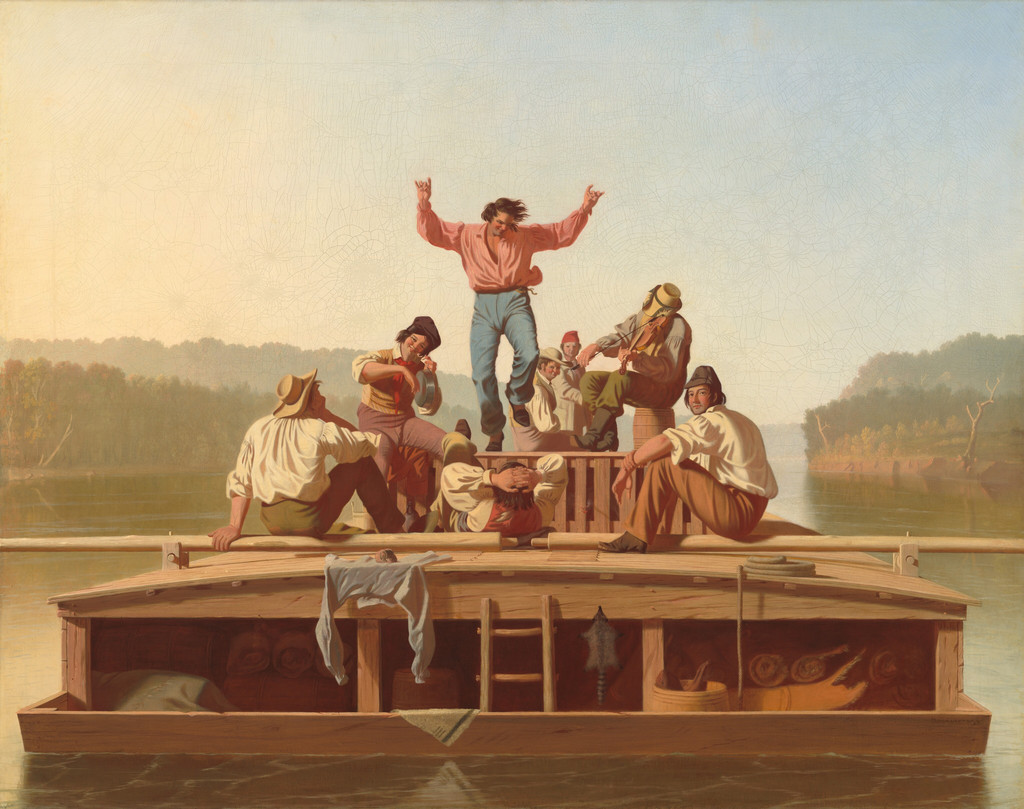
In George Caleb Bingham’s The Jolly Flatboatmen , a dancer rises above a group of men gathered on a river boat. His lifted hands and loose pink shirt make the movement immediately recognisable. A fiddler and a companion beating a pan supply the music, while other boatmen sit, watch or recline. The broad river around them appears calm enough to hold the performance almost motionless.
Bingham painted this oil on canvas in 1846. The original is now in the National Gallery of Art, Washington, where it is accession 2015.18.1. It measures 96.8 × 123.2 cm and entered the collection through the Patrons’ Permanent Fund. It is distinct from the more crowded Jolly Flatboatmen in Port of 1857 and a late version painted in 1877–78. [1] [2]
The picture makes leisure feel spontaneous, although its figures form a carefully balanced design. Its public life was equally deliberate: an American Art-Union print carried the composition far beyond the people who could see the canvas. The result joined a particular image of river workers with a national audience for western subjects. [3]
At a Glance
- Artist George Caleb Bingham.
- Date 1846.
- Medium Oil on canvas.
- Dimensions 96.8 × 123.2 cm.
- Collection National Gallery of Art, Washington.
- Accession 2015.18.1.
- Acquisition credit Patrons’ Permanent Fund. [1]
This work across George Caleb Bingham’s career
The Jolly Flatboatmen (current article)
1846; NGA canvasThe County Election
1851–52 original; 1852 replica illustratedCanvassing for a Vote
1852; signed canvasStump Speaking
1853–54The Verdict of the People
1854–55Order No. 11: Martial Law
1865–68; Cincinnati originalNotes and sources
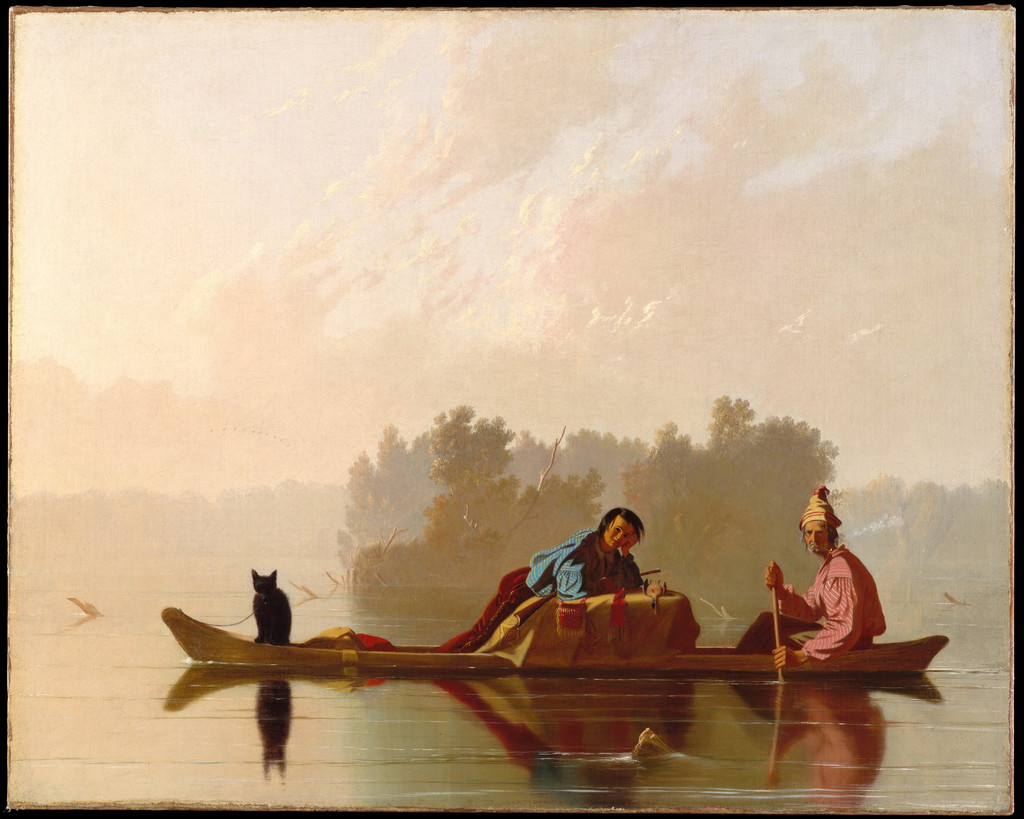
Fur Traders Descending the Missouri. Dates identify the canvas discussed in the article. [4]
The Jolly Flatboatmen (current article). Dates identify the canvas discussed in the article. [1]
Raftsmen Playing Cards. Dates identify the canvas discussed in the article. [5]
Mississippi Boatman. Dates identify the canvas discussed in the article. [6]
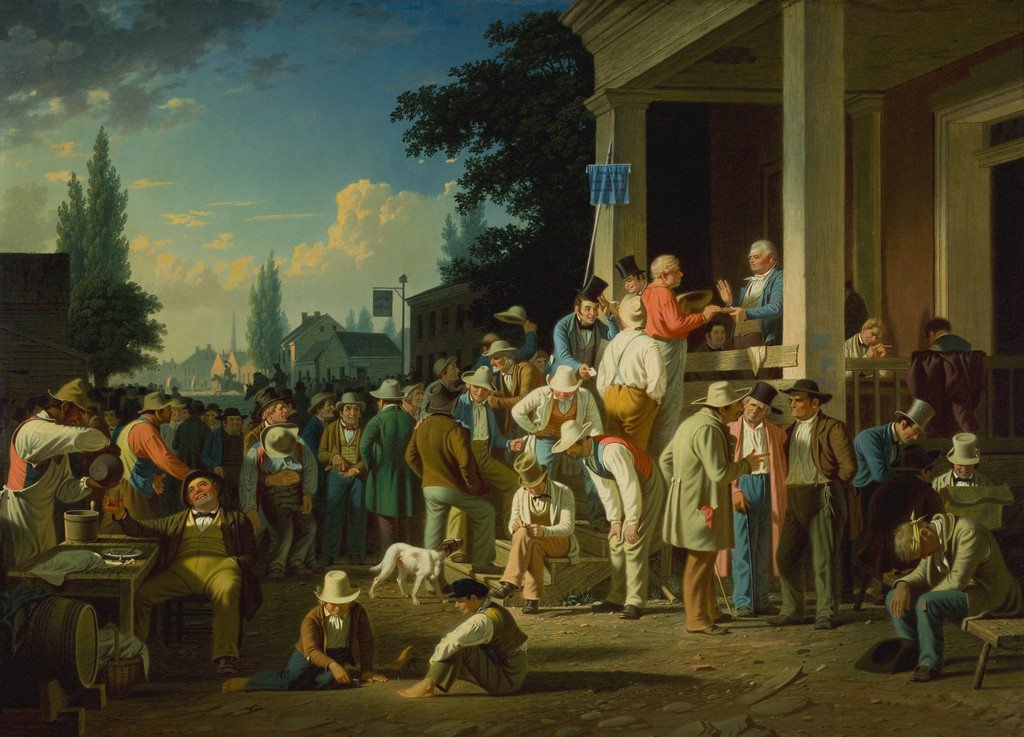
The County Election. The original is 124:1944; the illustrated 1852 replica is 44:2001. Their dimensions and acquisition histories differ. [7] [8]
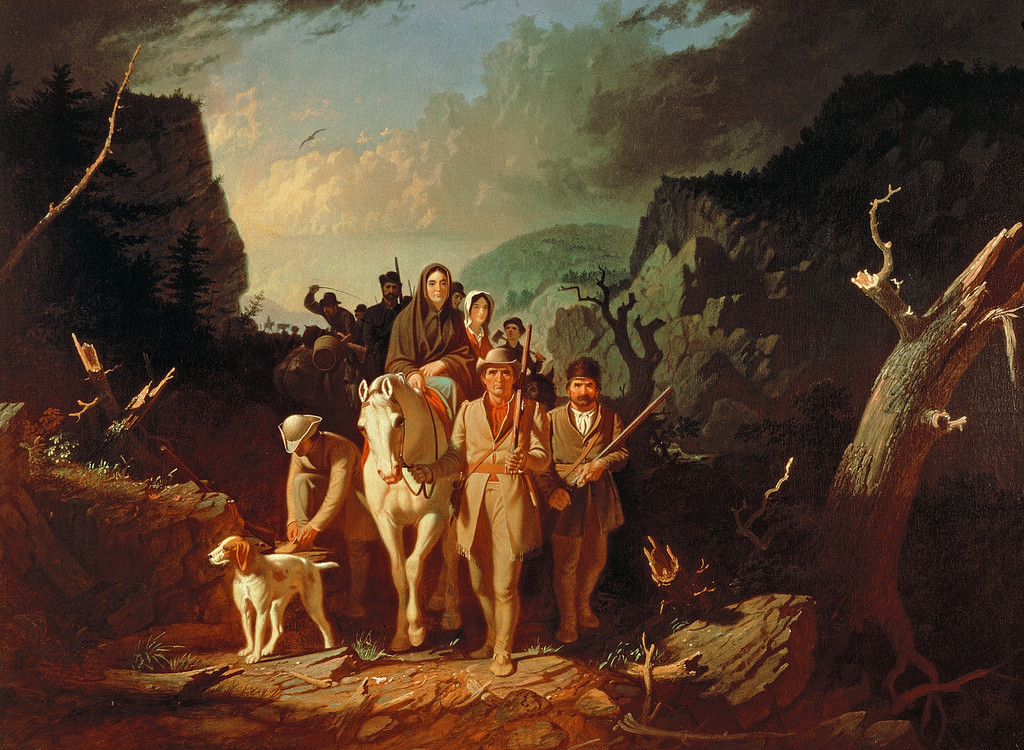
Daniel Boone Escorting Settlers through the Cumberland Gap. Dates identify the canvas discussed in the article. [9]
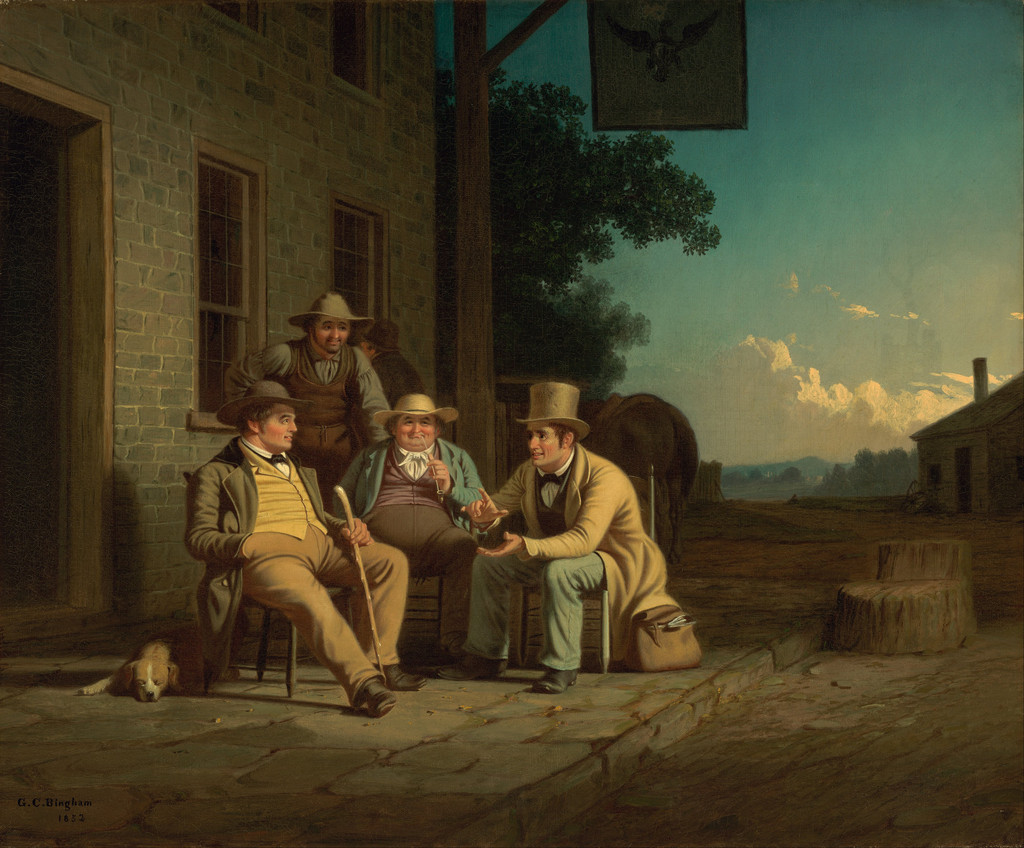
Canvassing for a Vote. Dates identify the canvas discussed in the article. [10]
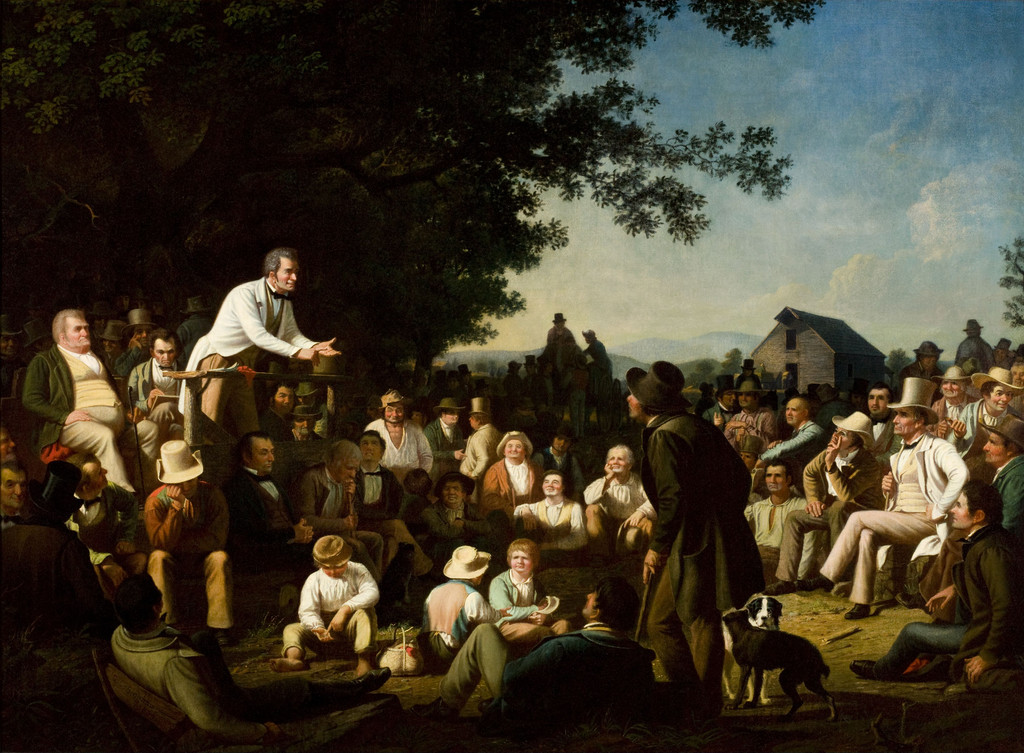
Stump Speaking. Dates identify the canvas discussed in the article. [11]
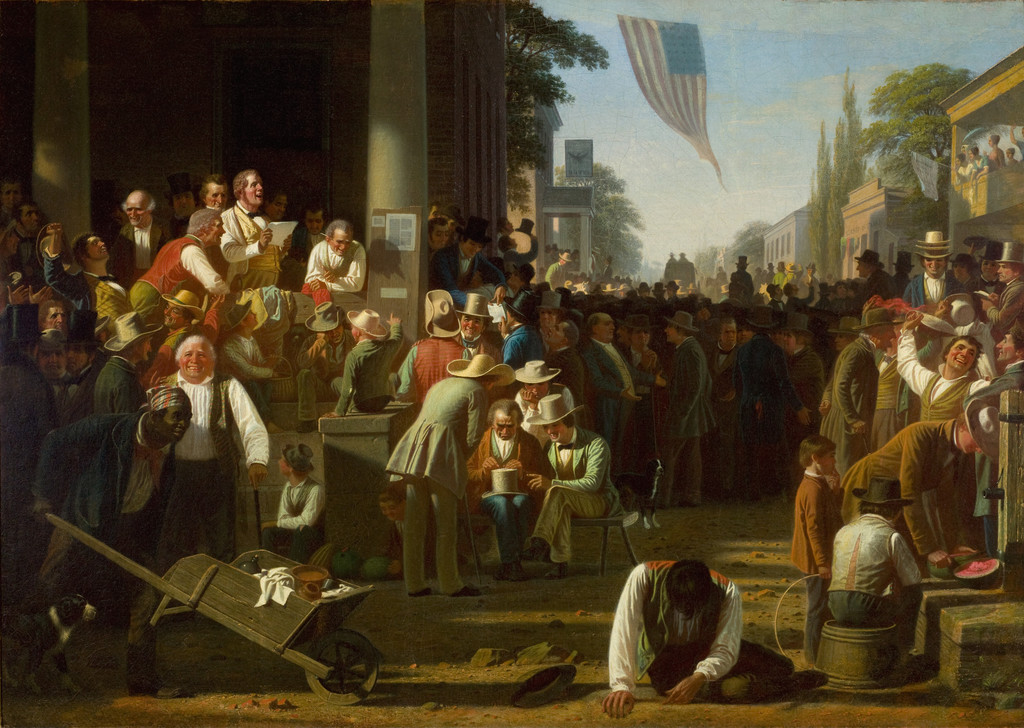
The Verdict of the People. Dates identify the canvas discussed in the article. [12]
Jolly Flatboatmen in Port. Dates identify the canvas discussed in the article. [13]
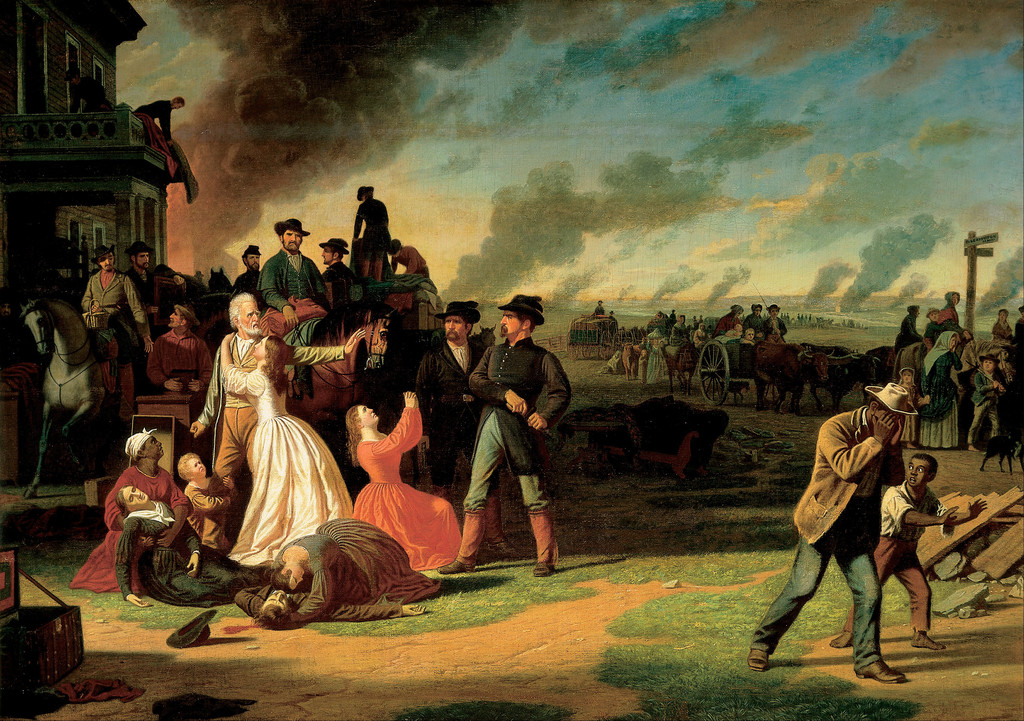
Order No. 11: Martial Law. Dates identify the canvas discussed in the article. [14]
Contents
- A dance above the river
- A vessel made into a stage
- Working people shown at leisure
- Drawing a rhythm into the figures
- The Art-Union and an audience in print
- Three versions, three settings for leisure
- Ownership and the return to public view
- Looking for the quieter movements
- Annotated details
A dance above the river
The dancer occupies the highest point of the group. His arms rise apart, opening a space around his head, while his feet hold different positions on the raised platform. The loose fabric of his sleeves spreads the movement outwards. Hair lifting to one side gives another small sign of action, even though the figure remains precisely fixed within the composition.
His pink shirt and blue trousers distinguish him from the surrounding whites, creams, browns and greens. These are broad areas of colour, visible before the viewer begins to examine individual expressions. The shirt also separates him from the pale sky. Bingham does not need a crowded background or a dramatic event to give this body prominence.
The musicians stand or sit below him on either side. To the left, a young man holds a metal pan and brings his other hand towards its base. His bent arms and tilted head make a compact counterpart to the dancer’s open pose. The dark cap and warm clothing help define a person who belongs to the group while keeping his attention on the shared performance.
On the right, the fiddler bends over his instrument. His hat partly shelters his face, making hands, bow and angled legs especially important to his presence. The instrument crosses his upper body, and the bow extends diagonally through the space in front. The activity is smaller than the dancer’s gesture but equally necessary to the scene.
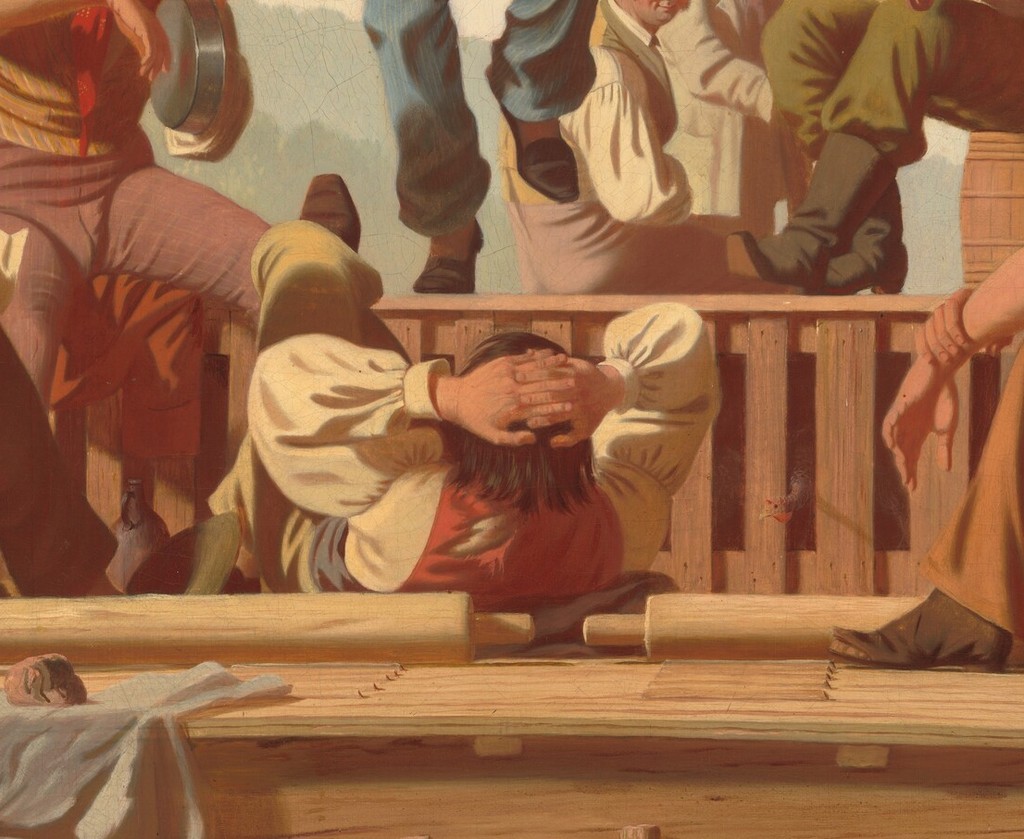
The audience supplies a range of responses. A man at the left turns his body towards the group and rests a hand on the long oar. Another, close to the centre, leans back with his hands behind his head. The man on the right looks outward towards the viewer. Further heads and shoulders fill the spaces behind the main figures without competing for the dancer’s height.
That outward glance gives the group an opening. We do not merely look at a performance whose participants are absorbed in one another. At least one person seems aware of someone beyond the boat. His face makes the viewer’s position part of the encounter, while his relaxed body leaves the scene’s overall mood undisturbed.
Annotated Details from The Jolly Flatboatmen
The numbered points identify visible features discussed in this article. Return from each detail to the whole composition. George Caleb Bingham, The Jolly Flatboatmen, 1846. Oil on canvas. National Gallery of Art, Washington, Patrons’ Permanent Fund, 2015.18.1. Image source. Public domain. Numbers added to a separate overview. Detail images are crops of the source reproduction.
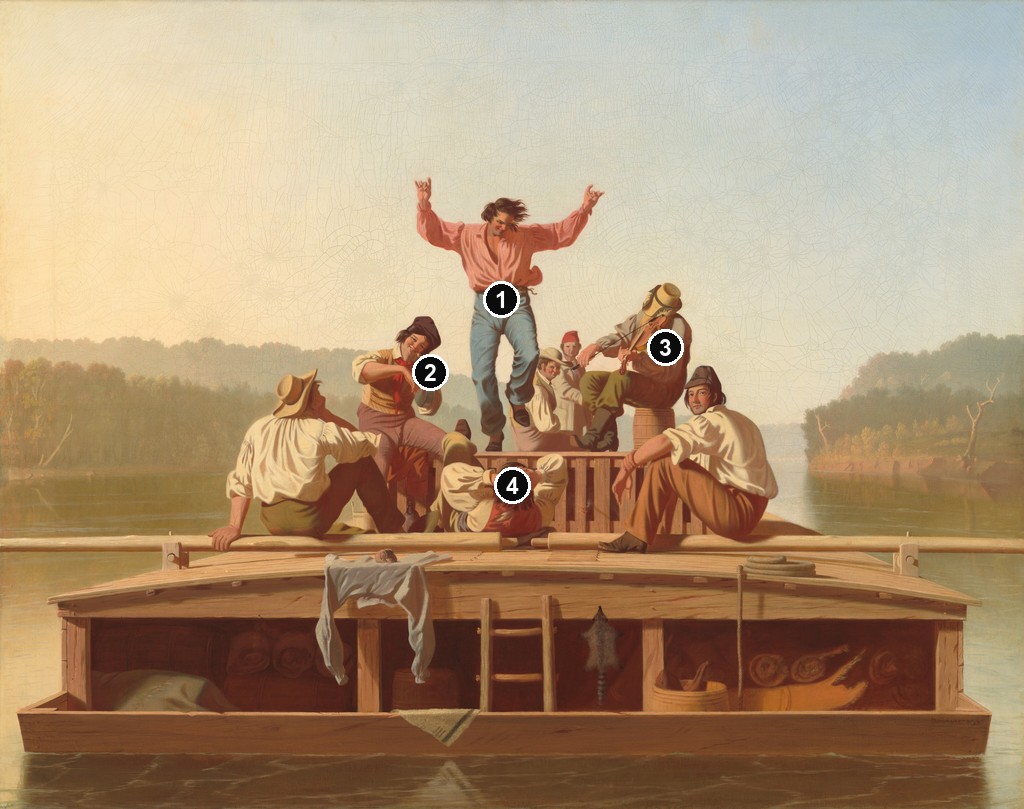
Details from THE JOLLY FLATBOATMEN
Compare the cropped details with the complete images above. Notice how their colours, shapes and positions contribute to the larger compositions.
The dancer above the group
Raised arms and the lifted foot give the dancer an open, uneven outline. The red shirt and blue trousers make his body easy to follow against the sky, while the seated figures below provide a broad, steadier base.
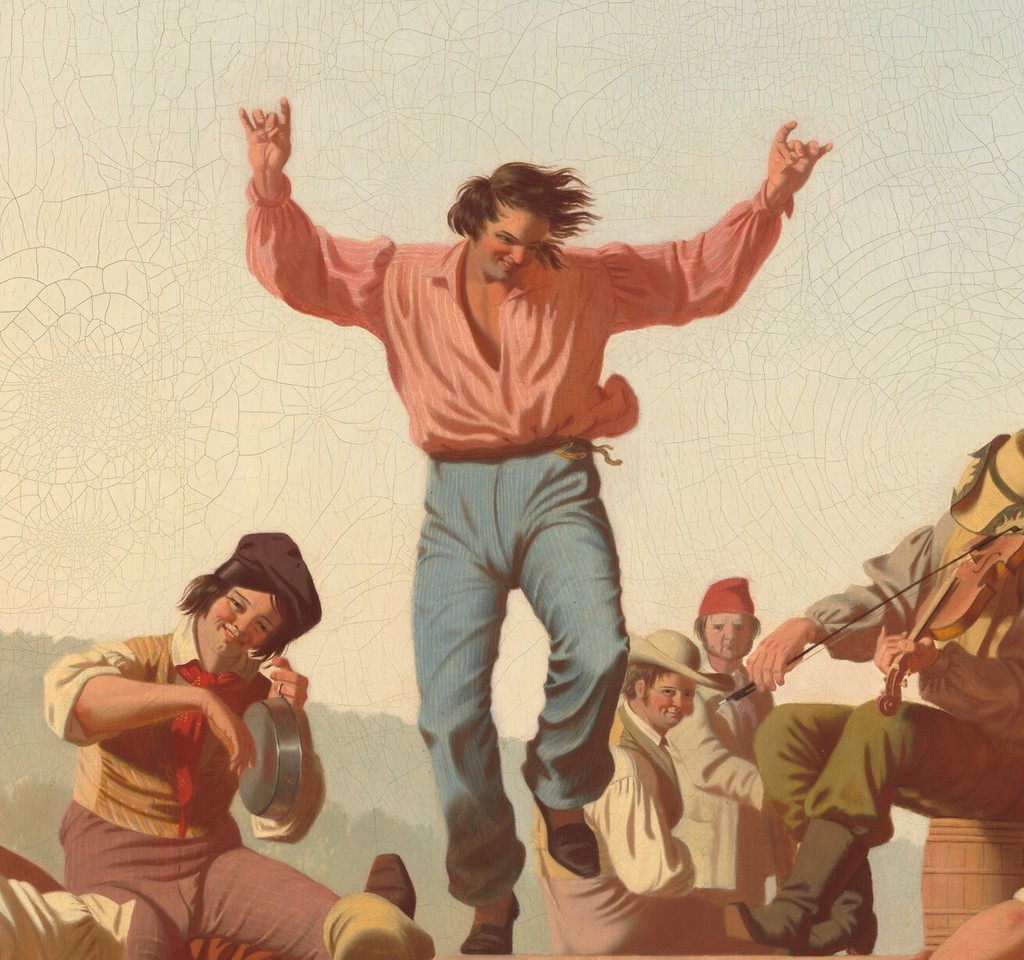
The skillet-beater’s rhythm
A hand is poised beside the upright pan held close to the body. The tilted head and bent arms draw a compact rhythm beneath the dancer’s wider gesture; clothing and overlapping limbs connect this player with the neighbouring seated figure.
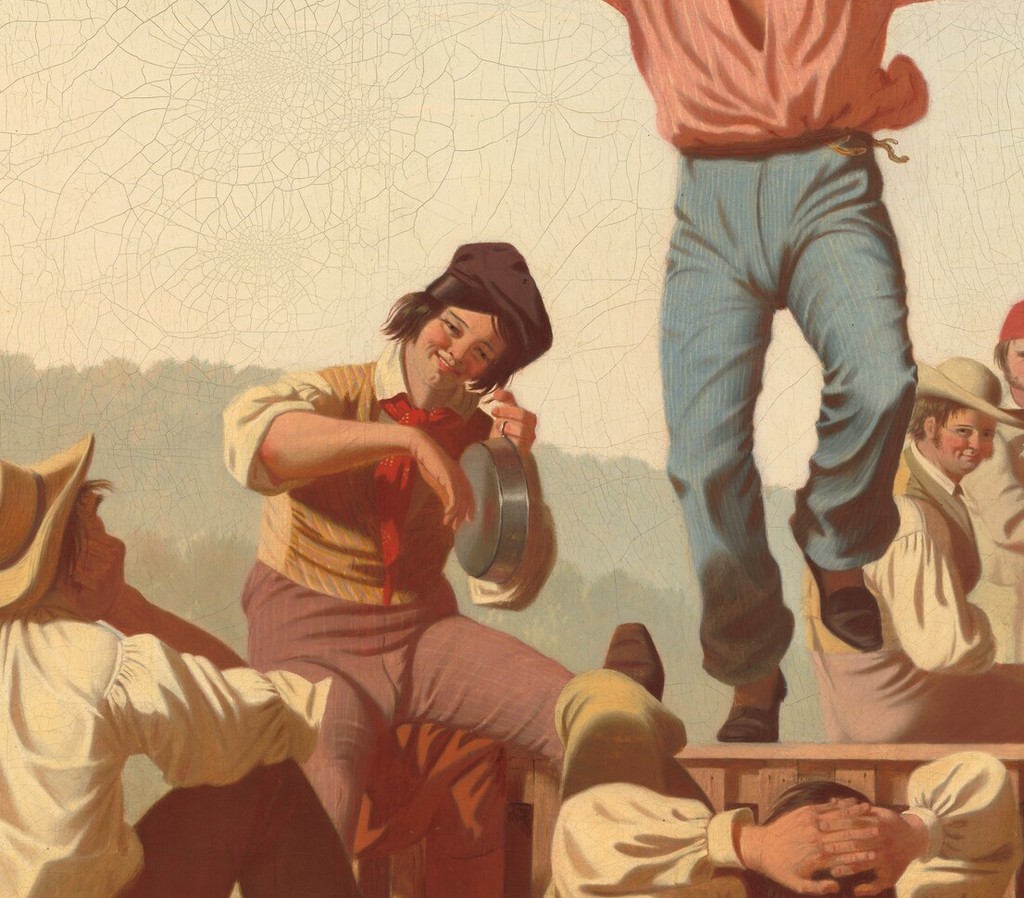
The fiddler on the barrel
The instrument and bow cross the fiddler’s chest as his head bends towards the music. The barrel raises him within the group, bringing another diagonal movement into the space beside the dancer.
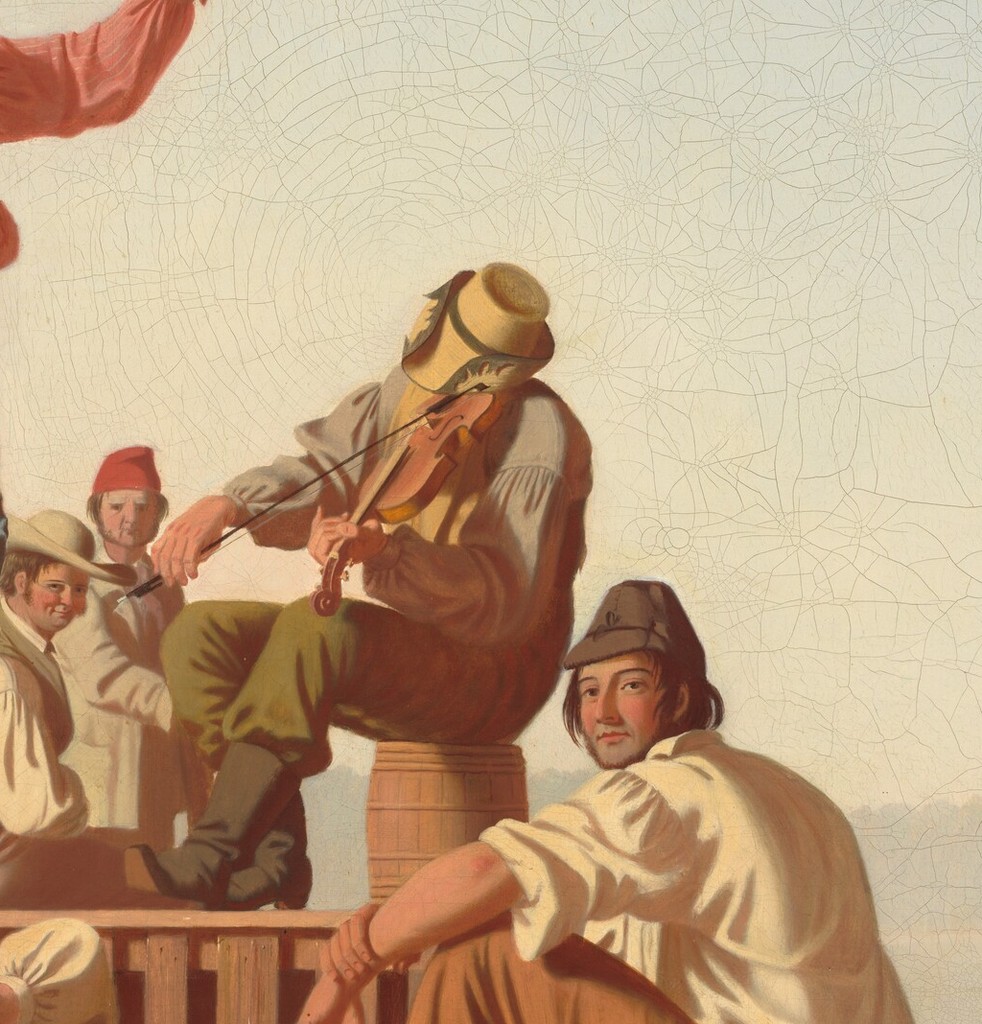
A quieter body in the foreground
The foreground figure rests with hands across the face and elbows opened to either side. That sheltered posture interrupts the surrounding performance and introduces another pace into the same carefully balanced gathering.
A vessel made into a stage
The flatboat’s construction creates several levels. Its near side forms a long low boundary, with the roofed structure rising behind it. The dancer’s platform and the seated figures provide a further step upwards. The gathering consequently has depth, even though the bodies are arranged for unusually clear viewing from the front.
Straight wooden edges make an important contrast with the people. Boards, uprights and the small central ladder divide the lower part of the image into compartments. Above them, arms bend, heads turn and legs change direction. The framework keeps the irregular bodies together without making their gestures identical.
The belongings below are more than incidental decoration. A blue garment hangs over the edge, softening the strong horizontal. Rolled bedding and containers occupy the darker spaces. A striped animal pelt hangs near the ladder, its vertical shape distinct from the clothing beside it. The coiled rope on the right adds a rounded form to a part of the boat otherwise dominated by straight edges.
These details let the vessel carry signs of ordinary use. The performance takes place among things that have been stored, hung up or set down. The lower area has a different pace from the dance: objects remain at rest while the bodies above seem to follow a rhythm. Looking between those levels reveals how much the painting’s apparent informality depends on a legible setting.
Bingham also gives the river enough room to contain the group. The wooded banks retreat on both sides, and the boat sits before a passage into the distance. The sky remains largely open above the dancer. The setting makes the foreground gathering prominent while suggesting a world that continues beyond this temporary entertainment.
The composition therefore works at two scales. Viewed broadly, the figures form a rising shape supported by the boat’s long horizontal. Examined closely, they separate into different postures and relationships. The larger order lets us find the individual gestures without losing our sense of the complete group.
Working people shown at leisure
The painting offers a selective view of river life. We see neither an exhausting effort to manoeuvre the vessel nor an argument among its occupants. Tools and practical belongings remain present, but the central activity is pleasure. That selection is part of the image’s appeal and part of the historical question it raises.
The Met’s 2015 exhibition related the subject to songs, literature and stories that made western boatmen familiar as rough, unruly characters. Bingham’s group instead places convivial music and shared attention at the centre. Their clothing and vessel still identify a working world, while the arrangement gives that world a composed public image. [2]
Margaret Conrads describes a related contrast between the men’s reputation and Bingham’s treatment. In her account, the balanced arrangement and gentle light offer a different view from eastern expectations of a wild frontier. She also notes that some viewers found the everyday subject vulgar. The painting’s national appeal did not mean that all audiences automatically valued its people or its subject in the same way. [15]
The contrast is visible without turning the men into moral examples. Relaxation can coexist with skill, and an informal performance can be carefully arranged by the painter. The broad light gives the faces and garments clarity; the low riverbank avoids an overwhelming landscape spectacle. Bingham allows the group to become the principal interest.
What is absent deserves attention too. The scene does not provide a complete account of the communities and exchanges that sustained river commerce. It concentrates on a group of male workers sharing a moment. The Fur Traders Descending the Missouri article explores another selective river image, where the original title makes a family relationship central to the history of trade.
The two subjects also establish different relationships with movement. In Fur Traders , a long canoe passes parallel to our view. Here the flatboat presents a broad gathering, and a dancer supplies the most conspicuous action. Bingham can make a river painting about stillness, social attention or bodily rhythm by changing how the people occupy their vessel.
Drawing a rhythm into the figures
Surviving drawings explain some of the work behind the gathering. Conrads discusses Bingham’s separate studies of compact poses and strongly shortened limbs, including the fiddler. A figure had to read convincingly in itself and contribute to the larger arrangement. Preparation allowed the painter to work on those two demands before completing the canvas. [15]
The figure at the front right also demonstrates how a compact pose can occupy space. One leg folds up in front of the torso, while the arm bends across the knee and the other hand hangs lower. Clothing folds describe those changes of direction. The body remains easy to read because the pale sleeve, brown trousers and darker gaps between limbs distinguish its parts. Comparing that pose with the dancer’s extended limbs reveals two different demands on the painter: expansion into open sky and a folded body seen at close range.
The fiddler offers a particularly useful example. Conrads observes the space below the boot in the study as a way of anticipating another beat. The point is small but revealing: a nearly seated body can convey rhythm through the position of a foot. Movement is distributed across the group rather than confined to the dancer at the centre. [15]
Clothing also helps give each body its character. The fiddler’s straw hat hides part of his face, while the pan player’s cap sits differently above a more visible expression. The men’s sleeves vary in shape and fold, and their trousers create different masses of colour. These differences make the group seem socially particular even when the composition is highly ordered.
The drawing of the pan player discloses another kind of preparation. The 2015 exhibition pointed out short marks where Bingham tested the amount of ink wash on his brush. It contrasted a thin application near the elbow with denser shadow across the chest. Such evidence concerns the practical making of a convincing body, not simply the selection of a picturesque pose. [2]
Separate studies also complicate the impression of a single moment observed intact. An individual pose could be examined, adjusted and then brought into relation with other figures. The finished performance depends on those relations: the distance between musicians, the dancer’s height, the reclining man below him and the faces visible in the intervals.
Bingham’s drawings and prints reveal these connections across his work. The drawings prepare and preserve useful figures; the reproductive print sends a completed arrangement to new viewers. The two kinds of paper object belong to different stages in the painting’s life, one helping make the scene and the other helping circulate it.
Watch: George Caleb Bingham
Choose a film to explore the artist’s work, its interpretation and its wider setting.
Navigating the West: George Caleb Bingham and the River at the Amon Carter Museum of American Art
The Amon Carter Museum introduces an exhibition devoted to Bingham’s river paintings.
Watch on YouTubeThe Art-Union and an audience in print
The painting’s route into national circulation involved several decisions spread across two years. The NGA records a purchase recommendation in October 1846, selection for engraving the following month and a formal change of title in December. Payment was approved in February 1847. The sequence matters because the date of the canvas, the decision to buy it and its reproduction do not all fall at the same moment. [1]
Thomas Doney made the reproductive print, published by the American Art-Union and printed by Powell and Company. The Met’s impression is dated 1847 and catalogued as mezzotint and engraving with etching. It preserves the composition in a different material form, with lettering beneath the scene identifying the work and its connection to the Art-Union. [3]
The print’s dark and light areas make an instructive comparison with the painting. In the canvas, the dancer’s pink and blue help bring him forward. On the sheet, tonal contrasts and lines within the clothing carry more of that work. The pale shirts of the seated men remain important, while the darker interior of the boat gives the foreground depth.
The scene has also become an image with a named public identity. Below the pictorial area, a large title spells out The Jolly Flat Boat Men . The surrounding lettering belongs to the reproductive object, rather than to the river setting. It addresses viewers as people encountering a circulated work of art, whose artist, engraver and institutional connection can be named.
Compare the upper sky on the two objects as well. In the canvas, the lightly coloured expanse gives the dancer a spacious setting. In the print, more emphatic cloud markings help articulate that area in tone. The difference is especially noticeable away from the figures, where a viewer might first assume that there was little to translate. Reproduction required decisions throughout the design, including passages whose effect in paint depends on delicate colour changes.
The lettered margin introduces a second kind of looking. We move from bodies and river to words identifying the image. Keeping that margin visible allows the sheet to be understood as a published print, with its own arrangement of picture and text. Cropping it down to the painted scene’s boundaries would hide part of the object’s historical function.
That distinction helps explain the Art-Union’s importance. A subscriber could receive a reproductive engraving and participate in a lottery for an original work. The organisation linked a public exhibition to a network of private possessions. As the Met explains, that network helped establish Bingham’s reputation by carrying his scene to audiences across the country. [3]
The Met dates its print to 1847, while the 2015 exhibition records distribution in 1848 to more than 9,500 subscribers. The object’s date and the distribution year therefore need to be kept distinct. They also show how far the composition could travel while the single canvas entered another owner’s hands. [3] [2]
Reproduction did not simply multiply the experience of standing before the painting. Paper, scale, tone and lettering changed that experience. Yet the group’s strong structure made it recognisable across the change: the raised dancer, the musicians below, the reclining man and the long boat all remain readily legible. The design could retain its central action while becoming a different kind of object.
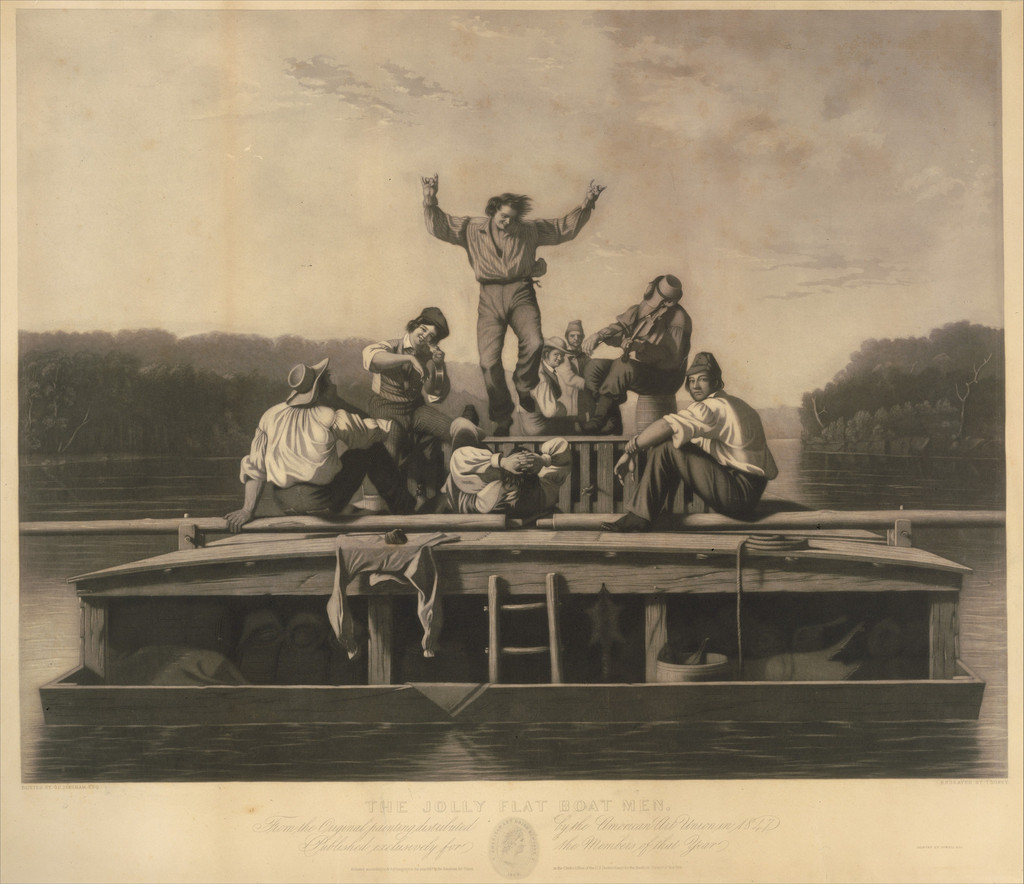
Thomas Doney after George Caleb Bingham, The Jolly Flat Boat Men, 1847. Mezzotint and engraving with etching; published by the American Art-Union and printed by Powell and Company. The Metropolitan Museum of Art, 42.119.68.
Image source
.
Public domain
.
Three versions, three settings for leisure
The subject remained useful to Bingham. In 1857 he painted Jolly Flatboatmen in Port , now at the Saint Louis Art Museum. It was made in Düsseldorf and sets the performance within a larger, more crowded view of the Saint Louis waterfront. The subject’s geography and the artist’s place of work were therefore different: an American river scene could be constructed while he was in Europe. [2]
That later setting changes the meaning of the gathering’s surroundings. The 1846 boat occupies a relatively open passage of river, with wooded banks and a large pale sky. The 1857 work brings the entertainment into a commercial destination. The dancer continues to organise attention, but the environment connects his group to a busier social world. [2]
A third treatment, now in the Terra Foundation collection, dates to 1877–78. The 2015 exhibition identified it as the final version and described the boat as an increasingly stage-like setting for the familiar dancer. It also noted the changed position of the oars. This late chronology matters: the painting belongs to the end of Bingham’s career, rather than to an immediate sequence of repetitions in the 1840s. [2]
The exhibition connected the late work’s compressed figures with the possible effect of Bingham no longer possessing his river drawings. That was offered as a possibility, not as a complete explanation. The surviving canvas and the historical location of the drawings supply different kinds of evidence; one does not automatically establish the artist’s thoughts while making the other. [2]
For a viewer, the versions demonstrate how a recognisable motif can survive substantial changes in context. A dancing body can remain central while the river, other people and practical space around it shift. The 1846 painting is best understood as a particular solution within that continuing interest, with its own arrangement of open distance and concentrated company.
Ownership and the return to public view
The Art-Union awarded the original canvas to Benjamin van Schaick in December 1847. Its later entry into the Pell family is less securely documented. The NGA’s provenance notes explain that a family account named an ancestor who had died before the painting was made; the institution consequently leaves the identity of the first Pell owner unresolved. That gap should remain visible within the ownership history. [1]
The subsequent route is clearer. The painting passed through Pell family ownership, was purchased by Richard A. Manoogian in 1986 and entered the NGA in 2015. Its exhibition record includes the 1954–55 Westward the Way exhibition and the 2014–15 Navigating the West exhibition. Private ownership therefore did not prevent all public display, and acquisition by a national collection was a later stage in an already substantial public history. [1]
The contrast with the print’s circulation is revealing. A widely known composition could have an original whose location was uncertain to researchers. Knowledge of the image and knowledge of the physical canvas are related, but they are not interchangeable. A print can preserve a design and spread a reputation without recording every transfer of the painting it reproduces.
Looking for the quieter movements
The dancer is the natural starting point, but the less conspicuous bodies help hold our attention. Compare the outward-facing man on the right with the man whose back turns towards us on the left. Both sit close to the front of the gathering. Their opposing directions open and close different routes into the group.
Then look below the dancer. The reclining figure’s raised elbows create another spread of limbs, at a lower level and with a different energy. The pose echoes the dancer’s openness without repeating his effort. The relation lets relaxation and performance share the same central axis.
The pan player supplies a smaller circular pattern. His hand, the pan and the bend of his other arm concentrate attention in a compact area. Across the dancer, the fiddler’s bow introduces a longer diagonal. The musicians’ gestures differ, giving a visual equivalent of separate contributions to the same rhythm.
Finally, return to the river. Fine reflections and a narrowing gap between the banks establish distance around a gathering that initially seems to fill the entire picture. The boat is both a practical vessel and a temporary place for company. Bingham’s paintings repeatedly find such moments in which work, social life and pictorial order occupy the same space.
Artworks directory
A documented selection discussed across these articles, including separate canvases, figure studies and reproductive impressions. Dates identify the particular object or study; collection and title distinctions follow museum records and the 2015 exhibition checklist. This is not a catalogue raisonné. Prints are grouped with works on paper in the Drawing filter.
| Name | Date | Medium |
|---|---|---|
| Fur Traders Descending the Missouri | 1845 | Painting — oil on canvas |
| The Jolly Flatboatmen | 1846; NGA canvas | Painting — oil on canvas |
| The County Election (original) | 1851–52 | Painting — oil on canvas |
| Stump Speaking | 1853–54 | Painting — oil on canvas |
| The Verdict of the People | 1854–55 | Painting — oil on canvas |
| Order No. 11: Martial Law | 1865–68; Cincinnati original | Painting — oil on canvas |
| Daniel Boone Escorting Settlers through the Cumberland Gap | 1851–52 | Painting — oil on canvas |
| Canvassing for a Vote | 1852; signed canvas | Painting — oil on canvas |
| Raftsmen Playing Cards | 1847 | Painting — oil on canvas |
| Mississippi Boatman | 1850 | Painting — oil on canvas |
| Jolly Flatboatmen in Port | 1857 | Painting — oil on canvas |
| The County Election (replica illustrated here) | 1852 | Painting — oil on canvas |
| Martial Law or Order No. 11 (Missouri replica) | 1870 | Painting — oil on canvas |
| The Jolly Flatboatmen (Terra canvas) | 1877–78 | Painting — oil on canvas |
| John Quincy Adams (later version) | about 1850, after an 1844 original | Painting — oil on canvas |
| Country Politician | 1849 | Painting — oil on canvas |
| The Trappers’ Return | 1851 | Painting — oil on canvas |
| The Concealed Enemy | 1845 | Painting — oil on canvas |
| The Wood-boat | 1850 | Painting — oil on canvas mounted on board |
| Lighter Relieving a Steamboat Aground | 1847 | Painting — oil on canvas |
| Watching the Cargo | 1849 | Painting — oil on canvas |
| In a Quandary | 1851 | Painting — oil on canvas |
| Boatmen on the Missouri | 1846 | Painting — oil on canvas |
| Self-Portrait (Saint Louis) | 1834–35 | Painting — oil on canvas |
| Self-Portrait (Nelson-Atkins) | about 1877 | Painting — oil on canvas |
| Mrs. David Steele Lamme and Son William Wirt | 1837 | Painting — oil on canvas |
| Portrait of Leonidas Wetmore | 1839–40 | Painting — oil on canvas |
| Fur Trader (study for Fur Traders Descending the Missouri) | 1845 | Drawing — brush, ink and wash over pencil |
| Skillet-beater (study for The Jolly Flatboatmen) | 1846 | Drawing — brush, ink and wash over pencil |
| Young Wood-boatman (study for The Wood-boat) | 1850 | Drawing — brush, ink and wash over pencil |
| Thomas Doney after Bingham: The Jolly Flat Boat Men (Met impression) | 1847 | Print — mezzotint and engraving with etching |
| Thomas Doney after Bingham: The Jolly Flat Boat Men (coloured Carter impression) | 1847 | Print — intaglio with applied watercolour |
| The Verdict of the People (lithographic proof) | ca. 1858–59 | Print — lithographic proof |
| Gautier after Bingham: Stump Speaking | 1856 | Print — etching and aquatint |
| Claude Regnier after Bingham: In a Quandary, Mississippi Raftsmen Playing Cards | 1852 | Print — hand-coloured lithograph |
Frequently Asked Questions
Bingham painted the original in 1846. The National Gallery of Art, Washington, holds it as accession 2015.18.1. [1]
Thomas Doney engraved the composition. The American Art-Union published the print, and Powell and Company printed it. The Met’s impression is dated 1847. [3]
No. Jolly Flatboatmen in Port is a separate painting of 1857 at the Saint Louis Art Museum. Bingham also made a late Jolly Flatboatmen version in 1877–78, now in the Terra Foundation collection. [2]
Discussion
Look again at the images and ideas explored in The Jolly Flatboatmen. These editorial prompts invite your observations.
Reader Insights
How does the dancer’s movement depend on the quieter figures below?
What changes when you compare the canvas with Doney’s printed version?
Where does your eye go after the dancer and the musician?
Join the Conversation
Share a detail, comparison or question about The Jolly Flatboatmen below.
References
- National Gallery of Art , The Jolly Flatboatmen , 1846, 2015.18.1. Current object record, provenance and exhibition history. View source
- Metropolitan Museum of Art , Navigating the West: George Caleb Bingham and the River , exhibition labels, 2015, especially pp. 8–10, 16 and 19–20. View source
- Metropolitan Museum of Art , Thomas Doney after Bingham, The Jolly Flat Boat Men , 1847, 42.119.68. Current print record. View source
- Metropolitan Museum of Art, Fur Traders Descending the Missouri. View source
- Saint Louis Art Museum, Raftsmen Playing Cards. View source
- National Gallery of Art, Mississippi Boatman. View source
- Saint Louis Art Museum, The County Election, 1851–52, 124:1944. View source
- Saint Louis Art Museum, The County Election, 1852 replica, 44:2001. View source
- Kemper Art Museum, Washington University, Daniel Boone Escorting Settlers through the Cumberland Gap. View source
- Nelson-Atkins Museum of Art, Canvassing for a Vote. View source
- Saint Louis Art Museum, Stump Speaking. View source
- Saint Louis Art Museum, The Verdict of the People. View source
- Saint Louis Art Museum, Jolly Flatboatmen in Port. View source
- Cincinnati Art Museum, Order No.11 / Martial Law. View source
- Margaret C. Conrads , “Bingham@200: A Bicentennial Celebration”, Antiques & Fine Art , Spring 2011, pp. 193–199, especially p. 196. View source
- Splash image source.
George Caleb Bingham, The Jolly Flatboatmen, 1846. Oil on canvas, 96.8 × 123.2 cm. National Gallery of Art, Washington, Patrons’ Permanent Fund, 2015.18.1. Public domain .
View source