 by
Tom Gurney
Tom Gurney BSc (Hons) is an art history expert with over 20 years experience
Email:
tomgurney1@gmail.com
/ Phone:
+44 7429 011000
George Caleb Bingham Portraits: Introduction
Portraiture sustained George Caleb Bingham across a career now more often remembered for river workers and election crowds. He began seeking portrait commissions in Missouri in the early 1830s and returned to the subject throughout his life. Margaret Conrads places that continuous work alongside the more concentrated period in which he developed his best-known scenes of Missouri life. Portraits were a profession as well as a field of artistic experiment. [1]
The range includes prosperous Missouri sitters, political figures and images of the artist himself. These paintings ask different things of a face. A commissioned likeness could establish identity and standing; a self-portrait could present a professional role; a later version of an earlier likeness could preserve a sitter’s appearance beyond death. Keeping those purposes distinct makes Bingham’s portraits easier to understand.
At a Glance
- Career Portraiture continued throughout Bingham’s working life [1]
- Subjects Missouri sitters, public figures and the artist himself [1]
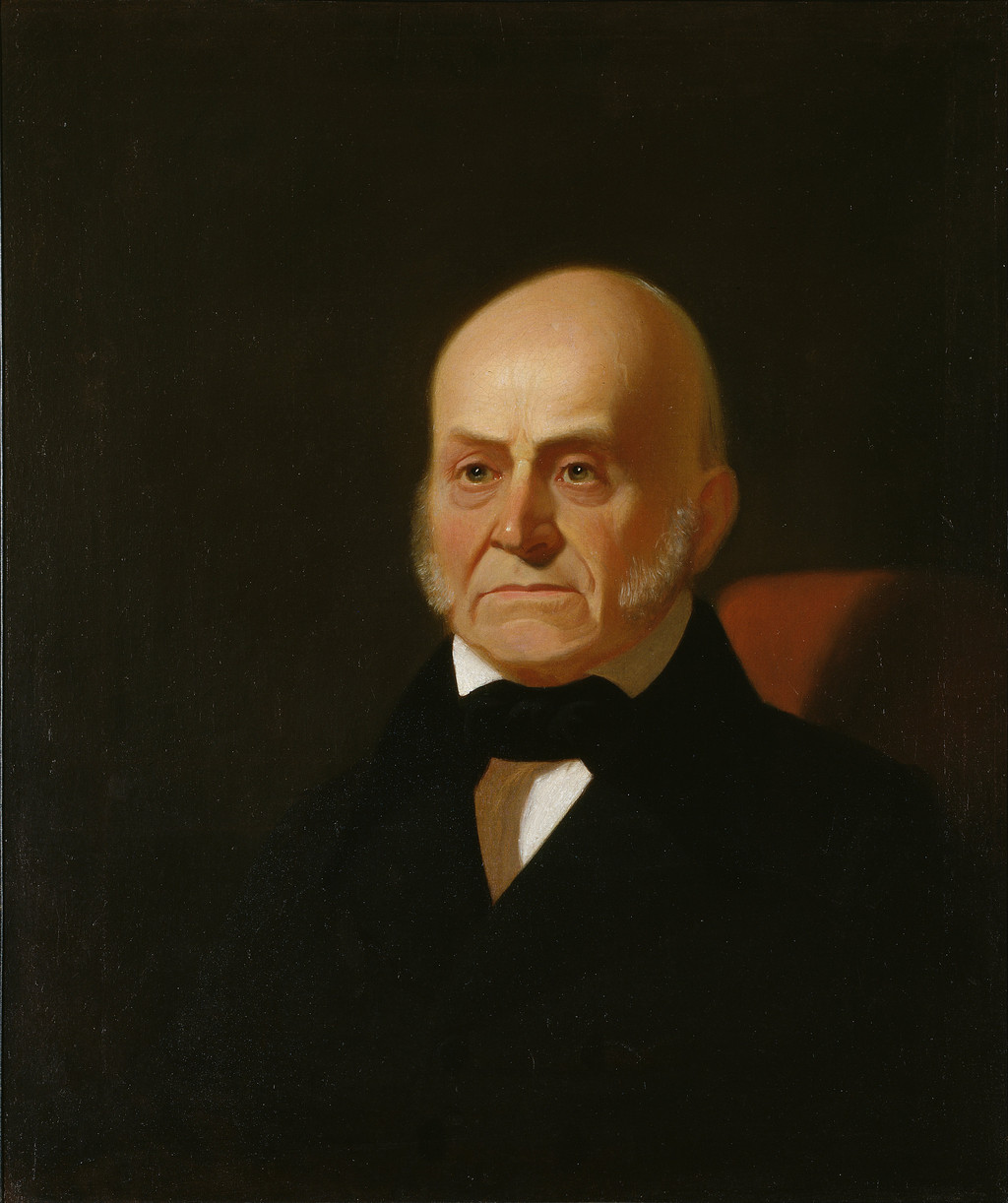
- Illustrated canvas John Quincy Adams, about 1850, after an 1844 original [2]
- Collection National Portrait Gallery, Smithsonian Institution; NPG.69.20 [2]
Contents
- A profession that continued across the career
- The young artist without a palette
- Missouri sitters and the river beyond the face
- John Quincy Adams: a sitting and a later version
- Public portraits and a lost collection
- The late self-portrait: showing the act of drawing
- Likeness and character in the wider paintings
- Annotated details
A profession that continued across the career
Bingham’s early work depended on finding people willing to commission a likeness. Conrads describes an itinerant Missouri portraitist whose contact with developing art centres helped enlarge his ambitions. Travel and commissions were connected: he could earn through particular sitters while encountering other paintings and different expectations of what a portrait should achieve. [1]
The Met’s 1994 catalogue traces a change in his treatment of the figure. It describes early portraits as comparatively rigid and linear, with a softening of manner visible after his 1838 visit to the East Coast. The account relates that development to his study of established portraitists including Thomas Sully and Samuel F. B. Morse. It is a history of learning through examples, rather than a reason to imagine an uninterrupted formal academy education. [3]
The same catalogue describes the difficulty of supporting a family through portrait work during his Washington period in the early 1840s. Portraiture did not automatically provide financial security, even when it brought him close to prominent people. His return to Missouri and later development of river subjects belong within a career shaped by both artistic choices and the need to find a market. [3]
Portraits also continued after the principal river and election paintings. Conrads notes their importance following his return from Europe and through his later years around Kansas City. The subject was not simply an apprenticeship discarded when more ambitious scenes became possible. It remained a way of working with individual presence and a practical foundation for his livelihood. [1]
Annotated Details from George Caleb Bingham Portraits
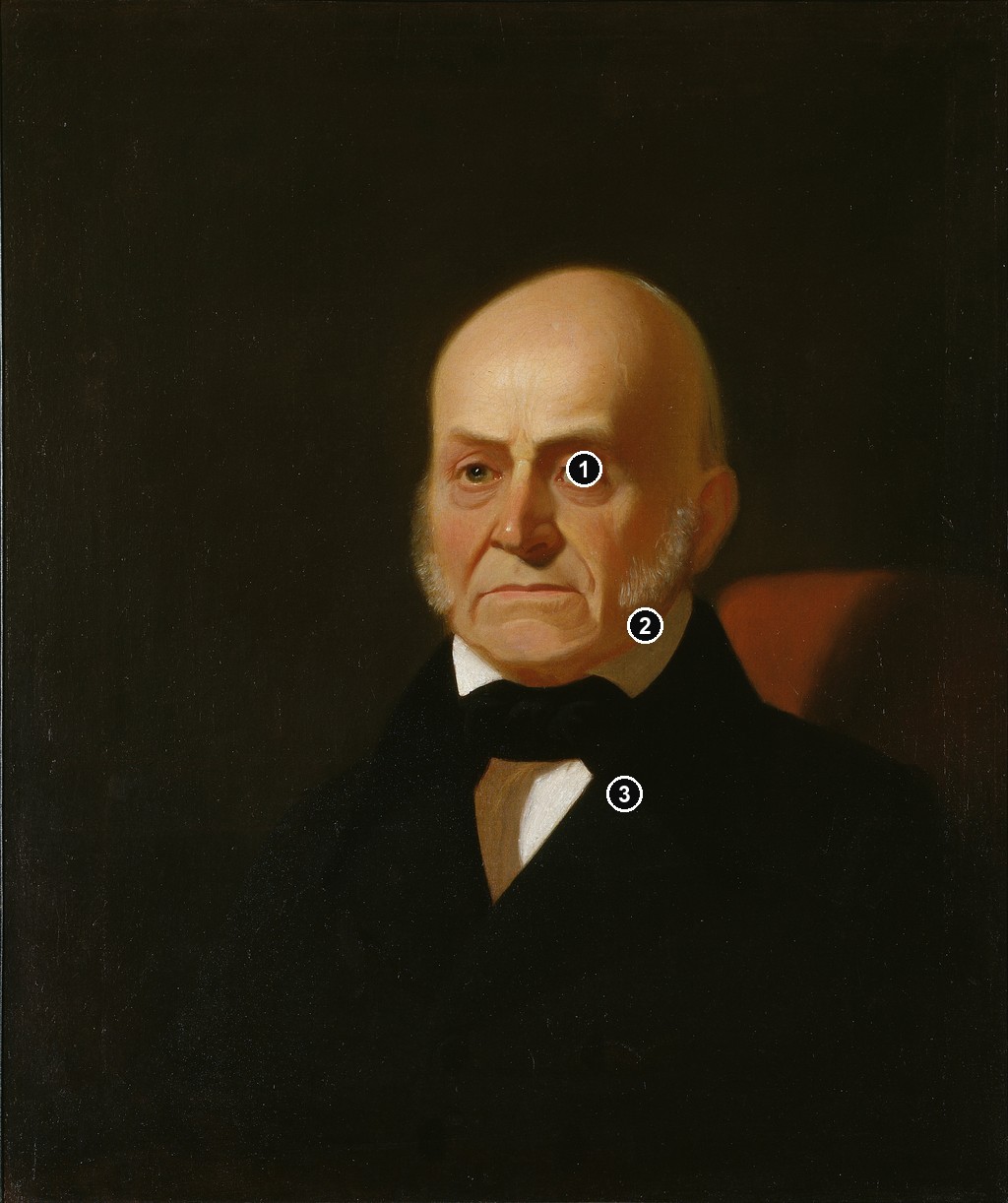
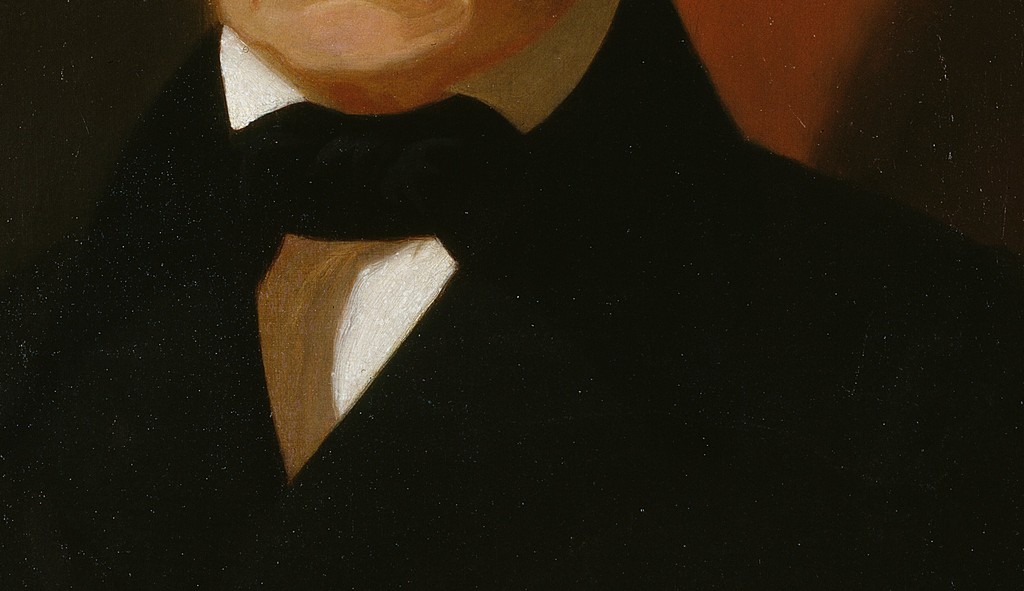
The numbered points identify visible features discussed in this article. Return from each detail to the whole composition. George Caleb Bingham, John Quincy Adams, about 1850, based on an 1844 original. Oil on canvas. National Portrait Gallery, Smithsonian Institution, NPG.69.20. This is the later posthumous version. Image source. Public domain. Numbers added to a separate overview. Detail images are crops of the source reproduction.
Details from GEORGE CALEB BINGHAM PORTRAITS
Compare the cropped details with the complete images above. Notice how their colours, shapes and positions contribute to the larger compositions.
Forehead, brows and eyes
Light describes the broad forehead before passing into smaller changes around the brows and eyes. The gaze is slightly turned, giving the head a direction within the otherwise restrained setting.
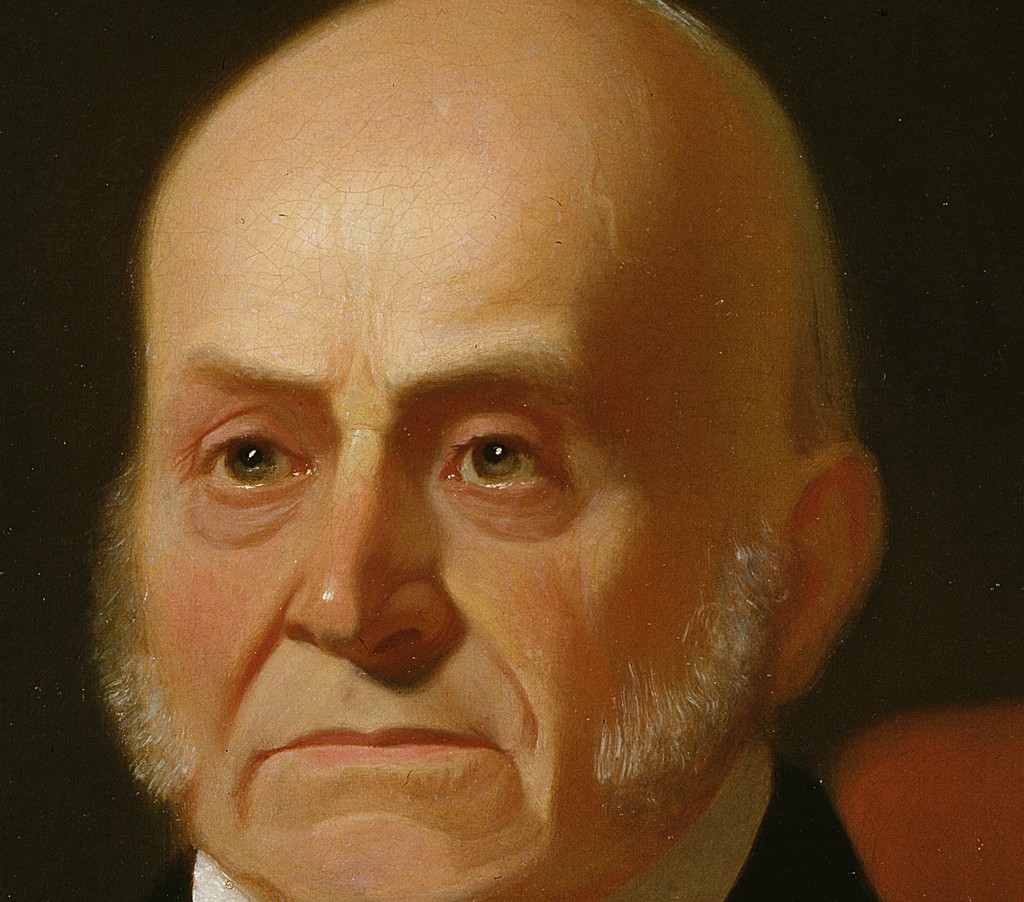
Pale hair at the edge of the face
The pale hair beside the jaw marks a boundary between skin and the surrounding darkness. Small changes of warmth and shadow help turn the cheek and lower face rather than enclosing the head with a hard outline.
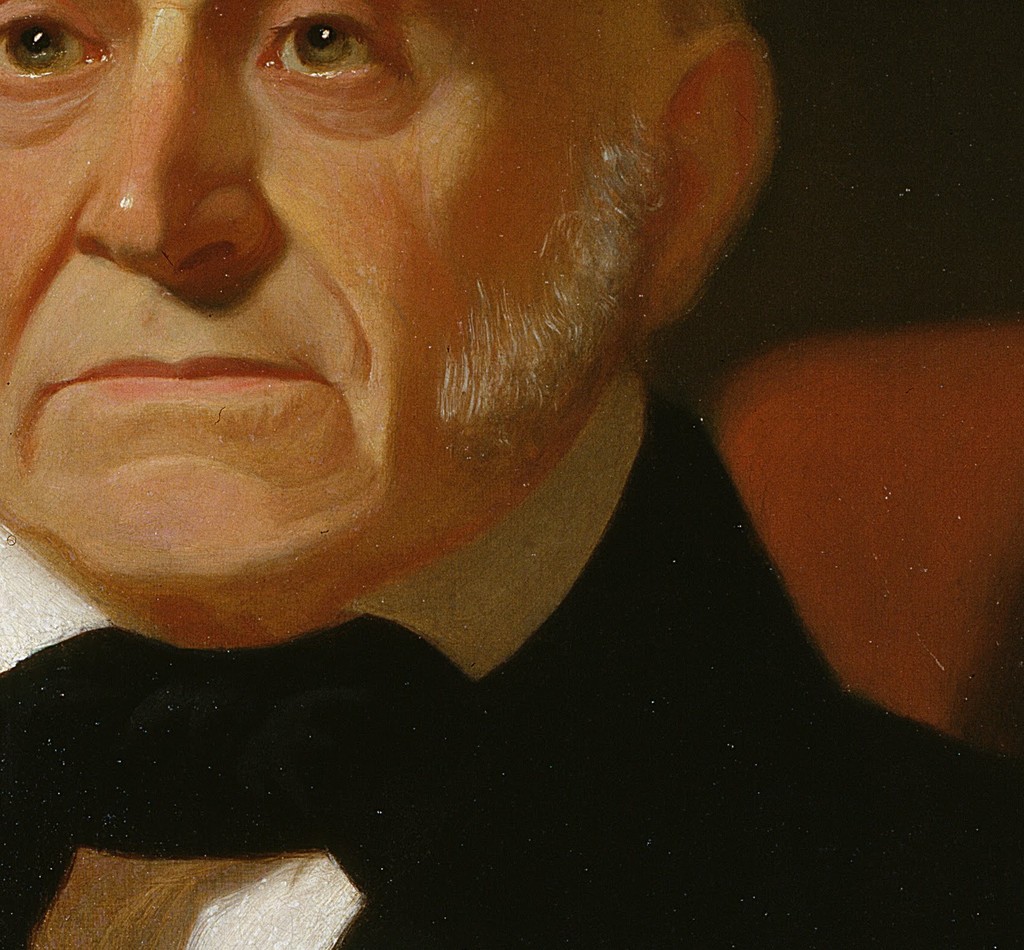
White cloth and the reddish chair
The white collar and shirt create sharp accents against the dark neckwear and coat. A reddish chair back introduces another shape at the side, giving the bust a little surrounding space.
The young artist without a palette
The early Self-Portrait of 1834–35, held by the Saint Louis Art Museum, offers one form of professional presentation. The Met’s 2015 exhibition described its sober, direct character and drew attention to something absent: Bingham did not include the conventional palette or brush that might immediately identify him as a painter. [4]
That omission allows a broader social identity. The exhibition connected the image with the self-made Missouri men Bingham portrayed, whose livelihoods could depend on river commerce. A serious gaze and respectable appearance could align the artist with that clientele. He could present ambition and standing without making the tools of his occupation the principal subject. [4]
The distinction is useful because a self-portrait always involves selection. The painter chooses how much to tell the viewer through clothing, objects, pose and setting. Even a seemingly straightforward likeness has a public function. In this early case, the museum’s reading asks us to consider how an artist might wish to belong within the social world of his patrons.
It also prepares a revealing comparison with the later self-portrait in which drawing becomes explicit. The two images do not need to be read as a simple progression from uncertainty to confidence. They offer different ways of making a professional identity visible at different points in the career.
Missouri sitters and the river beyond the face
The portrait of Mrs. David Steele Lamme (Sophia Woodson Hickman) and Son William Wirt , dated 1837, shows how an individual likeness could connect domestic identity with a wider setting. The 2015 exhibition identified its river view as one of Bingham’s earliest surviving depictions of a river. It also noted David Steele Lamme’s investments associated with river trade. The landscape therefore belongs to the family’s social world as well as to the painter’s developing interests. [4]
The museum emphasised Sophia’s position in a domestic interior with her child. The river does not turn the painting into a scene of labour like the later boatmen pictures. Its relation to the sitter is indirect, joining a family’s respectable presentation with the economic landscape beyond the room. The portrait can hold both kinds of information without giving them equal prominence. [4]
Portrait of Leonidas Wetmore , 1839–40, constructs another kind of identity. The exhibition connected buckskin clothing and weaponry with a frontier image, while the dark suit underneath and the sitter’s posture suggested the standing of his Saint Louis family. It placed the commission before Wetmore’s departure for military service against the Seminoles in Florida. [4]
That combination makes clothing particularly important. A person could appear attached to western experience and respectable urban society within the same image. The portrait does not require the sitter to fit one simple category. Bingham’s attention to such distinctions helped him develop the clothing, gestures and social character of figures within his later scenes of everyday life.
John Quincy Adams: a sitting and a later version
Bingham painted John Quincy Adams from life in 1844, but the familiar portrait in the National Portrait Gallery is a later object. The Smithsonian dates it to about 1850, based on the 1844 original, and describes it as posthumous. Adams had died in 1848. The distinction separates an encounter between artist and sitter from the subsequent production of another likeness. [2]
The Smithsonian’s account also records Adams’s doubts about Bingham’s ability to capture him before the sitting. That detail gives the commission a human tension: a prominent sitter could have opinions about the painter’s competence as well as the finished result. It does not tell us everything about the sittings or justify inventing their conversation. [2]
In the later canvas, the head emerges from a dark field. A white collar and shirt create small areas of sharp contrast below the face, while the coat and neckwear largely merge with the surrounding darkness. The reddish chair back at one side establishes a little space without becoming an elaborate setting.
The face carries most of the description. Light falls across the forehead, cheeks and nose, while pale hair beside the jaw marks the boundary between skin and shadow. The eyes look slightly away from a perfectly frontal encounter. Bingham gives the head volume through changes of tone rather than through the strong objects and broad landscape used in some of his river scenes.
The National Portrait Gallery identifies this oil on canvas as NPG.69.20. Its date should stay attached to the reproduced image whenever it appears beside an account of the 1844 sitting. Calling every version simply an 1844 portrait would conceal the difference between a likeness first made in a person’s presence and a later object that carries it forward. [2]
Watch: George Caleb Bingham
Choose a film to explore the artist’s work, its interpretation and its wider setting.
Navigating the West: George Caleb Bingham and the River at the Amon Carter Museum of American Art
The Amon Carter Museum introduces an exhibition devoted to Bingham’s river paintings.
Watch on YouTubePublic portraits and a lost collection
Portraiture could serve a public institution as well as a private sitter. The State Historical Society of Missouri records Bingham’s large portraits displayed in the state Capitol from 1859 onwards, including Washington, Jefferson, Andrew Jackson, Henry Clay and Nathaniel Lyon. Washington and Jefferson had been completed during his time in Germany. These were images through which a public building presented a national and political past. [5]
The collection’s later history places a limit on what survives to be studied directly. The Capitol burned on 5 February 1911, destroying the paintings, although photographs of the lost portraits remain. A surviving photographic record can preserve an arrangement or likeness without providing the same evidence of colour, surface and scale as the painted object. The loss makes it especially important not to mistake the selection of surviving portraits for the full range of his public work. [5]
Such portraits also complicate a simple division between Bingham the portraitist and Bingham the political painter. A likeness of a public figure can help organise civic memory without showing an election or a historical confrontation. The individual face becomes part of an institutional setting, and the purpose of the image extends beyond a private encounter between artist and sitter.
The late self-portrait: showing the act of drawing
In the Self-Portrait dated about 1877, Bingham makes his occupation visible. He holds a drawing board and a drawing implement, while looking directly outward. The work is lent by the Kansas City Public Library to the Nelson-Atkins Museum of Art, whose current record identifies it as object 1-1955. [6]
The arrangement joins face and hands without allowing them to compete equally. The pale shirt and collar separate the head from the dark coat. One hand grips the upper edge of the board, while the other remains near the drawing surface. The board crosses the lower portion of the image, giving the hands a practical task and the viewer a clear explanation of the artist’s activity.
The Nelson-Atkins label relates the composition to a self-portrait by Edwin Landseer known to Bingham through an engraving. It also interprets the outward gaze as placing the viewer in the position of a mirror. Those connections make the image an account of artistic self-observation as well as a likeness of an older painter. [6]
Compared with the early self-portrait described in the 2015 exhibition, the tools now say something the earlier painting left unstated. Bingham can appear as a working artist through a board, an implement and the coordination of his hands. The simple act of drawing provides a professional identity within the image.
This emphasis also belongs to the wider career. Preparatory sheets helped Bingham compose individual figures and groups, while drawing on the canvas could help him develop a painted arrangement. The self-portrait gives that sustained practice a visible place. The drawings and prints article examines its different roles in making and circulating his work. [6]
Likeness and character in the wider paintings
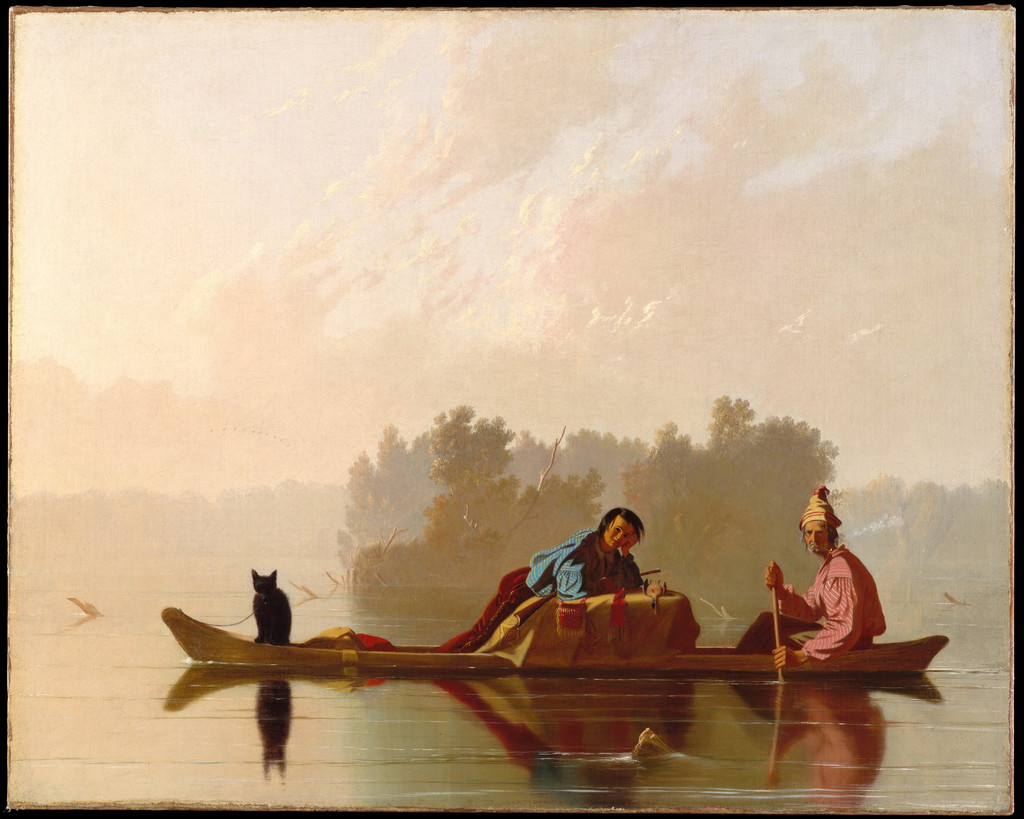
The portraits and the genre scenes share attention to the body, but they do not make the same promise. A portrait names a sitter or identifies the artist himself. A character study for a river painting may preserve a model’s pose while changing age, clothing or expression to serve the composition. Conrads’s discussion of the drawing for Fur Traders Descending the Missouri makes that transformation especially clear. [1]
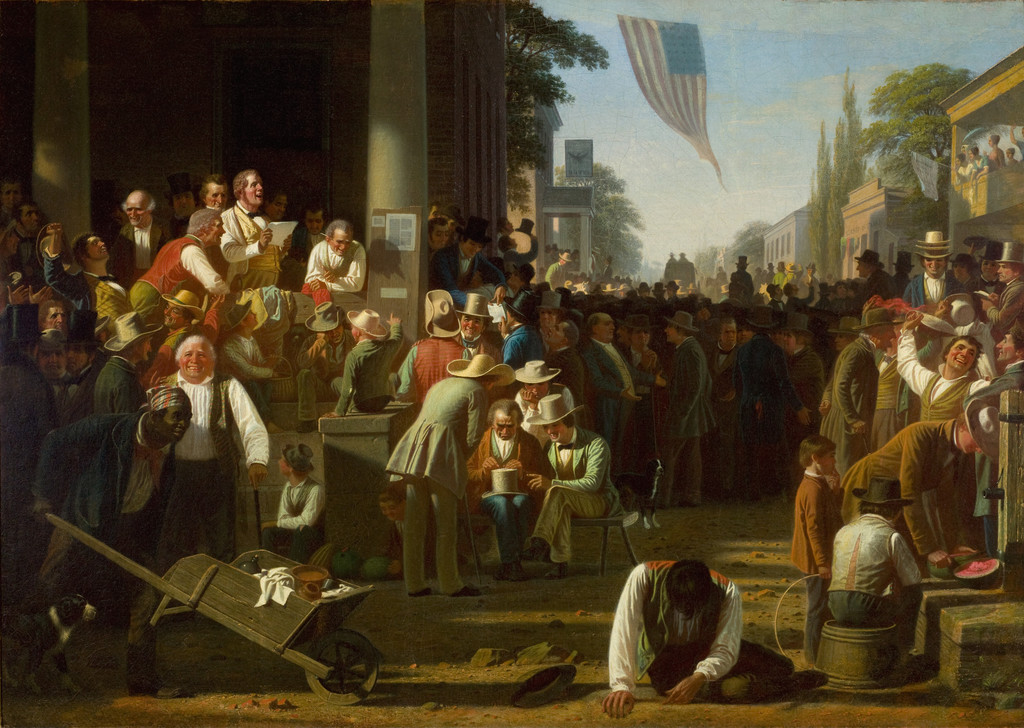
A convincing face within a crowd is therefore not automatically an identifiable portrait. Conversely, a named sitter can be presented through conventions that shape how a viewer understands status, work and character. Bingham’s paintings are most revealing when likeness and arrangement are considered together, rather than when every expressive figure is treated as a documentary record of a known individual.
Looking across these examples, begin with what surrounds the face: the presence or absence of tools, a river outside a room, distinctive clothing or the narrow appearance of a chair. Such details explain how a portrait introduces its sitter to the world. They give the individual encounter a social setting without reducing the person to that setting alone.
Artworks directory
A documented selection discussed across these articles, including separate canvases, figure studies and reproductive impressions. Dates identify the particular object or study; collection and title distinctions follow museum records and the 2015 exhibition checklist. This is not a catalogue raisonné. Prints are grouped with works on paper in the Drawing filter.
| Name | Date | Medium |
|---|---|---|
| Fur Traders Descending the Missouri | 1845 | Painting — oil on canvas |
| The Jolly Flatboatmen | 1846; NGA canvas | Painting — oil on canvas |
| The County Election (original) | 1851–52 | Painting — oil on canvas |
| Stump Speaking | 1853–54 | Painting — oil on canvas |
| The Verdict of the People | 1854–55 | Painting — oil on canvas |
| Order No. 11: Martial Law | 1865–68; Cincinnati original | Painting — oil on canvas |
| Daniel Boone Escorting Settlers through the Cumberland Gap | 1851–52 | Painting — oil on canvas |
| Canvassing for a Vote | 1852; signed canvas | Painting — oil on canvas |
| Raftsmen Playing Cards | 1847 | Painting — oil on canvas |
| Mississippi Boatman | 1850 | Painting — oil on canvas |
| Jolly Flatboatmen in Port | 1857 | Painting — oil on canvas |
| The County Election (replica illustrated here) | 1852 | Painting — oil on canvas |
| Martial Law or Order No. 11 (Missouri replica) | 1870 | Painting — oil on canvas |
| The Jolly Flatboatmen (Terra canvas) | 1877–78 | Painting — oil on canvas |
| John Quincy Adams (later version) | about 1850, after an 1844 original | Painting — oil on canvas |
| Country Politician | 1849 | Painting — oil on canvas |
| The Trappers’ Return | 1851 | Painting — oil on canvas |
| The Concealed Enemy | 1845 | Painting — oil on canvas |
| The Wood-boat | 1850 | Painting — oil on canvas mounted on board |
| Lighter Relieving a Steamboat Aground | 1847 | Painting — oil on canvas |
| Watching the Cargo | 1849 | Painting — oil on canvas |
| In a Quandary | 1851 | Painting — oil on canvas |
| Boatmen on the Missouri | 1846 | Painting — oil on canvas |
| Self-Portrait (Saint Louis) | 1834–35 | Painting — oil on canvas |
| Self-Portrait (Nelson-Atkins) | about 1877 | Painting — oil on canvas |
| Mrs. David Steele Lamme and Son William Wirt | 1837 | Painting — oil on canvas |
| Portrait of Leonidas Wetmore | 1839–40 | Painting — oil on canvas |
| Fur Trader (study for Fur Traders Descending the Missouri) | 1845 | Drawing — brush, ink and wash over pencil |
| Skillet-beater (study for The Jolly Flatboatmen) | 1846 | Drawing — brush, ink and wash over pencil |
| Young Wood-boatman (study for The Wood-boat) | 1850 | Drawing — brush, ink and wash over pencil |
| Thomas Doney after Bingham: The Jolly Flat Boat Men (Met impression) | 1847 | Print — mezzotint and engraving with etching |
| Thomas Doney after Bingham: The Jolly Flat Boat Men (coloured Carter impression) | 1847 | Print — intaglio with applied watercolour |
| The Verdict of the People (lithographic proof) | ca. 1858–59 | Print — lithographic proof |
| Gautier after Bingham: Stump Speaking | 1856 | Print — etching and aquatint |
| Claude Regnier after Bingham: In a Quandary, Mississippi Raftsmen Playing Cards | 1852 | Print — hand-coloured lithograph |
Frequently Asked Questions
Yes. He began portrait work in Missouri in the early 1830s and continued it through his later years. His river and political subjects occupy a more concentrated period within that longer profession. [1]
The current canvas is dated about 1850, based on an 1844 original. The Smithsonian describes it as posthumous, so it should not be labelled as the canvas made during the actual sitting. [2]
The Nelson-Atkins label connects the composition with Landseer and with the importance of drawing in Bingham’s practice. The board and hands make the artist’s work visible within the likeness. [6]
Discussion
Look again at the images and ideas explored in George Caleb Bingham Portraits. These editorial prompts invite your observations.
Reader Insights
What does the later Adams version ask us to distinguish from the original sitting?
How does a commissioned likeness differ from a character in a river scene?
What would you look for when comparing Bingham’s early and late self-portraits?
Join the Conversation
Share a detail, comparison or question about George Caleb Bingham Portraits below.
References
- Margaret C. Conrads , “Bingham@200: A Bicentennial Celebration”, Antiques & Fine Art , Spring 2011, pp. 193–199. View source
- National Portrait Gallery , Smithsonian Institution, John Quincy Adams , about 1850, from an 1844 original, NPG.69.20. Current object record. View source
- Metropolitan Museum of Art , American Paintings in the Metropolitan Museum of Art , volume I, 1994, Bingham entry, pp. 538–543, especially p. 539. View source
- Metropolitan Museum of Art , Navigating the West: George Caleb Bingham and the River , exhibition labels, 2015, pp. 3–4. View source
- The State Historical Society of Missouri , “George Caleb Bingham,” Historic Missourians , especially the Capitol portraits section. View source
- Nelson-Atkins Museum of Art , Self-Portrait , about 1877, 1-1955. Current record and gallery label; lent by the Kansas City Public Library. View source
- Splash image source.
George Caleb Bingham, John Quincy Adams, about 1850, based on an 1844 original. Oil on canvas. National Portrait Gallery, Smithsonian Institution, NPG.69.20. This is the later posthumous version. Public domain .
View source