 by
Tom Gurney
Tom Gurney BSc (Hons) is an art history expert with over 20 years experience
Email:
tomgurney1@gmail.com
/ Phone:
+44 7429 011000
Mississippi Boatman: Introduction
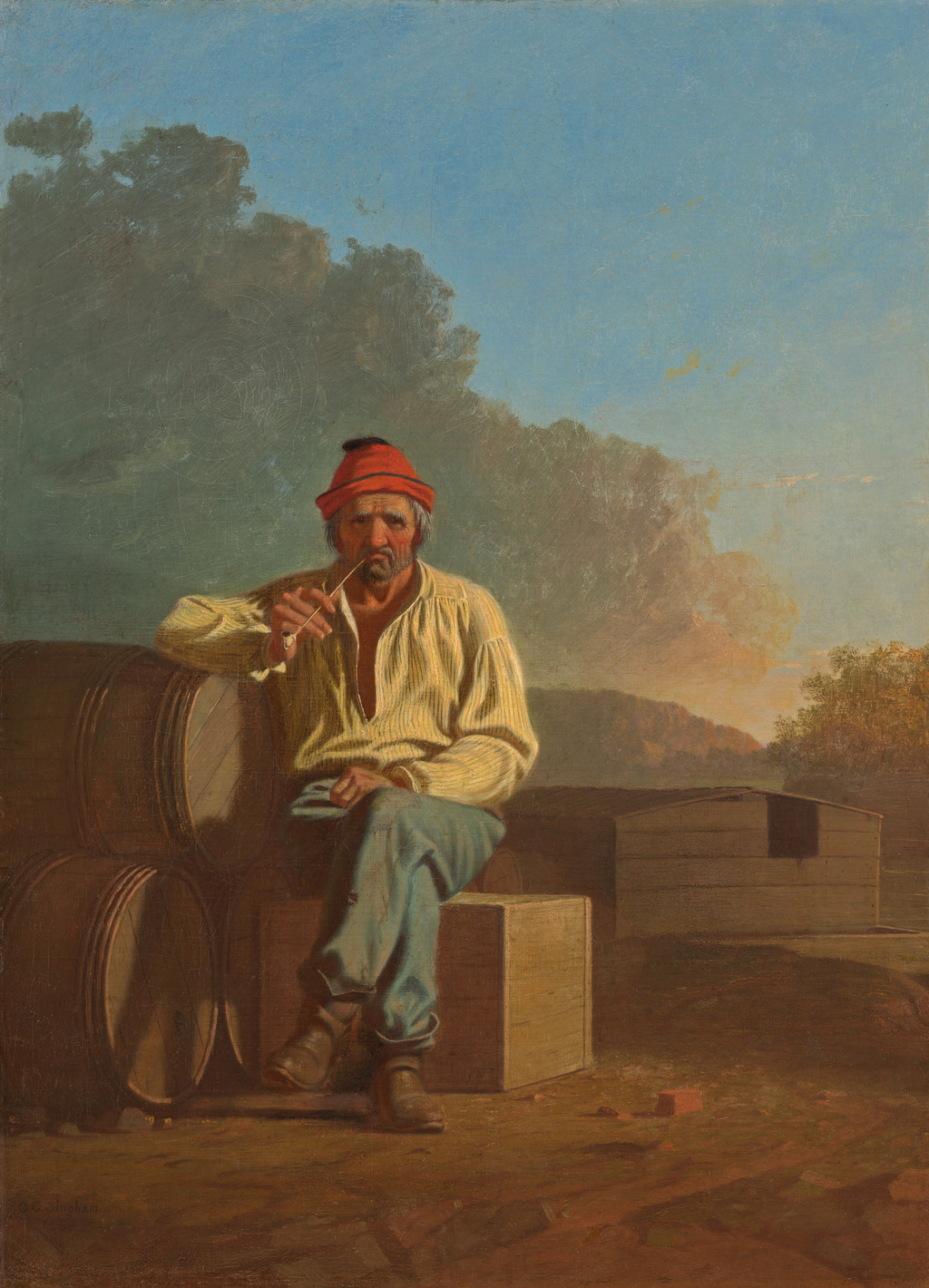
A man in a red cap sits beside stacked barrels and looks directly out of George Caleb Bingham’s Mississippi Boatman . His legs are crossed, one elbow rests on a barrel and a pipe extends from his mouth towards his hand. The posture suggests a pause in work. The lined face and downturned mouth make that pause feel less companionable than the leisure in many of Bingham’s river scenes.
Painted in 1850, this small vertical oil on canvas is now in the National Gallery of Art, Washington. It measures 61.3 × 43.7 cm and belongs to the John Wilmerding Collection, accession 2004.66.1. Its single figure gives an unusually concentrated form to a subject Bingham more often explored through groups of people. [1]
The boatman’s pose had appeared before, in a drawing and in Watching the Cargo of 1849. Bingham changed the figure’s appearance and surroundings to make a different encounter. Franklin Kelly’s catalogue account follows that transformation while leaving open how far the result should be understood as a comment on the troubled politics of 1850. [2]
At a Glance
- Artist George Caleb Bingham.
- Date 1850.
- Medium Oil on canvas.
- Dimensions 61.3 × 43.7 cm.
- Collection National Gallery of Art, Washington.
- Collection credit John Wilmerding Collection.
- Accession 2004.66.1. [1]
This work across George Caleb Bingham’s career
The Jolly Flatboatmen
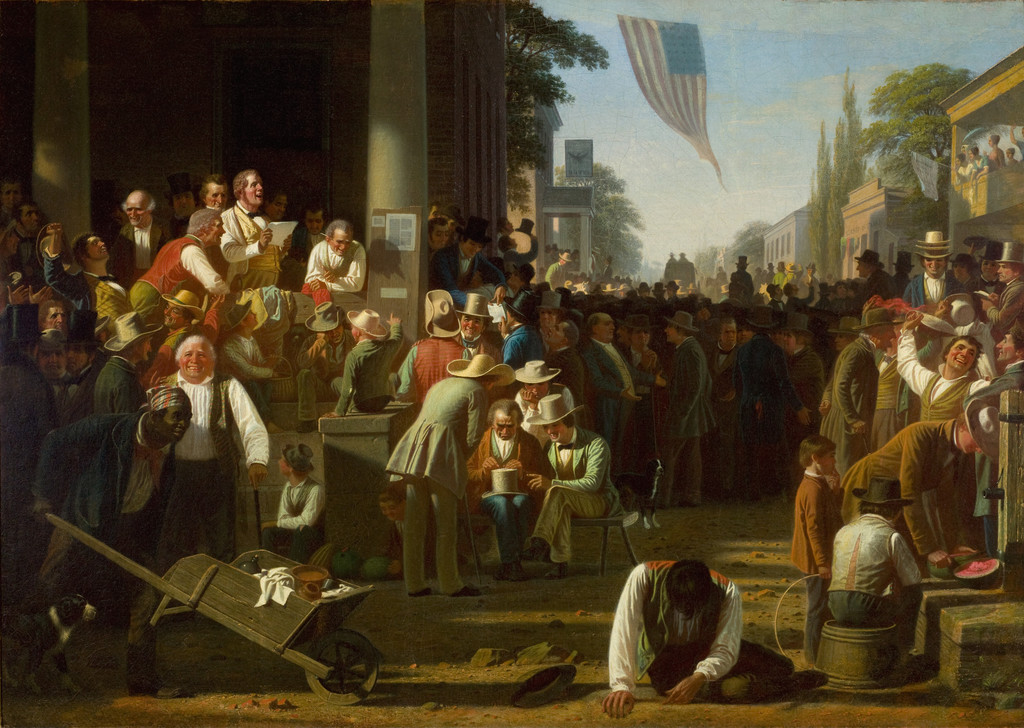
1846; NGA canvasThe County Election
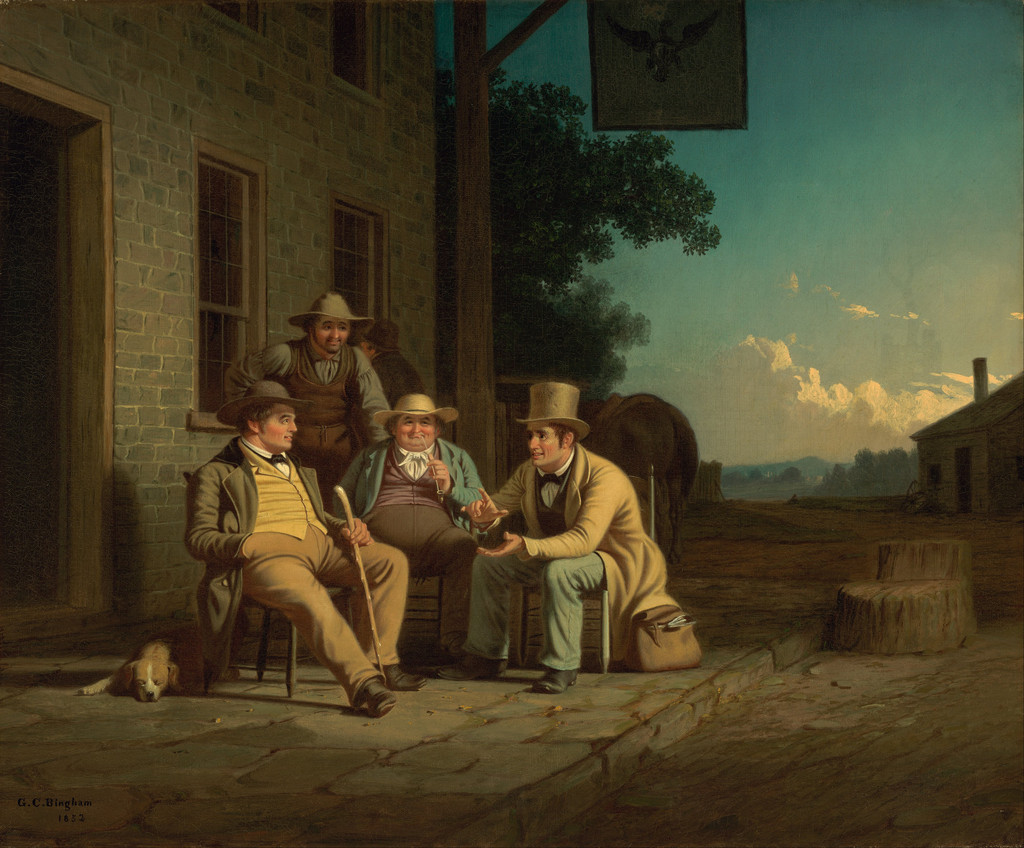
1851–52 original; 1852 replica illustratedCanvassing for a Vote
1852; signed canvasStump Speaking
1853–54The Verdict of the People
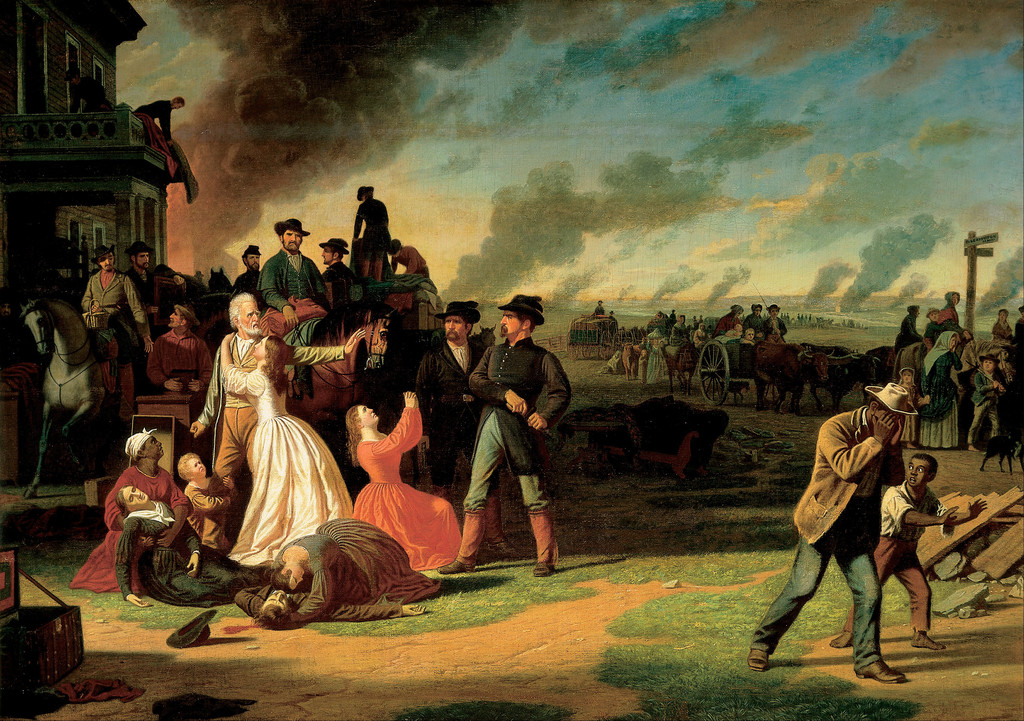
1854–55Order No. 11: Martial Law
1865–68; Cincinnati originalNotes and sources
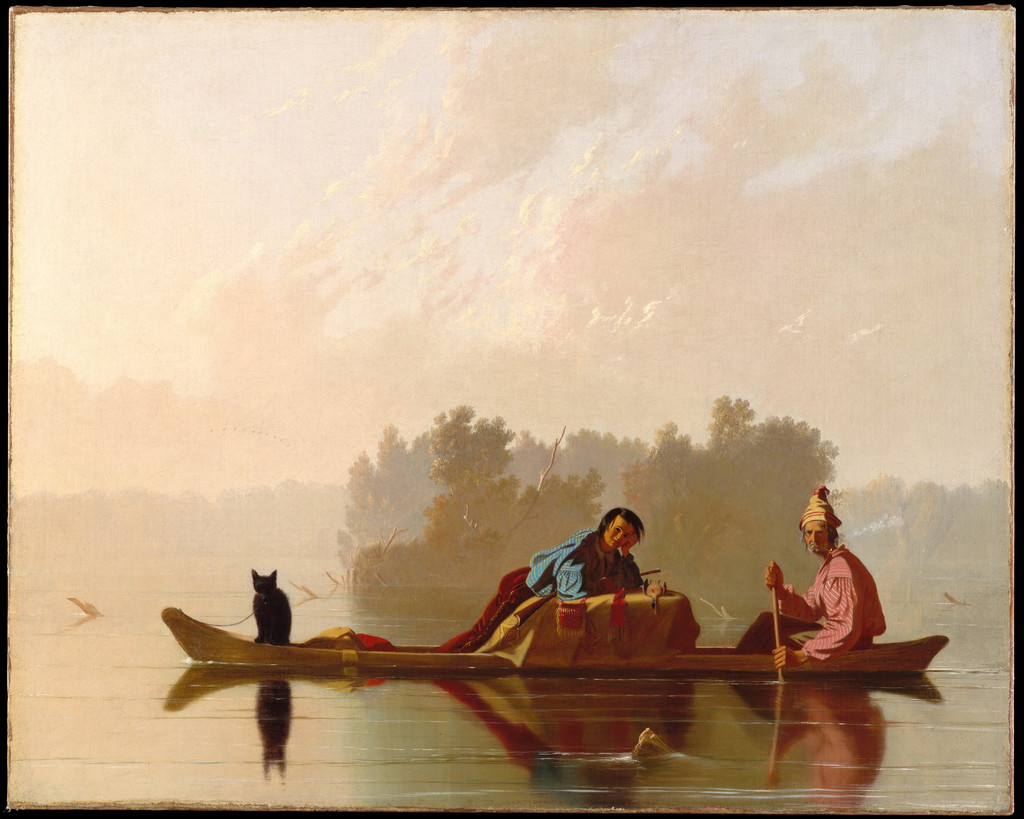
Fur Traders Descending the Missouri. Dates identify the canvas discussed in the article. [3]
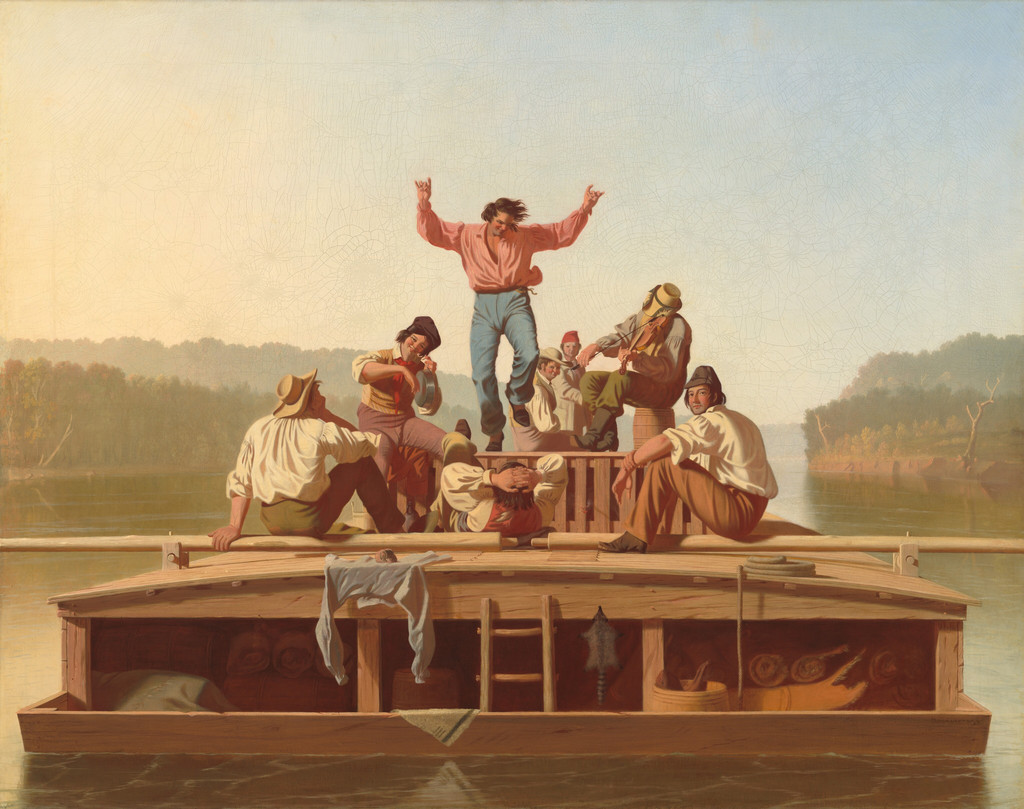
The Jolly Flatboatmen. Dates identify the canvas discussed in the article. [4]
Raftsmen Playing Cards. Dates identify the canvas discussed in the article. [5]
Mississippi Boatman (current article). Dates identify the canvas discussed in the article. [1]
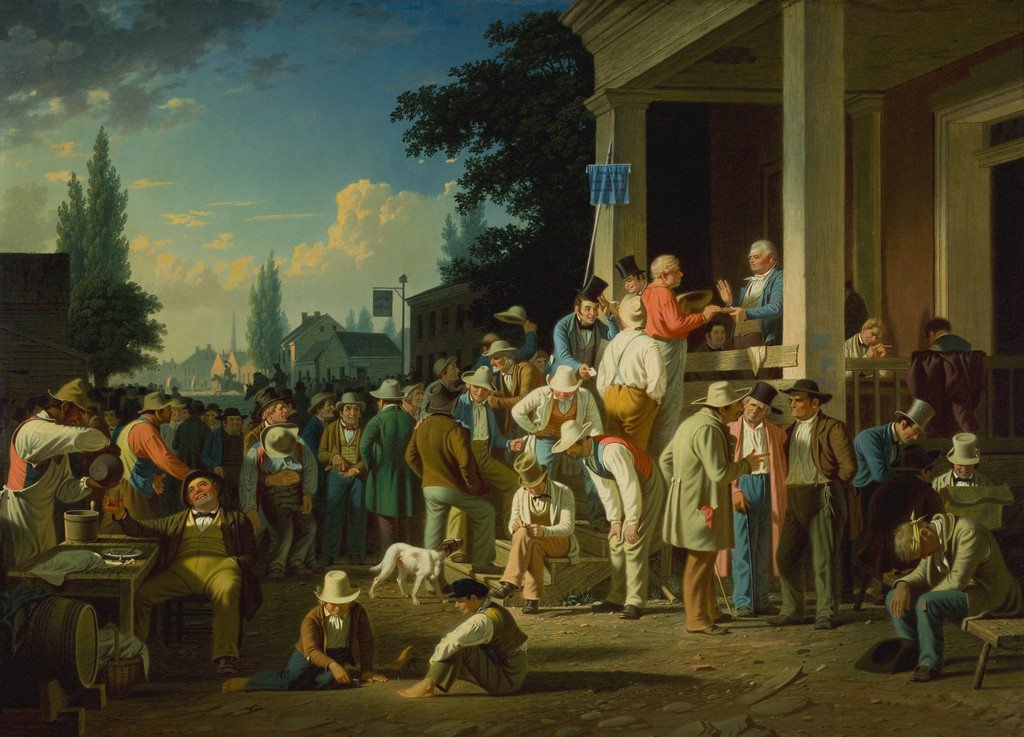
The County Election. The original is 124:1944; the illustrated 1852 replica is 44:2001. Their dimensions and acquisition histories differ. [6] [7]
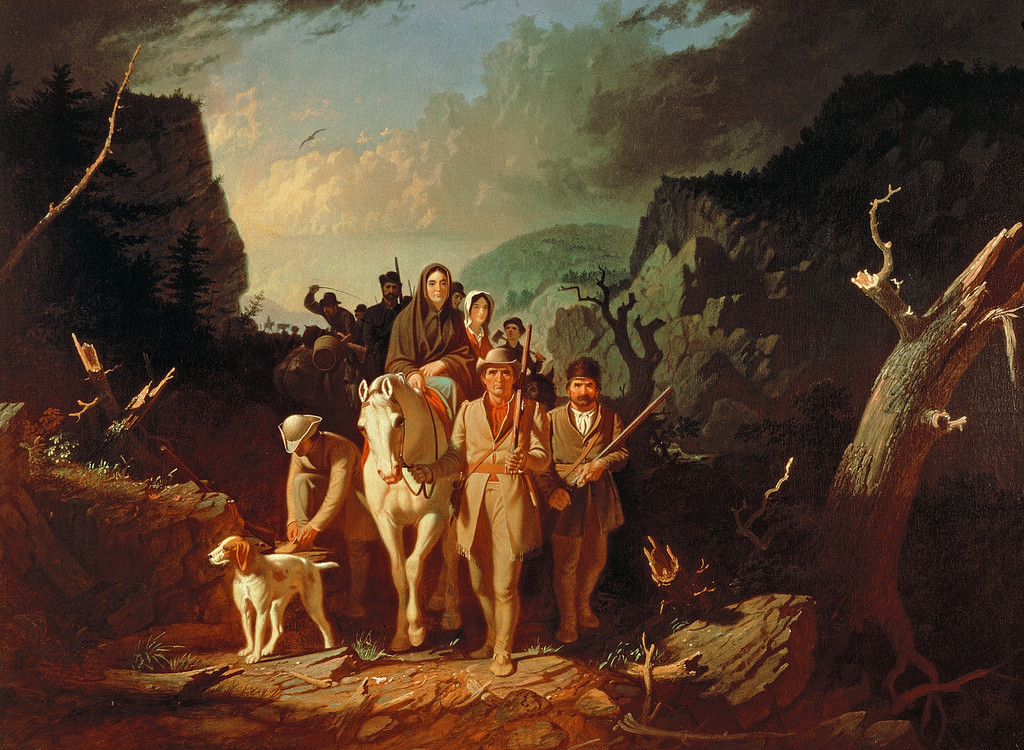
Daniel Boone Escorting Settlers through the Cumberland Gap. Dates identify the canvas discussed in the article. [8]
Canvassing for a Vote. Dates identify the canvas discussed in the article. [9]
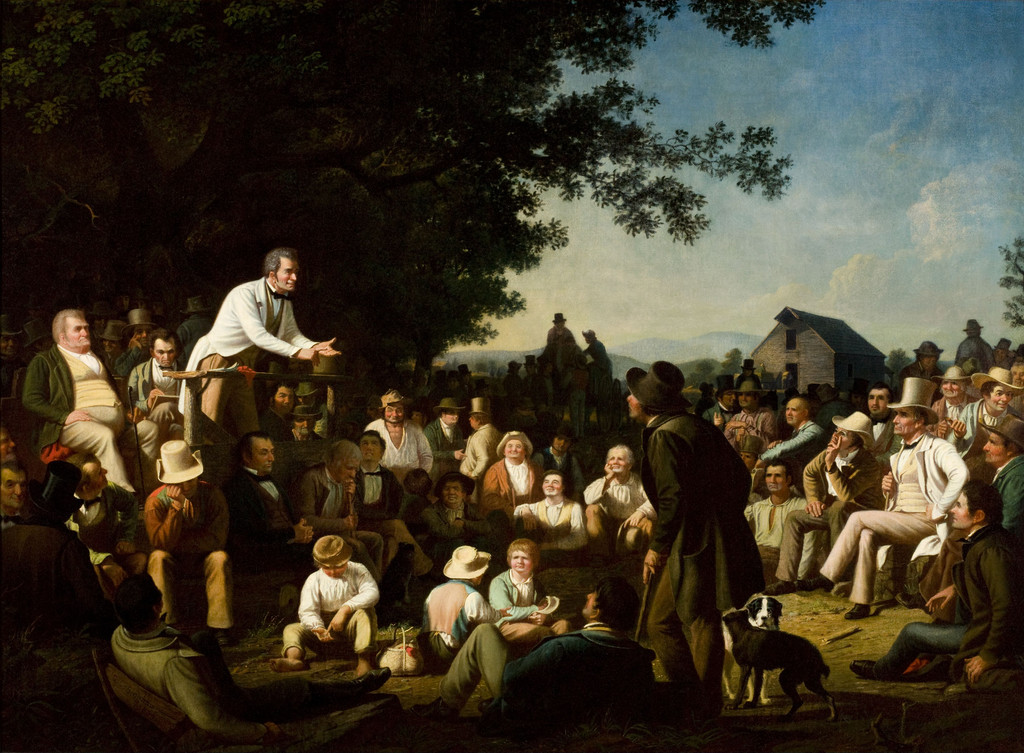
Stump Speaking. Dates identify the canvas discussed in the article. [10]
The Verdict of the People. Dates identify the canvas discussed in the article. [11]
Jolly Flatboatmen in Port. Dates identify the canvas discussed in the article. [12]
Order No. 11: Martial Law. Dates identify the canvas discussed in the article. [13]
Contents
- A solitary figure facing the viewer
- A familiar pose made unfamiliar
- Solid forms and worn clothes
- A working man and a classical comparison
- Modernisation and a possible political meaning
- Bingham’s doubts about the subject
- Ownership and later attention
- Looking beyond the scowl
- Annotated details
A solitary figure facing the viewer
The boatman sits close to the front of the picture. His body occupies much of its lower half, while his red cap rises against a darker area of background. That contrast gives his head prominence without placing it in the middle of an empty sky. His expression is the place where the surrounding folds and curves seem to concentrate.
The pipe connects his face to his raised hand. Its thin stem runs diagonally downwards from the mouth, making a small line within a composition of much broader forms. Fingers curl around the area near the bowl. The arm rests rather than reaches, and the elbow has a firm support in the upper barrel.
His other hand lies lower, near the crossing of the legs. The difference between the hands helps establish the body’s asymmetry. One side is supported by a raised object and occupied with the pipe; the other folds back into the seated posture. The figure is compact, but his parts remain easy to follow.
The yellow shirt has narrow stripes that respond to the body beneath. At the shoulder and sleeve they turn around bends in the fabric, while down the chest they follow a more vertical fall. The open neck creates a dark gap below the beard. Bingham uses the garment to describe volume and to introduce a lighter, warmer colour into the shadowed foreground.
The trousers and boots tell a different story of surfaces. Patches, worn areas and folds interrupt the blue fabric. The boots are substantial, with edges that appear scuffed rather than polished. These details establish working clothes without giving us enough evidence to reconstruct the sitter’s income, employer or individual history.
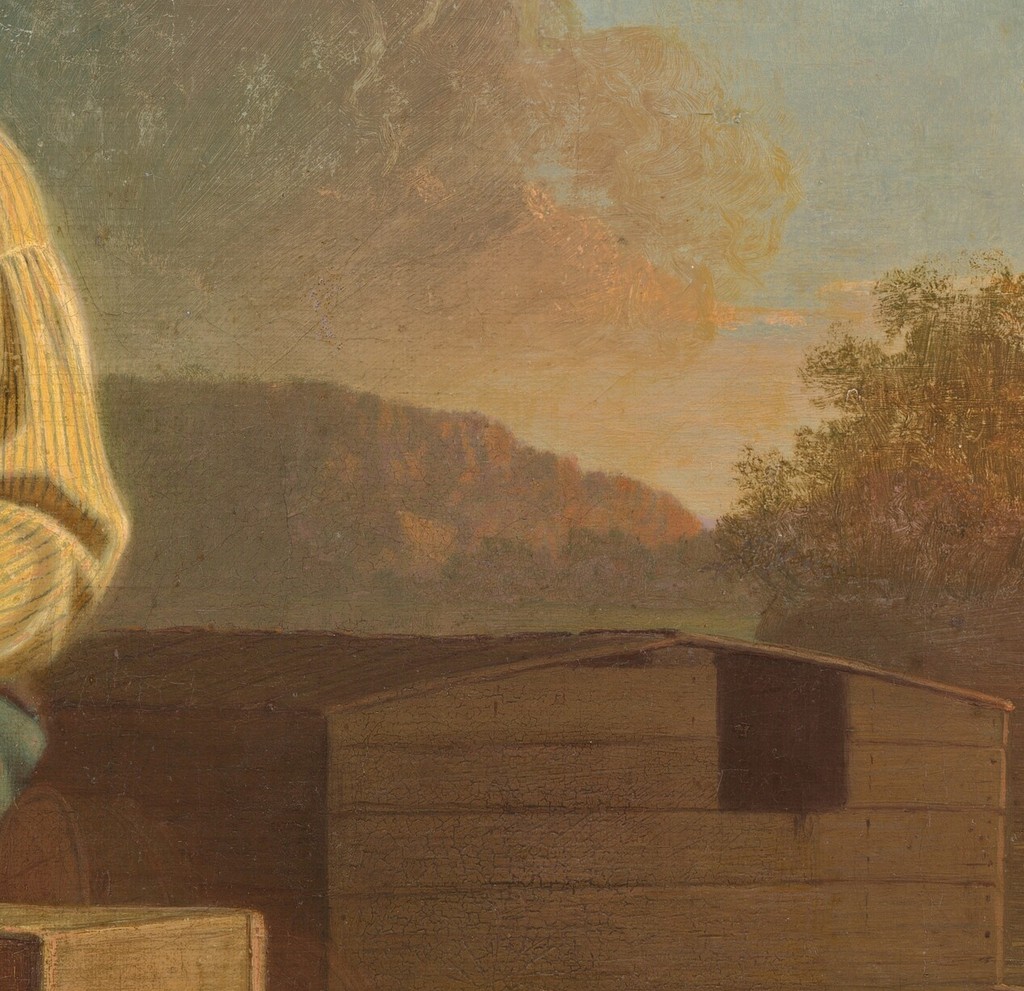
The space around him is also practical. Barrels fill the left edge, and the box on which he sits gives his body another solid support. A larger wooden structure lies further back to the right. The river and a low boat can be seen beyond it, connecting the figure’s immediate surroundings with the occupation named in the title.
The face resists an easy social exchange. The eyes look towards us beneath heavy brows, and the beard frames a mouth compressed around the pipe. We can describe that arrangement more securely than we can identify the man’s thoughts. A viewer may feel challenged or kept at a distance without treating the image as a record of a named worker’s private feelings.
Annotated Details from Mississippi Boatman
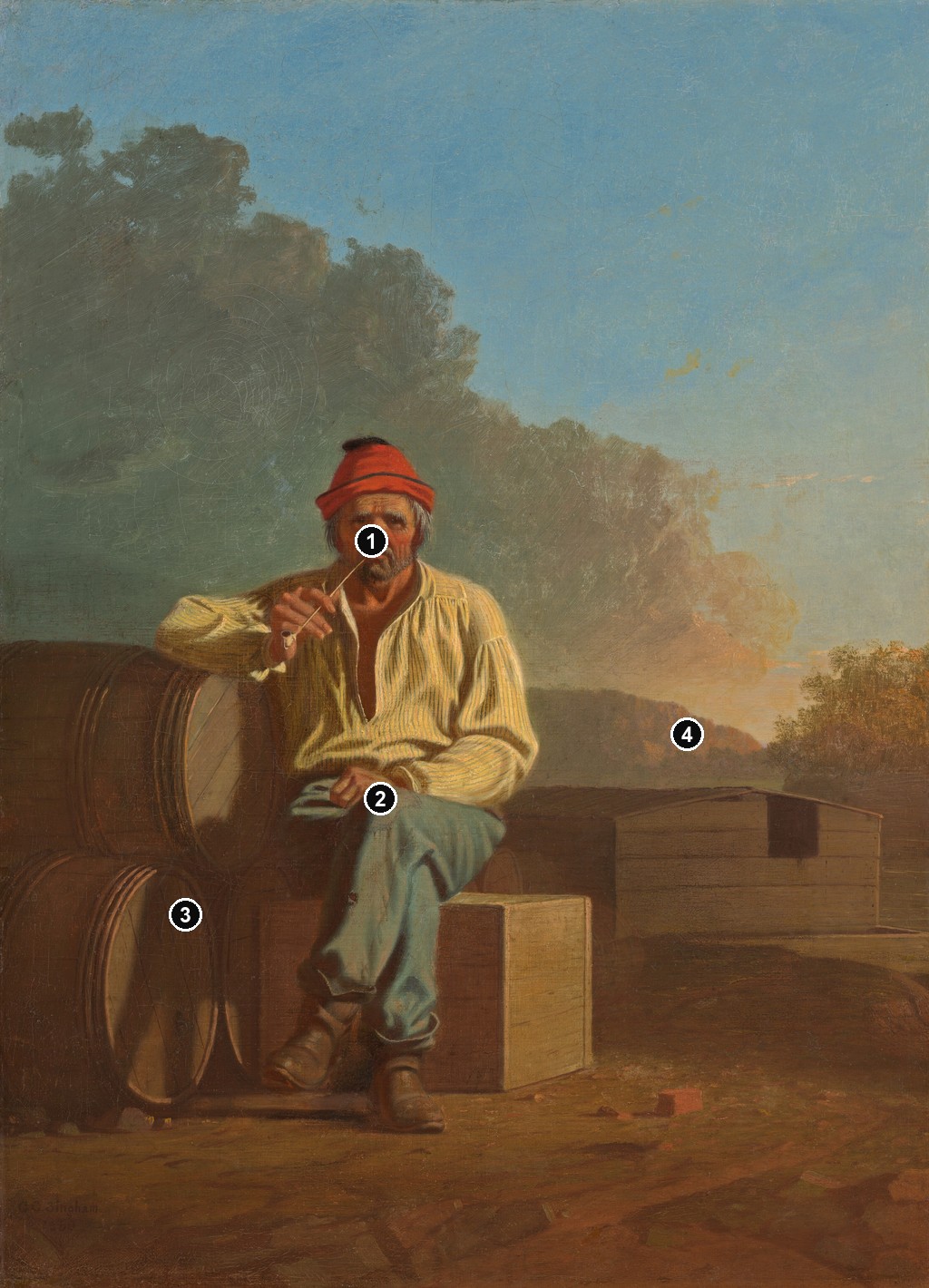
The numbered points identify visible features discussed in this article. Return from each detail to the whole composition. George Caleb Bingham, Mississippi Boatman, 1850. Oil on canvas, 61.3 × 43.7 cm. National Gallery of Art, Washington, John Wilmerding Collection, 2004.66.1. Image source. Public domain. Numbers added to a separate overview. Detail images are crops of the source reproduction.
Details from MISSISSIPPI BOATMAN
Compare the cropped details with the complete images above. Notice how their colours, shapes and positions contribute to the larger compositions.
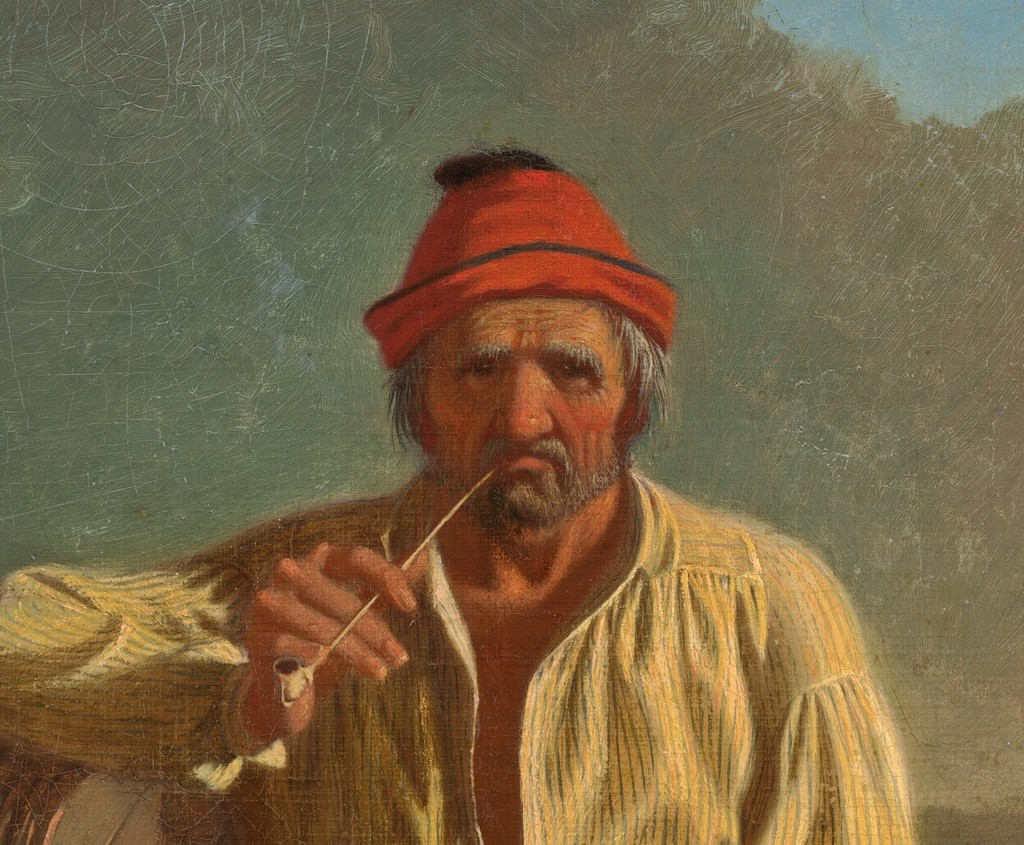
The direct gaze and red cap
The face looks straight out from beneath the red cap. The dark brows and folds around the eyes give the head a firm presence, while the thin pipe makes a small diagonal between mouth and hand.
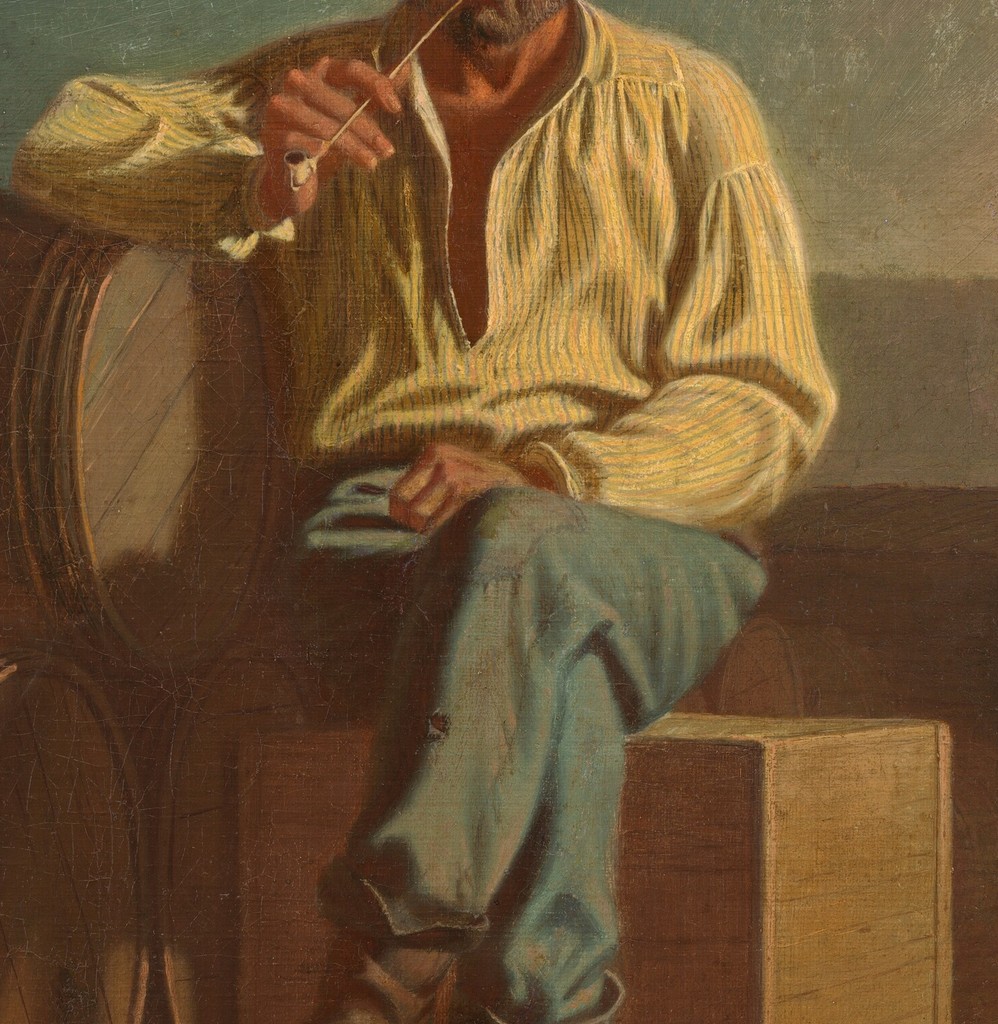
Stripes, folds and crossed legs
Stripes follow the swelling sleeves and the open front of the shirt. The crossing legs introduce another set of diagonals beneath the torso, making the seated body feel compact and firmly supported.
Barrels beside the sitter
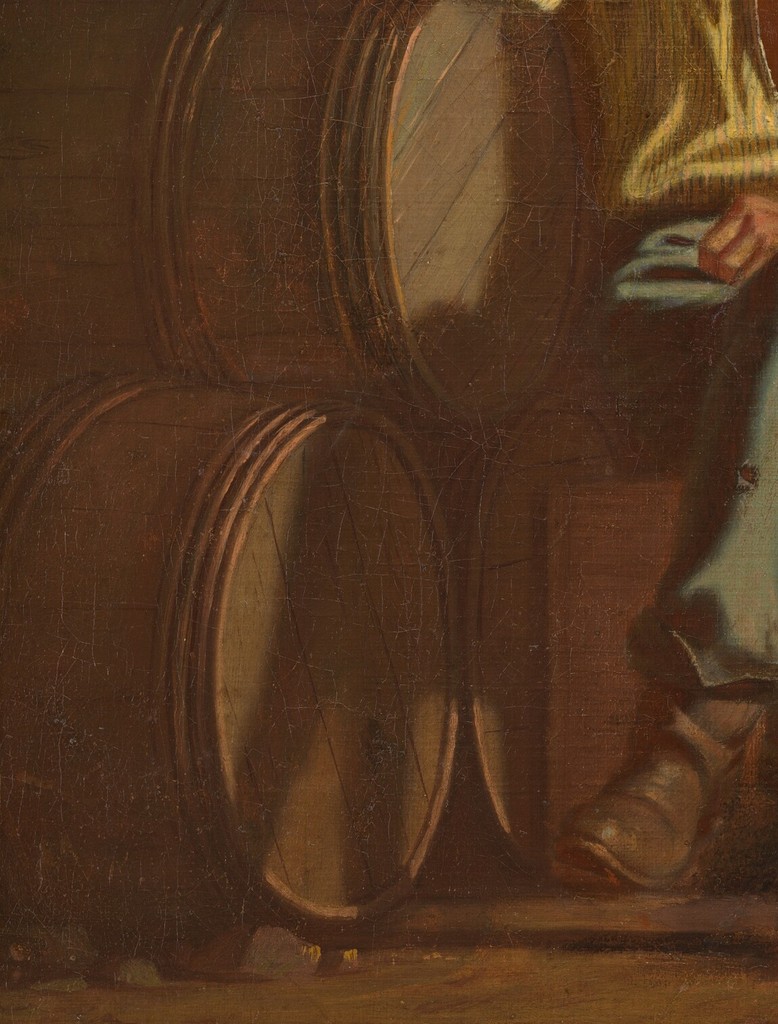
Curving staves and broad circular ends give the barrels a solid presence beside the figure. Their repeated rounded forms contrast with the smaller boxes and the sharper folds of clothing.
The fading riverbank
Warm light opens at the right behind the solid foreground figure. Trees and riverbank soften into broader zones of colour, providing depth without drawing attention away from the head and clothing.
A familiar pose made unfamiliar
The seated figure developed from an 1849 drawing used for Watching the Cargo . Kelly explains that the body’s position remains closely related across the drawing and the two paintings. In the earlier group scene, however, the central man is younger and shares his setting with other figures. The later canvas isolates and changes him. [2]
The Met’s 2015 exhibition similarly emphasised the combination of continuity and revision. Bingham retained the basic posture while altering facial details and the colours of the clothes. A flatboat in the background makes the occupation legible. What looks like one strongly characterised person was therefore developed through the reworking of an existing pictorial figure. [14]
The change to a vertical format matters as much as the altered face. In Watching the Cargo , other people and a wider landscape help establish a social situation. Here the space narrows around the boatman. We encounter his body before we can use companions to explain what is happening, and his gaze has no equally prominent face to divert our attention.
Kelly also notes how the position of the eyes above the canvas’s midpoint contributes to the encounter. The man seems to look down towards us. Within a modestly sized painting, that arrangement can still produce a forceful presence: physical dimensions and psychological effect are not the same thing. [2]
Reusing a pose did not require Bingham to repeat a personality. Age, clothing, framing and expression could change the role a body played. The relation is useful across his drawings and prints , where separate studies often preserve a figure that later paintings adapt. A sheet can hold an arrangement of limbs without fixing its final meaning.
Solid forms and worn clothes
The barrels make the figure’s balance unusually clear. Their circular ends and curved sides establish solid volumes, while the wooden box has flat planes and straight edges. The man sits among these different shapes, his crossed legs and bent arms forming a more intricate structure. The objects support his body and make its position readable.
Kelly places such organisation within a broader account of Bingham’s classical interests. His catalogue entry connects the artist’s scenes of ordinary life with carefully ordered volumes and arrangements. The formal discipline can give a river worker the gravity more often associated with an elevated subject. It does not depend on giving him fine clothes or an idealised face. [2]
The coexistence of composure and wear is especially noticeable here. A crossed leg can look settled, while the trouser fabric above it looks tired. An arm may rest securely, while the face remains guarded. These differences prevent a simple equation between a balanced composition and an agreeable mood.
The colour reinforces the concentration on the body. Red at the cap, yellow in the shirt and blue in the trousers mark three successive areas. The colours are not evenly bright: shadow and surface texture interrupt them. Even so, they give the eye a route down the figure before it moves out towards the more subdued setting.
A working man and a classical comparison
Kelly suggests that the pose and expression could have recalled John Vanderlyn’s Caius Marius Amid the Ruins of Carthage . Vanderlyn’s seated Roman general belongs to a history of classical subjects and defeated public figures. Kelly also traces a connection behind that work to Jacques-Louis David’s treatment of Brutus. The comparison supplies an art historical setting for the boatman’s grave presence. [2]
This is a comparison of effects and pictorial traditions, rather than proof that Bingham copied a particular classical image. A river worker in worn trousers does not become an identifiable Roman hero. The value of the connection is that it makes us consider how a seated body, inward tension and a direct encounter can bring seriousness to a subject drawn from everyday life.
It also allows the painting’s humble objects to remain visible. The barrels are barrels, the box is a seat and the pipe belongs to the man’s immediate activity. Their place within an ordered design does not require them all to carry hidden meanings. The painting can give weight to a worker’s presence through the relation of forms as well as through an explicit story.
Watch: George Caleb Bingham
Choose a film to explore the artist’s work, its interpretation and its wider setting.
Navigating the West: George Caleb Bingham and the River at the Amon Carter Museum of American Art
The Amon Carter Museum introduces an exhibition devoted to Bingham’s river paintings.
Watch on YouTubeModernisation and a possible political meaning
The question of meaning becomes sharper because the boatman appears alone. Guarding goods is a plausible account of his situation, but the image does not show companions leaving him or establish why they are absent. Kelly considers several possible explanations for the solitude without identifying any of them as a documented event. The painting gives us a figure and a setting, leaving much of the surrounding story unstated. [2]
Kelly relates that uncertainty to the changing world of river transport. Steamboat commerce was altering the place of the flatboatmen whose lives supplied Bingham with subjects. The older figure could be read as someone whose kind of work and social position were becoming less secure. In that interpretation, the worker’s age and worn appearance matter alongside the direct gaze. [2]
The account is suggestive, but the painting does not document this individual losing a job. A history of transport can explain pressures within the world represented without proving one exact cause for a painted expression. Keeping that distinction allows the social context to deepen the encounter rather than replace it with a complete invented biography.
Politics offers another possible context. Kelly points to Bingham’s election to the Missouri House of Representatives in 1848 and his opposition to slavery’s expansion into new territories. The artist’s public engagement makes political interpretation a reasonable question. It does not, by itself, establish that every troubled face in his paintings stands for a particular national crisis. [2]
The catalogue consequently leaves open whether Mississippi Boatman comments on specific political issues. That qualification is central to the reading. We can connect an unsettled figure with an unsettled historical moment while acknowledging the gap between an appropriate association and a verified statement of intention. Bingham’s biography follows the more complicated record of his political commitments across his life.
Bingham’s doubts about the subject
A letter to James S. Rollins offers a different kind of evidence. Kelly quotes Bingham writing on 30 March 1851 about three pictures sent to Philadelphia that winter. Two had sold readily, while the third had proved less promising. Kelly identifies Mississippi Boatman as the work described as “not being a well selected subject”. The wording comes through the catalogue’s quotation of the letter. [2]
The remark concerns the choice of subject and the prospect of keeping an unsold picture. It need not be treated as a rejection of the painting’s execution. Kelly links the difficulty to an encounter more confrontational than the agreeable rural subjects sent with it. The very qualities that can make the canvas arresting for a later viewer may have complicated its immediate appeal. [2]
The contrast with The Jolly Flatboatmen is useful. There, several people share an entertainment, and attention moves among the dancer, musicians and watchers. Here there is no activity that opens into collective enjoyment. The single figure holds us at the front of the image, and the surrounding objects reinforce his position rather than supply a separate social drama.
This does not turn the two paintings into opposites in every respect. Both organise working people through clear volumes and carefully placed objects. Both offer an encounter made more concentrated by composition. Their different moods show how much Bingham could change while retaining an interest in river life and the presence of ordinary bodies.
Ownership and later attention
The NGA records Mississippi Boatman at the Philadelphia Art Union in 1851, listed for sale at sixty dollars. Its later provenance resumes in Rhode Island in the 1940s, followed by Vose Galleries in Boston and John Wilmerding’s purchase in 1965. The work entered the NGA as a gift in 2004. The record does not supply a continuous chain of named owners for the intervening decades. [1]
The ownership history focuses attention on a physical canvas whose movements are only partly recorded. That differs from following a design through a known published print such as Doney’s Jolly Flat Boat Men . The painting’s later prominence also encourages renewed attention to the relationship between a striking subject and its initial difficulty in finding a buyer.
Looking beyond the scowl
The face is compelling, but the picture rewards a slower route through the whole figure. Follow the pipe to the hand and the supporting elbow, then down through the yellow sleeve to the crossed legs. The body becomes a sequence of connected rests and bends. Its stability helps make the fixed gaze so noticeable.
Then consider how little background is needed to establish another world beyond him. A vessel, river and retreating landscape are enough to connect the foreground objects with transport. The setting does not compete with the man’s scale, yet his occupation would be less clear without it.
Finally, compare the worn fabric with the deliberate arrangement of barrel, box and body. The painting neither dissolves the worker into an anonymous landscape nor explains him through a complete anecdote. It makes a sustained encounter out of a particular pose, a changed face and the space between the figure and the viewer.
Artworks directory
A documented selection discussed across these articles, including separate canvases, figure studies and reproductive impressions. Dates identify the particular object or study; collection and title distinctions follow museum records and the 2015 exhibition checklist. This is not a catalogue raisonné. Prints are grouped with works on paper in the Drawing filter.
| Name | Date | Medium |
|---|---|---|
| Fur Traders Descending the Missouri | 1845 | Painting — oil on canvas |
| The Jolly Flatboatmen | 1846; NGA canvas | Painting — oil on canvas |
| The County Election (original) | 1851–52 | Painting — oil on canvas |
| Stump Speaking | 1853–54 | Painting — oil on canvas |
| The Verdict of the People | 1854–55 | Painting — oil on canvas |
| Order No. 11: Martial Law | 1865–68; Cincinnati original | Painting — oil on canvas |
| Daniel Boone Escorting Settlers through the Cumberland Gap | 1851–52 | Painting — oil on canvas |
| Canvassing for a Vote | 1852; signed canvas | Painting — oil on canvas |
| Raftsmen Playing Cards | 1847 | Painting — oil on canvas |
| Mississippi Boatman | 1850 | Painting — oil on canvas |
| Jolly Flatboatmen in Port | 1857 | Painting — oil on canvas |
| The County Election (replica illustrated here) | 1852 | Painting — oil on canvas |
| Martial Law or Order No. 11 (Missouri replica) | 1870 | Painting — oil on canvas |
| The Jolly Flatboatmen (Terra canvas) | 1877–78 | Painting — oil on canvas |
| John Quincy Adams (later version) | about 1850, after an 1844 original | Painting — oil on canvas |
| Country Politician | 1849 | Painting — oil on canvas |
| The Trappers’ Return | 1851 | Painting — oil on canvas |
| The Concealed Enemy | 1845 | Painting — oil on canvas |
| The Wood-boat | 1850 | Painting — oil on canvas mounted on board |
| Lighter Relieving a Steamboat Aground | 1847 | Painting — oil on canvas |
| Watching the Cargo | 1849 | Painting — oil on canvas |
| In a Quandary | 1851 | Painting — oil on canvas |
| Boatmen on the Missouri | 1846 | Painting — oil on canvas |
| Self-Portrait (Saint Louis) | 1834–35 | Painting — oil on canvas |
| Self-Portrait (Nelson-Atkins) | about 1877 | Painting — oil on canvas |
| Mrs. David Steele Lamme and Son William Wirt | 1837 | Painting — oil on canvas |
| Portrait of Leonidas Wetmore | 1839–40 | Painting — oil on canvas |
| Fur Trader (study for Fur Traders Descending the Missouri) | 1845 | Drawing — brush, ink and wash over pencil |
| Skillet-beater (study for The Jolly Flatboatmen) | 1846 | Drawing — brush, ink and wash over pencil |
| Young Wood-boatman (study for The Wood-boat) | 1850 | Drawing — brush, ink and wash over pencil |
| Thomas Doney after Bingham: The Jolly Flat Boat Men (Met impression) | 1847 | Print — mezzotint and engraving with etching |
| Thomas Doney after Bingham: The Jolly Flat Boat Men (coloured Carter impression) | 1847 | Print — intaglio with applied watercolour |
| The Verdict of the People (lithographic proof) | ca. 1858–59 | Print — lithographic proof |
| Gautier after Bingham: Stump Speaking | 1856 | Print — etching and aquatint |
| Claude Regnier after Bingham: In a Quandary, Mississippi Raftsmen Playing Cards | 1852 | Print — hand-coloured lithograph |
Frequently Asked Questions
The NGA dates the painting to 1850. It is an oil on canvas, 61.3 × 43.7 cm, accession 2004.66.1. [1]
The consulted accounts treat him as a developed pictorial figure and do not establish a named sitter. A reused body position should not be mistaken for proof of a particular worker’s identity. [2]
Kelly considers a political reading but leaves commentary on specific issues open. Bingham’s political engagement supplies context; it does not establish a single intended meaning for this canvas. [2]
It is in the National Gallery of Art, Washington, as part of the John Wilmerding Collection. The NGA records a gift in 2004. [1]
Discussion
Look again at the images and ideas explored in Mississippi Boatman. These editorial prompts invite your observations.
Reader Insights
How does the figure’s direct gaze change the mood of a river subject?
Which details make the clothes feel solid and worn?
How does this isolated sitter compare with a similar pose inside a larger group?
Join the Conversation
Share a detail, comparison or question about Mississippi Boatman below.
References
- National Gallery of Art , Mississippi Boatman , 1850, 2004.66.1. Current collection record and provenance. View source
- Franklin Kelly , Bingham entry in American Masters from Bingham to Eakins: The John Wilmerding Collection , National Gallery of Art, 2004, pp. 32–37; provenance p. 152. The 1851 letter is quoted through this entry. View source
- Metropolitan Museum of Art, Fur Traders Descending the Missouri. View source
- National Gallery of Art, The Jolly Flatboatmen. View source
- Saint Louis Art Museum, Raftsmen Playing Cards. View source
- Saint Louis Art Museum, The County Election, 1851–52, 124:1944. View source
- Saint Louis Art Museum, The County Election, 1852 replica, 44:2001. View source
- Kemper Art Museum, Washington University, Daniel Boone Escorting Settlers through the Cumberland Gap. View source
- Nelson-Atkins Museum of Art, Canvassing for a Vote. View source
- Saint Louis Art Museum, Stump Speaking. View source
- Saint Louis Art Museum, The Verdict of the People. View source
- Saint Louis Art Museum, Jolly Flatboatmen in Port. View source
- Cincinnati Art Museum, Order No.11 / Martial Law. View source
- Metropolitan Museum of Art , Navigating the West: George Caleb Bingham and the River , exhibition labels, 2015, pp. 10–11. View source
- Splash image source.
George Caleb Bingham, Mississippi Boatman, 1850. Oil on canvas, 61.3 × 43.7 cm. National Gallery of Art, Washington, John Wilmerding Collection, 2004.66.1. Public domain .
View source