 by
Tom Gurney
Tom Gurney BSc (Hons) is an art history expert with over 20 years experience
Email:
tomgurney1@gmail.com
/ Phone:
+44 7429 011000
Daniel Boone Escorting Settlers through the Cumberland Gap: Introduction
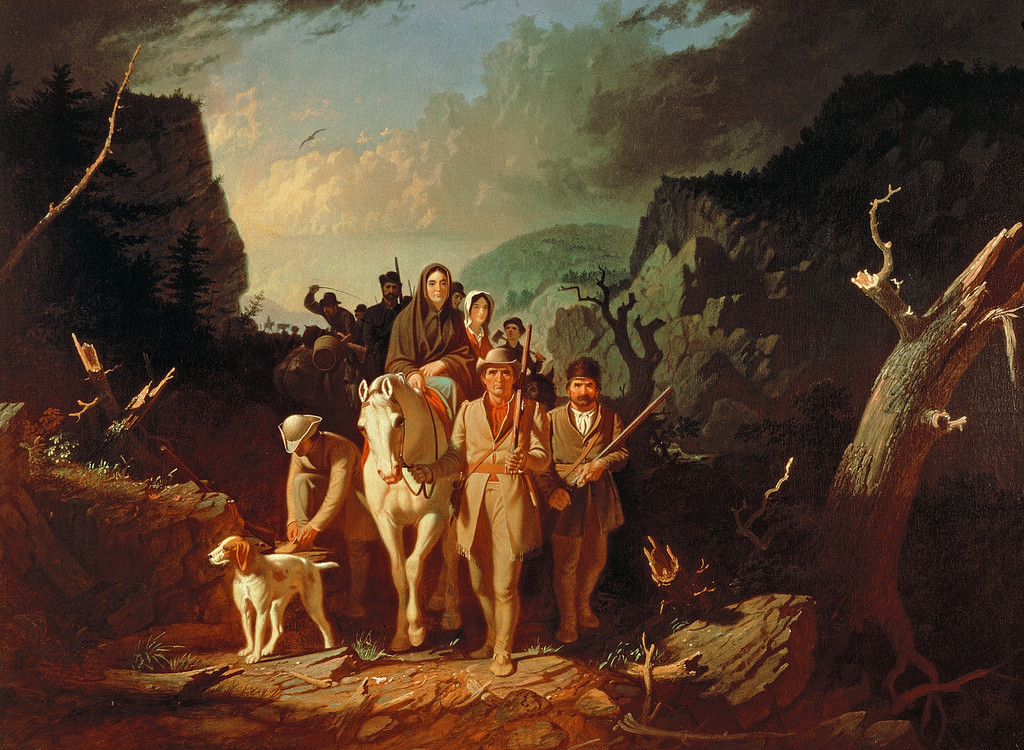
A group of travellers advances between dark cliffs and broken trees. Two armed men lead the way, while a woman on a white horse rises behind them. George Caleb Bingham’s Daniel Boone Escorting Settlers through the Cumberland Gap turns migration into a carefully staged entrance, with light gathering around the people at its centre.
Bingham painted the canvas in 1851–52, long after the eighteenth-century journeys associated with Boone. It is now in the Mildred Lane Kemper Art Museum at Washington University in St. Louis, a gift of Nathaniel Phillips in 1890. The oil painting measures 36½ × 50¼ inches and carries the object number WU 2171. [1]
The museum interprets the work through classical and Christian imagery, connecting Boone’s stance with a Greek sculptural model and the procession with biblical deliverance. Its reading also asks what those associations do: they give moral and heroic authority to settler expansion into Indigenous territories. The painting records an influential way of imagining that history rather than offering an eyewitness account of the passage. [1]
At a Glance
- Artist George Caleb Bingham.
- Date 1851–52.
- Medium Oil on canvas.
- Dimensions 36½ × 50¼ inches, unframed.
- Collection Mildred Lane Kemper Art Museum, Washington University in St. Louis.
- Collection credit Gift of Nathaniel Phillips, 1890.
- Object number WU 2171. [1]
This work across George Caleb Bingham’s career
The Jolly Flatboatmen
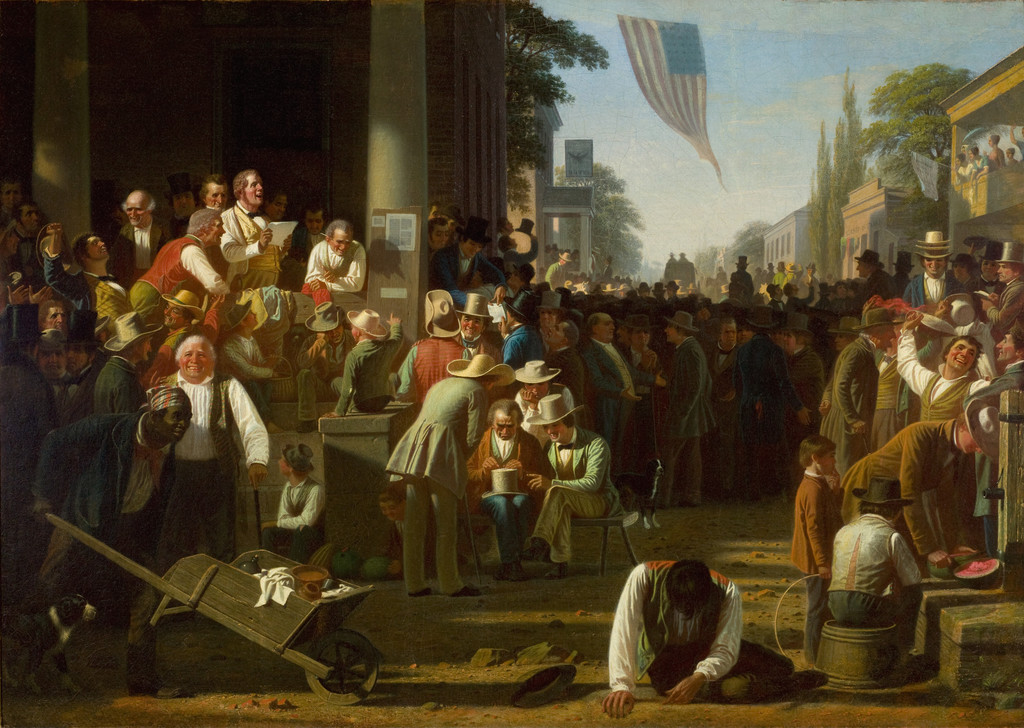
1846; NGA canvasThe County Election
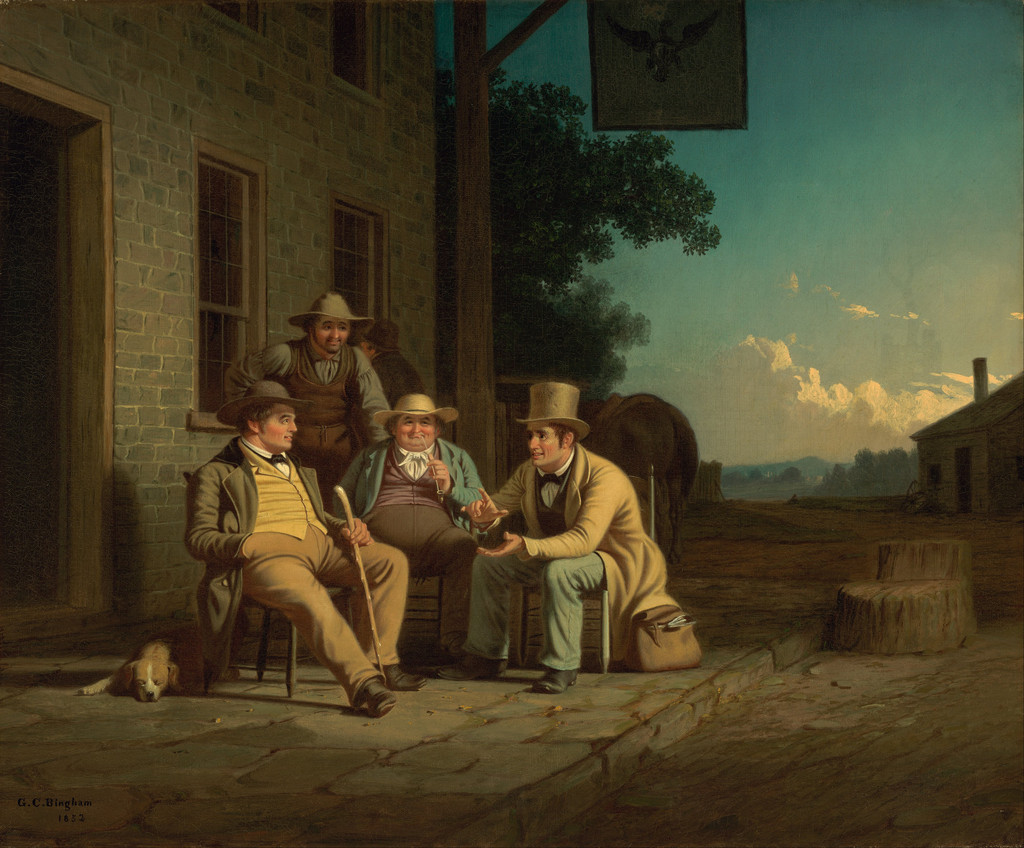
1851–52 original; 1852 replica illustratedCanvassing for a Vote
1852; signed canvasStump Speaking
1853–54The Verdict of the People
1854–55Order No. 11: Martial Law
1865–68; Cincinnati originalNotes and sources
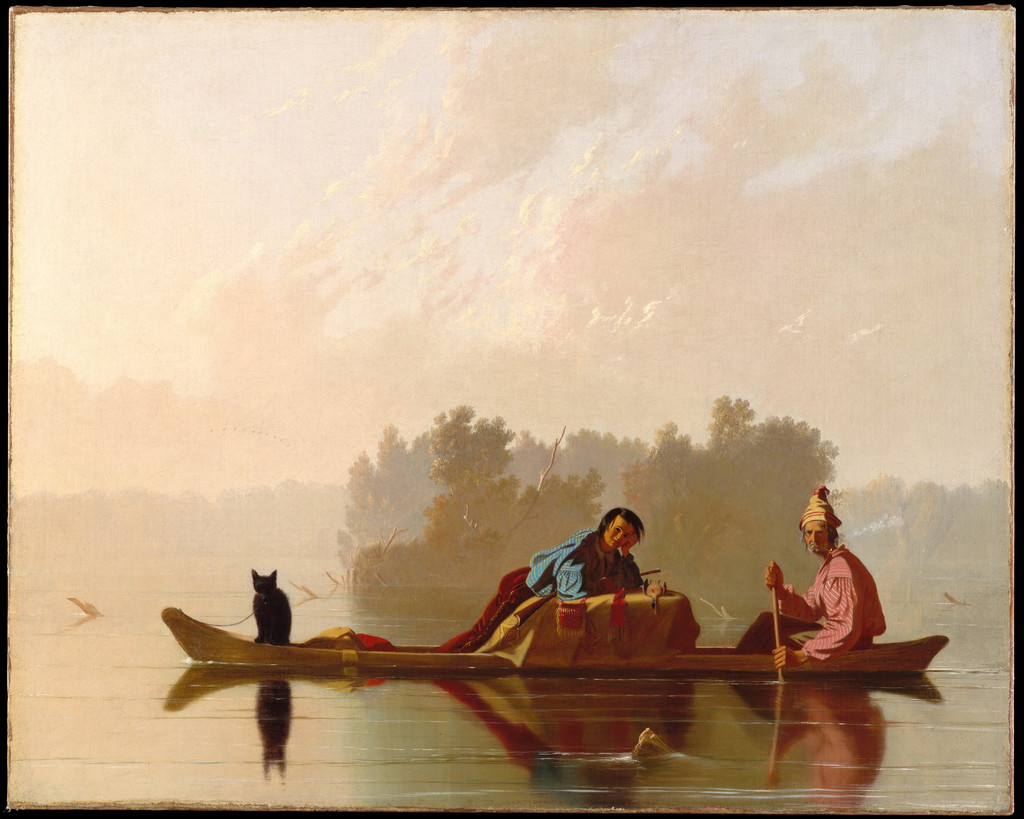
Fur Traders Descending the Missouri. Dates identify the canvas discussed in the article. [2]
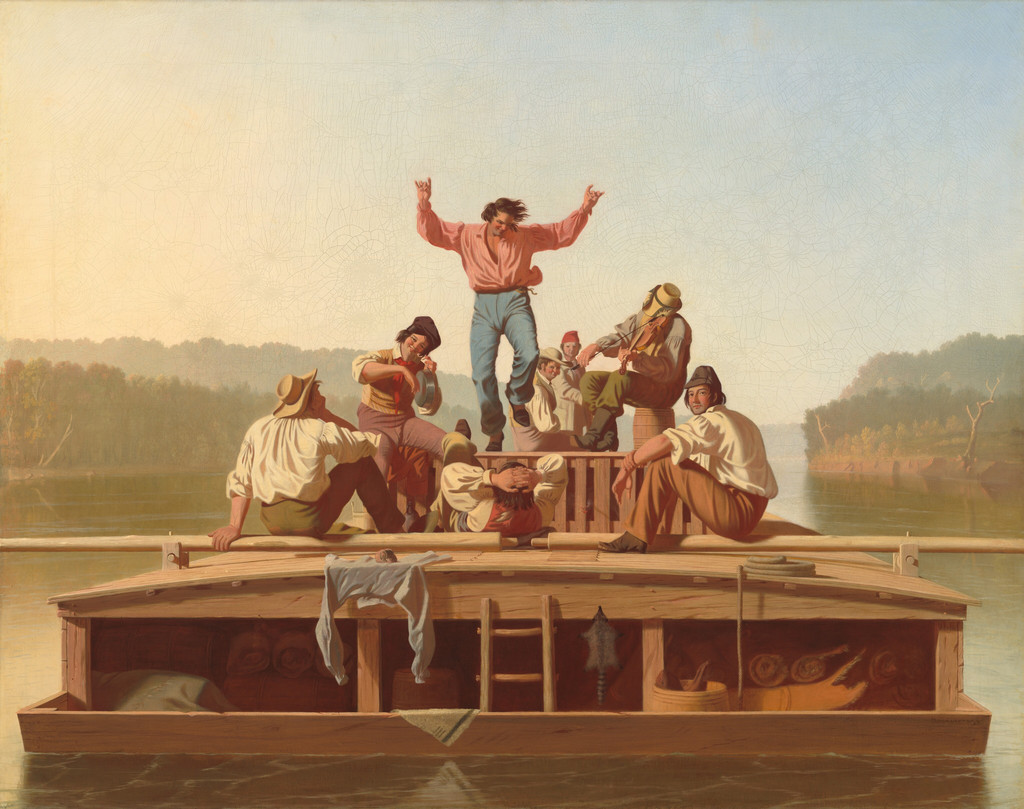
The Jolly Flatboatmen. Dates identify the canvas discussed in the article. [3]
Raftsmen Playing Cards. Dates identify the canvas discussed in the article. [4]
Mississippi Boatman. Dates identify the canvas discussed in the article. [5]
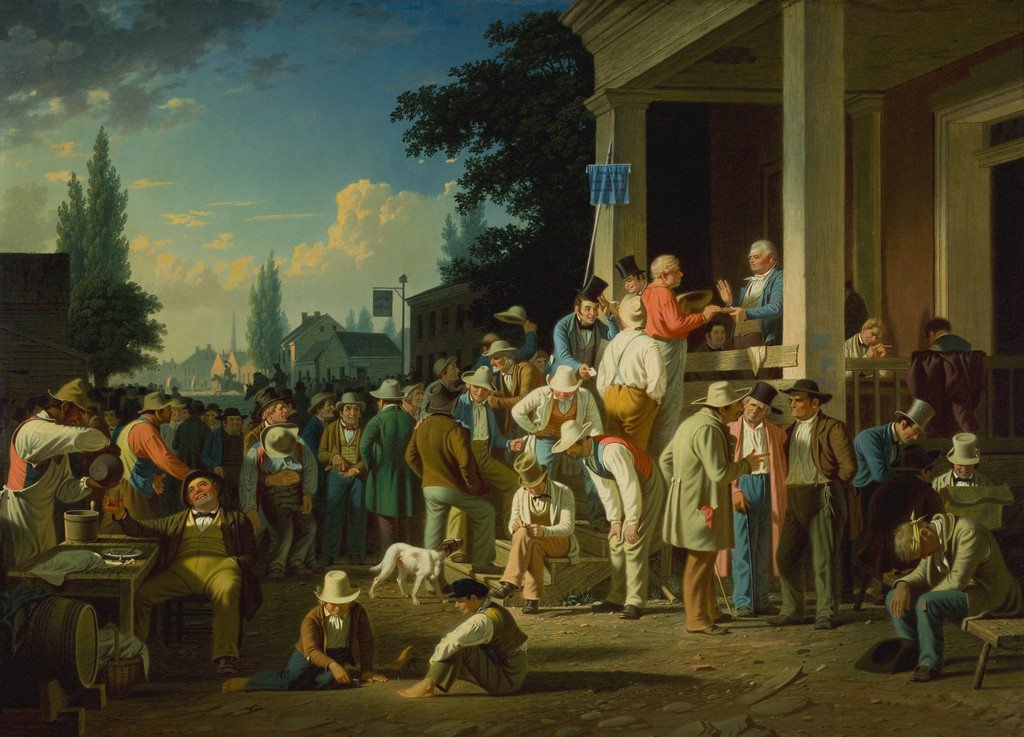
The County Election. The original is 124:1944; the illustrated 1852 replica is 44:2001. Their dimensions and acquisition histories differ. [6] [7]
Daniel Boone Escorting Settlers through the Cumberland Gap (current article). Dates identify the canvas discussed in the article. [1]
Canvassing for a Vote. Dates identify the canvas discussed in the article. [8]
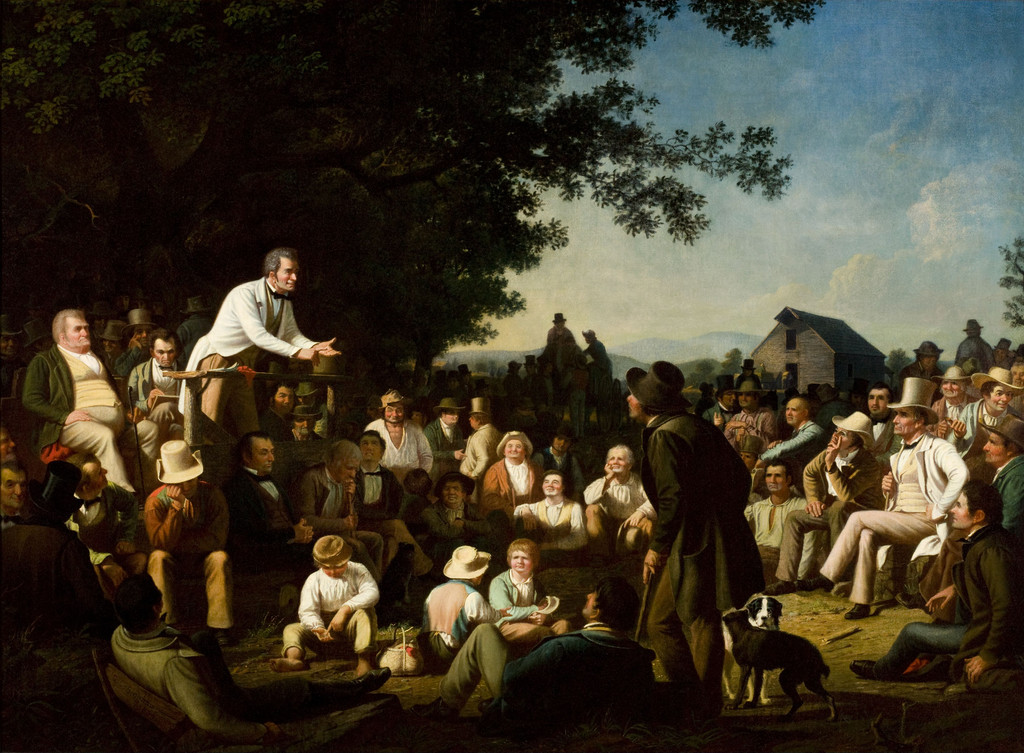
Stump Speaking. Dates identify the canvas discussed in the article. [9]
The Verdict of the People. Dates identify the canvas discussed in the article. [10]
Jolly Flatboatmen in Port. Dates identify the canvas discussed in the article. [11]
Order No. 11: Martial Law. Dates identify the canvas discussed in the article. [12]
Contents
- An entrance arranged for the viewer
- Cliffs, broken trees and dramatic light
- The Gap before and beyond Boone
- Classical bodies and Christian associations
- Heroic order and what the picture leaves out
- A different image of people being moved
- A landscape photograph as context
- Boone within Bingham’s career
- Annotated details
An entrance arranged for the viewer
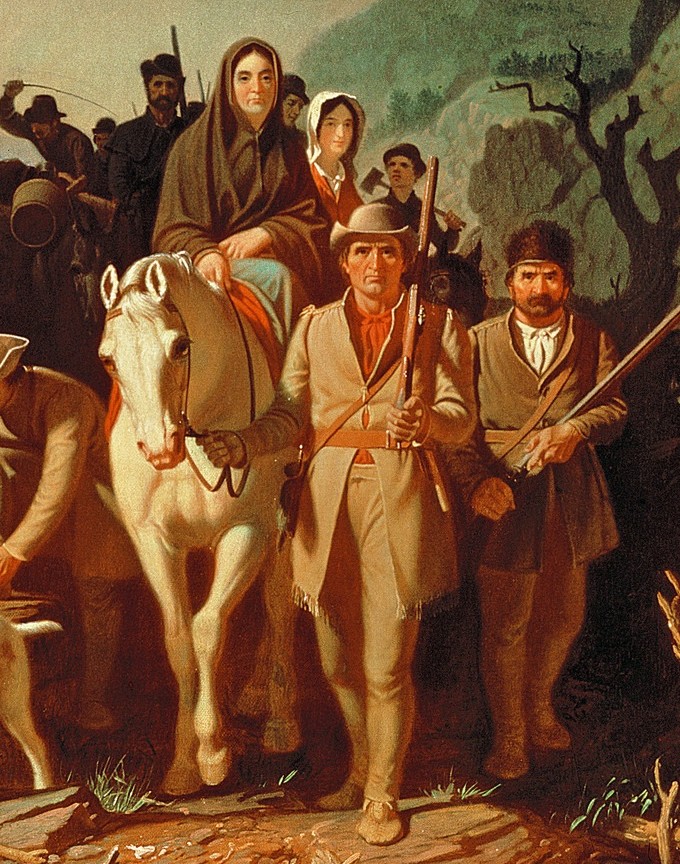
The leading men approach almost directly towards us. Their bodies occupy the lower centre, where their pale clothing catches the light against the darker ground. Rifles introduce long, firm lines beside their faces and torsos. Bingham presents the men as prepared and purposeful without showing a particular confrontation or the immediate use of a weapon.
The white horse supplies another strong point of brightness. Its head emerges beside the leader, while the woman seated above it occupies a higher level within the group. A shawl covers her head and falls around her shoulders. Her upright posture differs from the men’s stepping bodies, giving the procession a more stable central presence.
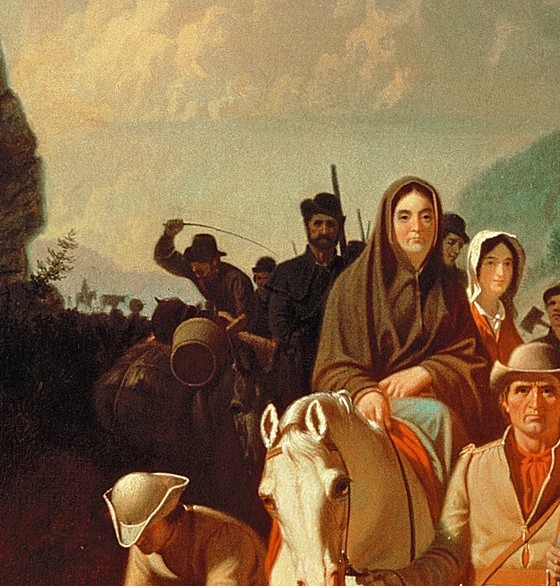
Other travellers follow through the narrow space behind. Some faces remain visible, while equipment, bodies and the constriction of the path conceal others. The picture suggests a longer movement than it can show in full. The people nearest us are individualized enough to hold attention; those further back establish continuity into the landscape.
A dog stands near the lower left, its body turned across our view. This small figure helps connect the approaching group with the ground in front. Its lower position also increases the apparent height of the people and horse behind. The caravan enters at several levels rather than forming one flat line across the canvas.
The composition is deliberately frontal. Instead of watching a distant band move across an immense landscape, we face the people as they come forward. Their scale gives them priority over the place through which they travel. The mountain setting matters greatly, but the human group determines how we first encounter it.
Annotated Details from Daniel Boone Escorting Settlers through the Cumberland Gap
The numbered points identify visible features discussed in this article. Return from each detail to the whole composition. George Caleb Bingham, Daniel Boone Escorting Settlers through the Cumberland Gap, 1851–52. Oil on canvas, 36½ × 50¼ inches. Mildred Lane Kemper Art Museum, Washington University in St. Louis, Gift of Nathaniel Phillips, 1890, WU 2171. Image source. Public domain. Numbers added to a separate overview. Detail images are crops of the source reproduction.
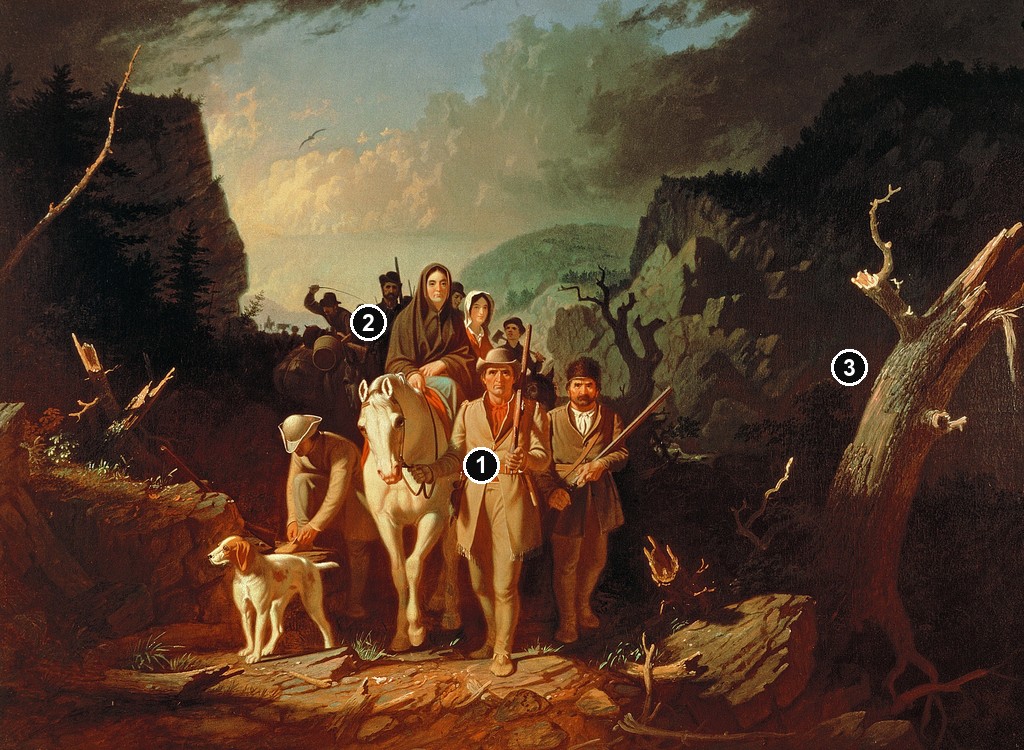
Details from DANIEL BOONE ESCORTING SETTLERS THROUGH THE CUMBERLAND GAP
Compare the cropped details with the complete images above. Notice how their colours, shapes and positions contribute to the larger compositions.
The leader and the mounted figure
The upright rifle and leading body establish a clear front to the procession beside the white horse. Above the horse’s head, the mounted figure’s hood and draped clothing form another compact, strongly outlined shape.
The followers emerging through the pass
Riders, bundles and animals emerge from the shadow between the cliffs. Alternating heads, hats and loads change the ordered front of the procession into a longer moving line behind it.
Splintered wood against the rock
Light catches splintered wood and bare branches against the dark rock. The large oblique forms press towards the travellers’ route, making the passage seem narrow and physically demanding.
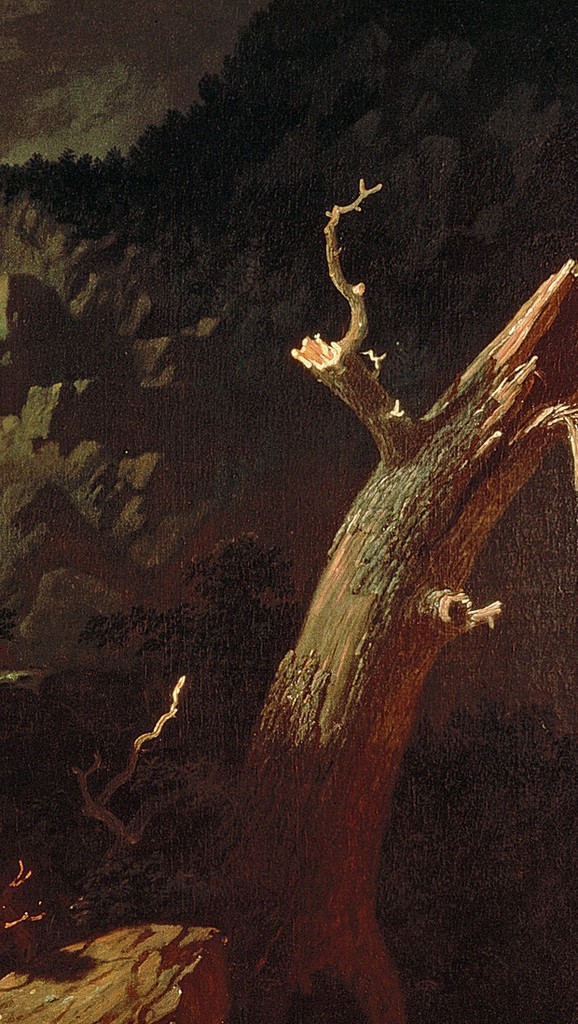
Cliffs, broken trees and dramatic light
Dark rock rises on both sides of the passage. At the right, a large broken tree leans diagonally into the scene, its pale splinters and bare branches catching the light. Another damaged trunk appears at the left. These forms enclose the travellers and make their route look difficult even though the central group remains composed.
The landscape offers more than a neutral background. Its jagged edges contrast with the measured verticals of the leaders and the horse’s smooth, bright head. Broken wood and irregular rock make the people’s progress appear organized against resistance. The painter gives the passage a dramatic setting in which steadiness can read as a virtue.
The sky opens above and behind the group. Clouds and blue-green distance make the enclosing cliffs feel darker, while the leading bodies receive warmer light. This distribution lets the scene move between threat and promise without showing a complete change of weather. We see enough brightness to imagine an opening beyond the difficult ground.
The light is a pictorial arrangement, not a secure compass bearing. It would be misleading to use the canvas alone to reconstruct the exact direction of travel, the hour of a historical crossing or a matching camera position today. Bingham makes the landscape serve an approach towards the viewer, with illumination directing attention to the group he wants us to follow.
The Gap before and beyond Boone
The Cumberland Gap was a route long before Boone’s journeys. The National Park Service describes Indigenous use of the region for hunting, trade and settlement, and explains that European-American expansion displaced people already connected with that land. It also records Boone’s 1775 employment by Richard Henderson to blaze a route through the Gap for settlement. [13]
The park’s separate history of the Warrior’s Path notes that Cherokee and Shawnee travellers had used the passage for centuries. Parts of that existing route became associated with the Wilderness Road. This history changes what a phrase such as opening the West can conceal: Boone did not bring movement into a landscape that had previously known none. [14]
Those distinctions are especially useful beside the painting because the canvas makes the settler procession so prominent. Its figures emerge as the main agents of movement, while no comparable Indigenous presence is represented. The absence belongs to the image’s construction. It should not be carried into an account of the place as an absence of earlier inhabitants, routes or relationships.
A Washington University exhibition account published in 2003 offered another caution about literal history. It described the painting as combining an unsuccessful migration attempt of 1773 with a larger expedition in 1775. That is an attributed account of how the image gathers historical material into a single scene, rather than a reason to identify every painted traveller with a documented participant in one expedition. [15]
The gap between event and painting is substantial. Bingham’s date of 1851–52 places the work within a later society looking back at settlement and making images of national beginnings. The question is therefore not only what Boone did in the eighteenth century, but why this later painter made the journey look heroic, ordered and morally purposeful. [1]
Classical bodies and Christian associations
The Kemper Museum compares Boone’s stance with the Spear-Bearer of Polykleitos, a celebrated ancient Greek figure. It also connects the leader and his caravan with Moses bringing his people towards a promised land. These comparisons place the frontier subject within visual traditions that carried established forms of physical and moral authority. [1]
The effect does not depend on the viewer identifying a precise sculptural quotation at first sight. The leading figure’s controlled posture, upright weapon and clear silhouette already distinguish him from a person struggling unevenly over rough ground. The classical comparison helps explain why such a body can seem exemplary rather than merely particular.
The woman on the white horse introduces a different association. The museum reads her covered head and draped clothing as recalling the Virgin Mary. Her relative stillness and raised position place her within the visual centre of the procession even though the men lead its immediate movement. The group acquires a familial and sacred resonance beside its armed readiness. [1]
These parallels are interpretations of the painting’s imagery. They do not mean the historical travellers understood themselves as biblical characters, or that the canvas illustrates a scene from scripture. Their significance lies in the painter’s ability to bring familiar forms of veneration to a recent national subject.
The museum’s critical reading concerns the consequences of that transfer. If movement into Indigenous territory is made to resemble deliverance towards a promised land, settlement can appear to possess an authority beyond ordinary political contest. The same image that gives the travellers dignity can leave the rights and experiences of people outside the procession unrepresented. [1]
Watch: George Caleb Bingham
Choose a film to explore the artist’s work, its interpretation and its wider setting.
Navigating the West: George Caleb Bingham and the River at the Amon Carter Museum of American Art
The Amon Carter Museum introduces an exhibition devoted to Bingham’s river paintings.
Watch on YouTubeHeroic order and what the picture leaves out
The travellers appear to form a coherent body. Their arrangement encourages us to imagine a common destination and a shared purpose. Differences within the group are less conspicuous than in Bingham’s later crowded election scenes, where people argue, celebrate or turn away. Here the principal movement is forward, and the dramatic setting makes that movement the picture’s central achievement.
The damaged trees can strengthen this impression. They make nature look resistant, but they do not speak for the people who already used and valued the land. Treating the painting’s obstacle as simply a threatening wilderness would accept the limits of its viewpoint as a complete historical account. The park histories provide a necessary account of longstanding human use alongside the museum’s reading of settler ideology. [13] [14]
The painting can be admired for its control of form while its historical argument remains open to examination. The horse’s brightness, the frontal leaders and the enclosing cliffs are powerful devices. Asking whom those devices honour, and whose relationship with the place they exclude, makes the visual analysis more exact rather than replacing it with a separate moral verdict.
A different image of people being moved
Bingham’s later Order No. 11 , painted in 1865–68, provides a revealing comparison. Its subject is the enforced removal of Missouri civilians during the Civil War. In the Cincinnati Art Museum’s original, a threatened household and figures preparing to depart occupy a scene of confrontation and distress. The movement of people has become the source of an accusation against power. [12]
The contrast is visible in how bodies hold together. The Boone procession advances as a relatively coherent group, with upright leaders and a centrally placed rider. In Order No. 11 , bodies bend, reach and collapse within a more divided arrangement. The viewer encounters several simultaneous actions whose relationships have to be followed across the picture. Each canvas gives movement a different human shape.
The comparison should preserve the historical differences between the subjects. Boone’s settler expansion into Indigenous territory and the Civil War removal order are not interchangeable events. Neither painting, considered alone, explains every position Bingham held about land, coercion or political rights. What can be examined directly is the way he uses composition to make one passage appear purposeful and another deeply troubling.
The landscapes contribute to that difference. In the Boone painting, the broken trees and constricting rocks make an ordered advance seem an achievement. In Order No. 11 , smoke and departure extend the household’s distress into the surrounding country. Setting participates in the argument of each work. Bingham’s style and technique gave him ways to organize dramatic groups whose apparent order or disruption could carry historical meaning.
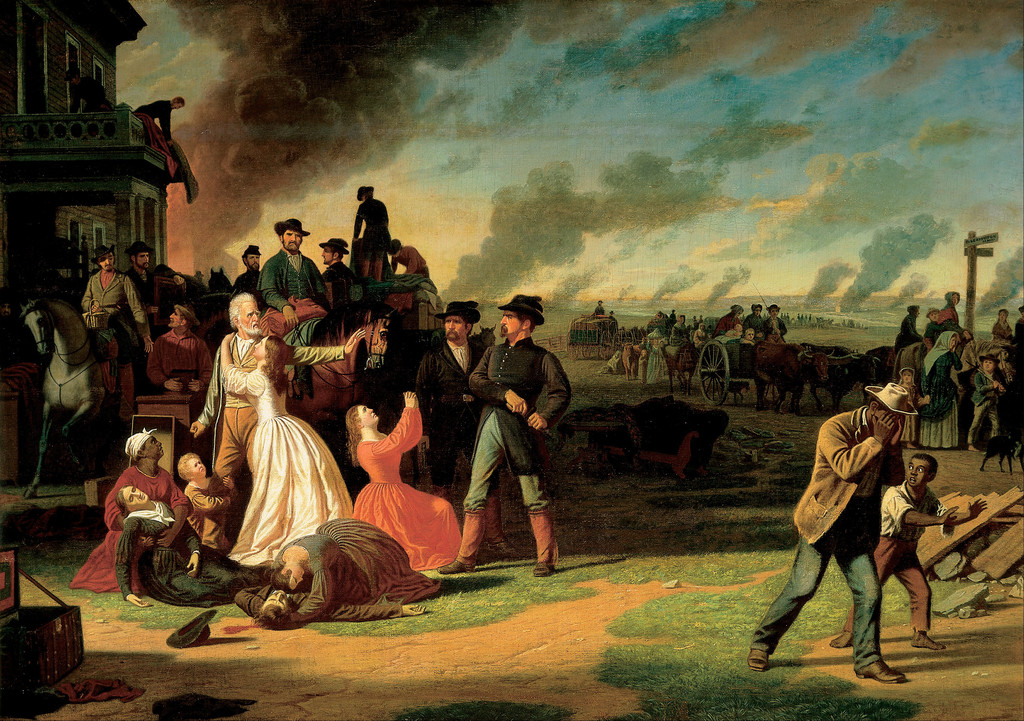
George Caleb Bingham, Order No. 11 (Martial Law), 1865–1868. Oil on canvas. Cincinnati Art Museum, The Edwin and Virginia Irwin Memorial, 1958.515.
Image source
.
Public domain
.
A landscape photograph as context
The accompanying photograph, Mountains at Sunrise , was made from Pinnacle Overlook in Cumberland Gap National Historical Park. The National Park Service record credits Scott Teodorski and identifies the image as public domain. It does not supply a capture date. The photograph is included as geographical context for the region, with its layered ridges and broad atmosphere. [16]
It is not presented as the exact pass or the viewpoint Bingham used. The photograph looks across successive wooded ridges beneath an orange sky, with small modern structures visible on a distant height. Bingham instead encloses a procession between sharply opposing foreground masses. Comparing the two helps distinguish an actual photographed landscape from a painted landscape arranged to give a historical movement meaning.
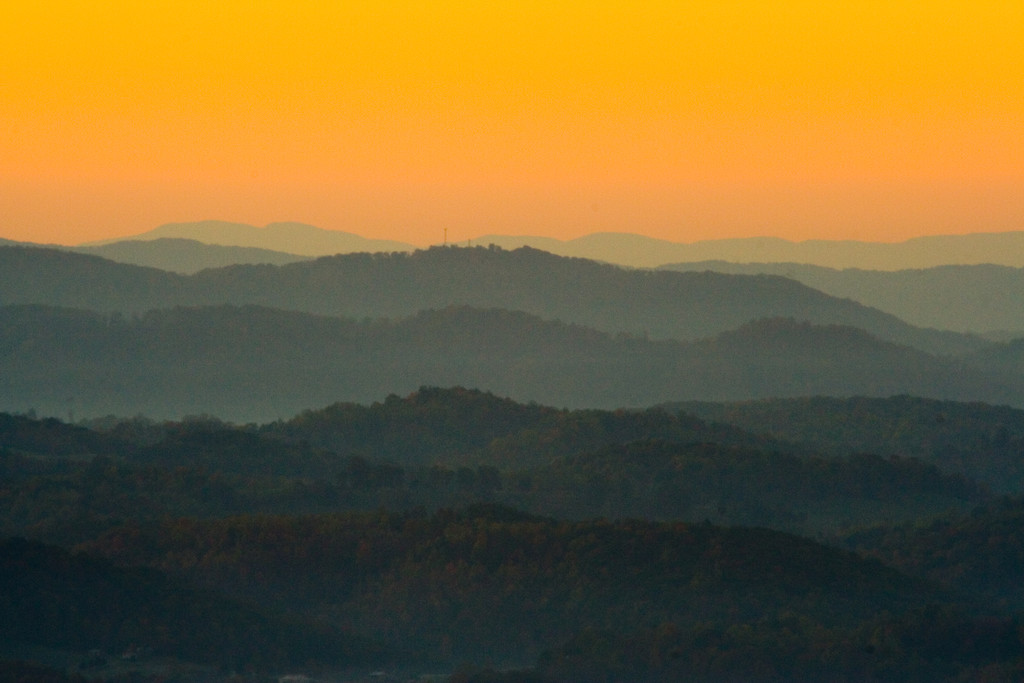
Scott Teodorski, Mountains at Sunrise, viewed from Pinnacle Overlook in Cumberland Gap National Historical Park. Undated photograph, National Park Service. Regional context; not the painting’s exact viewpoint. Photograph: National Park Service / Scott Teodorski.
Image source
.
Public domain
.
Boone within Bingham’s career
Boone’s image was connected with Bingham’s artistic interests from an early stage. The State Historical Society of Missouri recounts that, as a boy, Bingham watched Chester Harding working on a portrait of Boone in Franklin. That later biographical account describes exposure to portrait painting; it is not evidence that Bingham witnessed the eighteenth-century journey represented here. [17]
Conrads places Bingham’s mature work in the context of both American subjects and his high regard for European art. That combination is useful for this canvas. A local or national historical theme did not require the painter to abandon inherited methods of composing bodies, landscape and dramatic action. Those methods helped make the subject recognizable as an ambitious painting. [18]
The Bingham biography follows the wider career, while Fur Traders Descending the Missouri offers another important encounter between western imagery and the shaping of historical memory. The works differ in mood and action, but both reward attention to what a serene or heroic image can leave outside its frame.
The Kemper record identifies the 1890 Phillips gift but does not supply a complete earlier ownership chain. That limited provenance should remain limited. The painting’s place in the collection is secure without filling the preceding decades with an undocumented patron, sale or commission. [1]
Artworks directory
A documented selection discussed across these articles, including separate canvases, figure studies and reproductive impressions. Dates identify the particular object or study; collection and title distinctions follow museum records and the 2015 exhibition checklist. This is not a catalogue raisonné. Prints are grouped with works on paper in the Drawing filter.
| Name | Date | Medium |
|---|---|---|
| Fur Traders Descending the Missouri | 1845 | Painting — oil on canvas |
| The Jolly Flatboatmen | 1846; NGA canvas | Painting — oil on canvas |
| The County Election (original) | 1851–52 | Painting — oil on canvas |
| Stump Speaking | 1853–54 | Painting — oil on canvas |
| The Verdict of the People | 1854–55 | Painting — oil on canvas |
| Order No. 11: Martial Law | 1865–68; Cincinnati original | Painting — oil on canvas |
| Daniel Boone Escorting Settlers through the Cumberland Gap | 1851–52 | Painting — oil on canvas |
| Canvassing for a Vote | 1852; signed canvas | Painting — oil on canvas |
| Raftsmen Playing Cards | 1847 | Painting — oil on canvas |
| Mississippi Boatman | 1850 | Painting — oil on canvas |
| Jolly Flatboatmen in Port | 1857 | Painting — oil on canvas |
| The County Election (replica illustrated here) | 1852 | Painting — oil on canvas |
| Martial Law or Order No. 11 (Missouri replica) | 1870 | Painting — oil on canvas |
| The Jolly Flatboatmen (Terra canvas) | 1877–78 | Painting — oil on canvas |
| John Quincy Adams (later version) | about 1850, after an 1844 original | Painting — oil on canvas |
| Country Politician | 1849 | Painting — oil on canvas |
| The Trappers’ Return | 1851 | Painting — oil on canvas |
| The Concealed Enemy | 1845 | Painting — oil on canvas |
| The Wood-boat | 1850 | Painting — oil on canvas mounted on board |
| Lighter Relieving a Steamboat Aground | 1847 | Painting — oil on canvas |
| Watching the Cargo | 1849 | Painting — oil on canvas |
| In a Quandary | 1851 | Painting — oil on canvas |
| Boatmen on the Missouri | 1846 | Painting — oil on canvas |
| Self-Portrait (Saint Louis) | 1834–35 | Painting — oil on canvas |
| Self-Portrait (Nelson-Atkins) | about 1877 | Painting — oil on canvas |
| Mrs. David Steele Lamme and Son William Wirt | 1837 | Painting — oil on canvas |
| Portrait of Leonidas Wetmore | 1839–40 | Painting — oil on canvas |
| Fur Trader (study for Fur Traders Descending the Missouri) | 1845 | Drawing — brush, ink and wash over pencil |
| Skillet-beater (study for The Jolly Flatboatmen) | 1846 | Drawing — brush, ink and wash over pencil |
| Young Wood-boatman (study for The Wood-boat) | 1850 | Drawing — brush, ink and wash over pencil |
| Thomas Doney after Bingham: The Jolly Flat Boat Men (Met impression) | 1847 | Print — mezzotint and engraving with etching |
| Thomas Doney after Bingham: The Jolly Flat Boat Men (coloured Carter impression) | 1847 | Print — intaglio with applied watercolour |
| The Verdict of the People (lithographic proof) | ca. 1858–59 | Print — lithographic proof |
| Gautier after Bingham: Stump Speaking | 1856 | Print — etching and aquatint |
| Claude Regnier after Bingham: In a Quandary, Mississippi Raftsmen Playing Cards | 1852 | Print — hand-coloured lithograph |
Frequently Asked Questions
The Kemper Art Museum dates the canvas 1851–52, long after the eighteenth-century migration journeys it evokes. [1]
The museum connects Boone’s procession with Moses and the draped woman on the white horse with the Virgin Mary. It interprets those associations as giving authority to the painting’s image of settler expansion. [1]
Discussion
Look again at the images and ideas explored in Daniel Boone Escorting Settlers through the Cumberland Gap. These editorial prompts invite your observations.
What first makes the procession seem heroic: the figures’ posture, their light or the threatening landscape? Consider how the effect changes when you look beyond the people at its centre.
Reader Insights
How do the cliffs and light turn the procession into a heroic entrance?
What changes when the Gap’s history is considered before Boone’s passage?
How does the modern landscape photograph help you distinguish regional setting from invented composition?
Join the Conversation
Share a detail, comparison or question about Daniel Boone Escorting Settlers through the Cumberland Gap below.
References
- Mildred Lane Kemper Art Museum , Daniel Boone Escorting Settlers through the Cumberland Gap , WU 2171. Object metadata, 2016 permanent-collection interpretation and short provenance. View source
- Metropolitan Museum of Art, Fur Traders Descending the Missouri. View source
- National Gallery of Art, The Jolly Flatboatmen. View source
- Saint Louis Art Museum, Raftsmen Playing Cards. View source
- National Gallery of Art, Mississippi Boatman. View source
- Saint Louis Art Museum, The County Election, 1851–52, 124:1944. View source
- Saint Louis Art Museum, The County Election, 1852 replica, 44:2001. View source
- Nelson-Atkins Museum of Art, Canvassing for a Vote. View source
- Saint Louis Art Museum, Stump Speaking. View source
- Saint Louis Art Museum, The Verdict of the People. View source
- Saint Louis Art Museum, Jolly Flatboatmen in Port. View source
- Cincinnati Art Museum , Order No. 11 (Martial Law) , 1865–1868, 1958.515. Current original painting identity and forced-removal subject. View source
- National Park Service , Cumberland Gap . Indigenous use, displacement, Boone’s 1775 trail-building and the painting’s relation to Manifest Destiny. View source
- National Park Service , Warrior’s Path . The pre-existing Cherokee and Shawnee route. View source
- Liam Otten , “Painting America in the 19th Century,” Washington University, 8 December 2003. Exhibition account’s interpretation of the painting’s combination of 1773 and 1775 events. View source
- National Park Service , Mountains at Sunrise , Pinnacle Overlook. Scott Teodorski photograph; exact asset metadata supplies public-domain status and no capture date. View source
- State Historical Society of Missouri , George Caleb Bingham , Historic Missourians. Account of Bingham watching Harding work on Boone’s portrait. View source
- Margaret C. Conrads , “Bingham@200: A Bicentennial Celebration,” Antiques & Fine Art , Spring 2011, pp. 193–199. Bingham’s American subjects and regard for European artistic traditions. View source
- Splash image source.
George Caleb Bingham, Daniel Boone Escorting Settlers through the Cumberland Gap, 1851–52. Oil on canvas, 36½ × 50¼ inches. Mildred Lane Kemper Art Museum, Washington University in St. Louis, Gift of Nathaniel Phillips, 1890, WU 2171. Public domain .
View source