 by
Tom Gurney
Tom Gurney BSc (Hons) is an art history expert with over 20 years experience
Email:
tomgurney1@gmail.com
/ Phone:
+44 7429 011000
Stump Speaking: Introduction
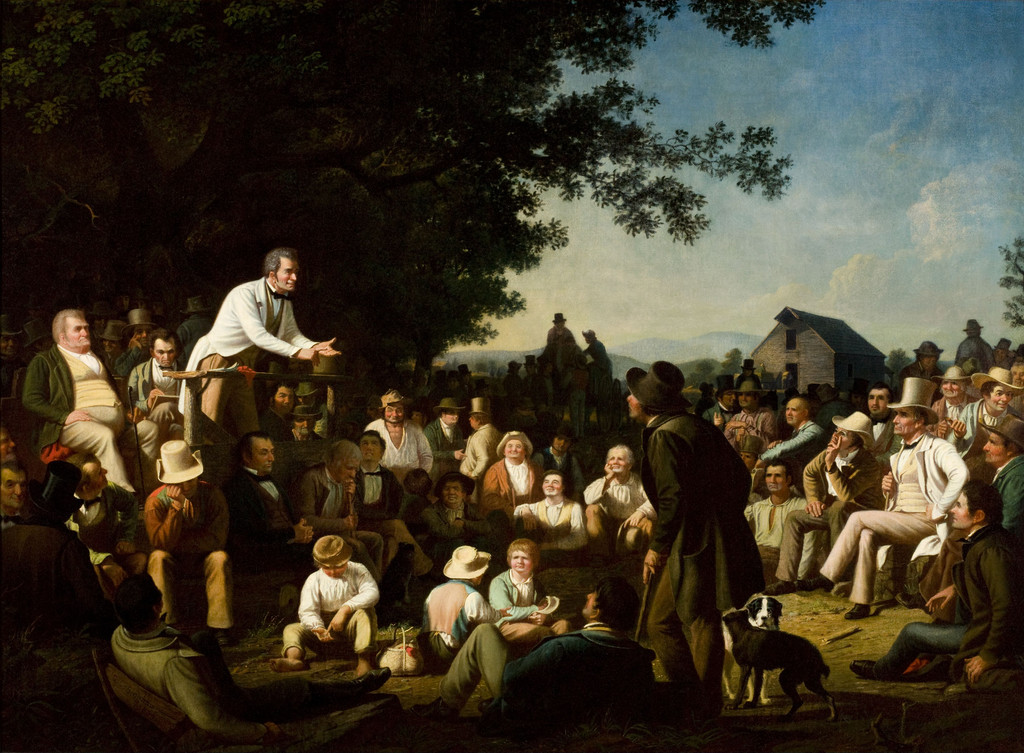
A candidate leans towards a gathering of men beneath a large tree. His hands open as if he is explaining a point; behind him, a seated man has paper ready for his reply. George Caleb Bingham’s Stump Speaking makes political persuasion a public performance, with an audience whose reactions matter as much as the speaker’s words.
Bingham painted the work in Philadelphia in 1853–54. The oil on canvas, now in the Saint Louis Art Museum, measures 108 × 147.3 cm. It belongs to the group of election paintings through which he explored campaigning, voting and the announcement of results. The museum identifies the speaker with Erasmus Darwin Sappington, Bingham’s opponent in the disputed Missouri legislative election of 1846. That identification gives the scene a personal edge within its broader subject. [1]
The painting also had a future beyond the canvas. In a letter to his friend James S. Rollins, written while the picture was under way, Bingham discussed its grouping alongside the costs and timing of an engraving after The County Election . He was thinking about how a new political image would look, how it could reach buyers and how he would finance that ambition. [2]
At a Glance
- Artist George Caleb Bingham.
- Date 1853–54.
- Medium Oil on canvas.
- Dimensions 108 × 147.3 cm.
- Place made Philadelphia, Pennsylvania.
- Collection Saint Louis Art Museum.
- Collection credit Gift of Bank of America.
- Object number 43:2001. [1]
This work across George Caleb Bingham’s career
The Jolly Flatboatmen
1846; NGA canvasThe County Election
1851–52 original; 1852 replica illustratedCanvassing for a Vote
1852; signed canvasThe Verdict of the People
1854–55Order No. 11: Martial Law
1865–68; Cincinnati originalNotes and sources
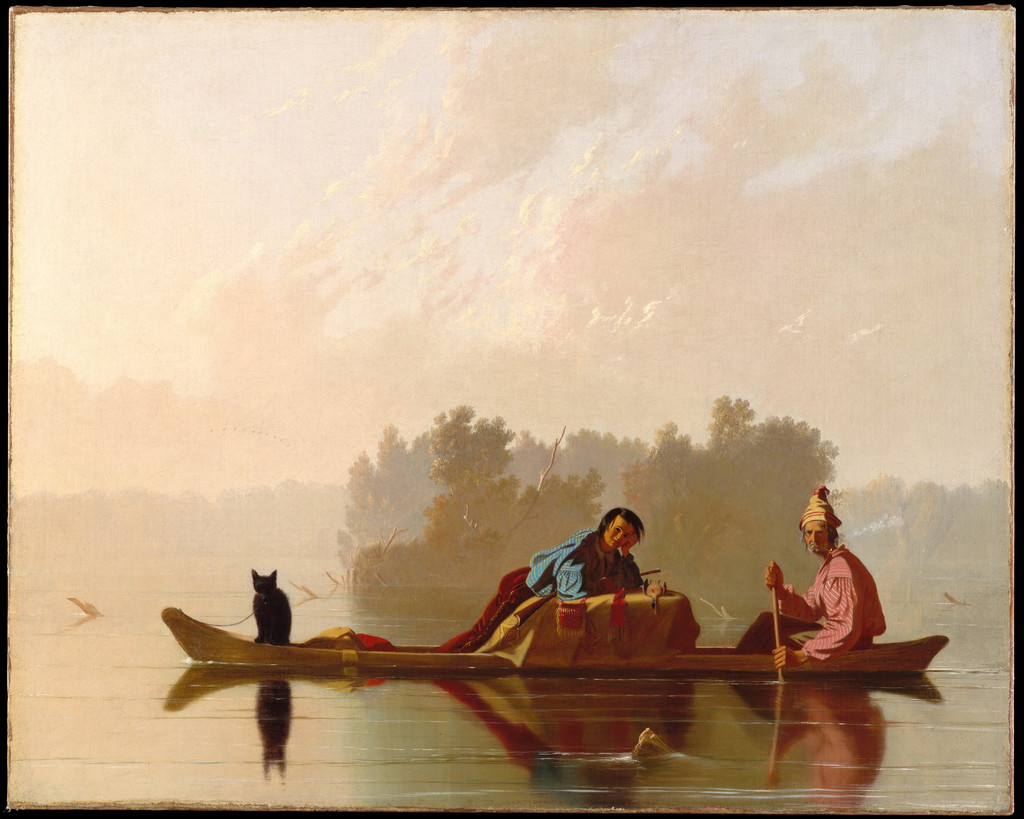
Fur Traders Descending the Missouri. Dates identify the canvas discussed in the article. [3]
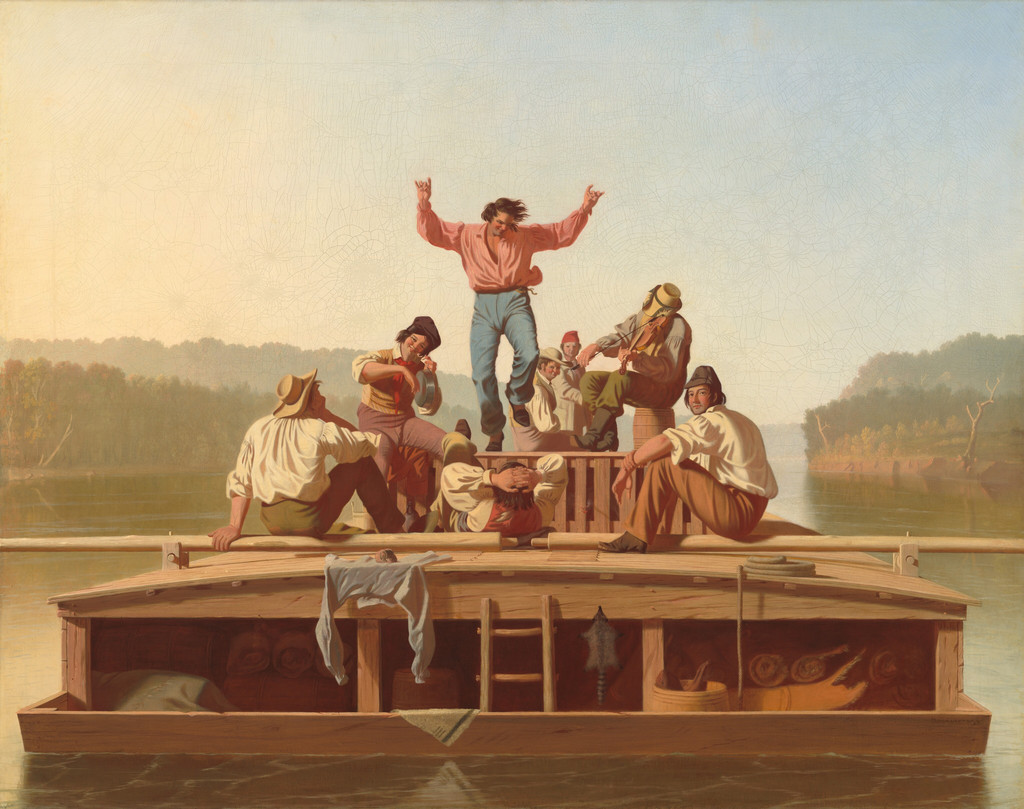
The Jolly Flatboatmen. Dates identify the canvas discussed in the article. [4]
Raftsmen Playing Cards. Dates identify the canvas discussed in the article. [5]
Mississippi Boatman. Dates identify the canvas discussed in the article. [6]
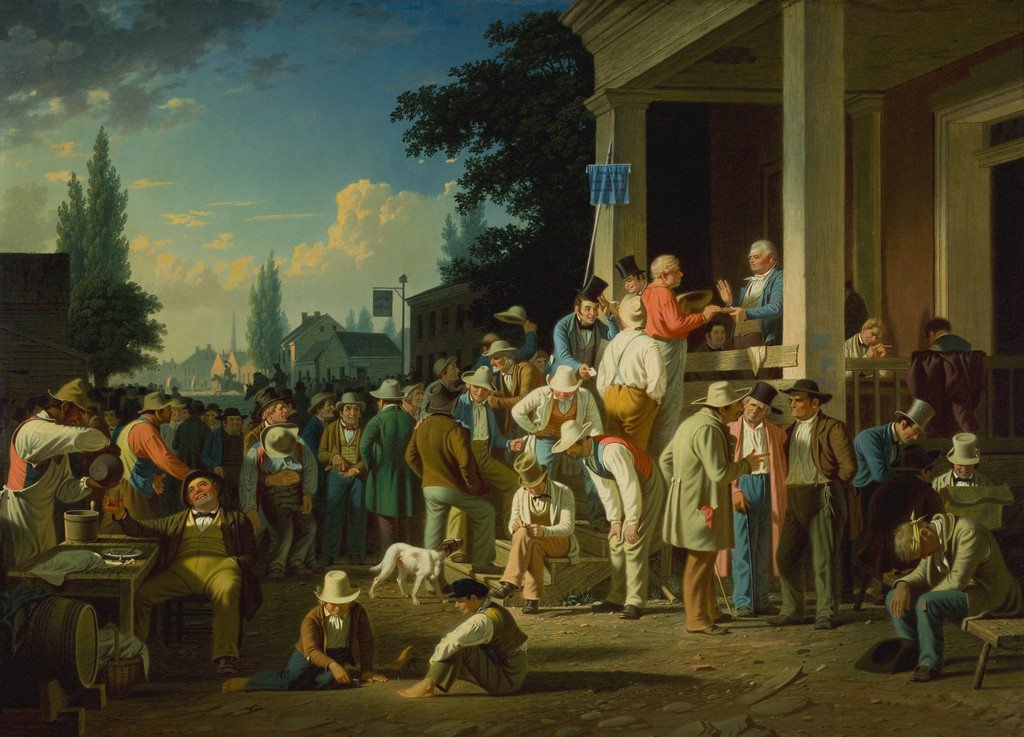
The County Election. The original is 124:1944; the illustrated 1852 replica is 44:2001. Their dimensions and acquisition histories differ. [7] [8]
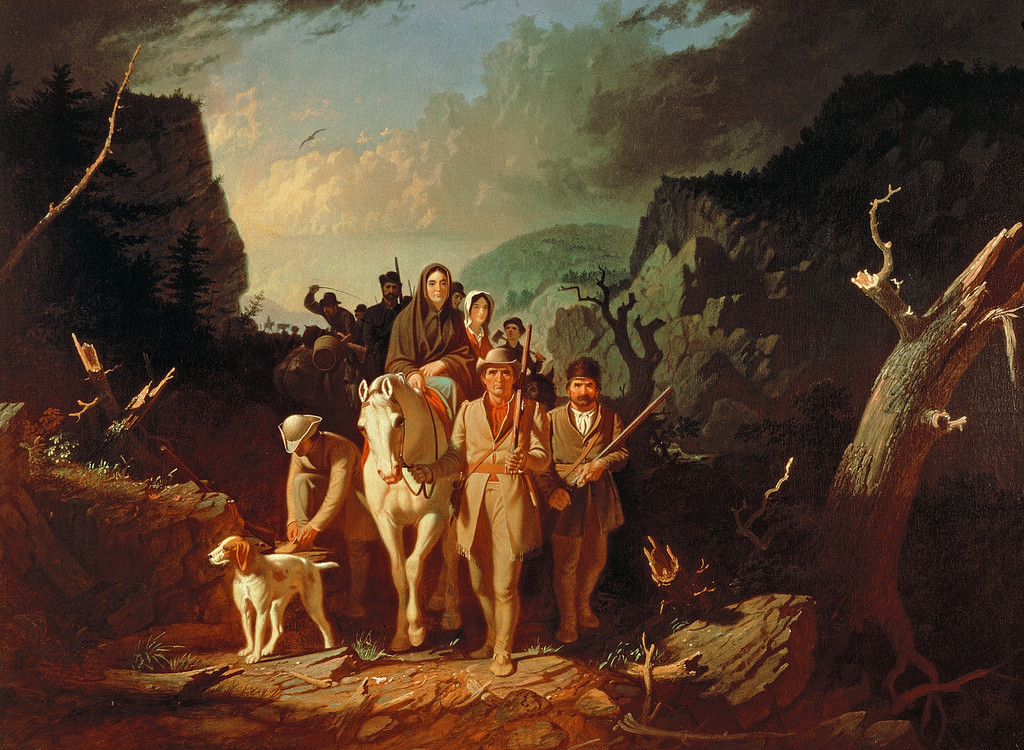
Daniel Boone Escorting Settlers through the Cumberland Gap. Dates identify the canvas discussed in the article. [9]
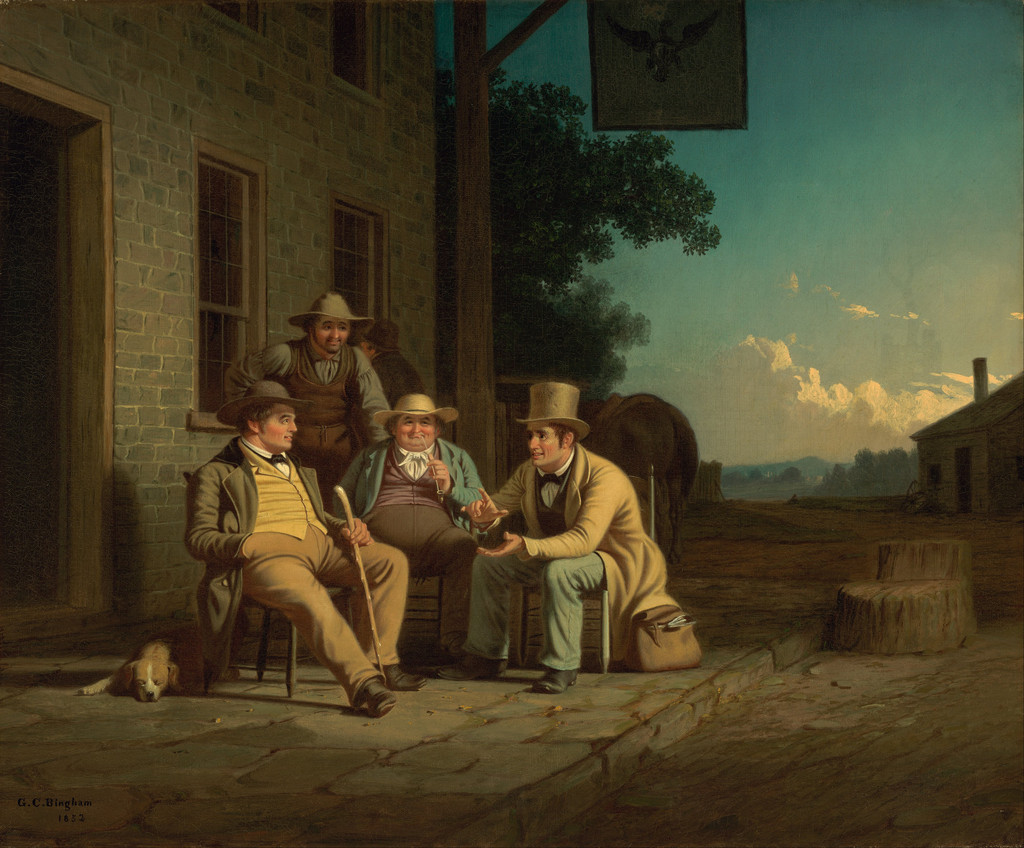
Canvassing for a Vote. Dates identify the canvas discussed in the article. [10]
Stump Speaking (current article). Dates identify the canvas discussed in the article. [1]
The Verdict of the People. Dates identify the canvas discussed in the article. [11]
Jolly Flatboatmen in Port. Dates identify the canvas discussed in the article. [12]
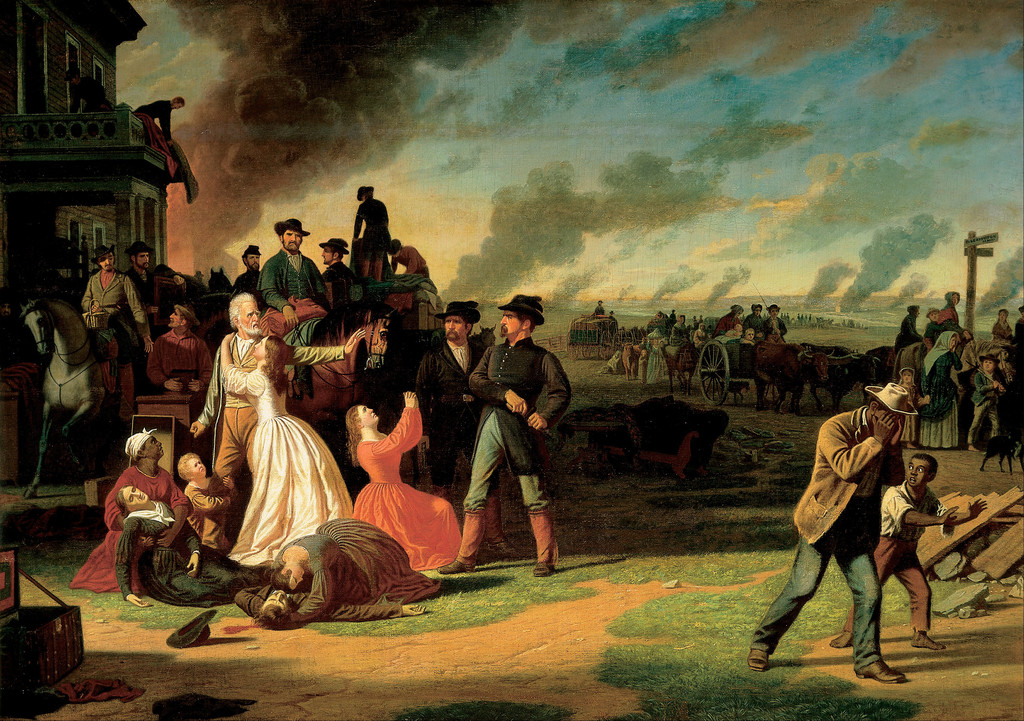
Order No. 11: Martial Law. Dates identify the canvas discussed in the article. [13]
Contents
- How the speech holds the picture together
- Recognizable people and a constructed public
- What Bingham’s 1853 letter reveals
- Financing a picture’s wider audience
- The earlier Stump Orator and the election paintings
- Looking at the original today
- Annotated details
How the speech holds the picture together
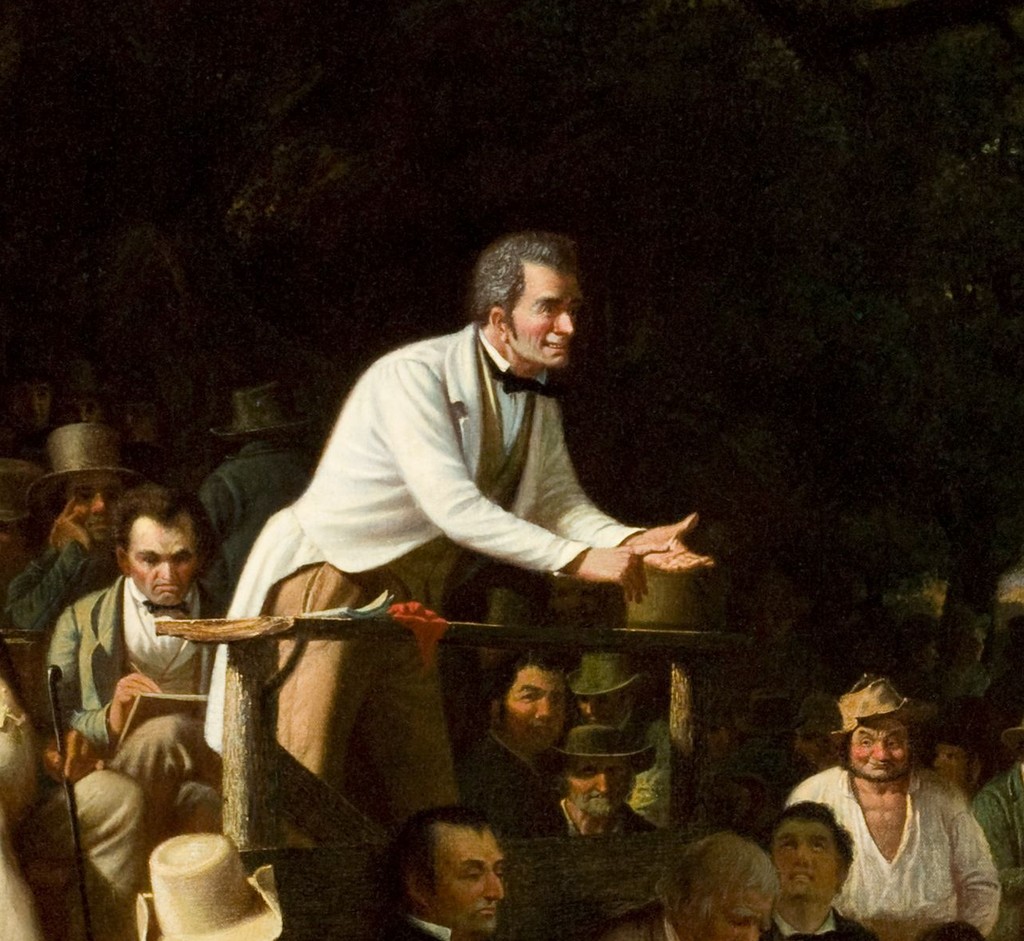
The orator stands towards the left rather than at the exact centre. His pale coat makes him conspicuous against the dark tree, while the angle of his body sends attention into the gathering. One hand extends towards the listeners and the other turns upwards. We cannot hear the argument, but we can see the work involved in delivering it.
A rough support serves as a speaking stand. Its plain timber belongs to the outdoor setting and differs from the formal architectural platforms of a legislative chamber. Around it, people occupy whatever positions the ground and gathering allow. Some sit on chairs, others on the earth; men further back stand or remain on horseback. The event has brought together a temporary public rather than a uniformly seated assembly.
Immediately behind the speaker, a man holds paper close to his knees. The Saint Louis Art Museum interprets him as the opponent preparing for his own turn. This detail changes the relationship between speech and response. The gathering is presented as a contest in which one address can be answered, rather than a single authoritative declaration. [1]
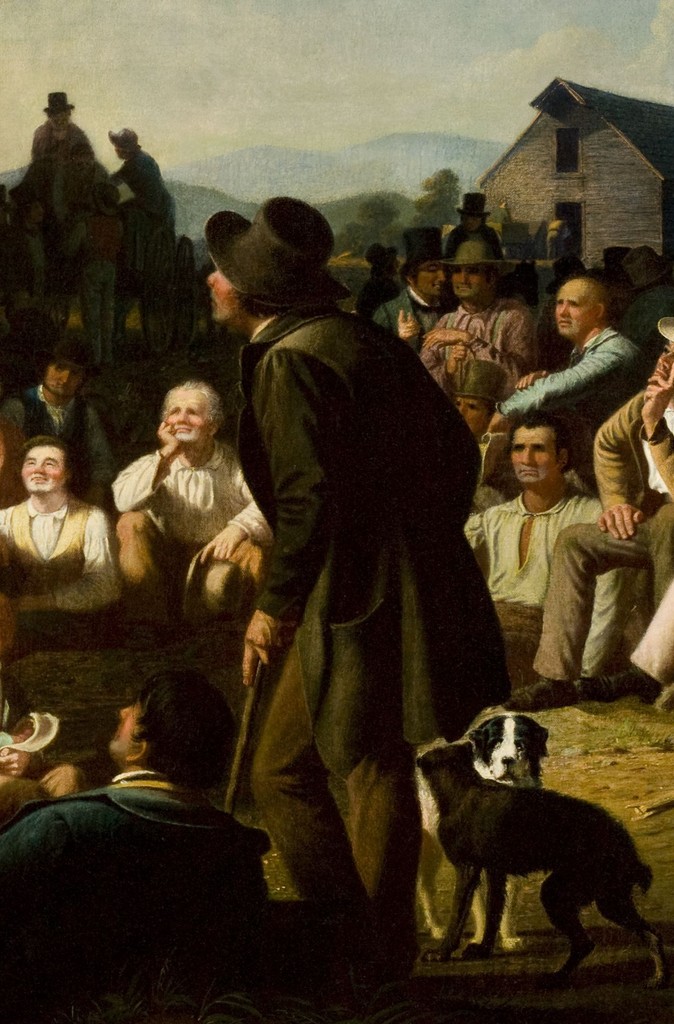
The listeners form a broad arc across the lower part of the painting. Heads turn at different angles, and hats mark a succession of light and dark shapes. A large standing figure near the centre-right has his back towards us. He partly interrupts our view of the audience, placing us behind one participant even as other faces remain open to inspection.
This obstruction gives the picture an engaging double position. We can study the crowd from outside, comparing expressions and clothes, yet we also seem to occupy its edge. The standing man does not politely clear a path to the speaker. His solid back makes the gathering feel populated by bodies with their own locations and concerns.
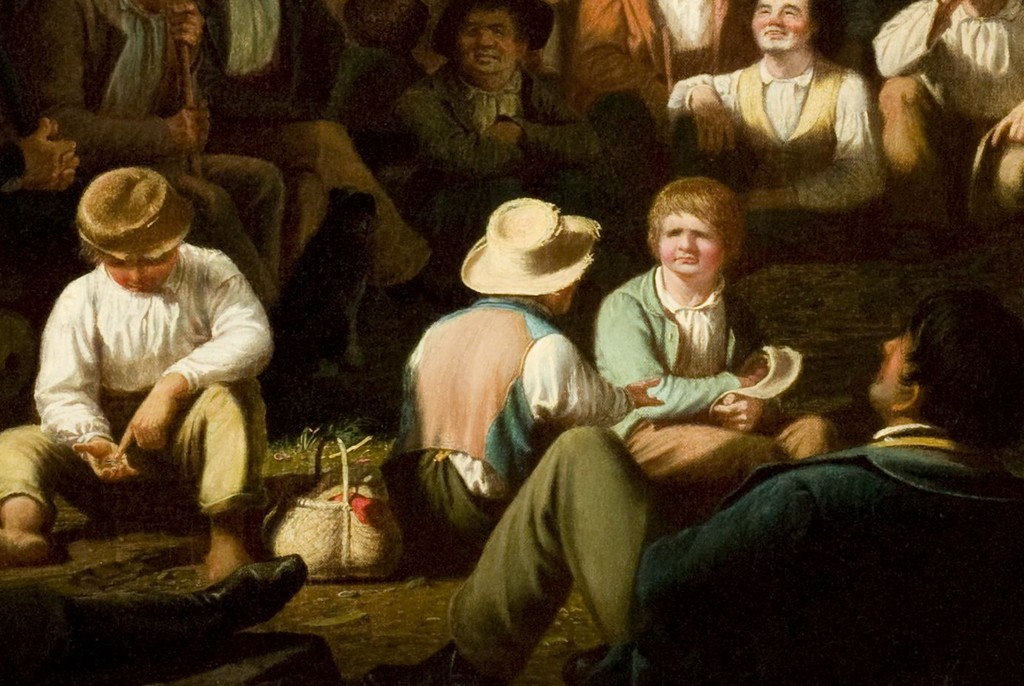
The foreground is less attentive than the platform. Boys sit on the ground, absorbed in small activities or looking in different directions. A dog near the standing man turns its head outwards. These details prevent the speech from organizing every action in the scene. Political participation takes place amid the ordinary restlessness of a social occasion.
At the right, seated men create another cluster of pale shirts, dark coats and broad-brimmed hats. Some lean forward; others settle back. The contrast with the speaker’s upright, reaching body gives the painting much of its rhythm. Persuasion appears as something offered to people who retain the physical freedom to respond, wait, watch or lose interest.
Above these crowded exchanges, the picture opens into sky. A small building and distant figures establish the rural setting without competing with the foreground. The tree’s dark mass shelters the speaker, while the lighter distance gives the crowd room to spread. The landscape supports the event, but the picture’s most important differences occur between human postures.
Annotated Details from Stump Speaking
The numbered points identify visible features discussed in this article. Return from each detail to the whole composition. George Caleb Bingham, Stump Speaking, 1853–54. Oil on canvas. Saint Louis Art Museum, Gift of Bank of America, 43:2001. Image source. Public domain. Numbers added to a separate overview. Detail images are crops of the source reproduction.
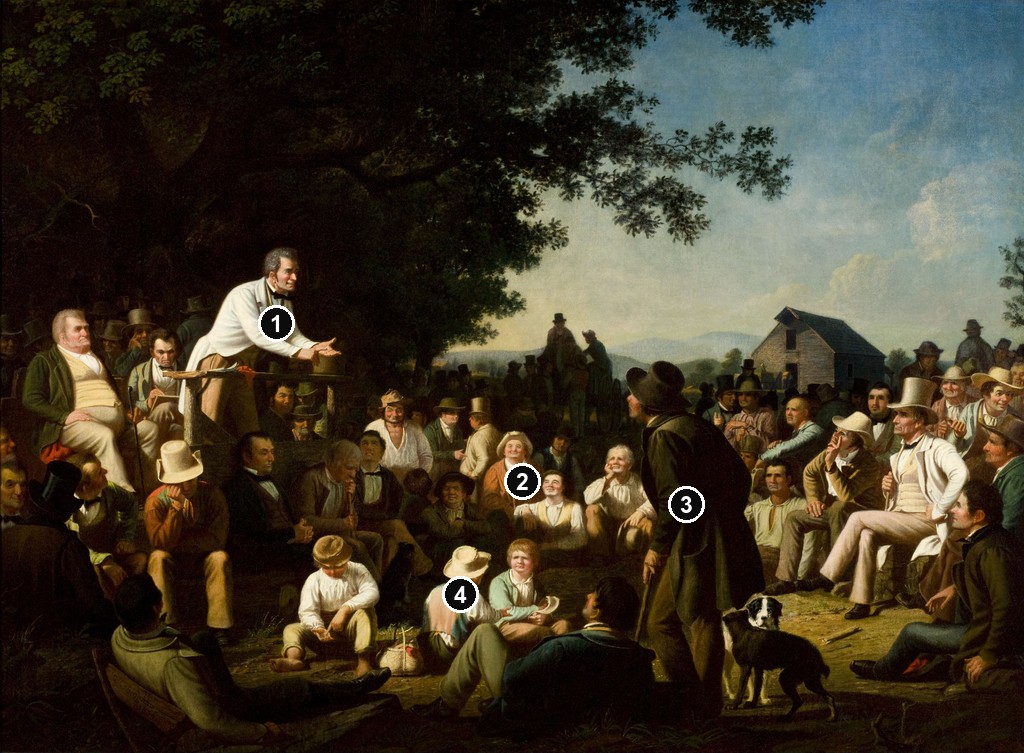
Details from STUMP SPEAKING
Compare the cropped details with the complete images above. Notice how their colours, shapes and positions contribute to the larger compositions.
The speaker’s open hands
The pale coat stands out against the dark tree, and the open hands project into the space occupied by the listeners. The simple platform lifts this forward-leaning body above the surrounding heads.
Different directions of attention
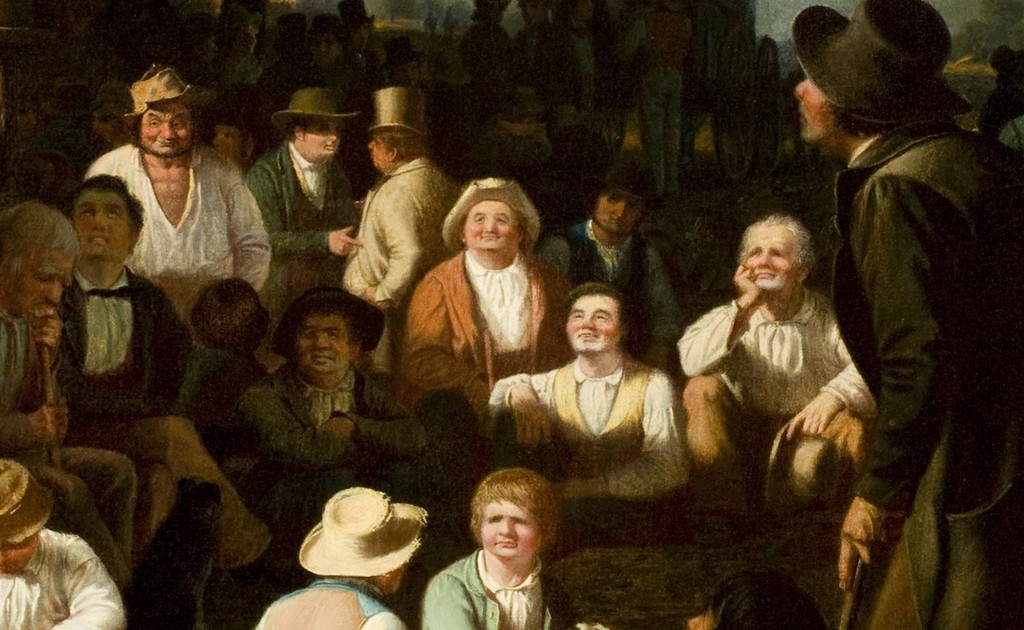
Faces turn upwards towards the speaker, across towards neighbours and out of the gathering. These varied directions allow a crowd to contain separate exchanges and degrees of attention within one organised composition.
The tall foreground figure
A tall hat and a long dark coat give the standing foreground figure a strong vertical presence. His turned head connects him with the speaker while his scale draws the viewer into a position close to the gathering.
Children at the front of the gathering
The children’s lowered bodies occupy a small foreground group beneath the adults. Their hands and facing heads establish an activity on its own scale, helping to distinguish the public speech from everything else happening around it.
Recognizable people and a constructed public
Bingham’s attention to individual appearance has encouraged scholars to connect figures with particular Missouri politicians. The museum identifies the large seated man behind the speaker as Meredith Miles Marmaduke and the white-coated, top-hatted man at the right as Claiborne Fox Jackson. It relates these identifications to the artist’s drawings. They are scholarly readings of the image, rather than names supplied by an inscription within the painted scene. [1]
Recognizable faces would have offered some Missouri viewers a more pointed experience than distant buyers could have had. Someone familiar with the state’s political rivalries could bring those associations to the speaker and listeners. A viewer elsewhere could still understand the subject through the exchange of gestures, the provisional platform and the contrast between an active orator and a varied audience.
The variety itself was made through deliberate choices. In her study of Bingham’s drawings, curator Margaret C. Conrads emphasizes the differentiation of costume, pose and physical features in his political pictures. She connects the figure called Village Character , drawn in 1847, with both the earlier Stump Orator and this later painting. A figure developed for one composition could acquire a different prominence when placed among new neighbours. [14]
Conrads reads that figure’s difference from the better-dressed men as significant to Bingham’s understanding of participation. The painter belonged to the Whig political world, yet the public he represented extended beyond its preferred social circle. That interpretation helps explain why varied clothing matters: it offers a way to see differences within the electorate without turning every hat or worn sleeve into a securely identified personal biography. [14]
The faces do not produce a single collective expression. A broad smile, a lowered head and a steady sideways look can coexist within a small area. These differences invite us to imagine responses, but they do not tell us how each person would vote. Bingham gives enough information to make the listeners interesting while leaving the outcome of persuasion unresolved.
Dress establishes differences without dividing the audience into neat rows. The speaker’s light coat is echoed by the clothes of seated men at the right, carrying pale accents across the gathering. Darker coats intervene, and exposed shirtsleeves create smaller patches of brightness nearer the ground. People who differ in appearance remain interwoven within one continuous assembly. The composition lets us notice distinctions while also seeing the physical proximity that a public meeting creates.
The painting’s population should also be distinguished from the population of Missouri as a whole. Its principal political exchange is among white men. The related election pictures expose the distance between the language of a public will and the unequal ability to take part in the vote. Reading the gathering as a complete portrait of society would make that boundary disappear. [11]
What Bingham’s 1853 letter reveals
On 7 November 1853, Bingham wrote from Philadelphia to James S. Rollins about a picture he then called County Canvass . The surviving text consulted here is a transcription by Rollins’s son, C. B. Rollins. Its editorial note identifies that work as the painting later titled Stump Speaking . Bingham reported that the drawing was complete and the painting was advancing. [2]
That account places a developed design before the finished canvas. It does not mean every surviving study can be assigned to that November, or that all decisions had become irreversible. It does show that Bingham understood drawing and grouping as a substantial stage of the project. The crowd’s apparent informality emerged from preparation.
He told Rollins that this subject gave him greater freedom in arranging attitudes than The County Election . The difference is visible when the two compositions are considered together. A speech permits bodies to gather around a single active person, while a polling scene involves separate actions around the procedure of voting. The variety Bingham valued was part of how he distinguished one political subject from another. [2]
The letter also records John Sartain’s favourable response to the new drawing and its grouping. Bingham presented that reaction as a reversal of Sartain’s earlier belief that he could not surpass The County Election . Such a report is evidence of the artist’s confidence and of the conversation he wanted Rollins to hear. It is not an independent ranking of the two paintings. [2]
Bingham went on to discuss another possible subject: Thomas Hart Benton addressing a Missouri audience. He imagined using portraits of friends who had attended and adding others who had not. The proposal remained a proposal, but it is revealing. In this same letter, he openly treated political painting as a form that could reorganize attendance for pictorial effect. That makes a useful caution against treating Stump Speaking as a literal record of one witnessed meeting. [2]
His proposed Benton picture also depended on choosing a particular instant within a speech. Bingham wanted an action that would display the speaker effectively and register in the audience’s faces. The idea links bodily gesture with response, rather than treating the text of an address as sufficient subject matter. Even in an unrealized project, he was asking how political language could become visible. [2]
Watch: George Caleb Bingham
Choose a film to explore the artist’s work, its interpretation and its wider setting.
Navigating the West: George Caleb Bingham and the River at the Amon Carter Museum of American Art
The Amon Carter Museum introduces an exhibition devoted to Bingham’s river paintings.
Watch on YouTubeFinancing a picture’s wider audience
The letter’s artistic discussion sits beside a practical problem. Sartain was still working on the plate after The County Election , and payment, printing paper and the timing of sales had to be coordinated. Bingham had initially misremembered the contractual completion date by a month. On consulting the agreement, he found that the engraver had fourteen months from receiving the picture. [2]
For Bingham, that month mattered because one project was intended to help launch another. He hoped to have County Canvass ready for exhibition when Sartain completed the earlier plate, then to seek subscribers for the new work while distributing impressions of the old one. The speech painting belonged to a connected business plan as well as to a connected set of subjects. [2]
The printing materials were a further commitment. Bingham described paper ordered from London and asked Rollins to advance money against the benefit of subscriptions. His account placed Sartain’s total, including money already received, at $1,350, with another $300 for paper. Those figures describe the financing of the earlier engraving and its distribution; they should not be presented as the price of the Stump Speaking canvas. [2]
These practical details explain why a friend and patron figures so prominently in the picture’s history. An artist could have a finished design and an enthusiastic engraver yet still need temporary credit to bring a print to buyers. The letter moves naturally between confidence about the new composition and anxiety about obligations already approaching. Its political imagery depended on the less visible labour of contracts, materials and collecting payments.
The eventual reproductive history needs a separate identification. The Saint Louis Art Museum holds an 1856 Stump Speaking print by Louis-Adolphe Gautier after Bingham, published by Goupil & Cie in Paris. Its record describes etching and aquatint. This is a later object made through different hands and processes from the oil painting. Sartain’s work on The County Election in the 1853 letter should not be transferred to it. [15]
An engraving or aquatint could carry the grouping into spaces where the original canvas would never be seen. But the image’s survival in print also creates opportunities for confusion. Dates attached to impressions may be several years later than the painting’s execution. A monochrome or coloured printed version can reproduce the composition without being the original object whose surface, dimensions and ownership history are described here.
The earlier Stump Orator and the election paintings
The related title The Stump Orator belongs to an earlier painting of 1847, whose location Conrads records as unknown. It provided a precedent for Stump Speaking , but the works should not be collapsed into one canvas with competing dates. Conrads places them within a longer development of political subjects and traces figures shared between their compositions. [14]
That continuity matters because it makes the 1853–54 picture more than a sudden response to one event. Bingham had already explored a campaign speaker years earlier. He returned to the problem with a larger repertory of poses and with a new opportunity to connect campaigning to images of voting and results. Reuse becomes a means of developing an argument across pictures rather than evidence that every repeated figure represents the same event.
In The County Election , dated 1851–52 in the owning museum’s record, the gathering forms around the act of casting votes. Its episodes of drinking and pressure on voters complicate a straightforward celebration of participation. In Stump Speaking , the appeal precedes that decision: the main action is still the effort to persuade. [7]
The Verdict of the People , painted in 1854–55, moves the sequence towards the announcement of results. Its crowd responds to news rather than to a candidate’s case. Read together, the three subjects offer different relationships between one person who speaks and many people who listen or react. They need not be imagined as consecutive minutes in a single town’s actual election. [11]
The contrast also changes the viewer’s expectations. A campaign speech can be judged by the attention it wins; a polling scene makes us consider the conduct of participants; an announcement brings winners and disappointed listeners into the same space. Bingham’s broader achievement lies in giving those stages distinct visual structures. The democratic process becomes a series of encounters whose meaning depends on how people behave towards one another.
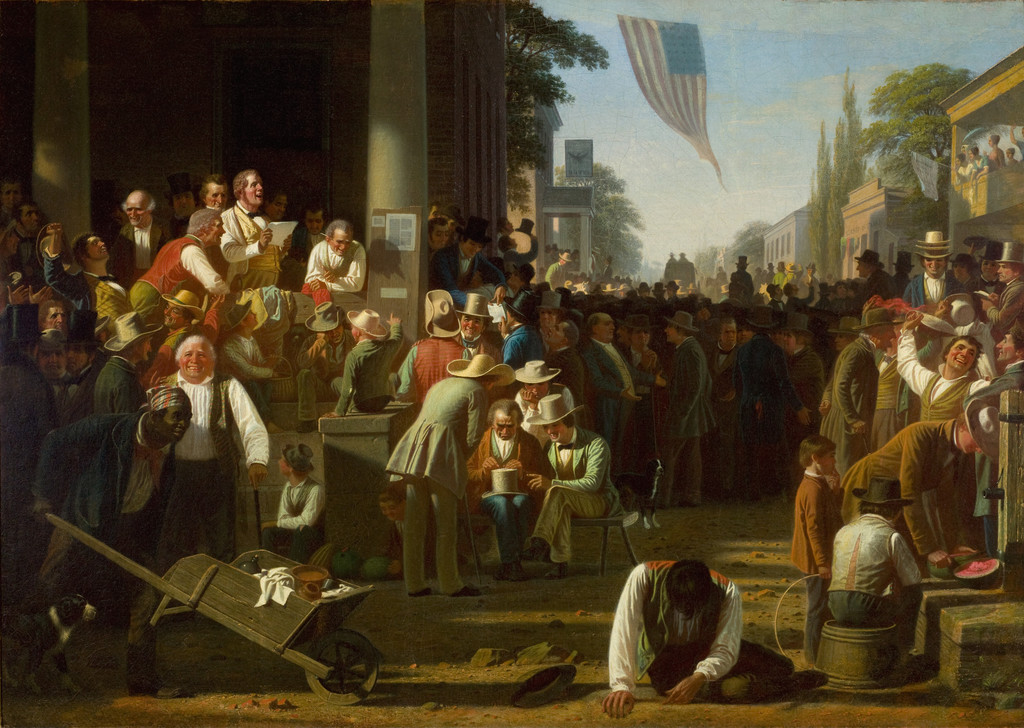
George Caleb Bingham, The Verdict of the People, 1854–55. Oil on canvas. Saint Louis Art Museum, Gift of Bank of America, 45:2001.
Image source
.
Public domain
.
Looking at the original today
The museum’s provenance follows the painting from Bingham through John How, John H. Beach, the St. Louis Mercantile Library and banking ownership to the Bank of America gift of 2001. It leaves the timing and circumstances of Beach’s acquisition unresolved. That gap should remain visible in an ownership history, rather than being filled by an assumed direct sale. [1]
In front of the painting, it is worth looking away from the speaker after finding him. The pale coat first establishes where attention should begin; the surrounding bodies then show that attention being redistributed. A listener looks across rather than up, a child attends to something close at hand and the standing man blocks part of the scene. The orator supplies a focus, but the gathering supplies the picture’s range.
That balance is what makes Stump Speaking rewarding beside Bingham’s quieter river paintings. The controlled arrangement remains, yet its purpose has changed. Instead of holding a few workers in a pause of music or rest, it makes room for competing public responses. The crowd is organized enough to be read and varied enough to keep the speech from having the final word.
For the artist’s broader career, see the Bingham biography . His drawings and prints explain how individual studies and reproductive images connect the planning of a composition with its later audiences.
Artworks directory
A documented selection discussed across these articles, including separate canvases, figure studies and reproductive impressions. Dates identify the particular object or study; collection and title distinctions follow museum records and the 2015 exhibition checklist. This is not a catalogue raisonné. Prints are grouped with works on paper in the Drawing filter.
| Name | Date | Medium |
|---|---|---|
| Fur Traders Descending the Missouri | 1845 | Painting — oil on canvas |
| The Jolly Flatboatmen | 1846; NGA canvas | Painting — oil on canvas |
| The County Election (original) | 1851–52 | Painting — oil on canvas |
| Stump Speaking | 1853–54 | Painting — oil on canvas |
| The Verdict of the People | 1854–55 | Painting — oil on canvas |
| Order No. 11: Martial Law | 1865–68; Cincinnati original | Painting — oil on canvas |
| Daniel Boone Escorting Settlers through the Cumberland Gap | 1851–52 | Painting — oil on canvas |
| Canvassing for a Vote | 1852; signed canvas | Painting — oil on canvas |
| Raftsmen Playing Cards | 1847 | Painting — oil on canvas |
| Mississippi Boatman | 1850 | Painting — oil on canvas |
| Jolly Flatboatmen in Port | 1857 | Painting — oil on canvas |
| The County Election (replica illustrated here) | 1852 | Painting — oil on canvas |
| Martial Law or Order No. 11 (Missouri replica) | 1870 | Painting — oil on canvas |
| The Jolly Flatboatmen (Terra canvas) | 1877–78 | Painting — oil on canvas |
| John Quincy Adams (later version) | about 1850, after an 1844 original | Painting — oil on canvas |
| Country Politician | 1849 | Painting — oil on canvas |
| The Trappers’ Return | 1851 | Painting — oil on canvas |
| The Concealed Enemy | 1845 | Painting — oil on canvas |
| The Wood-boat | 1850 | Painting — oil on canvas mounted on board |
| Lighter Relieving a Steamboat Aground | 1847 | Painting — oil on canvas |
| Watching the Cargo | 1849 | Painting — oil on canvas |
| In a Quandary | 1851 | Painting — oil on canvas |
| Boatmen on the Missouri | 1846 | Painting — oil on canvas |
| Self-Portrait (Saint Louis) | 1834–35 | Painting — oil on canvas |
| Self-Portrait (Nelson-Atkins) | about 1877 | Painting — oil on canvas |
| Mrs. David Steele Lamme and Son William Wirt | 1837 | Painting — oil on canvas |
| Portrait of Leonidas Wetmore | 1839–40 | Painting — oil on canvas |
| Fur Trader (study for Fur Traders Descending the Missouri) | 1845 | Drawing — brush, ink and wash over pencil |
| Skillet-beater (study for The Jolly Flatboatmen) | 1846 | Drawing — brush, ink and wash over pencil |
| Young Wood-boatman (study for The Wood-boat) | 1850 | Drawing — brush, ink and wash over pencil |
| Thomas Doney after Bingham: The Jolly Flat Boat Men (Met impression) | 1847 | Print — mezzotint and engraving with etching |
| Thomas Doney after Bingham: The Jolly Flat Boat Men (coloured Carter impression) | 1847 | Print — intaglio with applied watercolour |
| The Verdict of the People (lithographic proof) | ca. 1858–59 | Print — lithographic proof |
| Gautier after Bingham: Stump Speaking | 1856 | Print — etching and aquatint |
| Claude Regnier after Bingham: In a Quandary, Mississippi Raftsmen Playing Cards | 1852 | Print — hand-coloured lithograph |
Frequently Asked Questions
Bingham began it before 7 November 1853 and completed it by early February 1854. The Saint Louis Art Museum dates the painting 1853–54. [1]
The museum identifies him as Erasmus Darwin Sappington, Bingham’s opponent in the disputed Missouri legislative election of 1846. The identification is an interpretation of the painting and related drawings. [1]
No. The Stump Orator is an earlier work of 1847. Conrads records its location as unknown and discusses figures reused in Stump Speaking . [14]
Discussion
Look again at the images and ideas explored in Stump Speaking. These editorial prompts invite your observations.
Which listener seems most engaged by the speech? Compare the direction of the face with the position of the hands and body before deciding.
Reader Insights
How do listeners’ different postures affect your reading of the speaker?
What does the letter add to the story of the painting and its planned print?
How does this gathering differ from the poll in The County Election?
Join the Conversation
Share a detail, comparison or question about Stump Speaking below.
References
- Saint Louis Art Museum , Stump Speaking , 43:2001. Current object record, interpretation and provenance notes. View source
- George Caleb Bingham to James S. Rollins , 7 November 1853. Transcription by C. B. Rollins, made available by the State Historical Society of Missouri; letter pages 1–2 and editorial notes on page 3. The autograph was not examined. View source
- Metropolitan Museum of Art, Fur Traders Descending the Missouri. View source
- National Gallery of Art, The Jolly Flatboatmen. View source
- Saint Louis Art Museum, Raftsmen Playing Cards. View source
- National Gallery of Art, Mississippi Boatman. View source
- Saint Louis Art Museum , The County Election , 124:1944. Current record for the 1851–52 painting, distinct from the 1852 replica. View source
- Saint Louis Art Museum, The County Election, 1852 replica, 44:2001. View source
- Kemper Art Museum, Washington University, Daniel Boone Escorting Settlers through the Cumberland Gap. View source
- Nelson-Atkins Museum of Art, Canvassing for a Vote. View source
- Saint Louis Art Museum , The Verdict of the People , 45:2001. Current object record and interpretation of participation and exclusion. View source
- Saint Louis Art Museum, Jolly Flatboatmen in Port. View source
- Cincinnati Art Museum, Order No.11 / Martial Law. View source
- Margaret C. Conrads , “Bingham@200: A Bicentennial Celebration,” Antiques & Fine Art , Spring 2011, pp. 193–199. Particularly the account of Village Character , The Stump Orator and Stump Speaking , p. 199. View source
- Saint Louis Art Museum , Gautier after Bingham, Stump Speaking , 1856, 58:2007. Print record, maker, publisher, date and medium. View source
- Splash image source.
George Caleb Bingham, Stump Speaking, 1853–54. Oil on canvas, 108 × 147.3 cm. Saint Louis Art Museum, Gift of Bank of America, 43:2001. Public domain .
View source