 by
Tom Gurney
Tom Gurney BSc (Hons) is an art history expert with over 20 years experience
Email:
tomgurney1@gmail.com
/ Phone:
+44 7429 011000
George Caleb Bingham Biography: Introduction
George Caleb Bingham’s life joined the work of a professional painter to the responsibilities and conflicts of public office. Born in Virginia in 1811, he grew up in Missouri, established himself through portrait commissions and made river scenes and political gatherings central subjects of American painting. He travelled repeatedly in search of sitters, artistic opportunities and ways to circulate his pictures, while maintaining close connections with the state whose people supplied many of his best-known subjects. [1]
His career resists a simple account of an isolated artist recording the frontier. Family relationships, enslaved labour, patrons, elections, eastern art institutions and European travel all belonged to his world. The Civil War made the relationship between his political loyalties and his pictures especially difficult. Following that history reveals both the practical work behind the familiar paintings and the contradictions within the society they represent. [2] [3]
At a Glance
- Born 1811, Virginia [1]
- Died 1879, Missouri [1]
- Career Portrait painter, river and political subjects, public office [1]
- Home Arrow Rock, Missouri; later restored [4]
George Caleb Bingham in context
Bars show approximate historical periods. c. means circa (about).
Hudson River School
c. 1825–1880 [27]American genre painting
c. 1830–1880 [28]The genre-painting range marks a period of nineteenth-century prominence; the genre continued beyond it. Other subjects and practices are retained in Notes and sources.
Notes and sources
Hudson River School. A parallel mid-century landscape community. New York landscape painters offered another approach to American subjects. Their school provides contemporary context rather than a membership label for Bingham. [7] [5]
American genre painting. Public audiences from about 1830. Scenes of daily life reached broader exhibition audiences. Bingham’s river groups belong within this field. [5] [6]
Each bar runs from the artist’s birth to their death.
William Sidney Mount
1807–1868 · Birth–death [29]George Caleb Bingham
1811–1879 · Birth–death [30]Emanuel Leutze
1816–1868 · Birth–death [31]Winslow Homer
1836–1910 · Birth–death [32]Notes and sources
William Sidney Mount. Cider Making, 1840–41. Mount’s rural subjects offer a contemporary comparison within American genre painting. This comparison does not imply personal contact. [5]
George Caleb Bingham. Missouri river scenes and political gatherings. Explore selected paintings across his career. [6] [3]
Emanuel Leutze. Düsseldorf, 1856. Leutze welcomed Bingham to Düsseldorf, where Bingham painted Jolly Flatboatmen in Port. [6]
Winslow Homer. The Veteran in a New Field, 1865. Homer offers a later example of everyday subjects bearing the weight of national experience. [5]
The Jolly Flatboatmen
1846; NGA canvasThe County Election
1851–52 original; 1852 replica illustratedCanvassing for a Vote
1852; signed canvasStump Speaking
1853–54The Verdict of the People
1854–55Order No. 11: Martial Law
1865–68; Cincinnati originalNotes and sources
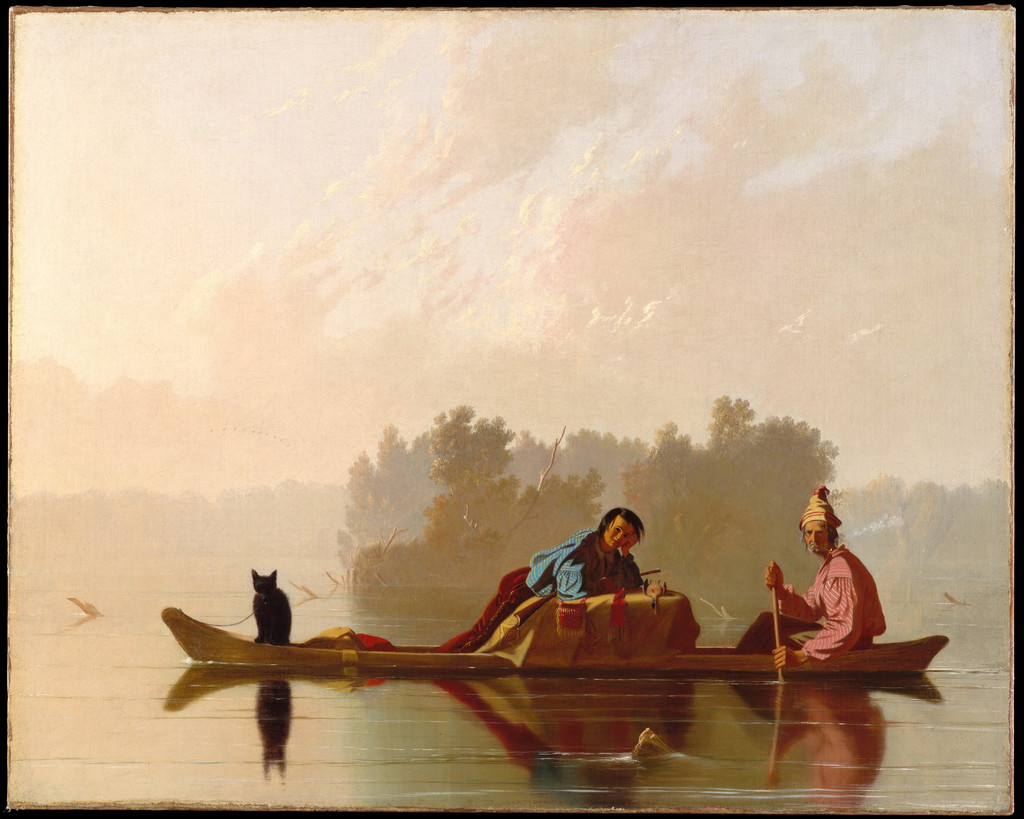
Fur Traders Descending the Missouri. Dates identify the canvas discussed in the article. [8]
The Jolly Flatboatmen. Dates identify the canvas discussed in the article. [9]
Raftsmen Playing Cards. Dates identify the canvas discussed in the article. [10]
Mississippi Boatman. Dates identify the canvas discussed in the article. [11]
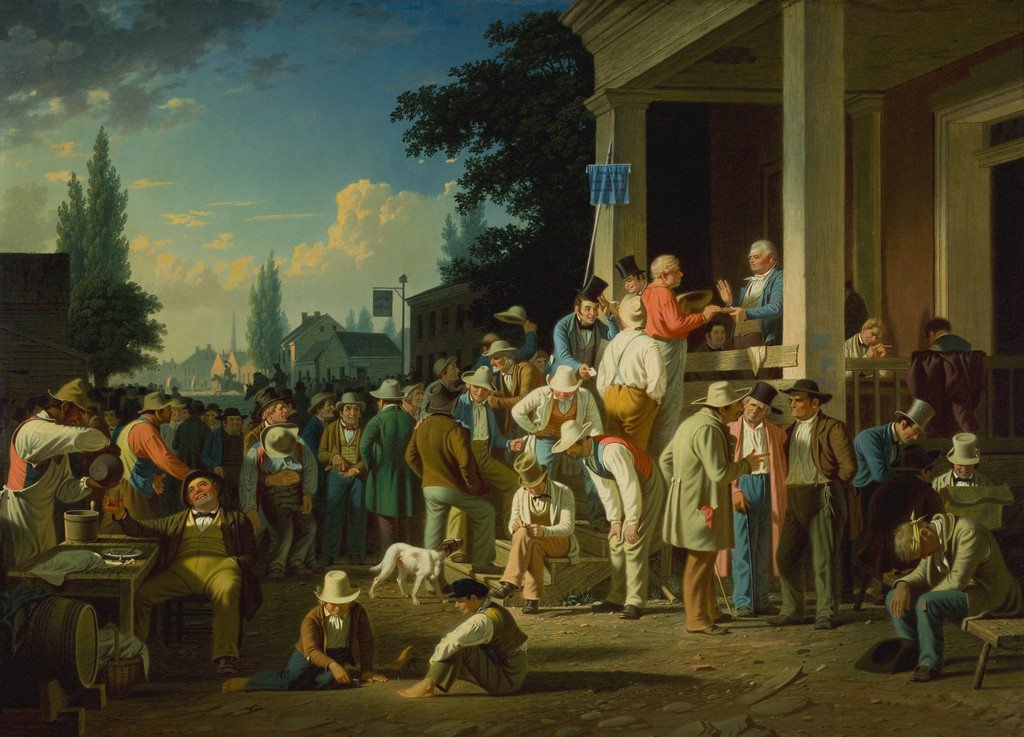
The County Election. The original is 124:1944; the illustrated 1852 replica is 44:2001. Their dimensions and acquisition histories differ. [12] [13]
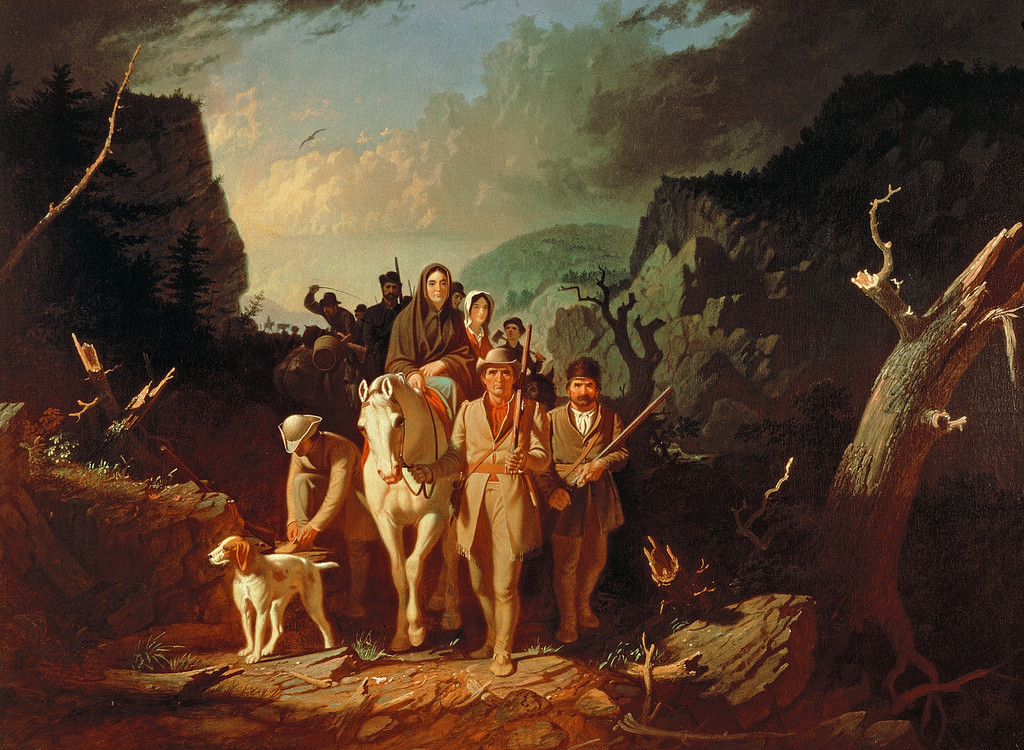
Daniel Boone Escorting Settlers through the Cumberland Gap. Dates identify the canvas discussed in the article. [14]
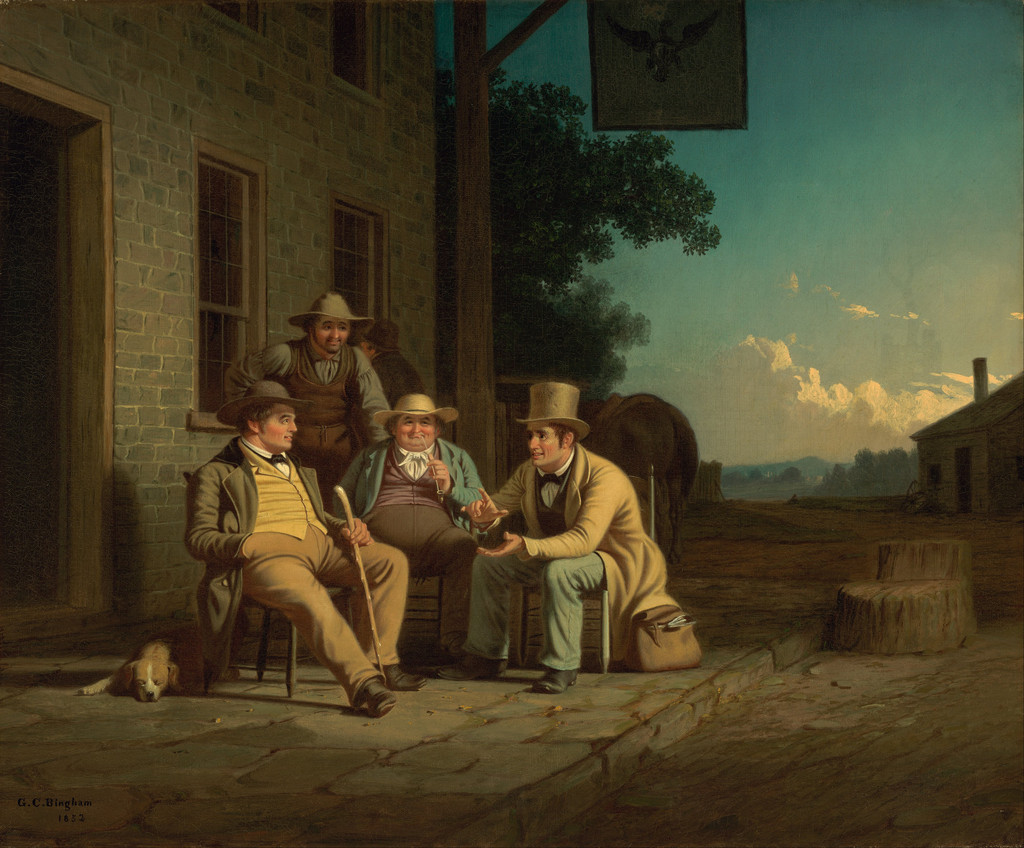
Canvassing for a Vote. Dates identify the canvas discussed in the article. [15]
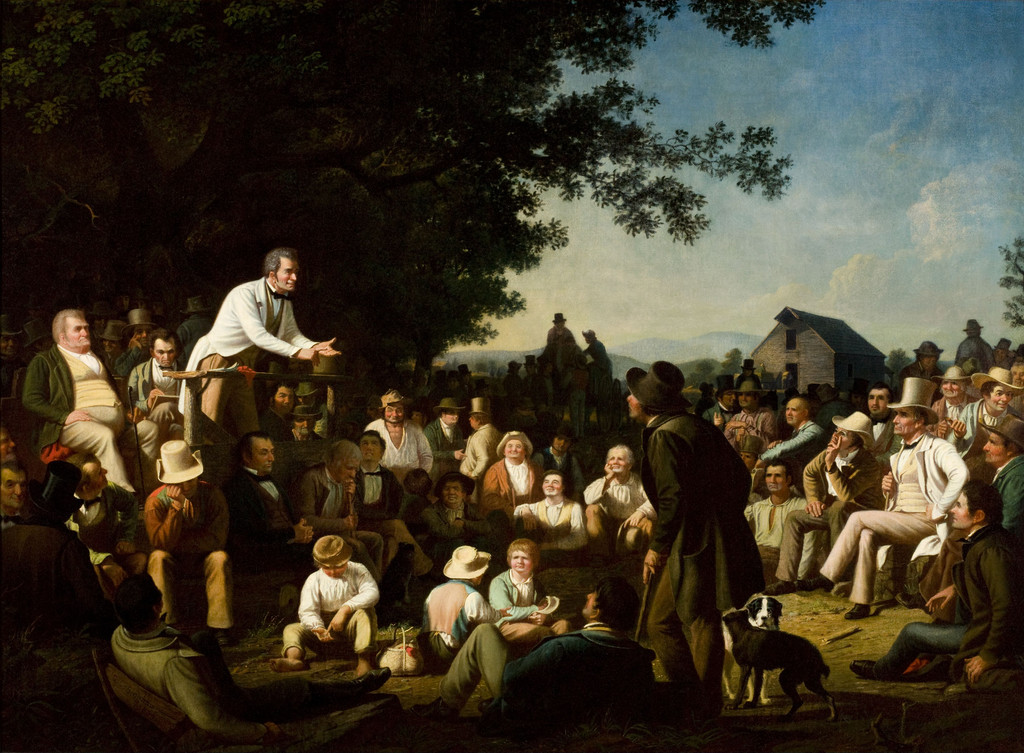
Stump Speaking. Dates identify the canvas discussed in the article. [16]
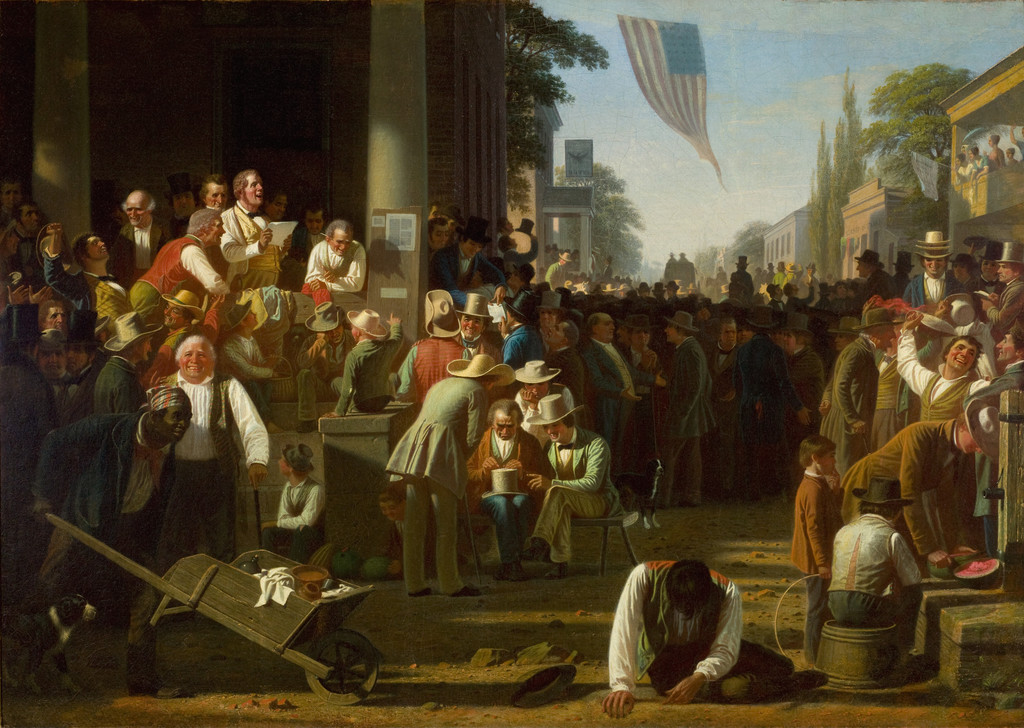
The Verdict of the People. Dates identify the canvas discussed in the article. [17]
Jolly Flatboatmen in Port. Dates identify the canvas discussed in the article. [18]
Order No. 11: Martial Law. Dates identify the canvas discussed in the article. [19]
Contents
- Virginia origins and a childhood in Missouri
- Learning a trade and becoming a portrait painter
- Family, friendship and the Arrow Rock house
- Washington, eastern institutions and the river paintings
- A Whig painter in public office
- Europe and a changing balance of work
- Union service and the argument over Order No. 11
- Later portraits, teaching and family changes
- Collections, loss and renewed attention
Virginia origins and a childhood in Missouri
Bingham was born on 20 March 1811 in Augusta County, Virginia, to Henry Vest and Mary Amend Bingham. The family’s agricultural and commercial circumstances connected his early life with slavery. When financial difficulties led them to leave Virginia, the household that travelled west included people they enslaved. The move formed part of the expansion of a slaveholding society as well as a search for new opportunities. [1] [2]
The Binghams reached Franklin, Missouri, in 1819. Located beside the Missouri River, the town offered his father opportunities in hospitality, tobacco and farming. His mother ran a school. The river environment that later became so important in George’s paintings was thus part of the family’s daily surroundings, although the mature pictures would emerge from artistic decisions made years afterwards. [1]
The State Historical Society of Missouri recounts an early encounter with the portrait painter Chester Harding. During Harding’s visit to Franklin in 1820, the young Bingham watched him working on a likeness of Daniel Boone. The episode supplies a vivid connection between a child interested in drawing and an established artist making a portrait. Its place in Bingham’s biography should not be enlarged into the claim that one encounter determined every later choice. [1]
Henry Bingham died in 1823, leaving debts and a family whose circumstances had changed sharply. Mary moved with her children to property near Arrow Rock in Saline County and continued teaching. The Historical Society also identifies art instruction available to George through his mother’s school. His early opportunities therefore involved domestic and local networks alongside the talent described in later accounts of his childhood. [1]
These moves establish the geography of his youth: Virginia origins, Franklin beside the river, and the Arrow Rock area. They do not make every later landscape an exact view remembered from childhood. Bingham could draw on familiarity with a region while rearranging its appearances for a painting. That distinction becomes important when the smooth water and carefully separated figures of his river pictures are taken as direct records of what he saw on a particular day.
The same caution applies to the attractive idea of a childhood devoted entirely to art. His family needed work, education and income. The trade he learned as a young man and the portrait commissions he later sought belonged to those practical circumstances. Artistic development took place within them, rather than outside the ordinary demands of earning a living.
Four stages of George Caleb Bingham’s career
These periods group related developments; painting, travel and local work overlap across their boundaries.
A profession established in Missouri
A Virginia childhood was followed by life in Missouri, an apprenticeship and portrait commissions. Travel east broadened Bingham’s professional opportunities before his best-known river paintings. [1]
Groups of people for a wider public
River scenes and election crowds became major subjects. The Art-Union and reproductive printmaking helped compositions travel beyond Missouri, while Bingham participated in electoral politics. [3]
American subjects painted abroad
Bingham travelled to Europe in 1856 and worked in Düsseldorf, where he made Jolly Flatboatmen in Port. He returned to Missouri in 1859 and continued portraiture alongside public service. [6]
Public argument, portraits and teaching
Civil War service and the civilian removals ordered in 1863 supplied the background to Order No. 11. Portrait commissions, further public roles and teaching continued in his later life. [1]
Learning a trade and becoming a portrait painter
In the later 1820s, Bingham entered a cabinetmaking apprenticeship. Accounts differ in the precision of their dates and locations, but the broader sequence is clear: training in a practical trade preceded the establishment of painting as his livelihood. Conrads describes the cabinetmakers involved as Methodist ministers, placing the young man in an environment where craft and religious discussion could exist together. [1] [3] [20]
By the early 1830s he was pursuing portrait work around Missouri. Commissions required access to people able and willing to pay for a likeness, and travel formed part of the profession. A sitter in one town might lead to an introduction elsewhere. Building a reputation involved both the visible result and the personal connections that made the next commission possible. [1] [3]
Portraiture gave Bingham repeated opportunities to study faces, clothing and the way a body occupies a limited space. The 1994 Met catalogue contrasts the harder linear appearance of his early work with the increasing softness and assurance of later portraits. It relates those developments to his contact with other painters’ work, including the pictures he encountered on journeys east. [20]
Calling him self-taught captures the absence of a long conventional academy training, but it can hide the activity through which he learned. He studied existing pictures, made drawings and sought opportunities beyond his immediate surroundings. The skill apparent in the mature compositions was the result of sustained practice and changing access to artistic models. [1] [3]
In 1838 he travelled to eastern cities and studied works in Philadelphia. The trip brought him into contact with a larger art world of collections, exhibitions and professional acquaintances. The important point is the widened range of paintings and institutions available to him; accounts that give different lengths for his stay should not obscure that shift in opportunity. [3] [20]
His early career also helps explain why portraiture remained important when narrative subjects attracted increasing attention. A genre painting might establish a wider reputation, but individual commissions were a recurring source of work. The career’s continuity lies partly in this movement between the needs of a particular sitter and the ambitions of a picture intended for a broader public.
Family, friendship and the Arrow Rock house
In 1834 Bingham met James Sidney Rollins in Columbia. Rollins, a lawyer and politician, became a close friend and a source of practical assistance. Their surviving correspondence gives the relationship an unusual documentary richness: artistic projects appear beside money, politics, family news and the demands of travel. [1]
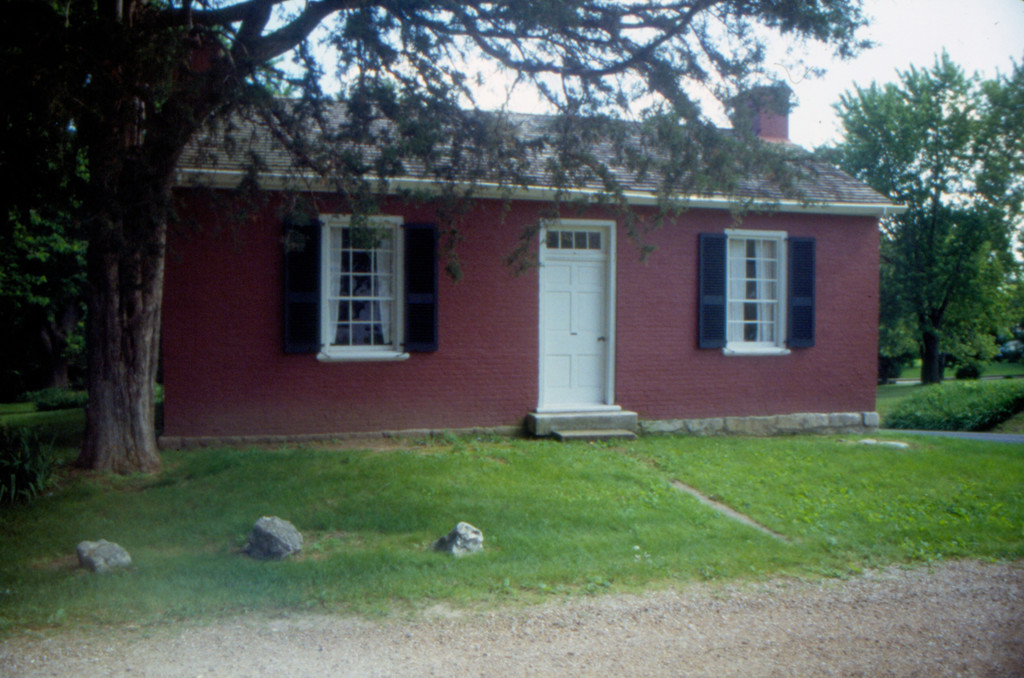
Bingham married Sarah Elizabeth in 1836. A small house at Arrow Rock, built in 1837, provided a family base during a period when his work took him elsewhere. The HABS historical account records the sale of the house in 1845. The building’s story is useful evidence for the shape of his domestic life, provided that the surviving restored structure is distinguished from the exact house he occupied. [1] [4]
The household experienced repeated losses. The Historical Society records five children from the first marriage and Sarah Elizabeth’s death in 1848. Bingham married Eliza Thomas in 1849; their son James Rollins, born in 1861, carried the name of his father’s friend. These relationships are part of his biography, but a death or bereavement should not automatically be used to explain a painted mood without evidence connecting the two. [1]
The house itself changed substantially after the family’s ownership. Later additions altered its size and appearance. The state acquired it in 1934, and a 1936 restoration removed later rooms and rebuilt parts of the exterior. Further work in 1964–65 followed archaeological and documentary investigation. The Historical Society’s account notes that the evidence did not establish every detail of the original appearance; the restoration presented a typical small Federal-style house of the 1830s. [1]
Archival photographs preserve stages in that history. The HABS caption index identifies 1934 views before reconstruction and a 1942 view after reconstruction, from the Piaget–van Ravenswaay survey. These are records of different moments in the building’s afterlife, not interchangeable photographs of an unchanged nineteenth-century interior or exterior. [21]
Rollins’s importance extended beyond a familiar name in the family. Bingham’s 1853 letter from Philadelphia discusses a political composition, the progress of drawings, engraving and printing arrangements. The letter makes visible a working friendship through which an artist could discuss the resources needed to move a picture from an idea towards public circulation. Artistic production depended on relationships as well as on what happened before a canvas. [22]
Washington, eastern institutions and the river paintings
Bingham lived in Washington during the early 1840s, seeking portrait commissions in the national capital. Political sitters offered access to prominent faces and the possibility of a reputation extending beyond Missouri. The Met’s biographical account also describes the difficulty of supporting a growing family there. By 1844 he was back in Missouri, travelling for work and approaching the period in which his most distinctive genre paintings emerged. [20]
The John Quincy Adams portraits illustrate how a professional encounter could generate more than one object. Adams sat to Bingham in 1844. The National Portrait Gallery’s canvas, however, is dated about 1850 and identified as a later version after that original. It is evidence for the persistence of a likeness, not proof that Adams sat for the later painting. Distinguishing a sitting from a subsequent version matters throughout Bingham’s career. [23]
In 1845, Fur Traders Descending the Missouri placed the artist’s river world before an eastern audience. The American Art-Union became an important purchaser and distributor of his work. Bingham’s relationship with the organisation joined a Missouri subject to a New York institution that could exhibit a painting, award it to a subscriber and circulate an engraving of its composition. [1] [3]
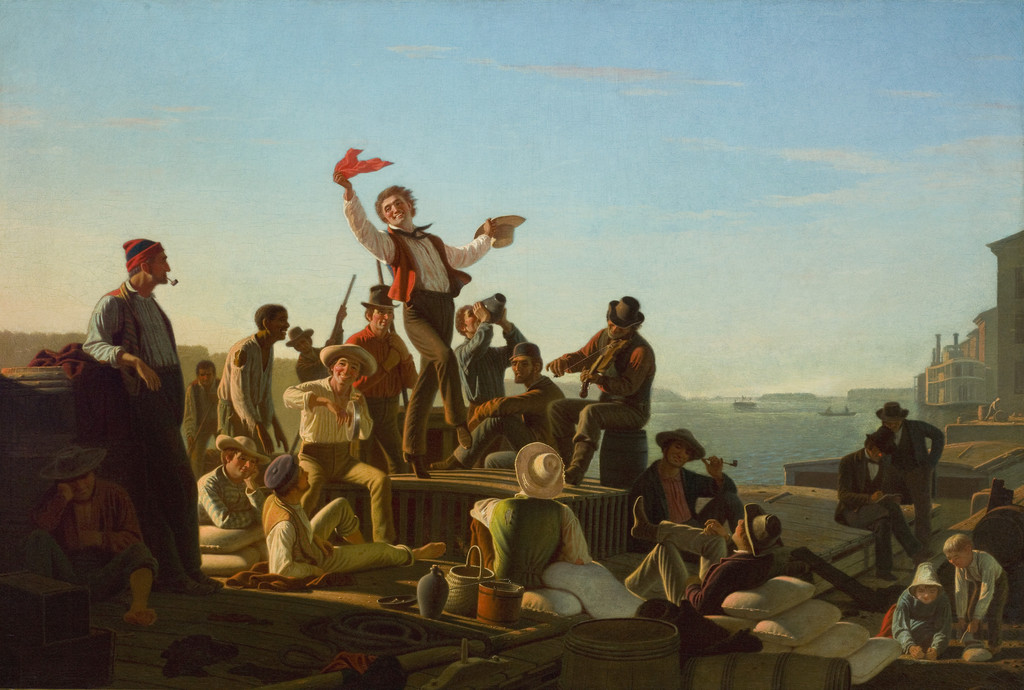
The opportunities were artistic as well as commercial. A picture of boatmen had to sustain the attention of people who knew the occupation and people who encountered it primarily through images. Clothing, instruments, gestures and the shape of the boat helped make the subject intelligible. The painter could give a group compositional dignity while retaining differences of expression and behaviour within it.
His drawings reveal the preparation behind these apparently natural encounters. Individual figures were studied and could be transferred or reused within later compositions. The 2015 Navigating the West exhibition examined such relationships through surviving sheets and infrared study of paintings. The resulting account emphasises design and revision, complicating an image of the artist simply copying a passing boat from the shore. [6]
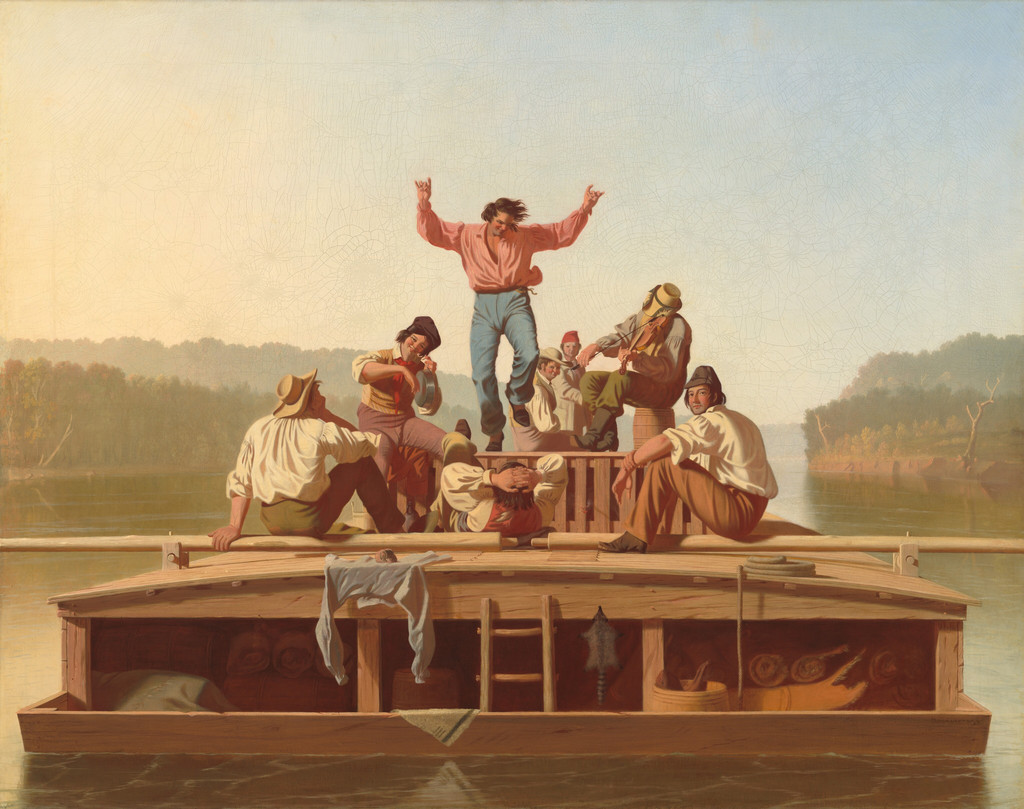
The Jolly Flatboatmen , painted in 1846, became especially important to his public reputation through its reproductive print. Other river pictures offered quieter groups or a more isolated figure. The changes show an artist exploring how a familiar class of subjects could sustain different arrangements of bodies, attention and mood. His drawings and prints make that continuing work easier to follow. [3] [6]
George Caleb Bingham, The Jolly Flatboatmen, 1846. Oil on canvas. National Gallery of Art, Washington, 2015.18.1.
Image source
.
Public domain
.
A Whig painter in public office
Political activity accompanied this achievement. Bingham supported the Whig Party and made political banners as well as easel pictures. In 1846 he narrowly won an election to the Missouri legislature, but his opponent challenged the result successfully. He secured election in 1848 and represented Saline County. The sequence gives a concrete background to his interest in persuasion and electoral conduct without turning every figure in a painting into a disguised incident from his own campaign. [1] [3]
His major election paintings developed during the early and middle 1850s. The County Election presents the movement towards a poll, while Stump Speaking concentrates on an orator and audience. The Verdict of the People gives the response to an outcome its own public drama. These are different actions within political life, rather than three interchangeable statements about democracy. [1] [3]
The 1853 letter to Rollins connects that subject matter with the practical circumstances of painting. Writing from Philadelphia, Bingham described the progress of the composition then called County Canvass , later known as Stump Speaking . He also discussed engraving, printing materials and finance. It is a valuable document because an ambitious public image appears as a project requiring separate stages of labour and support. [22]
His political beliefs must also be understood within the history of slavery. Stack notes that federal censuses for 1840 and 1850 recorded three and two enslaved people respectively attached to Bingham’s household. His frequent absence on painting journeys does not remove those people from his domestic history. Opposition to slavery’s expansion and participation in a slaveholding society could exist within the same life. [2]
During the 1850s his opposition to the extension of slavery became more explicit. Stack discusses his rejection of the Kansas–Nebraska Act, criticism of efforts to impose slavery on Kansas and support for John C. Frémont in 1856. These positions show change and commitment. They do not justify retrospectively describing every earlier action as the conduct of an abolitionist whose views were always consistent. [2]
Watch: George Caleb Bingham
Choose a film to explore the artist’s work, its interpretation and its wider setting.
Navigating the West: George Caleb Bingham and the River at the Amon Carter Museum of American Art
The Amon Carter Museum introduces an exhibition devoted to Bingham’s river paintings.
Watch on YouTubeEurope and a changing balance of work
In 1856 Bingham travelled to Europe with Eliza and his daughter Clara. After time in Paris, he settled in Düsseldorf, an important centre for artists and training. The journey placed him in sustained contact with another artistic environment while he continued to work with American subjects. His European residence belongs to the development of his practice, rather than an interruption entirely separate from the Missouri paintings. [1] [3]
Jolly Flatboatmen in Port was painted there in 1857. The subject returned to river sociability and incorporated figures related to his earlier studies. Its date and place of execution make the role of memory, drawings and composition especially clear: the image was made abroad, although its world remained associated with Missouri. The river subject could travel with the painter. [6]
He also worked on large portraits of American political figures. The Historical Society records the Washington and Jefferson portraits completed in Germany and their later place in Missouri’s state capitol. Public portraiture and the smaller narrative paintings were different ways of giving American subjects a durable visual form. [1]
Bingham returned to Missouri in 1859. The later career was increasingly centred on portrait commissions, together with continuing political service. Conrads places that period in the Kansas City area. This changing balance should not be treated simply as disappearance after a handful of masterpieces: the profession that had supported his early adulthood remained a substantial part of his work. [1] [3]
Union service and the argument over Order No. 11
Bingham supported the Union when the Civil War began. His political choices nevertheless reflected Missouri’s particular circumstances. Stack notes that he admired Abraham Lincoln but supported the Constitutional Union Party in the 1860 election. The following year he served as a captain in the volunteer reserve corps, and from 1862 to 1865 he held the office of Missouri state treasurer in the provisional Union government. [2]
Union loyalty did not mean approval of every action taken by Union forces. The violence of the Missouri–Kansas border brought military policy, guerrilla warfare and civilian suffering into a bitter relationship. In August 1863, after the massacre at Lawrence, Kansas, General Thomas Ewing Jr. issued Order No. 11 to remove civilian support from Confederate guerrillas. It required the evacuation of much of the population of Jackson, Cass and Bates counties and part of Vernon County, subject to geographical exceptions and distinctions involving loyalty and relocation. [2] [24]
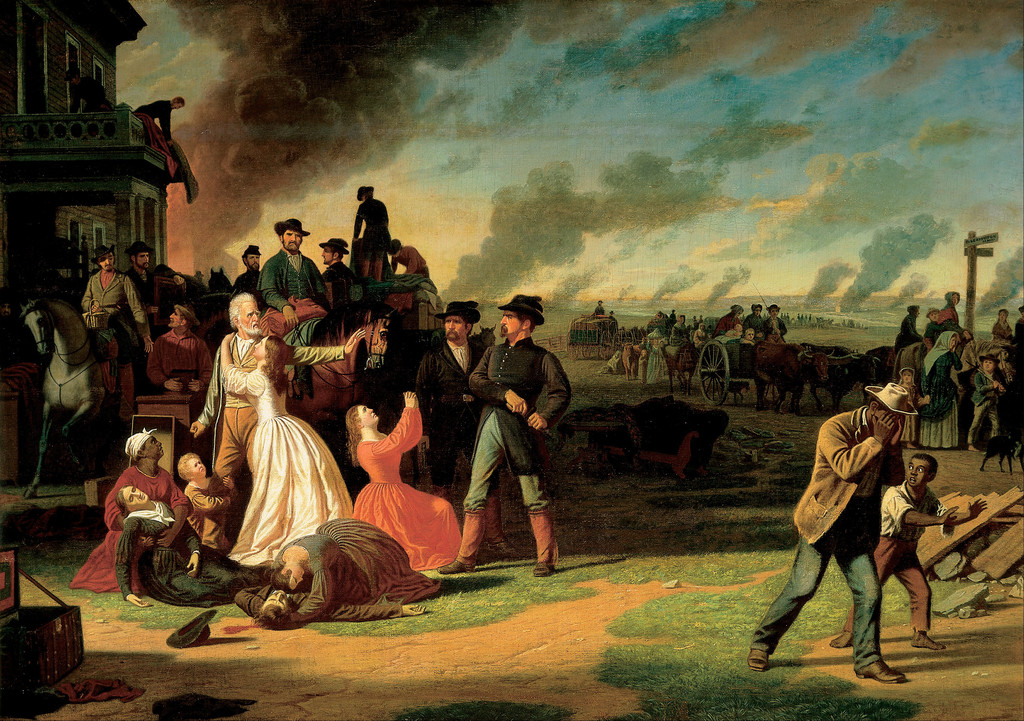
The consequences provoked Bingham’s sustained opposition. The painting he developed after the war, Order No. 11 , places the distress of a household in the foreground of a larger expulsion. Wagons, smoke and figures on the road extend the suffering beyond the immediate confrontation. The Cincinnati original is dated 1865–1868; a second version followed in 1870 and belongs to the State Historical Society of Missouri. [1] [19]
The scene needs to be read as an argument made through painting. Bingham selected and arranged actions to make coercion and civilian vulnerability visible. The result is evidence of his response to wartime authority, but it is not a photograph of a particular household at a particular instant. Its force comes partly from bringing a wider policy into a concentrated, emotionally legible encounter.
His 1871 public defence explains the purpose he claimed for this undertaking. He argued that art could preserve a warning for later generations and that remembering abuses of power need not amount to a demand for revenge. He also answered critics who believed his emphasis on Union wrongdoing misrepresented the wider conflict. The address makes clear that his political loyalties and his accusation were being contested by his first audiences. [24]
The distinction between purpose and reception is central to the painting’s history. Some viewers saw a condemnation of military abuse consistent with Union principles; others associated the threatened family with sympathy for the Confederate cause. Stack examines those disagreements and argues for greater attention to Black figures and emancipation within the scene. Her interpretation belongs to an ongoing discussion of what the picture makes visible and what different audiences have wanted it to mean. [2]
The controversy also demonstrates a limit to the painter’s authority. Bingham could explain his intentions in print and promote a reproductive engraving, but he could not determine every use or response. The picture continued to enter histories of the war that did not necessarily correspond to the history he wished to tell. His biography therefore includes the effort to influence public memory as well as the acts of making and exhibiting a canvas. [2]
George Caleb Bingham, Order No. 11 (Martial Law), 1865–1868. Oil on canvas. Cincinnati Art Museum, 1958.515. The Edwin and Virginia Irwin Memorial.
Image source
.
Public domain
.
Later portraits, teaching and family changes
Public service continued after the war. In 1875 Bingham became Missouri’s adjutant general, a role that included work on former soldiers’ claims. The Historical Society describes his efforts in Washington the following year to obtain funds for the state’s Civil War militia and notes that he began a portrait of the sculptor Vinnie Ream during that visit. His professional and administrative activities continued to bring him into contact with people in public life. [1]
He also returned to his own appearance. The self-portrait now on loan to the Nelson-Atkins Museum is dated about 1877. It shows the artist looking towards the viewer while holding a book or drawing surface and pencil. The museum connects the pose with a self-image by the English painter Edwin Landseer known through an engraving. A mature painter could therefore construct his own likeness through a relationship with another artist’s image. [25]
The choice to show drawing gives the portrait a particular relevance to his career. In the narrative paintings, separate studies helped form a convincing group. Here, the activity becomes part of the identity offered to the viewer. The direct gaze and visible implements join the face of a particular man to the work through which he had made other people recognisable.
His family circumstances changed again in old age. Eliza died in 1876. In June 1878 he married Mattie Livingston Lykins, a widow and family friend. Of the six children recorded across his first two marriages, only two survived him. These losses and relationships give a necessary human scale to the later years without supplying a speculative explanation for every change in the paintings. [1]
Bingham was appointed professor of art at the University of Missouri in 1877. Teaching offered another institutional setting for a practice formed through craft training, portrait commissions, observation and travel. He died in Kansas City on 7 July 1879, aged 68. The career left a varied body of work, from the portraits that had sustained him to paintings whose public arguments remained unsettled. [1] [20]
Collections, loss and renewed attention
The survival of Bingham’s work has its own history. Some large portraits made for Missouri’s state capitol were destroyed when the building burned in 1911. Photographs preserve information about those pictures, but the loss limits what can be learned from their painted surfaces. A biography based only on surviving masterpieces consequently presents a narrower career than the one he actually pursued. [1]
The Met’s purchase of Fur Traders Descending the Missouri in 1933 helped renew attention to Bingham. Exhibitions in the 1930s contributed to a wider reassessment of the river pictures and the artist’s place in American painting. This renewed interest followed a lifetime in which prints and exhibitions had already brought some images before distant audiences; it was a change in reputation and interpretation, rather than the first discovery that the work existed beyond Missouri. [1] [20]
His drawings became another focus of public commitment. When the St. Louis Mercantile Library’s collection faced sale in the 1970s, a fundraising effort secured it for the People of Missouri. The sheets are held through the Bingham Trust and associated with the Saint Louis and Nelson-Atkins museums. Their preservation enables comparisons between a study, a painted figure and a later reuse that would otherwise be much harder to make. [6]
The collections now offer several routes through his life. Portraits show the continuing profession; river scenes reveal the ambitions of a concentrated period; political pictures connect observation and public argument. Letters supply evidence of planning, finance, friendship and conviction. Keeping those forms of evidence together produces a fuller biography than the familiar image of a frontier painter working alone beside the river.
It also leaves the art open to careful looking. Knowledge of a political commitment cannot settle every expression in a crowd, just as a surviving study cannot explain every change made in paint. Bingham’s life gives the pictures historical substance, while the pictures retain the particular relationships between bodies, faces and settings that made them worth returning to in the first place.
Artworks directory
A documented selection discussed across these articles, including separate canvases, figure studies and reproductive impressions. Dates identify the particular object or study; collection and title distinctions follow museum records and the 2015 exhibition checklist. This is not a catalogue raisonné. Prints are grouped with works on paper in the Drawing filter.
| Name | Date | Medium |
|---|---|---|
| Fur Traders Descending the Missouri | 1845 | Painting — oil on canvas |
| The Jolly Flatboatmen | 1846; NGA canvas | Painting — oil on canvas |
| The County Election (original) | 1851–52 | Painting — oil on canvas |
| Stump Speaking | 1853–54 | Painting — oil on canvas |
| The Verdict of the People | 1854–55 | Painting — oil on canvas |
| Order No. 11: Martial Law | 1865–68; Cincinnati original | Painting — oil on canvas |
| Daniel Boone Escorting Settlers through the Cumberland Gap | 1851–52 | Painting — oil on canvas |
| Canvassing for a Vote | 1852; signed canvas | Painting — oil on canvas |
| Raftsmen Playing Cards | 1847 | Painting — oil on canvas |
| Mississippi Boatman | 1850 | Painting — oil on canvas |
| Jolly Flatboatmen in Port | 1857 | Painting — oil on canvas |
| The County Election (replica illustrated here) | 1852 | Painting — oil on canvas |
| Martial Law or Order No. 11 (Missouri replica) | 1870 | Painting — oil on canvas |
| The Jolly Flatboatmen (Terra canvas) | 1877–78 | Painting — oil on canvas |
| John Quincy Adams (later version) | about 1850, after an 1844 original | Painting — oil on canvas |
| Country Politician | 1849 | Painting — oil on canvas |
| The Trappers’ Return | 1851 | Painting — oil on canvas |
| The Concealed Enemy | 1845 | Painting — oil on canvas |
| The Wood-boat | 1850 | Painting — oil on canvas mounted on board |
| Lighter Relieving a Steamboat Aground | 1847 | Painting — oil on canvas |
| Watching the Cargo | 1849 | Painting — oil on canvas |
| In a Quandary | 1851 | Painting — oil on canvas |
| Boatmen on the Missouri | 1846 | Painting — oil on canvas |
| Self-Portrait (Saint Louis) | 1834–35 | Painting — oil on canvas |
| Self-Portrait (Nelson-Atkins) | about 1877 | Painting — oil on canvas |
| Mrs. David Steele Lamme and Son William Wirt | 1837 | Painting — oil on canvas |
| Portrait of Leonidas Wetmore | 1839–40 | Painting — oil on canvas |
| Fur Trader (study for Fur Traders Descending the Missouri) | 1845 | Drawing — brush, ink and wash over pencil |
| Skillet-beater (study for The Jolly Flatboatmen) | 1846 | Drawing — brush, ink and wash over pencil |
| Young Wood-boatman (study for The Wood-boat) | 1850 | Drawing — brush, ink and wash over pencil |
| Thomas Doney after Bingham: The Jolly Flat Boat Men (Met impression) | 1847 | Print — mezzotint and engraving with etching |
| Thomas Doney after Bingham: The Jolly Flat Boat Men (coloured Carter impression) | 1847 | Print — intaglio with applied watercolour |
| The Verdict of the People (lithographic proof) | ca. 1858–59 | Print — lithographic proof |
| Gautier after Bingham: Stump Speaking | 1856 | Print — etching and aquatint |
| Claude Regnier after Bingham: In a Quandary, Mississippi Raftsmen Playing Cards | 1852 | Print — hand-coloured lithograph |
Frequently Asked Questions
Bingham was born on 20 March 1811 in Augusta County, Virginia. His family moved to Franklin, Missouri, in 1819. [1]
Yes. He served as a volunteer captain and as Missouri’s state treasurer during the Civil War. His opposition to Order No. 11 concerned military policy and civilian treatment, and should be considered alongside both his Union loyalty and the complex history of slavery within his life. [2]
The surviving house has undergone substantial alteration and restoration. The Historical Society notes that the evidence did not establish every detail of its 1830s appearance. It is valuable as a surviving historic site, with that restoration history understood. [1]
He died in Kansas City on 7 July 1879 at the age of 68. [1]
Discussion
Look again at the images and ideas explored in George Caleb Bingham Biography. These editorial prompts invite your observations.
Reader Insights
How did portrait commissions and public office shape the opportunities available to Bingham?
What changes when the river pictures are seen alongside his travels and print business?
How does the restored Arrow Rock house help you imagine the working life described here?
Join the Conversation
Share a detail, comparison or question about George Caleb Bingham Biography below.
References
- State Historical Society of Missouri , “George Caleb Bingham,” Historic Missourians. View source
- Joan Stack , “Toward an Emancipationist Interpretation of George Caleb Bingham’s General Order No. 11: The Reception History of the Painting and the Remembered Civil War in Missouri,” Missouri Historical Review 107, no. 4 (July 2013), pp. 203–221. View source
- Margaret C. Conrads , “Bingham@200: A Bicentennial Celebration,” Antiques & Fine Art , Spring 2011, pp. 193–199. View source
- Historic American Buildings Survey , George Caleb Bingham House, HABS MO-221, written historical and descriptive data, Library of Congress. View source
- Carrie Rebora Barratt and H. Barbara Weinberg, Metropolitan Museum of Art, American Scenes of Everyday Life, 1840–1910, September 2009. View source
- Metropolitan Museum of Art , Navigating the West: George Caleb Bingham and the River , exhibition labels, June 29, 2015. View source
- Kevin J. Avery, Metropolitan Museum of Art, The Hudson River School, October 2004. View source
- Metropolitan Museum of Art, Fur Traders Descending the Missouri. View source
- National Gallery of Art, The Jolly Flatboatmen. View source
- Saint Louis Art Museum, Raftsmen Playing Cards. View source
- National Gallery of Art, Mississippi Boatman. View source
- Saint Louis Art Museum, The County Election, 1851–52, 124:1944. View source
- Saint Louis Art Museum, The County Election, 1852 replica, 44:2001. View source
- Kemper Art Museum, Washington University, Daniel Boone Escorting Settlers through the Cumberland Gap. View source
- Nelson-Atkins Museum of Art, Canvassing for a Vote. View source
- Saint Louis Art Museum, Stump Speaking. View source
- Saint Louis Art Museum, The Verdict of the People. View source
- Saint Louis Art Museum, Jolly Flatboatmen in Port. View source
- Cincinnati Art Museum , Order No. 11 , 1865–1868, 1958.515. View source
- John Caldwell and Oswaldo Rodriguez Roque , with Dale T. Johnson, American Paintings in the Metropolitan Museum of Art , volume I (1994), Bingham biography and entry, pp. 538–543. View source
- Historic American Buildings Survey , HABS MO-221, index to photographs, Library of Congress. View source
- George Caleb Bingham to James Sidney Rollins , 7 November 1853, later transcription by C. B. Rollins, State Historical Society of Missouri. View source
- National Portrait Gallery , Smithsonian Institution, John Quincy Adams , about 1850 from an 1844 original, NPG.69.20. View source
- George Caleb Bingham , An Address to the Public, Vindicating a Work of Art (1871), State Historical Society of Missouri. View source
- Nelson-Atkins Museum of Art , Self-Portrait , about 1877, 1-1955, on loan from the Kansas City Public Library. View source
- Splash image source.
The restored George Caleb Bingham House at Arrow Rock, Missouri, in an undated National Park Service photograph. The house has undergone several restorations; this view does not document its exact 1837 appearance. Photograph: National Park Service / Jeff Wade. Public domain . A narrow scan edge has been cropped.
View source - Kevin J. Avery, “The Hudson River School”, Metropolitan Museum of Art (2004). Origins in 1825 and decline in the 1870s–1880s; c. 1825–1880 is an approximate comparative range. View source
- George Michael Cohen, A Regional Study of American Genre Painting from 1830–1880 (Boston University, 1962). This is a period of nineteenth-century prominence, not an end date for the genre. View source
- National Gallery of Art, William Sidney Mount: 1807–1868. Artist life dates. View source
- National Gallery of Art, George Caleb Bingham: 1811–1879. Artist life dates. View source
- Smithsonian American Art Museum, Emanuel Leutze: 1816–1868. Artist life dates. View source
- National Gallery of Art, American Masters catalogue, Winslow Homer: 1836–1910. Artist life dates. View source