 by
Tom Gurney
Tom Gurney BSc (Hons) is an art history expert with over 20 years experience
Email:
tomgurney1@gmail.com
/ Phone:
+44 7429 011000
Fur Traders Descending the Missouri: Introduction
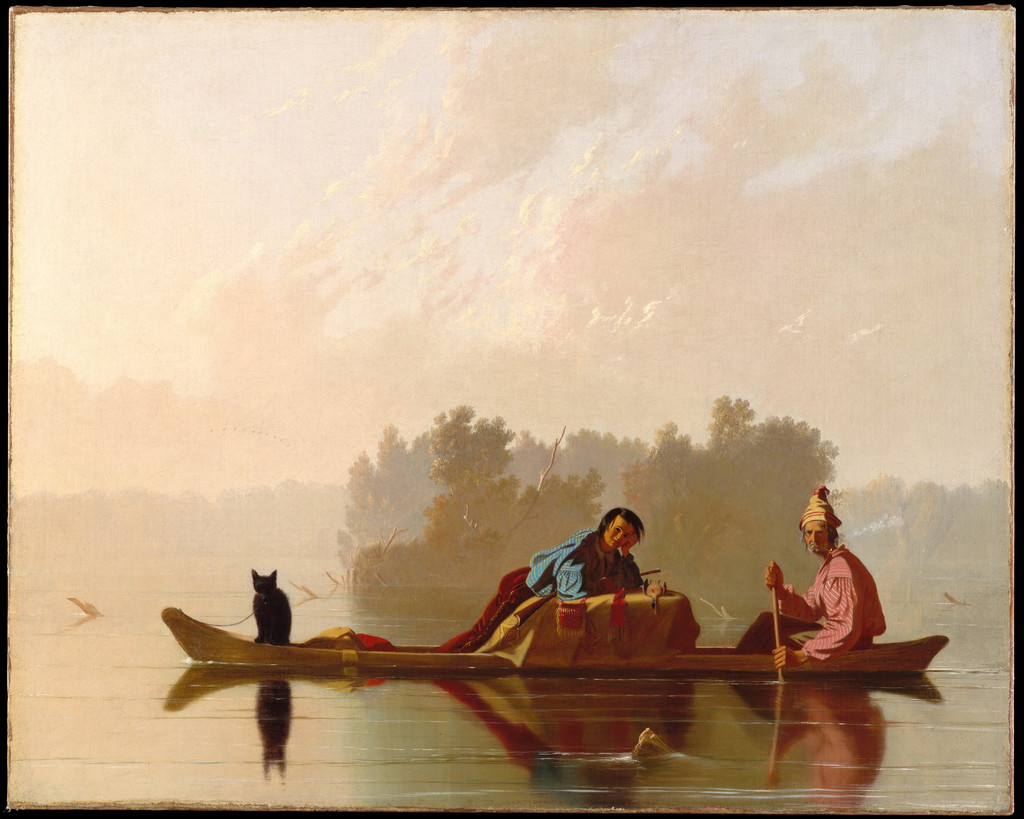
George Caleb Bingham’s Fur Traders Descending the Missouri brings a boat almost level with the viewer’s eyes. An older man paddles at the stern, a younger companion leans across a bundle in the middle, and a small dark animal sits near the bow. Above them, pale sky and mist occupy much of the canvas. The scene feels quiet, but the faces looking towards us make the encounter unusually direct.
Painted in 1845, the work belongs to the early flowering of Bingham’s river subjects. It is an oil painting on canvas, measuring 73.7 × 92.7 cm, now in the Metropolitan Museum of Art. Its balance of clear figures and uncertain distance has made it one of the artist’s most familiar pictures. The Met places its making within a career that had begun with portrait commissions and was opening towards more ambitious scenes of American life. [1]
Looking longer reveals several histories within the apparent calm. The title changed before the painting reached its first national audience. A surviving study and infrared examination disclose work beneath the finished arrangement. Modern interpretations have also changed what the relationship between the two people is understood to mean. The painting’s stillness gives those questions a powerful setting, rather than putting them to rest. [2]
At a Glance
- Artist George Caleb Bingham.
- Date 1845.
- Medium Oil on canvas.
- Dimensions 73.7 × 92.7 cm (29 × 36½ in).
- Collection Metropolitan Museum of Art, New York.
- Accession 33.61.
- Acquisition credit Morris K. Jesup Fund, 1933. [1]
This work across George Caleb Bingham’s career
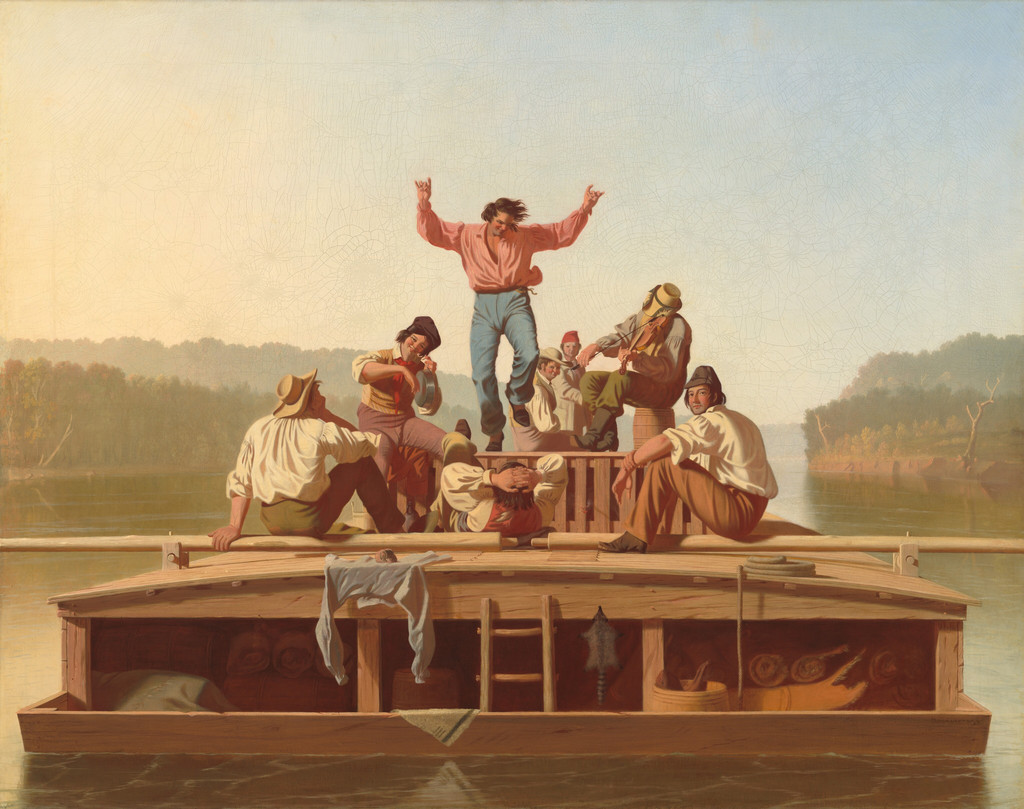
The Jolly Flatboatmen
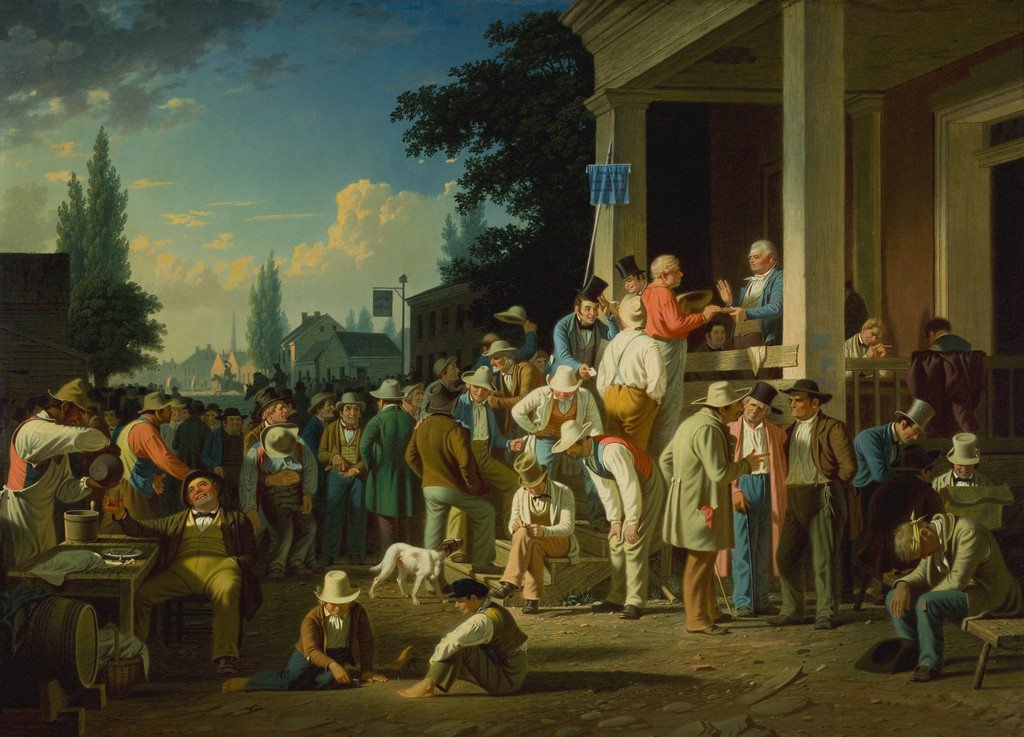
1846; NGA canvasThe County Election
1851–52 original; 1852 replica illustratedCanvassing for a Vote
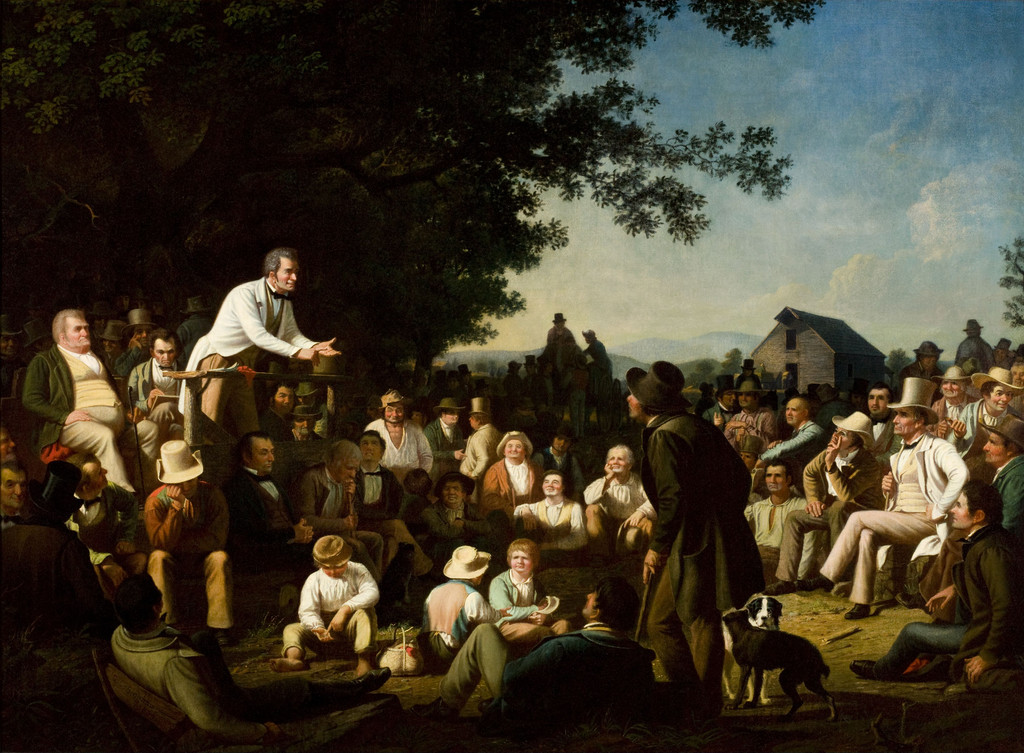
1852; signed canvasStump Speaking
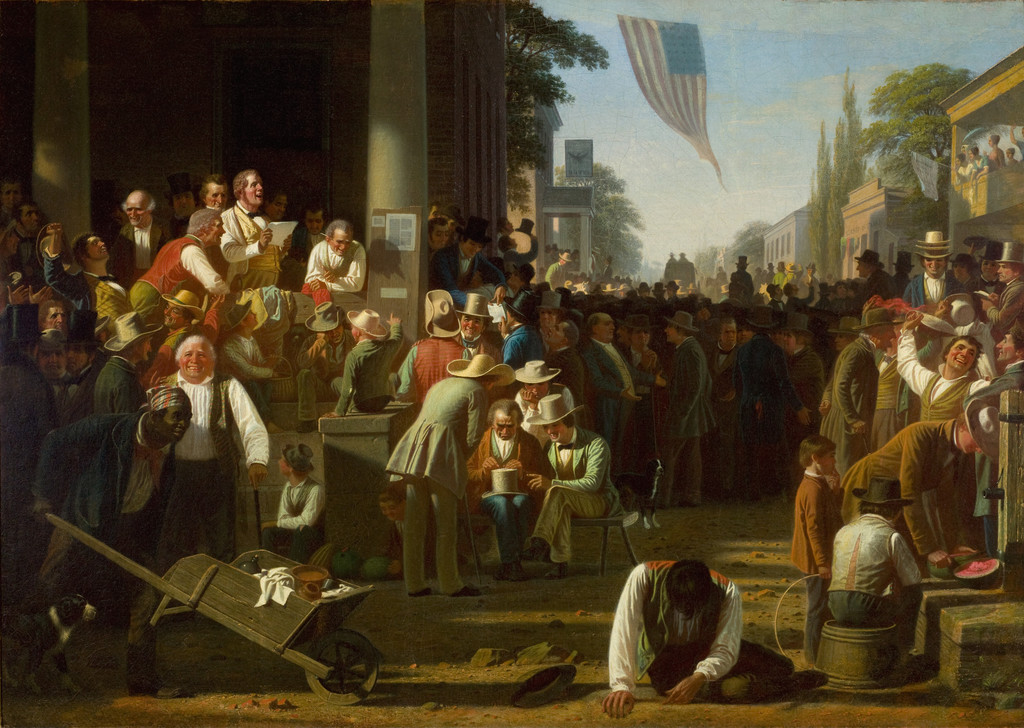
1853–54The Verdict of the People
1854–55Order No. 11: Martial Law
1865–68; Cincinnati originalNotes and sources
Fur Traders Descending the Missouri (current article). Dates identify the canvas discussed in the article. [1]
The Jolly Flatboatmen. Dates identify the canvas discussed in the article. [3]
Raftsmen Playing Cards. Dates identify the canvas discussed in the article. [4]
Mississippi Boatman. Dates identify the canvas discussed in the article. [5]
The County Election. The original is 124:1944; the illustrated 1852 replica is 44:2001. Their dimensions and acquisition histories differ. [6] [7]
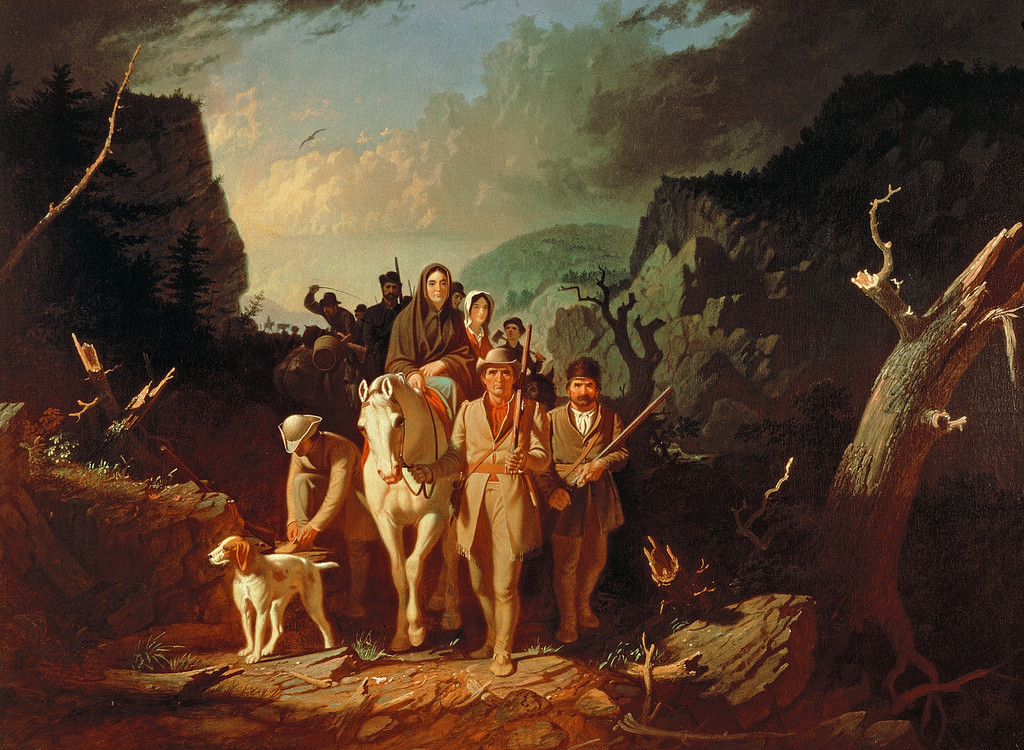
Daniel Boone Escorting Settlers through the Cumberland Gap. Dates identify the canvas discussed in the article. [8]
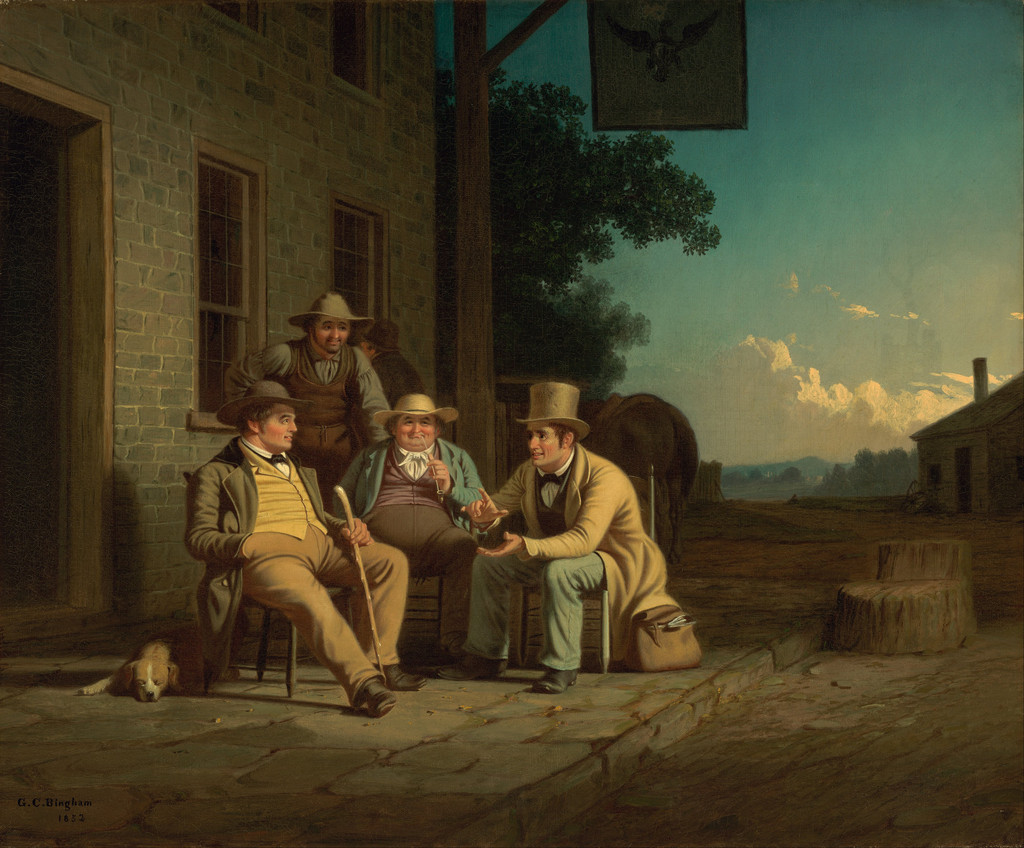
Canvassing for a Vote. Dates identify the canvas discussed in the article. [9]
Stump Speaking. Dates identify the canvas discussed in the article. [10]
The Verdict of the People. Dates identify the canvas discussed in the article. [11]
Jolly Flatboatmen in Port. Dates identify the canvas discussed in the article. [12]
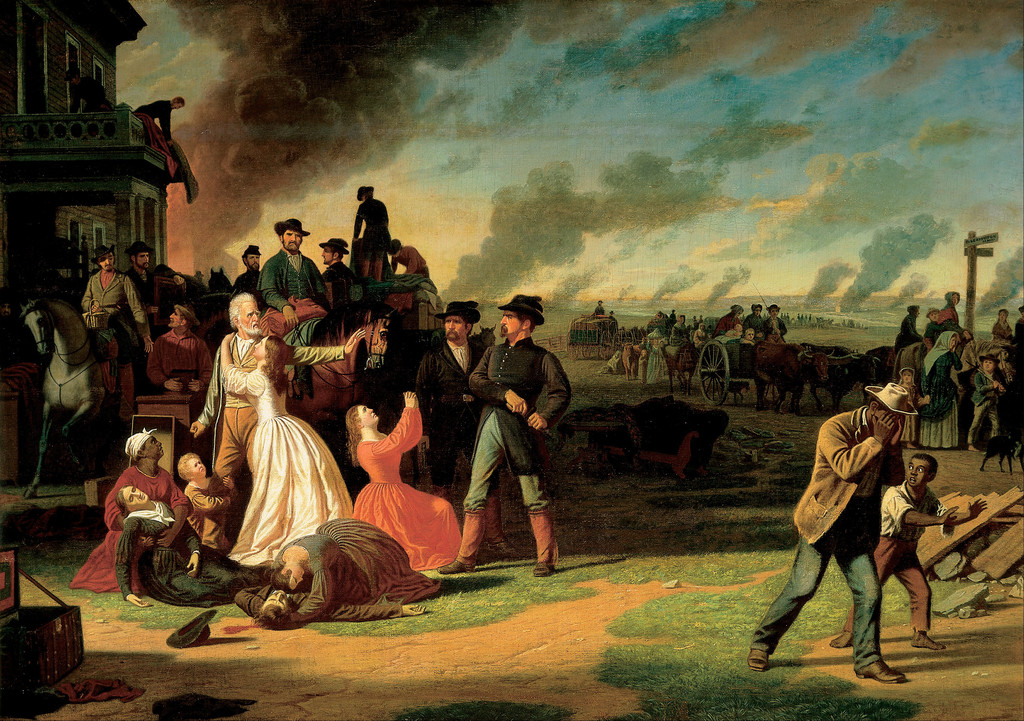
Order No. 11: Martial Law. Dates identify the canvas discussed in the article. [13]
Contents
- An 1845 painting for a wider public
- Reading the boat, figures and river
- The original title and what changed
- Kinship, commerce and the eastern imagination
- A drawing transformed into a painted trader
- The bear cub at the bow
- Light, reflection and the Luminism question
- Was The Concealed Enemy a companion?
- Returning to the subject in 1851
- Annotated details
An 1845 painting for a wider public
Bingham’s knowledge of Missouri came from living and working there, but this painting was destined for viewers elsewhere. The Met records that he returned to St. Louis in the summer of 1845 after spending the winter in central Missouri, bringing paintings and sketches with him. Fur Traders was among the works he sent to the American Art-Union in New York, an organisation that promoted American art through exhibitions, purchases and distribution. [1]
The connection joined two different worlds of experience. Bingham had grown up around the Missouri River and earned his living by painting people in the region. An eastern exhibition audience could encounter the West through the pictures that artists and institutions selected for it. A river scene needed enough particularity to feel convincing while possessing a form that made it legible and appealing beyond its place of origin.
Margaret Conrads describes the character studies behind Bingham’s genre paintings as an important part of that work. Poses, clothing and expressions helped identify different kinds of people for contemporary viewers. The figures could be closely observed and still be adapted to the purposes of a composition. Their physical specificity did not make the complete scene a transcription of one passing encounter. [14]
The 1994 Met catalogue gives Fur Traders a striking place in his development, finding relatively little in the surviving earlier work that fully anticipates its assurance. Bingham had already attempted river subjects, including a lost 1838 painting, but the 1845 canvas achieves an unusually concentrated relationship between people, space and light. That assessment concerns the surviving paintings; it need not imply that his working process was effortless or inexplicable. [15]
The subsequent study of drawings and underdrawing makes that distinction important. A composition can appear remarkably resolved when finished while having passed through preparation and adjustment. Bingham’s biography supplies the wider career, but the object itself preserves evidence of an artist actively constructing this particular view of river life.
Annotated Details from Fur Traders Descending the Missouri
The numbered points identify visible features discussed in this article. Return from each detail to the whole composition. George Caleb Bingham, Fur Traders Descending the Missouri, 1845. Oil on canvas, 73.7 × 92.7 cm. The Metropolitan Museum of Art, Morris K. Jesup Fund, 1933, 33.61. Image source. Public domain. Numbers added to a separate overview. Detail images are crops of the source reproduction; the supplied canvas edges remain visible in the overview.
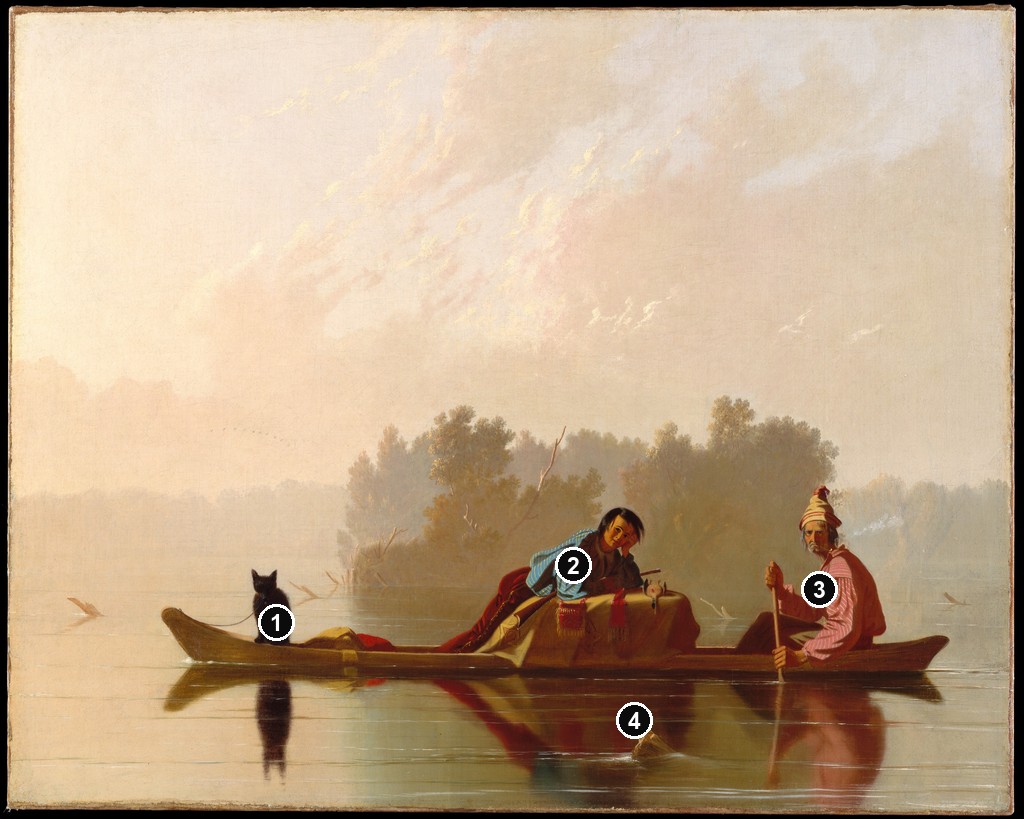
Details from FUR TRADERS DESCENDING THE MISSOURI
Compare the cropped details with the complete images above. Notice how their colours, shapes and positions contribute to the larger compositions.
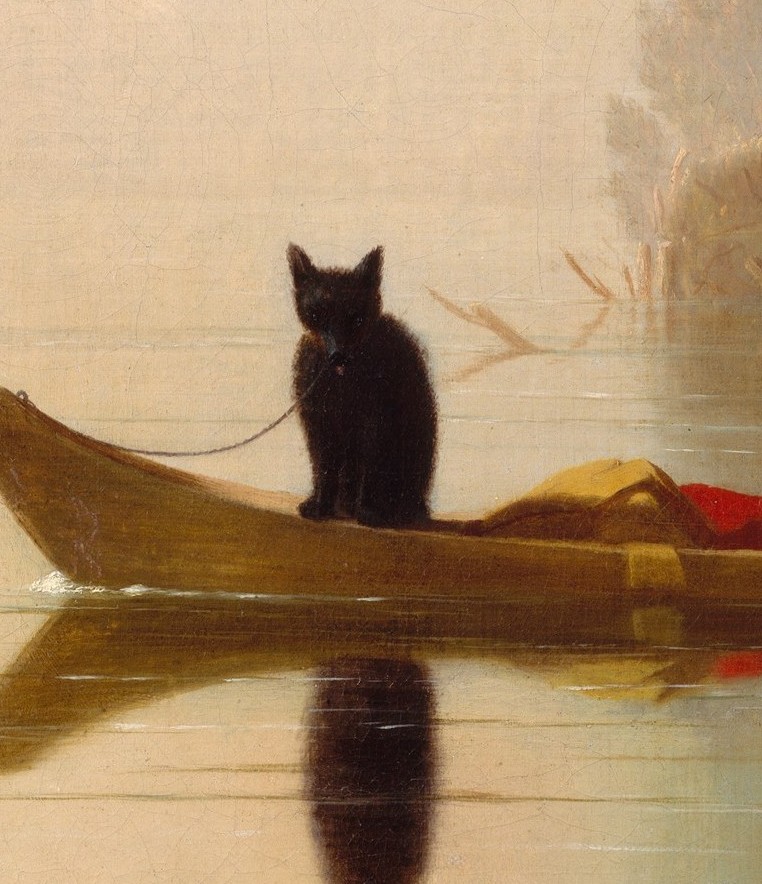
The bear cub near the bow
The dark animal has a compact silhouette against the pale river. A fine tether leads towards the front of the boat, while the reflected shape below binds this small figure to the long horizontal vessel.
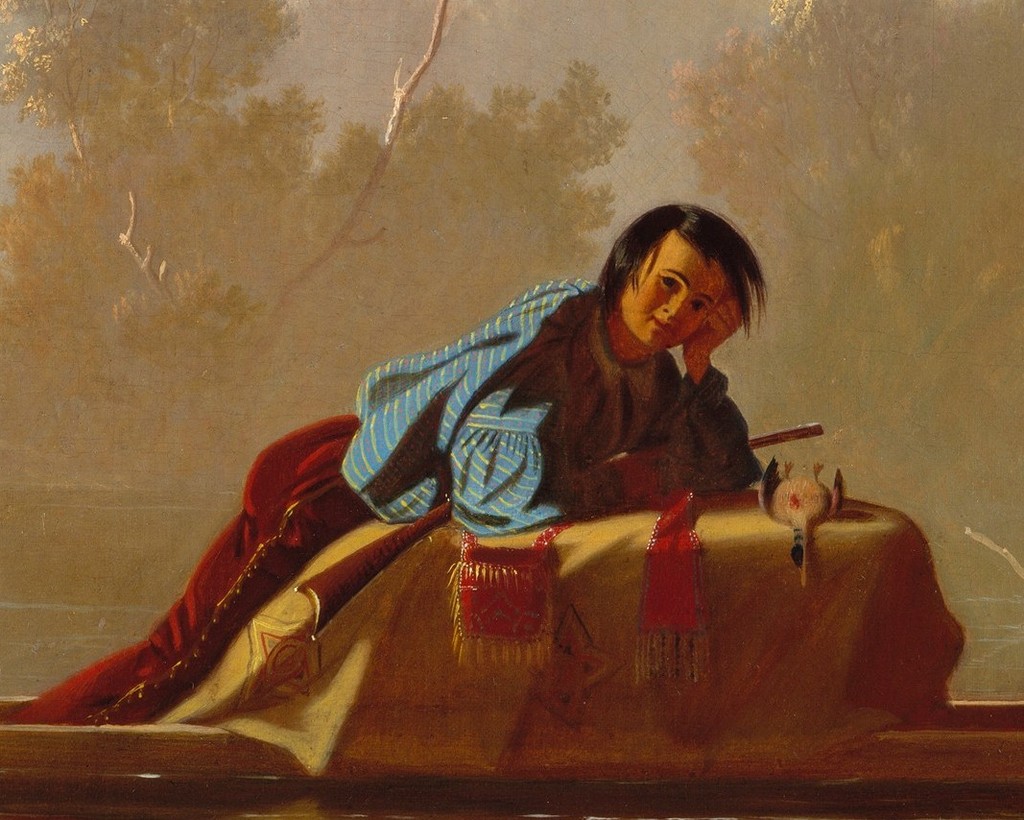
The younger figure and the cargo
The younger figure leans across the bundled cargo, with the blue sleeve and tilted head breaking the boat’s horizontal line. The turned face directs attention out towards the viewer while the body remains supported by the load.
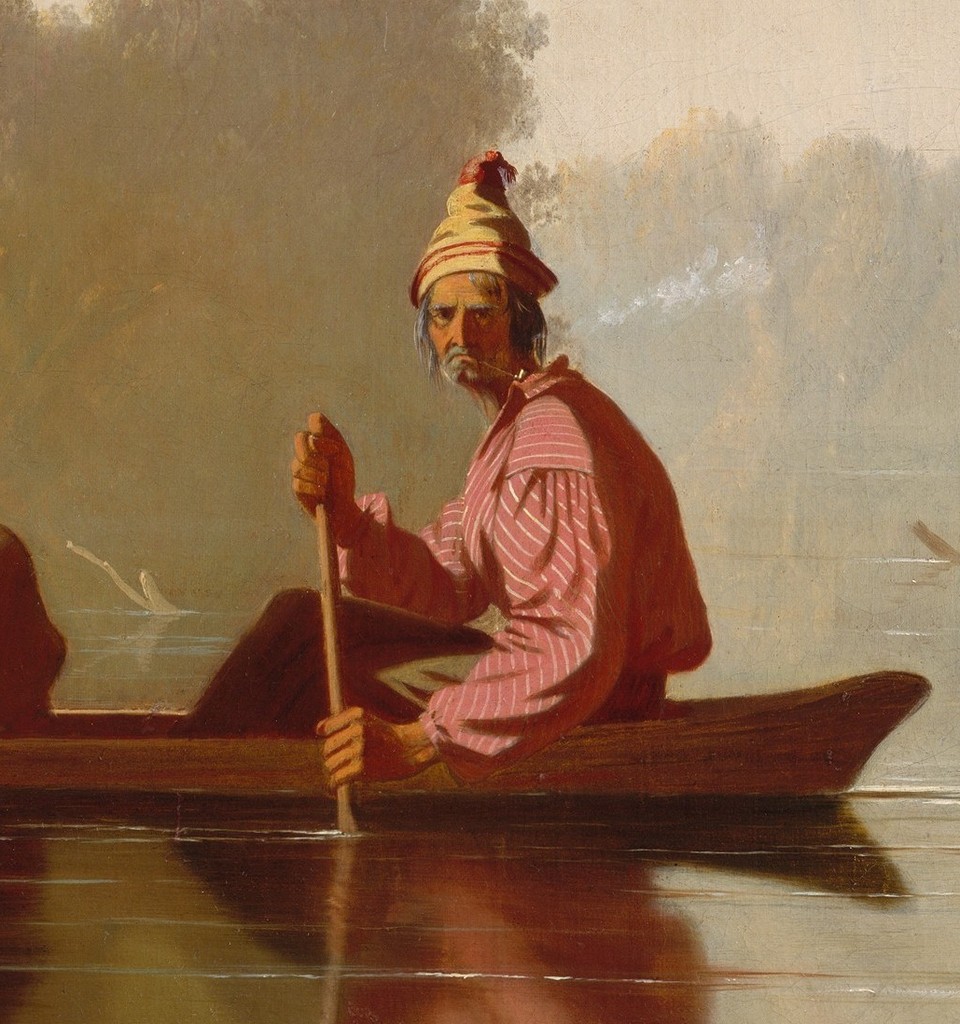
The paddler and the upright stroke
The older figure’s striped shirt, cap and bent knees form a compact group at the right. His hands and the upright paddle give this end of the boat a vertical accent against the surrounding bands of water.
Reflections and the broken surface
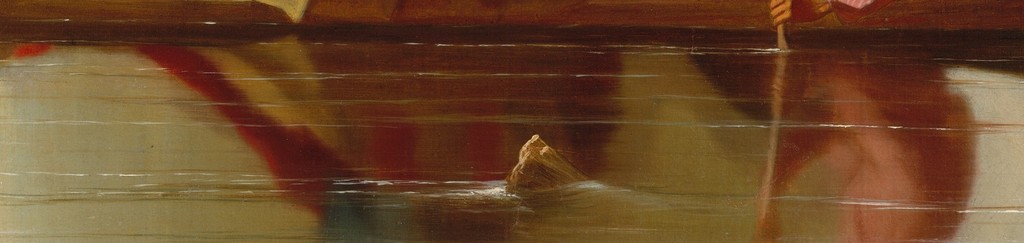
The boat and its figures return as softened shapes beneath the hull. Thin lines of light and a protruding branch interrupt those reflections, giving the calm surface small variations that matter within the larger stillness.
Reading the boat, figures and river
The long canoe establishes the first strong horizontal. Its narrow body sits low in the water, with the bow at the left and the paddling trader at the right. Within it, the animal, the leaning youth and the upright older man form three different concentrations of height and darkness. The figures are easy to distinguish because the expanse behind them is comparatively open.
The older trader’s body is compact and angular. A striped pink shirt brings warmth to the right side of the boat, and the folds follow the changes of direction in his arm and torso. One hand grips the paddle while the other steadies it lower down. The implement enters the water close to the hull, connecting the figure’s action with the reflection below.
The young companion has a less vertical position. His body inclines across the central bundle, with a blue patterned garment providing another concentrated area of colour. The pose makes him appear at ease, yet his face turns towards us. The encounter depends on that combination: a body apparently resting within its own activity and eyes that acknowledge an observer outside it.
Between the two people, their belongings occupy much of the canoe’s limited interior. A gun extends along the younger figure’s position, and a dead bird lies beside him. The objects connect the journey with hunting and trade. They also contribute formal accents: a thin dark line, a pale shape, a warm cloth and a hanging pouch interrupt the broader mass of the bundle. The 2015 exhibition identified the son’s rifle and the trading cargo as part of the subject’s legibility. [2]
At the bow, the animal is almost a silhouette. The surrounding light makes its body more immediately legible than its face. A tether curves towards the boat, an easily overlooked line that links a small living creature to the human activity around it. The identification of that creature has its own history, but its visual role is clear even before the question is settled: the dark upright shape anchors the left side of the group.
The reflection supplies a second, less stable arrangement. The hull becomes a long band below the waterline, while patches of pink, blue and brown spread downwards. These repeated colours make the people seem connected to the river’s surface. They also complicate the stillness: a reflection recognisably belongs to the figure above, but its edges are softer and more interrupted.
A pointed brown form breaking through the foreground water provides another point of resistance. It sits below the central part of the canoe, separate from the boat and close to the viewer. Fine lines across the surface pass around it. This small interruption brings the river into the immediate foreground, preventing the water from becoming an entirely blank space between us and the travellers.
Behind them, a wooded bank or island rises out of haze. Some trees have rounded, leafy forms, while thinner projecting branches break the larger outline. The distance is not rendered with the clarity of the figures’ clothes and faces. Its softened appearance gives the canoe a stronger presence without closing the space around it.
The result depends as much on separation as on connection. We can read each body and object, yet the people share a low vessel and a broad field of atmosphere. The canoe is moving within the subject, but Bingham holds it before us long enough to make an ordinary passage feel like a sustained encounter.
The original title and what changed
The painting reached the Art-Union with a more explicit title: French Trader and Half-Breed Son . The second part contains a racial term that is now offensive. It is relevant to the work’s history because it identifies a familial relationship and mixed Indigenous and European ancestry that the later title does not state. The Art-Union renamed the painting Fur Traders Descending the Missouri in 1845. [1] [16]
Both titles direct attention, but they do different work. The familiar one identifies an occupation, an action and a river. It invites viewers to understand the two figures as people engaged in the same economic activity. The original distinguishes father and son and makes ancestry part of the subject before the viewer begins to examine their faces or clothes.
The change therefore affects more than the politeness of a label. Under the later title, the relationship can be absorbed into a general picture of river commerce. Under the earlier one, a family and its place within colonial and Indigenous histories become harder to overlook. We are prompted to ask how trading relationships were made, and whose presence the peaceful landscape leaves outside the frame.
Scott Manning Stevens, an Akwesasne Mohawk scholar writing for the Met’s Native Perspectives , places particular weight on this difference. He explains that marriages between French traders and Indigenous women established kinship connections essential to trade within Native territories. Such relationships carried obligations as well as commercial advantages. The family connection named by the original title consequently opens a history that the more general title can obscure. [16]
The title does not, however, provide a complete biography for either painted person. It does not identify a named father, a named mother or a particular Indigenous nation. Nor does the painted appearance of the younger figure supply that missing documentation. The useful distinction is between recognising the relationship the artist intended viewers to understand and inventing specific identities that the object does not establish.
There is also a difference between explaining the original language and accepting its categories. The phrase belongs to a nineteenth-century racial vocabulary. A present-day account can preserve the historical evidence of the title while describing the people and their relationships more carefully. The work is richer when its naming history remains visible, rather than when either the offensive wording or the family history is allowed to disappear without explanation.
Kinship, commerce and the eastern imagination
Stevens’s interpretation changes the kind of history we see in the canoe. The father and son need not be understood simply as isolated individuals travelling through an empty wilderness. Their relationship can point towards wider networks of marriage, obligation and exchange. Goods moved through relationships between communities, and the capacity to trade depended on more than a trader’s personal boldness or skill. [16]
The Indigenous woman implied by the son’s ancestry is absent from the image. That absence matters because the visible pair can easily become the whole story for a viewer who knows only the later title. Stevens restores attention to the relationships through which such trade operated. His reading asks us to look beyond the two male bodies without pretending that the painting gives us an identifiable portrait of the missing mother or her community. [16]
This approach also qualifies an easy description of the scene as an untouched world before history. The cargo, firearm, clothing and family relationship all belong to a world of exchanges already taking place. The atmosphere can make the canoe seem suspended outside ordinary time, but the details place its occupants within social and economic relationships. Calm appearance and historical complexity coexist.
The Met’s 2015 exhibition further emphasised the distance between Bingham’s scene and the changing transport economy of his own day. It described this small-scale form of trading as an older way of life, viewed after the arrival of steamboats. The painting could therefore satisfy an eastern desire to imagine the West while selecting a form of river activity that appeared less industrial and more self-contained. [2]
That observation does not mean that all fur trading had ceased by 1845, or that every small boat had vanished from the river. The narrower point concerns selection. Bingham gives no steamboat a conspicuous place in this composition. The canoe and its people occupy the attention that a busier scene of transport might divide among vessels, buildings, smoke and crowds.
The contrast with his later Jolly Flatboatmen in Port is useful. That subject makes a larger social and commercial setting part of the picture’s activity. Fur Traders isolates the encounter. The difference allows each painting to construct a particular relationship between people and the river, rather than requiring either to stand as a comprehensive account of western life. [2]
A drawing transformed into a painted trader
The older man’s vivid presence began with a separate study. The 1845 drawing known as Fur Trader uses pencil, ink and wash to establish a paddling figure. The 2015 exhibition identified it as the earliest drawing in its selection and noted the unusually thin, soft paper, distinct from the stronger papers Bingham used for later river studies. The figure was transferred to the canvas and helped establish the painting’s compositional perspective. [2]
Conrads draws attention to the difference between the studied model and the painted character. In the drawing, light around the eyes and forehead helps concentrate the stare. In paint, Bingham made the trader appear older and deepened the creases around his mouth. The resulting figure is therefore related to an observed model without being restricted to the model’s exact appearance. [14]
That transformation helps explain the painting’s combination of individuality and type. The man has a face strong enough to resist becoming a generic patch of colour in a landscape. Yet his weathered appearance also contributes to the subject’s sense of a longstanding occupation. The alteration is part of the artist’s construction of a trader, not evidence that we can identify the person who sat for the study.
The figure also had to belong to the whole composition. The paddle’s angle, the turn of the torso and the height of the head connect a studied body to the canoe and surrounding space. Transferring a drawing could preserve a useful pose while leaving decisions about setting, colour and relationships to be worked out in paint. A carefully prepared figure was one element within a larger design.
Infrared examination added another layer of evidence. The 2015 presentation compared the finished painting with underdrawing executed on the canvas, including details omitted from the final image. The visible arrangement consequently records the outcome of choices, not every possibility considered along the way. The painting was simplified through making as well as through its initial conception. [2]
This evidence changes how the apparent stillness can be understood. A silent expanse of water and sky may feel immediate when first encountered, but the scene was assembled through separate acts of looking, drawing, placing and revising. The drawings and prints article follows that practice across other works, where the reuse of a body makes the painter’s adjustments especially clear.
It is important, however, to keep the dates of the surviving sheets distinct. The drawing called Trapper’s Son , often reproduced near discussions of this painting, is dated 1851 and relates to the later Trappers’ Return . It is not an 1845 study for the youth in the Met canvas. The older trader’s 1845 study was reused in the later painting, creating a connection across the two works without making all the associated drawings contemporary. [2]
The bear cub at the bow
The small animal is a bear cub. Its dark body and apparently pointed ears have encouraged a cat-like reading, especially in reproductions that lose detail in the face. The technical findings presented in 2015 provide more specific evidence than a comparison of silhouettes alone. [2]
Infrared reflectography revealed rounded tops to the ears in Bingham’s preliminary drawing. The museum explained that fine painted tufts of hair project above them, making the completed shape appear more pointed. Photography under stronger light also clarified the bear-like features of the face. The identification therefore rests on examination of the object as well as on what a viewer can distinguish in an ordinary photograph. [2]
The cub’s place in the design remains distinctive. It sits apart from the two people, near the opposite end of the canoe from the older trader. Its upright shape and dark reflection balance the more richly coloured masses towards the centre and right. A fine curved tether makes the creature’s connection to the boat visible without interrupting the broader horizontal of the hull.
Interpretations of the captive animal go beyond those visual and technical facts. Henry Adams included it in his proposed account of a movement from wilderness towards an emerging settler civilisation. That is part of his larger symbolic reading of the painting, not something established by the rounded ears or the tether itself. An identification can be well supported while a claim about its intended meaning remains open to debate. [17]
The cub also changes the pace of looking. Once noticed, it draws attention back towards small details that the expansive sky can initially overwhelm. The painting’s broad atmosphere and its miniature incidents do not compete for attention permanently; a viewer can move between them, finding that the scale of the whole makes a small shape unusually memorable.
Watch: George Caleb Bingham
Choose a film to explore the artist’s work, its interpretation and its wider setting.
Navigating the West: George Caleb Bingham and the River at the Amon Carter Museum of American Art
The Amon Carter Museum introduces an exhibition devoted to Bingham’s river paintings.
Watch on YouTubeLight, reflection and the Luminism question
Light holds together parts of the painting that differ sharply in their degree of definition. We can distinguish stripes on the older trader’s shirt and lines within his companion’s blue garment, while the far bank almost dissolves into the sky. The transition is gradual rather than theatrical. There is no single shaft illuminating an event; a pale atmosphere spreads across the river and around the canoe.
The sky is especially important because of the space it occupies. The people and their boat sit within the lower portion of a much larger field. Moving our attention upwards, we encounter faint changes of tone and the lightly marked passage of clouds. Those changes prevent the pale area from feeling empty, while allowing the concentrated shapes below to remain the principal encounter.
Reflection makes the water another surface of light. The canoe’s dark underside creates a horizontal boundary, but the reflected figures extend below it. Their colours become broader and less precise as they meet the fine horizontal marks of the river. The water can look smooth from a distance and visibly worked when examined closely. Its apparent calm depends on small differences within the painted surface.
These effects have encouraged comparisons with Luminism, a category used in discussions of nineteenth-century American landscape painting. The Met’s 1994 catalogue records several positions rather than treating the classification as unanimous. Barbara Novak emphasised the painting’s combination of luminist qualities; Theodore Stebbins placed it among precedents for the style; William H. Gerdts distinguished reflecting luminist interests from being a luminist landscape. Those accounts, summarised in the catalogue, show that the label has been a question of emphasis. [15]
One reason for the distinction is visible within the work. Atmosphere matters enormously, yet the figures do not become incidental to an expansive landscape. Their faces, clothing, activity and historical relationship remain specific. The painting joins a scene of human life to a treatment of space that can absorb our attention almost independently of its occupants.
Calling the work a precursor can illuminate that combination, provided it does not turn Bingham into a painter pursuing a later critical category. We can see the precision of the foreground, the suspended movement and the unifying light before deciding where they belong in a stylistic history. The classification is most useful when it sharpens those observations.
The same caution applies to the painting’s calm. Soft light is an effect Bingham creates for the viewer; it is not a guarantee that the lives represented were peaceful or that the surrounding history was free of conflict. A luminous surface can carry a selective account of the West. The title and the trading relationship remain part of what we are looking at, even when the atmosphere initially seems to promise escape from history.
Was The Concealed Enemy a companion?
A different 1845 painting opens a more pointed comparison. The Concealed Enemy , now at the Stark Museum of Art, places an armed Native figure behind a large rock above the river. The Met’s 2015 exhibition presented it near Fur Traders and explained the speculation that the two were intended to hang together. One image is built around concealment and a dramatic rocky setting; the other places its people openly before us on the water. [2]
Henry Adams developed the companion hypothesis in a 1983 article. He drew attention to their shared date, their submission to the American Art-Union and their comparable formats. He proposed that the works were conceived as pendants: pictures whose differences make sense as a deliberate pairing. This was an argument assembled from relationships between the works, rather than a surviving instruction from Bingham specifying how to hang them. [17]
An important qualification appears in Adams’s own note. He explicitly separated the paintings’ times and places, rejecting the idea that the concealed figure should be understood as lying in ambush for the traders. His argument concerns contrasting subjects and artistic modes. Turning the two pictures into consecutive frames of a single threatening encounter changes that argument into a story he said they did not depict. [17]
Adams connected the contrast with the different reputations of Claude Lorrain and Salvator Rosa. Claude’s name evoked serene arrangements and atmospheric light; Rosa’s was associated with rugged terrain, broken forms and danger. In his reading, Bingham could adapt those broad artistic modes to western subjects. Adams also acknowledged that Fur Traders has no close connection to a particular painting by Claude. The proposal is about an approach to landscape, not the identification of a copied composition. [17]
The ideological part of that reading requires equal care. Adams interpreted the contrast through a settler narrative of progress, treating the paintings as an opposition between a supposedly wild Native world and an emerging civilisation. That framework reveals assumptions through which western imagery has been explained. It should not become our own neutral description of Indigenous people or a claim that their histories ended as settlers advanced. [17]
Stevens’s account of kinship supplies a valuable counterpoint. The family relationship in the canoe already joins European and Indigenous histories, while trade depends on reciprocal connections across communities. A simple separation between Native presence and settler society misses the relationship made explicit by the original title. Reading the interpretations together exposes a tension within the image’s reception, rather than requiring the painting to deliver one agreed political lesson. [16]
Even without a proven original pairing, the comparison improves our view of Bingham’s choices. Fur Traders gives its figures no rocky screen and no emphatic confrontation within the depicted space. Their exposure to our gaze is part of its effect. The comparison makes the openness more noticeable while leaving the historical question of intended companionship appropriately unresolved.
Returning to the subject in 1851
Bingham revisited the canoe subject six years later in The Trappers’ Return , now at the Detroit Institute of Arts. The museum dates that canvas to 1851 and describes it as a second version of the 1845 picture. Its current record identifies the same basic group: an older trader paddling at the stern, his son near the centre and an animal attached at the bow. The Detroit painting is a separate object, accession 50.138, given by Dexter M. Ferry, Jr. [18]
The later work is particularly useful because its preparation can be traced through drawings. Bingham returned to the 1845 study of the older man but made a new drawing for the younger figure. The 2015 exhibition explained how registration marks on the sheets aligned with marks on the primed canvas. Impressions in the paper of Trapper’s Son correspond with contour lines in the later painting’s underdrawing. [2]
Those small marks connect a familiar pose to a practical procedure. They show the painter organising where figures would sit before completing the visible surface. Repetition did not mean merely remembering an earlier scene and painting it again. The earlier study remained a usable resource, while the new drawing allowed Bingham to work on a different part of the composition.
The exhibition also judged the 1851 version less subtle in atmosphere and less classically balanced than the first. That is a curatorial comparison, not a reason to disregard the later work. It helps isolate how much the 1845 painting owes to its particular relationship between figures and surrounding space. Keeping a canoe and its occupants recognisable does not automatically reproduce the effect of their first arrangement. [2]
The two canvases consequently illuminate different questions. Fur Traders invites sustained attention to its finished atmosphere and its changing interpretation. The Trappers’ Return makes the continued usefulness of a subject and a working drawing especially clear. Their connection is strongest when the separate dates and objects remain visible, including the 1851 date of the son’s study.
From the Art-Union lottery to the Met
The painting’s first circulation was built around an institution that connected exhibitions with private ownership. According to the Met’s 1994 catalogue, the American Art-Union acquired Fur Traders in 1845 and distributed it by lottery to Robert S. Bunker of Mobile, Alabama. The work therefore left the public exhibition setting for a family collection. Its early national audience and its subsequent private history are two different phases of the same object’s life. [15]
The catalogue traces the painting from Bunker to his daughter Josephine, who married Alphonse du Mont, and then to her daughter Lina du Mont of Point Clear, Alabama. E. Herndon Smith acted as an agent in 1932, and the dealer John Wise appears in the 1933 history. The Met acquired the painting that year through the Morris K. Jesup Fund. The current collection record confirms 1933 as its acquisition date. [15] [1]
This chain is more informative than a simple claim that the picture was forgotten and rediscovered. It identifies a route through named owners, family inheritance and the art market. Private ownership could limit public access without erasing the work’s existence. Its arrival at the Met gave it a different institutional setting and made it available for another phase of interpretation.
Exhibition history helps explain that change in visibility. The 1994 catalogue records the 1845 Art-Union showing and later appearances in a 1934 Bingham exhibition in Saint Louis and a 1935 exhibition at the Museum of Modern Art. It also lists the 1943 Romantic Painting in America exhibition at MoMA. These selected appearances place the work within both renewed attention to Bingham and broader accounts of American painting. [15]
Its later critical life has not followed a single path. Discussions of light and composition concentrated on the picture’s formal assurance. The proposed companion relationship brought questions about European landscape conventions and western ideology into sharper focus. Technical study returned attention to the physical decisions beneath the surface. Native interpretation has made the implications of the original family title harder to overlook. [15] [17] [2] [16]
These approaches do not all answer the same question. Infrared evidence can clarify the drawn shape of an ear; it cannot establish a complete account of Bingham’s politics. Provenance can explain where a painting travelled; it cannot tell us everything its owners thought. The work’s museum history has become more useful as such different kinds of evidence have been brought into conversation.
Looking again at an uncertain encounter
A close return to the faces can change the apparent mood. The older man’s compressed mouth and the younger figure’s direct gaze do not supply an unambiguous welcome. The river may be tranquil, but the people need not be described as cheerful. Their expressions leave room for a viewer to feel curiosity, distance or resistance without assigning a precise thought to either person.
Small lines also qualify the broad stillness. The paddle enters the water, the animal’s tether bends towards the bow and the gun extends across the central grouping. Each gives the eye a different route through the low band of activity. The canoe’s long edge holds those accents together, while the rising trees and the pale sky keep the grouping from becoming the whole pictorial world.
One useful way to look is to move between three distances. From across a room, register the balance of the boat against the sky. Closer, follow the different directions of the bodies and their belongings. Finally, attend to the small dark animal, the reflected colours and the contrast between the carefully described garments and the hazy bank. Each distance gives a different account of what is prominent.
The image can sustain that attention without every detail becoming a symbol. A rifle belongs to the depicted activity before it becomes evidence for a wider political argument. A tether establishes captivity before it carries a proposed allegory. The original title supplies a family relationship before a modern viewer decides how that relationship fits a larger history. Moving carefully between those levels preserves the painting’s specificity.
The stillness is therefore a beginning for interpretation. Bingham presents a carefully arranged encounter whose apparent simplicity draws us back to people, objects and histories that take time to distinguish. That concentration gives Fur Traders Descending the Missouri its place within his paintings and makes the individual canvas worth repeated looking.
Artworks directory
A documented selection discussed across these articles, including separate canvases, figure studies and reproductive impressions. Dates identify the particular object or study; collection and title distinctions follow museum records and the 2015 exhibition checklist. This is not a catalogue raisonné. Prints are grouped with works on paper in the Drawing filter.
| Name | Date | Medium |
|---|---|---|
| Fur Traders Descending the Missouri | 1845 | Painting — oil on canvas |
| The Jolly Flatboatmen | 1846; NGA canvas | Painting — oil on canvas |
| The County Election (original) | 1851–52 | Painting — oil on canvas |
| Stump Speaking | 1853–54 | Painting — oil on canvas |
| The Verdict of the People | 1854–55 | Painting — oil on canvas |
| Order No. 11: Martial Law | 1865–68; Cincinnati original | Painting — oil on canvas |
| Daniel Boone Escorting Settlers through the Cumberland Gap | 1851–52 | Painting — oil on canvas |
| Canvassing for a Vote | 1852; signed canvas | Painting — oil on canvas |
| Raftsmen Playing Cards | 1847 | Painting — oil on canvas |
| Mississippi Boatman | 1850 | Painting — oil on canvas |
| Jolly Flatboatmen in Port | 1857 | Painting — oil on canvas |
| The County Election (replica illustrated here) | 1852 | Painting — oil on canvas |
| Martial Law or Order No. 11 (Missouri replica) | 1870 | Painting — oil on canvas |
| The Jolly Flatboatmen (Terra canvas) | 1877–78 | Painting — oil on canvas |
| John Quincy Adams (later version) | about 1850, after an 1844 original | Painting — oil on canvas |
| Country Politician | 1849 | Painting — oil on canvas |
| The Trappers’ Return | 1851 | Painting — oil on canvas |
| The Concealed Enemy | 1845 | Painting — oil on canvas |
| The Wood-boat | 1850 | Painting — oil on canvas mounted on board |
| Lighter Relieving a Steamboat Aground | 1847 | Painting — oil on canvas |
| Watching the Cargo | 1849 | Painting — oil on canvas |
| In a Quandary | 1851 | Painting — oil on canvas |
| Boatmen on the Missouri | 1846 | Painting — oil on canvas |
| Self-Portrait (Saint Louis) | 1834–35 | Painting — oil on canvas |
| Self-Portrait (Nelson-Atkins) | about 1877 | Painting — oil on canvas |
| Mrs. David Steele Lamme and Son William Wirt | 1837 | Painting — oil on canvas |
| Portrait of Leonidas Wetmore | 1839–40 | Painting — oil on canvas |
| Fur Trader (study for Fur Traders Descending the Missouri) | 1845 | Drawing — brush, ink and wash over pencil |
| Skillet-beater (study for The Jolly Flatboatmen) | 1846 | Drawing — brush, ink and wash over pencil |
| Young Wood-boatman (study for The Wood-boat) | 1850 | Drawing — brush, ink and wash over pencil |
| Thomas Doney after Bingham: The Jolly Flat Boat Men (Met impression) | 1847 | Print — mezzotint and engraving with etching |
| Thomas Doney after Bingham: The Jolly Flat Boat Men (coloured Carter impression) | 1847 | Print — intaglio with applied watercolour |
| The Verdict of the People (lithographic proof) | ca. 1858–59 | Print — lithographic proof |
| Gautier after Bingham: Stump Speaking | 1856 | Print — etching and aquatint |
| Claude Regnier after Bingham: In a Quandary, Mississippi Raftsmen Playing Cards | 1852 | Print — hand-coloured lithograph |
Frequently Asked Questions
George Caleb Bingham painted it in 1845. It is an oil painting on canvas, now in the Metropolitan Museum of Art, New York. [1]
It is a bear cub. Infrared examination revealed rounded ears beneath the painted tufts of hair, and stronger-light photography clarified the face. The Met’s 2015 exhibition explained this evidence. [2]
That is not Henry Adams’s argument for a companion relationship. His 1983 article explicitly says the pictures represent different times and settings, rather than a literal ambush of the traders. The proposed pairing remains a scholarly interpretation. [17]
The Metropolitan Museum of Art’s object record identifies it as accession 33.61, acquired through the Morris K. Jesup Fund in 1933. [1]
Discussion
Look again at the images and ideas explored in Fur Traders Descending the Missouri. These editorial prompts invite your observations.
Reader Insights
How do the boat’s narrow horizontal shape and the open river change the encounter?
What changes when you know the animal at the bow is identified as a bear cub?
Which parts of the picture invite an interpretation that its documented history cannot settle?
Join the Conversation
Share a detail, comparison or question about Fur Traders Descending the Missouri below.
References
- Metropolitan Museum of Art , Fur Traders Descending the Missouri , 1845, 33.61. Current collection record. View source
- Metropolitan Museum of Art , Navigating the West: George Caleb Bingham and the River , exhibition labels, 2015, especially pp. 6–7 and 18–19. View source
- National Gallery of Art, The Jolly Flatboatmen. View source
- Saint Louis Art Museum, Raftsmen Playing Cards. View source
- National Gallery of Art, Mississippi Boatman. View source
- Saint Louis Art Museum, The County Election, 1851–52, 124:1944. View source
- Saint Louis Art Museum, The County Election, 1852 replica, 44:2001. View source
- Kemper Art Museum, Washington University, Daniel Boone Escorting Settlers through the Cumberland Gap. View source
- Nelson-Atkins Museum of Art, Canvassing for a Vote. View source
- Saint Louis Art Museum, Stump Speaking. View source
- Saint Louis Art Museum, The Verdict of the People. View source
- Saint Louis Art Museum, Jolly Flatboatmen in Port. View source
- Cincinnati Art Museum, Order No.11 / Martial Law. View source
- Margaret C. Conrads , “Bingham@200: A Bicentennial Celebration”, Antiques & Fine Art , Spring 2011, pp. 193–199. View source
- Metropolitan Museum of Art , American Paintings in the Metropolitan Museum of Art , volume I, 1994, Bingham entry, pp. 538–543. View source
- Scott Manning Stevens , “Fur Traders Descending the Missouri,” Native Perspectives , Metropolitan Museum of Art. View source
- Henry Adams , “A New Interpretation of Bingham’s Fur Traders Descending the Missouri”, The Art Bulletin 65(4), December 1983, pp. 675–680, especially p. 675, note 3. View source
- Detroit Institute of Arts , The Trappers’ Return , 1851, 50.138. Current collection record. View source
- Splash image source.
George Caleb Bingham, Fur Traders Descending the Missouri, 1845. Oil on canvas, 73.7 × 92.7 cm. The Metropolitan Museum of Art, Morris K. Jesup Fund, 1933, 33.61. Public domain .
View source