 by
Tom Gurney
Tom Gurney BSc (Hons) is an art history expert with over 20 years experience
Email:
tomgurney1@gmail.com
/ Phone:
+44 7429 011000
Raftsmen Playing Cards: Introduction
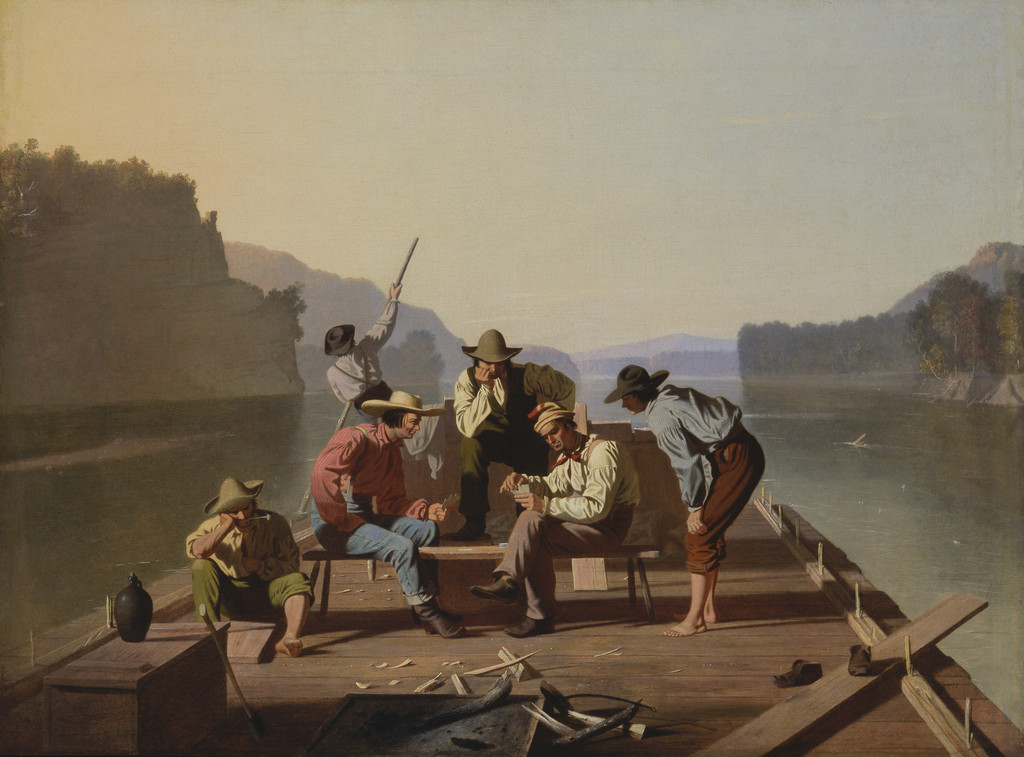
A game of cards occupies the middle of a raft, but it does not occupy everyone aboard. One man rests at the left, another props his head on a hand and a boatman at the rear works a long pole. George Caleb Bingham’s Raftsmen Playing Cards brings different kinds of activity into a compact group, set against a river whose still-looking surface opens into the distance.
Painted in 1847, the oil on canvas is in the Saint Louis Art Museum. It measures 71.3 × 96.7 cm and entered the collection in 1934, with the credit Bequest of Ezra H. Linley, by exchange. Its close view of the raft gives us an unusually direct position beside Bingham’s river workers. [1]
The picture also became a starting point for later work. Drawings associated with its figures connect it to In a Quandary of 1851 and Jolly Flatboatmen in Port of 1857. Those relationships show how Bingham could return to a pose while changing its companions, setting and audience. They do not make the three paintings interchangeable versions of a single object. [2]
At a Glance
- Artist George Caleb Bingham.
- Date 1847.
- Medium Oil on canvas.
- Dimensions 71.3 × 96.7 cm.
- Collection Saint Louis Art Museum.
- Collection credit Bequest of Ezra H. Linley, by exchange.
- Object number 50:1934. [1]
This work across George Caleb Bingham’s career
The Jolly Flatboatmen
1846; NGA canvasThe County Election
1851–52 original; 1852 replica illustratedCanvassing for a Vote
1852; signed canvasStump Speaking
1853–54The Verdict of the People
1854–55Order No. 11: Martial Law
1865–68; Cincinnati originalNotes and sources
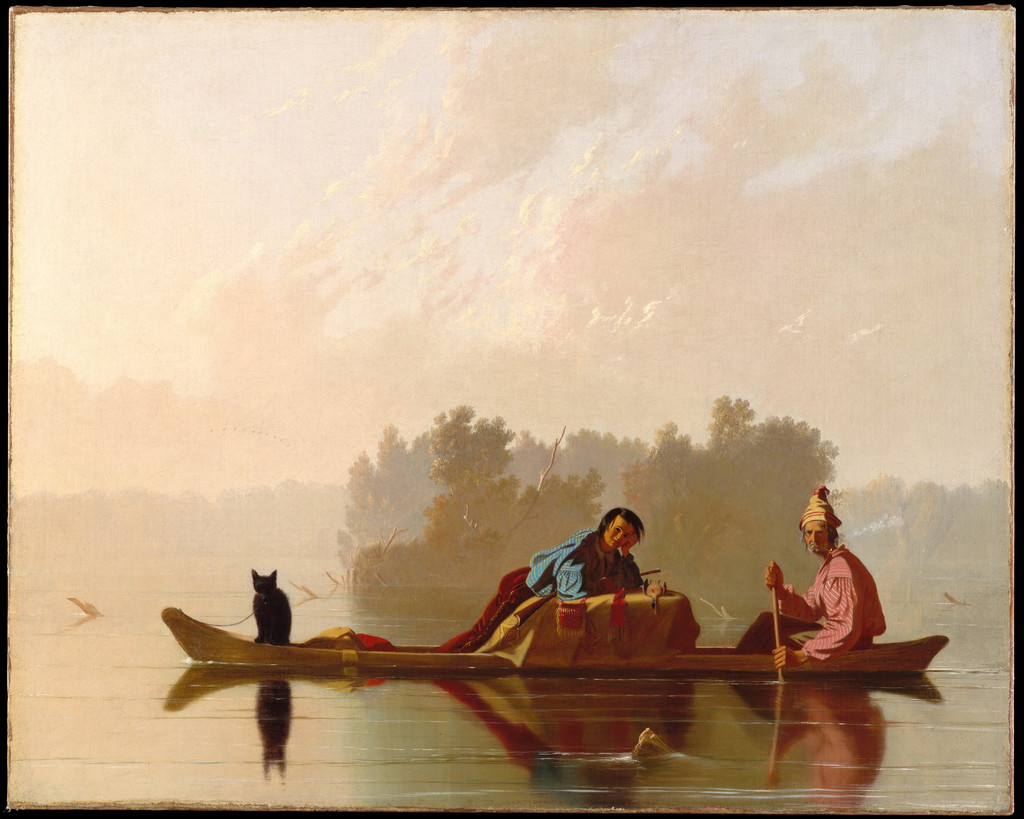
Fur Traders Descending the Missouri. Dates identify the canvas discussed in the article. [3]
The Jolly Flatboatmen. Dates identify the canvas discussed in the article. [4]
Raftsmen Playing Cards (current article). Dates identify the canvas discussed in the article. [1]
Mississippi Boatman. Dates identify the canvas discussed in the article. [5]
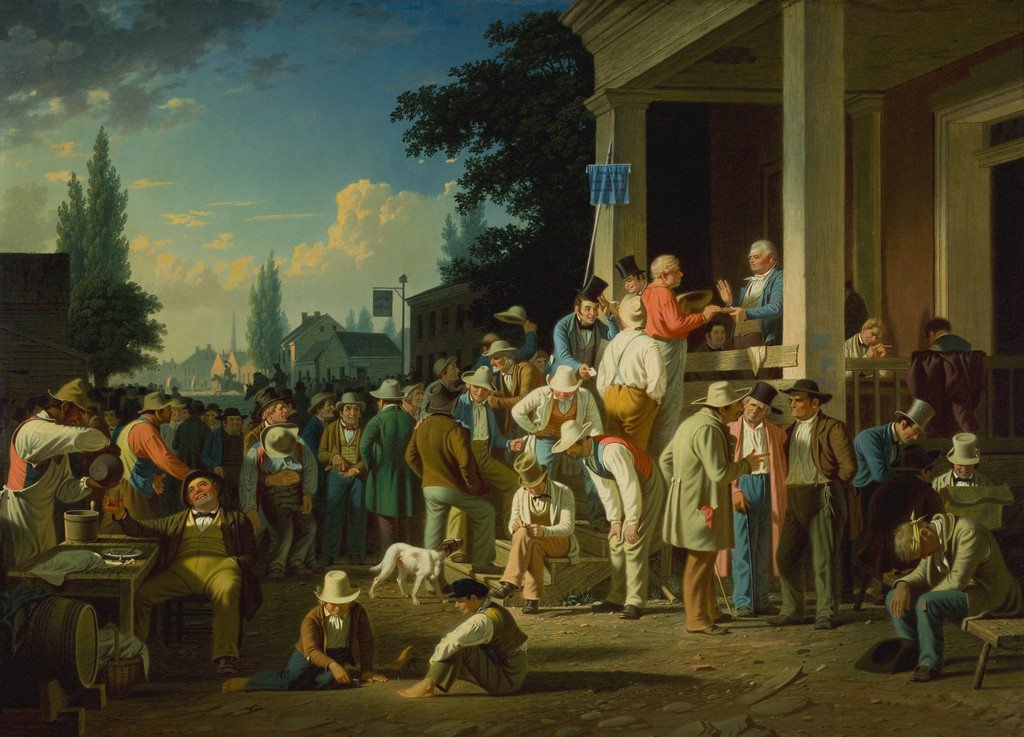
The County Election. The original is 124:1944; the illustrated 1852 replica is 44:2001. Their dimensions and acquisition histories differ. [6] [7]
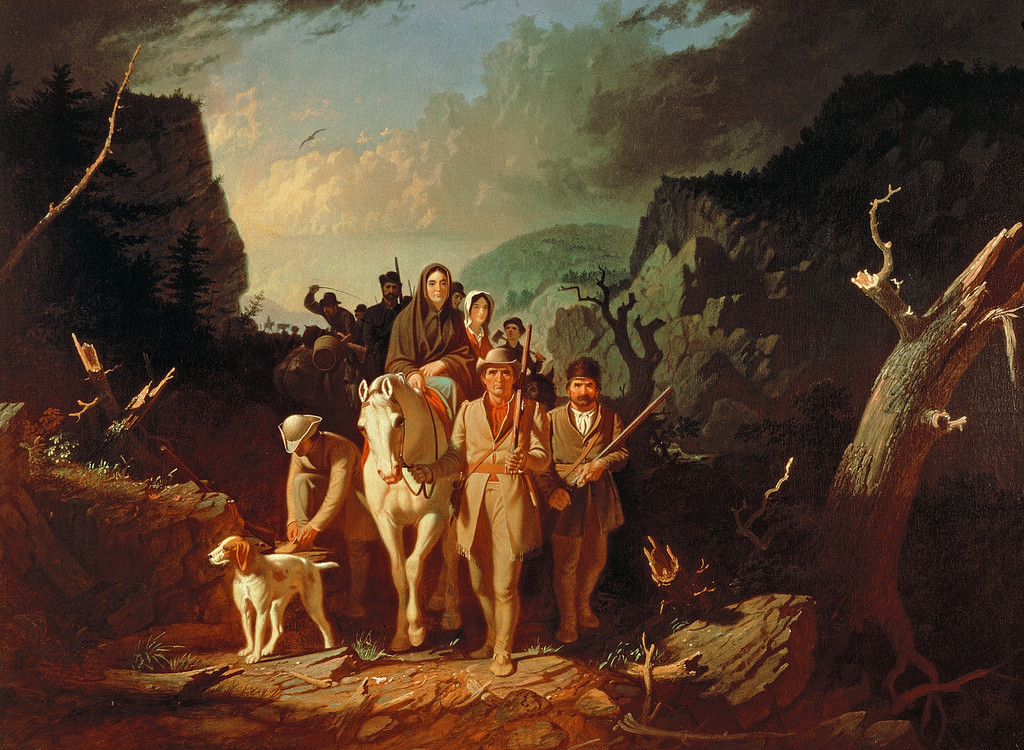
Daniel Boone Escorting Settlers through the Cumberland Gap. Dates identify the canvas discussed in the article. [8]
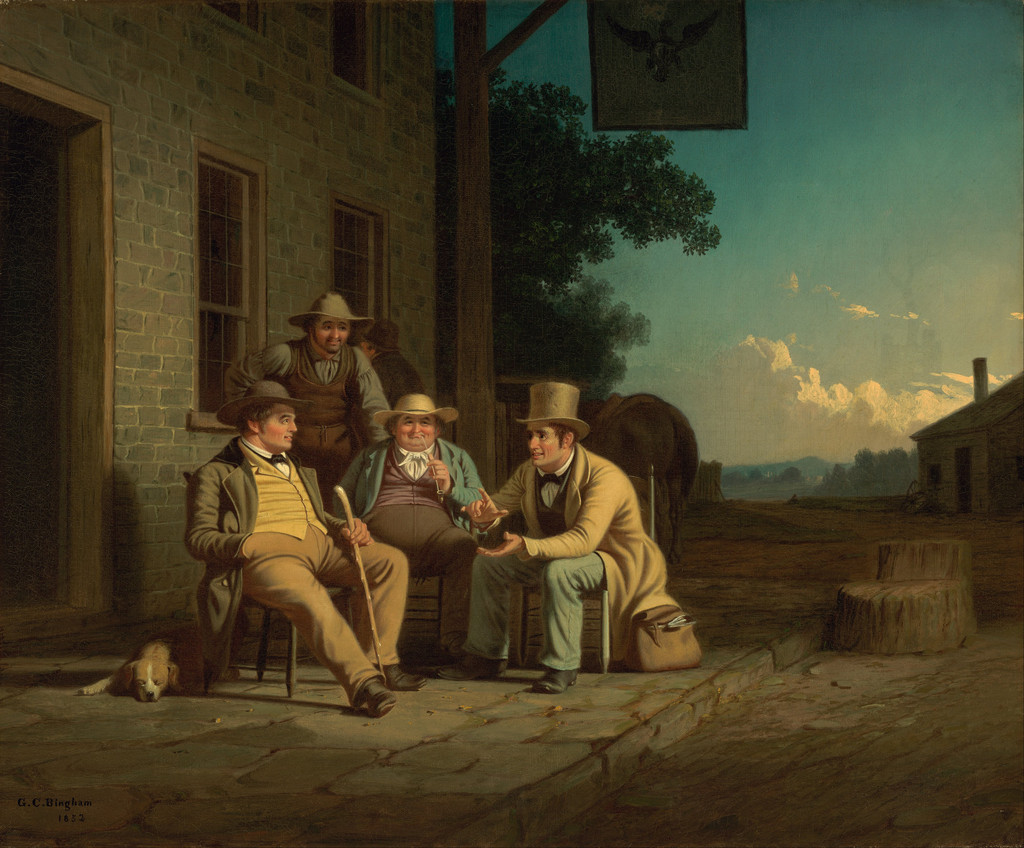
Canvassing for a Vote. Dates identify the canvas discussed in the article. [9]
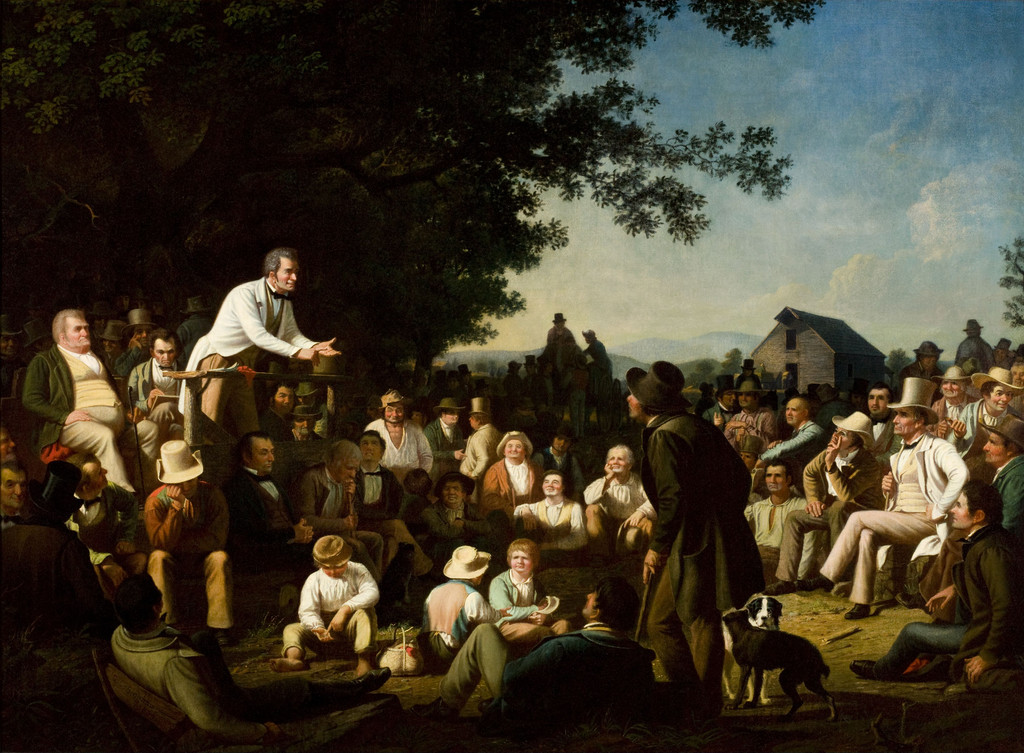
Stump Speaking. Dates identify the canvas discussed in the article. [10]
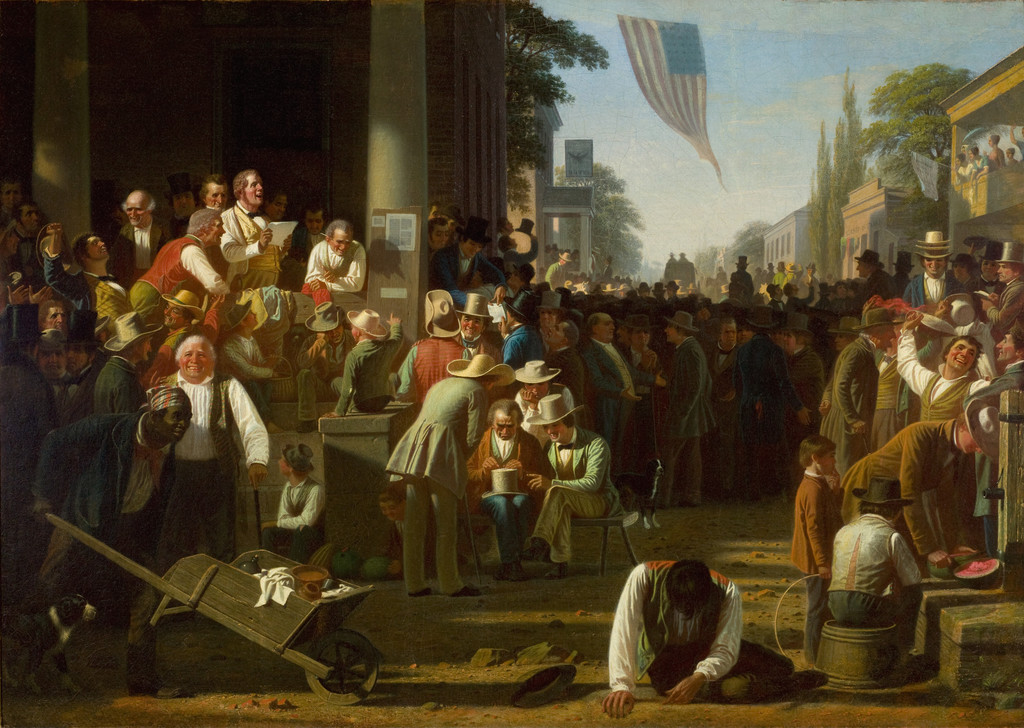
The Verdict of the People. Dates identify the canvas discussed in the article. [11]
Jolly Flatboatmen in Port. Dates identify the canvas discussed in the article. [12]
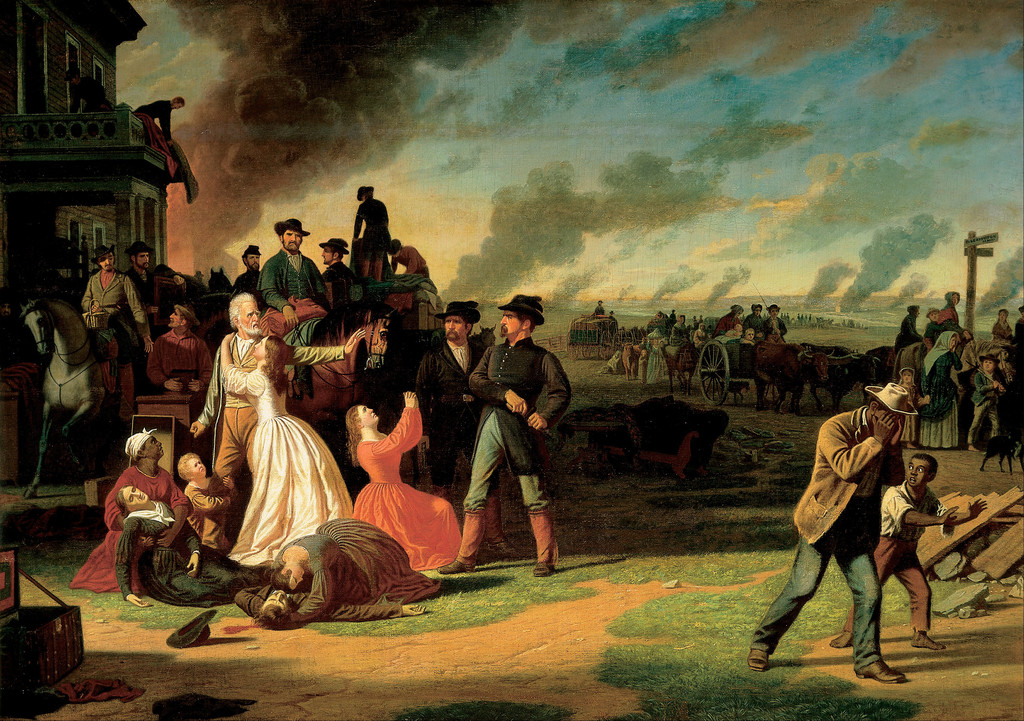
Order No. 11: Martial Law. Dates identify the canvas discussed in the article. [13]
Contents
- Looking across the raft
- Cards, work and an orderly composition
- A river setting with hazards
- Drawings that travelled between paintings
- Why In a Quandary is a different painting
- The Art-Union and the museum painting
- Annotated details
Looking across the raft
The raft’s near edge lies below the picture’s boundary, so the boards seem to extend towards our own position. Large pieces of equipment and loose wood occupy the foreground before the figures begin. An anchor rests close to the lower edge; a dark jug stands at the left, and a long board crosses diagonally at the right. These objects establish a working platform rather than an empty stage.
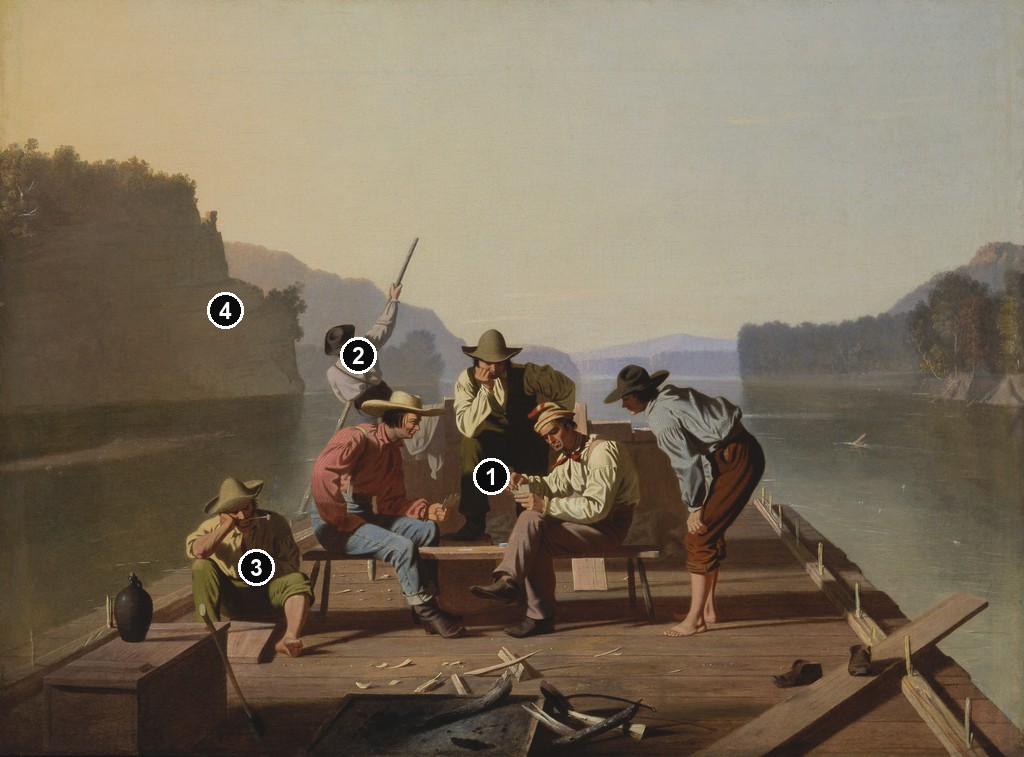
The card players sit facing one another across a small area of timber. The man at the left wears a reddish shirt, blue trousers and a wide straw hat. His opponent has a pale shirt, darker trousers and a close-fitting striped cap. Their clothes supply distinct patches of colour, making the exchange easy to locate within the larger gathering.
Hands give the game its focus. The left player keeps his cards low while looking towards the other man, whose hands gather near his lap. Bingham does not give us an overhead view of the cards or a legible account of the game’s rules. The interest lies in the encounter between players and in the attention it attracts.
Behind them, a man in a broad hat supports his face with one hand. At the right, a barefoot figure bends towards the play, his weight carried through an angled back and bent knees. Their poses make different forms of watching visible. One looks settled into a prolonged pause; the other seems to lean into a particular moment.
The resting man at the left introduces another pace. His body drops lower than the seated players, and his head rests against a raised hand. He belongs physically to the group without joining its immediate exchange. Bingham places this quiet figure near the jug and the raft’s edge, where his low position leads our eye towards the central bodies.
Clothing helps explain the bodies as well as separate them. The right-hand spectator’s pale blue shirt stretches across his bent back, while the rolled trousers leave his lower legs and feet exposed. The card player’s red sleeve turns around a bent elbow. These folds make the poses readable through changes in direction, allowing us to follow a shoulder into an arm or a knee towards a boot even where figures overlap.
At the rear, the pole rises steeply above the men. The boatman holding it stretches an arm upwards, giving a vertical accent to a picture otherwise full of seated and crouching forms. His work continues while the game proceeds. The painting therefore contains leisure within an ongoing journey, rather than presenting the whole crew as uniformly idle.
Annotated Details from Raftsmen Playing Cards
The numbered points identify visible features discussed in this article. Return from each detail to the whole composition. George Caleb Bingham, Raftsmen Playing Cards, 1847. Oil on canvas. Saint Louis Art Museum, Bequest of Ezra H. Linley, by exchange, 50:1934. Image source. Public domain. Numbers added to a separate overview. Detail images are crops of the source reproduction.
Details from RAFTSMEN PLAYING CARDS
Compare the cropped details with the complete images above. Notice how their colours, shapes and positions contribute to the larger compositions.
The card players’ hands
Small rectangles of cards gather around the hands of the two seated players. Their inclined torsos and lowered gazes turn attention inwards, giving a compact shared activity a clear place on the broad raft.
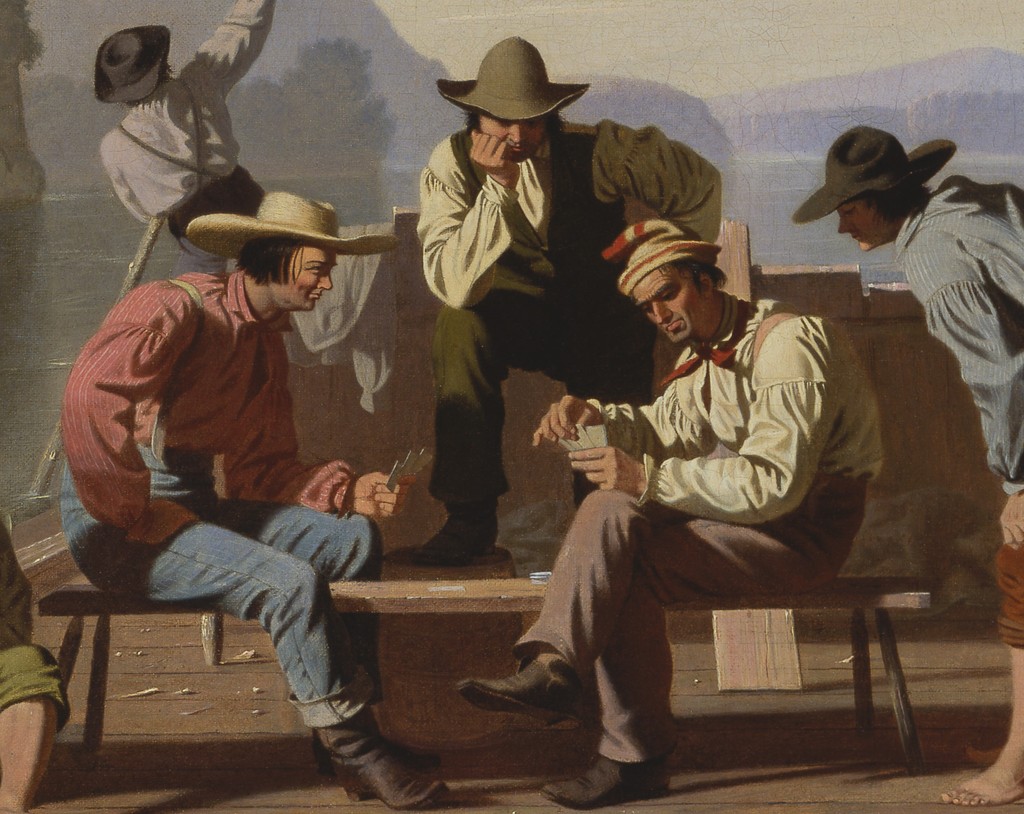
The raised pole
A raised arm and the long pole introduce a steep diagonal behind the card players. The standing body turns away from the viewer, keeping the physical work of moving the raft within a scene otherwise dominated by leisure.
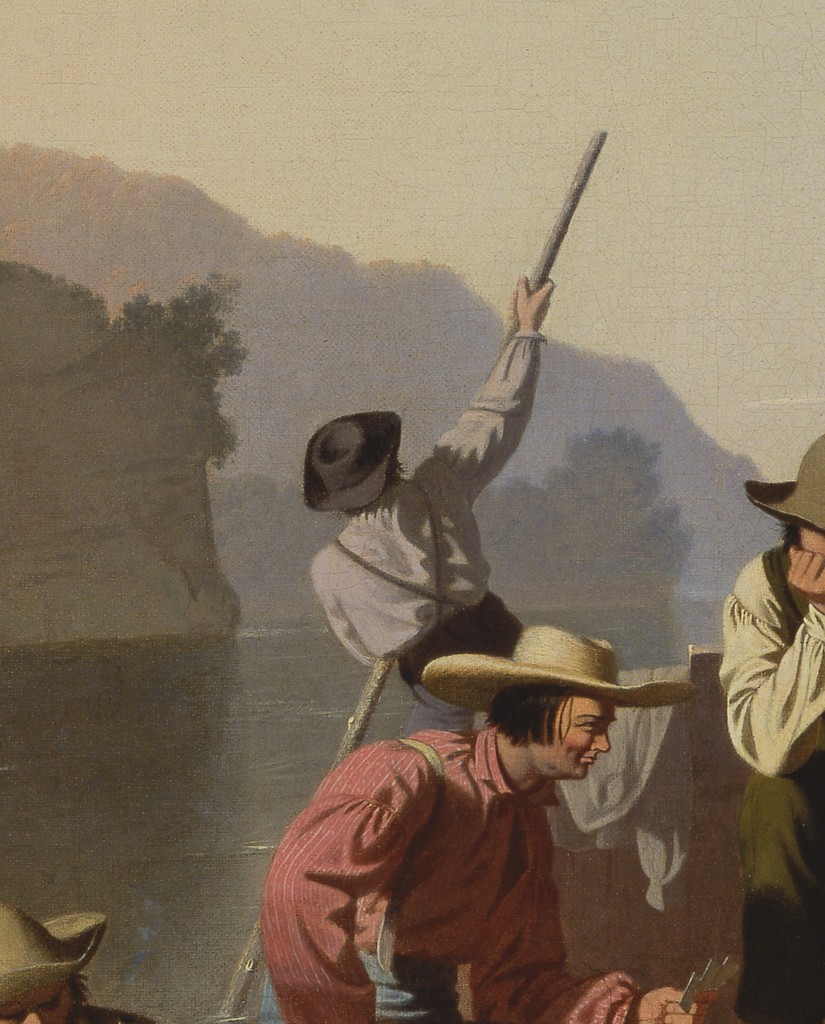
A reclining pace at the front
The head propped on a hand and the extended legs create a low, slow shape along the near edge. The jug and box provide separate solid forms around this resting figure.
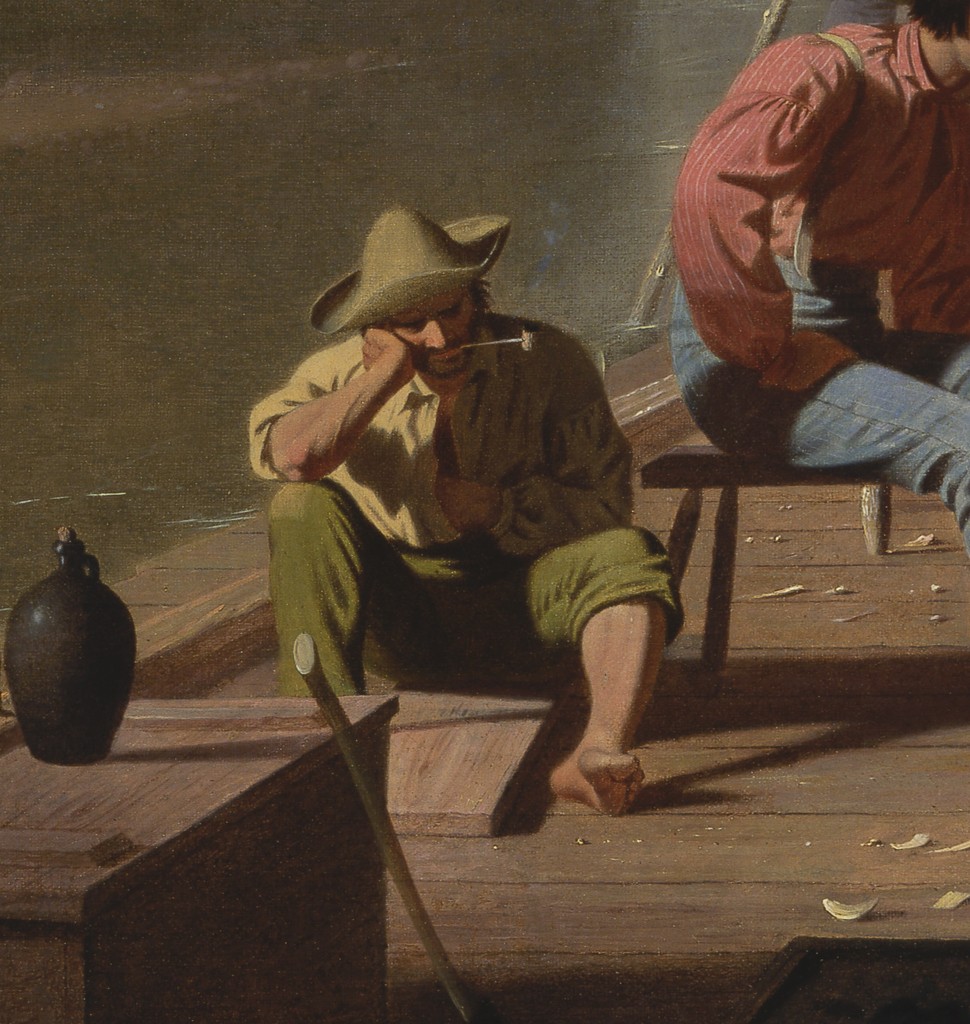
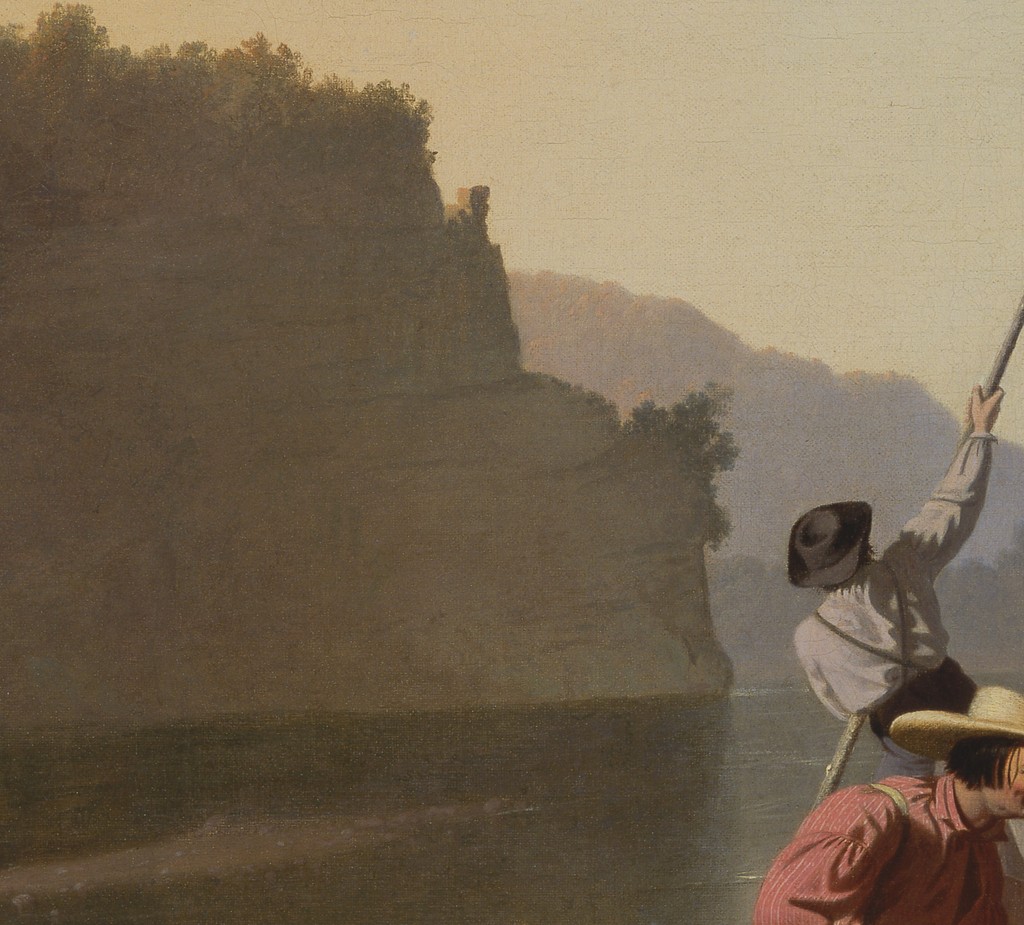
The bluff beside the passage
The high dark bluff comes close to the raft’s passage, while paler cliffs recede beyond it. The hard landforms and fading distance give the foreground activity a setting of considerable scale.
Cards, work and an orderly composition
The central figures make a broad, stable grouping. Hats and shoulders form successive levels, with the rear watcher’s head above the players and the poler extending beyond them. The bent figure at the right helps close the arrangement. His forward inclination directs attention back towards the game instead of allowing it to escape at the edge.
The foreground is more open. Gaps between objects let the planks remain visible, and the anchor’s dark curves differ from the straight timbers around it. These intervals matter: they give the figures a setting to occupy and keep the picture from becoming a row of isolated bodies. Our imagined route into the scene passes across the raft before reaching the cards.
Bingham’s arrangement makes the men companionable without requiring them to behave alike. Their shared platform and overlapping positions hold them together; their gestures keep them separate. That combination is characteristic of his interest in ordinary people as subjects of genre painting . A simple activity becomes worth examining because several different responses can surround it.
Curator Margaret C. Conrads places Bingham’s river imagery within his effort to shape how audiences understood western workers. Discussing The Jolly Flatboatmen , she contrasts his balanced, peaceful groups with stereotypes of a disorderly frontier. The comparison is helpful here too, provided the card game is allowed its own quieter structure rather than being treated as a second dance scene. [14]
There is no need to decide that the picture is either praise of gambling or a warning against it. The men’s concentrated faces, resting bodies and continuing labour support a more specific account of the scene. A card game organizes attention during a river passage. The painting gives us little basis for inventing stakes, a winner or a financial crisis from the cards alone.
A river setting with hazards
Beyond the raft, a high bank rises at the left and the water narrows into a hazy distance. The opposite shore is lower and more lightly described. Reflections and soft transitions bind land and water together, while the foreground bodies remain much more sharply differentiated. The contrast makes the river feel spacious without diminishing the close social encounter.
The 2015 exhibition Navigating the West described the setting as generalized. Its labels noted that Bingham reused banks, bluffs and trees, and that his river scenes rarely identify a specific location. They also recorded the painting’s exhibition in both New York and Saint Louis in 1847. A viewer could recognize a western river world without being able to assign this bend to an exact place on a map. [2]
The Saint Louis Art Museum’s later Art Along the Rivers label draws attention to another aspect of that landscape. It identifies a sandbar at the left and a snag at the right as navigational dangers, and interprets the painting in relation to Bingham’s advocacy for federal investment in clearing western rivers. The apparent calm therefore coexists with features that could threaten commerce. [15]
That interpretation gives the distant setting a role beyond atmosphere. It also asks us to notice the difference between the workers’ absorbed attention and the river around them. The game may be the centre of their immediate interest, but the means of travel still depends on physical conditions outside it. The raised pole provides a visible connection between the human group and those conditions.
Watch: George Caleb Bingham
Choose a film to explore the artist’s work, its interpretation and its wider setting.
Navigating the West: George Caleb Bingham and the River at the Amon Carter Museum of American Art
The Amon Carter Museum introduces an exhibition devoted to Bingham’s river paintings.
Watch on YouTubeDrawings that travelled between paintings
The related drawings make the composition’s development especially revealing. The Navigating the West labels connect a study titled Cardplayer with both this painting and In a Quandary , noting an alteration to the right leg. Another Cardplayer and a Raftsman also relate to the two compositions. A repeated pose could thus serve a new arrangement without every detail remaining fixed. [2]
One Raftsman drawing contains a grid near the figure’s feet. The exhibition explains that it helped Bingham establish perspective rather than depicting an actual pattern on the raft. This is a useful distinction when comparing a study with the painting: a line can be a working aid even when it occupies the space where a floor or deck will eventually appear. [2]
The drawing’s practical problem is also visible in the finished scene. The men sit at different distances from us, yet their feet, seats and supports must belong to one platform. A convincing figure considered alone would not necessarily settle correctly into that shared space. Studying the body together with its support helped connect the person to the raft, giving the assembled group a sense of weight rather than making it appear suspended above the boards.
The labels also associate Raftsman Dozing with the 1847 canvas and the 1857 Jolly Flatboatmen in Port , with changes in pose. They report that Bingham took drawings with him to Düsseldorf, where he reused material in the later composition. The studies offered a portable store of bodies and attitudes, capable of linking paintings separated by a decade and an Atlantic crossing. [2]
These are relationships established through the study of specific sheets, rather than a claim that Bingham mechanically copied an entire painting. Figures still had to work beside new neighbours and within different spaces. In Raftsmen Playing Cards , the resting body contributes to a concentrated group. In the larger port scene, rest appears amid a much more crowded entertainment and waterfront setting.
The separate article on Bingham’s drawings and prints follows this process more broadly. Here its value is particularly concrete: the cards, raft and men form a convincing single moment, yet the preparation reveals poses with longer working lives.
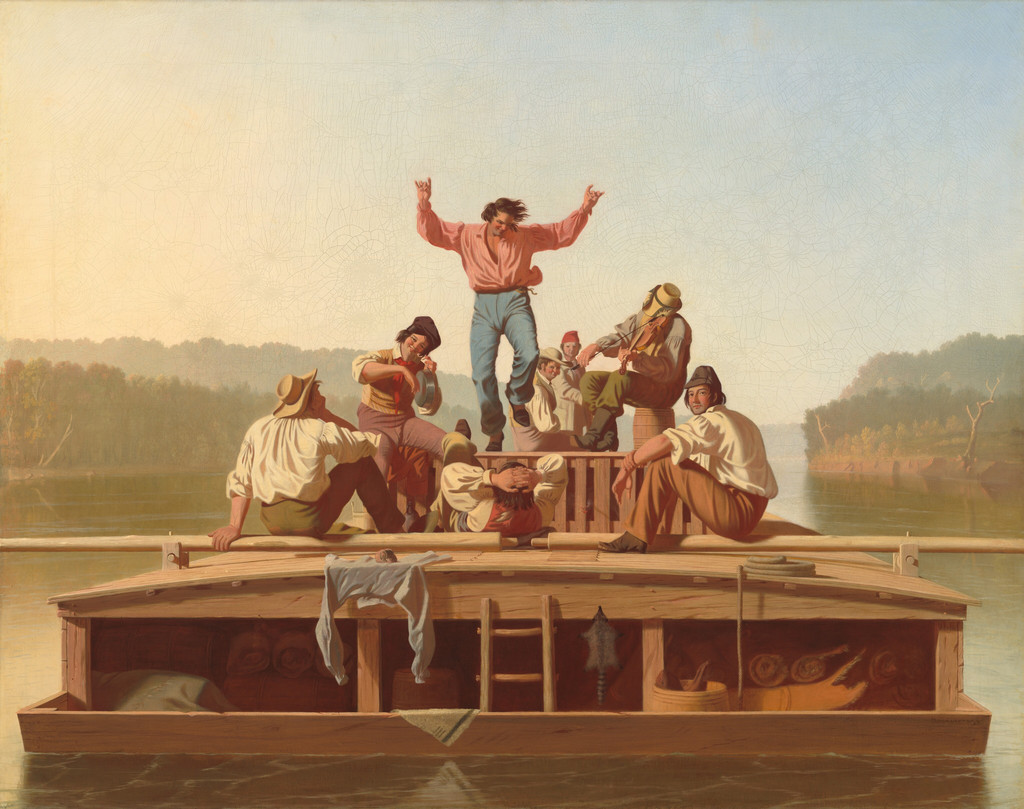
George Caleb Bingham, The Jolly Flatboatmen, 1846. Oil on canvas. National Gallery of Art, Washington, Patrons’ Permanent Fund, 2015.18.1.
Image source
.
Public domain
.
Why In a Quandary is a different painting
The 1851 In a Quandary , also called Mississippi Raftsmen at Cards , was made in connection with the French publisher Goupil. According to the 2015 exhibition account, the American Art-Union had already purchased the 1847 painting, so Bingham produced a new composition for the print project. He reduced the number of figures, brought the boat closer to the bank and changed their characterization. [2]
The exhibition interprets the rougher appearance of the later men in relation to an international audience’s expectations. That reading makes the changes more consequential than simple economies of reproduction. Bingham was reconsidering how a western river subject would be understood by people outside the region. The resulting print was related to the earlier picture through a new painting, rather than being a straightforward reproduction of the 1847 canvas. [2]
By comparison, The Jolly Flatboatmen of 1846 makes a dancer the most conspicuous member of its group. The National Gallery of Art’s painting supplies an energetic counterpart to the lower, more inward-facing gathering around cards. Looking between the two shows how Bingham varied the action that could hold river workers together. [4]
Jolly Flatboatmen in Port , painted in Düsseldorf in 1857, moves the entertainment to a St. Louis wharf. Its larger gathering and waterfront surroundings open another direction for comparison. The same painter could make music, cards, sleep and spectatorship serve different arrangements, rather than repeating one undifferentiated picture of boatmen. [12]
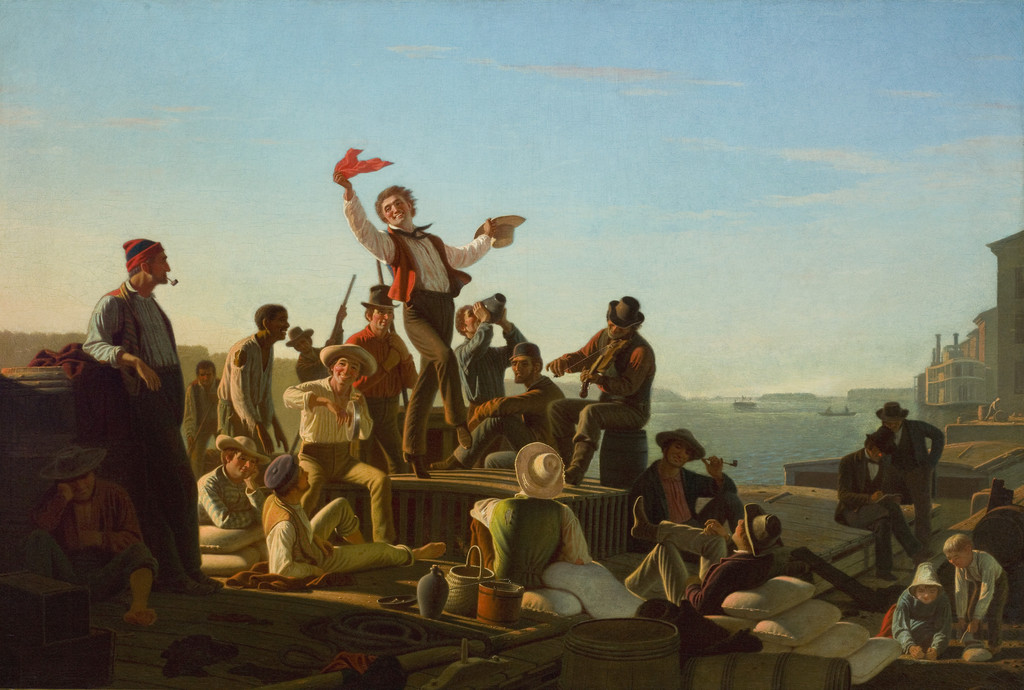
George Caleb Bingham, Jolly Flatboatmen in Port, 1857. Oil on canvas. Saint Louis Art Museum, Museum Purchase, 123:1944.
Image source
.
Public domain
.
The Art-Union and the museum painting
The Saint Louis Art Museum’s provenance records Bingham’s sale of Raftsmen Playing Cards to the American Art-Union for $300. Its subsequent ownership includes the Berkshire Museum before the Saint Louis acquisition. Those collection histories belong to the 1847 canvas; the Goupil print project belongs to the later In a Quandary . [1]
Seen on its own, the painting rewards a slow passage from foreground to distance. The anchor and loose timber make the raft tangible; the figures give it a social life; the hazy banks return us to the journey beyond the game. Its stillness contains both occupied and unoccupied time, with a working boatman keeping the river passage visible at the edge of leisure.
Artworks directory
A documented selection discussed across these articles, including separate canvases, figure studies and reproductive impressions. Dates identify the particular object or study; collection and title distinctions follow museum records and the 2015 exhibition checklist. This is not a catalogue raisonné. Prints are grouped with works on paper in the Drawing filter.
| Name | Date | Medium |
|---|---|---|
| Fur Traders Descending the Missouri | 1845 | Painting — oil on canvas |
| The Jolly Flatboatmen | 1846; NGA canvas | Painting — oil on canvas |
| The County Election (original) | 1851–52 | Painting — oil on canvas |
| Stump Speaking | 1853–54 | Painting — oil on canvas |
| The Verdict of the People | 1854–55 | Painting — oil on canvas |
| Order No. 11: Martial Law | 1865–68; Cincinnati original | Painting — oil on canvas |
| Daniel Boone Escorting Settlers through the Cumberland Gap | 1851–52 | Painting — oil on canvas |
| Canvassing for a Vote | 1852; signed canvas | Painting — oil on canvas |
| Raftsmen Playing Cards | 1847 | Painting — oil on canvas |
| Mississippi Boatman | 1850 | Painting — oil on canvas |
| Jolly Flatboatmen in Port | 1857 | Painting — oil on canvas |
| The County Election (replica illustrated here) | 1852 | Painting — oil on canvas |
| Martial Law or Order No. 11 (Missouri replica) | 1870 | Painting — oil on canvas |
| The Jolly Flatboatmen (Terra canvas) | 1877–78 | Painting — oil on canvas |
| John Quincy Adams (later version) | about 1850, after an 1844 original | Painting — oil on canvas |
| Country Politician | 1849 | Painting — oil on canvas |
| The Trappers’ Return | 1851 | Painting — oil on canvas |
| The Concealed Enemy | 1845 | Painting — oil on canvas |
| The Wood-boat | 1850 | Painting — oil on canvas mounted on board |
| Lighter Relieving a Steamboat Aground | 1847 | Painting — oil on canvas |
| Watching the Cargo | 1849 | Painting — oil on canvas |
| In a Quandary | 1851 | Painting — oil on canvas |
| Boatmen on the Missouri | 1846 | Painting — oil on canvas |
| Self-Portrait (Saint Louis) | 1834–35 | Painting — oil on canvas |
| Self-Portrait (Nelson-Atkins) | about 1877 | Painting — oil on canvas |
| Mrs. David Steele Lamme and Son William Wirt | 1837 | Painting — oil on canvas |
| Portrait of Leonidas Wetmore | 1839–40 | Painting — oil on canvas |
| Fur Trader (study for Fur Traders Descending the Missouri) | 1845 | Drawing — brush, ink and wash over pencil |
| Skillet-beater (study for The Jolly Flatboatmen) | 1846 | Drawing — brush, ink and wash over pencil |
| Young Wood-boatman (study for The Wood-boat) | 1850 | Drawing — brush, ink and wash over pencil |
| Thomas Doney after Bingham: The Jolly Flat Boat Men (Met impression) | 1847 | Print — mezzotint and engraving with etching |
| Thomas Doney after Bingham: The Jolly Flat Boat Men (coloured Carter impression) | 1847 | Print — intaglio with applied watercolour |
| The Verdict of the People (lithographic proof) | ca. 1858–59 | Print — lithographic proof |
| Gautier after Bingham: Stump Speaking | 1856 | Print — etching and aquatint |
| Claude Regnier after Bingham: In a Quandary, Mississippi Raftsmen Playing Cards | 1852 | Print — hand-coloured lithograph |
Frequently Asked Questions
He painted it in 1847. The Saint Louis Art Museum holds the oil on canvas, object 50:1934. [1]
The 2015 exhibition describes the setting as generalized, with banks, trees and bluffs Bingham also used elsewhere. It does not establish an exact river bend. [2]
No. It is a related painting of 1851, made for a print project associated with Goupil, with changes to the figures and setting. [2]
Discussion
Look again at the images and ideas explored in Raftsmen Playing Cards. These editorial prompts invite your observations.
Does your eye return first to the players, the resting man or the boatman with the pole? Notice how the angle of each body affects the pace of the scene.
Reader Insights
How does the raft’s low viewpoint change your relation to the card players?
Where do signs of work remain visible around the game?
How does a familiar pose acquire a different role in another river painting?
Join the Conversation
Share a detail, comparison or question about Raftsmen Playing Cards below.
References
- Saint Louis Art Museum , Raftsmen Playing Cards , 50:1934. Current object record and provenance. View source
- Navigating the West: George Caleb Bingham and the River , exhibition labels, 2015. Particularly pp. 9–10 and 15–16, on the painting, related drawings, generalized setting and In a Quandary . View source
- Metropolitan Museum of Art, Fur Traders Descending the Missouri. View source
- National Gallery of Art , The Jolly Flatboatmen , 1846, 2015.18.1. Current identity and composition comparison. View source
- National Gallery of Art, Mississippi Boatman. View source
- Saint Louis Art Museum, The County Election, 1851–52, 124:1944. View source
- Saint Louis Art Museum, The County Election, 1852 replica, 44:2001. View source
- Kemper Art Museum, Washington University, Daniel Boone Escorting Settlers through the Cumberland Gap. View source
- Nelson-Atkins Museum of Art, Canvassing for a Vote. View source
- Saint Louis Art Museum, Stump Speaking. View source
- Saint Louis Art Museum, The Verdict of the People. View source
- Saint Louis Art Museum , Jolly Flatboatmen in Port , 1857, 123:1944. Current record for the later port composition. View source
- Cincinnati Art Museum, Order No.11 / Martial Law. View source
- Margaret C. Conrads , “Bingham@200: A Bicentennial Celebration,” Antiques & Fine Art , Spring 2011, pp. 193–199. Particularly p. 196, on the characterization and organization of river workers in The Jolly Flatboatmen . View source
- Saint Louis Art Museum , Art Along the Rivers: A Bicentennial Celebration , Raftsmen Playing Cards label. Interpretation of navigational hazards and federal river improvements. View source
- Splash image source.
George Caleb Bingham, Raftsmen Playing Cards, 1847. Oil on canvas, 71.3 × 96.7 cm. Saint Louis Art Museum, Bequest of Ezra H. Linley, by exchange, 50:1934. Public domain .
View source