 by
Tom Gurney
Tom Gurney BSc (Hons) is an art history expert with over 20 years experience
Email:
tomgurney1@gmail.com
/ Phone:
+44 7429 011000
Jolly Flatboatmen in Port: Introduction
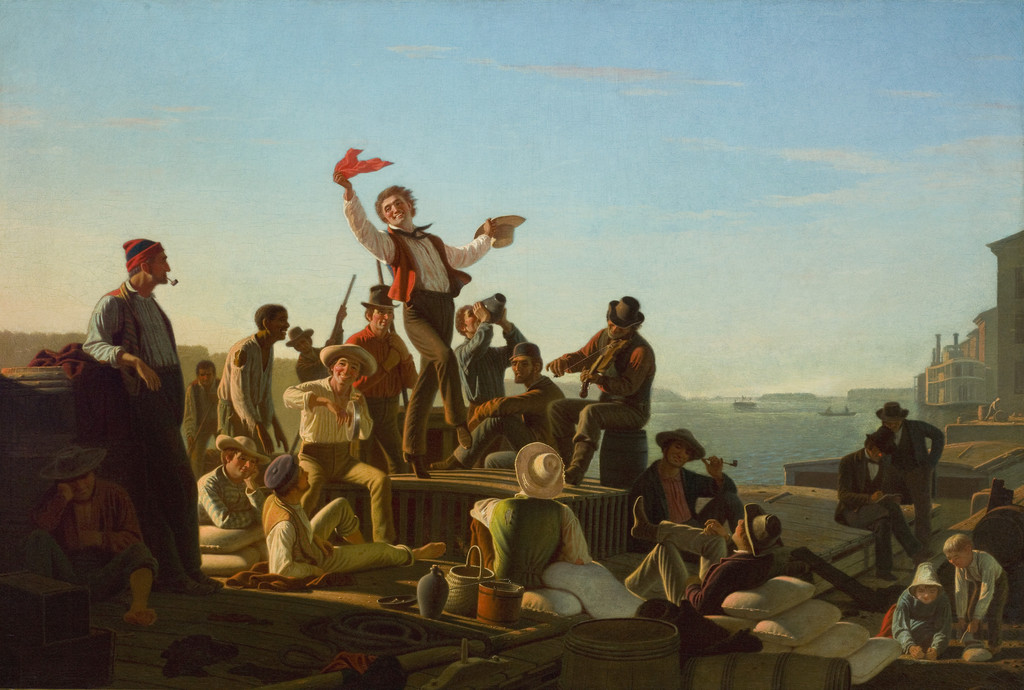
A dancer lifts a red handkerchief above a boat crowded with men. Around him, music, conversation, drinking and rest fill the foreground, while a steamboat and waterfront buildings establish the setting beyond. In Jolly Flatboatmen in Port , George Caleb Bingham enlarged one of his favourite subjects into a bustling scene of arrival and entertainment.
The painting dates from 1857 and belongs to the Saint Louis Art Museum, which identifies the setting as a wharf in St. Louis. Bingham made it in Düsseldorf, Germany. The oil on canvas measures 120 × 176.8 cm, substantially wider than his 1846 Jolly Flatboatmen . Its Missouri subject and European place of production are both essential to understanding the work. [1]
The 2015 exhibition Navigating the West described it as Bingham’s last major river painting. That qualification matters: he returned to the dancing boatmen in a later work of 1877–78. The 1857 picture marks a culmination of his sustained exploration of river subjects without being the final time he painted them. [2]
At a Glance
- Artist George Caleb Bingham.
- Date 1857.
- Medium Oil on canvas.
- Dimensions 120 × 176.8 cm.
- Place made Düsseldorf, Germany.
- Subject Flatboatmen at a St. Louis wharf.
- Collection Saint Louis Art Museum.
- Collection credit Museum Purchase.
- Object number 123:1944. [1]
This work across George Caleb Bingham’s career
The Jolly Flatboatmen
1846; NGA canvasThe County Election
1851–52 original; 1852 replica illustratedCanvassing for a Vote
1852; signed canvasStump Speaking
1853–54The Verdict of the People
1854–55Order No. 11: Martial Law
1865–68; Cincinnati originalNotes and sources
Fur Traders Descending the Missouri. Dates identify the canvas discussed in the article. [3]
The Jolly Flatboatmen. Dates identify the canvas discussed in the article. [4]
Raftsmen Playing Cards. Dates identify the canvas discussed in the article. [5]
Mississippi Boatman. Dates identify the canvas discussed in the article. [6]
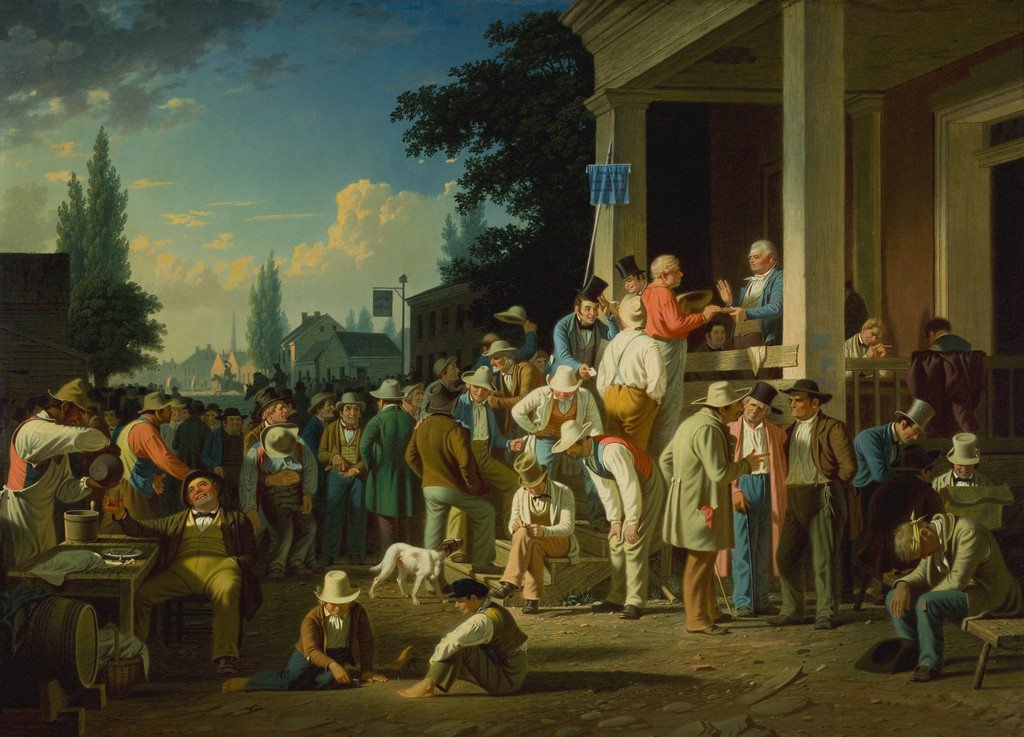
The County Election. The original is 124:1944; the illustrated 1852 replica is 44:2001. Their dimensions and acquisition histories differ. [7] [8]
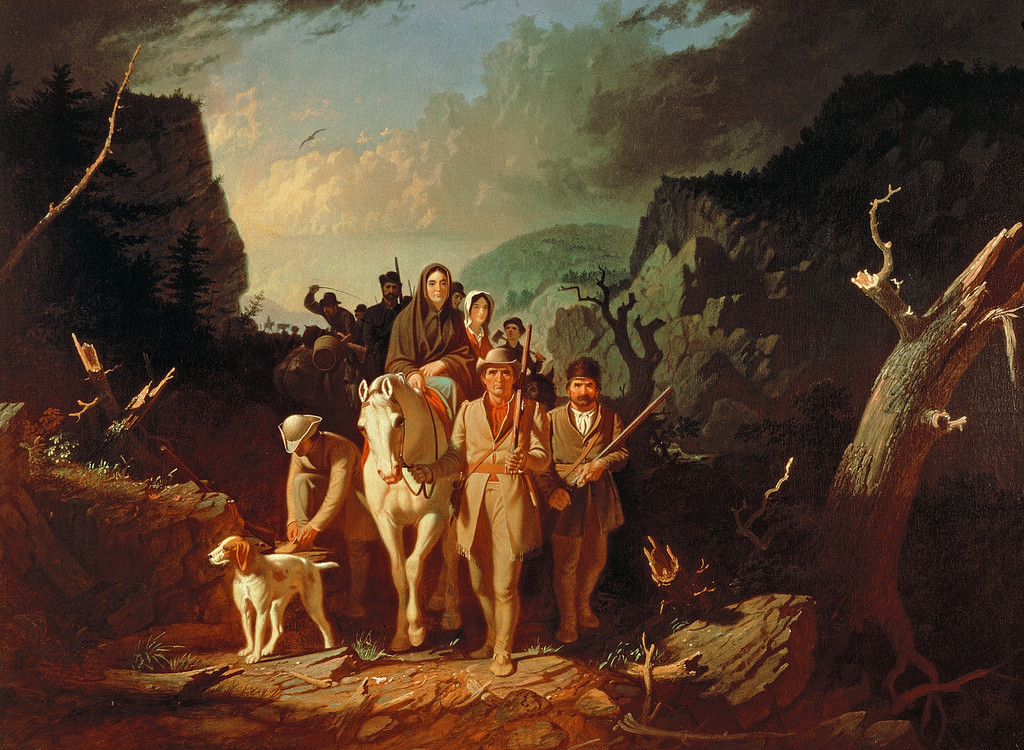
Daniel Boone Escorting Settlers through the Cumberland Gap. Dates identify the canvas discussed in the article. [9]
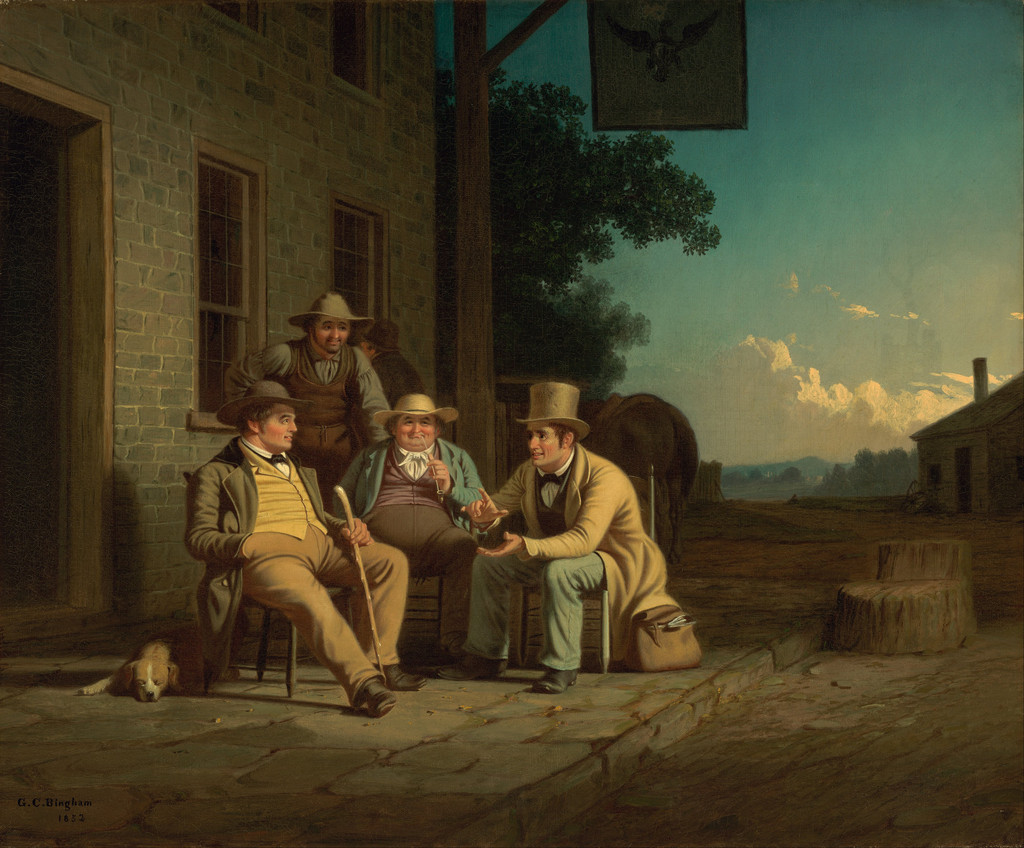
Canvassing for a Vote. Dates identify the canvas discussed in the article. [10]
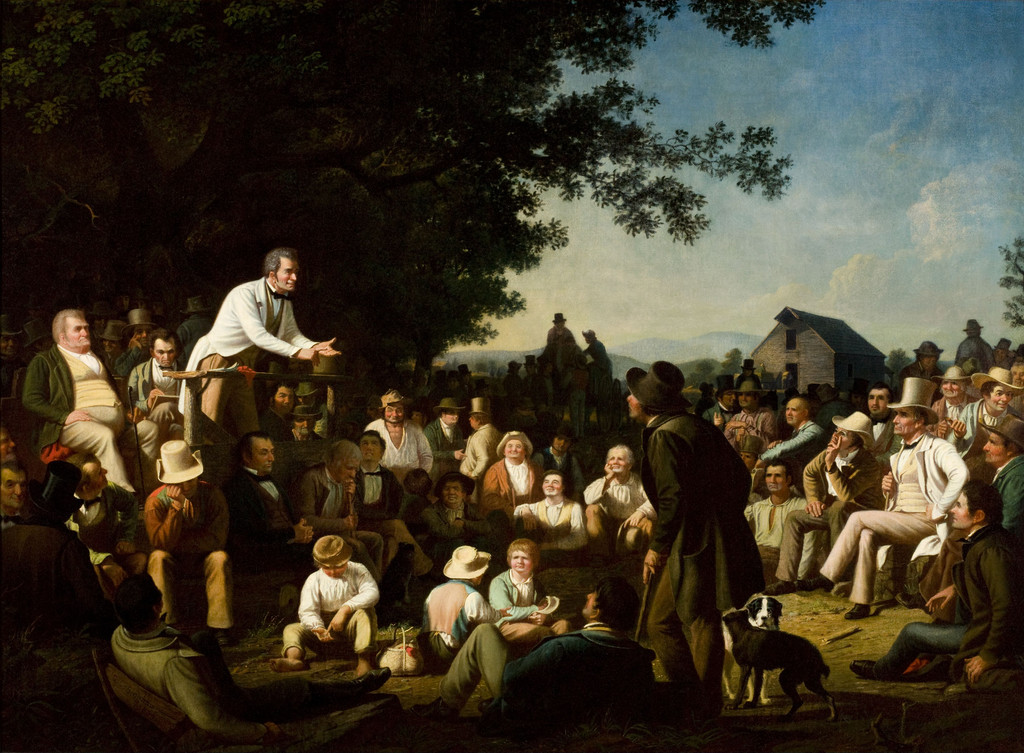
Stump Speaking. Dates identify the canvas discussed in the article. [11]
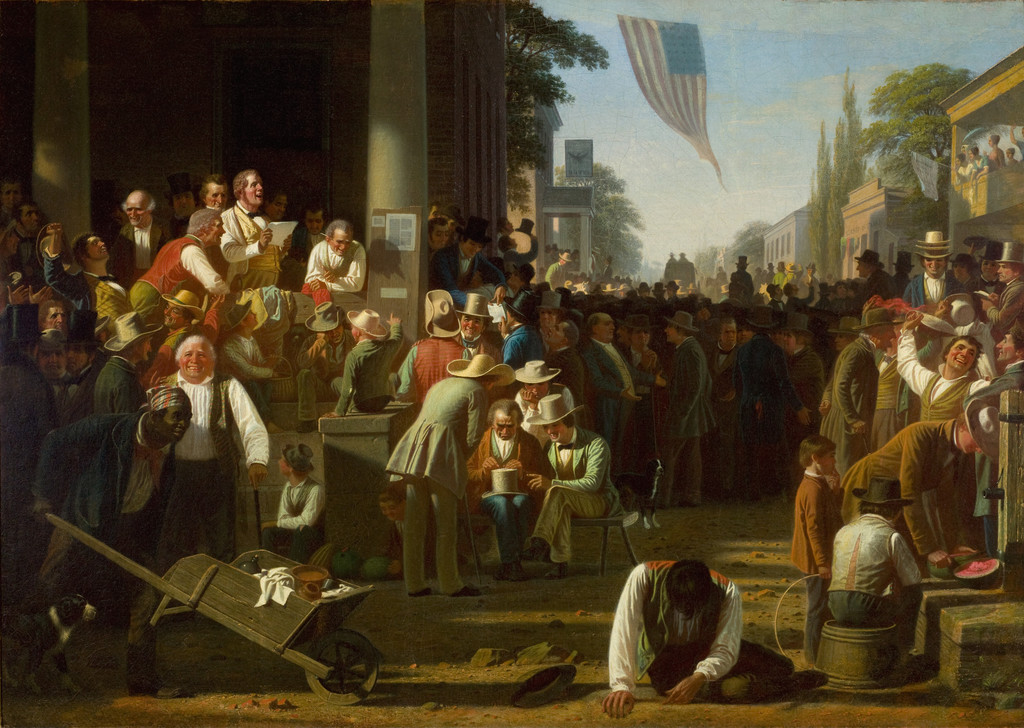
The Verdict of the People. Dates identify the canvas discussed in the article. [12]
Jolly Flatboatmen in Port (current article). Dates identify the canvas discussed in the article. [1]
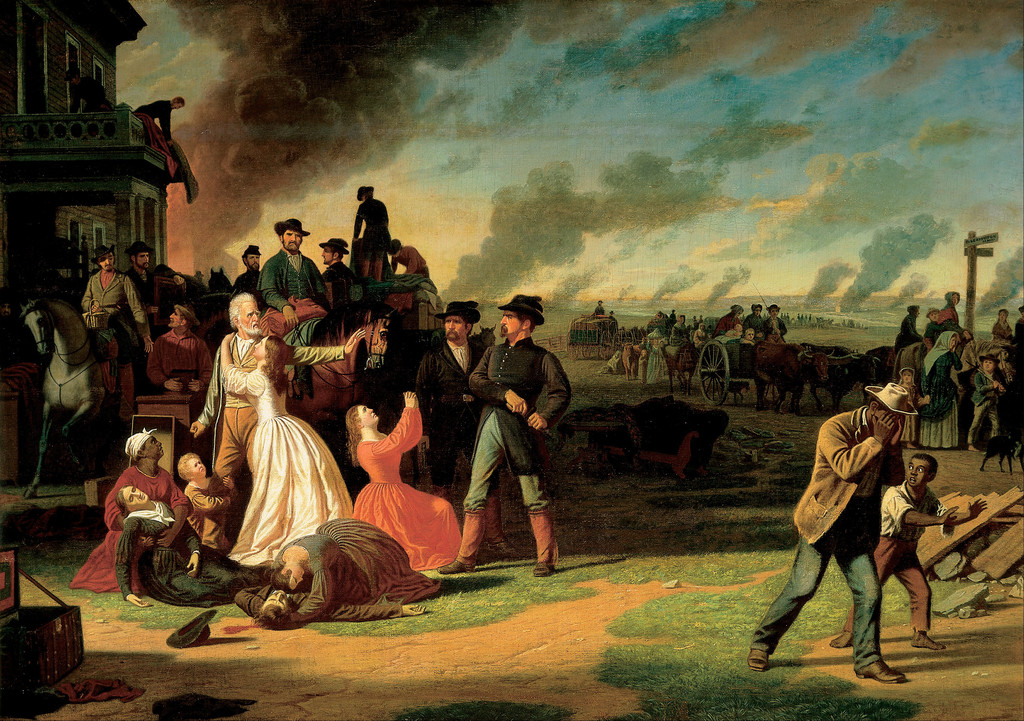
Order No. 11: Martial Law. Dates identify the canvas discussed in the article. [13]
Contents
- Missouri remembered from Düsseldorf
- A dancer above a crowded boat
- The port beyond the performance
- The people around the entertainment
- What changed after The Jolly Flatboatmen of 1846?
- Familiar poses in a new setting
- Ownership and the later return to the subject
- Annotated details
Missouri remembered from Düsseldorf
Bingham travelled to Düsseldorf in 1856. The Navigating the West exhibition account records that Emanuel Leutze welcomed him there and places the picture in the context of the academic painting associated with the German city. It states that Bingham conceived and executed Jolly Flatboatmen in Port there. The canvas therefore represents a distant American subject organized in a European studio. [2]
That distance helps explain why drawings mattered. Bingham took figure studies with him, and the exhibition connects several with the port composition. They provided material he could rearrange far from the people and waterways of Missouri. The picture’s convincing details need not imply that he set up his canvas beside the wharf and recorded a single gathering as it happened. [2]
Leutze’s presence offers a useful connection with another artist treating American subjects abroad. His Washington Crossing the Delaware was already an important example of American history painted in Düsseldorf. The subjects and moods differ greatly, but both works ask us to distinguish the place represented from the place where the artist constructed the image. The exhibition’s account establishes the contact; it does not prove that Bingham copied a particular Leutze composition. [2]
For the viewer, the most immediate consequence is the picture’s complexity. Many figures have to share the boats, while the waterfront remains readable at the side. Bingham makes the scene expansive without distributing attention evenly. The dancer supplies a clear summit around which the other activities can gather.
Annotated Details from Jolly Flatboatmen in Port
The numbered points identify visible features discussed in this article. Return from each detail to the whole composition. George Caleb Bingham, Jolly Flatboatmen in Port, 1857. Oil on canvas, 120 × 176.8 cm. Saint Louis Art Museum, Museum Purchase, 123:1944. Image source. Public domain. Numbers added to a separate overview. Detail images are crops of the source reproduction.
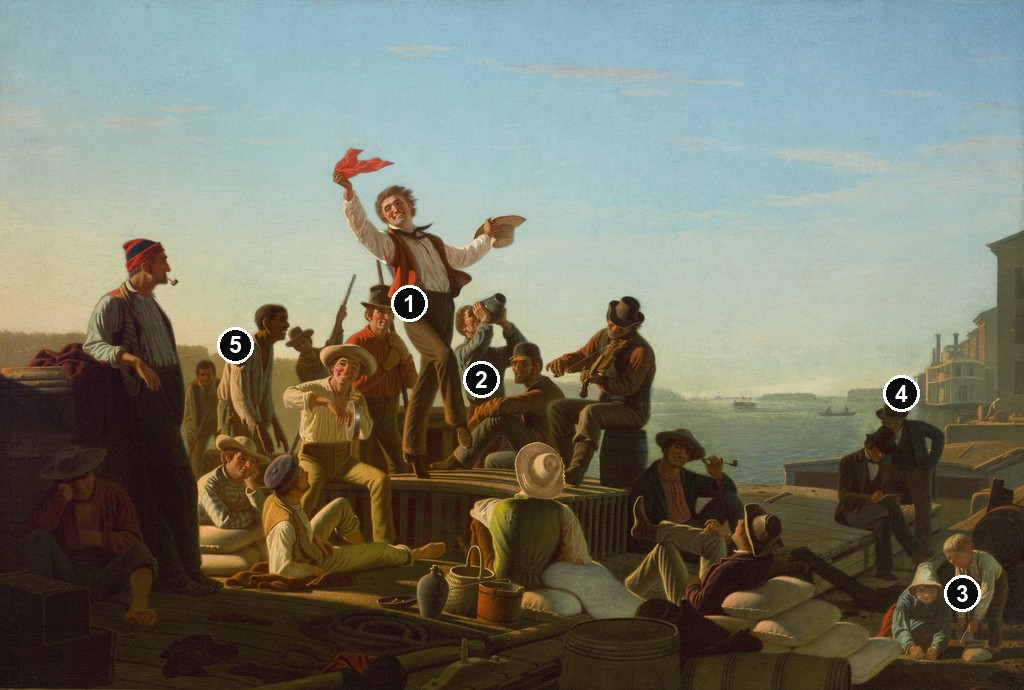
Details from JOLLY FLATBOATMEN IN PORT
Compare the cropped details with the complete images above. Notice how their colours, shapes and positions contribute to the larger compositions.
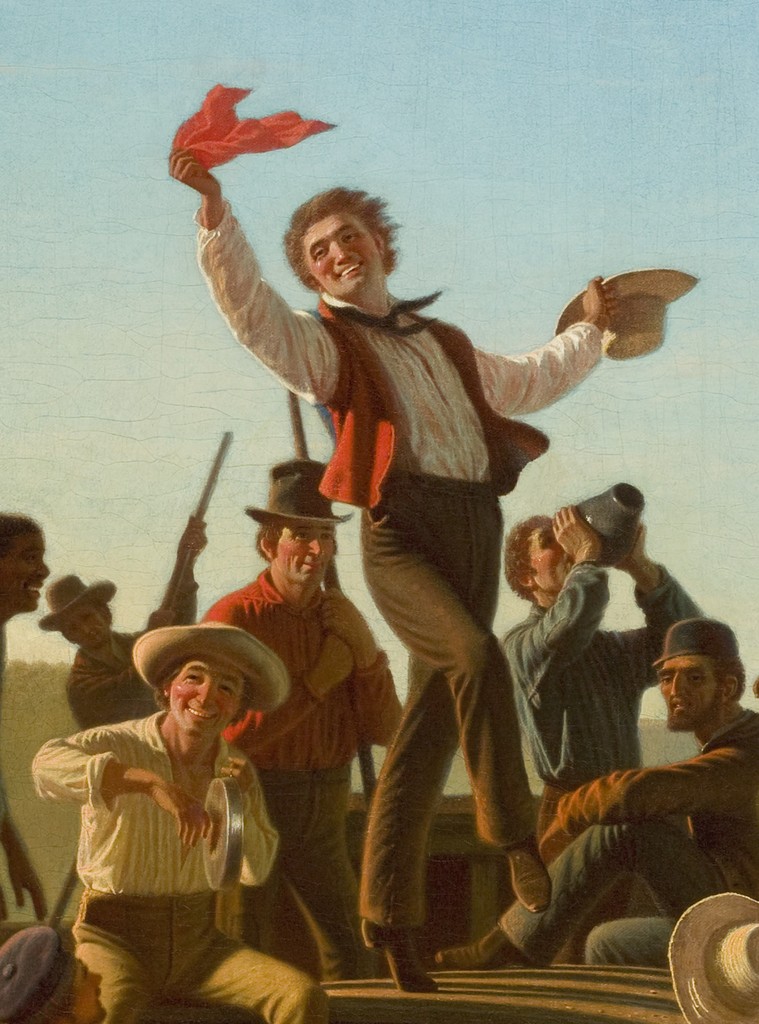
The dancer with cloth and hat
The dancer raises a bright cloth in one hand and a hat in the other. His open arms and uneven legs lift the action above the crowded deck, while the surrounding bodies give the movement a broad base.
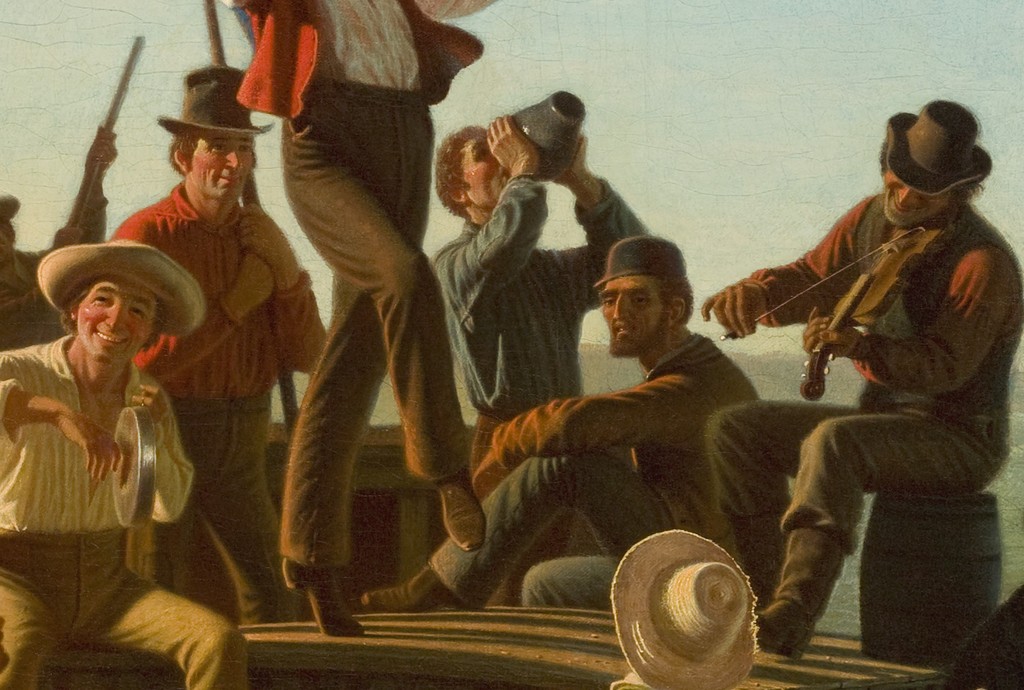
A lifted vessel and a fiddle
A lifted vessel and the angled fiddle occupy the space beside the dancer. The backward tilt of one head contrasts with the fiddler’s downward attention, allowing separate activities to share the central group.
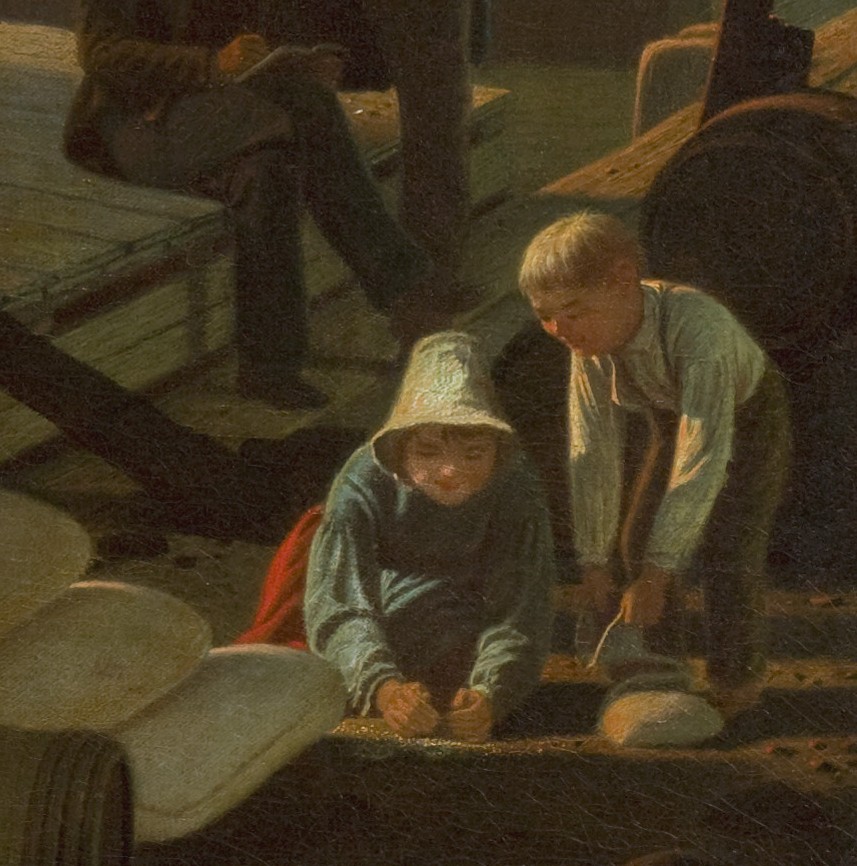
Children at the right edge
Two small figures bend over a low activity at the far right. Their lowered heads and hands create a quieter foreground exchange, set apart from the performance higher on the boat.
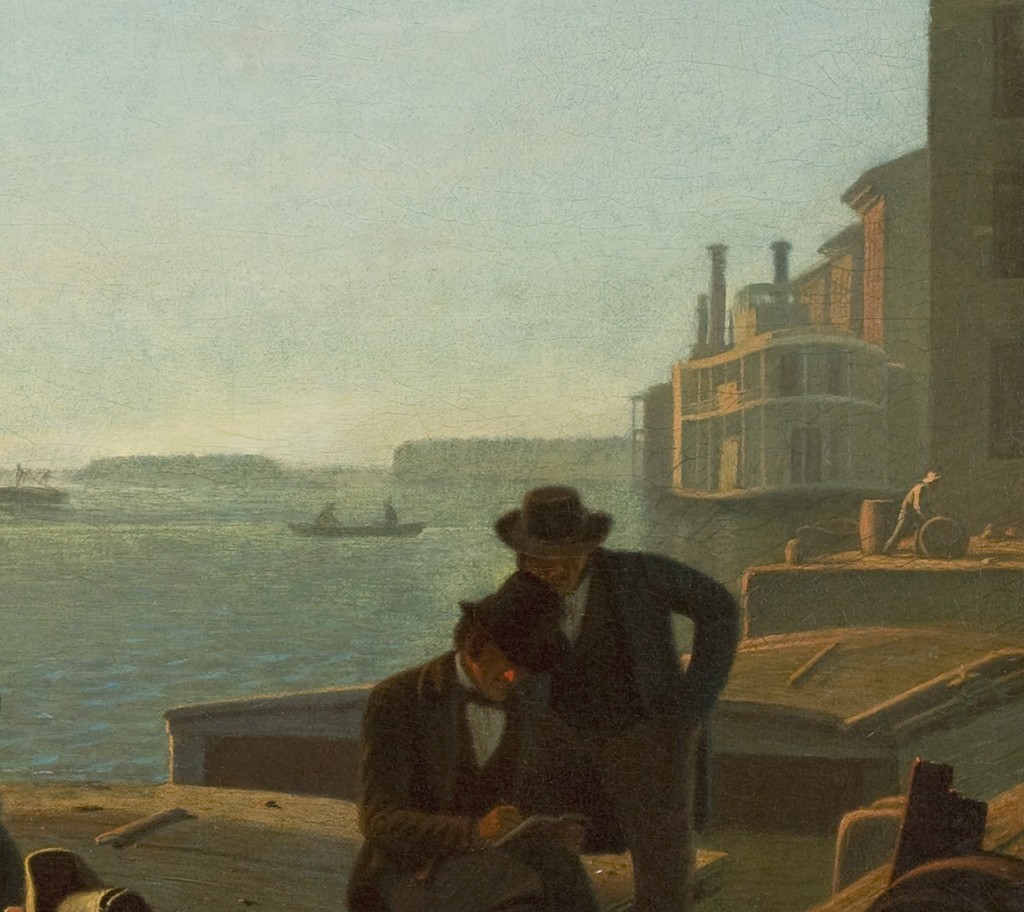
The wharf and steam traffic
Buildings, moored craft and a small steamer give the open water an urban edge. The distant traffic places the entertainment at a destination, with the long waterfront continuing beyond the crowded boat.
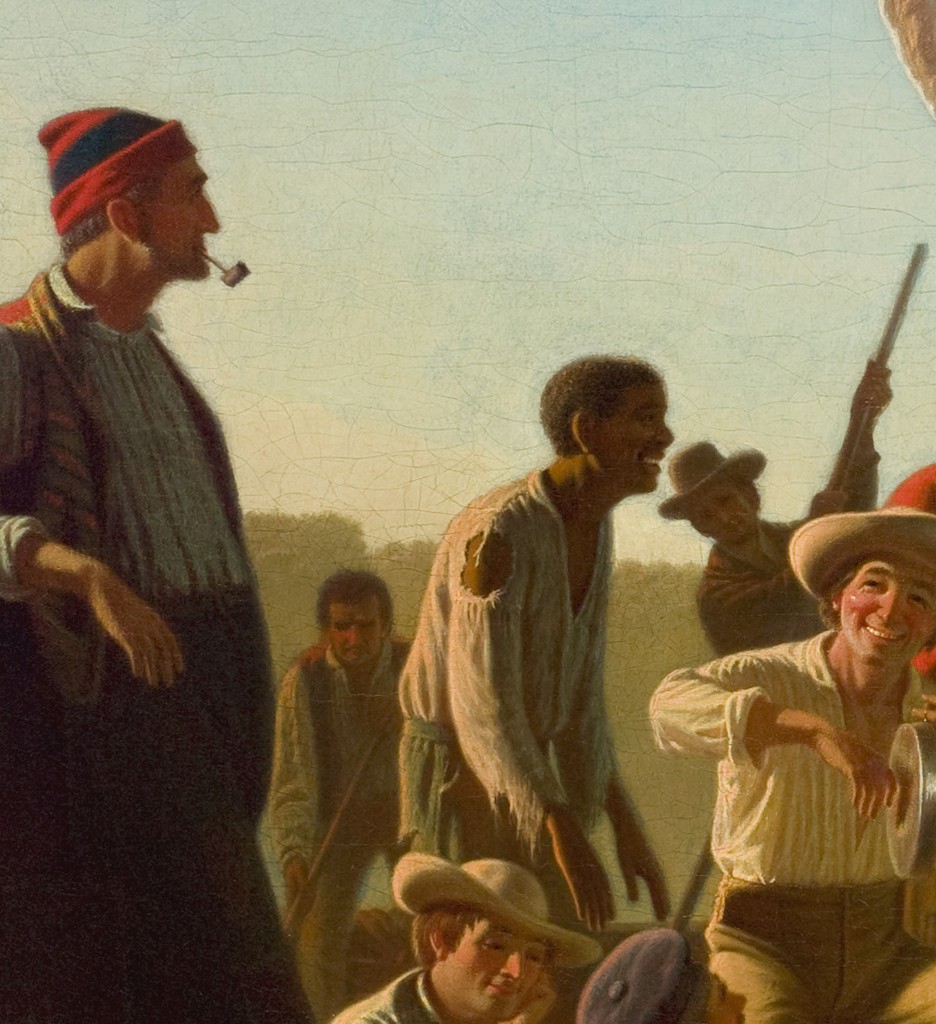
Standing figures on the left
The worn shirt and turned head of the standing figure make a distinctive shape beside the seated company. A smaller figure remains partly enclosed by surrounding bodies, adding another direction of attention below the dancer.
A dancer above a crowded boat
The dancer’s head and outstretched arms stand against open sky. One hand carries the bright cloth, while the other holds a hat. His legs make an animated, uneven shape below the more widely extended arms. The lifted objects enlarge his gesture, making it conspicuous even before the smaller expressions around him become legible.
His position is supported by a series of bodies below. Seated men and musicians establish a broad base, while heads and shoulders rise towards the central figure. This gives the performance a stable setting despite its movement. The dancer seems free to turn and wave because the composition beneath him is so firmly organized.
At the right of the main group, a fiddler draws a bow across his instrument. Near the centre-left, a seated man holds a pan-like object as part of the entertainment. The instruments introduce different scales of action: broad dancing gestures above, smaller movements of hands below. They make the implied sound of the scene easy to imagine without requiring us to identify a particular tune.
The men around the performance do not all take part in the same way. One raises a vessel towards his mouth. Others look towards the dancer or settle into seated positions. A figure in a broad pale hat turns his back to us in the lower centre, while a reclining man further right presents a darker, quieter shape. Their differing orientations give the celebration a social texture beyond the principal performers.
At the far right, two boys occupy a small area close to the bottom edge. They draw attention away from the adult entertainment towards an activity on their own level. At the opposite side, a standing man in a red cap and striped shirt helps frame the group. Between these edges, Bingham makes room for a range of bodies without giving each the same visual prominence.
The port beyond the performance
Cargo and equipment fill the lower foreground. Rounded containers, sacks and timber overlap around the seated men. Their solidity makes the boat a place where goods and people share limited room. The entertainment occupies a working environment, even though the painting does not show a coordinated sequence of loading or unloading.
The river remains visible behind the figures. At the right, a steamboat and the line of the wharf establish a more built-up setting than the open banks in many earlier Bingham paintings. Small boats and distant forms extend the scene without competing with the dancer’s silhouette. The contrast between the busy foreground and the lighter distance gives the picture both density and depth.
The Saint Louis Art Museum interprets another flatboat as having drawn alongside to watch the revelry. That reading makes spectatorship part of the action: the entertainment has an audience beyond its immediate group. The picture’s crowded edges then become evidence of an attraction strong enough to draw people together. [1]
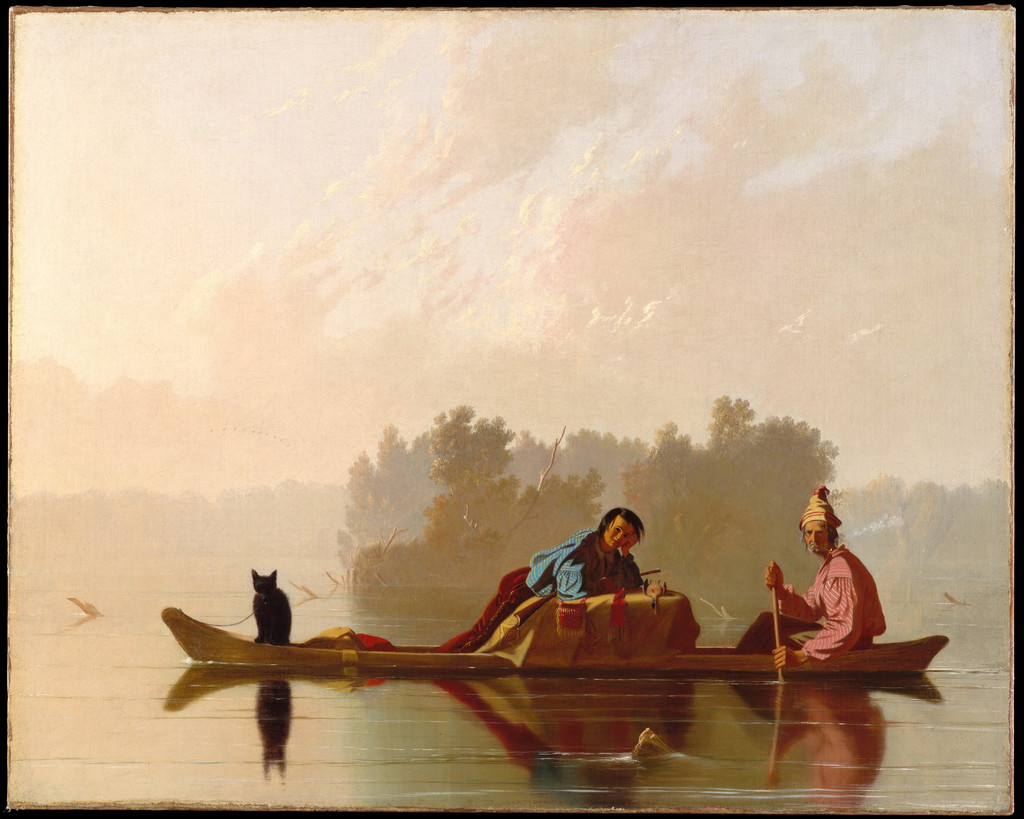
The 2015 exhibition placed the painting at the urban end of an imagined journey through Bingham’s river subjects, beginning with Fur Traders Descending the Missouri . This is a curatorial way of connecting works, rather than a claim that they document one continuous voyage. It highlights how the wharf changes the meaning of a familiar river subject: the boat has reached a destination where commerce and sociability visibly meet. [2]
The people around the entertainment
Two Black figures appear at the left behind the seated musician, partly enclosed by the larger bodies in front. The nearer figure leans towards the gathering in a worn, light-coloured shirt. The other stands further back, with less of his body visible. Looking closely at these figures changes an account concerned only with the dancer and fiddler: the boat’s social world extends beyond its most brightly lit performers.
Their positions also raise questions the image alone cannot settle. Clothing and proximity do not establish a person’s name, employment contract or legal status. Nor does participation in one painted gathering demonstrate equality outside it. The figures should remain part of a description of the scene without being supplied with biographies that the consulted records do not provide.
Across the foreground, Bingham gives different viewers different degrees of access to faces. Some people look towards us, others turn away, and several are partly hidden. This uneven visibility helps make a crowded scene convincing. It also rewards attention to its edges: people who are secondary to the composition can still be important to understanding the society the painter chose to represent.
Watch: George Caleb Bingham
Choose a film to explore the artist’s work, its interpretation and its wider setting.
Navigating the West: George Caleb Bingham and the River at the Amon Carter Museum of American Art
The Amon Carter Museum introduces an exhibition devoted to Bingham’s river paintings.
Watch on YouTubeWhat changed after The Jolly Flatboatmen of 1846?
In the earlier Jolly Flatboatmen , now in the National Gallery of Art, a dancer also rises above musicians and resting workers. That painting dates from 1846. Its group is more compact, with open water and distant banks forming a quiet setting behind the figures. The basic relationship between an animated summit and a stable base was already present. [4]
The 1857 picture expands the surrounding social world. More bodies occupy the foreground, the nearby boat gives the performance additional observers, and the wharf places it beside an urban waterfront. Resting figures now share space with a broader mixture of spectators and participants. The result feels less like a small crew’s self-contained amusement and more like a performance spreading through a port.
Colour also moves attention through the larger canvas. The red cloth is the most emphatic accent above the dancer; red caps and warm garments echo it lower down. Pale hats, shirts and sacks form other points of connection. These repeated colours help us move among the figures without losing the hierarchy established by the dancer’s height.
Conrads’s account of the 1846 painting stresses the relationship between Bingham’s orderly grouping and his characterization of river workers. His composed, companionable figures offered an alternative to familiar images of a violent or unruly frontier. Looking at the later scene through that discussion helps explain why the crowd can be lively without dissolving into visual disorder. It remains an interpretation of how the painter shaped his subjects, rather than evidence that every actual wharf gathering was equally harmonious. [14]
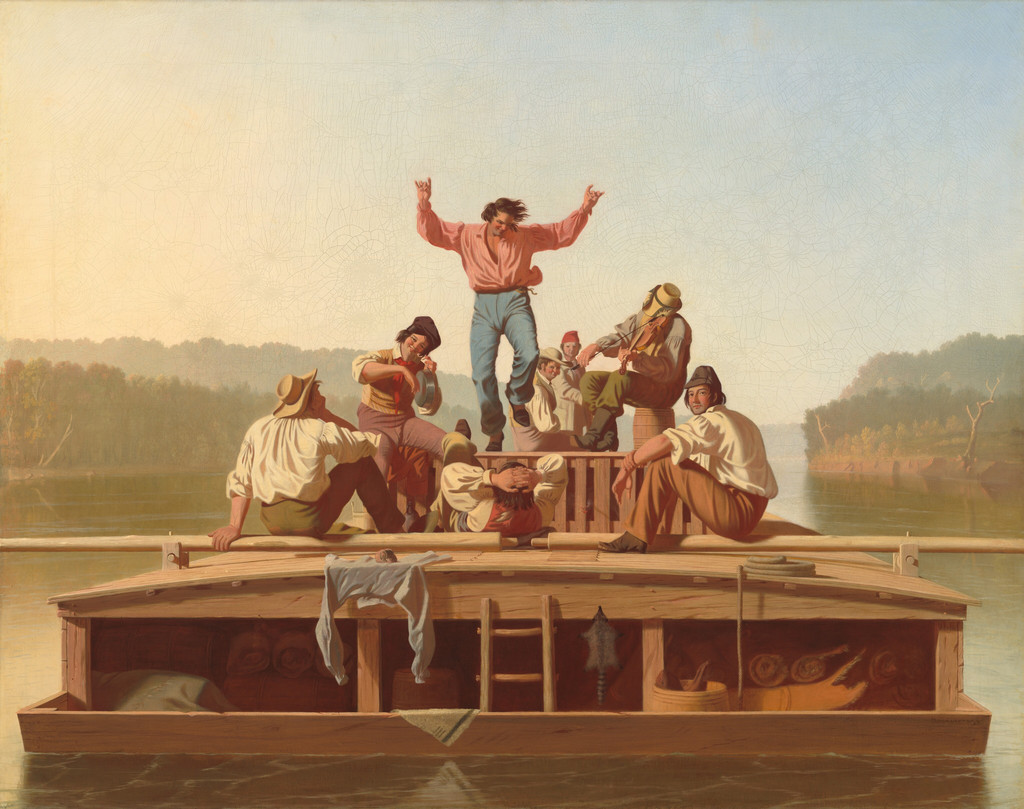
George Caleb Bingham, The Jolly Flatboatmen, 1846. Oil on canvas. National Gallery of Art, Washington, Patrons’ Permanent Fund, 2015.18.1.
Image source
.
Public domain
.
Familiar poses in a new setting
Several studies connect the port scene with other paintings. The 2015 exhibition links Raftsman Dozing to both Raftsmen Playing Cards of 1847 and this work, with changes in pose. It also identifies a Raftsman study used in both compositions. Reuse gave Bingham a way to develop a new gathering from figures whose weight and attitude he had already considered. [2]
Other sheets are associated with the port picture’s particular occupations and actions. The exhibition lists a Dockhand for the 1857 painting and studies called Skillet-beater (2) and Fiddler (2) that also relate to the later 1877–78 Jolly Flatboatmen . The links are specific: the fiddler study includes an alteration to the little finger of the right hand. Such a detail gives a more precise account of revision than saying that all the figures were simply copied. [2]
The drawings help us see the canvas as an assembly of decisions. A study might establish a body’s position, but the finished group requires new intervals, overlaps and companions. The musician must remain visible beside the dancer; a resting figure must contribute to the foreground without competing with the performance. Bingham’s style and technique depend on this relationship between individual form and collective arrangement.
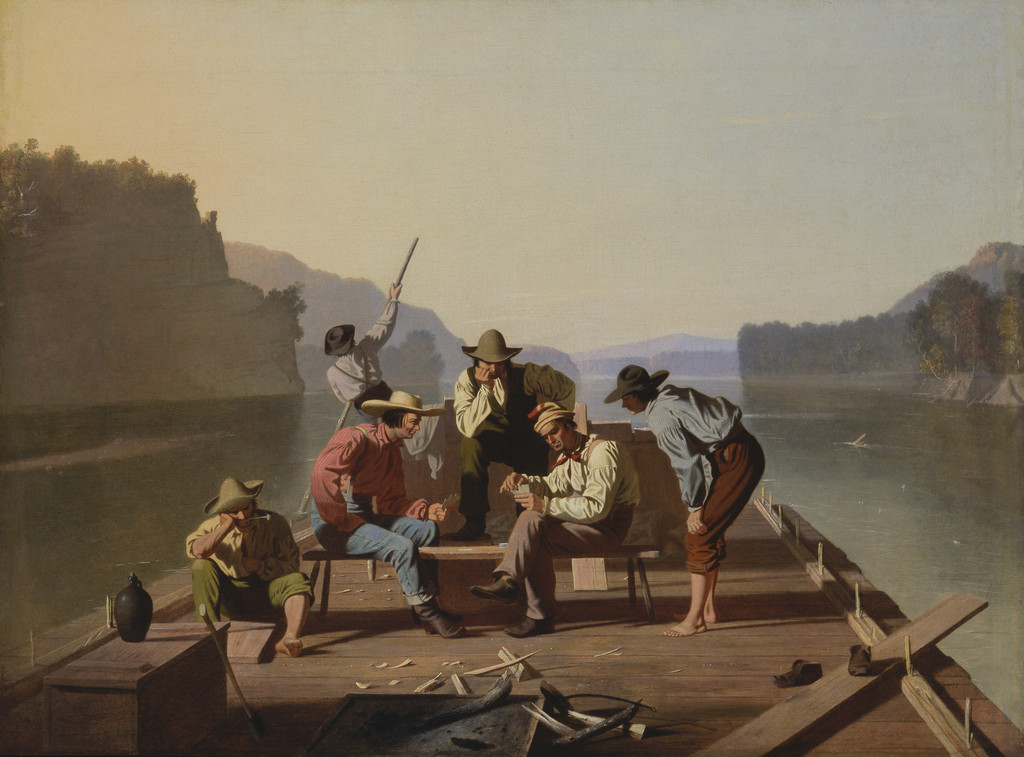
George Caleb Bingham, Raftsmen Playing Cards, 1847. Oil on canvas. Saint Louis Art Museum, Bequest of Ezra H. Linley, by exchange, 50:1934.
Image source
.
Public domain
.
Ownership and the later return to the subject
The museum’s provenance follows the painting through John How, John H. Beach and the St. Louis Mercantile Library before its purchase for the museum in 1944. It also records the earlier loan from Bingham to the library in 1862. The circumstances of Beach’s acquisition remain unclear in the record; a complete chain should not be inferred from the sequence of names alone. [1]
Bingham’s final Jolly Flatboatmen , in the Terra Foundation collection, dates from 1877–78. The owning record explicitly corrects an earlier dating to 1848. It is a separate late return to the subject, not another title for Jolly Flatboatmen in Port . Keeping the dates and collections apart allows the 1857 painting’s scale, crowded wharf and European production to retain their particular place in his career. [15]
Returning to the port canvas, the dancer is only the beginning of a rewarding look. Follow the raised cloth down through the musicians, then across the resting bodies and the crowded boat edges to the wharf. The painting’s breadth becomes apparent through that movement: one conspicuous performance holds together a scene filled with different ways of passing time beside the river.
Artworks directory
A documented selection discussed across these articles, including separate canvases, figure studies and reproductive impressions. Dates identify the particular object or study; collection and title distinctions follow museum records and the 2015 exhibition checklist. This is not a catalogue raisonné. Prints are grouped with works on paper in the Drawing filter.
| Name | Date | Medium |
|---|---|---|
| Fur Traders Descending the Missouri | 1845 | Painting — oil on canvas |
| The Jolly Flatboatmen | 1846; NGA canvas | Painting — oil on canvas |
| The County Election (original) | 1851–52 | Painting — oil on canvas |
| Stump Speaking | 1853–54 | Painting — oil on canvas |
| The Verdict of the People | 1854–55 | Painting — oil on canvas |
| Order No. 11: Martial Law | 1865–68; Cincinnati original | Painting — oil on canvas |
| Daniel Boone Escorting Settlers through the Cumberland Gap | 1851–52 | Painting — oil on canvas |
| Canvassing for a Vote | 1852; signed canvas | Painting — oil on canvas |
| Raftsmen Playing Cards | 1847 | Painting — oil on canvas |
| Mississippi Boatman | 1850 | Painting — oil on canvas |
| Jolly Flatboatmen in Port | 1857 | Painting — oil on canvas |
| The County Election (replica illustrated here) | 1852 | Painting — oil on canvas |
| Martial Law or Order No. 11 (Missouri replica) | 1870 | Painting — oil on canvas |
| The Jolly Flatboatmen (Terra canvas) | 1877–78 | Painting — oil on canvas |
| John Quincy Adams (later version) | about 1850, after an 1844 original | Painting — oil on canvas |
| Country Politician | 1849 | Painting — oil on canvas |
| The Trappers’ Return | 1851 | Painting — oil on canvas |
| The Concealed Enemy | 1845 | Painting — oil on canvas |
| The Wood-boat | 1850 | Painting — oil on canvas mounted on board |
| Lighter Relieving a Steamboat Aground | 1847 | Painting — oil on canvas |
| Watching the Cargo | 1849 | Painting — oil on canvas |
| In a Quandary | 1851 | Painting — oil on canvas |
| Boatmen on the Missouri | 1846 | Painting — oil on canvas |
| Self-Portrait (Saint Louis) | 1834–35 | Painting — oil on canvas |
| Self-Portrait (Nelson-Atkins) | about 1877 | Painting — oil on canvas |
| Mrs. David Steele Lamme and Son William Wirt | 1837 | Painting — oil on canvas |
| Portrait of Leonidas Wetmore | 1839–40 | Painting — oil on canvas |
| Fur Trader (study for Fur Traders Descending the Missouri) | 1845 | Drawing — brush, ink and wash over pencil |
| Skillet-beater (study for The Jolly Flatboatmen) | 1846 | Drawing — brush, ink and wash over pencil |
| Young Wood-boatman (study for The Wood-boat) | 1850 | Drawing — brush, ink and wash over pencil |
| Thomas Doney after Bingham: The Jolly Flat Boat Men (Met impression) | 1847 | Print — mezzotint and engraving with etching |
| Thomas Doney after Bingham: The Jolly Flat Boat Men (coloured Carter impression) | 1847 | Print — intaglio with applied watercolour |
| The Verdict of the People (lithographic proof) | ca. 1858–59 | Print — lithographic proof |
| Gautier after Bingham: Stump Speaking | 1856 | Print — etching and aquatint |
| Claude Regnier after Bingham: In a Quandary, Mississippi Raftsmen Playing Cards | 1852 | Print — hand-coloured lithograph |
Frequently Asked Questions
Discussion
Look again at the images and ideas explored in Jolly Flatboatmen in Port. These editorial prompts invite your observations.
Which feature makes this feel most like a port: the waterfront, the second boat or the crowded foreground? Compare what changes when you concentrate on each one.
Reader Insights
How does the waterfront change the meaning of the entertainment?
What does the dancer gain from the crowded group around him?
Which differences from the 1846 painting matter more than the repeated subject?
Join the Conversation
Share a detail, comparison or question about Jolly Flatboatmen in Port below.
References
- Saint Louis Art Museum , Jolly Flatboatmen in Port , 123:1944. Current object record, interpretation and provenance. View source
- Navigating the West: George Caleb Bingham and the River , exhibition labels, 2015. Particularly pp. 10 and 19–20, on Düsseldorf, reused drawings, the port painting and the late Jolly Flatboatmen . View source
- Metropolitan Museum of Art, Fur Traders Descending the Missouri. View source
- National Gallery of Art , The Jolly Flatboatmen , 1846, 2015.18.1. Current identity and composition of the earlier painting. View source
- Saint Louis Art Museum, Raftsmen Playing Cards. View source
- National Gallery of Art, Mississippi Boatman. View source
- Saint Louis Art Museum, The County Election, 1851–52, 124:1944. View source
- Saint Louis Art Museum, The County Election, 1852 replica, 44:2001. View source
- Kemper Art Museum, Washington University, Daniel Boone Escorting Settlers through the Cumberland Gap. View source
- Nelson-Atkins Museum of Art, Canvassing for a Vote. View source
- Saint Louis Art Museum, Stump Speaking. View source
- Saint Louis Art Museum, The Verdict of the People. View source
- Cincinnati Art Museum, Order No.11 / Martial Law. View source
- Margaret C. Conrads , “Bingham@200: A Bicentennial Celebration,” Antiques & Fine Art , Spring 2011, pp. 193–199. Particularly p. 196, on the characterization of river workers and the 1846 painting’s order. View source
- Terra Foundation for American Art , The Jolly Flatboatmen , 1877–78, 1992.15. Current date and correction of the earlier 1848 dating. View source
- Splash image source.
George Caleb Bingham, Jolly Flatboatmen in Port, 1857. Oil on canvas, 120 × 176.8 cm. Saint Louis Art Museum, Museum Purchase, 123:1944. Public domain .
View source