 by
Tom Gurney
Tom Gurney BSc (Hons) is an art history expert with over 20 years experience
Email:
tomgurney1@gmail.com
/ Phone:
+44 7429 011000
George Caleb Bingham Drawings and Prints: Introduction
Drawings helped George Caleb Bingham construct his paintings; prints helped other people encounter them. Between those two uses of paper lay a sequence of decisions about bodies, settings, materials and audiences. His surviving figure studies reveal preparation behind scenes that can initially look like moments of everyday life observed intact. Reproductive engravings gave completed compositions a different form and a much wider circulation. [1]
The distinction is practical as well as artistic. A drawing might remain available in the studio after a painting was sold. A print could carry a familiar dancer or election crowd into a private home far from the canvas. An early photograph could preserve another kind of record. Together these objects explain how Bingham’s images were made, remembered and reused.
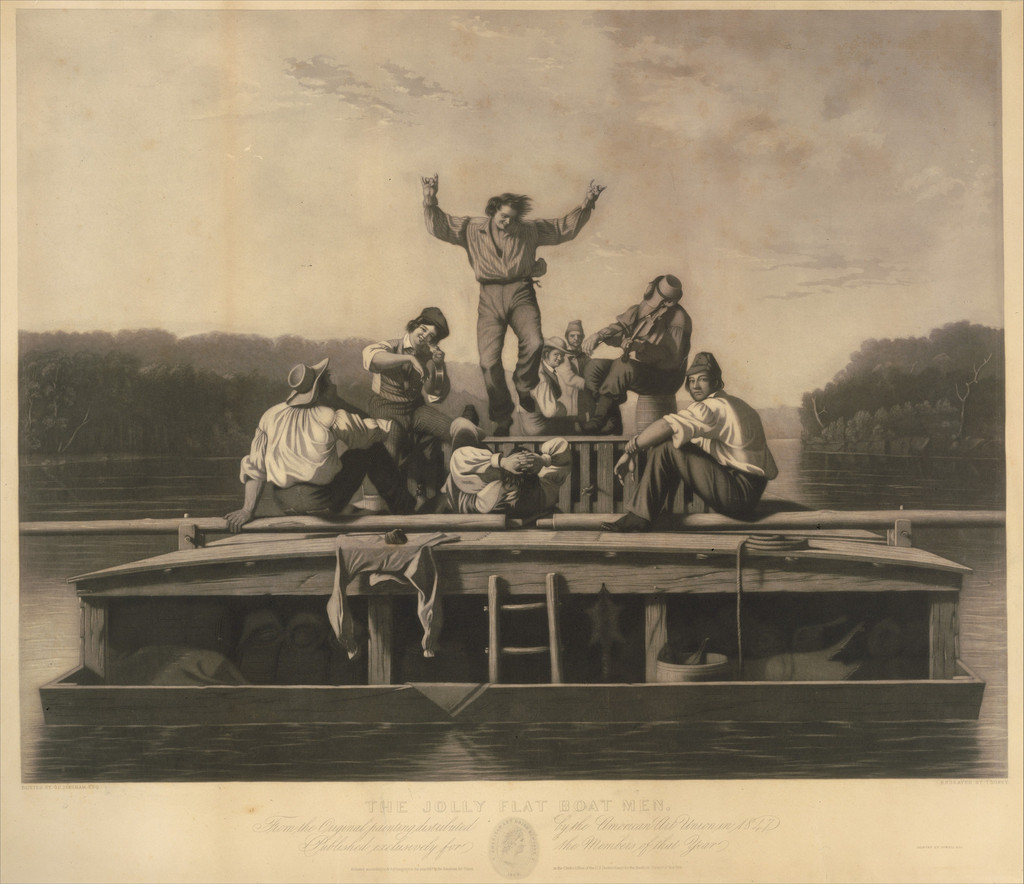
Two impressions after The Jolly Flatboatmen
At a Glance
- Drawing materials Pencil, ink and wash among the surviving figure studies [1]
- Studio use Preparing and reusing figures in painted compositions [1]
- Reproduction Prints translated paintings for wider audiences [2]
- Illustrated print Doney after Bingham, The Jolly Flat Boat Men, 1847 [3]
Contents
- From a model to a pictorial character
- Paper, wash and the move to canvas
- Keeping a figure available for another setting
- A painting becomes a published print
- A new composition for a European publisher
- Sartain, subscriptions and the cost of a print
- What an early photograph could preserve
- Drawings kept together for the People of Missouri
- Annotated details
From a model to a pictorial character
The Met’s 2015 exhibition described Bingham’s models as often drawn from friends and neighbours, dressed and posed as river people. Their presence in a drawing consequently does not establish that every depicted occupation belonged to the person who sat. The artist could observe a body closely while constructing a character for a particular subject. [1]
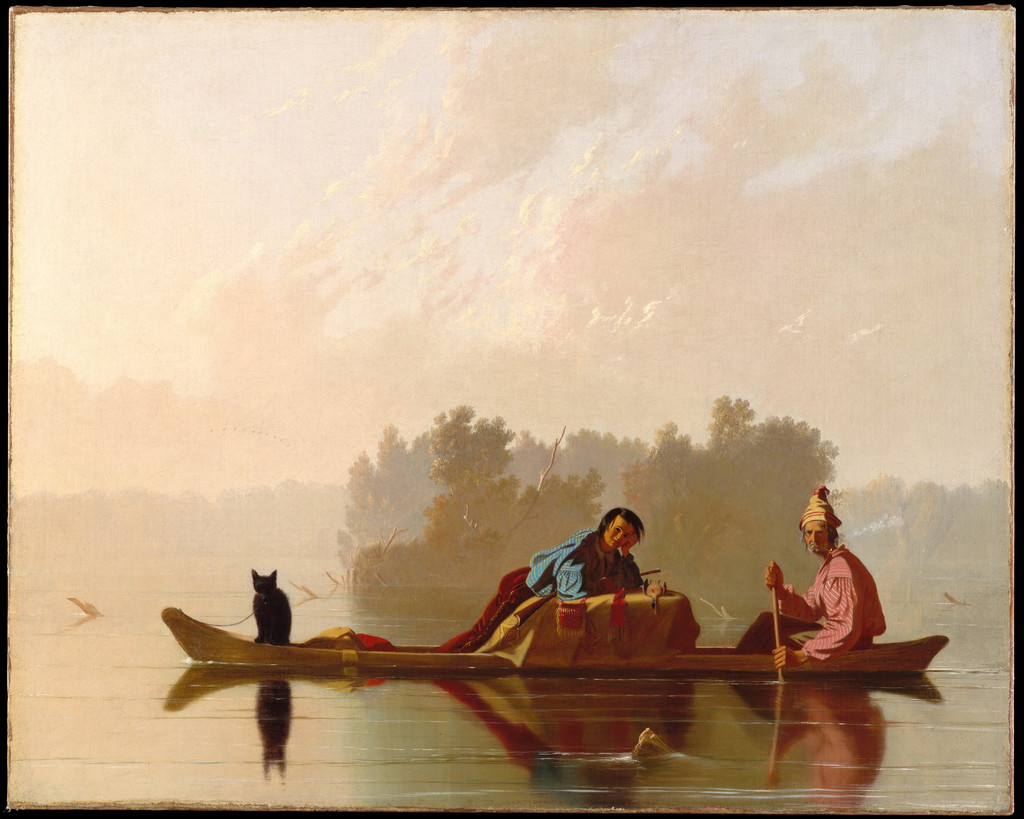
Margaret Conrads makes that transformation clear in her discussion of the 1845 Fur Trader study. Bingham developed the older man in the painting from a drawn model, changing age and facial expression. Preparation preserved useful information without binding the finished work to one exact likeness. The distinction connects the drawings with his portraits , where a named sitter and an intended public identity create a different kind of obligation. [2]
Bodies also had to fit an arrangement. A compact seated figure, an extended arm or a turning head could be studied before being placed among other people. Separate sheets allowed attention to clothing folds, hands, feet and shadows. Those details helped Bingham give a group variety while retaining clear relationships between its parts.
The 2015 exhibition offered a telling example in a study for Lighter Relieving a Steamboat Aground . Bingham left part of a man’s lower body undrawn because cargo would conceal it in the completed scene. Such a sheet can be highly specific without describing a whole body. Its usefulness depended on a compositional decision already made. [1]
Annotated Details from George Caleb Bingham Drawings and Prints
The numbered points identify visible features discussed in this article. Return from each detail to the whole composition. The captions keep each work’s identity, date and medium separate.
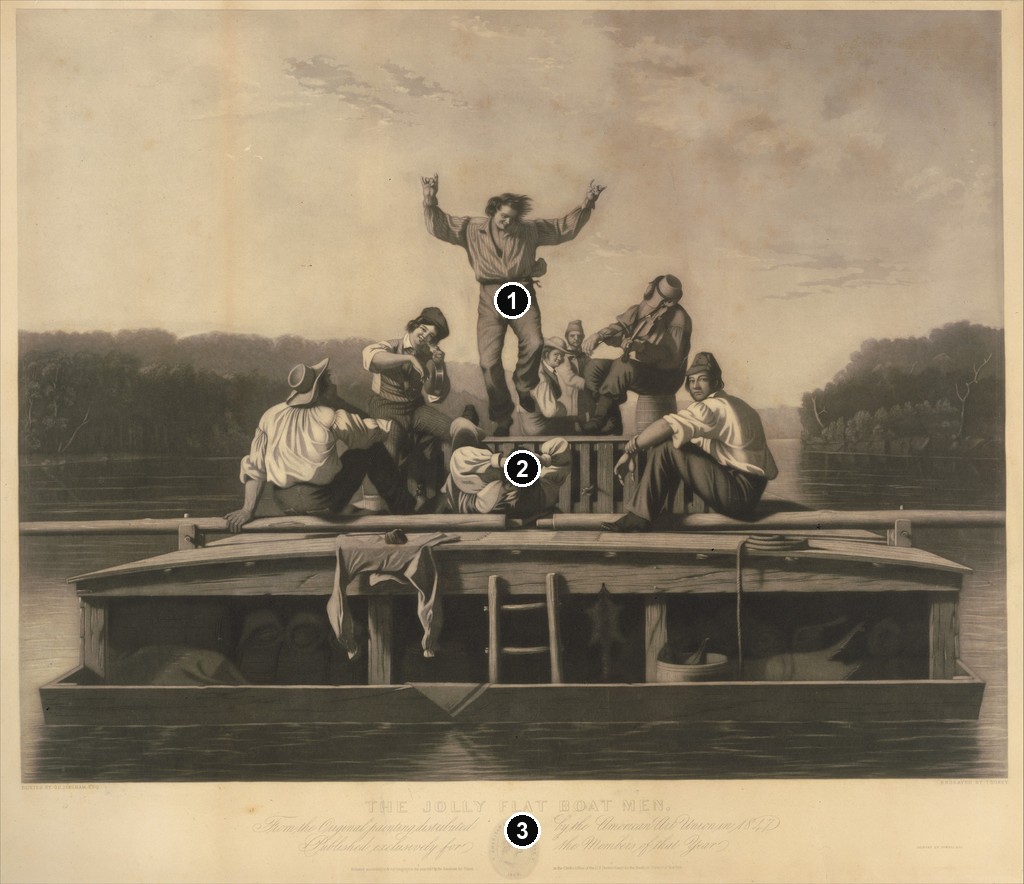
Thomas Doney after Bingham, The Jolly Flat Boat Men, Met impression, 1847
Thomas Doney after George Caleb Bingham, The Jolly Flat Boat Men, 1847. Mezzotint and engraving with etching; published by the American Art-Union and printed by Powell and Company. The Metropolitan Museum of Art, 42.119.68. Image source. Public domain. Numbers added to a separate overview. Detail images are crops of the source reproduction; the whole supplied sheet remains visible in the overview.
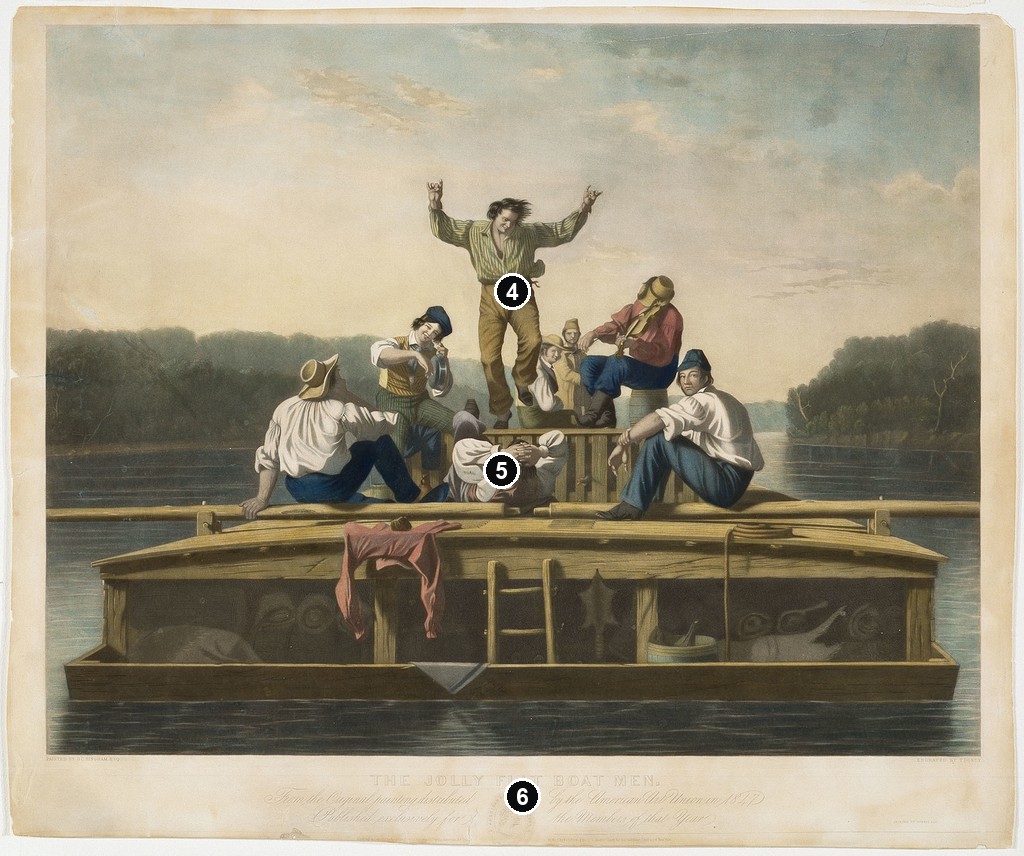
Thomas Doney after Bingham, The Jolly Flat Boat Men, coloured Carter impression, 1847
Thomas Doney after George Caleb Bingham, The Jolly Flat Boat Men, 1847. Aquatint, engraving, stipple, etching and roulette with applied watercolour. Amon Carter Museum of American Art, Fort Worth, Texas, 1971.44. Image courtesy of the Amon Carter Museum of American Art. Image source. Public domain. Numbers added to a separate overview. Detail images are crops of the source reproduction; the whole supplied sheet remains visible in the overview.
Details from GEORGE CALEB BINGHAM DRAWINGS AND PRINTS
Compare the cropped details with the complete images above. Notice how their colours, shapes and positions contribute to the larger compositions.
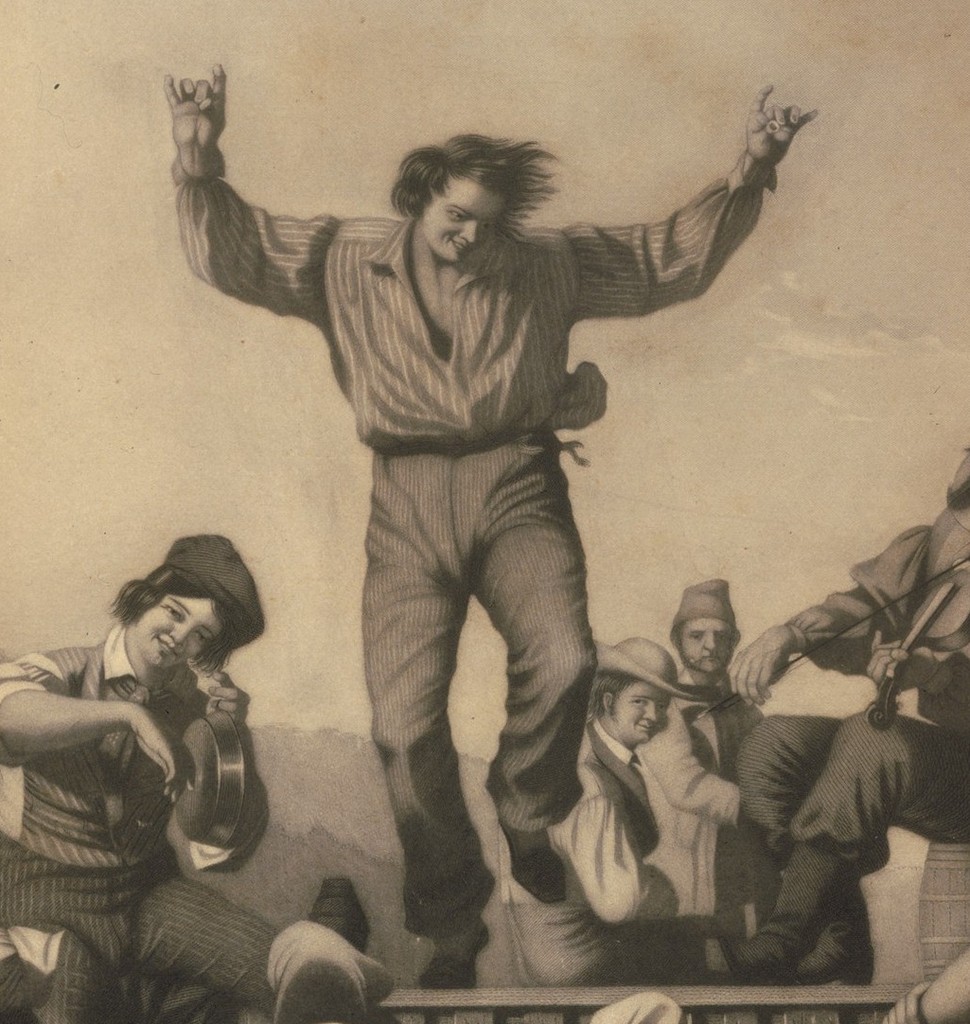
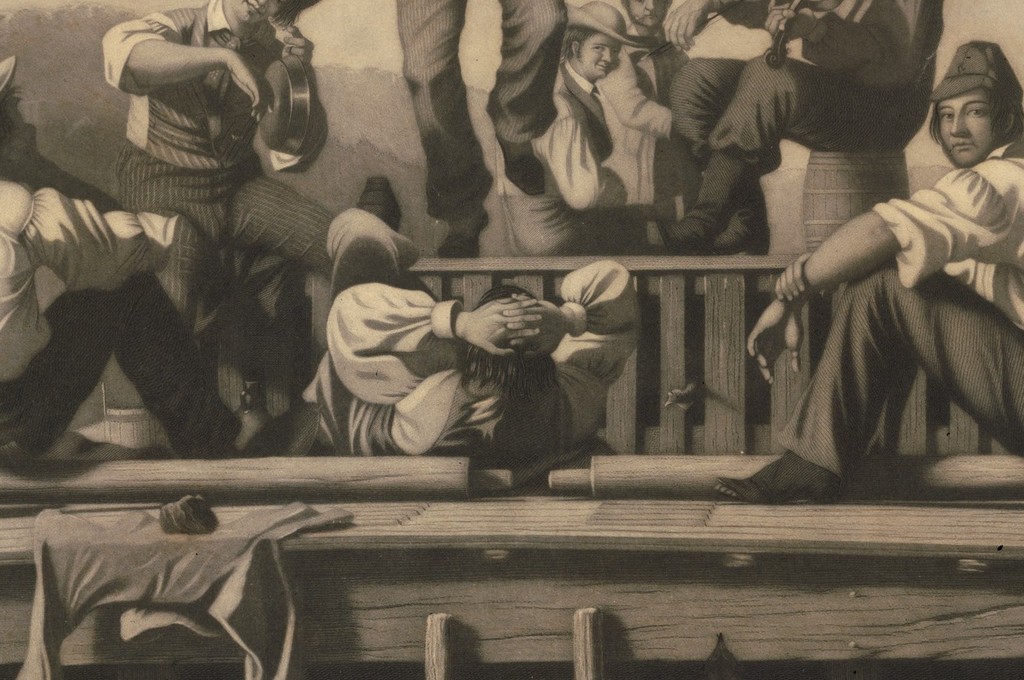
Thomas Doney after Bingham, The Jolly Flat Boat Men, Met impression, 1847
The dancer translated into tone
The dancer’s raised arms and bent legs remain easy to follow without the painting’s red and blue. Pale cloth and darker folds separate the body from the sky through changes of tone across the printed image.
Pale clothing around the resting figure
Broad pale sleeves lead towards the resting foreground figure. Darker hats, waistcoats and the boat rail divide the surrounding bodies, allowing the group to hold together through contrasts of light and shade.
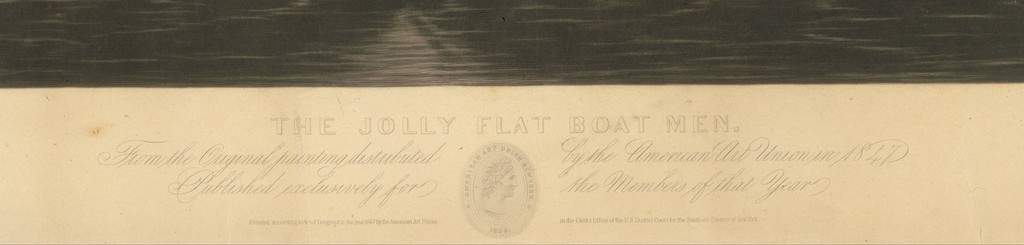
The title and the subscribers’ inscription
The title and flowing script occupy a separate margin below the image. This printed text presents the scene as an object made for circulation, with the picture and its inscription sharing the paper sheet.
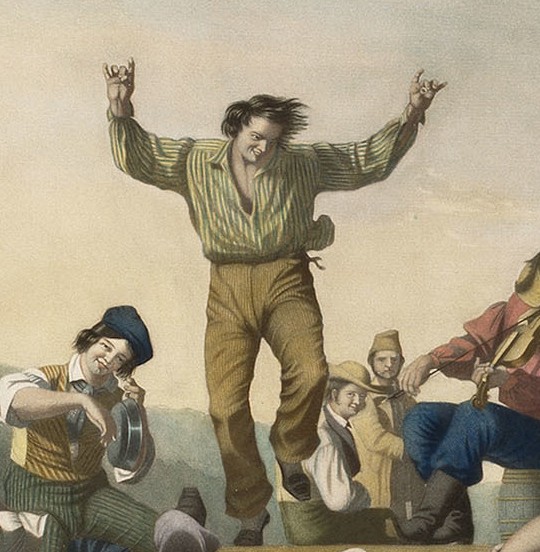
Thomas Doney after Bingham, The Jolly Flat Boat Men, coloured Carter impression, 1847
Colour on the dancer
The green striped shirt and brown trousers distinguish this dancer from the red-shirted figure in the painting. The applied colours also give this impression a different presence from the uncoloured sheet beside it.
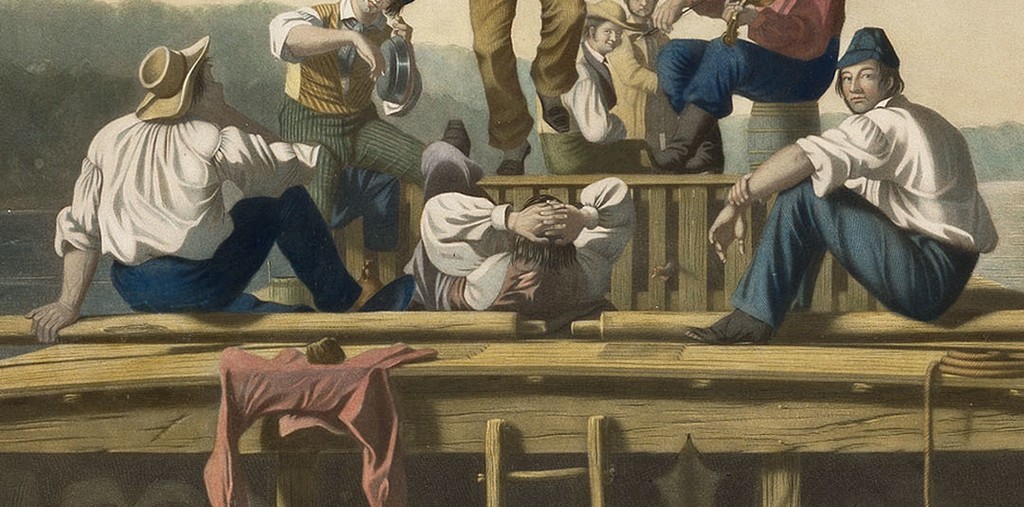
Colour distributed through the group
Blue trousers, yellow clothing and the red garment crossing the boat distribute colour among separate forms. Pale shirts still provide broad light shapes against the darker hull and the surrounding landscape.
The margin around the printed scene
The print’s title, script and surrounding paper remain part of the object. The margin distinguishes this particular impression from a reproduction cropped to show the painted composition alone.

Paper, wash and the move to canvas
The figure studies combine pencil with brush, ink and wash in different ways. Line can establish a boundary, while a broader area of wash develops shadow and volume. The exhibition’s account of the pan player for The Jolly Flatboatmen pointed out small test marks where Bingham checked the amount of wash on his brush. A working sheet could record experiments with the medium alongside a carefully finished figure. [1]
Some sheets also preserve evidence of transfer. For The Wood-boat , the exhibition described outlines traced with a pointed stylus and impressions left in the paper. It identified a change in the position of a pole during that process, with the alteration carried into the painted figure. Transfer was therefore another opportunity to revise the design. [1]
Registration marks offer a further connection between paper and canvas. In the studies associated with The Trappers’ Return of 1851, marks helped align the figures with positions on the prepared surface. Impressions in the son’s drawing correspond with contours in the painting’s underdrawing. The material evidence gives more precision to an account of preparation than the general statement that Bingham must have sketched first. [1]
The dates of the sheets remain essential. The older trader’s study originated with Fur Traders Descending the Missouri in 1845 and was reused in 1851. Trapper’s Son belongs to the later painting. Treating both as 1845 preparation would turn evidence of reuse into an inaccurate story about the first canvas. [1]
Keeping a figure available for another setting
Bingham could do more than move a figure from one composition to another. The exhibition explained how tracing through a sheet against a light source, such as a window, could produce a reversed version on its back. The changed direction allowed a familiar body to face differently within a new arrangement. Clothing and other details could also be altered. [1]
Reuse therefore helps reveal both continuity and invention. A recognisable pose can survive while its age, expression, companions and surroundings change. The central figure of Watching the Cargo became the older, isolated presence in Mississippi Boatman . A useful study did not carry one unchangeable personality or narrative with it. [1]
The drawings also preserved decisions after the paintings left the artist. Conrads discusses incised outlines and traces of material on the backs of some sheets as evidence for their practical use. Their finished appearance and their working marks belong together. They can be appreciated as images while also being read as objects handled during the making of other works. [2]
This is why the collection matters beyond the identification of a model for one painting. It records a set of bodies that remained available for new combinations. The style and technique article follows how those combinations contribute to the order of the finished scenes.
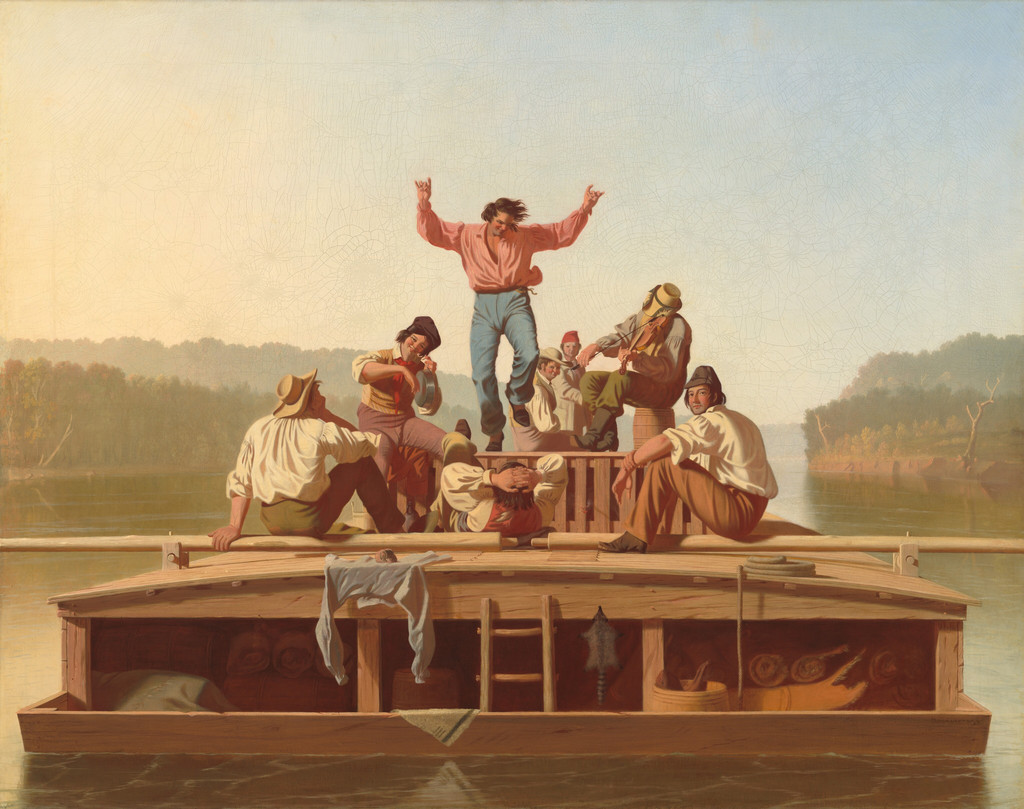
George Caleb Bingham, The Jolly Flatboatmen, 1846. Oil on canvas. National Gallery of Art, Washington, Patrons’ Permanent Fund, 2015.18.1.
Image source
.
Public domain
.
A painting becomes a published print
Thomas Doney’s The Jolly Flat Boat Men makes the difference between painting and print especially clear. The Met’s impression, dated 1847, is catalogued as mezzotint and engraving with etching. The American Art-Union published it, and Powell and Company printed it. The work identifies several participants in the movement from Bingham’s canvas to a reproducible image. [3]
In the monochrome sheet, light and dark carry relationships that the painting also establishes through colour. The dancer’s body still rises above the gathering, the musicians remain on either side and the boat holds the group together. Below the image, the title and publication lettering give the scene a named identity outside the depicted river world.
The Met explains the Art-Union’s combination of an engraving for subscribers with a lottery for original artworks. The system joined a public exhibition to objects that members could possess privately. The 2015 exhibition records distribution of the Jolly Flatboatmen print in 1848 to more than 9,500 subscribers. The print’s 1847 date and that distribution year should remain distinct. [3] [1]
An impression at the Amon Carter Museum of American Art, accession 1971.44, adds another comparison. Its current record includes applied watercolour and describes a different combination of print processes from the Met’s record. It is a separate impression, with its own material description, rather than an interchangeable illustration for every surviving sheet. [4]
The colour does not simply repeat the painting’s scheme. In the Carter impression, the dancer wears a green striped shirt and brown trousers; the original painting gives him pink and blue. The garment hanging over the boat also changes colour. These visible differences show how a familiar composition could reach viewers through a substantially different surface.
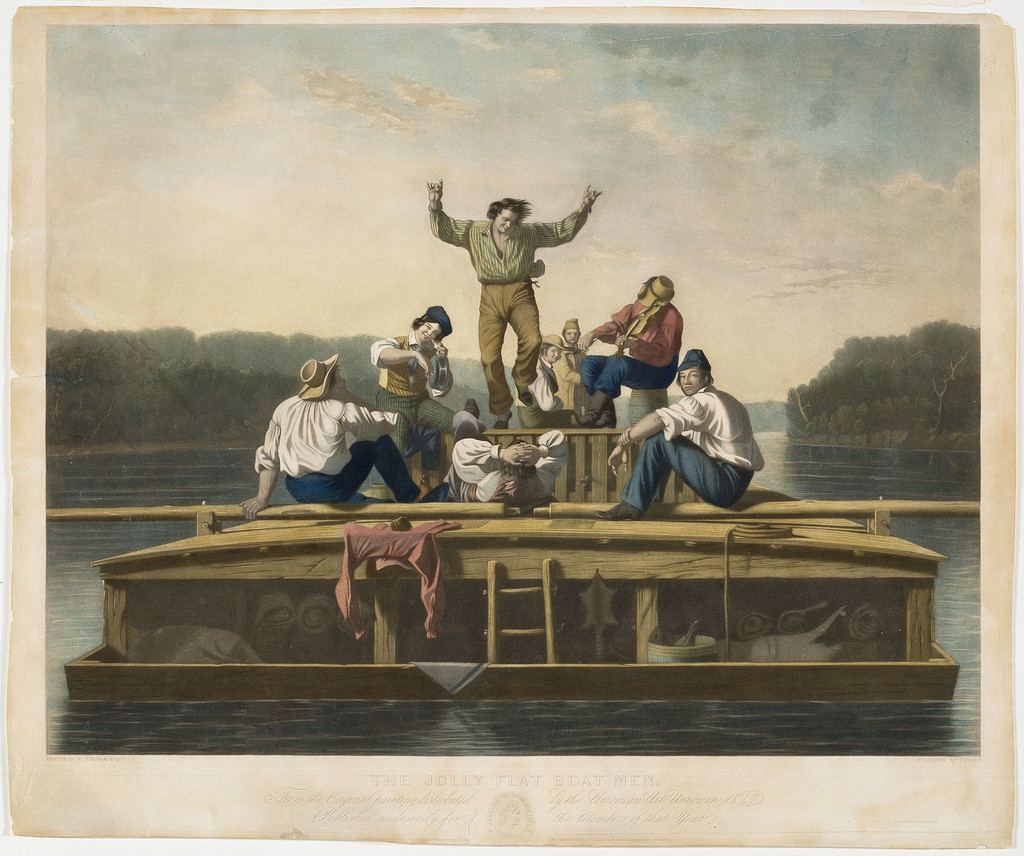
Thomas Doney after George Caleb Bingham, The Jolly Flat Boat Men, 1847. Aquatint, engraving, stipple, etching and roulette with applied watercolour. Amon Carter Museum of American Art, Fort Worth, Texas, 1971.44. Image courtesy of the Amon Carter Museum of American Art.
Image source
.
Public domain
.
A new composition for a European publisher
Bingham’s next major river print project involved Goupil and Company. The 2015 exhibition explained that the publisher’s 1852 print was based on In a Quandary , painted in 1851, rather than simply reproducing the 1847 Raftsmen Playing Cards . The American Art-Union had bought the earlier canvas. Bingham developed another version for the new publication. [1]
The changes went beyond the practical existence of a second painting. The exhibition identified fewer figures, a boat nearer the bank and a rougher characterisation of the men, relating those choices to a European audience. The printed image could therefore emerge from a composition reconsidered for circulation, rather than from an untouched painting translated into another medium. [1]
That sequence brings making and marketing into the same account. An artist could reuse a subject while changing the number of people or the relation of boat and landscape. A publisher’s proposed audience supplied another context for those choices. The Raftsmen Playing Cards article keeps the original painting distinct from the later variation and its print.
Watch: George Caleb Bingham
Choose a film to explore the artist’s work, its interpretation and its wider setting.
Navigating the West: George Caleb Bingham and the River at the Amon Carter Museum of American Art
The Amon Carter Museum introduces an exhibition devoted to Bingham’s river paintings.
Watch on YouTubeSartain, subscriptions and the cost of a print
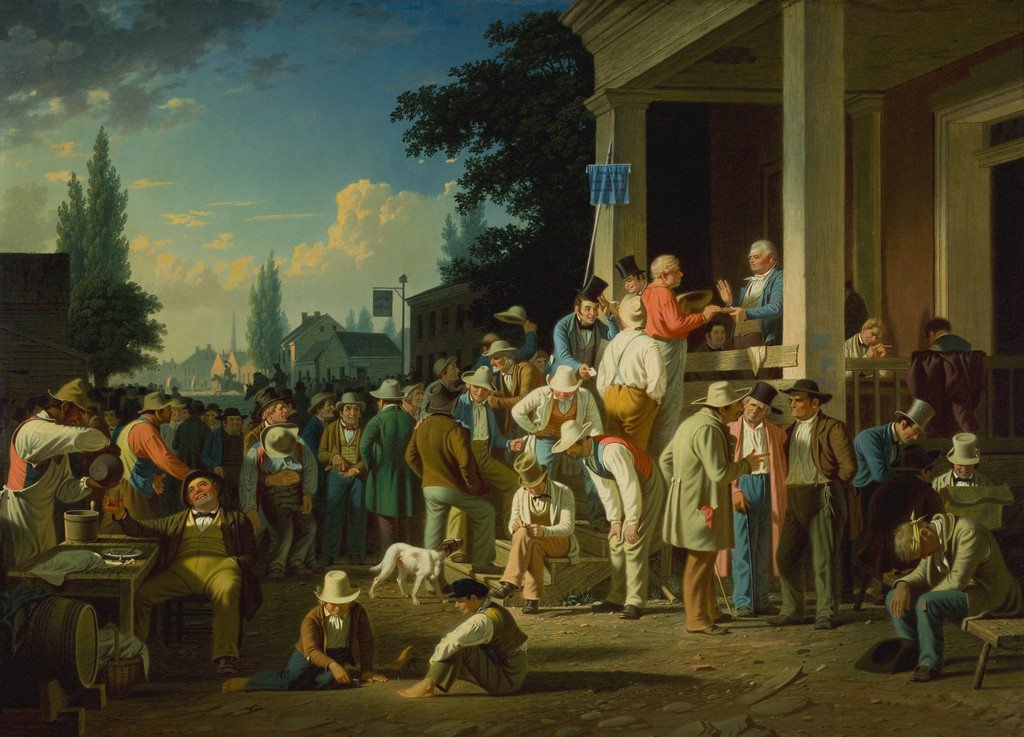
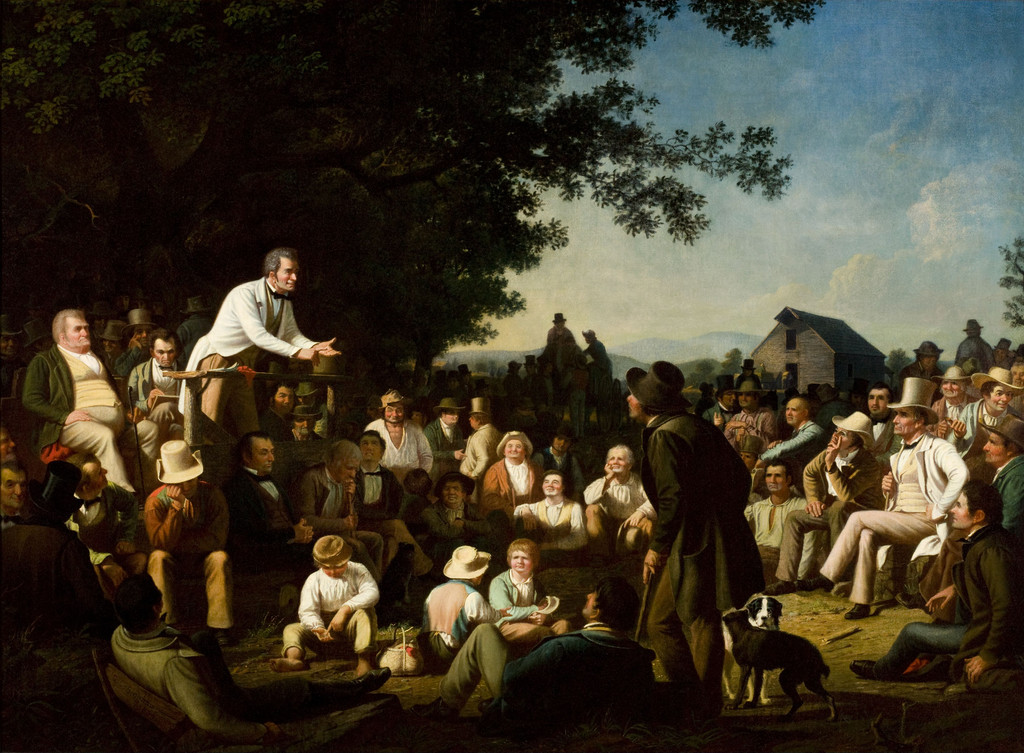
A letter to James S. Rollins dated 7 November 1853 reveals the practical demands of another publishing project. In the surviving transcription, Bingham describes work on the County Canvass , later called Stump Speaking , as a companion to The County Election . He writes, “I have already completed the drawing”, while the painting was progressing. The letter distinguishes preparation, painting and engraving as overlapping activities. [5]
John Sartain was then working on the plate after The County Election . Bingham reports correcting his own misunderstanding of the completion deadline: the contract allowed fourteen months from receipt of the painting. The passage gives time and specialised labour a place in the history of an image that could later appear to viewers as a readily available printed sheet. [5]
Paper required another arrangement. Bingham describes a printer ordering substantial sheets from London and asks Rollins for financial support while he awaited income from subscriptions. The amount discussed for Sartain included money already received, rather than representing an entirely unpaid new balance. His account makes clear that producing an engraving involved commitments before all the anticipated sales income was available. [5]
He hoped to exhibit the new painting and obtain subscribers while distributing the print of the earlier one. The projects could support one another through public attention and anticipated demand. The letter also considers a future picture of Thomas Hart Benton, but that proposal should not be turned into another completed painting. Plans are evidence of ambition and calculation as well as of things actually made. [5]
What an early photograph could preserve
Photography introduced another way to record a painting. The Nelson-Atkins holds Marcus A. Root’s George Caleb Bingham’s “Lighter Relieving a Steamboat Aground” , dated about 1847–49. It is a half-plate daguerreotype , accession 2005.37.77, with a marked Root’s Gallery case. The subject is Bingham’s painting, rather than a boat photographed on the river. [6]
That distinction changes what the photograph can tell us. It records the existence and arrangement of a painted composition through a different medium. It does not independently confirm that the people and vessel occupied that exact relationship in a witnessed event. The chain still begins with an artist’s constructed image.
The Met’s exhibition compared this kind of photographic record with Bingham’s highly finished figure drawings. A painting sold to an institution or collector might no longer be available to him, while the retained studies preserved detailed information useful for future work. A photograph and a drawing could both keep an image accessible, but they did not preserve the same range of information or serve identical purposes. [1]
The small photographic object also makes reproduction a matter of scale. An arrangement that belongs to a canvas can be encountered on a plate held within a case. The subject remains recognisable while the conditions of looking change. That is another reason to identify each object’s medium and date, rather than allowing every reproduction to stand for the painting without explanation.
Drawings kept together for the People of Missouri
The surviving group has its own history of ownership and preservation. According to the 2015 exhibition account, former Saint Louis mayor John How gave 112 Bingham preparatory drawings to the Mercantile Library in 1868. They remained together there until a proposed sale became public in 1974. The size of this group should not be confused with a complete count of every drawing Bingham ever made. [1]
A statewide fundraising campaign sought to keep the sheets together. The exhibition’s account describes support from individuals, institutions, businesses and schoolchildren, with the purchase secured through a campaign culminating in 1976. The drawings were conveyed to a trust for the benefit of the People of Missouri and lent to the Saint Louis Art Museum and the Nelson-Atkins for preservation, study and exhibition. [1]
The credit line consequently tells a history beyond the individual artist. A study can carry the name of a donor or a dedication while being identified as lent by the People of Missouri. Those credits record the public effort that made continued access possible. They are part of the sheets’ later lives, rather than evidence for the circumstances in which Bingham originally drew them.
Keeping a group together also preserves relationships. A study can be compared with another pose, a revision on a sheet’s back or a figure reused years later. The collection supports questions that would be harder to pursue through isolated pictures selected only for their attractiveness. Its importance lies in the connections between objects as well as in the quality of individual drawings.
For a reader beginning with Bingham’s paintings , the paper objects offer two productive routes. Follow a drawing towards the finished figure to examine decisions; follow a print away from the canvas to examine circulation. The same familiar scene can be approached through the work that made it and through the objects that helped others know it.
Artworks directory
A documented selection discussed across these articles, including separate canvases, figure studies and reproductive impressions. Dates identify the particular object or study; collection and title distinctions follow museum records and the 2015 exhibition checklist. This is not a catalogue raisonné. Prints are grouped with works on paper in the Drawing filter.
| Name | Date | Medium |
|---|---|---|
| Fur Traders Descending the Missouri | 1845 | Painting — oil on canvas |
| The Jolly Flatboatmen | 1846; NGA canvas | Painting — oil on canvas |
| The County Election (original) | 1851–52 | Painting — oil on canvas |
| Stump Speaking | 1853–54 | Painting — oil on canvas |
| The Verdict of the People | 1854–55 | Painting — oil on canvas |
| Order No. 11: Martial Law | 1865–68; Cincinnati original | Painting — oil on canvas |
| Daniel Boone Escorting Settlers through the Cumberland Gap | 1851–52 | Painting — oil on canvas |
| Canvassing for a Vote | 1852; signed canvas | Painting — oil on canvas |
| Raftsmen Playing Cards | 1847 | Painting — oil on canvas |
| Mississippi Boatman | 1850 | Painting — oil on canvas |
| Jolly Flatboatmen in Port | 1857 | Painting — oil on canvas |
| The County Election (replica illustrated here) | 1852 | Painting — oil on canvas |
| Martial Law or Order No. 11 (Missouri replica) | 1870 | Painting — oil on canvas |
| The Jolly Flatboatmen (Terra canvas) | 1877–78 | Painting — oil on canvas |
| John Quincy Adams (later version) | about 1850, after an 1844 original | Painting — oil on canvas |
| Country Politician | 1849 | Painting — oil on canvas |
| The Trappers’ Return | 1851 | Painting — oil on canvas |
| The Concealed Enemy | 1845 | Painting — oil on canvas |
| The Wood-boat | 1850 | Painting — oil on canvas mounted on board |
| Lighter Relieving a Steamboat Aground | 1847 | Painting — oil on canvas |
| Watching the Cargo | 1849 | Painting — oil on canvas |
| In a Quandary | 1851 | Painting — oil on canvas |
| Boatmen on the Missouri | 1846 | Painting — oil on canvas |
| Self-Portrait (Saint Louis) | 1834–35 | Painting — oil on canvas |
| Self-Portrait (Nelson-Atkins) | about 1877 | Painting — oil on canvas |
| Mrs. David Steele Lamme and Son William Wirt | 1837 | Painting — oil on canvas |
| Portrait of Leonidas Wetmore | 1839–40 | Painting — oil on canvas |
| Fur Trader (study for Fur Traders Descending the Missouri) | 1845 | Drawing — brush, ink and wash over pencil |
| Skillet-beater (study for The Jolly Flatboatmen) | 1846 | Drawing — brush, ink and wash over pencil |
| Young Wood-boatman (study for The Wood-boat) | 1850 | Drawing — brush, ink and wash over pencil |
| Thomas Doney after Bingham: The Jolly Flat Boat Men (Met impression) | 1847 | Print — mezzotint and engraving with etching |
| Thomas Doney after Bingham: The Jolly Flat Boat Men (coloured Carter impression) | 1847 | Print — intaglio with applied watercolour |
| The Verdict of the People (lithographic proof) | ca. 1858–59 | Print — lithographic proof |
| Gautier after Bingham: Stump Speaking | 1856 | Print — etching and aquatint |
| Claude Regnier after Bingham: In a Quandary, Mississippi Raftsmen Playing Cards | 1852 | Print — hand-coloured lithograph |
Frequently Asked Questions
Surviving studies and transfer marks show extensive preparation for particular figures and canvases. The evidence should be followed object by object, rather than turned into a claim that every painting was made by exactly the same method. [1]
No. The drawing belongs to The Trappers’ Return of 1851. Bingham reused the older trader’s 1845 study in that later composition and made a new drawing for the son. [1]
It is a photograph of Bingham’s painting Lighter Relieving a Steamboat Aground , dated about 1847–49. It is not an independent photographic view of the river scene. [6]
A statewide campaign preserved the group formerly owned by the Mercantile Library. The drawings were placed in a trust for the People of Missouri and lent to museums for care, research and exhibition. [1]
Discussion
Look again at the images and ideas explored in George Caleb Bingham Drawings and Prints. These editorial prompts invite your observations.
Reader Insights
What changes when the dancer moves from the painted canvas to the printed sheet?
Which details become more conspicuous in the coloured impression?
How might keeping a figure study help an artist invent a different scene?
Join the Conversation
Share a detail, comparison or question about George Caleb Bingham Drawings and Prints below.
References
- Metropolitan Museum of Art , Navigating the West: George Caleb Bingham and the River , exhibition labels, 2015, especially pp. 2–3, 5–7, 9–16 and 18–19. View source
- Margaret C. Conrads , “Bingham@200: A Bicentennial Celebration”, Antiques & Fine Art , Spring 2011, pp. 193–199. View source
- Metropolitan Museum of Art , Thomas Doney after Bingham, The Jolly Flat Boat Men , 1847, 42.119.68. Current print record. View source
- Amon Carter Museum of American Art , The Jolly Flat Boat Men , 1847, 1971.44. Current print record and applied watercolour medium. View source
- George Caleb Bingham to James S. Rollins , 7 November 1853, transcription by C. B. Rollins, The State Historical Society of Missouri. Letter pp. 1–2; later explanatory notes p. 3. View source
- Nelson-Atkins Museum of Art , Marcus A. Root, George Caleb Bingham’s “Lighter Relieving a Steamboat Aground” , about 1847–49, 2005.37.77. Current photographic object record. View source
- Splash image source.
Thomas Doney after George Caleb Bingham, The Jolly Flat Boat Men, 1847. Mezzotint and engraving with etching. The Metropolitan Museum of Art, 42.119.68; published by the American Art-Union and printed by Powell and Company. Public domain .
View source