


 by
Tom Gurney
Tom Gurney BSc (Hons) is an art history expert with over 20 years experience
Email:
tomgurney1@gmail.com
/ Phone:
+44 7429 011000
George Caleb Bingham Paintings: Introduction
George Caleb Bingham painted people at work, at leisure, in political gatherings and in encounters with history. His best-known river scenes form only part of that achievement. Portraiture occupied him throughout his career, while the election pictures and Order No. 11 gave ordinary bodies and gestures a public significance beyond the scale of an individual likeness. [1]
The most rewarding route through his paintings is comparative. A seated figure can move from one river scene into another; a speech, a vote and an announcement require different kinds of crowd; an apparently familiar title can belong to more than one canvas. Following those differences makes Bingham’s choices clearer than treating all his Missouri subjects as interchangeable pictures of frontier life.
This page introduces a selected group of paintings and links to closer discussions. Dates, collections and version labels identify individual objects rather than claiming a complete catalogue of everything Bingham painted. Where a composition survives in more than one canvas or a later print, the distinction matters to both the image and its history.
Selected George Caleb Bingham paintings
At a Glance
- Selection River scenes, political gatherings, history painting and portraits [1]
- Fur Traders 1845; The Metropolitan Museum of Art [2]
- The Jolly Flatboatmen 1846; National Gallery of Art [3]
- Versions Different canvases and reproductive prints require separate identities [4]
Contents
- The quiet encounter in Fur Traders
- Music, cards and the time between work
- Following figures across the river paintings
- Arrival at the port and a late return
- Politics at the scale of conversation
- A speech, a poll and the news of a result
- History painting and the authority of an image
- Portraiture throughout the career
- Versions, prints and precise looking
The quiet encounter in Fur Traders
Fur Traders Descending the Missouri of 1845 offers one of Bingham’s most concentrated river images. Two figures occupy a long boat, with a small animal near its bow. Reflections and a low horizon slow the scene, while the older man looks towards the viewer. Its quietness makes the encounter feel suspended rather than empty. [2]
The Metropolitan Museum of Art’s account connects the painting with the American Art-Union and the changing presentation of its subject. Its earlier title identified a French trader and a son of mixed ancestry; the title by which it became familiar makes the occupation more general. That history is part of how the image reached its audience, not merely a change in a label. [2]
The painting is useful as a starting point because its economy makes each choice conspicuous. A boat, two bodies, an animal and a few interruptions in the water carry the scene. The more crowded pictures can then be approached as different solutions to a related problem: how to make people readable within a setting without reducing them to isolated poses.
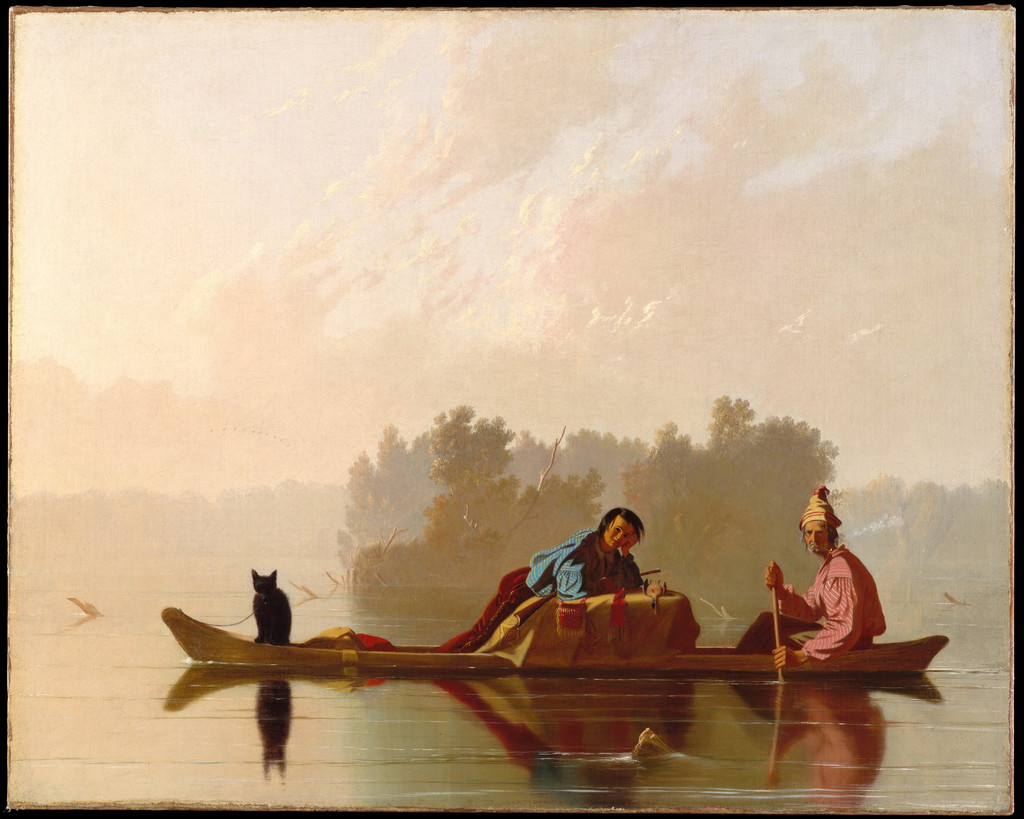
George Caleb Bingham, Fur Traders Descending the Missouri, 1845. Oil on canvas. The Metropolitan Museum of Art, Morris K. Jesup Fund, 1933, 33.61.
Image source
.
Public domain
.
Music, cards and the time between work
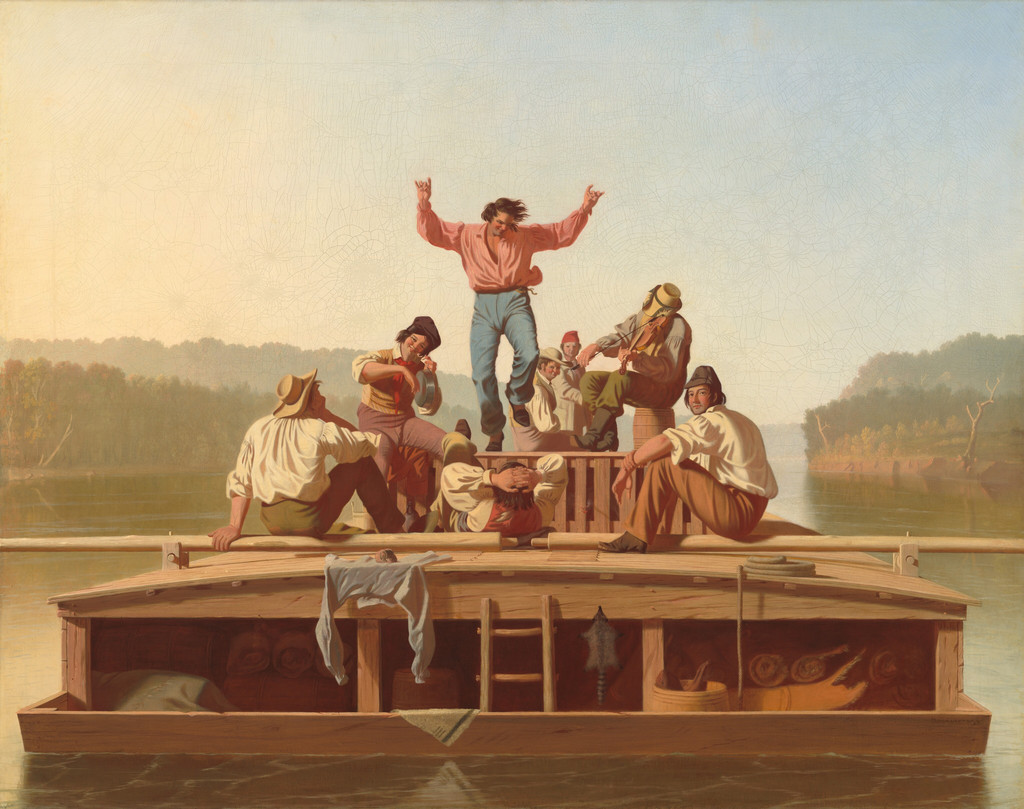
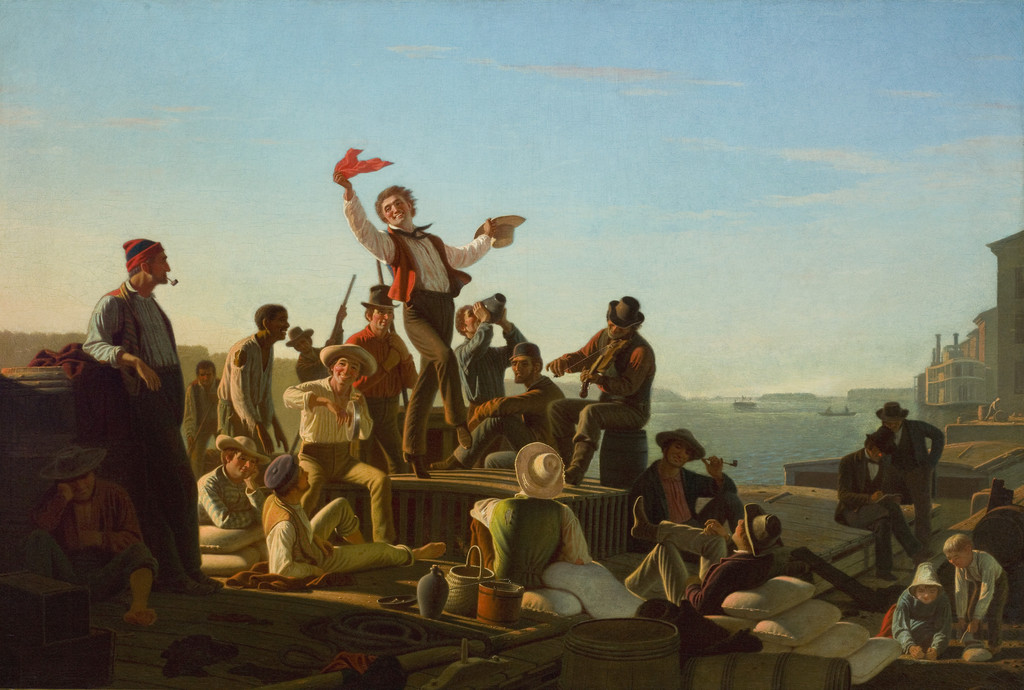
In The Jolly Flatboatmen of 1846, now in the National Gallery of Art, a dancer rises above musicians and resting workers. The group forms a broad, stable arrangement even as the dance suggests movement. Bingham gives leisure the order and sustained attention of an ambitious composition. [3]
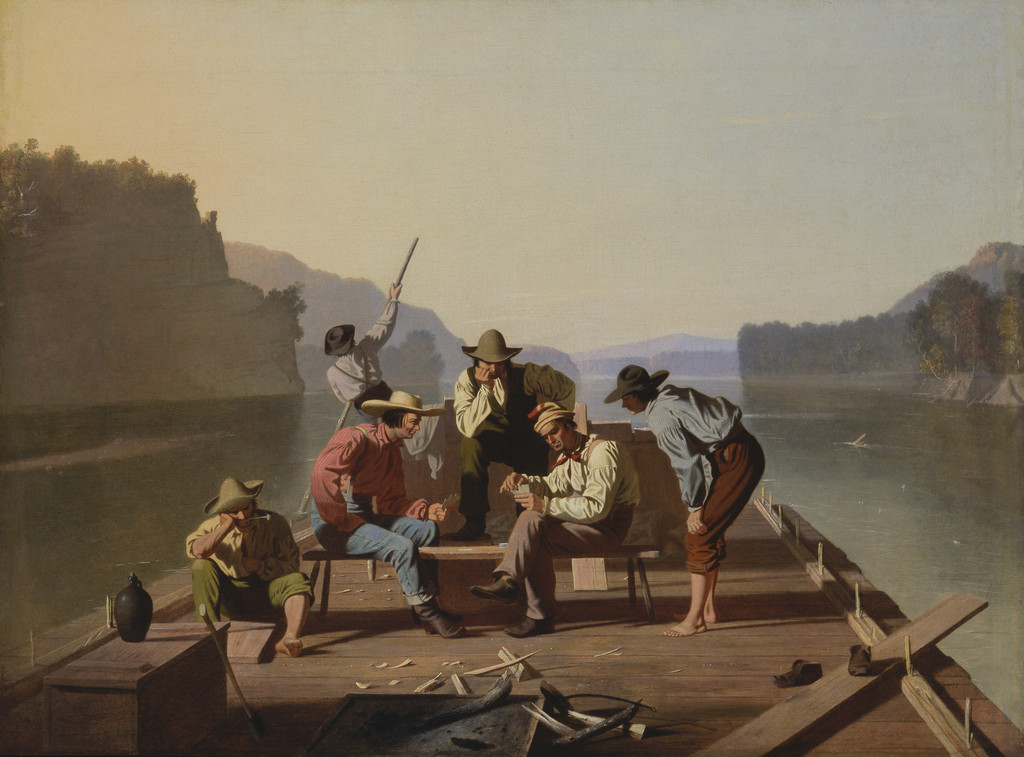
Raftsmen Playing Cards , painted in 1847, offers a quieter group activity. Players and spectators gather around a game, while one man rests and another continues to handle a pole. The subject does not make every person equally idle or equally absorbed. Different kinds of time share a working platform. [5]
Comparing the two paintings shifts attention from an elevated performer to a lower, inward-facing exchange. Both depend on the relationship between participants and observers, but the dance spreads gestures upwards and outwards while the cards draw bodies together. Resting figures provide a slower counterpoint in each scene.
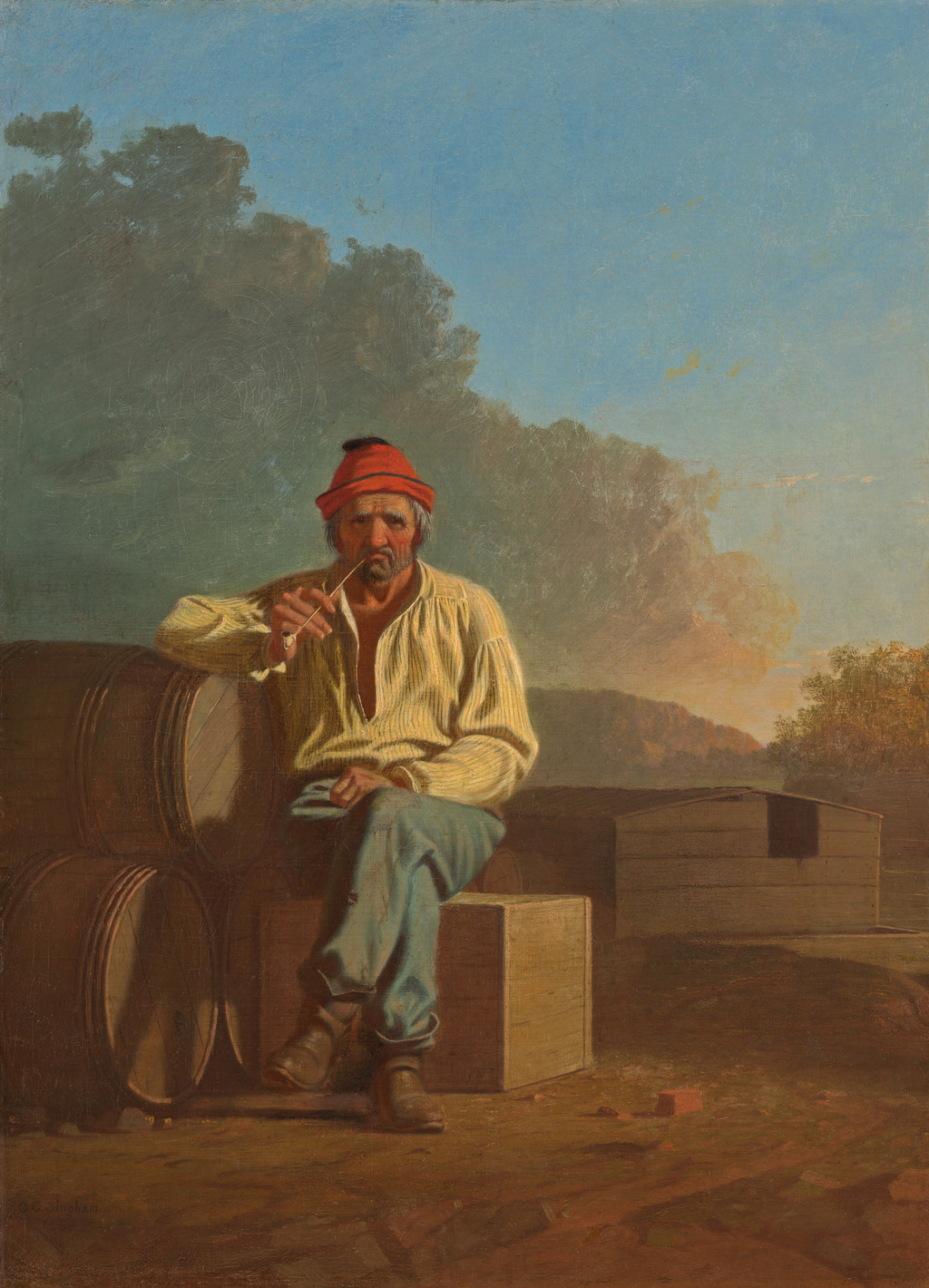
Mississippi Boatman of 1850 reduces the encounter to a single seated man. His crossed legs, striped shirt, pipe and surrounding containers establish a compact world. The direct look and compressed expression make this a less companionable pause than the broader entertainment of the dancing boatmen. The National Gallery’s canvas demonstrates how much can change when the group is removed. [6]
These paintings should not be read as a transparent sample of every worker’s experience. Bingham selected costumes, poses and settings for pictures that would travel beyond Missouri. Conrads’s account of the river scenes places their balanced forms beside the painter’s effort to shape eastern audiences’ understanding of western people. [1]
Format makes another useful comparison. The broad shape of Fur Traders allows the boat and its reflections to extend sideways, while the narrower Mississippi Boatman stacks the seated body and surrounding containers vertically. The dance and card scenes need room for relationships across a group. A subject is therefore shaped partly by the space the canvas makes available to it. Before considering a possible symbol or historical message, look at where the figures fit and how the edges contain them. The style and technique article develops these differences through specific examples.
Following figures across the river paintings
The 2015 Navigating the West exhibition connected the finished paintings with specific figure studies. Its labels trace card players from the 1847 canvas into In a Quandary of 1851 and a dozing raftsman into the later port scene. They also describe changed limbs, reversed figures and adjustments to clothing or props. A familiar body could serve a new relationship. [4]
Other works extend the river subject beyond entertainment. The Wood-boat of 1850 concerns a working boat and its occupants; Lighter Relieving a Steamboat Aground of 1847 brings river labour and stranded transport together. Watching the Cargo of 1849 and the later night subjects make waiting, light and the handling of goods central to their scenes. [4]
Looking at such works beside the celebrated dance avoids a narrow definition of Bingham’s river painting. The same environment could support music, effort, delay, guarded stillness or a solitary encounter. The drawings explain part of the continuity, while the different activities explain why repetition did not require an identical narrative.
The drawings and prints page follows those connections in greater detail. The distinction between media remains essential: a study associated with a painting has its own date and purpose, while a reproductive print may have been made from a later version of the composition.
Arrival at the port and a late return
Jolly Flatboatmen in Port of 1857 expands the dancing group into a much busier waterfront scene. The Saint Louis Art Museum identifies the setting as a St. Louis wharf, but Bingham made the canvas in Düsseldorf. The represented place and the place of production therefore need to be kept distinct. [7]
The wider composition makes room for more spectators, cargo, a nearby boat and the built waterfront beyond. Its dancer remains an organizing summit, but the scene’s social reach extends beyond one small crew. Comparing it with the 1846 work shows how a familiar entertainment can acquire a more elaborate setting.
The Terra Foundation’s The Jolly Flatboatmen is a separate late painting of 1877–78. Its owning record corrects an older date of 1848. It should not be confused with either the National Gallery’s 1846 canvas or the Saint Louis port painting. The related titles connect works across Bingham’s career; they do not identify one object that moved between three collections. [8]
Politics at the scale of conversation
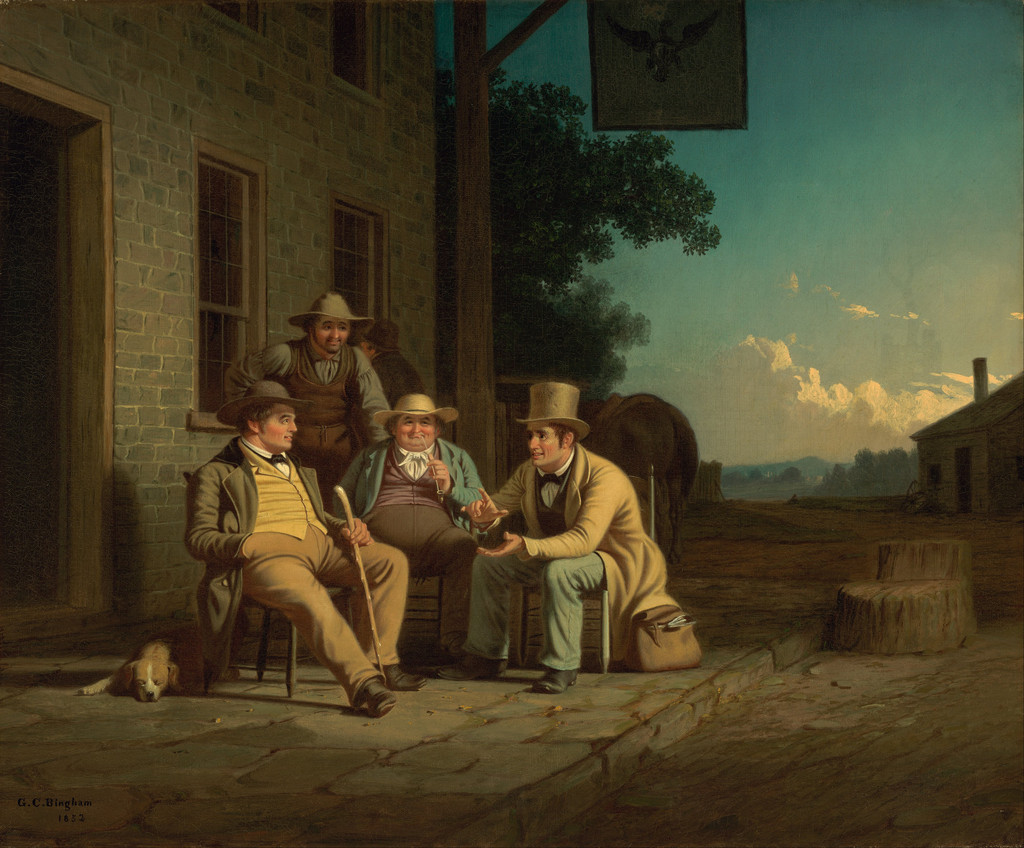
Canvassing for a Vote , signed and dated 1852, places an appeal outside an Arrow Rock tavern. The canvasser leans towards seated listeners, whose responses remain less emphatic than his open hands. The Nelson-Atkins Museum’s picture makes the interval between asking for support and receiving it visible through posture. [9]
Conrads relates the composition to the earlier Country Politician of 1849 and describes revisions in the drawing Potential Voter . The change from an older attentive listener to a more relaxed prosperous farmer gives the later exchange a different balance. Political meaning can emerge through the choice of a recipient as well as through the politician’s performance. [1]
This small encounter provides a useful bridge towards the larger election canvases. It establishes a process of persuasion before the crowded public procedure appears. The picture’s humour and uncertainty do not require us to invent the canvasser’s words or decide how the listener will eventually vote.
Watch: George Caleb Bingham
Choose a film to explore the artist’s work, its interpretation and its wider setting.
Navigating the West: George Caleb Bingham and the River at the Amon Carter Museum of American Art
The Amon Carter Museum introduces an exhibition devoted to Bingham’s river paintings.
Watch on YouTubeA speech, a poll and the news of a result
The County Election survives in an original dated 1851–52 and a replica of 1852, both in the Saint Louis Art Museum. The original is 124:1944, Museum Purchase; the replica is 44:2001, Gift of Bank of America. The article’s principal illustration shows the replica and labels it accordingly. [10] [11]
The composition gathers people around the act of voting, with conversation, drinking and attempts at influence taking place nearby. Its breadth makes the procedure social rather than abstract. A varied group can share one public occasion without displaying equal judgement, attention or political rights. [10]
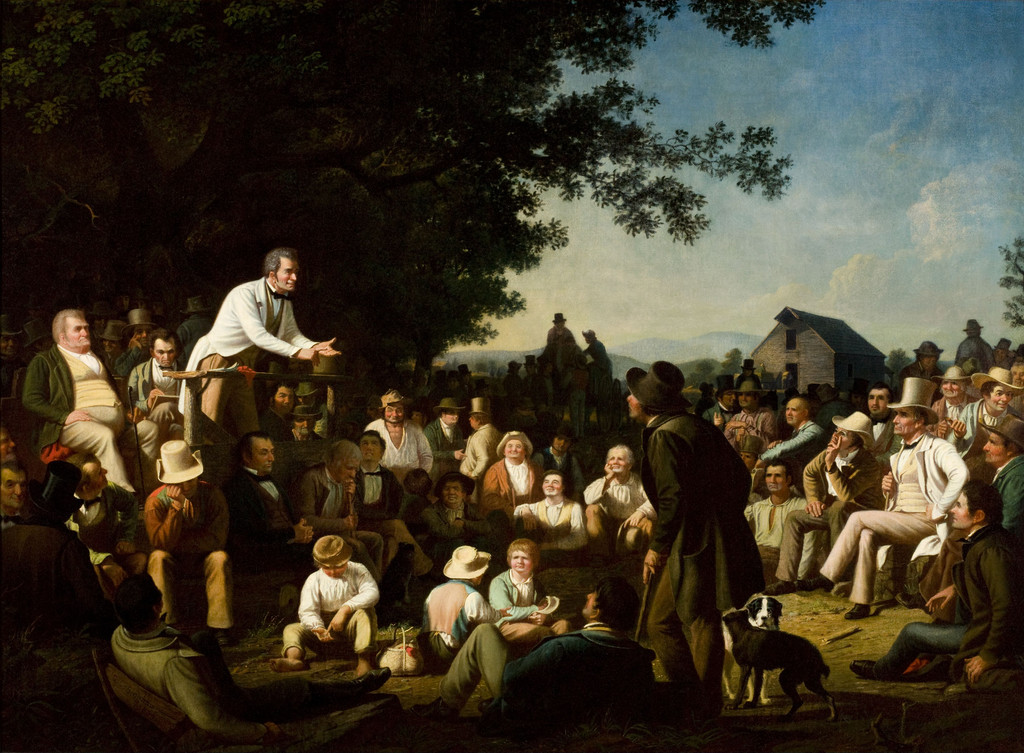
Stump Speaking , painted in 1853–54, organizes a crowd around an address. A pale-coated speaker stands beneath a tree, while the audience occupies the surrounding ground. The museum’s interpretation identifies the tablet-holding man behind him as an opponent preparing to respond. The principal action is still an argument in progress. [12]
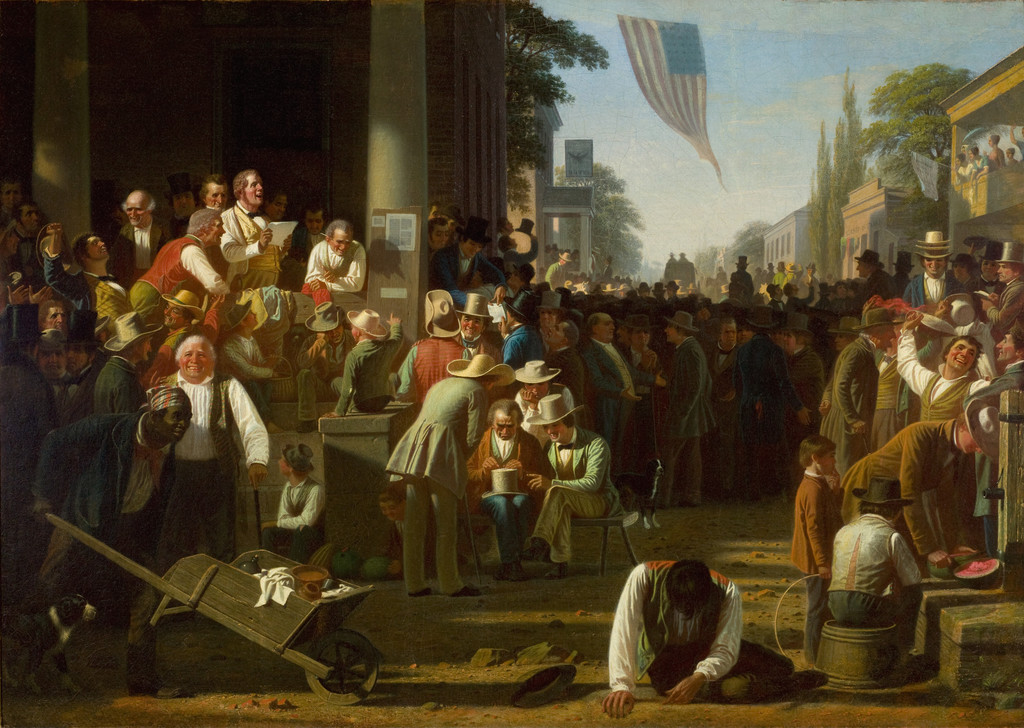
The Verdict of the People of 1854–55 changes that relationship again. A man announces results from a porch, and the crowd responds with different gestures and expressions. Women watching from a balcony and a Black figure near the foreground cart broaden the people visible in the scene without erasing the period’s exclusions from voting. [13]
The three subjects can be understood as stages without being treated as records of one actual election. Bingham gives persuasion, voting and response distinct structures. Comparing them is more useful than simply counting the number of people in each crowd: it reveals how a different public act changes the placement of bodies, the source of attention and the range of possible reactions.
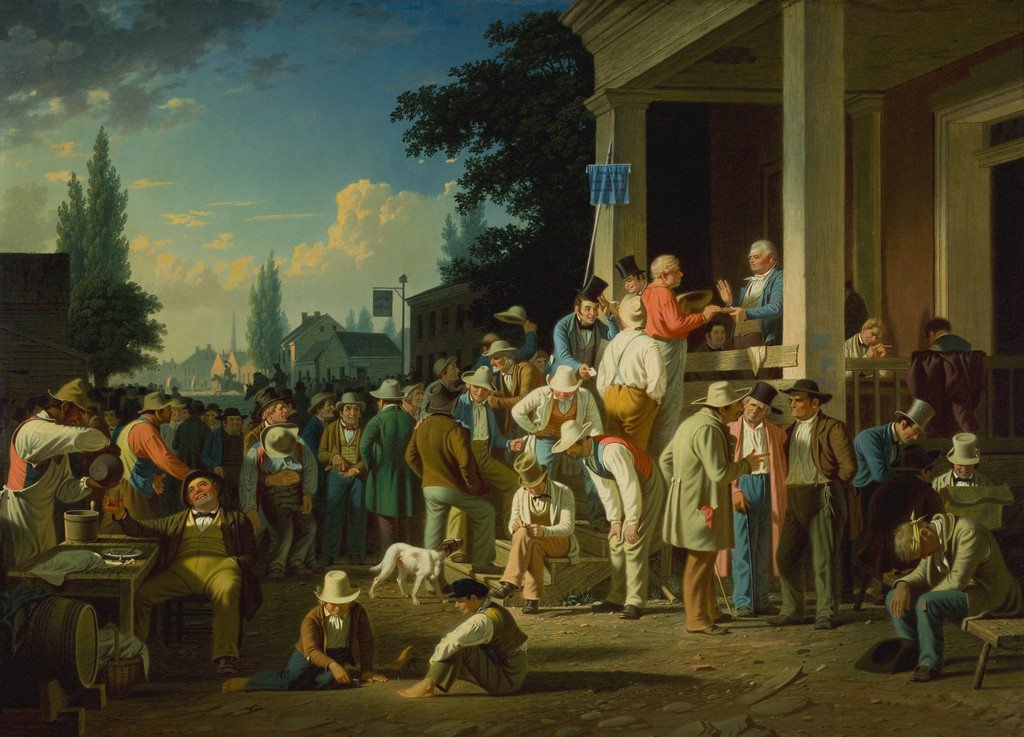
George Caleb Bingham, The County Election, 1852, replica. Oil on canvas. Saint Louis Art Museum, Gift of Bank of America, 44:2001; distinct from original 1851–52, 124:1944.
Image source
.
Public domain
.
History painting and the authority of an image
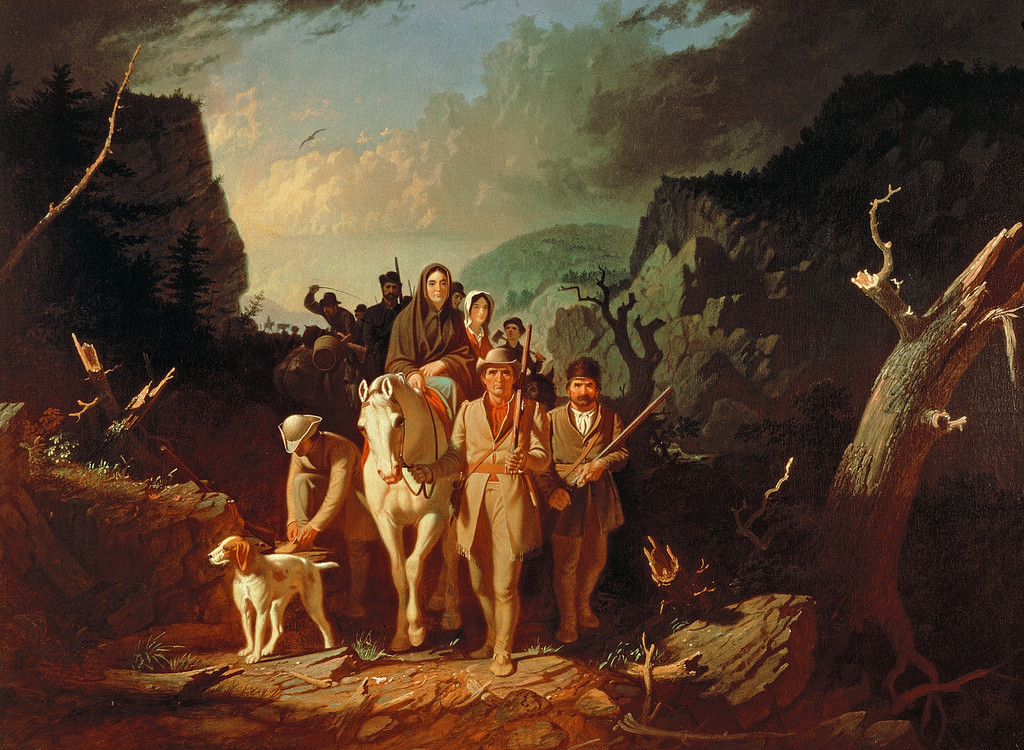
Daniel Boone Escorting Settlers through the Cumberland Gap dates from 1851–52. The Kemper Art Museum reads its frontal procession through classical and Christian comparisons, including Boone’s relationship with the Spear-Bearer of Polykleitos and the group’s resemblance to biblical deliverance. These associations help give the settler journey a heroic authority. [14]
The museum also interprets that authority critically, in relation to expansion into Indigenous territories. The landscape’s enclosing cliffs, broken trees and dramatic light make the travellers’ progress seem purposeful. What the image omits is therefore part of its historical argument, alongside the people whom it presents so prominently. [14]
Order No. 11 , painted in 1865–68, gives the movement of civilians a different meaning. The Cincinnati Art Museum’s original concerns forced removal in Civil War Missouri. A threatened household, departing figures and smoke create a scene of distress, whose carefully staged groups serve an accusation rather than a heroic advance. [15]
The comparison does not make the two events equivalent or explain every position Bingham held. It shows how composition can carry different claims about history. Bodies can appear orderly, exemplary and protected by purpose, or divided by coercion and suffering. His control of arrangement serves more than one kind of public story.
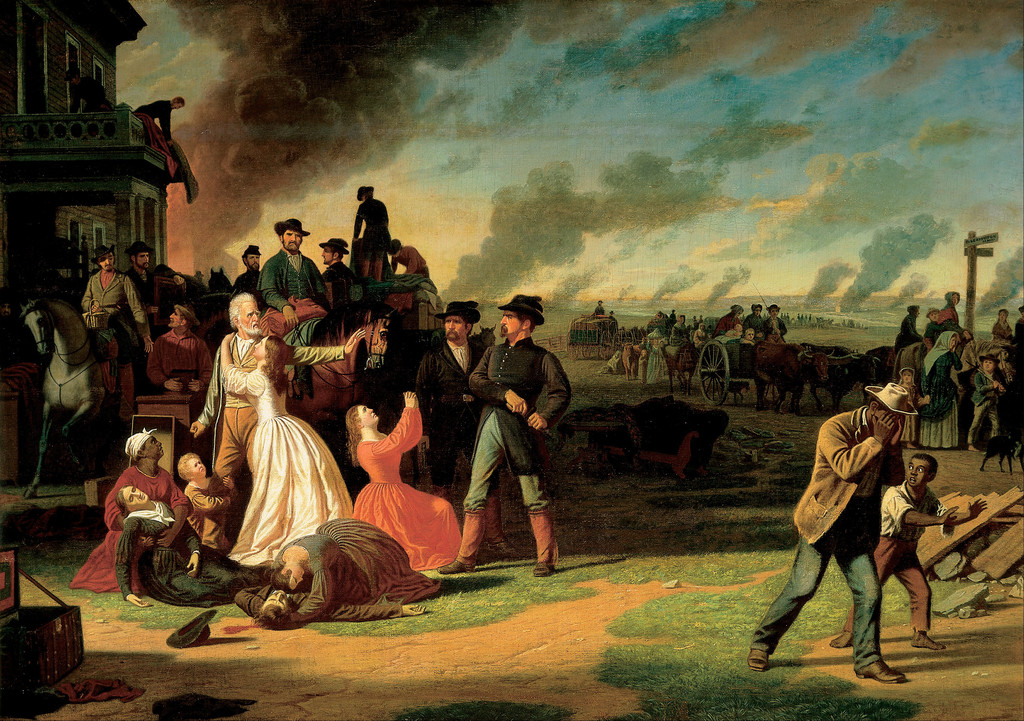
George Caleb Bingham, Order No. 11 (Martial Law), 1865–1868. Oil on canvas. Cincinnati Art Museum, The Edwin and Virginia Irwin Memorial, 1958.515.
Image source
.
Public domain
.
Portraiture throughout the career
Conrads’s career account begins with Bingham’s work as a portraitist and returns to its importance after his European stay. The famous river and political subjects should therefore be placed within a career that depended substantially on likenesses. They were not followed by an empty interval in which the painter ceased to work. [1]
The National Portrait Gallery’s John Quincy Adams , dated about 1850, is a useful example of why object identification matters in portraiture too. Its record describes a later version after the portrait made in connection with the 1844 sitting. The canvas illustrated in the portraits article should not be described as the actual object painted during that sitting. [16]
In the image, a concentrated head and dark clothing replace the extended spaces of the river scenes. Small differences of facial structure, collar, hair and expression become the main field of attention. Looking at portraits beside the group pictures makes Bingham’s interest in particular faces easier to see, even where the narrative works transform a model into a more generalized character.
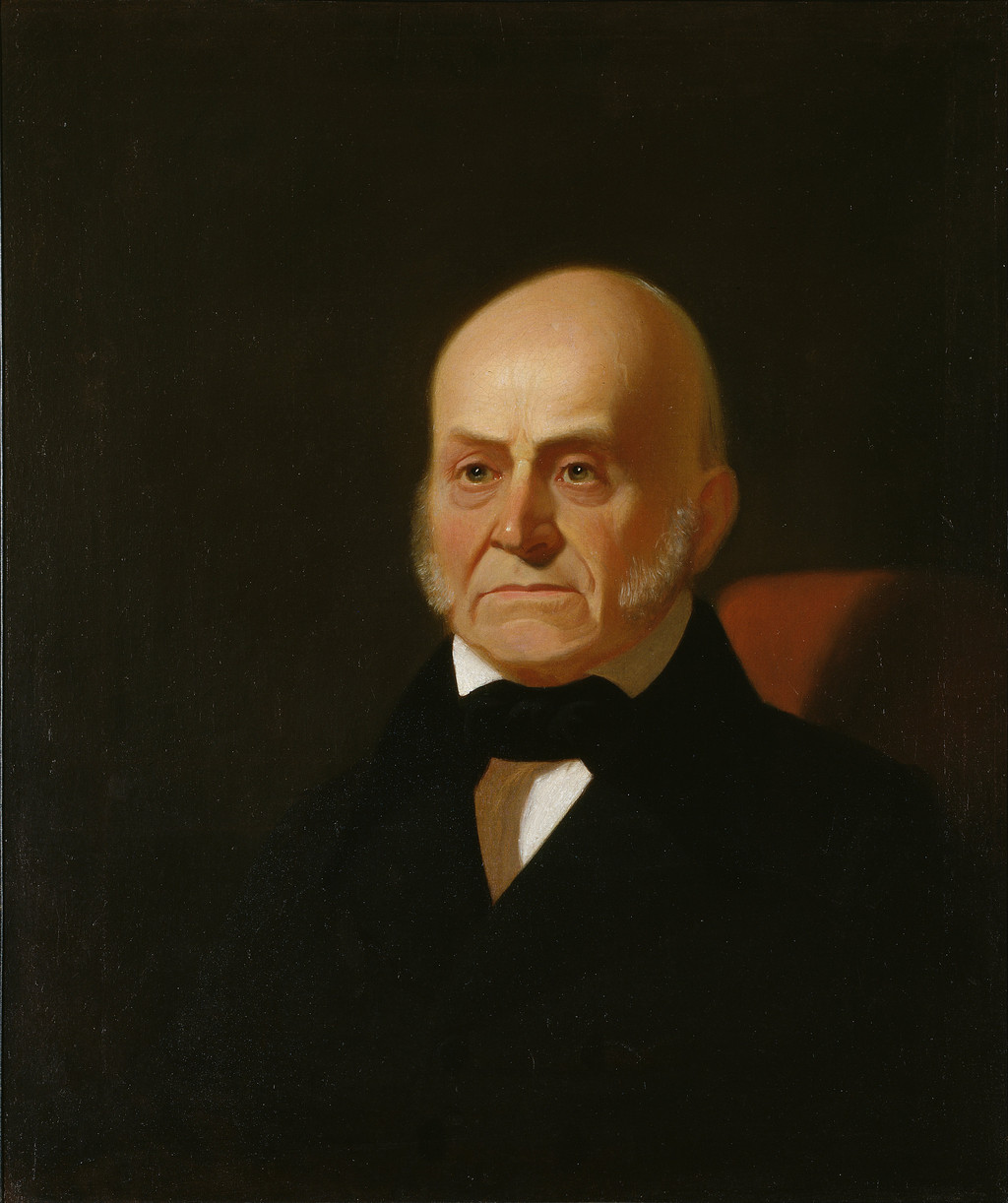
George Caleb Bingham, John Quincy Adams, about 1850, after the 1844 portrait. Oil on canvas. National Portrait Gallery, Smithsonian Institution, NPG.69.20.
Image source
.
Public domain
.
Versions, prints and precise looking
A reliable approach to the paintings keeps three questions together: what is represented, which physical object is shown and how that object reached its present audience. A title can answer the first question while leaving the other two uncertain. Dates, accession numbers and collection credits help keep related canvases apart.
The distinction is especially important when a painted composition becomes a print. Bingham’s figures could circulate widely through another artist’s plate or a publisher’s edition, with changes of medium, colouring and scale. A printed sheet is a work with its own making history, even when its composition remains immediately recognizable. [4]
The individual articles provide space for those particular histories. Read together, the selection shows Bingham repeatedly reconsidering how people share a boat, a street, a room or a difficult passage. His achievement rests in those specific relationships: the ways a body turns towards another person, a group creates a focus and an apparently ordinary action becomes a subject for sustained looking.
Artworks directory
A documented selection discussed across these articles, including separate canvases, figure studies and reproductive impressions. Dates identify the particular object or study; collection and title distinctions follow museum records and the 2015 exhibition checklist. This is not a catalogue raisonné. Prints are grouped with works on paper in the Drawing filter.
| Name | Date | Medium |
|---|---|---|
| Fur Traders Descending the Missouri | 1845 | Painting — oil on canvas |
| The Jolly Flatboatmen | 1846; NGA canvas | Painting — oil on canvas |
| The County Election (original) | 1851–52 | Painting — oil on canvas |
| Stump Speaking | 1853–54 | Painting — oil on canvas |
| The Verdict of the People | 1854–55 | Painting — oil on canvas |
| Order No. 11: Martial Law | 1865–68; Cincinnati original | Painting — oil on canvas |
| Daniel Boone Escorting Settlers through the Cumberland Gap | 1851–52 | Painting — oil on canvas |
| Canvassing for a Vote | 1852; signed canvas | Painting — oil on canvas |
| Raftsmen Playing Cards | 1847 | Painting — oil on canvas |
| Mississippi Boatman | 1850 | Painting — oil on canvas |
| Jolly Flatboatmen in Port | 1857 | Painting — oil on canvas |
| The County Election (replica illustrated here) | 1852 | Painting — oil on canvas |
| Martial Law or Order No. 11 (Missouri replica) | 1870 | Painting — oil on canvas |
| The Jolly Flatboatmen (Terra canvas) | 1877–78 | Painting — oil on canvas |
| John Quincy Adams (later version) | about 1850, after an 1844 original | Painting — oil on canvas |
| Country Politician | 1849 | Painting — oil on canvas |
| The Trappers’ Return | 1851 | Painting — oil on canvas |
| The Concealed Enemy | 1845 | Painting — oil on canvas |
| The Wood-boat | 1850 | Painting — oil on canvas mounted on board |
| Lighter Relieving a Steamboat Aground | 1847 | Painting — oil on canvas |
| Watching the Cargo | 1849 | Painting — oil on canvas |
| In a Quandary | 1851 | Painting — oil on canvas |
| Boatmen on the Missouri | 1846 | Painting — oil on canvas |
| Self-Portrait (Saint Louis) | 1834–35 | Painting — oil on canvas |
| Self-Portrait (Nelson-Atkins) | about 1877 | Painting — oil on canvas |
| Mrs. David Steele Lamme and Son William Wirt | 1837 | Painting — oil on canvas |
| Portrait of Leonidas Wetmore | 1839–40 | Painting — oil on canvas |
| Fur Trader (study for Fur Traders Descending the Missouri) | 1845 | Drawing — brush, ink and wash over pencil |
| Skillet-beater (study for The Jolly Flatboatmen) | 1846 | Drawing — brush, ink and wash over pencil |
| Young Wood-boatman (study for The Wood-boat) | 1850 | Drawing — brush, ink and wash over pencil |
| Thomas Doney after Bingham: The Jolly Flat Boat Men (Met impression) | 1847 | Print — mezzotint and engraving with etching |
| Thomas Doney after Bingham: The Jolly Flat Boat Men (coloured Carter impression) | 1847 | Print — intaglio with applied watercolour |
| The Verdict of the People (lithographic proof) | ca. 1858–59 | Print — lithographic proof |
| Gautier after Bingham: Stump Speaking | 1856 | Print — etching and aquatint |
| Claude Regnier after Bingham: In a Quandary, Mississippi Raftsmen Playing Cards | 1852 | Print — hand-coloured lithograph |
Frequently Asked Questions
It presents a selected group and links to closer articles. A full catalogue requires a much broader record, including portraits and works with incomplete or changing ownership histories.
Discussion
Look again at the images and ideas explored in George Caleb Bingham Paintings. These editorial prompts invite your observations.
Which comparison changes your understanding most: dance and cards, campaign and poll, or heroic passage and forced removal? Look for a specific difference in the arrangement of bodies.
Reader Insights
Which pair of paintings makes the reuse of a pose easiest to follow?
How does a single figure differ from a crowd as a political subject?
What changes when you compare two versions rather than treating a title as one object?
Join the Conversation
Share a detail, comparison or question about George Caleb Bingham Paintings below.
References
- Margaret C. Conrads , “Bingham@200: A Bicentennial Celebration,” Antiques & Fine Art , Spring 2011, pp. 193–199. View source
- Metropolitan Museum of Art , Fur Traders Descending the Missouri , 1845, 33.61. View source
- National Gallery of Art , The Jolly Flatboatmen , 1846, 2015.18.1. View source
- Navigating the West: George Caleb Bingham and the River , exhibition labels, 2015. Drawings, related river paintings and prints. View source
- Saint Louis Art Museum , Raftsmen Playing Cards , 1847, 50:1934. View source
- National Gallery of Art , Mississippi Boatman , 1850, 2004.66.1. View source
- Saint Louis Art Museum , Jolly Flatboatmen in Port , 1857, 123:1944. View source
- Terra Foundation for American Art , The Jolly Flatboatmen , 1877–78, 1992.15. View source
- Nelson-Atkins Museum of Art , Canvassing for a Vote , 1852, 54-9. View source
- Saint Louis Art Museum , The County Election , original, 1851–52, 124:1944. View source
- Saint Louis Art Museum , The County Election , replica, 1852, 44:2001. View source
- Saint Louis Art Museum , Stump Speaking , 1853–54, 43:2001. View source
- Saint Louis Art Museum , The Verdict of the People , 1854–55, 45:2001. View source
- Mildred Lane Kemper Art Museum , Daniel Boone Escorting Settlers through the Cumberland Gap , 1851–52, WU 2171. View source
- Cincinnati Art Museum , Order No. 11 (Martial Law) , 1865–1868, 1958.515. View source
- Smithsonian National Portrait Gallery , John Quincy Adams , about 1850, NPG.69.20. View source
- Splash image source.
George Caleb Bingham, The Jolly Flatboatmen, 1846. Oil on canvas. National Gallery of Art, Washington, Patrons’ Permanent Fund, 2015.18.1. Public domain .
View source