 by
Tom Gurney
Tom Gurney BSc (Hons) is an art history expert with over 20 years experience
Email:
tomgurney1@gmail.com
/ Phone:
+44 7429 011000
Order No. 11: Martial Law: Introduction
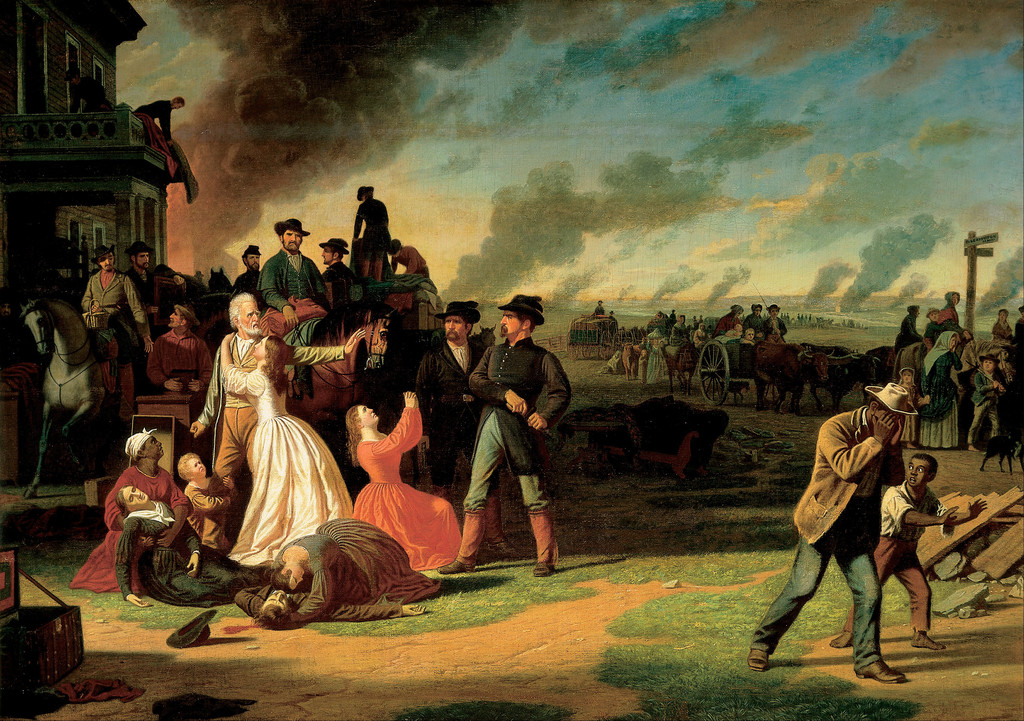
George Caleb Bingham ’s Order No. 11 , also called Martial Law , turns a military policy into a scene of threatened domestic life. An elderly man confronts armed men outside a house. Women kneel, cling to him or bend over the fallen, while a Black man and boy move away at the right. Beyond the foreground, wagons, refugees and columns of smoke carry the disturbance across a wide landscape.
The original painting is in the Cincinnati Art Museum. Its current record dates the oil on canvas to 1865–1868 and gives its dimensions as 142.7 × 201.7 cm. It is accession 1958.515, credited to The Edwin and Virginia Irwin Memorial. Those dates matter: Bingham made his protest after the 1863 order it addresses. [1]
A second version, completed in 1870, belongs to the State Historical Society of Missouri. The two paintings and the later reproductive print helped give the composition a public life extending well beyond its first appearance. That life has been contentious, because viewers have disagreed about the people it defends and the history it asks them to remember. [2] [3]
At a Glance
- Artist George Caleb Bingham.
- Alternate title Martial Law .
- Original painting 1865–1868; oil on canvas.
- Dimensions of original 142.7 × 201.7 cm.
- Original collection Cincinnati Art Museum, 1958.515; The Edwin and Virginia Irwin Memorial. [1]
- Later version 1870; oil on linen; The State Historical Society of Missouri, 1945.0003. [2] [3]
- Historical order Issued by General Thomas Ewing Jr. on 25 August 1863. [4]
This work across George Caleb Bingham’s career
The Jolly Flatboatmen
1846; NGA canvasThe County Election
1851–52 original; 1852 replica illustratedCanvassing for a Vote
1852; signed canvasStump Speaking
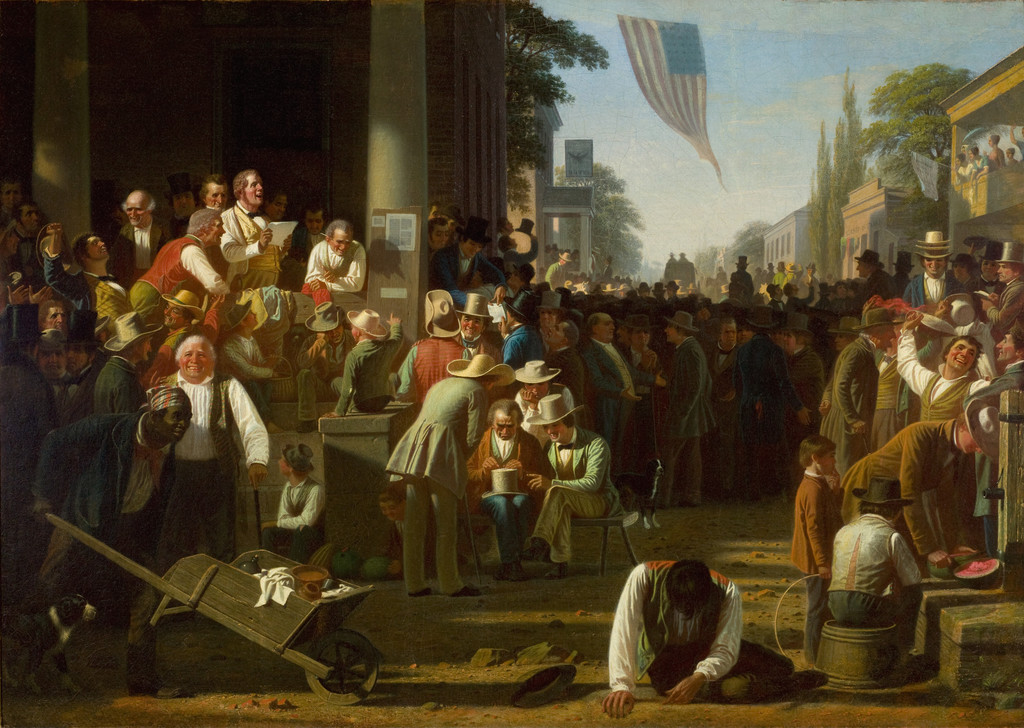
1853–54The Verdict of the People
1854–55Order No. 11: Martial Law (current article)
1865–68; Cincinnati originalNotes and sources
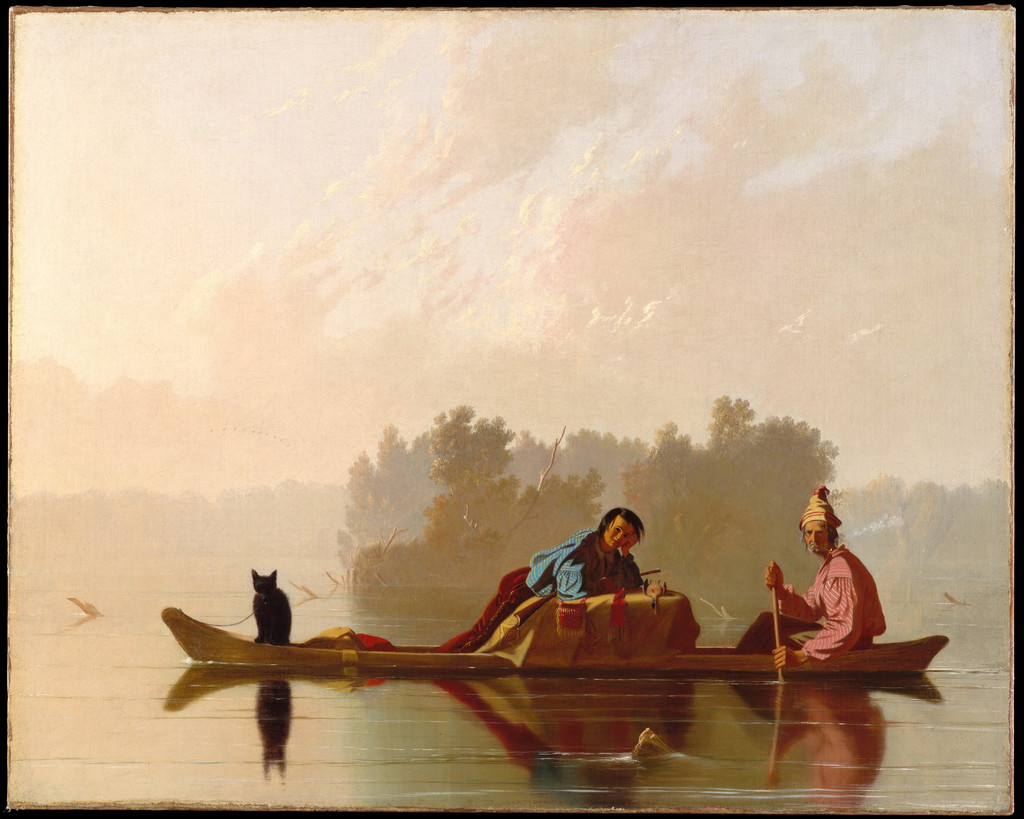
Fur Traders Descending the Missouri. Dates identify the canvas discussed in the article. [5]
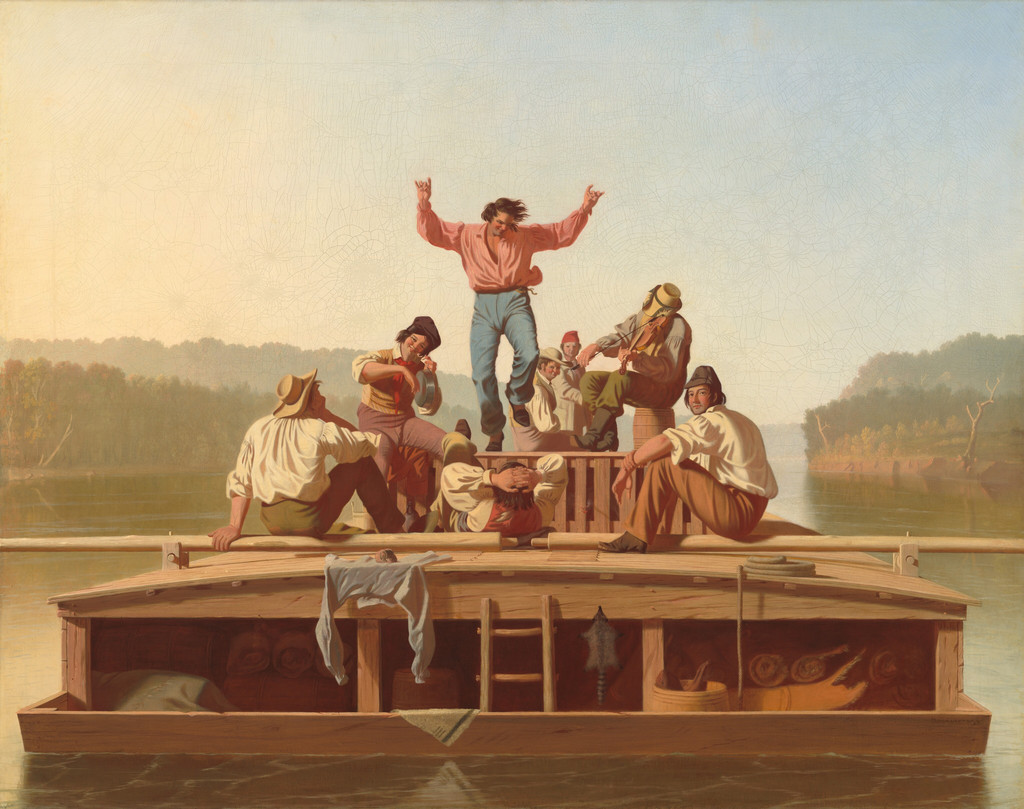
The Jolly Flatboatmen. Dates identify the canvas discussed in the article. [6]
Raftsmen Playing Cards. Dates identify the canvas discussed in the article. [7]
Mississippi Boatman. Dates identify the canvas discussed in the article. [8]
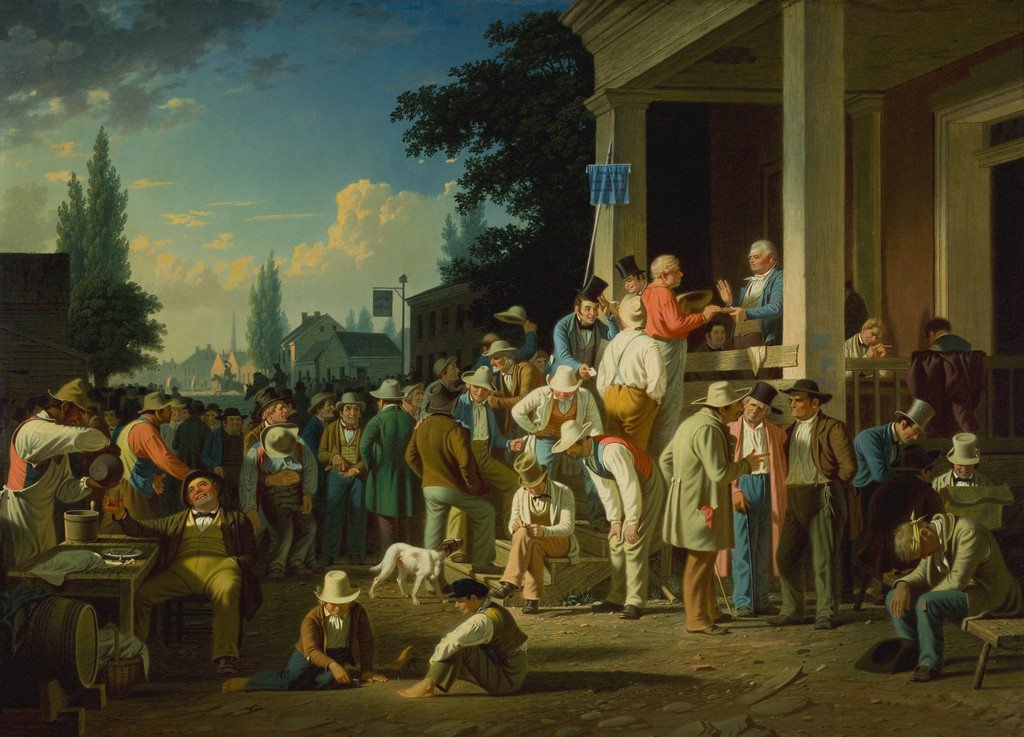
The County Election. The original is 124:1944; the illustrated 1852 replica is 44:2001. Their dimensions and acquisition histories differ. [9] [10]
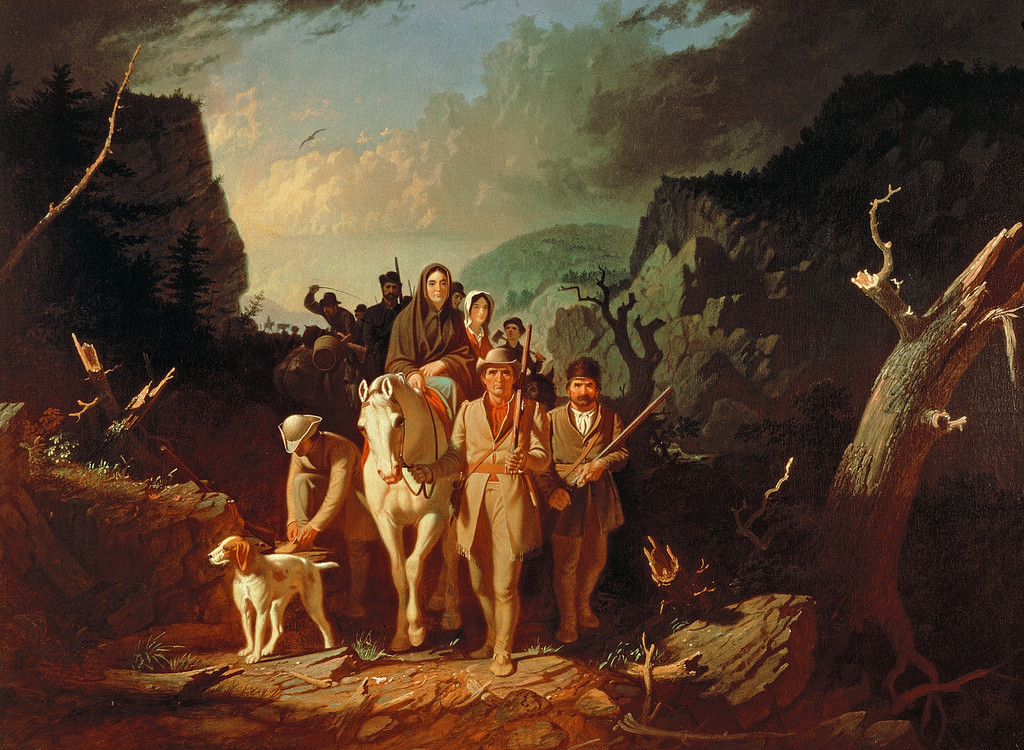
Daniel Boone Escorting Settlers through the Cumberland Gap. Dates identify the canvas discussed in the article. [11]
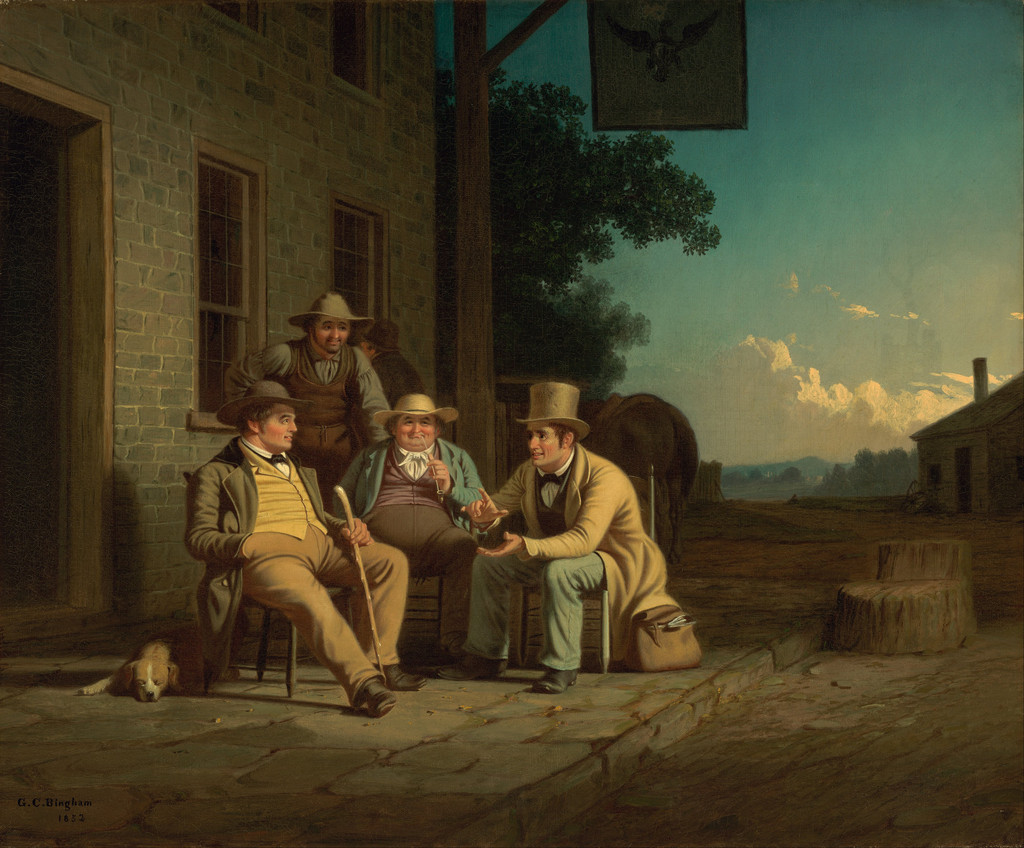
Canvassing for a Vote. Dates identify the canvas discussed in the article. [12]
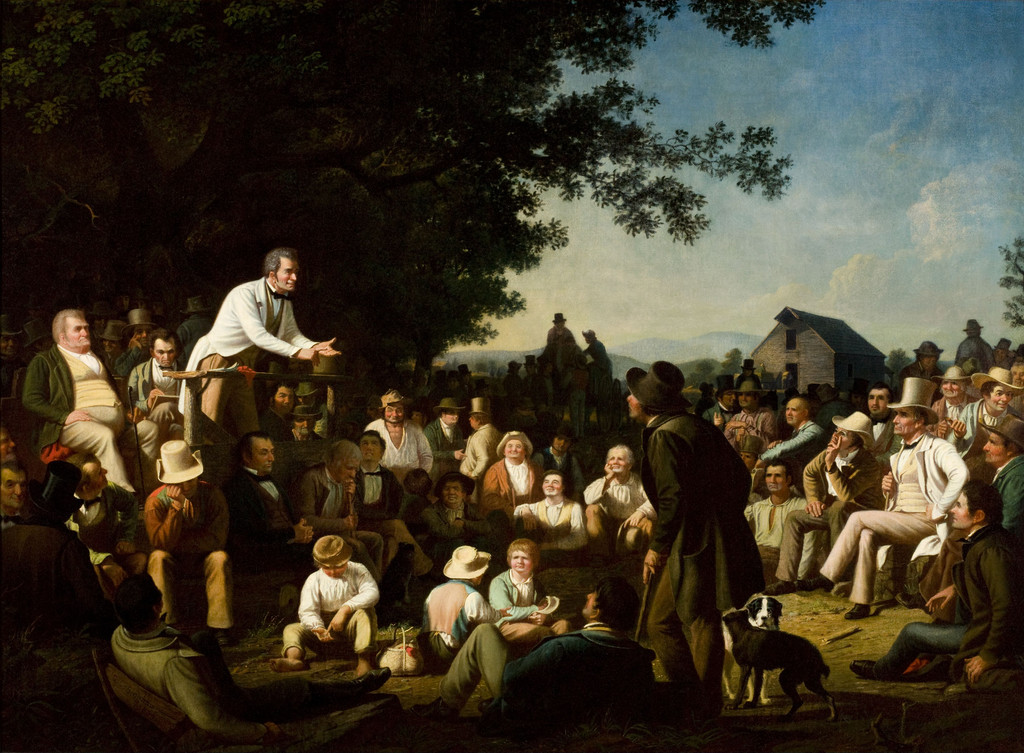
Stump Speaking. Dates identify the canvas discussed in the article. [13]
The Verdict of the People. Dates identify the canvas discussed in the article. [14]
Jolly Flatboatmen in Port. Dates identify the canvas discussed in the article. [15]
Order No. 11: Martial Law (current article). Dates identify the canvas discussed in the article. [1]
Contents
- A painting, a replica and a public argument
- The order of 25 August 1863
- The household in the foreground
- Smoke, wagons and the road out
- Why a Unionist criticised Union power
- Black figures and the meaning of departure
- A patriarch who cannot protect the family
- Reproduction, criticism and political use
- Remembering the war through a contested image
- Annotated details
A painting, a replica and a public argument
The Cincinnati canvas and the Missouri version belong to the same campaign of protest, but they remain separate objects. The Missouri repository describes its painting as oil on linen, measuring 56 × 78 inches, and records it as unsigned. Its accession number is 1945.0003. The later date comes from the historical account of Bingham’s work, rather than from an inscribed date on that canvas. [2] [3]
Art historian Joan Stack places completion of the first picture in 1868 and the second in 1870. Cincinnati’s broader date range records the original’s development across several years. These descriptions can be understood together without dating either canvas to the moment when the order was issued. The war supplied the subject; later making, exhibition and argument shaped its pictorial form. [1] [3]
Bingham also defended the work in print. His 1871 Address to the Public presented painting as a means of preserving historical wrongs and warning future generations. He opened with the phrase “Art being the most efficient hand-maid of history”, then developed a forceful justification for recording abuses of power. The document makes his purpose unusually explicit, while also showing how strongly he wished to guide the response to his picture. [4]
The three kinds of evidence need to remain distinct. The military order specifies a policy. The painting constructs an encounter through figures and landscape. The address argues for the truth and legitimacy of that construction. Reading them together helps explain the work’s force without treating the artist’s defence as independent confirmation of every event shown.
Annotated Details from Order No. 11: Martial Law
The numbered points identify visible features discussed in this article. Return from each detail to the whole composition. George Caleb Bingham, Order No. 11 (Martial Law), 1865–1868. Oil on canvas. Cincinnati Art Museum, The Edwin and Virginia Irwin Memorial, 1958.515. Image source. Public domain. Numbers added to a separate overview. Detail images are crops of the source reproduction.
Details from ORDER NO. 11: MARTIAL LAW
Compare the cropped details with the complete images above. Notice how their colours, shapes and positions contribute to the larger compositions.
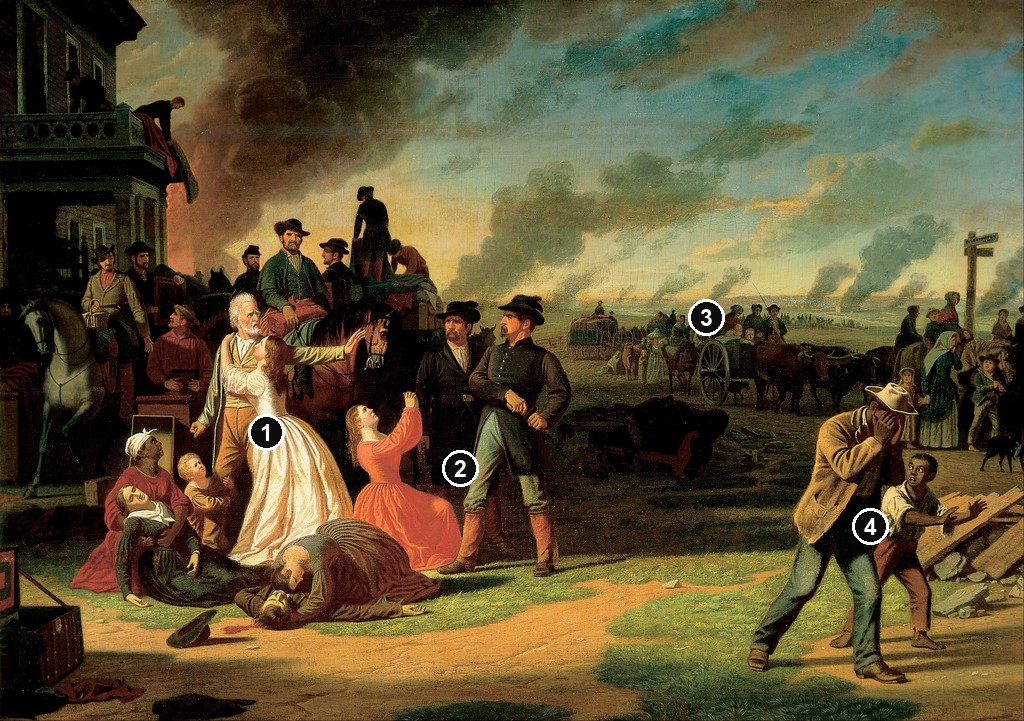
The raised hand and pale dress
The older man’s open hand reaches across the space towards the soldiers. The pale dress and leaning body in front of him carry the eye down towards the tightly grouped foreground figures.
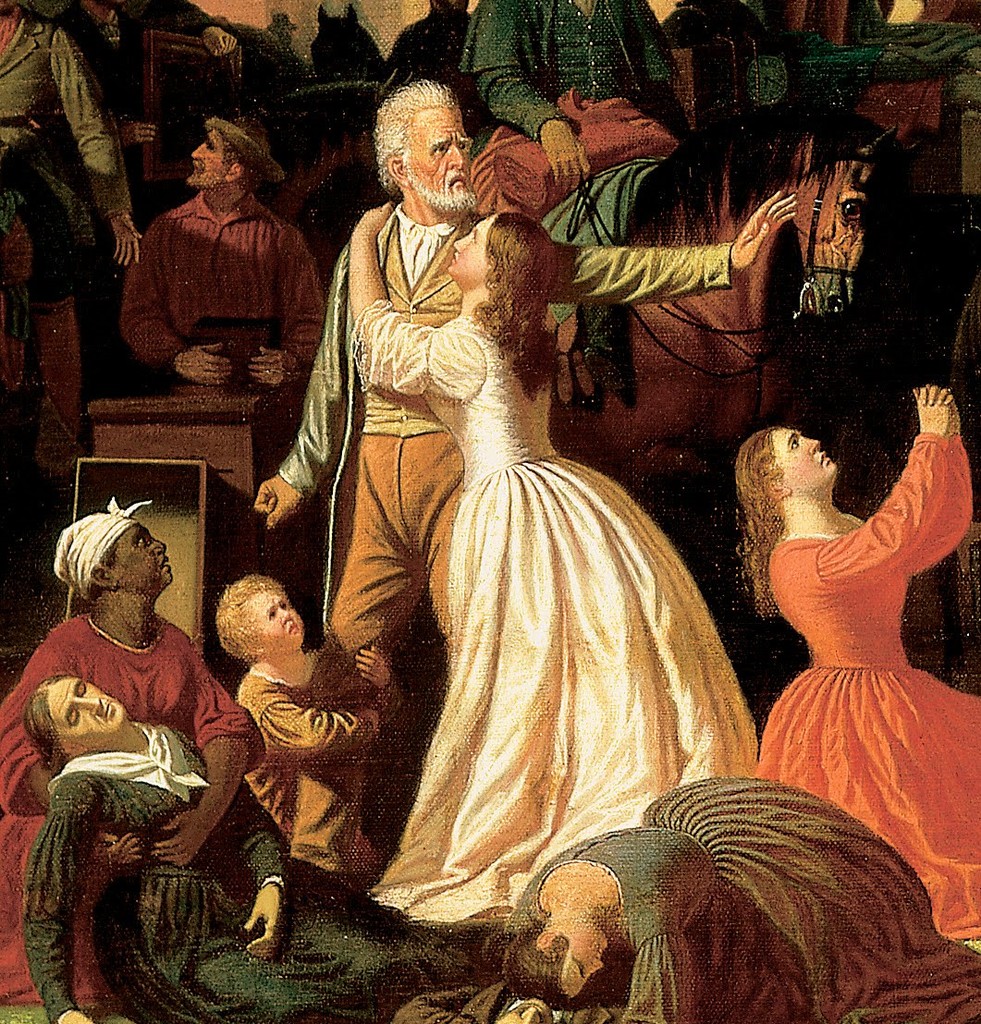
Appeal and military stance
A kneeling figure raises both hands towards the standing men. The wide stance, dark uniform and long weapon make a hard-edged counterpart to the lifted arms and spreading red dress below.
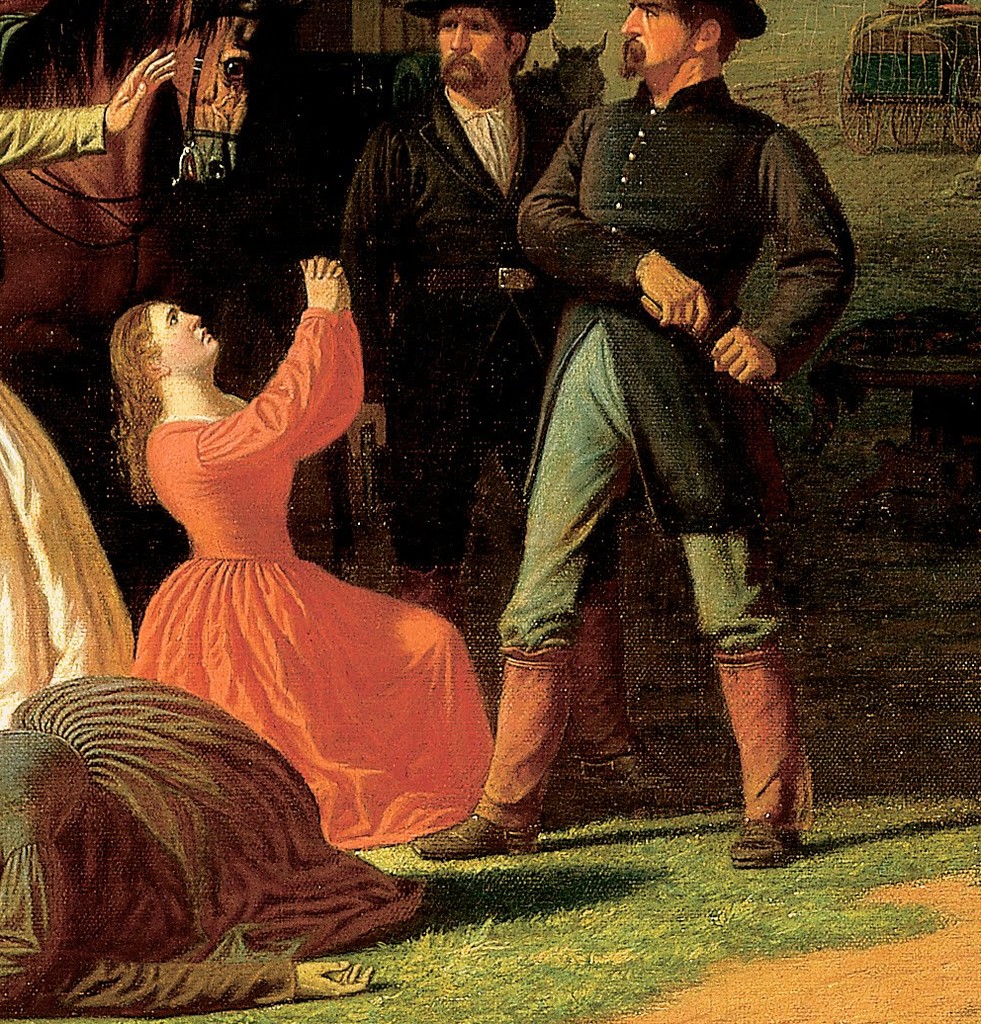
Wagons and smoke in the distance
Loaded wagons and accompanying figures diminish along the road. Plumes of smoke break the horizon beyond them, connecting the concentrated foreground encounter with a much wider landscape of departure.
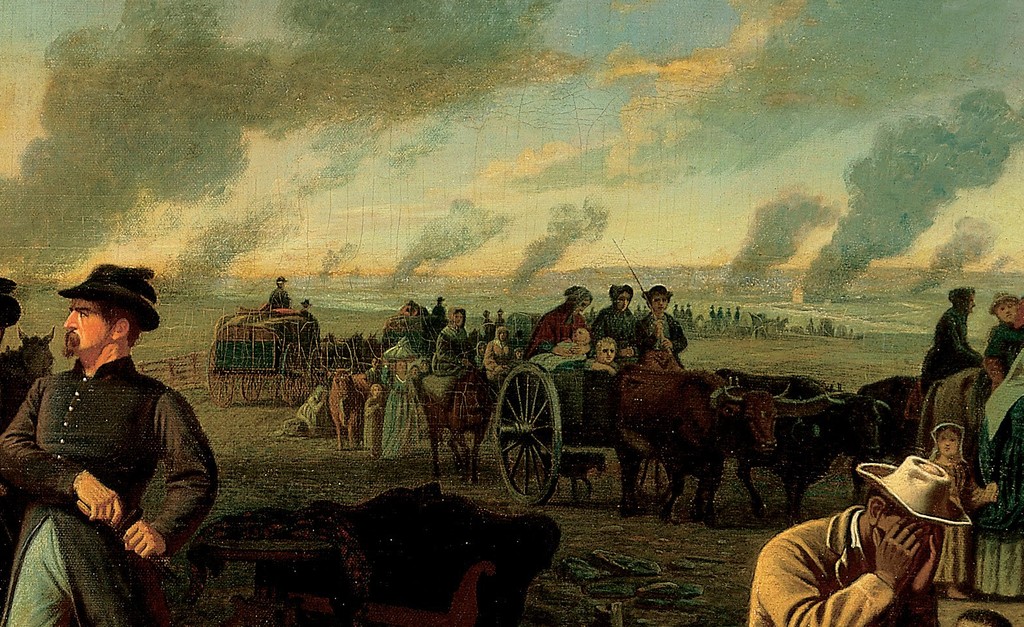
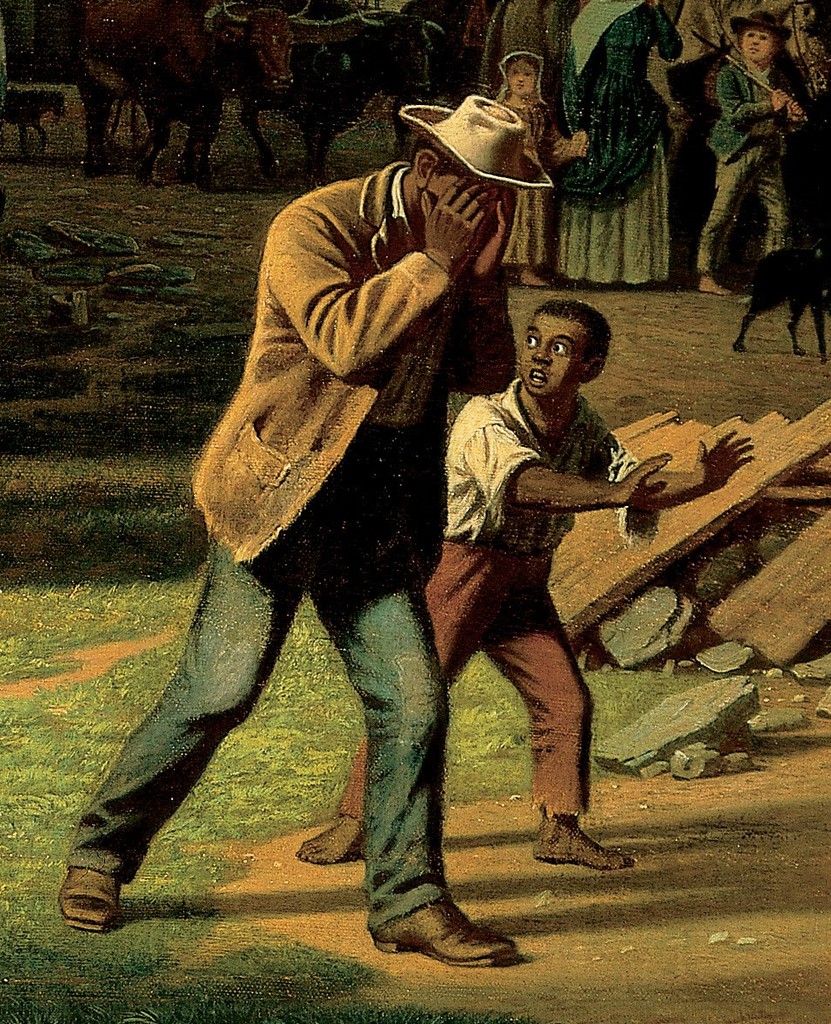
The two figures at the right
The two foreground figures turn their faces towards the disorder while their bodies lean away. Open hands, bent knees and the angled boards around them make this corner a separate scene of alarm and movement.
The order of 25 August 1863
The painting grew out of the violent border conflict between Missouri and Kansas during the American Civil War. On 21 August 1863, William Quantrill’s guerrillas attacked Lawrence, Kansas, killing civilians and devastating the town. Ewing issued Order No. 11 four days later as part of an effort to deny guerrillas the support and refuge available in the Missouri countryside. The Missouri History Museum’s account places the policy within both guerrilla warfare and demands for retaliation. [16]
That context is essential to understanding why a military authority imposed such a severe measure. It does not make the resulting displacement disappear. The order affected people through residence within a designated area, including residents who professed loyalty to the Union. Bingham’s protest concentrated on what such a policy meant when enforced against households. [4] [16]
The text named Jackson, Cass and Bates counties and the part of Vernon County within the military district. It required removal within fifteen days, with specified exceptions around Independence, Hickman’s Mills, Pleasant Hill and Harrisonville, and for a defined part of Kaw Township. These were particular geographic exemptions, not a general permission for anyone near any military post to remain at home. [17]
Loyalty could affect where a displaced person was permitted to go. Residents who satisfied a commanding officer could receive certificates and move to military stations within the district or to permitted parts of Kansas. Others had to leave the district. A separate provision directed the collection of grain and hay within reach of military stations after 9 September and destruction of supplies that could not conveniently be taken there. [17]
The same order appears in the appendix to Bingham’s address. Its administrative language makes a revealing contrast with the picture. Counties, certificates and deadlines become bodies, possessions and routes of departure. The painting’s emotional argument begins where the document’s categories meet the practical vulnerability of people required to leave. [4]
The written order should not, however, be reduced to an instruction describing every violent action on Bingham’s canvas. His image brings expulsion, threatened violence, death, pillage and burning into one constructed scene. It presents an accusation about enforcement and responsibility, rather than an illustrated transcript of each clause.
The household in the foreground
The house occupies the left edge, cut by the boundary of the canvas. Its porch, balcony and doorway establish a domestic structure under pressure. People and objects extend from it into the foreground, while figures above handle belongings. The building no longer provides the security its solid architecture might promise.
The elderly man is the highest point within the principal family group. His white hair and beard distinguish him from the dark hats and coats around him. One arm extends towards the armed men, while his body remains upright. The gesture is both an appeal and a resistance: he addresses people who have the physical power to act against him.
A woman in a pale dress clings to his torso, turning the vertical body into the centre of a closely connected group. Her skirt spreads downwards towards the fallen figures. Its light colour makes a strong contrast with the mounted men and the shadows around the house. She connects the threatened patriarch with the vulnerable people below him.
Another woman kneels before an armed man near the centre. Her red dress and lifted hands make her position easy to follow. Bingham sets the difference in height against a difference in power: her body is low and open, while the man remains upright, with a hand close to his weapon. Pleading and threat occupy the same narrow space.
At the front, a woman bends over a man lying on the ground. Nearby, another woman has collapsed into the support of a Black woman. A child looks upwards within this group. Bingham’s own description identifies family relationships and specifies death, murder and a swoon, turning the visible gestures into an explicit narrative of outrage. Those identifications belong to the explanation he published with the work. [4]
The foreground objects reinforce the interruption of home life. An open container, loose clothing and scattered possessions occupy the lower edge. A hat lies apart from a body. Such things have become separated from ordinary use and storage. The disturbance is not confined to an exchange between two men; it has reached the organisation of the household itself.
Horses and mounted figures thicken the space behind the family. Their height and overlapping bodies prevent the house from feeling like an available retreat. The foreground is crowded with different forms of vulnerability, while the people carrying authority or force retain the ability to occupy and move through the space.
Smoke, wagons and the road out
The painting changes scale across its width. The large figures on the left give way to a road filled with people, animals and wagons. Further back, smaller groups repeat the movement into distance. Columns of smoke mark other places across the horizon, so that the threatened household appears as one part of a much wider disaster.
The road also separates different kinds of movement. Bingham’s published description contrasts wagons carrying plunder with refugees leaving their homes. He gives the traffic a moral direction, distinguishing the people who benefit from seizure from those who lose their property and security. That is an argument made through the relation between foreground and distance. [4]
Smoke provides a second connection. A large dark mass rises above the house, while smaller columns continue across the landscape. The repeated shape carries attention away from the individual family towards other unseen households. It makes the countryside appear subject to the same process, even where the particular acts of violence are too distant to distinguish.
A sign beside the road at the right supplies a smaller detail within the broad view. The name Lexington is visible, bringing a named destination into a landscape otherwise organised around repeated smoke and departing groups. The sign does not identify the threatened house or turn the whole composition into an exact map. Its position beside the traffic instead gives the eye a point at which routes must be followed. The scene extends beyond the immediate confrontation into the practical question of where displaced people can go.
Stack describes the composition as a staged progression in which cause and consequence can be presented simultaneously. The foreground confrontation and the departure into the landscape need not be separate moments observed together. Bingham can make them coexist to explain what he wants the viewer to understand about the order. [3]
Her account also notes the inclusion of Ewing within the scene as an assertion of responsibility rather than a literal record of his presence at this particular encounter. The distinction changes how the work should be read. A commanding officer can become pictorially present because an artist holds him accountable for a policy, without the image establishing eyewitness evidence of his actions at one house. [3]
Why a Unionist criticised Union power
Bingham’s position cannot be understood simply by assigning sympathy to the side whose uniform appears least threatening in the picture. He had served the Union cause, first in a reserve military role and then as Missouri’s state treasurer. Stack’s account places his opposition to the order within that Unionist biography, rather than treating criticism of Federal power as proof of Confederate allegiance. [3]
His address makes a related distinction between the honour of Union soldiers and the conduct of people who committed crimes while wearing their uniform. He argued that clothing and official standing could not turn wrongdoing into legitimate service. In his account, condemning those acts defended the Union’s proper principles rather than dishonouring soldiers who had served honestly. [4]
The argument also explains why civilians occupy so much of the canvas. Bingham wanted military policy judged through its effects on people whose rights, he insisted, government should protect. In the address, the painting becomes a warning about what happens when authority fails that obligation. His claim rests on a particular understanding of constitutional loyalty and civil liberty, not on an objection to every use of military force. [4]
Critics challenged the selection. Bingham records objections that he gave prominence to Union wrongdoing while omitting rebel violence and thereby created a false impression. His reply defended the legitimacy of showing particular crimes without balancing each one with an atrocity committed by the other side. The exchange identifies a problem that remains central to historical images: how a truthful accusation can still offer a selective account of a wider conflict. [4]
His own description of the victims was selective too. He presented them as loyal, law-abiding citizens and defended their claim to protection. That is evidence for the case he wished the picture to make; it is not a census of the actual allegiances of everyone affected by the order. The painting’s concentrated household makes an argument about vulnerability and rights that the varied history of the entire district cannot be expected to fit exactly.
The artist’s explanation therefore helps and limits interpretation at the same time. It clarifies why the uniforms should not automatically make the image anti-Union. It also reveals the categories through which Bingham chose to defend his subjects. The biography follows the longer record of his political commitments beyond this particular public dispute.
Watch: George Caleb Bingham
Choose a film to explore the artist’s work, its interpretation and its wider setting.
Navigating the West: George Caleb Bingham and the River at the Amon Carter Museum of American Art
The Amon Carter Museum introduces an exhibition devoted to Bingham’s river paintings.
Watch on YouTubeBlack figures and the meaning of departure
Three Black figures are especially important to the work’s later interpretation. A woman at the left supports the collapsed white matriarch. At the right, a man covers his face while moving away with a boy, whose body and gaze turn back towards the scene. Their positions connect them to the general suffering while giving them different actions within it.
The woman’s role has often been absorbed into a story of loyalty to a white household. Bingham’s published description does use the language of faithful service. That wording places her within his account of a family wronged by the order. It does not exhaust what a later viewer can see in a figure whose upright attention and physical support contrast with the collapse around her. [4]
Stack proposes an interpretation that gives the Black figures greater agency. She contrasts the woman’s active care with the white matriarch’s helplessness, and the departure of the man and boy with the stationary patriarch. In her account, the man and child can be understood as a family moving towards a life beyond slavery, rather than simply as dependants pleading for the preservation of their enslavers’ world. [3]
That reading makes the separation on the canvas significant. The two departing figures share the direction of exile, yet they do not remain physically folded into the principal white family group. The boy’s turned head holds a connection with what is being left behind, while the man’s and boy’s different gestures keep their experiences from becoming identical. Movement out of the scene can carry more than one historical meaning.
Stack also connects the pair with Masaccio’s Expulsion from Eden . She develops the resemblance into a reading of a new beginning under conditions of loss and suffering. The proposed allusion is part of her argument about emancipation and historical memory. It is not a surviving statement by Bingham identifying every Black figure with a particular biblical character. [3]
The date of the historical event makes the distinction important. The Emancipation Proclamation did not itself end slavery in Missouri; the state abolished slavery on 11 January 1865. Stack places the figures’ possible self-emancipation against the danger faced by Black people leaving enslavers during the war. The road into the distance could therefore be a route into uncertainty, rather than an uncomplicated image of freedom already secured. [3]
Bingham’s personal history also needs to remain visible. Stack reports enslaved people attached to his household in the 1840 and 1850 censuses, as well as his later opposition to slavery’s expansion and support for emancipation. Those facts resist an effortless description of him as either a consistently enlightened observer or a painter whose Union loyalty erased the institution’s place in his life. [3]
His 1871 argument does not speak in a modern language of equal citizenship throughout. It defends the constitutional position of white residents and includes a discussion of how slaveholding interests had once favoured remaining in the Union. Reading that material alongside the painting prevents an emancipationist interpretation from turning into an unqualified endorsement of all the artist’s assumptions. [4]
The value of Stack’s reading is that it asks viewers to notice people whom accounts of white sectional grievance can push to the edge. It adds another possible history to the departure on the right. It does not require us to believe that Bingham settled all the questions later audiences would bring to the image.
A patriarch who cannot protect the family
The old man at the centre of the household has also supported contrasting interpretations. His upright posture and extended arm make him look commanding, but the surrounding events expose the limits of that command. People cling to him, fall beside him or appeal to armed men he cannot control. Bingham places dignity and powerlessness within the same figure.
Stack discusses the relationship between his pose and the Apollo Belvedere . The classical reference could give the patriarch a noble appearance, encouraging viewers to identify with his threatened household. She also proposes a less reassuring reading: an inflexible representative of an older social order, unable to protect the people who depend upon him. The same formal dignity can become a sign of failure. [3]
The woman who holds him makes that ambiguity particularly visible. She is connected to his body, yet she also acts to restrain or protect him. His extended arm directs attention towards the confrontation, while hers turns the action back towards the safety of the family. The composition gives care to people who possess little military authority.
That distribution of action complicates the image’s apparent hierarchy. The patriarch is high within the group, but height does not make him effective. The Black woman, the kneeling woman and the woman bending over the fallen man perform different forms of care or appeal. Their activity helps explain why the scene can be read as more than a portrait of one defiant male victim.
Reproduction, criticism and political use
The first documented responses discussed by Stack already show how little control Bingham had over the work’s meaning. In 1868, the Reverend R. S. Johnson criticised the image as sympathetic to the Confederate cause. A further press attack followed in 1869. Bingham answered by reaffirming his loyalty to the Union and distinguishing the people he condemned from honourable Union soldiers. [3]
Reproduction extended the dispute. John Sartain’s engraved version was published in 1872, after Bingham had completed the second painting. Stack also records an earlier request in 1871 for copies to use against Ewing’s political ambitions in Ohio. Since the engraving was unfinished, Bingham supplied a photograph of the painting. The image’s political circulation therefore involved more than one medium and did not wait for the completed print. [3]
That episode is more precise than a general claim that Bingham toured the country campaigning with the canvas. Surviving references establish particular uses, requests and arguments. They should not be expanded into an undocumented itinerary. The print made repeated private possession possible, while a photograph could answer an immediate demand for the composition before that publication was ready.
Some former Confederates and their supporters found a different use for the painting. Stack describes accounts in which memories of the image merged with memories of the devastated border country. One writer, John Newman Edwards, supplied details not actually present in the composition. The discrepancy illustrates how an artwork can reorganise recollection, rather than simply preserve a fixed record for later readers. [3]
The often repeated story that Bingham personally threatened Ewing with revenge through art requires similar care. Stack traces a familiar version of the supposed speech to an undocumented annotation made in 1938, more than seventy years after the event. She also identifies a different nineteenth-century newspaper claim. Neither warrants presenting the dramatic modern formulation as an authenticated quotation from a verified meeting. [3]
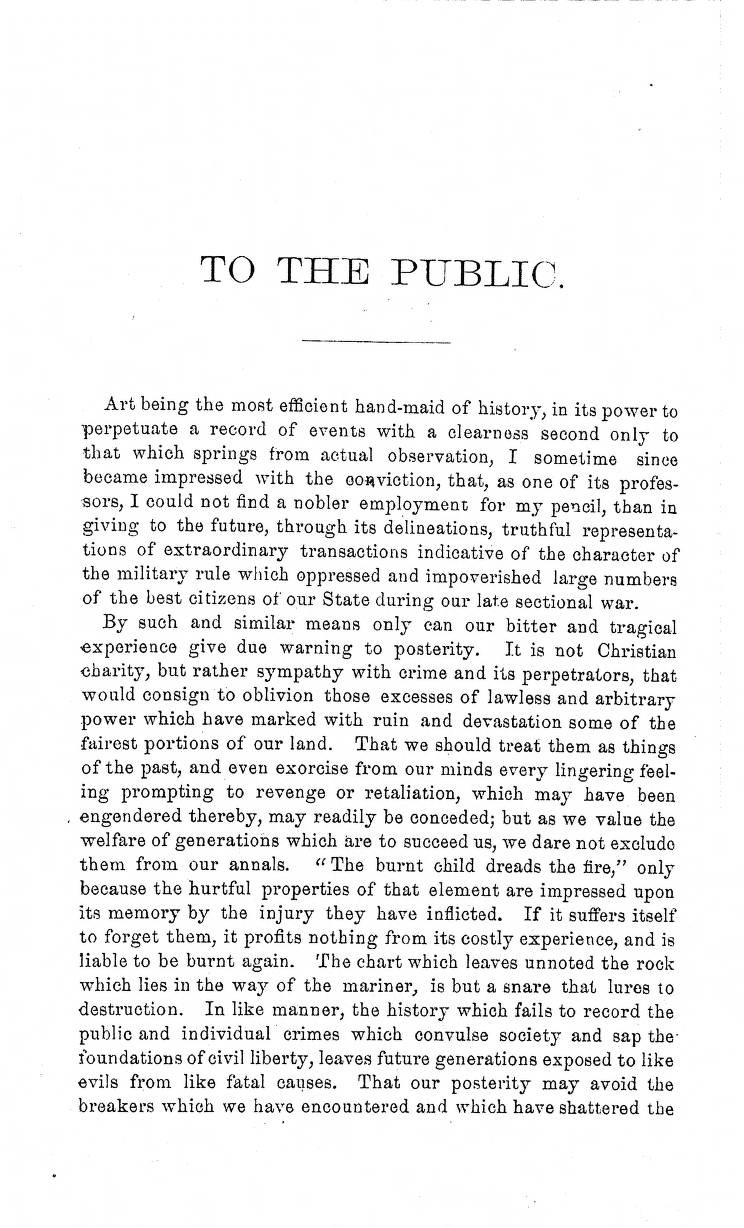
Opening page of George Caleb Bingham’s An Address to the Public, Vindicating a Work of Art, 1871. The State Historical Society of Missouri. Bingham’s postwar defence is distinct from the 1863 military order reproduced in its appendix.
Image source
.
No Copyright – United States
.
Remembering the war through a contested image
Stack organises the painting’s reception around different approaches to Civil War memory. A white supremacist reading can turn the household into a defence of a supposedly benign slaveholding past. A reconciliationist account can emphasise shared white suffering and restored sectional harmony. Her proposed emancipationist reading brings the Black figures and the consequences of slavery more firmly into view. These are interpretive frameworks, not labels the canvas assigns to itself. [3]
The distinction between an artist’s position and an audience’s use is crucial. Bingham could insist that he was a Unionist and still produce an image that Confederate sympathisers adopted. A later viewer can recognise that adoption without assuming that it proves every claim about his original intention. Conversely, the artist’s own defence cannot dictate all subsequent meanings.
The painting’s emotional clarity helps explain its capacity for reuse. Armed force confronts a household, and suffering bodies make its consequences immediate. The broader causes of the war, the violence at Lawrence and the varied loyalties of the district are less visible within that encounter. Historical context restores those dimensions without removing the civilian suffering Bingham chose to depict.
A useful viewing sequence begins with the principal family, follows the road and smoke into the distance, and then returns to the departing man and boy. The sequence changes where the painting seems to end. If our attention stops at the white patriarch, the image can become a closed story of a ruined household. Following the figures to the right opens questions about displacement, emancipation and the uncertain futures left outside the frame.
Order No. 11 remains a forceful example of how Bingham’s paintings can organise public argument. Its authority comes from a deliberate construction of people, objects and landscape. Looking carefully means recognising that construction while continuing to ask whose experience it makes visible, whose account it follows and what further history is needed to understand it.
Artworks directory
A documented selection discussed across these articles, including separate canvases, figure studies and reproductive impressions. Dates identify the particular object or study; collection and title distinctions follow museum records and the 2015 exhibition checklist. This is not a catalogue raisonné. Prints are grouped with works on paper in the Drawing filter.
| Name | Date | Medium |
|---|---|---|
| Fur Traders Descending the Missouri | 1845 | Painting — oil on canvas |
| The Jolly Flatboatmen | 1846; NGA canvas | Painting — oil on canvas |
| The County Election (original) | 1851–52 | Painting — oil on canvas |
| Stump Speaking | 1853–54 | Painting — oil on canvas |
| The Verdict of the People | 1854–55 | Painting — oil on canvas |
| Order No. 11: Martial Law | 1865–68; Cincinnati original | Painting — oil on canvas |
| Daniel Boone Escorting Settlers through the Cumberland Gap | 1851–52 | Painting — oil on canvas |
| Canvassing for a Vote | 1852; signed canvas | Painting — oil on canvas |
| Raftsmen Playing Cards | 1847 | Painting — oil on canvas |
| Mississippi Boatman | 1850 | Painting — oil on canvas |
| Jolly Flatboatmen in Port | 1857 | Painting — oil on canvas |
| The County Election (replica illustrated here) | 1852 | Painting — oil on canvas |
| Martial Law or Order No. 11 (Missouri replica) | 1870 | Painting — oil on canvas |
| The Jolly Flatboatmen (Terra canvas) | 1877–78 | Painting — oil on canvas |
| John Quincy Adams (later version) | about 1850, after an 1844 original | Painting — oil on canvas |
| Country Politician | 1849 | Painting — oil on canvas |
| The Trappers’ Return | 1851 | Painting — oil on canvas |
| The Concealed Enemy | 1845 | Painting — oil on canvas |
| The Wood-boat | 1850 | Painting — oil on canvas mounted on board |
| Lighter Relieving a Steamboat Aground | 1847 | Painting — oil on canvas |
| Watching the Cargo | 1849 | Painting — oil on canvas |
| In a Quandary | 1851 | Painting — oil on canvas |
| Boatmen on the Missouri | 1846 | Painting — oil on canvas |
| Self-Portrait (Saint Louis) | 1834–35 | Painting — oil on canvas |
| Self-Portrait (Nelson-Atkins) | about 1877 | Painting — oil on canvas |
| Mrs. David Steele Lamme and Son William Wirt | 1837 | Painting — oil on canvas |
| Portrait of Leonidas Wetmore | 1839–40 | Painting — oil on canvas |
| Fur Trader (study for Fur Traders Descending the Missouri) | 1845 | Drawing — brush, ink and wash over pencil |
| Skillet-beater (study for The Jolly Flatboatmen) | 1846 | Drawing — brush, ink and wash over pencil |
| Young Wood-boatman (study for The Wood-boat) | 1850 | Drawing — brush, ink and wash over pencil |
| Thomas Doney after Bingham: The Jolly Flat Boat Men (Met impression) | 1847 | Print — mezzotint and engraving with etching |
| Thomas Doney after Bingham: The Jolly Flat Boat Men (coloured Carter impression) | 1847 | Print — intaglio with applied watercolour |
| The Verdict of the People (lithographic proof) | ca. 1858–59 | Print — lithographic proof |
| Gautier after Bingham: Stump Speaking | 1856 | Print — etching and aquatint |
| Claude Regnier after Bingham: In a Quandary, Mississippi Raftsmen Playing Cards | 1852 | Print — hand-coloured lithograph |
Frequently Asked Questions
It required residents of designated areas in Jackson, Cass, Bates and part of Vernon County to leave their homes within fifteen days, subject to specified geographic exceptions. Loyalty certificates affected permitted destinations. It also provided for the seizure or destruction of grain and hay. [17]
His protest against the order should not be treated as proof of Confederate allegiance. He had served the Union cause and defended the painting as a criticism of abuses, while later audiences used it for different political purposes. His broader record on slavery and politics is more complicated than a single label. [3] [4]
It is a constructed protest made after the events. Stack discusses its staged figures and inclusion of Ewing as devices of interpretation and responsibility, rather than proof of a single witnessed encounter. [3]
John Sartain made the reproductive engraving published in 1872. A photograph was also supplied for political use before the engraving was finished. [3]
Discussion
Look again at the images and ideas explored in Order No. 11: Martial Law. These editorial prompts invite your observations.
Reader Insights
How do the foreground household and distant smoke create different scales of loss?
What does the title gain from being read beside the wording of the military order?
How does Bingham’s later defence affect your reading without settling the painting’s meaning?
Join the Conversation
Share a detail, comparison or question about Order No. 11: Martial Law below.
References
- Cincinnati Art Museum , Order No. 11 / Martial Law , 1865–1868, 1958.515. Current collection record. View source
- The State Historical Society of Missouri , Martial Law, or Order No. 11 , 1945.0003. Repository object metadata; the 1870 date is supported by Stack below. View source
- Joan Stack , “Toward an Emancipationist Interpretation of George Caleb Bingham’s General Order No. 11: The Reception History of the Painting and the Remembered Civil War in Missouri”, Missouri Historical Review 107(4), July 2013, pp. 203–221, including note 48 on p. 220. View source
- George Caleb Bingham , An Address to the Public, Vindicating a Work of Art , 1871. Opening address, physical pp. 3–14; order appendix, p. 15; painting description, p. 16. The State Historical Society of Missouri. View source
- Metropolitan Museum of Art, Fur Traders Descending the Missouri. View source
- National Gallery of Art, The Jolly Flatboatmen. View source
- Saint Louis Art Museum, Raftsmen Playing Cards. View source
- National Gallery of Art, Mississippi Boatman. View source
- Saint Louis Art Museum, The County Election, 1851–52, 124:1944. View source
- Saint Louis Art Museum, The County Election, 1852 replica, 44:2001. View source
- Kemper Art Museum, Washington University, Daniel Boone Escorting Settlers through the Cumberland Gap. View source
- Nelson-Atkins Museum of Art, Canvassing for a Vote. View source
- Saint Louis Art Museum, Stump Speaking. View source
- Saint Louis Art Museum, The Verdict of the People. View source
- Saint Louis Art Museum, Jolly Flatboatmen in Port. View source
- Missouri History Museum , “Thomas Ewing Jr.’s General Order No. 11”, The Civil War in Missouri . Historical context; exact provisions checked against the order text. View source
- National Park Service , “Order No. 11, 7th & 8th Grade”. Reproduced text of the 25 August 1863 order, checked against Bingham’s 1871 appendix. View source
- Splash image source.
George Caleb Bingham, Order No. 11 (Martial Law), 1865–1868. Oil on canvas, 142.7 × 201.7 cm. Cincinnati Art Museum, The Edwin and Virginia Irwin Memorial, 1958.515. Public domain .
View source