by Tom Gurney
Tom Gurney BSc (Hons) is an art history expert with over 20 years experience
Published on June 19, 2020 / Updated on November 2, 2026
Email: tomgurney1@gmail.com / Phone: +44 7429 011000
The Child’s Bath by Mary Cassatt: Introduction
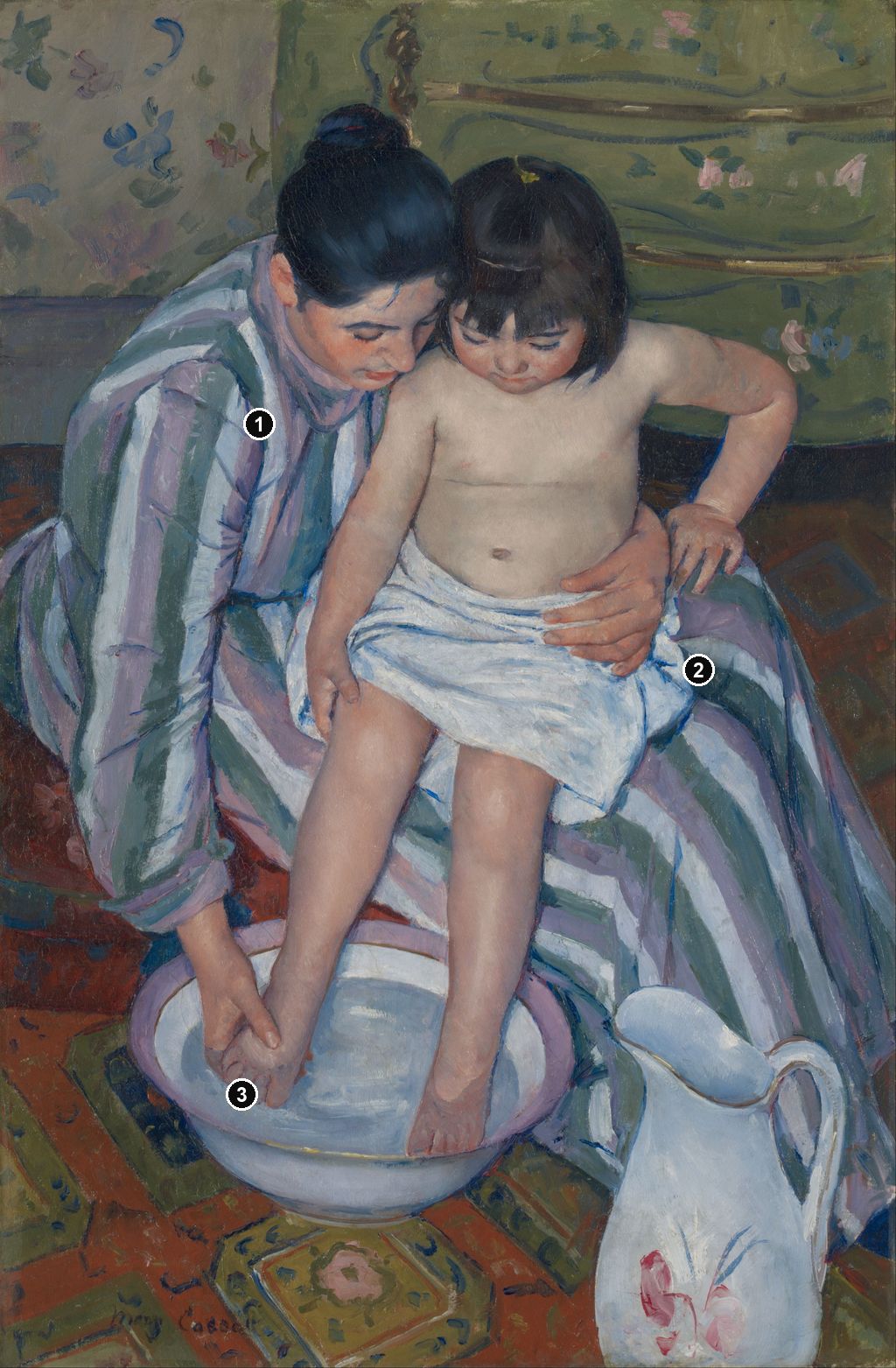
Two heads bend towards a small act of washing. An adult steadies a child across her lap and reaches down to a foot in a basin. Their attention moves through hands, limbs and water, while stripes, flowers and geometric patterns surround them. Mary Cassatt’s The Child’s Bath makes a familiar task into a remarkably concentrated arrangement of bodies and surfaces.
Painted in 1893, the oil on canvas belongs to the Art Institute of Chicago, which acquired it in 1910 through the Robert A. Waller Fund. Its accession number is 1910.2. The picture is distinct from Cassatt’s earlier bathing oil in Los Angeles and from the colour print called The Bath. Similar titles describe different compositions, dates and materials. [1]
The most useful way into the painting is to follow the action before deciding what it means. Which arm supports the child? Which hand washes? Why can we see so far into the basin? Those questions reveal how Cassatt connects intimate care with a viewpoint that keeps the picture’s patterned surface strongly present.
At a Glance
- ArtistMary Cassatt [1]
- Date1893 [1]
- MediumOil on canvas [1]
- CollectionArt Institute of Chicago [1]
- Accession1910.2 [1]
- AcquisitionRobert A. Waller Fund, 1910 [1]
This work across Mary Cassatt’s career
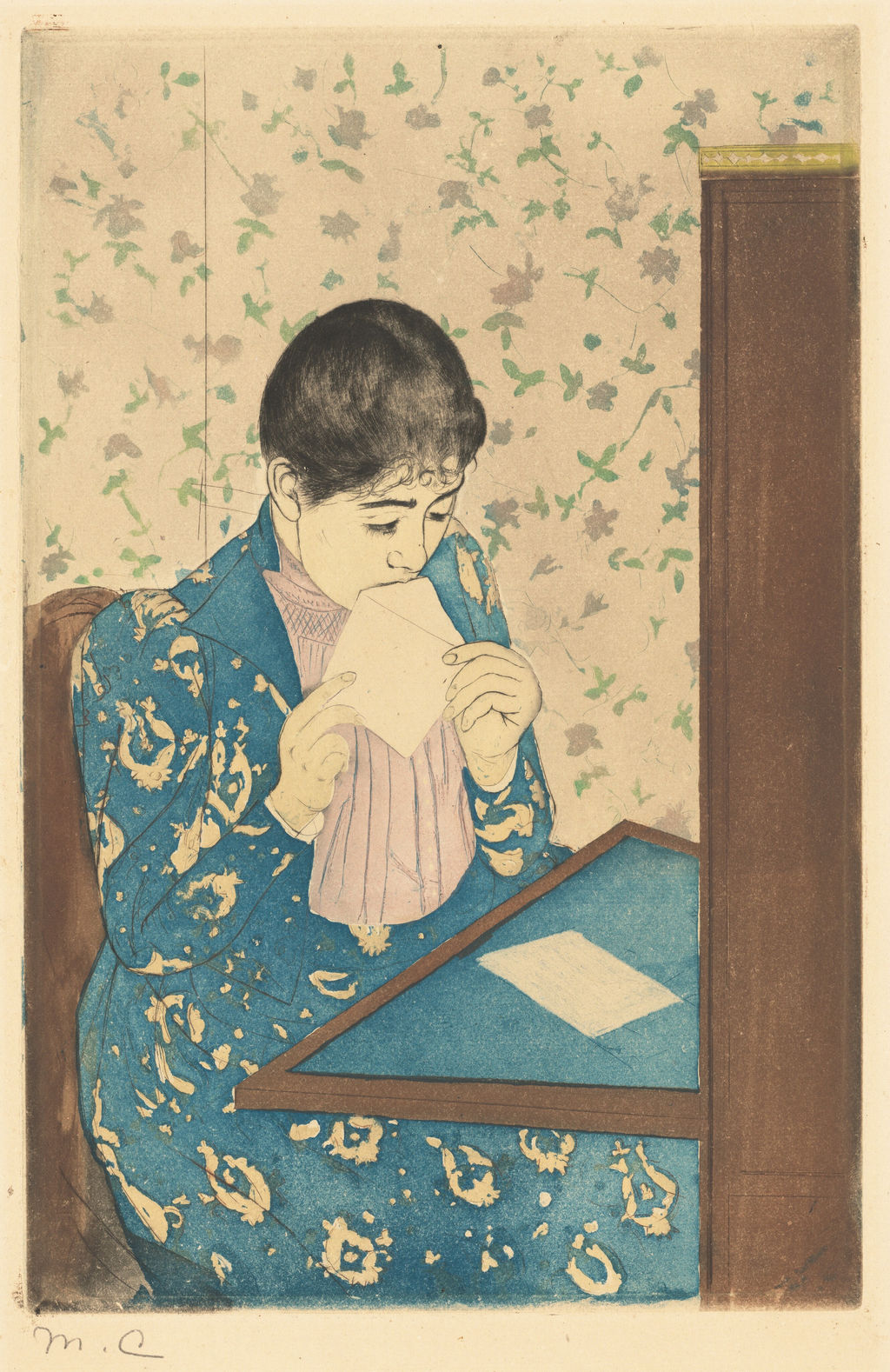
The Letter
1890–91 [6]Modern Woman
1892–93; displayed in 1893 [7] [8] [9]The Boating Party
1893–94 [10]Woman with a Sunflower
About 1905 [12]Young Woman in Green Outdoors in the Sun
About 1914 [13]Contents
- Hands, weight and shared attention
- The elevated viewpoint
- Stripes, flowers and the room around the figures
- Japanese prints and the history of care
- Materials and the limits of a reproduction
- From Cassatt’s studio to Chicago
- Titles and the identity of the picture
- Three different bathing pictures
- Looking again
- Annotated details
Hands, weight and shared attention
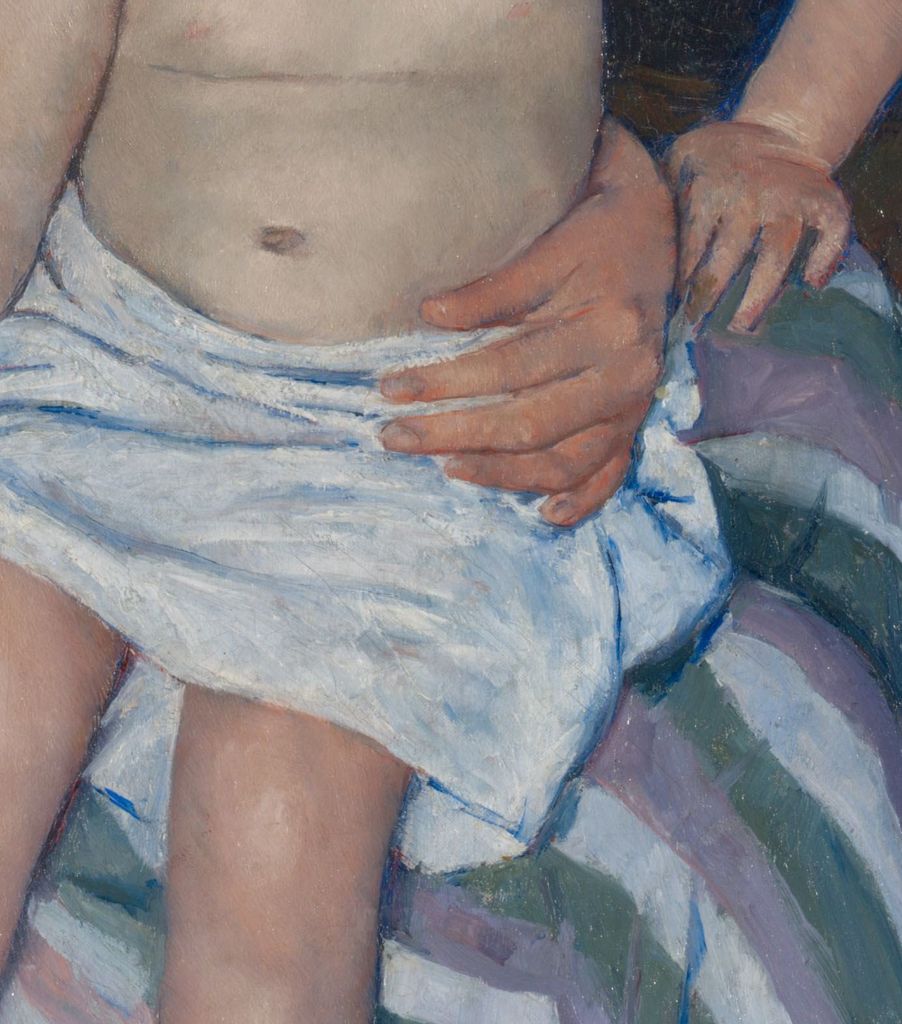
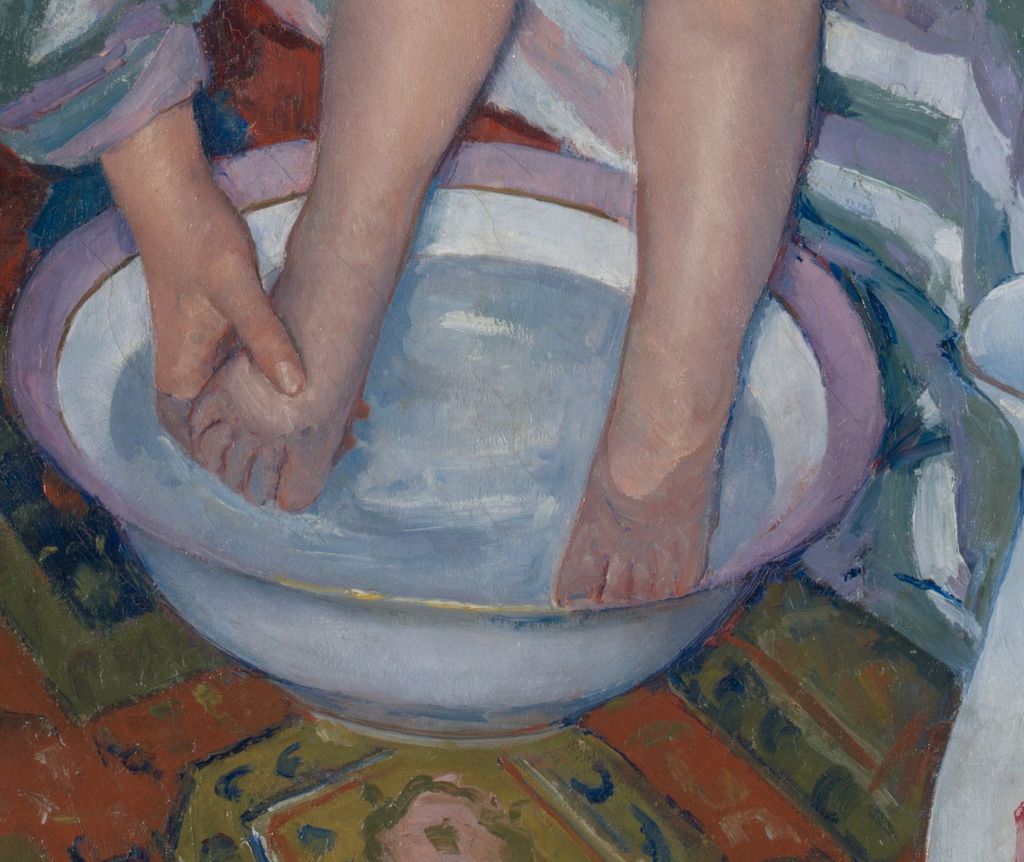
The adult’s enclosing arm passes around the child’s torso, with a broad hand resting against the white cloth at the waist. That support makes the upright body feel secure. The other arm descends along the left side of the image towards the basin. Its hand meets the child’s foot, giving the washing action a precise destination.
The two hands perform different tasks. One holds the child close; the other attends to a small part of the body. Looking at their separation helps us understand the scene physically. Care involves both maintaining a position and carrying out an action. Cassatt makes those responsibilities visible without introducing a dramatic gesture or turning either figure towards the spectator.
The child’s legs descend from the lap into the basin. Their pale, relatively continuous forms interrupt the striped clothing behind them. At the top of the body, one arm bends outwards, while the other hand rests lower beside the thigh. These differing positions keep the child from becoming a rigid vertical shape. The body is supported, but it retains its own distribution of weight and movement.
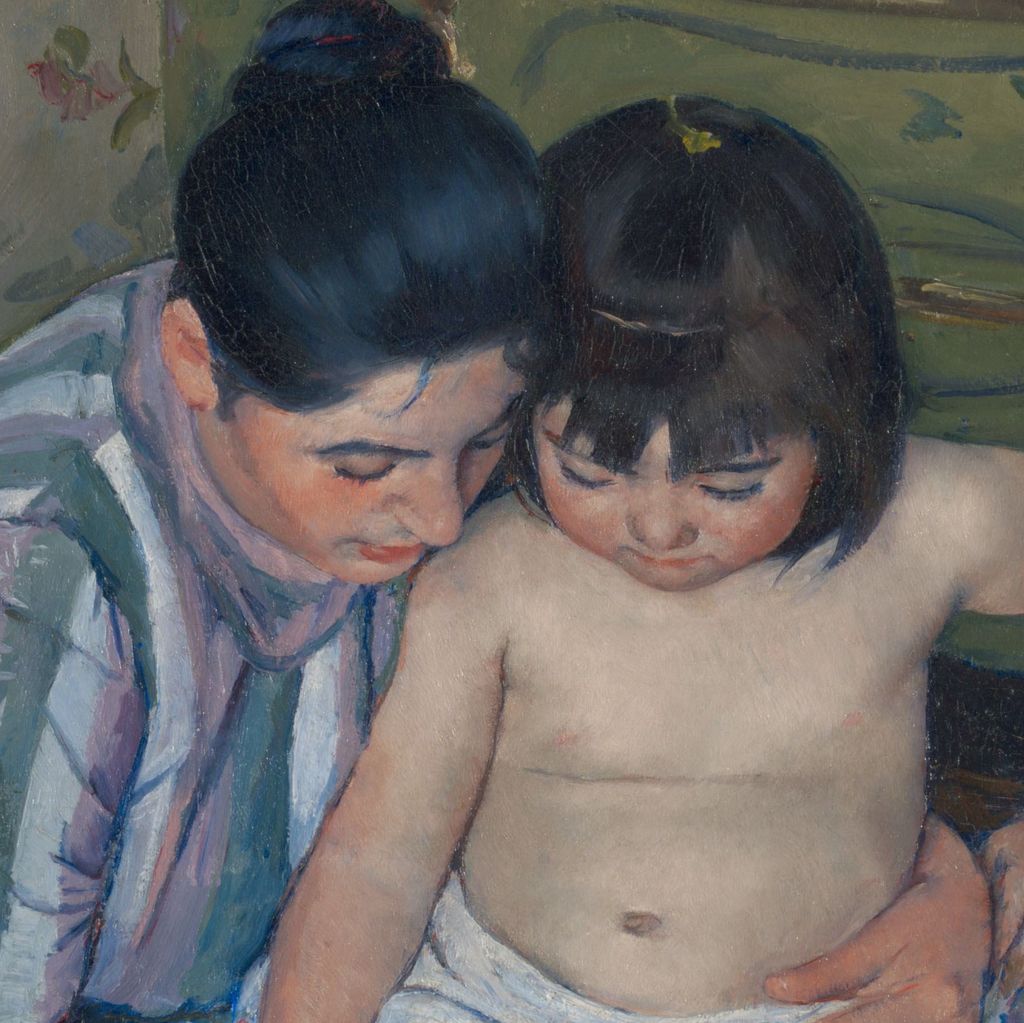
The adult’s head inclines beside the child’s. Dark hair brings their upper silhouettes close together, and the faces turn towards the washing rather than towards us. Neither face supplies a direct invitation to enter the scene. Instead, the hand at the foot and the direction of the eyes tell us where attention is concentrated.
This is an intimate picture partly because its figures share an activity. Their closeness is not conveyed only through cheeks placed near one another. The supporting hand, the downward arm and the child’s seated position make the relationship practical. We can see what the adult is doing for the child, and how the child’s body depends on that support.
The white cloth at the waist also plays more than one role. It covers part of the body, gathers into folds and separates pale skin from patterned dress. Its edges establish overlaps: cloth lies across the lap, a hand presses against it, and legs emerge below. Following these small junctions makes the arrangement more legible than treating the two figures as one general emblem of tenderness.
The elevated viewpoint
We look down into the scene. The basin opens into a broad oval, while the upper surfaces of the lap and surrounding furnishings remain visible. The spectator’s position differs from that of someone sitting face-to-face with the figures. Cassatt lets us see the action of washing from an angle that exposes its organisation.
The viewpoint draws attention to the child’s head and shoulders as well as the water below. Our eye can travel down through the body towards the hand at the foot. The adult’s lowered arm provides a parallel route. These downward movements are held within the larger grouping of shoulders, enclosing arm and striped clothing.
Depth remains present, but it does not operate through a long view into a distant room. The objects press close to the figures and the edges of the canvas. A green chest occupies the upper right; the patterned wall closes the space at left; the floor covering spreads across the foreground. We have enough information to understand an interior without being given a complete architectural plan.
The Art Institute connects the high viewpoint, cropped forms, outlines and compressed space with Cassatt’s interest in Japanese prints. This helps explain why a convincing bodily action can coexist with an emphatic arrangement of patterns on the surface. The picture does not require us to choose between seeing represented depth and seeing shapes fitted together. [14]
Try following the basin’s rim without looking at the faces. Its oval marks out the space occupied by the feet. Then look at the white pitcher beside it. The pitcher rises as a separate pale form, while its handle and opening introduce other curves. These objects help organise the lower part of the picture rather than simply tell us that water was available.
Annotated Details from The Child’s Bath
The numbered points identify visible features discussed in this article. Return from each detail to the whole composition. The Child’s Bath, 1893. Art Institute of Chicago. Image source. Public domain. Numbered overview and detail crops from the separate source master; original appearance retained.
Details from THE CHILD’S BATH
Compare the cropped details with the complete images above. Notice how their colours, shapes and positions contribute to the larger compositions.
Two downward heads
Both heads incline towards the washing action. Their proximity concentrates attention without turning either face directly towards the viewer.
The supporting hand
The adult’s supporting hand meets the child’s torso above the cloth. It performs a different job from the hand working near the foot.
Foot, hand and basin
The foot enters the pale basin as a hand attends to it. Curved rims, fingers and the small limb give the washing action a precise location.
Stripes, flowers and the room around the figures
The adult’s garment is built from broad stripes in subdued green, pale blue, white and lilac. The stripes change direction as the fabric bends around shoulder, arm and lap. Their repeated rhythm makes the surface lively, but their curvature also helps us understand the body beneath it. Pattern and volume cooperate within the same passages.
Different patterns occupy the surrounding interior. The wall has scattered floral forms; the chest combines green bands and small painted flowers; the floor covering uses larger geometric shapes and coloured centres. Their scales differ. A small flower near the heads does not behave like a broad band across the foreground, even though both contribute to the density of the setting.
Against these surfaces, the child’s torso provides a quieter area. Skin is not literally without variation, but it lacks the repeated motifs of the garment and furnishings. The relatively uninterrupted pale body becomes an important centre within the patterned field. The dark-haired heads establish another concentrated area at the top of the grouping.
The white cloth, basin and pitcher create a series of pale accents. They do not all have the same surface: cloth folds, glazed vessels and skin respond differently to painted edges and tonal changes. Cassatt uses their related lightness to connect separate parts of the image while preserving the distinctions between them.
The pitcher deserves a second look. Its decoration makes it part of the patterned room, while its pale body connects with the basin and cloth. It therefore belongs to two visual systems at once: the repeated ornament around the figures and the lighter shapes that organise the washing action. Such connections make an apparently incidental furnishing important to the whole composition.
The Art Institute’s education manual encourages attention to these differences in pattern and viewpoint. Its discussion is useful because it directs the viewer back to specific relationships rather than treating decoration as a background added after the figures. The surfaces around the child and caregiver are active parts of the image. [14]
Japanese prints and the history of care
Cassatt’s engagement with Japanese art provides an important context for this 1893 painting. She had encountered the major Paris exhibition of Japanese prints in 1890 and developed her own colour-print project in 1890–91. The Art Institute’s account relates that experience to the elevated view, cropping and patterned surfaces of The Child’s Bath. It does not identify one Japanese print as an exact model copied for this canvas. [14]
The distinction matters when comparing images. A raised viewpoint or a cropped figure can establish a meaningful resemblance without proving a direct line from one particular sheet to one particular painting. Cassatt’s own choices involve the medium of oil, the proportions of this canvas and the arrangement of these bodies. Cassatt and Japanese Art considers those relationships more broadly.
The museum’s education manual also places the bathing subject within changing nineteenth-century attitudes towards child rearing and hygiene. This is a historical framework for understanding why a routine act of care could carry significance. It does not establish that Cassatt painted the picture to promote a named physician’s programme, or that the unidentified figures represent a particular profession or social class. [14]
The painting itself makes the work of care observable. The adult cannot simply place the child in the basin and stand aside; the composition depends on an enclosing arm, a seated body and the reach towards the foot. These details give an ordinary task structure and effort. The affectionate effect is inseparable from the physical organisation that sustains it.
The Philadelphia Museum of Art’s 2024 exhibition Mary Cassatt at Work offers a related modern perspective on the relationship between Cassatt’s professional labour and the caregiving represented in her art. It encourages us to notice tasks and concentration alongside intimacy. That framework can deepen our looking while remaining distinct from a recorded statement by Cassatt about this particular picture. [15]
Watch: Mary Cassatt
Choose a film to explore the artist’s work, its interpretation and its wider setting.
Demonstrating Mary Cassatt's Color Printmaking Techniques
The Philadelphia Museum of Art demonstrates techniques used to make Cassatt’s colour prints.
Watch on YouTubeMaterials and the limits of a reproduction
The painting is oil on canvas. Close looking reveals differences between the treatment of skin, striped fabric, vessel outlines and the marks describing the surrounding patterns. Those visible differences help explain the image without supplying a complete account of its making. A broad painted passage does not tell us exactly how long it took or which pigment mixture produced it. [1]
Cassatt’s emphasis can shift between a relatively continuous form and a passage whose individual marks remain conspicuous. The chest and wall contain abbreviated flowers; the clothing uses bands that remain visibly painted; the faces concentrate smaller tonal changes. These differences organise attention. They should not automatically be converted into a story in which one part was carefully finished and another carelessly left behind.
The work’s style and technique can therefore be explored through observation, but object-specific technical findings require separate documentation. Imaging or pigment results reported for another Cassatt painting do not become findings about this one. The present composition is rich enough to reward looking without borrowing a conservation history from a different canvas.
From Cassatt’s studio to Chicago
The Art Institute’s provenance records a sequence of movements after the painting was made. Cassatt sold it to Durand-Ruel in Paris on 24 November 1893; it was transferred to the dealer’s New York branch on 27 December. The Whittemores purchased it on 17 January 1894, and it returned to the dealer in 1899. The museum acquired it in 1910. [1]
This sequence distinguishes several kinds of event. Moving a painting between a dealer’s branches is different from a collector buying it. A return to the dealer is different again from the later entry into a public museum. Those changes explain how a picture made in France became part of an American collection without requiring an invented commission for the original scene.
The museum identifies The Child’s Bath as its first Cassatt acquisition. Its public history has continued through display, reproduction and interpretation. The collection record also includes the 1915 Knoedler exhibition in its exhibition history. That later visibility belongs to the painting’s reception, alongside its place within Cassatt’s 1890 swork. [1]
An early reproduction appeared in Achille Ségard’s 1913 book about Cassatt. Its historical caption used 1894, while the current Art Institute record dates the painting 1893. The reproduced composition helps document the picture’s circulation, but an old caption need not determine the date retained by the owning museum today. [16] [1]
Titles and the identity of the picture
The Chicago oil has also circulated under titles including La Toilette, The Toilet and The Bath. Those names belong to its historical record, but they do not make it identical to the print showing an adult woman bathing or the colour print of a kneeling caregiver and child. The date and composition help distinguish the objects when titles overlap. [1]
The familiar title The Child’s Bath usefully places the child and the action at the centre of our attention. It supplies less information about the sitters. A description of a relationship within an image does not establish the models’ names or biological kinship. The supporting gestures remain visible even where those identities are unknown.
Three different bathing pictures
The colour print, 1890–91
Cassatt’s The Bath is a colour print rather than another name for the Chicago oil. A kneeling woman supports a turning child while extending a hand into a tub. The large yellow patterned dress occupies much of the design, and the surrounding field remains comparatively open. Its arrangement separates the testing hand and the supporting action differently from the hand at the foot in the 1893 painting. [17]
The contrast in space is especially revealing. In the print, the open surrounding field gives the patterned garment and outlined bodies considerable independence. In the Chicago oil, the figures sit within a dense system of floor, wall and furniture. Both images organise care through more than one simultaneous gesture, but the visual setting changes how those gestures are experienced.
The Metropolitan Museum’s final-state impression of the print uses two plates. That technical description belongs to a particular printed design and its development, not to the oil painting. It also does not describe every experimental trial. A photograph of a print can resemble a painted scene in subject while recording an object made through a fundamentally different process. [17]
The earlier oil, 1880
The Los Angeles County Museum of Art’s A Child’s Bath, also known as Mother About to Wash Her Sleepy Child, dates from 1880. Here a white-clad adult supports a child across her lap, and the faces turn towards one another. A hand reaches towards a basin near the lower left, while a blue chair helps enclose the figures. [18]
The earlier oil creates a more face-to-face relationship. The Chicago painting instead directs both heads down towards the foot-washing action. Its child is more upright, and the elevated viewpoint exposes the basin and lap. Looking between the two reveals a change in the arrangement of attention, not simply a second illustration of the same event.
Their titles can easily obscure these differences. The 1880 Los Angeles oil, 1890–91 print and 1893 Chicago oil are separate works. Their models, collecting histories and materials cannot be merged merely because a title contains the words “child” and “bath.” Recognising the distinct compositions makes comparison more useful: each shows Cassatt solving a different problem of bodily support and pictorial space.

The Bath — print design; the illustrated legacy impression is unidentified.

Mother about to Wash her Sleepy Child.
Looking again
Return to the Chicago painting after those comparisons. The supporting hand at the waist, the hand at the foot and the two inclined heads form a connected sequence. The striped garment surrounds that sequence without concealing the body’s weight. Basin and pitcher hold the lower composition together, while the patterns of the room press close to the figures.
The picture’s intimacy grows through these precise relationships. We see practical attention carried out in a setting that remains visually complex. Cassatt gives a small action enough structure to sustain a large amount of looking. The painting can be affectionate without asking us to invent a family biography, and formally ambitious without making the caregiving task incidental.
Cassatt artworks and studies
A source-bounded directory of documented works and studies, including the works in the National Gallery’s 2026 checklist and one clearly marked former attribution. Different print impressions are grouped by design and remain searchable by their recorded accessions. This is not a complete catalogue raisonné. Unlinked titles have no individual article here.
| Name | Date | Medium |
|---|---|---|
| A Child’s Bath — LACMA oil | 1880 | Oil on canvas |
| A Goodnight Hug | 1880 | Pastel |
| After the Bullfight | 1873 | Oil on canvas |
| Afternoon Tea Party | 1890–91 | Colour print |
| At the Theatre (Lydia Cassatt Leaning on Her Arms, Seated in a Loge) | About 1879 | Pastel |
| Automne, portrait de Lydia Cassatt | 1880 | Oil on canvas |
| Breakfast in Bed | 1897 | Oil on canvas |
| Bust of Ellen with Bows in Her Hair | 1898 | Pastel |
| By the Pond | About 1896 in Met and Terra records; about 1898 at MoMA | Not established |
| Child Drinking Milk from a Bowl; provisionally identified composition (qualified identification) | About 1890, following inventory and catalogue text | Pastel |
| Child in a Straw Hat | About 1886 | Oil on canvas |
| Child Picking a Fruit | 1893 | Oil on canvas |
| Children Playing on the Beach | 1884 | Oil on canvas |
| Clarissa, Turned Left, with Her Hand to Her Ear | About 1890–93 in Sotheby’s 2012 entry; about 1893 in GCMA notice | Pastel |
| Denise at her Dressing Table | About 1908–09 | Oil on canvas |
| Driving | 1881 | Oil on canvas |
| Eddy Cassatt (Edward Buchanan Cassatt) | 1875 | Oil on canvas |
| Ellen Mary Cassatt in a White Coat | About 1896 | Oil on canvas |
| Emmie and her Child | About 1890 | Oil on canvas |
| Gathering Fruit | About 1893 | Not established |
| Girl Arranging her Hair | 1886 | Oil on canvas |
| Head of a Child with a Red Hat | 1903, signed and dated | Pastel |
| Head of a Woman in a Large Hat | About 1909 | Pastel |
| Head of Simone in a Green Bonnet with Wavy Brim | About 1904 | Pastel |
| In the Garden | 1903 or 1904 | Oil on canvas |
| In the Loge | 1878 | Oil on canvas |
| In the Omnibus | 1890–91 | Colour print |
| In the Omnibus [recto] — preparatory drawing | c. 1891 | Chalk and graphite |
| In the Opera Box (No. 3) [recto] — preparatory drawing | 1880 | Graphite |
| In the Opera Box (No. 3) — print | c. 1880 | Intaglio print |
| Jeune fille au jardin (Young Woman Sewing in a Garden) | 1880–82 | Oil on canvas |
| Jules Dried by His Mother; provisionally identified composition (qualified identification) | 1901, following catalogue text | Oil on canvas |
| Lady in Black, in a Loge, Facing Right | c. 1880 | Etching |
| Lilacs in a Window | About 1880–83 | Oil on canvas |
| Little Girl in a Blue Armchair | 1878 | Oil on canvas |
| Louise Nursing her Child | 1899 in Luxembourg caption; 1898–99 in loan and Arp records | Pastel |
| Madame Gaillard and Her Daughter Marie-Thérèse | 1897, Reynolda collection listing | Pastel |
| Maternal Caress | 1890–91 | Not established |
| Maternal Caress — preparatory drawing | About 1891 | Charcoal and graphite |
| Mathilde Holding a Baby Who Reaches out to the Right | About 1889, Christie’s catalogue | Pastel |
| Mimi as a Brunette | c. 1889 | Drypoint |
| Mimi Holding a Japanese Fan | c. 1889 | Drypoint |
| Modern Woman | 1892–93; displayed in 1893 | Not established |
| Mother about to Wash her Sleepy Child | 1880 | Oil on canvas |
| Mother and Child (Maternal Kiss) | 1896 | Pastel |
| Mother and Child (Nude Dark-Eyed Little Girl with Mother in Patterned Wrapper) | About 1898–99, Sotheby’s catalogue | Pastel |
| Mother and Child (The Oval Mirror) | About 1899 | Oil on canvas |
| Mother Berthe Holding Her Nude Baby | 1898–99 | Pastel |
| Mother in Purple Holding her Child | About 1914, Christie’s catalogue | Pastel |
| Mother Playing with Child | About 1897 | Pastel |
| Mother’s Kiss | 1890–91 | Colour print |
| Nurse Reading to a Little Girl | 1895 | Pastel |
| Poppies in a Field (formerly Cassatt; attributed to Victor Gabriel Gilbert) | About 1880, current museum record | Oil on panel |
| Portrait of an Elderly Lady | c. 1887 | Oil on canvas |
| Portrait of Madame AF Aude and her Two Daughters | 1899, Breeskin 1970 exhibition catalogue | Pastel |
| Portrait of the Artist | 1878 | Watercolour and gouache |
| Reading Le Figaro | 1878, NGA 2026 checklist; about 1877–78 in SAAM’s 2015 caption | Oil on canvas |
| Reflection — drypoint | c. 1890 | Drypoint |
| Sara Holding a Cat | About 1907–08 | Oil on canvas |
| Sara in a Green Bonnet | About 1901 | Oil on canvas |
| Sara with Her Dog, in an Armchair, Wearing a Bonnet with a Plum Ornament | 1901 | Pastel |
| Self Portrait | About 1880 | Watercolour and gouache |
| Simone in Blue Plumed Hat | About 1903 | Pastel |
| Simone Seated on the Grass next to her Mother | 1901–02 | Pastel |
| Sketch of Master St. Pierre | Date not established | Pastel |
| Sleepy Baby | About 1910 | Pastel |
| Smiling Mother with Sober Faced Child | Date not established | Pastel |
| Spanish Dancer Wearing a Lace Mantilla | 1873 | Oil on canvas |
| Summertime, horizontal painting | 1894–95, current Sotheby’s catalogue | Oil on canvas |
| Tea — print | c. 1890 | Drypoint |
| The Bath | 1890–91 | Not established |
| The Boating Party | 1893–94 | Oil on canvas |
| The Caress | 1902 | Oil on canvas |
| The Child's Bath | 1893 | Oil on canvas |
| The Coiffure | 1890–91 | Colour print |
| The Cup of Tea | About 1880–81 | Oil on canvas |
| The Fitting | 1890–91 | Colour print |
| The Lamp | 1890–91 | Colour print |
| The Letter | 1890–91 | Colour print |
| The Loge | About 1878–1880 | Oil on canvas |
| The Mandolin Player | 1868 | Oil on canvas |
| The Manicure (Les Ongles; The Nails) | About 1908 | Intaglio print |
| The Tea; Le Thé | About 1880 | Oil on canvas |
| The Visitor | c. 1880 | Intaglio print |
| Two Sisters | 1896 | Pastel |
| Two Women Seated by a Woodland Stream | About 1869 | Oil on canvas |
| Two Women Throwing Flowers During Carnival | 1872 | Oil on canvas |
| Under the Horse-Chestnut Tree | 1896–97, National Gallery and MoMA records | Not established |
| Woman Bathing (La Toilette) | 1890–91 | Colour print |
| Woman in a Loge (Woman with a Pearl Necklace) | 1879 | Oil on canvas |
| Woman Reading | 1878–79 | Oil on canvas |
| Woman Standing, Holding a Fan | 1878–79 | Distemper |
| Woman with a Fan | c. 1878–1879 | Oil on canvas |
| Woman with a Red Zinnia | 1891 | Oil on canvas |
| Woman with a Sunflower | About 1905 | Oil on canvas |
| Young Girl at a Window | c. 1883–1884 | Oil on canvas |
| Young Girl with Brown Hair, Looking Left | About 1913 (1997 summary catalogue) | Pastel |
| Young Mother Sewing | 1900 | Oil on canvas |
| Young Woman in Green, Outdoors in the Sun | About 1914 | Oil on canvas |
Questions about The Child’s Bath
The Art Institute of Chicago dates it 1893. It entered the museum in 1910 through the Robert A. Waller Fund and has the accession number 1910.2. [1]
Their names and biological relationship are not established by the current record. The painting shows an adult caring for a child; its traditional title does not provide a genealogy. [1]
The elevated viewpoint reveals the basin, lap and washing action. The museum connects it, together with cropping and pattern, to Cassatt’s engagement with Japanese prints. [14]
Discussion
Look again at the images and ideas explored in The Child’s Bath by Mary Cassatt. These editorial prompts invite your observations.
Reader Insights
Two heads bend towards a small act of washing. What does this first detail make you notice?
The adult’s enclosing arm passes around the child’s torso, with a broad hand resting against the white cloth at the waist. How does it affect your reading of the whole work?
How does the high viewpoint change your understanding of the child’s weight and the adult’s two different hand actions?
Join the Conversation
Share a detail, comparison or question about The Child’s Bath by Mary Cassatt below.
References
- Art Institute of Chicago, The Child’s Bath, 1893, 1910.2, current collection record, provenance and exhibition history. View source.
- Denver Art Museum, Whistler to Cassatt Access Guide, The Salon, stop 104. View source.
- Denver Art Museum, Whistler to Cassatt:American Painters in France, bilingual exhibition livret,The Salon,no2. View source.
- National Gallery of Art, Little Girl in a Blue Armchair, 1983.1.18. View source.
- Philadelphia Museum of Art, Driving, 1881. View source.
- National Gallery of Art, The Letter,1943.3.2763. View source.
- Art Institute of Chicago, Ryerson and Burnham Archives, Bertha Honoré Palmer Correspondence Collection finding aid, selected Mary Cassatt entries, Box1Folder3. View source.
- Museum of Modern Art, Mary Cassatt artist essay and print records. View source.
- MaudHoweElliott(ed.) / UniversityofIllinoisUrbanaChampaign scan, Art and Handicraft in the Woman’s Building of the World’s Columbian Exposition,Chicago,1893,Chicago:RandMcNally,1894. View source.
- National Gallery of Art, The Boating Party, 1963.10.94. View source.
- Metropolitan Museum of Art, Young Mother Sewing, 29.100.48. View source.
- National Gallery of Art, Woman with a Sunflower, 1963.10.98. View source.
- Sotheby’s, Young Woman in Green Outdoors in the Sun, Modern Day. View source.
- Art Institute of Chicago, American Art, new edition, 2008, pp.34–35 and the patterns lesson, pp.93–94. View source.
- Philadelphia Museum of Art, Mary Cassatt at Work, 2024 exhibition press release. View source.
- Achille Ségard, Un peintre des enfants et des mères: Mary Cassatt, 1913, interleaved reproduction near p.52, scan p.89 (French; historical 1894 caption). View source. (in French).
- Metropolitan Museum of Art, The Bath, 1890–91, 16.2.7, final-state impression and process discussion. View source.
- Los Angeles County Museum of Art, A Child’s Bath, 1880, M.62.8.14. View source.
- Art Gallery of Ontario, Cassatt–McNicoll:ImpressionistsBetweenWorlds. View source.
- National Gallery of Art, Children Playing on the Beach, 1970.17.19. View source.
- Colby College Museum of Art, Explore Inside Out: The Prints of Mary Cassatt; Mother Berthe Holding Her Nude Baby,2013.549. View source.
- Sotheby’s, syndicated auction catalogue hosted by Invaluable, Simone in Blue Plumed Hat, Watson collection, 18 May 2005, lot 20. View source.
- The Huntington, Breakfast in Bed, 83.8.6. View source.
- Adelyn Dohme Breeskin / Smithsonian Institution Press; University of California scan indexed by Google Books, Mary Cassatt:A Catalogue Raisonné of the Oils,Pastels,Watercolors,and Drawings,1970,322pp; selected public search snippets pp91–92,143–144,316,318. View source.
- Metropolitan Museum of Art, The Private Collection of Edgar Degas: A Summary Catalogue, Cassatt entries, printed p.7, no.48. View source.
- Art Institute of Chicago, After the Bullfight, 1969.332. View source.
- Smithsonian American Art Museum, Art Inventories, After the Bullfight, siris_ari_180619. View source.
- Smithsonian American Art Museum, The Caress, 1911.2.1. View source.
- Museum of Modern Art, Under the Horse-Chestnut Tree,671.1940. View source.
- National Gallery of Art, Under the Horse-Chestnut Tree,1959.12.4. View source.
- Virginia Museum of Fine Arts, Board of Trustees minutes,17September2020,loan recommendation7:ChildPickingaFruit75.18. View source.
- Cincinnati Art Museum, Les Ongles(The Nails;The Manicure),ca1908,1940.155,secondstate. View source.
- Sotheby’s, Clarissa Turned Left with Her Hand to Her Ear, 2012 lot 51. View source.
- Greenville County Museum of Art, Recent Acquisitions Funded by Sale of Alma Thomas Painting, 2021. View source.
- Metropolitan Museum of Art, The Coiffure,16.2.3. View source.
- Metropolitan Museum of Art, The Cup of Tea, 22.16.17. View source.
- Sotheby’s, Mother and Child (Nude Dark-Eyed Little Girl with Mother in Patterned Wrapper), 19 May 2010, lot 31. View source.
- Metropolitan Museum of Art, Denise at Her Dressing Table, 2005.129. View source.
- Denver Art Museum, Whistler to Cassatt exhibition guide, stop 112: Bust of Ellen with Bows in Her Hair. View source.
- Museum of Fine Arts, Boston, Ellen Mary in a White Coat, 1982.630. View source.
- Amon Carter Museum of American Art, Woman Standing Holding a Fan, 2011.20. View source.
- Smithsonian American Art Museum, Special Installation of Nineteen American Masterworks, 2015. View source.
- Metropolitan Museum of Art, The Fitting, 16.2.8 final state. View source.
- Reynolda House Museum of American Art, Mary Cassatt collection listing: Madame Gaillard and Her Daughter Marie-Thérèse, 1897. View source.
- Wake Forest University, Wake Women 2023 schedule, Highlighting the Art of Women at Reynolda, captioned Cassatt image. View source.
- Detroit Institute of Arts, In the Garden, 36629. View source.
- National Gallery of Art, Gathering Fruit,1943.3.2757. View source.
- Sotheby’s, A Goodnight Hug,N09860lot11,14May2018. View source.
- Sotheby’s, syndicated auction catalogue hosted by Invaluable, Head of Simone in a Green Bonnet with Wavy Brim, Watson collection,18May2005,lot39. View source.
- National Gallery of Art, Girl Arranging Her Hair, 1963.10.97. View source.
- Joslyn Art Museum, Art Break:Woman Reading,1943.38,program object caption. View source.
- National Gallery of Art, The Lamp, 5937. View source.
- Sotheby’s, Tête de Femme au Grand Chapeau, 2008 N08449 lot135. View source.
- Metropolitan Museum of Art, Lilacs in a Window, 1997.207. View source.
- National Gallery of Art, The Loge,1963.10.96. View source.
- Arp Museum Bahnhof Rolandseck, Maestras: Malerinnen1500–1900,25February–16June2024,official five-page flyer. View source.
- Spanish official gazette / exhibition insurance schedule, BOE-A-2023-19808,21September2023,Maestras loan schedule. View source.
- Nationalmusée um Fëschmaart / ArpMuseum CollectionRauforUNICEF, Louise,NursingHerChild,1899,GR1.949;FromRenoirtoMonet2026–27. View source.
- Petit Palais / Paris Musées, Automne, portrait de Lydia Cassatt, PPP706; IIIF manifest 160008392. View source. (in French).
- Metropolitan Museum of Art, Maternal Caress, 16.2.5. View source.
- Philadelphia Museum of Art, Mother and Child Maternal Kiss, object 54049. View source.
- Metropolitan Museum of Art, Maternal Caress, preparatory drawing64.123.3, c1891. View source.
- Christie’s, Mathilde Holding Baby who Reaches out to Right, lot 5459369. View source.
- National Portrait Gallery / Catalog of American Portraits, Madame Meerson and her Daughter, SSSA2282. View source.
- Museum of Fine Arts Boston, In the Loge, 10.35. View source.
- Smithsonian art inventories, Child Drinking Milk from a Bowl, siris_ari_197517. View source.
- MutualArt public auction index; original auctioneer undisclosed without subscription, Child Drinking Milk from a Bowl, public listing dated 2 June 2024. View source.
- National Gallery of Art, Mother's Kiss,1963.10.254. View source.
- National Gallery of Art, Mary Cassatt the Daring Printmaker, 23 January 2026. View source.
- National Gallery of Art, Mary Cassatt An American in Paris checklist, updated 24 February 2026. View source.
- Adelyn D. Breeskin / National Gallery of Art, Mary Cassatt 1844–1926, 1970 exhibition catalogue. View source.
- Metropolitan Museum of Art, Nurse Reading to a Little Girl, 62.72. View source.
- National Gallery of Art, In the Omnibus, 46725. View source.
- Metropolitan Museum of Art, Mother and Child (The Oval Mirror), 29.100.47. View source.
- Philadelphia Museum of Art, Woman in a Loge, 1978-1-5, object72182. View source.
- Metropolitan Museum of Art, Mother Playing with Child, 22.16.23. View source.
- Metropolitan Museum of Art, By the Pond,60.732bis. View source.
- Museum of Modern Art, By the Pond,673.1940. View source.
- Terra Foundation for American Art, By the Pond,1999.25. View source.
- Philadelphia Museum of Art, Poppies in a Field, attributed to Victor Gabriel Gilbert; formerly attributed to Mary Stevenson Cassatt, 1978-1-6. View source.
- Christie’s, Mother in Purple Holding Her Child, lot 5369421. View source.
- Sotheby’s, Tête d’enfant au chapeau rouge, American Art N09229, 20 November 2014, lot 39. View source.
- Christie’s, Sara Holding a Cat, lot 5561267. View source.
- Smithsonian American Art Museum, Art Inventories Catalog, Sara with Her Dog, in an Armchair, Wearing a Bonnet with a Plum Ornament; IAP 80170363 / siris_ari_180925. View source.
- Smithsonian American Art Museum, Sara in a Green Bonnet, 1929.6.11. View source.
- Mary Cassatt Catalogue Raisonné project, with Adelson Galleries, presented on Artnet, Sara with Her Dog, in an Armchair, Wearing a Bonnet with a Plum Ornament, work 424155733. View source.
- Metropolitan Museum of Art, Portrait of the Artist, 1975.319.1. View source.
- National Portrait Gallery, Mary Cassatt Self-Portrait, NPG.76.33. View source.
- Musée d’Orsay, Jeune fille au jardin,RF193720. View source. (in French).
- Sotheby’s, Simone Seated on the Grass Next to Her Mother, 30 September 2020, lot 33. View source.
- Dallas Museum of Art, Sleepy Baby,1952.38.M. View source.
- Sotheby’s, Smiling Mother with Sober Faced Child, 2022. View source.
- Smithsonian American Art Museum, Spanish Dancer Wearing a Lace Mantilla, 1967.40. View source.
- Spencer Museum of Art,University of Kansas, The Manicure,c1908,1991.0266. View source.
- Christie’s, Sketch of Master St Pierre, 2017 online lot. View source.
- National Gallery of Art, Child in a Straw Hat, 1983.1.17. View source.
- Sotheby’s, Summertime, Armand Hammer: The Private Collection, Modern Evening Auction 2026. View source.
- National Gallery of Art, Afternoon Tea Party, 46731. View source.
- Museum of Fine Arts, Boston / Erica E. Hirshler, The Tea, 42.178. View source.
- The Nelson-Atkins Museum of Art, At the Theater,F77-33;French Paintings and Pastels appendixII. View source.
- Metropolitan Museum of Art, Woman Bathing La Toilette, 16.2.2. View source.
- Sotheby’s, Two Sisters, 2005 American Paintings sale N08134, lot 44. View source.
- Wichita Art Museum, Mother and Child, M109.53. View source.
- Smithsonian American Art Museum, Art Inventories, Two Women Seated by a Woodland Stream / Duex femmes assises aupres de l’eau, IAP 80170008. View source.
- Tacoma Art Museum / David Setford, Impressionist Painting: From Pleasure Gardens to the Palais Garnier, 22 October 2019. View source.
- Tacoma Art Museum, French Impressionism and the Northwest, Works of Art Adoption Program, 2019–2020, no. 10 / PDF p. 12. View source.