by Tom Gurney
Tom Gurney BSc (Hons) is an art history expert with over 20 years experience
Published on June 19, 2020 / Updated on November 2, 2026
Email: tomgurney1@gmail.com / Phone: +44 7429 011000
The Mandolin Player by Mary Cassatt: Introduction
The woman holds the instrument across her lap, but her eyes turn away from it. One hand rests near the strings, the other curls around the neck. A white blouse, red-orange sash and dark skirt give each part of the seated figure a different visual weight. Against a deep brown background, the mandolin becomes both the subject’s identifying object and the link between her hands.
Mary Cassatt painted The Mandolin Player in 1868. Denver Art Museum’s caption identifies it as oil on canvas in a private collection, and its exhibition guide describes the painting as her first work accepted at the Paris Salon. That milestone makes this a useful starting point for understanding the professional ambitions of her early career. [1]
The picture deserves to be considered as more than an announcement of what Cassatt would later become. Its stable seated pose, concentrated lighting and relation between costume and instrument offer specific things to examine. The face looks beyond the hands’ activity, giving the composition a quiet division between what the figure does and where she directs her attention.
At a Glance
- ArtistMary Cassatt [1]
- Date1868 [1] [2]
- MediumOil on canvas [1] [2]
- Collection creditPrivate collection, as credited by the Denver exhibition [1] [2]
- Exhibition milestoneCassatt’s first accepted Paris Salon work, 1868 [1] [3]
- DimensionsNot established by the reviewed museum caption
This work across Mary Cassatt’s career
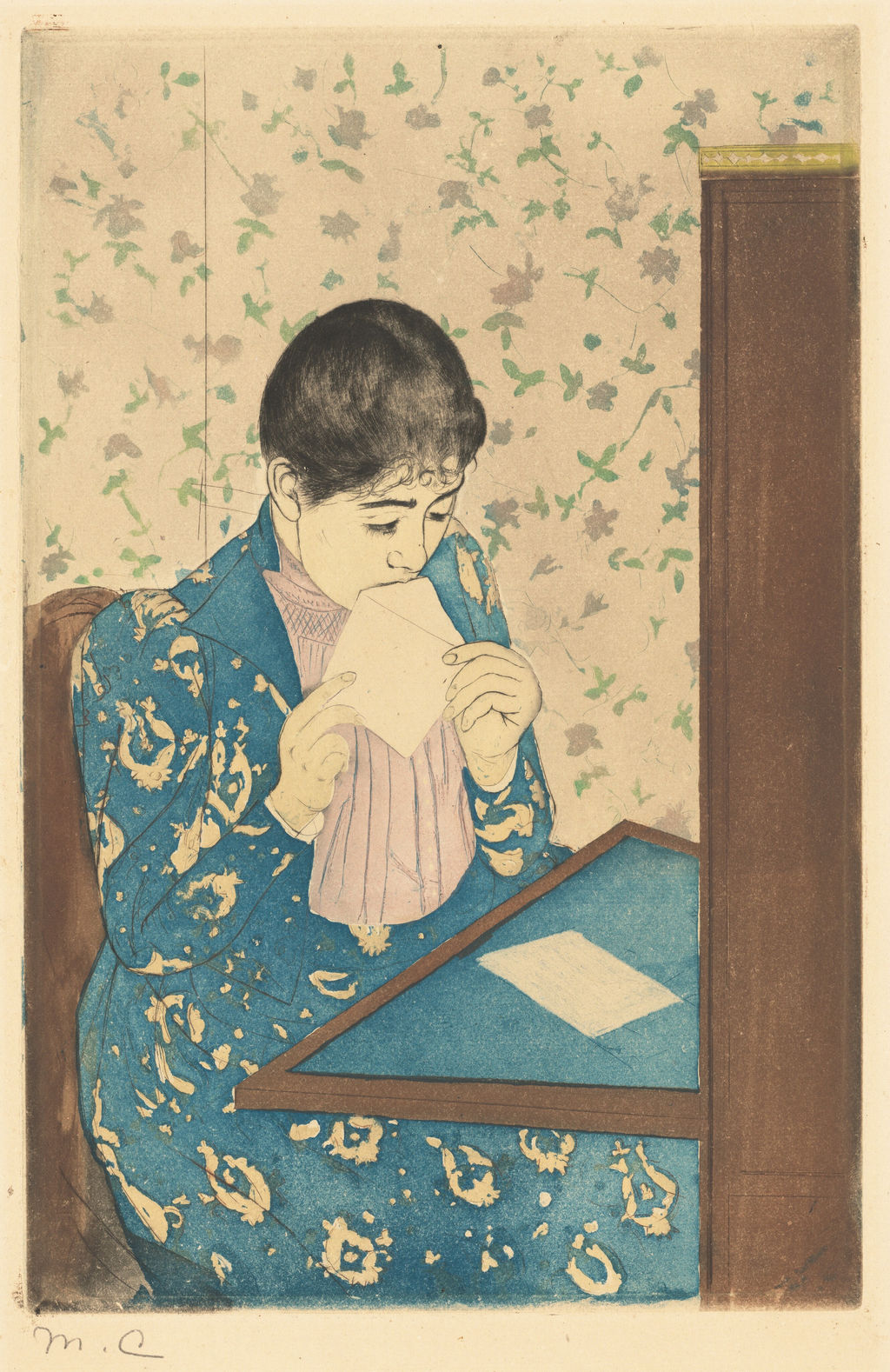
The Letter
1890–91 [6]Modern Woman
1892–93; displayed in 1893 [7] [8] [9]The Boating Party
1893–94 [10]The Child's Bath
1893 [11]Woman with a Sunflower
About 1905 [13]Young Woman in Green Outdoors in the Sun
About 1914 [14]Contents
- The instrument joins the hands
- White blouse, red sash and dark skirt
- A face turned beyond the music
- Why the Salon mattered in 1868
- Looking at finish without inventing a technique
- After the Bullfight: another figure with occupied hands
- Which Mandolin Player is this?
The instrument joins the hands
The mandolin lies diagonally across the lower torso. Its rounded body occupies the centre of the grouping, while its neck extends towards the upper right. The dark strings and their surrounding wooden surfaces give that diagonal a clear direction. We can follow it from the hand near the sound hole to the fingers arranged around the neck.
The two hands have different tasks within both the represented action and the composition. The hand over the instrument’s body lies relatively flat, its fingers angled towards the strings. The other hand wraps around a narrower shape and turns at the wrist. Their different orientations prevent the two pale forms from appearing as repeated accents on either side of the same object.
The forearms reinforce that distinction. One crosses more nearly horizontally from the white sleeve into the centre. The other rises along the neck of the instrument. Together they make an open enclosure around the mandolin’s body. The wooden form remains legible inside that enclosure, rather than disappearing behind a tangle of fingers and fabric.
The instrument’s long neck also carries attention beyond the broadest part of the figure. Its tuning pegs mark a small cluster near the right, where pale details stand against the background. That extension counterbalances the head and the long fall of dark hair on the left. The mandolin consequently helps distribute the figure across the canvas as well as identifying a musical activity.
The pose permits us to understand how the instrument is held without reconstructing a particular performance. Nothing in the image names a tune, establishes an audience or proves that the sitter was a professional musician. The precise interest lies in the relation between body, hands and object: a convincing arrangement of holding and touching, open to examination even when the occasion remains unknown.
White blouse, red sash and dark skirt
The blouse supplies the largest area of light. Its sleeves broaden the shoulders and follow the bends of the arms, while smaller folds interrupt what might otherwise have become a single flat white shape. The neckline leaves the upper chest visible and creates a pale frame below the face.
The light fabric is especially effective against the surrounding darkness. At the left shoulder, it separates the figure from the brown ground. Near the centre, it makes the transition to bare forearm easy to follow. On the right, its bright edge helps distinguish the raised arm from both the instrument and the background.
Across the torso, the red-orange sash changes the colour and direction of the grouping. It lies above the rounded instrument, then continues into a hanging section at the right. The longer hanging end carries warm colour down into the dark skirt. Without it, the lower part of the figure would read as a much more continuous area of shadow.
The sash also connects otherwise separated passages. Its warm colour relates to the wood of the instrument and the illuminated face, while remaining more saturated than either. It draws the eye back towards the torso after the instrument’s neck has carried it to the right. The effect is structural as well as decorative.
The skirt provides a broad dark base beneath these smaller accents. A raised area at the right helps suggest the seated position, but much of the lower body remains in shadow. The painting does not explain every part of the chair or every fold equally. It gives sufficient information to establish a seated figure while concentrating the strongest contrasts around the upper body and instrument.
This distribution of detail is worth distinguishing from a simple light-versus-dark formula. The blouse contains folds and changes of tone; the skirt contains quieter variations; the sash carries both a broad band and a narrow descending end. Each material occupies a different place within the balance of the whole.
A face turned beyond the music
The head rises above the central activity, with the face turned towards the left. The gaze does not follow either hand down to the strings. That difference creates a pause between the bodily action and the direction of looking. The subject can be understood as holding or playing an instrument without becoming wholly absorbed in examining it.
Dark hair frames the face and falls along the left shoulder. Where it meets the blouse, the contrast makes the length and contour especially clear. Higher up, the hair approaches the colour of the background, so its outer edge becomes less emphatic. Cassatt varies the degree to which the head separates from the surrounding field.
The face itself is more brightly illuminated than the outer hair. Forehead, cheek, nose and chin form a connected light shape, with darker features giving it articulation. Its position above the instrument creates a second focus of attention. The eye can move between an expressive human presence and a carefully described action without finding them identical.
The background gives no extensive view of a room. Its brown tones surround the figure with little architectural information. This helps the blouse, face and instrument retain their prominence. It also leaves the viewer without the evidence needed to identify a studio, a household interior or a public venue from the setting alone.
An outward-looking face can invite imagined explanations: perhaps someone has spoken, or perhaps a performer awaits a cue. The picture does not establish either event. Its tension is already present in the visible arrangement, where the hands engage one object and the eyes address another direction. Recognising that separation is more useful than choosing an undocumented story.
Why the Salon mattered in 1868
The Metropolitan Museum’s account of Cassatt’s life independently places her first Salon acceptance in 1868. Before that achievement, she had pursued training in Philadelphia and then in Paris during the middle of the decade. The accepted painting belonged to a career being built through study and public exhibition, rather than to an artist already established in the Impressionist group. [3]
Training involved more than a simple division between access and exclusion. Anna Havemann’s study of female artists at the Pennsylvania Academy of the Fine Arts describes Cassatt and Eliza Haldeman taking part in student-organised modelling. That activity was distinct from the institution’s formal life class for women, established in 1868. The distinction helps explain why an account of restricted opportunities should still recognise the practical ways students worked with living figures. [15]
The Mandolin Player gives that early professional history a concrete object. The coordinated hands, seated body and differences among skin, cloth and wood offer visible evidence of the demands Cassatt set herself in a figure painting. They do not reveal a complete lesson plan or identify the instruction behind each passage. The biography provides the broader sequence without requiring every feature of this canvas to be assigned to one teacher.
Denver’s guide presents the Salon as an important juried exhibition through which artists sought notice from critics and patrons. It interprets this painting’s traditional subject and relatively smooth finish in relation to that setting’s expectations. This is a modern curatorial explanation of how the work could appeal within an exhibition system. It is not a preserved statement by the 1868 jury explaining its decision. [1]
Acceptance also needs to be distinguished from other forms of success. It establishes that a work entered the exhibition; it does not, on its own, establish a particular review, a sale, an award or a commission. The milestone remains significant without attaching undocumented consequences to it. A young artist had gained a place in a major public forum.
Nor should later independence make that ambition seem insincere. Working towards a jury’s acceptance and later choosing other exhibition relationships belong to different moments in a career. This early canvas allows us to see a particular professional position through an actual painting, before the familiar later subjects of theatres, intimate caregiving and colour printmaking came to dominate accounts of Cassatt.
Watch: Mary Cassatt
Choose a film to explore the artist’s work, its interpretation and its wider setting.
Demonstrating Mary Cassatt's Color Printmaking Techniques
The Philadelphia Museum of Art demonstrates techniques used to make Cassatt’s colour prints.
Watch on YouTubeLooking at finish without inventing a technique
The painting’s relatively continuous modelling helps distinguish the face and hands from the darker setting. Its areas of cloth can be followed as folds around a seated body, and the instrument retains a clear outline. These visible features are compatible with Denver’s account of a relatively smooth finish, but they should not be turned into a laboratory analysis. [1]
A reproduction cannot establish the complete paint surface, the sequence of layers or the pigments used to build the shadows. The dark ground does not itself prove that Cassatt used a particular black pigment. Likewise, the brightness of the blouse cannot identify its white paint. Such questions require object-specific examination rather than a colour name applied to a digital image.
There is a particular reason for care with the exhibition guide. Its discussion moves from The Mandolin Player to Susan on a Balcony Holding a Dog. Comments there about blue pigments and the absence of black refer to the later Susan painting. They are not technical findings about this 1868 oil. Keeping the two objects separate allows the guide’s historical comparison to remain useful. [1]
The most productive first examination of The Mandolin Player therefore remains visual. Compare the sharper edges of the instrument with softer transitions around the face; compare the bright folds of the blouse with the subdued skirt. These contrasts show how attention is directed without requiring an unsupported reconstruction of Cassatt’s materials or working order.
After the Bullfight: another figure with occupied hands
Cassatt’s After the Bullfight, dated 1873 by the Art Institute of Chicago, offers a purposeful comparison with the earlier seated musician. It shows a costumed male figure with raised hands near his face, a cigarette and richly embroidered clothing. A rail crosses the lower part, with a red textile hanging over it. [16]
Both pictures give the hands a small, specific activity. In The Mandolin Player, they are separated along the length of an instrument. In After the Bullfight, they converge closer to the mouth. The difference changes how the viewer travels through the image: along a diagonal joining two hands, or towards a compact cluster near the face.
Costume also works differently. The musician’s white blouse supplies a broad light area against a dark skirt and ground. The bullfighter’s jacket breaks into repeated embroidery and bright details, producing a denser surface across the shoulders and arms. A red accent appears in each picture, but the sash integrated with the musician’s body differs from the cloth crossing the rail in the later work.
The rail introduces an additional division between spectator and figure. The mandolin canvas relies more heavily on the instrument and seated body to explain the foreground. Comparing them makes clear that a single figure against a relatively subdued setting need not produce a uniform formula. Objects, gestures and clothing can organise markedly different relationships within that general arrangement.
The title After the Bullfight does not identify a precise arena or performance for the mandolin player. Nor does either costume establish the musician’s nationality, name or social position. The value of the comparison lies in observable choices: the use of hands, the placement of red and the balance between broadly lit fabric and detailed ornament.

After the Bullfight.
Which Mandolin Player is this?
The key identifying facts are the 1868 date, oil-on-canvas medium and seated woman with a white blouse and red-orange sash. Denver’s modern bilingual exhibition booklet lists that painting as number 2 within its Salon section and credits a private collection. That modern exhibition number should not be mistaken for an entry number in the original 1868 Salon catalogue. [2]
The private-collection credit also has a limited meaning. It records the work’s loan status for the exhibition, without naming a present owner or promising public access today. No numerical dimensions are supplied here because the reviewed museum caption and booklet do not establish them.
Returning to the picture, the most revealing path begins at the rounded mandolin, follows its neck to the raised hand, then moves back across the blouse towards the turned face. The route joins activity, material and gaze. It gives this early professional milestone a specific visual character that remains interesting apart from the achievement recorded in its exhibition history.
Cassatt artworks and studies
A source-bounded directory of documented works and studies, including the works in the National Gallery’s 2026 checklist and one clearly marked former attribution. Different print impressions are grouped by design and remain searchable by their recorded accessions. This is not a complete catalogue raisonné. Unlinked titles have no individual article here.
| Name | Date | Medium |
|---|---|---|
| A Child’s Bath — LACMA oil | 1880 | Oil on canvas |
| A Goodnight Hug | 1880 | Pastel |
| After the Bullfight | 1873 | Oil on canvas |
| Afternoon Tea Party | 1890–91 | Colour print |
| At the Theatre (Lydia Cassatt Leaning on Her Arms, Seated in a Loge) | About 1879 | Pastel |
| Automne, portrait de Lydia Cassatt | 1880 | Oil on canvas |
| Breakfast in Bed | 1897 | Oil on canvas |
| Bust of Ellen with Bows in Her Hair | 1898 | Pastel |
| By the Pond | About 1896 in Met and Terra records; about 1898 at MoMA | Not established |
| Child Drinking Milk from a Bowl; provisionally identified composition (qualified identification) | About 1890, following inventory and catalogue text | Pastel |
| Child in a Straw Hat | About 1886 | Oil on canvas |
| Child Picking a Fruit | 1893 | Oil on canvas |
| Children Playing on the Beach | 1884 | Oil on canvas |
| Clarissa, Turned Left, with Her Hand to Her Ear | About 1890–93 in Sotheby’s 2012 entry; about 1893 in GCMA notice | Pastel |
| Denise at her Dressing Table | About 1908–09 | Oil on canvas |
| Driving | 1881 | Oil on canvas |
| Eddy Cassatt (Edward Buchanan Cassatt) | 1875 | Oil on canvas |
| Ellen Mary Cassatt in a White Coat | About 1896 | Oil on canvas |
| Emmie and her Child | About 1890 | Oil on canvas |
| Gathering Fruit | About 1893 | Not established |
| Girl Arranging her Hair | 1886 | Oil on canvas |
| Head of a Child with a Red Hat | 1903, signed and dated | Pastel |
| Head of a Woman in a Large Hat | About 1909 | Pastel |
| Head of Simone in a Green Bonnet with Wavy Brim | About 1904 | Pastel |
| In the Garden | 1903 or 1904 | Oil on canvas |
| In the Loge | 1878 | Oil on canvas |
| In the Omnibus | 1890–91 | Colour print |
| In the Omnibus [recto] — preparatory drawing | c. 1891 | Chalk and graphite |
| In the Opera Box (No. 3) [recto] — preparatory drawing | 1880 | Graphite |
| In the Opera Box (No. 3) — print | c. 1880 | Intaglio print |
| Jeune fille au jardin (Young Woman Sewing in a Garden) | 1880–82 | Oil on canvas |
| Jules Dried by His Mother; provisionally identified composition (qualified identification) | 1901, following catalogue text | Oil on canvas |
| Lady in Black, in a Loge, Facing Right | c. 1880 | Etching |
| Lilacs in a Window | About 1880–83 | Oil on canvas |
| Little Girl in a Blue Armchair | 1878 | Oil on canvas |
| Louise Nursing her Child | 1899 in Luxembourg caption; 1898–99 in loan and Arp records | Pastel |
| Madame Gaillard and Her Daughter Marie-Thérèse | 1897, Reynolda collection listing | Pastel |
| Maternal Caress | 1890–91 | Not established |
| Maternal Caress — preparatory drawing | About 1891 | Charcoal and graphite |
| Mathilde Holding a Baby Who Reaches out to the Right | About 1889, Christie’s catalogue | Pastel |
| Mimi as a Brunette | c. 1889 | Drypoint |
| Mimi Holding a Japanese Fan | c. 1889 | Drypoint |
| Modern Woman | 1892–93; displayed in 1893 | Not established |
| Mother about to Wash her Sleepy Child | 1880 | Oil on canvas |
| Mother and Child (Maternal Kiss) | 1896 | Pastel |
| Mother and Child (Nude Dark-Eyed Little Girl with Mother in Patterned Wrapper) | About 1898–99, Sotheby’s catalogue | Pastel |
| Mother and Child (The Oval Mirror) | About 1899 | Oil on canvas |
| Mother Berthe Holding Her Nude Baby | 1898–99 | Pastel |
| Mother in Purple Holding her Child | About 1914, Christie’s catalogue | Pastel |
| Mother Playing with Child | About 1897 | Pastel |
| Mother’s Kiss | 1890–91 | Colour print |
| Nurse Reading to a Little Girl | 1895 | Pastel |
| Poppies in a Field (formerly Cassatt; attributed to Victor Gabriel Gilbert) | About 1880, current museum record | Oil on panel |
| Portrait of an Elderly Lady | c. 1887 | Oil on canvas |
| Portrait of Madame AF Aude and her Two Daughters | 1899, Breeskin 1970 exhibition catalogue | Pastel |
| Portrait of the Artist | 1878 | Watercolour and gouache |
| Reading Le Figaro | 1878, NGA 2026 checklist; about 1877–78 in SAAM’s 2015 caption | Oil on canvas |
| Reflection — drypoint | c. 1890 | Drypoint |
| Sara Holding a Cat | About 1907–08 | Oil on canvas |
| Sara in a Green Bonnet | About 1901 | Oil on canvas |
| Sara with Her Dog, in an Armchair, Wearing a Bonnet with a Plum Ornament | 1901 | Pastel |
| Self Portrait | About 1880 | Watercolour and gouache |
| Simone in Blue Plumed Hat | About 1903 | Pastel |
| Simone Seated on the Grass next to her Mother | 1901–02 | Pastel |
| Sketch of Master St. Pierre | Date not established | Pastel |
| Sleepy Baby | About 1910 | Pastel |
| Smiling Mother with Sober Faced Child | Date not established | Pastel |
| Spanish Dancer Wearing a Lace Mantilla | 1873 | Oil on canvas |
| Summertime, horizontal painting | 1894–95, current Sotheby’s catalogue | Oil on canvas |
| Tea — print | c. 1890 | Drypoint |
| The Bath | 1890–91 | Not established |
| The Boating Party | 1893–94 | Oil on canvas |
| The Caress | 1902 | Oil on canvas |
| The Child's Bath | 1893 | Oil on canvas |
| The Coiffure | 1890–91 | Colour print |
| The Cup of Tea | About 1880–81 | Oil on canvas |
| The Fitting | 1890–91 | Colour print |
| The Lamp | 1890–91 | Colour print |
| The Letter | 1890–91 | Colour print |
| The Loge | About 1878–1880 | Oil on canvas |
| The Mandolin Player | 1868 | Oil on canvas |
| The Manicure (Les Ongles; The Nails) | About 1908 | Intaglio print |
| The Tea; Le Thé | About 1880 | Oil on canvas |
| The Visitor | c. 1880 | Intaglio print |
| Two Sisters | 1896 | Pastel |
| Two Women Seated by a Woodland Stream | About 1869 | Oil on canvas |
| Two Women Throwing Flowers During Carnival | 1872 | Oil on canvas |
| Under the Horse-Chestnut Tree | 1896–97, National Gallery and MoMA records | Not established |
| Woman Bathing (La Toilette) | 1890–91 | Colour print |
| Woman in a Loge (Woman with a Pearl Necklace) | 1879 | Oil on canvas |
| Woman Reading | 1878–79 | Oil on canvas |
| Woman Standing, Holding a Fan | 1878–79 | Distemper |
| Woman with a Fan | c. 1878–1879 | Oil on canvas |
| Woman with a Red Zinnia | 1891 | Oil on canvas |
| Woman with a Sunflower | About 1905 | Oil on canvas |
| Young Girl at a Window | c. 1883–1884 | Oil on canvas |
| Young Girl with Brown Hair, Looking Left | About 1913 (1997 summary catalogue) | Pastel |
| Young Mother Sewing | 1900 | Oil on canvas |
| Young Woman in Green, Outdoors in the Sun | About 1914 | Oil on canvas |
Discussion
Look again at the images and ideas explored in The Mandolin Player by Mary Cassatt. These editorial prompts invite your observations.
Reader Insights
The woman holds the instrument across her lap, but her eyes turn away from it. What does this first detail make you notice?
The mandolin lies diagonally across the lower torso. How does it affect your reading of the whole work?
How does the woman’s averted gaze change your reading of the hands holding the instrument?
Join the Conversation
Share a detail, comparison or question about The Mandolin Player by Mary Cassatt below.
References
- Denver Art Museum, Whistler to Cassatt Access Guide: The Salon, stop 104, object caption and transcript. View source.
- Denver Art Museum, Whistler to Cassatt: American Painters in France, bilingual exhibition booklet, English and Spanish, Salon section, number 2; modern exhibition document. View source.
- H. Barbara Weinberg, Metropolitan Museum of Art, Mary Stevenson Cassatt (1844–1926), October 2004; early training and 1868 Salon chronology. View source.
- National Gallery of Art, Little Girl in a Blue Armchair, 1983.1.18. View source.
- Philadelphia Museum of Art, Driving, 1881. View source.
- National Gallery of Art, The Letter,1943.3.2763. View source.
- Art Institute of Chicago, Ryerson and Burnham Archives, Bertha Honoré Palmer Correspondence Collection finding aid, selected Mary Cassatt entries, Box1Folder3. View source.
- Museum of Modern Art, Mary Cassatt artist essay and print records. View source.
- MaudHoweElliott(ed.) / UniversityofIllinoisUrbanaChampaign scan, Art and Handicraft in the Woman’s Building of the World’s Columbian Exposition,Chicago,1893,Chicago:RandMcNally,1894. View source.
- National Gallery of Art, The Boating Party, 1963.10.94. View source.
- Art Institute of Chicago, The Child’s Bath,1910.2,current expanded collection entry. View source.
- Metropolitan Museum of Art, Young Mother Sewing, 29.100.48. View source.
- National Gallery of Art, Woman with a Sunflower, 1963.10.98. View source.
- Sotheby’s, Young Woman in Green Outdoors in the Sun, Modern Day. View source.
- Anna Havemann, Pennsylvania Academy of the Fine Arts, Expanded Horizon: Female Artists at the Pennsylvania Academy of the Fine Arts during the Course of the Nineteenth Century, in The Female Gaze, printed pages 31–41, especially pages 35 and 40. View source.
- Art Institute of Chicago, After the Bullfight, 1969.332. View source.
- Art Gallery of Ontario, Cassatt–McNicoll:ImpressionistsBetweenWorlds. View source.
- Metropolitan Museum of Art, The Bath, 16.2.7. View source.
- National Gallery of Art, Children Playing on the Beach, 1970.17.19. View source.
- Colby College Museum of Art, Explore Inside Out: The Prints of Mary Cassatt; Mother Berthe Holding Her Nude Baby,2013.549. View source.
- Sotheby’s, syndicated auction catalogue hosted by Invaluable, Simone in Blue Plumed Hat, Watson collection, 18 May 2005, lot 20. View source.
- The Huntington, Breakfast in Bed, 83.8.6. View source.
- Adelyn Dohme Breeskin / Smithsonian Institution Press; University of California scan indexed by Google Books, Mary Cassatt:A Catalogue Raisonné of the Oils,Pastels,Watercolors,and Drawings,1970,322pp; selected public search snippets pp91–92,143–144,316,318. View source.
- Metropolitan Museum of Art, The Private Collection of Edgar Degas: A Summary Catalogue, Cassatt entries, printed p.7, no.48. View source.
- Smithsonian American Art Museum, Art Inventories, After the Bullfight, siris_ari_180619. View source.
- Smithsonian American Art Museum, The Caress, 1911.2.1. View source.
- Museum of Modern Art, Under the Horse-Chestnut Tree,671.1940. View source.
- National Gallery of Art, Under the Horse-Chestnut Tree,1959.12.4. View source.
- Virginia Museum of Fine Arts, Board of Trustees minutes,17September2020,loan recommendation7:ChildPickingaFruit75.18. View source.
- Cincinnati Art Museum, Les Ongles(The Nails;The Manicure),ca1908,1940.155,secondstate. View source.
- Sotheby’s, Clarissa Turned Left with Her Hand to Her Ear, 2012 lot 51. View source.
- Greenville County Museum of Art, Recent Acquisitions Funded by Sale of Alma Thomas Painting, 2021. View source.
- Metropolitan Museum of Art, The Coiffure,16.2.3. View source.
- Metropolitan Museum of Art, The Cup of Tea, 22.16.17. View source.
- Sotheby’s, Mother and Child (Nude Dark-Eyed Little Girl with Mother in Patterned Wrapper), 19 May 2010, lot 31. View source.
- Metropolitan Museum of Art, Denise at Her Dressing Table, 2005.129. View source.
- Denver Art Museum, Whistler to Cassatt exhibition guide, stop 112: Bust of Ellen with Bows in Her Hair. View source.
- Museum of Fine Arts, Boston, Ellen Mary in a White Coat, 1982.630. View source.
- Amon Carter Museum of American Art, Woman Standing Holding a Fan, 2011.20. View source.
- Smithsonian American Art Museum, Special Installation of Nineteen American Masterworks, 2015. View source.
- Metropolitan Museum of Art, The Fitting, 16.2.8 final state. View source.
- Reynolda House Museum of American Art, Mary Cassatt collection listing: Madame Gaillard and Her Daughter Marie-Thérèse, 1897. View source.
- Wake Forest University, Wake Women 2023 schedule, Highlighting the Art of Women at Reynolda, captioned Cassatt image. View source.
- Detroit Institute of Arts, In the Garden, 36629. View source.
- National Gallery of Art, Gathering Fruit,1943.3.2757. View source.
- Sotheby’s, A Goodnight Hug,N09860lot11,14May2018. View source.
- Sotheby’s, syndicated auction catalogue hosted by Invaluable, Head of Simone in a Green Bonnet with Wavy Brim, Watson collection,18May2005,lot39. View source.
- National Gallery of Art, Girl Arranging Her Hair, 1963.10.97. View source.
- Joslyn Art Museum, Art Break:Woman Reading,1943.38,program object caption. View source.
- Los Angeles County Museum of Art, A Child’s Bath, M.62.8.14. View source.
- National Gallery of Art, The Lamp, 5937. View source.
- Sotheby’s, Tête de Femme au Grand Chapeau, 2008 N08449 lot135. View source.
- Metropolitan Museum of Art, Lilacs in a Window, 1997.207. View source.
- National Gallery of Art, The Loge,1963.10.96. View source.
- Arp Museum Bahnhof Rolandseck, Maestras: Malerinnen1500–1900,25February–16June2024,official five-page flyer. View source.
- Spanish official gazette / exhibition insurance schedule, BOE-A-2023-19808,21September2023,Maestras loan schedule. View source.
- Nationalmusée um Fëschmaart / ArpMuseum CollectionRauforUNICEF, Louise,NursingHerChild,1899,GR1.949;FromRenoirtoMonet2026–27. View source.
- Petit Palais / Paris Musées, Automne, portrait de Lydia Cassatt, PPP706; IIIF manifest 160008392. View source. (in French).
- Metropolitan Museum of Art, Maternal Caress, 16.2.5. View source.
- Philadelphia Museum of Art, Mother and Child Maternal Kiss, object 54049. View source.
- Metropolitan Museum of Art, Maternal Caress, preparatory drawing64.123.3, c1891. View source.
- Christie’s, Mathilde Holding Baby who Reaches out to Right, lot 5459369. View source.
- National Portrait Gallery / Catalog of American Portraits, Madame Meerson and her Daughter, SSSA2282. View source.
- Museum of Fine Arts Boston, In the Loge, 10.35. View source.
- Smithsonian art inventories, Child Drinking Milk from a Bowl, siris_ari_197517. View source.
- MutualArt public auction index; original auctioneer undisclosed without subscription, Child Drinking Milk from a Bowl, public listing dated 2 June 2024. View source.
- National Gallery of Art, Mother's Kiss,1963.10.254. View source.
- National Gallery of Art, Mary Cassatt the Daring Printmaker, 23 January 2026. View source.
- National Gallery of Art, Mary Cassatt An American in Paris checklist, updated 24 February 2026. View source.
- Adelyn D. Breeskin / National Gallery of Art, Mary Cassatt 1844–1926, 1970 exhibition catalogue. View source.
- Metropolitan Museum of Art, Nurse Reading to a Little Girl, 62.72. View source.
- National Gallery of Art, In the Omnibus, 46725. View source.
- Metropolitan Museum of Art, Mother and Child (The Oval Mirror), 29.100.47. View source.
- Philadelphia Museum of Art, Woman in a Loge, 1978-1-5, object72182. View source.
- Metropolitan Museum of Art, Mother Playing with Child, 22.16.23. View source.
- Metropolitan Museum of Art, By the Pond,60.732bis. View source.
- Museum of Modern Art, By the Pond,673.1940. View source.
- Terra Foundation for American Art, By the Pond,1999.25. View source.
- Philadelphia Museum of Art, Poppies in a Field, attributed to Victor Gabriel Gilbert; formerly attributed to Mary Stevenson Cassatt, 1978-1-6. View source.
- Christie’s, Mother in Purple Holding Her Child, lot 5369421. View source.
- Sotheby’s, Tête d’enfant au chapeau rouge, American Art N09229, 20 November 2014, lot 39. View source.
- Christie’s, Sara Holding a Cat, lot 5561267. View source.
- Smithsonian American Art Museum, Art Inventories Catalog, Sara with Her Dog, in an Armchair, Wearing a Bonnet with a Plum Ornament; IAP 80170363 / siris_ari_180925. View source.
- Smithsonian American Art Museum, Sara in a Green Bonnet, 1929.6.11. View source.
- Mary Cassatt Catalogue Raisonné project, with Adelson Galleries, presented on Artnet, Sara with Her Dog, in an Armchair, Wearing a Bonnet with a Plum Ornament, work 424155733. View source.
- Metropolitan Museum of Art, Portrait of the Artist, 1975.319.1. View source.
- National Portrait Gallery, Mary Cassatt Self-Portrait, NPG.76.33. View source.
- Musée d’Orsay, Jeune fille au jardin,RF193720. View source. (in French).
- Sotheby’s, Simone Seated on the Grass Next to Her Mother, 30 September 2020, lot 33. View source.
- Dallas Museum of Art, Sleepy Baby,1952.38.M. View source.
- Sotheby’s, Smiling Mother with Sober Faced Child, 2022. View source.
- Smithsonian American Art Museum, Spanish Dancer Wearing a Lace Mantilla, 1967.40. View source.
- Spencer Museum of Art,University of Kansas, The Manicure,c1908,1991.0266. View source.
- Christie’s, Sketch of Master St Pierre, 2017 online lot. View source.
- National Gallery of Art, Child in a Straw Hat, 1983.1.17. View source.
- Sotheby’s, Summertime, Armand Hammer: The Private Collection, Modern Evening Auction 2026. View source.
- National Gallery of Art, Afternoon Tea Party, 46731. View source.
- Museum of Fine Arts, Boston / Erica E. Hirshler, The Tea, 42.178. View source.
- The Nelson-Atkins Museum of Art, At the Theater,F77-33;French Paintings and Pastels appendixII. View source.
- Metropolitan Museum of Art, Woman Bathing La Toilette, 16.2.2. View source.
- Sotheby’s, Two Sisters, 2005 American Paintings sale N08134, lot 44. View source.
- Wichita Art Museum, Mother and Child, M109.53. View source.
- Smithsonian American Art Museum, Art Inventories, Two Women Seated by a Woodland Stream / Duex femmes assises aupres de l’eau, IAP 80170008. View source.
- Tacoma Art Museum / David Setford, Impressionist Painting: From Pleasure Gardens to the Palais Garnier, 22 October 2019. View source.
- Tacoma Art Museum, French Impressionism and the Northwest, Works of Art Adoption Program, 2019–2020, no. 10 / PDF p. 12. View source.