 by Tom Gurney
Tom Gurney BSc (Hons) is an art history expert with over 20 years experience
Published on June 19, 2020 / Updated on July 19, 2026
Email: tomgurney1@gmail.com / Phone: +44 7429 011000
Claude Monet Painting by the Edge of a Wood by John Singer Sargent: Introduction
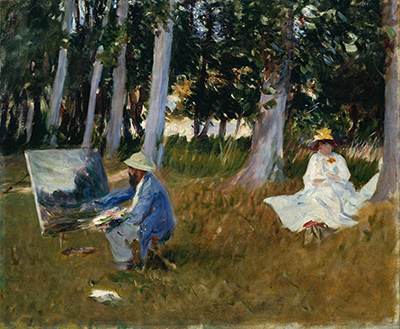
John Singer Sargent's Claude Monet Painting by the Edge of a Wood is a portrait of an artist, a friendship, and a way of working. It shows Claude Monet seated outdoors at an easel, palette in hand, painting in the open air while a woman sits under the trees behind him. The scene is quiet, but it is one of the most revealing pictures in Sargent's career because it places him beside the painter most closely identified with Impressionism and with direct painting from nature. [1], [2]
The work is not a formal society portrait. Monet does not stand before the viewer in public dress, and he is not arranged as a commanding studio sitter. He is shown in action, turned toward his own canvas, partly absorbed into the landscape that he is painting. Sargent's subject is therefore not only Monet's likeness. It is Monet painting: the body at work, the easel in the grass, the relation between artist and motif, and the practice of looking outdoors.
That makes the picture a crucial test case for Sargent's relation to Impressionism. Sargent admired Monet and learned from outdoor light, but he was not simply an Impressionist. His art remained tied to portraiture, old-master study, exhibition painting, figure staging, and the disciplined surface of direct painting learned in Paris. In this small canvas, those worlds meet without becoming identical. Sargent paints Monet with sympathy, but he paints him as Sargent: through figure, setting, tone, practical equipment, and a sharp sense that an artist's working method can itself become a portrait.
Contents
- Introduction
- Sargent, Monet and Giverny
- Portrait of an Artist at Work
- Outdoor Painting Without a Formula
- Alice Hoschede Monet and the Woodland Setting
- Materials, Canvas and Practical Evidence
- Sargent and Impressionism
- Place in Sargent's Career and Tate Collection
- How to Look at the Painting
- Related Works And Where To Go Next
Sargent, Monet and Giverny
The painting belongs to Sargent's direct contact with Monet in the mid-1880s. The National Portrait Gallery's research on Sargent's suppliers notes that Sargent stayed with Monet at Giverny, probably in 1885, and connects that visit with this canvas [3]. Giverny matters because it was not merely a background location. It was the setting in which Monet had made the open-air study of motif, light, garden, field, and river into a daily practice.
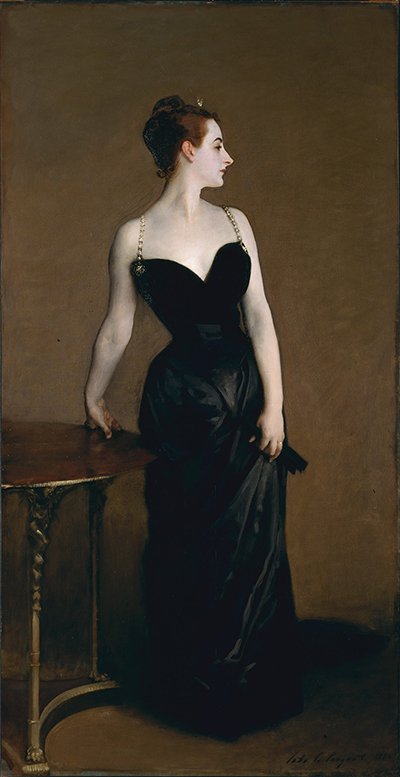
Sargent came to Monet as a younger artist with a different career path. He had trained in Paris with Carolus-Duran, won attention at the Salon, and suffered the hostile reception of Portrait of Madame X in 1884. By 1885 he was trying to rebuild momentum while still testing what modern painting could be. Monet offered another model of seriousness: not society display, not Salon provocation, but repeated looking outdoors.
The friendship mattered artistically. The National Academy of Design record for Sargent's bust portrait of Monet, available through Google Arts & Culture, says Sargent first met Monet in 1876 at Durand-Ruel's gallery in Paris and that the two became good friends. It also notes that Sargent later bought works by Monet and helped bring attention to Monet's art among English-speaking audiences [4]. That evidence helps place the Tate picture inside a real artistic relationship, not a casual encounter.
The 1885 date is important because older accounts have sometimes varied. Some earlier summaries linked the picture to a later Giverny visit, but current Smithsonian and Tate-linked records support 1885. The National Academy text also notes that later research moved the Tate painting to 1885, correcting older assumptions about dating. The result is a picture made at a delicate moment: after Madame X, before Sargent's London portrait fame fully hardened, and during a period when he was unusually open to the possibilities of outdoor painting. [5], [6]
Portrait of an Artist at Work
Most portraits show a sitter prepared to be seen. This one shows a painter occupied with seeing. Monet faces away from the viewer toward his canvas and the landscape beyond it. His hat, smock, stool, easel, and palette identify him through work rather than social rank. The pose is modest, but the idea is bold: Sargent makes the action of painting into the sitter's identity.
This is why the work belongs with Sargent's artist-friend portraits. The Metropolitan Museum of Art's Sargent: Portraits of Artists and Friends exhibition described many such pictures as more intimate and experimental than his formal commissions, often records of relationships, influences, aspirations, and allegiances [1]. Monet is one of the crucial names in that group. A formal portrait of Monet could have presented the famous artist as a face and name. Sargent instead gives him a task.
The composition is built around a chain of attention. Monet looks at the motif and at his canvas. Sargent looks at Monet looking. The viewer looks at Sargent's image of that process. The painting therefore creates a layered portrait of observation. It does not only ask what Monet looked like. It asks what it meant to see Monet working.
The easel is central. In a society portrait, a chair or drapery can signal taste, leisure, and status. Here the easel is a tool and a sign. It marks Monet as a painter, but it also divides the scene into two acts of painting: Monet's unfinished work and Sargent's finished image of Monet making it. The small canvas within the canvas reminds the viewer that outdoor painting is not an idea in the abstract. It is a practical arrangement of body, support, tools, weather, time, and concentration.
Sargent's handling keeps the image informal. Monet is not monumentalized. He is compact, intent, and partly absorbed by the green setting. Yet the informality is not slight. It gives the portrait its truth. Sargent recognizes that an artist's authority may be most visible when he is not performing authority at all.
Outdoor Painting Without a Formula
The painting's outdoor setting is essential, but it should not be treated as a simple label. "Plein-air" can become shorthand, as if setting an easel outside were enough to make a work Impressionist. Sargent's picture is more exact than that. It shows outdoor painting as a lived process: a painter seated in grass, a canvas angled toward light, a wooded edge filtering sun, and a figure in the background registering the social world around the working artist.
Monet had made direct study of outdoor light one of the defining commitments of his art. Sargent shows that commitment through posture and equipment. Monet is not posing with a finished canvas or surrounded by studio signs. He is midway through work, responding to what is in front of him. The image on his easel remains a second, smaller field of paint inside Sargent's field of paint.
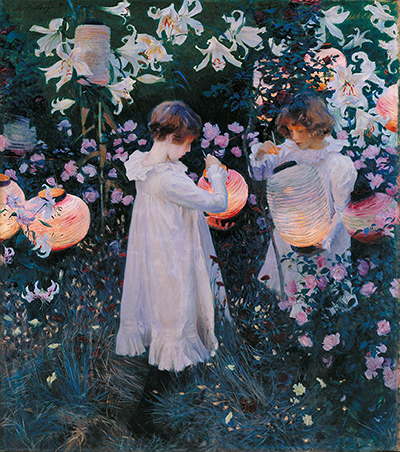
Sargent's own interest in outdoor light had several forms. Carnation, Lily, Lily, Rose pursued the fragile balance between twilight and lantern glow across two seasons. His travel works and watercolors show a mobile eye trained to seize architecture, water, shadow, and glare. The Monet picture sits near these concerns, but it is different because the outdoor subject includes another painter. The landscape is not only a view. It is the ground of Monet's method.
Sargent also avoids a mechanical imitation of Monet's style. He does not dissolve the whole scene into pure color vibration. He keeps figure and setting legible, with Monet's body, easel, stool, and palette carrying the structure. The brushwork is loose enough to suggest dappled outdoor light, but the design remains tied to portrait intelligence. This is Sargent learning from Monet while staying alert to his own strengths.
That balance is the picture's modernity. It does not dramatize the artist as genius in a studio, nor does it make nature empty of people. It shows art being made in the open air, under ordinary conditions, by a named painter whose method had become part of modern art's vocabulary.
Alice Hoschede Monet and the Woodland Setting
The seated woman in the background changes the picture's rhythm. Smithsonian's American Art Inventory describes an unidentified woman seated at right, while the National Portrait Gallery CAP record identifies Alice Raingo Hoschede Monet as a sitter [5], [6]. Her presence keeps the scene from becoming a solitary manifesto of artistic labor. Monet works, but he does not work in an empty world.
Alice is set back under the trees, quieter and less active than Monet. She does not compete with the painter or become a second formal portrait. Her position creates depth, domestic atmosphere, and social context. Giverny appears not only as a painting site but as a lived environment, a place where work, companionship, garden, and woodland overlap.
Modern viewers should be careful with this secondary figure. The painting gives far more pictorial agency to Monet than to Alice. That imbalance reflects the subject Sargent chose: Monet at work. Still, Alice's presence matters because it complicates the image. She is not simply scenery. Her seated body stabilizes the right side of the composition and hints at the household and emotional world around Monet's practice.
The wooded edge also matters. Sargent does not place Monet in an open field under uninterrupted sunlight. The trees create broken light, shade, and a soft screen behind the figures. The setting lets the painter study contrasts without turning the picture into a bright landscape display. The forest edge gives the work a sheltered character. It is outdoors, but not expansive. The action is intimate, almost enclosed.
That enclosure makes the picture feel like a private glimpse. The viewer does not encounter Monet in a public exhibition space or a studio arranged for visitors. We see him at the edge of work, in a place where painting happens before it becomes public art. Sargent's tact lies in keeping the scene small enough to feel witnessed rather than staged.
Materials, Canvas and Practical Evidence
One of the strongest pieces of evidence about the painting is material. The National Portrait Gallery's study of Sargent's suppliers records that the canvas for Claude Monet Painting by the Edge of a Wood bears a Vieille & Troisgros stencil. That stencil is described as identical in form to those found on some of Monet's work, and Vieille & Troisgros was one of Monet's suppliers at the time [3].
This is more than a technical footnote. It links the painting's subject to the physical support on which Sargent painted him. Sargent was not only depicting Monet's outdoor practice from the outside. He may have been using a canvas obtained from Monet or on Monet's recommendation. The painting therefore carries friendship and influence in its material body as well as in its image. [1], [2]
The size matters too. The NPG study gives the canvas as 54.0 x 64.8 cm, a toile de 15, smaller than Monet's usual size. Tate-linked records give the same dimensions. This is not a grand exhibition scale. It is a portable, workable format, suited to the open-air subject and to the informal portrait of a friend. The scale keeps the viewer close to the act of painting rather than turning Monet into a monument. [6], [7]
Material evidence also helps correct the myth that Sargent's art is only brushy instinct. His work depended on supports, suppliers, papers, easels, pigments, studios, travel, and practical decisions. The same NPG research places the Monet canvas inside a broader account of Sargent's materials in France, Italy, and London. Style is physical. It is made through what an artist has at hand and what a particular support allows. [6], [3]
For this painting, that physicality is unusually meaningful. The subject is Monet with his equipment; the support may come from Monet's supplier network; the scene is one of outdoor painting; and Sargent's own handling registers the speed and freshness such a situation invited. The object and the image say the same thing from different angles: this is a picture about making art in the open air, made on a canvas that belonged to the practical world of such making.
Sargent and Impressionism
The painting invites the word Impressionism, but it also asks for precision. Monet was central to Impressionism. Sargent admired him, visited him, painted him, and absorbed lessons from outdoor light. Yet Sargent's career cannot be folded neatly into the movement. He remained a painter of portraits, figure compositions, society sitters, public commissions, watercolors, travel subjects, and war art.
That distinction matters because the painting's value lies in contact rather than conversion. Sargent is not pretending to be Monet. He is painting Monet as Monet works. The homage is embedded in the scene. The figure at the easel becomes a living emblem of a method Sargent respected, while Sargent's own picture keeps its emphasis on body, setting, and portrait structure.
The National Portrait Gallery and Metropolitan Museum artist-friend exhibitions both help frame this contact. Sargent's portraits of creative peers often let him work more freely than formal commissions. They record admiration and artistic allegiance without requiring the public ceremony of society portraiture. Monet was not a patron sitting for status. He was a fellow artist whose way of seeing mattered to Sargent. [6], [3]
Sargent's broader career shows the same selective absorption. Carnation, Lily, Lily, Rose uses outdoor work and changing light, but it is highly staged and technically revised. The watercolors often feel immediate, but they depend on drawing and omission. The society portraits can be painterly and modern while still drawing on Velazquez, Hals, Van Dyck, and Carolus-Duran. Sargent's strength was not purity of movement affiliation. It was the ability to carry different lessons into his own pictorial intelligence.
Seen in that light, Claude Monet Painting by the Edge of a Wood is not a minor anecdote about a famous friend. It is a condensed statement of artistic position. Sargent stands close enough to Monet to paint him at work, close enough to use a related canvas supplier, close enough to understand the practice of outdoor looking. But he remains just far enough away to make that practice into portraiture. [7]
Place in Sargent's Career and Tate Collection
The 1885 date places the painting near one of the most important transitions in Sargent's life. The reception of Portrait of Madame X in 1884 damaged his Paris prospects and pushed him toward London. In the same broad period, he was making works that explored alternatives to formal society portraiture: outdoor subjects, friends, children, gardens, and artist circles. [1], [2]
The painting therefore belongs with the works that kept Sargent from becoming one thing too soon. He would soon become famous in Britain and the United States as a portraitist, but the Monet picture shows a painter still moving among experimental possibilities. It is a portrait, but not a commission in the usual sense. It is a landscape, but the landscape is structured around a working artist. It is connected to Impressionism, but not defined by it. [7]
Tate's ownership gives the work another layer. The painting entered the collection in 1925, the year of Sargent's death, through Emily Sargent and Mrs Ormond via the Art Fund. That late family presentation suggests that the work remained close to Sargent's circle rather than disappearing into ordinary market circulation. Its subject was a famous artist, but its first meaning was personal: a memory of Monet, Giverny, and Sargent's own artistic formation. [7]
The National Gallery of Art's 1999 Sargent retrospective helps show why such a work matters in the larger career. That exhibition included 86 paintings and 31 watercolors and presented Sargent through portraits, landscapes, figure sketches, and major works [8]. A picture like Claude Monet Painting by the Edge of a Wood sits exactly at the crossing of those categories. It is a portrait of a painter, a landscape scene, a study of outdoor work, and a record of artistic friendship.
Its modest scale should not mislead the viewer. Some works are important because they are large public statements. Others are important because they reveal an artist's position with unusual clarity. This painting belongs to the second kind. It shows Sargent before the full pressure of his later portrait reputation, looking at a friend whose art opened a different path into modern painting. [7]
How to Look at the Painting
Begin with Monet's body. He is seated, practical, and intent. His hat and smock protect him from the sun and identify him as a working painter rather than a public sitter. The angle of his body keeps attention moving toward the easel. Sargent makes the act of painting visible before he makes Monet's face memorable.
Then look at the easel and canvas. They are not accessories. They form the inner center of the image. Monet's small painting within Sargent's painting is the reason the scene exists. It also reminds the viewer that the visible world is being translated twice: once by Monet, inside the picture, and once by Sargent, in the finished work we see.
Next, look at Alice seated at the right. She is quieter than Monet, but she changes the social tone. The scene becomes less isolated, more domestic, and more specific to Giverny. Her stillness balances Monet's concentration.
The trees and grass deserve slow attention. They are not polished into botanical detail. They create a field of green, shade, and broken light. Sargent's looseness here is meaningful. The wooded edge gives enough information for place and atmosphere while allowing the painting to stay focused on the working figures.
Finally, ask where Sargent sharpens and where he leaves open. Monet, the easel, and the main structure of the scene are held firmly enough to read as a portrait. Other passages remain sketchier, closer to the sensation of outdoor light. That hierarchy is Sargent's own. It is how he absorbs the lesson of Monet without surrendering the portrait.
The best way to see the painting is to keep both artists present. Monet is the subject, but Sargent is the intelligence arranging the subject. The picture is a conversation between two ways of looking, one contained inside the other.
Related Works And Where To Go Next
For Sargent's broader portrait practice, compare Claude Monet Painting by the Edge of a Wood with the artist-friend portraits discussed in the portraits essay, especially Auguste Rodin and other creative sitters. These works show Sargent painting reputation through work, posture, and artistic identity rather than through rank alone.
For outdoor light, compare the Monet picture with Carnation, Lily, Lily, Rose. Both belong to the 1880s and both depend on painting outside, but the garden picture is staged across repeated sessions while the Monet scene feels like a private record of another artist's method. Together they show why Sargent's outdoor work cannot be reduced to one formula.
For medium and method, move to the paintings, watercolors, and style-and-technique essays. The Monet picture connects oil painting to outdoor practice, material support, and Sargent's habit of controlled freshness. For artistic context beyond Sargent, the Claude Monet page is the natural companion.
Frequently Asked Questions
The main figure is Claude Monet, shown seated outdoors at an easel, painting. Smithsonian records also identify Alice Raingo Hoschede Monet as a sitter, seated in the woodland at the right. [5], [6]
Current Tate-linked and Smithsonian records date the painting to 1885. Older accounts sometimes proposed later dates for Sargent's Giverny visit, but the current records support 1885. [5], [6]
The painting is in Tate, London. Its Tate accession number is N04103, and it entered the collection in 1925 through Emily Sargent and Mrs Ormond via the Art Fund. [7]
It is oil on canvas and measures 54 x 64.8 cm. The National Portrait Gallery's materials research identifies the support as a toile de 15 and connects it with the Paris supplier Vieille & Troisgros. [6], [3]
The canvas bears a Vieille & Troisgros stencil like those found on some Monet works. Because that firm supplied Monet, Sargent may have obtained the canvas from Monet or through his recommendation. The physical support therefore strengthens the painting's connection to Monet's working world.
It is closely connected to Impressionism because it shows Monet painting outdoors and because Sargent was engaging with plein-air practice and outdoor light. But Sargent was not simply an Impressionist. The work remains a portrait structured by figure, setting, and Sargent's own painterly discipline. [8]
Her seated figure gives the scene depth and domestic context. She does not dominate the image, but her presence makes the outdoor setting feel lived rather than empty and helps balance Monet's working figure.
It captures Sargent in direct contact with Monet, Giverny, and outdoor painting at a turning point after Madame X. It shows him learning from Impressionist practice while keeping his own identity as a portraitist and figure painter.
Discussion
This painting asks whether a portrait can show not only what a person looked like, but how that person looked at the world. Sargent's answer is to paint Monet painting, so that likeness becomes a record of work.
Reader Insights
What is the first detail that shapes your reading of Claude Monet Painting by the Edge of a Wood by John Singer Sargent: pose, setting, light, costume, brushwork or historical context?
Which small visual decision begins to matter more after a longer look, and how does it change the mood of the page?
Which comparison helps most: another Sargent portrait, a travel subject, a public commission, or a work by one of his contemporaries?
Join the Conversation
Share a thoughtful comment below about what you notice, question or compare when looking at this page.
References
- Metropolitan Museum of Art, *Sargent: Portraits of Artists and Friends* https://www.metmuseum.org/exhibitions/listings/2015/sargent-portraits-of-artists-and-friends
- National Portrait Gallery, *Sargent: portraits of artists and friends* https://www.npg.org.uk/whatson/exhibitions/2014/sargent-portraits-of-artists-and-friends-aa
- National Portrait Gallery, "John Singer Sargent's suppliers of artists' materials" https://www.npg.org.uk/collections/research/programmes/artists-their-materials-and-suppliers/john-singer-sargents-suppliers-of-artists-materials
- John Singer Sargent, *Claude Monet* https://artsandculture.google.com/asset/claude-monet-john-singer-sargent/PgEv2gbWxFOD8A?hl=en
- Smithsonian Institution, *Claude Monet, Painting, by the Edge of a Wood* https://www.si.edu/object/claude-monet-painting-edge-wood-painting%3Asiris_ari_220152
- Smithsonian National Portrait Gallery, *Claude Monet Painting at the Edge of a Wood* https://www.si.edu/object/npg_N04103
- Tate, *Claude Monet Painting by the Edge of a Wood* https://www.tate.org.uk/art/artworks/sargent-claude-monet-painting-by-the-edge-of-a-wood-n04103
- National Gallery of Art, *John Singer Sargent* https://www.nga.gov/exhibitions/john-singer-sargent