


 by
Tom Gurney
Tom Gurney BSc (Hons) is an art history expert with over 20 years experience
Email:
tomgurney1@gmail.com
/ Phone:
+44 7429 011000
Homer Dodge Martin: Introduction
Homer Dodge Martin (1836–1897) was an American landscape painter whose pictures turn observed places into carefully arranged relationships of land, water and sky. A line of trees, a pale stretch of river or a distant mountain can give an apparently quiet scene its structure. His best paintings reward time spent following those relationships. [1]
Martin began within the American landscape tradition associated with the Hudson River School. Encounters with French painting, life in Normandy and his friendships with other artists widened his approach. The Smithsonian emphasizes the importance of memory in his later studio pictures, where an experience of a place could become the starting point for a much longer process of selection. [1]
The paintings , drawings and life considered here show the range behind that achievement: Adirondack lakes, an iron mine on Lake Champlain, British and French rivers, coastal ground and old buildings reflected in water.
At a Glance
- Full name Homer Dodge Martin.
- Lived 1836–1897.
- Nationality American.
- Born Albany, New York.
- Died Saint Paul, Minnesota.
- Principal medium Oil painting, alongside graphite, chalk and watercolor work.
- Associated traditions Hudson River School, Barbizon influence and Tonalism.
- Recurring subjects Mountain lakes, rivers, coastal landscapes and inhabited countryside.
- Major work View on the Seine: Harp of the Winds , 1893–95.
- Working interests Memory, revision, pictorial breadth and relationships of tone.
Homer Dodge Martin in context
Bars show approximate historical periods. c. means circa (about).
Hudson River School
c. 1825–1880 [20]Barbizon School
c. 1830–1870 [21]Notes and sources
Hudson River School. An early landscape tradition. Martin established his career with American landscapes in the Hudson River tradition. Later changes developed from this earlier practice. [1]
Barbizon School. Admiration and encounters with French art. Corot and French landscape painting mattered to Martin before and during his European travels. Admiration does not establish a formal apprenticeship. [2] [3]
Tonalism. A later historical connection. The Wellin Museum places Martin across the transition from Hudson River landscape toward later tonal painting. This is a historical grouping, rather than a dated society membership. [4]
Each bar runs from the artist’s birth to their death.
Camille Corot
1796–1875 · Birth–death [23]James M. Hart
1828–1901 · Birth–death [24]James McNeill Whistler
1834–1903 · Birth–death [25]John La Farge
1835–1910 · Birth–death [26]Homer Dodge Martin
1836–1897 · Birth–death [27]Notes and sources
Camille Corot. Admired paintings and French landscape. Elizabeth remembered Martin’s early enthusiasm for Corot. The connection is admiration and the study of art, rather than documented tuition with Corot. [2]
James M. Hart. Brief early tuition in Albany. Martin’s formal instruction with James Hart lasted about a fortnight. His broader education included the Albany artistic circle and independent work. [3]
James McNeill Whistler. Acquaintance in England, 1876. Martin became acquainted with Whistler on his first European journey. The Met cautiously connects Whistler with Martin’s use of charcoal to establish compositions. [3]
John La Farge. Friendship and encouragement in New York. La Farge’s friendship and advice encouraged a softer, more poetic approach to landscape. This was a sustained personal connection. [1] [2]
Homer Dodge Martin. Follow selected paintings in the key works view. Observation, travel and revision overlap across the career. [5]
The Iron Mine, Port Henry, New York
about 1862Evening on the Thames
about 1876Behind Dunes, Lake Ontario
1883–87Old Manor of Criqueboeuf
about 1882–92Normandy Coast
1884Westchester Hills
about 1887Lighthouse, Honfleur
UndatedNotes and sources
The Iron Mine, Port Henry, New York. An industrial opening, sloping runway and worked cliff stand above Lake Champlain. The Smithsonian connects this landscape with the North’s resources during the Civil War. [6]
Upper Ausable Lake. Foreground reeds and birds lead toward a bright passage of water beneath the mountain wall. The Smithsonian identifies this canvas as Upper Ausable Lake. [7]
Evening on the Thames. A low river horizon, distant buildings and reflected light bring a British subject into Martin’s painting. The museum’s date remains approximate. [8]
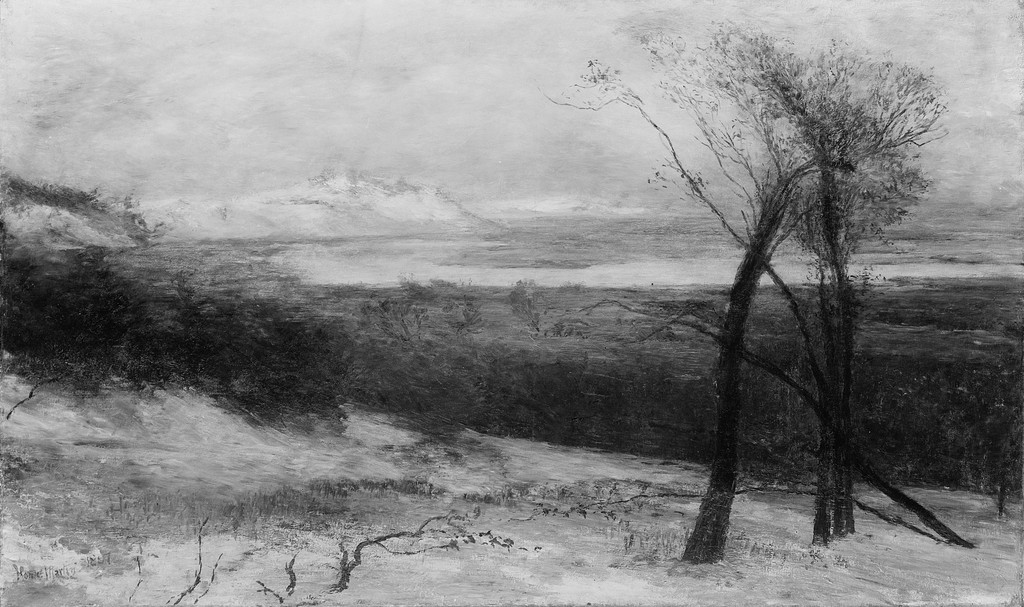
Behind Dunes, Lake Ontario. An American subject developed during the French residence and after the return. The Met records rejection at the 1884 Salon followed by revision in 1887. [9]
Old Manor of Criqueboeuf. A house and its reflection organize this slowly developed Normandy subject. The broad date range does not mean that Martin painted it without interruption. [10]
Normandy Coast. Freely brushed clouds dominate a small coastal board. Brooklyn places it among outdoor paintings made during Martin’s French residence. [11]
Westchester Hills. Mather describes a large outdoor undertaking at Croton Falls and records its exhibition in 1888. The probable painting date and exhibition year remain distinct. [5]
Wild Coast, Newport. An extensive sky opens above low coastal ground. This dated Cleveland canvas is distinct from the Smithsonian painting bearing the same title. [12]
Criqueboeuf Church, Normandy. A church, trees and their reflections give architecture a place within the landscape. The current LACMA record supplies the date; the article reproduces a historical monochrome print. [13]
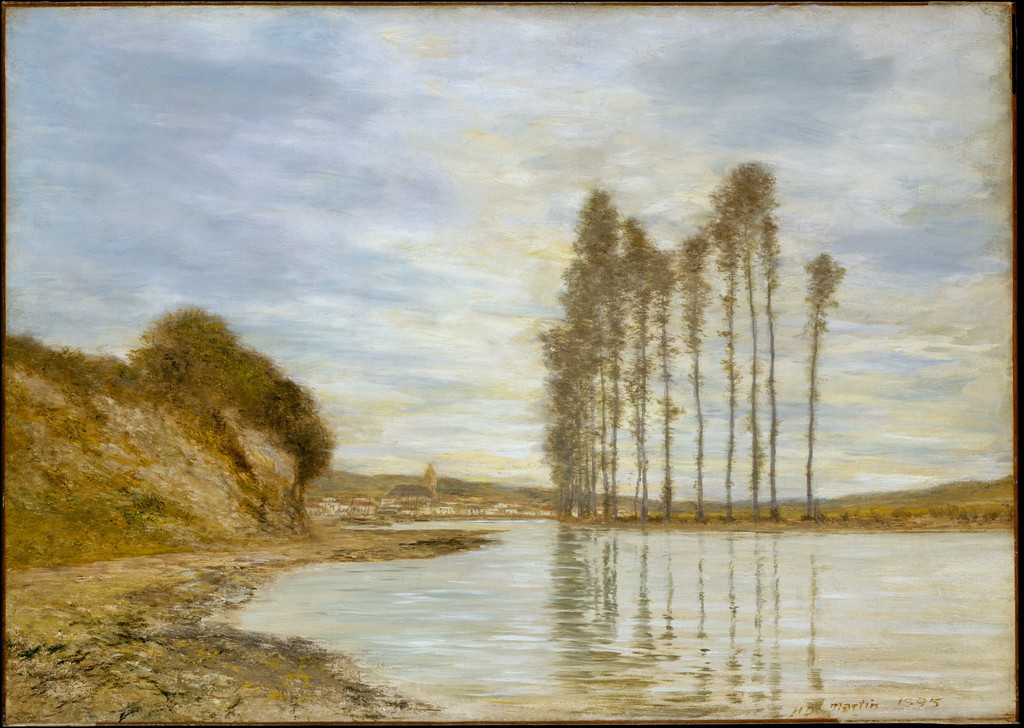
View on the Seine: Harp of the Winds. Poplars and their reflections repeat across the Seine. The Met records a charcoal beginning in New York in 1893 and completion in Saint Paul in 1895. [14]
Adirondack Scenery. Mountain slopes, a foreground ledge and water organize this late return to American scenery. Mather treats it as a major expression of experiences considered over many years. [5]
Lighthouse, Honfleur. Princeton’s small upright wood panel sets the lighthouse within a compact landscape. It remains undated and is distinct from the larger horizontal Century Club canvas. [15]
Martin’s artistic connections
Early encouragement, friendships and admired paintings contributed in different ways to Martin’s development.
- James M. Hart: James Hart gave Martin about two weeks of formal instruction. That short period formed part of a wider education through independent practice and the Albany artistic circle. [3]
- George Henry Boughton: Boughton belonged to Martin’s Albany circle. Mather describes a small Corot he brought to the city, giving the painters an opportunity to consider French landscape art before Martin’s own European travels. [5]
- John La Farge: La Farge became a lasting friend. The Smithsonian connects his encouragement with Martin’s softer, more poetic approach to landscape. [1] [2]
- James McNeill Whistler: Martin became acquainted with Whistler during the 1876 journey. The Met suggests Whistler encouraged the use of charcoal to establish a composition, while retaining that attribution as a cautious interpretation. [3]
Contents
- An American painter of remembered landscape
- Albany, New York and the landscape tradition
- How Martin builds a view
- Eight paintings to begin with
- Drawing and the studio imagination
- France, England and the American shore
- Music, mood and tonal painting
- Explore the life and individual works
An American painter of remembered landscape
Memory in Martin’s art involved returning to an experience and reshaping it. It could preserve a broad impression while allowing the painter to reconsider the arrangement that would convey it. A familiar landscape might therefore remain productive across different pictures and different periods of his life.
Frank Jewett Mather Jr., writing in 1912, placed particular weight on this deliberate construction. His study describes Martin repeatedly adjusting a composition and seeking a precise relationship between its parts. Mather also reproduced a letter of 25 February 1896 to the collector Thomas B. Clarke in which Martin described a picture as “all thought out except one or two cloud forms which trouble me greatly.” The words suggest how much work could remain within an apparently simple sky. [5]
Elizabeth Gilbert Martin’s memoir adds the perspective of someone who lived beside that work. She remembered an earlier state of Harp of the Winds with taller trees, which she preferred to the revised arrangement. Her account also conveys the interruptions, uncertainty and financial pressures surrounding the paintings. The remembered view belongs within the practical circumstances of this working life. [2]
That distinction helps when looking at the finished pictures. Quiet water and open sky can feel immediate, but the feeling may have emerged through substantial revision. Their apparent ease invites a closer examination of how a few selected forms sustain an extensive view.
Four stages of Homer Dodge Martin’s career
These periods group related developments; painting, travel and local work overlap across their boundaries.
Finding a place in American landscape
Palmer’s encouragement, brief tuition with James Hart and the Albany artistic circle supported Martin’s beginnings. Local friendships, patrons and opportunities to examine pictures accompanied his early mountain and lake subjects. [5]
Friendships, recognition and travel
New York brought a lasting friendship with La Farge and a wider professional world. Martin became an Associate Academician in 1867 and a full Academician in 1874. His first European journey in 1876 included acquaintance with Whistler and a visit to Barbizon. [3]
Travel becomes a longer residence
An English illustration commission preceded the move to Normandy. Villerville and Honfleur supplied coastal and architectural subjects, while American themes also remained active. Martin returned to New York in December 1886. [2]
Revision and the late landscapes
Large outdoor work in Westchester existed alongside slowly revised canvases. After moving to Saint Paul in 1893, Martin completed Harp of the Winds and Adirondack Scenery in 1895, despite worsening health and eyesight. [2]
Albany, New York and the landscape tradition
Martin grew up in Albany, where the sculptor Erastus Dow Palmer encouraged his artistic ambitions. The local circle included George Henry Boughton and the landscape painters James and William Hart. Martin’s direct tuition with James Hart was brief, lasting about a fortnight; conversation, looking at pictures and independent practice were also important parts of his development. [5]
This was an education within a community as well as a response to scenery. Albany supplied artists, patrons and opportunities to see work. Summer travel brought other experiences. Mountains, wooded valleys and lakes became subjects he could explore through drawings and later canvases, joining the physical experience of a place to the work of arranging a picture.
His marriage to Elizabeth in 1861 began a household in which writing and painting both mattered. Her literary work contributed to its support. She later became an important witness to his career, preserving observations about subjects, habits and the changes made to particular paintings. Her memoir deserves attention as the work of a writer with her own interests and judgments. [2]
The move to New York brought Martin into a wider professional world. The National Academy records his election as an Associate in 1867 and a full Academician in 1874. Its biography also places his career within friendships, exhibition activity and the continuing problem of earning a living through landscape. [16]
The Hudson River School provides an essential starting point for understanding him. An early lake view and a late Normandy picture can differ markedly in handling while sharing a concern with extensive space. The biography follows the circumstances through which that approach developed.
How Martin builds a view
Begin with the division between near and far. Foreground rocks, vegetation or a projecting bank establish a place from which to look. Beyond them, a lake or open field can spread across a much larger distance. A mountain range may close the view while a gap between slopes directs attention toward the sky.
In Upper Ausable Lake , the nearer reeds and shore contrast with the mountain wall beyond the water. The bright horizontal passage across the lake helps separate one depth from another. The painting’s space becomes clearer when those bands are compared before the eye settles on smaller details.
Reflection creates other possibilities. In Harp of the Winds , slender poplars are extended downward in the water, making a repeated pattern that also measures distance. The curve of the bank carries attention past those verticals toward the farther shore. Trees, river and reflection have distinct roles within a single arrangement.
The history of that canvas reinforces the importance of construction. The Met’s catalogue describes its charcoal beginnings in New York in 1893 and completion in Saint Paul in 1895. A French subject could continue to develop after the painter had left France. [3]
Finally, compare the size of a feature with its contribution to the whole. A small building can establish human occupation, while a narrow band of water can carry light through an otherwise dark foreground. Martin often asks these modest passages to do considerable compositional work.
Eight paintings to begin with
View on the Seine: Harp of the Winds
Harp of the Winds , 1893–95, brings together many of Martin’s concerns. Poplars and their reflections form a rhythm across the river, while the bank opens a route into distance. The title’s musical association encourages attention to repeated forms and intervals. Its long working history makes it an especially useful introduction to his studio practice. [3]
The Iron Mine, Port Henry, New York
The Iron Mine , about 1862, places industry within a lake landscape. A steep, marked cliff rises above the water, with an opening, a sloping runway and small structures along the shore. The Smithsonian’s interpretation connects the scene with the resources of the North during the Civil War. That historical reading adds another dimension to the visible relationship between worked ground and reflective water. [6]
Behind Dunes, Lake Ontario
Behind Dunes , 1883–87, returns to a subject encountered years earlier. Foreground trunks interrupt the view, while distant sand and water offer a more open space beyond them. The painting was submitted unsuccessfully to the 1884 Salon and subsequently revised. Its development shows how a familiar subject could remain unsettled through changes of location and circumstance. [3]
Old Manor of Criqueboeuf
Old Manor of Criqueboeuf , about 1882–92, concentrates attention on a house, its surrounding trees and the pool before it. Reflection gives the building a second, less stable presence. The Met catalogue identifies it with the picture known as the Haunted House and traces its prolonged revision. Mather’s comparison with Poe belongs to the painting’s critical reception. [3] [5]
Wild Coast, Newport
The Cleveland Museum’s Wild Coast, Newport , 1889, spreads low coastal ground beneath an extensive sky. Variations across the land give the foreground substance without competing with the larger arrangement. A separate Smithsonian version carries the same title, making museum identity and date particularly useful when comparing reproductions. The Cleveland painting offers a clear point of departure for exploring Martin’s American coastal work. [12]
Normandy Coast
Brooklyn’s Normandy Coast , 1884, is a small oil on board with freely worked clouds above a low shore. The museum places it among Martin’s outdoor paintings from his French residence. It provides a valuable counterpart to the slowly revised studio pictures: a concentrated response to coastal space, with the brushwork remaining conspicuous across the sky. [11]
Westchester Hills
Westchester Hills , probably painted in 1887, brings a broad sweep of countryside into view. Rocks, a route across the ground and the wooded ridge organize its successive depths. Mather described an unusually large outdoor undertaking at Croton Falls and recorded its exhibition in 1888. The picture widens an account of Martin that might otherwise concentrate too heavily on rivers and remembered French places. [5]
Adirondack Scenery
Adirondack Scenery , completed in 1895, returns to the mountain landscapes of Martin’s earlier career. The foreground ledge, wooded slopes, lake and clouded distance form a layered view. Mather treated it as a major expression of observations and memories considered over many years. It is especially revealing beside an earlier lake picture, where related landscape forms produce a different arrangement and emotional emphasis. [5]
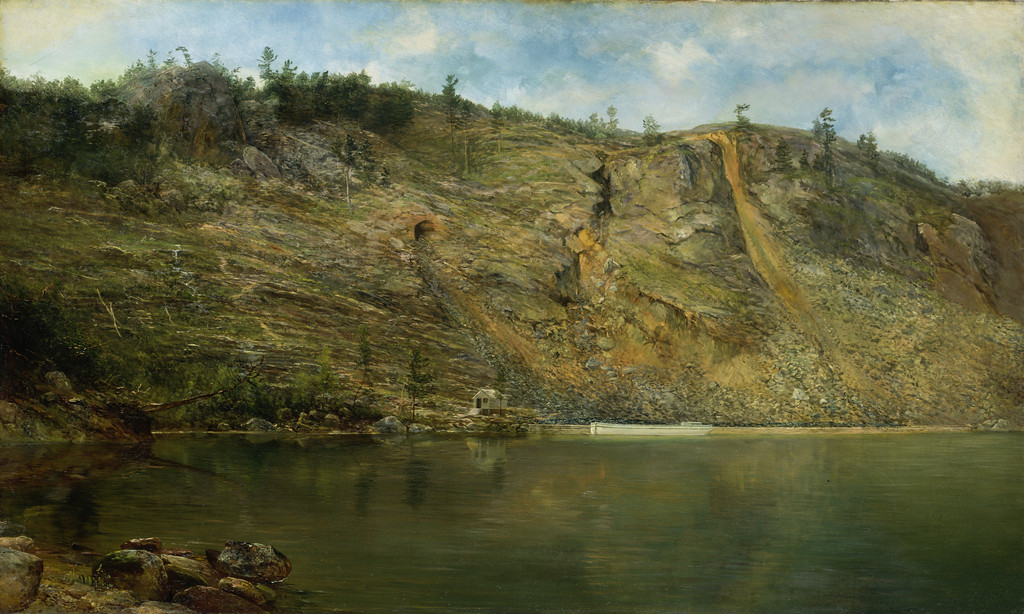
Homer Dodge Martin, The Iron Mine, Port Henry, New York, about 1862. An industrial site occupies a Lake Champlain landscape. Smithsonian American Art Museum, 1910.9.11. Smithsonian American Art Museum, Gift of William T. Evans.
Image source
.
Public domain
. Resized only; source appearance preserved.
Watch: Homer Dodge Martin
Start with Martin’s Normandy Landscape, then explore the wider Hudson River School tradition in which he began.
Homer Dodge Martin | Normandy Landscape
The Castellani Art Museum introduces Martin’s Normandy Landscape.
Watch on YouTubeDrawing and the studio imagination
The surviving drawings and watercolors help make Martin’s powers of observation tangible. A graphite line can distinguish a tree from surrounding foliage; chalk can build a broader mass; watercolor can establish relationships through washes. These different means deserve attention alongside the finished oil paintings.
Mather’s account stresses the care of Martin’s outdoor studies, complicating anecdotes that make him seem unwilling to work. The detailed sheet and the selective canvas belong to different tasks. Information recorded before nature could supply material for a later arrangement without requiring every mark or object to be carried into it. [5]
Drawing also preserves the scale of an encounter. A small study can hold a chosen relation between shore, water and sky. Enlarging that relation into a canvas raises further questions about intervals, emphasis and the balance of masses. The drawing’s apparent completeness does not mean the painting’s decisions have all been made.
Repeated subjects offer another way to follow this process. Martin returned to the Ontario dunes in different media and versions. Each object has its own date and working history, so their differences become evidence of continued thought about a place. [3]
France, England and the American shore
Martin’s first European journey, in 1876, included England and France. Mather describes time with Whistler in England and a visit to Barbizon. These encounters connected him with artists and pictures he could consider alongside his American experience. [5]
The longer absence beginning in 1881 unfolded in stages. Elizabeth’s memoir distinguishes the period in England from the subsequent move to Normandy, where Villerville and Honfleur became important settings. Her writing conveys the practical experience of living abroad as well as the subjects that interested her husband. [2]
The France and Normandy account follows that period through its places and pictures. A shore, a lighthouse or a church beside a pond offered different relationships between open space and built form. The Lighthouse, Honfleur and Criqueboeuf Church show two approaches to architecture within landscape.
Britain also retained a place in his art. Evening on the Thames can be compared with the later Seine picture through the low horizon, distant buildings and reflected light. Following such relationships across countries makes travel part of an ongoing pictorial practice, while preserving the particular character of each subject.
Music, mood and tonal painting
Music mattered within the Martins’ household and within their recollections of art. Elizabeth associated the private Harp of the Winds title with her husband’s attention to music while painting. Her account makes the association personal and specific, even though the landscape does not illustrate a particular musical score. [2]
The comparison can sharpen looking. Repeated trunks establish intervals; their reflections extend the pattern; the river’s curve carries it through space. These are visible relationships through which the title becomes suggestive. They leave room for the viewer’s response without turning every tree into an encoded symbol.
Martin’s later work also belongs within the history of Tonalism . The Wellin Museum’s account places his career across the transition from Hudson River landscape toward the more expressive tonal painting of the later nineteenth century. It is a useful historical connection, alongside the distinct circumstances of his French experience. [4]
Mather’s criticism adds a different perspective. He valued the contemplative character of Martin’s art and argued for the emotional force of arrangements that some painters found technically uncertain. His advocacy remains illuminating as an early response, while its judgments belong to his own position as a critic. [5]
The style and technique discussion examines these questions through the paintings’ surfaces, their revision and the historical accounts of Martin at work.
Explore the life and individual works
The paintings lead back to a life sustained by friendships, literary work, patronage and persistence. The image of an isolated visionary leaves out much of that history. Martin exhibited, maintained professional connections and continued to work through difficult circumstances; Elizabeth’s account and the Academy record make that wider setting visible. [2] [16]
The move to Saint Paul in 1893 placed him at a distance from his New York circle. Yet the final years brought sustained work on both American and French subjects, including the completion of Harp of the Winds and Adirondack Scenery in 1895. His pictures continued to carry earlier experiences into new circumstances. Mather’s account also distinguishes critical enthusiasm from dependable sales: praise, friendship and financial security did not necessarily arrive together. That uneven reception helps explain why a painter with professional recognition could still struggle to support a household. It also gives the late work a practical history alongside its remembered landscapes. [5]
An archival photograph taken at Enfield, England, in 1892 offers another encounter with the artist. It shows him seated in a dark suit, with patterned neckwear and one hand resting forward. Elizabeth’s identification on the photograph’s reverse supplies its place and period. The portrait brings a particular person into view beside the landscapes. [17]
Within the broader history of American artists , Martin is especially rewarding for the connections between observation and recollection. Begin with a lake, coast or river picture, then compare another treatment of a related form. His achievement becomes more distinct as those individual choices accumulate.
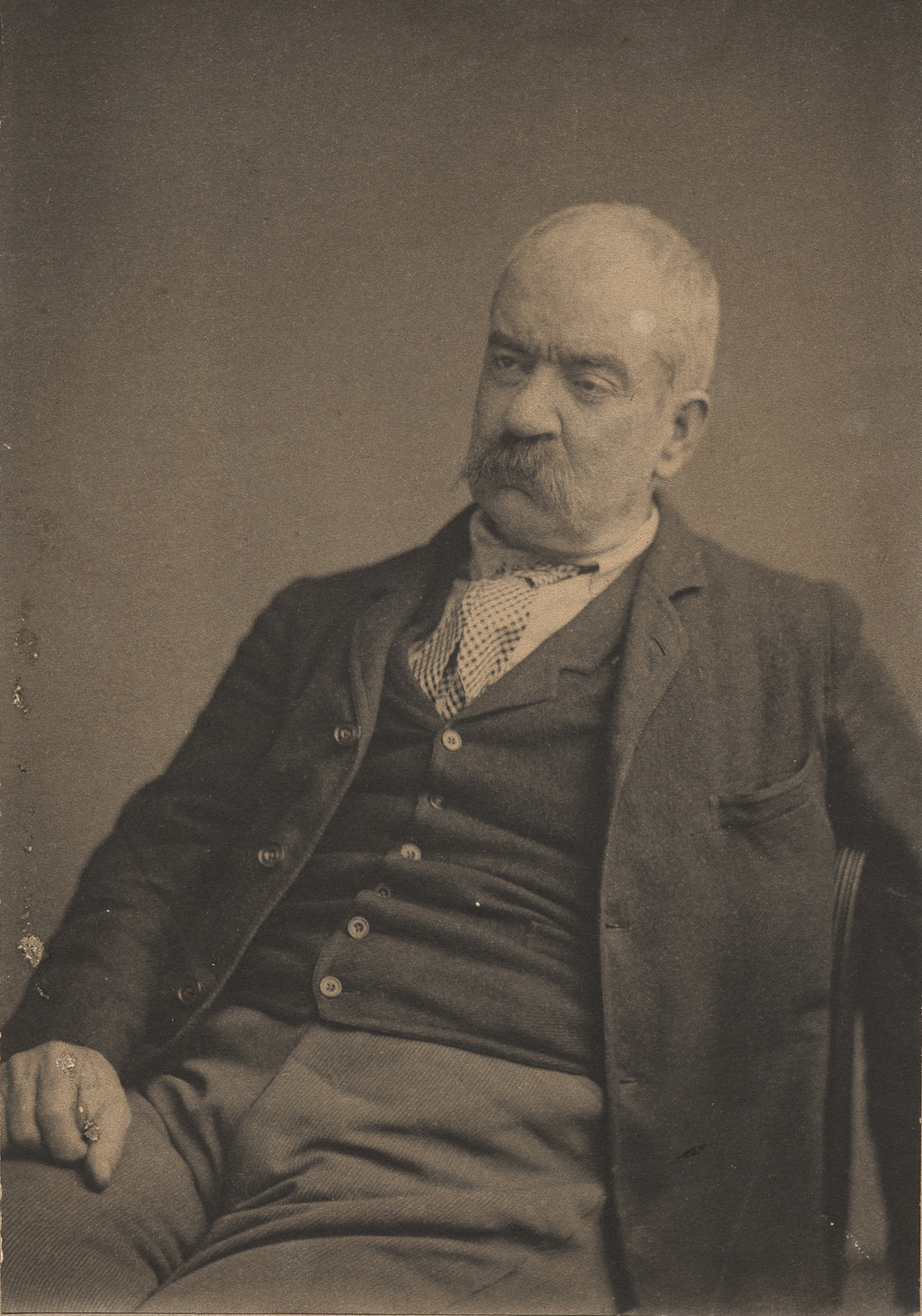
Homer Dodge Martin at Enfield, England, in 1892. Photographer unidentified. Elizabeth Gilbert Martin’s identification on the reverse supplies the place and date. Unidentified photographer. Archives of American Art, Smithsonian Institution, Macbeth Gallery Records, aaa_macbgall_4776.
Image source
.
No known copyright restrictions
. Resized only; source appearance preserved.
Essential Homer Dodge Martin works
View on the Seine: Harp of the Winds
1893–95 · Poplars and their reflections repeat across the Seine. The Met records a charcoal beginning in New York in 1893 and completion in Saint Paul in 1895.
The Iron Mine, Port Henry, New York
about 1862 · An industrial opening, sloping runway and worked cliff stand above Lake Champlain. The Smithsonian connects this landscape with the North’s resources during the Civil War.
Behind Dunes, Lake Ontario
1883–87 · An American subject developed during the French residence and after the return. The Met records rejection at the 1884 Salon followed by revision in 1887.
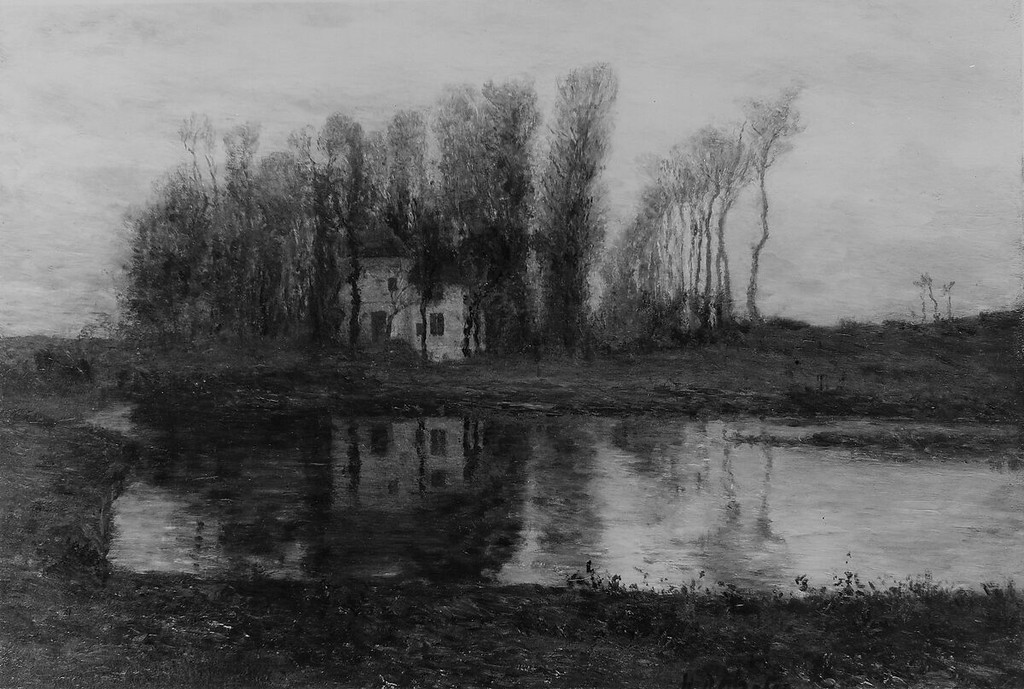
Old Manor of Criqueboeuf
about 1882–92 · A house and its reflection organize this slowly developed Normandy subject. The broad date range does not mean that Martin painted it without interruption.
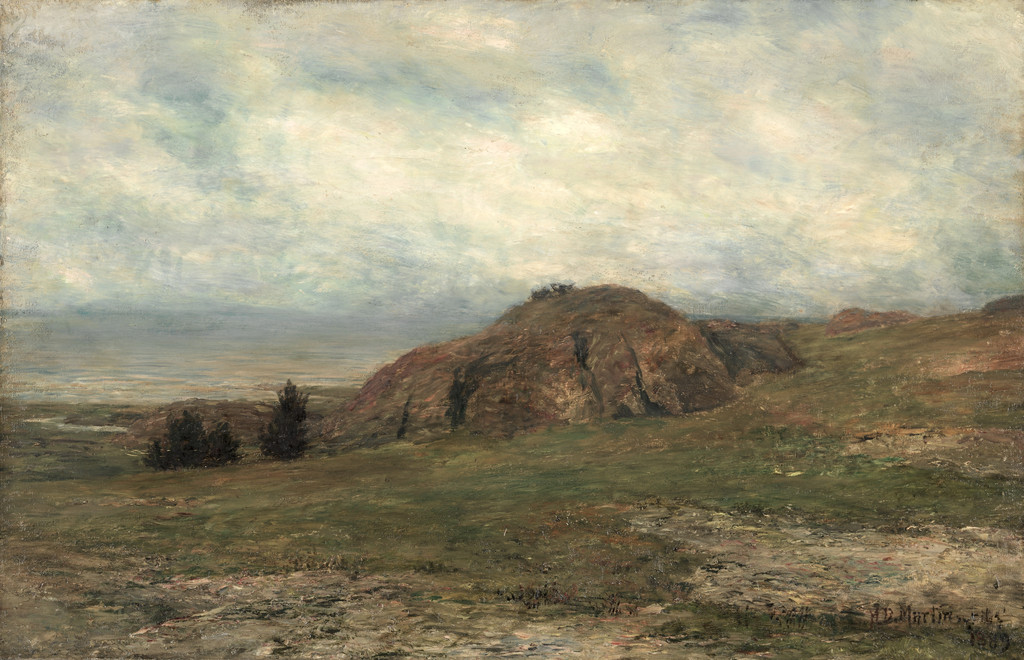
Wild Coast, Newport
1889 · An extensive sky opens above low coastal ground. This dated Cleveland canvas is distinct from the Smithsonian painting bearing the same title.
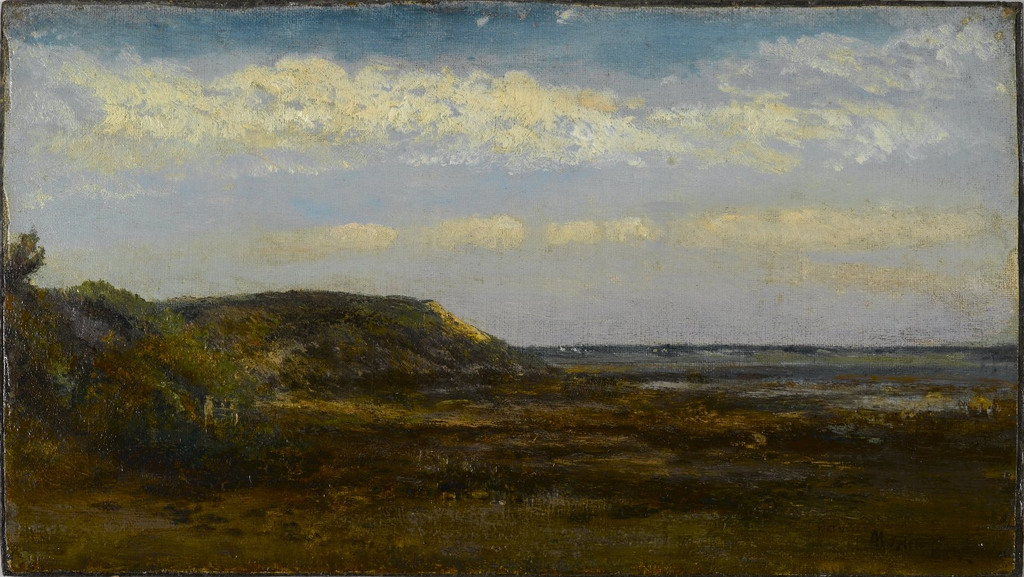
Normandy Coast
1884 · Freely brushed clouds dominate a small coastal board. Brooklyn places it among outdoor paintings made during Martin’s French residence.
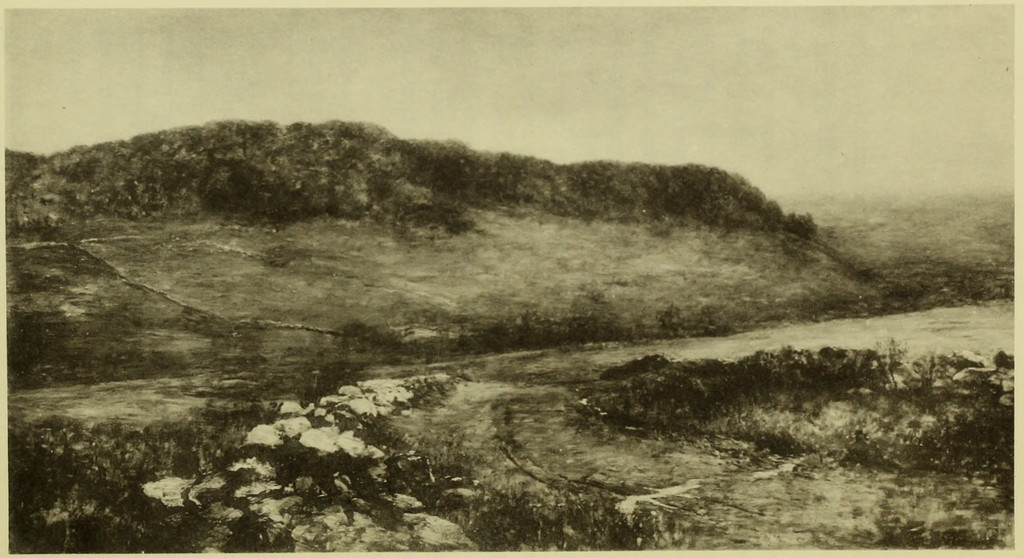
Westchester Hills
about 1887 · Mather describes a large outdoor undertaking at Croton Falls and records its exhibition in 1888. The probable painting date and exhibition year remain distinct.
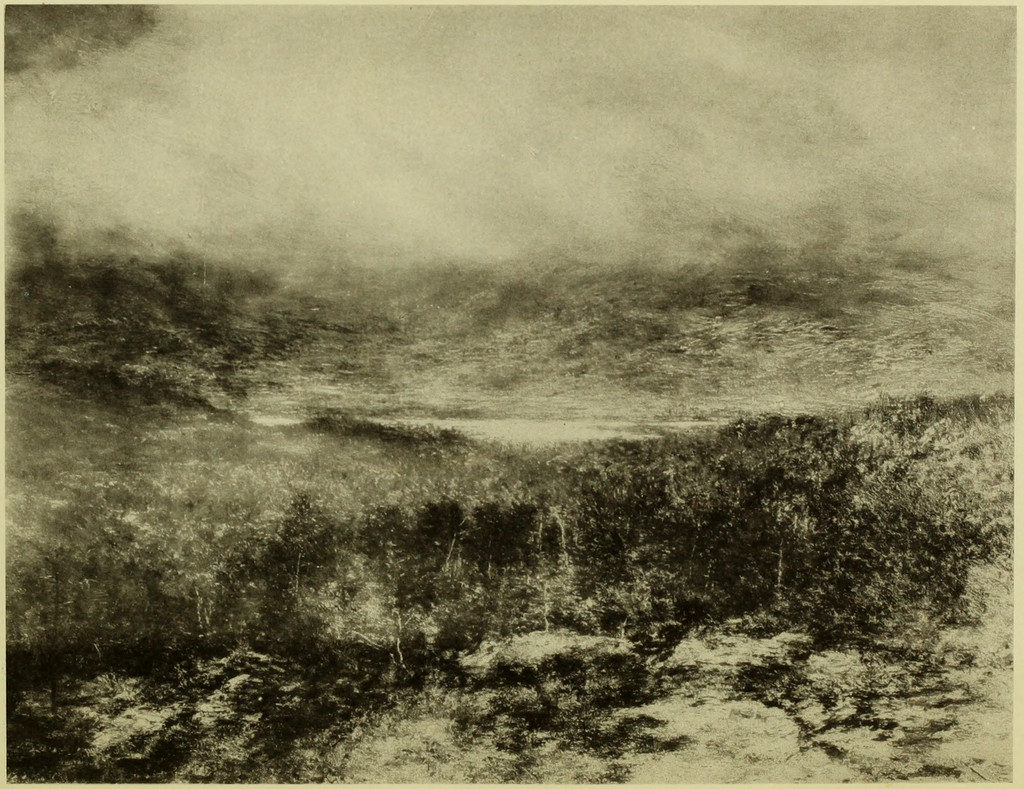
Adirondack Scenery
1895 · Mountain slopes, a foreground ledge and water organize this late return to American scenery. Mather treats it as a major expression of experiences considered over many years.
Artwork records
Browse 58 records from Carroll’s selected 1913 catalogue alongside 25 separately documented object records. Some records concern the same work; this is not a complete lifetime catalogue or a count of 83 unique artworks. [18]
| Name | Date | Medium |
|---|---|---|
| Carroll 1: Saranac Lake (1913 record) | 1860s; exact date not clearly decipherable | Painting — historical catalogue record |
| Carroll 2: Lake George from Bolton (1913 record) | Date not stated | Painting — historical catalogue record |
| Carroll 3: The Iron Mine, Port Henry, N. Y. (1913 record) | Date not stated | Painting — historical catalogue record |
| Carroll 4: On Lake Ontario (1913 record) | Probably late 1860s | Painting — historical catalogue record |
| Carroll 5: The Giant of the Valley (1913 record) | 1865 | Painting — historical catalogue record |
| Carroll 6: An Adirondack Lake (1913 record) | Date not stated | Painting — historical catalogue record |
| Carroll 7: Winter in Normandy (1913 record) | Date not stated | Watercolor — historical catalogue record |
| Carroll 8: Across the Lake (1913 record) | Date not stated | Painting — historical catalogue record |
| Carroll 9: New Hampshire Landscape (1913 record) | Late 1860s | Painting — historical catalogue record |
| Carroll 10: Long Lake (1913 record) | Date not stated | Painting — historical catalogue record |
| Carroll 11: Salt Meadows (1913 record) | Mid 1880s | Painting — historical catalogue record |
| Carroll 12: Autumn on the Susquehanna (1913 record) | 1879 | Painting — historical catalogue record |
| Carroll 13: Ontario Sand Dunes (1913 record) | 1887 | Painting — historical catalogue record |
| Carroll 14: Late Autumn (1913 record) | About 1877 | Painting — historical catalogue record |
| Carroll 15: Early Spring (1913 record) | About 1877; companion dating | Painting — historical catalogue record |
| Carroll 16: Raquette Lake (1913 record) | 1869 | Painting — historical catalogue record |
| Carroll 17: A Glimpse of the Sea (1913 record) | Date not established; historical suggestion disputed | Painting — historical catalogue record |
| Carroll 18: Headwaters of the Hudson (1913 record) | 1869 | Painting — historical catalogue record |
| Carroll 19: Autumn in the Adirondacks (1913 record) | 1871 | Painting — historical catalogue record |
| Carroll 20: Richmond on Thames (1913 record) | About 1877; later alterations | Painting — historical catalogue record |
| Carroll 21: Saranac Lake (1913 record) | 1878 | Painting — historical catalogue record |
| Carroll 22: Windsor Castle (1913 record) | Finished 1878 | Painting — historical catalogue record |
| Carroll 23: L’Anse St. Étienne, Saguenay (1913 record) | 25 July 1879 | Watercolor — historical catalogue record |
| Carroll 24: L’Anse aux Basses Pierres (1913 record) | Date not stated | Watercolor — historical catalogue record |
| Carroll 25: Blossoming Trees (1913 record) | Mid 1880s | Painting — historical catalogue record |
| Carroll 26: On the Seine (1913 record) | Date not stated; later years suggested | Painting — historical catalogue record |
| Carroll 27: The Dunes (1913 record) | 1883 | Watercolor — historical catalogue record |
| Carroll 28: The Moonlit Pond—Honfleur (1913 record) | Date not stated | Painting — historical catalogue record |
| Carroll 29: Normandy Landscape (1913 record) | Date not stated | Painting — historical catalogue record |
| Carroll 30: The Lighthouse, Honfleur (1913 record) | Date not stated | Painting — historical catalogue record |
| Carroll 31: Ruby Strong—Normandy (1913 record) | Date not stated | Painting — historical catalogue record |
| Carroll 32: Sand Dunes, Lake Ontario (1913 record) | 1874 | Painting — historical catalogue record |
| Carroll 33: Low Tide, Honfleur (1913 record) | Date not stated | Painting — historical catalogue record |
| Carroll 34: Evening on the Seine (1913 record) | Date not stated | Painting — historical catalogue record |
| Carroll 35: On the Seine (1913 record) | Date not stated | Painting — historical catalogue record |
| Carroll 36: On the Hudson (1913 record) | 1881 | Painting — historical catalogue record |
| Carroll 37: A Forest Brook (1913 record) | 1881 | Painting — historical catalogue record |
| Carroll 38: Coast Meadows, St. Sauveur (1913 record) | 1881 | Painting — historical catalogue record |
| Carroll 39: Landscape (1913 record) | 1883 | Painting — historical catalogue record |
| Carroll 40: An Adirondack Lake—Lake Sanford (1913 record) | 1883 | Painting — historical catalogue record |
| Carroll 41: Lower Ausable Pond (1913 record) | 1868 | Painting — historical catalogue record |
| Carroll 42: December Morning in Normandy (1913 record) | 1883 | Painting — historical catalogue record |
| Carroll 43: Low Tide—Villerville (1913 record) | 1884 | Painting — historical catalogue record |
| Carroll 44: Lake George (1913 record) | 1884 | Painting — historical catalogue record |
| Carroll 45: Crepuscule—Montvilliers (1913 record) | 1885 | Painting — historical catalogue record |
| Carroll 46: The Sea at Villerville (1913 record) | 1885 | Painting — historical catalogue record |
| Carroll 47: Golden Sands (1913 record) | Date not stated | Painting — historical catalogue record |
| Carroll 48: The Meadow Brook (1913 record) | 1887 | Painting — historical catalogue record |
| Carroll 49: The Sun Worshippers (1913 record) | After the 1886 return to New York | Painting — historical catalogue record |
| Carroll 50: South Side of Long Island (1913 record) | 1894 | Painting — historical catalogue record |
| Carroll 51: Criqueboeuf Church (1913 record) | 1893 | Painting — historical catalogue record |
| Carroll 52: Normandy Farm (1913 record) | 1895 | Painting — historical catalogue record |
| Carroll 53: On the Mississippi (1913 record) | Toward the close of the artist’s life | Painting — historical catalogue record |
| Carroll 54: Newport Neck (1913 record) | 1893 | Painting — historical catalogue record |
| Carroll 55: A Newport Landscape (1913 record) | 1896 | Painting — historical catalogue record |
| Carroll 56: A Distant View of Caen (1913 record) | Date not stated; exhibited 1894 | Painting — historical catalogue record |
| Carroll 57: The Brook (1913 record) | 1894 | Painting — historical catalogue record |
| Carroll 58: Normandy Trees (1913 record) | Date not stated | Painting — historical catalogue record |
| View on the Seine: Harp of the Winds | 1893–95 | Oil on canvas |
| The Iron Mine, Port Henry, New York | About 1862 | Oil on canvas mounted on fiberboard |
| Wild Coast, Newport | 1889 | oil on canvas |
| In the Housatonic Valley (attributed to Homer Dodge Martin) | late 1850s | oil on canvas |
| Sand Dunes, Lake Ontario | c. 1874 | Possibly black crayon on paper |
| Adirondacks | 1868 | Pencil drawing |
| Landscape | 1896 | Watercolor |
| Near Newport | mid-1800s | Watercolor |
| Effect of Trees | About 1879 | Oil on canvas |
| Behind Dunes, Lake Ontario | 1883–87 | Oil on canvas |
| Old Manor of Criqueboeuf | About 1882–92 | Oil on canvas |
| Upper Ausable Lake | 1868 | Oil on canvas |
| Wild Coast, Newport (Smithsonian version) | About 1885–95 | Oil on canvas |
| On the Seine | About 1895 | Oil on canvas |
| The Lighthouse, Honfleur | Date not supplied by museum | Oil on wood panel |
| The White Mountains from Randolph Hill (Wellin canvas) | 1866–67 | Oil on canvas |
| Old Crossing, Otter Tail River | 1871 | Black chalk touched with white chalk on paper |
| Landscape with Poplars | Date not supplied by museum | Oil on canvas |
| Normandy Coast | 1884 | Oil on board |
| Criqueboeuf Church, Normandy | 1893 | Oil on canvas |
| Evening on the Thames | About 1876 | Oil on canvas |
| Hudson River | 1860 | Graphite drawing on wove paper |
| The White Mountains, from Randolph Hill (formerly Met canvas) | About 1862–68; later revisions | Oil on canvas |
| Westchester Hills | About 1887 | Oil painting — historical accounts |
| Adirondack Scenery | 1895 | Oil painting — historical accounts |
Frequently Asked Questions
He is best known for landscape paintings, particularly View on the Seine: Harp of the Winds . His subjects also include Adirondack lakes, the Normandy coast and American coastal scenery. [1]
His eyesight deteriorated, but Elizabeth explicitly stated that his blindness never became total. The late paintings should be considered with that qualification and with attention to his continuing compositional decisions. [2]
Discussion
Look again at the images and ideas explored in Homer Dodge Martin. These editorial prompts invite your observations.
Reader Insights
Compare the repeated trees and reflections in *Harp of the Winds*. Which part of the arrangement first draws your eye into distance?
Look at *The Iron Mine* beside *Normandy Coast*. How do the size of the sky and the shape of the foreground change your experience of each place?
Consider an early lake view alongside *Adirondack Scenery*. Which relationships persist even as the handling and emphasis change?
Join the Conversation
Share a detail, comparison or question about Homer Dodge Martin below.
References
- Smithsonian American Art Museum , Homer Dodge Martin: artist biographies, accounts by Joan Stahl and Emery Battis. View source
- Elizabeth Gilbert Martin , Homer Martin: A Reminiscence, 1904, complete historical text in Project Gutenberg’s transcription. View source
- Natalie Spassky and colleagues , American Paintings in The Metropolitan Museum of Art, Volume II, 1985, Martin biography and painting entries, pp.420–430. View source
- Katherine D. Alcauskas , The White Mountains from Randolph Hill, Ruth and Elmer Wellin Museum of Art, Hamilton College, object account from Innovative Approaches, Honored Traditions , 2017, p.126. View source
- Frank Jewett Mather Jr. , Homer Martin: Poet in Landscape, 1912, particularly pp.11–18,25–32,38–48,53–59 and65–76; letter excerpt p.67. View source
- Smithsonian American Art Museum , The Iron Mine, Port Henry, New York, 1910.9.11, object record and 2006 exhibition label. View source
- Smithsonian American Art Museum, Upper Ausable Lake, 1909.7.44. View source
- Smithsonian American Art Museum, Evening on the Thames,1909.7.45. View source
- Metropolitan Museum of Art, Behind Dunes, Lake Ontario, 06.1287. View source
- Metropolitan Museum of Art, Old Manor of Criqueboeuf, 22.117. View source
- Brooklyn Museum , Normandy Coast, 15.281, object record and curatorial account. View source
- Cleveland Museum of Art , Wild Coast, Newport, 1923.1118, object record and exhibition history. View source
- Los Angeles County Museum of Art, Criqueboeuf Church,Normandy,M.90.159. View source
- Metropolitan Museum of Art, View on the Seine: Harp of the Winds, 97.32. View source
- Princeton University Art Museum, The Lighthouse, Honfleur, y1948-3. View source
- National Academy of Design , Homer Dodge Martin: Academician biography. View source
- Archives of American Art , Smithsonian Institution, Homer Dodge Martin: archival photograph, Macbeth Gallery Records, photograph and verso identification. View source
- Dana H. Carroll, Fifty-Eight Paintings by Homer D. Martin, 1913, selected illustrated catalogue. View source
- Splash image source.
Homer Dodge Martin, View on the Seine: Harp of the Winds, 1893–95. The repeated poplars and their reflections organize the river view. The Metropolitan Museum of Art, 97.32. The Metropolitan Museum of Art. CC0 / Public domain . Resized only; source appearance preserved.
View source - Kevin J. Avery, “The Hudson River School”, Metropolitan Museum of Art (2004). Origins in 1825 and decline in the 1870s–1880s; c. 1825–1880 is an approximate comparative range. View source
- National Gallery of Art, Picturing France, p. 37: the Barbizon school between about 1830 and 1870. View source
- Mulvane Art Museum, Lyric in Landscape: Tonalism, 1880–1920. View source
- National Gallery, London, Camille Corot: 1796–1875. Artist life dates. View source
- Museo Nacional Thyssen-Bornemisza, James M. Hart: 1828–1901. Artist life dates. View source
- National Gallery of Art, James McNeill Whistler: 1834–1903. Artist life dates. View source
- National Gallery of Art, John La Farge: 1835–1910. Artist life dates. View source
- National Gallery of Art, Homer Dodge Martin: 1836–1897. Artist life dates. View source