 by
Tom Gurney
Tom Gurney BSc (Hons) is an art history expert with over 20 years experience
Email:
tomgurney1@gmail.com
/ Phone:
+44 7429 011000
View on the Seine: Harp of the Winds: Introduction
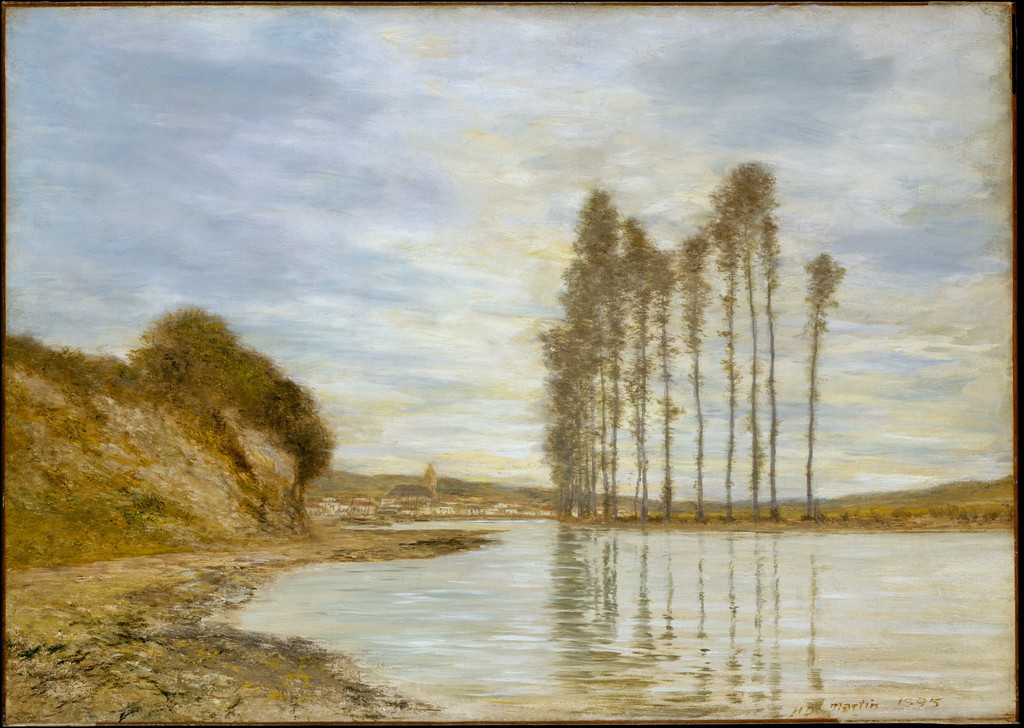
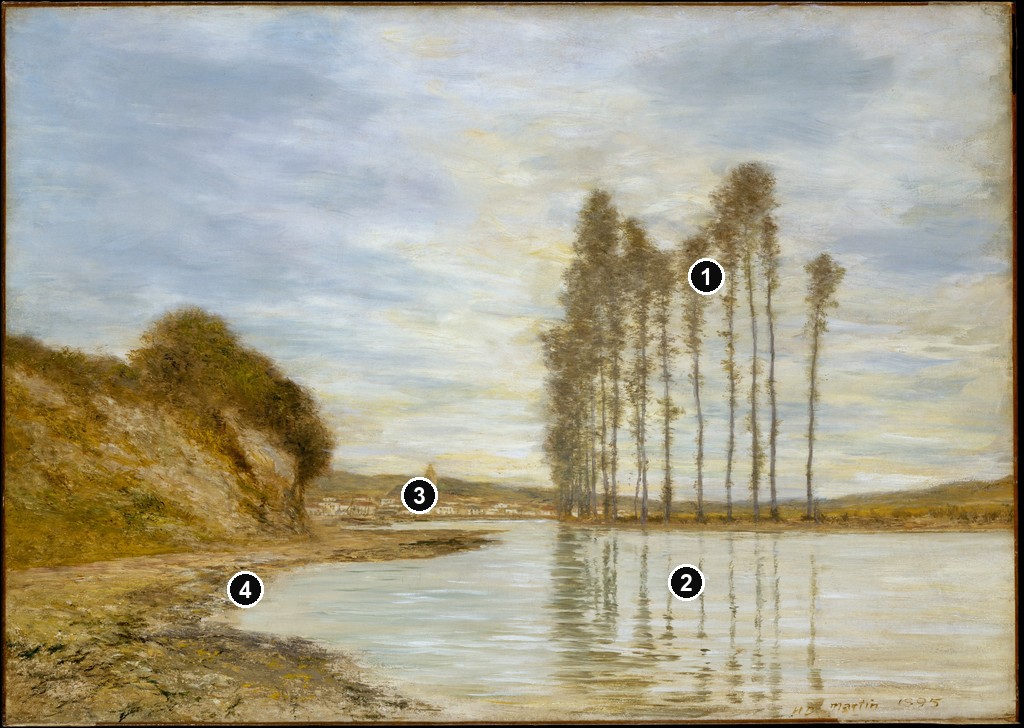
A line of slender poplars stands beside a quiet river, its trunks extended downward through reflection. At the left, a rough bank curves toward a distant settlement; above it, the pale sky occupies much of the canvas. Homer Dodge Martin’s View on the Seine: Harp of the Winds holds these few elements in an arrangement that rewards sustained looking.
The Metropolitan Museum of Art dates the painting 1893–95. Martin began its composition in charcoal in New York and completed the oil in Saint Paul, Minnesota, drawing on his earlier experience of France. The view’s apparent ease emerged through reconsideration after the painter had left its setting. [1]
Elizabeth Gilbert Martin associated the private title Harp of the Winds with her husband’s thoughts about music while painting. Her account also preserves an earlier version with taller trees. Those recollections make the canvas a particularly revealing meeting of landscape, memory and deliberate arrangement. [2]
At a Glance
- Artist Homer Dodge Martin.
- Full title View on the Seine: Harp of the Winds.
- Date 1893–95.
- Medium Oil on canvas.
- Dimensions 73 × 103.5 cm.
- Collection The Metropolitan Museum of Art, New York.
- Accession 97.32.
- Composition begun New York, 1893.
- Completed Saint Paul, fall 1895.
- First exhibited Union League Club, New York, 1896.
- Museum acquisition Gift of several gentlemen, 1897.
- Place-name question The current Met account names Criqueboeuf; its 1985 catalogue quotes Martin naming Quilleboeuf.
This work across Homer Dodge Martin’s career
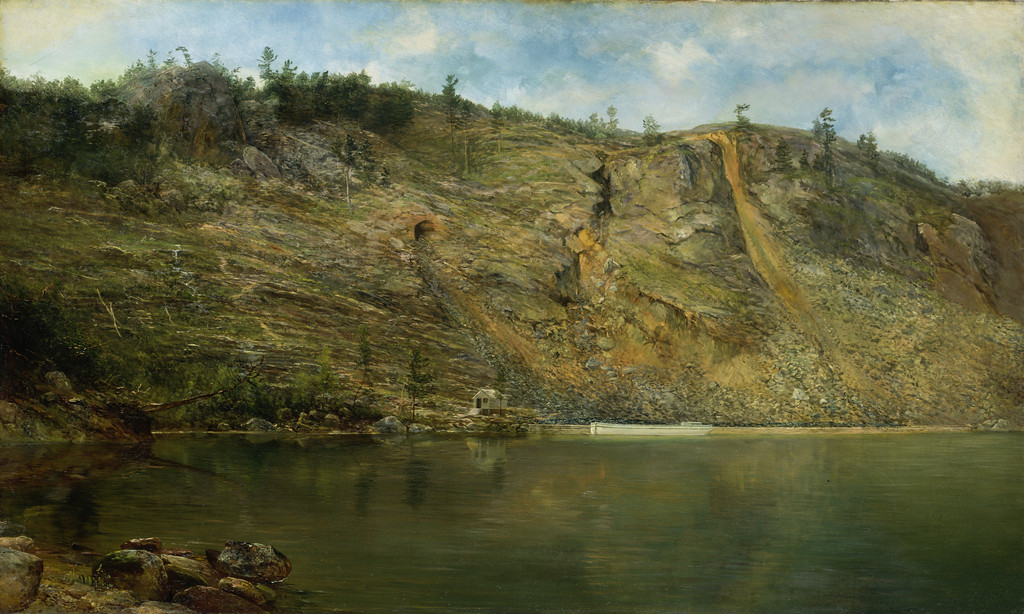
The Iron Mine, Port Henry, New York
about 1862Evening on the Thames
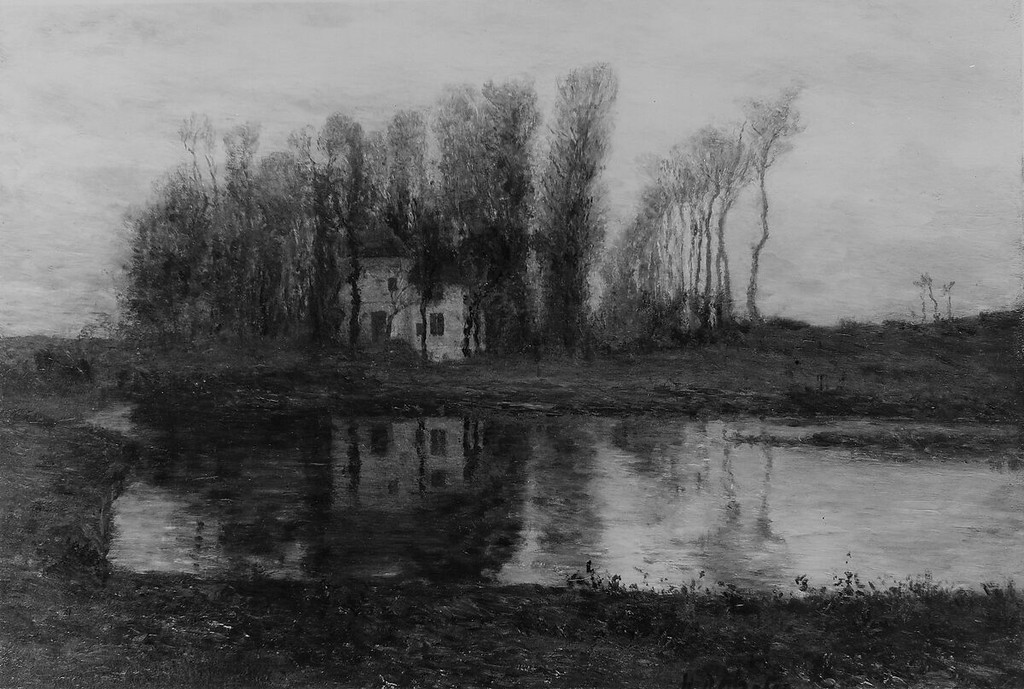
about 1876Old Manor of Criqueboeuf
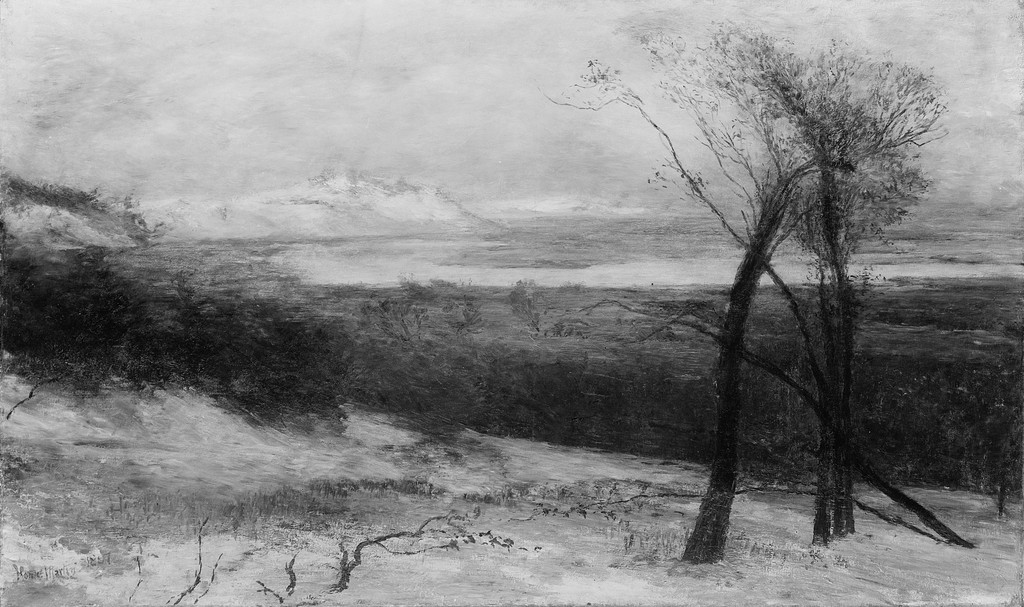
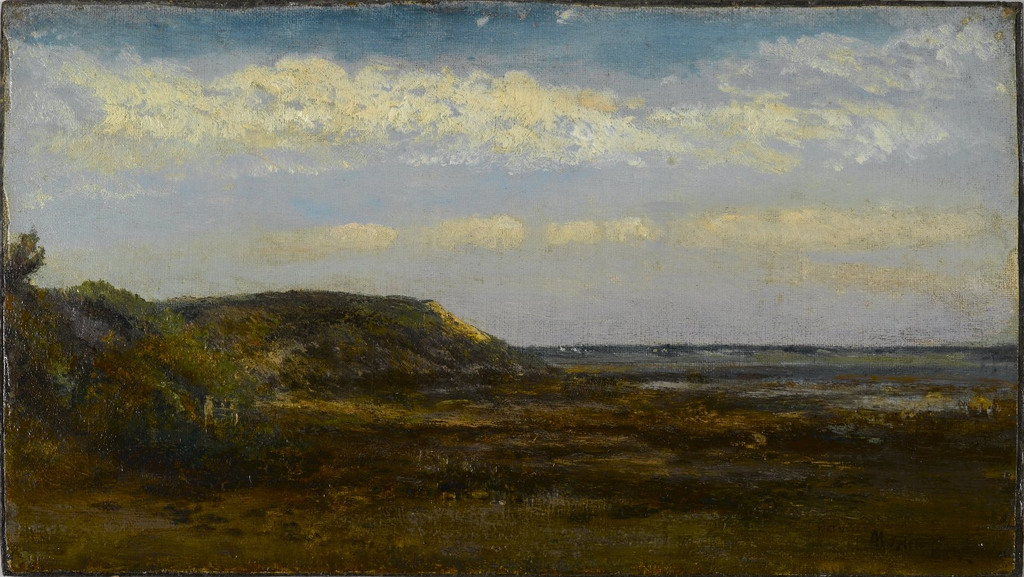
about 1882–92Behind Dunes, Lake Ontario
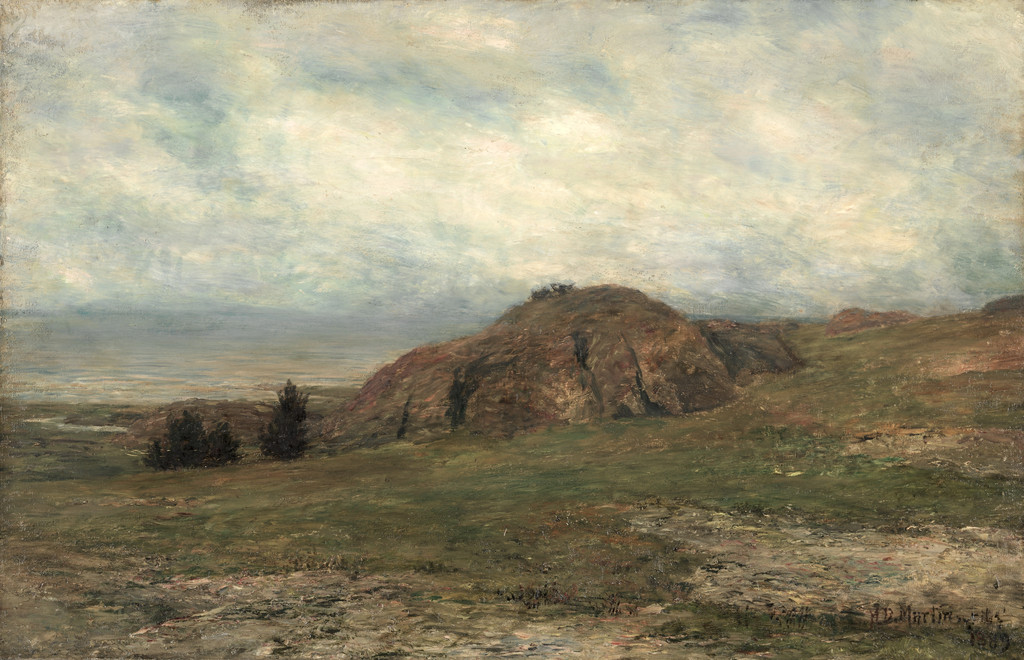
1883–87Normandy Coast
1884Westchester Hills
about 1887Lighthouse, Honfleur
UndatedNotes and sources
The Iron Mine, Port Henry, New York. An industrial opening, sloping runway and worked cliff stand above Lake Champlain. The Smithsonian connects this landscape with the North’s resources during the Civil War. [3]
Upper Ausable Lake. Foreground reeds and birds lead toward a bright passage of water beneath the mountain wall. The Smithsonian identifies this canvas as Upper Ausable Lake. [4]
Evening on the Thames. A low river horizon, distant buildings and reflected light bring a British subject into Martin’s painting. The museum’s date remains approximate. [5]
Old Manor of Criqueboeuf. A house and its reflection organize this slowly developed Normandy subject. The broad date range does not mean that Martin painted it without interruption. [6]
Behind Dunes, Lake Ontario. An American subject developed during the French residence and after the return. The Met records rejection at the 1884 Salon followed by revision in 1887. [7]
Normandy Coast. Freely brushed clouds dominate a small coastal board. Brooklyn places it among outdoor paintings made during Martin’s French residence. [8]
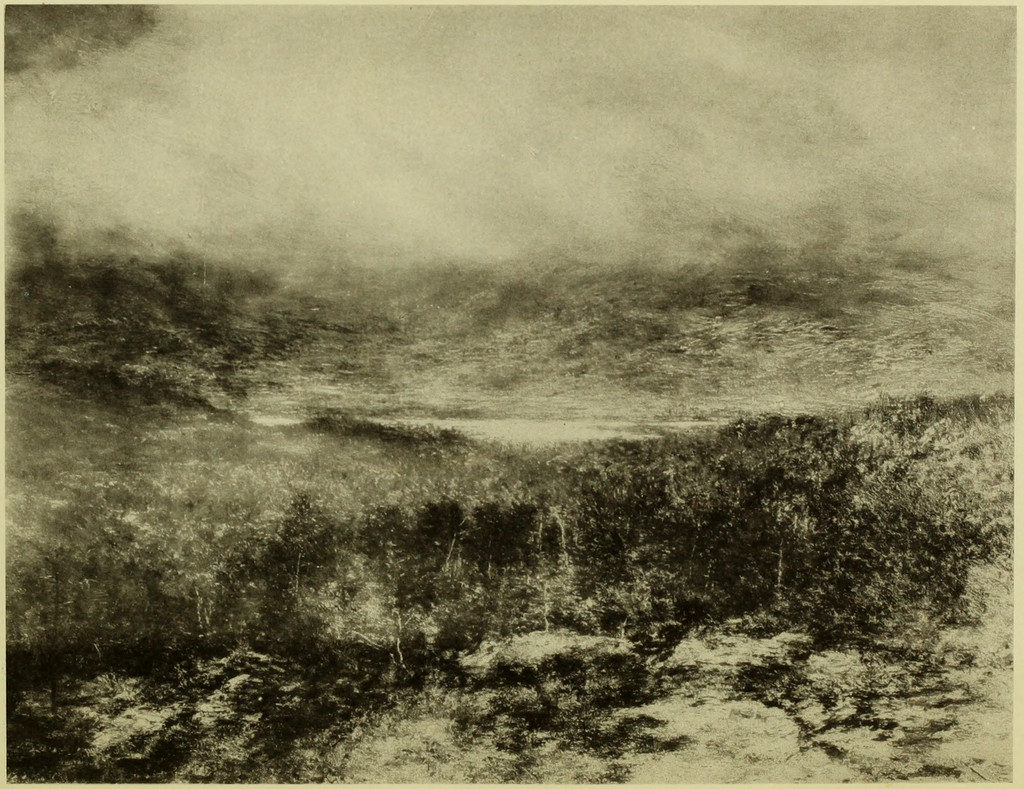
Westchester Hills. Mather describes a large outdoor undertaking at Croton Falls and records its exhibition in 1888. The probable painting date and exhibition year remain distinct. [9]
Wild Coast, Newport. An extensive sky opens above low coastal ground. This dated Cleveland canvas is distinct from the Smithsonian painting bearing the same title. [10]
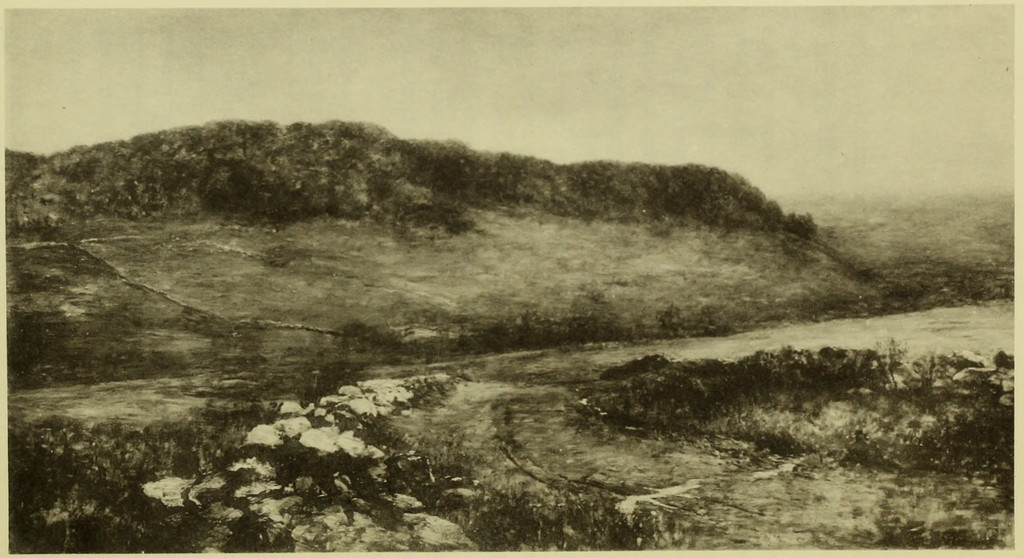
Criqueboeuf Church, Normandy. A church, trees and their reflections give architecture a place within the landscape. The current LACMA record supplies the date; the article reproduces a historical monochrome print. [11]
View on the Seine: Harp of the Winds (current article). Poplars and their reflections repeat across the Seine. The Met records a charcoal beginning in New York in 1893 and completion in Saint Paul in 1895. [1]
Adirondack Scenery. Mountain slopes, a foreground ledge and water organize this late return to American scenery. Mather treats it as a major expression of experiences considered over many years. [9]
Lighthouse, Honfleur. Princeton’s small upright wood panel sets the lighthouse within a compact landscape. It remains undated and is distinct from the larger horizontal Century Club canvas. [12]
Contents
- A river shaped by trees and reflections
- The curve into the landscape
- Poplars, intervals and the suggestion of a harp
- A French memory painted in America
- Charcoal beginnings and the 1895 completion
- Music and the title Elizabeth remembered
- The published letter and the question of place
- Paint, mood and historical criticism
- Exhibition, friends and the museum gift
- Annotated details
A river shaped by trees and reflections
The river occupies the lower part of the view, opening from the curved foreground shore toward the opposite bank. The trees stand beyond that opening, their narrow trunks interrupting the sky. They give the eye a repeated measure through which to judge the breadth of the water and the lower sweep of distant ground.
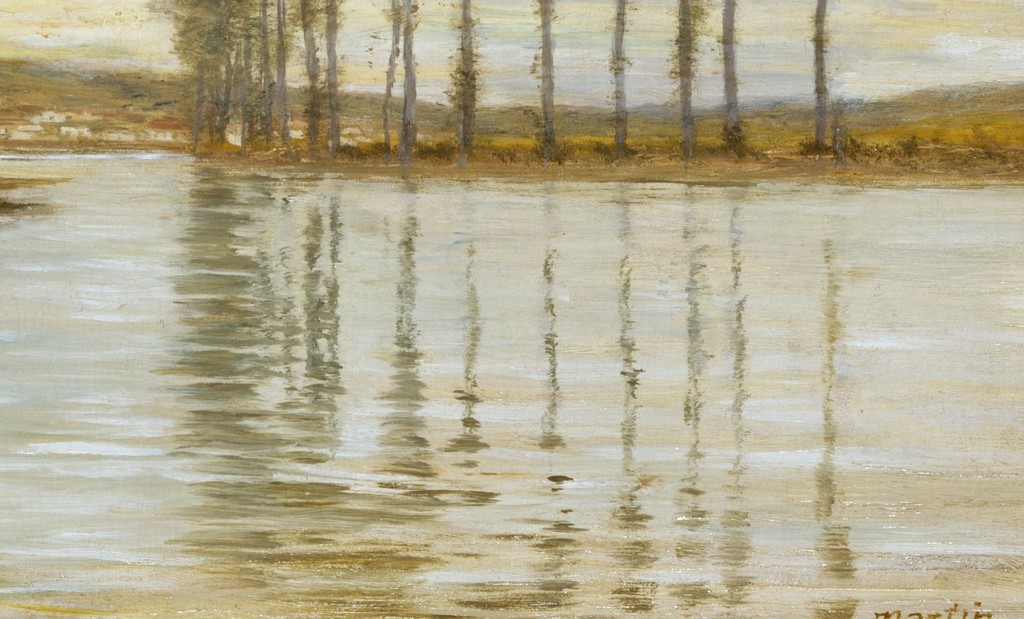
The reflections make the arrangement more complex. The trunks continue below the bank, but their lower images are broken by small horizontal marks across the river. What is upright and comparatively continuous above becomes intermittent below. The painting joins the two regions through a shared pattern while allowing each to retain its own surface character.
The sky is equally active. Blue-gray and pale cream passages spread between and around the foliage, with lighter bands crossing behind the trees. The crowns vary in height and density. Air remains visible between the trunks, preventing the row from closing into a solid barrier across the picture.
At the left, the near bank has a different weight. Its ocher ground, rough vegetation and pale exposed patches gather into a substantial projecting mass. That mass gives the foreground a firm presence against the open water. Looking between bank, river and trees reveals how differently shaped elements can balance one another without repeating the same outline.
The canvas measures a little over a meter across. Its broad horizontal format gives the bank space to turn and the trees room to stand at changing intervals. The actual dimensions matter because a small reproduction can compress the quiet stretches between prominent forms. Those stretches are part of the composition’s force, allowing repeated verticals and lateral movement to coexist. [1]
Annotated Details from View on the Seine: Harp of the Winds
The numbered points identify visible features discussed in this article. Return from each detail to the whole composition. The captions keep each work’s identity, date and medium separate.
View on the Seine - Harp of the Winds
Homer Dodge Martin, View on the Seine: Harp of the Winds, 1893–95. Oil on canvas, 73 × 103.5 cm. The Metropolitan Museum of Art, 97.32. The Metropolitan Museum of Art. Image source. CC0 / Public domain. Numbers added to a separate overview; detail crops made from the accepted source. No enlargement, recoloring, restoration or reconstruction.
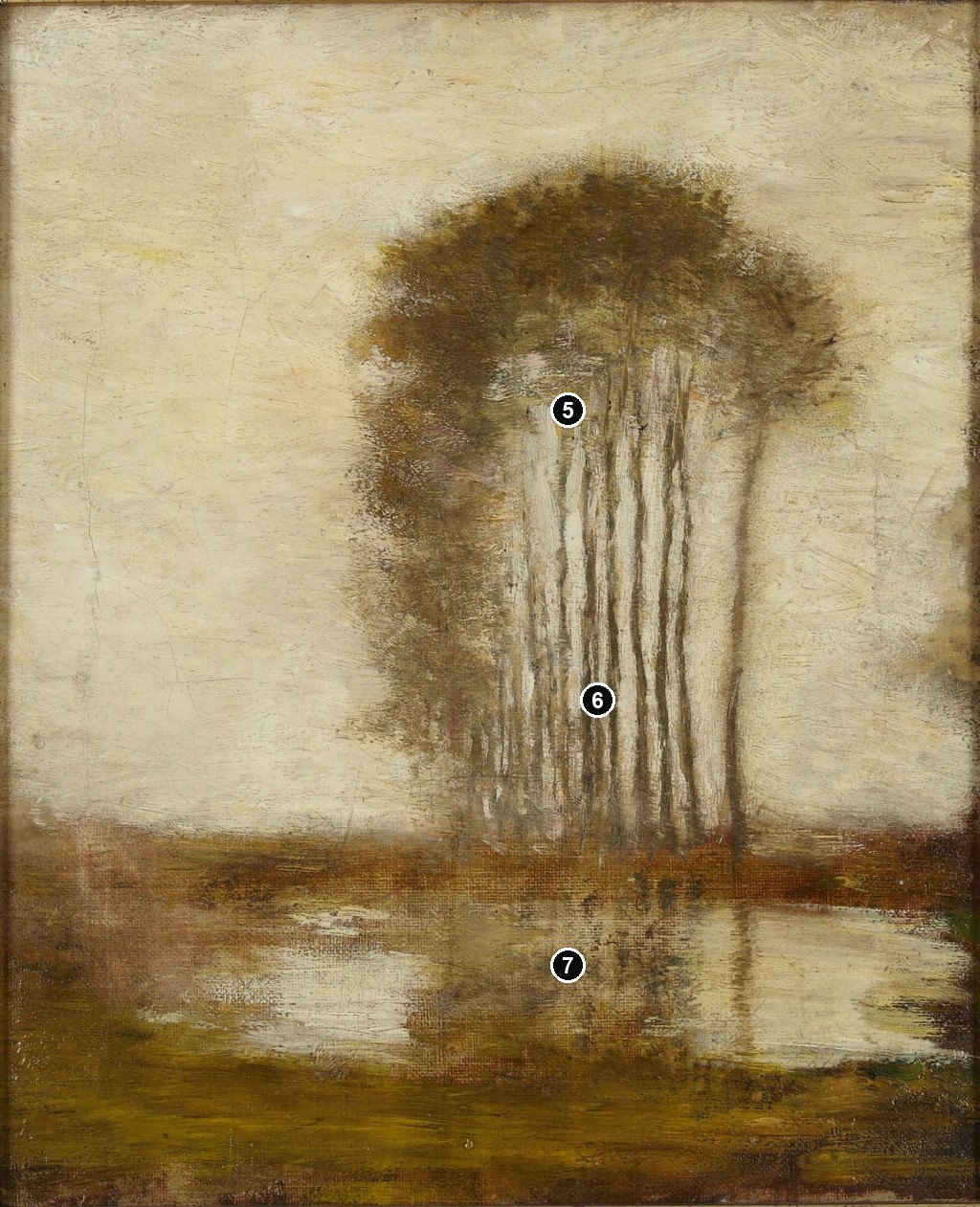
Landscape with Poplars - Undated Princeton Canvas
Homer Dodge Martin, Landscape with Poplars, undated. Oil on canvas, 29 × 24 cm. Princeton University Art Museum, y1946-105. A related motif in a vertical format, without an established preparatory relationship to Harp. Princeton University Art Museum, Gift of Frank Jewett Mather Jr. and Mrs. William Crary Brownell. Image source. Public domain. Numbers added to a separate overview; detail crops made from the accepted source. No enlargement, recoloring, restoration or reconstruction.
Details from VIEW ON THE SEINE: HARP OF THE WINDS
Compare each detail with its own complete painting above. The undated Princeton canvas is a separate comparison of the poplar motif, without an established preparatory relationship to Harp.
View on the Seine - Harp of the Winds
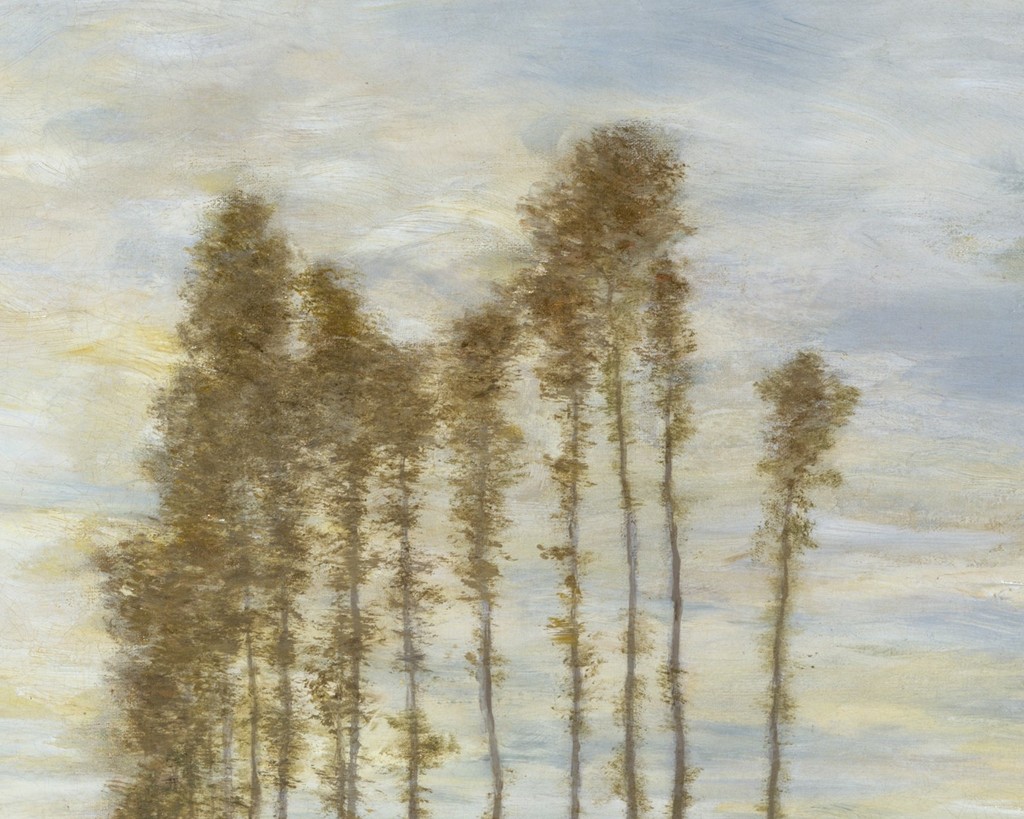
Poplar crowns against the open sky
The separate crowns form an uneven group above the thin trunks. Their different heights interrupt the sky while keeping the trees legible as a repeated motif.
Trunks continued in reflection
The trunks appear again below the bank as wavering dark reflections. Compare the upright trees with these less stable shapes across the horizontal surface of the river.
A settlement held in the distance
Low buildings and a taller church form a narrow band beyond the nearer bank. Their small scale helps establish distance between the viewer and the far shore.
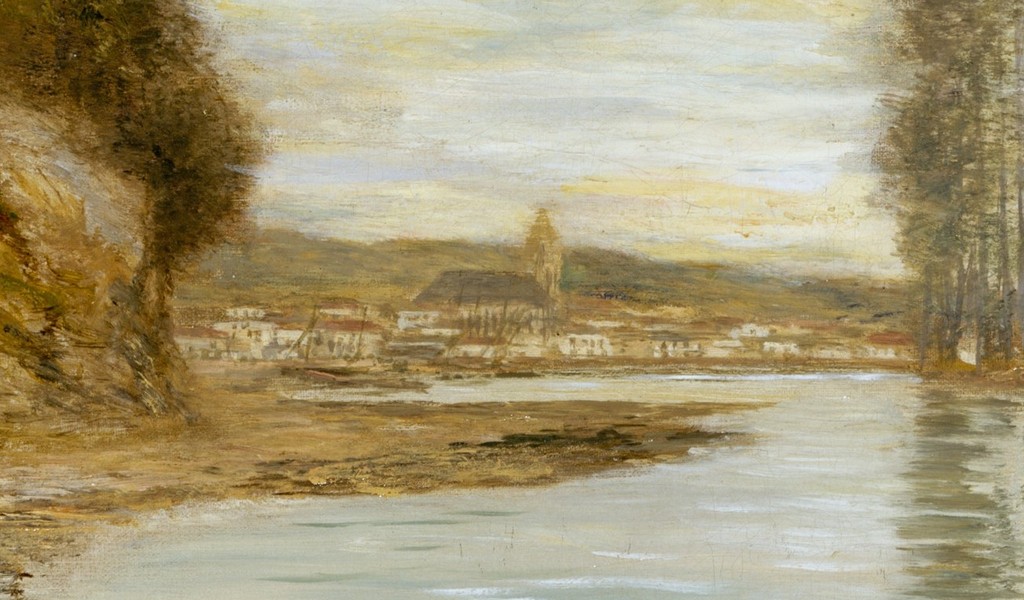
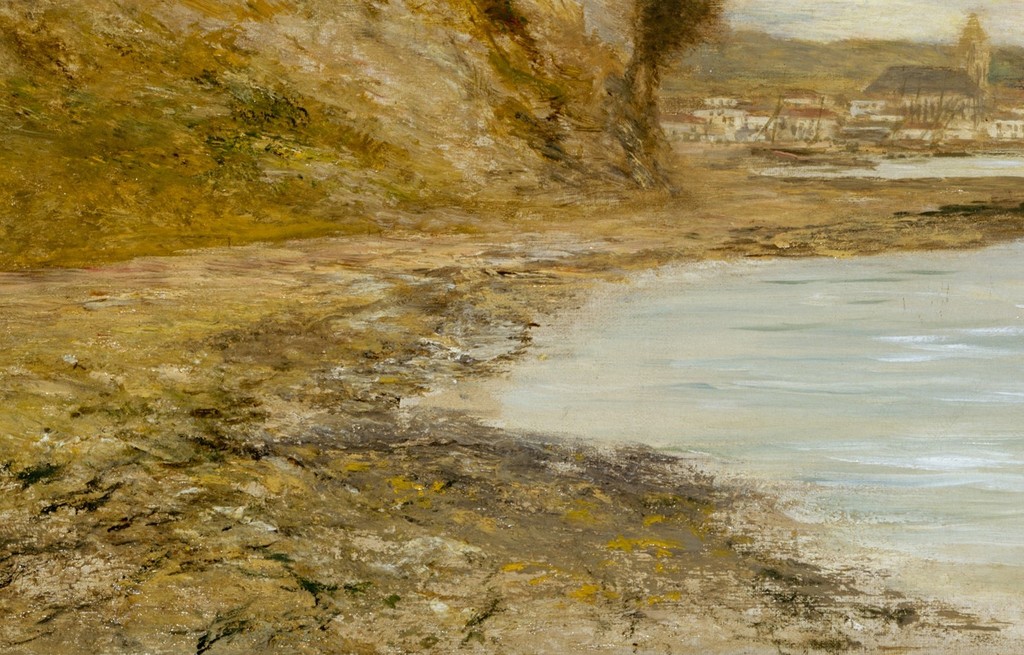
The bank curves toward the river
The irregular edge of the near bank turns across the lower picture before meeting open water. This curve gives the eye a route from the foreground toward the trees and farther shore.
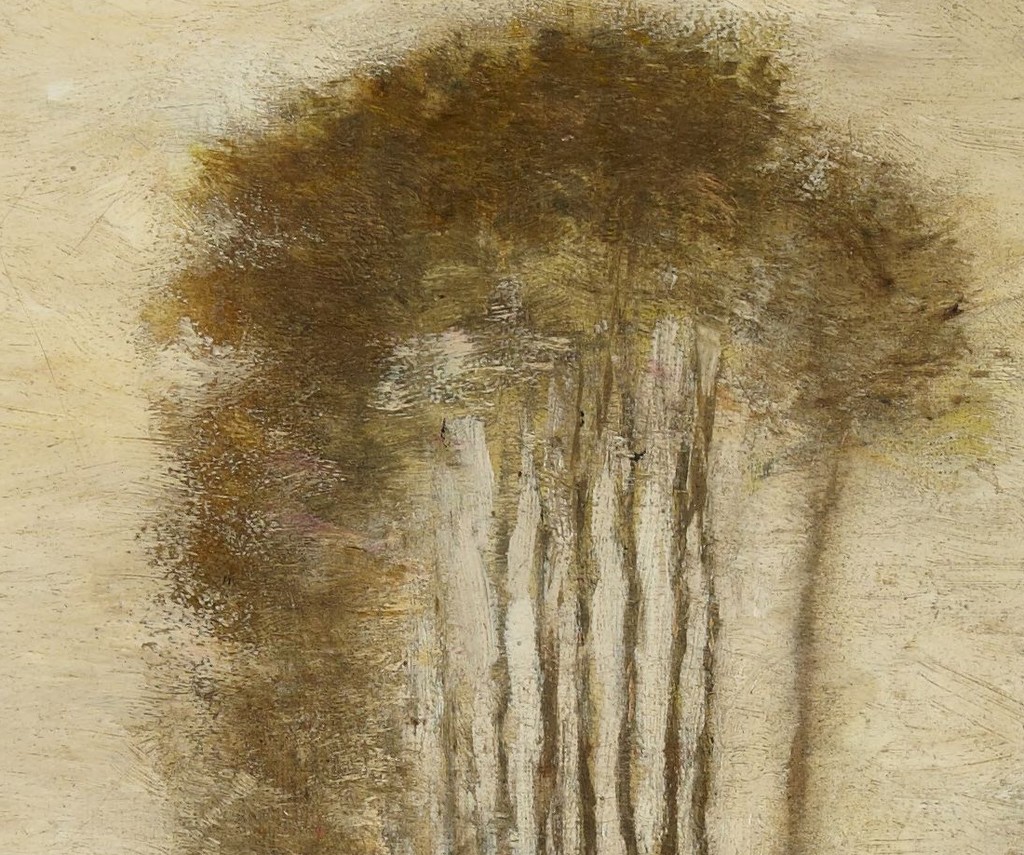
Landscape with Poplars - Undated Princeton Canvas
A rounded crown above separate trunks
The foliage collects into a broad rounded mass, while openings below allow the individual trunks to remain distinct. The compact arrangement differs from the more widely spaced trees in Harp.
A cluster of verticals
Narrow trunks occupy much of this upright canvas. Their slight changes of direction keep the repeated forms from becoming identical parallel lines.
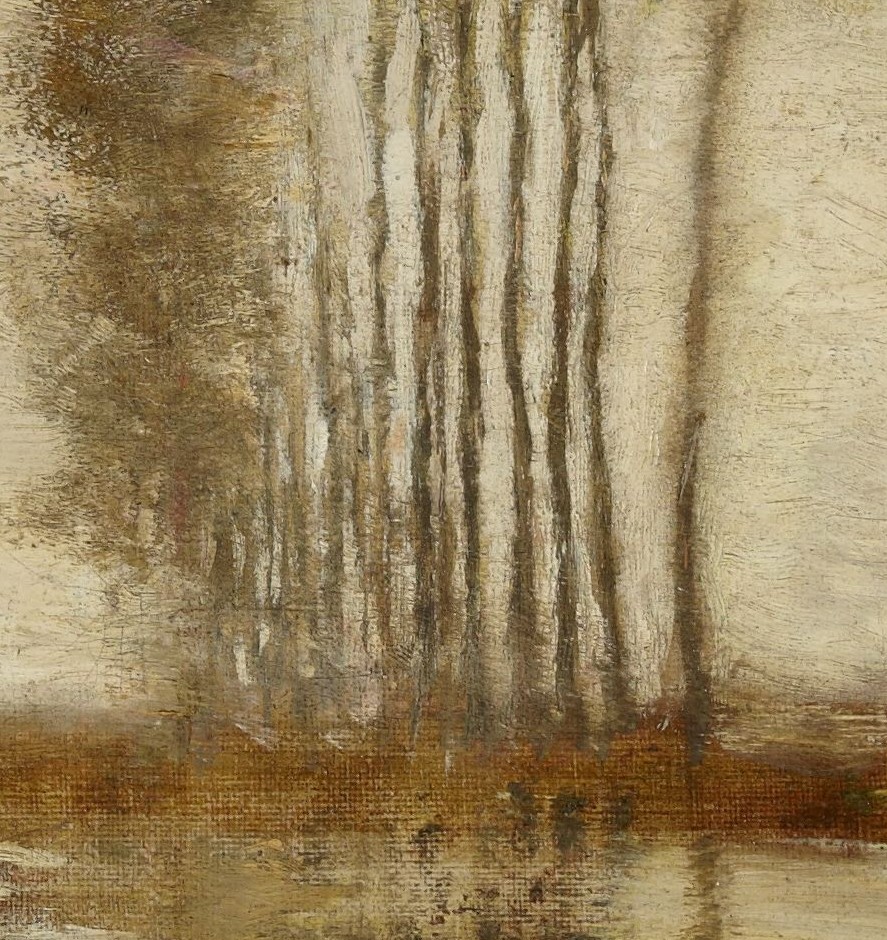
Reflections in the shallow foreground
Dark reflected forms descend into pale water beneath the tree group. This comparison concerns a shared motif; the undated painting is not established as a preparatory study for Harp.
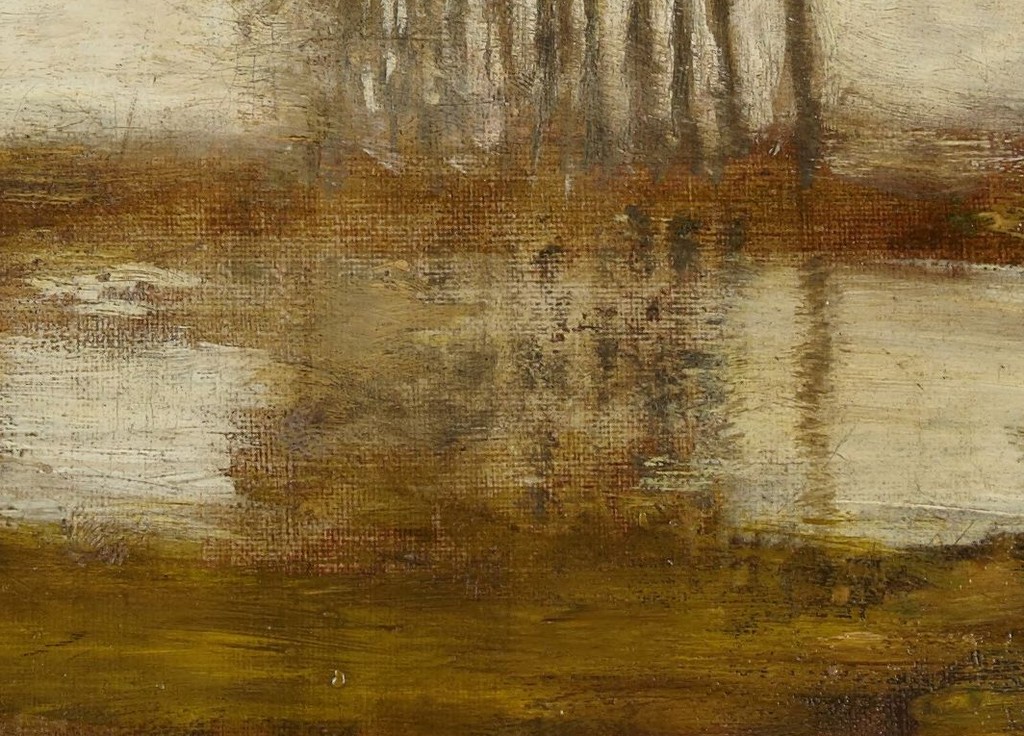
The curve into the landscape
Follow the shoreline from the lower left. The near ground projects into the water, then draws inward toward the settlement beyond. This turn gives the viewer a route into the scene. It also distinguishes the nearer bank from the narrow strip of land supporting the trees across the river.
The curve works at two levels. As an outline across the canvas, it divides one shape from another; as a shore in a landscape, it suggests a way around the water and into distance. Mather emphasized this conjunction of pattern and space in his 1912 account. He saw the picture’s curves as both designed elements and essential means of creating depth. [9]
The small settlement adds another measure. Pale buildings gather beneath a low ridge, with a taller form rising among them. Compared with the poplars, their compact scale carries the eye farther back. The scene remains inhabited without giving a large figure or an individual action command of the view.
Look also at the narrow passage of water near those buildings. It gives light a way to continue between the projecting bank and the farther ground. The near water and the distant settlement therefore remain connected through an opening within the arrangement. The eye can travel beyond the most conspicuous trees rather than stopping at their row.
The bank’s roughness helps make this movement convincing. Small broken marks establish a nearby texture against the broader passages in the river and sky. The contrast directs attention between close and far without requiring equally detailed description everywhere. A limited set of textures can distinguish several distances within the same extensive view.
Poplars, intervals and the suggestion of a harp
The poplars rise at unequal intervals and heights. Their dark trunks are comparatively slender, while the crowns gather into softer, irregular masses. This difference between narrow support and spreading foliage gives the group a changing rhythm as the eye moves from one tree to the next.
The row also bends with the landscape. The trees toward the left appear more closely grouped and farther away, while the larger trunks toward the right open broader spaces between them. Reflection extends the pattern, helping the lower half of the canvas answer the upper half. The repeated forms can be followed as intervals as well as individual trees.
That arrangement gives the musical title a visible point of contact. Trunks and reflections may suggest strings, while their varying spacing establishes a rhythm across the view. The association need not turn the riverbank into a literal diagram of an instrument. Its value lies in drawing attention to the relationships through which the painting holds together.
Elizabeth remembered the first charcoaled arrangement as particularly elegant. In her account, the trees were taller, and she regretted the later change. Martin considered their height excessive. Her recollection preserves a disagreement about proportion, giving the familiar finished image a history of alternatives rather than treating its forms as inevitable. [2]
Mather did not share her preference for the earlier state. He admired the proportion and graceful movement of the finished trees, making his response a useful counterpart to hers. Neither account supplies an image of the lost arrangement for direct comparison. They preserve different judgments about a canvas whose working history included changes to one of its defining features. [9]
A French memory painted in America
Martin’s longer European absence began in England in 1881, followed by residence in Normandy from the winter of 1882–83 until 1886. Villerville and Honfleur supplied coastal and inland subjects that remained important after his return. The France and Normandy account follows that lived setting through both Martins’ experiences. [13] [2]
The distinction between seeing a place and completing its painting is central here. A French landscape could remain active in New York and later in Minnesota, through sketches, recollection and repeated decisions on the canvas. Harp belongs to that extended practice. Its execution dates describe the later work, rather than the dates of Martin’s residence beside the Norman coast. [13]
Other pictures demonstrate the same continuing engagement. Old Manor of Criqueboeuf was revised into the early 1890s, while the church subject likewise returned in an American working context. The French years supplied relationships of building, trees and water that could be reconsidered under different circumstances. [13]
A modern photograph of Villerville can give the region a tangible presence alongside this history. Paolo Gamba’s 2020 coastal view shows beach, sea and rising wooded ground in another period. It provides geographical context for a place where the Martins lived; it does not establish the exact river viewpoint represented in Harp . [14]
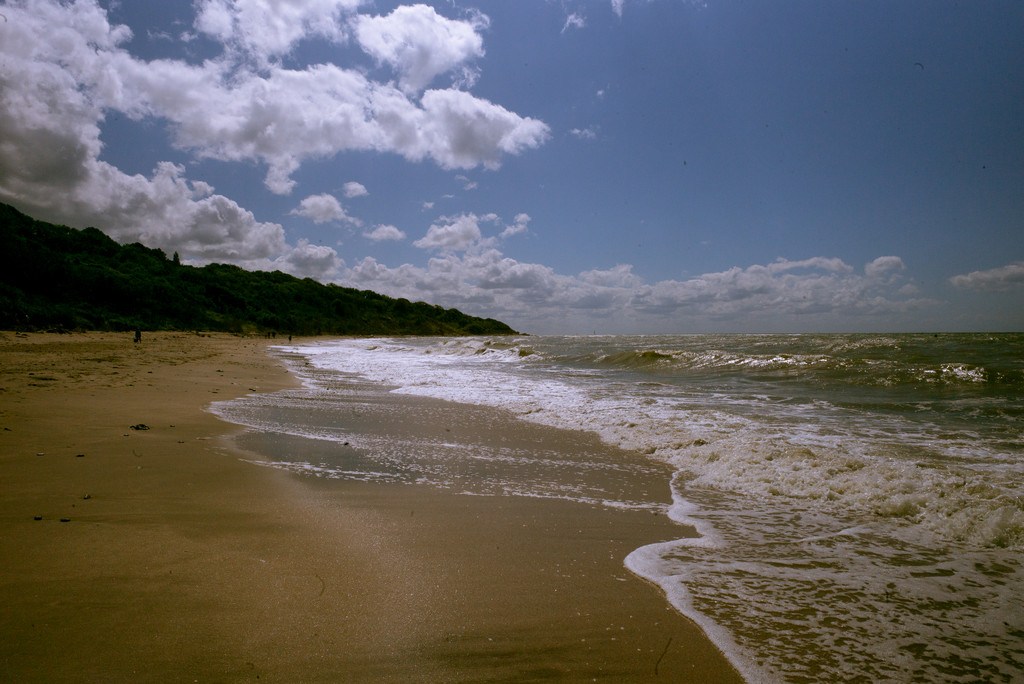
Villerville’s coast photographed in 2020. The village provides context for the Martins’ French residence; this photograph does not identify the river viewpoint in Harp. Photograph: Paolo Gamba, via Wikimedia Commons.
Image source
.
CC BY 2.0
. Resized only; source appearance preserved.
Charcoal beginnings and the 1895 completion
The Met records that Martin sketched the composition in charcoal in his New York studio in 1893. He took the unfinished canvas to Saint Paul, where he completed it in the fall of 1895. The interval matters: the picture developed across a change of home and through a substantial period of work. [1] [13]
The lower-right signature and date identify the finished canvas as 1895. They sit within a light passage of water below the repeated reflections, giving the documentary mark a place within the painted surface. [13]
Elizabeth’s recollection of the tree heights reaches back to this early arrangement. The canvas had a recognizable structure before its final painted state, yet its proportions could still be reconsidered. Charcoal provided an initial organization rather than a guarantee that every relationship would remain fixed. [2]
In Saint Paul, Martin worked on several important pictures drawn from different parts of his experience. Adirondack Scenery brought American mountain country into the same late period as the French river. Mather describes the completion of these works in 1895 after extended development. Their juxtaposition makes the final years a convergence of earlier subjects. [9]
His eyesight was seriously impaired. Elizabeth described the difficulty but stated that his blindness never became complete. That qualification belongs beside the evidence of continued revision and judgment. The biography follows the circumstances more fully; the painting itself preserves the choices through which he sustained its arrangement. [2]
Music and the title Elizabeth remembered
The full museum title joins a geographical description to the more suggestive Harp of the Winds . Elizabeth said that the latter was the name her husband used privately, though he worried that it might seem sentimental. She connected it with his attention to music while making the picture. The association therefore has a particular witness and setting within their shared life. [2]
Music had other places in the household. Elizabeth recalled an earlier commission from a music-loving friend who asked Martin for a painting connected with a Beethoven symphony. Her account gives the title a broader personal context without making this river scene an illustration of that earlier musical undertaking. [2]
For the viewer, the title encourages attention to interval, recurrence and variation. The trees provide a repeated motif, but each has a different relationship to the sky around it. Their reflections answer them with a less stable pattern. The comparison with music becomes most useful when it sharpens the experience of those visible relationships.
It also leaves room for quietness. Large passages of pale water and sky allow the repeated forms to emerge without becoming crowded. The eye can linger on a single trunk, cross an open interval and resume the sequence elsewhere. That pacing helps account for the painting’s capacity to sustain attention after its principal subject has been recognized.
Watch: Homer Dodge Martin
Start with Martin’s Normandy Landscape, then explore the wider Hudson River School tradition in which he began.
Homer Dodge Martin | Normandy Landscape
The Castellani Art Museum introduces Martin’s Normandy Landscape.
Watch on YouTubeThe published letter and the question of place
The picture’s exact geographical description requires care. The Met’s current account identifies a view down the Seine toward Criqueboeuf. Its 1985 catalogue, however, quotes Martin’s letter to Thomas B. Clarke of 31 October 1895, in which he described the scene as “looking down the River Seine towards the little town of Quilleboeuf.” The published wording and the current summary name different places. [1] [13]
The letter excerpt is valuable because it connects the description with Martin’s own account near the time of completion. It reaches the reader through the museum catalogue’s transcription. Elizabeth’s memoir supplies another complication: she questioned the strict accuracy of the geographical title while emphasizing the musical name that mattered to her husband. These accounts illuminate the picture from different positions. [13] [2]
The church pond at Criqueboeuf should therefore remain distinct from this river view. A shared regional context or a similar place-name is insufficient to establish one exact viewpoint for several paintings. The Criqueboeuf Church and manor pictures can still be compared with Harp through reflection and built forms, while retaining their separate subjects and histories.
Within the image, the useful starting points remain clear: a projecting bank, distant buildings, repeated trees and reflective water. The uncertainty about the named location does not make those relationships uncertain. It changes how the painting’s geographical account should be described, while leaving its visible construction available to close examination.
Paint, mood and historical criticism
Muted color does not make Harp colorless. Ocher and brown gather in the near bank, subdued greens occupy vegetation, and gray-blue passages carry the water and sky. Pale warm marks move through both. Their relationships give the scene a common atmosphere while preserving differences between earth, foliage, air and reflection.
The surface is visibly varied. The bank’s broken texture contrasts with the more extended strokes across the water and sky. The reflected trees are interrupted by lateral marks, while the upper trunks remain more continuous. Looking at these changes helps connect paint handling with the landscape’s different kinds of substance and movement.
The Met’s catalogue connects the painting with experiments in watercolor, use of the palette knife and interest in Impressionism. It also distinguishes the canvas’s prolonged, tonal construction from an immediate response to passing light. That interpretation gives the work a place within French influence while preserving the importance of memory and considered arrangement. [13]
Mather’s criticism emphasizes the balance between an elegant surface pattern and convincing depth. He valued the painting’s luminosity and contemplative mood even while discussing limitations in Martin’s handling elsewhere in his study. His response belongs to the work’s early reception, offering an argument for what mattered most in its effect rather than a technical account of every paint layer. [9]
The style and technique discussion follows these questions across the career. Here they can be tested against a single arrangement. A change in the bank’s weight, the trees’ height or the continuity of a reflection would affect several other relationships at once. The apparent simplicity depends on their working together.
Exhibition, friends and the museum gift
The painting was first exhibited at the Union League Club in New York in 1896. The Met records favorable notices, but praise did not produce an immediate purchaser. The distinction is important within Martin’s late career, when professional friendships and critical admiration could coexist with severe financial insecurity. [1]
The 1985 catalogue records Elizabeth’s suggestion that money collected in Martin’s honor be used to buy the Seine painting for the museum. The proposal connected assistance to the painter with a lasting destination for a work she had admired from its beginnings. Friendship, practical support and judgment of the canvas came together in the acquisition. [13]
The museum received it in 1897, the year of Martin’s death, as a gift from a group of gentlemen. It remains identified by accession 97.32. The execution, first exhibition and accession dates therefore mark different events: a finished picture in 1895, public presentation in 1896 and entry into the collection in 1897. [1]
This history also qualifies a familiar story of artistic neglect. The canvas received attention before its museum acquisition, and people close to Martin valued it intensely. What failed to arrive promptly was a dependable sale. Its passage into the Met preserved a major late picture through the intervention of the same social world that had sustained much of his working life.
Related Seine and poplar pictures
Princeton’s Landscape with Poplars offers a close comparison of motif. Its undated vertical canvas, 29 by 24 centimeters, concentrates the trees within a compact field. A rounded mass of foliage rests above separate trunks and their reflections. Similar forms can therefore occupy a substantially different format and balance. The object is not documented as a preparatory study for Harp . [15]
The Art Institute of Chicago’s On the Seine , accession 1943.92, is another distinct painting, currently dated about 1895. At 39.1 by 61.6 centimeters, it is considerably smaller than the Met canvas. Its identity and date should remain attached to that object rather than being absorbed into Harp through the shared river subject. [16]
The Met’s 1985 catalogue places Harp among several French-subject pictures involving silhouetted trees, reflection, low horizons and distant settlements. That comparison helps explain the canvas as a synthesis of recurring interests. It also reminds the viewer that the poplars are part of a wider practice of selecting and rearranging landscape forms. [13]
For another route through the same late period, compare the river with Adirondack Scenery . The mountain picture organizes a different subject through near ground, extensive distance and a strongly active sky. The paintings overview connects these works, while Martin’s main page places them within the full career.
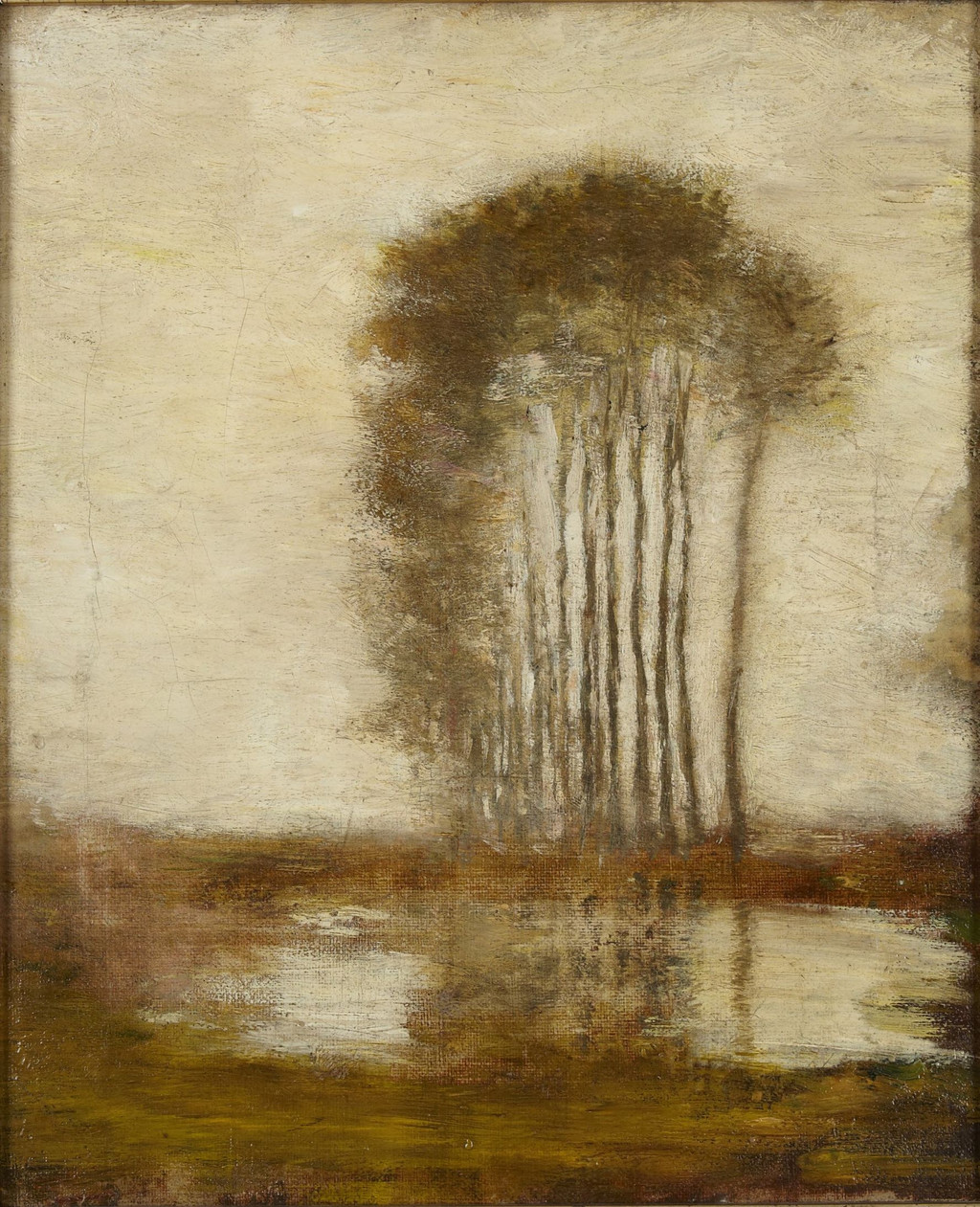
Homer Dodge Martin, Landscape with Poplars, undated. Oil on canvas, 29 × 24 cm. Princeton University Art Museum, y1946-105. A related motif in a vertical format, without an established preparatory relationship to Harp. Princeton University Art Museum, Gift of Frank Jewett Mather Jr. and Mrs. William Crary Brownell.
Image source
.
Public domain
. Resized only; source appearance preserved.
Artwork records
Browse 58 records from Carroll’s selected 1913 catalogue alongside 25 separately documented object records. Some records concern the same work; this is not a complete lifetime catalogue or a count of 83 unique artworks. [17]
| Name | Date | Medium |
|---|---|---|
| Carroll 1: Saranac Lake (1913 record) | 1860s; exact date not clearly decipherable | Painting — historical catalogue record |
| Carroll 2: Lake George from Bolton (1913 record) | Date not stated | Painting — historical catalogue record |
| Carroll 3: The Iron Mine, Port Henry, N. Y. (1913 record) | Date not stated | Painting — historical catalogue record |
| Carroll 4: On Lake Ontario (1913 record) | Probably late 1860s | Painting — historical catalogue record |
| Carroll 5: The Giant of the Valley (1913 record) | 1865 | Painting — historical catalogue record |
| Carroll 6: An Adirondack Lake (1913 record) | Date not stated | Painting — historical catalogue record |
| Carroll 7: Winter in Normandy (1913 record) | Date not stated | Watercolor — historical catalogue record |
| Carroll 8: Across the Lake (1913 record) | Date not stated | Painting — historical catalogue record |
| Carroll 9: New Hampshire Landscape (1913 record) | Late 1860s | Painting — historical catalogue record |
| Carroll 10: Long Lake (1913 record) | Date not stated | Painting — historical catalogue record |
| Carroll 11: Salt Meadows (1913 record) | Mid 1880s | Painting — historical catalogue record |
| Carroll 12: Autumn on the Susquehanna (1913 record) | 1879 | Painting — historical catalogue record |
| Carroll 13: Ontario Sand Dunes (1913 record) | 1887 | Painting — historical catalogue record |
| Carroll 14: Late Autumn (1913 record) | About 1877 | Painting — historical catalogue record |
| Carroll 15: Early Spring (1913 record) | About 1877; companion dating | Painting — historical catalogue record |
| Carroll 16: Raquette Lake (1913 record) | 1869 | Painting — historical catalogue record |
| Carroll 17: A Glimpse of the Sea (1913 record) | Date not established; historical suggestion disputed | Painting — historical catalogue record |
| Carroll 18: Headwaters of the Hudson (1913 record) | 1869 | Painting — historical catalogue record |
| Carroll 19: Autumn in the Adirondacks (1913 record) | 1871 | Painting — historical catalogue record |
| Carroll 20: Richmond on Thames (1913 record) | About 1877; later alterations | Painting — historical catalogue record |
| Carroll 21: Saranac Lake (1913 record) | 1878 | Painting — historical catalogue record |
| Carroll 22: Windsor Castle (1913 record) | Finished 1878 | Painting — historical catalogue record |
| Carroll 23: L’Anse St. Étienne, Saguenay (1913 record) | 25 July 1879 | Watercolor — historical catalogue record |
| Carroll 24: L’Anse aux Basses Pierres (1913 record) | Date not stated | Watercolor — historical catalogue record |
| Carroll 25: Blossoming Trees (1913 record) | Mid 1880s | Painting — historical catalogue record |
| Carroll 26: On the Seine (1913 record) | Date not stated; later years suggested | Painting — historical catalogue record |
| Carroll 27: The Dunes (1913 record) | 1883 | Watercolor — historical catalogue record |
| Carroll 28: The Moonlit Pond—Honfleur (1913 record) | Date not stated | Painting — historical catalogue record |
| Carroll 29: Normandy Landscape (1913 record) | Date not stated | Painting — historical catalogue record |
| Carroll 30: The Lighthouse, Honfleur (1913 record) | Date not stated | Painting — historical catalogue record |
| Carroll 31: Ruby Strong—Normandy (1913 record) | Date not stated | Painting — historical catalogue record |
| Carroll 32: Sand Dunes, Lake Ontario (1913 record) | 1874 | Painting — historical catalogue record |
| Carroll 33: Low Tide, Honfleur (1913 record) | Date not stated | Painting — historical catalogue record |
| Carroll 34: Evening on the Seine (1913 record) | Date not stated | Painting — historical catalogue record |
| Carroll 35: On the Seine (1913 record) | Date not stated | Painting — historical catalogue record |
| Carroll 36: On the Hudson (1913 record) | 1881 | Painting — historical catalogue record |
| Carroll 37: A Forest Brook (1913 record) | 1881 | Painting — historical catalogue record |
| Carroll 38: Coast Meadows, St. Sauveur (1913 record) | 1881 | Painting — historical catalogue record |
| Carroll 39: Landscape (1913 record) | 1883 | Painting — historical catalogue record |
| Carroll 40: An Adirondack Lake—Lake Sanford (1913 record) | 1883 | Painting — historical catalogue record |
| Carroll 41: Lower Ausable Pond (1913 record) | 1868 | Painting — historical catalogue record |
| Carroll 42: December Morning in Normandy (1913 record) | 1883 | Painting — historical catalogue record |
| Carroll 43: Low Tide—Villerville (1913 record) | 1884 | Painting — historical catalogue record |
| Carroll 44: Lake George (1913 record) | 1884 | Painting — historical catalogue record |
| Carroll 45: Crepuscule—Montvilliers (1913 record) | 1885 | Painting — historical catalogue record |
| Carroll 46: The Sea at Villerville (1913 record) | 1885 | Painting — historical catalogue record |
| Carroll 47: Golden Sands (1913 record) | Date not stated | Painting — historical catalogue record |
| Carroll 48: The Meadow Brook (1913 record) | 1887 | Painting — historical catalogue record |
| Carroll 49: The Sun Worshippers (1913 record) | After the 1886 return to New York | Painting — historical catalogue record |
| Carroll 50: South Side of Long Island (1913 record) | 1894 | Painting — historical catalogue record |
| Carroll 51: Criqueboeuf Church (1913 record) | 1893 | Painting — historical catalogue record |
| Carroll 52: Normandy Farm (1913 record) | 1895 | Painting — historical catalogue record |
| Carroll 53: On the Mississippi (1913 record) | Toward the close of the artist’s life | Painting — historical catalogue record |
| Carroll 54: Newport Neck (1913 record) | 1893 | Painting — historical catalogue record |
| Carroll 55: A Newport Landscape (1913 record) | 1896 | Painting — historical catalogue record |
| Carroll 56: A Distant View of Caen (1913 record) | Date not stated; exhibited 1894 | Painting — historical catalogue record |
| Carroll 57: The Brook (1913 record) | 1894 | Painting — historical catalogue record |
| Carroll 58: Normandy Trees (1913 record) | Date not stated | Painting — historical catalogue record |
| View on the Seine: Harp of the Winds | 1893–95 | Oil on canvas |
| The Iron Mine, Port Henry, New York | About 1862 | Oil on canvas mounted on fiberboard |
| Wild Coast, Newport | 1889 | oil on canvas |
| In the Housatonic Valley (attributed to Homer Dodge Martin) | late 1850s | oil on canvas |
| Sand Dunes, Lake Ontario | c. 1874 | Possibly black crayon on paper |
| Adirondacks | 1868 | Pencil drawing |
| Landscape | 1896 | Watercolor |
| Near Newport | mid-1800s | Watercolor |
| Effect of Trees | About 1879 | Oil on canvas |
| Behind Dunes, Lake Ontario | 1883–87 | Oil on canvas |
| Old Manor of Criqueboeuf | About 1882–92 | Oil on canvas |
| Upper Ausable Lake | 1868 | Oil on canvas |
| Wild Coast, Newport (Smithsonian version) | About 1885–95 | Oil on canvas |
| On the Seine | About 1895 | Oil on canvas |
| The Lighthouse, Honfleur | Date not supplied by museum | Oil on wood panel |
| The White Mountains from Randolph Hill (Wellin canvas) | 1866–67 | Oil on canvas |
| Old Crossing, Otter Tail River | 1871 | Black chalk touched with white chalk on paper |
| Landscape with Poplars | Date not supplied by museum | Oil on canvas |
| Normandy Coast | 1884 | Oil on board |
| Criqueboeuf Church, Normandy | 1893 | Oil on canvas |
| Evening on the Thames | About 1876 | Oil on canvas |
| Hudson River | 1860 | Graphite drawing on wove paper |
| The White Mountains, from Randolph Hill (formerly Met canvas) | About 1862–68; later revisions | Oil on canvas |
| Westchester Hills | About 1887 | Oil painting — historical accounts |
| Adirondack Scenery | 1895 | Oil painting — historical accounts |
Frequently Asked Questions
Homer Dodge Martin painted it during 1893–95, beginning the composition in New York and completing the oil in Saint Paul in the fall of 1895. [1]
Elizabeth Gilbert Martin connected the private title with her husband’s thoughts about music while painting. The repeated trees and reflections also invite attention to rhythm and intervals. [2]
The subject drew on French experience, but the composition began in charcoal in New York in 1893 and was finished in Minnesota in 1895. [1]
It belongs to the Metropolitan Museum of Art, New York, accession 97.32, acquired in 1897. [1]
Discussion
Look again at the images and ideas explored in View on the Seine: Harp of the Winds. These editorial prompts invite your observations.
Reader Insights
Follow the curving bank toward the distant buildings. Where does your eye change from following an outline to reading depth?
Compare the trunks above the water with their interrupted reflections. How does that difference affect the painting’s quietness?
Look at Princeton’s compact poplar picture beside Harp. What changes when a related motif moves into a wide horizontal view?
Join the Conversation
Share a detail, comparison or question about View on the Seine: Harp of the Winds below.
References
- Metropolitan Museum of Art , View on the Seine: Harp of the Winds, 1893–95, 97.32, object record and curatorial account. View source
- Elizabeth Gilbert Martin , Homer Martin: A Reminiscence, 1904, particularly pp.39–41 and48–55. View source
- Smithsonian American Art Museum, The Iron Mine, Port Henry, New York, 1910.9.11. View source
- Smithsonian American Art Museum, Upper Ausable Lake, 1909.7.44. View source
- Smithsonian American Art Museum, Evening on the Thames,1909.7.45. View source
- Metropolitan Museum of Art, Old Manor of Criqueboeuf, 22.117. View source
- Metropolitan Museum of Art, Behind Dunes, Lake Ontario, 06.1287. View source
- Brooklyn Museum, Normandy Coast,15.281. View source
- Frank Jewett Mather Jr. , Homer Martin: Poet in Landscape, 1912, particularly pp.57–64,69–70 and73–76. View source
- Cleveland Museum of Art, Wild Coast, Newport, 1923.1118. View source
- Los Angeles County Museum of Art, Criqueboeuf Church,Normandy,M.90.159. View source
- Princeton University Art Museum, The Lighthouse, Honfleur, y1948-3. View source
- Natalie Spassky and colleagues , American Paintings in The Metropolitan Museum of Art, Volume II, 1985, Harp entry and references, pp.425–428. View source
- Paolo Gamba , Villerville, Normandie, 2020 photograph, CC BY 2.0. View source
- Princeton University Art Museum , Landscape with Poplars, undated, y1946-105, object record. View source
- Art Institute of Chicago , On the Seine: current API object record, about 1895, 1943.92, identity, dimensions and provenance fields. View source
- Dana H. Carroll, Fifty-Eight Paintings by Homer D. Martin, 1913, selected illustrated catalogue. View source
- Splash image source.
Homer Dodge Martin, View on the Seine: Harp of the Winds, 1893–95. Oil on canvas, 73 × 103.5 cm. The Metropolitan Museum of Art, 97.32. The Metropolitan Museum of Art. CC0 / Public domain . Resized only; source appearance preserved.
View source