 by
Tom Gurney
Tom Gurney BSc (Hons) is an art history expert with over 20 years experience
Email:
tomgurney1@gmail.com
/ Phone:
+44 7429 011000
Old Manor of Criqueboeuf: Introduction
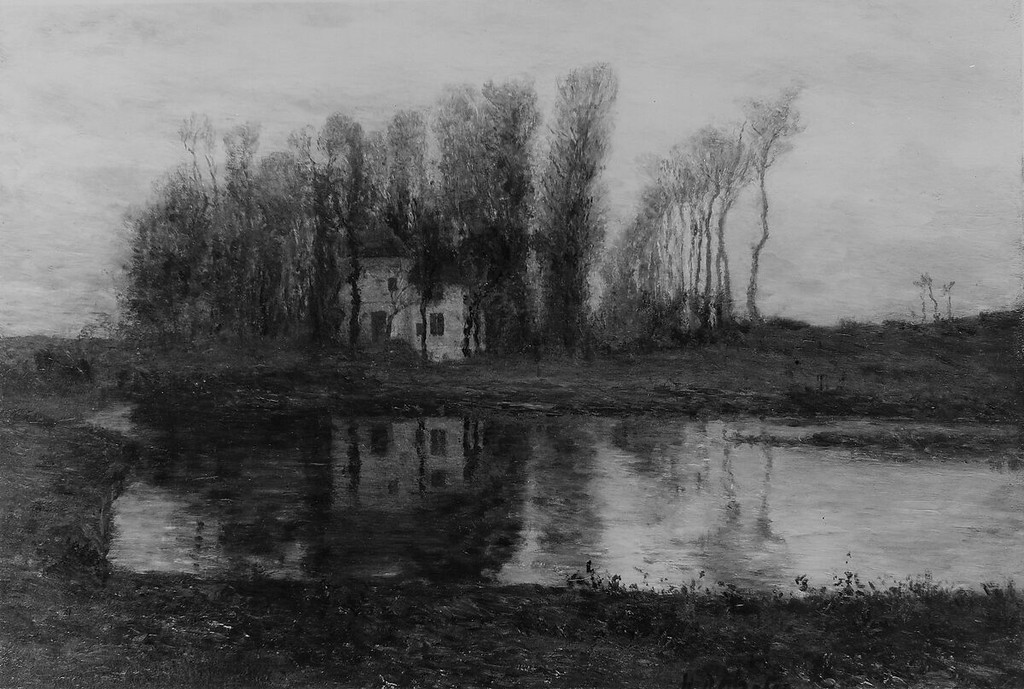
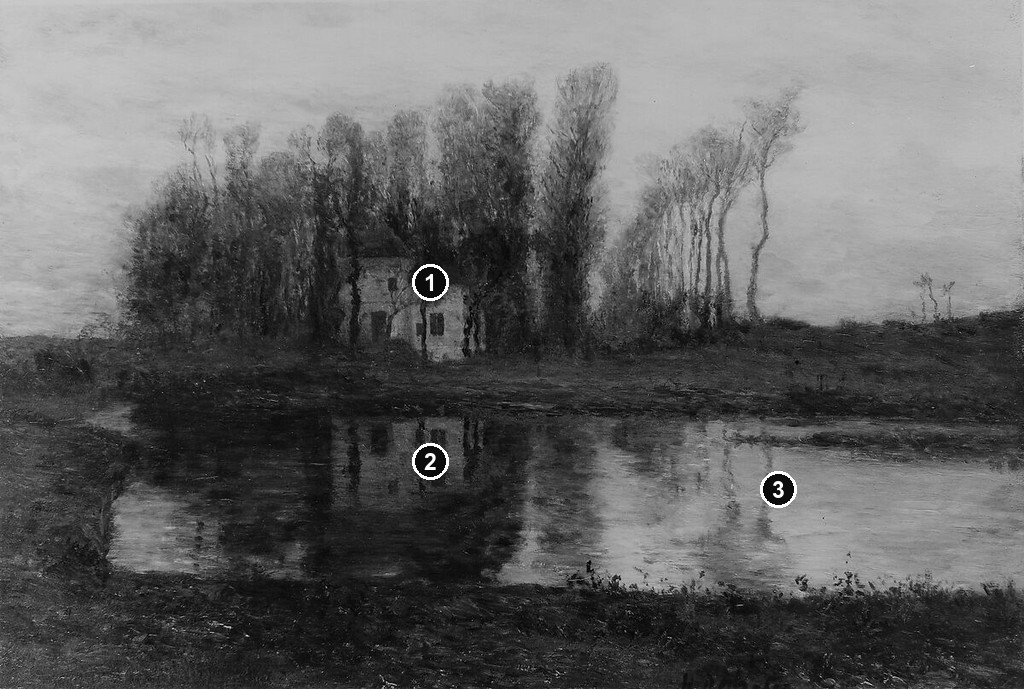
A pale house stands behind a screen of trees, its empty-looking openings repeated in the pond below. In Old Manor of Criqueboeuf , Homer Dodge Martin gives architecture a strangely uncertain presence: the building can be recognized, but the trees, water and surrounding ground continually interrupt its outline. The landscape makes the house seem secluded even as its reflection brings it closer.
The Metropolitan Museum of Art dates the canvas about 1882–92, a range that spans Martin’s Normandy residence and later work in America. Its alternative title, The Haunted House , belongs to an early response to the scene. The main illustration here is a monochrome museum reproduction; it reveals the arrangement and tonal contrasts without recording the original paint colors. [1] [2]
At a Glance
- Artist Homer Dodge Martin.
- Title Old Manor of Criqueboeuf; also exhibited as The Haunted House.
- Date About 1882–92.
- Medium and size Oil on canvas, 64.1 × 95.3 cm.
- Collection The Metropolitan Museum of Art, 22.117.
- Acquisition Bequest of Daniel M. Stimson, 1922.
- Illustration Monochrome reproduction; original colors are not represented.
- Sources Current object record and the Met’s scholarly catalogue. [1] [2]
This work across Homer Dodge Martin’s career
The Iron Mine, Port Henry, New York
about 1862Evening on the Thames
about 1876Old Manor of Criqueboeuf (current article)
about 1882–92Behind Dunes, Lake Ontario
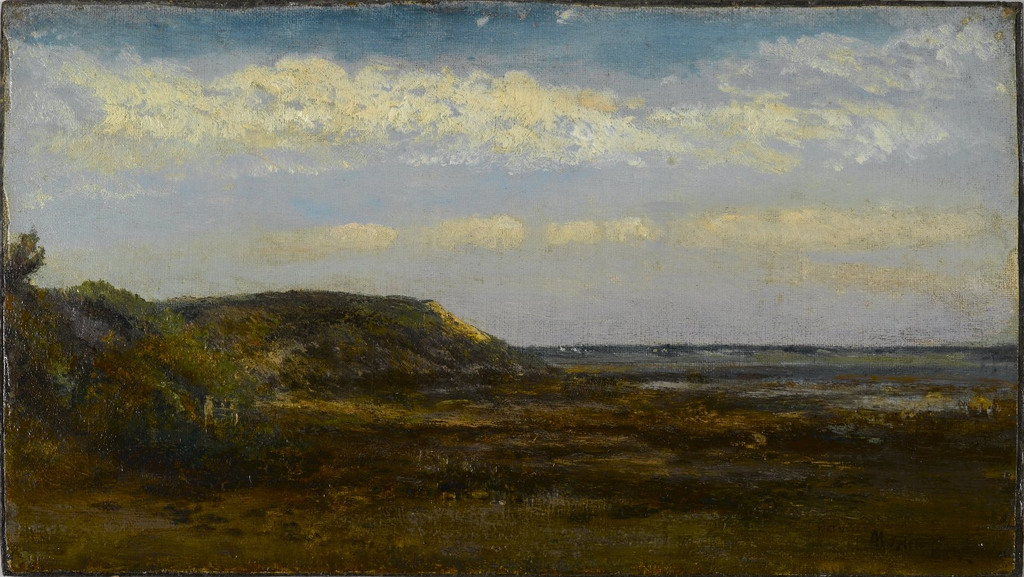
1883–87Normandy Coast
1884Westchester Hills
about 1887Lighthouse, Honfleur
UndatedNotes and sources
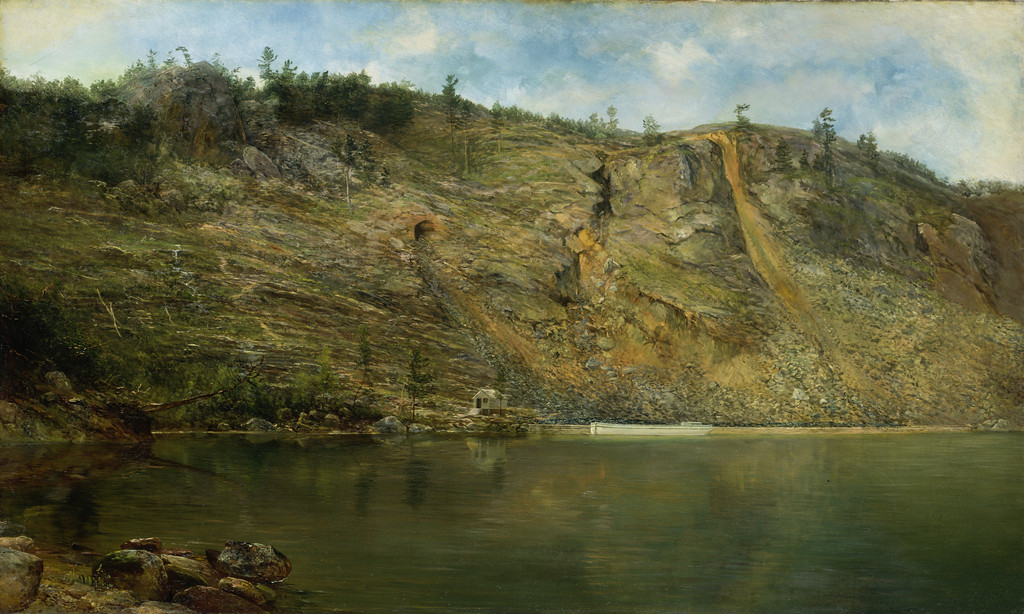
The Iron Mine, Port Henry, New York. An industrial opening, sloping runway and worked cliff stand above Lake Champlain. The Smithsonian connects this landscape with the North’s resources during the Civil War. [3]
Upper Ausable Lake. Foreground reeds and birds lead toward a bright passage of water beneath the mountain wall. The Smithsonian identifies this canvas as Upper Ausable Lake. [4]
Evening on the Thames. A low river horizon, distant buildings and reflected light bring a British subject into Martin’s painting. The museum’s date remains approximate. [5]
Old Manor of Criqueboeuf (current article). A house and its reflection organize this slowly developed Normandy subject. The broad date range does not mean that Martin painted it without interruption. [1]
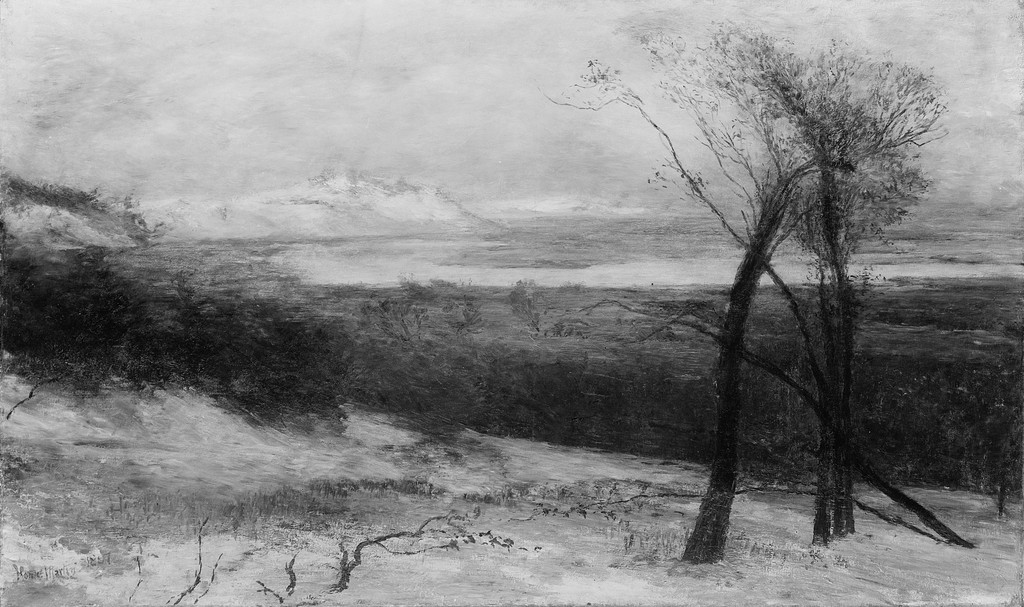
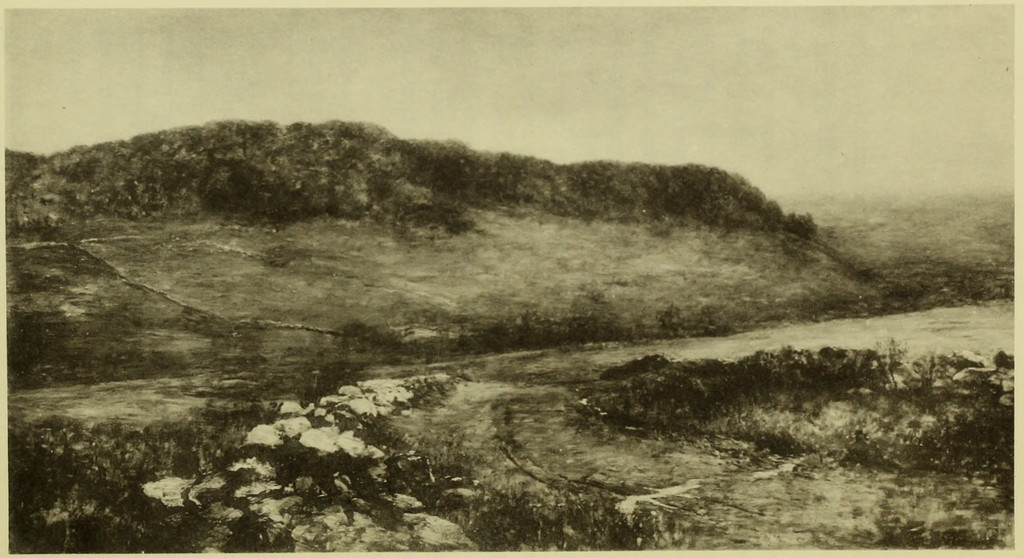
Behind Dunes, Lake Ontario. An American subject developed during the French residence and after the return. The Met records rejection at the 1884 Salon followed by revision in 1887. [6]
Normandy Coast. Freely brushed clouds dominate a small coastal board. Brooklyn places it among outdoor paintings made during Martin’s French residence. [7]
Westchester Hills. Mather describes a large outdoor undertaking at Croton Falls and records its exhibition in 1888. The probable painting date and exhibition year remain distinct. [8]
Wild Coast, Newport. An extensive sky opens above low coastal ground. This dated Cleveland canvas is distinct from the Smithsonian painting bearing the same title. [9]
Criqueboeuf Church, Normandy. A church, trees and their reflections give architecture a place within the landscape. The current LACMA record supplies the date; the article reproduces a historical monochrome print. [10]
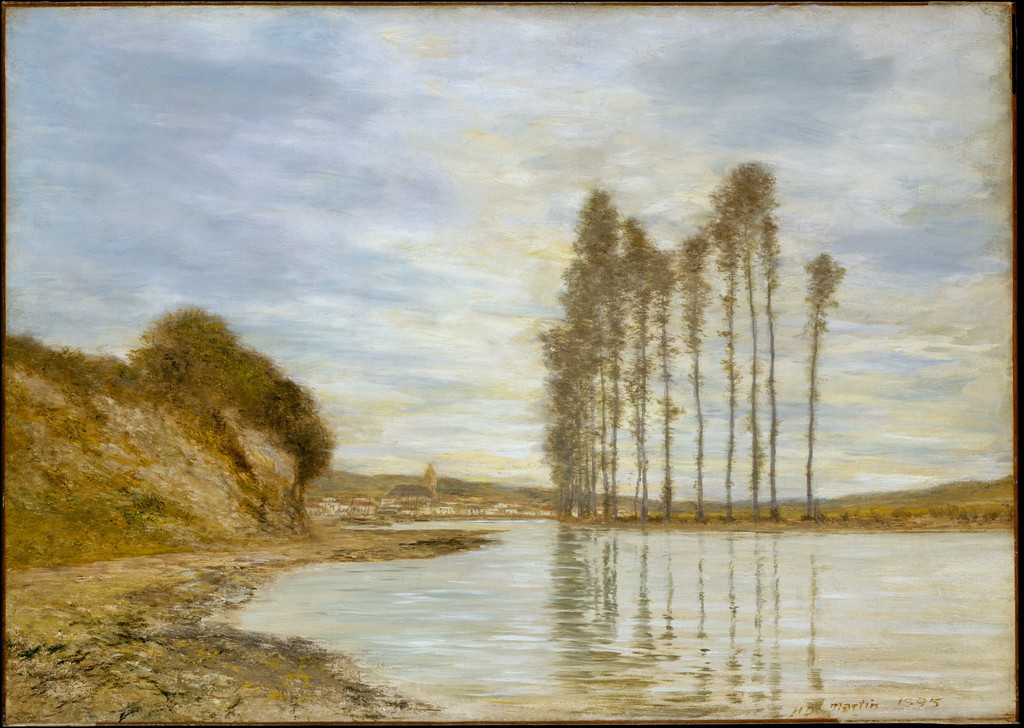
View on the Seine: Harp of the Winds. Poplars and their reflections repeat across the Seine. The Met records a charcoal beginning in New York in 1893 and completion in Saint Paul in 1895. [11]
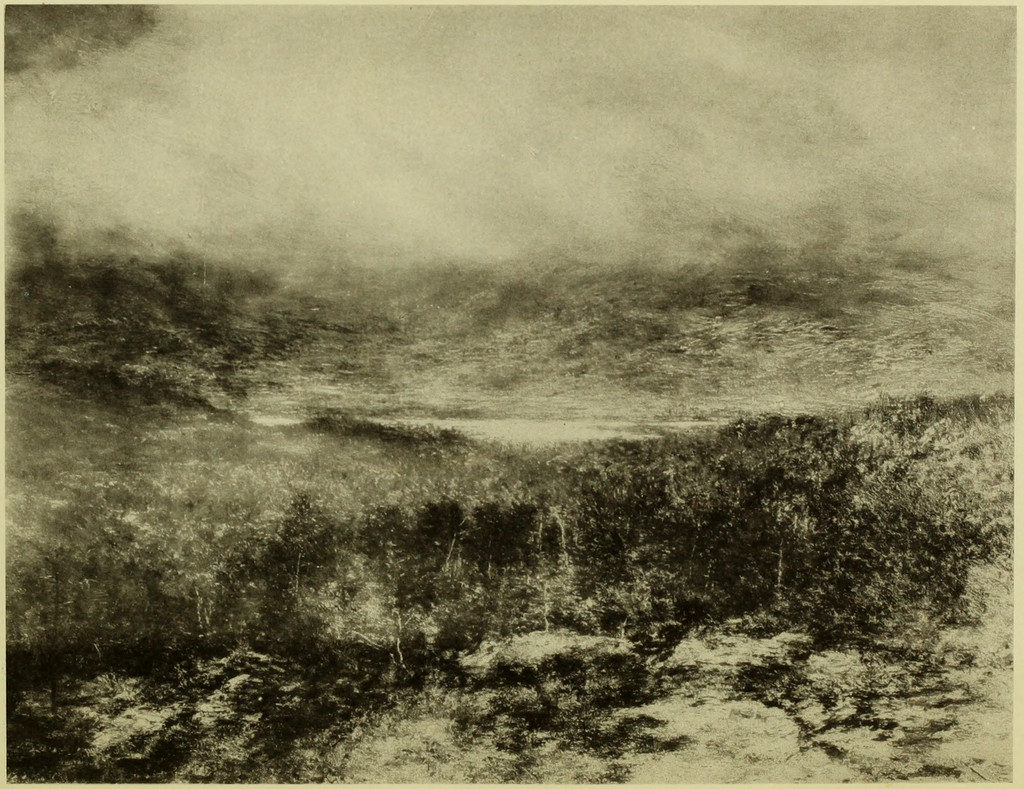
Adirondack Scenery. Mountain slopes, a foreground ledge and water organize this late return to American scenery. Mather treats it as a major expression of experiences considered over many years. [8]
Lighthouse, Honfleur. Princeton’s small upright wood panel sets the lighthouse within a compact landscape. It remains undated and is distinct from the larger horizontal Century Club canvas. [12]
Contents
- A house held between trees and water
- The pool as a second image
- Vacant openings and the crowded bank
- Criqueboeuf as an inhabited landscape
- The Haunted House and its revisions
- A decade-long date and the studio return
- Poe in Mather’s interpretation
- The manor beside church and farm
- Collection history and a quiet kind of drama
- Annotated details
A house held between trees and water
The house occupies a relatively small part of the whole canvas. Its pale walls sit within a much larger mass of trunks and foliage, with the upper branches rising well above the roof. The surrounding vegetation gives the scene its scale. Architecture offers a point of recognition inside a landscape that seems capable of closing around it.
The bank divides the picture near its middle, but the balance above and below remains unequal. The trees form a crowded upright group, while the water spreads into a broad horizontal opening. Dark ground holds the lower edge. Beyond the bank on the right, a few slender trees stand apart against the lighter sky.
Those isolated forms matter because they loosen the denser central group. Their spacing allows air and distance to enter around the house, preventing its enclosure from becoming absolute. The composition moves between compression and release: closely gathered vegetation at the center, a low open horizon to the right, and the pond extending toward the viewer.
Martin’s paintings repeatedly bring upright trees into relation with open water. Here the architecture adds a further layer. The eye seeks a familiar structure, then follows the landscape that partly conceals it.
Annotated Details from Old Manor of Criqueboeuf
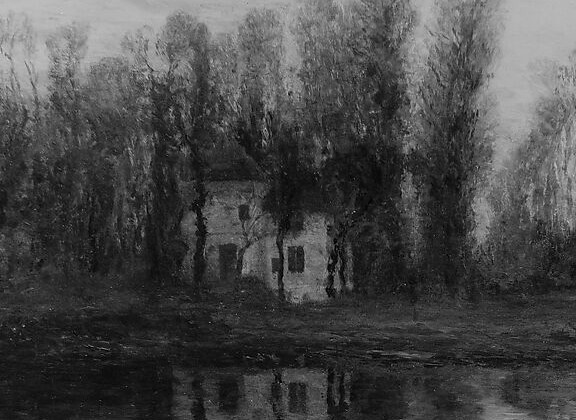
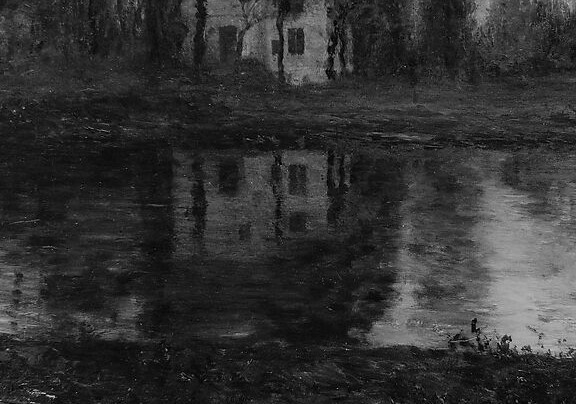
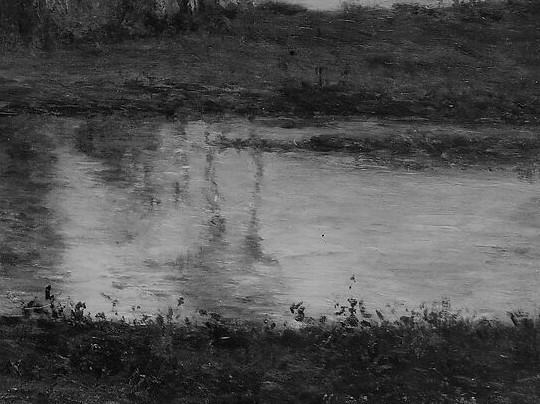
The numbered points identify visible features discussed in this article. Return from each detail to the whole composition. Homer Dodge Martin, Old Manor of Criqueboeuf, about 1882–92. Oil on canvas, 64.1 × 95.3 cm. The Metropolitan Museum of Art, 22.117. Monochrome museum reproduction; original paint colors are not represented. The Metropolitan Museum of Art, Bequest of Daniel M. Stimson, 1922. Image source. Public domain. Numbers added to a separate overview; detail crops made from the accepted source. No enlargement, recoloring, restoration or reconstruction.
Details from OLD MANOR OF CRIQUEBOEUF
Compare these broad details with the complete monochrome reproduction above. Follow relationships of light and dark, shape and position; the reproduction does not preserve the painting’s original colors.
The house within the trees
Light walls emerge from the darker tree group. The broad crop shows how the building is partly enclosed by vegetation rather than standing freely against the sky.
The house repeated below the bank
The light walls and dark openings reappear in the pool. Compare their approximate symmetry with the less distinct edges of the reflected tree mass.
A more open stretch of water
The pool becomes lighter toward the right, beside the dark near bank. This broad contrast helps the reflection read as part of an open surface, rather than a second solid building.
The pool as a second image
The reflection offers another way of finding the house. Pale walls and dark openings appear beneath the bank, accompanied by downward extensions of the trees. The water repeats the principal forms while changing their clarity and continuity. It is both a broad interval before the building and a surface on which the building becomes visible again.
The Met’s scholarly catalogue identifies the pairing of actual and reflected images as one of Martin’s recurring interests. In this picture, the relationship links the house to the pond more strongly than a simple foreground setting would. The landscape’s principal object appears twice, each time partly absorbed by its surroundings. [2]
The water has its own divisions. Darker reflected growth occupies the area beneath the trees; lighter passages spread toward the right and lower center. The near edge curves around the pond rather than presenting a perfectly straight border. Small foreground plants interrupt the water’s breadth without becoming a competing subject.
A comparison with Harp of the Winds clarifies the difference. Both works join vertical growth to a reflective surface, but the manor’s pale walls make recognition more specific. The repeated image seems to confirm the house’s presence at the same time that the water unsettles its solidity.
Vacant openings and the crowded bank
The house’s openings are among its strongest dark accents. They are small enough to require attention, yet distinct enough to suggest rooms or passages beyond the visible walls. No clearly legible human action explains the building. The viewer encounters an exterior whose interior remains inaccessible.
Frank Jewett Mather’s 1912 discussion emphasizes the vacant windows and doors, the weathered wall and the untrimmed trees. His account reads these elements together as a landscape of abandonment. The impression of desolation is therefore part of the painting’s historical reception as well as a possible response to its visible forms. [8]
The trees complicate the architecture’s edges. Trunks pass before the pale wall, while darker growth almost merges with the roof and the building’s sides. One can recognize a house without being able to separate every part of it from the vegetation. That partial recognition is central to the picture’s unease.
The effect does not depend on an illustrated apparition or a dramatic incident. It develops through ordinary objects placed in a particular relation: an unoccupied-looking building, enclosing growth, a low bank and still water. Their arrangement allows the title’s suggestion to emerge gradually from close looking.
Criqueboeuf as an inhabited landscape
Elizabeth Gilbert Martin’s memoir places these subjects within the walks and friendships of their Normandy years. She describes Criqueboeuf near Villerville and Pennedepie, between Honfleur and Trouville. The church, a farm and a deserted manor provided closely associated subjects around a pond and grassy enclosure. [13]
Her account also describes the Hennessys’ home at Pennedepie, an old manor opposite that village’s church. This was the house where the Martins visited friends. The deserted Criqueboeuf manor was another subject; the shared word manor does not make the two buildings identical. Their different roles distinguish a welcoming household from the abandoned-looking structure in the painting. [13]
The memoir’s geographical setting gives the picture a life beyond its melancholy atmosphere. Martin found it in a region of villages, agricultural land, fellow painters and familiar walks. Elizabeth remembered their Villerville residence with particular affection. The motif’s solitude belongs to its pictorial treatment within that wider, inhabited world. [13]
France and Normandy follows this period more fully. The manor provides a concentrated example of how an accessible local subject could remain important after Martin left France. Its later development did not require the landscape to lose its geographical identity.
The Haunted House and its revisions
According to Elizabeth, Mrs. Hennessy suggested that the deserted manor seen through its ghostly trees ought to be called The Haunted House . The nickname arose from a friend’s response to the subject. Elizabeth herself used it when identifying the picture completed for Martin’s longstanding friend Dr. D. M. Stimson. [13]
That origin helps explain the title without turning it into a claim about local folklore. The memoir supplies a response to an evocative landscape, rather than a documented haunting. The name directs attention toward the concealment, emptiness and reflection already present in the image.
The Met catalogue records the painting at the National Academy of Design’s autumn exhibition in 1886 and traces further revisions into the early 1890s. Exhibition was therefore one stage in the work’s development. The state seen by its earliest reviewers preceded the completion associated with Stimson in 1892. [2]
The catalogue also reproduces an 1886 reviewer’s comparison with Hawthorne and description of an uncanny house among gaunt trees. This is evidence of an early literary response, mediated through the museum publication. It shows that the scene invited imaginative associations before Mather’s later, more extended interpretation. It does not establish that every detail of the present canvas was already in place. [2]
A decade-long date and the studio return
The museum’s date range preserves a history that one completion year would obscure. The subject belongs to the French residence; the painting was exhibited in 1886; and its arrangement continued to occupy Martin after his return. The Met catalogue identifies 1892 as the year he finished it for Stimson. [1] [2]
Elizabeth associates The Haunted House with his last New York studio, in Fifty-ninth Street, which he occupied from 1890 until June 1893. Her recollection links the canvas to other Normandy subjects developed there, including Normandy Trees and the church picture subsequently completed in St. Paul. [13]
This history matters when considering Martin’s loose handling. The Met catalogue discusses its relationship to Impressionism and compares the real-and-reflected arrangement with a contemporary Criqueboeuf church painting by Eugène Boudin. Its suggestion that Martin may have known Boudin’s work remains a proposed connection, rather than proof of contact between the painters. [2]
The extended revisions also complicate the idea of a fleeting outdoor impression. A landscape could retain the appearance of atmosphere and weather while being reconsidered over years. Martin’s style and technique brought observation, memory and studio judgment into a continuing relationship.
Elizabeth noticed his eyesight worsening during these last New York years. That testimony belongs to the working circumstances, but it cannot assign a medical cause to each blurred edge or dark passage. The picture’s development and artistic choices require attention alongside the biographical evidence. [13]
Watch: Homer Dodge Martin
Start with Martin’s Normandy Landscape, then explore the wider Hudson River School tradition in which he began.
Homer Dodge Martin | Normandy Landscape
The Castellani Art Museum introduces Martin’s Normandy Landscape.
Watch on YouTubePoe in Mather’s interpretation
Mather compared the manor with Edgar Allan Poe’s The Fall of the House of Usher . His discussion links the house, the surrounding trees and the reflected building with Poe’s oppressive atmosphere and dark water. The comparison is his critical reading of the picture, not a statement by Martin naming a literary source. [8]
Mather did not reduce the landscape to horror. He found a composed, sorrowful feeling in the declining light and enclosing vegetation, interpreting the house as an image of departed grandeur. His account makes melancholy the governing response, even while drawing on a story associated with dread. [8]
Mather also describes a subdued relationship between warm browns and luminous grays, with a small red accent in the sky. These are his published observations of color, distinct from the light-and-dark information in the monochrome illustration. They suggest how a restrained palette could sustain variation within the scene’s overall gravity. His emphasis falls on related tones and a departing gleam, rather than on a sudden theatrical effect. [8]
The distinction is productive for looking. The stillness of the pond and the absence of a visible event can hold attention without requiring a narrative climax. The architecture remains standing, its reflection persists, and the surrounding trees continue beyond the building’s scale. A sense of duration can grow from those relationships.
Mather’s reading joins the earlier Hawthorne comparison as part of the painting’s reception. Different writers reached for literature to describe a landscape whose mood seemed unusually concentrated. Their comparisons illuminate how viewers responded; they leave room for a reader to begin again with the house, bank and water themselves. [8] [2]
The manor beside church and farm
The neighboring subjects allow a closer comparison than a general discussion of Normandy scenery. Elizabeth groups the church, farm and manor within the same local setting. Carroll’s 1913 selection includes Criqueboeuf Church as number fifty-one and Normandy Farm as number fifty-two, preserving their separate identities within Martin’s work. [13] [14]
The historical church illustration presents a more dominant building. Its tower and roof rise as a substantial mass above the water, whereas the manor’s architecture sits within a higher screen of trees. Both compositions involve reflection, but the balance between building and vegetation changes the viewer’s first point of attention.
The church painting is dated 1893 in LACMA’s current record. Its medium is oil on canvas and its dimensions are close to, though different from, those of the Met manor. These are distinct paintings whose shared locality and recurring motifs invite comparison. The illustration reproduced here comes from Carroll’s 1913 publication. [10] [14]
Together, the subjects show how one neighborhood could offer several pictorial problems. A tower establishes a strong vertical landmark; a low house behind trees depends on intermittent visibility. The surrounding water joins architecture to the foreground in each, while the different distribution of forms changes the scene’s character.
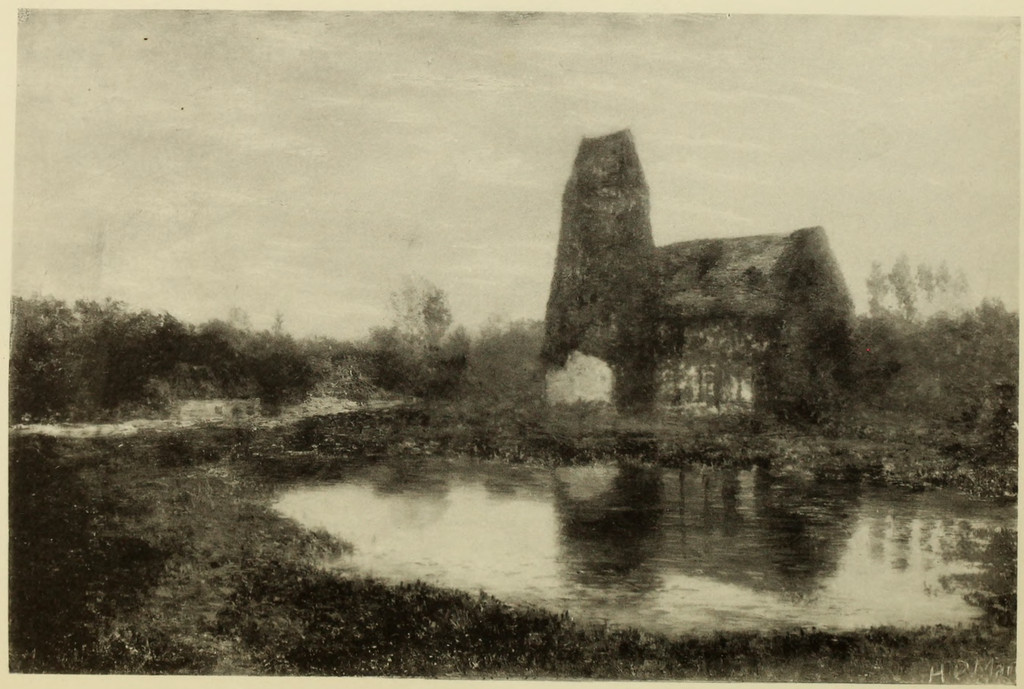
Homer Dodge Martin, Criqueboeuf Church, historical monochrome illustration in Dana H. Carroll’s Fifty-Eight Paintings by Homer D. Martin, 1913, no. 51. A distinct composition from Old Manor; this image is from the historical publication. Carroll, 1913. Original scan: Internet Archive / Getty Research Institute.
Image source
.
Public domain
. Book page margins removed and orientation corrected; original scan tone retained. Resizing only follows.
Collection history and a quiet kind of drama
The Met catalogue records Stimson’s ownership from 1892 until 1922 and the painting’s appearance at the Society of American Artists in 1892 and Chicago’s World’s Columbian Exposition in 1893. Elizabeth’s tentative recollection of a Chicago showing is thus supported by the catalogue’s exhibition history. [2] [13]
The exhibition list also records the title The Haunted House at the Engineers’ Club in New York in 1909. The nickname continued to identify the painting after Martin’s death, alongside titles emphasizing the manor and its locality. Those different names offer complementary approaches: one begins with a place and building, the other with the feeling they prompted. Neither requires the architecture to become an illustration of a particular ghost story. [2]
The canvas entered the Met through Stimson’s bequest in 1922. Its collection history gives a further meaning to Elizabeth’s account of its completion for an old friend: the picture remained associated with that patron before entering a public collection. [1] [2]
Within Martin’s career, the manor brings together sustained revision, a remembered French setting and a distinctive response to architecture in landscape. Its dramatic effect remains quiet. Trees obscure a house, the pond repeats it, and the viewer moves between those two imperfect appearances. The picture’s history helps explain that concentration without exhausting the experience of looking.
Artwork records
Browse 58 records from Carroll’s selected 1913 catalogue alongside 25 separately documented object records. Some records concern the same work; this is not a complete lifetime catalogue or a count of 83 unique artworks. [14]
| Name | Date | Medium |
|---|---|---|
| Carroll 1: Saranac Lake (1913 record) | 1860s; exact date not clearly decipherable | Painting — historical catalogue record |
| Carroll 2: Lake George from Bolton (1913 record) | Date not stated | Painting — historical catalogue record |
| Carroll 3: The Iron Mine, Port Henry, N. Y. (1913 record) | Date not stated | Painting — historical catalogue record |
| Carroll 4: On Lake Ontario (1913 record) | Probably late 1860s | Painting — historical catalogue record |
| Carroll 5: The Giant of the Valley (1913 record) | 1865 | Painting — historical catalogue record |
| Carroll 6: An Adirondack Lake (1913 record) | Date not stated | Painting — historical catalogue record |
| Carroll 7: Winter in Normandy (1913 record) | Date not stated | Watercolor — historical catalogue record |
| Carroll 8: Across the Lake (1913 record) | Date not stated | Painting — historical catalogue record |
| Carroll 9: New Hampshire Landscape (1913 record) | Late 1860s | Painting — historical catalogue record |
| Carroll 10: Long Lake (1913 record) | Date not stated | Painting — historical catalogue record |
| Carroll 11: Salt Meadows (1913 record) | Mid 1880s | Painting — historical catalogue record |
| Carroll 12: Autumn on the Susquehanna (1913 record) | 1879 | Painting — historical catalogue record |
| Carroll 13: Ontario Sand Dunes (1913 record) | 1887 | Painting — historical catalogue record |
| Carroll 14: Late Autumn (1913 record) | About 1877 | Painting — historical catalogue record |
| Carroll 15: Early Spring (1913 record) | About 1877; companion dating | Painting — historical catalogue record |
| Carroll 16: Raquette Lake (1913 record) | 1869 | Painting — historical catalogue record |
| Carroll 17: A Glimpse of the Sea (1913 record) | Date not established; historical suggestion disputed | Painting — historical catalogue record |
| Carroll 18: Headwaters of the Hudson (1913 record) | 1869 | Painting — historical catalogue record |
| Carroll 19: Autumn in the Adirondacks (1913 record) | 1871 | Painting — historical catalogue record |
| Carroll 20: Richmond on Thames (1913 record) | About 1877; later alterations | Painting — historical catalogue record |
| Carroll 21: Saranac Lake (1913 record) | 1878 | Painting — historical catalogue record |
| Carroll 22: Windsor Castle (1913 record) | Finished 1878 | Painting — historical catalogue record |
| Carroll 23: L’Anse St. Étienne, Saguenay (1913 record) | 25 July 1879 | Watercolor — historical catalogue record |
| Carroll 24: L’Anse aux Basses Pierres (1913 record) | Date not stated | Watercolor — historical catalogue record |
| Carroll 25: Blossoming Trees (1913 record) | Mid 1880s | Painting — historical catalogue record |
| Carroll 26: On the Seine (1913 record) | Date not stated; later years suggested | Painting — historical catalogue record |
| Carroll 27: The Dunes (1913 record) | 1883 | Watercolor — historical catalogue record |
| Carroll 28: The Moonlit Pond—Honfleur (1913 record) | Date not stated | Painting — historical catalogue record |
| Carroll 29: Normandy Landscape (1913 record) | Date not stated | Painting — historical catalogue record |
| Carroll 30: The Lighthouse, Honfleur (1913 record) | Date not stated | Painting — historical catalogue record |
| Carroll 31: Ruby Strong—Normandy (1913 record) | Date not stated | Painting — historical catalogue record |
| Carroll 32: Sand Dunes, Lake Ontario (1913 record) | 1874 | Painting — historical catalogue record |
| Carroll 33: Low Tide, Honfleur (1913 record) | Date not stated | Painting — historical catalogue record |
| Carroll 34: Evening on the Seine (1913 record) | Date not stated | Painting — historical catalogue record |
| Carroll 35: On the Seine (1913 record) | Date not stated | Painting — historical catalogue record |
| Carroll 36: On the Hudson (1913 record) | 1881 | Painting — historical catalogue record |
| Carroll 37: A Forest Brook (1913 record) | 1881 | Painting — historical catalogue record |
| Carroll 38: Coast Meadows, St. Sauveur (1913 record) | 1881 | Painting — historical catalogue record |
| Carroll 39: Landscape (1913 record) | 1883 | Painting — historical catalogue record |
| Carroll 40: An Adirondack Lake—Lake Sanford (1913 record) | 1883 | Painting — historical catalogue record |
| Carroll 41: Lower Ausable Pond (1913 record) | 1868 | Painting — historical catalogue record |
| Carroll 42: December Morning in Normandy (1913 record) | 1883 | Painting — historical catalogue record |
| Carroll 43: Low Tide—Villerville (1913 record) | 1884 | Painting — historical catalogue record |
| Carroll 44: Lake George (1913 record) | 1884 | Painting — historical catalogue record |
| Carroll 45: Crepuscule—Montvilliers (1913 record) | 1885 | Painting — historical catalogue record |
| Carroll 46: The Sea at Villerville (1913 record) | 1885 | Painting — historical catalogue record |
| Carroll 47: Golden Sands (1913 record) | Date not stated | Painting — historical catalogue record |
| Carroll 48: The Meadow Brook (1913 record) | 1887 | Painting — historical catalogue record |
| Carroll 49: The Sun Worshippers (1913 record) | After the 1886 return to New York | Painting — historical catalogue record |
| Carroll 50: South Side of Long Island (1913 record) | 1894 | Painting — historical catalogue record |
| Carroll 51: Criqueboeuf Church (1913 record) | 1893 | Painting — historical catalogue record |
| Carroll 52: Normandy Farm (1913 record) | 1895 | Painting — historical catalogue record |
| Carroll 53: On the Mississippi (1913 record) | Toward the close of the artist’s life | Painting — historical catalogue record |
| Carroll 54: Newport Neck (1913 record) | 1893 | Painting — historical catalogue record |
| Carroll 55: A Newport Landscape (1913 record) | 1896 | Painting — historical catalogue record |
| Carroll 56: A Distant View of Caen (1913 record) | Date not stated; exhibited 1894 | Painting — historical catalogue record |
| Carroll 57: The Brook (1913 record) | 1894 | Painting — historical catalogue record |
| Carroll 58: Normandy Trees (1913 record) | Date not stated | Painting — historical catalogue record |
| View on the Seine: Harp of the Winds | 1893–95 | Oil on canvas |
| The Iron Mine, Port Henry, New York | About 1862 | Oil on canvas mounted on fiberboard |
| Wild Coast, Newport | 1889 | oil on canvas |
| In the Housatonic Valley (attributed to Homer Dodge Martin) | late 1850s | oil on canvas |
| Sand Dunes, Lake Ontario | c. 1874 | Possibly black crayon on paper |
| Adirondacks | 1868 | Pencil drawing |
| Landscape | 1896 | Watercolor |
| Near Newport | mid-1800s | Watercolor |
| Effect of Trees | About 1879 | Oil on canvas |
| Behind Dunes, Lake Ontario | 1883–87 | Oil on canvas |
| Old Manor of Criqueboeuf | About 1882–92 | Oil on canvas |
| Upper Ausable Lake | 1868 | Oil on canvas |
| Wild Coast, Newport (Smithsonian version) | About 1885–95 | Oil on canvas |
| On the Seine | About 1895 | Oil on canvas |
| The Lighthouse, Honfleur | Date not supplied by museum | Oil on wood panel |
| The White Mountains from Randolph Hill (Wellin canvas) | 1866–67 | Oil on canvas |
| Old Crossing, Otter Tail River | 1871 | Black chalk touched with white chalk on paper |
| Landscape with Poplars | Date not supplied by museum | Oil on canvas |
| Normandy Coast | 1884 | Oil on board |
| Criqueboeuf Church, Normandy | 1893 | Oil on canvas |
| Evening on the Thames | About 1876 | Oil on canvas |
| Hudson River | 1860 | Graphite drawing on wove paper |
| The White Mountains, from Randolph Hill (formerly Met canvas) | About 1862–68; later revisions | Oil on canvas |
| Westchester Hills | About 1887 | Oil painting — historical accounts |
| Adirondack Scenery | 1895 | Oil painting — historical accounts |
Frequently Asked Questions
Mather compared the picture with Poe’s House of Usher. That is a critic’s interpretation; it does not establish Martin’s intention. [8]
It entered through the bequest of Daniel M. Stimson in 1922. [1]
Discussion
Look again at the images and ideas explored in Old Manor of Criqueboeuf. These editorial prompts invite your observations.
Reader Insights
Compare the pale house with its reflection. Where does the building become easiest to recognize?
Follow the trees from the dense central group to the isolated forms on the right. How does their spacing change the mood?
Consider the ghostly title before and after looking at the picture. Which visible relationships support that response?
Join the Conversation
Share a detail, comparison or question about Old Manor of Criqueboeuf below.
References
- Metropolitan Museum of Art , Old Manor of Criqueboeuf, about 1882–92, 22.117, current object record. View source
- Natalie Spassky and colleagues , American Paintings in The Metropolitan Museum of Art, Volume II, 1985, Old Manor entry, pp.423–425, revision, criticism, exhibitions and provenance. View source
- Smithsonian American Art Museum, The Iron Mine, Port Henry, New York, 1910.9.11. View source
- Smithsonian American Art Museum, Upper Ausable Lake, 1909.7.44. View source
- Smithsonian American Art Museum, Evening on the Thames,1909.7.45. View source
- Metropolitan Museum of Art, Behind Dunes, Lake Ontario, 06.1287. View source
- Brooklyn Museum, Normandy Coast,15.281. View source
- Frank Jewett Mather Jr. , Homer Martin: Poet in Landscape, 1912, pp.67–69, interpretation of the manor and comparison with Poe. View source
- Cleveland Museum of Art, Wild Coast, Newport, 1923.1118. View source
- Los Angeles County Museum of Art , Criqueboeuf Church, Normandy, 1893, M.90.159, current object record. View source
- Metropolitan Museum of Art, View on the Seine: Harp of the Winds, 97.32. View source
- Princeton University Art Museum, The Lighthouse, Honfleur, y1948-3. View source
- Elizabeth Gilbert Martin , Homer Martin: A Reminiscence, 1904, pp.27–28 and 46–47, Normandy subjects, alternative title and New York studio. View source
- Dana H. Carroll , Fifty-Eight Paintings by Homer D. Martin, 1913, nos.51–52, Criqueboeuf Church and Normandy Farm; church illustration preceding p.133. View source
- Splash image source.
Homer Dodge Martin, Old Manor of Criqueboeuf, about 1882–92. Oil on canvas, 64.1 × 95.3 cm. The Metropolitan Museum of Art, 22.117. Monochrome museum reproduction; original paint colors are not represented. The Metropolitan Museum of Art, Bequest of Daniel M. Stimson, 1922. Public domain . Resized only; source appearance preserved.
View source